ECONOMÍA
SERIE DOCUMENTOS
No. 88, marzo de 2006
Working Towards and Discovering a New
Organizational Culture Within a Very Traditional
University
José Manuel Restrepo Abondano BORRADORES
DE
INVESTIGACIÓN BORRADORES
DE
© Centro Editorial Universidad del Rosario © Facultad de Economía
© José Manuel Restrepo Abondano
Todos los derechos reservados Primera edición: marzo de 2006 ISSN: 0124-4396
Impresión digital: Cargraphics S.A. - Colombia
Manuel Restrepo Abondano. — Bogotá: Centro Editorial Universidad del Rosario, 2006. 45 p. : cuadros, tablas.– (Economía. Serie Documentos, Borradores de Investigación; 88) ISSN: 0124-4396
Incluye bibliografía.
W
ORKING TOWARDS AND DISCOVERINGA NEW ORGANIZATIONAL CULTURE WITHIN A VERY TRADITIONAL
U
NIVERSITY*J
OSEM
ANUELR
ESTREPOA
BONDANO**
[email protected]
A
BSTRACT“Universidad del Rosario” is one of the oldest Universities in Colombia. Founded in 1653, it has since then been characterized as a very traditional University. Within the University, one of the Faculties has developed a deeply rooted cultural change which has transformed its nature and performance. This paper explores this change using a model that considers culture as a complex reality. The results of this work are very interesting from a theoretical viewpoint, as they are an example of a change of agents having to do with how a very old and academically traditional institution may be transformed, and how such a phenomenon may be addressed.
Keywords: Universidad del Rosario, education, change of agents, culture, complex reality.
R
ESUMENLa Universidad del Rosario es una de las universidades más antiguas de Colombia; fundada en 1653, se ha caracterizado por ser una universidad tradicional. A pesar de esta tradición, una Facultad perteneciente a la institución ha generado un profundo cambio cultural que ha transformado la naturaleza y el desempeño de la Universidad. La presente investigación explora este cambio utilizando un modelo que estudia la cultura como una realidad compleja. El resultado de este trabajo es interesante desde el punto de vista teórico, dado que es un ejemplo de “cambio de los agentes” en lo que respecta a cómo puede transformarse una institución antigua y tradicional en términos académicos y cómo puede estudiarse dicho caso.
Palabras Clave: Universidad del Rosario, educación, cambio de los agentes, cultura, realidad compleja
* Paper presented for the DBA program in Higher Education Management, University of Bath, UK ** Professor Faculty of Economics – “Universidad del Rosario” – Colombia
“The central hypothesis of this article is that, contrary to the popular knowledge, what determines change in the path of a Country is the academy, the theory, the concepts, the ideas. That means the non
practical stuff ”
Luis Carlos Valenzuela, Former Minister of Oil in Colombia Part of a speech he pronounced about the future of the oil sector
I. I
NTRODUCTION“Universidad del Rosario” is one of the oldest universities in Colombia. Since its foundation in 1653, it has characterized itself as a very traditional institution. During the last six years one of its Faculties has been devoted to create a deep cultural change which has improved its performance.
In order to analyse how the Faculty has achieved this, the present research uses a model that considers the organizational culture as a complex system, and as such it may be applied to the Faculty. Thus, the research will conceptualize what organizational culture is and will propose a particular model to describe the Faculty’s culture. At this part, the research will define the principal drivers of cultural change and the way they help to explain improvement on perfor-mance indicators.
The research will use a “learning strategy” to help institutional leaders study the culture of their Faculties and to know how these cultural experiences can be systematised. One of the future applications of this research is that the “Learning Strategy” could help this or any other institution to build on its culture, and can be considered an important input for change agents.
II. T
HED
ESIGNA
LEARNINGAPPROACH: J
USTLIKE BUILDINGAHOUSEBuilding a house can be described through a group of very definite and clear stages. It may be summarised in five main stages: designing the house, finding a site, building the main structure and its foundations, building the walls, to end with the finishing, which involves details such as tiles, carpentry, fine finishing, decoration and even landscaping. In this paper, I want to describe the Faculty of Economics’ culture and its impact on “Universidad del Rosario” using the simile of the construction stages. In this initial chapter, identified with the design, I will describe the procedures and research methods used throughout the re-search, as well as people interviewed and documents analysed. Then, I will describe in detail the institutional setting that in construction terms may be compared with looking for the site. In this part I will develop a first interview with the main actors of the Faculty of Econo-mics management and leadership —the Dean, the Director of Academic Planning and Deve-lopment of the University and me.
show how I applied it to the research and will do some initial auditing of the first results I have gotten. In order to do this, I will refer to my first meeting with the Dean and the head of planning of the University. The results of the organizational culture and the study of change in management and the improvement on performance at the Faculty of Economics are compared with building the wall structure, and, finally, the conclusions and the learning outcomes can be related with finishing the house.
In all of these stages, I will describe a session in the “Learning Group”, where we —the Dean and the Director of Academic Planning of the Faculty of Economics, and me as the Vice-rector of the University—discuss the methodology and the partial or final conclusions derived from the theoretical and/or empirical results. This will provide a continuous institu-tional reflection that may be helpful for the University in the future. As Marshall (1988) says: “knowing about your culture is a starting place for change”, and it can also be useful to avoid obstacles to change. That means that if you first learn how things have changed throughout time, you can afterwards reinforce it and avoid instability. A strong knowledge on organiza-tional culture can therefore be seen as a useful tool to build the future.1
During this account of the research development, we will go back from time to time to any of the previous stages, and we will even retake some of the research methods formerly used.2 In some way, this breaks the traditional linear approach to problems and preserves the opportu-nity to enrich work already done during the research or the conclusions derived from it. In this way, I will introduce my own reflections as well as the institutional notions, which may be further extended beyond the scope of this paper, as a part of the Universidad del Rosario’s dynamic intellectual capital. One of the reasons to invite our Head of Planning to this research stems from the idea that the planning process requires to work on the culture, study it, and, particularly, understand that research-based universities and colleges “need not to have the same culture; indeed they ought not. What members of institutions need to do is to incorporate throughout their planning processes various methods of fostering a shared 0cultural value… As a whole, planners should focus on capitalizing on useful elements of the existing cultures, especially those that exist across a subculture” (Peterson et al., 1997: 239-240). In my view, this paper will give our institution not only information about a particular subculture, but it will also provide an interesting perspective on other cultures coexisting in the same institution. Finally, the methodology may be used in the immediate future to compare the results to any other Department or Faculty.
Figure 1 shows the overall description of the research presented schematically3
1 Marshall (1988) also expresses how “the continuity of social interaction that is only possible as a result of shared
understandings also explains why cultures can be experienced as an impediment to change…. The obvious risk is that all cultures have a capacity so stifle difference and thereby only support and reinforce those ways of thinking and acting that are consistent with the historically shared and reinforced way of doing things. In this way cultures are prone to self justification and reinforcement”.
2 In particular, an audit will be made at the middle of the research, to assess the main partial results, difficulties and
future stages to be developed. This task will be a collective analysis made by the Dean of the Faculty, the Director of Planning and me.
F
IGURE1
C
YCLE OFTHERESEARCH*
* The blue lines describe the way in which the research can go back to check previous chapters and enrich partical conclusions The black lines describe the initial order ofther development of the project.
T
HEMETHODOLOGYOFTHERESEARCH: F
ROMLINEARITYTONON-
LINEARITYThe aim behind this work is based on research, and understood as a construction practice, implying that knowledge is the product of a community. In other words, the research methods employed must reflect the assumptions and values of a certain group of people. As a result, the research methods used in this case are quite particular, and are developed in a non-linear or systematic way. This paper will include two main research methods: one associated with critical discourse analysis, and another related to in-depth interviews based on personal experiences. Both of them will be analysed simultaneously, and will enriched each other. In addition, I will allow the objects of analysis to give their consensus and express their agreement regarding my conclusions, and I will try to end up with a social point of view. Gergen and Gergen (2004: 81) describe this as a narrative study in which “researchers enable people to tell their own stories” and “rather than writing about them, why not let them portray their lives”.
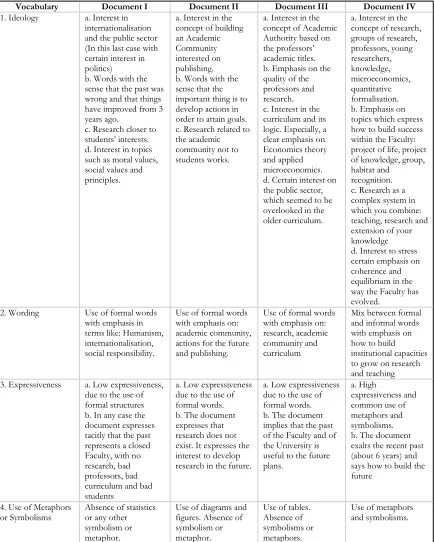
Using a Critical Discourse Analysis, and following the procedures proposed by Wodak and Meyer (2003), I will study four documents with significant statements, in which I will check the type and the form of argumentation, the strategies to argue, the logic and the composition of the texts, as well as hints, symbolisms, vocabulary and style and references. Fairclough (1989)
devel-Designing the research; mothods Used and methodology applied.
Theoretical framework and first use of the Research methods employed
Theoretical and empirical Analysis
About cultural change management and cultural Change and performance at the Faculty of Economics
Auditing the final redults and conclusions Personal and institutional reflection
First collective approach tothe problem Studied by the research: Initial interview With the Dean., Director of Planning and Me. Description of the Institutional and Faculty settings.
Auditing the initial results and conclusions. Personal and University reflection
Conclusions and the learning outcomo
oped ten questions,4 which can be asked in a text in order to provide answers about such topics. For the purpose of the research, I will try to answer those questions in the documents selected. In Appendix 1, the questions selected for this paper are showed. Critical Discourse Analysis may not give a precise analysis, but it is more objective when compared and checked against other meth-ods such as in-depth interviews, which I will use in this paper. To do the Critical Discourse Analysis I will check documents, reflecting the Faculty’s principles. After initially reviewing se-veral documents, and according to interviews with the “Learning Group” regarding works cover-ing the Faculty’s culture, I found that only four of all those documents are a faithful representation of the Faculty’s institutional thinking. In some way, all of them represent at least three periods or stages of the Faculty, related to the ones revealed in the interviews.5 All of them include strategic and tactical realities within the Faculty of Economics. Below such documents are listed; all of them will be discussed in depth in the following chapters:
1. Plans and Programs, “Universidad del Rosario” 1995-1996, Faculty of Economics, pages 205-239, Stage I
2. University Policies for the next future 1997-2000, Chapter on Research, pages 29-31, Stage I
3. Strategic Plan of the Faculty of Economics. 1999-February- Stage II
4. Accounting to one generation- Speech to former students graduated in 1973 - Pronounced by Hernán Jaramillo Salazar. November 2003, Stage III
Following Robson (2002), the study will also include in-depth, unstructured interviews, in order to let conversations develop freely and flexibly. In addition, face to face individual and group interviews will take place as part of the research in order to collect non verbal clues. Group interviews will be conducted with heterogeneous groups.
The model used on the interviews will focus on four main groups related to the cultural change inside the Faculty of Economics and its impact on “Universidad del Rosario”. The first group corresponds to current and past leaders at the institutional level. The other groups of people to be interviewed are conceivers, implementers and recipients of the hypothetical cul-tural change: conceivers such as the Deans of the Faculty, implementers such as Professors and Deans6 and recipients such as students. In the last part of the research I will have group inter-views. In these, the main partial conclusions will be discussed.
Throughout the research, I will work with the current Faculty of Economics’ Dean and with the University’s Head of Academic Planning to assess the research evolution, through what I have called the “Learning Group”. This group will help to develop a cycle in which I will combine action and reflection, action by interviewing and working with the main institutional
4 Questions related to vocabulary, grammar and textual structures.
5 Those stages are: the first one before Maria del Rosario Guerra assumed the Deanship; the second one, when she
was the Dean, and the last one when the Deanship was assumed by Hernán Jaramillo Salazar. More about these three stages can be found in the chapter of Results.
6 During the construction stage called “Finding the site”, which corresponds to the initial meeting with the “Learning
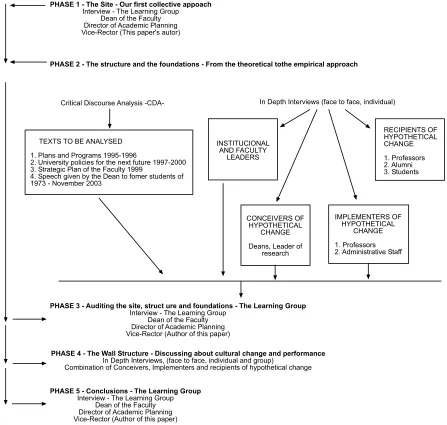
and faculty members, and reflection by studying the results through the lens of the theoretical framework, and the discussions in the “Learning group”. Figure 2 presents the dynamics and cycle of the research methods used in this paper.
F
IGURE2
C
YCLE ANDD
YNAMICS OFTHER
ESEARCHM
ETHODSU
SEDPHASE 1 - The Site - Our first collective appoach Interview - The Learning Group
Dean of the Faculty Director of Academic Planning Vice-Rector (This paper's autor)
PHASE 2 - The structure and the foundations - From the theoretical tothe empirical approach
Critical Discourse Analysis
-CDA-TEXTS TO BE ANALYSED
1. Plans and Programs 1995-1996
2. University policies for the next future 1997-2000 3. Strategic Plan of the Faculty 1999
4. Speech given by the Dean to fomer students of 1973 - November 2003
IMPLEMENTERS OF HYPOTHETICAL
CHANGE
1. Professors 2. Administrative Staff CONCEIVERS OF
HYPOTHETICAL CHANGE
Deans, Leader of research
RECIPIENTS OF HYPOTHETICAL CHANGE
1. Professors 2. Alumni 3. Students INSTITUCIONAL
AND FACULTY LEADERS
In Depth Interviews (face to face, individual)
PHASE 3 - Auditing the site, struct ure and foundations - The Learning Group Interview - The Learning Group
Dean of the Faculty Director of Academic Planning Vice-Rector (Author of this paper)
PHASE 4 - The Wall Structure - Discussing about cultural change and performance In Depth Interviews, (face to face, individual and group)
Combination of Conceivers, Implementers and recipients of hypothetical change
PHASE 5 - Conclusions - The Learning Group Interview - The Learning Group
[image:8.612.82.529.207.632.2]Again, I must say that this research has not been developed in a continuous way; therefore both the first approach to the research methods used and the overall design of this paper were discussed with the Learning Group. Some recommendations were made and accord-ingly some improvements were implemented that changed the initial design. This resulted on the design and the methods exposed in this chapter. Next sections will describe the particular topics and questions to be answered during the interviews, according to the theoretical frame-work and/or the needs of the particular interest in each case.
III. T
HES
ITE– O
URF
IRSTC
OLLECTIVEA
PPROACHIn this chapter, I will not only describe the institution as a whole and the Faculty settings, but also my first encounter with the current Dean and the Director of Academic Planning and Development of “Universidad del Rosario”.
“Universidad del Rosario” is a very old higher education institution founded in 1653 by the Dominican priest Fray Cristóbal de Torres. The School was approved by Felipe IV (King of Spain), when Colombia belonged to the Spanish Empire. At that moment the University only had four undergraduate programs: Jurisprudence, Philosophy, Theology and Medicine, and 15 students. The University followed the honour of being a replica of Bologna (University of Bologna in Italy) and Salamanca (University of Salamanca in Spain) in America. Universidad del Rosario has always been focused in achieving excellence in teaching according to humanism and ethical values. In fact, since 1653 the University’s mission has included topics such as: strong education in Ethics and Humanism, suitable teaching and the fostering of Colombian leaders7 who act according to the society’s common good. Nowadays, “Universidad del Rosario” is one of 10 Universities accredited according to quality standards, and has a recognised repu-tation for its teaching, research and social projection in Colombia.
By 1990 the University had identified a certain crisis in its development and adjustment to higher education setting in Colombia. According to the new Law (Law 30 of 1992), many new institutions appeared in the higher education arena, developing strong educational projects which inevitably competed with “Universidad del Rosario”. In fact, by 1994 the University was talking about how it was adjusting itself to the rhythm and tone of present times: “this turbu-lent period, which has broken the established paradigms through which we understood reality, must be studied. These moments of transition… represent extraordinary opportunities for de-velopment for those who perceive the sense and rhythm of change and are able to adapt their action to them.” (Universidad del Rosario, 1995). That year the University put forward a plan five main courses of action: academic strengthening, education on Rosarism (institutional val-ues), financial and administrative strengthening and technological development. Today, those programs include internationalisation and building an academic community. The results achieved during the last 10 years show a very consolidated University with 8,000 students, many more groups of research recognised by the main science authority in Colombia, all programs accred-ited for their quality standards, an increase in quantity and quality of full-time teachers and
researchers, new investments on campus in technology, books and research journals, software and hardware for teachers and students, and many other accomplishments.8
One of the Faculties that has advanced the most throughout this change is the Faculty of Economics. This department was founded in 1960, and today it is one of the oldest Faculties of Economics in Colombia. It was created according to the development of topics such as economic law; fiscal policies in the country and business management, and its students were well prepared for the private sector. In 1999 there was a clear message to transform the Faculty in terms of strengthening research to build master and doctoral programs, opening new spaces to understand national economic problems, developing new analytical abilities within students, and increasing the number of teachers with master and doctoral qualifica-tions.9 Today the Faculty of Economics is recognised by its research, especially within the academic community, due to the Research Group achievements. Last year, this organization was recognised by Colciencias as the best group of research in Economics in Colombia. Colciencias is the national agency on research qualifying research groups in the country ac-cording to their academic production.10
Having this in mind, I started sharing the content and methodology of the project with the current Faculty’s Dean (Doctor Hernán Jaramillo Salazar) and with the University Planning Director (Mrs. Nora Pabón), in order to get a better understanding of the Faculty of Economics culture. To do this, I explained the main stages of the project, the methods of research, the people who were going to be interviewed and particularly our role as a “learning group”. They found this experiment quite useful, as they recognized it could be used by other Faculties in the future, but also because it helps to clarify the real development in the Faculty of Economics. Their recommendations are related to at least two main topics: the concept of organizational culture and general research methods.
The Learning Group insisted to go beyond the “play between the tacit and explicit issues”. This means that the main result of this paper must be to identify what was tacit and what was explicit in the change at the Faculty and how both things are integrated and useful within the transformation. To help me on this matter they insisted on treating the Faculty as a “knowledge organization” and they suggested me to read a book published and made in Latin America by
8 The best way to support this remark is to refer to the “self evaluation process” held at the University, which led to
the “Institutional Accreditation”. This achievement implied that the external community was publicly informed of the qualification of the institution according to the national quality standard for higher education. Today only 10 universities in Colombia, out of 300, have achieved this recognition. The model includes variables such as the mission and planning at the institution, quality of students, teaching and research processes, external impact, academic and financial resources, management, infrastructure and well being.
9 This period began when María del Rosario Guerra assumed the Deanship of the Faculty of Economics. She held
this position for two years, then she was elected to be the Vice-rector of the University, and Hernan Jaramillo Salazar was awarded the Deanship.
10 In addition, the Faculty of Economics also held its “self evaluation process” and attained the “Program
37 science and technology institutions (37 knowledge organizations) (Gómez and Jaramillo, 1997). This book explains how these institutions were created, what happened to them, what the clues in their productivity or stagnation are, and the relationship between the people, the institution, the ideas, the group and the context. This book uses a methodology which mixes interviews with documental analysis and more and more refining meetings. I have emphasised on this book particularly, because it will be very useful in one of the following chapters.
With regard to the methods, the “Learning Group” asked me to include in the interviews not only the current professors, or even the ones who had been working during the last 10 years of change at the Faculty of Economics, but also those who worked with the Faculty but resigned or were fired due to certain incompatibilities with the culture and life of the new Faculty. I found this advice quite useful, and after checking the results of those particular interviews, it has proven to be just that.
IV. T
HES
TRUCTUREANDTHEF
OUNDATIONS– T
HEORETICALF
RAMEWORKT
HECONCEPTOFORGANIZATIONALCULTUREAND APPLYINGARESEARCHMODELThere are plenty definitions of Organizational Culture, such as the ones included in Schein (1989),11 Marshall (1988),12 Mendez (2004)13 Williams or Dobson and Walters (1993). From these definitions, it is possible to draw some common meanings and understandings such as collective conscience, norms, dominant values, traditions and habits, philosophy or ideology, rules, climate and social environment, shared meanings, behavioural regularities or standardizations and beliefs. However, all of these definitions tackle the concept in a very superficial way. Organizations are complex systems in which there are many interactions and relationships, the majority of which are not very clear for all. There are inevitable, invisible thoughts and acts that can be related to topics such as leadership in an organization, structure, behaviours related to myths, rituals, values, ideologies and the organizational climate. An inter-esting view comes from Trompenaars and Hampden Turner (2000) who compare the organiza-tional culture to the different layers of an onion, “the outside (…) represents the artefacts of the organisation; those tangible items such as logos, uniform and office design that should reflect the organisation’s norms, beliefs values and basic assumptions. The skin needs to be peeled away if these norms, beliefs and values are to be seen, and further peeling away of layers is required to reveal, at the core, the organization’s basic assumptions” (Hill, Lomas and MacGregor, 2003: 318).
11 Who deals with concepts from Goffman 1959, Homans 1950, Van Maanen 1979, Deal and Kennedy 1982, Pascale
and Athos 1981, Ritti and Funkhouser 1982, Tagiuri and Litwin 1968.
12 Who deals with concepts from Ouchi and Johnson 1978, Van Maanen and Schein 1979, Baker 1980, Braten 1983,
Wilkins 1983, McLean and Marshall 1983.
13 Who deals with concepts from Linda Smirnich 1983, James O’Toole 1996, James Stoner and Edward Freeman 1984,
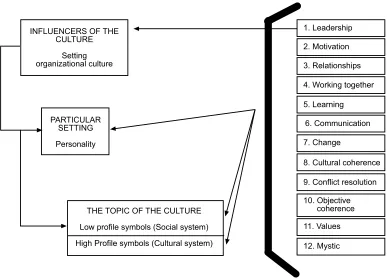
Following Marshall (1988)14 and Mendez (2004),15 I developed an integrated model to un-derstand the concept of organizational culture, which I will use in this paper. In this concept, it is necessary to include the influencers of the organizational culture such as its history, its senior management leadership, the main role of the organization (relevance of the organization16), the structure and size of the organization. All of this I would call the culture setting. On the other hand, I include the particular setting of the culture, integrating what Mendez (2004) and Marshall (1998) call the personality system and the subculture, respectively. This concept is of particular importance when considering a University setting. On its part, Becher (1989) talks about aca-demic tribes and territories, and how there are clear interconnections between acaaca-demic cul-tures and the nature of disciplines, something which is quite important for this paper.
And finally the topic of culture, integrating what Mendez (2004) calls the shared meanings,17 and Marshall (1998), low and high profile symbols. Low profile symbols (or the social system), refer to the “lived reality” of an organisation. That includes habits, social and authority rela-tionships, customs, communication, climate, and any other informal reality of the organisation. High profile symbols (or the cultural system) refer to the “public face of the organization…found among other places in publicity material, formal statements, newspapers, logos, slogans, catch phrases, physical artefacts [...] speeches and ceremonies […] statements about what the organi-zation stands for” (Marshall and Mc Lean, 1998), in other words the “symbolic apparatus” of the organisation. Figure 3 models this understanding of organizational culture.
Upon further speculation, the picture of how to conduct research on an organizational cul-ture is still unclear. We encounter two obstacles: firstly there is the dilemma between single and multi-perspective approaches to organizational culture research and secondly is how to de-velop a proper model to understand the organizational culture amidst complexity.
Referring to the first obstacle, we have on one side a traditional approach, which sees organi-zational culture from one single perspective, and, on the other side, one that explores organiza-tional culture as a multi-perspective field, which however displays a clear concept of complexity. The first traditional approach can be easily found in works such as those by Cameron and Quinn (1998), Mendez (2004), Mendez (2005), Wiener (1988), Mc Nay (1995), Trompenaars and Hampden (2000). In these papers the authors provide different categories to explain an organiza-tion’s culture, and the idea is that each organization should be related to one culture. If you are doing research on organizational culture, you should classify the organization into one of these categories. Table 1 summarizes the main conclusions of each of these works.
14 Marshall (1988) says that “culture represents the understandings that we live by as members of an organisation;
these are carried in symbols which act as vehicles for meaning. In addition to specific meanings, we also absorb other things characteristic of the culture such as attitudes, and ways of thinking about the world. Culture is something that is lived and the “lived reality” may not always coincide with statements about the culture.”
15 Mendez (2004) gives his own concept and says that “Organizational Culture is the collective conscience expressed
in a system of shared meanings which identify and differentiate members of an organization. Such meanings and behaviours are determined by the concept the leader has about humankind, structure, cultural system, organiza-tional climate, and the relationships between all of these”.
16 In this case a Knowledge Organization.
17 Mendez (2004) relates those shared meanings with what he calls the social system, and the cultural system. These
F
IGURE3
U
NDERSTANDINGOFO
RGANIZATIONC
ULTURE INT
HISP
APERINFLUENCERS OF CULTURE Setting the organizational culture
History (Past experiences) Role of the institution Size
Structure Leadership
Subcultures PARTICULAR
SETTING Personality
THE TOPIC OF THE CULTURE Low profile symbols (Social system) High Profile symbols (Cultural system)
However, the reality of an organisation is quite more complex. As Wiener (1988) says, “It is important to note that even theoretically helpful typologies usually are simplified representa-tions of complex realities. Often, neat or perfect classificarepresenta-tions are impossible” (Yoash, 1988: 539). In conclusion it is difficult to describe a culture by only one method.
That is why it is interesting to consider a multi-perspective approach. Martin (1992) answers this by defining the three different social scientific views of an organizational culture: integra-tion, differentiation and fragmentation. In the first, ambiguity does not exist; all cultural mani-festations must result in an organizational consensus. In the second, consensus does not exist and differences can take place given certain boundaries among subcultures. Finally, the third considers that consensus and dissensus can coexist in an organization.
This paper deals with the research problem from a multi-perspective approach where is impossible to give a proper interpretation from only one of the three social scientific views or any other category. It is necessary to capture the complexity, subjectivism and dynamics of the organization. A researcher “has to abandon the objectivism assumption that one perspective will be correct, or more correct, than the others. Instead, the perspectives need to be seen as subjective frames, like lenses, that bring some aspects of a culture into focus while inevitably blurring others, not because of researcher carelessness, but because of the inherent limitations of any one perspective” (Joanne, 1992). This approach adds to the fact that Higher Education Institutions (HEIs) tend to be more complex than any other kind of organization. Usually different academic departments have different academic sub-cultures close to what is called collegiate cultures, defined as: “high levels of faculty autonomy” (Peterson et al., 1997: 231-232) even ending in poor loyalty to the University culture (Becher (1989), Altbach (1996)).18
T
ABLE1
S
OMEW
ORKSB
ASEDO
N AS
INGLEA
PPROACHTOO
RGANIZATIONALC
ULTUREAuthor Main Conclusions – Single Approaches to Organizational Culture
Kim S. Cameron and Robert E. Quinn (1999)
Aspects considered for the categories: There are two main aspects to be considered: 1. Effectiveness criteria that emphasizes on flexibility, discretion and dynamism, as opposed to stability, order and control. 2. Effectiveness criteria that emphasizes on internal orientation, integration and unity, as opposed to external orientation, differentiation and rivalry.
Types or organizational culture: The hierarchy culture (formalized and structured place to work); the market culture (The organization works as a market looking for profitability, results, strength in market niches and secure customer bases); The Clan culture (team-work, employee involvement programs, corporate commitment to employees); and the Adhocracy culture (adaptability, flexibility, creativity, ambiguity and information overload).
Carlos Mendez (2004) Aspects considered for the categories: It considers topics such as: structure, authority, affiliation, interpersonal-relationships, creativity, Team-work, decision making, training, human-development, work division, client service, leadership, coordination, efficiency, productivity, technology.
Types or organizational culture: Identification between the employee and the organization; Leadership action; person-oriented management; structure dynamics. Carlos Mendez (2005) Aspects considered for the categories: it considers topics such as: knowledge of the
objectives, cooperation, leadership, decision making inter-personal relationships, motivation and control.
Types or organizational culture: Formal Authority culture; identity model (Employees identified with the organization); Weak interpersonal relationships culture; cooperation and team-work culture; Weak decision making culture, Autocratic leadership culture. Yoahs Wiener (1988) Aspects considered for the categories: It considers two topics, on one side the content
focus of organizational values, referred to the objective and focus of its content (It classifies this as functional values or elitist values, the firs ones focusing in particular goals, function and style of operation); and on the other side the source and anchoring of the values, having two possible origins, on one side from organizational tradition or from a charismatic leadership.
Types or organizational culture: Functional-Traditional; Elitist-Charismatic; Functional-Charismatic; Elitist-Traditional.
Ian Mc Nay (1995) Aspects considered for the categories: It considers two topics, on one side how loose or tight is the definition of the policy and; on the other side how loose or right is the control over activity or the f implementation of any policy.
Types or organizational culture: Collegium (Based on freedom, permissiveness, informal groups, consensual management and long term); Bureaucracy (Based on equity, regulations, committees and administrative briefings, formal management and cyclic terms); Corporation (Based on loyalty, directions, working parties and senior management teams, political and tactical management and short and mid terms); and Enterprise (Based on competence, support, project teams, devolved leadership management and instant terms).
Fons Trompenaars and Charles Hampden-Turner (2000)
Aspects considered for the categories: The relationship between employees and the organization; The vertical or hierarchical system of authority; The views of the employees about the organization’s destiny, purpose and goals.
Types or organizational culture: the family culture (person-oriented, the leader as a “father”); the Eiffel tower culture (role-oriented); the guided missile culture (project-oriented); and the incubator culture (Fulfillment oriented).
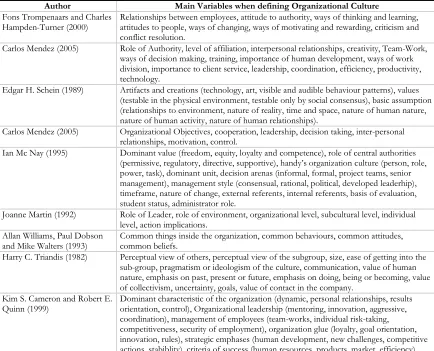
behav-iour, decision making, motivation, and as such they also have the potential to affect an organi-zation. Schein (1989), on the other hand, defines three levels: the artefacts (physical and social environment), the values and the basic underlying assumptions (relationship to environment, nature of reality and truth, nature of human nature, nature of human activity and nature of human relationships). Finally Mendez (2004) identifies the leadership concept, the structure of power and decision (size, work division, authority, coordination, strategy and structure, technology and structure, environment and structure), the cultural system (myths, ideology, values, rituals, beliefs, habits, rules and stories), the organizational climate and relationships between all of these dimensions. Table 2 summarizes these works including the variables de-fined by other papers relevant to this research.
T
ABLE2
M
AINV
ARIABLES ORO
RGANIZATIONALC
ULTURE INV
ARIOUSP
APERSAuthor Main Variables when defining Organizational Culture
Fons Trompenaars and Charles Hampden-Turner (2000)
Relationships between employees, attitude to authority, ways of thinking and learning, attitudes to people, ways of changing, ways of motivating and rewarding, criticism and conflict resolution.
Carlos Mendez (2005) Role of Authority, level of affiliation, interpersonal relationships, creativity, Team-Work, ways of decision making, training, importance of human development, ways of work division, importance to client service, leadership, coordination, efficiency, productivity, technology.
Edgar H. Schein (1989) Artifacts and creations (technology, art, visible and audible behaviour patterns), values (testable in the physical environment, testable only by social consensus), basic assumption (relationships to environment, nature of reality, time and space, nature of human nature, nature of human activity, nature of human relationships).
Carlos Mendez (2005) Organizational Objectives, cooperation, leadership, decision taking, inter-personal relationships, motivation, control.
Ian Mc Nay (1995) Dominant value (freedom, equity, loyalty and competence), role of central authorities (permissive, regulatory, directive, supportive), handy’s organization culture (person, role, power, task), dominant unit, decision arenas (informal, formal, project teams, senior management), management style (consensual, rational, political, developed leaderhip), timeframe, nature of change, external referents, internal referents, basis of evaluation, student status, administrator role.
Joanne Martin (1992) Role of Leader, role of environment, organizational level, subcultural level, individual level, action implications.
Allan Williams, Paul Dobson and Mike Walters (1993)
Common things inside the organization, common behaviours, common attitudes, common beliefs.
Harry C. Triandis (1982) Perceptual view of others, perceptual view of the subgroup, size, ease of getting into the sub-group, pragmatism or ideologism of the culture, communication, value of human nature, emphasis on past, present or future, emphasis on doing, being or becoming, value of collectivism, uncertainty, goals, value of contact in the company.
Kim S. Cameron and Robert E. Quinn (1999)
Dominant characteristic of the organization (dynamic, personal relationships, results orientation, control), Organizational leadership (mentoring, innovation, aggressive, coordination), management of employees (team-works, individual risk-taking, competitiveness, security of employment), organization glue (loyalty, goal orientation, innovation, rules), strategic emphases (human development, new challenges, competitive actions, stabiblity), criteria of success (human resources, products, market, efficiency).
[image:15.612.87.521.273.624.2]T
HEL
EADER1. Leadership and role of authority within the group and in relation to the organization (Ma-nagement, decisions)
2. Ways of motivation and rewarding (Affiliation)
T
HEF
OLLOWERS3. Internal and external relationships
4. Ways of working together
5. Ways of learning
6. Ways of communication
7. Attitudes toward change
8. Coherence and relationships between the subculture and the institutional culture
T
HEG
LUEB
ETWEENL
EADERANDF
OLLOWERS9. Conflict resolution
10. Coherence between individual and communal objectives
11. Main values
12. Internal mystic (Common things)
These main variables may be compared to the model and definition of organizational cul-ture used in this paper, having considered that all of them may be related either with the low profile system (lived reality) or with the high profile system (public face of the organization). In addition, all of them can characterize the particular sub-culture. Finally, we need to observe that the concept of leadership is part of the setting of the organizational culture. Figure 4 expresses these relationships.
The next phase is to define how to develop the proper instruments in order to better under-stand culture in a complex way. Many papers apply a form-questionnaire assuming that the organization may be easily formatted. This will not be the case of this research.20 To begin with, this paper will analyse a group of texts produced at the Faculty and at the University, using the Critical Discourse Analysis, keeping in mind that this work may not provide a precise analysis of organizational culture, though it can be more objective when compared and checked against other methods such as in-depth interviews.
The real problem is how to develop those interviews in such a way that they represent the real aim of the research. To solve this problem, I will apply the plausible and useful ways in which Marshall (1988) explores organizational culture, as she describes “real life” situations
19 As Marshall (1988) says “organisational culture is complex, multilayered and often incorporates significant conflicts
through which it is possible to address any institution or department’s culture. As Marshall says, they offer “opportunities to explore and experiment with the notion of culture, and thus to start developing a deep awareness of how your culture now operates”(Marshall and Mc Lean, 1988). This paper will intend to incorporate the main variables discussed in figure 4, and how to relate them with the methods proposed by Marshall (1988).
Through these methods, I will ask to recall or bring back situations lived by students, profes-sors, deans, staff or even institutional leaders, from the Faculty of Economics at “Universidad del Rosario”; each topic will be analysed avoiding excessive formality, and taking the maximum out from each person. Finally I shall characterise interviewees as: transition actors (students, professors, staff and deans who have supposedly undergone a cultural change), and current actors (current students, professors or staff who have just lived the current organisational cul-ture, and who did not know the previous cultural scenario).
The situations studied in this paper, following Marshall (1988), will be inscribed in one of the following procedures:
i) Being a Newcomer: in this, I will analyse situations in which transition and current actors remember situations lived when they arrived to the Faculty of Economics, recalling their first encounter with the Department’s culture.
1. Leadership 2. Motivation 3. Relationships 4. Working together 5. Learning
6. Communication 7. Change
8. Cultural coherence 9. Conflict resolution 10. Objective coherence 11. Values 12. Mystic THE TOPIC OF THE CULTURE
Low profile symbols (Social system) High Profile symbols (Cultural system) PARTICULAR
SETTING Personality INFLUENCERS OF THE
CULTURE Setting organizational culture
F
IGURE4
U
NDERSTANDINGOFO
RGANIZATIONALC
ULTUREINT
HISP
APER.
[image:17.612.117.504.146.425.2]ii) Breaking the rules: here I will put situations in which transition actors illustrate how things changed, where it is possible to identify a “before and after” picture of the faculty culture.
iii) Exemplification: through this procedure I will analyse situations in which transition and current actors see the faculty culture based on one particular event, incident, situation or anecdote, related to any of the 12 variables proposed in this paper.
iv) Making comparisons: here I will ask transition and current actors to compare the culture of the Faculty of Economics with other faculties or with the University as a whole, relating the answer to any of the 12 variables proposed in this paper.
v) Becoming a stranger: in this situation I will ask transition and current actors to adopt the attitude of being a person who sees the Faculty for the first time, and coming from outside. The idea is to relate the answers to any of the 12 variables here proposed.
vi) Solving problems, challenges or controversies: to simulate this situation I will ask tran-sition and current actors to recall certain problems in the Faculty and narrate how they were solved. It will also include problems between the University and the Faculty of Economics.
Appendixes 2 to 7 contain the initial questions used in each procedure.20
V. T
HEW
ALLS
TRUCTURE—E
MPIRICALA
PPROACHTOO
RGANIZATIONALC
ULTURE ANDC
ULTURALC
HANGEANDP
ERFORMANCE ATTHEF
ACULTYOF
E
CONOMICSO
RGANIZATIONALC
ULTURE ATTHEF
ACULTYOFE
CONOMICSAfter conducting the interviews (Appendix 8) and analysing the selected documents through Critical Discourse Analysis (see Appendix 9) I will make some comments about the culture at the Faculty of Economics. As it was aforementioned, I have included not only key documents which explain the Faculty’s culture, but also I have applied the same model to institutional leaders, professors, former professors, former students, current students, administrative staff and even the coordinator of research, deans and the “Learning Group”. With all this informa-tion, I prepared a synthetic analysis trying to respond to the Faculty’s culture complexity.
The first analysis relates to the scenario found when the current actors arrived to the Faculty of Economics, and to how the needed change began. This period can be characterised by deanship instability,21 inexistence, questioning and even refusal to do research, distrust or dis-interest in building academic careers by professors, administrative and bureaucratic authorities, personal rather than academic relationships, professors addressing private interests and indi-vidual appropriation of results, extreme formality in the organizational behaviour, top-down
20 I prefer to ask the initial questions, because I will try to be very flexible during the interviews, getting the most from
each interviewee, and try to go further than the original questions.
control of results, low recognition by the external academic community and poor academic production in the Faculty. All the actors interviewed, and even the analysis of the documents (using Critical Discourse Analysis) concur that all these realities took place before 1999, when the new Dean undertook certain moves towards a new model of leadership and management. Text 1 in Appendix 10 illustrates this situation.
The new Faculty model can be described in two stages: one starting in 1997 with the coming of a new Dean22 and the second with the following Dean.23 Both stages have common objec-tives and represent a continuous line of change towards a Faculty centred on research. So even though the Faculty had two different Deans in the new scenario, both of them represent the model which is going to be presented next. Some people at the Faculty level can identify differ-ences between these two stages, which at the end are not relevant for the purpose of this work. Text 2 in Appendix 10 records some of these opinions, and the Critical Discourse Analysis provides some ideas about these differences (Critical Discourse Analysis to documents III and IV— see Appendix 9).
“Relevance is what gives direction. Only concepts give direction” (Valenzuela, 2005). The question to be answered in the new model was how to build a Faculty of Economics that was research-oriented, with institutional support, keeping in mind that such a model was not pre-vailing at the University. Both statements represent the essence of change, and can be an-swered through cohesion-tension among four variables: a project of life, a project of knowledge, the habitat, the group and the environment of legitimacy. These four variables account for the concept applied after 1999, and explain the majority of changes carried out since then. “If today some-one asks me about the success of our institutional construction, the answer is simple: Being able to build five variables in a stable equilibrium, with coherence and with taking care of solving tensions in favor of the institution”.24
As it can be taken from the interviews and the critical discourse analysis, a project of life
means how the members of the group of teachers are able to build their academic career within the faculty. It also means how the Faculty gives them a permanent vocation and motivation to create and distribute knowledge. It is also the reason to build a program for young researchers and give correspondence between individual talents and the Faculty’s needs.25 A project of
know-ledge means how teaching and research are interconnected around certain critical topics, such as microeconomics. It also represents the method used in the Faculty and how it is actually ap-plied by the group of professors. The Group stands for the solidarity, leadership and compromise among teachers, administrative staff and academic coordinators within the Faculty. It is the
22 The new Dean was Maria del Rosario Guerra, who became the University Vice-Rector several years later. At that
moment, she brought Hernan Jaramillo to be the Dean.
23 Hernan Jaramillo Salazar.
24 “Accounting to one generation”, (speech given by Hernan Jaramillo, current Dean, to former students graduated
in 1973), November 2003, speaking about the five variables already explained.
25 Shattock (2003: 75) gives particular importance to this topic. Talking about universities he says “the way they
organizational basis of the Faculty and it also represents breaks with more formal ways of authority. The Habitat is the institutional environment in which the Faculty develops itself, and finally the environment of legitimacy is where Faculty members are confronted by their peers, soci-ety and the judges of academic production. It also has to do with how the Faculty is related to other academic units around the country and the world. Text 3 from Appendix 10 confirms how people in the Faculty have lived within this concept, although they have not rationalized it.
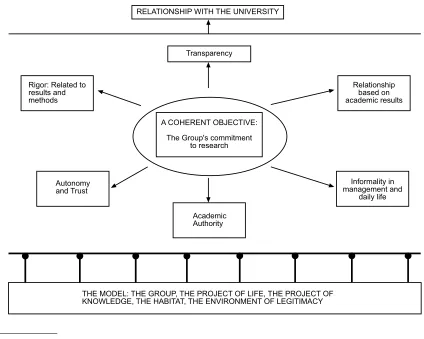
This model has transformed the Faculty’s culture. Given the results from the methodology proposed in this paper, and keeping in mind that culture is a complex reality, I will give a preliminary approach to the main determinants of the Faculty’s culture which were shared and improved by the “Learning Group”. Figure 5 shows the main determinants linked around the group’s objective, which has been to promote and develop research (creating and distributing knowledge). I also insist that culture is based on the model presented in the paragraph before; that is why I present those five variables as a pivot to the main determinants of the culture. Finally, both the model and the main determinants of culture have an influence on the kinds of relations that are establishing between the University and the Faculty of Economics.
results and academic production. That is why this type of relationship is also a key element when explaining how the relationship between the Faculty and the University works. Text 4 in Appendix 10 brings some remarks from the actors concerning these culture determinants.
Finally, it is possible to integrate the elements of organizational culture described in chap-ter IV to the dechap-terminants we have just mentioned. Figure 6 lists the relations between these cultural determinants and the 12 major elements included in the literature as elements of the organizational culture, and which were studied here. An analysis on this could be found in the conclusions.
T
HE CONCEPTOFCULTURALCHANGEAND PERFORMANCEIN THEF
ACULTY OFE
CONOMICSTaking into account the organizational culture of the Faculty, and how it has changed during the last 7 years, I tried to find a relationship between this new culture and the Faculty’s perfor-mance. I asked some questions regarding this issue in the interviews; however I did not receive any clear answers. People either evaded the question or answered it with doubt. They showed me extraordinary results and could prove them, but they were not sure about the connection between these two aspects, and if the culture was one of the reasons or “the” reason for the results.
This led me to check the literature around this topic in order to shed new light on it. I did not find many works on this issue, but some of them were very useful. For this reason, I chose to analyse Alvesson, because he alerts us on not trying to use organizational culture as a rational and technical instrument which management can use in any way: “A basic problem in much management thinking and writing is impatience in showing the great potential of organizational culture. Associated with this is a bias for a premature distinction between the good and the bad values and ideas, trivialization of culture, overstressing the role of management and employ-ment of casual thinking”(Alvesson, 2003: 42-43). This advice made me think again about how not to end up ignoring the complexity of the topic. Alvesson also insists on warning about three ways in which organizational culture is wrongly used as a managerial tool. At the end he con-cludes that any of those three ways have methodological deficiencies which makes us think that organizational culture cannot be merely linked to performance. This does not mean that there have not been any studies trying to prove this relationship empirically; however “empiri-cal study in the area is very difficult to carry out.
Not only is culture difficult to capture but so is performance […] any such influence may, however, be lost among all the factors and interaction patterns that have something to do with these results”(Alvesson, 2003: 55).
full time with the Faculty, the results of the program “Young Researchers” in terms of papers produced and published, their involvement with senior professors on certain research projects, and the addition of new members, the publications —classified in terms of the difficulty to produce them26—, memberships to academic networks, number of visiting international pro-fessors, number of research projects and evaluations of their way of funding, agreements re-lated to research projects, international academic seminars, and relationships with academic peers. The way the Faculty was evaluated before included variables such as (Universidad del Rosario, 1980) the number and titles of the professors, kinds of teachers in terms of their dedication (Full-time, Part-time), number of students, number and quality of classrooms, and number of subjects. Performance nature has changed since 1999, and now it is more important to evaluate the inputs, processes and outputs related to research. This has been the case in the new model, given the main commitment of the group of professors and their commitment to research (see figure 5).
F
IGURE5
M
AINDETERMINANTSIN THECULTURE OFTHEF
ACULTYOFE
CONOMICSRELATIONSHIP WITH THE UNIVERSITY
THE MODEL: THE GROUP, THE PROJECT OF LIFE, THE PROJECT OF KNOWLEDGE, THE HABITAT, THE ENVIRONMENT OF LEGITIMACY
Transparency
Autonomy and Trust
Informality in management and
daily life A COHERENT OBJECTIVE:
The Group's commitment to research
Academic Authority
Relationship based on academic results Rigor: Related to
results and methods
26 The difficulty depends on the classification. Publications are classified as follows: papers in international journals
[image:22.612.91.515.317.656.2]Continuing with Alvesson’s critique, literature on Higher Education Management supports the importance of certain practices applied in the Faculty of Economics, especially when talking about research performance. Concerning informality and autonomy-trust values, Bargh, Bocock, Scott and Smith (2000) confirm the importance of leaving formal structures and using informal meth-ods in order to attain success. Similar analysis related to this topic can be found in works such as
F
IGURE6
T
HE CONCEPTOFO
RGANIZATIONALC
ULTUREIN THISPAPER AND THEDETERMINANTSOFTHECULTURESTUDIEDAT THE
F
ACULTY OFE
CONOMICSTHE MODEL: THE GROUP, THE PROJECT OF LIFE, THE PROJECT OF KNOWLEDGE, THE HABITAT, THE ENVIRONMENT OF LEGITIMACY
THE RELATIONSHIP WITH THE INSTITUCIÓN
1. Leadership 2. Motivation 3. Relationships 4. Working together 5. Learning
6. Communication 7. Change
8. Cultural coherence 9. Conflict resolution 10. Objective coherence 9. Values 10. Mystic Relationships
based on academic results
Informality in management and real life Rigor: Related with results and
methods (Discussion)
Autonomy and Trust Transparency
Shattock (2003) who quotes a part of a speech from a distinguished vice-chancellor:27 “a much smaller and more authoritarian oligarchy, with a tight hierarchy of subordinates […] would how-ever, be unacceptable for the valid reason that under it academic freedom would be restricted and academics would carry out research and teaching less well. The academic does not produce best performance to order” (Shattock, 2003: 85). The importance of bringing some kind of Academic Authority to the group of professors is also clearly stated in much of the literature. Particularly when talking about cultural change, Bargh, Bocock, Scott and Smith (2000) insist on the Vice-Chancellors view that appointments to the senior staff area a primary tool. The idea is to bring academic recognition and authority to the faculties and departments.
When talking about rigor and its consequence on open discussions, Shattock’s (2003) deserves to be mentioned. In particular, how this value can impact on effectiveness (giving an idea of the relationship culture-performance): “faculties in the humanities and social sciences tend to be more discursive, less willing to cede authority to a dean, reluctant to accept policies laid down by central authority without question and much more willing to challenge the status quo”. It is clear from this chapter that this has been the case in the Faculty of Economics at “Universidad del Rosario”, where the emphasis has been on creating an environment for decision-making based on consensus rather than on charismatic leadership. Others see this as participative deci-sion-making process, but warn us of possible flaws in this model, for example “In periods of unfavourable economic conditions, conflict can arise over scarce resources, rendering the model inadequate for achieving interdisciplinary consensus” (Bargh, Scott and Smith, 1996: 30). Even the Dean of the Faculty precisely anticipated this remark when he was talking about the model; “The Faculty of Economics is a strange model in the University and it bothers now and again, but it shows results! [...] It is because of results that it is sustainable”.
Relationships based on academic results are another topic which has been of particular impor-tance when studying collegial approaches to university management. It could be thought that academic failure may easily be tolerated in a collegial environment, however as Shattock (2003) says, “Nothing could be further from the truth. In many ways the decisions of a properly con-structed community of scholars operating in a competitive market are likely to be tougher than a managerialist regime […] because the academic community is likely to draw lines and make judgements more confidently than non-academic leaders” (Shattock, 2003: 88). During the interviews, I noticed that this has been the case at the Faculty of Economics. Bargh, Scott and Smith (2000) confirm this point in Universities as communities of scholars where academic authority is based on the quality of the academic work assessed by peers.
VI. F
INISHING THEB
UILDING–C
ONCLUSIONS AND THEL
EARNINGO
UTCOME– T
HEC
YCLEG
OESB
ACKConclusions can be given in two different aspects: on one hand, is the model applied to research on organizational culture and what the institution can learn form it, and on the other
27 He considers that a good practice for successful universities is to maintain short lines of communication where
hand, is how such a model relates to the culture of a Faculty and what can be learnt for its future actions. Both conclusions lead us also to think that this methodology can be used to compare different faculties, and to discover ways in which they can work together, given their different subcultures. Institutions such as “Universidad del Rosario” usually need to be trans-formed in the middle of quasi-feudal structures. A model of research like this can help me and the institution to discover the glue to stick many faculties to an institutional project that en-compasses the University as a whole.
The model used in this paper responded to the need of having a complex-oriented investiga-tion on organizainvestiga-tional culture. It included not only a multi-perspective orientainvestiga-tion, but also it was able to discover key variables of culture using real lived situations. From the Faculty of Econo-mics, it is remarkable how the new culture has been interiorised by all its community. It is clear that the main determinants of the culture are the respect for academic authority, the emphasis on academic results for all the community and informality dominating relationships. Also, this paper has highlighted its main flaw which is the permanent need for particular and expected results. Table 3 shows a proposed “before and after” in the Faculty of Economics’ culture.
T
ABLE3
B
EFORE AND AFTERIN THEF
ACULTY OFE
CONOMICS– M
AIN CHANGES IN THECULTUREOFTHEF
ACULTYOFE
CONOMICSBefore After
Deanship instability Formality
Deanship instability Informality
No interest on research Research as the main objective
Distrust on academic careers Building academic careers (Projects of life) Bureaucratic authority
Relationships based on personal relations Private interests
Top-Down control
Academic authority
Relationships based on academic production Group interests
Control based on autonomy and trust Charismatic or autocratic decision making Decision making based on consensus
Performances evaluated in terms of inputs Performances evaluated in terms of inputs, process and outputs
Derived from the research, it is also possible to identify challenges and possibilities for future in the Faculty of Economics. There exists a clear need to make some changes, but they must be done without affecting results and the model which has been implemented success-fully. Text 5 in Appendix 10 presents some preliminary remarks about those things that have to be transformed (more emphasis on teaching and students, more formality within the manage-ment system and openness to criticism). The Faculty needs to work on these topics in order to keep reaching its expected results.
R
EFERENCESAlvesson Mats (2003), Understanding Organizational Culture, Sage Publications, Second Edition.
Bargh, Catherine; Scott, Peter; Smith, David (1996), Governing Universities, changing the culture? Open University Press. Bargh, Catherine; Bocock, Jean; Scott, Peter; Smith, David (2000), University Leadership. The Role of the Chief Executive,
Open University Press.
Bate, Paul (1996), Strategies for cultural change, Butterworth Heinemann, Second Edition. Becher, Tony (1989), Academic Tribes and Territories, Open University Press.
Cameron, Kim; Quinn, Robert (1999), Diagnosing and changing organizational culture, Addison Wesley Publishing, 1999. Fairclough, Norman (1989), Language and power, Longman Group.
Gergen, Kenneth J.; Gergen, Mary (2004), Social Construction. Entering the Dialogue, The Taos Institute Publication, 2004.
Gómez, Hernando; Jaramillo, Hernán (1997), 37 modos de hacer ciencia en América Latina, TM Editores-Colciencias. Hill, Yvonne; Lomas, Laurie; McGregor, Janet (2003), “Managers, researchers, teachers and dabblers: Enabling a
research culture in nursing departments, in higher education institutions”, Journal of Further and Higher Educa-tion, Carfax Publishing, 27 (3), August.
Joanne, Martin (1992), “Culture in Organizations, Three Perspectives”, Oxford University Press, chapter 9. Kenneth J. Gergen and Mary Gergen, Social Construction: Entering the Dialogue, , 2004, page 81.
Lumby, Jacky (2003), “Culture change- The case of sixth form and general further education colleges”, Educational Management and Administration, 31 (1), Carfax Publishing, January.
Marshall, Judi; McLean, Adrian (1988a), “Cultures at Work- How to identify and understand them”, in: Local govern-ment training board, Merry Printers.
________ (1988b), “Reflection in Action: Exploring organizational culture”, in: Peter Reason, Human Inquiry in Action: Developments in new paradigm research, Sage Publications, pages 199-220.
Marshall, Judi; Reason, Peter (1998), “Collaborative and self-reflective forms of inquiry in management research”, in: J. Burgoyne and M. Reynolds, Management Learning: Integrating perspectives in theory and practice, Sage Publica-tions, pages 227-242.
Martin, Joanne (1992), Cultures in organizations: Three perspectives, Oxford University Press.
McNay, Ian (1996), “From the collegial academy to corporate enterprise: the changing cultures of Universities”, in: Tom Schuller, The Changing University?, Open University Press, Second edition, pages 105-116.
Méndez, Carlos (2005), El Clima y la cultura organizacional, reto para el cambio en gestión de las organizaciones: Clima organizacional en empresas colombianas 1980-2004.
________ (2004), “Transformación cultural en las organizaciones: Un modelo para la gestión de cambio”, Facultad de Altos Estudios de Administración y Negocios, Universidad del Rosario, November.
Peterson, Marvin W.; Dill, David D.; Mets, Lisa A. and associates (1997), Planning and Management for a changing environment, The Jossey Bass Higher and Adult Education Series.
Robson, Colin (2002), Real World Research, a resource for social scientists and practitioners-researchers, Blackwell Publishing, Second Edition.
Reason, Peter; Bradbury, Hilary Handbook of Action Research-Participative inquiry and practice, Sage Publications. Schein, Edgar H. (1989), Organizational Culture and Leadership, Jossey Bass Publishers, 8th edition.
Shattock, Michael (2003), Managing successful Universities, Open University Press.
Triandis, Harry C. (1982), Dimensions of Cultural variation as parameters of organisational theories,
Trompenaars, Fons; Hampden-Turner, Charles (2000), Riding the waves of culture. Understanding cultural diversity in business, Nicholas Brealey Publishing.
Universidad del Rosario (1980), Situación de la Facultad de Economía de la Universidad del Rosario con respecto a otras Facultades de Economía de Bogotá, October, Santafé de Bogotá, Universidad del Rosario.
________ (1995), Planes y Programas 1995-1996, May, Santafé de Bogotá, Universidad del Rosario.
_______ (1997), Políticas para el futuro inmediato. Documento síntesis de discusiones y recomendaciones. Seminario de Planes y Programas 1997-2000, March Santafé de Bogotá, Universidad del Rosario.
________ (2004), Informe de Autoevaluación Institucional, September, Santafé de Bogotá, Universidad del Rosario. Universidad del Rosario, Facultad de Economía (1999), Plan Estratégico 1999, February, Santafé de Bogotá, Universidad
del Rosario.
________, (2005a), Renovación de la Acreditación del Programa de Economía, June, Santafé de Bogotá, Universidad del Rosario.
_________, (2005b), Ficha Resumen-Grupo de Investigación Facultad de Economía, August, Santafé de Bogotá, Universidad del Rosario.
Wiener, Yoash (1988), “Forms of value systems: A focus on organizational effectiveness and cultural change and maintenance”, Academy of Management Review, 13 (4).
Williams, Allan; Dobson, Paul; Walters, Mike (1993), “Changing Culture. New Organisational approaches”, in: Insti-tute of Personnel Management, Second Edition,