FACULTAD de FILOSOFÍA Y LETRAS
DEPARTAMENTO de FILOLOGÍA INGLESA
Grado en Estudios Ingleses
TRABAJO DE FIN DE GRADO
HOW CLIL AND NON-CLIL L1SP/L2EN STUDENTS
UNDERSTAND AND USE PHRASAL VERBS
Nerea Gómez Gómez
Vº Bº, 25 de junio de 2015
Tutor: Esther Álvarez de la Fuente
ABSTRACT
Phrasal verbs pose significant difficulties to L1SP/L2EN students due to their complex syntatic and semantic dimensions. This study analyzes the responses of two groups of students aged from 15 to 16 years old who belong to CLIL and non-CLIL educational programs in Spain when they have to deal with the use and understanding of phrasal verbs. We have designed two tests in which both dimensions are tested separately: Test 1 aims to observe if students use semantic strategies to decipher the meaning of unknown phrasal verbs and test 2 aims to observe in which position students place pronouns and simple NPs in transitive phrasal verbs. We analyze the results in order to see if the educational program plays a role in the acquisition of both dimensions. We conclude that (1) CLIL students outperform non-CLIL ones in the understanding of phrasal verbs (semantic dimension), but that (2) neither group masters yet the syntactic dimension although CLIL students perform better in this dimension.
KEYWORDS
CLIL education; L1SP/L2EN students; phrasal verbs; semantic dimension; semantic strategies; syntactic dimension.
RESUMEN
Los verbos frasales plantean muchas dificultades a los estudiantes L1ES/L2IN debido a su compleja dimensión sintáctica y su dimensión semántica. Este estudio analiza las respuestas ante ambas dimensiones de dos grupos de estudiantes de entre 15 y 16 años de los cuales uno estudia en el sistema educativo AICLE español. Hemos diseñado dos tests para analizar ambas dimensiones por separado: el test 1 está diseñado para observar si los estudiantes usan estrategias semánticas para descifrar el significado de verbos frasales desconocidos, y el test 2 para observar en qué posición colocan los pronombres y los SNs en los verbos frasales transitivos. Analizamos los resultados de ambos tests para comprobar si el sistema educativo es un factor significativo en la adquisición de ambas dimensiones. La conclusión del estudio muestra (1) que los estudiantes del sistema AICLE superan a aquellos que no cursan este sistema a la hora de comprender verbos frasales (dimensión semántica), pero (2) que ninguno de los dos grupos domina aún la dimensión sintáctica aunque los estudiantes AICLE obtienen mejores resultados.
PALABRAS CLAVE
TABLE OF CONTENTS
1. INTRODUCTION 1
2. THE DIFFICULTY OF LEARNING PHRASAL VERBS BY L1SP/L2EN
STUDENTS
2
2.1. Phrasal Verbs: Description 2
2.2. Phrasal Verbs: Classification 4
2.2.1. Syntactic Dimension 4
2.2.2. Semantic Dimension 6
2.2.2.1. Opaqueness-Transparency Scale 6
2.2.2.2. Strategies to Decipher the Meaning of Phrasal Verbs 8
3. CLIL PROGRAM IN THE SPANISH EDUCATIONAL SYSTEM 10
3.1. What is CLIL Education? 11
3.2. CLIL System vs. Non-CLIL System 12
4. RESEARCH QUESTIONS 14
5. METHODOLOGY 16
5.1. Participants’ Profile 16
5.2. Procedure 17
6. DATA ANALYSIS: RESULTS 20
6.1. Test 1 Results: Semantic Dimension 20
6.2. Test 2 Results: Syntactic Dimension 22
7. DISCUSSION AND CONCLUSIONS 23
8. REFERENCES 27
9. APPENDIXES 29
9.1. Appendix 1: Background Questionnaire, Test 1 and Test 2 29
9.2. Appendix 2: Classifications of Phrasal Verbs 34
9.2.1. Classification of Phrasal Verbs According to the Opaqueness-Transparency Scale
34
1
1. INTRODUCTION
English phrasal verbs, due to the syntactic movements they involve and their non-literal nature, pose a real challenge to students of English as their second language (L2) whose mother tongue (L1) is Spanish. Therefore, the present research focuses on their acquisition of the syntactic and semantic dimensions of phrasal-verb structures.
The main aim of this study is to observe the performance in the use and understanding of phrasal verbs by these students. More specifically, in order to analyze how the participants of this study acquire the syntactic and semantic dimensions of phrasal verbs, they are tested on what strategies they use to decipher their meaning
(adapted from Crutchley’s (2007)) and on where they place the direct object (DO) in
transitive phrasal verbs. In this study, both dimensions are analyzed separately since they pose different problems for L2 learners.
Recently, there has been an increase in the research in the field of L2 acquisition due to the increasing number of Spanish schools implementing Content and Language Integrated Learning (CLIL) education in their teaching programs. Since it is usually argued that CLIL education benefits students when acquiring English (Villoria, J., S. Hughes and D. Madrid, 2011; Manzano Vázquez, 2013), this study aims at comparing
CLIL students’ performance on phrasal verbs with that of non-CLIL or Communicative
Language Teaching (CLT) students. In other words, this study researches if CLIL education is useful for students when they have to use and understand phrasal verbs by
comparing their performance with that of non-CLIL students.
2 In brief, this study contributes to the discussion on whether CLIL is a useful educational program or not focusing on the grammatical structure of phrasal verbs. For this purpose, a description of phrasal verbs and the difficulties associated with their learning is presented in the following section.
2. THE DIFFICULTY OF LEARNING PHRASAL VERBS BY L1SP/L2EN
STUDENTS
2.1.PHRASAL VERBS:DESCRIPTION
Speakers of Spanish as their mother tongue (L1SP) and learners of English as a second language (L2EN) may find English grammatical structures quite simple in some ways, such as in the use of verb tenses since Spanish has complex verbal inflections while English verbs are not so richly inflected. Nevertheless, sometimes, English presents serious grammatical difficulties to L1SP/L2EN speakers. One of these difficulties lies on the use and understanding of phrasal verbs. These verbs are commonly used in spoken and written (informal) English so they are essential structures when acquiring and teaching this language. Therefore, whether the L1SP/L2EN students learn them at early or late stages, they have difficulties from the moment they
face them.
Before explaining those difficulties, we must point out that there is a debate on which verbs must be placed under the definition of phrasal verbs. According to the
Collins Cobuild Dictionary of Phrasal Verbs (1990: p. 4), phrasal verbs are
“combinations of verbs with adverbial or prepositional particles.” This definition
includes two types of verbs: phrasal verbs (Verb + Adverbial Particle) and prepositional verbs (Verb + Prepositional Particle).
3 (P) since this nomenclature deletes any kind of relation the particle may have with prepositions or adverbs. In this study, particles in phrasal constructions are considered part of the meaning of the phrasal verb as a unit, not as adverbs or prepositions added to a verb in order to create a phrasal verb1.
Therefore, the definition of phrasal verbs, that will be adopted in this study, will be the following: From a semantic point of view, phrasal verbs are combinations of two elements, a verb and a particle (V + P), which constitute a single unit of meaning. The meaning of phrasal verbs lies in the connection of these two elements with a single concept. If one of the two elements is missing, the phrasal verb ceases to exist (Hare, 2010; Cappelle, Shtyrov, and Pulvermüller, 2010). From a syntactic point of view, phrasal verbs can be transitive (Tear up), in which case the DO can be placed after P (John tore up the letter) or between V and P (John tore the letter up) (Haegeman and Guéron, 2002: p.263) or intransitive (The plain has just touched down) (Quirk et al., 1985: p. 1152).
After having cleared the definition of phrasal verbs, now the difficulties of learning phrasal verbs by L1SP/L2EN students come into focus. First of all, Spanish language does not have similar structures to phrasal verbs although it has some
structures similar to prepositional verbs: Depender de + Noun Phrase (NP) (V + Prep).
1
Although in this study we will focus on the analysis of phrasal verbs, it is convenient to point out that in
L2EN textbooks for Spanish students a distinction between phrasal and prepositional verbs is not usually
established. However, there is an important difference between these two types of verbs at the level of
their syntactic behavior: In the case of transitive phrasal verbs, the DO can be placed after the P when it is
a simple Noun Phrase (Det + N), being this movement optional to the speaker (John tore up the letter or
John tore the letter up) (Haegeman and Guéron, 2002: p. 263). However, when the DO is a pronoun, it must be placed between the verb and its P (John tore it up). In the case of prepositional verbs, they are followed by a preposition that needs a noun phrase (NP) as its object (John talked about a house) (Haegeman and Guéron, 2002: p. 263). Unlike the DO of phrasal verbs, the prepositional object, either a
NP or a pronoun, cannot be placed between the verb and the preposition (*John talked it about / *John talked a house about). The reason for this is the impossibility of moving the object of the preposition since it takes its case (oblique) from the preposition and must be placed right after it in order to obtain
case. In contrast, the DO of phrasal verbs takes objective case from the phrasal verb (the verb and P act as
a grammatical unit) and the DO can be placed after either to receive objective case (Haegeman and
4 These are composed of a verb and a preposition which does always occur with that verb. Taking this into account, the lack of phrasal verb structures in the Spanish language poses huge difficulties for L1SP/L2EN students: they are difficult to understand and produce not only because of their complex semantic dimension (their meaning is difficult to infer by L1SP/L2EN students) but also because of their syntactic peculiarities (when the DO movement is possible or it is not).
2.2.PHRASAL VERBS:CLASSIFICATION
Phrasal verbs are considered lexical units or, rather, units of two elements (V + P), which convey a single meaning (Cappelle, Shtyrov, and Pulvermüller, 2010). In this definition of phrasal verbs, two of their dimensions are stated: the syntactic and the semantic one.
The fact that phrasal verbs are composed of two elements that can be separated in order for a DO to be placed between them, when possible, implies their syntactic dimension. And the fact that they are single units of meaning even if they are composed of two elements, which are independent lexical units in isolation, implies their semantic dimension. Both dimensions must be taken into account when dealing with the use and
understanding of phrasal verbs in the performance of L1SP/L2EN students.
2.2.1.SYNTACTIC DIMENSION
Theoretically speaking, phrasal verbs are composed of a verb followed by a P; however, this P can change its position with respect to the verb. This means that, under certain conditions, the particles in phrasal verbs can be separated from the verb. Therefore, phrasal verbs can be divided into two groups depending on the possibility of separation of the particle from the verb: separable and inseparable verbs (Khalaili and Marina, 1991).
5
Table 1: Syntactic Classification of Phrasal Verbs
CLASSIFICATIONS OF
PHRASAL VERBS
SEPARABLE
(Sep)
INSEPARABLE
(Insep)
TRANSITIVE
(Vtr)
x ALWAYS SEPARABLE when the DO is a pronoun
x OPTIONAL SEPARATION when the DO is a simple NP
INTRANSITIVE
(Vi)
x SEPARABLE due to the movement of an adverb
between the V and the P
x USUALLY INSEPARABLE
since they do not take a DO
Separable verbs do not always imply that they are transitive; for instance, an intransitive verb may be separated due to the movement of an adverb in between the verb and the P (The plane took quickly off) (Khalaili and Marina, 1991). Nevertheless, in this study, we refer to intransitive verbs as inseparable because they cannot be separated by a DO.
When a phrasal verb is transitive and its DO is a pronoun, this pronoun must be located between the verb and the P; in this case, the phrasal verb is always separable (Please drink it up) (Quirk et al., 1985: p. 1158). However, when the DO is a simple NP the speaker chooses whether to place it before or after P (They turned on the light/ They turned the light on) (Quirk et al., 1985: p. 1154).
6
2.2.2.SEMANTIC DIMENSION
The other element to take into account when analyzing phrasal verbs is their semantic dimension. As previously stated, phrasal verbs can be considered lexical units or, rather, units of two elements which convey a single meaning. There is a debate among linguists on the definition of phrasal verbs as lexical units. There is no agreement on which phrasal verbs are to be considered lexical units and which are simply “syntactically assembled combinations of two independent lexical units” (Cappelle, Shtyrov, and Pulvermüller, 2010: p. 189). Usually, linguists consider phrasal verbs only those which are fully idiomatic (Fraser, 1976; Wurmbrand, 2000) and whose elements do not give the speaker any clue about the true meaning of the phrasal verb. However, this conception represents only one part of the semantic dimension of phrasal verbs, since other meanings must be taken into account.
When analyzing phrasal verbs from a semantic point of view, their
non-compositional nature (Crutchley, 2007) usually makes their meaning not easy to be
inferred from the meaning of their constituents. However, it must not be taken for granted the fact that only those highly idiomatic phrasal verbs are considered phrasal verbs; there is an opaqueness-transparency scale when dealing with phrasal verbs as
lexical units: when they are highly idiomatic and the meaning of the constituents in isolation is far from the meaning of the unit, they are opaque phrasal verbs; when the
meaning of their constituents is similar to that of each unit in isolation, they are translucent or transparent phrasal verbs. Therefore, the more similar the meaning of the phrasal verb is to the meaning of its constituents, the less opaque and more transparent its meaning will be. A further description of these two semantic types of verbs is provided in the following sections.
2.2.2.1.OPAQUENESS-TRANSPARENCY SCALE
7
Table 2: Semantic Classification of Phrasal Verbs
OPAQUENESS-TRANSPARENCY SCALE
OPAQUE
TRANSPARENT
x OPAQUE phrasal verbs
o Go off (“to explode”)
x TRANSLUCENT phrasal verbs
o Read out (“to read in a loud voice”)
x TRANSPARENT phrasal verbs
o Walk out (“to exit on foot”)
Opaque phrasal verbs are those whose meaning is not easily understood from
the meaning of their elements. This means that the meaning of the phrasal verb is completely different from the meaning of its constituents in isolation. Phrasal verbs
constituted by light verbs (make, do, go, take, etc.) are usually opaque due to the polysemous nature of these verbs. For instance, go off (“to explode”) is opaque since the meanings in isolation of go (“leave”) and off (“away from,” among other meanings) are completely different from the meaning of the phrasal verb as a unit. Moreover, go off, includes a light verb which makes its meaning even more difficult to decipher.
Translucent phrasal verbs are those whose meaning is closely related to the meaning of the main verb but the P gives it a different nuance and meaning. The nomenclature and definition of these kinds of verbs were not extracted from any source since any of the definitions fitted this study. The nomenclature translucent was selected in order to maintain the metaphor started with the word opaque. “Opaque,” according to the Oxford English Dictionary (OED Online), is defined as “not able to be seen through,” while translucent is definedas “allowing light but not detailed shapes to pass through.” The meaning of opaque phrasal verbs cannot be deciphered from looking at
their constituents just like nothing can be seen through an opaque object; likewise, the meaning of translucent phrasal verbs can be intuited by looking at the verb since the meaning of the unit has to do with the meaning of the verb in isolation, but the P changes that meaning to a certain extent and gives the phrasal verb a less literal
8 of transparent phrasal verbs; just like translucent objects let you see there is something behind them but do not allow a full picture of it. For instance, the meaning of read out in the sense of “read in a loud voice,” is closely related to the meaning of read in
isolation (“look at and comprehend the meaning of written or printed matter” –OED
Online) but the P out offers a different nuance to the verb read, and therefore, a less literal meaning to the phrasal verb that is “to read in a loud voice.”
Transparent phrasal verbs are those whose meaning is easily understood by looking at the meaning of their constituents in isolation; their meaning is literal. For instance, the meaning of walk out (“to exit on foot”) is the same as the meaning of its constituents in isolation: walk (“to travel on foot”) and out (“to the outside”). In this study, transparent phrasal verbs were not analyzed since they do not pose serious difficulties due to their literal nature.
Resuming the previous discussion, the fact that only highly idiomatic (opaque) phrasal verbs can be considered “true” phrasal verbs must be disregarded since verbs and particles can contribute to the meaning of phrasal verbs as a unit in a higher or lower degree. According to Cappelle, Shtyrov and Pulvermüller (2010), who conducted a series of neurophysiological tests, phrasal verbs, regardless of their opacity, are
understood as lexical units. Therefore, this study will work with the semantic conception that phrasal verbs are lexical units regardless of their transparency.
Even if all phrasal verbs are conceived as lexical units, their degree of opaqueness is a key fact in the process of deciphering their meaning by L1SP/L2EN students. Probably,
the most problematic phrasal verbs for them are those opaque ones since their components do not give any clue to the learners about their meaning; therefore, they are a true challenge for L1SP/L2EN learners. However, the more transparent the phrasal verbs become, the less difficulties learners may find at understanding them since the constituents offer clues to decipher their meaning.
2.2.2.2.STRATEGIES TO DECIPHER THE MEANING OF PHRASAL VERBS
9 consists in examining in detail the different components of phrasal verbs (Crutchley, 2007). This examination is not useful in the task of understanding and extracting the meaning of opaque phrasal verbs since their meaning cannot be inferred from analyzing their components. Even when dealing with more transparent phrasal verbs, analytic strategies may not be quite useful. However, L1SP/L2EN students still analyze phrasal
verbs’ components whenever they are unknown to them. Moreover, L1SP/L2EN
students do not only analyze the components of the phrasal verbs but the context in which they appear in order to infer their meaning.
Crutchley (2007) provided four analytic strategies that English monolingual children used when dealing with deciphering the meaning of unknown phrasal verbs. To carry out our empirical work, some of those strategies have been adopted from
Crutchley’s study and adapted in order to fit the purpose of this study and the profile of
our L1SP/L2EN students. Therefore, we used the following strategies as variables of analysis in this study to examine the understanding of phrasal verbs by L1SP/L2EN students when facing unknown phrasal verbs.
Strategy 1: Students use semantic information from both the verb and the particle (not necessarily as a unit) in order to decipher the meaning of the phrasal verb. The verb may be interpreted as a verb or as a different category when possible. For
instance, the verb dress in Alicedressed up to go to the opera (dress upmeaning “to put on fancy clothes”) may be interpreted as a noun or as a verb. In addition, the P may be
interpreted as a preposition, an adverb or even an adjective when possible. For instance, the P down in John’s dog suffered from an illness and he had to put it down (put down meaning “to kill an animal as an act of mercy”) may be interpreted as a preposition of
direction (“from higher to lower place”), or as an adverb meaning “on the floor.”
10
Strategy 3: The students look for an interpretation of the phrasal verb which is not literal (not derived from the meanings of the verb and the particle in isolation). This non-literal interpretation may be an existing one (L1SP/L2EN students may know a different meaning of the phrasal verb which does not fit the context but is the only one they know) or an invented one which students create by looking at the context in which the phrasal verb appears. For instance, they may interpret dress up (“to put on fancy clothes”) in the sentence Alice dressed up to go to the opera as Alice dressed as a witch to go to the opera since they may know a different meaning of dress up (“to wear a costume”).
In order to examine if L1SP/L2EN students may use different strategies to understand the meanings of phrasal verbs depending on the quantity and quality of input they receive in their schools, we have taken into consideration two different educational programs developed in Castile and Leon, Spain, in order to see if the type of educational programs plays an important role in the acquisition of English phrasal verbs.
3. CLIL PROGRAM IN THE SPANISH EDUCATIONAL SYSTEM
The actual L2 Spanish educational system involves two different systems:
Communicative Language Teaching (CLT) (Ellis, 2009) and Content and Language
Integrated Learning (CLIL) program. The CLT system was initiated in the course
1993-1994. In its early stages, this system stated that the age at which students should start learning English as a L2 was 8 (while the previous systems stated that that age had to be
12). However, the changes introduced by the “Ley de Calidad” in 2002 (BOE, Ley
11
3.1.WHAT IS CLILEDUCATION?
The term CLIL can be defined in various ways:
“The educational setting where a language other than the students’ mother tongue is used as medium of instruction” (Dalton-Puffer 2007, p.1)
“Situations where subjects, or parts of subjects, are taught through a foreign language with dual
-focused aims, namely the learning of content and the simultaneous learning of a foreign language”
(Marsh, 2002: p. 2, qtd. in Manzano Vázquez, 2013).
“Language and content integration concerns the teaching and learning of both language and subject areas (e.g. science, mathematics, etc.) in the same classroom, at the same time”
(Barwell, 2005: p. 143, qtd. in Bruton, 2013).
We can see in these definitions that CLIL education provides an indirect approach to teaching a L2 (opposed to the direct approach which involves the teaching of the L2 grammar, vocabulary, etc.) in which students learn how to communicate by participating in subjects taught in that L2.
The objective of CLIL education is to provide a way of education in which students acquire a L2 in similar ways to which L1 speakers acquire it, that is, by listening to it and with the help of Universal Grammar (UG) or the grammar of the language (Haegeman and Guéron, 2002). In order to achieve this goal, CLIL programs start at early stages of education (usually in kindergarten -3 year-old students-) and CLIL students are not given a series of rules to develop the L2.
Even if the CLIL system has been put into practice in most Europe, including Spain, there are mixed opinions regarding this program; on the one hand, linguists and educational experts who are not so in favor of CLIL education believe this program and teaching L2 in schools is unsatisfactory. They argue that classrooms are not ideal places to learn a L2 even if students are involved in programs such as CLIL. In fact, they argue
that real language learning is just attained “on the street” (Dalton-Puffer, 2007: p. 2),
that is, in environments in which the L2 is spoken as a L1.
12 in favor of implementing CLIL programs are the following (Dalton-Puffer, 2007; Manzano Vázquez, 2013):
x CLIL turns school into a naturalistic environment in which a L2 is learnt by
reproducing the way in which a L1 are acquired.
x CLIL makes use of a L2 in classroom with a purpose: to learn various subjects.
x CLIL is positive to learning L2s since it emphasizes the content rather than the form.
x Being involved in CLIL programs increases the amount of exposure to the L2.
Many researches on CLIL students have contributed to the idea of CLIL being beneficial rather than detrimental for students. Wiesemes (2009) concluded that students in CLIL programs had better outcomes in language and content of L2s, and Pérez Cañado (2012) concluded that CLIL programs increased students’ motivation and confidence in the L2. Furthermore, Dalton-Puffer (2008) did also conclude that CLIL students improved their speaking skills and receptive and productive vocabulary.
Moreover, Villoria, J., S. Hughes and D. Madrid (2011) and Manzano Vázquez (2013) researched on the effect of the different types of L2 education in Spain: CLIL and non-CLIL. They interviewed students from primary and secondary education from both educational programs and tested them on the four skills (listening, speaking, reading and writing). They found out significant differences in the level of English of both groups: CLIL students outperformed non-CLIL ones in the four skills.
One of the aims of this study is to compare CLIL with non-CLIL programs in order to see if the main difference between both educational systems (the presence or absence of L2 content classes) plays an important role in the use and understanding of phrasal verbs.
3.2.CLILSYSTEM VS.NON-CLILSYSTEM
13 preference for either. Meanwhile, non-CLIL education does only focus on the teaching of the L2. Supposedly, the benefit of CLIL programs is that students learn subject content and develop a L2 at the same time.
Therefore, CLIL programs include content classes in which subjects are taught in a L2. As a consequence, students develop their proficiency in the L2 without any detriment of the content of the subjects. However, not every CLIL program includes only content classes in L2; other CLIL programs are supplemented with non-content classes or “decontextualised itemised language” (Bruton, 2013: p.3) classes. In these classes, grammar, vocabulary and other aspects of the L2 are learnt as isolated items or items within certain texts. Non-content classes are those in which the L2 is the subject of the class while in content classes the L2 is the medium to teach a different subject (mathematics, science, etc.). CLIL and non-CLIL programs’ methodology is shown in Table 3.
Table 3: CLIL and Non-CLIL Programs’ Methodology
EDUCATIONAL PROGRAM CONTENT CLASSES NON-CONTENT CLASSES
NON-CLIL PROGRAM +L1
-L2
+L2
CLIL PROGRAM
1. L2 as separate subject to
learn content through L2
+L2 +L2
2. Students learn L2
through the content
(already learnt in L1)
+L2
+L1
-L2
3. Students learn L2 and
content together
+L2 -L2
+L2 = Taught in a L2; –L2 = Not taught in a L2; +L1 = Taught in mother tongue.
There are three variations in CLIL programs according to the quantity of content
14 studied by our participants is the first one. In the case of non-CLIL students, content subjects are taught in their L1 and they are given non-content classes in the L2. The difference between both programs lies in the language in which content classes are taught.
In Spain, the way of teaching content classes is the same for CLIL and non-CLIL programs since they follow the CLT system. On the one hand, in L2 non-content classes, students learn items in isolation within a modified context (form-oriented education) which is relevant for the aspect of the L2 that is being learnt. On the other hand, L2 content classes in the CLIL program create an authentic environment (content-oriented education) in which students can develop their skills in the L2.
In this study, the objective is to research whether there is a significant difference in English performance between CLIL and non-CLIL L1SP/L2EN students when dealing with phrasal verb structures. This study aims at unveiling if CLIL L1SP/L2EN students perform better at using and understanding phrasal verbs, as CLIL supporters argue, in a naturalistic environment and receiving a higher amount of exposure to English, or if, on the contrary, these factors prove to have no influence on a better
performance. This aim is further developed in the following section that deals with the main research questions and hypotheses of this study.
4. RESEARCH QUESTIONS
In order to find out if the different Spanish educational programs play a role in the understanding and use of phrasal verbs, we propose three different research questions and hypotheses.
Research question 1: As far as the semantic dimension of phrasal verbs is concerned, do CLIL and non-CLIL students differ in the use of strategies in order to decipher the meaning of unknown phrasal verbs?
15 verbs in isolation but the attempt to give them unity of meaning. CLIL students may prefer this strategy since they are more exposed to spoken English in the content classes in which phrasal verbs are very common; therefore, they are exposed to more phrasal structures and may find more similarities between the phrasal verbs in the test and those they have heard or used in class. In this sense, CLIL students would have a better sense of lexical unity regarding phrasal verbs than non-CLIL students.
On the other hand, non-CLIL students may use strategies 1 (that is, they may use semantic information from the verb and the particle but not as a unit) and 2 (that is, they may interpret the verb or the particle of phrasal verbs in isolation) more often than strategy 3. This may happen due to the fact that non-CLIL students are not so exposed to this structure and may not realize, in contrast with CLIL students, that phrasal verbs are lexical units and, therefore, they may try to figure out their meanings by looking at the meaning of their components.
Research question 2: As far as the syntactic dimension of phrasal verbs is concerned, will CLIL students perform better than non-CLIL at selecting the correct position of the pronoun as a DO in transitive phrasal verbs? And which position will CLIL and non-CLIL students prefer when dealing with a NP as the DO of a phrasal
verb, after the P, or between V and P?
Hypothesis 2: Maybe non-CLIL students will have an advantage over CLIL
when placing the pronoun as a DO between V and P since they have been taught more hours of CLT classes which focus more on English grammar (syntax). In addition, NPs
as DOs have two correct positions in phrasal structures (before or after P) and maybe both CLIL and non-CLIL students would place the NP after the particle since that is the usual position of DO in transitive verbs.
Research question 3: As far as both dimensions are concerned, does less L2 learning (non-content classes) in CLIL programs compared to non-CLIL ones contribute to the failure of CLIL students to use and understand phrasal verbs?
16 Since syntax and grammar are really emphasized in CLT classes, non-CLIL students may have an advantage over CLIL in this dimension of phrasal verbs. However, the exposure to English in content classes by CLIL students may provide them an advantage over non-CLIL ones not only in the semantic dimension of phrasal verbs but also in the syntactic one since they have to use mental skills which are acquired, rather than learned only by means of constantly using English and not only learning its grammar.
5. METHODOLOGY
5.1.PARTICIPANTS’PROFILE
In order to study the differences between the use and understanding of phrasal verbs, two types of participants took part in this study: students enrolled in the CLIL educational program and students enrolled in the CLT one.
The L1 of all the participants is Spanish and their L2 English. All the participants attend the fourth grade (they are either 15 or 16 years old) of the same state-financed high school (I.E.S. Emilio Ferrari) in Valladolid. This high school includes
both CLIL and CLT programs so it is the appropriate scenario to develop this study. Non-CLIL participants have been learning English in the CLT program since they
started learning English (from 3 to 8 years old) while CLIL students have been enrolled in the CLIL program since kindergarten (3 years old). Those who were once in the CLIL program but are no longer part of it were excluded from the study.
Both groups differ in the quantity of input received in English, the type of educational programs and the number of students enrolled in the study, as shown in Table 4.
Table 4: Hours of English Input and Number of Participants
TYPE OF
PARTICIPANTS
CLIL STUDENTS NON-CLIL STUDENTS
NUMBER OF
PARTICIPANTS
17
INPUT
(HOURS/WEEK)
ENGLISH AS L2: 5h/w
HISTORY AND GEOGRAPHY: 3h/w
SCIENCE: 3h/w
WORLD LITERATURE: 2h/w
ENGLISH AS L2: 3h/w
CLIL students who attend Science classes do not attend WorldLiterature classes and vice versa. Therefore, CLIL students who attend WorldLiterature are given an hour less of content classes in English per week (10 hours instead of 11 in total). The English non-content classes are taught in very similar ways for CLIL and non-CLIL students although CLIL students have two more hours of content classes (5 h/w) than non-CLIL students (3 h/w). Therefore, the results of their performance will depend rather on
the content classes.
In addition to English classes at school, some participants attend extra classes of
English outside school: 6 non-CLIL students (1h or 2h per week) and 4 CLIL students (1h or 2h per week). Although the input account would be still higher in CLIL students,
these classes may contribute to the better performance in the use and understanding of phrasal verbs.
5.2.PROCEDURE
The participants had to complete two different tests which include two different experimental elicitation techniques: an acceptability test (Test 1) and a grammaticality judgement test (Test 2) (See Appendix 1).
18 Test 1, adapted from Crutchley’s verb-particle comprehension test (2007),is an acceptability test in which participants are given 10 written stimulus sentences involving a phrasal verb and they have to select, out of 4 written options, another sentence which implies the same meaning as the stimulus one. In this part of the test, the semantic dimension of phrasal verbs is being tested.
Each of the options under every stimulus sentence include a sentence which implies the same meaning as that of the stimulus one, and the other options involve the three semantic strategies described in section 2.2.2.2 (adapted from Crutchley, 2007). Participants had to choose only one possible option to indicate the meaning of the phrasal verb.
For instance, one stimulus sentence is 1. The phrasal verb included in this sentence is look up and the semantic options are a) to d).
1. Jack didn’t know what “platypus” meant, so he had to look it up in a dictionary.
a)Jack looked upwards for a dictionary. b) Jack searched for “platypus” in a dictionary. c)Jack stared at a dictionary.
d)Jack admires the dictionary.
Option b) would correspond with the same meaning as that of the stimulus
sentence but the present study focuses on the options which were not correct: a), c) and d). Option a) is a semantic option in which strategy 1 is involved: the meaning of the
phrasal verb is extracted from the core meaning of look (“to stare”) and up (as an
adverb meaning “towards the top”). Option c) is another semantic option which
involves strategy 2, implying that the interpretation of meaning is based only on the core meaning of the verb look. And option d) involves strategy 3, that is, the students would infer a different meaning of the phrasal look up based on their previous
knowledge of other phrasal verbs (in the sense of “looking up to something or somebody,” “to admire”).
19 option. However, when the phrasal verbs are opaque (5 items included), they may rely more on the use of one of the three strategies in order to know their meanings, which will be the focus of our analysis. The classification according to the opaqueness-transparency of the phrasal verbs used in this study can be seen in Appendix 2 (section 9.2.1).
Test 2 is a grammaticality judgement test in which participants had to decide the degree of grammaticality of 30 sentences (See Appendix 1). This test deals with the syntactic dimension of phrasal verbs and includes different kinds of phrasal verbs: Transitive separable verbs (Vt sep) (20 items) and intransitive verbs (Vi) (10 items). For the purpose of this study, we have focused on the transitive phrasal verbs since they involve the syntactic movement of the DO, whether a NP or a pronoun. Since intransitive verbs do not involve any kind of DO movement, we included them as distractors.
In this test, participants had to read the sentences and, on a scale from 1 to 4, being 1 grammatically correct and 4 grammatically incorrect, they had to grade how grammatical they thought the sentences were. The possibility of rating the grammaticality of the sentences from 1 to 4 will allow us to deduce not only the
participants’ knowledge of phrasal verbs’ syntax and syntactic movements but also
their preference for placing a NP before or after the P.
There is the same number of grammatically correct (10 items) and incorrect sentences (10 items) with Vt sep phrasal verbs in the test. Furthermore, there is the
same number of sentences in which the pronoun is placed before (5 items) and after (5 items) the P; the same number of sentences in which a simple NP is placed before (5 items) and after (5 items) the P in order to see if there is a preference for any of the two positions. The verbs used in this part of the test are presented and classified according to where the NP or the pronoun is placed in Appendix 2 (section 9.2.2).
20 Some sentences were extracted or adapted from Khalaili and Marina (1991), while others were specifically created for this study.The phrasal verbs included in this
part of the test were extracted from the Student’s Books that participants use at school
(Laser B1+ and English Plus) from Khalaili and Marina’s work (1991) and from
Mukundan and Zarifi’s work (2013) in order for students to be acquainted with them and perform better in the test.
6. DATA ANALYSIS: RESULTS
The results of the test were separately classified depending on the dimension of the phrasal verbs tested. Moreover, the results from CLIL and non-CLIL students were separately analyzed and later compared.
6.1.TEST 1RESULTS:SEMANTIC DIMENSION
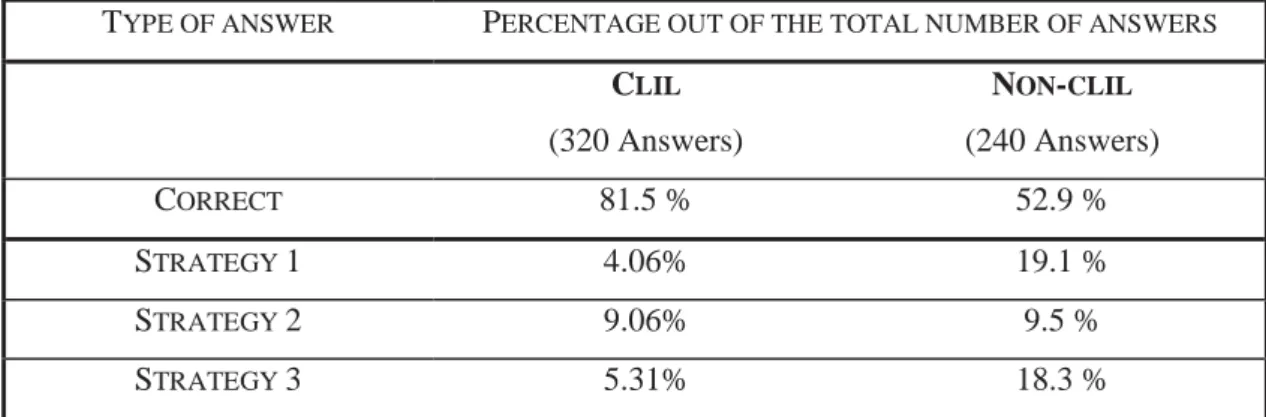
CLIL and non-CLIL students’ performance results of Test 1 can be seen in Table 5:
Table 5: OverallResults of CLIL and Non-CLIL Students in Test 1
The total number of answers in the CLIL group was 320 (32 students completing 10 sentences). CLIL students selected the correct meaning for the stimulus sentences 81.5% of the times and, in the rest of the cases, that is, whenever they had to use a strategy to decipher the meaning of the phrasal verb, 4.06% used strategy 1, 9.06% strategy 2, and 5.31% strategy 3.
Meanwhile, the total number of answers in the non-CLIL group was 240 (24 students completing 10 sentences). Non-CLIL students selected the correct meaning for the stimulus sentences 52.9% of the times and whenever they used a strategy to
TYPE OF ANSWER PERCENTAGE OUT OF THE TOTAL NUMBER OF ANSWERS
CLIL
(320 Answers)
NON-CLIL
(240 Answers)
CORRECT 81.5 % 52.9 %
STRATEGY 1 4.06% 19.1 %
STRATEGY 2 9.06% 9.5 %
21 decipher the meaning of the phrasal verb they used mostly strategies 1 and 3 (19.1% and 18.3%, respectively). Only 9.5% of non-CLIL students used strategy 2 to guess the meaning of the phrasal verb.
According to these results, CLIL students were more accurate than non-CLIL students in selecting the correct answer for the stimulus sentences. Whenever CLIL students did not select the correct answer, they relied more on strategy 2 (interpreting the verb or the P in isolation) than on the other two strategies, although the difference is not too broad. Meanwhile, non-CLIL students relied more on strategy 1 (using information from the verb and the particle) closely followed by strategy 3 (looking for a non-literal interpretation of the phrasal verb), being strategy 2 the less preferred among them.
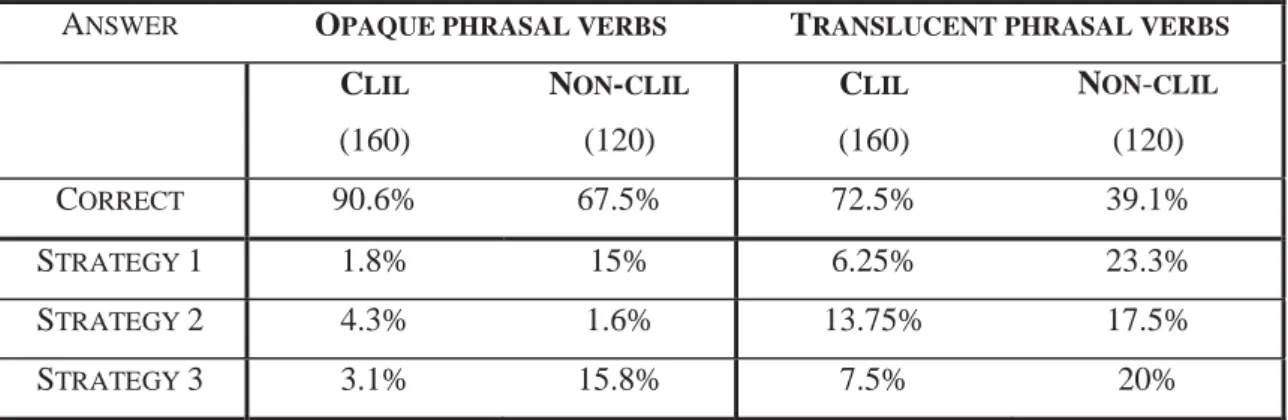
In order to observe if a higher or lower degree of opaqueness in the phrasal verbs involved in Test 1 had any influence on these results, we show in Table 6 the answers provided by the participants according to the opaqueness-transparency scale variable.
Table 6: Phrasal Verb Opaqueness-Transparency
ANSWER OPAQUE PHRASAL VERBS TRANSLUCENT PHRASAL VERBS
CLIL
(160)
NON-CLIL
(120)
CLIL
(160)
NON-CLIL
(120)
CORRECT 90.6% 67.5% 72.5% 39.1%
STRATEGY 1 1.8% 15% 6.25% 23.3%
STRATEGY 2 4.3% 1.6% 13.75% 17.5%
STRATEGY 3 3.1% 15.8% 7.5% 20%
100% CLIL = 160 answers (32 students x 5 opaque phrasal verbs) 100% non-CLIL = 120 answers (24 students x 5 opaque phrasal verbs)
22 When CLIL students had to decipher opaque phrasal verbs, they preferred strategy 2 (4.3%) over the other two; on the other hand, non-CLIL students preferred strategy 3 (15.8%) closely followed by strategy 1 (15%). Both groups had more difficulties with translucent phrasal verbs; however, they did not change the strategies used to decipher the opaque verbs meaning from those used to decipher translucent ones although strategy 1 is a bit more preferred when deciphering translucent ones by non-CLIL students.
6.2.TEST 2RESULTS:SYNTACTIC DIMENSION
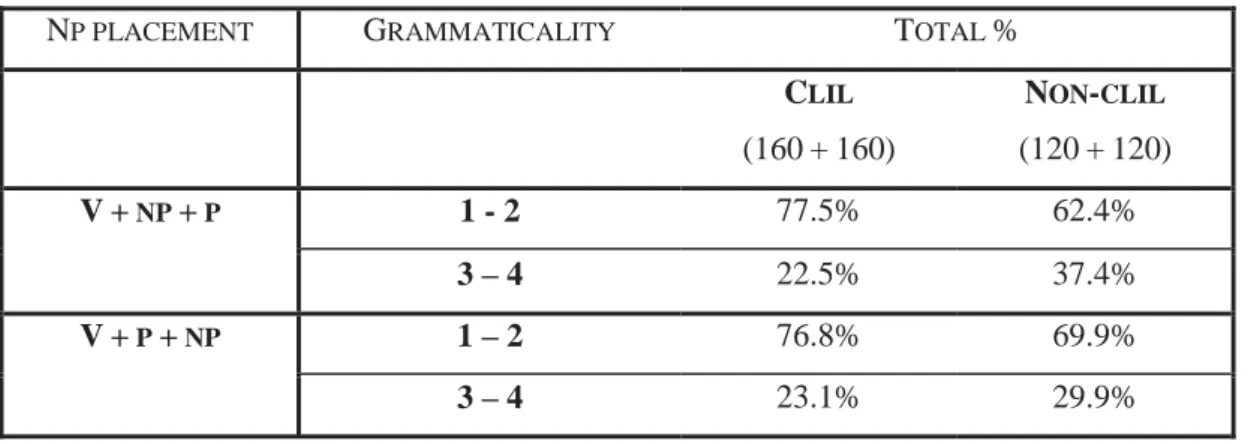
Results from Test 2 were analyzed according to two criteria: the position of the NP and the position of the pronoun within the phrasal verb. Tables 7 and 8 reflect the results according to these criteria.
Table 7: NP Position within the Phrasal Verb
NP PLACEMENT GRAMMATICALITY TOTAL %
CLIL
(160+160)
NON-CLIL
(120+120)
V+ NP + P 1 - 2 77.5% 62.4%
3 – 4 22.5% 37.4%
V+ P + NP 1 – 2 76.8% 69.9%
3 – 4 23.1% 29.9%
100% CLIL = 160 answers (32 students x 5 V+NP+P) / 100% CLIL = 160 answers (32 students x 5 V+P+NP)
100% non-CLIL = 120 answers (32 students x 5 V+NP+P) / 100% non-CLIL = 120 answers (32 students x 5 V+P+NP)
All the sentences involving a simple NP were grammatically correct; the aim
was to check if participants had a preference for either of the simple NP positions in the phrasal verb.
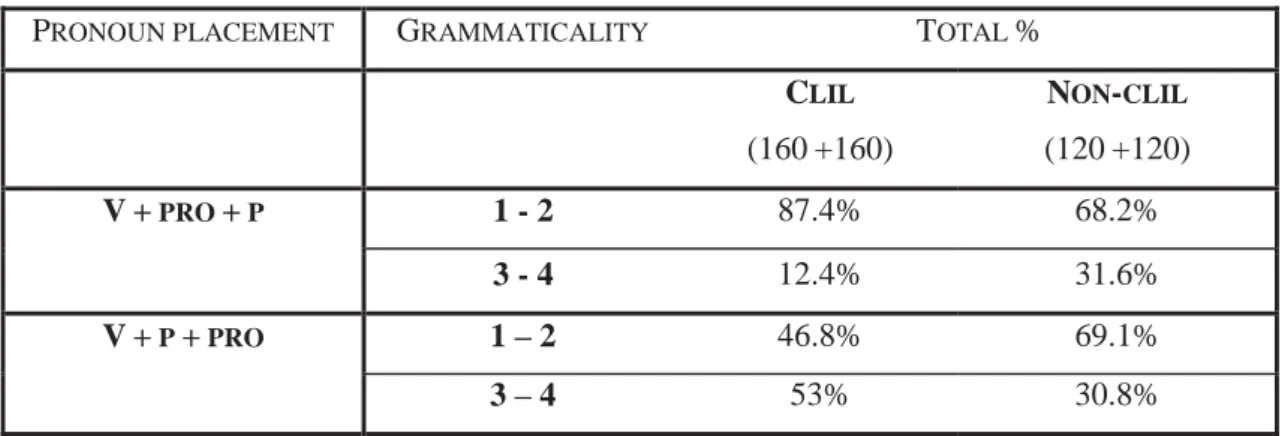
23 Table 8 shows the results of CLIL and non-CLIL students’ judgements on the sentences that included a pronoun before and after the particle:
Table 8: Pronoun Position within the Phrasal Verb
PRONOUN PLACEMENT GRAMMATICALITY TOTAL %
CLIL
(160+160)
NON-CLIL
(120+120)
V+ PRO + P 1 - 2 87.4% 68.2%
3 - 4 12.4% 31.6%
V+ P + PRO 1 – 2 46.8% 69.1%
3 – 4 53% 30.8%
100% CLIL = 160 answers (32 students x 5 V+Pro+P) / 100% CLIL = 160 answers (32 students x 5 V+P+Pro)
100% non-CLIL = 120 answers (32 students x 5 V+Pro+P) / 100% non-CLIL = 120 answers (32 students x 5 V+P+Pro)
In the case of deciding whether the pronoun was grammatically correctly placed before or after the particle, CLIL and non-CLIL students performed differently.
In the sentences where the pronoun was placed before the P, most of CLIL students judged the sentence as grammatically correct (66.8%), and a similar behavior is found in non-CLIL students who mostly (68.2%) did also judge this structure as grammatically correct.
In the case of the sentences in which the pronoun was placed after the P, although they did not show themselves so categorical in their judgement as with the other type of sentences (53% as grammatical vs. 46.8% as ungrammatical), most CLIL students judged them as grammatically incorrect. However, in the case of non-CLIL students, most of them (69.1%) considered the structure V+P+Pro grammatically correct, judging them in a similar proportion as the structure V+Pro+P (69.1% and 68.2%, respectively).
7. DISCUSSION AND CONCLUSIONS
24 the semantic dimension of phrasal verbs, stated that CLIL students would make more use of strategy 3 and non-CLIL students would make more use of strategies 1 and 2 in Test 1. This hypothesis was partly refuted. First, although CLIL students performed better in choosing the correct answers (maybe due to the higher amount of input they receive), when providing a wrong one, they preferred strategy 2 (deciphering the meaning of the phrasal verb based on the core meaning of its verb or particle in isolation).
Non-CLIL students were not so accurate in this test. They selected the correct meaning 53.9% of the times. CLT education may have played a role in these results since non-CLIL students receive less L2 input than CLIL students. Moreover, whenever they did not choose the correct answer, they preferred strategies 1 and 3. This indicates that they know that phrasal verbs are units of two elements, but they tend to interpret them as two elements which mean the same as in isolation (strategy 1) or they invent a new meaning (strategy 3) due to the context or due to analogy with a phrasal verb they know.
Regarding phrasal verb opaqueness, we observed that both groups performed better in selecting the correct meaning of opaque phrasal verbs rather than that of
translucent ones. This is something unexpected since it is easier to decipher the meaning of translucent phrasal verbs due to their higher relation between the meaning of their
constituents and their meaning as a unit. This could also be the reason why they were less accurate; maybe the more they relate the meaning of the verb of a phrasal verb to the meaning of a lexical verb they know, the less they see their unity of meaning. This is, the less opaque a phrasal verb is, the more the students rely on its constituents to decipher its meaning since they relate it to a lexical verb in isolation (strategy 2 in CLIL students) or to both constituents separately (strategy 1 in non-CLIL students). This observation could serve as a confirmation of what some linguists argue (Fraser, 1976; Wurmbrand, 2000): opaque phrasal verbs are considered the “true” phrasal verbs since their meaning creates a unit in the mind of the users more than those which are more transparent.
25 pronoun and which position of the NP they preferred within transitive phrasal verbs. With regards to the position of the NP, before or after the P, neither CLIL nor non-CLIL groups of students show a preference for neither structure, making evident that they are aware that both positions are correct.
The results of the sentences with a pronoun as a DO were different. When the sentence included a pronoun in its grammatically correct position (before the P), 87.4% of the CLIL students selected it as the correct option, while only 68.2% of the non-CLIL students chose this option, which shows that the latter group had more difficulties in finding this structure as correct or incorrect.
It can be concluded that CLIL students outperformed non-CLIL ones when dealing with the semantic dimension of phrasal verbs since they selected the correct meaning of the phrasal verb involved in almost all the cases while non-CLIL students selected the correct answer half of the times. The reason for this better CLIL performance could lie in the fact that, while CLT education is not so centered in the exposure to the L2, the education that CLIL students receive is more content oriented, trains them in being more intuitive with certain grammatical structures, and exposes them more frequently to the language (three times more input of English than non-CLIL
students).
In the case of syntax, both groups made similar choices when deciding the
position of the NP in a phrasal verb; however, when they had to decide on the correct position of pronouns in phrasal verbs, CLIL students performed better than non-CLIL
ones although, since the difference in choosing the correct position between both groups was not so categorical as in the structure with the NP, both groups are in the process of mastering the order of pronouns in phrasal verbs. Nevertheless, CLIL students go a step further than non-CLIL ones in the mastering of pronouns, since they performed better in selecting their correct position.
26 All in all, CLIL education has proven to be more effective when dealing with the understanding of phrasal verbs. However, when the use of phrasal verbs is at stake, neither CLIL or non-CLIL education has proven to be radically more effective regardless of the difference in L2 input since the syntactic dimension seems to be acquired later than the semantic one. Nevertheless, results show that CLIL students master the syntax of phrasal verbs in a higher degree than non-CLIL ones even if this difference is not categorical.
27
8. REFERENCES
Barwell, R., 2005. “Critical Issues for Language and Content in Mainstream Classrooms: Introduction.”Linguistics Educ.16: 143-150.
Bruton, A., 2013. “CLIL: Some of the Reasons Why … and Why Not.”System 41: 587-597. Cappelle, B., Y. Shtyrov, and F. Pulvermüller, 2010. “Heating Up Or Cooling Up the Brain?
MEG Evidence that Phrasal Verbs are Lexical Units.”Brain and language 115: 189-201.
Casenhiser, D. and A. E. Goldberg, 2005. “Fast Mapping between a Phrasal Form and Meaning.”Developmental Science 8.6: 500-508.
Collins Birmingham University International Language Database, 1990. Collins Cobuild Dictionary of Phrasal Verbs. Collins.
Crutchley, A., 2007. “Comprehension of Idiomatic Verb Particle Constructions in 6- to 11-Year-Old Children.”First Language 27.3: 203-226.
Dalton-Puffer, C., 2007. Discourse in "Content and Language Integrated Learning" (CLIL) Classrooms. Amsterdam: John Benjamins.
Dobson, A., M. D. Pérez Murillo and R. Johnstone, 2010. Programa de Educación Bilingüe en España: Informe de la Evaluación. Spain: British Council.
Ellis, R., 2009. “Task-Based Language Teaching: Sorting Out the Misunderstandings.” Int. J. Appl. Linguistics 19: 221-246.
Farrell, P., 2005. “English Verb-Preposition Constructions: Constituency and Order.”Language
81.1: 96-137.
Fraser, B., 1976. The Verb–Particle Combination in English. New York: Academic Press.
Haegeman, L. and J. Guéron, 2002. English Grammar: a Generative Perspective. Blackwell.
Hare, A., 2010. Incidental Phrasal Verb Acquisition through Second Language Reading. MA thesis. Concordia University, Canada.
Khalaili. K and B. Marina, 1991. English Phrasal Verbs in Spanish. Hong Kong: Thomas Nelson Ltd.
Manzano Vázquez, B., 2013. “Lexical Transfer in the Written Production of a CLIL Group and a Non-CLIL Group.”International Journal of English Studies 14.2: 57-76.
Marsh, D., 2002. CLIL/EMILE. The European Dimension. Actions, Trends, and Foresight Potential. Jyväskylä: University of Jyväskylä.
28
Mukundan, J. and A. Zarifi, 2013. “Selection and Presentation of Phrasal Verbs in ESL Textbooks.” Theory and Practice in Language Studies 3.10: 1821-1829.
Oxford University Press. Oxford English Dictionary Online. Web.
http://www.oxforddictionaries.com/es (accessed April 28, 2015)
Pérez Cañado, M. L., 2012. “CLIL research in Europe: Past, Present and Future.”International Journal of Bilingual Education and Bilingualism 15.3: 315-341.
Quirk, R et al., 1985. A Comprehensive Grammar of the English Language. Longman.
Saorín Ibarra, A. M., 2003. Las Cartas de Queja en el Aula de Inglés para Turismo: Implicaciones Pedagógicas Basadas en el Uso de Recursos de Cortesía. “Capítulo 1: El
Inglés como Lengua Internacional.” PhD. Diss. University of Jaume I, Castellón de la Plana.
Villoria, J., S. Hughes and D. Madrid, 2011. “Learning English and learning through English.”
Studies in Bilingual Education, 157-194. Frankfurt am Main: Peter Lang.
Wiesemes, R., 2009. “Developing Theories of Practices in CLIL: CLIL as Post-Method Pedagogies?” Content and Language Integrated Learning: Evidence from Research in Europe: 41-59. Bristol: Multilingual Matters.
29
9. APPENDIXES
9.1.APPENDIX 1:BACKGROUND QUESTIONNAIRE,TEST 1 AND TEST 2
BACKGROUND QUESTIONNAIRE
1. Name: __________
2. Age: ____________
3. Grade: _________
4. Sex: Male Female
5. At what age did you start studying English?_________
6. Do you take extra English classes outside school? Yes No
If your answer is “yes,” how many hours per week do you take? ___
7. Do you attend the British program? Yes No
If so, which of the following subjects do you learn in English?
30
TEST 1
Select the best meaning for the following sentences in bold type (only one answer is correct):
1. Jack didn’t know what “platypus” meant, so he had to look it up in a dictionary.
a) Jack looked upwards for a dictionary. Strategy 1: core meaning of “look” (to stare) and “up” (as an
adverb meaning “towards the top”)
b) Jack searched for “platypus” in a dictionary. Correct
c) Jack stared at a dictionary. Strategy 2: Core meaning of “look”
d) Jack admires the dictionary. Strategy 3: Analogy with the phrasal verb “look up to sb/sth”
2. Alice has started learning the violin. She’s picking it up really quickly.
a) She can lift it over her head easily. Strategy 1: core meaning of “pick” (in the sense of “lifting”) and “up” (as an adverb meaning “upwards”)
b) She plays very fast. Strategy 3: Meaning extracted from context (focusing on the adverb “quickly”) c) She is learning it easily. Correct
d) She can take it with her handStrategy 2: Core meaning of “pick”
3. John drew a funny picture of his teacher in his book. When the teacher saw it, she crossed it out.
a) The teacher took the picture outside the classroom while drawing lines on top of it. Strategy 1: core
meaning of “cross” (to draw lines on top of sth)and “out” (as a preposition meaning “outside of”) b) The teacher made the book go through the door. Strategy 2: Core sense of “cross” (go through)
c) The teacher saw the drawing and tore it to pieces. Strategy 3: Non-literal meaning based on the context
(Participants know the picture is something bad and that the teacher must be angry. Connecting these two
ideas they may think, since they do not know the meaning of the phrasal, that the teacher was so angry that
she destroyed the picture).
d) The teacher drew some lines on top of the picture. Correct
4. During the English class, the teacher told John to read the book out.
a) John took the book out of the classroom and read it there. Strategy1: core meaning of “read” (known by
the student) and “out” (as a preposition meaning “outside of”)
b) John read the book aloud. Correct
c) John read the book for himself. Strategy2: Core meaning of “read”
d) John was told to retrieve the information stored in the book. Strategy 3: Different meaning of the phrasal verb “read out” (to retrieve information)
5. John was feeling very sick and he threw up all his breakfast.
a) John threw the breakfast upwards across the air. Strategy 1: core meaning of “throw” and “up” (as an
adverb meaning “towards the top” )
b) John didn’t eat his breakfast because he was sick. Strategy 3: Meaning extracted from context (meaning deciphered by looking at the context)
c) John vomited all his breakfast. Correct
31
6. During the house party, John kicked his best friend out because he was too drunk.
a) John hit his best friend with his foot. Strategy 2: Core meaning of “kick”
b) John and his best friend kicked each other outside John’s house party. Strategy 1: Meaning deciphered by interpreting “kick” as “kick with the foot” and “out” as an adverb meaning “in the open air.”
c) John and his best friend fought against each other. Strategy 3: Connection of concepts included in the
context: Verb “kick”(in the sense of “hit with the foot”) + adjective “drunk” involving trouble and a
fight.
d) John forced his best friend to leave the party. Correct
7. John ate out four times this week. Now he has no money left.
a) John took his food outside his house to eat it four times this week. Strategy 1: core meaning of “eat” and “out”(as an adverb meaning “in the open air”)
b) John dined at a restaurant four times this week. Correct
c) John consumed food four times this week. Strategy 2: Core meaning of “eat”
d) John spent a lot of money in the supermarket this week. Strategy 3: Meaning extracted from context:
relying on the main concept (lack of money) of the second sentence.
8. John’s dog suffered from an illness and he had to put it down.
a) John placed his dog on the floor. Strategy 1: core meaning of “put” (to place sth somewhere) and
“down” (as an adverb meaning “on the floor”)
b) John killed his dog because it was suffering. Correct
c) John took his dog to the ground floor of the building. Strategy 2: Interpret the particle “down” in
isolation in the sense of “from a higher to a lower position.”
d) John’s dog was suffering from an illness and he wrote about it. Strategy 3: Different interpretation of the phrasal verb “put down” (to write; to make note of something)
9. Alice dressed up to go to the opera with John.
a) Alice dressed as a witch to go to the opera. Strategy 3: Another meaning of the phrasal verb “dress up”
(to dress in a costume)
b) Alice got dressed upstairs to go to the opera.Strategy 1: core meaning of “dress” and “up” (as an adverb
meaning “upstairs”)
c) Alice wore her best clothes to go to the opera. Correct
d) Alice put on clothes to go to the opera. Strategy 2: Core meaning of dress (to put clothes on)
10. John bought Alice chocolate ice cream to cheer her up after knowing she had failed the exam.
a) John bought chocolate ice cream and encouraged Alice with shouts until she woke up. Strategy 1: core meaning of “cheer” as “encourage with shouts” and “up” as an adjective meaning “risen from bed”.
b) John bought chocolate ice cream to congratulate Alice. Strategy 2: Core meaning of “cheer” (“to
congratulate”)
c) John bought Alice chocolate ice cream to keep her from thinking of the exam. Strategy 3: Interpretation
of the phrasal verb extracted from the context (Alice had failed the exam so she must be sad and John
brings her chocolate ice cream so she does not think of the exam)
32 TEST 2
Read the following sentences and decide how grammatically correct they are in a scale from 1 to 4: (1 = Grammatically CORRECT; 4 = Grammatically INCORRECT):
1. Jack gets up at 6 am to go to school.
1 2 3 4
2. Matthew works out 3 hours per week.
1 2 3 4
3. I love water skiing; I will take it up next semester.
1 2 3 4
4. That TV is distracting me. Could you, please, turn off it?
1 2 3 4
5. Jack will have to set off early in order to arrive in time for dinner.
1 2 3 4
6. Lucy’s not home now; she’ll come back in a few hours.
1 2 3 4
7. My brother and I always stop off to visit our parents on Sundays.
1 2 3 4
8. I’ll be glad to put my friends up when they come to visit me.
1 2 3 4
9. James is ill today so he put off the party until Saturday.
1 2 3 4
10. The story she told her parents was a lie! She made it up so they wouldn’t punish her.
1 2 3 4
11. Jack turned up at the party even if he wasn’t invited.
1 2 3 4
12. We said we wouldn’t talk about the subject but she brought up it when I least expected it.
1 2 3 4
13. Lucy turned down the job offer because she had a job already.
1 2 3 4
14. Matthew’s dog was very ill and he had to put him down.
1 2 3 4
15. It was very hot in the room and Lilly passed out.
1 2 3 4
16. Our house was on fire but the firefighters put out it.
1 2 3 4
17. My parents often fall out when they try to cook together.
33
18. Jack called the party off because he broke a leg playing football.
1 2 3 4
19. The criminals killed an old lady and made off in a motorcycle.
1 2 3 4
20. Last night, Matthew came over to watch a movie
1 2 3 4
21. The little girl was anxious to blow out the candles on the cake.
1 2 3 4
22. The soldiers blew up the bridge.
1 2 3 4
23. Lilly had a great fortune and she gave away it to charitable foundations.
1 2 3 4
24. Jack had to go to the doctor so his mother picked him up from school early.
1 2 3 4
25. The students handed the exams in to the teacher.
1 2 3 4
26. Check that guy out! He’s so handsome!
1 2 3 4
27. A child took a cigarette from the street and his mother told him to throw away it.
1 2 3 4
28. The criminal was hidden behind a wooden door and the policemen broke it down using their feet.
1 2 3 4
29. Jack helped his friend out when he needed money to buy a new computer.
1 2 3 4
30. Lily had to wrap up the gift before going to Jack’s party.
1 2 3 4
Glossary
Blow out: Extinguish Blow up: Explode
Break down: Knock down a door Bring up: Mention a subject in a conversation
Call off: Cancel a planned event Check out: Look at someone or something
Come back: Return Come over: Pay a visit Fall out: Quarrel Get up: Rise from bed
Give away: Give free of charge Help out: Give assistance to somebody Hand in: Submit
Make off: Escape; run away Make up: Invent; create
Pass out: Faint; lose consciousness Pick up: Collect in a vehicle Put down: Kill an animal as an act of mercy
Put off: Delay until later Put out: Extinguish a fire
Put up: Accommodate somebody Set off: Begin a journey Stop off: Stay briefly Take up: Start a hobby or sport Throw away: Get rid of something; dispose of something
Turn down: Decline; refuse Turn off: Disconnect Turn up: Arrive unexpectedly Work out: Engage in vigorous physical exercise
34
9.2APPENDIX 2:CLASSIFICATIONS OF PHRASAL VERBS
9.2.1 CLASSIFICATION OF PHRASAL VERBS ACCORDING TO THE OPAQUENESS -TRANSPARENCY SCALE
PHRASAL VERB TRANSLUCENT OPAQUE
Look up X
Pick up X
Cross out X
Read out X
Throw up X
Kick out X
Eat out X
Put down X
Dress up X
Cheer up X
9.2.2 CLASSIFICATION OF PHRASAL VERBS ACCORDING TO SYNTAX
NO DO DO BETWEEN VERB
AND PARTICLE
DO AFTER
PARTICLE
VI
(DISTRACTORS)
Get up Work out Set off Come back Stop off Turn up Pass out Fall out Make off Come over
VT SEP
(NP AS DO)
Put up Call off Hand in Check out Help out Put off Turn down Blow out Blow up Wrap up
VT SEP
(P AS DO)