Direct medical costs of treating Mexican children under 2 years of age
with respiratory syncytial virus
r
esearch
article
Joaquín F. Mould-Quevedo,
1Iris Contreras-Hernández,
2Silvia Martínez-Valverde,
3Miguel A.
Villasís-Keever,
4Víctor M. Granados-García,
5Guillermo Salinas-Escudero,
3Onofre Muñoz-Hernández
3ABSTRACT
Background. Respiratory syncytial virus (RSV) is the most frequent etiologic agent causing lower respiratory tract infection in children <2
years of age. Between 0.5 and 3% of patients will require hospitalization. The aim of this study was to estimate the direct medical cost of treating children <2 years old with suspicion of RSV at the Instituto Mexicano del Seguro Social (IMSS).
Methods. Direct medical costs were estimated from an institutional perspective. Medical records were reviewed from patients <2 years
of age who attended emergency services in second-level hospitals including subjects who required hospitalization. Estimated costs were obtained with the microcosting technique using the institutional costs from IMSS (year 2010). Costs were reported in USD (year 2011).
Results. When analyzing total medical costs, outpatient management yielded a cost of $230.0 ± $10.30 U.S. dollars (USD), whereas
hospitalized patients exhibited an average cost of $8,313.20 ± $595.30 USD. The main components of outpatient management costs were emergency visits, specialist consultations and diagnostic testing (41.6%, 32.7% and 10.7% of the total cost, respectively). In the case of hospitalized patients, intensive care unit cost (89.3%) and overall hospitalization cost (6.5%) represented 95.7% of the total cost.
Conclusions. RSV is a disease that represents a significant economic burden for health care institutions, although most patients are
treated on an outpatient basis.
Key words: direct medical costs, respiratory syncytial virus, microcosting.
1 Health Economics and Outcomes Research Director, Latin
Ame-rica and Primary Care Products, Pfizer Laboratories, Mexico, D.F., Mexico
2 Hospital General de Zona 1-A “Venados”, Instituto Mexicano
del Seguro Social (IMSS), Mexico, D.F., Mexico
3 Centro de Estudios Económicos y Sociales en Salud (CEESES),
Hospital Infantil de México Federico Gómez, Mexico, D.F., Mexico
4 Unidad en Investigación en Epidemiología Clínica, Hospital de
Pediatría, Centro Médico Nacional Siglo XXI, IMSS, Mexico, D.F., Mexico
5 Unidad de Investigación de Economía de la Salud, IMSS,
México, D.F., México Received for publication: 3-16-12 Accepted for publication: 4-4-12
INTRODUCTION
Respiratory syncytial virus (RSV) is the most frequent
etiologic agent that causes lower respiratory tract infection
in children <2 years of age.
1It is generally a benign disea
-se; however, between 0.5 and 3% of patients will require
hospitalization.
2Between 30% and 40% of children will
have a lower respiratory tract infection,
2-5and it is
consi-dered to be the principal cause of bronchiolitis (60-80%)
and pneumonia (20-40%) in infants, which represent the
most common clinical presentations.
6There are reports of epidemiological surveillance in
Mexico that make it possible to determine that circulation
of respiratory viruses during winter months is similar to
that of other countries.
7Etiologically, studies by Muraira
highest costs were those reported in the U.S. where the
costs per hospital admission for RSV ranged from $3,799
USD to $9,000 USD.
17,18In Mexico there is no information regarding the costs
involved in the care of patients with RSV; therefore, its
impact on health institutions and society is unknown. Even
with a high incidence of disease, the majority of RSV
infections do not require medical care (ambulatory and/
or hospital). However, taking into consideration the high
impact of this disease and its impact on high-risk groups
(such as patients with heart disease who do require medical
attention), carrying out a study that provides information
to assist decision-makers in regard to resource allocation
and planning within health institutions for management
of RSV and its complications in Mexico is warranted.
In this regard, the objective of this study was to identify
the management pattern of those patients who receive
medical care for suspicion of RSV infection (with hospital
and/or ambulatory management) within the public health
system and the estimated direct medical costs associated
with patient management.
MATERIALS AND METHODS
Given that the public health institutions cover more than
two-thirds of the Mexican population, the analysis was
conducted from the perspective of the public health
insti-tutions where information from Hospital General Regional
of the Instituto Mexicano del Seguro Social (IMSS) located
in Mexico City was used. This hospital is representative of
a second-level care facility within the IMSS. To reference
the importance of the IMSS, this institution covers 80.8%
of the social security services in Mexico.
19A descriptive, cross-sectional, retrospective study was
performed and included all patients who were seen from
January 2006 to December 2009 in the emergency room
and/or were hospitalized with suspicion of bronchiolitis
or pneumonia. All patients with gastroesophageal reflux
disease, patients with lipoidic pneumonia or with airway
malformations were excluded.
A review of medical records was done using a survey
that identified the principal demographic and clinical
characteristics of the patients (gender, age, weight, height)
as well as resources utilized for their management (dose,
frequency, duration, quantities, etc.). This review covered
information up to 1 year of patient follow-up from the
initial contact in case the patient returned to the hospital
due to a complication related to the first encounter. The
survey used was previously validated in a pilot study by
a group of medical experts within the hospital.
Cost analysis was carried out using a case-mix te
-chnique. In the case of services used, unit costs were
determined, whereas for estimation of drug costs, the
microcosting technique was used (adjusting the
calcu-lation according to the presentation and corresponding
unit price).
Sources of information used were costs of institutional
care (IMSS 2010)
20and unit costs for purchasing drugs by
the IMSS during 2010.
21Due to the duration of the study,
no discount rate in the costs is used.
Total costs were divided according to the principal cost
components and according to whether they corresponded
to ambulatory and/or hospital medical care. For each
component percentage of utilization, average values of
the monetary equivalent expressed in Mexican pesos (year
2010) were presented as well as its standard deviation
(SD) and/or resource utilization rates. To generate more
robust estimates in the estimation of the SD of the costs,
adjustment by means of the bootstrap technique was used.
22For statistical analysis, Excel 2007 and Stata v.10 software
were used. Results are reported in USD where an exchange
rate of $12 Mexican pesos to $1 USD was used.
23RESULTS
A total of 74 patients who were treated during the study
period were analyzed; 46% (
n
= 34) were managed as
outpatients and 54% (
n
= 40) required hospitalization.
Among the principal characteristics of the patients,
fe-males represented 52.7% of the sample. Average age of
the patients was 10.78 (±8.2) months. Average weight
was 8.23 (±2.5) kg and average height was 68.0 (±10.0)
cm (Table 1).
89.3% and general hospitalization 6.5%), placement of
central venous catheter (CVC) 2.0%, interconsultations
0.7%, and ventilatory support and diagnostic/imaging
studies 0.5%. The remainder of the resources used repre
-sented 0.2%.
DISCUSSION
Emergency services in the IMSS hospitals have a specified
length of stay in the emergency room as a maximum of 3 h.
One of the important findings in this study was that 20% of
the patients exceeded the specified waiting times. Another
important finding in the review of the medical records
and which was widely discussed with the physicians was
the existing problem of lack of rapid diagnostic tests to
confirm the etiology of the cases treated in the emergency
department, which leads to the following three problems:
1) Without a supportive diagnosis, an increased length
of stay in the emergency department is generated in
order to assess patient progress.
2) Lack of accurate diagnosis implies that, in some
ca-ses, antibacterial coverage was administered to the
patient with this type of infection.
3) Increase in wait time in the emergency room gene
-rates a saturation of service and high costs for other
patients who arrive for such services.
These three factors increase the actual cost of treatment
of patients with RSV within the institution.
When comparing the costs obtained per episode of
outpatient management of $230 USD in this study with
those costs reported in Germany by Ehlken et al. ($99.20
USD),
13we find that the cost obtained in our study is
almost 2.3 times greater. Similarly, we found that our co
-Table 1. General characteristics of patients
Variables
Ambulatory management
In-hospital management n = 34 n = 40 Mean SD Mean SD Age (months) 13.44 11.64 8.52 5.28 Weight (kg) 8..68 3.04 7.85 2.04 Height (cm) 69.52 11.36 66.90 8.93 Male (%) 52.0 42.5
SD, standard deviation
Table 2. Patient utilization of resources during emergency consult
Variables Ambulatory management n = 34 Mean SD Shift time in emergency service 1.79 0.20 Time of stay (h) 5.89 1.82 Emergency consults 1.00 -Interconsults 1.70 0.29 Laboratory tests 1.94 0.19 Diagnostic studies 1.05 0.05 SD, standard deviation.
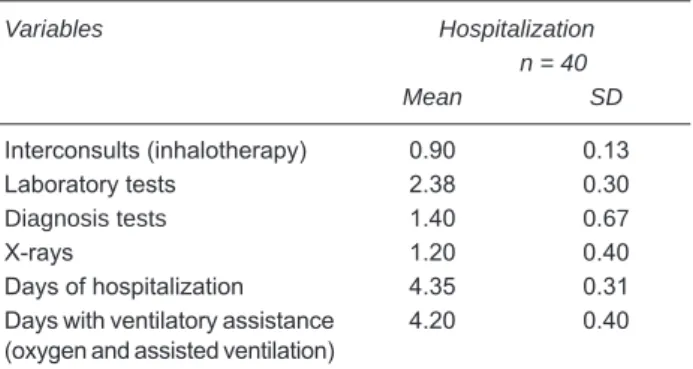
patients, it is necessary to add the resources previously
reported for outpatient management. The resources de
-tailed here correspond to hospital management (Table 3).
Patients managed in the hospital had an average
hos-pital stay of 4.35 ± 2.6 days; 98% of patients required
ventilatory therapy support, 90% required an additional
consultation and a new battery of diagnostic and laboratory
studies. Total average cost for patients who received out
-patient management was $230.0 ± $10.35 USD, whereas
for patients admitted to the hospital the average cost was
$8,313.2 ± $595.36 USD (Table 4).
In patients with outpatient management, a percentage
of the total costs were for emergency room consultation
(41.6%), interconsultation (32.7%), diagnostic/imaging
studies (10.7%), costs for venous infusion (7.1%), labo
-ratory tests (5.9%) and, finally, medications and solutions,
which together represent 1.9%.
In those patients requiring hospital management, the
principal component of the total cost was represented by
hospitalization (95.7% of the total cost, intensive care
Table 3. Patient utilization of resources during hospitalization
Variables Hospitalization n = 40
Mean SD
Interconsults (inhalotherapy) 0.90 0.13 Laboratory tests 2.38 0.30 Diagnosis tests 1.40 0.67
X-rays 1.20 0.40
Days of hospitalization 4.35 0.31 Days with ventilatory assistance
rresponding costs for hospital management reported in our
study ($8,313 USD) were greater than those reported by
Miedema et al.
15($2,200 USD) and Diez Domingo et al.
16($2750 USD) for various European countries; however,
these were found to be within the range of those reported
for the U.S. Health System by Stewart et al.
17and Pelletier,
et al.
18of $3,800 USD-$9,000 USD.
Information reported in this study may be valuable
in terms of management for decision-makers because it
identifies two main aspects: 1) to obtain costs associated
with management of patients presenting to medical
servi-ces with RSV and 2) to identify a niche of opportunity to
improve patient management with the use of rapid
diag-nostic tests and to improve utilization of resources within
emergency services of the institution. Performance of these
tests does not necessarily establish the best alternative;
however, it provokes an opportunity for possible further
studies including patient characteristics, cost-effectiveness
or cost-benefit for the patient and/or institution.
One of the limitations of this study is that the corres
-ponding information regarding patient severity was not
included, which may provide additional information to
explain the somewhat prolonged observation of patients.
Finally, we are aware that the use of medical records as
a source of information to determine resource utilization
may be a limitation due to underreporting of information
normally associated with these types of clinical records.
Estimating the management of patients <2 years of
age who seek public health services with suspicion of
RSV represented an average direct medical cost of $275
USD in the case of patients managed on an outpatient
basis and $7,739 USD in the case of patients requiring
hospitalization.
Corresponding author
: Mtro. Guillermo Salinas Es
-cudero, CEESES, Hospital Infantil de México Federico
Gómez, Dr. Márquez 162, segundo piso, Col. Doctores,
Delegación Cuauhtémoc, 06720 México, D.F., México.
Tel: 52289917, ext. 3001.
E-mail: [email protected]
REFERENCES
1. Levy BT, Graber MA. Respiratory syncytial virus infection in infants and young children. J Fam Pract 1997;45:473-481.
Table 4. Treatment costs in USD
Variables Patient with ambulatory management (emergencies)
Patient with in-hospital management
Mean SD Mean SD
Emergency consults $95.77 — $0.00 —
Interconsults $75.33 $7.28 $62.25 $5.00
Hospitalization $0.00 — $537.30 $67.47
Surgical procedure*,† $16.24 $2.79 $167.91 $13.77
Ventilatory support (assisted ventilation) $0.00 — $39.87 $7.85
Intensive therapy $0.00 — $7,421.69 $550.97
Oxygen $0.00 — $7.22 $5.12
Laboratory tests $13.62 $1.34 $16.67 $2.06
Diagnosis tests $24.59 $1.38 $43.34 $8.87
Antibiotics (emergencies/hospitalization) $0.09 $0.05 $4.49 $0.86 Medications (emergencies/hospitalizations) $2.81 $1.37 $9.59 $2.35 Solutions emergencies/hospitalizations) $0.27 $0.58 $0.75 $0.13
Discharge medications $1.25 $0.48 $1.80 $0.44
Discharge antibiotics $0.08 $0.04 $0.29 0.07
Total $230.08 $10.35 $8,313.21 $595.36
SD, standard deviation.
*Ambulatory venoclysis.
2. Meissner HC, Welliver RC, Chartrand SA, Law BJ, Weisman LE, Dorkin HL, et al. Immunoprophylaxis with palivizumab, a humanized respiratory syncytial virus monoclonal antibo-dy, for prevention of respiratory syncytial virus infection in high risk infants: a consensus opinion. Pediatr Infect Dis J 1999;18:223-231.
3. Wright AL, Taussig LM, Ray CG, Harrison HR, Holberg CJ. The Tucson Children’s Respiratory Study. II. Lower respi-ratory tract illness in the first year of life. Am J Epidemiol 1989;129:1232-1246.
4. Darville T, Yamauchi T. Respiratory syncytial virus. Pediatr Rev 1998;19:55-61. doi: 10.1542/pir.19-2-55.
5. Dubois B, Ray G. Viral infections of the lower respiratory tract. In: Taussig LM, Landau LI, eds. Pediatric Respiratory Medicine: New York: Elsevier; 1999. pp. 573-579.
6. Murtagh P, Cerqueiro C, Halac A, Avila M, Salomón H, Wis-senbacher M. Acute lower respiratory infection in Argentinian children: a 40 month clinical and epidemiological study. Pediatr Pulmonol 1993;16:1-8.
7. Miranda-Novales G, Solórzano-Santos F, Leaños-Miranda B, Vázquez-Rosales G, Palafox-Torres M, Guiscafre-Gallardo H. Blood culture and respiratory syncytial virus identification in acute lower respiratory tract infection. Indian J Pediatr 1999;66:831-836. doi:10.1007/BF02723847.
8. Muraira GA, Villareal CE, Quiroga GA, Ábrego MV, Duran RAG, Cárdenas CBG, et al. Agentes virales en niños hospitalizados por infecciones respiratorias bajas. Rev Mex Pediatr 2002; 69;185-189.
9. Noyola DE, Rodríguez-Moreno G, Sánchez-Alvarado J, Martínez-Wagner R, Ochoa-Zavala JR. Viral etiology of lower respiratory tract infections in hospitalized children in Mexico. Pediatr Infect Dis J 2004;23:118-123.
10. World Health Organization. Acute respiratory infections (update September 2009). Respiratory syncytial virus and parainfluen-za viruses. Available at: http://www.who.int/vaccine_research/ diseases/ari/en/index2.html
11. Leader S, Kohlhase K. Recent trends in severe respiratory syncytial virus (RSV) among US infants, 1997 to 2000. J Pediatr 2003;143(suppl 5):S127-S132.
12. Langley JM, Wang EE, Law BJ, Stephens D, Boucher FD, Dobson S, et al. Economic evaluation of respiratory syncytial virus infection in Canadian children: a Pediatric Investigators Collaborative Network on Infections in Canada (PICNIC) study. J Pediatr 1997;131:113-117.
13. Ehlken B, Ihorst G, Lippert B, Rohwedder A, Petersen G, Schumacher M, et al. PRIDE Study Group. Economic impact of community-acquired and nosocomial lower respiratory tract infections in young children in Germany. Eur J Pediatr 2005;164:607-615.
14. Banco Nacional de México. Tipo de cambio EUA. Tipo de cambio promedio Dólar/Euro 2005. Available at: http://www. banamex.com/esp/finanzas/historicos/economia_int/ei_eua_ cambio.jsp?init=2005&offset=7
15. Miedema CJ, Kors AW, Tjon A Ten WE, Kimpen JL. Medical consumption and socioeconomic effects of infection with respiratory syncytial virus in The Netherlands. Pediatr Infect Dis J 2001;20:160-163.
16. Díez Domingo J, Ridao López M, Úbeda Sansano I, Ballester Sanz A. [Incidence and cost of hospitalizations for bronchiolitis and respiratory syncytial virus infections in the Autonomous Community of Valencia in Spain (2001 and 2002)]. An Pediatr (Barc) 2006;65:325-330.
17. Stewart DL, Romero JR, Buysman EK, Fernandes AW, Maha-devia PJ. Total healthcare costs in the US for preterm infants with respiratory syncytial virus lower respiratory infection in the first year of life requiring medical attention. Curr Med Res Opin 2009;25:2795-2804.
18. Pelletier AJ, Mansbach JM, Camargo CA Jr. Direct medical costs of bronchiolitis hospitalizations in the United States. Pediatrics 2006;118:2418-2423.
19. Secretaría de Gobernación. Anexo Estadístico Tercer Informe de Gobierno, Felipe Calderón Hinojosa. Estadísticas Nacio-nales. México; 2009. pp. 251-270.
20. Diario Oficial de la Federación. Instituto Mexicano Seguro Social. Costos Unitarios de Atención Médica. May 18, 2010. Available at: http://dof.gob.mx/nota_detalle.php?codigo=514 3097&fecha=18/05/2010
21. Instituto Mexicano del Seguro Social. Portal de Transparencia México. IMSS va a comprar. IMSS compró. January-December 2010. Available at: http://www.imss.gob.mx/transparencia/ Pages/index.aspx.
22. Glick HA, Doschi JA, Sonnad SS, Polsky D. Economic tion in Clinical Trials. Handbooks in Health Economic Evalua-tion. Great Britain: Oxford University Press; 2007. pp. 89-113. 23. Diario Oficial de la Federación. Banco de México. Tipo de