11
thMeeting of the Conference of the Parties to the
Convention on Wetlands (Ramsar, Iran, 1971)
“Wetlands: home and destination”
Bucharest, Romania, 6-13 July 2012
Agenda item XVIII
Ramsar COP11 DR9, REV 1
Draft Resolution XI.9, Rev. 1
An Integrated Framework and guidelines for avoiding, mitigating
and compensating for wetland losses
1. RECALLING that the objective of Contracting Parties, as set out in the preamble of the Convention text, is to “stem the progressive encroachment on and loss of wetlands now and in the future”; that Article 3.1 of the Convention urges Contracting Parties to “formulate and implement their planning so as to promote the conservation of wetlands included in the List, and as far as possible the wise use of wetlands in their territory”; and that Article 3.2 and subsequent Resolutions of the Conference of the Parties express the Parties‟ responsibility to detect, report, and respond to adverse human-induced changes in the ecological character of wetlands included in the List of Wetlands of International Importance (Ramsar Sites);
1bis NOTING that the term “wetland loss” is taken to cover both loss of wetland area and/or the loss or degradation of the ecological character of a wetland, regardless of whether or not there is any change to its overall area;
2. ALSO RECALLING that the Millennium Ecosystem Assessment (MA) reported that
wetlands were being lost and degraded in many parts of the world and at rates faster than other ecosystems, and that such wetland losses and degradation jeopardise the future provision of their ecosystem services to people;
3. CONCERNED that the total area and condition of natural wetlands in many countries,
and the species they support, are still declining;
5. REITERATINGthat,as agreed in Resolution VII.24 on Compensation for lost wetland habitats and other functions, effective wetland protection begins with avoidance of adverse wetland impacts;
6. AWARE that the 10th Meeting of the Conference of the Contracting Parties (COP10)
instructed the Scientific and Technical Review Panel (STRP) to “develop guidance on mitigation of and compensation for losses of wetland area and wetland values, in the context of Resolution X.16 on A Framework for processes of detecting, reporting and responding to change in wetland ecological character, including lessons learned from available information on implementation of „no net loss‟ policies, the „urgent national interest‟ test, and other aspects relating to situations in which Article 2.5 and 4.2 and/or Resolution VII.24 are relevant”;
7. AWARE of the suite of technical and scientific guidelines and other materials prepared by the STRP to support Contracting Parties in their implementation of wetland conservation and wise use and available as the Ramsar Wise Use Handbooks, 4th edition, 2010;
7 bis RECOGNIZING the need for developing countries to design policies that are consistent with their national objectives for the achievement of sustainable development, and aware that these guidelines should be adapted to suit national conditions and circumstances;
8. NOTING that previous Resolutions adopted by the Parties consistently urge that a three-step approach should be taken to responding to current or likely changes in the ecological character of wetlands, whether or not such wetlands are included in the Ramsar List, namely:
a) avoiding impacts (e.g., through strategic planning to systematically map out the potential areas for conservation);
b) mitigating on-site for unavoidable impacts (e.g., through minimizing project impacts and restoring area after the project); and
c) compensating for, or offsetting, any remaining impacts (e.g., off-site restoration);
9. RECOGNIZING that many Contracting Parties have adopted a similar approach or
sequence in their national laws and policies concerning wetlands, [as is discussed in COP11 DOC. XI.xx]; and
10. ALSO RECOGNIZING that changes in the ecological character of wetlands may be due to in situ or ex situ activities and that appropriate responses to such changes may depend on whether the change is likely to occur, is ongoing, or has occurred;
10 bisEXPRESSES APPRECIATION to the government of the United Kingdom and Stetson
University College of Law for their support for the STRP‟s work in preparing the Framework and guidelines;.
THE CONFERENCE OF THE CONTRACTING PARTIES
compensation/offset actions, including through wetland restoration. As far as possible these actions should be delivered in advance of negative impacts,taking into account the different contexts and specificities of Contracting Parties;
[12. WELCOMES NOTES the “Integrated Framework and guidelines for avoiding, mitigating and compensating for wetland losses” provided in the annex to this Resolution, which applies to existing Ramsar Sites [and other wetlands]as well as to any other wetlands being managed to maintain their ecological character as a contribution to achieving the wise use of wetlands [and as far as possible other wetlands in the territory of the Contracting Parties according to Article 3.1 of the Convention], and URGES Contracting Parties to make
good use of the framework on a voluntary basis, adapting it as needed to suit national conditions and circumstances, including within existing National Wetland Policies and plans for wetland conservation, mitigation and compensation;]
[Alternative 12 NOTES the “Integrated Framework and guidelines for avoiding, mitigating and compensating for wetland losses” provided in the annex to this Resolution, as
a further contribution to the advice available to assist Contracting Parties in their
application of these concepts in the management of potential impacts to wetlands within their territories, and ENCOURAGES Contracting Parties to make use of the framework, as appropriate and in accordance with national legislation, adapting it as needed to suit national conditions and circumstances, including within existing National Wetland Policies and plans for wetland conservation, mitigation and compensation;]
12 bisURGES Contracting Parties to systematically identify and map priority wetland areas ffor conservation, especially at catchment and river basin levels, in order to promote a more strategic approach to avoidance, mitigation and compensation;
12 ter ENCOURAGES Contracting Parties to undertake research, resources permitting, on the feasibility, methodology, and outcomes of mitigation and compensation measures, and to share results of such research with other Contracting Parties and as appropriate to wetland managers and decision makers at national and local levels;
13. URGES Contracting Parties to implement Strategic Environmental Assessments with all related sectors and conduct long-term monitoring of mitigation [and compensation projects], as appropriate, to determine whether such actions minimize mitigate and
compensate for adverse wetland impacts as planned, and REQUESTS INVITESthe
Parties to report on this matter, including lessons learned, as part of their future National Reports to the Conference of the Parties;
14. URGES Contracting Parties to harmonize the Framework within the policies and regulations adopted by the Contacting Parties in their local context and to bring the Framework to the attention of the relevant stakeholders responsible for maintaining the ecological character of Ramsar Sites and other wetlands, including wetland site managers, government agencies and departments, government officials, non-governmental
organizations, infrastructure and energy investors, developers, and the public;
and strategic environmental assessments (SEAs), particularly for biodiversity of inland water systems, at its 11th meeting, to be held in October 2012; and
15. INSTRUCTS the Ramsar Secretariat to disseminate the Framework widely, including
Annex
An Integrated Framework and guidelines for avoiding, mitigating and
compensating for wetland losses
CONTENTS
1. Introduction 4
2. Structure of the Framework 7
2.1 The elements of the Framework 7
2.2 Definitions of key terms used in the Framework 8
3. Deciding on appropriate responses to wetland loss and degradation 11
3.1 Avoiding wetland loss and degradation 11
3.2 Applying risk-based approaches 11
3.3 Selecting responses for all wetlands 13
3.4 Additional responses for Ramsar Sites 19
3.5 Additional responses for sites that qualify for Ramsar Site designation 21
4. Principles and guidance for avoiding, mitigating and compensating for 22
wetland losses
4.1 Introduction 22
4.2 Describing the ecological character 22
4.3 Monitoring and early warning indicators 23
4.4 Avoiding change in wetland ecological character 25
4.5 Mitigating for loss of wetland ecological character 26
4.6 Compensating for loss of wetland ecological character 27
Wetland restoration as a response option Wetland creation as a response option Applying “no net loss” policy
Mitigation banking and biodiversity offsets
4.7 Monitoring and verification of outcomes of mitigation, compensation and 32 restoration activities
4.8 Reporting obligations 33
1. Introduction
1. This integrated framework and guidance has been developed by the Ramsar Convention‟s
Scientific & Technical Review Panel (STRP) in response to the request from the
Contracting Parties in Resolution X.10 (2008) to “develop guidance on mitigation of and compensation for losses of wetland area and wetland values, in the context of Resolution X.16 on A Framework for processes of detecting, reporting and responding to change in wetland ecological character, including lessons learned from available information on implementation of „no net loss‟ policies, the „urgent national interest‟ test, and other aspects relating to situations in which Article 2.5 and 4.2 and/or Resolution VII.24 are relevant”.
imperative to avoid wetland losses applies to all wetlands and is underscored in the Ramsar Convention text and Resolutions subsequently adopted by the Contracting Parties,
including the Strategic Plan 2009-2015 (Resolution X.1, 2008).
3. The preamble of the Convention text states that “wetlands constitute a resource of great economic, cultural, scientific, and recreational value, the loss of which would be
irreparable” and that the Contracting Parties desire “to stem the progressive encroachment on and loss of wetlands now and in the future”. Hence avoiding further wetland losses has been the overall objective of the Ramsar Convention since 1971.
4. Article 3.1 of the Convention mandates that Contracting Parties “promote the
conservation” of Ramsar Sites. To that end, Article 3.2 of the Convention emphasizes maintaining the ecological character of Ramsar Sites, providing that:
Each Contracting Party shall arrange to be informed at the earliest possible time if the ecological character of any wetland in its territory and included in the List has changed, is changing or is likely to change as the result of technological developments, pollution or other human interference. Information on such changes shall be passed without delay to the
organization or government responsible for the continuing bureau duties [i.e., the Ramsar Secretariat] specified in Article 8.
5. Article 4.2 states that if a Contracting Party invokes “its urgent national interest” to delete or restrict a Ramsar Site‟s boundaries, then “it should as far as possible compensate for any loss of wetland resources”. Although the Convention contemplates compensation in such a scenario, the overriding and primary duty (in light of Article 3 and the rarity with which Contracting Parties have formally invoked urgent national interest) is to maintain the ecological character of Ramsar Sites and avoid the need for compensation in the first place.
6. Goal 2 of the Strategic Plan 2009-2015 recognizes “those internationally important wetlands that have not yet been formally designated as Ramsar Sites but have been identified through domestic application of the Strategic Framework or an equivalent process” and calls for Ramsar guidance on the maintenance of ecological character to be “applied with a priority upon recognized internationally important wetlands not yet designated as Ramsar Sites.” Accordingly, the principle of maintaining ecological character and avoiding wetland losses applies to those sites as well.
7. With respect to all wetlands, Article 3.1 states that “Contracting Parties shall formulate and implement their planning so as to promote . . . as far as possible the wise use of wetlands in their territory.” Resolution IX.1 Annex A (2005) linked the concepts of wise use and ecological character such that the present definition of “wise use” of wetlands is:
“the maintenance of their ecological character, achieved through the implementation of ecosystem approaches, within the context of sustainable development.”
8. Resolutions and Recommendations of the Conference of the Parties (COP) that discuss mitigation and compensation for wetland losses uniformly emphasize the need to avoid wetland losses in the first instance. These consistently recognize a three-stage approach to responding to threats to wetland ecological character: first, avoidance; second, if that is not possible, mitigating (or minimizing) loss; and third, compensating for any remaining loss (see Box 1).
Box 1. Ramsar Resolutions and Recommendations which recognize the three-stage sequence of avoiding, mitigating (or minimizing), and compensating for wetland losses
Recommendation 2.3 (Annex) (1984): national policies should include “provision of measures to mitigate or exclude any adverse effects of wetland transformation, including compensation measures, if transformation of wetlands is planned”.
Resolution VII.24 (1999): “effective wetland protection involves the conservation of wetlands as a first choice within a three-step mitigation sequence, including avoidance, minimization, and compensation, the latter only as a last resort”.
Resolution X.12 (2008): “to avoid negative impacts, and to mitigate unavoidable effects throughout the supply and production chain”.
Resolution X.17 (Annex) (2008): “Remedial action can take several forms, i.e., avoidance (or prevention), mitigation (by considering changes to the scale, design, location, siting, process, sequencing, phasing, management and/or monitoring of the proposed activity, as well as restoration or rehabilitation of sites), and compensation (often associated with residual impacts after prevention and mitigation). A „positive planning approach‟ should be used, where avoidance has priority and compensation is used as a last resort measure.”
Resolution X.19 (Annex) (2008): “avoid, minimize or compensate (for example, through conservation offsets) possible negative effects on wetlands of activities within river basins”.
Resolution X.25 (2008): “avoid negative impacts, and where such avoidance is not feasible, to apply as far as possible appropriate mitigation and/or compensation/offset actions, for example through wetland restoration”.
Resolution X.26 (2008): “ensure that impacts on wetland ecosystems and their ecosystem services are avoided, remedied or mitigated as far as possible, and that any unavoidable impacts are sufficiently compensated for in accordance with any applicable national legislation”.
9. Although many COP Resolutions emphasize the concepts of avoiding, mitigating, and compensating for wetland impacts, besides remarks in Resolution IX.6 on contemplating restriction of the boundaries of a designated Ramsar Site, Contracting Parties have not yet adopted guidance concerning when and how to make the choice between different
10. This Framework has been prepared to provide guidance to Contracting Parties on selecting the appropriate responses to actual or potential wetland loss, and to identify available guidance for implementing each response.
2. Structure of the Framework
2.1 The elements of the Framework
11. Throughout this Framework, the term “wetland loss” is taken to cover both loss of wetland area and/or the loss or degradation of the ecological character of a wetland, regardless of whether or not there is any change to its overall area.
12. The Framework follows the basic three-stage approach set out in the preamble to Resolution VII.24 and other Resolutions:
i) avoidance of wetland loss, if possible;
ii) then in situ mitigation (minimisation), if avoidance is not possible; and finally iii) compensation for any remaining wetland loss – which usually, but not always, takes
some form of ex situ action.
13. A key precursor step to choosing appropriate response options is the establishment of a baseline condition describing the ecological character of the wetland. (For guidance on describing ecological character, see Resolution X.15 (2008).) This description of the site needs not only to cover its present state but must also provide this information in the context of its natural variability over time, as well as past and projected future changes to its ecological character, including any long-term changes for which the most likely driver is a changing climate.
14. With respect to Ramsar Sites, this information is required as a baseline so as to be able to identify whether a change in ecological character has occurred (or is likely to occur), and if so, whether such a change is too trivial to need to be reported under Article 3.2 or lies beyond any established specified limits of change, in which case it should be addressed through mitigation and/or compensation responses.
15. Monitoring, in line with appropriate management planning practices, is also central to choosing suitable response options. First, a monitoring regime will help identify whether a change in ecological condition character is occurring. Second, monitoring is necessary to determine whether mitigation and/or compensation responses have been effective or whether further remedial measures are needed to offset wetland losses.
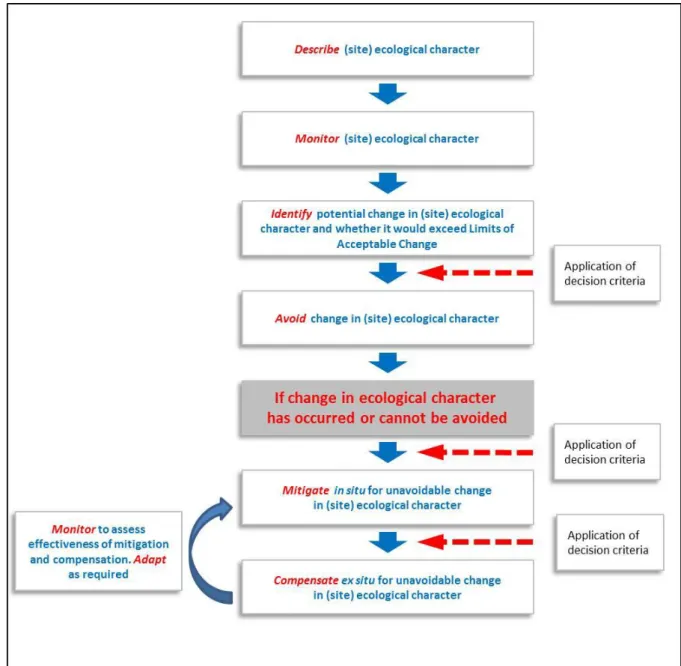
Figure 1. The conceptual framework for avoiding, mitigating and compensating for wetland losses
17. The implications of decisions made at various stages throughout the application of this Framework should follow existing reporting obligations previously adopted by the Convention (Resolution X.16, with further guidance in Handbook 19 (4th Edition)).
2.2 Definitions and descriptions of key terms used in the Framework
or project, or actions specifically to reduce greenhouse gas emissions as climate change mitigation.
19. The following definitions apply in this Framework:
Ecological character: “the combination of the ecosystem components, processes and benefits/services that characterise the wetland at a given point in time” (Resolution IX.1 Annex A). In a footnote, the Resolution states that “within this context, ecosystem benefits are defined in accordance with the MA definition of ecosystem services as “„the benefits that people receive from ecosystems‟”.
Change in ecological character: “the human-induced adverse alteration of any
ecosystem component, process, and/or ecosystem benefit/service” (Resolution IX.1 Annex A).
Maintenance: the maintenance of the ecological character of a wetland, an affirmative duty that the Ramsar Convention requires with respect to Wetlands of International Importance (Ramsar Sites) and “as far as possible” to all wetlands. To maintain a site‟s ecological character, Contracting Parties “are expected to establish
management planning and monitoring mechanisms” for Ramsar Sites, and to invoke appropriate response options for resolving change or likely change to the ecological character of such sites”. (Handbook 19, 4th Edition).
Avoidance: Avoiding wetland impacts involves proactive measures to prevent adverse change in a wetland‟s ecological character through appropriate regulation, planning or activity design decisions. Examples would include choosing a non-damaging location for a development project, or choosing a “no-project” option where the risks to the maintenance of ecological character are assessed as being too high.
Mitigation: Mitigating wetland impacts refers to reactive practical actions that minimize or reduce in situ wetland impacts. Examples of mitigation include “changes to the scale, design, location, siting, process, sequencing, phasing, management and/or
monitoring of the proposed activity, as well as restoration or rehabilitation of sites” (Resolution X.17 Annex, paragraph 23). Mitigation actions can take place anywhere, as long as their effect is realised in the site where change in ecological character is likely is to reduce the effect on the site where change in ecological character is likely, or the values of the site are affected by those changes.. In many cases it may not be appropriate to regard restoration as mitigation, since doing so represents an
acknowledgement that impact has already occurred: in such cases the term “compensation” may be a truer reflection of this kind of response.
[Note: The interpretation of mitigation in this context does not relate to climate change mitigation.]
Compensation: Compensating for wetland impacts refers to actions that are intended to offset the residual impacts on wetland ecological character that remain after any mitigation has been achieved. An example of compensation would be an off-site on-siteor off-site wetland restoration or creation project, provided it adds value beyond what would have happened otherwise (i.e., relying on an already-planned benefit would not constitute compensation). Contracting Parties have emphasized the fact that it is preferable to compensate for wetland loss with wetlands of a similar type and in the same local water catchment (Resolution VII.24, 1999), and priority should be given to on-site compensation.
Restoration: As in Resolution VIII.16, Principles and guidelines for wetland restoration (2002), these guidelines use the term “restoration” in its broadest sense, which includes both projects that promote a return to or toward original conditions and projects that improve the ecological character of the wetland functions without necessarily promoting a return to original/reference conditions. Although some Ramsar texts imply a distinction between these two potential scenarios by referring to
“rehabilitation” as well as “restoration”, such a distinction in practice is not precise and the two terms are often used interchangeably (Resolution VIII.16, para. 3). The term “restoration” applies to locations where wetland habitat has previously existed or where an existing wetland habitat is degraded.
Creation: the establishment of wetland habitat in locations where no wetland habitat existed previously. It is thus distinct from restoration.
Enhancement: a general expression for any augmentation or improvement in wetland components, processes and/or benefits/services. It often refers to “the modification of specific structural features of an existing wetland to increase one or more
functions based on management objectives, typically done by modifying site elevations or the proportion of open water. Although this term implies gain or improvement, a positive change in one wetland function may negatively affect other wetland functions”1.
[“No net loss”: a government policy or strategy that is expressed in terms of no net loss of wetland area and/or ecological character overall, at a given geographical scale (often national). Wetland impacts may be permitted, but compensation (through restoration or creation) is necessary to counterbalance these impacts, not necessarily site-by-site but at the level of the totality of the wetland resource. A no net loss policy may be limited to a particular programme, subset of wetlands, or jurisdiction.]
Risk: a prediction of the likelihood and impact of an outcome; usually referring to the likelihood of a variation from the intended or hoped-for outcome.
Risk-based approach: an approach to decision-making which takes account of context-specific judgments about the relative risks associated with different choice options. It includes processes for assessing the magnitude and likelihood of risks (see Resolution VII.10, Wetland Risk Assessment Framework, 1999), but in addition it is a
3. Deciding on appropriate responses to wetland loss and degradation
3.1 Avoiding wetland loss and degradation
20. Consistent with the philosophy established above, this guidance advocates that avoiding wetland loss and degradation should be the desired outcome, in line with Ramsar Convention commitments.
21. Inherent in this approach is the need to avoid a negative change in the ecological character of a wetland. However, the guidance recognizes that in some instances avoidance may be difficult or impossible to achieve unless a decision is taken to abandon a proposal. Consequently the guidelines set out a risk-based framework to assist in deciding the appropriate response to wetland loss and degradation.
21 bis Such a framework may be supplemented by undertaking a systematic process to identify and map priority areas for conservation, especially at catchment and river basin levels, in order to promote a more strategic approach to avoidance, mitigation and compensation. However, the absence of such a systematically-derived set of priority areas should not inhibit the application of the guidance on avoidance, mitigation and compensation, nor should it replace the need to undertake detailed assessment of ecological character and value of individual sites.
3.2 Applying risk-based approaches
22. The Framework encourages an overall philosophy for avoiding, mitigating and
compensating for loss of wetlands or wetland functions which can be described as a “risk-based approach”. Such an approach is designed to ensure that each decision in a sequence is approached at the outset on the basis of a consideration of the full range of risks
associated with the existing situation and with all relevant alternative outcomes.
23. An element of this approach involves identification of the risks that apply in a given instance, and an assessment of the magnitude and likelihood of each of them. Further guidance on processes for this is provided in the Wetland Risk Assessment Framework
adopted by Resolution VII.10 (see Handbook 18, 4th Edition). It needs to be noted,
however, that the risk under consideration extends not just to the ecological responses within a wetland but also to wider and longer-term social or economic issues associated with the decision being made.
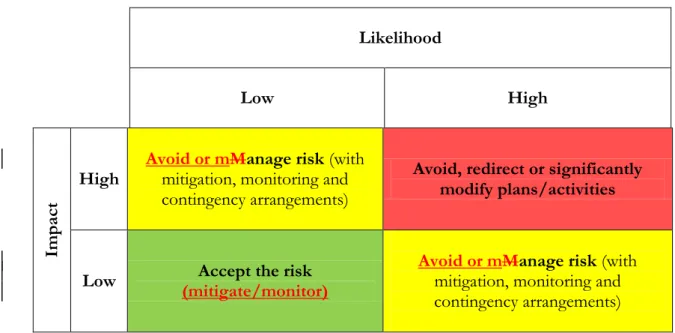
24. The risk-based approach can be summarized in a simple risk evaluation matrix based upon “likelihood” and “impact”. Risks are characterized, for example, as low impact/low
likelihood, low impact/high likelihood, high impact/low likelihood, etc., with each of these combinations suggesting a different level of response.
26. The matrix cells then act as prompts to the appropriate type of response. These range from a significant rethinking of plans or activities for unacceptably high combinations of risk factors (the red cell in Figure 2) to a conscious decision to tolerate risks that are
deemed to be acceptably low (the green cell in the figure) but which still require mitigation.
27. The level of response is flexible and can be set according to a choice as to what level of risk can or cannot be tolerated in the given circumstances. If the circumstances change, these tolerance limits may change as well. The assessment of risk must also consider cumulative and in-combination effects and not just single issues.
Likelihood
Low High
Im
pact
High Avoid or mMmitigation, monitoring and anage risk (with contingency arrangements)
Avoid, redirect or significantly modify plans/activities
Low (mitigate/monitor)Accept the risk Avoid or mMmitigation, monitoring and anage risk (with contingency arrangements)
Figure 2. An example of a risk evaluation matrix
28. Consider these hypothetical examples of the application of this matrix for specific situations:
i) An impact assessment for an infrastructure development adjacent to a wetland reveals severe threats of disruption to water flows in the site, which would lead to certain habitat loss and change in ecological character if it were to go ahead. Such risks should prompt the decision-making authority to withhold consent and trigger a search for alternative locations for the development.
ii) An increase in livestock grazing intensity on a wet grassland, while in theory having the potential to affect the botanical species composition of the site, may be judged more likely to have effects that are negligible within the natural range of variation of the site. Although there is a risk that this prediction may be wrong, it would be disproportionate to prevent the activity on that basis, and so instead the small risk is consciously accepted. However, given the uncertainty of an adverse effect occurring, a monitoring and contingency plan could be developed and implemented.
scope for documenting a transparent audit trail of the judgments made about the management of risks.
3.3 Selecting responses for all wetlands
30. The framework for applying a risk-based approach to responding to a change or likely change in the ecological character or loss of a wetland comprises the same three-fold approach to decision making: avoidance, mitigation and compensation. The overall decision-making Framework for avoiding, mitigating and compensating for wetland loss (including degradation) is provided in Figure 3.
Figure 3. The overall decision-making framework for avoiding, mitigating and compensating for wetland loss (including degradation)
31. When an activity or project2 is either planned or has been completed, it is necessary to
understand the implications of the project and any related project activity on the ecological character of the wetland. Decisions made in the implementation of a project should be predicated on an understanding of the associated risk. The decision to move from one stage (for instance, from avoid to mitigate) requires a consideration of all appropriate response options to ensure that changes in ecological character are minimized or obviated entirely.
32. When considering the potential or actual impact of a project or an activity on a wetland it is also necessary to appraise all possible alternatives and outcomes. Traditionally the focus has been on the overall process and the techniques applied to deliver mitigation or
compensation. However, an essential element in implementing the conceptual framework is the requirement to be able to evaluate all options before triggering a move from one step in the framework to another (e.g., from avoid to mitigate).
33. Some of the crucial issues and decision-making criteria that require consideration in applying the avoidance-mitigation-compensation framework are considered below.
33 bis The Framework must be applied in the context set by the Convention that wise use is to be achieved where possible. While compensation does not contribute to wise use of the affected wetland, it may contribute to the wise use of the broader wetland network (e.g., by providing resources necessary for restoration), and the replacement of benefits that are lost due to the un-mitigated impacts.
Avoidance
34. To ensure that the ecological character of any wetland is maintained, avoidance of any impact should be the default position. The following decision criteria should be considered
in order to evaluate whether avoidance is a realistic response to a likely change in the ecological of a wetland.
Is the site unique and/or does it provide valuable or irreplaceable ecosystem services/benefits?
The ecological character of a wetland may be significant unique and/or provide valuable and/or irreplaceable ecosystem services, in which case any change in ecological character should be considered unacceptable. In this situation, a
cost/benefit analysis that includes a risk-based assessment would indicate that the activity should be abandoned or relocated to avoid any direct or indirect impact on the wetland.
Have other localities been examined for the proposed activity or is the proposed activity wetland-dependent?
In certain circumstances, it may be possible to undertake the proposed activity in an alternative location or at a different site that does not impact a wetland. A
comprehensive assessment of other potential sites should be conducted in order to determine if changing the location of the activity would result in avoiding change in the ecological character of the wetland.
Have design modifications been considered to avoid wetland losses?
In certain circumstances, a review of the activity design should consider
modifications or alternative methods that would result in the avoidance of change in the ecological character of the wetland. All practicableviable design modifications should be considered during this process.
Have the economic values of lost or altered ecosystem services been considered in the project cost-benefit analysis? Are the benefits sufficient to justify a failure to achieve wise use or affect a listed site?
The wetland will be providing benefits to a variety of stakeholders through the delivery of ecosystem services, and these ecosystem services may will have an economic value. Any change in ecological character will make a resultant change in ecosystem services and consequently may have an economic impact. The value of any change in the values derived from ecosystem services needs to be considered in the project development phase.
What are the costs and efficacy of mitigation/compensation measures if the proposed activity is implemented?
The financial costs of mitigating and compensating for the change in ecological character of the wetland should be considered seriously, including an assessment of the implications for ecosystem services. Likewise, the efficacy of any measures in achieving the desired outcomes needs to be evaluated rigorously through a risk-based approach. If the cost and effectiveness of these measures are unacceptable, avoidance should be adopted as the default strategy.
Have both direct and indirect impacts on the wetland been considered?
implications of all impacts and their potential to change ecological character need to be assessed fully to ensure that a change in ecological character is avoided.
Have cumulative or in-combination impacts on the wetland been considered?
It is possible that in isolation the impact of a project may be insufficient to result in a change of ecological character within the specified limits of change. The project might not be an isolated event, however, and its potential impact needs to be considered in association with all other projects or activities which might have an impact on the wetland.
Has an assessment been made of all the risks and benefits associated with the project?
There will be risks and benefits associated with all projects, and usually these will have an economic dimension, but there may also be moral, ethical or other considerations as well. Before proceeding with a project which could change the ecological character of a wetland, a risk-based approach should be pursued to understand fully the implication of any possible change in ecological character.
Box 2. Avoidance of change in ecological character. Case study: The Severn Estuary, UK
The Severn Estuary Ramsar Site in the west of England has one of the largest tidal ranges in the world and is one of Europe‟s most important wildlife habitats. The estuary, and the rivers that feed into it, contain and support a wealth of wildlife. Its tidal waters, saltmarshes and mudflats are used by 69,000 waterbirds each winter. The diverse habitats support over 100 fish species and vast numbers of invertebrates, and the Estuary is a vital migration route for migratory fish, including Atlantic salmon, sea trout and eels, and a significant contributor to the economy of the area.
Schemes to harness the tidal energy of the Severn have been promoted for more than a hundred years. A report by the UK Sustainable Development Commission published in October 2007 suggested that the Severn Estuary could produce 5% of the UK‟s electricity needs. The preferred option promoted by a consortium of developers was for a 10-mile tidal barrage which would have altered some 160km2 of estuarine habitats. Many conservation groups raised concerns
regarding the fundamental changes that a large-scale barrage would have on the ecological character of the estuary. Doubts were also raised regarding the cost-benefit calculations and the long-term economic returns from a barrage.
Source: www.decc.gov.uk/assets/ decc/What%20we%20do/UK%20energy
%20supply/Energy%20mix/Renewable%20energy/severn-tp/621-severn-tidal-power-feasibility-study-conclusions-a.pdf
Box 3. Understanding economic benefits to avoid wetland loss. Case study: Yamuna River floodplain, India
Around 3,250 hectares of floodplain between the Yamuna River and the landmass in Delhi offer benefits such as provision of water, fodder and other materials, fisheries, and recreation. Faced with pressures to convert the floodplain into areas suitable for housing development and industry, the decision makers, whilst acknowledging the ecological role of the floodplain, were not able to establish sufficient justification for conserving it without economic valuation of the ecosystem services to enable a cost-benefit analysis of conversion.
Value estimates for a range of services totaled US$ 843/ha/year (2007 prices). The embankment of the Yamuna would virtually dry the floodplain, causing the disappearance of those services. These ecosystem benefits exceeded the opportunity costs of conservation (estimated from the land price, assumed to reflect the discounted value of „development‟ benefits) for a range of discount rates from 2 percent to 12 percent, justifying the maintenance of the floodplain. The Delhi government halted the embankment plan of the Yamuna River floodplain until further order.
Source: Kumar, P.; Babu, C. R.; Sharma, S. R; Love, A. and Prasad, L.(2001) Valuation of Ecosystem Services: A Case Study of Yamuna Floodplain in the Corridors of Delhi. Under the World Bank Aided Environmental Management Capacity Building Programme.Mimeograph, IEG, Delhi.
Mitigation
35. Where a risk-based evaluation has indicated that a project can proceed, but that a change in the ecological character is likely, and the risk associated with this is considered
acceptable, then appropriate proactive mitigation should be undertaken. In certain
circumstances a change in ecological character may have already been detected and reactive mitigation needs to be undertaken.
36. If a change in the ecological character of a wetland has been detected or is likely to be detected, the following decision criteria should be considered:
Are the costs and risks associated with effective mitigation measures considered to be too high?
A risk-based approach may consider the cost of mitigation to be prohibitive. In this scenario a decision needs to be made as to whether this is appropriate or the party should refrain from implementing the activity, with avoidance becoming the best response.
Is it possible to mitigate the impacts of the activity in a practical and effective manner?
Are the mitigation activities going to fully minimize the impacts?
In some scenarios it may not be possible to fully mitigate impacts on a wetland and, consequently, residual impacts may remain. Attempts should be made to ensure that the temporal extent, magnitude and scale of any residual impacts are minimized. Where residual impacts exist appropriate compensation measures should be provided.
Box 4. Mitigation. Case study: Gasbol (Bolivia-Brazil Gas Pipeline)
Gasbol is a 3,150-km gas pipeline between Brazil and Bolivia. The project, which was partly financed by the World Bank (WB), starts in Rio Grande, Bolivia, extending west and then south to Porto Alegre, Brazil. WB policy requires that all WB-financed infrastructure projects conduct an Environmental Assessment (EA). Projects must also comply with the WB Natural Habitats (critical and non-critical) policy, and they must avoid significant modification to critical habitats. For non-critical habitats, avoidance is still recommended unless there are no feasible alternatives. Where impacts are unavoidable, mitigation or compensation measures are required.
To avoid certain sensitive ecosystems, the pipeline‟s route was modified. To reduce the size of impacts, the width of the right of way (ROW) was narrowed in many transects. In Brazil, the ROW width was reduced from 30 to 20 meters.
As described in Quintero (2007), mitigation measures to minimize unavoidable impacts included:
Manual tree removal along the ROW: Trees were manually removed with chain saws to ensure that they were felled within the ROW, avoiding damage to surrounding vegetation.
Pushing and pulling method for wetlands: State-of-the-art techniques were used to install the pipeline across the wetlands. The pushing and pulling method is used during the rainy season. It uses a preassembled section of pipe which is floated into position over an inundated trench. The buoys are removed and the pipe, coated with concrete jackets, sinks into the ditch. This method requires less clearing than conventional methods, because the construction space is limited to that required to allow the backhoe to cross the wetland to stockpile excavated soil. In contrast, under conventional methods the entire area is usually cleared during the dry season in order to set the pipe.
Drilling under river beds: Similar special works were commissioned for the crossing of 13 rivers to avoid negative impacts on vegetation and water quality. Horizontal drilling techniques were used to tunnel under river beds, minimizing disturbance to riparian vegetation and protecting the pipe from pipeline scouring.
On-site restoration: A 13-meter-wide strip along the ROW of the pipeline was revegetated and the trenches were refilled after construction.
The Gasbol project has received the International Association of Impact Assessment‟s Environmental Award for its EA and the World Bank‟s 2001 Green Award.
Compensation
37. Where there are residual post-mitigation impacts, it is necessary to compensate for the resultant change in ecological character, as agreed by the Parties in Resolution VII.24,
Compensation for lost wetland habitats and other functions (1999). Any such action should be ex situ and appropriate to offset the residual impacts.
38. The following decision criteria require consideration during the development and implementation of compensation measures:
Is the compensation type-for-type?
The change of ecological character of one type of wetland (for instance, an area of saltmarsh) should be compensated ,as appropriate, by the protection, enhancement, restoration or creation of a similar wetland type (Resolution VII.24), in this case another area of saltmarsh rather than, for example, an area of freshwater marsh.
Is the compensation function-for-function, component-for-component, or area-for-area?
The residual change in ecological character may result in a loss of area and/or a loss of function (or loss of provision of ecosystem services). The compensation provided should address both the areal extent,significant ecosystem components, and the functional performance of the wetland. Therefore, it is necessary to understand the range of ecosystem services provided by the wetland, its physical size, and the type of biodiversity a wetland supports prior to developing compensatory habitat.
Where should compensation be located?
The location of any compensatory wetland habitat is important. Ideally it should be in close proximity to the impacted wetland and within the same hydrological catchment or coastal zone. Where compensation measures require habitat
restoration or creation, the existing ecological character of the proposed restoration or creation site needs to be assessed to ensure that a) other existing important wetland values and services are not damaged, and b) other non-wetland impacts are not generated.
How can compensation be achieved?
Compensation may be achieved through the restoration, enhancement, and/or creation of wetlands. The compensation measures must address cumulative impacts on both area and function and promote integrity and resilience through a detailed scientific understanding of risks and uncertainties. The timing of implementing compensatory measures is important. Compensation must be established in advance of, or at least in consideration of, the timing of the proposed impacts. The
monitoring of any compensatory measures needs to be undertaken to evaluate whether the residual impact to the ecological character has been adequately compensated, or whether further compensation provision proves to be necessary. Securing the conservation of other existing wetlands, for example through increasing statutory protection for maintaining the ecological character of another wetland, whilst covered under the terms of Article 4.2, should generally be considered a less appropriate compensation option under the overall terms of the Convention, since all Parties have already committed themselves to the wise use, through the
How can long-term compensation be implemented?
The security of any long-term success will depend on appropriate stewardship and resourcing. When considering compensation, the ability to ensure that the necessary technical, financial, management and legislative capabilities will exist into the future needs to be considered with sufficient care and consideration. As with any wetland restoration, enhancement or creation, full local community engagement, support and stewardship is a key prerequisite for long-term success (in line with Resolutions VII.8, Guidelines for establishing and strengthening local communities’ and indigenous people’s participation in the management of wetlands (1999), and VIII.16, Principles and guidelines for wetland restoration (2002)).
Are the costs and risks associated with effective compensation considered to be too high?
A risk-based approach may consider the full cost of compensation, including both initial or capital costs and the long-term cost to secure the future ecological character of the area in perpetuity, to be prohibitive. Alternatively, because of ecosystem complexity, irreplaceability and/or scientific uncertainty the risk of failure to
successfully compensate an adverse decision may be unacceptably high. In this these
scenarios a decision needs to be made as to whether compensation is appropriate or instead the party should refrain from implementing the activity, with avoidance becoming the appropriate strategy.
3.4 Additional responses for Ramsar Sites
39. Under Article 2 of the Convention, Contracting Parties have committed themselves to designating suitable wetlands within their territories for inclusion on the List of Wetlands of International Importance. The legal status of Ramsar Sites will be different to other wetlands in a territory (Article 3). For instance, if a Party does not follow prescribed guidance in the case of a designated Ramsar Site (e.g., Article 3.2 reporting in the event of a change in ecological character), then it is in breach of the Convention itself – if a Party does not follow guidance in the case of other wetlands (Article 3.1), however, it is only breaching the spirit of a non-binding good practice principle. Consequently, under the avoid-mitigate-compensate framework there are additional commitments, and hence responses required, for Ramsar Sites concerning wetland loss and degradation. Guidance on these responses (including reporting obligations; see also section 4.8) has been adopted in Resolution X.16, A Framework for processes of detecting, reporting and responding to change in wetland ecological character (2008), included in Handbook 19, 4th edition, 2010.
40. Article 2.5 of the Ramsar Convention states that “any Contracting Party shall have the right . . . because of its urgent national interests, to delete or restrict the boundaries of wetlands already included by it in the List”. Following from that, Article 4.2 of the
41. Furthermore, Resolutions 5.1 and VII.24 respectively make the points that “Contracting Parties will aim to meet their commitments under the Convention through the following actions: . . . restore degraded wetlands and compensate for lost wetlands” (under a heading of Wetlands of International Importance), and that Contracting Parties are urged to “take all practicable measures for compensating any loss of wetland functions, attributes and values, both in quality and surface area, caused by human activities”.
42. The overall decision-making framework for avoiding, mitigating and compensating for wetland loss (Figure 3 above) applies both to already-designated Ramsar Sites and as far as possible to all other wetlands in the territory of the Contracting Party according to Article 3.1 of the Conventionas well.
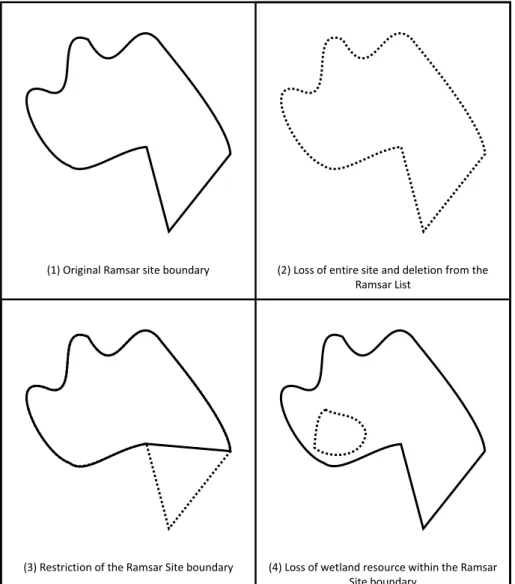
43. A range of potential scenarios are illustrated in Figure 43. Concerning site area, the
deletion of a site or a restriction in the boundary of a Ramsar Site (square 1) is illustrated in (2) and (3). The appropriate response to the development of compensation measures for deleting or restricting the boundaries of wetlands on the Ramsar List should follow the guidance provided in section 3.2 of this Framework and in Resolution VIII.20 (Handbook 19, 4th edition).
44. Further guidance for consideration of the deletion or restriction of the boundaries of a listed Ramsar Site for reasons of other than “urgent national interest” is provided in the Annex to Resolution IX.6, Guidance for addressing Ramsar sites or parts of sites which no longer meet the Criteria for designation (2005).
45. It should be noted that the trigger for compensation under Article 4.2 is not the ecological character change itself, but rather the administrative decision that the Ramsar Site
designation should be changed because the ecological change is considered to be irreversible. This is logical, since until such a conclusion has been reached, the correct response to character change should be to endeavour to reverse it.
46. If, however, irreversible negative ecological character changes have occurred or will occur
as the result of activities on or off-site, and yet no decision is taken to amend or de-List the designated area (square 4 in Figure 43), the Convention text does not expressly require compensation, other than the general terms of Resolution VII.24. Nevertheless, in such cases, Resolution IX.6 calls upon Contracting Parties to make “at least equivalent provision of compensation” when there is unavoidable loss of ecological character at a Ramsar Site.3
Figure 43. Scenarios for changes to a Ramsar site
3.5 Additional responses for sites that qualify for Ramsar site designation
47. Under the Ramsar Strategic Plan 2009-2015, Strategic Goal 2 seeks to “develop and maintain an international network of wetlands that are important for the conservation of global biological diversity, including waterbird flyways and fish populations and for
sustaining human life, by ensuring that all Contracting Parties appropriately implement the Strategic Framework and guidelines for the future development of the List of Wetlands of International Importance and by appropriate management and wise use of those
internationally important wetlands that are not yet formally designated as Ramsar sites but have been identified as qualifying through domestic application of the Strategic
Framework or an equivalent process.”
48. This Goal is advanced further through Strategy 2.7 on the management of other
internationally important wetlands, which states: “Appropriate management and wise use achieved for those internationally important wetlands that have not yet been formally designated as Ramsar sites but have been identified through domestic application of the Strategic Framework or an equivalent process.”
(1) Original Ramsar site boundary (2) Loss of entire site and deletion from the Ramsar List
49. The implication in the Strategic Plan is that all sites which have been recognized through a domestic or equivalent process as being “internationally important” under the terms of the
Strategic Framework and guidelines for the future development of the List of Wetlands of International Importance but which have not been formally designated as Ramsar Sites should be considered, in terms of the maintenance of their ecological character, in the same way as sites which have been placed on the List of Wetlands of International Importance.
50. Consequently the response options and the decision criteria applied to these sites should be identical to those applied to sites which are designated on the List of Wetlands of International Importance (section 3.4 above)., using the decision-making framework set out in Figure 3.
4. Principles and guidance for avoiding, mitigating and compensating for
wetland losses
4.1 Introduction
51. Whilst the focus of this Framework is upon avoidance, mitigation and compensation, other aspects of the issue of maintenance of the ecological character of wetlands are considered within these overall principles and guidance.
52. In order to detect change, the ecological character of the wetland first needs to have been described, limits of acceptable change in ecological character defined, and then appropriate monitoring is required to ensure that any change is identified and characterized. Without these essential elements, it is difficult to make an informed decision regarding the risk of implementing various response options to change or likely change in ecological character.
53. Key principles and guidance for implementation of the overall Framework are elaborated below and follow the Framework for processes of detecting, reporting and responding to change in wetland ecological character adopted as Resolution X.16 (Handbook 19, 4th edition, 2010).
4.2 Describing wetland ecological character
54. As noted above, the current definition of “ecological character” (paragraph 15 of Resolution IX.1 Annex A) is: “Ecological character is the combination of the ecosystem components, processes and benefits4/services that characterise the wetland at a given point
in time.”
55. Whilst a definition of “ecological character” is helpful, it is also important to be able to describe the particular ecological character of a wetland as a key element of an effective management planning process, including monitoring, as is set out in the wetland
management planning guidance in Ramsar Wise Use Handbook 18 (4th edition.). It also follows that if human-induced adverse change in the ecological character of a wetland occurs, a baseline description of ecological character is needed against which to assess change and consequently to consider avoidance, mitigation and compensation.
4 In this context, ecosystem benefits are defined in accordance with the MA [Millennium Ecosystem Assessment] definition of ecosystem services as “the benefits that people receive from
56. The Contracting Parties have adopted guidance which has moved beyond the definition of the concept to a treatment of the constituent parts of what goes to make up ecological character, and which can be applied to any wetland. Guidelines on describing ecological character of a wetland, including its components, processes and services, are provided in the annex to Resolution X.15, Describing the ecological character of wetlands, and data needs and formats for core inventory (2008).
57. Consistent with Resolution X.15, this ecological character description structure and fields have now also been incorporated into the Ramsar Site Information Sheet (RIS) – 2012 revision [adopted by Resolution XI.xx].
4.3 Monitoring and early warning indicators
58. In order to detect actual or potential changes in ecological character, regular monitoring is required. Monitoring is defined in the Ramsar Framework for Wetland Inventory (Resolution VIII.6, 2002) as the “collection of specific information for management purposes in response to hypotheses derived from assessment activities, and the use of these
monitoring results for implementing management. (Note that the collection of time-series information that is not hypothesis-driven from wetland assessment should be termed surveillance rather than monitoring, as outlined in Resolution VI.1.)”
59. The Additional Guidance for the implementation of the wise use concept (Resolution 5.6, 1993) also pointed out that monitoring does not automatically require sophisticated technology or high investment and can be carried out at different levels of intensity. It should be emphasised that there are many different monitoring techniques available and that each Contracting Party should select the technique(s) most appropriate to its priorities and available resources.
60. A monitoring programme should, ideally, be an integral part of a site-specific wetland management plan, as set out in Resolution VIII.14, New Guidelines for management planning for Ramsar sites and other wetlands, and described further in Ramsar Handbook 18 (4th edition,
2010). Where a management plan does not yet exist, it is still possible to implement a monitoring programme; without the framework of a management plan, however, it will be difficult to implement the results of monitoring effectively.
61. In any monitoring programme, it is useful to develop early warning indicators.The underlying concept of early warning indicators is that effects can be detected which are precursors to, or indicate the onset of, actual environmental impacts. Whilst such „early warnings‟ may not necessarily provide firm evidence of larger-scale environmental degradation, they present an opportunity to determine whether intervention or further investigation is warranted. As such, early warning indicators can be defined as “the measurable biological, physical or chemical responses to a particular stress, preceding the occurrence of potentially significant adverse effects on the system of interest”. Further information on early warning indicators is also provided in Ramsar Handbook 18 (4th
edition).
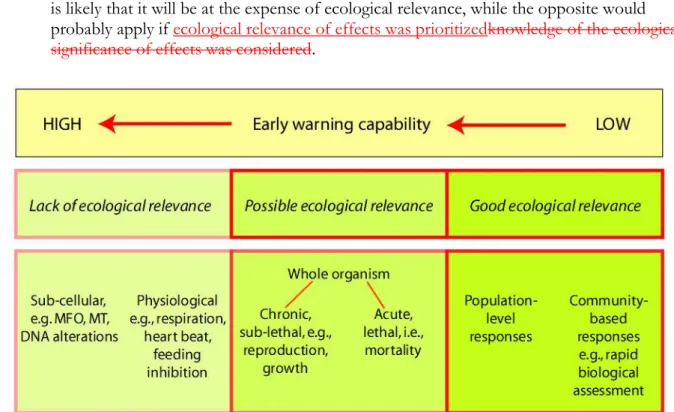
can conflict. The types of biological responses that can be measured, and their relationship to ecological relevance and early warning capability, is generalised in Figure 54.
63. As an example, biomarker responses can offer exceptional early warning of potential adverse effects, but there exists very little evidence that observed biomarker responses result, or culminate in, adverse effects at an individual level, let alone at the population, community or ecosystem level. Therefore, biomarker responsesthey cannot be considered ecologically relevant because they have low predictive power for the future ecological changes or condition. If the primary assessment objective is that of early detection, then it is likely that it will be at the expense of ecological relevance, while the opposite would probably apply if ecological relevance of effects was prioritizedknowledge of the ecological significance of effects was considered.
Figure 54. Relationship of ecological relevance and early warning capability to measurable biological responses (from Resolution VII.10, Handbook 18, 4th edition, 2010)
Ideal attributes of early warning indicators
64. The annex to Resolution VII.10 sets out a clear strategy for developing early warning indicators. To have potential as an early warning indicator, a particular response should be:
a) anticipatory: it should occur at levels of organization, either biological or physical, that provide an indication of degradation, or some form of adverse effect, before serious environmental harm has occurred;
b) sensitive: in detecting potential significant impacts prior to their occurring, an early warning indicator should be sensitive to low levels or early stages of the problem; c) diagnostic: it should be sufficiently specific to a problem to increase confidence in
identifying the cause of an effect;
d) broadly applicable: it should predict potential impacts from a broad range of problems;
manifestation of the response, would usually or often lead to significant environmental (ecosystem-level) adverse effects;
f) timely and cost-effective: it should provide information quickly enough to initiate effective management action prior to significant environmental impacts occurring, and it should be inexpensive to measure while providing the maximum amount of information per unit effort;
g) regionally or nationally relevant: it should be relevant to the ecosystem being assessed;
h) socially relevant: it should be of obvious value to, and observable by stakeholders, or predictive of a measure that is socially relevant;
i) easy to measure: it should be able to be measured using a standard procedure with known reliability and low measurement error;
j) constant in space and time: it should be capable of detecting small change and of clearly distinguishing that a response is caused by some anthropogenic source, not by natural factors as part of the natural background (that is, high signal to noise ratio); and
k) nondestructive: measurement of the indicator should not be damaging to the ecosystem being assessed.
4.4 Avoiding change in wetland ecological character
65. As explained above, Ramsar Contracting Parties through their decisions of the COP have consistently endorsed the notion that wetland impacts should be avoided as the principal step in any decision-making process in matters of environmental impact assessments, wetlands and river basin management, and sector-specific activities.
66. For example, the Annex to Resolution X.17 in providing advice on environmental impact assessments observes that “remedial action can take several forms, i.e., avoidance (or
prevention), mitigation (by considering changes to the scale, design, location, siting, process, sequencing, phasing, management and/or monitoring of the proposed activity, as well as restoration or rehabilitation of sites), and compensation (often associated with residual impacts after prevention and mitigation). A „positive planning approach‟ should be used, where avoidance has priority and compensation is used as a last resort measure. One should acknowledge that compensation will not always be possible: there are cases where it is appropriate to reject a development proposal on grounds of irreversible damage to, or irreplaceable loss of, biodiversity.”
67. Resolution X.19 on wetlands and river basin management also identifies avoidance as the priority, calling on wetlands and river basin management policy to address “the need to avoid, minimize or compensate (for example, through conservation offsets) possible negative effects on wetlands of activities within river basins.”
68. Sector-specific guidance on biofuels and extractive industries also recognize avoidance as the priority under the Convention. Resolution X.25 calls on Contracting Parties “to seek to avoid negative impacts, and where such avoidance is not feasible, to apply as far as
accordingly urges Contracting Parties to “review and revise regulatory and permitting procedures related to extractive industrial activities, in order to ensure that impacts on wetland ecosystems and their ecosystem services are avoided, remedied or mitigated as far as possible, and that any unavoidable impacts are sufficiently compensated for in
accordance with any applicable national legislation”.
69. Contracting Parties have also long emphasized that “restoration schemes” – and thus mitigation and compensation efforts – “must not weaken efforts to conserve existing natural systems” (Recommendation 4.1, 1990).
4.5 Mitigating for loss of wetland ecological character
70. When all options for avoiding change in ecological character have demonstrably been exhausted, the next step in the sequence which may be considered is the taking of practical actions to minimize or reduce in situ wetland impacts. Such mitigation actions can take place anywhere (including, for example, upstream in the catchment), as long as their effect is realised in the site where change in ecological character is likely. Judgments about impacts should be based on appropriate methods of impact assessment.
71. Ramsar guidance on Environmental Impact Assessment (Resolution X.17) refers to the purpose of mitigation as being to look for ways to achieve the objectives of a project while reducing negative impacts to acceptable levels. Typically this will involve the incorporation of safeguards in the design of the project, and the guidance describes this as potentially including “changes to the scale, design, location, siting, process, sequencing, phasing, management and/or monitoring of the proposed activity, as well as restoration or rehabilitation of sites”.
72. The guidance further observes that:
i) “mitigation requires a joint effort of the proponent, planners, engineers, ecologists and other specialists, to arrive at the best practicable environmental option”;
ii) options should be examined at early scoping stages in the process so that their feasibility can be evaluated before choices become more constrained; and
iii) “mitigation measures must be identified and described in detail, including an analysis of their likely success and realistic potential to offset adverse project impacts”. National policy and legal systems may specify particular requirements in individual countries.
73. A common method of framing and applying mitigation measures is by means of conditions or covenants attached to project or plan consents. As well as specifying the measures to be undertaken, these can also enable mechanisms for accountability and oversight to be specified where appropriate. In some cases this can be formulated as an agreement between those responsible for implementing and assessing the mitigation.
75. A mitigation plan may often best be implemented through an “adaptable management” approach, whereby adjustments and corrections can be applied as necessary in the light of feedback from monitoring and testing. Resolution VIII.14 (2005), in the New Guidelines for management planning for Ramsar sites and other wetlands, includes some guidance on adaptable management, outlining such a process as follows:
i) a decision is made about what should be achieved (i.e., quantified management objectives are prepared for the important features);
ii) appropriate management, based on the best available information, is implemented to achieve the objectives;
iii) the features are monitored in order to determine the extent to which they are meeting the objectives;
iv) if objectives are not being met, management is modified;
v) monitoring is continued to determine if the modified management is meeting the objectives, and step iv) is repeated for any further adjustments, as necessary.
4.6 Compensating for loss of wetland ecological character
76. Where residual post-mitigation impacts remain or are expected to occur (or when Article 2.5 “urgent national interest” is invoked for a listed Ramsar Site), the next step in the sequence is to compensate for the resulting change in ecological character. Note, however, that the COP has stressed the point (in Resolutions VII.17, para. 10, and VIII.16, para. 10) that restoration or creation of wetlands cannot replace the loss or degradation of natural wetlands. This is true in relation to the ecological values of such wetlands, but in many cases it is equally true, or even more so, in relation to those cultural values that are site-specific in nature (see also Resolution IX.21, Taking into account the cultural values of wetlands).
77. Contracting Parties have also highlighted the fact that it is preferable to compensate for wetland loss with wetlands of a similar type and in the same local water catchment (Resolution VII.24 and the annex to Resolution VIII.20).
Wetland restoration as a response option
78. Restoration constitutes a potential response to change or likely change in ecological
character in situations where residual impacts remain after avoidance or mitigation efforts.
79. In 2002, the Conference of the Parties adopted Principles and guidelines for wetland restoration
(Resolution VIII.16). The concepts embedded in those principles apply equally to the application of restoration as a response option to a loss of wetland ecological character.
80. When choosing wetland restoration as a response option, it is essential that a clear understanding and statement of goals, objectives, and performance standards for