I
a
I
!!
1lI=
I
Itsi
q
i
,."'I
:k-;=.
-i
_-INTEGRATED
LAND
USE
AND
TRANSPORT
MODELLING
Decision Chains
and
Hierarchies
TOMAS DE
LA
BARRA
Instltuta ol Urfunism, C.;cntral Unlwrslt9 ol Vcrwwh
Published by lhe Press Syndicate of the University of Cambridge
The Pitt Building, Trumpington Street, Cambridge CB2 IRP
'zt0 West 20th Street,
New York, NY
l00ll.{2ll
USAl0 Stamford Road, Oakleigh, Melbourne 3166, Australia
O Cambridge University Press 1989
First published l9E9
Reprinted 195
Printed in Great Britain by Atheneum Press Ltd, Gateshead, Tyne & Wear British Llbrarg catalogalng in publication ilola
Barra Tom6s de la
Intfgratcd land use and bansport modelllng:declsion chains and heirarchles.
-
(Cambrldge urban andarchitectunl studies; v. l2).
l. Urban regions. Transport. Planning
L fitle
7tt'.7',o9t732
Llbary of Congrcss cotalogulng in Ebliution ilata
Bana. Tom6s de la.
1946-Int€grat€d land use and bansport modelling:decision chalns and
hlerarchiesfiomris de la Barra.
p,
cm.-
(Cambridge urban and architectural studies:I2)Bibllography Includes lndex.
rsBN 0-521-24318-l
l- Ttansportaton
-
Plrnning-
Mathematical models. 2. Iand use -Planning-
Mathemadcal models. l. Tltle. II. Series: Cambridgeurban and archit€ctural studles:no, 12.
t'E147.7.B37 t989
38O.5'068
-
dcl9
E8-29235ISBN O 521 24318
I
Contents
List ol
figures
pagevii
Prelace
xiAcknowleilgements
xiii
Social sciences and
planning
I
l.l
Natural and social sciences: the hypothesis ofcon-vergency
I
1.2
The scientificmethod
41.3
Social phenomena and social objectiveknowledge
67.4
Social scientists andplanners
91.5
Some basic concepts aboutmodels
l1
1.6
Modeldynamics
157.7
Conclusions
l8
Micro-economic theories of
land
use
20
2.L
Von Thtinen's isolatedstate
2l
2.2
Calculating Von Thiinen's basicmodel
242.3
Extending Von Thtinen's model throughelasticities
252.4
Wingo's transportation and land usemodel
322.5
Alonso's location and land usemodel
362.6
Multiple market areas: the models of Christaller andLiisch
422.7
Some conclusions about micro-economicmodels
45Spatial
interaction
models
483.1
Origins and development of spatial interactionmodels
483.2
Basicconcepts
493.3
The entropy maximisingderivation
503.4
Some speciffc forrrs of spatial lnteractionmodels
553.5
Micro+conomic and spatial interaction modelscompared
59Random
utility
theory
and discrete choicemodels
654.1
Decision theory: the individualcase
66vl
Contents4.3
Some properties of discrete choicemodels
734.4
Decisionchains
784.5
Variable costs andelasticities
804.6
Hierarchies
81Spatial accounting
models
825.1
The theory of production and themultiplier
825,2
The regional income model and the economic basemethod
855.3
The input--outputmodel
875.4
A random utility based multi-region input--outputmodel
5.5
ConclusionsUrban and regional
activity
allocation6.1
General urban-regional dynamics6.2
The activity system6.3
The dynamic relationship between floorspace supplyand the activity system
Migration between regions Spatial hierarchies
Conclusions
The transportation system
7.l
The linked land use and transport model7.2
The integrated land use and transport model7.3
Network analysis for transportation systems7.4
Capacity restriction7.5
Tlip generation7.6
Modal split7.7
Route assignment7,8
Composite costs and consumers' surplus7.9
ConclusionsApplications of rneNus, an integrated land use and transport model
8.1
Brief description of the rnexus system8.2
Urban land use planning applications8.3
Urban hansportation planning applications8.4
Regional transportation applications8.5
land
use and transport energy consumptionFigures
1.1
The scientific method-
induction and Popper'sproposition
7.2
The planning system1.3
Brternal factors afrecting a system through time7.4
Different types of system dynamics2.1
Von Thiinen's single commodity model2.2
Von Thiinen's model with several commodlties2.3
A numerical example of Von Thiinen's model withone, two and three commodities in sequence
2.4
Demand functions for commodities to extend VonThiinen's model
2.5
A numerical example of Von Thiinen's modelwith
30one, two and three commodities in sequence and elasticities in the consumption of commodities
2.6
Demand functions for land to extendVon
3l
Thtinen's model
2.7
A numerical example of Von Thiinen's modelwith
33one, two and three commodities in sequence and elasticities in the consumption of land
2.8
Graphical representation of some aspectsof
35Wingo's model
2.9
Iocus of opportunity surface in Alonso'smodel
372.lO
Indiflerence map in Alonso'smodel
38z.Ll
Bid price curves for an indivtdual or firmin
40Alonso's model
2.12
Chain of bid price curyes for two users inAlonso's
40model
2.13
Chain of bid price curves for many usersin
42Alonso's model
2.14
Formation of a market area in central place theory2,15
Formation of a system of market areas in cenhalplace theory
Basic structure of the Lowry model Discrete interpretatlon of real systems: (a)
numerical analysis; (b) direct approach
Variability in the cost of travel
Distributions of perceived utilities
page 7
l1
l5
18 22 23
26
27
3.1
3.2 4.1 4.2
43
44
7l
72 76 83 84 86 88 899r
4.5 5.1 5.2 5.3 5.4viii
List ol figures4.3
Normal and Weibull distributions compared4,4
Cochrane's exponential approximation of thedistribuflon of utilities
Example of the river to illustrate the way average costs and user benefit indicators should be
calculated
The general economic system in Keynes' model
Consumption and saving schedules in Keynes'
model
Basic relationships in the regional income model Basic elements of the single-region
input<utput
accounting table
5.5
Algorithm for the solution of the single-regioninputoutput
model5.6
Flows of commodities in the Leontief-Shoutmulti-region
inputoutput
model5,7
Multi-region multi-secior flow of commodities6,1
Dynamic relationships in the activity system6.2
General structure of the activity system model6.3
Floorspace demand function6,4
Difrerent types of potential floorspace7,7
General sEucture s1 3 linked land use andtransport model
Sequence of decisions and sequence of models in
the integrated land use and transport model
Typical example of a transport network
represented as a directed graph
Basic diagrans of heffic flow
The method of expanded nodes for representing
turn prohibitions in a transport network
Reverse graph representation of a transport
network
Reduction of speed in difrerent types of links as the
volume of flow increases
7,8
Elasticity in the generation of trips7.9
Average and marginal travel time7.7O
Cost functlonsln
the equilibrium assignmentmodel
7,71
An example of Dial's trip assignment algorithm7.12
E:rample of the 'hole on the road' to explainatffibute conelation problems in the assignment model
8.1
Dynamic relations in the land use and transportsystem
Calculation sequence used by TRANUs
Operative struchrre of rnexus
Tnning and hansport network for the study of
List
ol
figures
ix
8.5
Hierarchical zonlng and transport network forthe
153study of
Ia
Victoria8.6
Trrnlng and hansport network for the study ofthe
L54extension of the metro line in Caracas
8.7
Tnning and fansport network for the evaluationof
156the monorail syst€m for the south-east of Caracas
8.8
Some resulb of the study of the Caracas-IaGuaira
159 motorway8.9
Tnnlng and hansport networkhr
the study ofthe
161CaracarValencia-Puerto Cabello railway
8.lO
Six development patterns for energrevaluation
1658.ll
Primary fuel demand for the threeenergl
L66scenarios ln the energl evaluadon study
8.12
Overall energy evaluation summary foreach
165Preface
This book has a dual character. On the one hand, it is structured in the
form of a textbook. Subjects are treated
in
a sequence such that the reader can follow from basics to more elaborate formulations; most ofthe elements required for its proper comprehension are given, making
it self sufficient; references are deliberately kept to a minimum. On the
other hand, the book is the result of extensive research, and the
know-Iedgeable reader
will
find many stimulating propositions, some morenovel than others, and some probably more pertinent than others.
Integrated land use and transport modelling is an area of research
that reached a high peak in Britain in the early seventies, mainly with an academic interest. Real-world applications in industrialised nations,
however, have been limited mainly because of the slow rate of growth
of the cities of Europe. The second half of the seventies and the first half
of the eighties have seen considerable advances in the development of
theories and operational models in the area of transport. Most cities in
Europe and the USA regularly use stand-alone transport models for their
everyday planning practice, considering the location of activities and
other socio-economic variables as a relatively stable set of given inputs.
The situation in third world countries, however, is quite different; since
cities grow so rapidly, the interaction between the location of activities
and the transport system becomes a dominant issue. It is not surprising,
then, that the research contained in this book is supported by
applica-tions mostly carried out
in
Venezuela.It
is arguedthat
this area ofresearch
will
see new light, at least in Europe, because of its potentialfor the evaluation of energy use in cities and regions.
The idea
of writing
this book originatedin
a
phD thesisfor
theUniversity of Cambridge. The aim of the thesis and of this book is to
propose a general and consistent theoretical framework for land use and
transport analysis. There are many advantages in presenting a unified
explanation for most of the urban phenomena, and the purpose of this
book is to lay this out as clearly as possible. This book, however, differs
from the original thesis in many ways. Firstly, several years of research
and development
in
the
areaof
integrated land use and transportmodelling modified substantially many
of the
original propositions. Next, a large number of real-world applications of the proposed methods have lead to numerous improvements, Lastly, a decade of post-graduatexii
Prefaceauthor to present matters in different logical orders, hopefully making
them more comprehensible to the reader.
The first chapter of the book is devoted to the epistemology of social
sciences and to models in particular. Although it is not intended to be a full treatment of this subject, it is covered to a certain length, bbcause
there are a number of frequent misunderstandings with respect to the
scientific method in social sciences. In particular, the role of models has
not been covered adequately by the literature. Much more work must
be devoted to this subject, mainly because social scientists are going
through so many methodological changes, and models are bound to
play an increasingly important role.
The second chapter deals with theories and models based on
micro-economic theory. They not only represent the beginning of land use and
lransport modelling in historical terms, but also present basic concepts
that are used
in
the rest of the book.A
third chapter reviews spatialinteraction models, from their gravitational origin to entropy
maximis-ing
types.At
the end of this chaptera
comparison betweenmicro-economic models and the spatial interaction approach is made, not only
from a theoretical point of view, but also from the point of view of their
mathematical representation, a matter of great importance.
Chapter
4
discusses randomutility
theory, presented as the bridgebetween micro-economics and spatial interaction, allowing the
integra-tion between the principles of the former and the discrete, aggregated
forrrulation of the latter. This represents the theoretical backbone for
the subjects in the remaining chapters. From this starting point, chapter
5
looksat
macro-economic theories, particularlythe
input--outputmodel, establishing a close relation with spatial interaction. The broad
theoretical framework provided by input--output analysis can be used
for the representation of cities and/or regions,.and if prices and
elastici-ties are incorporated, together with random utility theory, markets can also be represented.
Chapter 6 presents a number of issues related to land use, the location
of activities in space, demand and supply of floorspace and the formation of property markets. Chapter 7 covers the transportation system, its
relation to land use, and the supply/demand relationships that prevail.
Only those aspects of supply that affect demand analysis are treated.
Finally, chapter
8
acts as an appendixto
the theoretical chapters,presenting an operative land use and hansport model that has been
developed by the author and Beatriz Perez. The idea in presenting such
a model, code-named rRANUs, is to illushate the practical implications
of the theory. The model is first outlined, and finally a number of specific
real applications are described to further illustrate its usefulness.
In the theoretical chapters, the reader will find references to specific
computer programs that have been developed by the author to illustrate
particular issues. In fact, some of these programs have been used in this
book
to
produce numerical examples. Detailsof
the
programs areAcknowledgements
The number of people
I
would like to thank would go well beyond thenatural limitations of this book. However, a minimum list must begin
with my Cambridge supervisor Marcial Echenique; Lionel March sug-gested the idea of producing this book and encouraged me to do so;
liiends also ac0ed as sparring partners, especially Ian Williams, Tony
Flowerdew, Alex Catalano, Marta Vallmitjana, Pe0er Rickaby and Luis
Carlos Palacios. Then there are the students of the Universidad Central
de Venezuela, with so many intelligent and disturbing questions.
It
iscommon practice to thank the patience and endurance of the author's
wife; in my case, Beatriz Perez acted as a loving critic, and since she has
participated in most of the research and development, it is very difficult
for me 0o draw a line between my work and hers.
It
is also customaryto
thank the person who typed the manuscript; nowadays,with
theadvent
of
word processors, the distance between the author's dirtymanuscript and the handsome final proof has vanished, so that
I
canonly thank
my
computerfor
reproducingon
the screen faint ideas1
Social sciences
and
planning
The view that social sciences are very difrerent
llom
other forms ofscience
is
common, hence the needto
develop special methods. Insection 1.1
it
is argued that, although there are some importantdif-ferences, modern developments both in social sciences and in what are
called here natural sciences tend
to
reduce them, pointing towards acommon methodological framework. This idea serves as an
introduc-tion
to
further sections wherethe
scientific methodfor
the
socialsciences is outlined, and then is shown the role that models play in it.
l.l
Natural and social sciences: the hypothesis of convergencyTraditionally, social sciences have been considered a very special form
ofscience, difrerent from biology, physics or natural sciences in general.
Many arguments are put forward
to
support this distinction. Firstly,natural phenomena are said tobepermansnt, that is, they do not change
through time. For instance, water boils at 100 oC at sea level and it
will
continue to do so in the foreseeable future. By conhast, social
phenom-ena are considered
to
be ever-changing.As
a
result, theories thatexplain natural phenomena are p€nnanent truths or laws of ruture.
It
may well be that in natural sciences theories themselves change and old
ones are replaced by new ones, but once adopted, they are consldered
as pennanent.
If
social phenomena are ever-changing, social theoriesmay be valid
only for
a
short periodof
time;that
is, they have aparticular historical reference.
Because
it
is generally assumed that natural phenomena areper-manent, theories that successfully explain their past behaviour have
strong predictive power.
In
social sciences, evenI
a theory has beenvery successful in explaining a phenomenon that occurred in the past,
it
can only provide predictions as long as the historical conditions prevail.Another diflerence
that
is commonly pointedout is that
naturalphenomena can be reproduced in the controlled conditions of a
labora-tory, which
isolates them from unwanted externallties. The use ofexperiments has become a key element ln the creation of knowledge in natural sciences. In social sciences it is impossible to experiment in this
way, because it would be expensive, unfair to the people involved, and
2
Social sciences and planningand hence distorts results.,social sciences are restricted because
empiri-cal evidence can only be inferred from data describing past events, and
therefore
a
particular phenomenon can never be isolated from itscomplex surroundings.
Furthermore, a popular argument to explain the differences between
natural and social sciences is that, since the social scientist is himself
part of the
social environment,his
propositions are influenced byideology and by his personal relationship
with
the phenomena beinginvestigated. The natural scientist, on the contrary, is said to be neutral in that his political views bear no relationship with his research.
In
spite of the strength of the arguments which attempt to make adistinction between natural and social sciences, scientists in both fields
are beginning to recognise that such differences are fading, making
it
difficult to draw a clear line of demarcation. There are many factors that
have helped to bring this about. In the last few decades, natural sciences
have been shaken by the introduction of theories that have completely
changed,
if
not
contradicted, old theoretical bastions. The theory ofrelativity is often quoted as an example of a fundamental change in
scientific thinking. Newton's law of gravity was thought to be a
per-manent truth, verified by innumerable experiments and able to produce
successful and useful predictions. Yet relativity emerged as
a
newtheory, and
to
make matters worse,it
was based onlittle
empiricalevidence and difficult to prove through experiments. This was a direct
challenge to induction as the method for creating knowledge. Induction
states that scientific theories have to be inferred from direct observations
of reality; for relativity this was clearly not the case. It became gradually
evident that laws of nature should be understood as intellectual
con-structions rather than substantive real entities. Scientists became
scepti-cal about permanent truths in general.
Nowadays, theories in natural science are simply considered as a set
of propositions that attempt an explanation of real phenomena. There
can be a large number of theories explaining particular phenomena, so
that a scientist must choose from among competing theories the one he
thinks gives a better explanation. Thus, theories are never absolute
truths: they are preferred options
to
be replacedif
no longer useful.Kuhn (1962) argues that scientists usually work with an accepted body
of theories or paradigms. This is defined as normal science. However, they
may come across
a
discoverywhich
fundamentally contradicts ormodifies
an
existing paradigm.A
revolutionary period takes place,resulting in the replacement of the old paradigm. What has happened
in this century is that the speed at which this process comes about is
increasing steadily, making it difficult to distinguish between normality
and revolution.
There has also been a change in the way scientists have been
con-structing theories about natural phenomena which brings them closer
to the social sciences. The strictness between cause and eflect used to be
a basic principle respected by all. Between the cause 100oC and the
Social sciences and
planning
3 be accepted or even considered, it had to correspond exactly in all casesto the highest degree of accuracy. However, in the last few decades, this
principle has been relaxed. Faced with the necessity of explaining a large
number of simultaneous events. natural scientists have been creating
theories
in
which a cause produces an effectwith
a certain degree ofprobability. Classic examples are thermodynamics and mechanical
stat-istics. This is a relatively recent development, and
it
must be remem-bered that even Einstein abhorred the ideathat
in
nature anythingcould happen by chance. Today, many natural systems in physics and
biology are conceived as ever-changing entities, represented through
concepts such as probabilities, likelihood, unexplained
or
randomelements, error margins, and even catastrophes and surprises. This has meant that both natural and social sciences are increasingly
adopting similar methods. Statistics has become, perhaps, the major
common ground, and an exception in the sense that it is one of the few
branches of mathematics specifically developed for the social sciences
and later adopted by physics and biology.
Social sciences recognised very early on the changing character of
real phenomena. Marx (1847) criticised the formulation of permanent
social laws which classical economists had adopted so enthusiastically.
Such laws, Marx claimed, must be understood as mere human
construc-tions, therefore, they can be adopted as long as they are useful. 'The
same men who establish social relations . . . also produce principles,
laws and categories,
in
conformitywith
their social relations. Thus, these categories areno
more eternal than the relations which theyexpress. They are historical and transient products.'
In the case of planning, the main subject of this book, the process of
convergency has been accelerated by the fact that many disciplines that
originated in the tradition of natural sciences have moved into areas like
economics. town planning and architecture. Transportation engineers
have expanded
their
area of interest from trafficto
the causes thatgenerate traffic, such as the location and socio+conomic characteristics
of drivers. Industrial engineers have moved from the technical aspects
of
productive processes,to a
much broader viewof
the social andeconomic environment
of
production. Their contributionto
social sciencesis
significant,the
best-known beinglinear
programming,syst€ms analysis and cybernetics. Geography has also helped
in
theprocess
of
convergency,firmly
incorporatingurban and
regionalanalysis
into its
field, and introducing many methods and theoriesformerly applied
in
physical geography.Many authors describe this process as a quantitative revolution (Batty,
1976), because
it
representsan
important changein
the
way
of thinking. fust over a century ago, the social sciences were considered bythe scientific establishment as
a
soft areaof
research, interested insubjects that nobody could seriously describe as scientific problems. In
the battle for recognition, social scientists reacted by building a
defens-ive wall, insisting that exclusive methods and a iargon of its own were
4
Social sciences anil planningwholeheartedly, and any attempts to use methods from, or analogies to,
natural sciences were denounced as anathema. Nowadays, as social
sciences have acquired a solid reputation, this tendency to break away
has lost strength, and cross-fertilisation
with
other disciplines is nolonger considered negatively.
In
this process of convergency, the invention and increasingavail-ability of computers has become another important common element.
Social events are best described as large sets of data
that
are easilymanipulated by computers. Once data have been stored conveniently,
many different types of analysis become possible, from simple statistics
to complex numerical analysis and econometrics. In the case of urban
and regional studies, the possibility of building large data-banks with
spatial referencing enables a kind of analysis that would be impossible
without a computer.
The main contribution of digital computing is, however, the
possi-bility of simulation, enabling the social scientist to perform experiments.
This, it was mentioned, was something that social scientists could not
do
in
the past. Since ideal laboratory conditions cannot be created,simulation becomes a viable substitution: instead ef alaking experi-ments in real environments, the analyst recreates a simplified version of reality in a computer model. Once satisfied that the model reproduces
reality
to
an
accepted degreeof
accuracy, the analyst can performexperiments
on
the artificial envtonment. The importanceof
theseexperiments contributes not only to decision makilg in planning, but to
theory building
in
scienfific research as well.1.2 The scientific method
Here, the process
of
constructing scientific knowledgeis
presented,based primarily on Popper's (1963, 1972) explanation. These ideas are
then adapted, in a later section, to the way in which people build social
knowledge, to the planning process, and to the creation of knowledge
in social sciences. This leads to the discussion of two particular cases:
the social scientist and the planner.
For a long time
it
was thought that a scientist distinguished himselffrom other intellectuals because he used facts to support his statements
about the real world. This process of building hypotheses on
accumu-lated observations of specific instances is lrrown as iniluction, and was
originally described by Bacon. According to this method, the scientist
identifies a phenomenon located at some point on the fringe between
what is known and what is ignored. Scientists collect information about
the phenomenon until several hypotheses can be forrrulated in order to explain it. Discussion then takes place and the hypothesis that manages
to
collectthe
largest numberof
corroborating facts becomes theaccepted fruth. The frontier between knowledge and ignorance is then
pushed one step further, and a completely new area of research becomes
Social sciences and
planning
5Induction is based on the principle that confirming evidence is the
proof
a
particular hypothesis requiresin
orderto
be accepted, and therefore is the basis for the creation of scientific knowledge. However,it
is clear that evenif
overwhelming confirming evidence leads us tobelieve
that
a
certain hypothesisis
correct,it
doesnot
necessarilydemonstrate it. Popper (1963) uses the statement'all swans are white'
as
a
classical exampleto
explain this; basedon this
hypothesis, ascientist can devote a considerable amount of energy looking for white
swans, obtaining thousands
of
confirming eventsto
showthat
thehypothesis is true. The magnitude of the confirming evidence may be
such that we may be induced psychologically to believe that we have
arrived at an absolute and permanent truth, and zoologists can work
happily and creatively on this basis for years
-
until someone discoversa single black swan. The conclusion is, then, that confirming evidence
does not necessarily prove anything, yet this was thought to be the basis
of
all
scientific knowledge. This disturbing argument wasfirst
putforward by Hume, and is known as Hume's problem.
To solve it, Popper proposed the concept of logicalasAmmetry between
verification and falsification, which simply states that even if no amount
of confirming evidence can demonstrate the
truth
of a stalement, asingle piece of refuting evidence falsifies it, This, however, must not be
regarded as unfortunate, because
it
is precisely the refuting evidencethat allows the scientist to improve upon his previous statement. In the
above example, the original statement can now become 'not all swans are white', or better still, the scientist can look for an improved
state-ment
that
describes swansin
terms otherthan
colour, such as thegenetical stxucture and other elements, resulting
in
a
more generalstatement
which
at
the
sametime
containsmore
information.Therefore,
to
create knowledge, scientists should alwayslook
forrefuting rather than confirming evidence.
According to Popper, the fact that a particular statement is
poten-tially subject to refutation, establishes the criteria of demarcation between science and non-science. For example, the statement 'the sun
will
risetomorrow between 6 and 9 a.m.' is a scientific statement, because even
if it might have a high degree of probability in particular latitudes, there
is always a chance that
it
might fail to be true. The statementwill
runa greater risk if it is modified to 'between 7:30 and 7:32a.m.', but it will
be more useful, For this kind of statement it is always possible to devise
an
experimentthat
can potentiallyput the
statementat
risk.
Bycontrast, a statement like 'Buddha is eternal' might be considered by
millions as an inspiring and useful idea,
but
sinceit
is impossible torefute,
it
cannot be considered as a scientific statement.Popper also explains
the
constructionof
knowledge asa
social process,in
which three worlds can be distinguished: world one, theworld of existing material things; world two, the world of individual
minds where the process of building knowledge takes place: and world
6
Social sciences and planningtraditions, and so on, where knowledge is accumulated. World three,
then, exists independently of individuals, and for this reason is called
objective knowledge.
The scientific process is as follows: the phenomenon being
inves-tigated exists in world one; theories are devised in world two in the form
of
potentially refutable propositions,which
are then tested againstworld one events; preferred theories are added to previous knowledge, becoming objective knowledge in world three. Previously accumulated
objective knowledge afrects the way
in
which individuals perceive thereal world, and provides the cultural background
in
the process oftesting and selecting a preferred theory.
Whether or not individual solutions are accepted, they become part
of objective knowledge. This is where intellectual products are stored, so
that others can use them
in
the next cycles of scientific research. Arejected theory can be as valuable as accepted ones, because eventually
it may become accepted, or because parts of it can be used to assemble
an improved theory, or simply because if it failed the tests, the question
as to why
it
failed gives rise to problems that would otherwise haveremained unnoticed.
The way in which the scientific method is structured is also import-ant. The traditional inductive method is a linear process, where the
starting element
is
observation.The next
stagein
the
process isgeneralisation, from
which
a
hypothesisis
iniluceil and then testedthrough experimentation.
If
the
tests provide sufficient confirmingevidence, the successful statement becomes knowledge.
Popper argues
that
simple observationof
reality cannotbe
thestarting point in the process of research. What is chosen as a subject for
observation
is
determinedby the
needto
solve problems. Problemidentification replaces observation as the driving element in the scientific
method, after which
a
proposed solution (new theory) leadsto
thededuction of testable propositions. After tests (attempted refutations), a
preference must be established between competing theories. Once a
preferred solution has been decided, new problems arise, beginning the
process all over again. The scientific method becomes cyclic or iterative,
rather than linear. The inductive method and Popper's proposition are
compared in figure 1.1.
1.3 Social phenomena and social objective knowledge
The
approach presented aboveis
particularly relevantto
socialphenomena, and
in
this section a particular adaptation of Popper'sscientific method is proposed. The idea of the three worlds, to start with, can be usefully applied
to
social eventsin
general.All
individuals,human organisations and
their
relationshipwith
the
environmentconstitute world one.
At
the same time, each individual member ofsociety constitutes world two and, as such, identifies a set of problems,
conditioned by his cultural, ideological and political background. This
Social sciences anil planning
lnduc'tivo method Popper's proposition
Observation and
experimentation
Generalisation
Hypothesis
Tesrs
Knowledge
constitutes $rorld three, social objective knowledge. Within world two,
individuals devise alternative solutions to the problems they have
ident-ified,
in
the form of proposed courses of action, rather than scientifictheories.
If Popper's description of the scientific process is followed strictly, the
next stage should be the deduction
of
testable propositions,that
is,experiments or attempts to refute the alternative soluflons. In the case
of
social events, however, individuals cannotperforn
experiments.They can, instead, resort to historical evidence by assuming that
if
acertain course of action did or did not work in the past, it similarly might or might not work
in
the foreseen future.Each individual will decide among alternative courses of action open
to him according to the level of benefit he expects lbom each one. [n
other words, individuals will estimate the benefits that each alternadve
course will produce, should they carry
it
out, and then opt for the onethey think will reward them with the highest benefits. This is roughly
what is
calledufrlity
maximisationin
economics.But how
arein-dividuals able to estimate the expected benefits? For this, they must have
some idea of how society is structured, of the way in which they relate
individually to the rest of society, and of how other individuals or gpoups
will
reactto
their own actions. Each individualwill
understand his social environment in a particular way, and will conceive of society as a set of elements (the state, institutions, social groups, etc.) and a set ofrelationships among them. In other words, each individual
will
have,consciously or unconsciously, a moilel of. his own soclal environment.
[image:18.472.75.351.37.284.2]Individuals
will
usetheir
modelsof
societyto
testthe
proposed courses of actionin
an imaginary and anticipatcd way. From theseFigure
l.l.
The scientlflc method - lnducdon and Popper's prcposltlon8
Social sciences and planningsimulated tests, a preferred solution will emerge and action will follow,
modifying world one. Action, however, may or may not produce the
anticipated effects. The similitude between the anticipated effects and
the outcome of the actions in real terms will depend on the accuracy of
the model, on the action taken by others, and on other unpredicted
events.
All
courses of actionwill
become part of world three, the objectiveknowledge of society. New problems
will
emerge, because the socialenvironment changes, because corrections
to
previous actions arenecessary, or as a direct consequence of the actions taken. The main
feature
of
this process,in
whicha
large numberof
individuals aresimultaneously defining problems, testing alternative courses of action
with
numerous models, and frnally acting simultaneously upon acommon social environment, can be defined as the multiplicity of social
objective knowledge.
Failure
to
recognise this multiplicity can leadto
misconceptions, Popper (1966) himself assumes that there is a certain onenessin
thecreation of social knowledge, which is true, but only to a certain extent.
In
a way Popper makes a straightforward translation from his owndescription of the way in which scientists create knowledge to the way
in
which society builds social knowledge.In
order to encourage thisprocess, Popper (1966) proposes an open societA,
in
which criticism,discussion and the principle of refutation are the means of developing
social knowledge. Campbell (1959) uses
a
similar ideato
define anexperimental society, where real-life tests are regularly carried
out
toincrease social knowledge. Batty (1975) describes this as asociallearning
process, but recognises the existence ofconflicts. Social groups can have different, conflicting goals and thus might consider a proposed solution
to a common problem as against their own interests. The role of the
planner, according
to
this view, consists of identiffing these conflictsand providing channels of communication
in
order to arrive at com-promise solutions, halfway between two conflicting interests.From a Marxist point of view, the possibility of achieving consensus
or
even compromise is limitedin
a class-structured society, becausebasic conflicts like the exploitation of labour by the owners of the means
of production are unsolvable. The only possible solution is to achieve a
classless society, i.e.
to
abolish private ownershipof
the means ofproduction: only then can conflicts (these would still exist) be solved.
It
can be concluded, then,that
social processes are much morecomplicated than scientific ones because of the two factors described
above: multiplicity and conflict.
All
members of society are activelyworking in numerous worlds two, so that the preferred solution in the
scientific process becomes a large number of courses of action, often
contradicting each other. A new social situation emerges as a result of
these numerous actions, forcing their way through a network of social relationships. The degree of success of each individual will dependon his share of power within the social structure, as much as of the rightness
Social sciences anil
planning
9to group with others whose model of society is similar, and with whom
compromise lies
within
an
acceptable range. This leadsto
politicalparties, trade unions, action groups, and so on. Each group will create
its own obiective knowledge.
1.4 Social scientists and planners
The process described above applies
to
all
membersof
a
particularsociety, but there are two special cases that deserve further discussion:
the social scientist and the planner.
7.4.7 The social scientist
The aim of the social scientist is
to
improve knowledge about social phenomena. In order to achieve this, hewill
follow roughly the same process described above for all scientists.The first question that can be raised is: to what extent is the social scientist biased in his research because of the fact that he is an active member of the society which constitutes his subject matter? The answer
must be
that,
fromthe
stageof
problem identificationto
the finalcreation of knowledge, the social scientist is conditioned by his position
in society, his cultural background and his political views. But the same
can be said of any scientist. When a physicist or a biologist chooses his
subject of interest, he is also conditioned by his social environment.
What is certain is that the subjectivity of science in general cannot be
considered as a deficiency. The fact that a scientist belongs to society
does not blind him; it merely provides him with a necessary perspective,
and vision and perspective go together. On the other hand, problems,
whether natural or social, are problems because they affect people;
if
they did not, they would not be worth investigating. The only source of information available to a scientist to help him decide which are themost relevant problems and to motivate him to solve them, stems from his particular position in society.
The social scientist, then, can be seen as an active member of society
investigating his own environment,
in
the same way as any otherscientist would proceed with respect to any other subject. The fact that
he belongs to society is precisely what enables him to identify problems,
in
this
case,a
particular social phenomenonof
relevance. He will lormulate one or more theories to explain the problem at hand, andfrom these he
will
derive testable propositions.[t
was said thatin
thecase of social sciences, laboratory-type experiments cannot be
perfor-med, so
that
the scientist must resortto
models. Models are, then,testable propositions derived from theories.
A simple example may be useful at this point.
A
scientist identifieseducation as a problem
in
a particular city, because he realises thatstudents with similar IQs perform differently. He elaborates a theory that explains this as due to two factors: crowded classrooms and the
10
Social sciences and planninghaditional
way,
becausethe
scientist cannot changethe
teacher/student ratio
or
the educational level of parents for the sakeof
theexperiment. But he can build a model which states that the level of
performance measured, say, in terms of success rates in examinations,
is a linear function of the teacher/student ratio, and of an index of
parental education. He can then collect the relevant data and test the
model.
From this example, several conclusions can be drawn. Firstly, a model
is a reinterpretation of a theory in a testable form. Next, it must be noted
that from a single theory several models can be built. For example,
it
could have been an exponential function instead of a linear one, or the
variables could have been measured in different terms. It is also possible
that the same model can be used to test different theories, for instance,
that the educational level of parents plays only a minor role. The results
of the tests
will
help the scientist to establish a preference among thecompeting theories. It can also be concluded that if the tests are carried
out
with
reference to a particular case, say the secondary schools inBombay, the theory can be established
at that
level,but
if
a
moregeneral statement is sought, tests should be carried out with a much
broader data set. Therefore, certain theories can be considered valid
only for certain realities. Equally, and because of the changing character
of society, theories may be valid for particular historical instances, but
not for others, so that theories should be updated periodically.
7.4.2
The plannerThe planner has a more direct involvement because he participates
actively
in
the decision-making process of society. The problems he identiffes might be the same as those identified by the social scientist, but the solutions he considers are coursesof
action ratherthan
expla-nations or improved theories.
The planning process can also be viewed in a cyclical way, as shown
in figure 1.2. The first step in the planning process is the identification
of a problem, The planner then formulates a set of alternative courses
of action
in
order to solve the problem. The plannerwill
also have atheory about the way in which reality is structured, and about how
it
will react to the changes being considered. Planners will then test their
proposed solutions, and in order to do so, they will simulate them with
a model derived from the theory. The model can be expressed
in
avariety of forms, such as verbal, physical or mathematical. Simulation
will produce as a result the probable effects of each alternative course
of action.
The results of the simulations are then pre-evaluated
in
order toassess the positive or negative effects that each alternative course might
produce on the various social groups and on the physical environment.
This
is
called pre-evaluation becauseit
takes place before action iscarried out. Once alternatives have been compared, a preference must
Social sciences and planning
rory
Model in testal
(theory
rle forml Priorities
Devising of alternative
courses of action Simulation Pre-evaluation
ldentif of a (nt
of pro cation
lwl set
Selection of
a preferred solution
Other implementations
After this, the proposed course of action is (hopefully) implemented.
Once reality has been modified as a result of actions, information must
be collected to monitor the way
in
which changes have taken place.This leads to the process of post-evaluation. New data might show that
6vents diflered from the planner's predictions, because the model and/or
its underlying theory were not very realistic, because of unpredictable
external events, or because other individuals or institutions
implemen-ted plans of their own. Information
will
also show whether identifiedproblems have been solved; if they have not been solved complet€ly,
it
will show which are the remaining problems and if new ones should be added. Ifthere is a gap between predictions and real events,
post-evalu-ation must determine what caused them: was it the disturbing action of
others, was the model inefrective or was the theory mistaken? Usually
the last two issues are taken up by social scientists.
Post-evaluation, then, can lead to the identification of a new set of
problems, to improvements in the model and/or changes in the theory,
thus starting a new cycle.
1.5 Some basic concepts about models
It has been argued above that models are part of all planning processes.
Individuals use models
in
their daily decisions, and so do groups andinstitutions. Professional planners can be seen as individuals whose role
is to help groups or institutions carry out decision-making processes.
They are called upon to do this because they are supposed to have better
11
Figure 1.2. The planning
[image:22.466.74.335.45.317.2]12
Social sciences anil planningtheories about the social environment, and models which are better
tests for the proposed courses of action.
Therefore, the discussion is not so much about whether or not to use
models,
but
rather about what types of model are most suitable forparticular cases. Here we begin by defining and discussing some basic
concepts related
to
models, and particularly those most relevant tourban and regional planning. There is no intention, however, of making
an exhaustive classification of models; this has been done extensively
elsewhere, and useful reviews are contained
in
Echenique (1968),Bunge (1973), and Batty (1976).
Of necessity, all models are simplifications of reality. This is not only
because
it
would be impossible to represent reality in all its detail:it
isalso intentional. The model-maker
will
deliberately ignoreall
aspectswhich he thinks are not essential for the problem being analysed; the model is intended to represent its real relerent only in its most significant
aspects. Hence, a model is more an idealisation of its referent, than a
simplification. As Bunge (1973) puts it, 'there are as many idealisations
as idealisers, data and goals. Even if two model-builders have access to
the same empirical infonnation, they may construct different models,
for model building is a creative activity engaging background, abilities,
and taste of the builder.'
A model has been defined as a theory in a testable form. On the other
hand, a model is also an idealised representation of reality. Models are,
then, an intermediary between theory and reality. General theories, being highly abstract entities unconcerned with particulars, are
untest-able. We have
to
build models which combine theoretical and realaspects. If we call T a theory,
M
a model, and R reality, then we canestablish the relationship T
+
M
-
R.I.et us begin by discussing the
M
-+ R relationship.In
general, thecloser the relationship between model and reality the better, but this will
depend on the purpose for which the model is built. If the
model-build-er's intention is to make an accurate representation of reality, then the
goodness-of-fit between real data and simulated results becomes
essen-tial. The model-builder will be tempted to include as many elements as he can, as well as complex functional relationships. in order to represent
reality in its full richness. However, if the intention is to make long-term
predictions of the future behaviour of the real system, then
it
will
besafer if only those elements which are thought to be relevant in the long
run are included, overlooking short-tenn peculiarities.
The same principle applies if the intention of the model-builder is to prove the validity of a particular theory. tf the theory is meant to stand
only for specific cases, then the corresponding model should be able to represent reality in an accurate and similarly detailed fashion, resulting
in a close
M
--+ R relationship. If, however, the theory is meant to be ageneral one to explain a large variety of real situations, then
M
--+ Rcannot be close. [n this case, the strength of a theory can be measured
in terms of the number of difrerent R's for which the
M
+
R relationshipSocial sciences and
planning
13From the point of view of the T
--
M relationship, it can be said thatmodels vary according to their degree of theoretical content. If we think of a theory as a set of statements
or
hypotheses that explain how acertain aspect of reality can be broken down into its components and
how these components relate to each other, the theoretical content of
a derived model could be measured in terms of the number of
hypoth-eses
that
are made explicit. For instance,if
a theory T(H) containshypotheses Ht, . . . ,
Hn,
it
is
possibleto
build
a
model M(S), Sr , . . . , Sn, where $, denotes specific representations ofthecorrespond-ing hypotheses H,,, and such a model would have a maximum degree
of theoretical content. A model M(Sr , Sr ), say, would have a low degree
of theoretical content.
As in the
M
--+ R relationship, simplicity can also favour the T--
Mrelationship.
It
might be expected that an oversimplified model shouldfail or give only approximate results, but
in
factit
may tell us moreabout the pros and cons of the theory and of its real referent than a
highly sophisticated model.
In
the latter caseit
might be difficult toobtain new insights into the problem because of the difficulty of
untang-ling the many complex cause-eflect relationships. As Bunge (1973)
puts it, 'the failure of a precise idea is more instructive than the success
of a muddled idea'. Oversimplified theories and models are also
dan-gerous: they can become either hopelessly general or simply lack
in-formation.
A related concept to theoretical content is testnbility. There are some
very general theories, like information theory, which are not testable
unless applied to specific cases. Ifthe theory is so general that it cannot
be tested as such, it is not possible to derive from
it
a testable model.It
can be argued
that
information theory is not reallya
theorybut
amethod, just like statistics, geometry or systems analysis' But even if
it
is not possible to build testable models from such theories or methods,it is always possible to represent them as diagrams, flow charts or even complex mathematical models, which happen to be untestable models
of untestable theories. To avoid confusion, such models
will
be calledrepresentations. Representations are only symbols of their theoretical
referent, while models simulate real referents.
Representations can be very useful to clarify and check the
consis-tency of a theory, but only through testable models can we actually
verify its correspondence with the real referent. From this point of view'
a model must be designed to contain a maximum number of outputs
that
can be compared against data collected from reality.In
otherwords, the model-builder must
fy
to maximise the possibility of failure.A risk-free model will teach us very Iittle about a real phenomenon or
the theory being tested, because
it
can only avoid risk by eliminatingspecific outputs that can be compared to reality.
Apart from the theoretical content of the model itsell the theoretical
content recognised by the user has
to
be considered.At
the lowestextreme of the scale
-
that is, when the user knows nothing about the14
Social sciences anil planningis a model
in
which only the input and output terminals are madeexplicit. The user simply knows how to manipulate the inputs and how
to interpret the ou@uts, rather like most people do when watching a
television set. Inside the black box there could be models of any degree
of theoretical content, but this is of no concern to the user.
From this point of view, a whole range of models can be established,
from the completely black box, through grey boxes,
to
translucentboxes. If a black box is divided into several components linked to each other, the structure of the model becomes more explicit. What is fed into
the model
-
the input-
are generally called exogenous variables, that is,data that the model must accept as unquestionable lacts (the selected
channel on the TV). These given inputs are processed inside the box,
whatever its blackness,
until
the results comeout
the other end (apicture on the screen).
All
variables that are calculated inside the boxare called end.ogenous variables.If the box is completely black, the only
endogenous variables the user will be aware of are the model ou@uts.
If, however, the box has been divided into several parts, the user will be
able to assess intermediate endogenous variables, of which only some
will become final outputs.
Another key concept is that oI analogy.
If
we do not know enoughabout some aspect of reality, it is sometimes useful to draw an analogy
with another, better known, real system, about which we have a sound
theory or well-tes0ed models. In other words, in the lack of a theory that
explains the behaviour of a particular phenomenon,
it
might becon-venient
to
borrowa
theory and/ora
derived modelfrom
anothersystem, because we think that both share important characteristics. At
the beginning, the borrowed model or theory can be tested as found,
from which the main differences will become apparent. This will lead to
improvements,
until
we arrive at a completely new theory or model,which was what we were looking for in the first place. Although they
have many friends and foes, analogies can be very useful
in
creatingnew knowledge, and
in
fact their use is probably as old as any otherscientific method. It is important, however, to keep in mind that
analo-gies are only the starting point in the development of new theories, and
the sooner we depart from them the better.
Models can have
a
varietyof
forms, ranging from simple verbalstatements, to diagrams, graphs, physical models (called iconic models),
to mathematical models. Mathematical models,
in
turn, can bedeter-ministic, probabilistic or stochastic. The deterministic model will always
produce the same exact result from a given input. The probabilistic
model
will
also produce the same results from identical given inputs,except that
it
will
assign to them a certain degree of probability. Thestochastic model
will
give different results each time. Aswill
be seenlater
in
this book, many models can have probabilitiesor
stochastic elements as intermediate steps; probabilities can be assigned tostochas-tic variables, and
in
turn, deterministic values can be obtained fromSocial sciences and
planning
15 each run, but with degrees of probabilities and randomness attached tothem.
There are some rather obvious advantages
in
the
useof
highlyformalised models, because they allow for more accurate predictions
and more complex relationships. As was mentioned, social processes are
best described as large sets of data which can only be handled through mathematics
and
computation. However,in
urban and
regionalplanning it is sometimes difficult to maintain a high degree of
formalis-ation throughout an analytical process, because not enough is known
about some parts of the phenomena being analysed, because of lack of
data, or simply because of theoretical weakness. As a result, planners or
social scientists can choose
a
combinationof
modelswith
differentdegrees of formalisation. A broad mental picture of the social system as
a whole can be followed by more-formalised models containing
un-related information about the system, such as maps, listings, diagrams,
and so on. Some, like diagrams, can contain simple relationships, and
the complexity of models can grow gradually as more relationships are
established.
Model structure is also affected by the particular characteristics of the
planning system.
An
adequate correspondence should be establishedbetween the exogenous variables
of
the model and the real controlvariables in the planning process. For example, il a planning authority
has effective control only over land use, then land should be, ideally, the
single exogenous variable of the model. This, however, is not always
possible, but
in
general exogenous variables not subject to control in reality should be kept to a minimum. As will be seen later, simulationand evaluation are closely linked, and, as a consequence, what is left out
of the model cannot be properly evaluated. For instance, if employment
of a certain type or a particular population group is not modelled but
rather given exogenously to the model, then the effects of alternative
courses of action over these variables is impossible to assess, since by
definition exogenous elements will not change their behaviour within
the model.
1.5 Model dynamics
The choice of models is also aflected by the speed of change of the real
referent. If a certain element is particularly sensitive to the efrect of other
elements and as a consequence is highly subject to change, the corre-sponding model should be very dynamic with respect to that element.
On the other hand,
if
an element of the system changes slowly, saybeyond the planning horizon, then its simulation can be more static,
and eventually can be given as data. As a consequence, models will not
only combine different degrees of formalisation and detail, but they will
also combine diflerent dynamics, giving special emphasis to those
varia-bles that change rapidly, and treating other, more stable variables as
external to the model.
f6
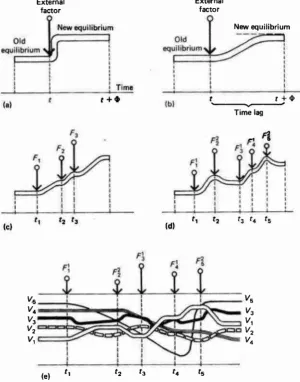
Social sciences anil planningurban and regional systems, is the response time. Consider a system in
dynamic equilibrium, that is, a system that
will
not change throughtime, unless affected by external stimuli at a particular time t. Figure 1.3 shows several examples of system dynamics of this kind. Figure 1.3(a) shows a case in which the change in the system occurs instantly as a
result of an external factor. Figure 1.3(b) shows an example where the
system takes some time
to
react and reaches the new steady stategradually rather than instantly. The amount of time that the system
takes
to
reach a new equilibrium is called relaxation time, responsetime,
or
time lag.External factors can take place at several times, such as at
tr,
t, andt, in figure 1.3(c), and can be of different magnitudes, such as F1, F, and
Fr. The symbolic curve representing the behaviour of the system
will
External
factor
r+O
v5 v1
v3
v2
v1
(e) fl t2 t3 t4 ts
Figure 1.3, E:rtemal factors affecting a system through dme External
factor
t
r+o
-_
Time las
v5
v3
v1 v2
v4
[image:27.449.103.404.211.594.2]