THE FOUNDATION OF SOUNDSCAPE-LAB IN MACAU
PACS: 43.50.Qp
Cordeiro, João1,2; Barbosa, Álvaro1,2; Luís Gustavo Martins2, José Alberto Gomes2 1 Universidade de São José
Rua de Londres 16 (NAPE) Macau, China +85366778260
{joao.cordeiro, abarbosa}@usj.edu.mo
2 CITAR – Centro de Investigação em Ciência e Tecnologia das Artes
Universidade Católica Portuguesa – Centro Regional do Porto - Escola das Artes Rua Diogo Botelho, 1327. 4169-005 Porto – Portugal
[email protected], [email protected]
Abstract
In this paper we present the framework of “Soundscape-Lab”, an emerging research lab in Macau, dedicated to study soundscapes in high-density urban and semi-urban environments. Macau is a special administrative region of China, known for its thriving gaming industry and being one of the most densely populated regions in the world. Despite its small size (30.3km2), the territory is quite heterogeneous, featuring islands, continental areas, bridges, beaches, forest, lakes, skyscrapers and an extensive waterfront with almost 40km. Such a variety of locations and human environments in a condensed small area makes Macau a unique setting to conduct large-scale studies, exploring emerging networked technologies for soundscapes monitoring and developing community based acoustic awareness.
Resumo
Introduction
Although the study of sound can be traced back to the Classical Period in Greece (Aristotle, 1881), the notion of environmental sound came later and was systemized under the concept of Soundscape by the hand of Murray Schafer, used to describe the sound of a particular location in a particular time, analogously to what happens in the visual realm with the term landscape (Schafer, 1994). However, the Soundscape as scientific discipline goes beyond the mere study of the sounds that can be heard in a place. It entails a complex phenomenon, which comprehends the physical, acoustic, psychoacoustic, sociological, geographical and aesthetical aspects related with the sound environment of a specific place. Despite such complexity, the auditory experience happens effortlessly and most of the time unnoticeable for the listener. Perhaps because of this, sound and our auditory system tend to be less regarded when compared to image and vision. While sounds can be considered indexical from a semiotic perspective, as their meanings are quickly understood by most humans since they are largely given by their obvious physical origin (Saldanha, 2009), the average person, normally operating on a casual listening mode (Chion, 1994), demonstrates an overall low awareness of his or her sonic milieu. It often takes a disruptive sound to perceive and become conscious of changes in a soundscape. This perceptual idiosyncrasy shapes the way soundscapes are assessed and definitely accounts for the importance of their study.
Our proposal seeks the creation of a research lab in Macau around the topic of Soundscapes, with an emphasis on the assessment and promotion of Soundscape awareness based on new technologies developed in the spirit of ubiquitous computing, mobile computing, physical computing, wearable computing, sensor networks and social networks.
The issue of noise pollution and the soundscape approach
With the industrial revolution taking place during the 17th century, the city soundscape dramatically changed. New mechanical sounds were injected into the acoustic environment, leading to an overpopulation of sounds that would eventually become a lo-fi soundscape. For Schafer, the lo-fi soundscape appears as an opposition to the hi-fi concept, which defines a system with a low signal-to-noise ratio. A lo-fi soundscape is that in which sounds carrying meaning (signals) cannot be distinguish from the blurred amalgam of background sounds (noise). The result is a much-constrained acoustic horizon (confined to a few meters radius), where people cannot listen to sound events occurring far from their location nor subtle and less conspicuous sounds close to them. This phenomenon is usually found in big cities and is considered potentially harmful (De Vos & Van Beek, 2011), able to induce sleep disorder, provoke annoyance, stress and even be the cause of minor psychiatric disorders (Stansfeld & Clark, 2011). Advances in society from demographic, geographic and technological points of view, are not always accompanied by an environmental consciousness, especially in emergent under-developed countries. Studies assessing the quality of the soundscape of a given place are important to ensure that the soundscape is in consonance with the place that embodied it. In urban environments, mainly in highly populated cities like Macau, it is common to observe that the sonic expectations for a given place are defrauded by overwhelming soundscape of automobile flux (Szeremeta & Zannin, 2009). On the other hand, humans are not only victims but also the source of the pollution problem, being harmed by the lack of environment-friendly urban planning and unawareness of their own ecological footprint. A study conducted at Muir Woods National Monument, California, supports this idea: visitors were surveyed regarding which sounds they considered more annoying, and the results concluded that these were the utterances from visitors themselves (Pilcher, Newman, & Manning, 2009).
design stage of urban planning. The Soundscape approach for noise control (Kang, 2011) takes a step further by widening the spectrum of aspects that are taken into consideration when combating this problem. It takes sound as resource rather than waste, studying it in context with the populations and communities affected, seeking a holistic solution that encompasses not only the sound sources but also the environmental setting and the listeners. To deal with the sound pollution issue it is definitely imperative to increase awareness for the sound phenomenon and a soundscape approach is a promising way to it, instead of the traditionally simplistic approaches based exclusively in measuring acoustic pressure, such as the Community Noise program (B Berglund, Lindvall, & Schwela, 1999).
Sound environment in Macau: issues, strategies and opportunities.
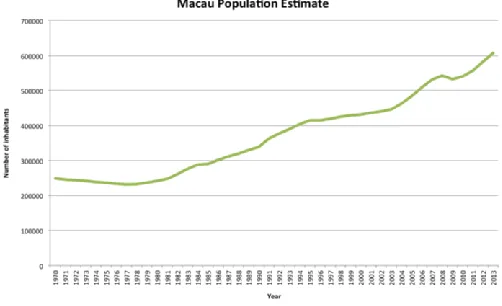
[image:3.595.172.423.315.468.2]Macau is a popular touristic destiny, which has experienced a gradual increase on the number of visitors1 and residents2 (figure 1).
Figure 1 - Increase of Macau population (Source: Statistics and Census Service of Macau)
The Bureau of Environmental Protection 3 (DSPA), showing concern for the sound environment, included this topic in the Environment Protection Planning for Macau released in 2012. The time-span of the plan goes from 2009 to 2020, aiming at a reduction of 2,3 Db(A) of the average sound environment intensity along the 11 years period (figure 2).
1 Information from the Statistics and Census Service (DSEC) indicated that visitor arrivals posted a new record for a single month, reaching 3,086,271 in the August Summer Holiday, up by 7% year-on-year.
(http://www.dsec.gov.mo/Statistic/TourismAndServices/VisitorArrivals/VisitorArrivals2014M08.aspx retrieved on 23 September 2014)
2 Macau had an increase of 37,23% on the Population Estimation indicator during the last 10 years, from 454700 to 624000. (Source: Statistics and Census Service, Government of Macao Special Administrative Region)
Figure 2 - Plan for the average reduction of regional ambient noise in Macau (Source: Environmental Protection Bureau of Macao).
Currently, the ambient noise monitoring network in Macau is comprised of four stations distributed along 4 strategic places in the city, ranging from busy traffic roads to residential areas. The annual average for the 4 places is 70,5dB Leq(24h), which is a high value considering that it includes residential areas. Moreover, the average during daytime is 72,1 dB Leq(8h-20h) which represents a variation below 2dB, meaning that the sound intensity has relatively small variations along the day. The strategic directions for the control of noise pollution are divided in three stems (Environmental Protection Bureau of Macao, 2012):
1. Optimization of the monitoring system for acoustic environmental quality. This will allow the management department to understand better the state of noise pollution, provide bases for decision making concerning the acoustic environment protection and feed data for different factor analyses related to noise, etc.
2. Put noise under control from the following perspectives: the control of noise sources, the control of noise transmission channels, and the protection of noise-sensitive receivers. Formulate the Regulation on the “Prevention and Control of Ambient Noise”, strengthen the control of noise from piling works and community activities, increase publicity and education targeting all social sectors to reduce noise disturbances, and take various measures to control noise from industry, commerce, traffic and construction.
3. Reduce noise at source during the stage of urban planning, and manage the acoustic environment by preventive means such as environmental impact assessment and green design.
New technologies for soundscape assessment: the Soundscape-Lab approach.
Knowledge is the key element for assuming control over something. In order to find appropriate solutions for a stated problem it is crucial to properly understand the object of study. Assuming a Soundscape approach to address environmental sound issues, we are dealing with three different elements that we need to fully understand: sound, place and people. The traditional tools to assess these elements are: sound measuring devices and sound mapping strategies (for sound), cartography methods for geographic spaces (places) and social assessment techniques like surveys and observations (for people). While these tools have reached great performance levels and have proven their success in assessing some aspects of these three elements, they are limited when concerning multimodal long-term and large scale-studies. The tools available are usually tailored for one specific task and usually demand an operator to work with them. For example, the SPL meter, the sound recorder or the social surveys all represent task-specific tools, which demand operators and involve time-consuming processes.
its integration in the fabric of everyday life. These tools are rooted in the essence of digital fabrication, using open source electronics and hardware/software products, along with modern fabrication techniques/tools such as laser cutters, 3D printers and CNC machines. The goal is to design new tools that can address the monitoring and evaluation of the sound environment effortlessly, in large-scale, low-cost and without direct involvement of specialists, passing the load to the everyday citizen of urban and rural areas. Likewise, new technologies can also be applied to survey methods, namely in the distribution and analysis of electronic questionnaires.
The second branch regards the analysis of the soundscape from a qualitative perspective, moving beyond the simple sound measurement. Through the use of auditory scene analysis techniques, it is possible to recognize meaningful aspects of the soundscape that can provide evidences about the sound itself (source materials, source activities) rather that just its intensity or even psychoacoustic indicators. Additionally, this rich-information should be combined with a multimodal-sensing feature, where different layers of the citizen’s context are taken into account and cross-analyzed, such as geo-localization, lighting environment, social interactions, etcetera. Combining this information with qualitative data gathered by survey methods, we are able to get a clearer picture of the citizen’s context and how it impacts his or her evaluation of the sound environment.
Related Scientific Areas
The sound environment is usually studied within the areas of acoustics, environmental studies, product design, architecture and occupational health. In our approach, we elect technology as a key discipline for undertaking further research in this scientific area, including, among others, concepts from ubiquitous computing, context-sensing and sensor networks.
The term ubiquitous computing (ubicom) – coined during the late eighties in PARC (Weiser, Gold, & Brown, 1999) - concerns the invisible and pervasive presence of computers in our daily life, merged within the everyday objects we use, in the clothes we wear, in the places we inhabit. To accomplish an effective ubiquity, computing and HCI should address, according to (Abowd, Mynatt, & Rodden, 2002), three main features: context-sensing, capture and access
and constant connectivity. A ubiquitous computing system fades into background, stepping
away from its explicit involvement on a specific task. This is what appends with intelligent houses where events are triggered after specific contextual cues are observed, without an explicit intervention from the user.
The evolution of ubiquitous computing is tied to the evolution of sensors, which are an important element of this form of computing. Sensors are responsible for the acquisition of contextual cues, either environmental or human related. Their current low-price makes them suitable for be included in everyday devices, such as phones, computers or house appliances. By linking sensors together, we are within the Sensor Network field (Tubaishat & Madria, 2003), which can enhance the understanding of a phenomenon and its evolution over wider areas.
We aim at creating new sets of tools based on the integration of new ubiquitous technologies into traditional soundscape assessment techniques and methods.
Research Networking
The current research partners involved in the creation of the project include the Research Centre for Science and Technology of the Arts (CITAR) from the Catholic University of Portugal and the Human and System Engineering Department from Ulsan National Institute of Science and Technology (UNIST). CITAR has been the stage for sound-related research since 2004, mainly in the field of sonification (Cardoso, Carvalho, Teixeira, & Barbosa, 2004), networked music (A. Barbosa, 2005; A. Barbosa, 2003) and latter in the field of soundscapes (Joao Cordeiro, Barbosa, & Santos, 2013; Joao Cordeiro & Makelberge, 2010; Gomes & Tudela, 2013), machine audition (Lagrange, Martins, & Tzanetakis, 2012) and sonic interaction design (Joao Cordeiro, Baltazar, & Barbosa, 2012). On the other hand, the research focus of our partners at UNIST has been the HCI field, with an emphasis on sound and haptic interaction on mobile computing (Bianchi, Oakley, & Kwon, 2012; Vazquez-Alvarez, Oakley, & Brewster, 2011).
The goal is to expand this network of collaborations to other research institutions worldwide working in the field of soundscapes. Some organizations that we consider a reference in these areas include: The Acoustics Group of the University of Sheffield, CAPS - Instituto Superior Técnico of Lisbon, several Acoustic Societies in the world, International Institute of Noise Control Engineering, World Forum for Acoustic Ecology, among others.
Major contributions by the members
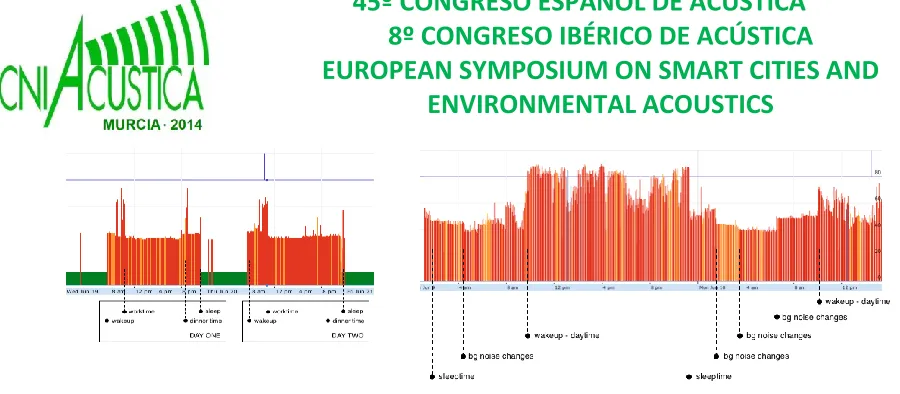
On the genesis of this project are two main research projects that sowed the seed for the conceptual and scientific frameworks of the Soundscape-Lab. The first project, entitled Sound Based Social Networks, explores the relation between soundscapes and social networking. The author developed an application for mobile devices that can sense and identify the sound sources present on the users’ acoustic environmental and shares that information with the peers of their social network (João Cordeiro, Barbosa, & Afonso, 2013). By providing a new contextual cue based on sonic information, the users gain awareness of their acoustic environment, while improving their profile on the cloud. Additionally, a record of all the information gathered is kept on a database, which can be used for large-scale analysis of the users soundscapes. The results of this research have shown that such record can be a good indicator of the users activity and a way to understand the sonic idiosyncrasies of the different places. Although not statistically relevant, the comparison of some records from Portugal users against records from Macau users has shown how the Macau soundscape is prone to be more intense than that in Portugal (figure 3).
The second research project is called URB (Gomes & Tudela, 2013). It is a system for automated analysis and storing of an urban soundscape based on available and inexpensive hardware and open source software. It complements the traditional sound maps4, allowing the direct access to the sound features at any arbitrary moment since the system boot, thus facilitating the study of the soundscape evolution and allowing for its direct comparison between specific timeframes. Moreover, this system simplifies the access to the aforementioned datasets for artistic purposes. It was developed to be used not only by environmentalists and urban planners but also by artists with creative intentions.
This project puts an emphasis on the open-source community, meaning that the citizen is able to create his/her own measuring device and connect it to a larger network. By doing so, the measuring technology, which is intended to adapt to the different social and personal contexts, can be built and customized by the end user.
The Soundscape-Lab Work Packages
Three main work packages were identified as the central lines of action for the Lab, providing guidance for the definition of future projects. Each project may address a particular line of action or a combination of lines.
A. Semantic Sound Sensing A.1 Adaptive Sound Sensing
A.2 Smart Apps and Wearable Computing A.3 Citizen as a Sound Sensor
A.4 Soundscape Qualitative Evaluation
B. 3D Soundscape Mapping
B.1 Vertical and Maritime Coastline Soundscape Mapping B.2 Dataset Development for Soundscape Machine Audition B.3 Surround Sensing and Reproduction
B.4 Immersive Soundscapes over Audio Networks
C. Community Soundscape Awareness
C1. Community-based field practices (sound walks, soundscape composition) C.2 Audio Social Network Interaction for awareness and auto-regulation C.3 Soundscape Awareness and Education through Creative Sound Design C.4 Soundscape Heritage and Ethnography
Resources and funding
[image:7.595.58.508.44.241.2]In order to achieve the Soundscape-Lab goals, it is important to consolidate a network of facilities, equipment and human resources. The University of Saint Joseph (USJ) in Macau is the main hosting institution, providing the legal and academic framework for the creating of the Lab. USJ is currently building a new campus at Green Island, which will feature audio labs and fabrication labs for the construction of the prototypes. The building is planned to start operating on the next academic year (2014/15). Regarding the equipment, USJ has the basic audio equipment for recording, analyzing and playing sound, including hand–held recorders, binaural microphones, headphones, SPL meters and surround sound rooms. On the fabrication side, USJ has three 3D printers, one laser cutter, one CNC machine and access to a PCB machine through a protocol with the Science Museum of Macau. The human resources available are dependent of the funding that the Soundscape-Lab is able to attract. It is expected that in the short-term, the Lab can operate with two full-time PhD students, two part-time senior researchers (USJ resident staff) and five senior research consultants
Figure 3 - Comparison between soundscape sensing of a Portuguese user (left) and a Macau user (right). The left record indicates that during night time the sound intensity drops below the fixed silence threshold (30dB -
(external institutions/research partners). The main funding institutions in Macau are the Science and Technology Development Fund5 (FDCT), the Tertiary Education Services Office6 (GAES) and Macao Foundation7, which provide funding for short-term and long-term scientific projects, as well as for equipment and scientific events.
Expected outcomes and acknowledgments
The expected outcomes for the Soundscape-Lab activity in the mid-term include the production of two PhD Thesis, the publishing of scientific papers at international peer-reviewed journals, presentations in scientific meetings, the production of software applications for mobile sound monitoring, the Lab website, establishment of methodologies for 3D and subaquatic sound mapping and the production of pedagogical tools and practices for sound awareness for the general public and schools.
This paper has been partially supported by the Tertiary Education Services Office of Macau (GAES) and the Foundation for Science and Technology – Portugal (FCT) in the scope of the project PEst-OE/EAT/UI0622/2014.
Bibliography
Abowd, G. D., Mynatt, E. D., & Rodden, T. (2002). The human experience. Pervasive
Computing, IEEE, 1(1), 48–57. doi:10.1109/MPRV.2002.993144
Aristotle. (1881). Aristotelis quae feruntur De coloribus, De audibilibus, Physiognomonica. B.G. Teubner.
Barbosa, A. (2005). Public Sound Objects: a shared environment for networked music practice on the Web. Organised Sound, 10(03), 233–242.
Barbosa, Á. (2003). Displaced soundscapes: A survey of network systems for music and sonic art creation. Leonardo Music Journal. Retrieved from
http://www.mitpressjournals.org/doi/abs/10.1162/096112104322750791
Berglund, B., Lindvall, T., & Schwela, D. (Eds.). (1999). Guidelines for community noise. Geneva: World Health Organization.
Berglund, B., & Nilsson, M. E. (2006). On a Tool for Measuring Soundscape Quality in Urban Residential Areas. Acta Acustica United with Acustica, 92(6), 938–944. Retrieved from http://www.ingentaconnect.com/content/dav/aaua/2006/00000092/00000006/art00012 Bianchi, A., Oakley, I., & Kwon, D. S. (2012). Counting clicks and beeps: Exploring
numerosity based haptic and audio PIN entry. Interacting with Computers, 24(5), 409– 422. doi:10.1016/j.intcom.2012.06.005
Cardoso, J., Carvalho, J., Teixeira, L., & Barbosa, Á. (2004). SOUNDSERVER : DATA SONIFICATION ON-DEMAND FOR COMPUTATIONAL INSTANCES. In Proceedings of the Tenth Meeting of the International Conference on Auditory Display (ICAD 2004)
(pp. 4–7). Citeseer. Retrieved from
http://citeseerx.ist.psu.edu/viewdoc/download?doi=10.1.1.60.8210&rep=rep1& type=pdf
Chion, M. (1994). Audio-Vision: Sound On Screen. (C. Gorbman, Ed.). New York: Columbia University Press.
Cordeiro, J., Baltazar, A., & Barbosa, A. (2012). Murky shooting: the use of auditory (non-speech) feedback on mobile audiogames. In Proceedings of the 7th Audio Mostly
Conference: A Conference on Interaction with Sound. Corfu - Greece (pp. 40–43). New
York: ACM. doi:10.1145/2371456.2371462
Cordeiro, J., Barbosa, Á., & Afonso, B. (2013). Soundscape-Sensing in Social Networks. In
Proceedings of AIA-DAGA 2013 Conference on Acoustics. Merano: EAA Euroregio.
Cordeiro, J., Barbosa, A., & Santos, A. (2013). A Soundscape Assessment Tool Based On A Massive Multichannel Loudspeaker Setup. In Proceeding of Echopolis-Days of Sound
2013: Sounds, noise and music for re-thinking sustainable city and econeighborhood.
Athina: SDMed.
Cordeiro, J., & Makelberge, N. (2010). Hurly-Burly: An Experimental Framework For Sound Based Social Networking. In E. Brazil (Ed.), Proceedings of the 16th International
Conference on Auditory Display (pp. 109–113). Washington D.C.: International
Community for Auditory Display.
De Vos, P., & Van Beek, A. (2011). Environmental Noise. In Reference Module in Earth
Systems and Environmental Sciences, from Encyclopedia of Environmental Health (pp.
476–488). Burlington: Elsevier. doi:10.1016/B978-0-444-52272-6.00252-X
Environmental Protection Bureau of Macao. (2012). Environmental Protection Planning for
Macao. Macao, Macao SAR: Environmental Protection Bureau of Macao.
Gomes, J. A., & Tudela, D. (2013). Urb: urban sound analysis and storage project. In R. Bresin (Ed.), Proceedings of the Sound and Music Computing Conference (pp. 493– 499). Stockholm, Sweden: Logos-Verlag.
Kang, J. (2011). Noise Management: Soundscape Approach. In J. O. Nriagu (Ed.),
Encyclopedia of Environmental Health (pp. 174–184). Burlington: Elsevier.
doi:10.1016/B978-0-444-52272-6.00260-9
Lagrange, M., Martins, L. G., & Tzanetakis, G. (2012). Cluster aware normalization for enhancing audio similarity. In ICASSP, IEEE International Conference on Acoustics,
Speech and Signal Processing - Proceedings (pp. 1969–1972).
Pilcher, E. J., Newman, P., & Manning, R. E. (2009). Understanding and managing experiential aspects of soundscapes at Muir woods national monument. Environ
Manage, 43(3), 425–435. doi:10.1007/s00267-008-9224-1
Saldanha, A. (2009). Soundscapes. In (R. Kitchin & N. Thrift, Eds.)International Encyclopedia
of Human Geography. Oxford, UK: Elsevier. doi:10.1016/B978-008044910-4.00979-2
Schafer, R. M. (1994). The Soundscape: Our Sonic Environment and the Tuning of the World. Rochester: Destiny Books.
Stansfeld, S., & Clark, C. (2011). Mental Health Effects of Noise. In (J. O. Nriagu,
Ed.)Encyclopedia of Environmental Health. Burlington, MA, USA: Elsevier.
doi:10.1016/B978-0-444-52272-6.00248-8
Szeremeta, B., & Zannin, P. H. T. (2009). Analysis and evaluation of soundscapes in public parks through interviews and measurement of noise. The Science of the Total
Environment, 407(24), 6143–9. doi:10.1016/j.scitotenv.2009.08.039
Tubaishat, M., & Madria, S. (2003). Sensor networks: an overview. Potentials, IEEE. Retrieved from http://ieeexplore.ieee.org/xpls/abs_all.jsp?arnumber=1197877 Vazquez-Alvarez, Y., Oakley, I., & Brewster, S. a. (2011). Auditory display design for
exploration in mobile audio-augmented reality. Personal and Ubiquitous Computing,
16(8), 987–999. doi:10.1007/s00779-011-0459-0