FACULTAD de FILOSOFÍA Y LETRAS
DEPARTAMENTO de FILOLOGÍA INGLESA
Grado en Estudios Ingleses
TRABAJO DE FIN DE GRADO
Compiling and Using a Specialized Corpus: The Use
of
Since
in Medical English Language
Paola Rodríguez Escribano
Tutor: Isabel Pizarro Sánchez
ABSTRACT
Most of the studies dealing with the academic language and the research article have focused on the structure of these. However, this paper presents an overview of the usage and frequency of the particle since in a specialized corpus dealing with Research Articles about spine deformities. It aims to depict the process and selection criteria followed to compile that corpus, to study the usage and frequency of since in this, and to compare these results to the results found in two reference corpora (COCA and BNC). Since can have three different functions (preposition, adverb and conjunction), which will be analyzed separately in each corpus.
Keywords: Since, POS, corpus, specialized corpus.
RESUMEN
La mayoría de las investigaciones dedicadas al estudio de lenguaje académico y, más concretamente, en el artículo de investigación se centran en el estudio de la estructura de los mismos. Sin embargo este estudio presenta una perspectiva diferente centrándose en el uso y frecuencia de la partícula since en un corpus especializado sobre artículos de investigación de las deformaciones de columna. Este trabajo explica en primer lugar el proceso y los criterios de selección que fueron seguidos para la compilación del corpus. Después estudiaremos el uso y la frecuencia de since en el corpus y compararemos los resultados con dos corpus de referencia (COCA y BNC). Since puede tener tres funciones diferentes (preposición, adverbio y conjunción), las cuales serán estudiadas por separado en cada uno de los tres corpus.
Table of contents
List of Figures ………..vi
List of Abbreviations………...………vii
1. Introduction ... 1
2. Theoretical background ... 2
2.1. Since in different dictionaries ... 3
2.2. Since in different grammars ... 4
3. Methodology ... 6
3.1. Corpus design and Compilation process ... 6
3.1.1. Selection criteria ... 7
3.1.2. Materials ... 11
3.2. Corpus exploitation ... 12
4. Findings ... 13
4.1. Total results ... 13
4.2. Findings by Part of Speech. ... 16
4.2.1. Since as preposition ... 17
4.2.2 Since as conjunction ... 19
4.2.3 Since as adverb ... 22
4.2 Summary: Since by POS in the subgenre of Medicine ... 24
5. Discussion ... 26
5.1. No native speakers: Universals of translations ... 26
5.2. American variety ... 28
5.3. Degree of specialization ... 29
6. Conclusions and further research. ... 30
Works Cited……….32
List of Figures
Figure 1: Since in CDS with AntConc Concordance Tool 14
Figure 2: Since in BNC 15
Figure 3: Since in COCA 15
Figure 4: Occurrences of Since 16
Figure 5: Since as Preposition in BNC 18
Figure 6: Since as Preposition in COCA 18
Figure 7: Since as Preposition 19
Figure 8: Since as Conjunction in BNC 20
Figure 9: Since as Conjunction in COCA 21
Figure 10: Since as Conjunction 21
Figure 11: Since as Adverb in BNC 22
Figure 12: Since as Adverb in COCA 23
Figure 13: Since as Adverb 24
Figure 14: Frequency of Since 25
Figure 15: Since in CSD 26
List of Acronyms
BNC: British National Corpus
COCA: Corpus of Contemporary American English
CSD: Corpus of Spine Deformities ESP: English for Specialized Purposes
LGP: Language for General purposes LSP: Language for Specialized purposes POS: Part of Speech
RA: Research Article
1. Introduction
Many studies have been carried out in the academic language, (Biber and Conrad, Swales, etc), however, most of them have focused their attention on the structure of the Research Articles. Nevertheless, the present paper has a different aim, to compile corpus of spine deformities and to study the use and frequency of the particle since in this and to compare it with two reference corpora (COCA and BNC).
I decided to study this specific particle due to its complexity as it can have three different functions: preposition and adverb denoting time, and conjunction expressing the reasons for something. Considering as no study regarding the use of since, in the general or specialized language, was found, it was felt that a corpus research may provide a clear, less intuitive insight into the use of since. Corpora can offer high benefits compared to other type of resources related to the study of the language such as dictionaries, grammars or natives speaker’s intuition, since corpora are based in real
language. The use of corpora can compliment other resources dealing with the study of language. One of the most common criticisms of dictionaries is that they provide little contextual or usage information. However, nowadays examples of use based on corpora are increasingly being included in language resources such as online grammars and dictionaries, in which size is not a problem.
As in most dictionaries and grammars the use of since can only be found in the general language, the current paper aims to (1) compile a specialized corpus dealing with two of the most common spine deformities, and (2) to provide a different perspective of the use of since regarding its use in the specialized language. More concretely the use of since will be analyzed in academic research articles in the medical discipline and compare this to some reference corpora, (BNC or COCA) and their specialized sub-corpora. This is a corpus driven study because a corpus will be
compiled and the use and frequencies of the different functions since can have will be studied and compared this to the British National Corpus (BNC) and the Corpus of Contemporary American English (COCA).
This paper is structured as follows: Section 2 provides an overview of related studies and collects information about since in different dictionaries as well as grammars. After this, in Section 3 the corpus compilation process will be depicted, as well as the criteria followed for this, and the methodology of analysis. The following section will show the results found in the corpus and compare them with some reference corpora such as the BNC and COCA. Finally, in the last section the results found in the previous section will be analyzed and it will be tried to explain why frequencies found in the corpus I compiled and those found in COCA and BNC are not similar in some sections.
2. Theoretical background
Many studies have been carried out in the academic language (Biber and Conrad; Swales). The research article (RA) is one of the most studied subgenres comprised of the academic language. This is not very surprising since it is highly used in many disciplines. “The research article or paper (henceforth often RA) is taken to be a written
text (although often containing non-verbal elements), usually limited to a few thousand words, that reports on some investigations carried out by its author or authors.” (Swales
93). According to Swales, the research article is an immense genre (93). It is the central communicative mechanism of most sciences. However, most of the studies dealing with the study of the RA focus on the study of its structure, for instance Swales, focuses his study in the RA introductions. However, this study is not concerned with the structure of the RA, but with the usage and frequency of the particle since in RAs dealing with spine deformities. There are not corpus-based or corpus driven studies dealing with the specific particle since, although there are there are many studies regarding other particles, mainly prepositions.
As it has already been anticipated in the introduction, according to most
of 1 percent of your vocabulary but make up almost 60 percent of the words you use." (Pennebaker 11).
A preposition is an independent word that does not have full meaning itself but it provides meaning to the rest of the sentence. They have a function rather than a meaning. According to Sinclair there are more than 100 prepositions in English, which is a very small number if it is compared with the number of nouns, adjectives and verbs in existence in English (“Prepositions” vi). However, most sentences contain at least one preposition (“Prepositions” vi). One of the most common errors that people
learning English make is to use the wrong preposition. A conjunction is a word that joins two different sentences, clauses or just two words. There are several kinds of conjunctions: coordinating, subordinating, and correlative. Since is a subordinating conjunction as it makes one clause dependent upon the other. An adverb is a word that modifies a verb but it can also modify an adjective or even other adverbs.
Before any study of since can be carried out, the uses of since should first be consulted in some grammars and dictionaries in order to be able to describe the use of since in the general language and to compare it latter to what was found in the Corpus
of Spine Deformities (CSD).
2.1. Since in different dictionaries
After consulting several dictionaries and confirming that all of them agreed on the functions, meanings, and uses of since, we selected three of the most representative and well known dictionaries and included the most relevant information found in them.
Oxford Dictionary: according to this, since is in the top 1000 frequently used
words. These are the uses of since presented in the Oxford Dictionary:
- Preposition: in the intervening period between (the time mentioned) and
the time under consideration, typically the present. She has suffered from depression since she was sixteen.
- Conjunction: For the reason that, because. Delegates were delighted,
since better protection of rhino reserves will help protect other rare species.
Cambridge Dictionary: The uses of since registered in this dictionary are the
same that in the previous one.
- Preposition: at a time between (something in the past) and
the present time. I’ve changed my address since last year.
- Conjunction: because. Since you are going, I will go too.
- Adverb: at a later time. We have since become friends.
Collins Dictionary: the last dictionary that was consulted was the Collins dictionary in which we found similar results to the previous ones.
- Preposition: during or throughout the period of time after. Since May it
has only rained once.
- Conjunction: seeing that, because. Since you have no money, you can't
come.
- Adverb: since that time. He left yesterday and I haven't seen him since.
2.2. Since in different grammars
In most grammars I have consulted, since is studied in a similar way. I include a summary of the information found in two of those grammars which provide a very different perspective of the use of since. Quirk et al.provide in the Longman Grammar a more professional overview of since divided according to the word class (56, 74, 86, 125, 838-849). On the other hand, Ronald in the Cambridge Grammar (137-140) is a
more practical one. It is addressed to learners of English as a second language and, thus, the usage of since is described in a different way. There is a whole section dedicated to this particle and many different uses are defined in it, without specifying the part of the speech (POS) of since in any of them.
According to the Longman Grammar (Quirk et al 56, 74, 86, 125, 838-849)
when it is a preposition or an adverb, it denotes time and can be followed by a temporal noun phrase, a subjectless –ing clause: since leaving school; or a noun phrase
perfect aspect and are normally positioned finally: His studies haven’t been improving since.
As conjunction, it can introduce clauses of time or clauses of reason or cause. Since is a simple subordinator for finite adverbial clauses of time. It can be followed by
–ing clauses but not by –ed clauses or verbless clauses, Since moving here, I have felt
more relaxed. Clauses of reason or cause are commonly introduced by the conjunctions
because, as or since: As/Since Jane was the eldest, she looked after the others.
When since is used in a temporal sense, the perfect is used in the superordinate clause, also sometimes in the subordinate clause, in referring to a stretch of time up to the present: She has been drinking Martinis ever since the party started. The same applies to since as preposition and as prepositional adverb: Scholars have been writing English grammars since the sixteenth century.
In the Cambridge Grammar, Ronald splits the meaning of since in two different sections, referring to time and referring to reasons (137-140). When since refers to time it indicates that something occurs from a point in time until now and when since is referring to reason, it is used when the reason for something is presumed to be already known to the listener. It is used with present perfect or past perfect in the main clause. However, present simple and past simple are often used instead of present perfect and past perfect with the construction it + be + time period + since: It was years since I’d seen him. It is used with the past tense in the since-clause when since refers to a point in
time and with the present perfect when it refers to an event leading up to now or still relevant.
Since referring to time may be followed by the –ing form of a verb where the
subject is the same in both the main and subordinate clause: She’d only had a couple of
hours’ sleep since arriving in Oxford the previous day. This does not occur when since
refers to reasons: Since I didn’t have medical insurance, I would have to pay for everything out of my pocket.
It is also studied in opposition to from. From is sometimes used instead of since, especially with reference to distant historical times. However, from also refers to the starting point of completed periods of time, whereas since refers to periods of time continuing up to the point of speaking or writing.
After consulting the meanings, functions and usages of since in the dictionaries and grammars that were previously described in this section, it can be deduced that it has three different functions: preposition, adverb, and conjunction which will be studied in terms of frequency in the Corpus of Spine Deformities in Section 4.
3. Methodology
Data for this analysis come from a corpus that was manually compiled collecting texts from five of the most important journals dealing with the main spine deformities (kyphosis, lordosis and scoliosis): Orthopaedics and Related Research, American Journal of Physical Medicine & Rehabilitation, Seminars in Spine Surgery, Spine
Deformity and The Spine Journal.
This section depicts the compilation process of the corpus and the specific criteria followed to carry this out, the materials which were eventually included, as well as the exploitation process of the corpus once it was compiled.
3.1. Corpus design and Compilation process
As Sinclair stated “the beginning of any corpus study is the creation of the corpus itself.” (“Collocation” 13), acorpus generally arises to answer a question or to be
the object of a study, therefore,this first step is influenced by the questions the linguists would like to answer based on the corpus data or the kind of study that is going to be based on this corpus. In this case, this corpus will study the usage and frequency of since in research articles dealing with spine deformities. The compilation process is the
most important part of the process due to the fact that “the results are only as good as the corpus” (Sinclair, “Collocation” 13). The following section focuses on the
characteristics that texts should have in order to be included in our research corpus,
3.1.1. Selection criteria
According to Bowker and Pearson “Texts in a corpus are selected according to
explicit criteria in order to be used as a representative sample of a particular language or subset of that language.” (10). Corpora are collected following several criteria which are
determined by the goal of the corpus, or by the intentions of the linguist compiling the corpus. When compiling a corpus, we have to include those criteria which better adapt to our purpose or those which will better answer our research questions. Sinclair stated that “Any selection must be made on some criteria and the major step in corpus building
is the determination of the criteria on which the texts that form the corpus will be selected” (“Collocation” 4) , he continued by saying that criteria should be small in
number, clearly separated from each other, and efficient as a group. According to him, common criteria should include mode, type, domain, language of the texts and date.
Table 1 summarizes the criteria followed to select our materials and the corpus characteristics according to those criteria.
Criteria Corpus characteristics
Level of specialisation Specialized
Type of communication Experts to experts
Language(s) English
Mode Online written articles
Genre Academic research articles
Topic Medicine: Spine deformities
Number of tokens 788,023
Number of texts 200
Date 2001 – 2014
Table 1: Building criteria.
particular type, such as academic articles in a particular subject, which aims to be representative of a given type of text and to investigate a particular type of language (14). There is no limit in the degree of specialization involved. According to Bowker and Pearson “LSP is the language that is used to discuss specialized fields of knowledge.” (25). They continue by saying that “These fields of knowledge can include
everything from professional activities to hobbies, as long as they treat a restricted subject.” (Bowker and Pearson 39) However, there is a difference between knowing a
subject and being able to use the LSP (Language for Specialized purposes) concerned with it. LSP and LGP (Language for General Purposes) overlap sometimes. LSP includes some terms that are only used in this area of knowledge and can sometimes combine language in a different way. However, it is developed upon the bases of general language. A corpus can be a useful resource for learning about the linguistic features of a LSP. There are several degrees of specialization, but articles included in the CSD, are written by experts and addressed to experts in the field of Orthopedics since previous knowledge is needed in order to understand them or to be able to work with them. Experts are those people who have training or experience in a specialized field. When experts communicate they tend to use a highly specialized language as they share a common background and thus, text written by experts for other experts, will be different from those written for non-experts.
The compilation of a specialized corpus is different from that of a reference corpus. For instance one of the criteria of a specialized corpus which differs from that of a reference corpus is the size, both in terms of the optimal length of each sample text, but also in terms of the optimal number of texts included in the corpus as discussed by McEnery and Wilson (80). Although the topic of size has been discussed by many different authors, Hunston (25), O’Keefee, McCarthy, and Carter (3), etc., there is not
agreement about the optimal overall size, because it highly depends on the goal of the corpus or the questions it is trying to answer. Following Bowker and Pearson (45) I
considered 788,023 words to be a respectable amount of words for a specialized corpus and for the needs of my research:
opposed to general texts, and second because LSP represents a more restricted subset of natural language. (Bowker and Pearson 45)
However, bigger does not always means better. This decision will be based on what it is been investigated, because much more information could be found in a smaller, well design specialized corpus than in a several million word reference corpus. Several authors have discussed this topic, for instance, for Bowker and Pearson well-designed corpora which are anywhere from a few thousand to a few hundred thousand words, have proved to be useful for LSP studies (45). As quoted in O’keefe, McCarthy, and Carter (4), “Aston (1997), Maia (1997) and Trible (1997) suggest using a small corpus if we are dealing with a very specialized language register [….] In terms of what constitutes a large or small corpus, it depends on what it is seeking to represent.”
Corpora are intended to be representative of a particular kind of language; the CSD is representative of the language used to describe the most common spine deformities in research articles published in several journals. Biber stated that common features of language are stable and, thus, smaller corpora are needed to study them (1). Conjunctions, prepositions and adverbs are functional words and some of the most common elements in any language which can be easily found in nearly any kind of language. Important information could be found anywhere in the texts, thus, as texts had a reasonable extension, from 2,500 to 7,000 words, it was found more useful to include full texts instead of extracts.
With respect to the authorship of the texts, there is a big difference between a corpus which only includes texts by one author and texts written by several ones. Our corpus includes a great variety of authors as the linguist will find more variety and will get a better idea of the language used in that concrete specialized area of knowledge. In this way, language is not limited to just one person’s style and linguistic choice.
Articles included in the CSD are written texts, they were collected from online newspaper and not transcribed, for instance from spoken lectures. “Medium refers to
whether the text in question was originally prepared as a written text or whether it is a transcription of a spoken text.” (Bowker and Pearson 49). Written texts are easier to
compile than transcribing oral texts as you do not need to transcribe them, which would be time consuming. Texts collected to be included in this corpus were found in online journals instead of printed journals, given that they were going to be analyzed with a linguistic tool, they needed to be computerized.
Regarding de number of languages included, corpora can be monolingual or multilingual, but in our case it only includes texts written in English. “Using original
language material in a monolingual corpus will provide you with authentic examples of typical LSP use.” (Bowker and Pearson 54), so special attention was paid to the authors
and institutions, and only texts published by institutions from English speaking countries were included. However, although texts were published in English speaking countries, it was not possible to figure it out if all the authors were English native speakers.
Another aspect that must be taken into account when selecting the materials is the genre or genres that best suit our purpose. The concept of genre has been discussed by Bhatia (16), Freedman and Medway (24), and Swales (58) to mention just a few. Swales defines it as follows:
A genre comprises a class of communicative events, the members of which share some set of communicative purposes. These purposes are recognized by the expert members of the parent discourse community, and thereby constitute the rationale for the genre. […] In addition to purpose, exemplars of a genre exhibit various patterns of similarity in terms of structure, style, content and intended audience. (Swales 58)
In this case we were interested in the study of since within the academic genre
and the research article (described in Section 2) dealing with texts in medicine, more specifically with spine deformities.
3.1.2. Materials
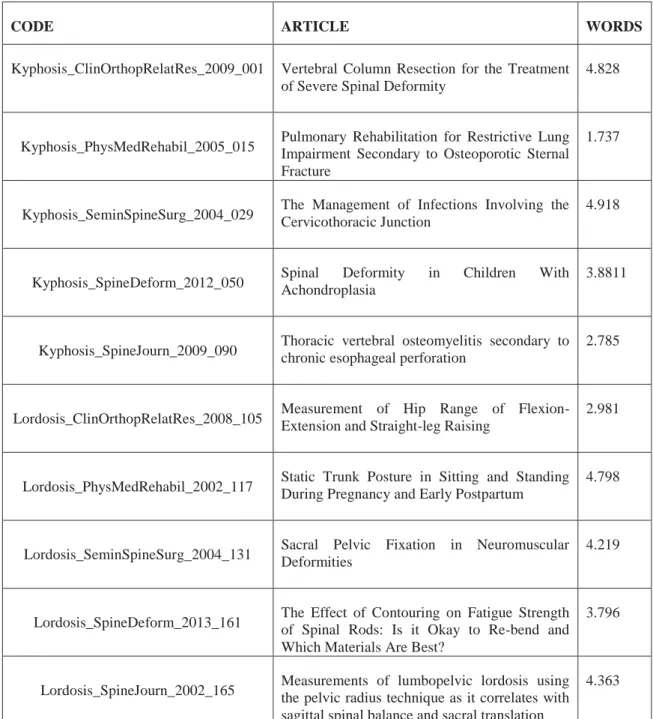
Once we had determined which criteria should be followed to compile our corpus, this section shows which materials were eventually included. As the complete list was too long to be included in this section it was included in the Appendix, but the following table is brief sample of how materials were organized and codify in order to work with them later. It includes ten samples, five of them dealing with kyphosis, and the other five dealing with lordosis. The table also includes the number of words included in each article.
CODE ARTICLE WORDS
Kyphosis_ClinOrthopRelatRes_2009_001 Vertebral Column Resection for the Treatment of Severe Spinal Deformity
4.828
Kyphosis_PhysMedRehabil_2005_015 Pulmonary Rehabilitation for Restrictive Lung Impairment Secondary to Osteoporotic Sternal Fracture
1.737
Kyphosis_SeminSpineSurg_2004_029 The Management of Infections Involving the Cervicothoracic Junction
4.918
Kyphosis_SpineDeform_2012_050 Spinal Deformity in Children With Achondroplasia 3.8811
Kyphosis_SpineJourn_2009_090 Thoracic vertebral osteomyelitis secondary to chronic esophageal perforation 2.785
Lordosis_ClinOrthopRelatRes_2008_105 Measurement of Hip Range of Flexion-Extension and Straight-leg Raising 2.981
Lordosis_PhysMedRehabil_2002_117 Static Trunk Posture in Sitting and Standing During Pregnancy and Early Postpartum 4.798
Lordosis_SeminSpineSurg_2004_131 Sacral Pelvic Fixation in Neuromuscular Deformities
4.219
Lordosis_SpineDeform_2013_161 The Effect of Contouring on Fatigue Strength of Spinal Rods: Is it Okay to Re-bend and Which Materials Are Best?
3.796
Lordosis_SpineJourn_2002_165 Measurements of lumbopelvic lordosis using the pelvic radius technique as it correlates with sagittal spinal balance and sacral translation
4.363
A code was designed for every article in the corpus, in order to identify them easily when working with the corpus. Codes include in first place the spine deformity the research article is dealing with (kyphosis or lordosis), the source from where they were collected (abbreviation of the journal), the year of publication and the number assigned to each text file.
3.2. Corpus exploitation
Once we had determined the materials and finished collecting our specialized corpus, we could start working with it. First we needed to convert the 200 texts to txt format in order to be readable by AntConc 3.2.4 (Laurence Anthony). In its official website, AntConc is described as a freeware, multiplatform tool for carrying out corpus linguistics research and dataǦdriven learning. It has several tools which can help the researcher to study linguistic features that manually would be harder to find and time consuming. These tools are the File View Tool, Clusters Tool, Word List Tool, Keyword List Tool, Concordance Plot Tool, Collocates Tool, and the Concordance Tool. The last one was the one used to find all the occurrences of since in the research articles included in the CSD, and to see these in context. “Also referred to
as key word in context (KWIC), a concordance is a list of all of the occurrences of a particular search term in a corpus, presented within the context in which they occur, usually a few words to the left and right of the search term.” (Baker, Hardie, and
McEnery 43). Concordances can be sorted alphabetically to the left or right of the search term, allowing linguistic patterns to be more easily observed by researches.
The Collocates Tool was used to determine the collocations of since in order to classify according to its function in the examples that were found. A collocation is described by Firth as a word which occurs within the neighborhood of another word.
Medicine subgenre as it was the one which was closer to the topic of our corpus. Once we had the total frequency of since in all the research fields, a distinction was made between each of its different functions (preposition, conjunction and adverb). Then, results were compared to those found in the Corpus of spine deformities.
4. Findings
The present section depicts the results found in terms of frequency in the corpora research and compares them with those found in two reference corpora, COCA and BNC. First we made a query in the three corpora in order to find quantitative data of the use of since. After this, we made a distinction in our query between the three different functions of since according to the different grammars and dictionaries we consulted (See section 2): preposition, adverb, and conjunction.
4.1. Total results
First, we searched for since in the three different corpora. As the Corpus of Spine Deformities (CSD) was composed by research articles dealing with spine deformities, since was searched in BNC and COCA in the fields and domains we considered more similar to the materials included in our corpus. Among the different genres these corpora offered, we chose academic and withinthe subgenres it comprises we selected Medicine as our corpus is composed by texts dealing with Spine deformities and we could not find any other subgenre more accurate.
Corpus of Spine Deformities
Figure 1: Since in CDS with AntConc Concordance Tool
The Corpus of Spine Deformities has a final length of 788,023 occurrences, in which since was found 86 times. As in the reference corpora the number of occurrences is expressed in times per million, we decided to extrapolate our findings to calculate the number of occurrences per million in order to be able to compare this to the reference corpora.
86 in 788,023 = 109.13 per million
In a million, since would be found 109.13 times, if we compare this result to the two reference corpora, the number of occurrences of since in both reference corpora is much higher than in our corpus, as we are going see below.
BNC:
In the British National Corpus since has a frequency of 431.76 times per million
Figure 2: Since in BNC
However, if we compare this result to its use in all the different genres and domains contained in the BNC (total frequency) and to the academic genre in general, we can observe that the number of occurrences per million in Medicine is lower than in the other two research fields. The frequency of since in the different subgenres contained within the academic genre is around 600 times per million except for Engineering, where the use of since is higher and our research field which is below average.
General: 500.57 per million
Academic: 645.66 per million
Medicine: 431.76 per million
COCA:
In the Corpus of Contemporary American English since has a frequency of 358.78 per million in the subgenre of Medicine, which means it would appear nearly
100 times less in a million than in the British corpus.
In this case, although the frequency of since in the general language and the academic genre is similar, the number of appearances of since in the medical subcorpus is again lower than within the other two. It is also the lowest frequency if we compare it to the other subgenres comprised by the academic genre.
General 485.14 per million
Academic: 482.01 per million
Medicine: 358.78 per million
Summary:
Figure 4: Occurrences of Since
Figure 1 summarizes the results found in terms of frequency comparing the number of occurrences of since in my corpus, the BNC, and COCA.
These results show a big difference between the number of occurrences of since in both reference corpora and in the CSD. Whereas in BNC and COCA the number of occurrences per million within the Medicine subgenre is around 400, in our corpus it was just found 109,133 times per million. Frequencies are always higher in the British National Corpus and in COCA and BNC the lowest frequency is the one found in the subgenre of Medicine.
4.2. Findings by Part of Speech.
A second search was made by specifying the function of since within the examples according to those determined in the different grammars and dictionaries we
have consulted in Section 2. In every section results are organized the same way. First 0
100 200 300 400 500 600 700
CSD BNC COCA
General
Academic
the Corpus of Spine Deformities was analyzed and the results were manually classified into one of the three different categories discussed in Section 2: preposition, conjunction and adverb. Then we looked for since in the reference corpora and finally we compared the frequencies of each corpus in the subgenre of Medicine.
4.2.1. Since as preposition
In first place we examine since when it performs the function of preposition, which was found to be the highest frequency in my corpus.
Corpus of Spine Deformities:
Results found in my corpus were manually analyzed and classified in one of the three categories (preposition, adverb and conjunction) based on the function it performed within the different examples. In this way, since was found to have the function of preposition a total number of 49 times, which constitutes the 56.97% of the examples found. This means that more than half of the examples found have the function of preposition. However, as in the previous case, results in both reference corpora are expressed in times per million, so we once again extrapolated our findings to times per million. So if in 788,023 we found since 49 times, in a million it is supposed to appear 62.18 times.
BNC:
One of Leech’s maxims of annotation is that corpus annotation is not infallible, but simply a potentially useful tool, which is supported by Potter (1999:35), “As tagging is something automatic, accuracy may not be complete”. This means that some errors
could be found in those reference corpora, although they usually constitute a very low percentage.
Figure 5: Since as Preposition in BNC
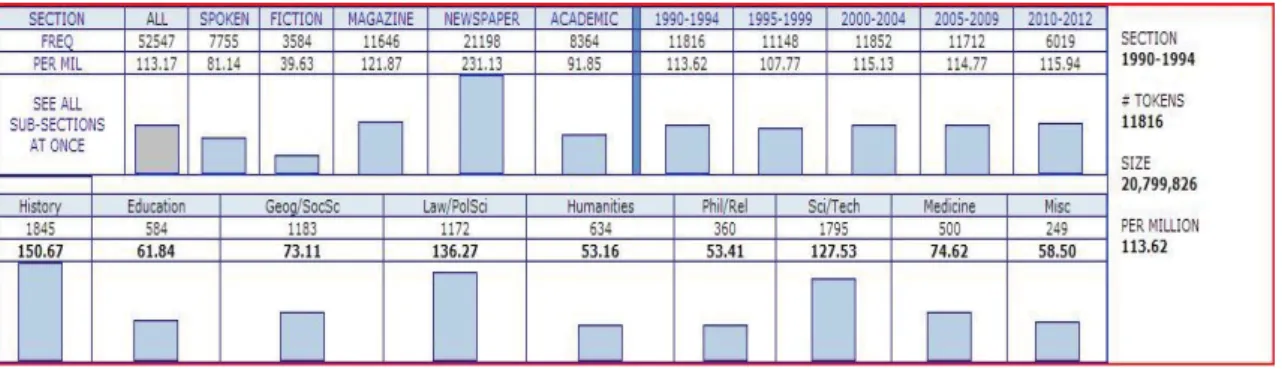
If we compare this to its frequency in the academic genre, the frequency is higher in the subgenre than in its genre, as the frequency of the research word in the academic genre was 78.47. However, both frequencies would be lower if we compare them to that of the general language, in which since is found 105.15 times per million.
General 105.15 per million.
Academic: 78.47 per million.
Medicine 84.23 per million.
COCA:
In the case of COCA the number of occurrences of since in the Medicine subgenre was lower than in the British Corpus, 74.62 per million.
Figure 6: Since as Preposition in COCA
Medicine to its frequency in the general language, the difference is bigger as it is found 113.16 times per million.
General: 113.16 per million.
Medicine: 74.62 per million.
Academic: 91.85 per million.
Summary
Figure 7: Since as Preposition
Figure 2 summarizes the frequency of since when it acts as preposition in the three corpora. As in the general language, the highest frequency is the one in the British National Corpus in all the categories and the lowest one is the one found in CSD when comparing frequencies in the subcorpora of Medicine. However, this time the difference between my corpus and the reference corpora is not as significant as in the previous section.
4.2.2 Since as conjunction
The second frequency registered in my corpus is that of since when this one acts as a conjunction.
Corpus of Spine Deformities:
Since was found to act as a conjunction a total of 29 times in the CSD, which
means a 33.7%. If we extrapolate this to times per million in order to compare it later to 0
20 40 60 80 100 120
CSD BNC COCA
General
Academic
both reference corpora (COCA and BNC) the number of occurrences per million would be 37.27.
BNC:
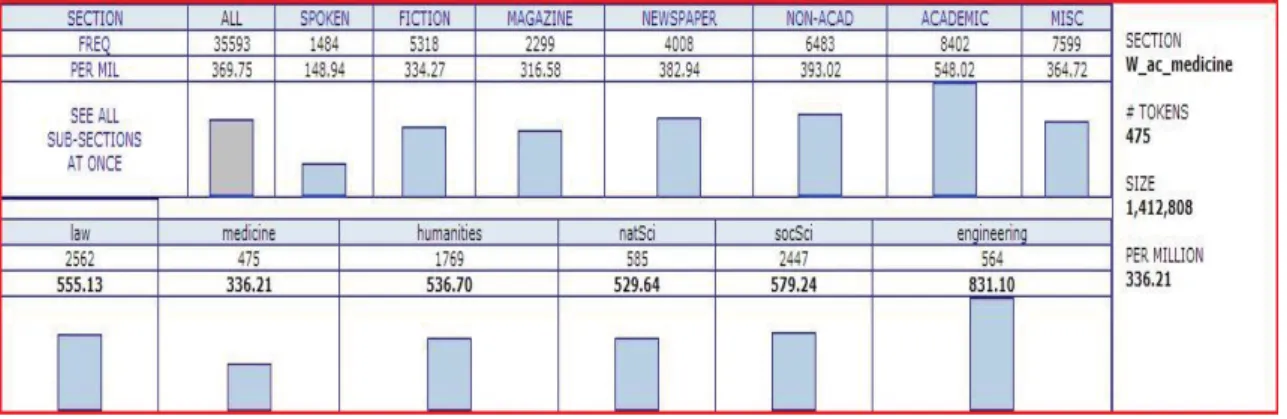
In the British National Corpus the number of occurrences of since as conjunction in the Medicine subgenre was 336.21 per million, being once again the highest frequency in the three corpora. This frequency is similar to the frequency of since in the general language.
Figure 8: Since as Conjunction in BNC
However, if we compare these two to the frequency of since in the academic genre, the frequency is more than 200 times per million higher in the genre than in its subgenre and in the general language.
General: 369.75
Academic: 548.02
Medicine: 336.21
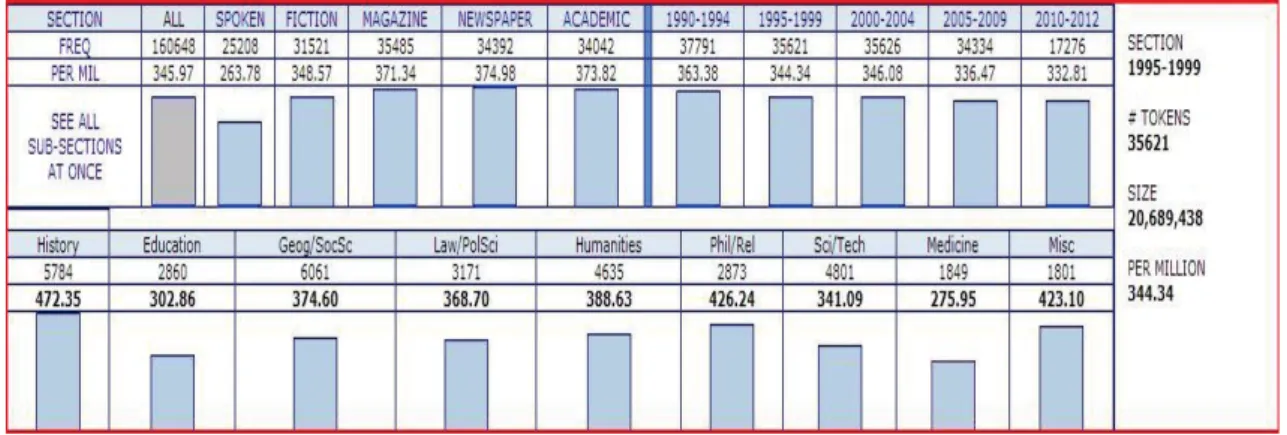
COCA:
Figure 9: Since as Conjunction in COCA
However, this time this frequency is not close to that found when querying since in the general language or the academic subcorpus. The frequencies in these are 80 and 100 times higher in a million respectively.
General: 346.02
Academic: 373.82
Medicine: 275.95
Summary:
Figure 10: Since as Conjunction
Figure 3 summarizes the frequency of since as conjunction in the three corpora. In the case of since as conjunction, the difference in terms of frequency between the two
0 100 200 300 400 500 600
CSD BNC COCA
General
Academic
reference corpora and my corpus is very significant. A frequency of 37.27 times in a million is a really low frequency if we compare it to those found in the reference corpora, in which its use as conjunction is nearly 100 times higher. In CSD since is more frequently used as preposition than as conjunction. However, in the reference corpora there is a much higher use of since as conjunction than as preposition. Section 5 provides several hypotheses that try to explain why the usage of since is so different between the three corpora.
4.2.3 Since as adverb
The frequency of since as adverb is considerably inferior if we compare it to the previous ones, not only in the Medicine subgenre, but in all research fields. It was found no more than 30 times per million in any field, whereas we were discussing a frequency around 400 times per million in the previous section. However, in this case not only the frequency is lower, but differences between corpora are smaller too.
Corpus of Spine Deformities:
Within my corpus, since was only found to have the function of adverb 8 times out of 86, or, what is the same 10.15 times per million, which would constitute the 9.30% of the cases.
BNC:
In the British National Corpus the number of occurrences of since as adverb in the Medicine subgenre was 11.32 per million.
According to the results found in the BNC, if we compare the frequency of since in the subgenre of Medicine to the frequency of the general language, this last one duplicates the number of times we found it in a million, as we can find since 25.68 times per million. Although the difference is no so high when we compare it to the academic genre, frequency in this research field is higher than the one found in Medicine too.
General: 25.68
Academic: 19.18
Medicine: 11.32
COCA:
The general frequency of since in COCA is similar to that found in the BNC, however, the frequency in the academic genre and the Medicine subgenre, are underneath the rest.
Figure 12: Since as Adverb in COCA
Since was found to occur 25.88 times per million in the general language; 16.26
in the academic genre; and 8,21 in the subgenre of Medicine, being this one the smallest frequency in this subfield if we compare it to the other corpora.
General: 25.88
Academic: 16.26
Summary:
Figure 13: Since as Adverb
The use of since as adverb is considerably inferior if we compare it to the previous ones, not only in the Medicine subgenre, but in the general language and in the
academic genre too. It was found no more than 30 times per million in any research field, whereas we were talking about a frequency of around 400 times per million in the previous section. However, in this case not only the frequency is lower, but differences between corpora are smaller too. The number of times since is found in a million is similar in both reference corpora. When searching it in the Medicine subcorpus, frequency was once again bigger in the BNC, but, although higher than in the rest of the corpus, in this case it is still low.
4.2 Summary: Since by POS in the subgenre of Medicine
Section 4 describes the results found in terms of frequency in the Corpus of Spine Deformities and two reference corpora, the BNC and the COCA. This part of the section provides a summary of the results found.
0 5 10 15 20 25 30
CSD BNC COCA
General
Academic
Figure 14: Frequency of Since
Looking into detail at the results, it can be deduced that the frequencies found in the Corpus of Spine Deformities are considerably inferior to those found in the Medicine subcorpora in both reference corpora. It can also be observed if we compare frequencies in the three corpora, that frequencies are always higher in all sections within the British variety. So, according to this, we could state that in the medical specialized language since is more frequently used by British people than by American people. Moreover, in COCA the use of since can be depicted yearly since 1990 to 2012. We can see how in this corpus the use of since tends to diminish along the years from a starting frequency of 501.00 times per million in the first time period, to one of 477.90 from 2010 to 2012 which means a reduction of around 5%.
1990-1994 1995-1999 2000-2004 2005-2009 2010-2012
RAW
FREQUENCY
52104 49293 50255 48778 24807
FREQUENCY
PER MILLION
501.00 476.50 488.19 478.02 477.90
Table 3: Frequency of Since in COCA over the years.
If we analyze since by POS we find that in COCA and BNC the most common use of since is the one that it has when it acts as conjunction, being this result the opposite to the one found in my corpus.
0 50 100 150 200 250 300 350 400
CSD BNC COCA
Preposition
Conjuction
Figure 15: Since in CSD
In the Corpus of Spine Deformities, the highest frequency is the one it has when it has the function of preposition, which constitutes the 56.97% of the cases. This is followed by its use as conjunction, 33.7%, and the smallest frequency, as in the other two corpora is the one when it acts as adverb, being only the 9.30% of the cases. The following section provides several hypotheses which could explain why frequencies are different between corpora.
5. Discussion
As it has already been stated in the previous section, the frequency of since is, in most of the cases, higher in both reference corpora than in the Corpus of Spine Deformities. Two different aspects were surprising when analyzing these results. One was the difference in terms of frequency between the functions of since, because the highest use of since in COCA and BNC is the one it has when it functions as conjunction; whereas the highest frequency in the Corpus of Spine Deformities is the one it has when it functions as preposition (56.97%). And the other difference which was significantly surprising was the differences registered between COCA and BNC,
and the Corpus of Spine Deformities when analyzing the frequency of since in the category of conjunction.
The present section presents several hypothesis that could explain why these differences between the reference corpora and the Corpus of Spine Deformities take place.
5.1. No native speakers: Universals of translations
One of the hypotheses we thought that could explain this difference between the frequencies of the functions of since, was that texts included in the Corpus of Spine
Preposition
Conjunction
Deformities might not have been written by native English speakers. Although special attention was paid to the institutions where the articles came from, we cannot be completely sure that these articles were originally written by English native speakers. Despite the fact that only texts published by institutions from English speaking countries were included, it was not possible to figure it out if all the authors were English native speakers due to the multiculturalism happening nowadays in those countries. If some texts were not from English native speakers, this could influence the kind of language used in these articles in two different ways. First option could be that texts are originally written in English by people working in these institutions, although they might not be native speakers. And the second option, although less probable, could be that some of the articles included in my corpus are not the original ones but translations. Taking into account these two options, similar features influence the use and complexity of language. When dealing with translated texts, Baker stated that there are three main aspects that take place in the process of translation: simplification, explicitation and normalization (181). According to her, simplification is “the tendency to simplify the language used in translation” (182). Thus the amount of vocabulary will
be lower and the length of the sentences will be sorter, which means that conjunctions, including since, will present lower frequency of use.
We cannot be sure if the texts included in the Corpus of Spine Deformities were written by native speakers, but being this a possible explanation, the frequency of since was checked in a corpus of translations in order to prove if this universal of translation affected the use of since. In this way, we queried since in the Translational English Corpus (henceforth TEC) from the University of Manchester which consists on translations into English from different source languages. It was created by Mona Baker and it is managed by her nowadays. In TEC, since has a total frequency of 921.4 times
per million. The highest frequency in the previous section in the general language was found in the BNC, with a total of 500.57 times per million, therefore, the frequency
Figure16: Since in TEC
As translated texts present a higher frequency of since than COCA, BNC, and the Corpus of Spine Deformities, this means that we can, thus, reject this premise to try to justify the difference between the frequencies of since in the reference corpora and in my corpus.
5.2. American variety
use of since is lower than in the BNC. However, this fact would not explain the difference in terms of frequency between our corpus and the COCA. A possible explanation for this could be that, as has been seen in section 4, the use of since tends to diminish over the years.
1990-1994 1995-1999 2000-2004 2005-2009 2010-2012
RAW
FREQUENCY
52104 49293 50255 48778 24807
FREQUENCY
PER MILLION
501.00 476.50 488.19 478.02 477.90
Table 3: Frequency of Since in COCA over the years.
The Corpus of Spine Deformities comprises texts from 2000 to 2014, whereas in COCA, texts from 1990 are included. As we can observe in table 3 the use of since decreased 12.81 times per million between those 10 years, which justifies part of its lower use in my corpus. The frequency of since continues decreasing over the years: from 1990 to 2012 it decreased 23.1 times per million. If the last period of years is analyzed, the frequency of since declined from 496.85 times per million in 2010 to 437.54 in 2012. In other words, the frequency of since declined 59.31 times per million in just three years. Following this, it can be deduced that the frequency of since will probably continue decreasing along the years in the American variety of English, which
would be closer to the frequency found in the Corpus of Spine Deformities.
5.3. Degree of specialization
According to results found in COCA and BNC, the frequency of since is lower
corpora in which the degree of specialization could be not so high as the one included in my corpus.
6. Conclusions and further research.
Corpus driven and corpus based studies are very significant for several reasons such as to study real examples of language, to provide examples of use or information regarding the context of a specific word, etc. This paper has presented a study of the use and frequency of since in a very specialized corpus which was compiled specifically for this study. This kind of studies allows the linguists to describe in detail the use of the language in a specific genre and topic, and to provide quantitative, as well as qualitative data of specific linguistic aspects as since, which can have different applications in translation or when teaching English as a second or foreign language in an English for Specific Purposes (ESP) teaching context.
Significant differences regarding the use and frequency of since were found in the Corpus of Spine Deformities if we compare this to the two reference corpora (COCA and BNC) consulted. Every function of since was studied independently and these differences were found to be higher when dealing with since as conjunction. Several possible explanations were taken into account when trying to justify why this differences took place.
However, after rejecting that the articles could be translations or could have been written by no native speaker of English by checking this with a corpus of translations as TEC in which the frequency of since nearly duplicated the one registered in COCA and BNC, the explanation which seemed more accurate was the one which stated that a high degree of specialization of a corpus, involves a lower use of the particle since. We also rejected the hypothesis regarding the reduction of the frequency of since along the years in the American variety because it would just partially explain those differences found between corpora, as the lowest frequency in the use of since along the years was only found in the Corpus of Contemporary American English. Besides, as stated in the
Discussion Section, the decreasing tendency in the use of since along the time would support just a percentage of this reduction.
academic genre. Articles included in the Corpus of Spine Deformities were highly specialized articles as they were collected from journals dealing specifically with this topic. It could explain this difference in terms of frequency between the Corpus of Spine Deformities and the Medicine subcorpora of the reference corpora (COCA and BNC) in which the degree of specialization could be not so high as the one included in Corpus of Spine Deformities.
Works cited
Alonso, Alexander, David P. Baker, Rachel Day, Amy Holtzman, Heidi B. King, Lauren Toomey, and Eduardo Salas. “Reducing Medical Error in the Military Health System: How Can Team Training Help”. Human Resource Management Review. 16 March 2006 .Web. 30 May 2014.
< http://yadda.icm.edu.pl/yadda/element/bwmeta1.element.elsevier-d6c14927-778d-356d-a351-7b79195e6f92>
Anthony, Laurence . “AntConc (Windows, MacintoshOS X, and Linux)”. AntConcLab. Center for English Language Education in Science and Engineering.10
November 2011. Web. 13 April 2014.
< http://www.antlab.sci.waseda.ac.jp/software/README_AntConc3.2.4.pdf>
Baker, Mona. Corpora in Translation Studies: An Overview and Some Suggestions for Further Research. Amsterdam: John Benjamins Publishing Company, 1995. Print.
Baker, Paul, Andrew Hardie, and Tony McEnery. A Glossary of Corpus Linguistics. Edinburgh: Edinburgh University Press, 2006. Print.
Bhatia, Vijay k. Analyzing Genre: Language Use in Professional Settings. London: Longman, 1993. Print.
Biber, Douglas. Variation Across Speech and Writing. New York: Cambridge University Press, 1998. Print.
Biber, Douglas, and Susan Conrad. Register, Genre and Style. Cambridge: Cambridge University Press, 2009. Print.
The British National Corpus. Oxford University Press. n.d. Web. 3 May 2014. < http://corpus.byu.edu/bnc/>
Bowker, Lynne, and Jennifer Pearson. Working with Specialized Language: A Practical Guide to Using Corpora. London: Routledge, 2002. Print.
Carter, Ronald and Michael McCarthey. Cambridge Grammar of English. A Comprehensive Guide: Spoken and Written English Grammar in Usage. Cambridge: Cambridge University Press, 2006. Print.
Corpus of Contemporary American English. Brigham Young University. n.d. Web. 3 May 2014. < http://corpus.byu.edu/coca/>
Firth, John. R. A Synopsis of Linguistic Theory 1930-195. London: Longman, 1968. Print.
Freedman, Aviva and Peter Medway. Genre and the New Rhetoric. London: Taylor & Francis, 1994. Print
McEnery, Tony and Andrew Wilson. Corpus Linguistics. Edimburgh: Edimburgh University Press, 1996. Print.
O’keefee, Anne, Michael McCarthy, and Ronald Carter. From Corpus to Classroom. Language Use and Language Teaching. Cambridge: Cambridge University Press, 2007. Print.
Quirk, Randolph, Sidney Greenbaum, Geoffrey Leech and Jan Svartvik A Grammar of Contemporary English. London: Longman, 1974. Print.
Pennebaker, James W. The Secret Life of Pronouns. New York: Bloomsbury Press, 2011. Print.
“Since”. Collins English Dictionary. Collins Dictionary. n.d. Web. 15 May 2014. <http://www.collinsdictionary.com/dictionary/english/since?showCookiePolicy=tr ue>
“Since”. Oxford Dictionary. Oxford University. n.d. Web. 15 May 2014. <http://www.oxforddictionaries.com/definition/english/since?q=since>
“Since”. Cambridge Dictionaries Online. Cambridge University, 2014. Web. 15 May 2014. <http://dictionary.cambridge.org/>
Sinclair , John. Corpus, Concordance, Collocation. Oxford: Oxford University Press, 1991. Print.
---. Prepositions. London: HarperCollins, 1994. Print.
Swales, John. Genre Analysis: English in Academic and Research Settings. Cambridge, UK: Cambridge University Press, 1990. Print.
“Translational English Corpus” Centre for Translation and Intercultural Studies. The University of Manchester. n.d. Web 25 May 2014
Appendix
CODE ARTICLE WORDS
Kyphosis_ClinOrthopRelatRes_2009_001 Vertebral Column Resection for the Treatment of Severe Spinal Deformity
4.828 Kyphosis_ClinOrthopRelatRes_2010_002 Kyphectomy in Children with
Myelomeningocele
4.611 Kyphosis_ClinOrthopRelatRes_2010_003 Correlation of Spine Deformity, Lung
Function, and Seat Pressure in Spina Bifida
4.026 Kyphosis_ClinOrthopRelatRes_2010_004 Posterior Kyphectomy for Myelomeningocele
With Anterior Placement of Fixation
4.515 Kyphosis_ClinOrthopRelatRes_2010_005 Laminoplasty versus Laminectomy and
Fusion for Multilevel Cervical Spondylotic Myelopathy
5.183
Kyphosis_ClinOrthopRelatRes_2010_006 Can VEPTR1 Control Progression of Early-onset Kyphoscoliosis?
4.961 Kyphosis_ClinOrthopRelatRes_2010_007 Kyphectomy Improves Sitting and Skin
Problems in Patients with Myelomeningocele
4.393 Kyphosis_ClinOrthopRelatRes_2011_008 VEPTRTM Growing Rods for Early-onset
Neuromuscular kyphosis
4.122 Kyphosis_ClinOrthopRelatRes_2011_009 Surgical Technique ´Modern Luque Trolley, a
Self-growing Rod Technique
5.479 Kyphosis_ClinOrthopRelatRes_2011_010 Convex Instrumented Hemiepiphysiodesis
with Concave Distraction
4.168 Kyphosis_ClinOrthopRelatRes_2011_011 Combined Anterior-Posterior Surgery is the
Most Important Risk Factor for Developing Proximal Junctional Kyphosis in Idiopathic Scoliosis
4.181
Kyphosis_ClinOrthopRelatRes_2012_012 Prolonged Bed Rest as Adjuvant Therapy After Complex Reconstructive Spine Surgery
5.412 Kyphosis_ClinOrthopRelatRes_2014_013 Minimally Invasive Surgical Techniques in
Adult Degenerative Spinal Deformity: A Systematic Review
6.795
Kyphosis_ClinOrthopRelatRes_2014_014 Minimally Invasive Surgical Approaches in the Management of Tuberculosis of the Thoracic and Lumbar Spine
5.923
Kyphosis_PhysMedRehabil_2005_015 Pulmonary Rehabilitation for Restrictive Lung Impairment Secondary to Osteoporotic Sternal Fracture
1.737
Kyphosis_PhysMedRehabil_2006_016 Interrater Reliability of the History and Physical Examination in Patients With Mechanical Neck Paine
7.999
Kyphosis_PhysMedRehabil_2006_017 Effect of Different Sitting Postures on Lung Capacity, Expiratory Flow, and Lumbar Lordosis
5.582
Kyphosis_PhysMedRehabil_2006_018 Sleep-Disordered Breathing in Fatigued Postpoliomyelitis Clinic Patients
4.861 Kyphosis_PhysMedRehabil_2007_019 Changes in Flexed Posture, Musculoskeletal
Impairments, and Physical Performance After Group Exercise in Community-Dwelling Older Women
6.639
Kyphosis_PhysMedRehabil_2008_020 Interventions in Chronic Pain Management. 2. Diagnosis of Cervical and Thoracic Pain Syndromes
6.174
Dystrophy and Facioscapulohumeral Dystrophy
Kyphosis_PhysMedRehabil_2008_022 Outcomes After a Prone Lumbar Traction Protocol for Patients With Activity-Limiting Low Back Pain
5.372
Kyphosis_PhysMedRehabil_2008_023 The Impact of Increasing Paraspinal Muscle Activity on Stature Recovery in
Asymptomatic People
4.022
Kyphosis_PhysMedRehabil_2008_024 Pelvic Floor Muscle Activity inDifferent Sitting Postures in Continent and Incontinent Men
5.421
Kyphosis_PhysMedRehabil_2009_025 Stability of Kyphosis, Strength, and Physical Performance Gains 1 Year After a Group Exercise Program in Community-Dwelling Hyperkyphotic Older Women
3.008
Kyphosis_PhysMedRehabil_2009_026 Implanted Electrical Stimulation of the Trunk for Seated Postural Stability and Function After Cervical Spinal Cord Injury: A Single Case Study
6.826
Kyphosis_PhysMedRehabil_2010_027 Biplanar Measurement of Thoracolumbar Curvature in Older Adults Using an Electromagnetic Tracking Device
4.472
Kyphosis_PhysMedRehabil_2012_028 Dynamic Lumbar Curvature Measurement in Acute and Chronic Low Back Pain Sufferers
4.801 Kyphosis_SeminSpineSurg_2004_029 The Management of Infections Involving the
Cervicothoracic Junction
4.918 Kyphosis_SeminSpineSurg_2006_030 Postarthrodesis Cervical Stenosis: Incidence,
Etiology, and Surgical Options
2.668 Kyphosis_SeminSpineSurg_2006_031 Following Laminectomy: Etiology,
Prevention, and Surgical Reconstruction
3.807 Kyphosis_SeminSpineSurg_2007_032 The Role for Cervical Arthroplasty for
Symptomatic Cervical Stenosis: Indicated for a Single-Level Cervical Disc Herniation Causing Stenosis with Myelopathy
1.957
Kyphosis_SeminSpineSurg_2007_033 Interspinous Distraction Devices for Spinal Stenosis
6.653 Kyphosis_SeminSpineSurg_2007_034 The Role for Cervical Arthroplasty for
Symptomatic Cervical Stenosis: The Case Against
2.612
Kyphosis_SeminSpineSurg_2009_035 Complications of Cervical Disc Arthroplasty 6.659 Kyphosis_SeminSpineSurg_2009_036 Spinal Sagittal Plane Deformities:
Etiology, Evaluation, and Management
5.368 Kyphosis_SeminSpineSurg_2010_037 Surgical Management of Adults
with Congenital Deformities of the Spine
3.181 Kyphosis_SeminSpineSurg_2010_038 Management of Osteoporotic Fractures of the
Thoracolumbar Spine
6.526 Kyphosis_SeminSpineSurg_2010_039 Surgical Management of Thoracolumbar
Fractures: Rationale for Short Fixation
6.316 Kyphosis_SeminSpineSurg_2011_040 Fusion for Lower Lumbar (L3-L5) Fractures:
Surgical Indications and Techniques
5.571 Kyphosis_SeminSpineSurg_2011_041 Osteotomies for the Treatment of Cervical
Kyphosis Caused by Ankylosing Spondylitis: Indications and Techniques
6.344
Kyphosis_SeminSpineSurg_2011_042 Iatrogenic Cervical Deformity 4.427 Kyphosis_SeminSpineSurg_2011_043 Normal Cervical Alignment 3.182 Kyphosis_SeminSpineSurg_2011_044 Degenerative Cervical Kyphosis:
Anatomy, Biomechanics, and Etiology
1.685 Kyphosis_SeminSpineSurg_2011_045 Neurogenic and Myopathic Deformities of the
Cervical Spine
Kyphosis_SeminSpineSurg_2011_046 Minimally Invasive Treatment of Pediatric Spinal Deformity
2.209 Kyphosis_SeminSpineSurg_2011_047 Percutaneous Augmentation of Vertebral
Compression Fractures
3.439 Kyphosis_SeminSpineSurg_2011_048 Fixed Sagittal Plane Deformity: Causes,
Prevention, and Treatment Options
4.444 Kyphosis_SeminSpineSurg_2013_049 Iatrogenic spinal instability: Cervical and
thoracic
8.981 Kyphosis_SpineDeform_2012_050 Spinal Deformity in Children With
Achondroplasia
3.8811 Kyphosis_SpineDeform_2012_051 Preoperative Halo-Gravity Traction for Severe
Pediatric Spinal Deformity: Complications, Radiographic Correction and Changes in Pulmonary Function
4.187
Kyphosis_SpineDeform_2012_052 L1 Burst Fracture Through an Area of Pseudarthrosisda Case Report
2.103 Kyphosis_SpineDeform_2012_053 Some Connectors in Distraction-based
Growing Rods Fail More Than Others
6.180 Kyphosis_SpineDeform_2012_054 Review of Cervical Kyphosis in Larsen
Syndrome
2.882 Kyphosis_SpineDeform_2012_055 Perioperative Outcomes and Complications of
Pedicle Subtraction Osteotomy in Cases With Single Versus Two Attending Surgeons
5.484
Kyphosis_SpineDeform_2012_056 Mucopolysaccharidoses: Etiology,
Classification, Deformities Unique to Each Type, Treatment Modalities and Indications for Surgical Intervention
3.177
Kyphosis_SpineDeform_2012_057 Neurofibromatosis: Etiology, Commonly Encountered Spinal Deformities, Common Complications and Pitfalls of Surgical Treatment
5.248
Kyphosis_SpineDeform_2013_058 Assessment of Morbidity and Mortality Collection Data 2009
4.325 Kyphosis_SpineDeform_2013_059 Type of Anchor at the Proximal Fusion Level
Has a Significant Effect on the Incidence of Proximal Junctional Kyphosis and Outcome in Adults After Long Posterior Spinal Fusion
4.496
Kyphosis_SpineDeform_2013_060 Multicenter Comparison of the Factors Important in Restoring Thoracic Kyphosis During Posterior Instrumentation for dolescent Idiopathic Scoliosis
4.556
Kyphosis_SpineDeform_2013_061 Proximal Junctional Kyphosis After Vertical Expandable Prosthetic Titanium Rib Insertion
4.634 Kyphosis_SpineDeform_2013_062 Maintenance of Thoracic Kyphosis in the 3D
Correction of Thoracic Adolescent Idiopathic Scoliosis Using Direct Vertebral Derotation
3.462
Kyphosis_SpineDeform_2013_063 Improvement of Kyphoscoliosis in a 9-Year-Old Using Growth Modulation With a Posterior Tether: A Case Report
2.083
Kyphosis_SpineDeform_2013_064 Preliminary Results of the Effect of
Prophylactic Vertebroplasty on the Incidence of Proximal Junctional Complications After Posterior Spinal Fusion to the Low Thoracic Spine
4.645
Kyphosis_SpineDeform_2013_065 Quantification of Increase in Three-dimensional Spine Flexibility Following Sequential Ponte Osteotomies in a Cadaveric Model
5.565
Compression Fractures in a Growing Child With Duchenne Muscular Dystrophy With Five-Year Follow-Up: Case Report and Review of Literature
Kyphosis_SpineDeform_2013_067 Matched Cohort Analysis of Posterior-Only Vertebral Column Resection Versus
Combined Anterior/Posterior Vertebrectomy for Severe Spinal Deformity
4.967
Kyphosis_SpineDeform_2013_068 Preoperative Pulmonary Function in Patients With Operative Scheuermann Kyphosis
4.092 Kyphosis_SpineDeform_2013_069 Minimally invasive treatment of osteoporotic
vertebral body compression fractures
3.627 Kyphosis_SpineDeform_2013_070 Scheuermann kyphosis: long-term follow-up 4.472 Kyphosis_SpineDeform_2013_071 Thoracic kyphoscoliosis resembling
neurofibromatosis: a case report focusing on subfascial instrumentation
2.652
Kyphosis_SpineJourn_2002_072 Lateral mass screw-rod fixation of the cervical spine: a prospective clinical series with 1-year follow-up
3.814
Kyphosis_SpineJourn_2002_073 A surgical revisitation of Pott distemper of the spine
10.872 Kyphosis_SpineJourn_2002_074 Comparison of thoracic kyphosis and postural
stiffness in younger and older women
3.194 Kyphosis_SpineJourn_2003_075 Acute versus chronic vertebral compression
fractures treated with kyphoplasty: early results
4.536
Kyphosis_SpineJourn_2003_076 Preliminary results of staged anterior
debridement and reconstruction using titanium mesh cages in the treatment of thoracolumbar vertebral osteomyelitis
3.924
Kyphosis_SpineJourn_2003_077 Posterior lumbar interbody fusion for lytic spondylolisthesis: restoration of sagittal balance using insert-and-rotate interbody spacers
5.452
Kyphosis_SpineJourn_2004_078 Influence of spine morphology on intervertebral disc loads and stresses in asymptomatic adults: implications for the ideal spine
7.582
Kyphosis_SpineJourn_2004_079 Neurofibromatosis type I with severe dystrophic kyphoscoliosis and its operative management via a simultaneous anterior-posterior approach: a case report and review of the literature
3.391
Kyphosis_SpineJourn_2005_080 Mini-open thoracoscopically assisted thoracotomy versus video-assisted
thoracoscopic surgery for anterior release in thoracic scoliosis and kyphosis: a comparison of operative and radiographic results
4.875
Kyphosis_SpineJourn_2005_081 Restoring geometric and loading alignment of the thoracic spine with a vertebral
compression fracture: effects of balloon (bone tamp) inflation and spinal extension
7.137
Kyphosis_SpineJourn_2005_082 Do anterior interbody cages have a potential value in comparison to autogenous rib graft in the surgical management of Scheuermann's kyphosis?
4.367
Kyphosis_SpineJourn_2005_083 Two in vivo surgical approaches for lumbar corpectomy using allograft and a metallic implant: a controlled clinical and
biomechanical study
Kyphosis_SpineJourn_2005_084 Design limitations of Bryan disc arthroplasty 6.226 Kyphosis_SpineJourn_2006_085 Preservation of the spinous
process-ligament-muscle complex to prevent kyphotic deformity following laminoplasty
3.411
Kyphosis_SpineJourn_2006_086 Video-assisted thoracoscopic surgery compared with thoracotomy: early and late follow-up of radiographical and functional outcome
4.949
Kyphosis_SpineJourn_2006_087 Assessment of injury to the thoracolumbar posterior ligamentous complex in the setting of normal-appearing plain radiography
4.373
Kyphosis_SpineJourn_2007_088 Juvenile degenerative disc disease: a report of 76 cases identified by magnetic resonance imaging
3.991
Kyphosis_SpineJourn_2008_089 Surgical management of posttraumatic thoracolumbar kyphosis
8.806 Kyphosis_SpineJourn_2009_090 Thoracic vertebral osteomyelitis secondary to
chronic esophageal perforation
2.785 Kyphosis_SpineJourn_2009_091 Sagittal balance influences range of motion:
an in vivo study with the ProDisc-C
3.748 Kyphosis_SpineJourn_2009_092 Intraobserver and interobserver reliabilty of
measures of kyphosis in thoracolumbar fractures
4.393
Kyphosis_SpineJourn_2009_093 Spinopelvic parameters in postfusion flatback deformity patients
6.767 Kyphosis_SpineJourn_2009_094 Recurrence of kyphosis and its functional
implications after surgical stabilization of dorsolumbar unstable burst fractures
4.742
Kyphosis_SpineJourn_2009_095 Postoperative spinal epidural hematoma at a site distant from the main surgical procedure: a case report and review of the literature
2.560
Kyphosis_SpineJourn_2010_096 Contemporary management of isthmic spondylolisthesis: pediatric and adult
11.048 Kyphosis_SpineJourn_2010_097 Bioabsorbable anterior cervical plate fixation
for single-level degenerative disorders: early clinical and radiographic experience
4.275
Kyphosis_SpineJourn_2011_098 A diagnostic classification for lumbar spine registry development
6.134 Kyphosis_SpineJourn_2011_099 Minimally invasive corpectomy and posterior
stabilization for lumbar burst fracture
2.910 Kyphosis_SpineJourn_2012_100 Progressive severe kyphosis as a complication
of multilevel cervical percutaneous facet neurotomy: a case report
2.295
Kyphosis_SpineJourn_2012_101 Fibular flap reconstruction of the cervical spine for repair of osteoradionecrosis
2.336 Kyphosis_SpineJourn_2013_102 Use of vertebroplasty to prevent proximal
junctional fractures in adult deformity surgery: a biomechanical cadaveric study
4.395
Kyphosis_SpineJourn_2013_103 Correlation of Pelvic and Spinal Parameters in Adult Deformity Patients With Neutral Sagittal Balance
3.645
Kyphosis_SpineJourn_2013_104 Incidence, diagnosis, and management of sacral fractures following multilevel spinal arthrodesis
4.301
Lordosis_ClinOrthopRelatRes_2008_105 Measurement of Hip Range of Flexion-Extension and Straight-leg Raising
2.981 Lordosis_ClinOrthopRelatRes_2008_106 The Classic: Congenital Dislocation of the
Hip