Re-treatment of previous non-responders and
relapsers to interferon plus ribavirin with peginterferon
alfa-2a (40KD), ribavirin ± amantadine in patients with chronic
hepatitis C: randomized multicentre clinical trial
Mario G. Pessôa,* Hugo Cheinquer,†Paulo R.L. Almeida,‡ Giovanni F. Silva,§ Maria Patelli J.S. Lima,|| Raymundo Paraná,** Marco A. Lacerda,†† Edison R. Parise,‡‡ José R.B. Pernambuco,§§ Suelene S. Pedrosa,¶¶
Rosângela Teixeira,*** Hoel Sette Jr,††† Fernando Tatsch‡‡‡
*University of São Paulo School of Medicine and Instituto de Infectologia Emílio Ribas, São Paulo, Brazil.
† Federal University of Rio Grande do Sul, Porto Alegre, Brazil. ‡ Federal University of Health Sciences of Porto Alegre, Porto Alegre, Brazil. § State University of Botucatu, Botucatu, Brazil. || PUC Campinas, Campinas, Brazil. ** Federal University of Bahia, Salvador, Brazil. †† Indiana University, Indiana, USA. ‡‡ Federal University of São Paulo, São Paulo, Brazil. §§ Federal University of Pernambuco, Recife, Brazil.
¶¶ Santa Casa de Misericórdia de Goiânia, Goiânia, Brazil. *** Federal University of Minas Gerais, Belo Horizonte, Brazil. ††† Hospital Alemao Oswaldo Cruz, São Paulo, Brazil. ‡‡‡ Roche Produtos Quimicos e Farmacêuticos, São Paulo, Brazil.
ABSTRACT
Introduction. A large number of patients with chronic hepatitis C have not been cured with interferon-ba-sed therapy. Therefore, we evaluated the efficacy of amantadine combined with the standard of care (pegylated interferon plus ribavirin) in patients who had not responded to or had relapsed after ≥ 24 weeks of treatment with conventional interferon plus ribavirin. Material and methods. Patients stratified by previous response (i.e., non-response or relapse) were randomized to 48 weeks of open-label treatment with peginterferon alfa-2a (40KD) 180 µg/week plus ribavirin 1,000/1,200 mg/day plus amantadine 200 mg/ day (triple therapy), or the standard of care (peginterferon alfa-2a [40KD] plus ribavirin). Results. The pri-mary outcome was sustained virological response (SVR), defined as undetectable hepatitis C virus RNA in serum (< 50 IU/mL) at end of follow-up (week 72). Among patients with a previous non-response, 12/53 (22.6%; 95% confidence interval [CI] 12.3-36.2%) randomized to triple therapy achieved an SVR compared with 16/52 (30.8%; 95% CI 18.7-45.1%) randomized to the standard of care. Among patients with a previous relapse 22/39 (56.4%; 95% CI 39.6–72.2%) randomized to triple therapy achieved an SVR compared with 23/38 (60.5%; 95% CI 43.4-76.0%) randomized to the standard of care. Undetectable HCV RNA (< 50 IU/mL) at week 12 had a high positive predictive value for SVR. A substantial proportion of non-responders and relapsers to conventional interferon plus ribavirin achieve an SVR when re-treated with peginterferon alfa-2a (40KD) plus ribavirin. Conclusion. Amantadine does not enhance SVR rates in previously treated patients with chronic hepatitis C and cannot be recommended in this setting.
Key words. Hepatitis C. Re-treatment. Peginterferon alfa-2a (40KD). Amantadine.
Correspondence and reprint request: M. G. Pessôa University of São Paulo School of Medicine
Av. Dr. Eneas de Carvalho Aguiar 255, 9º andar, sala 9117 São Paulo, SP, Brazil 05403-000
Tel.: (+55 11) 3067-4240, 3284-3168. Fax: (+55 11) 3287-1631 E-mail: [email protected]
Manuscript received: May 09, 2011. Manuscript accepted: September 19, 2011.
INTRODUCTION
More than 170 million people are infected with he-patitis C virus (HCV) worldwide1 and are at risk of
the long-term complications of chronic hepatitis C (CHC), which include cirrhosis, liver failure and he-patocellular carcinoma.2
Many patients have obtained lasting benefit from treatment for CHC; however, there is a large and growing number of patients who have either not res-ponded to treatment or who have experienced a viro-logical relapse after completion of treatment. The distinction between non-response and relapse is subtle but important. Non-response is defined as de-tectable HCV RNA throughout treatment and follow-up. Relapse is defined as suppression of the serum HCV RNA level to below the limit of detection of a sensitive assay at the end of treatment, with subse-quent reversion to an HCV RNA-positive state during follow-up (i.e., within 6 months of the end of treat-ment). Recent studies suggest that response and non-response to interferon may have a genetic basis.14-17
The pool of non-responders and relapsers is a hetero-geneous group that includes many patients who were previously treated with conventional interferon with or without ribavirin. Such conventional interferon-based treatment regimens are significantly less effective than the current standard of care (pegylated interferon plus ribavirin) and are no longer recommended.3,18
Amantadine is an oral antiviral agent that has been shown to improve the efficacy of conventional interfe-ron plus ribavirin in patients who have not responded to conventional interferon monotherapy.19 However, the impact of amantadine on virological response rates of interferon-based treatment is controversial, and a recent large multicentre study of 700 previously untre-ated patients with chronic HCV genotype 1 infection did not demonstrate an improvement on the virologi-cal response of peginterferon alfa-2a (40KD) and riba-virin when compared with placebo.20
Despite the failure to show any benefit of amanta-dine in previously untreated patients, the impact of amantadine on the efficacy of peginterferon and riba-virin in patients with previous treatment failure is largely unknown. Therefore, the objective of this study was to compare the efficacy of the standard of care –the combination of peginterferon alfa-2a (40KD) plus ribavirin– with that of a triple-therapy regimen comprising peginterferon alfa-2a (40KD), ri-bavirin and amantadine in patients who either did not respond to or relapsed after at least 24 weeks of treatment with the combination of conventional in-terferon plus ribavirin.
MATERIALS AND METHODS
Patients
Adults with a positive anti-HCV antibody test, de-tectable HCV RNA in serum, elevated alanine
ami-notransferase (ALT) serum levels on at least two occasions during the previous 6 months and a liver biopsy result within the previous 36 months consis-tent with the diagnosis of CHC were eligible for the trial. Patients with hepatic cirrhosis could be enrolled provided that they had compensated liver disease, defined as Child-Pugh class A disease.
Eligible patients had received at least 24 weeks of previous treatment with conventional interferon alfa plus ribavirin, the outcome of which was either viro-logical non-response or viroviro-logical relapse. The pre-vious course of treatment must have been completed at least 12 weeks prior to enrolment in the present study.
Virological non-response was defined as detecta-ble HCV RNA in serum at the end of previous treat-ment with conventional interferon alfa plus ribavirin. Virological relapse was defined as unde-tectable HCV RNA in serum at the end of previous treatment and detectable HCV RNA in serum at the end of a 24-week follow-up period.
Patients infected with hepatitis A or B virus or human immunodeficiency virus were excluded, as were patients with a neutrophil count < 1,500 cells/ mm3, serum creatinine level > 1.5 times the upper limit of normal, or haemoglobin level < 12 g/dL (women) or < 13 g/dL (men). Patients with serious chronic diseases including severe psychiatric disease or alcohol or drug abuse within 1 year were ineligi-ble. Pregnant or breastfeeding women and male partners of pregnant women were excluded. All eligible patients were required to use two forms of effective contraception during treatment and for 6 months after the end of treatment.
All patients provided written informed consent be-fore enrolling in the trial. The trial was conducted in accord with the Declaration of Helsinki, the laws and regulations of Brazil, and Guidelines for Good Clinical Practice.
Treatment
Patients were stratified by previous treatment response (i.e., previous non-response or previous re-lapse); thus, there were four treatment groups as de-picted in Figure 1.
In the event of adverse events or laboratory abnor-malities the dosage of peginterferon alfa-2a (40KD) could be reduced in steps to 135, 90 and 45 µg/week.
Figure 1. Flow of patients through the trial.
Table 1. Patient characteristics at baseline.
Characteristic Previous non-response Previous relapse
Group A (n = 53) Group B (n = 52) Group C (n = 39) Group D (n = 38)
Male, n (%) 38 (71.7) 40 (76.9) 24 (61.5) 28 (73.7)
Mean age, years ± SD 50.2 ± 9.9 47.2± 9.4 51.5 ± 10.0 48.7 ± 8.5 Mean weight, kg ± SD 76.3 ± 14.3 77.7± 14.1 75.4 ± 13.2 81.6 ± 12.9 Race, n (%)
White 45 (84.9) 44 (84.6) 37 (94.9) 34 (89.5)
Black 1 (1.9) 3 (5.8) 0 0
Other 7 (13.2) 5 (9.6) 2 (5.1) 4 (10.5)
ALT quotient,* n (%)
≤ 3 40 (75.5) 33 (63.5) 29 (76.3) 28 (77.8)
> 3 13 (24.5) 19 (36.5) 9 (23.7) 8 (22.2)
Cirrhosis
(fibrosis stage F4), n (%) 8 (15.1) 6 (11.5) 12 (30.8) 10 (26.3) Baseline HCV RNA
level ≥ 800,000 IU/mL, n (%) 32 (60.4) 28 (54.9) 22 (56.4) 24 (63.2) HCV genotype, n (%)
1 40 (75.5) 30 (57.7) 10 (25.6) 15 (39.5)
2 0 1 (1.9) 2 (5.1) 3 (7.9)
3 13 (24.5) 19 (36.5) 27 (69.2) 20 (52.6)
Genotype not reported 0 2 (3.9) 0 0
The dosage of ribavirin was reduced to 600 mg/day in the event of a reduction in haemoglobin level to < 10 g/dL in patients without cardiovascular disease, or a reduction of > 2 g/dL over any 4-week period in a pa-tient with stable cardiovascular disease. Ribavirin was discontinued in the event of a reduction in hae-moglobin level to < 8.5 g/dL in patients without car-diovascular disease or a persistent haemoglobin level < 12 g/dL after 4 weeks of therapy at the reduced do-sage (600 mg/day) in patients with stable cardiovas-cular disease. Use of erythropoietin-stimulating agents for the treatment of anaemia was allowed at the discretion of the investigator.
Monotherapy with peginterferon alfa-2a (40KD) was permitted if ribavirin was discontinued. At the discretion of the investigator peginterferon alfa-2a (40KD) or ribavirin could be restarted and/or the dosage increased after resolution of the precipitating event. Amantadine was administered at a reduced dosage (100 mg/day) in patients with renal impair-ment and those aged > 65 years. Patients with de-tectable HCV RNA in serum at week 24 of treatment were withdrawn from the study.
Outcomes
Serum HCV RNA was measured by qualitative po-lymerase chain reaction (PCR) assay (Cobas Ampli-cor HCV Test v2.0, Roche, Basel, Switzerland; limit of detection 50 IU/mL) at baseline and at weeks 12, 24 and 48 of treatment and at the end of follow-up (week 72). A quantitative HCV RNA test (Cobas Amplicor HCV Monitor v2.0, Roche, Basel, Switzer-land; limit of quantitation 600 IU/mL) was perform-ed on serum samples with detectable HCV RNA.
The primary efficacy outcome in the study was SVR, defined as undetectable HCV RNA (< 50 IU/ mL) at the end of follow-up (week 72). Secondary efficacy outcomes included sustained biochemical response defined as normalization of serum ALT levels at the end of follow-up (week 72), early virological response (EVR) at week 12 (defined as undetectable HCV RNA by qualitative PCR assay [< 50 IU/mL] or ≥ 2-log10 drop in serum HCV RNA by quantitative PCR), complete early virological response (cEVR) at week 12 (defined as undetectable HCV RNA by qualitative PCR assay [< 50 IU/mL]) and safety as assessed by means of adverse events and laboratory abnormalities.
Statistical methods
At the time the study was planned, it was known that re-treating non-responders or relapsers to
in-terferon and ribavirin with the same therapeutic re-gimen yielded low virological responses. The au-thors considered that offering the same regimen when re-treating would produce an SVR similar to interferon monotherapy in naive patients.21 Therefo-re, an SVR rate of 5% or less, which is similar to in-terferon monotherapy in naive patients, was considered the null hypothesis. The alternative hypothesis is an SVR ≥ 5% with the combination of amantadine plus the standard of care. The alternati-ve hypothesis was anticipated to be approximately 20% (vs. ≤ 5% with the standard of care).22 At a 5% significance level a sample size of 30 patients per treatment group would be required to provide 80% statistical power to reject the null hypothesis. A mi-nimum of 120 patients would then be required to be randomized in a 1:1 ratio to amantadine plus the standard of care (groups A, C) or the standard of care alone (groups B, D) to detect a significant diffe-rence if the SVR rate was at least 20%. To provide for protocol violations and withdrawal of patients the target sample sizes for groups A, B, C and D, respectively, were 50, 50, 40 and 40 patients.
The efficacy analysis was conducted according to the intention-to-treat principle. All eligible patients who received one dose of study medication were in-cluded; individuals without end of follow-up HCV RNA determinations were considered not to have had an SVR. SVR rates between groups A and B (non-responders) and groups C and D (relapsers) were compared by Cochran-Mantel-Haenszel test stratified by study centre. The safety population in-cluded all patients who received one dose of study medication and who had at least one post-baseline safety assessment.
Multiple logistic regression analysis was per-formed to examine the prognostic value of baseline characteristics for SVR. Characteristics considered for inclusion were previous treatment outcome (non-response vs. relapse), randomization to amantadine, sex, race (white vs. non-white), age (≤ 40 years vs. > 40 years), weight (≤ 75 kg vs. > 75 kg), HCV genotype (1 vs. 2 or 3), presence of cirrhosis (fibrosis stage F4 vs. < F4), HCV RNA level (≤ 800,000 IU/mL vs. > 800,000 IU/mL) and ALT quotient (≤ 3 vs. > 3).
RESULTS
HCV RNA negative at baseline; thus, the intention-to-treat population comprised 182 individuals.
Baseline characteristics of patients are presented in Table 1. The population was predominantly male, of white race, with a mean age of approximately 50 years and a baseline HCV RNA level ≥ 800,000 IU/mL. The majority of patients with a previous non-response were infected with HCV genotype 1 (75.5% in group A and 57.7% in group B), whereas the ma-jority of patients with a previous relapse were infected with HCV genotype 3 (69.2% in group C and 52.6% in group D). Reasons for premature discontinuation are presented in Figure 1.
Efficacy
• Patients with previous non-response. Therets i h t p r p s was no statistically significant difference between groups A and B in the virological response at the end of treatment or follow-up or in the biochemical response rate at the end of follow-up (Figure 2). Among patients with a previous non-response the rate of SVR at the end of follow-up was 22.6% (95% confidence interval [CI] 12.3-36.2%) in group A and 30.8% (95% CI 18.7-45.1%) in group B.
There was no statistically significant difference bet-ween groups A and B in the percentage of patients
Figure 2.A. Virological response at end of follow-up and end of treatment. B. Biochemical response at end of follow-up. NS: not significant.
Previous non-response Previous relapse
Previous non-response Previous relapse
A
B
Previous non-response
Previous relapse
Previous non-response
Previous relapse
Group A (triple therapy) Group B (dual therapy)
Group C (triple therapy) Group D (dual therapy)
Group A (triple therapy) Group B (dual therapy)
with an EVR at week 12 (group A: 41/53, 77.4%, 95% CI 63.8-87.7%; group B: 38/52, 73.1%, 95% CI 59.0-84.4%) or in the percentage of patients with a cEVR (group A: 18/53, 34.0%, 95% CI 21.5-48.3%; group B: 19/52, 36.5%, 95% CI 23.6-51.0%).
• Patients with previous relapse. There wasa n i w o ps no significant difference between groups C and D in the virological response at the end of treat-ment or follow-up or in the biochemical response rate at the end of follow-up (Figure 2A). Among patients with a previous relapse the rate of SVR at the end of follow-up was 56.4% (95% CI 39.6-72.2%) in group C and 60.5% (95% CI 43.4-76.0%) in group D.
There was no statistically significant difference between groups C and D in the percentage of patients with an EVR at week 12 (group C: 36/ 39, 92.3%, 95% CI 79.1-98.4%; group D 35/38, 92.1%, 95% CI 78.6-98.3%) or in the percentage of patients with a cEVR (group C: 30/39, 76.9%, 95% CI 60.7-88.9%; group D: 31/38, 81.6%, 95% CI 65.7-92.3%).
• Patients with previous non-response or re-a n r u n s o e
d
a e c i
lapse combined . In a post hoc analysis patients
with either a previous non-response or relapse were combined and the rates SVR compared for triple and dual therapy. This analysis confirmed the protocol specified analyses by demonstrating that patients with either a previous non-response or relapse had a lower rate of SVR if they were ran-domized to triple therapy (37.0%; groups A and C combined) compared to those randomized to dual therapy (43.3%; groups B and D combined).
Predictors of SVR
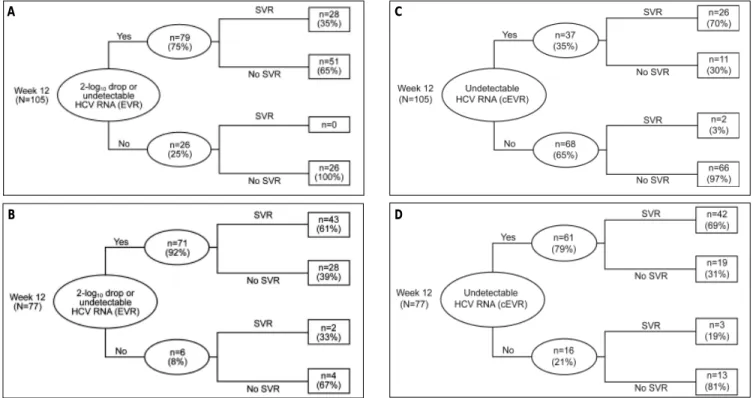
The predictive utility of an EVR and cEVR at week 12 for SVR at the end of follow-up is depicted in Figure 3. No patient with a previous non-res-ponse achieved an SVR in the absence of an EVR (Figure 3A). Most patients with a previous relapse had an EVR at week 12, and the majority of these individuals (61%) achieved an SVR (Figure 3B). Among previous non-responders, the positive pre-dictive value of a cEVR for SVR was 70% (Figure 3C), which is considerably higher than that for an EVR (35%) (Figure 3A). The positive predictive value of cEVR was similar in previous relapsers
Figure 3. Virological response at week 12 as a predictor of sustained virological response (SVR). A. Early virological response (EVR) as a predictor of SVR in patients with a previous non-response (groups A and B). B. EVR as a predictor of SVR in patients with a previous relapse (groups C and D). C. Complete EVR (cEVR) as a predictor of SVR in patients with a previous non-response (groups A and B). D. cEVR as a predictor of SVR in patients with a previous relapse (groups C and D).
D B
(69%) (Figure 3D); however the difference between this value and that of an EVR (61%) (Figure 3B) was not as great.
Significant baseline predictors of SVR retained in the final multiple logistic regression model included previous relapse (odds ratio [OR] 4.07 vs. previous non-response, 95% CI 2.02-8.27, p < 0.0001) and in-fection with HCV genotype 2 or 3 (OR 2.30 vs. geno-type 1, 95% CI 1.11-4.75, p = 0.024).
Safety and tolerability
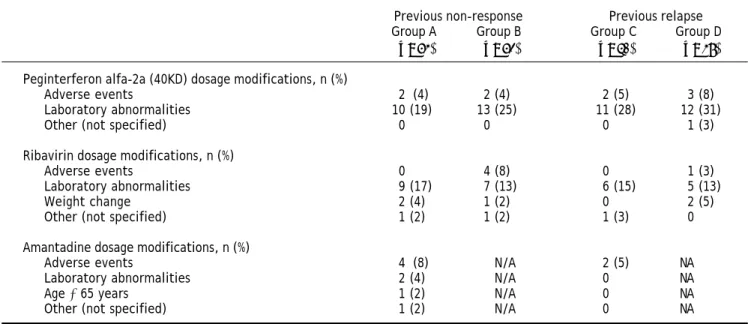
The safety population comprised 184 patients, six of whom withdrew from treatment because of adver-se events (Figure 1). The most common adveradver-se events included leucopenia, neutropenia, thrombo-cytopenia, fatigue and anaemia (Table 2). A total of 14 serious adverse events were reported in 10 pa-tients in the trial. One patient in group A died during treatment from cardiogenic shock, which was related to treatment in the opinion of the inves-tigator. The frequency of dose modifications is pre-sented in Table 3. Most dosage adjustments of peginterferon alfa-2a (40KD) and of ribavirin were made in response to laboratory abnormalities rather than adverse events. Amantadine dosage adjust-ments were infrequent and most of these were for adverse events.
DISCUSSION
The results of this analysis show that HCV can be eradicated with peginterferon alfa-2a (40KD) plus ribavirin in a substantial proportion of patients who have either not had a virological response during previous therapy or have experienced a viro-logical relapse after completion of therapy with con-ventional interferon plus ribavirin.
The primary results of the study confirm that amantadine does not augment the efficacy of pegin-terferon alfa-2a (40KD) plus ribavirin in patients who have not responded to treatment with conven-tional interferon plus ribavirin, and extend this finding to include patients with a previous relapse. We were unable to confirm the preliminary findings of Brillanti, et al.22 that suggested that amantadine enhances the efficacy of interferon plus ribavirin in interferon non-responders. As other authors have also been unable to demonstrate any benefit of amantadine in combination with pegylated interfe-ron plus ribavirin, the use of triple therapy with amantadine should be discouraged.
A previous study in Brazil showed that the combi-nation of peginterferon alfa-2a (40KD) plus ribavirin produced an SVR in 51% of relapsers and 26% of non-responders to conventional interferon plus riba-virin.23 The results of the present study are
Table 2. Adverse events.
Previous non-response Previous relapse Group A Group B Group C Group D (n = 53) (n = 52) (n = 40) (n = 39)
Patients with ≥ 1 serious adverse event, n (%) 3 (5.7) 3 (5.8) 3 (7.5) 1 (2.6)
Total number of serious adverse events, n 4 6 3 1
Incidence of specific adverse events,* n (%)
Leucopenia 25 (47.2) 25 (48.1) 24 (60.0) 27 (69.2)
Neutropenia 19 (35.8) 27 (51.9) 21 (52.5) 22 (56.4)
Thrombocytopenia 17 (32.1) 18 (34.6) 22 (55.0) 19 (48.7)
Fatigue 14 (26.4) 21 (40.4) 14 (35.0) 18 (46.2)
Anaemia 19 (35.8) 14 (26.9) 17 (42.5) 14 (35.9)
Myalgia 12 (22.6) 9 (17.3) 8 (20.0) 16 (41.0)
Insomnia 21 (39.6) 12 (23.1) 11 (27.5) 6 (15.4)
Headache 18 (34.0) 18 (34.6) 14 (35.0) 14 (35.9)
Irritability 7 (13.2) 12 (23.1) 7 (17.5) 11 (28.2)
Lymphopenia 10 (18.9) 7 (13.5) 11 (27.5) 9 (23.1)
Pruritus 7 (13.2) 10 (19.2) 10 (25.0) 7 (17.9)
Nausea 6 (11.3) 9 (17.3) 10 (25.0) 7 (17.9)
Depression 12 (22.6) 9 (17.3) 4 (10.0) 7 (17.9)
Anorexia 11 (20.8) 7 (13.5) 8 (20.0) 4 (10.3)
Pyrexia 5 (9.4) 9 (17.3) 4 (10.0) 8 (20.5)
Dizziness 1 (1.9) 6 (11.5) 8 (20.0) 3 (7.7)
Table 3. Dosage modifications for adverse events, laboratory abnormalities or other reasons.
Previous non-response Previous relapse Group A Group B Group C Group D
(n = 53) (n = 52) (n = 40) (n = 39)
Peginterferon alfa-2a (40KD) dosage modifications, n (%)
Adverse events 2 (4) 2 (4) 2 (5) 3 (8)
Laboratory abnormalities 10 (19) 13 (25) 11 (28) 12 (31)
Other (not specified) 0 0 0 1 (3)
Ribavirin dosage modifications, n (%)
Adverse events 0 4 (8) 0 1 (3)
Laboratory abnormalities 9 (17) 7 (13) 6 (15) 5 (13)
Weight change 2 (4) 1 (2) 0 2 (5)
Other (not specified) 1 (2) 1 (2) 1 (3) 0
Amantadine dosage modifications, n (%)
Adverse events 4 (8) N/A 2 (5) NA
Laboratory abnormalities 2 (4) N/A 0 NA
Age ≥ 65 years 1 (2) N/A 0 NA
Other (not specified) 1 (2) N/A 0 NA
N/A: not applicable.
tent with those of the earlier study and, taken together, provide a clear indication of the prognosis of patients for whom physicians are contemplating re-treatment.
The definition of previous response is a strength of this study. Only patients who had received at least 24 weeks of therapy were eligible, and strict criteria were applied to ensure that patients with a non-response and those with a relapse were treated separately in the analysis. These criteria are reflec-ted by differences in the baseline characteristics of patients with non-response vs. relapse. A higher pro-portion of non-responders were infected with HCV genotype 1 and a higher proportion of relapsers were infected with HCV genotype 2 or 3. Moreover, a higher proportion of relapsers had a histological diagnosis of cirrhosis or bridging fibrosis. Advanced fibrosis is a well-established poor prognostic factor in patients with CHC.
The results demonstrate the importance of the previous response to the standard of care as a pre-dictor of SVR. Patients with a previous virological relapse after completion of conventional combination therapy had considerably higher SVR rates than patients who had not had a virological response during previous treatment. This finding shows that physicians should carefully document the nature of a first response to therapy and should not hesitate to re-treat patients with a previous relapse.
Our study confirms that cEVR is a useful parame-ter in the management of patients who have not
res-ponded to a previous course of conventional interfe-ron-based therapies. cEVR had a higher positive pre-dictive value for SVR among both non-responders and relapsers to previous treatment. A recent analy-sis of data from a large, randomized, international study showed that complete viral suppression at week 12 (HCV RNA < 50 IU/mL) of treatment with peginterferon alfa-2a (40KD) plus ribavirin was a strong predictor of SVR in non-responders to previous treatment with pegylated interferon alfa-2b (12KD) plus ribavirin. The positive predictive value of week 12 HCV RNA ≤ 50 UI/mL was 57% in that study.24 In our study the positive predictive value was 70%.
Our analysis identified several unexpected asso-ciations between baseline factors and SVR. Among previous relapsers the SVR rate was considerably higher in those with low baseline ALT quotients (70.2% vs. 29.4% in those with ALT quotients ≤ 3 and > 3, respectively). Even more surprising was the SVR rates of 63.0% in patients with a high base-line HCV RNA level and 51.6% in those with a low baseline HCV RNA level. These findings are likely to be the result of confounding because of the low number of patients in some subgroups.
with pegylated interferon plus ribavirin.25-30 Consis-tent with the results of the present study, other au-thors have reported considerably higher SVR rates (in the order of 40-55%) in patients with a previous relapse to conventional interferon-based therapy.26-29 The somewhat higher SVR rates in patients with prior relapse in our study may be attributable to the use of a ribavirin dose of 1,000 or 1,200 mg/day. In previous studies either or both of the doses of pegin-terferon or ribavirin have been lower than what is currently recommended.26,27,29 Most of the patients included in this study had received a biosimilar con-ventional interferon of which little is known of the comparative efficacy. Thus, one might hypothesise that the higher response rates in our study was a reflection of lower efficacy of the biosimilar used in the previous course of treatment leading to a higher proportion of unexpected relapsers. The SVR rate of 26% in previous non-responders infected with HCV genotype 1 is particularly noteworthy. Other studies of re-treatment with pegylated interferon-based therapy have reported lower SVR rates in this im-portant subgroup. For example, 17% of genotype 1 non-responders to interferon alfa-2b plus ribavirin achieved an SVR after re-treatment with pegylated interferon alfa-2b (12KD) plus ribavirin 800-1,400 mg/day.28
Re-treatment with peginterferon alfa-2a (40KD) plus ribavirin results in an SVR in a proportion of patients who have not responded to a previous 12-week course of pegylated interferon alfa-2b (12KD) plus ribavirin24 or who have relapsed after a first course of peginterferon alfa-2a (40KD) plus ribavi-rin.31 In the case of non-responders to previous treatment with pegylated interferon alfa-2b (12KD) plus ribavirin, extending the duration of re-treat-ment with peginterferon alfa-2a (40KD) plus ribavi-rin to 72 weeks results in an SVR rate of 16%.24
CONCLUSION
A substantial proportion of patients who have not responded to or have relapsed after treatment with convention interferon plus ribavirin achieve an SVR when re-treated with peginterferon alfa-2a (40KD) plus ribavirin. Amantadine does not enhance SVR rates and cannot be recommended in this setting.
ABBREVIATIONS
• SVR: sustained virological response.VR • HCV: hepatitis C virus.
• CHC: chronic hepatitis C.H
• ALT: alanine aminotransferase. • EVR: early virological response.VR • OR: odds ratio.:
• SD: standard deviation.
GRANTS AND
OTHER FINANCIAL SUPPORT
This study was funded by Roche Produtos Quimi-cos e FarmacêutiQuimi-cos.
REFERENCES
1. Shepard CW, Finelli L, Alter MJ. Global epidemiology of hepa-titis C virus infection. Lancet Infect Dis 2005; 5: 558-67. 2. Perz JF, Armstrong GL, Farrington LA, Hutin YJ, Bell BP.
The contributions of hepatitis B virus and hepatitis C vi-rus infections to cirrhosis and primary liver cancer world-wide. J Hepatol 2006; 45: 529-38.
3. Dienstag JL, McHutchison JG. American Gastroenterologi-cal Association techniGastroenterologi-cal review on the management of he-patitis C. Gastroenterology 2006; 130: 231-64.
4. Manns MP, McHutchison JG, Gordon SC, Rustgi VK, Shiff-man M, Reindollar R, GoodShiff-man ZD, et al. Peginterferon alfa-2b plus ribavirin compared with interferon alfa-alfa-2b plus ribavirin for initial treatment of chronic hepatitis C: a randomised trial. Lancet 2001; 358: 958-65.
5. Fried MW, Shiffman ML, Reddy KR, Smith, C, Marinos G, Gonçales FL Jr, Häussinger D, et al. Peginterferon alfa-2a plus ribavirin for chronic hepatitis C virus infection. N Engl J Med 2002; 347: 975-82.
6. Hadziyannis SJ, Sette H Jr., Morgan TR, Balan V, Diago M, Marcellin P, Ramadori G, et al. Peginterferon-alpha2a and ribavirin combination therapy in chronic hepatitis C: a randomized study of treatment duration and ribavirin dose. Ann Intern Med 2004; 140: 346-55.
7. Swain MG, Lai MY, Shiffman ML, Cooksley WG, Zeuzem S, Dieterich DT, Abergel A, et al. A sustained virologic res-ponse is durable in patients with chronic hepatitis C trea-ted with peginterferon alfa-2a and ribavirin.
Gastroenterology 2010; 139(5): 1593-601.
8. Marcellin P, Boyer N, Gervais A, Martinot M, Pouteau M, Castelnau C, Kilani A, et al. Long-term histologic improve-ment and loss of detectable intrahepatic HCV RNA in pa-tients with chronic hepatitis C and sustained response to interferon-alpha therapy. Ann Intern Med 1997; 127: 875-81.
9. Camma C, Di Bona D, Schepis F, Heathcote J, Zeuzem S, Pockros PJ, Marcellin P, et al. Effect of peginterferon alfa-2a on liver histology in chronic hepatitis C: a meta-analy-sis of individual patient data. Hepatology 2004; 39: 333-42.
10. Kasahara A, Tanaka H, Okanoue T, ImaiY, TsubouchiH, YoshiokaK, Kawata S, et al. Interferon treatment impro-ves survival in chronic hepatitis C patients showing bio-chemical as well as virological responses by preventing liver-related death. J Viral Hepat 2004; 11: 148-56. 11. Veldt BJ, Saracco G, Boyer N, Cammà C, Bellobuono A, Hopf
U, Castillo I, et al. Long term clinical outcome of chronic hepatitis C patients with sustained virological response to interferon monotherapy. Gut 2004; 53: 1504-8.
in patients with hepatitis C virus-related cirrhosis. J Viral Hepat 2006; 13: 409-14.
13. Veldt BJ, Heathcote EJ, Wedemeyer H, Reichen J, Hof-mann WP, Zeuzem S, Manns MP, et al. Sustained virologic response and clinical outcomes in patients with chronic hepatitis C and advanced fibrosis. Ann Intern Med 2007; 147: 677-84.
14. Chen L, Borozan I, Feld J, Sun J, Tannis LL, Coltescu C, Heathcote J, et al. Hepatic gene expression discriminates responders and nonresponders in treatment of chronic he-patitis C viral infection. Gastroenterology 2005; 128: 1437-44.
15. Asselah T, Bieche I, Narguet S, Sabbagh A, Laurendeau I, Ripault MP, Boyer N,et al. Liver gene expression signature to predict response to pegylated interferon plus ribavirin combination therapy in patients with chronic hepatitis C.
Gut 2008; 57: 516-24.
16. Selzner N, Chen L, Borozan I, Edwards A, Heathcote EJ, McGilvray I. Hepatic gene expression and prediction of therapy response in chronic hepatitis C patients. J Hepa-tol 2008; 48: 708-13.
17. Ge D, Fellay J, Thompson AJ, Shianna KV, Urban TJ, Hein-zen EL, Qiu P, et al. Genetic variation in IL28B predicts hepatitis C treatment-induced viral clearance. Nature
2009; 461: 399-401.
18. Ghany MG, Strader DB, Thomas DL, Seeff LB. American As-sociation for the Study of Liver Diseases. Diagnosis, ma-nagement, and treatment of hepatitis C: an update.
Hepatology 2009; 49: 1335-74.
19. Deltenre P, Henrion J, Canva V, Dharancy S, Texier F, Lo-uvet A, De Maeght S, et al. Evaluation of amantadine in chronic hepatitis C: a meta-analysis. J Hepatol 2004; 41: 462-73.
20. Von Wagner M, Hofmann WP, Gerlinde T, Berg T, Goeser T, Spengler U, Hinrichsen H, et al. Placebo-controled trial of 400 amantadine combined with peginterferon alpha-2a and ribavirin for 48 weeks in chronic hepatitis C virus-1 infec-tion. Hepatology 2008; 48: 1404-11.
21. Schalm SW, Brouwer JT, Bekkering FC, van Rossum TG. New treatment strategies in non-responder patients with chronic hepatitis C. J Hepatol 1999; 31(Suppl. 1): 184-8. 22. Brillanti S, Levantesi F, Masi L, Foli M, Bolondi L. Triple
an-tiviral therapy as a new option for patients with
interfe-ron nonresponsive chinterfe-ronic hepatitis C. Hepatology 2000; 32: 630-4.
23. Parise E, Cheinquer H, Crespo D, Meirelles A, Martinelli AV, Sette H, Gallizi J, et al. Peginterferon alfa-2a (40KD) (PE-GASYS) plus ribavirin (COPEGUS) in retreatment of chronic hepatitis C patients, nonresponders and relapsers to pre-vious conventional interferon plus ribavirin therapy. Braz J Infect Dis 2006; 10: 11-6.
24. Jensen DM, Marcellin P, Freilich B, Andreone P, Di Bisceglie A, Brandão-Mello CE, Reddy KR, et al. Re-treatment of pa-tients with chronic hepatitis C who do not respond to peg-interferon alfa-2b. Ann Int Med 2009; 150: 528-40. 25. Shiffman ML, Di Bisceglie AM, Lindsay KL, Morishima C,
Wrig-ht EC, Everson GT, Lok AS, et al. Peginterferon alfa-2a and ribavirin in patients with chronic hepatitis C who have failed prior treatment. Gastroenterology 2004; 126: 1015-23. 26. Jacobson IM, Gonzalez SA, Ahmed F, Lebovics E, Min AD,
Bodenheimer HC Jr., Esposito SP, et al. A randomized trial of pegylated interferon alpha-2b plus ribavirin in the re-treatment of chronic hepatitis C. Am J Gastroenterol
2005; 100: 2453-62.
27. Krawitt EL, Ashikaga T, Gordon SR, Ferrentino N, Ray MA, Li-dofsky SD. Peginterferon alfa-2b and ribavirin for treatment-refractory chronic hepatitis C. J Hepatol 2005; 43: 243-9. 28. Poynard T, Colombo M, Bruix J, Schiff E, Terg R, Flamm S,
Moreno-Otero R, et al.; Epic Study Group. Peginterferon alfa-2b and ribavirin: effective in patients with hepatitis C who failed interferon alfa/ribavirin therapy. Gastroen-terology 2009; 136: 1618-28.
29. Sherman M, Yoshida EM, Deschenes M, Krajden M, Bain VG, Peltekian K, Anderson F, et al. Peginterferon alfa-2a (40KD) plus ribavirin in chronic hepatitis C patients who failed previous interferon therapy. Gut 2006; 55: 1631-8. 30. Taliani G, Gemignani G, Ferrari C, Aceti A, Bartolozzi D,
Blanc PL, Capanni M, et al. Pegylated interferon alfa-2b plus ribavirin in the retreatment of interferon-ribavirin nonresponder patients. Gastroenterology 2006; 130: 1098-106.