Direct Acting Antivirals
Improve HCV Treatment Initiation and
Adherence Among Underserved African Americans
Kendall R. Beck,* Nicole J. Kim,* Mandana Khalili*,**
* Department of Medicine, University of California San Francisco, San Francisco, CA, USA. ** Liver Center, University of California San Francisco, San Francisco, CA, USA.
May-June, Vol. 17 No. 3, 2018: 413-418
INTRODUCTION
African Americans (AA) make up 25% of the hepatitis C (HCV)-infected population in the United States and have higher rates of HCV infection than Caucasians.1 In
addition, self-identification as non-Hispanic black is an independent predictor of a positive HCV viral load.1
These rates are likely underestimated as HCV preva-lence studies often exclude vulnerable populations who are not only disproportionately affected by HCV, but are also at high risk of experiencing health disparities associated with this infection.1-4 Prior to the
introduc-tion of direct acting antiviral (DAA) agents, HCV-in-fected underserved AA patients had high rates of treatment ineligibility due to comorbid medical and psychiatric conditions as well as substance abuse.5
Addi-tional barriers to HCV therapy in the interferon-based era included lower treatment response rates that were
independent of disease characteristics, baseline viral load, or other viral and patient characteristics,6-8 as well
as higher rates of adverse effects related to these thera-pies. The introduction of interferon sparing, well-tol-erated, and highly effective DAA regimens in recent years along with enhanced birth cohort and risk-based screening recommendations provides an unprecedented opportunity to identify HCV-infected patients newly eligible for therapy.9 However, there is no data on
ad-herence to HCV care and treatment uptake in the un-derserved African American population despite the enactment of the Patient Protection and Affordable Care Act (ACA), expanding health insurance coverage.10
We therefore aimed to evaluate the impact of the intro-duction of second generation DAA-based treatment reg-imens on HCV treatment eligibility, treatment initiation, and adherence to HCV care among an under-served HCV-infected African American population.
The Official Journal of the Mexican Association of Hepatology, the Latin-American Association for Study of the Liver and
the Canadian Association for the Study of the Liver
Manuscript received: Manuscript received:Manuscript received:
Manuscript received:Manuscript received: September 11, 2017. Manuscript accepted:Manuscript accepted:Manuscript accepted:Manuscript accepted:Manuscript accepted: October 13, 2017.
DOI:10.5604/01.3001.0011.7385
A B S T R A C T A B S T R A C T A B S T R A C T A B S T R A C T A B S T R A C T
Introduction and aim. Adherence to hepatitis C (HCV) care was suboptimal in the interferon era among unders-erved African Americans (AA), but adherence data in the era of direct acting antivirals (DAA) is lacking in this pop-ulation. We aimed to evaluate the impact of DAA on HCV care in underserved AA. Material and methods. Clinical records of AAs undergoing HCV evaluation attending a safety net health system liver clinic were reviewed from 2006 to 2011 (pre-DAA), and January 1, 2014 to December 31, 2016 (post-DAA). Results. 291 patients were identified (129 pre-DAA, and 162 post-DAA). Median age was 58, 66% were male, 91% had HCV genotype 1, and 70% had fibrosis ≥ stage 2. Post-DAA patients were older (60 vs. 53 years; p < 0.001), had higher rates of insur-ance (98% vs. 88%; p < 0.001), liver fibrosis ≥ stage 2 (77% vs. 61%; p = 0.048), ≥ 2 medical comorbidities (19 vs.
0.8%; p < 0.001), and median baseline log10 HCV RNA (6.07 vs. 5.81 IU/mL; p < 0.001), but lower median ALT (46
vs. 62 U/L; p < 0.001). Post-DAA, fewer patients were treatment ineligible (5.6% vs. 39%; p < 0.001) and more initi-ated therapy (71% vs. 8.5%; < 0.001), were adherent to HCV care (82% vs. 38%; p < 0.001), and achieved cure (95.7% vs. 63.6%, p < 0.001). Availability of DAA was independently associated with improved adherence to HCV care (OR 10.3, 95% CI 4.84-22.0). Conclusion. Availability of DAA is associated with increased treatment eligibili-ty, initiation, adherence to HCV care, and cure in HCV-infected underserved AAs; highlighting the critical role of ac-cess to DAA in this population.
MATERIAL AND METHODS
Patient population and study design
This is a retrospective review of the electronic medical records of patients who were evaluated for HCV treat-ment at the Zuckerberg San Francisco General Hospital (ZSFG) liver specialty clinic between January 1, 2006 and June 30, 2011, the time period prior to the introduction of direct acting antiviral HCV medications (pre-DAA era), and between January 1, 2014 and December 31, 2016, the time period following approval of second generation DAA (post-DAA era). Patients were referred to the liver spe-cialty clinic from primary care clinics within the San Fran-cisco Health Network (SFHN), which is the traditionally designated safety-net healthcare system in San Francisco, and provides services to over 150,000 patients annually in-cluding most of the county’s uninsured and underinsured population.11 The SFHN is administered by the San
Fran-cisco Department of Public Health and includes a net-work of 15 primary care clinics, San Francisco General Hospital (an academic medical center that serves as an acute care and referral facility), and the San Francisco Community Clinic Consortium, which includes 11 feder-ally qualified health centers.11 This study was approved by
the University of California San Francisco Committee on Human Research.
All adult patients (18 years and older) who self-identi-fied as African American with chronic HCV (evidence of HCV antibody positivity ≥ 6 months and detectable HCV viral load), who had completed at least one liver specialty clinic visit for evaluation of HCV treatment eligibility during the specified study time period were included in the study. During the entire study period, the liver spe-cialty clinic instituted a formal HCV education class to en-hance patient knowledge of HCV disease and treatment, and to improve adherence to HCV care.11,12
Data extraction
Data was extracted from the electronic medical record with respect to demographics and clinical, laboratory, and imaging studies. Detailed HCV virologic characteristics including viral load, genotype, co-infection with hepatitis B (HBV) or human immunodeficiency virus (HIV), HCV treatment regimen, and treatment response were captured. Severity of liver disease was determined either by non-in-vasive Fibrosure test,13 liver biopsy if available, or
abdom-inal imaging studies documenting the presence of cirrhosis. History of decompensated liver disease was de-termined by standard biochemical or clinical parameters
(such as ascites, hepatic encephalopathy, and variceal hem-orrhage).
Treatment eligibility status (treatment eligible, treat-ment ineligible, or undergoing eligibility evaluation) and reasons for ineligibility were determined from the last at-tended liver clinic provider note. Patients were deemed adherent to HCV care if they returned to subsequent clin-ic visits after being deemed treatment eligible or while un-dergoing evaluation for treatment eligibility. Patients who were deemed ineligible for treatment were not included in the adherence data analysis.
HCV treatment
All subjects pre-DAA received standard of care pegylat-ed interferon and ribavirin combination therapy. Second generation DAAs (post-DAA) included sofosbuvir, simeprevir, ledipasvir, daclatasvir, paritaprevir/ritonavir/ ombitasvir/dasabuvir, elbasvir/ grazoprevir, and vel-patasvir. The standard of care planned duration of therapy for each combination regimen was used.14 Treatment
suc-cess was determined by standard sustained virologic re-sponse (SVR) documentation as undetectable HCV viral load at 24 weeks following end of therapy for the pre-DAA era and as undetectable HCV viral load at 12 weeks following end of therapy for the post-DAA era.
Statistical analysis
Descriptive statistics were generated using median (in-terquartile range) for continuous variables, and frequency (%) for qualitative variables. Patient characteristics were compared between pre- and post-DAA using the Chi-square (χ2) test (Fisher’s exact test when appropriate) for
categorical variables and the Mann-Whitney test for con-tinuous variables. Similarly, patient characteristics were compared between those lost to follow up versus not lost to follow up using χ2 (Fisher’s exact when appropriate)
RESULTS
Patient characteristics
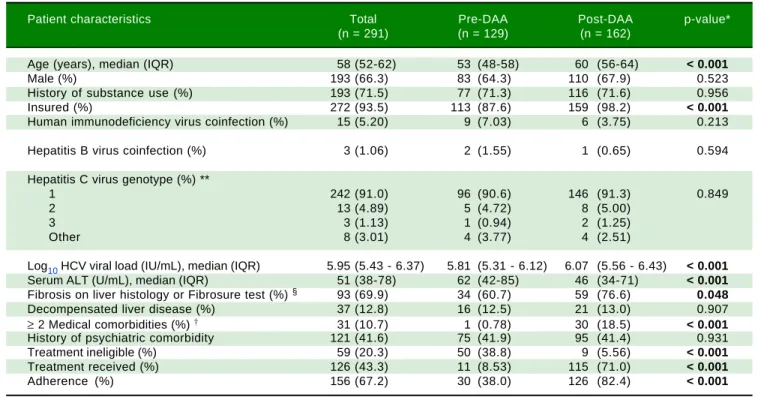
A total of 291 African American patients were identified during the study period, of whom 129 were pre-DAA and 162 were post-DAA. Table 1 summarizes patient charac-teristics overall, and by pre- and post-DAA. Overall, the median age was 58 years (52-62), 66% were male, and 91% had HCV genotype 1. Thirty-two percent of patients had a liver biopsy, and an additional 16% had Fibrosure test re-sults available; about 70% of these patients had liver fibro-sis stage ≥ 2. Compared to pre-DAA patients, patients in the post-DAA group were older (60 vs. 53 years; p < 0.001), more likely to be insured (98% vs. 88%; p < 0.001), had higher median baseline log10 HCV viral loads (6.07 IU/mL vs. 5.81 IU/mL; p < 0.001), had lower median alanine transaminase (ALT) levels (46 U/L vs. 62 U/L; p < 0.001), were more likely to have liver fibrosis ≥ stage 2 (77% vs. 61%; p = 0.048), and were more likely to have ≥ 2 medical comorbidities (19% vs. 0.8%; p < 0.001). There was no significant difference in rates of illicit drug use or psychiatric comorbidity. A similar proportion (~13%) of patients pre- and post-DAA had evidence of decompensat-ed liver disease.
Factors associated
with HCV treatment eligibility and initiation
In the post-DAA era, fewer patients were considered ineligible for treatment (5.6% vs. 39%; p < 0.001), more pa-tients received HCV therapy (71% vs. 8.5%; p < 0.001), and more were adherent to HCV care (82% vs. 38%; p < 0.001) (Table 1). Among those 47 patients who did not receive HCV therapy post-DAA, reasons for lack of receipt of HCV therapy included awaiting further work-up (n = 18), awaiting medication approval (n = 13), patient deferment of therapy (n = 8), and provider concern for poor adher-ence to HCV medications due to ongoing substance use or uncontrolled psychiatric condition (n = 8).
Factors associated with adherence to HCV care
Of the 232 patients who were either eligible for thera-py or in the process of being evaluated for eligibility, 76 patients were non-adherent to clinic visits [49 (38%) pre-DAA and 27 (20.9%) post-pre-DAA, p < 0.0001)]. Patient char-acteristics of those who were and were not lost to follow up are listed in table 2. Patients who were lost to follow-up were more likely to be in the process of determining
Table 1. Baseline patient characteristics.
Patient characteristics Total Pre-DAA Post-DAA p-value* (n = 291) (n = 129) (n = 162)
Age (years), median (IQR) 58 (52-62) 53 (48-58) 60 (56-64) < 0.001
Male (%) 193 (66.3) 83 (64.3) 110 (67.9) 0.523
History of substance use (%) 193 (71.5) 77 (71.3) 116 (71.6) 0.956
Insured (%) 272 (93.5) 113 (87.6) 159 (98.2) < 0.001
Human immunodeficiency virus coinfection (%) 15 (5.20) 9 (7.03) 6 (3.75) 0.213
Hepatitis B virus coinfection (%) 3 (1.06) 2 (1.55) 1 (0.65) 0.594
Hepatitis C virus genotype (%) **
1 242 (91.0) 96 (90.6) 146 (91.3) 0.849
2 13 (4.89) 5 (4.72) 8 (5.00)
3 3 (1.13) 1 (0.94) 2 (1.25)
Other 8 (3.01) 4 (3.77) 4 (2.51)
Log10 HCV viral load (IU/mL), median (IQR) 5.95 (5.43 - 6.37) 5.81 (5.31 - 6.12) 6.07 (5.56 - 6.43) < 0.001
Serum ALT (U/mL), median (IQR) 51 (38-78) 62 (42-85) 46 (34-71) < 0.001
Fibrosis on liver histology or Fibrosure test (%) § 93 (69.9) 34 (60.7) 59 (76.6) 0.048
Decompensated liver disease (%) 37 (12.8) 16 (12.5) 21 (13.0) 0.907
≥ 2 Medical comorbidities (%) † 31 (10.7) 1 (0.78) 30 (18.5) < 0.001
History of psychiatric comorbidity 121 (41.6) 75 (41.9) 95 (41.4) 0.931
Treatment ineligible (%) 59 (20.3) 50 (38.8) 9 (5.56) < 0.001
Treatment received (%) 126 (43.3) 11 (8.53) 115 (71.0) < 0.001
Adherence (%) 156 (67.2) 30 (38.0) 126 (82.4) < 0.001
IQR: interquartile range. ALT: alanine aminotransferase. * p-value < 0.05 considered statistically significant and bolded. **HCV genotype known for 266 pa-tients. § Liver biopsy performed for 93 patients, Fibrosure performed for 46 patients, fibrosis defined as ≥ stage 2. † Defined as presence of diabetes, heart
treatment eligibility (category defined as potentially eligi-ble for treatment) (difference of 57%; p < 0.001) and had fewer than two medical comorbidities (difference of 10%; p = 0.035) compared to those who were not lost to fol-low-up. Lack of access to DAA therapy was also a signifi-cant factor (difference of 45%; p < 0.001) contributing to adherence to subsequent clinic visits. On multivariate modeling, only the availability of DAA (post-DAA) re-mained positively associated with adherence to
subse-quent clinic visits (OR 10.3, 95% CI 4.84-22.0) after adjust-ing for age, sex, and insurance status (Table 3).
HCV treatment initiation and response to therapy
A total of 126 patients (11 pre-DAA and 115 post-DAA) initiated HCV therapy during the study period. In the pre-DAA period, all patients received standard of care
pegylated-Table 2. Characteristics of patients who were and were not lost to follow up among treatment eligible or possibly eligible groups.
Patient characteristics Lost to Not lost to p-value * Difference in p-value ** follow up follow up proportions
(n = 76) (n = 156) between were/were not lost
to follow up (95% CI)
Age (years), median (IQR) 58 (52-61) 54 (48-59) 0.173
Male (%) 50 (65.8) 106 (68.0) 0.742 0.02 (-0.11 to 0.15) 0.742
History of substance use (%) 48 (68.6) 107 (70.4) 0.783 -0.02 (-0.15 to 0.11) 0.783
Insured (%) 69 (90.8) 147 (94.2) 0.332 -0.03 (-0.11 to 0.04) 0.336
Hepatitis C virus genotype 1 (%) 67 (94.4) 142 (91.0) 0.442 0.03 (-0.04 to 0.10) 0.388
Log10 HCV viral load (IU/mL), median (IQR) 5.94 (5.40-6.42) 5.98 (5.49-6.37) 0.946
Serum ALT (U/mL), median (IQR) 51 (39-70) 50 (37-80) 1.000
Fibrosis on liver histology or Fibrosure test (%) § 19 (63.3) 62 (73.8) 0.277 -0.10 (-0.30 to 0.09) 0.277
Decompensated liver disease (%) 3 (3.95) 16 (10.3) 0.127 -0.06 (-0.13 to 0.00) 0.098
Treatment eligibility status (%)
Eligible 30 (39.5) 150 (96.2) <0.0001 -0.57 (-0.68 to 0.45) < 0.001
Possibly eligible 46 (60.5) 6 (3.9)
≥ 2 Medical comorbidities 4 (5.26) 23 (14.7) 0.048 -0.10 (-0.17 to -0.02) 0.035
History of psychiatric comorbidity 32 (42.1) 61 (39.1) 0.661 0.03 (-0.10 to 0.16) 0.661
Direct acting antiviral agent availability 27 (35.5) 126 (80.8) <0.0001 -0.45 (-0.57 to -0.33) < 0.001
ALT: alanine aminotransferase. IQR: interquartile range. * χ2 (Fisher's exact when appropriate) or Mann-Whitney test, p-value < 0.05 considered statistically
significant and bolded. ** Z-test, p-value < 0.05 considered statistically significant (2-sided). § Liver biopsy performed for 93 patients, fibrosure performed for
46 patients, fibrosis defined as ≥ stage2. Loss to follow-up defined as not attending scheduled liver clinic visit while undergoing treatment eligibility evaluation or after being deemed eligible for treatment.
Table 3. Factors associated with adherence.
Patient characteristics Unadjusted OR (95% CI) p-value* Adjusted OR ‡ (95% CI) p-value*
Age (years) 1.02 (0.99-1.06) 0.219 0.96 (0.92-1.01) 0.086
Male gender 1.10 (0.62-1.97) 0.742 1.17 (0.60-2.28) 0.64
History of substance use 1.09 (0.59-2.01) 0.783
History of psychiatric comorbidity 0.88 (0.51-1.54) 0.661
Insured 1.66 (0.59-4.63) 0.336 0.68 (0.22-2.16) 0.518
HIV coinfection 0.63 (0.21-1.87) 0.402
HBV coinfection 0.50 (0.03-8.16) 0.629
Cirrhosis 1.06 (0.41-2.72) 0.91
Decompensated liver disease 2.80 (0.79-9.93) 0.111
≥ 2 Medical comorbidities † 3.11 (1.04-9.35) 0.043 1.42 (0.44-4.57) 0.552
Direct acting antiviral agent availability 7.62 (4.12-14.1) < 0.001 10.3 (4.84-22.0) < 0.001
* p-value < 0.05 considered statistically significant and bolded. ‡ Adjusted for age, gender, and insurance status. OR: odds ratio. † Defined as presence of
interferon and ribavirin combined therapy. In the post-DAA period, sofosbuvir/ledipasvir ± ribavirin was the most common treatment regimen used (65%). The fre-quency of other regimens used were: elbasvir/grazoprevir ± ribavirin (10%), sofosbuvir/simeprevir (7%), sofosbu-vir/daclatasvir ± ribavirin (7%), sofosbuvir/pegylated in-terferon/ribavirin (4%), sofosbuvir/velpatasvir ± ribavirin (4%), and paritaprevir/ritonavir/ombitasvir/dasabuvir (3%). In the pre-DAA era, 64% of patients achieved SVR. Among 115 patients in the post-DAA era who initiated therapy, 93 had reached the SVR time point at data analysis and 89 (95.7%) achieved SVR. On univariate analysis, older age (OR 1.07, 95% CI 1.03 - 1.10, p<0.001) and presence of
≥ 2 medical comorbidities (OR 3.1, 95% CI 1.40 - 6.84, p = 0.005) were associated with higher rates of receiving HCV therapy. On multivariate analysis adjusting for gen-der and insurance status, olgen-der age remained positively as-sociated with receipt of HCV treatment (OR 1.06, 95% CI 1.03-1.10, p < 0.001) and presence of ≥ 2 medical comor-bidities was also associated with higher odds of receiving HCV therapy but this did not reach statistical significance (OR 2.22, 95% CI 0.98-5.04, p = 0.055).
DISCUSSION
This is the first study to report real world data on the impact of second generation DAA use on HCV treatment eligibility, initiation, and adherence to HCV care in a HCV-infected African American population accessing care in a liver specialty clinic within a safety-net healthcare sys-tem. We demonstrate that a significantly higher percentage of underserved AAs were treatment eligible and received treatment in the post-DAA era compared to the pre-DAA era. Conversely, lack of DAA access was significantly asso-ciated with subsequent poor adherence to HCV care among this population. These findings were independent of insurance status with the introduction of the ACA ex-panding access to insurance coverage in the post-DAA era in the safety net population.
We have previously shown that medical comorbidities and active substance abuse were significant reasons for HCV non-treatment in underserved HCV-infected Afri-can AmeriAfri-cans accessing care within the safety net liver specialty service in the pre-DAA era.5 Consequently,
dis-engaging from HCV care was also highly prevalent.5 While
we hypothesized that patient factors may continue to con-tribute to the observed health disparity in this population, in this study we found that on the contrary, a significantly higher proportion (71% vs. 8.5%) of patients received HCV therapy in the post-DAA era. Additionally, the presence of medical comorbidities and older age were independent predictors and represented priorities for initiation of HCV therapy post-DAA, factors that may have been a
rela-tive contraindication to therapy in the interferon-based era. Importantly, access to DAA therapy also impacted ad-herence to HCV care. DAA availability was associated with a 10 fold increased odds of adherence to subsequent clinic visits.
In this study, we observed a highly successful outcome of HCV therapy post-DAA with SVR rates of over 95% ir-respective of the type of DAA regimen, severity of liver disease, and other viral and patient factors among this mar-ginalized population. This high success rate is consistent with prior reports showing 97% SVR within a more ra-cially diverse underserved HCV-population receiving care in the safety-net liver specialty setting15 as well as
pub-lished clinical trials of various DAA regimens.16,17
Howev-er, some studies have also suggested an influence of treatment duration and regimen on SVR rates in African Americans. For example, in a recent study from the Veter-an’s Health Administration, black race was associated with lower SVR rates (adjusted OR 0.77) compared to whites.18
Blacks treated with sofosbuvir/ledipasvir for a shorter du-ration of 8 weeks were less likely to achieve SVR com-pared to the longer duration of 12 weeks, suggesting a possible impact of treatment duration on treatment re-sponse in this population.18 Also, in the ION3 clinical
tri-al, the SVR rates with sofosbuvir/ledipasvir were lower in blacks (83% vs. 92%) if baseline HCV viral load was ≥ 6 x 10⁶ IU/mL and there was no ribavirin used, and there was
a higher relapse rate among those treated with 8-week (vs.
12-week) duration of therapy (9% vs. 4%).16 Although high
response rates in our study precludes meaningful compar-isons of non-responders, we did not observe any differ-ences in treatment regimen and duration among the four patients that did not respond to HCV therapy.
While this is the first study to assess pre- and post-DAA HCV care in the underserved African American popula-tion, our study is limited by sample size and evaluation within the liver specialty clinic setting, which may not be generalizable to the non-specialty clinical setting. In addi-tion, it is possible that unmeasured factors may have con-tributed to improved adherence in the post-DAA era including patient awareness of highly successful newer HCV treatment regimens, significant cost of these medi-cations, and a potentially stronger emphasis on adherence considering the possibility of developing viral resistance19
with these newer agents which did not occur with inter-feron/ribavirin combination therapy. Nevertheless, we have shown a significant uptake of therapy independent of limited access to these regimens.
to pre-DAA era therapies. DAA access appears to be the single most important factor influencing engagement with HCV care among the underserved African American pop-ulation. Thus, eliminating the barrier of access to DAA regimens will likely significantly reduce hepatitis C dis-parities, a public health priority, in this underserved popu-lation.
ABBREVIATIONS
• AA: African American. • ACA: Affordable Care Act. • ALT: alanine transaminase. • DAA: direct acting antiviral. • HBV: hepatitis B virus. • HCV: hepatitis C virus.
• HIV: human immunodeficiency virus. • SFHN: San Francisco Health Network. • SVR: sustained virologic response.
• ZSFG: Zuckerberg San Francisco General Hospital and Trauma Center.
GRANTS AND FINANCIAL SUPPORT
Dr. Khalili has research grant support from Gilead Inc. and Intercept Pharmaceuticals and has participated in the advisory boards of Bristol Myers Squibb, Gilead Inc., and Intercept Pharmaceuticals. This work was supported in part by National Institutes of Health K24AA022523 (to M.K.) and P30 DK026743 (UCSF Liver Center).
REFERENCES
1. Denniston MM, Jiles RB, Drobeniuc J, Klevens RM, Ward JW, McQuillan GM, Holmberg SD. Chronic Hepatitis C Virus Infec-tion in the United States, NaInfec-tional Health and NutriInfec-tion Exami-nation Survey 2003 to 2010. Ann Intern Med 2014; 160: 293-300.
2. Razavi H, ElKhoury AC, Elbasha E, Estes C, Pasini K, Poy-nard T, Kumar R. Chronic hepatitis C disease burden and cost in the United States. Hepatology 2013; 57: 2164-70. 3. Saab S, Jackson C, Nieto J, Francois F. Hepatitis C in
Afri-can AmeriAfri-cans. Am J Gastroenterol 2014; 109: 1576-84. 4. Chak E, Talal AH, Sherman KE, Schiff ER, Saab S. Hepatitis C
virus infection in USA: an estimate of true prevalence. Liver Int 2011; 31: 1090-101.
5. Schaeffer S, Khalili M. Reasons for HCV non-treatment in underserved African Americans: Implications for treatment with new therapeutics. Ann Hepatol 2015; 14(2): 234-42. 6. Brau N, Bini EJ, Currie S, Shen H, Schmidt WN, King PD, Ho
SB, et al. Black patients with chronic hepatitis C have a low-er sustained viral response rate than non-blacks with geno-type 1, but the same with genogeno-types 2/3, and this is not explained by more frequent dose reductions of interferon and ribavirin. J Viral Hepat 2006; 13: 242-9.
7. Conjeevaram HS, Fried MW, Jeffers LJ, Terrault NA, Wiley-Lucas TE, Afdhal N, Brown RS, et al. Peginterferon and riba-virin treatment in African American and Caucasian American patients with hepatitis C genotype 1. Gastroenterology
2006; 131: 470-7.
8. Jeffers LJ, Cassidy W, Howell CD, Hu S, Reddy KR. Peginterferon alfa-2a (40 kd) and ribavirin for black Ameri-can patients with chronic HCV genotype 1. Hepatology
2004; 39: 1702-8.
9. Moyer, VA, U.S. Preventive Services Task Force. Screening for hepatitis C virus infection in adults: a U.S. Preventive Services Task Force recommendation statement. Ann Intern Med 2013; 159: 349-57.
10. Blumenthal D. Health care coverage under the Affordable Care Act - A progress report. N Engl J Med 2014; 371: 275-81.
11. Surjadi M, Torreullas C, Ayala C, Yee HF Jr., Khalili M. Formal patient education improves patients' knowledge of hepatitis C in vulnerable populations. Dig Dis Sci 2011; 56: 213-9. 12. Lubega S, Agbim U, Surjadi M, Mahoney M, Khalili M. Formal
hepatitis C education enhances HCV care coordination, ex-pedites HCV treatment and improves antiviral response. Liv-er Int 2013; 33: 999-1007.
13. Poynard T, Morra R, Halfon P, Castera L, Ratziu V, Imbert-Bismut F, Naveau S, et al. Meta-analyses of FibroTest diag-nostic value in chronic liver disease. BMC Gastroenterol
2007; 7(40).
14. AASLD-IDSA HCV Guidance panel. Hepatitis C guidance: AASLD-IDSA recommendations for testing, man- aging, and treating adults infected with hepatitis C virus. Hepatology
2015; 62: 932-54
15. Beck KB, Kim N, Khalili M. Sofosbuvir-containing regimens for chronic hepatitis C are successful in the safety-net pop-ulation: A real world experience. Dig Dis Sci 2016; 61: 3602.
16. Wilder JM, Jeffers LJ, Ravendhran N, Shiffman ML, Poulos J, Sulkowski MS, Gitlin N, et al. Safety and efficacy of ledipas-vir-sofosbuvir in black patients with hepatitis C virus infec-tion: A retrospective analysis of phase 3 data. Hepatology
2016; 63(2): 437-44.
17. Feld JJ, Jacobson IM, Hezode C, Asselah T, Ruane PJ, Gruener N, Abergel A, et al. Sofosbuvir and Velpatasvir for HCV Genotype 1, 2,4, 5, and 6. N Engl J Med 2015; 373: 2599-607.
18. Su F, Green PK, Berry K, Ioannou GN. The association be-tween race/ethnicity and the effectiveness of direct antiviral agents for hepatitis C virus infection. Hepatology 2017; 65: 426-38.
19. Pawlotsky JM. Hepatitis C Virus Resistance to Direct-Acting Antiviral Drugs in Interferon-free Regimens. Gastroenterolo-gy 2016; 151: 70-86.
Correspondence and reprint request:
Mandana Khalili, M.D. University of California San Francisco,
San Francisco General Hospital.
1001 Potrero Avenue, NH 3-D. San Francisco, CA 94110, USA. Tel.: 415-206-4766