PERMANYER www.permanyer.com
ORIGINAL ARTICLE Rev Inves Clin. 2015;67:177-81
Decrease in the Prevalence
of Pancreatitis Associated with Primary
Hyperparathyroidism: Experience
at a Tertiary Referral Center
Marcela Janka-Zires
1, Jorge Hernández-Calleros
2, Francisco Javier Gómez-Pérez
1,
Luis Federico Uscanga-Domínguez
2, Mario César Pelaez-Luna
2and Paloma Almeda-Valdés
1*
1Department of Endocrinology and Metabolism; 2Department of Gastroenterology, Instituto Nacional de Ciencias
Médicas y Nutrición Salvador Zubirán, México, D.F., Mexico
Corresponding author:
*Paloma Almeda-Valdés
Department of Endocrinology and Metabolism Instituto Nacional de Ciencias Médicas y Nutrición Salvador Zubirán
Vasco de Quiroga 15, Colonia Belisario Domínguez Sección XVI
Tlalpan C.P. 14000, México, D.F.
E-mail: [email protected] Received for publication: 12-02-2015 Accepted for publication: 20-05-2015
ABSTRACT
Background: Hypercalcemia is a rare but well recognized cause of acute and chronic pancreatitis. Hypercalcemia-related
pancreatitis is mainly caused by primary hyperparathyroidism. The prevalence of pancreatitis in hyperparathyroidism varies worldwide and additional disease-modifying factors may play a role in its development. In 1988 the prevalence of pancreatitis secondary to primary hyperparathyroidism at the Instituto Nacional de Ciencias Médicas y Nutrición Salvador Zubirán (INCMNSZ), a referral center in Mexico City, was 12.1% (95% CI: 6.7-21). Objective: To describe the current prevalence
of pancreatitis secondary to primary hyperparathyroidism at the INCMNSZ. Methods: We reviewed 385 cases of primary
hyperparathyroidism seen at the hospital between 1987 and 2012. Results: 26 cases with acute or chronic pancreatitis
associ-ated with primary hyperparathyroidism were documented, with a prevalence of 6.7% (95% CI: 4.6-9.7), which was lower than the 12.1% previously reported. In the present study, 20% had a history of alcohol consumption, 10% of gallstones, and 20% of ureteral calculi, compared with the previously reported 32.0, 34.6, and 40.0%, respectively. The average calcium levels were 13.1 and 13.8 mg/dl in the previous and current series, respectively. Conclusions: We found a decrease in the prevalence of
pancreatitis associated with primary hyperparathyroidism from 12.1% (95% CI: 6.7-21) to 6.7% (95% CI: 4.6-9.7). (REV INVES CLIN. 2015;67:177-81)
Corresponding author: Paloma Almeda-Valdés, [email protected]
Key words: Pancreatitis. Hypercalcemia. Hyperparathyroidism. Calcium. Parathyroid hormone.
.r
e
hsi
l
b
u
p
e
ht
f
o
n
ois
si
mr
e
p
ne
tti
r
w r
oir
p
e
ht
t
u
o
hti
w
g
ni
y
p
oc
ot
o
h
p r
o
de
c
u
d
or
pe
r
e
b
ya
m
n
oit
aci
l
b
u
p s
i
ht
f
o t
ra
p
o
N
INTRODUCTION
Hypercalcemia is a rare but well recognized cause of acute and chronic pancreatitis1. Pancreatitis due to
hypercalcemia is mainly caused by primary hyperpara-thyroidism (PHPT)2. However, the prevalence of
pan-creatitis in patients with PHPT is variable. Most studies report an association between both entities, but others have found a frequency similar to that of the normal population3-5. These divergent observations suggest
that additional disease-modifying factors may play an important role in the development of pancreatitis in patients with PHPT. Molecular studies have reported that the elevation of cytosolic calcium triggers acute pancreatitis6. Other reports have shown that a
combi-nation of hypercalcemia and genetic variants in SPINK1 and CFTR, among other genes, increase the risk of developing pancreatitis in patients with PHPT2.
In 1988 a prevalence of 12.1% (range, 6.7-21.0) of pancreatitis associated with hyperparathyroidism at the National Institute of Medical Sciences and Nutrition Salvador Zubirán (INCMNSZ) was reported7. Currently,
PHPT is diagnosed more frequently and most patients are asymptomatic, but there are still severe cases of PHPT with pancreatitis related to this condition. Pancre-atitis is associated with significant morbidity and mor-tality and the correction of associated factors, such as hypercalcemia, is essential to avoid recurrent episodes. We hypothesize that the prevalence of pancreatitis related to PHPT has decreased due to a higher number of cases of hyperparathyroidism. The aim of this report is to describe the current prevalence of pancreatitis associated to hyperparathyroidism at the INCMNSZ.
MATERIAL AND METHODS
A search of the clinical records was conducted using the International Statistical Classification of Diseases and Related Health Problems. For clinical records between 1987 and 1998, the 9th Revision was used, including
the following codes: 252.0 Hyperparathyroidism, and 275.4 Disorders of calcium metabolism. For records from 1999 to 2012, the 10th Revision was utilized, with
the following codes: E.20.0 Primary hyperparathyroid-ism; E21.1 Secondary hyperparathyroidhyperparathyroid-ism; E21.2 Oth-er hypOth-erparathyroidism and tOth-ertiary hypOth-erparathyroid- hyperparathyroid-ism; E21.3 Hyperparathyroidism, unspecified; E21.4 Other specified disorders of parathyroid gland; E21.5
Disorder of parathyroid gland, unspecified; D35.1 Be-nign neoplasm of parathyroid gland.
Cases with PHPT and pancreatitis were selected. Acute or chronic pancreatitis was recognized in those patients with a previous pancreatitis episode prior to their ad-mission to our institution or in those who developed pancreatitis during their follow-up. Demographic and biochemical variables were recorded, including serum calcium, phosphorus, 25-hydroxy vitamin D, and para-thyroid hormone (PTH). Variables comprising pres-ence of ureteral calculi and factors associated with pancreatitis were also documented. The average fol-low-up time of the cases was also recorded.
Statistical analysis
Distribution of dimensional variables was analyzed with the Shapiro-Wilk test, and means and standard deviations or medians and interquartile ranges were used as appropriate for their description. Categorical variables were reported as percentages. The preva-lence of pancreatitis related to PHPT was calculated and compared with the previously reported.
Statistical analysis was performed using SPSS version 21 program.
RESULTS
From 1987 to 2012, a total of 385 patients diagnosed with PHPT were identified. Of them, 26 were consid-ered to have pancreatitis. Five patients with hypercal-cemia were not included because PHPT diagnosis could not be established either with PTH determination or by histological analysis. The 26 identified cases rep-resent a prevalence of 6.7% (95% CI: 4.6-9.7).
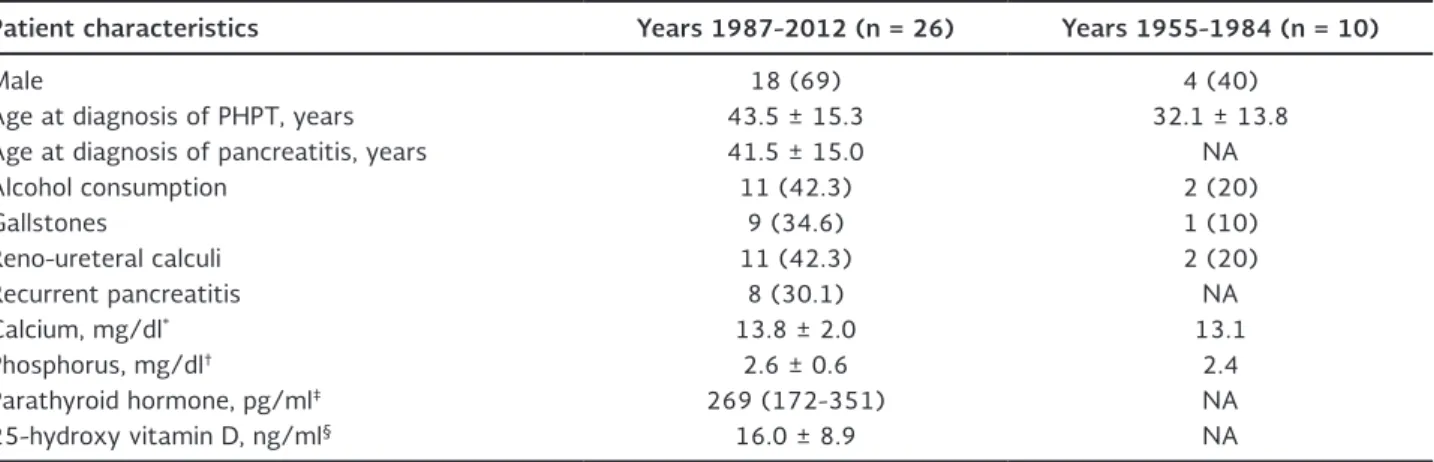
Age at diagnosis of PHPT was 43.5 ± 15.3 years (range, 19-70), 69% of the cases were male, 42.3% had a history of alcohol consumption, 34.6% had con-comitantly gallstones, and 42.3% ureteral calculi. In the previous series, the reported age was 32.1 ± 13.8 (range, 17-55) years while 20, 10, and 20% had a history of alcohol consumption, gallstones, and ure-teral calculi, respectively.
The mean age at the first episode of pancreatitis was 41.5 ± 15.0 years (range, 18-70), 14 patients developed
.r
e
hsi
l
b
u
p
e
ht
f
o
n
ois
si
mr
e
p
ne
tti
r
w r
oir
p
e
ht
t
u
o
hti
w
g
ni
y
p
oc
ot
o
h
p r
o
de
c
u
d
or
pe
r
e
b
ya
m
n
oit
aci
l
b
u
p s
i
ht
f
o t
ra
p
o
N
Table 1. Characteristics of the patients with pancreatitis secondary to primary hyperparathyroidism in the current and previous reports
Patient characteristics Years 1987-2012 (n = 26) Years 1955-1984 (n = 10)
Male 18 (69) 4 (40)
Age at diagnosis of PHPT, years 43.5 ± 15.3 32.1 ± 13.8 Age at diagnosis of pancreatitis, years 41.5 ± 15.0 NA
Alcohol consumption 11 (42.3) 2 (20)
Gallstones 9 (34.6) 1 (10)
Reno-ureteral calculi 11 (42.3) 2 (20)
Recurrent pancreatitis 8 (30.1) NA
Calcium, mg/dl* 13.8 ± 2.0 13.1
Phosphorus, mg/dl† 2.6 ± 0.6 2.4
Parathyroid hormone, pg/ml‡ 269 (172-351) NA
25-hydroxy vitamin D, ng/ml§ 16.0 ± 8.9 NA
Data are expressed as number (%), mean ± standard deviation, or median (interquartile range). *Obtained in 22 patients.
†obtained in 17 patients. ‡obtained in 23 patients. §obtained in nine patients.
PHPT: primary hyperparathyroidism; NA: not available.
pancreatitis before the diagnosis of PHPT; in nine cas-es the diagnoscas-es were made simultaneously, two cascas-es presented pancreatitis after the diagnosis of PHPT, and in one case it was not possible to document these dates. Eight patients (30.1%) had more than one epi-sode of pancreatitis. Of the eight patients with recur-rent pancreatitis, four had two events, one had three, two had four, and one patient had five episodes.
The average calcium and phosphorus levels deter-mined during the episode of pancreatitis (deterdeter-mined in 22 and 17 patients, respectively) were 13.8 ± 2.0 mg/dl (range, 11-19) and 2.6 ± 0.6 mg/dl (range, 2-4). In the previous report of 1988, calcium levels were 13.1 mg/dl (range, 10.8-16.0) and phosphorus levels were 2.4 mg/dl (range, 2.1-3.0).
The median PTH level, documented in 23 patients, was 269 (172-351) pg/ml (range, 78-1,355), and the 25-hydroxy vitamin D level (in nine patients) was 16.0 ± 8.9 ng/ml (range, 7-38). These parameters were obtained after the last episode of pancreatitis.
Cases in which calcium or PTH levels were not available in the clinical records were included only if they had a histopathological confirmation of PHPT. Table 1 shows characteristics of the patients with pancreatitis as-sociated with PHPT in both series.
In six patients surgery was not performed; one of them had a diagnosis of parathyroid carcinoma. Of the pa-tients with a histopathological diagnosis, 15 (57.7%) had parathyroid adenoma, three (11.5%) had parathy-roid hyperplasia, and two (7.7%) had parathyparathy-roid car-cinoma. None of these cases developed pancreatitis after surgical treatment. Two patients were diagnosed with type 1 multiple endocrine neoplasia. The average follow-up time of the cases was 7.3 years.
DISCUSSION
In this report, conducted at a referral center, we found a prevalence of pancreatitis associated with hyperpara-thyroidism of 6.7% (95% CI: 4.6-9.7), which is lower than the previously reported 12.1% (95% CI: 6.7-21.0)7.
In the present series, 385 cases of PHPT were identi-fied in a period of 25 years. In contrast, the previous study reported only 82 cases of PHPT in a period of 30 years (1955-1984), a difference that may be at-tributed to an increased diagnosis of hyperparathy-roidism. In addition, the previous report only included patients with PHPT that were surgically treated.
The frequency of pancreatitis associated with hyper-parathyroidism in other published series of diverse
.r
e
hsi
l
b
u
p
e
ht
f
o
n
ois
si
mr
e
p
ne
tti
r
w r
oir
p
e
ht
t
u
o
hti
w
g
ni
y
p
oc
ot
o
h
p r
o
de
c
u
d
or
pe
r
e
b
ya
m
n
oit
aci
l
b
u
p s
i
ht
f
o t
ra
p
o
N
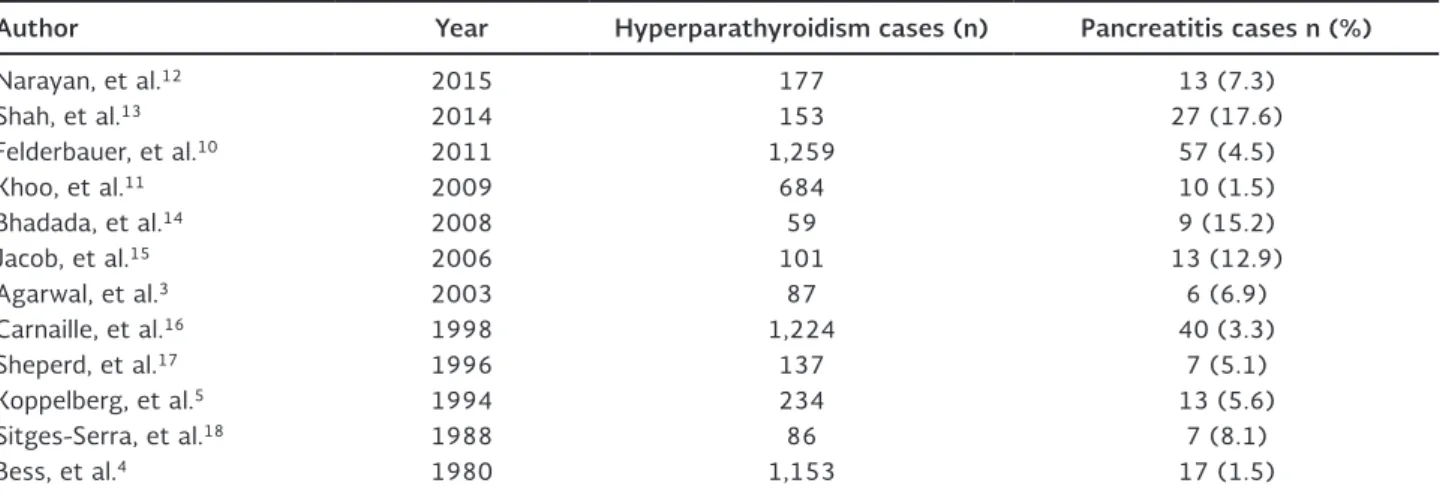
Table 2. Reported frequencies of pancreatitis associated with hyperparathyroidism
Author Year Hyperparathyroidism cases (n) Pancreatitis cases n (%)
Narayan, et al.12 2015 177 13 (7.3)
Shah, et al.13 2014 153 27 (17.6)
Felderbauer, et al.10 2011 1,259 57 (4.5)
Khoo, et al.11 2009 684 10 (1.5)
Bhadada, et al.14 2008 59 9 (15.2)
Jacob, et al.15 2006 101 13 (12.9)
Agarwal, et al.3 2003 87 6 (6.9)
Carnaille, et al.16 1998 1,224 40 (3.3)
Sheperd, et al.17 1996 137 7 (5.1)
Koppelberg, et al.5 1994 234 13 (5.6)
Sitges-Serra, et al.18 1988 86 7 (8.1)
Bess, et al.4 1980 1,153 17 (1.5)
populations is on average 3.6%, with a prevalence that varies widely, ranging from 1.5 to 15.3%8. Table
2 summarizes reported frequencies of pancreatitis associated with hyperparathyroidism.
When comparing the characteristics of the patients in both reports, we found that the average age at diagnosis found in the previous series was 32.1 years (range, 17-55)7, while the patients included in this series were
older, with a mean age of 43.5, ranging from 19 to 70 years. Age at diagnosis of pancreatitis was 41.5 years, indicating that in most of the cases the diagnosis of PHPT was established after the first pancreatitis event.
In the previous report, the mean calcium was 13.1 mg/dl (range, 10.8-16.0) and in the current review we found a mean calcium level of 13.8 mg/dl (range, 11-19). Ureteral calculi were reported in 20% of the previous cases and here we found that 40% of cases had this complication. Gallstones were reported in 10% and we recorded this finding in 32% of cases. Alcohol consumption was reported in 20% of cases in the pre-vious study7 compared with 32% in the current series.
Previously, the diagnosis of hyperparathyroidism was typically made in patients with overt clinical manifes-tations, including ureteral calculi, peptic ulcer, pancre-atitis, and osteoporosis, among others. Routine mea-surement of calcium in laboratory studies began in the USA in 1974 and later in Mexico. This was associated with a significant increase in the diagnosis of asymp-tomatic PHPT, accompanied by a decreased risk of the associated complications9. In our study, we found
a considerable proportion of patients with ureteral calculi in addition to pancreatitis. Furthermore, calci-um sercalci-um levels were considerably higher than levels typically reported in patients with PHPT; these findings illustrate the severity of PHPT cases with coexistent pancreatitis. In addition, other studies comparing PHPT patients with and without pancreatitis, also have doc-umented higher calcium levels10,11.
Occasionally, hypercalcemia is not considered as a potential etiology of pancreatitis since it is an uncom-mon cause, and most patients with hypercalcemia do not develop pancreatitis8. This observation raises the
question of why only some individuals with hypercal-cemia develop pancreatitis. One potential explanation is that some patients have other risk factors, in addition to hypercalcemia, that make them more susceptible to develop pancreatitis. Among these risk factors are ge-netic variants, alcohol consumption, and gallstones. In our study, we observed that more than half (57%) of the patients presented an additional risk factor for developing pancreatitis, such as alcohol consumption and a history of gallstones4. Initially in some of these
patients, the etiology of pancreatitis was attributed only to these coexisting factors, and some of them presented more than one episode of pancreatitis. Once the diagnosis of hyperparathyroidism was established and the appropriate treatment was provided, they did not present further episodes of pancreatitis.
The limitations of this report should be acknowledged, including its retrospective nature, which did not allow us to collect all the variables in each patient. However,
.r
e
hsi
l
b
u
p
e
ht
f
o
n
ois
si
mr
e
p
ne
tti
r
w r
oir
p
e
ht
t
u
o
hti
w
g
ni
y
p
oc
ot
o
h
p r
o
de
c
u
d
or
pe
r
e
b
ya
m
n
oit
aci
l
b
u
p s
i
ht
f
o t
ra
p
o
N
given the low frequency of pancreatitis associated with PHPT, it is difficult to conduct a prospective study with a larger number of cases. In addition, the study was conducted in a referral center; therefore, a selection bias may occur, with the risk of overlooking mild cases.
We conclude that the prevalence of pancreatitis in patients with PHPT decreased from 12.1% (95% CI: 6.7-21.0) to 6.7% (95% CI: 4.6-9.7). This was prob-ably due to an increase in the number of cases diag-nosed with PHPT as a result of the routine measure-ment of calcium in recent years.
DECLARATION OF INTEREST
The authors declare no conflicts of interest.
REFERENCES
1. Etemad B, Whitcomb DC. Chronic pancreatitis: diagnosis,
clas-sification, and new genetic developments. Gastroenterology. 2001;120:682-707.
2. Felderbauer P, Karakas E, Fendrich V, et al. Pancreatitis risk in
primary hyperparathyroidism: relation to mutations in the SPINK1 trypsin inhibitor (N34S) and the cystic fibrosis gene. Am J Gas-troenterol. 2008;103:368-74.
3. Agarwal A, George RK, Gupta SK, Mishra SK. Pancreatitis in
patients with primary hyperparathyroidism. Indian J Gastroen-terol. 2003;22:224-5.
4. Bess MA, Edis AJ, van Heerden JA. Hyperparathyroidism and
pan-creatitis. Chance or a causal association? JAMA. 1980;243:246-7.
5. Koppelberg T, Bartsch D, Printz H, Hasse C, Rothmund M.
[Pan-creatitis in primary hyperparathyroidism (pHPT) is a complication of advanced pHPT]. Dtsch Med Wochenschr. 1994;119:719-24. 6. Sutton R, Criddle D, Raraty MG, Tepikin A, Neoptolemos JP,
Petersen OH. Signal transduction, calcium and acute
pancreati-tis. Pancreatology. 2003;3:497-505.
7. Fernandez Del Castillo C, Cantu-Gonzalez G, Robles-Diaz G, Cam-puzano M. [Primary hyperparathyroidism and pancreatitis. Evidence
for a positive association]. Rev Gastroenterol Mex. 1988;53:61-5. 8. Bai HX, Giefer M, Patel M, Orabi AI, Husain SZ. The association
of primary hyperparathyroidism with pancreatitis. J Clin Gastro-enterol. 2012;46:656-61.
9. Bilezikian JP, Silverberg SJ. Clinical practice. Asymptomatic
pri-mary hyperparathyroidism. N Engl J Med. 2004;350:1746-51. 10. Felderbauer P, Karakas E, Fendrich V, Lebert R, Bartsch DK, Bulut K.
Multifactorial genesis of pancreatitis in primary hyperparathyroid-ism: evidence for “protective” (PRSS2) and “destructive” (CTRC) genetic factors. Exp Clin Endocrinol Diabetes. 2011;119:26-9. 11. Khoo TK, Vege SS, Abu-Lebdeh HS, Ryu E, Nadeem S, Wermers
RA. Acute pancreatitis in primary hyperparathyroidism: a
popu-lation-based study. J Clin Endocrinol Metab. 2009;94:2115-8. 12. Narayan SD, Kumar Gupta S, Kumari N, Krishani N, Chand G,
Mishra A, et al. Primary hyperparathyroidism presenting as hyper-calcemic crisis: Twenty-year experience. Indian J Endocr Metab 2015;19:100-5.
13. Shah VN, Kumar BS, Bhansali A, et al. Effect of gender, bio-chemical parameters & parathyroid surgery on gastrointestinal manifestations of symptomatic primary hyperparathyroidism. Indian J Med Res. 2014;139:279-84.
14. Bhadada SK, Udawat HP, Bhansahi A, Rana SS, Sinha SK, Bhasin DK. Chronic pancreatitis in primary hyperparathyroidism; com-parison with alcoholic and idiopathic chronic pancreatitis. J Gas-troenterol Hepatol. 2008;23:959-64.
15. Jacob JJ, John M, Thomas N, et al. Does hyperparathyroidism cause pancreatitis? A South Indian experience and a review of published work. ANZ J Surg. 2006;76:740-4.
16. Carnaille B, Oudar C, Pattou F, Combemale F, Rocha J, Proye C. Pancreatitis and primary hyperparathyroidism: forty cases. Aust NZ J Surg. 1998;68:117-19.
17. Shepherd JJ. Hyperparathyroidism presenting as pancreatitis or complicated by postoperative pancreatitis. Aust NZ J Surg. 1996;66:85-7.
18. Sitges-Serra A, de Lecea C AM, Gores PF, Sutherland DE. Pan-creatitis and hyperparathyroidism. Br J Surg. 1998;75:158-60.
.r
e
hsi
l
b
u
p
e
ht
f
o
n
ois
si
mr
e
p
ne
tti
r
w r
oir
p
e
ht
t
u
o
hti
w
g
ni
y
p
oc
ot
o
h
p r
o
de
c
u
d
or
pe
r
e
b
ya
m
n
oit
aci
l
b
u
p s
i
ht
f
o t
ra
p
o
N