PERMANYER
ORIGINAL ARTICLE Rev Invest Clin. 2019;71:321-9
Exploratory Analysis of Polygenic
Risk Scores for Psychiatric Disorders:
Applied to Dual Diagnosis
José J. Martínez-Magaña
1,2, Thelma B. Gonzalez-Castro
1,3, Alma D. Genís-Mendoza
2,4, Carlos A.
Tovilla-Zárate
5, Isela E. Juárez-Rojop
1, Erasmo Saucedo-Uribe
6, Oscar Rodríguez-Mayoral
7,
Nuria Lanzagorta
8, Michael Escamilla
9, Luis Macías-Kauffer
10and Humberto Nicolini
2,8*
1Academic Division of Health Sciences, Universidad Juárez Autónoma de Tabasco, Villahermosa, Tabasco, Mexico; 2Genomics Laboratory of Psychiatric and Neurodegenerative Diseases, Instituto Nacional de Medicina Genómica,
Mexico City, Mexico; 3Multidisciplinary Academic Division of Jalpa de Méndez, Universidad Juárez Autónoma
de Tabasco, Jalpa de Méndez, Mexico; 4Hospital Psiquiátrico Infantil “Juan N. Navarro”, Servicios de Atención
Psiquiátrica, Mexico City, Mexico; 5Multidisciplinary Academic Division of Comalcalco, Universidad Juárez Autónoma
de Tabasco, Comalcalco, Mexico; 6Neurosciences Center, Universidad Autónoma de Nuevo León, Monterrey, Mexico; 7Palliative Care Unit, Instituto Nacional de Cancerología, Mexico City, Mexico; 8Grupo de Estudios Médicos y Familiares
Carracci, Mexico City, Mexico; 9Department of Psychiatry and Center of Excellence in Neurosciences, Texas Tech
University Health Sciences Center, El Paso, Texas, USA; 10Unit of Population Genomics Applied to Health, Faculty
of Chemistry, Universidad Nacional Autónoma de México - Instituto Nacional de Medicina Genómica, Mexico City, Mexico.
Received for publication: 28-02-2019 Approved for publication: 24-04-2019 DOI: 10.24875/RIC.19003013
ABSTRACT
Background: Concurrence of substance use disorders (SUDs) is high in individuals with psychiatric illnesses; more importantly,
individuals with both disorders (dual diagnosis) have more severe symptoms. Psychiatric disorders have been proposed to share a genetic susceptibility with SUDs. To explore this shared genetic susceptibility, we analyzed whether any of the polygenic risk scores (PRSs) for psychiatric disorders could be associated to dual diagnosis in patients with schizophrenia (SCZ) or bipolar disorder (BD). Methods: We included 192 individuals of Mexican ancestry: 72 with SCZ, 53 with BD, and 67 unrelated controls
without psychiatric disorders. We derived calculations of PRS for autism spectrum disorders, attention-deficit/hyperactive dis-order, BD, major depression, and SCZ using summary genome-wide association statistics previously published. Results: We found
that dual diagnosis had a shared genetic susceptibility with major depressive disorder (MDD) and SCZ; furthermore, in indi-viduals with BD, dual diagnosis could be predicted by PRS for MDD. Conclusions: Our results reinforce the notion that
individu-als with dual diagnosis have a higher genetic susceptibility to develop both disorders. However, analyses of larger sample sizes are required to further clarify how to predict risks through PRS within different populations. (REV INVEST CLIN. 2019;71:321-9)
Key words: Dual diagnosis. Polygenic risk scores. Schizophrenia. Bipolar disorder.
Corresponding author:
*Humberto Nicolini
Genomics Laboratory of Psychiatric and Neurodegenerative Diseases
Instituto Nacional de Medicina Genómica Grupo de Estudios Médicos y Familiares Carracci Mexico City, Mexico
INTRODUCTION
Psychiatric disorders are complex diseases caused by multiple risk factors1,2. During the past decade, the discovery of genetic factors involved in the suscepti-bility to these disorders has increased rapidly, due to novel techniques such as genome-wide association studies (GWAS)3-6. GWAS have identified multiple loci among common genomic variants that have been as-sociated to one or more psychiatric disorders. Meth-ods to determine polygenic risk scores (PRSs) have been developed to summarize and use what is known about these multiple disease-associated loci as risk prediction tools7,8. PRS can be described as the sum-mation of disorder-associated alleles across many loci, weighted by their effect sizes estimated from GWAS in one individual to predict one person’s likeli-hood of developing a disease with a genetic compo-nent. Therefore, a high value of PRS could be trans-lated into an increased risk of a particular disorder for having more individual risk variants, each one known to be associated with the same disorder. The calcula-tion of how much an individual variant increases a disease risk, or how groups of variants increase the risk, derives from former GWAS9. Recent studies of PRS as risk prediction tools for a disease have exam-ined how different complex diseases might share polygenetic backgrounds. They have also evaluated whether PRS can be used to predict particular traits or subtypes within groups of individuals who have the same diagnosis10-12.
Many epidemiological analyses have shown that psy-chiatric disorders such as bipolar disorder (BD), schizophrenia (SCZ), and major depressive disorder (MDD) have high comorbidity with substance use dis-orders (SUDs)13,14. The comorbidity between SUD and other psychiatric disorders is so high that the term “dual diagnosis” was created to specify comor-bidity of these disorders15-17. Dual diagnosis, when it occurs, has been associated with multiple negative physical and psychosocial outcomes such as poorer quality of life, higher rates of relapse of substance use, and increased suicide risk18-20. Individuals with a dual diagnosis show increased severity of symptoms, which place them at high risk21. Although etiologic mechanisms underlying dual diagnosis have not been clearly established, some have suggested that indi-viduals with dual diagnosis could have a greater ge-netic susceptibility22,23. Recently, PRSs for psychiatric
disorders have been proposed to be useful for explor-ing the shared genetic susceptibility between psychi-atric disorders and SUD, to understand the genetic basis of dual diagnosis24-26. In addition, PRSs of psy-chiatric disorders have been studied to find risk pre-dictors for dual diagnosis27-30. However, one of the main limitations to this approach is that PRSs of psy-chiatric disorders were derived from GWAS in Euro-pean populations, which have a highly homogeneous genetic background, and they have not been conduct-ed in populations with a high degree of genetic ad-mixture. There are nations around the world with a high degree of admixture, including the Mexican pop-ulation31, which comes from the combination of sev-eral indigenous groups and a few European popula-tions. Therefore, some researchers are concerned with the generalization of the use of PRS in non-Eu-ropean populations, and how the use of PRS could be translated to populations with heterogeneous genet-ic background32-34. In this sense, our aim was to ex-plore the performance of PRS calculated from previ-ous GWAS for psychiatric disorders when applied to Mexican individuals with a high degree of admixture who have been diagnosed with SCZ or BD, many of whom had a dual diagnosis.
METHODS
Participants
Target sample
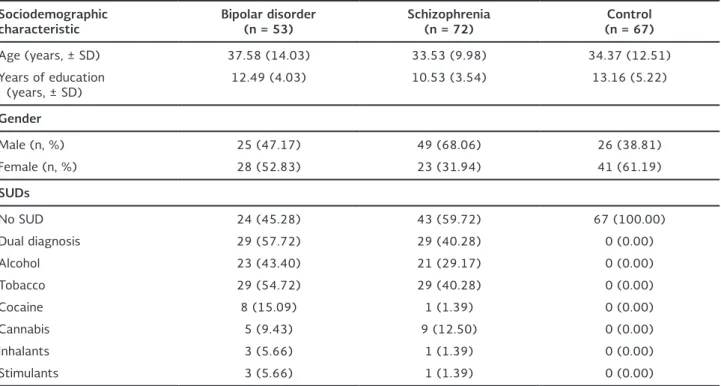
anxiety disorders, or history of suicidal behavior. The control group consisted of 67 subjects with no life-time history of any psychiatric disorder and who had no relatives with a known history of psychiatric disor-ders. We defined dual diagnosis as diagnosis of SCZ or BD with one or more lifetime SUDs (tobacco, alco-hol, and illegal drugs)36. The prevalence of lifetime SUD (dual diagnosis) in the group of patients with SCZ was 40.28% (n = 29) and 57.72% (n = 29) in patients with BD. An overview of sociodemographic characteristics of the sample is reported in Table 1. This protocol was approved by the ethics and investi-gation committee of the National Institute of Ge-nomic Medicine under the approval number 23/2015/I. All participants were informed of the aims of the study and gave their written consent be-fore the study began. All protocols were performed the following guidelines of the Helsinki Declaration.
Discovery samples
As discovery samples, we used the publicly available summary statistics from GWAS to obtain the single-nucleotide polymorphisms (SNPs) and associated
effect sizes, minor allele frequencies, and effect al-leles, to be included in the PRSs calculation for each disorder. Data from these discovery samples came from the Psychiatric Genomics Consortium (PGC)37 and could be accessed from https://www.med.unc. edu/pgc/results-and-downloads. Data in the PGC portal are summary statistics derived from GWAS previously performed in the following disorders: au-tism spectrum disorders (ASD)38, attention-deficit/ hyperactivity disorder (ADHD)39, BD3, MDD40, and SCZ41.
Procedures
Genotyping and imputation
of target sample
DNA was extracted from peripheral leukocytes using a salting-out commercial protocol, following the specifications established by the provider (Qiagen, USA). Genotyping was performed using the whole-genome genotyping platform PsychArray BeadChip (Illumina, USA) following the protocol and conditions established by the provider. PsychArray includes
Table 1. Summary of sociodemographic data
Sociodemographic
characteristic Bipolar disorder (n = 53) Schizophrenia (n = 72) (n = 67)Control
Age (years, ± SD) 37.58 (14.03) 33.53 (9.98) 34.37 (12.51) Years of education
(years, ± SD) 12.49 (4.03) 10.53 (3.54) 13.16 (5.22)
Gender
Male (n, %) 25 (47.17) 49 (68.06) 26 (38.81) Female (n, %) 28 (52.83) 23 (31.94) 41 (61.19)
SUDs
No SUD 24 (45.28) 43 (59.72) 67 (100.00) Dual diagnosis 29 (57.72) 29 (40.28) 0 (0.00) Alcohol 23 (43.40) 21 (29.17) 0 (0.00) Tobacco 29 (54.72) 29 (40.28) 0 (0.00) Cocaine 8 (15.09) 1 (1.39) 0 (0.00) Cannabis 5 (9.43) 9 (12.50) 0 (0.00) Inhalants 3 (5.66) 1 (1.39) 0 (0.00) Stimulants 3 (5.66) 1 (1.39) 0 (0.00)
approximately 560,000 polymorphisms distributed across the whole genome, as well as some variants previously associated with diverse mental psychiatric disorders including BD and SCZ. As quality control (QC), we removed all the SNPs with a minor allele frequency (MAF) of 5%, a Hardy–Weinberg equilib-rium (HWE) p < 0.00001 for a Chi-square test; ad-ditionally, polymorphisms with a genotyping rate lower than 95% were removed. The genotyped data-base is available as supplementary information 1.
After the genotyping process, we performed an impu-tation using Beagle software; the 1000 Genomes da-tabase was utilized as reference42-44. For the following analyses, we included only SNP with a Chi-square test p-value for an HWE lower than 0.00001, a MAF high-er than 0.05, and an allelic R2 highhigh-er than 0.445. After imputation and QC filter, we obtained a total of 4,835,917 SNPs.
Analyses
Polygenic risk score calculation
PRSs are measures developed to reduce the calcula-tion of risk profiles due to polygenicity in complex diseases to a simpler and more manageable, single score for everyone. The PRSs for one individual are the summation of GWAS associated alleles to a dis-order/trait, weighted by their effect sizes46. To calcu-late the individual PRS, we used summary statistics based on published GWAS from the Psychiatric Ge-nomic Consortium (data free to download from: https://www.med.unc.edu/pgc/results-and-down-loads) utilizing the algorithm implemented in PRSice9. PRSice calculated PRS using two sets of data, one discovery and one target sample. The discovery sam-ple is the summary statistics from a GWAS for a specific trait or disease, with enough power to detect an association at genome-wide significance (i.e., data downloaded from GWAS and meta-analysis reported by the PGC). The target sample is the sample where PRSs are going to be calculated (our target sample was the genotype data obtained after genotyping, genotyping QC, imputation, and imputation QC).
Once we had the discovery and the target samples, PRSice performed two steps: first, the clumping pro-cess, where polymorphisms in linkage disequilibrium (LD) between the associated loci in the target sample
and the discovery sample were unified47. In this analy-sis, we used the following clumping criteria: 250 kb and pairwise LD R2 < 0.1. Second, PRSice calculated the individuals’ PRS using different p-values thresholds for the associated variants in the discovery sample (with a lower bound of p = 0.0001 and an upper bound of p = 0.5; increments of 0.00005, which generated 9999 different thresholds). After the different thresh-olds were performed, the best-fitted model estimates were reported. This high-resolution approach allowed us to calculate the best-fitted PRS for the target sam-ple. In this study, we report the PRS for the best esti-mates of models. All the models were adjusted by age, gender, and the first five principal components of global ancestry; for p-value multiple testing correc-tions, we performed 1000 permutations tests. The global ancestry estimation was performed with princi-pal components analysis implemented in the GCTA software48, using a panel of 200 ancestry informative markers previously reported to reach at ancestry es-timations in American populations49. For ancestry cal-culation, the following populations were used as refer-ences: Utah’s residents with northern and western European ancestry (CEU), Yoruba residents in Ibadan from a Nigeria population (YRI) reported in the 1000 Genomes Project44, and 25 individuals of Mexican Amerindian (MA) ancestry genotyped with the multi-ethnic genotyping array (Illumina, San Diego, CA, USA). Once we calculated the best-fitted PRS, we compared the mean of these PRSs for psychiatric dis-orders between cases (subjects with BD and SCZ) and controls using a Welch t-test and considered a sig-nificant association when p < 0.05.
Calculation of SUD correlation
with psychiatric diseases PRSs
diagnosis as cases (29 individuals with both SUD and BD and 29 individuals with both SUD and SCZ) and defined a non-SUD phenotype consisting of all indi-viduals without SUD diagnoses (67 indiindi-viduals with either BD or SCZ who did not have a comorbid SUD and the 67 controls). Furthermore, for these analy-ses, we used the best-fitted models as described above. After finding which PRS explained a higher variance with SUD, we performed a Welch t-test comparison of this PRS between patients diagnosed with one psychiatric disease only (BD or SCZ without SUD) and patients with dual diagnosis (BD or SCZ with SUD) and considered a significant association when p < 0.05.
Effect of global ancestry estimation
on the best-fitted PRS
To establish whether ancestry influences the PRS that shared a genetic effect with dual diagnosis, we per-formed a Spearman correlation test implemented in
R52. We compared the global ancestry principal com-ponent 1 (PC1) and principal comcom-ponent 2 (PC2) with the PRS (best-fitted PRS and covariants adjusted). We only included PC1 and PC2 because these two global ancestry principal components divide individuals into two main populations31. We considered a correlation with PRS and global ancestry component if p < 0.05.
RESULTS
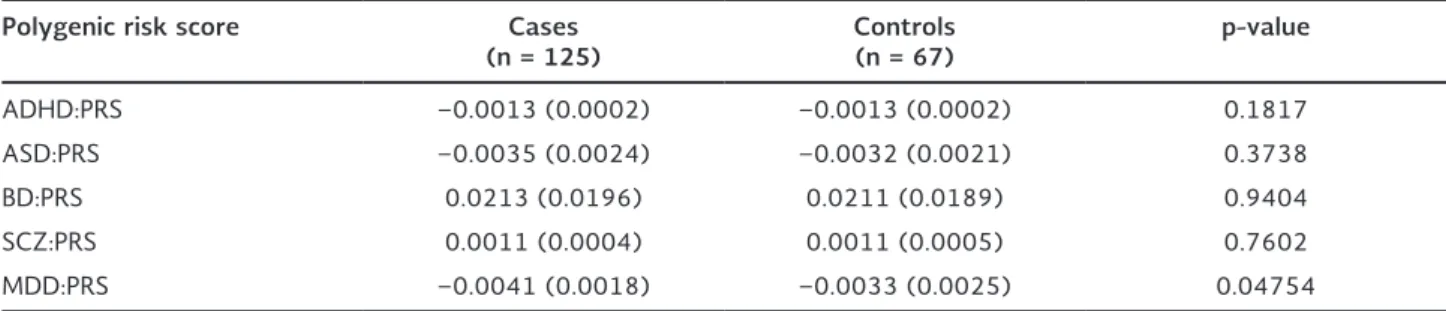
In the analysis of PRS for psychiatric disorders, we found that the only PRS that showed statistical dif-ferences between psychiatric cases (72 subjects
diagnosed with SCZ and 53 subjects diagnosed with BD) and controls (67 subjects) was the PRS for MDD. A summary of the means of each PRS for ADHD, ASD, BD, MDD, and SCZ is reported in Table 2.
SCZ and major depression shared
genetic etiology with dual diagnosis
PRSs for ADHD, ASD, and BD did not share a genetic etiology at a significant level with dual diagnosis in our population: ADHD p = 0.1570, ASD p = 0.0538, and BD p = 0.1585. In contrast, SCZ and MDD:PRS each showed a significant shared genetic etiology with the dual diagnosis phenotype: SCZ (Nagelkerke Pseudo-R2 = 0.0283, corrected p = 0.0423, n = 8058 SNPs) and MDD (Nagelkerke Pseudo-R2 = 0.0451, corrected p = 0.0118, n = 334 SNPs). As can be ob-served, the MDD:PRS explained a higher amount of variance (4.51%) predicting placement in the dual diagnosis group than did the SCZ:PRS (2.83%).
Once we identified that MDD and SCZ PRS had a shared genetic etiology with a dual diagnosis in our sample, we performed a pair-wise comparison of the individual MDD and SCZ PRS in patients with a dual diagnosis and patients without a dual diagnosis, to determine whether these PRSs (for MDD or SCZ) could be used to detect a subgroup of patients who had SUD within each diagnostic category (BD or SCZ patients). In this analysis, patients with a dual diag-nosis in the BD group had a higher MDD:PRS when compared to patients with BD without a dual diagno-sis, and this difference reached statistical significance (p < 0.05) (Fig. 1). In contrast, when the MDD:PRS was applied only to patients diagnosed with SCZ, it
Table 2. Comparisons of psychiatric disorders polygenic risk scores between patients diagnosed with psychiatric disorders and controls
Polygenic risk score Cases
(n = 125) Controls (n = 67) p-value
ADHD:PRS −0.0013 (0.0002) −0.0013 (0.0002) 0.1817 ASD:PRS −0.0035 (0.0024) −0.0032 (0.0021) 0.3738 BD:PRS 0.0213 (0.0196) 0.0211 (0.0189) 0.9404 SCZ:PRS 0.0011 (0.0004) 0.0011 (0.0005) 0.7602 MDD:PRS −0.0041 (0.0018) −0.0033 (0.0025) 0.04754
did not distinguish between SCZ patients with and without a dual diagnosis of SUD. The SCZ:PRS did not show statistically significant differences in detecting a dual diagnosis when it was applied only to patients with SCZ (SCZ patients with and without SUD) or to patients with BD (BD patients with and without SUD). The pair-wise comparisons are shown in Table 3.
Possible global ancestry deviation
of MDD and SCZ-PRS
To explore whether genetic admixture could influ-ence PRS, we analyzed how global ancestry within the sample could affect the best-fitted PRS (also,
adjusted after covariants). As PRSs of MDD and SCZ were the only ones that shared a genetic etiology with a dual diagnosis, we performed correlation tests with all the participants (SCZ, BD, and healthy con-trols) of each individual PRS and the global ancestry principal components (PC1 and PC2), which are the two components that separated main populations31, to search whether PRS calculations could have an ances-try-dependent deviation. In this analysis, both MDD (PC1: rho = −0.20, p = 0.01 and PC2: rho = −0.19, p = 0.01) and SCZ (PC1: rho = −0.61, p = 2.2e-16 and PC2: rho = −0.61, p = 2.2e-16) PRSs were cor-related with PC1 and PC2. Of the two, SCZ:PRS had a stronger correlation with the two global ancestry components (Fig. 2).
Figure 1. Comparisons of schizophrenia (SCZ) and major depressive disorder (MDD) polygenic risk score (PRS) in patients with and without dual diagnosis (substance use disorder). (A) Comparison of MDD:PRS in patients with bipolar disorder (BD) (dual
diagnosis patients had significantly higher scores than BD only subjects, p = 0.0005) and patients with SCZ (non-significant difference). (B) Comparison of SCZ-PRS in BD and SCZ patients. SCZ:PRS differences between dual diagnosis patients and
pa-tients with only the primary disorder were not significantly different in either BD or SCZ subjects.
Table 3. Comparisons of MDD and SCZ polygenic risk scores
Bipolar disorder Schizophrenia
Polygenic risk
score No substance use diagnosisDual p-value No substance use diagnosisDual p-value SCZ:PRS 0.0010
(0.0006) (0.0004)0.0011 0.6392 (0.0005)0.0011 (0.0004)0.0012 0.7409
MDD:PRS −0.0048
(0.0017) −0.0028 (0.0020) 0.0007 −0.0041 (0.0018) −0.0040 (0.0016) 0.6099
DISCUSSION
PRSs are of potential value for determining subphe-notypes within a larger phenotype or main diagnosis in psychiatric disorders53,54. In the present study, we evaluated whether the current PRS (available for phe-notypes of ADHD, ASD, BD, SCZ, and MDD) could also correlate with a lifetime history of dual diagnosis, in individuals diagnosed with SCZ or BD. Our results showed that both MDD and SCZ-PRSs had an impact on a dual diagnosis in the total sample. Nevertheless, when applied only to patients with one diagnosis, only MDD:PRS was found to differentiate patients nosed with BD and dual diagnosis from patients diag-nosed with BD without a dual diagnosis.
Our study suggests that both the MDD:PRS and the SCZ:PRS might be of use in detecting risk for a dual diagnosis; however, when PRSs are applied only to a specific diagnosis, we suggest that MDD:PRS, used in patients with BD, is the only specific PRS which cor-relates with a dual diagnosis within the specific diag-noses of SCZ or BD, respectively. The shared genetic susceptibility between MDD and alcohol dependence (AD) might be what drove this result within our BD
patients, especially when noting that the main sub-stance of SUD in our samples was (apart from nico-tine) alcohol abuse/dependence. These findings are consistent with the study of Andersen et al.55, where they suggested that shared genetic susceptibility con-tributed to MDD and AD comorbidity.
Although other studies have applied PRS to explore the shared genetic background between psychiatric disorders and SUDs24,25, all the approximations have been made in populations of European ancestry and not in admixed populations. Our study is one of the first approximations on how to apply psychiatric PRS in admixed populations. Our results suggest that PRS must be applied with caution in admixed populations such as the Mexican population, which has individuals with varying levels of admixture31,49,56. In relation to this, we found that SCZ:PRS showed a correlation with global ancestry components. The difference in PRS based on demographic history has been previously explored32,57. Martin et al. evaluated eight complex traits PRS in the 1000 Genomes Project panel and found similar results to ours; they observed that SCZ:PRS could be deviated based on the main popula-tion’s ancestry. In their analysis, they also reported
Figure 2. Analysis of the correlation of schizophrenia (SCZ) and major depressive disorder (MDD) polygenic risk scores (PRSs) with global ancestry components. Triangles represent patients with bipolar disorder, circles represent patients with SCZ, and squares represent non-psychiatric controls. Each triangle, circle, or square represents any of the 195 individuals included in the analysis. The individuals’ graph in both plots is the same in the same position, the only change is the gradient of SCZ:PRS or MDD:PRS value. (A) Correlation of SCZ:PRS with global ancestry components. The gradient represents the SCZ-PRS, red color
means a higher SCZ:PRS, and blue means a lower SCZ:PRS. Individuals with a higher degree of global Mexican Amerindian an-cestry are grouped in values lower than zero in both principal components’ axes. The high correlation between the anan-cestry components and the SCZ:PRS is shown. (B) Correlation of MDD:PRS with global ancestry components. The gradient represents
that it was not possible to predict how PRS could change according to ancestry. In this sense, we think that the application of PRS in different populations, with distinct admixtures and diverse phenotypes, could give us more information on the use of PRS for psychiatric disorders as a translational risk prediction tool.
The results obtained from this study should be con-sidered as preliminary due to the small sample size; it will be necessary to increase the sample size to have a better understanding of both the utility of PRS to determine dual diagnosis risk in BD and SCZ, and to assess how to correct for genetic population factors that influence PRS. This study is among the first ones looking at how PRSs for psychiatric disorders perform as markers of dual diagnosis in admixed populations. Nevertheless, we found that dual diagnosis had a shared etiology with MDD and SCZ. The present study can help reduce disparities in what is known about the PRSs in different populations.
ACKNOWLEDGMENTS
This work was supported by the Instituto Nacional de Medicina Genómica with a grant to Humberto Nicolini (Grant number 23/2015/I). We want to thank all the participants in the present study. We are grateful to Samuel Canizales-Quinteros for the critical revision of the manuscript. José Jaime Martínez-Magaña is a doctoral student at the Doctorado en Ciencias Bio-médicas, Universidad Juárez Autonóma de Tabasco (UJAT) and was supported by the National Council of Science and Technology (CONACYT) of Mexico.
REFERENCES
1. Mitchell KJ. What is complex about complex disorders? Genome Biol. 2012;13:237.
2. Avramopoulos D. Genetics of psychiatric disorders methods: molecular approaches. Psychiatr Clin North Am. 2010;33:1-3. 3. Psychiatric GWAS Consortium Bipolar Disorder Working Group.
Large-scale genome-wide association analysis of bipolar disor-der identifies a new susceptibility locus near ODZ4. Nat Genet 2011;43:977-83.
4. Stahl EA, Breen G, Forstner AJ, McQuillin A, Ripke S, Trubetskoy V, et al. Genome-wide association study identifies 30 loci as-sociated with bipolar disorder. Nat Genet. 2019;51:793-803. 5. Ritter ML, Guo W, Samuels JF, Wang Y, Nestadt PS, Krasnow J,
et al. Genome wide association study (GWAS) between atten-tion deficit hyperactivity disorder (ADHD) and obsessive com-pulsive disorder (OCD). Front Mol Neurosci. 2017;10:83.
6. Lambert JC, Ibrahim-Verbaas CA, Harold D, Naj AC, Sims R, Bel-lenguez C, et al. Meta-analysis of 74,046 individuals identifies 11 new susceptibility loci for Alzheimer’s disease. Nat Genet. 2013;45:1452-8.
7. Schork AJ, Brown TT, Hagler DJ, Thompson WK, Chen CH, Dale AM, et al. Polygenic risk for psychiatric disorders correlates with executive function in typical development. Genes Brain Behav. 2019;18:e12480.
8. Cross-Disorder Group of the Psychiatric Genomics Consortium. Identification of risk loci with shared effects on five major psy-chiatric disorders: a genome-wide analysis. Lancet. 2013; 381:1371-9.
9. Euesden J, Lewis CM, O’Reilly PF. PRSice: polygenic risk score software. Bioinformatics. 2015;31:1466-8.
10. Lewis CM, Vassos E. Prospects for using risk scores in poly-genic medicine. Genome Med. 2017;9:96.
11. Vassos E, Di Forti M, Coleman J, Iyegbe C, Prata D, Euesden J, et al. An examination of polygenic score risk prediction in individu-als with first-episode psychosis. Biol Psychiatry. 2017;81:470-7. 12. Torkamani A, Wineinger NE, Topol EJ. The personal and clinical
utility of polygenic risk scores. Nat Rev Genet. 2018;19:581-90. 13. Wong CC, Schumann G. Review. Genetics of addictions: strategies
for addressing heterogeneity and polygenicity of substance use disorders. Philos Trans R Soc Lond B Biol Sci. 2008;363:3213-22. 14. Maher BS, Marazita ML, Zubenko WN, Kaplan BB, Zubenko GS.
Genetic segregation analysis of alcohol and other substance-use disorders in families with recurrent, early-onset major de-pression. Am J Drug Alcohol Abuse. 2002;28:711-31. 15. Kessler RC. The epidemiology of dual diagnosis. Biol Psychiatry.
2004;56:730-7.
16. Buckley PF, Brown ES. Prevalence and consequences of dual di-agnosis. J Clin Psychiatry. 2006;67:e01.
17. Breslau N. Psychiatric comorbidity of smoking and nicotine de-pendence. Behav Genet. 1995;25:95-101.
18. Gattamorta KA, Mena MP, Ainsley JB, Santisteban DA. The co-morbidity of psychiatric and substance use disorders among Hispanic adolescents. J Dual Diagn. 2017;13:254-63.
19. Taukoor B, Paruk S, Karim E, Burns JK. Substance use in adoles-cents with mental illness in Durban, South Africa. J Child Adolesc Ment Health. 2017;29:51-61.
20. Wilton G, Stewart LA. Outcomes of offenders with co-occurring substance use disorders and mental disorders. Psychiatr Serv. 2017;68:704-9.
21. Di Lorenzo R, Galliani A, Guicciardi A, Landi G, Ferri P. A retro-spective analysis focusing on a group of patients with dual di-agnosis treated by both mental health and substance use ser-vices. Neuropsychiatr Dis Treat. 2014;10:1479-88.
22. Levran O, Randesi M, da Rosa JC, Ott J, Rotrosen J, Adelson M, et al. Overlapping dopaminergic pathway genetic susceptibility to heroin and cocaine addictions in African Americans. Ann Hum Genet. 2015;79:188-98.
23. Kendler KS, Karkowski LM, Neale MC, Prescott CA. Illicit psycho-active substance use, heavy use, abuse, and dependence in a US population-based sample of male twins. Arch Gen Psychiatry. 2000;57:261-9.
24. Hartz SM, Horton AC, Oehlert M, Carey CE, Agrawal A, Bogdan R, et al. Association between substance use disorder and poly-genic liability to schizophrenia. Biol Psychiatry. 2017;82:709-15. 25. Carey CE, Agrawal A, Bucholz KK, Hartz SM, Lynskey MT, Nelson
EC, et al. Associations between polygenic risk for psychiatric disorders and substance involvement. Front Genet. 2016;7:149. 26. Palmer RH, Brick L, Nugent NR, Bidwell LC, McGeary JE, Knopik
VS, et al. Examining the role of common genetic variants on al-cohol, tobacco, cannabis and illicit drug dependence: genetics of vulnerability to drug dependence. Addiction. 2015;110:530-7. 27. Maher BS. Polygenic scores in epidemiology: risk prediction,
eti-ology, and clinical utility. Curr Epidemiol Rep. 2015;2:239-44. 28. Vink JM, Hottenga JJ, de Geus EJ, Willemsen G, Neale MC,
Fur-berg H, et al. Polygenic risk scores for smoking: predictors for alcohol and cannabis use? Addiction. 2014;109:1141-51. 29. Reginsson GW, Ingason A, Euesden J, Bjornsdottir G, Olafsson
S, Sigurdsson E, et al. Polygenic risk scores for schizophrenia and bipolar disorder associate with addiction. Addict Biol. 2018; 23:485-92.
30. Gurriarán X, Rodríguez-López J, Flórez G, Pereiro C, Fernández JM, Fariñas E, et al. Relationships between substance abuse/ dependence and psychiatric disorders based on polygenic scores. Genes Brain Behav. 2019;18:e12504.
of Mexico recapitulates native American substructure and af-fects biomedical traits. Science. 2014;344:1280-5.
32. Martin AR, Gignoux CR, Walters RK, Wojcik GL, Neale BM, Grav-el S, et al. Human demographic history impacts genetic risk prediction across diverse populations. Am J Hum Genet. 2017; 100:635-49.
33. Kim MS, Patel KP, Teng AK, Berens AJ, Lachance J. Genetic disease risks can be misestimated across global populations. Genome Biol. 2018;19:179.
34. De La Vega FM, Bustamante CD. Polygenic risk scores: a biased prediction? Genome Med. 2018;10:100.
35. Nurnberger JI Jr., Blehar MC, Kaufmann CA, York-Cooler C, Simp-son SG, Harkavy-Friedman J, et al. Diagnostic interview for ge-netic studies. Rationale, unique features, and training. NIMH genetics initiative. Arch Gen Psychiatry. 1994;51:849-59. 36. Volkow ND. Substance use disorders in schizophrenia clinical
implications of comorbidity. Schizophr Bull. 2009;35:469-72. 37. Sullivan PF, Daly MJ, O Donovan M. Genetic architectures of
psychiatric disorders: the emerging picture and its implications. Nat Rev Genet. 2012;13:537-51.
38. Autism Spectrum Disorders Working Group of the Psychiatric Genomics Consortium. Meta-analysis of GWAS of over 16,000 individuals with autism spectrum disorder highlights a novel locus at 10q24.32 and a significant overlap with schizophrenia. Mol Autism. 2017;8:21.
39. Neale BM, Medland SE, Ripke S, Asherson P, Franke B, Lesch KP, et al. Meta-analysis of genome-wide association studies of at-tention-deficit/hyperactivity disorder. J Am Acad Child Adolesc Psychiatry. 2010;49:884-97.
40. Major Depressive Disorder Working Group of the Psychiatric GWAS Consortium, Ripke S, Wray NR, Lewis CM, Hamilton SP, Weissman MM, et al. A mega-analysis of genome-wide asso-ciation studies for major depressive disorder. Mol Psychiatry. 2013;18:497-511.
41. Schizophrenia Working Group of the Psychiatric Genomics Con-sortium. Biological insights from 108 schizophrenia-associated genetic loci. Nature. 2014;511:421-7.
42. Browning SR, Browning BL. Rapid and accurate haplotype phas-ing and missphas-ing-data inference for whole-genome association studies by use of localized haplotype clustering. Am J Hum Genet. 2007;81:1084-97.
43. Browning BL, Browning SR. Genotype imputation with millions of reference samples. Am J Hum Genet. 2016;98:116-26. 44. 1000 Genomes Project Consortium, Auton A, Brooks LD, Durbin
RM, Garrison EP, Kang HM, et al. A global reference for human genetic variation. Nature. 2015;526:68-74.
45. Verma SS, de Andrade M, Tromp G, Kuivaniemi H, Pugh E, Namjou-Khales B, et al. Imputation and quality control steps for combining multiple genome-wide datasets. Front Genet. 2014;5:370.
46. International Schizophrenia Consortium, Purcell SM, Wray NR, Stone JL, Visscher PM, O Donovan MC, et al. Common poly-genic variation contributes to risk of schizophrenia and bipolar disorder. Nature. 2009;460:748-52.
47. Shi H, Medway C, Brown K, Kalsheker N, Morgan K. Using fisher’s method with PLINK ‘LD clumped’ output to compare SNP effects across genome-wide association study (GWAS) datasets. Int J Mol Epidemiol Genet. 2011;2:30-5.
48. Yang J, Lee SH, Goddard ME, Visscher PM. GCTA: a tool for genome-wide complex trait analysis. Am J Hum Genet. 2011; 88:76-82.
49. Galanter JM, Fernandez-Lopez JC, Gignoux CR, Barnholtz-Sloan J, Fernandez-Rozadilla C, Via M, et al. Development of a panel of genome-wide ancestry informative markers to study admixture throughout the Americas. PLoS Genet. 2012; 8:e1002554.
50. Nagelkerke NJ. A note on a general definition of the coefficient of determination. Biometrika. 1991;78:691-2.
51. Steyerberg EW, Vickers AJ, Cook NR, Gerds T, Gonen M, Obu-chowski N, et al. Assessing the performance of prediction mod-els: a framework for traditional and novel measures. Epidemiol-ogy. 2010;21:128-38.
52. Team RDC. R: a Language and Environment for Statistical Com-puting. R Dev Core Team. R Foundation for Statistical Comput-ing. Vienna, Austria: Team RDC; 2008.
53. Dzafic I, Burianová H, Periyasamy S, Mowry B. Association between schizophrenia polygenic risk and neural correlates of emotion perception. Psychiatry Res Neuroimaging. 2018; 276:33-40.
54. Poletti M, Raballo A. Polygenic risk score and the (neuro)devel-opmental ontogenesis of the schizophrenia spectrum vulnerabil-ity phenotypes. Schizophr Res. 2018;202:389-90.
55. Andersen AM, Pietrzak RH, Kranzler HR, Ma L, Zhou H, Liu X, et al. Polygenic scores for major depressive disorder and risk of alcohol dependence. JAMA Psychiatry. 2017;74:1153-60. 56. Florez JC, Price AL, Campbell D, Riba L, Parra MV, Yu F, et al.
Strong association of socioeconomic status with genetic ances-try in latinos: implications for admixture studies of Type 2 dia-betes. Diabetologia. 2009;52:1528-36.