Jour
nal
Name
Adsorption and Growth of Palladium Clusters on
Graphdiyne
†
A. Seif,a,bM.J. López,∗a, A. Granja-DelRíoa, K. Azizib, and J.A. Alonsoa
The density functional formalism has been used to investigate the stability and the properties of small palladium clusters supported on graphdiyne layers. The large triangular holes existing on the graphdiyne structure provide efficient sites to hold the clusters at small distances from the plane of the graphdiyne layer. The cluster adsorption energies, between 3 and 4 eV, are large enough to maintain the clusters tightly bound to the triangular holes. The competition between dispersion of Pd atoms on graphdiyne and growth of Pd clusters in the triangular holes of the layer is also discussed. In addition, the triangular holes can be simultaneously decorated with clusters on both sides. This indicates that palladium clusters could be used to build nanostructures formed by stacked graphdiyne layers with tailored interlayer distances controlled by the size of the clusters. The size of the clusters also controls the electronic HOMO-LUMO gap of the material.
1
Introduction
An important and common process in the industrial and phar-maceutical areas is catalysis. Often, clusters of transition met-als (TM) supported on appropriate surfaces are the active cat-alysts, and the understanding of the cluster-support interaction is of great scientific and technological interest. Also, for many other purposes, the presence of adsorbed clusters can modify the electronic and magnetic properties of the substrate system1. There are some challenges regarding the adsorption of molecular species on supported metal clusters, related to the coupling of the clusters with the substrate2–9. For instance, an important issue is to reduce the TM contamination occurring during desorption of the molecular species; that is, preventing desorption of TM-molecule complexes. Evidently, a strong binding between the TM clusters and the supporting surface will result in a lower contam-ination of TM6. Also, a strong TM-surface binding will decrease the metal migration and aggregation on the substrate, which is a big challenge in fuel cells10. Therefore, designing stable TM-supported systems as efficient frames for adsorption of chemical species is relevant. Nowadays, because of their unique advan-tages of light weight, flexibility, diverse and economical meth-ods of fabrication, novel carbon allotropes have been given a lot of attention as substrates. In addition, those carbon allotropes are generally stable under different working conditions and allow
a
Departamento de Física Teórica, Atómica y Optica, Universidad de Valladolid, 47011 Valladolid, Spain.
b
Department of Chemistry, Faculty of Science, University of Kurdistan, Sanandaj, Iran.
∗Corresponding author. Tel:+34 983-184436. E-mail: [email protected]
†Electronic Supplementary Information (ESI) available: [details of any supplemen-tary information available should be included here]. See DOI: 10.1039/b000000x/
for an ecological recovery of the catalytic metal by simply burn-ing off the carbon. In this way, fullerenes11, carbon nanotubes
12and graphene13have been synthesized and applied in diverse
fields. However, the applications of the first two have been limited mostly due to the unavailability of their inner surfaces, and partic-ular attention has been dedicated to graphene. In fact, graphene is a good model for the inner surfaces of the pores in porous car-bons14.
Taking palladium as an example, it is known that Pd atoms and clusters bind much stronger to graphene vacancies than to pristine graphene6. As this effect could be assigned to a
differ-ent local electronic structure induced by the absence of carbon atoms at the vacancies, we became motivated to look at one of the newest synthesized allotropic forms of carbon, graphdiyne (GDY)15. This is a layered framework formed by benzoic rings connected by very stable carbon chains containing diacetylenic linkages (see Figure 1). The structure presents an ordered reg-ular arrangement of large triangreg-ular holes in the planar layers, with the sides of the triangle being linear−C≡C−C≡C−chains with the two ends linked to the hexagonal benzoic rings. This ar-rangement leads to remarkable electronic and optical properties that are quite different from those of graphene, such as a natural band gap opening due to the asymmetricπ conjugation16, high
third-order nonlinear optical susceptibility17, and high fluores-cence efficiency18. Consequently, promising applications of GDY
are expected in electrode materials19, semiconductor devices20, hydrogen storage21, gas separation22, lithium storage23, solar cells24, etc.
Pan and coworkers25have reported density functional (DFT)
metallic palladium, proposing that this contact could be effective for graphdiyne-based devices, especially in field effect transistors. Using experimental methods, Qi et al. have concluded that GDY can be used as an effective reducing agent and stabilizer for elec-troless deposition of Pd nanoparticles26, and it was also discov-ered that graphdiyne could be an excellent substrate to replace graphite or other pure carbon matrices for stabilizing Pt nanopar-ticles27.
A study of the electronic and adsorption properties of Pd clus-ters supported on GDY, and a comparison with the corresponding results for adsorption of the same clusters on pure and defective graphene should be very valuable. Palladium shares many inter-esting properties with platinum, and it was recently found that hyper-cross-linked polystyrene (HPS) can be efficiently used to control the growth, size and shape of metal nanoparticles such as Pt and Pd28. However, palladium is lighter (and less
expen-sive) than platinum. Then, considering that the adsorbate to ad-sorbent weight ratio plays an important role in the adsorption of molecular species, Pd should also be favorable in many cases. The present work presents a theoretical analysis of the structure and the electronic properties of palladium clusters deposited on GDY layers. The transition from planar to three-dimensional structures of the deposited Pd clusters is identified and compared to the corresponding case of deposition on graphene. The competition between the dispersion of Pd atoms deposited on GDY and the clustering of the of the Pd atoms and growth of Pd clusters in the triangular holes of the layer is also discussed. Finally, simultane-ous deposition of clusters on both sides of the GDY layer is also explored. Because small metal particles have a higher fraction of surface atoms than larger particles, dispersed small particles can be advantageous in catalysis and in adsorption processes.
2
Computational method
Density functional calculations were carried out using the DA-CAPO code29and ultrasoft pseudopotentials. A basis set of plane
waves is used to expand the Kohn-Sham wave functions and the electronic density, with cutoff values of 350 eV and 1000 eV, re-spectively. The substrate, GDY layer, was simulated as a period-ically repeated unit cell consisting of 72 carbon atoms in the (x, y) plane (see Fig. 1). To minimize interactions between periodic images, the cell parameter c in the z direction was fixed at 14 Å. Integrations over reciprocal space are based on a Monkhorst-Pack grid with 2×2×1 k-points, as a sufficiently large cell has been considered here. The value of c, the cutoffs, and the Monkhorst-Pack grid were taken to guarantee adsorption energies with a nu-merical precision of 0.005 eV. Optimization of geometries was lasted until the forces on the atoms were lower than 0.05 eV/Å. The ultrasoft pseudopotential for Pd uses a Kr-like core. The exchange-correlation energy is calculated with the Perdew-Wang PW91 functional30, within the generalized gradient
approxima-tion (GGA). Since this funcapproxima-tional does not incorporate dispersion interactions, we have also performed dispersion corrected den-sity functional calculations using Grimme’s DFT-D3 corrections31 to the PBE32functional for exchange-correlation. Both, the calcu-lated DFT-PW91 and DFT-PBE-D3 energies are provided to asses the effect of the dispersion interactions. Cluster adsorption
ener-gies were calculated in different ways:
Eadd(Pd) =E(GDY−Pdn−1) +E(Pd)−E(GDY−Pdn) (1)
Eads(Pdn) =E(GDY) +E(Pdn)−E(GDY−Pdn) (2)
Eform(Pdn) = [E(GDY) +n E(Pd)−E(GDY−Pdn)]/n (3)
whereE(GDY-Pdn), E(GDY) andE(Pdn) represent the total
en-ergies of the combined system GDY-Pdn, clean GDY and isolated
Pdnclusters, respectively. In this way,Eadd(Pd) is the energy
re-leased by adding a Pd atom to the supported Pdn−1cluster; that
is, the adsorption energy of the additional Pd atom, and it helps to understand the growth of the supported cluster. Eads is the
adsorption energy of the Pdn cluster on GDY. Finally,Eform(Pdn)
is the energy of formation, per Pd atom, of the supported GDY-Pdnsystem starting from clean GDY andnisolated Pd atoms. In
these definitions, the system becomes more stable the larger is the value of the left hand side. The electronic energy gap varia-tion,∆Egap, for any GDY-Pdnsystem is defined byEgap(GDY-Pdn)
−Egap(GDY), whereEgapis the difference between the energies of
the lowest unoccupied molecular orbital, LUMO, and the highest occupied molecular orbital, HOMO.∆Egap is an indicator of the
change in the electronic structure due to the cluster adsorption.
3
Results and discussion
1
2
3
4
C’ C”
C” C’
C’ C’ C” C” C’C”
C”C’
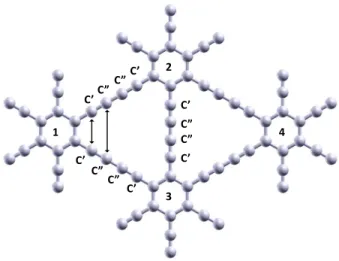
Fig. 1Optimized structure of the unit cell of GDY used in the calculations. The C’-C’ and C”-C” distances near the benzenic rings, marked as double arrows, are 2.82 Å and 4.05 Å, respectively.
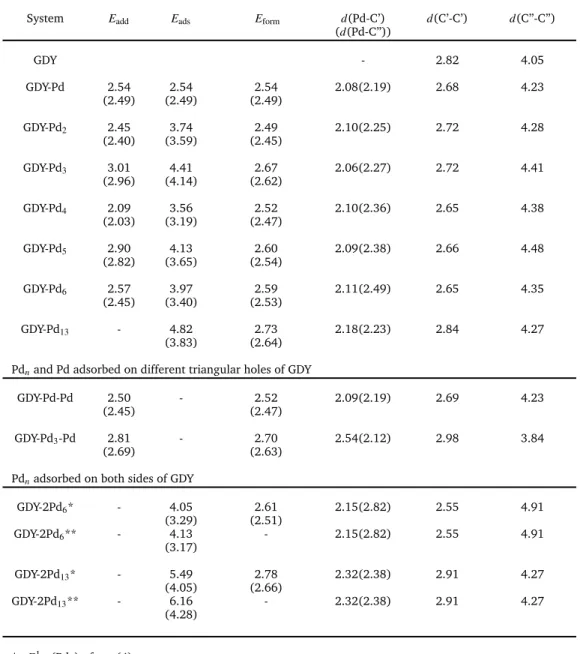
conve-Table 1Addition, adsorption and formation energies (in eV), and some relevant (averaged) interatomic distances (in Å) of palladium clusters adsorbed on GDY. For each system the first row provides the energies calculated with the dispersion corrected formalism DFT-PBE-D3, and the second row in parenthesis gives the energies calculated with the DFT-PW91 formalism that does not incorporate dispersion interactions.
System Eadd Eads Eform d(Pd-C’) d(C’-C’) d(C”-C”)
(d(Pd-C”))
GDY - 2.82 4.05
GDY-Pd 2.54 2.54 2.54 2.08(2.19) 2.68 4.23 (2.49) (2.49) (2.49)
GDY-Pd2 2.45 3.74 2.49 2.10(2.25) 2.72 4.28
(2.40) (3.59) (2.45)
GDY-Pd3 3.01 4.41 2.67 2.06(2.27) 2.72 4.41
(2.96) (4.14) (2.62)
GDY-Pd4 2.09 3.56 2.52 2.10(2.36) 2.65 4.38
(2.03) (3.19) (2.47)
GDY-Pd5 2.90 4.13 2.60 2.09(2.38) 2.66 4.48
(2.82) (3.65) (2.54)
GDY-Pd6 2.57 3.97 2.59 2.11(2.49) 2.65 4.35
(2.45) (3.40) (2.53)
GDY-Pd13 - 4.82 2.73 2.18(2.23) 2.84 4.27
(3.83) (2.64)
Pdnand Pd adsorbed on different triangular holes of GDY
GDY-Pd-Pd 2.50 - 2.52 2.09(2.19) 2.69 4.23 (2.45) (2.47)
GDY-Pd3-Pd 2.81 - 2.70 2.54(2.12) 2.98 3.84
(2.69) (2.63)
Pdnadsorbed on both sides of GDY
GDY-2Pd6* - 4.05 2.61 2.15(2.82) 2.55 4.91
(3.29) (2.51)
GDY-2Pd6** - 4.13 - 2.15(2.82) 2.55 4.91
(3.17)
GDY-2Pd13* - 5.49 2.78 2.32(2.38) 2.91 4.27
(4.05) (2.66)
GDY-2Pd13** - 6.16 - 2.32(2.38) 2.91 4.27
(4.28)
* Eads1 (Pdn) of eq. (4)
**E2
nience, the four carbon atoms along the−C≡C−C≡C− chains are labelled C’, C”, C” and C’, respectively, as indicated in Fig 1. The distance between the two C’ atoms close to a hexagonal ring, indicated by a double arrow in Fig. 1, isd(C’-C’) = 2.82 Å, and the distance between the two C” atoms, also indicated by a double arrow, isd(C”-C”) = 4.05 Å.
3.1 Pd cluster growth on GDY
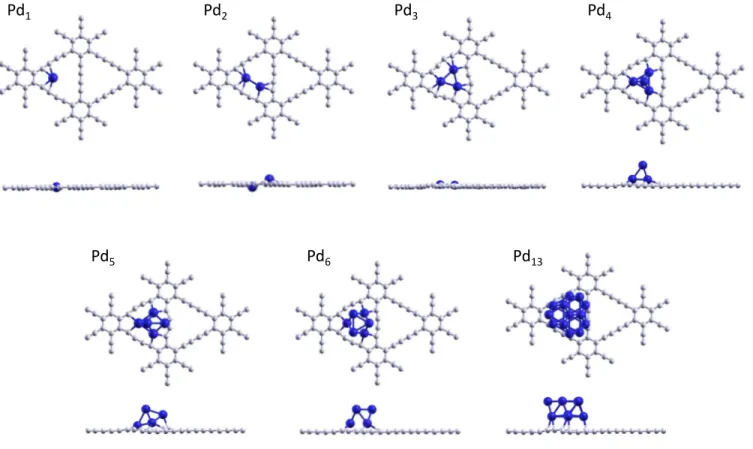
The adsorption behavior of palladium clusters and their growth on GDY is now discussed starting with the adsorption of a single Pd atom. In order to find the most stable position for a Pd atom on GDY, many initial locations in the big triangular and small hexag-onal holes were explored and relaxed, and the most stable con-figuration found corresponds to the Pd atom inside the triangular hole, in the position shown in Fig. 2, symmetrically bound to the nearest C’ and C” atoms of two carbon chains of the triangle. The adsorption binding energy isEads= 2.54 eV. The addition and
for-mation energies are, evidently, equal to the adsorption energy in this case. The Pd atom fits quite well in the GDY plane, being only 0.04 Å above the plane. The bond distances Pd-C’ and Pd-C” are 2.08 Å and 2.19 Å, respectively, in good agreement with previous results by Lu et al.36, who obtained values of 2.07 Å and 2.17 Å
for those two distances. Adsorption, addition and formation en-ergies of all the Pd clusters studied, as well as the relevant bond lengths and interatomic distances are shown in Table 1. The dis-tortion of the structure of GDY induced by the adsorption of the Pd atom is non negligible. The C’-C’ distance near the hexagonal ring 1 decreases by 0.14 Å (d(C’-C’) = 2.68 Å), while the C”-C” distance increases by 0.18 Å (d(C”-C”) = 4.23 Å), and so the two −C≡C−C≡C−chains near the adsorbed Pd atom become a bit distorted.
The magnetic moment of GDY-Pd isM=0(magnetic moments of the all systems studied are given in Table 2). Regarding the re-sults obtained for adsorption of atomic Pd on pristine graphene2, the Pd atom sits above a C-C bond, at a vertical distance of 2.22 Å, with adsorption energy of 1.09 eV. In the case of the graphene va-cancy6, the Pd atom sits at a distance of 1.56 Å above the vacancy center, with adsorption energy of 5.13 eV. In summary, the ad-sorption energy of Pd on GDY is intermediate between the other two cases, and the distance of Pd to the carbon plane is the low-est; that is, the Pd atom is nearly in-plane. The close approach of the Pd atom to the carbon plane results in a stronger interaction of Pd with GDY compared to pristine graphene; however, it is less intense compared to the interaction with the vacancy, because the vacancy has reactive dangling bonds.
Starting with the lowest energy configuration for adsorbed Pd, a second Pd atom was added in different positions on both sides of the GDY plane and all those initial configurations of the system were relaxed. The most stable position of the dimer is shown in Fig. 2, with the second Pd atom near a second corner of the triangular hole, and the addition energy isEadd = 2.45 eV. The
two Pd atoms stand a bit out of the GDY plane, by 0.6 Å, but on opposite sides from that plane. The Pd-Pd distance is 2.75 Å. This bond length is elongated by 0.23 Å with respect to the free Pd2
dimer (d= 2.52 Å), as a consequence of the interaction of the Pd
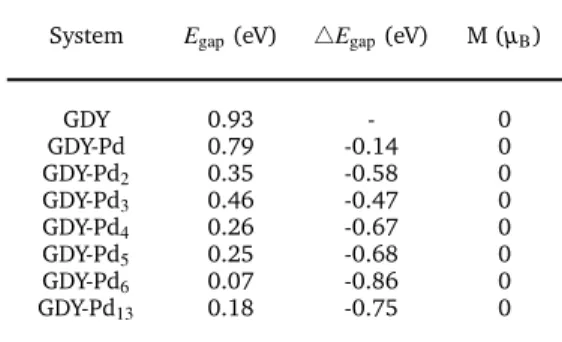
Table 2Energy band gaps,Egap, of GDY-Pdn, change in the gap with
respect to clean GDY, and magnetic momentMof GDY-Pdn
System Egap(eV) 4Egap(eV) M (µB)
GDY 0.93 - 0
GDY-Pd 0.79 -0.14 0 GDY-Pd2 0.35 -0.58 0
GDY-Pd3 0.46 -0.47 0
GDY-Pd4 0.26 -0.67 0
GDY-Pd5 0.25 -0.68 0
GDY-Pd6 0.07 -0.86 0
GDY-Pd13 0.18 -0.75 0
Pdnand Pd adsorbed on different triangular holes
GDY-Pd-Pd 0.70 -0.23 0 GDY-Pd3-Pd 0.51 -0.42 0
Pdnadsorbed on both sides of GDY
GDY-2Pd6 0.07 -0.86 2
GDY-2Pd13 0.03 -0.90 2
atoms with GDY. The magnetic moment of the system isM= 0. The C’-C’ and C”-C” distances increase with respect to the case of a single adsorbed Pd atom. The average of the two relevant C’-C’ distances near the Pd atoms is 2.72 Å, and the average of the two C”-C” distances is 4.28 Å. The first one is still smaller than the valued(C’-C’) = 2.82 Å in clean GDY. In pristine graphene, Pd2forms on the same side of the carbon plane2; in contrast, on
defective graphene37and on GDY, Pd
2samples both sides of the
flake, what is quite interesting for the adsorption of gases. We also found a second low-lying energy minimum of GDY-Pd2with
the two Pd atoms on the same side of the GDY plane, and energy 0.5 eV above the ground state.
Adding a third Pd atom leads to the very symmetrical configu-ration in Fig. 2. The Pd atom occupies the third corner of the big triangular hole, as it could be expected. Interestingly, the three Pd atoms are close to the GDY plane, the average height is 0.23 Å, and it can be appreciated in the Figure that the distortion of the surrounding carbon chains is larger than in the two previous cases. Averages of C’-C’ and C”-C” distances in Table 1 show an additional increase of d(C”-C”). The large addition energy,Eadd
= 3.01 eV, reveals the contribution of the Pd-Pd bonds. This bonding contribution occurs because the Pd-Pd distances, 2.57, 2.60 and 2.61 Å, are close to the Pd-Pd distance in the isolated Pd3cluster2,d(Pd-Pd) = 2.56 Å, and this effect compensates for
the distortion energy of the carbon chains. The parallel orien-tation of Pd3 with respect to the GDY plane is at variance with
the adsorption on pristine graphene or on a graphene vacancy: in those cases the triangular Pd cluster is perpendicular to the plane of carbon atoms5,6. We notice that the energy of the next low-lying minimum, corresponding to a triangular configuration of Pd3with vertical orientation similar to those occurring on
pris-tine and defective graphene, is 0.5 eV above the ground state. Similar to the isolated Pd4cluster38and Pd4cluster supported
struc-Pd
2Pd
1Pd
4Pd
5Pd
6Pd
13Pd
3Fig. 2Top and side views of the ground state geometries of GDY-Pdnwithn=1−6, 13.
ture is the first three-dimensional structure for Pdn clusters on
GDY. One face of the tetrahedron sits on the GDY plane (see Fig. 2) . The position of the three Pd atoms of that face rela-tive to the triangular hole is similar to that seen above for Pd3,
but the atoms are at an average height of 0.95 Å above the GDY plane. The addition energy of the fourth Pd atom,Eadd = 2.09
eV, is due mostly to Pd-Pd bonding, because the fourth Pd atom is well above the GDY plane. Actually, the interaction of the fourth Pd atom with the other three allows the Pd3triangle to move up
to form the tetrahedron. At the same time the interatomic Pd-Pd distances experience an expansion towards values 2.67 - 2.69 Å, close to those in free Pd42.
The lowering of the addition energy between Pd3 and Pd4 is
an interesting feature. Although adding the fourth atom provides substantial Pd-Pd bonding, separating Pd3from its favorable
po-sition close to the pore plane reduces the interaction between the cluster and GDY. The closest palladium-carbon distances (aver-aged(Pd-C’) = 2.10 Å), are smaller than those for Pd4on pristine
graphene (2.3-2.4 Å), so the interaction is still higher.
The ground state structure of Pd5on GDY is obtained by
cap-ping the triangular face on the right hand side of the tetrahedron, as shown in Fig. 2. Then, the two Pd atoms near the hexagonal rings 2 and 3 move a bit towards the hexagonal ring 1. In this way, the distorted trigonal bipyramid shown in Fig. 2 is obtained for supported Pd5 (in fact, the structure is midway between a
trigonal bipyramid and a square pyramid). The addition energy isEadd = 2.90 eV. The position of the cluster is peculiar: three
Pd atoms, forming a face of that distorted trigonal bipyramid, sit
on top of the triangular hole in a configuration similar to those found in Pd3and Pd4, that is, near the three vertices of the pore.
However, this triangular face is not parallel to the GDY plane; the heights of the three Pd atoms above the GDY plane are 0.76, 1.20 and 1.20 Å, and this indicates that the face is tilted with re-spect to the GDY plane. The shape of the distorted structure of supported Pd5 is in between the two lowest energy structures of
isolated Pd5, the trigonal bipyramid and the square pyramid2. In
fact, the second most stable isomer of Pd5on GDY is the square
pyramid, with energy 0.16 eV above the ground state. In compar-ison, the structure of Pd5on a graphene vacancy is also a trigonal
bipyramid with the face in contact with the vacancy again tilted6, as in the case of GDY. The structure of Pd5supported on pristine
graphene is the square pyramid5.
There are two main competing isomers for free Pd6: the
octahe-dral structure, OCT, which is the ground state, and the incomplete pentagonal bipyramid IPB (with an atom missing from the equa-torial common base), with an energy 0.29 eV above the ground state5. The preferred structure of Pd6on GDY, as well as on other
carbon materials (clean and defective graphene6, and HPS) is the OCT structure. This structure is obtained with an addition energy Eadd= 2.57 eV. As depicted in Fig. 2, Pd6 on GDY rests on a
tri-angular face. The position of this face on the tritri-angular GDY hole is similar to the position of Pd3, although the atoms are at a
Pd-Pd distances in the upper parallel face are 2.69, 2.69, 2.70 Å (average 2.69 Å). The Pd-Pd distances in the bottom face are en-larged by 10 per cent with respect to Pd-Pd distances in free Pd6
(average 2.68 Å), and this enhancement is due to the interaction between Pd atoms with benzylic carbons C’. The energy of the second minimum, which is a spin triplet state, is 0.30 eV above the ground state.
The addition energies are collected together in Table 1. The Ta-ble also shows the formation energies and the cluster adsorption energies, defined in equations (3) and (2), respectively. There is a good correspondence in the trends ofEaddandEformas the size of
the palladium cluster increases. The most salient feature shown byEadsis that the largest adsorption energy occurs for Pd3, which
is the case when the triangular Pd3 cluster is optimally close to
the triangular hole. Actually, the most stable structures of Pd3to
Pd6 show a common feature, namely, their contact with GDY is
through a triangular face, parallel to the GDY plane except for Pd5, in which case the face is tilted. The situation for Pdn
sup-ported on pristine graphene or on a graphene vacancy is differ-ent. In those cases Pd3 is perpendicular to the substrate, and a
variety of configurations occur for Pd4−Pd6.
The observed trend on GDY invites investigating larger clusters, and for this purpose we have focused on Pd13. The structure of
the isolated cluster is a bilayer formed by two fcc (111) planes with seven and six atoms, respectively39,40. The calculated low-est energy structure of Pd13 on GDY is shown in Fig. 2. The two
Pd layers are parallel to the GDY plane, and the layer in contact with the substrate is the face having seven atoms: six Pd atoms sit on top of the carbon chains forming the boundary of the trian-gular hole, and the seventh Pd atom is in the center of the hole. The height of this layer above the GDY plane is 2.18 Å, the largest height of all clusters studied. On the other hand, the upper Pd layer forms a triangle with three atoms in positions whose projec-tions on the GDY plane are near the vertices of the triangular hole and the projections of the other three atoms fall in the middle of the edges of that triangle. The distance between the two (111) planes of the cluster is 2.27 Å. This value is close to the interpla-nar spacing in Pd nanoparticles of size 4nm deposited on GDY and measured by high resolution transmission electron microscopy26, d= 2.22 Å, and to the interplanar spacing in bulk fcc palladium, d=2.24 Å. This means that the effect of the GDY substrate on the interlayer spacing of the fcc-like Pd particles is small.
The spin magnetic moment of the free Pd13 cluster, 6 µB,
quenches down to zero upon deposition of the cluster on GDY. In contrast, deposition of Pd13 on pristine graphene quenches only
partially the moment and the magnetic moment of the supported cluster41 is 4
µB. The adsorption energy of the cluster isEads
= 4.82 eV. The adsorption energy of the clusters does not scale with the number of Pd atoms in contact with the substrate. For the three clusters having a triangular face in contact with GDY, Pd3-Pd6, the cluster adsorption energies vary between 3.56 and
4.41 eV. The adsorption energy of Pd3, 4.41 eV, is larger than
the adsorption energies of Pd4, Pd5and Pd6. The same lack of a
systematic trend occurs for Pdnclusters on pristine graphene2–5.
We also conclude that the adsorption energies of Pdnon GDY are
intermediate between the adsorption energies on pristine and
de-fective graphene. As the number of vacancies in graphene is lim-ited and these disappear at high temperature, GDY could be a more effective substrate to anchor clusters than graphene.
Inclusion of the van der Waals interactions leads to larger addi-tion, adsorption and formation energies. Although van der Waals interactions are small, their net contribution increases as the size of the Pd cluster grows up. This can be appreciated in the ad-dition energiesEadd(Pd) of Table 1. The dispersion contribution
is 0.05 eV for the addition of the first Pd atom to GDY, and then grows up slowly, reaching a value of 0.12 eV for the addition of the sixth Pd atom. As a fraction ofEadd, the dispersion
contribu-tion increases from 2 percent to 12 percent. This increase is due to the fact that the dispersion interactions are evaluated in the DFT-D3 method as a sum of pairwise terms, and a larger Pd clus-ter implies more clus-terms. The adsorption energiesEadsreflect the
same behavior. The van der Waals contribution to the adsorption energy of the Pdncluster increases from 0.05 eV for adsorption of
a single Pd atom to 0.99 eV for the adsorption of Pd13, or from 2
percent to 20 percent.
3.2 Competition between dispersion of Pd atoms and cluster growth on GDY
Palladium atoms deposited on a GDY layer can adsorb on the layer by binding to previously adsorbed Pd atoms, as shown in the pre-vious section, and thus leading to the growth of Pd clusters. On the other hand, the successively deposited Pd atoms could also be adsorbed on different triangular holes, leading to the dispersion of the Pd atoms on the GDY layer. To shed light on the compe-tition between these two processes, clustering and dispersion of Pd on GDY, we have investigated the adsorption of Pd on adja-cent triangular holes. First we notice from the upper section of Table 1 that the addition energy of a second Pd atom next to a Pd atom preadsorbed on GDY (Eadd= 2.45 eV) is almost equal to the
adsorption energy of one palladium atom on the GDY layer (Eads
= 2.54 eV). These very similar energies suggest that it would be nearly equally favorable adding the second Pd atom on the same triangular hole or on a different triangular hole, thus the coverage of the GDY would tend to be uniform. The calculated addition en-ergy of a second Pd atom on a different triangular hole than the first Pd atom, which amounts to 2.50 eV (see the middle section of Table 1), confirms that expectation. The most favorable po-sition of the two Pd atoms in two adjacent pores is on opposite vertices of the respective triangular pores (see Fig. 3).
a) b)
It is also of interest to study the competition between clus-tering and dispersion for preadsorbed Pd clusters, specially for the case when the transition between 2-dimensional, Pd3, and
3-dimensional, Pd4, clusters takes place. The triangular holes of
GDY can hold a maximum of three Pd atoms in plane and thus the fourth Pd atom attached to the same pore forms a three di-mensional Pd4cluster. Notice that the fourth Pd atom is not
di-rectly bound to the GDY layer. The addition energy of the fourth Pd atom to a preadsorbed Pd3, 2.09 eV, is somewhat lower than
the addition energy of that atom to a different triangular hole, 2.81 eV (see Fig. 3). This result can be understood because, as we showed in the previous subsection, the formation of the three dimensional Pd4cluster is accompanied by a lowering in the
ad-sorption energy of the cluster (from 4.41 eV in Pd3to 3.56 in Pd4)
due to an increase in the overall distance between the cluster and the GDY layer. Therefore it is slightly more favorable to bind a Pd atom directly to the GDY layer in a different triangular hole than to grow a three dimensional Pd cluster. Overall, the two processes, dispersion of Pd atoms and growth of Pd clusters, can take place in the GDY layer. However, if preformed Pd clusters are deposited on GDY, they will adsorb with substantial adsorp-tion energies as shown in the previvous subsecadsorp-tion. These conclu-sions are consistent with the experimental observation that the Pd nanoparticles of size 1.3 nm are fairly well dispersed on GDY26.
3.3 Adsorption of Pd clusters on both sides of GDY
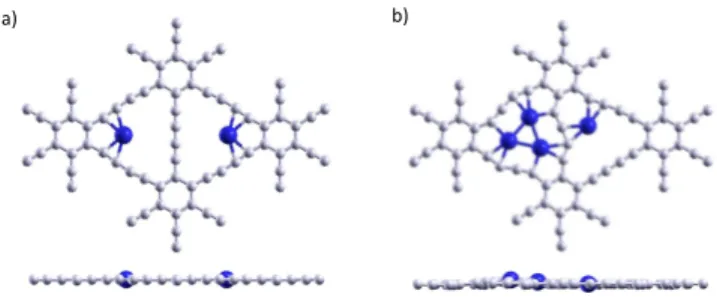
In order to investigate the efficiency of the GDY layer to anchor clusters on both sides of the big triangular hole simultaneously, two Pd6(or two Pd13) clusters have been added. The lowest
en-ergy structures obtained are displayed in Fig. 4. The positions of the two Pd6(or two Pd13) clusters are symmetrical with respect
to the GDY plane. The projections of those positions onto the GDY plane are nearly the same as for single Pd6or Pd13clusters.
The cluster-GDY distance has increased to 1.34 Å for two Pd6(it
was 1.22 Å for one Pd6). However, the two Pd13 clusters are at
the same distance (one on each side of the layer) from GDY, 2.21 Å, as the single Pd13. We have calculated the cluster adsorption
energies in two ways. In the first definition
Eads1 (Pdn) = [E(GDY) +2E(Pdn)−E(GDY−2Pdn)]/2 (4)
is an average adsorption energy corresponding to the process of adding the Pdn clusters on both sides of the GDY plane
simulta-neously. A second criterion can be used,
Eads2 (Pdn) =E(GDY−Pdn) +E(Pdn)−E(GDY−2Pdn)]/2 (5)
corresponding to the process of adding the second cluster when the first one is already adsorbed. As shown in Table 1, the two adsorption energies are not equal: For Pd6,Eads2 is a bit higher
thanEads1 , so the adsorption of the second cluster releases a larger amount of energy than the adsorption of the first one. The same effect can be noticed in thatEads1 =4.05 eV andEads2 = 4.13 eV for Pd6are larger than the adsorption energy of the first Pd6cluster,
3.97 eV. This increase of the adsorption energy for the second Pd6
cluster would not be expected on the basis of the increase of the
a) b)
Fig. 4Top and side views of the optimized structures of: (a) two Pd6, and (b) two Pd13clusters adsorbed on GDY.
GDY-Pd6distance, from 1.22 Å to 1.34 Å, upon adsorption of the
second cluster. A larger distance usually leads to smaller inter-action energies. However, the larger GDY-Pd6distance results in
interatomic distances between neighboring Pd atoms across the pore of 2.68 Å, close to the interatomic distance of 2.75 Å in bulk Pd; in this way Pd-Pd bonding across the triangular hole is re-sponsible for the increase of binding of the second Pd6cluster.
Similarly, in the case of Pd13, Eads2 is a bit higher than Eads1 .
In this case, the distances between GDY and the two Pd13
clus-ters, 2.21 Å, are the same as for the adsorption of a single Pd13
cluster. The higher adsorption energy of the second Pd13cluster,
Eads2 =6.16 eV, as compared with the adsorption energy of a single cluster, 4.82 eV, mainly reflects the effect of the Pd-Pd bonding across the triangular hole. Although the Pd-Pd distances across the triangular hole are larger than the bond distance in bulk Pd, the effect of the attractive tail of the effective interatomic poten-tial is active. A part of this bonding effect is contributed by the dispersion interactions. The important conclusion from the whole discussion is that clusters can be attached on both sides of the GDY layer simultaneously with adsorption energies of about 4-6 eV. This result suggests that clusters can be employed to build nanostructures formed by GDY bilayers or multilayers with inter-layer distances controlled by the intercalated clusters. A compar-ison of the C’-C’ and C”-C” distances in GDY-2P6and GDY-2Pd13
with those in GDY-Pd6and GDY-Pd13reveals that the deformation
of the carbon framework of the triangular holes is larger in GDY-2P6and GDY-2Pd13. This can also be observed in the Pd-C’ and
Pd-C” distances in Table 1.
3.4 Electronic properties
Some electronic properties of all GDY-Pdnand GDY-2Pdnsystems
are reported in Table 2, and the densities of states (DOS) of GDY, GDY-Pd and GDY-Pd3 are shown in Fig. 5. The electronic band
gap of pristine GDY is 0.93 eV. This value is intermediate between band gaps calculated using DFT with other exchange-correlation functionals (gaps in the range 0.4-0.5 eV)33,42,43and the value of 1.18 eV calculated by the hybrid B3LYP method43. A recent
on thedlevels of Pd (see Fig.5) shows that the additional levels in the region between -4 and 0 eV are mainly contributed by the dstates of Pd. This trend continues for larger clusters and the development of adband associated to the growth of the Pd clus-ters is clearly apparent from the projected density of states on the dlevels of Pd in Fig.5. Moreover, the progressive lowering of the
F ( eV)
DOS
(a
rbitrary
u
n
its)
GDY – Pd3 GDY
GDY – Pd
GDY – Pd6
Fig. 5Density of electronic states (black line) of GDY, GDY-Pd, GDY-Pd3 and GDY-Pd6. The projected density of states on thedlevels of Pd is represented by the shadowed area in red. The energy region around the Fermi level, from -8 eV to 4 eV is shown in the figure. Notice that further bands corresponding to GDY without hibridization with Pd levels extend down to -19 eV (not shown).εFrepresents the Fermi energy.
width of the gap also continues as the anchored Pdncluster grows
in size. This trend is attributed to the increasingly dominant ef-fect of the Pdd states around the Fermi energy. Thus, the size of the Pd clusters can be used to modify the width of the band gap in a controlled way, a feature that could be useful for appli-cations in sensing devices. On the other hand, the dispersion of
Pd atoms on different triangular holes of the GDY layer has only a minor effect in the electronic gap (the gap of GDY-Pd-Pd is 0.70 eV) with respect to the system with one adsorbed Pd atom, 0.79 eV. A similar behaviour is observed in the case of adsorption of a Pd atom in a triangular hole adjacent to another hole decorated with Pd3. The gap in this case, 0.51 eV, is similar to that of the
GDY-Pd3system, 0.46 eV.
a)
b)
c)
Fig. 6Electron density redistribution in a) GDY-Pd2, b) GDY-Pd4and c) GDY-Pd13resulting from cluster adsorption. Yellow and green colors indicate regions of enhancement and lowering of electron density, respectively.
The electron density redistribution,∆ρ, for adsorption of a Pdn
cluster on GDY, defined as
∆ρ=ρ(PdnonGDY)−ρ(Pdn)−ρ(GDY) (6) is given in Fig. 6 for GDY-Pd2, GDY-Pd4 and GDY-Pd13. Yellow
and green colors indicate regions of enhancement and lowering of electron density, respectively. The electron redistribution is quite complex, but an accumulation of electron density in the regions between the Pd atoms and the closest carbon atoms can be appre-ciated. Some polarization of the charge also occurs around the Pd atoms.
4
Summary and conclusions
to Pd6 for the cluster sizes analyzed), and are longer than this
value for larger cluster sizes (Pd13in our case). Palladium atoms
deposited on GDY can be dispersed in different triangular holes of the layer or may join together forming clusters. These two processes are nearly equally favorable. The cluster adsorption energies are between 3 and 4 eV, large enough to maintain the clusters tightly bound to the triangular holes, more so than the same clusters on pristine graphene. It is also feasible to dope graphdiyne simultaneously with clusters on the upper and lower sides of the same triangular hole, and the adsorption binding en-ergies only decrease by a little (less than 10 percent). These prop-erties indicate that Pd clusters (many other elements are expected to behave in the same way) can be used to build nanostructures in which graphdiyne layers are stacked with interlayer distances controlled at will by the size of the clusters. The size of the clus-ters also controls the electronic band gap of the material.
Conflicts of interest
There are no conflicts of interest to declare.
Acknowledgements
This work was supported by MINECO of Spain (Grant MAT2014-54378-R) and Junta de Castilla y León (Grant VA050U14). A. G. acknowledges a predoctoral fellowship from Junta de Castilla y León. A. S. acknowledges a visiting fellowship from Elites Foun-dation. The authors thankfully acknowledge the facilities pro-vided by Centro de Proceso de Datos - Parque Científico of the University of Valladolid.
References
1 M. Mahmoodinia, P.-O. A. Strand and D. Chen,J. Phys. Chem. C, 2015,119, 24425.
2 I. Cabria, M. J. López and J. A. Alonso,Phys. Rev. B, 2010,81, 035403:1–5.
3 Q. Sun, Q. Wang, P. Jena and Y. Kawazoe,J. Am. Chem. Soc., 2005,127, 14582–14583.
4 P. O. Krasnov, F. Ding, A. K. Singh and B. I. Yakobson,J. Phys. Chem. C, 2007,111, 17977–17980.
5 I. Cabria, M. J. López, S. Fraile and J. A. Alonso,J. Phys. Chem. C, 2012,116, 21179–21189.
6 M. J. López, I. Cabria and J. A. Alonso,J. Phys. Chem. C, 2014, 118, 5081–5090.
7 I. López-Corral, S. Piriz, R. Faccio, A. Juan and M. Avena,
Applied Surface Science, 2016,382, 80–87.
8 I. López-Corral, J. D. Celis, A. Juan and B. Irigoyen, Int. J. Hydrogen Energy, 2012,37, 10156–10164.
9 G. M. Yang, X. F. Fan, S. Shi, H. H. Huang and W. T. Zheng,
Appl. Surf. Sci., 2017,392, 936–941.
10 Y. Shao-Horn, W. C. Sheng, S. Chen, P. J. Ferreira, E. F. Holby and D. Morgan,Topics in Catalysis, 2007,46, 285.
11 H. W. Kroto, J. R. Heath, S. C. O’Brien, R. F. Curl and R. E. Smalley,Nature, 1985,318, 162–163.
12 S. Iijima,Nature (London), 1991,354, 56–58.
13 K. S. Novoselov, A. K. Geim, S. V. Morozov, Y. Z. D. Jiang, S. V.
Dubonos, I. V. Grigorieva and A. A. Firsov,Science, 2004,306, 666.
14 M. J. López, I. Cabria and J. A. Alonso,J. Chem. Phys., 2011, 135, 104706.1–9.
15 G. Li, Y. Li, H. Liu, Y. Guo, Y. Lia and D. Zhu,Chemical Com-munications, 2010,46, 3256–3258.
16 H. Bu, M. Zhao, H. Zhang, X. Wang, Y. Xi and Z. Wang,J. Phys. Chem. A, 2012,116, 3934–3939.
17 A. Bhaskar, R. Guda, M. M. Haley and T. G. III,J. Am. Chem. Soc., 2006,128, 13972–13973.
18 G. Luo, X. Qian, H. Liu, R. Qin, J. Zhou, L. Li, Z. Gao, E. Wang, W.-N. Mei, J. Lu, Y. Li, and S. Nagase,Phys. Rev. B, 2011,84, 075439.
19 C. Sun and D. J. Searles,J. Phys. Chem. C, 2012,116, 26222– 26226.
20 X. Qian, H. Liu, C. Huang, S. Chen, L. Zhang, Y. Li, J. Wang and Y. Li,Sci. Rep., 2015,5, 7756.
21 H. J. Hwang, Y. Kwon and H. Lee, J. Phys. Chem. C, 2012, 116, 20220–20224.
22 S. W. Cranford and M. J. Buehler,Nanoscale, 2012,4, 4587– 4593.
23 C. Huang, S. Zhang, H. Liu, Y. Li, G. Cui and Y. Li,Nano En-ergy, 2015,11, 481–489.
24 J. Xiao, J. Shi, H. Liu, Y. Xu, S. Lv, Y. Luo, D. Li, Q. Meng and Y. Li,Advanced Energy Materials, 2015,5, 1401943.
25 Y. Pan, Y. Wang, L. Wang, H. Zhong, R. Quhe, Z. Ni, M. Ye, W.-N. Mei, J. Shi, W. Guo, J. Yang and J. Lu,Nanoscale, 2015, 7, 2116–2127.
26 H. Qi, P. Yu, Y. Wang, G. Han, H. Liu, Y. Yi, Y. Li and L. Mao,
J. Am. Chem. Soc., 2015,137, 5260–5263. 27 Z.-Z. Lin,Carbon, 2015,86, 301–309.
28 A. Prestianni, F. Ferrante, E. M. Sulman and D. Duca,J. Phys. Chem. C, 2014,118, 21006.
29 dacapo,See https://wiki.fysik.dtu.dk/dacapo for a description of the total energy code, based on the density functional theory (2009). Last accessed on January 2017.
30 J. P. Perdew and Y. Wang, Phys. Rev. B, 1992, 45, 13244– 13249.
31 S. Grimme, J. Antony, S. Ehrlich and H. Krieg,J. Chem. Phys., 2010,132, 154104:1–19.
32 J. P. Perdew, K. Burke and M. Ernzerhof,Phys. Rev. Lett., 1986, 77, 3865–3868.
33 M. Long, L. Tang, D. Wang, Y. Li, and Z. Shuai,ACS Nano, 2011,5, 2593–2600.
34 H. Zhang, M. Zhao, X. He, Z. Wang, X. Zhang and X. Liu,Phys. Rev. C, 2011,115, 8845–8850.
35 H. Zhang, X. He, M. Zhao, M. Zhang, L. Zhao, X. Feng and Y. Luo,J. Phys. Chem. C, 2012,116, 16634–16638.
36 Z. Lu, S. Li, P. Lv, C. He, D. Ma and Z. Yang,Applied Surface Science, 2016,360, 1–7.
37 A. Granja-DelRío, J. A. Alonso and M. J. López,Computational and Theoretical Chemistry, 2017,1107, 23–29.
39 L.-L. Wang and D. D. Johnson,Phys. Rev. B, 2007,75, 235405. 40 A. M. Köster, P. Calaminici, E. Orgaz, D. R. Roy, J. U. Reveles and S. N. Khanna,Jour. Am. Chem Soc, 2011,133, 12192– 12196.
41 M. Blanco-Rey, J. I. Juaristi, M. Alducin, M. J. López and J. A.
Alonso,J. Phys. Chem. C, 2016,120, 17357–17364.
42 N. Narita, S. Nagai, S. Suzuki and K. Nakao, Phys. Rev. B, 2000,62, 11146–11151.