I .4 .i .,. .r¡ r...
,¡.r'.1É
-Þr '_"
f + , ¡'l¿
Fobert af Klinteberg
F
A _ MACIAS COUNTRY E0UAT0RIAL EUINE¡
THE FOFGOTTEN FEFUGEES
lNÐrÀr'¡fi ultlvIR$ITY t lllilÊlfiitÞ rl*untrru*r0¡¿
I t- /
L-.t
\/
li r
,1 ././\ r'.: .-¡i i
.!.- :1, -r l- .
J
t /11
!./. . "1
' * ¡
CONTENTS
Page }{unb.er
1 1. ) Foreword Maps Surmnry Introduetion Baekground t-1 v 1 3 3 4 B 10 L4 15 23 2B 32 39 43 46 50 55 55 56 6I 64 66 2.L. na 2.3. 2.4. 3.1. 3.2. J.J. 3.4. 3.5. The Country The People
IIi s tory
Chronology
). Macías t Countrv
The, State Apparatus
Economy
Forced Labour
Law and Law Enforcement
Relations with Foreign Powers Macías, "The unigue Miracle"
4,r.
+.¿.
'The Personality of
Macías and Religion
Papa Macías
( The Refugees
5.1.
(,
6. Solutions and Recommendat,ions
Outflux
Influx
5.2.I.
Gabon5
,2.2.
Cameroon5.2,3. Nigeria
5.2,4.
Spain and OtherEuropean Countries
Legal Recognitíon
Rehabilitation
Education
Sugges tions
66 69 70 7L 74 75 80 BZ 84 85 B7 6.1.
6 .2.
6.3.
6 .4.
Sources
7"
8" S.elected Bibliography
Appendix 1
Appendix 2
Appendix 3
FORE TORD
By Lars-Gunnar Eriksson, Director, International University Exchange
Fund (IUEF)
On a number of occasions, the IUEF has commissioned studies on special refugee problems with a vier,v to devise prograrunes for assistance.
A refugee problem r¿hich has been preoccupying us for the last couple
of years is that of the Equatorial Guíneans. Their plight, as well as
that of Lheir countrymen sti1l living under the brutal oppression of
President Macíast dictatorship, is litt1e known and hence the assistance
provided Eo them is in no proportion to their needs.
I^lith the assistance of a grant from the Swedish International
Development Authority (SIDA), the IUEF decided to carry out a mission,
combining a study of the situation in Equatorial Guinea itself with that
of the refugees in neighbouring countries, as well as in Spain.
The ob.jective was twofold: firstly, to provide information about
the situation of the refugees and to make proposals for programmes of
assistance, particularly in the field of education and training;
secondly, to províde firsthand information about the situation in
Equatorial Guinea in order to facilitate assessment of the possibilities for repatriation.
I,rle were lucky to be able to benefit from the services of Dr. Robert
af Klinteberg, a Swedish anthropologist with sixteen years of experience
of refugee problems in Europe, Asia and Africa. After a very risky visit to the country itself , Dr. Kl inteberg spent four months living with r-he
refugees ín Gabon, Cameroon, Nigeria and Spain. The ensuing report and
its appendix are the result of this mission, which we hope will add to
the knowledge about the refugees, as well as the situation inside
Equatorial Guinea. Above all, we hope it r¡ill contribute to increase
the aid provided to the refugees. The views expressed
not necessarily those of
this
report are thoseof
Dr. Klinteberg and IUEF.in
the
P.
FERNANDO
PO(MACIAS
NGUEMA
BIYOGO)SANTA ISABEL
.c
i\C'
BALOERI DE0$'
cRlsro RE)¡ Þ\\BASAKATO DEL
SAN CARLOS
SUALA SAKATO
DEL ESTE
CEPCION (RIABA)
LOCATION ON
WEST COAST OF
THE AFRICA
Sonlo lsobel
FERNANDO PO IS./ì
(MACIAS NGUEMA( /
BIYOGO)
GULF OF GU/NEA
principe ls,
ELOBEY CHICO, ELOBEY GRANDE
Sio romé lsrsõo Tomi
NIGERIA Port Horcourl
a CAMEROON
Lr
€Â
ó
(J
Þ
.iQB ô<É
ït
2 3
=
a É
(t
o t
E
Q
UAT
OR
IA
L
G UIN
E AJ
I {
t,
!
,Ë
1
¡
1,
I
i .3
l
SUMMARY
Equatorial Guinea consists of the island of Fernando Po situated in'
rhe culf of Guinea and the mainland enclave of Rio Y"ii^tliih is sandwiched
betweenGabonandCameroon.Thecountryissmall,2S,000km.,andhadan
estimated population of 285,000 in L910'
A strategic position made it a valuable pa!ùn in colonial politics and
for nearly 300 y..r" it was dominated by Portugal, England and spain' I^lhen it reached independ.ence aftel 110 years of Spanish rule the prospects
looked good. An economy based on the best cocoa in the world, coffee and
timber made the per capita income the highest in Black Africa' A good
infrastructure and a high 1evel of education promised even gl:eater prosperity
for the future.
In 1968, Francisco Macfas Nguema became the first President of the
independenr Republic. The diffiãulties began shortly afterr'iards when he
began to eliminate real or imagined political opponents. 1972 saw him
become President for 1ife. His rule has since become increasingly personal and is characterised by political, religious and ethnic persecuËion'
Systematic terror and near total disintãgration of the economy have
contrib-uted to drive an estimated third of the population into exile from the most
regressive desPotism in Africa'
president Maclast reign has a \^/eak po\,7er base. It functions because
of a deliberate cultural regression not unlike that of Nazi Germany, which
has thrown the country and the people into a situation far below that of
the pre-colonial period and has even destloyed lhe strong traditions of village democracy. fni" is condoned by the foreign po!üers present'in the
country, notably the USSR, Cuba and China' as \^7e11 as by ruthless capítalist
enterprises, particularly French. The United Nations' Development Prografrune
(UNDP) and the European Economic Community (EEC) provide assistance' tacitly accepting the regimL, while Spain and the Vatican remain silent about what
is going on in oid"r to avoid, at all costs, a final rupture of very strained relations. The silence perpetuates the terror, and the cost is paid by the
people of Equatorial Guinea'
official figures for refugees are: 60,000 in Gabon, 30,000 in cameroon'
5,000 in Nigeriu:6,000 in spain, wirh smaller groups in a number of other countries in Africa and Europe. The refugees in Gabon and cameroon are in
an especially difficult posiiion. Agents provocateurs threaten their
security. unemployrnent, poverty, tact< of education and medical facilities
combine with the language problLm and micro-political tensions to make their
situation increasingly worrying.
Maclas, persecutions have been directed against the intellectuals in
particular. As a consequence, the refugees are probably among the best
educated and most competent professionally in Africa, a fact i¡hich poses
special problems for their social and economic rehabilitation.
l i l
E
i
¿ J
INTRODUCTION
This report deals with the situation of the refugees from Equatorial
Guinea. For varíous reasons they have remained almosttotally ignored and
neglected. ft was thanks to the initiative of the International University
Exchange Fund (IUEF), and the generous assistance of the S¡^¡edish International
Development Authority (SIDA), that I had an opportuníty to go on a f.act-fínding
missíon to Central Africa during four months in L978,
The fact-finding was planned with four major questions in mind:
l{hat is the situation of the refugees?
I,rlhat are the possibilítíes of repatriation?
lrlhat are the short-term and long-term needs of the refugees?
Itlhat solutions should be suggested?
The first question required information about where the refugees are
and in whar circumstances they find themselves, about health and nutrition,
security, emplo¡rment, relations with nationals and other micro-political
considerations - all seen in the context of the general situation in the
country of asylum
The second was crucial in the sense that voluntary repatriation
always remains the most desirable solution to a refugee problem, so much so
that it is questionable if other forms of assistance should even be attempted
if a return is a genuine possibility. An assessment of the situation required
information about Ëhe economíc situation inside Equatorial Guinea: employment,
salaries and prices, economic plans and prospects, infrastructure, etc.; the health and nutrition status; macro- and micro-polirics, educatíon and
security. Information about these matters would also hopefully help in sorting
out some of the rather disturbing contradictions which occurred as soon as one
tried to understand the situaËion
There r^rere, for instance, the discrepancies betv¡een the sombre
picture of Equatorial Guinea painted by the exiles and the rather more s)anpathetic
descriptions given in certain Spanish and French media; the apparent ambivalence
of the United Nations and the European Economic Community, both giving assistance
while providing minimal information about their progrannes, an unusLlal policy for
donor agencies. There \^iere also the conflieting appraisals of the reliability
of rhe information abouË the country. l,Iore specifically, if President Macías
had his counLry under strong domination, must he not also have an equally strong
po\,,rer base indicating that vast numbers of his subjects were in favour of the
regime? If it \^/ere true that exiles returned voluntarily, must it not be
assumed that Macfast rule r^ras much more benevolent than had been a1 leged?
hlhy had the important Fang tribe, described as fierce \¡rarriors, not created an effective opposition to the President if they had really felt oppressed?
Evidently these and oËher questions had to be given satisfactory ansr¡/ers. t
! f I
¡
!
:
¡
;
I
I
Once it became clear if large-scale repatriation was a realistic
solution to the refugee problem, a preliminary need assessment would have
to be presented, either'for a return to a counlry said to have lost much
of its htunan resources and its infrastructure, or for continued lífe in
exile.
The question of repatriation reoccurred in the context of the
needs of the refugees, especially in the field of education and training.
If they vrere to go back to a country said to have lost much of its trained
*"rrporlr and infrastructure, how could assistance best be used to alleviate
the needs of Equatorial Guinea? If the refugees could not go back, how
could they best be assisted to become useful residents in the countries
of asylum?
Final1y, preliminary solutions would have to be suggested on the
basis of these needs, to facilitate further discussions between the countries
2
2.L.
BACKGROUND
TIIE COUNTRY
Equatorial Guinea
is
among the least known countriesin
the ¡¿or1dtoday. It is
often confused with Guinea-Conakry and Guinea-Bissau, even withNew Guinea
in
the Pacífic(1) or
incorrecÈly referredto
byíts old
colonialname, Spanish Guinea.
Geographically and administratively
it
consistsof
t¡¡oparts,
themainland province
of
Rio Muni plus the three coastalislets
Corisco, ElobeyGrande andElobey
Chieo;
and the offshore islands Fernando Po and Annobón.These have now been renamed, respectively, Macías Nguema Biyogo and Pigalú,
but
will
be mentioned bytheir
morefamiliar
namesin this
report.The official capital is Malabo, formerly Santa Isabel, on Fernando
Po. The island is subdivided into the districrs of Malabo; Luba, ex-San
Carlos; and Riaba, ex-Concepcion. Also included in Maclas Province is
Annobón r^rhich constitutes a fourth district. On the mainland the Rio Muni
Province has twelve districts: Bata \,/ith the province capital, Ebebeyin,
Evinayong, I'ficomeseng, Bimbiles, Mongomo, Nyefang; Mbini, formerly Rio
Benito; Kogo, Acurenen, Nsok and Rio Campo.
Fernando Po is in the Gulf of Guinea, 33 km from the nearest part of the Cameroon coast. It is roughly 70 by 30 km, with a coastline of some
250 krn and an area of 2rOI7 km2, and consists of Ëhree extinct volcanoes.
The highest, Pico de Santa Isabel, is 3,007 meters and important for Ëhe
possibilities it offers for electronic surveillance of sea and air traf.f.íc along a strategically important part of the African coast. The Moka
mountain, with its crater lake at 11800 meters, used to be economically
important because of its livestock. A1l over, the volcanic soils contribute
to exLremely fertile lands, and in Malabo a broken dor,¡n crater rim provides
a good deepwater harbour some 700 meters in diameLer.
Annobón is the last of the chain of volcanoes which begins with
¡{t. Cameroon and continues through Fernando Po, Príncipe and Sao Tomé.
South of the Equator and 600 km south-south-west of Malabo, it is 750 meters
high, covers 17 km2 and, at the time of independence, had a population of
1,500. This has since been reduced by an uncontrolled cholera epidemic.
NaËural reseurces abound in Equatorial Guinea. The agricultural
potential is very high, particularly on volcanic soils and the differing altitudes allow the cultivation of practically anything. The sea and the
rivers are rich in fish and other seafoods.
On the other hand, there seem to be no mineral resources of any
consequence. ùn the mainland, minute quantities of gold have been found
near Evinayong, and there have been rumours about títaniumriron-ore and
coal. Prospecting for oil in the coastal sediments, inspired by the presence
I
t
1
ii! ill iii ji ,r1 iì1 !il :il lii .ii lj ll ',iI iii ''l ,il ril rll tìi :l :,i I .ii Ì :il ,i iii ì:i ;i ri I I' ;. i :l .j ril
of oil in similar
investment of US$
be excluded that
geological strata in Gabon, began in 1960' In spite of 15 million it has so far 1ed to nothing, but it cannot
future test-dri11ing might produce results'
Duringthecolonialtime,theeconomywasbasedprimarilyon
cocoa, famous for its excellent quality; on second grade Robusta coffee;
on timber, like Oukoumé, walnut aná different kinds of mahogany; and on
palm-oil.
Rio Muni is a rectangular enclave on the continent, bordering
on Cameroon in the north and Gabon in the east and south, roughly 7?0 ^O^I . ,
140 km, with approximately 150 km of coastllne and wiÈh an area of 2b'0UU Km'
Most of the boundaries have been drawn with a ruler on the colonial map'
Behind a narror¡r coastal plain, the landscape begins to roll gently
upwards, eventually reaching hills of 1,000 tó 11200 meters in rhe eastern
pära. Geological1y, it consists of ancient metamorphic rocks, like granite'
gn.iss, diorites and gabbroes. This produces soils of mediocre quality,
but with an annual rainfall of 21300 mn or more, average temperature of
¡øõC rni
"lr"ttge hurnidity rangíng around 862, the fertility is very
good and
rhe rain forest stands lush and ábundant - strikingly beautiful in its great variety, manifested in 140 different species of wood'
Animal life in the forest \^7as sparse but rich in variety, with
gorillas, chimpanzees, elephants' hippopotami, buffaloes' antelopes'
crocodiles, pythons and Gaboon vipers ' It would seem that it has now
practicalty àisappeared, as pïoLein shortages have forced people to hunt
rh"t",r"t they have been able to calch with traps and dogs'
In the Rio Tamboni estuary are the manglove-studded islets of
Corisco, Elobey Grande and Elobey Chico' respectlvety 1-5,2'34 and O'26 kmZ'
Being closer to the coast of Gabon than to that of Rio lfuni, the islands were
the subject of conflicts betr¿een the two countries in 1912 and 1974'
2.2, THE PEOPLE
Ethnically,EquatorialGuineahasbeendominatedbytwogloups' the ancíent Bubi on Fernando po, and the increasingly powerful Fang on the
mainland. some of the history of the country is influenced by the animosity
between them, which has been deliberaCely exploited in a divide-and-rule
policy, both by the colonialists and by the present regime'
TheslaveryperiodmusthavehurttheBubibadly,butquiteto
v/hat exte"a ir unknown. Statements that they suffered from a ne\^/ decline
around 1900 probably reflect exaggerated population estimates in the pasr
rather than an actual reduction brrt, since then, their number has increased very slowly. Apparently they were affected by sleeping sickness and other
diseases and, "".otairrg to Bubi informants' also by a tendency rowards
alcoholism which r¿as reinforced by Spanish plantation ovmers who paid part
J
I
'.
i
:
t
-a
A census
in
1912 gave the Bubi as 547"of
the populationof
FernandoPo.Inlg60,theymayhaverepresentedaboutathirdoftheinhabitants.
In
addifíon, therL were a few thousand Fernandinos'
They are a group ofmixed heritage descended from Europeans as r¿ell as from former slaves
îi;;";;;
by"theBrit.ish,
and from emancipated Africans from sierra Leone'Liberia and the West Indies, oft.en with English names and a knowledge of
Coastal
Englísh.
Other minorities r/ere lhe Crioulosof
mixed African andportuguese blood, and irmigrants from Ëhe ís1and
of
Annobón, populated byliberated slaves from Angola. There I¡/ere a1 so
limited
nurnbersof
Fang andri"y.ro"
from Rio Muni and 4,222whites.
However, the largest group !üereirmigrants fron
Nigeria; Ibo, Ibibio
andEfik
contracË \^rorkers on the"o"oã plantatiorr"
tto lived in
compaetcolonies'
Theybrought the toËal
population up
to
some 63r000 shortiy before independence, making a populationdensity
of
31 perkmz.
An important characleristic $/as the large surplusof men, caused by the importation
of
workers 'The mainland
tribes
are dividedinto
Ë¡¡o seeËions. The oldestinhabitants are the small
tribes of
the Bujeba and the Ndowetribe with its
subdivisions Benga and Combê. They are the "People
of
the Beach", LosPlayeros. Inland are the Fang, comparatively
late arrivals'
A census made 31 December 1950 showed Rio l'Íuni
to
have 156,175inhabitants;
L,4g7of
them whites, and L2,263 mainly of.Gabonese andCameroonese
origin.
Ten yearslater
the population had increasedto
LB3'377;Z,gøq
of
rhemrtit".
The population density was 7 per krn2,fairly
evenlydistributed throughout. the
districts.
Subsequent figures have to beextra-polated
r¡ith
the helpof
an estimated growth rateof
1.7% per annum' Thisbrings rhe populetion
to
285,000in
1970 and would have broughtit to
326'000in
1978if it
had not beenfor
factors outside normal demography' The slowgrowth raÈe should be
noted.
Although Èhe infant mortaliËy rate I'fas oneof
the lo¡¿est on the African continent (53.2/Lr000), Lhefertility
rate \'rasËhe second lowest (G55/Lr000)
after
Gabon' Thissub-fertílity
has a strongbearing on the values and atùitudes
of
the ethnic groups, especially theFang.
l,lany events
of
the more recenthistory of
the peopleof
Equatori-alGuinea are fair1y
well
known,in particular
fromwriters like
Ndongo Bidyogo'Domínguez, Fernandez, Pelissier and
cronjé.
l{hat has been made less clearis
the generalcultural
and social backgroundfor
these events and the attitudeswhich hãve interacËed
with
them. Toclarify
the issueit is
necessary to makea thr:mbnaíl sketch
of
thepeople.
The emphasiswill
be on the Fangtribe,
because
of its
numerical andpolitical
domifiance, and becauseits
extensioninto
three countries must be takeninto
accountfor
an understandingof
thesituation
of
the exiles.Fang stories
tell that
they cane from a bush countryfar to
thenorth-easË, outside the region
of
thetropical rain forest'
They seem tohave been driven south and south_r,¡est by the Fulbé
tribe
Some one hundred andfifty
years ago andto
have s1ow1y madefheir
\dayinto
rn¡haEis
nor'r ËheCentre-Sud Province
of
Cameroon, Rio Muni and the norttrern and north-\^Testern partslll iii ii; irj irl ;ìi :ir iii iii ìli iii rij iil iii iii
movemenË petered out around 1890. l4ígration inside Fang territory is still
going on, which has made frustrated colonial administt.iorc describe the
Fang as "nomadic". The Ëerm is misleading, with few, if any, of the normally
accepted criteria of nomadism applicable to the slow extension and
consolid-ation of an area taken over from smaller tribes.
Fang settlements have taken dífferenË forms. In Cameroon and Rio
l4uni there are relatively well demarcated. areas populated by one parËicular
subdivision of the tribe while in Gabon fragmented groups are interspersed.
Relations between the groups are strengthened by
"*ogr*y, a system aimed at
preventing incest in the widest sense of the term, which allows a
man to
marry only outside his own clan. The Fang actually appear to practise double
exogamy, which means that a man is prohibited from ràrrying nàt only a girl
from his fatherts c1an, buË also one from his motherts. this cornplicated
system means that the kinship ties become further extended geographically.
rt is also indicative of the profound values-Fang tradition attaches to
morality, which they regard as one of the fundamental prerequisites for the
granting of fertí1iry.
It is not certaín what the economic basis of Fang life was before
the migration began, but once they entered their present tãrritory, trad.e
seems to have become a dominant aspect. Slave trade and colonialism had
encouraged an extensive netv/ork of Ërad.e routes between the inland and the
littoral, and the Fang were in an excellent geographical and cor¡rnercial
position to make use of it.
During the seventy years after 1850, commerce changed from almost
exclusively ivory and natural produce to manufactured trade goods, and
from bartering to exclusively cash basis. rn the process, most of the
traditional skil1s at handicrafts disappeared. and the capitalisation of
trade goods upset the circulation of marriage payments which, in turn,
weakened the social organisation. This is relevant to the present hardships
in Equatorial Guinea in three \,rays: non-existence of the cottage ind.ustries
which might have provided basic necessities, adherence to cash economy in
spite of runavray inflation, and serious social disorganisation.
compared with many other Bantu tribes, the Fang appear to have
paid little attention to farming. subsistence agricultui"
"ãr, on rhe whole, for the I¡/omen' while the men d.evoted themselves to trading, at times raising
the necessary capital through wage labour in the timber industry and to the
sporting events of hunting and "obánn" raiding. The introd.uction of cocoa
and other cash crops, in the nineteen-twenties, changed this. Many of the men became farmers attached to a particular plot of 1and. As a consequence,
the population became more settled and the growing importance of trading centres for the crops led to previously unknown concentrations of the
population. In the centres the bark huts gave \,/ay to r^¡ell-built houses
of dried clay on woodframes and, in spite of a certain resistance to
innovations, furniture of all kinds began to appear. propelled by the
economic boom which had begun in the tr,¿enties with the
"*ploit"tion of
oukoumé wood and the profits made from cocoa and coffee, lh" area \,,/as on its
\''lay ro a relative prosperity. At the same time, crises were building up inside
a social system which was vulnerable to the sLrains imposed by rapid
socio-economic change.
IT
I
t: ri
!
I
1
A classical study by Balandier analyses what happened in Gabon;
what \^7ent \^rrong r¿ith the colonial system and how the Fang responded' (1)
The situation i-n Equatorial Guinea shor¡s st-rong analogies which help in
explaining how a rapidly developíng country with excellent economic
pofential has backtracked a century of evolution in a few years and become
the most backr¡ard region in Africa.
Early explorers like du Chaillu and Fourneau were impressed by
the intelligence "tt¿ tn" vitality of the Fang, but were not a\'rare of the
vulnerability which was inherent in the social system. They saw the
strength and dynamism but not that it was lacking in direction' Migrations
to do wage labour added to the dispersion and fragmentation of the social
grorrpirrgs. Rapid economic progress had unfortunâte social side-effects ãnd contributed to a !üeakening of tradítional values which, in turn,
interacted with what can best be described as a eultural inferiority
complex vis-ã-vis the colonialists and their technical superioríty. "The
whiteman r¡ras described as the favourite son of God, the possessor of the
knowledge that is the source of power. He was said to be able to perform
miracles (akungé) ." (2)
At the same time, the growing imbalance was further affected by
Ëhe gap betvreen the traditional village elders and the rapidly growing
number of well trained and educated youngsters who were becoming a ne\¡I
social type for which there \^/as no place available within the system'
Apparently, the Fang felt a kind of identity crisis and a need
for reorientation. ]n the late forties' a series of steps v/ere taken to
cope with the situaËion: bringing the groups togelher inside the "alar
ayãng" movement for clan consolidation and setting up the "Pahouin Congress"
for policy-making and external relations. ("Pahouin" has often been used
as a name for the Fang. In reality, it is probably a corruption of a
M'pongwe phrase *eaning "I do not know" used in response to incomprehensible
quesËions about their neighbours the Fang')
Another response to the vaguely understood but strongly felt
crisis was in the field of religion. Missionaries, money and the miracles
of technique had reduced the ínfluence of the Biéri cult of ancestor worship'
A new, more por4Terful , religion had to be introduced. The outcome r¿as the
syncretistic Bwiti cu1t, courbining traditional and Christian traits and
sirongly reminiscent of the Voodoo of the inlest Indies and the Candomblé
of Brazi|. Like these, Bwiti had strong elements of magic and secrecy and
is, in many respects, an underground movement made to Serve as refuge and
defence frorn the superimposed threats of colonialism"
The reaction is in no way unique. 0n the contrary, it is quite
common as a reaction of defence againsË oppression in the form of innumerable
more or less messianic movements throughout history. On occasion the reactior¡
has been pushed further to become a militant \^/ay of political expression and
Balandier
,
L970.Balandier, Ibid.
r P.
279i'
(1)
action. Bur while such a turn of events as, for instance, in Çhe case of Mau-Mau in Kenya has oftqn been the work of évo1ués with a sopûisticated
policy towards eventual improvement of their own peoþle, Equatorial Guinea
is a different case altogether.
The Bwiti cult appears to have been growing strong during the
fifties. It vras protected partly by its ov¡n clandestinity and partly by
the perpetual lack of corununicaËion across the cultural and linguistic
gap between colonisers and colonised. In retrospect, it is clear that
much of Macfasr election campaign in 1968 r¡as dírected towards the adherents
of the Bwiti cult and, more specifically, towards Lhe influential village elders whos.e fears of the Spaniards could be played upon easily. Once the
foreigners and their superior magic were gone, the good o1d days of Fang
po\¡/er would return, with many wives and children; the old virtues restored,
notably that of greater respect for the elders. All the property of the
colonialistis would be distributed to those'who were for Macías, bringing
endless prosperity.
a') IlISTORY
The history of Fernando Po began in a distant past when it was
populated by Bantu-speaking peoples coming across the narro\.{ straits from
what is now Víctoria on the coast of Cameroon. Their descendents were the
Bubi who created a centralised kingdom, ruled from the Moka highlands.
Portuguese seafarers came to the island tn 1472, noted its great economic
and strategic value and named it Formosa, "The Beautiful".
Twenty-one years later, in an unparal1e1led display of colonialistic
at,titudes, a Papal Bu11 put the "undiscovered" r¡or1d up for grabs, dividing
it into two spheres of interest for Portugal and Spain. The Papal Seal closed
Africa to Spain and. gave Portugal South America east of longitude 460\,1. The
arrangement survived until L777 when Spain obtained Fernando Po in exchange
for its part of BraziI . i^Ihat Spain lost in terms of size of territory it
gained by getting a base for the slave-trading which was necessary for the
exploítation of its American colonies. But Spanish presence on the island
was insignificant and the most influential there r¡rere the British who were
soon Ëo use it as a base for their anti-slavery warships. English attempts
at buying the island were opposed by the Cortes but Spanish interests in
keeping it were dívided and it v/as not until 1858 that Spanish colonial interests, rapidly declining in the rest of the r¿orld, reluctantly began to
focus on equatorial Africa. In the turmoil of frantic land-grabbing in the
late nineteenth century, Spain demanded large areas on the mainland where
it r¿as now beginning to stake out possessions, but. it was'up against stronger
colonial po\¡¡ers and received only a fraction of its claims.
Originally, the desire to possess the mainland terrítory of Rio
Muni was based on a realisation that there \¡/as a great need for manpower
on the plantations of Fernando Po. This did not work out. The mainland
tribes were different from the docile Bubi and Crioulos. Spanish settlers could geL theiï way with the Playeros. They found it rather more difficult
The Fang were fierce warriors, independent and primitive' not quite' to be
trusted and no good as farm labour. The inability to understand what was
goíng on ¿lmong the Fang qras to become one of the most fatal short-comings
of the colonialists.
There were other faí1ures. Rio Muni remained largely unexplored
until the 1920s. Itlhen the Europeans finally moved in they did much to
develop Èhe area, building model villages compleËe with churches and schools
along the new roads, introduced coffee farming and timber industries, built
"r, rã"q,r"te road netowrk and worked hard on getting the health situation
under cont.rol. But there \^7as an ever-presenË paternalistic attitude which
prevented clear ideas of the damages which were being done and created
what was to become a heavy psychological legacy. Post-primary educagion
was sadly neglected and attitudes tol'rards political conscíousness hlere set
by the Franco regime.
In 1945, a newly awakened and slightly bewildered attention to
its exotic colony found an expression in the creation of an Institute for African Studies in Madrid. IL was getting too late. "The winds of change"
were moving up on the Beaufort scale. The Bubi and the Playeros kept quiet,
but Fang nationalism \^las beginning to express itself in Gabon and Cameroon'
gradualiy spilling over into the more prosperous and advanced Rio Muni'
lp"in r.â"tå¿ with increasing oppression, culminaling wirh the alleged murder
of the nationalist Enrique Nvo.
Two years later Spain was finally admitted into Èhe United Nations.
Respectabitity became a must. l'loreover, there was the issue of Gibraltar
and how to put pressure on the British to hand it back to Spain. UN pressure
tovrards decolonialisation left litt1e option. The Madrid Government had to
do something. It made the colony a province and began an assimilation policy" Economically, iE created great benefits for the population, in particular for
the r¿hites. Predictably, the increased freedom stimulated the demands for
further independence. In 1958, hundred of nationalists went into exile' one of the most important leaders was kil1ed and pressuTe mounted. The
nationalists protested in the UN against the strengthening of the Spanish
influence through an increasing integration r¿hich sar¿ the first African
delegates in the Cortes in Madrid and growing numbers of African students
in universities in Spain. The opposition against these apparent benefits must
be seen against the inferiority complexes which the colonial domination created'
From 1960, Spanish repression became milder. Prisoners and detainees
were released and ín 1962 most of the exiles had returned. In that year
Spanish Foreign Minister Carrero Blanco visited Spanish Guinea for the first
tiure. Things were beginning to stir. In 1963 a referendum \^7as held on the
question of increased autonomy. The people of Fernando Po, feeling they
had more to lose than to gain from stronger Fang participation in internal
affairs, voted against. The larger population of Rio Muni voted for' In July Lg63, the Liberation Conrnittee of the OAU increased
diplomatic pressure and, one month later, Madrid announced its intention of
giving the two provinces of Spanish Guinea greater autonomy and an opportunity.
ii li ii il i1 :ìr ,ii ri: l¡ ir il ii: :t: lir l l Ìll iil I 'rì .l :ll ii .! ,;I H H rq tf il t:t 1å tl Id H il lt il itiÍ +t i¡ :l ¡t å il ït {l rl il rl i¡ 11 f1 Ìl t1 r1 ¿t i1'_t 1 il -.êd ¡i it ¿1 Ël fi fl * H d # d # g åi fl ,21 åt AI ïl fl {t Il # ,'.¡l ä ö ü # fl ã å Yd {1 s F-l :Èl ,'l .;l irl :j l
Atanasio Ndongo founded the independence party MONALIGE and an
autonomous goverrìment r^ras set up, headed by Bonifacio Ondo Edu who later
became the leader of the MUNGE party. An unkno\^m colonial civil servant
from a remote inland district named Francisco Macfas was,íappointed as
Vice PresidenL.
It is obvious that Ëhe last years of Spanish rule represented
a seríous attempt to make up for past neglect. "Economically speaking the
period of autonomy \^ras characterised by outstanding achievements, especially
as regards Ëhe development of an economic and social infrastructure and
the development of agricultural exports." (1) Fernando Po had a per capita
GNP of US$ 466.-- in 1965, way above any other country in Black Africa. In 1968, the average per capita GNP for the whole country reached US$ 300.--,
second only to Gabon. Literacy \,/as assessed at 897., there \474s one doctor
per 71230 inhabitants and 5.7 hospital beds per 1,000; Fernando Po had
12.3 telephones per 1,000 and by far the highest number of vehicles. The
countryts energy consumption per capita was the fourth in Black Africa, etc. Q)
Opinions among the exiles about the role of Spain as a coloniser
vary from acceptance by most of the refugees in Africa, to harsh condennation
from several of the politícal1y conscious resistance groups in Europe. But
even those who give much credit to the malerial benefits of the later period
of Spanish presence agree that"Ëhe greatest crime Spain committed in Equatorial
Guinea was its neglect to introduce political education and to form political
cadres". There is an easy explanation for this, the oppression of politics during the Franco regime - but the fact remains. The colonial por^/er withdrew
from a country woefully unprepared for the political aspects of independence. The circtrnstances leading up to and following independence'
described in some detail by the specíalists, will be outlined here under
section 3, ttMaclas I Countrytr. 2.4. CI1RONOLOGY r'l rl ,i' ii iil 'i ti ¡l r470 1500 L4:3 L494
T77 7
L789
Portuguese seafarers discover uninhabited Annobón, and
r\^ro years later Fernando Po, populated by the Bubi people.
First factories and slave-trading on Annobón
Papal Bu1l splits the world into tv/o sphere of dominance
between Portugal and Spain along longitude 46oW, shutting
out Spain from Africa and giving a part of present-day
Brazil to Portugal.
Portugal and Spain swap Fernando Po and Annobón for BrazíLían
possessions.
Spain begins slave-hunting and slave-trading.
(1)
(2)
ANRD document, undated.
"España y Guinea Ecuatorial", Servicio Informativo
1968,
10
L827
England sets up a basefor
naval shipsto
suppress theslave trade
at
Port Clarencer no\¡tr Malabo'Beginnings
of
Fang migrationinto
Rio Muni'1843
A spanish Royal commíssioner sent t.o take possession ofthe islands appoints an Englishman the
first
governorof
Fernando Po1B5B
Thefirst
spanish-born governor, and beginningsof
spanishcolonialism orì Fernando Po'
1866
Thefirst
Catholic mlssions on Fernando Po1885
Germany and France draw a coÍlmon border between theirrespective colonies Karnerun and Gabon'
lBBg
Spain, havinglost its
American and Asian colonies,expropriates land from the indigenous population and
steps up the colonialisation.
Fang migrations ebbing ouË.
1900
Atreaty in
Paris reduces Spanish land claims on Ëhe continent from 300,000 km2to
26,000k'n2:
the Rio Muni enclavewhich
is
conceded from French Gabon. An adminisËraËionis
organisedín
1904, but mostof it
remains unexploredunril
rhe 1920s.1936 Civil
warin Spain.
Fernando Pois Falangist.
RepublicanRio }funi becomes
"pacified", i.e.,
Falangist'Lg42
Treaty withBritain
on Nigerian labourin
Equatorial Guinea.Lgl+7 Fang nationalism emerges
in
Gabon and Cameroon. Spain Ëries-
to
repress budding tendencies towards independence'1953
Nationalist leader Enrique Nvois killed
1955
Spainjoins
the United Nations.Lg56
Under UN pressure Spain givesits
colony equal statusr¿ith the provinces
of
the peninsula.spain introduces an assimilation policy along Portuguese 1ines.
1958
Nationalist leade-r Acacio Manéis ki1led.
Hundredsin
exílein
Gabon ¡.nd Cameroon.f959
The indigenous populationis
granted Spanish citizenship..
Nationalists protest increasing Spanish dominationin
the UN.1960 General Spanish
elections. First
African delegatesin
the Cortes.iii
1ìi
llj
iri
iii
.,i
jii
ii
iti ììl iij lij ili
iÌi
ili iti iii
!11
ti;l
lrll
I'il
L963 Referendum. Rio Muni votes for increased autonomy'
Fernando Po against for fear of becoming dominated by
the Fang. Macías becomes Vice President'
Franco no¡ninates Bonifacio Ondu Edu to head the autonomous
government.
Two UN resolutions urge Spain to give full independence
and to prepare a constitutíonal conference'
A UN commission visits Bquatorial Guinea'
Record. year for cocoa. In October Èhe constitutional
conference begins in Spain, buL stalls'
t964
L965
]-966
t967
1963SpainI^fantstoincreaseinternationalpressureonBritain
to
concede Gibraltar and pushes the conferenceto
showits
eagernessfor
decolonisation'Macíasr relations with Trevijano
begins'
Maclasvisits
UN
in
New York'11 August, the new constitution
is
acceptedin
a referendumobserved bY the UN'
In
September general elections are won by Macías '12 October: proclamatíon
of
Independence'11 Novernber: Equatorial Guinea
joins
the UN'Lg6g
t{acías bans Red Crossrelief flights
from Fernando Po toBíafua;
asks UNfor
peace-keepingforce; ki1ls
Ondo Edu'5March:thefirst''coupd'étatatËempt'tleadstoviolent
seriesofassassinations.6,00Ospaniardsareevacuated by
air
and sea, B0 remainin
Equatorial Guinea'TgTo''YouthonEhelnlarchwithMacías''roamthecountry.
7
July:
creationof
"Partido Unico Nacional'Exchangeofambassadorsbetr¿eenSantalsabelandPeking.
Equatorial Guínea voËes
for
Chinain
the UN'LSlt
Macías assumestotal
por¡/er'SpaindeclaresallinformationaboutEquatorialGuineatobe
against the
official
secrets act'LgTzReligiouspersecutions'NzéAbuy'BishopofBata'inexile'
14
July:
l'Iacías makes himself Presidentfor Life'
AgreemenEsabouteconomic'cultural'rechnicalandmilitary assistancefromUssR'Cubaandothersocialistcountries.
Somalís and Ethiopians engaged
ín
the security system'Strained relations with Gabon'
r97 3 Maclas imposes ne\,ü coûstitution and renames most places in
a desire
for authenticity.
Third PUNT congress. Attemptsat
a national census. Economydisintegrating.
Ca. L27. ofthe populatíon
in exi1e.
US$ 400,000'-- loan from IDA'August: formation
of
ANRD Liberation movement'"Coup attemptil followed by large-scale
killings
'L97 4
L975: March: formation of Liberation movements: ANALIGE, URGE and MOLIFUGE in SPain.
1976
Deterioration
of
relationswith spain.
Macías signsfriend-ship treaty r,/ith PresidentBokassa
of
CenËral African Republic.Labour treaty with Nigeria abrogated and 20,000 Nígerians
repatriated.
All
Roman Catnâlicpriests
and nuns arrested'Diplomatic relations with US broken.
Franco dies.
11 Nigerians shot
in
Malabo. 25,000 repatriated' US Embassy closed.Equatorial Guinean students
in
Spain occupy the EquaforialGuinean embassy
in
Madríd. Theirrelatives at
home ki1ledin
reprisals.Meeting
of
the Liberation movements.20 October: the ner¿ Spanish Government
lifts
theofficial
secrets act from information about Equatorial Guinea.
lularch:
last
Spanish diplomat leaves embassyin
Malabo.November: The President
of
Gabon, Omar Bongo' goesto
Spainwhere he requests diplomatic support
for his
countryts claimon the islands
of
Equatorial Guineain
exchangefor
Gabonrssupport
for
spainin its
problemswith
the canaty Islands.Macías
visits
Peking, Pyongyang and Hanoi'March:
last
Spanish teachers leave.April:
A mercenary committs suicidein
London. Docr:mentsfound
in
his apartment provethat
he had been employed inI972
to
overthrow Macías and put General Ojukwu, leader ofthe Bíafran
rebellion, in his
place.May: Macfas declares an
atheistic
state.June:
The Spanish Ministerof
ForeignAffairs
saysin
Pekingthat
his
country would strengthenits
diplomatic relationswith Equatorial Guinea'.
July:
Six Spanishpriests
are expelled from Equatorial Guinea.Equatorial Guinean ambassador
in
Gabon abducËed and presuruablyki11ed.
L97 7
L97 B
J. MACIAS' COUNTRY
The change r¡hich has Laken place in Equatorial Guinea after Macías
took poweris ofamagnitude which makes it unique in Africa. stil1 more
astounding is that it remains so unknor^m. It is a contributing part' of
the tragedy that even the meagre information ¡n'hich has trickled out of the country has to a great extent been ignored, or repressed. Spain and the
vaLican have kept their silence. So have the socialist countries and the
inter-governrnental organisations. Some lJestern publications like "Marchés
Tropicãux" have produãed information vihich is misleading to the point of
becárning fa1se. Other üIestern reíterations of reports from the refugees
have been regarded by Third !,lorld countries as representing partisan
interests. t'Such reports remain a matter of speculation in the absence
of first-hand reports, much more so while Spain, United States and West
Germany are sti11 Equatorial Guineafs rnajor.trading partners'" (1) fne
list of trading païtners is incorrect but the caution is justified' Most
of what has been published so far is at best second-hand, and much of it
consists of rehashed digests based on sources so far away in time and space
that checking' and controlling become irnpossible'
The task of providing a report on Ëhe exiles, their reasons for
leaving the country and the possibilities of repatriation, made an assessment
of Ëhe current situation inside the country essential. However, a study
of the existing documentation was anything but conclusive.
until 1968 the country had been abundantly, if not wel1, described
inSpanishpublications.AnauthoritylikeLinigerlistsl,T00titlesinhis
iiuriogr"ptti. Q) Macías changed that. rn December 1968 he told leading
civil servanEs "Franco commands in Spain and I command here" ' (3) Among
his commands were the closing doi,rn oi tr"tt a dozen nevrspapers and
period-icals, rigid censorship and banning of all foreign journalists' News from and about Ëhe country became scarce, contrádictory and hard to evaluate'
In 1971 he was helped by the Franco regime which made all information
relating to EquaÈo.i"f grrirrea "materia reservada", prohibiting its public-ation in Spain under the official secretst act'
tr{hat was eventually published was obviously biased. statements
from Ì,Ialabo, reinforced by Macíast eminence grise, Trevijano, stressed the
progressive nature of a regime threatened by colonialism and imperialism'
Those who had fled from the country held rather different opinions '
Impartial sources like member organisations of the uN expressed
themselves in bland offici.alese and ín statistical estimates. Handbooks
abouË Africa provided some inÈeresting information but in vier¿ of what I
was laËer Eo experience personally, much of it is so out-of-date that it
is totally misleading. l"la1abo is no longer a town where "You may sip
coffee in the main plaza in front of the Cathedral, walk to the port and
No
.
79,
l"larch \97 8.,
"Guinea EcuatorialiBibliogtafía general,UNESCO 1L91 4(1)
(2)
(3)
Africa Magazine,
Liniger-Gournaz rM.
L4
the beach, and enjoy 12 hours a day of televísion on free public sets (Spain's
last pre-independence gift) and where inexpensive local taxís Ëake you to a
cqcoa esËaterr. (1) All this was already untrue in 1973 and the statements
in "Africa Yearbook" of L976 ate nothing short of macabre. Its "VisiËorrs
Guide" provides opening hours for banks and shops, lists hotels and restaurants'
and describes t"tala¡o "ã "r busy town, throbbing with life and music". (2)
Evidently it was necessary to visit Equatorial Guinea personally,^.
Eo assess the contradictory infor*"rion. But "Tourism is not encouragedt' (3)
and visas were all but unobtainable for lJesterners. I eventually goE one
from a díplomaf who was planning to defect in order to avoid the fate of
numerous of his colleagues. Some had been called home "for urgent consulations"
and some had been forcibly abducted from their embassies; all had been kil1ed. The following descriptions contain ury firsthand observations of the
situation inside Equatorial Guinea and corroborative information obtained
through methods mentioned.,below in sectlor- 7., "Sources".
3.1 THE STATE APPARATUS
"The rule of the first President, Francisco Macías Nguema, is
highly personal" observes the Encyclop.edia Britannica. l'fitogo, less given
to understatement, claims that I'True independence lasted only 145 days, from
12 Ocrober 1968 to 5 March 1969. Since then Macías has suppressed the righc
of association, abolished the political parties and created PUNT, membership
of which is compulsory from birth. The President has assumed the rights
which belong exclusively to the people. To maintain his por/Íer he practises
to an excessive degree racism, tribalism and regionalism. The life presidency
claimed by Macías is contrary to the ConsËitution. tle has insfitutíonalised
a reign of rerror by imprisoning or physically elirninating persons guilty of
non-existant or supposed crimes". (4)
Actually the democraticConstitrrlion was disregarded after 75 days.
After the Christmas recess the Public Prosecutor, Juan José Martínez Zafo,
approached the Minister of the Interior on 26 December L968, drawing his
altention to "excesses and maltreatmentt' by Government officials, and "reports,
of which the Chief of Police had no official ne\,/s, that certain persons had
been detained and were being held Inrithout having appeared in court, apparently
as political prisoners. The Minister informed the Public Prosecutor that tre
could not discuss the matter r¿ith him and that it ¡¿as forbidden to interfere
with political matters". (5)
The five political parties had all come into existence during the
colonial period. Idea Popular de la Guinea Ecuatorial (IPGE) was formed by
the lawyei, Lrri" Maho, whose leadership eventually passed on to Maclas' once
(1) A11en & Segal, "The Travellerts Africa", Hopkinson & Blake, New
York, L973.
(Z) "Africa Yearbook and tr^lhot s .hlho", Africa Journal Ltd., London, L976,
"Africa South
of
the Sahara", Europa PublicationsLtd.,
London' 1977.l"títogo
,
1977 ."Yat', october L977 .
(3)
(4)
(s)
iii iit Ìii iii
Spanish attitudes tor¡ards the independence movements had become more tolerant.
The Movimiento de 1a Guinea Ecuatorial (MUNGE) was formed in 1963 by Ondo
Edu who died in Blackbich prison in 1968. The Movimiento Nacional de
Liberacion de la Guinea Ecuatorial (MONALIGE) was formed ín L964 by Atanasio
Ndongo, ki11ed in March 1968. The others r¡/ere the Fernando Po Democratic
Union and the more important Union Bubi. The Bubi leader, Pastor Torao
Sikara r¡/as to die in Bata pfison, "of thirst". A founder of the Union Bubi
is said to have died from gangrene caused by his eyes having been gouged
our.
( 1)In 1970 Macías banned the political parties and created the Partido
Unico Nacional. In July the same year it was renamed Partido Unico l.lacional
Trabajadores (PUNT), "The Workerst Only National Party'r. The PIJNT membership
card became the all-important document which had to be shov¡n ever¡zwhere and
at any time. Before he became a refugee, the Minister of fhe Interior used
to say that "Once you needed a certificate. of baptism to enter Heaven. Now
al1 you need is the card fron PUNT, because there is no other God but Macías".
Failure to produce the card usually 1ed to immediate arresÈ. The Party
activists quickly assumed a povüer over and beyond the 1aw, much of it based on the fear inspired by the youth section of PUNT, Juventud en Marcha con
Macías. The Youth on the March with Macfas \^¡as recruited mainly from the
discontented teenagers at the boÈtom of the society. Given sudden po\,üer
to intimidate anybody below the top strata of the Party they formed bands
of thugs, encouraged to ferret out potential enemies of the state.
Confisc-ations, beatings and general harassment of the population became routine.
The democratic Constitution, accepted by a UN-supervised referendum
in August 1968 had become more and more dísregarded. hrhat remained of it
was effectively s\¡/ept aside when Macías assumed Èota1 supremacy over the
nation, PUNT and the arrned forces. Adding a surrealistic touch he also declared himself Grand Master of Education, Science and Culture. (2) Aft"r
a nevr referendum, twelve months later, Ëhe Third Congress of PUNT adopted a new
constitution r¡hich formalised the autocracy and set legal rights aside in the
case of subversion or acts against state security. Accusations of these
two offences would be judged by persons appoínted by Macías himself. Their
verdict could be anticipated from the way in which the referendum had been
carried out. "Everybody agreed that the referendum day was disastrous. It \¡/as pure coercion and ímplanted an undescribable terror: anybody who intended
to vote against. or abstain \,üas threatened with public ki1ling. This was carried
out. The few r^/ho abstained in Evinayong and Santa Isabel were given a terríble
beating, and any who managed to survive v/ere executed a few days later in
Bata prison." (3)
The Independence Consitution had tried to balance the numerically
dominant Fang by providing certain safeguards for the smaller ethnic groups
on Fernando Po. These measures r,¡ere no\,ü abolished and the administratíon of
the two provinces became more íntegrated.
L7 October 1975.
de1 Estado, 14 JulY L972.
(1)
(2)
(3)
Jeune Afrique,
Boletin Oficial
Bidyogo, p. 229
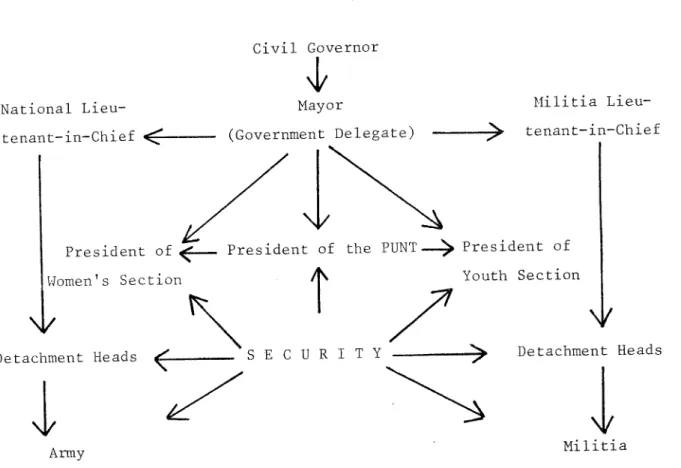
officially Malabo remains the capital. In reality the centre of po\,üer is now on the mainland, as Macfas only visits the island on very
rare occasíons, preferring to spend almost all his time in the small town
of Mongomo and ,.rl_irrg rhrãugh his political network. Each province is
go.r"rrrãd by a "Gorci" (Gobernador Civil). Each district is governed by a
ã"yor who is delegated from the Government, and by two Lieutenants-ín-Chief' one from the National Guard and one from the Militia, commanding their
respective units. The Government delegate is theoretically in control over
a conrnittee consisting of the local President of the PUNT, the President
of the l,Iomenf s Section of the PUNT and the President of the Juventud en
Marcha con Mácías. On paper this set-up is under formal control of the
PUNT and the arme-d forces but responsible to the civil administratíon'
In reality it is a shell around Ehe security organisation shown in the diagram
below, r^rhich has its members in all the other bodies, primarily as spies
and informers.
,7
\
The real administrative structure gives a different picture. Tire
diagram below shor¿s the key posts. Gone are the ideas of delegation of
po\^rer between etitnic groups, of balance and collaboration. All of them
are held by Ì'{acíast clånsmen, Ëhe Esengui from Mongomo'
tenant-in-Chief
€--
(Government Delegate)-+
President of rhe PUNTT' President of
[Jomenr s Section Youth Section
Detachment Heads
Civil
Governor..t
Mayor
National Lieu-
Ì,fi1itia
Lieu-tenant-in-Chief
)
1
SECURITY
J
Army
Detachment lleads
I
I
\.L
Militia
L7
Life President
H- E. Macías
of the Republic Nguema Biyogo
Miníster of
Armed Forces
the People I s
(Macías )
lutínister
for
NationalSecuriry (l'tacías)
Minister for
(Macías) Trade
Head of H.E. I s
Cívi1 Household
SecretarY General
Minístry of Defence
(Com. Teodoro Nguema
Mba N'zogo) (1)
Head of H.E. rs
Military Household
(Com. Teodoro Nguema
Mba N'zogo) (1)
Captain Aide-de-CanP
(t,taye)
lfinis
ter
f orBonifacio
Vice Bonifacio
President
Nguema Esono (2)
Foreign Nguema
Affairs
Esono (2)
Di s tric
t
Corunanders-in-Chief
Captain
Znd. ComPanY
(IIba Onana) ( I)
Secretary of State for
Economy and Finance
Director-General of
Information and Tourism
(Daniel Oyono AYingono)
Civil Governor
) )
) )
(3)
Notes:
(1) Cousins of Macías
(2) From Macías t village
and f amilY.
(3) Nephew of Macías
Permanent SecretarY of
the PUNT (Feliciano Oyono)
-v
(l)Commande'r-in-Chief
of
the People'sMilitia
(Braulio N'zue)v
Dis
trict-
Lieutenants-in-Chief \yDi s trict Second-Lieutenant s
v
Detachment Offieers
{,
Militia
Minister
of
theInterior
Secretary-General of
the PresidencY
Director*General of
Security
As with Ëhe administration, the Government is one thing on paper
and another in reality. This began on L4 JuLy L972 when Macías, elected for
a five-year period, proclaimed himself President for Life and took upon
him-self forty-five other official titles. The first Vice-President, a Bubi
from Fernando Po, died in connection with the destruction of a photo of
Macías. According to the Constitution the post should be held by a Bubi, but the present Vice-President is a Fang from Ì'facías' clan in Mongomo.
He will appear again in this account, in the office of Blackbich Prison.
The CabineË should also include the heads of twelve ministries.
Of those who made up the Independence Cabinet, ten have been killed'
"Africa South of the Sahara" lists the 1974 Cabinet, soberly commenting that
"some of these Ministers may be dead". Three have indeed been ki11ed' but
the low number most 1ikely depends not so much on lack of zeal as lack of
money. trrlhen the economy came close to bankruptcy in L972, several ministries
\47ere more or less closed. At present three seem to have dísappeared altogether'
The l,Iinistries of Popular Educatíon, Popular Construction, Agriculture,
Popular Health, and Electricity and Natural Resources have ministers
appointed by Macías personally. However, they have no budget and when I went
tå tne buitdings the doors had been loeked for a long time. The only
ministries which seem to function to any degree are the l4inistry for
External Relations and Friendship with the Peoples,headed by the
Vice-president; the Ministries of the Peoplets Armed Forces, National Security
and Èhe Peoplets Ministry of Trade, with Macías carrying all the portfolios'
The mechanisms which really govern life in the country are elementary,
brutal and effective. The constitutional structure at the top has been
s\^/ept array and the same has happened to the structures at grassroots 1evel,
i.u., the tradítional village democracy which functioned on a basis of
spiritual authority, kinship loyalties and prestige based on Ëhe respect
a person could earn from his community. The o1d chiefs and their councillors
have been substituted by militants appointed by Macías. "Now every chief
\^/ants to be a little Macías in his or,rn village." If he has ambitions to
go further in life he has to prove himself politically, inform on those who are discontented, report suspected "subversivos" and act in support
of Þtacías. The days of ruling by consensus are long gone.
Every village or tor^7n in controlled by a Comité de Base:, The
compositíon is the same as that of the Committee at the district 1evel,
with the local President of PUNT, the President of the I'rlomenrs Section and the president of the Youth Section. The Base CommitËee deals primarily
with national security and surveillance of al1 travel and movement within
the country. Nobody is allowed to leave his or her place of residence
wifhout splcial permission. The perrnit, ca11ed "credencia", is issued by
the Delegã'ao C.tUãtnativo. It ís given for such things as reporting for
\^/ork; on occasions for seeking such medical treatment as is available,
but very rarely for such purposes as visitinEi onets wife and children.
lfhen a traveller arrives at his stafed destination he must
prompt.ly report to the local Base Commíttee, giving an account of v¡here he
h",
"oro" from, the purpose of his visit and the persons with
whom he is
going tostay (there are no\¡/ only two hotels in the eountry, in BaLa and
Malabo) ancl for how 1ong. His host must report on the s¿tme matlers'
Failure Ëo comply inevitably leads to arresË by the political police
-the Mílitia.
Further control of movements inside the country is maintained by
an extensive network of checkpoints' established every 25 kiloneters along
Ehe roads and manned day and night. The system is based on a double watch
kept borh by the Militia and the ar:Ïny, the Guardia Nacional' At every
chãckpoint there are tr^7o separate camps \^7ith 5-10 people in each, checking
orr each other as well as on travellers'
There has been no lack of official justification for the internal
security system. Macías has declared that he has been threatened by, and
by devine grace saved from, no less than fourteen attacks against his
life. This is not a case of allegations open to doubt; it is downright
ridiculous. Already the evenLs of 5 March'Lg6g are questionable, and as far
as the other reputeã coups d'état are concerned it seems faír1y clear that
most of them have been nothing but stories made up by Macías to demonstrate
his invulnerability and divine protection. Among the refugees, opinions
are dívided as to l"lacías' other motives for claiming that he has been
threatened by "subversivos". Some say that he uses an invented attempt
against tris iife as ân excuse to kil1, others that he kills whether he has
an excuse or nor. Judging from the existing list of his victims and from
the knov¡n cases where entire villages have been exterminated, it appears
unlikely that he feels restrained by the need for offical excuses '
"Mitogott, an Equatorial Guinean using a pseudonym for the sake
of protecting rálatives inside the country' also mentiones "excessive degrees of racísm, tribalism and regionalism". This deserves comments' The racism
directed tor¿ards Spaniards may be seen as a natural post-Independence
reaction and has not been systematic. The tribalism directed tor¡ards
the non-Fang ethnic groups has been much in evidence and has been severe
periodically, but I have heard refugees of Bubi and Fernandino origin say ttrat "tie Fâng now suffer more than us". Against the background of
what has been donã to their groups lhis seemed a surprising opinion, but
their rationale \^¡as that "the Fang have lost more than us because there are
more of them and nor^i Macías oppresses everybody"'
Theregionalismcanperhapsberegardedasanexaggerated
at.tempt at counteracting the preferential treatment the colonialists
gave to Fernando Po. But other things are difficult to understand, such
as the attitude to\n/ards the already vastly diminished population of
Annobón. A medically trained refugee relates:
"In March and April there \^ras a cholera epidemic in Equatorial
Guínea. The hrorld Health organisation, in collaboration tiith
the Ministry of Health, began a campaign of vaccination with a team
for each province. The tearn for Ëhe island of Macías Nguema
Biyogo began its work in the capital, starting r¡ith the Government
grtr_rl r" i" usual and then going on to vaccinate those in
""f,oãt". A third of this latter group was vaccinated. Subsequently,