C. Claravall, 1-3 08022 Barcelona Tel. 93 602 22 00 Fax 93 602 22 49
C. I. F . G: 5 9 0 6 9 7 4 0 Un iv e rs ita t Ra m o n L lu ll F u n d a ci ó Rg tr e . F u n d . Ge n e ra lit a t d e Ca ta lu n ya n úm . 472 (28 -02 -90)
TESI DOCTORAL
Títol
Animation and Interaction of Responsive, Expressive,
and Tangible 3D Virtual Characters
Realitzada per
Adso Fernández Baena
en el Centre
La Salle Campus Barcelona
i en el Departament Grup de Tecnologies Mèdia (GTM)
Agra¨ıments
La consecuci´o d’aquesta tesi ha estat un cam´ı llarg, algunes vegades molt divertit i d’altres molt dur, on he tingut l’oportunitat de con`eixer a diverses persones molt interessants que m’han ajudat i acompanyat, i que de la mateixa manera que aquesta tesi, m’enporto amb mi per sempre.
En primer lloc, m’agradaria agrair al meu director de tesi, en David Miralles, l’oportunitat d’haver pogut realitzar aquest treball. Sense ell, aquesta tesi no hagu´es estat possible, i so-bretot, li agraeixo el fet de d’haver-me ensenyat el m´on de la recerca. A m´es a m´es, durant aquests anys he crescut molt com a professional i persona al seu costat gr`acies als seus bons consells i indicacions. Ha estat un plaer treballar amb ell.
A continuaci´o, m’agradaria agrair a en Francesc Al´ıas, director de l’`area d’HCI (Human Computer Interaction) durant la consecuci´o de la tesi i actualment cap del grup de recerca GTM (Grup de Tecnologies M`edia) i director d’Enginyeria La Salle, els seus profitosos con-sells i `anims en moments durs de la tesi. Durant aquest temps, tamb´e he tingut el plaer de compartir viv`encies amb els companys doctorands que van iniciar tamb´e aquest cam´ı en temps similars, en Marc Arnela, en Ramon Mart´ın, en Xavier Valero i l’Angels Aragon`es, que han estat de gran ajuda.
Tamb´e vull agrair l’entusiasme, professionalitat i ganes de participar en els nostres pro-jectes d’investigaci´o a l’Eduard Ruesga i la Meritxell Aragon`es, t`ecnics del Medialab, el laboratori de captura de moviment de la Salle.
Seguint, m’agradaria mencionar als meus companys del projecte THOFU (Tecnolog´ıas del HOtel del FUturo, CEN-20101019), que ha abarcat bona part de la meva tesi i del qual he tingut el plaer de ser Team Leader en un dels seus subpaquets de treball. En especial, vull fer menci´o del meu company Marc Antonijoan per la seva professionalitat i saber fer, i tranquilitat a l’hora d’afrontar el problemes, que m’ha fet cr`eixer molt. Tamb´e vul extendre-ho al Ra´ul Monta˜no, amb el qual hem treballat colze a colze, i a l’Arturo Roversi, l’Anna Fust´e i Judith Amores.
Tambe vull agrair al meu company Roger Bold´u la bona feina i la grata companyia, que han donat lloc a la part final de la tesis. Tamb´e a en Jordi Alb´o i al projecte PATRICIA (Pain and Anxiety Treatment based on social Robot Interaction with Children to Improve pAtient experience, TIN2012-38416-C03-01,02), que ha finan¸cat part d’aquesta recerca, i a en Marc Exp`osito per la seva co l.laboraci´o. Per altra banda, tamb´e agrair al grup de recerca Fluid Interfaces i a la seva directora, Pattie Maes, pel fet d’haver-me deixat passar prop d’un mes al Medialab del MIT (Massachussets Institute of Technology), un lloc que no deixa a ning´u indiferent, i al Xavi Benavides i de nou a la Judith Amores per fer-nos d’anfitrions.
Depar-tament de Tecnologies M`edia) i al grup de recerca GTM (Grup de Tecnologies M`edia) per haver-me perm´es realitzar aquest treball i presentar algunes parts en congressos cient´ıfics in-ternacionals i con`eixer llocs com Hong Kong, Cagliari, Las Vegas o Kobe, i tenir l’oportunitat de compartir experi`encies amb altres investigadors. A l’Emiliano Labrador per la seva ajuda en el disseny gr`afic del p`oster que encapsala les publicacions d’aquesta tesi. Tamb´e agrair a tots els companys de la universitat que en algun moment m’han donat un cop de m`a.
Per acabar, i el m´es important, m’agradaria agrair als meus pares el seu suport incondi-cional i sobretot, l’oportunitat d’haver pogut estudiar una carrera i un m`aster, que al fi i al cap, m’han perm´es poder realitzar aquesta tesi. Tamb´e agrair al meu germ`a, en Cesc, als meus tiets, Xati i Pepe, cosins i als meus avis les ganes que m’han transm´es per poder aconseguir aquest repte. Tamb´e a tots els meus amics, pel suport incondicional i les festes que m’han deixat perdre.
Gr`acies a tots.
0.1
Abstract
This thesis is framed within the field of 3D Character Animation. Virtual characters are used in many Human Computer Interaction applications such as video games and serious games. Within these virtual worlds they move and act in similar ways to humans controlled by users through some form of interface or by artificial intelligence. This work addresses the challenges of developing smoother movements and more natural behav-iors driving motions in real-time, intuitively, and accurately. The interaction between virtual characters and intelligent objects will also be explored. With these subjects researched the work will contribute to creating more responsive, expressive, and tangible virtual characters.
The navigation within virtual worlds uses locomotion such as walking, running, etc. To achieve maxi-mum realism, actors’ movements are captured and used to animate virtual characters. This is the philosophy of motion graphs: a structure that embeds movements where the continuous motion stream is generated from concatenating motion pieces. However, locomotion synthesis, using motion graphs, involves a tradeoff between the number of possible transitions between different kinds of locomotion, and the quality of these, meaning smooth transition between poses. To overcome this drawback, we propose the method of progres-sive transitions usingBody Part Motion Graphs (BPMGs). This method deals with partial movements, and generates specific, synchronized transitions for each body part (group of joints) within a window of time. Therefore, the connectivity within the system is not linked to the similarity between global poses allowing us to find more and better quality transition points while increasing the speed of response and execution of these transitions in contrast to standard motion graphs method.
Secondly, beyond getting faster transitions and smoother movements, virtual characters also interact with each other and with users by speaking. This interaction requires the creation of appropriate gestures according to the voice that they reproduced. Gestures are the nonverbal language that accompanies voiced language. The credibility of virtual characters when speaking is linked to the naturalness of their move-ments in sync with the voice in speech and intonation. Consequently, we analyzed the relationship between gestures, speech, and the performed gestures according to that speech. We defined intensity indicators for both gestures (GSI, Gesture Strength Indicator) and speech (PSI, Pitch Strength Indicator). We studied the relationship in time and intensity of these cues in order to establish synchronicity and intensity rules. Later we adapted the mentioned rules to select the appropriate gestures to the speech input (tagged text from speech signal) in theGesture Motion Graph (GMG). The evaluation of resulting animations shows the importance of relating the intensity of speech and gestures to generate believable animations beyond time synchronization. Subsequently, we present a system that leads automatic generation of gestures and facial animation from a speech signal: BodySpeech. This system also includes animation improvements such as: increased use of data input, more flexible time synchronization, and new features like editing style of output animations. In addition, facial animation also takes into account speech intonation.
0.2
Resum
Aquesta tesi s’emmarca dins del m´on de l’animaci´o de personatges virtuals tridimensionals. Els personatges virtuals s’utilitzen en moltes aplicacions d’interacci´o home m`aquina, com els videojocs o els serious games, on es mouen i actuen de forma similar als humans dins de mons virtuals, i on s´on controlats pels usuaris per mitj`a d’alguna interf´ıcie, o d’altra manera per sistemes intel·ligents. Reptes com aconseguir moviments fluids i comportament natural, controlar en temps real el moviment de manera intuitiva i precisa, i incl´us explorar la interacci´o dels personatges virtuals amb elements f´ısics intel·ligents; s´on els que es treballen a continuaci´o amb l’objectiu de contribuir en la generaci´o de personatges virtuals responsius, expressius i tangibles.
La navegaci´o dins dels mons virtuals fa ´us de locomocions com caminar, c´orrer, etc. Per tal d’aconseguir el m`axim de realisme, es capturen i reutilitzen moviments d’actors per animar els personatges virtuals. Aix´ı funcionen els motion graphs, una estructura que encapsula moviments i per mitj`a de cerques dins d’aquesta, els concatena creant un flux continu. La s´ıntesi de locomocions usant els motion graphs comporta un com-prom´ıs entre el n´umero de transicions entre les diferents locomocions, i la qualitat d’aquestes (similitud entre les postures a connectar). Per superar aquest inconvenient, proposem el m`etode transicions progressives usantBody Part Motion Graphs (BPMGs). Aquest m`etode tracta els moviments de manera parcial, i gen-era transicions espec´ıfiques i sincronitzades per cada part del cos (grup d’articulacions) dins d’una finestra temporal. Per tant, la conectivitat del sistema no est`a lligada a la similitud de postures globals, permetent trobar m´es punts de transici´o i de m´es qualitat, i sobretot incrementant la rapidesa en resposta i execuci´o de les transicions respecte als motion graphs est`andards.
En segon lloc, m´es enll`a d’aconseguir transicions r`apides i moviments fluids, els personatges virtuals tamb´e interaccionen entre ells i amb els usuaris parlant, creant la necessitat de generar moviments apropiats a la veu que reprodueixen. Els gestos formen part del llenguatge no verbal que acostuma a acompanyar a la veu. La credibilitat dels personatges virtuals parlants est`a lligada a la naturalitat dels seus moviments i a la concordan¸ca que aquests tenen amb la veu, sobretot amb l’entonaci´o d’aquesta. Aix´ı doncs, hem realitzat l’an`alisi de la relaci´o entre els gestos i la veu, i la conseq¨uent generaci´o de gestos d’acord a la veu. S’han definit indicadors d’intensitat tant per gestos (GSI, Gesture Strength Indicator) com per la veu (PSI, Pitch Strength Indicator), i s’ha estudiat la relaci´o entre la temporalitat i la intensitat de les dues senyals per establir unes normes de sincronia temporal i d’intensitat. M´es endavant es presenta elGesture Motion Graph (GMG), que selecciona gestos adients a la veu d’entrada (text anotat a partir de la senyal de veu) i les regles esmentades. L’avaluaci´o de les animaciones resultants demostra la import`ancia de relacionar la intensitat per generar animacions cre¨ıbles, m´es enll`a de la sincronitzaci´o temporal. Posteriorment, presentem un sistema de generaci´o autom`atica de gestos i animaci´o facial a partir d’una senyal de veu: BodySpeech. Aquest sistema tamb´e inclou millores en l’animaci´o, major reaprofitament de les dades d’entrada i sincronitzaci´o m´es flexible, i noves funcionalitats com l’edici´o de l’estil les animacions de sortida. A m´es, l’animaci´o facial tamb´e t´e en compte l’entonaci´o de la veu.
0.3
Resumen
Esta tesis se enmarca dentro del mundo de la animaci´on de personajes virtuales tridimensionales. Los person-ajes virtuales se utilizan en muchas aplicaciones de interacci´on hombre m´aquina, como los videojuegos y los serious games, donde dentro de mundo virtuales se mueven y act´uan de manera similar a los humanos, y son controlados por usuarios por mediante de alguna interfaz, o de otro modo, por sistemas inteligentes. Retos como conseguir movimientos fluidos y comportamiento natural, controlar en tiempo real el movimiento de manera intuitiva y precisa, y incluso explorar la interacci´on de los personajes virtuales con elementos f´ısicos inteligentes; son los que se trabajan a continuaci´on con el objetivo de contribuir en la generaci´on de personajes virtuales responsivos, expresivos y tangibles.
La navegaci´on dentro de los mundos virtuales hace uso de locomociones como andar, correr, etc. Para conseguir el m´aximo realismo, se capturan y reutilizan movimientos de actores para animar los personajes virtuales. As´ı funcionan los motion graphs, una estructura que encapsula movimientos y que por mediante b´usquedas en ella, los concatena creando un flujo cont´ınuo. La s´ıntesi de locomociones usando los motion graphs comporta un compromiso entre el n´umero de transiciones entre las distintas locomociones, y la calidad de estas (similitud entre las posturas a conectar). Para superar este inconveniente, proponemos el m´etodo transiciones progresivas usando Body Part Motion Graphs (BPMGs). Este m´etodo trata los movimientos de manera parcial, y genera transiciones espec´ıficas y sincronizadas para cada parte del cuerpo (grupo de articulaciones) dentro de una ventana temporal. Por lo tanto, la conectividad del sistema no est´a vinculada a la similitud de posturas globales, permitiendo encontrar m´as puntos de transici´on y de m´as calidad, incre-mentando la rapidez en respuesta y ejecuci´on de las transiciones respeto a los motion graphs est´andards.
En segundo lugar, m´as all´a de conseguir transiciones r´apidas y movimientos flu´ıdos, los personajes virtuales tambi´en interaccionan entre ellos y con los usuarios hablando, creando la necesidad de generar movimien-tos apropiados a la voz que reproducen. Los gesmovimien-tos forman parte del lenguaje no verbal que acostumbra a acompa˜nar a la voz. La credibilidad de los personajes virtuales parlantes est´a vinculada a la naturalidad de sus movimientos y a la concordancia que estos tienen con la voz, sobretodo con la entonaci´on de esta. As´ı pues, hemos realizado el an´alisis de la relaci´on entre los gestos y la voz, y la consecuente generaci´on de gestos de acuerdo a la voz. Se han definido indicadores de intensidad tanto para gestos (GSI, Gesture Strength Indica-tor) como para la voz (PSI, Pitch Strength Indicator), y se ha estudiado la relaci´on temporal y de intensidad para establecer unas reglas de sincron´ıa temporal y de intensidad. M´as adelante se presenta elGesture Motion Graph (GMG), que selecciona gestos adientes a la voz de entrada (texto etiquetado a partir de la se˜nal de voz) y las normas mencionadas. La evaluaci´on de las animaciones resultantes demuestra la importancia de relacionar la intensidad para generar animaciones cre´ıbles, m´as all´a de la sincronizaci´on temporal. Posterior-mente, presentamos un sistema de generaci´on autom´atica de gestos y animaci´on facial a partir de una se˜nal de voz: BodySpeech. Este sistema tambi´en incluye mejoras en la animaci´on, como un mayor aprovechamiento de los datos de entrada y una sincronizaci´on m´as flexible, y nuevas funcionalidades como la edici´on del es-tilo de las animaciones de salida. Adem´as, la animaci´on facial tambi´en tiene en cuenta la entonaci´on de la voz.
Finalmente, se han trasladado los personajes virtuales de los entornos virtuales al mundo f´ısico para explorar las posibilidades de interacci´on con objetos reales. Para este fin, presentamos los AvatARs, per-sonajes virtuales que tienen representaci´on tangible y que se visualizan integrados en la realidad a trav´es de un dispositivo m´ovil gracias a la realidad aumentada. El control de la animaci´on se lleva a cabo mediante un objeto f´ısico que el usuario manipula, seleccionando y configurando las animaciones, y que a su vez sirve como soporte para la representaci´on del personaje. Posteriormente, se ha explorado la interacci´on de los
Contents
0.1 Abstract . . . 5
0.2 Resum . . . 7
0.3 Resumen. . . 9
1 Motivation 29 1.1 Responsive virtual characters . . . 34
1.2 Expressive virtual characters . . . 36
1.3 Tangible virtual characters . . . 37
1.4 Organization . . . 39
2 Notes on Character Animation 41 2.1 Motion capture . . . 43
2.2 Motion synthesis . . . 45
2.3 Motion graphs . . . 47
2.3.1 Construction process . . . 49
2.3.2 Motion synthesis process . . . 51
3 Synthesis and Evaluation of Progressive Transitions in Locomotions using Body Part Motion Graphs 53 3.1 Introduction. . . 55
3.2 Related work . . . 58
3.2.1 Construction process . . . 59
3.2.2 Labeling criteria . . . 59
3.2.3 Maneuverability . . . 59
3.2.4 Parameterization . . . 60
3.2.5 Evaluation . . . 61
3.3 Body Part Motion Graphs (BPMGs) . . . 61
3.3.1 Overview . . . 61
3.3.2 Body part specification . . . 62
3.3.3 Constructing a Body Part Motion Graph (BPMG) . . . 64
3.3.4 Synthesis of progressive transitions . . . 66
3.4 Evaluations I: Body Part Motion Graphs (BPMGs) against Standard Mo-tion Graph (SMG) . . . 72
3.4.2 Motion to motion transitions . . . 75
3.5 Evaluations II: Analyzing body part segmentation in BPMGs . . . 77
3.5.1 Connectivity versus split profiles . . . 78
3.5.2 Transition costs versus split profiles . . . 80
3.5.3 Optimizing motion to motion transitions . . . 82
4 Analysis and Synthesis of Body Language driven by Speech Emphasis 83 4.1 Introduction. . . 85
4.2 Gestures . . . 89
4.3 Related work . . . 90
4.3.1 Modelling synchrony between gestures and speech . . . 90
4.3.2 Synthesis systems of gestures . . . 93
4.4 Synthesizing gestures adapted to speech emphasis. . . 95
4.4.1 Overview . . . 95
4.4.2 Gesture analysis . . . 97
4.4.3 Speech-Gesture correlation . . . 101
4.4.4 Gesture synthesis using a Gesture Motion Graph (GMG) . . . 105
4.4.5 Evaluations . . . 111
4.4.6 Results and discussion . . . 114
4.5 BodySpeech: Facial and gesture animations . . . 118
4.5.1 Setting up . . . 119
4.5.2 Facial and body gesture synthesis . . . 121
4.5.3 Editing gestures style . . . 125
4.5.4 Summary . . . 126
5 Tangible Control and Interaction with Robots of Augmented Reality Virtual Char-acters 127 5.1 Introduction. . . 129
5.2 Tangible control of augmented reality virtual characters . . . 134
5.2.1 AvatAR (Augmented Reality virtual character) . . . 136
5.2.2 Interaction system . . . 138
5.2.3 Control design . . . 139
5.2.4 Implementation . . . 141
5.2.5 Discussion . . . 144
5.3 Interaction between AvatARs and social robots . . . 144
5.3.1 Pleo robot state of the art . . . 146
5.3.2 Interaction design . . . 148
5.3.3 Implementation . . . 153
5.3.4 Experiment design . . . 156
5.3.5 Results and discussion . . . 158
6 Conclusions, Limitations, and Future Directions 163
6.1 Animation using Body Part Motion Graphs (BPMGs) . . . 165
6.2 Animation and interaction through Gesture Motion Graph (GMG) and BodySpeech . . . 167
6.3 AvatARs animation and interaction with character robots . . . 171
7 Research Outputs 175 7.1 Summary of contributions . . . 177
7.2 Publications and additional material . . . 180
8 Appendix 189 8.1 Speech analysis . . . 191
8.1.1 Intonation in Spanish . . . 191
8.1.2 Speech analysis . . . 192
8.2 Automatic pitch accents detection . . . 194
Glossary
3D 3-dimensional. 29, 33, 35, 37, 43, 44, 45, 46, 85, 88, 98, 118, 163, 171, 173
AI Artificial Intelligence. 32, 34, 47, 51, 130
AM Autosegmental and Metrical model. 191
APML Affective Presentation Markup Language. 93
AR Augmented Reality. 34, 37, 127, 129, 131, 136, 141, 145, 163, 171, 173, 178, 179
ARA* Anytime Repairing A*. 51
AU Action Units. 169
AvatAR Augmented Reality virtual character. 38, 127, 131, 132, 133, 134, 136, 137, 138, 139, 144, 145, 151, 153, 163, 171, 172, 173, 178
BEAT Behavior Expression Animation Toolkit. 93
BF Branching Factor. 168
BP Body Part. 35, 61, 62, 64, 66, 67, 68, 166
BPMGs Body Part Motion Graphs. 35, 53, 57, 58, 61, 64, 65, 66, 70, 72, 73, 74, 75, 78, 80, 87, 141, 163, 165, 166, 167, 168, 177
BVH BioVision Hierarchy. 126
CCR Comparison Category Rating. 113
CGI Computer-Generated Imagery. 29, 32
CMOS Comparative Mean Opinion Score. 113, 114, 116, 169
CRF’s Conditional Random Fields. 94
DTW Dynamic Time Warping. 68
EV Evidence Variable. 192, 193
EV2 Evidence Variable 2. 192, 193, 194
FMDistance Fast Motion Distance. 99, 100, 121, 123, 168, 177
FMG Feature-based Motion Graph. 59, 165
fps frames per second. 59, 72, 74, 97
GMG Gesture Motion Graph. 36, 83, 87, 95, 105, 106, 107, 108, 111, 113, 118, 119, 122, 125, 163, 167, 168, 169, 170, 177
GP Gesture Phrase. 90, 95, 105, 106, 107, 108, 109, 110, 111, 119, 120, 121, 122, 123, 168, 169
GPLVMs Gaussian Process Latent Variable Models. 94
GPU Graphics Processing Unit. 32
GSI Gesture Strength Indicator. 87, 95, 99, 100, 101, 103, 105, 110, 168, 177
HCI Human Computer Interaction. 32, 85, 86, 134, 156, 163, 167, 171
HMD Head-Mounted Display. 173
HMG Hybrid Motion Graph. 59
HMM Hidden Markov Models. 94
HRI Human Robot Interaction. 38, 127, 133, 134, 145, 163, 171, 178
IK Inverse Kinematics. 65
IMG Interpolated Motion Graph. 59
IoT Internet of Things. 132
IPOCL Intent-based Partial Order Causal Link. 173
ISO International Organization for Standardization. 156
ITU International Telecommunication Union. 113
LM Local Maneuverability. 75, 165, 166
MCC Matthews Correlation Coefficient. 99, 100, 103, 193, 194
MmG Motion-motif Graph. 59
OS Operating System. 126
PAPT Pitch Accent Peak Time. 95, 102, 103, 108, 109, 168, 192
PCA Principle Component Analysis. 49, 134
Pegaso Primal Estimated sub-GrAdient SOlver. 100
PMG Parametric Motion Graph. 60
PSI Pitch Strength Indicator. 87, 95, 103, 105, 108, 110, 112, 168, 193, 194
SAPI Speech API. 118
SCC Strongly Connected Component. 51, 65, 107, 165, 166
SDK Software Development Kit. 169
SMG Standard Motion Graph. 35, 47, 53, 57, 58, 61, 62, 64, 65, 70, 72, 73, 74, 75, 78, 80, 87, 163, 165, 166, 177
SMO Sequential Minimal Optimization. 100
SP Split Profile. 57, 62, 64, 66, 67, 73, 77, 78, 80, 82, 166
SVM Support Vector Machine. 100
TBF Time Between Frames. 73, 74, 165, 166
TCP/IP Transmission Control Protocol / Internet Protocol. 153
ToBI Tones and Break Indices. 192
TRUE Testing platfoRm for mUltimedia Evaluation. 111
TUI Tangible User Interface/s. 34, 37, 127, 130, 132, 135, 137, 141, 163, 171, 178
List of Figures
1.1 From left to right, up to down: Buzz Lightyear (a) from ”Toy Story” [Pixar, 1995], Carl Fredricksen (b) from ”Up!” [Pixar, 2009], R´emy (c) from ”Rata-touille” [Pixar, 2007], Po (d) from ”Kung Fu Panda” [Dreamworks Studios, 2008], Shrek (e) [Dreamworks Studios, 2001] and Beowulf (f) [Robert Ze-meckis, 2007]. . . 30 1.2 Graphs of emotional response against similarity to human appearance and
movement from [Brenton et al., 2005] . . . 31 1.3 A capture from Ghostbusters: Sanctum of Slime [Atari, 2015]. . . 32
2.1 An actor dressed in a suit with markers being captured while performing a shoot with a bow. [The Capture Lab, 2015] . . . 43 2.2 From right to left, motion capture to virtual character. Actor movement is
captured by inferring 3D markers positions through cameras, then these 3D points are mapped to a human model for finally drive a virtual character by retargeting. [Wikipedia Commons, 2015a] . . . 44 2.3 Two people are being tracked by a Kinect Xbox One. Note the obtained
precision of skeletons although the captured subjects have their hands in touch. Although the obtained results, Kinect’s user tracking suffers from occlusion problems because as a unique camera it has only one point of view rather than tracking systems where more cameras are involved. [fxguide, 2015] 45 2.4 Videogame character move tree. As graph shows, there are defined paths to
transition between motion clips establishing strict relations that could affect to character controllability. . . 46 2.5 A standard motion graph [Lee et al., 2002] from two motion capture clips.
Vertices are poses from the motion capture data and edges are transitions between similar poses. Black edges are from the original motion capture and gray edges are additional edges found between similar poses. . . 47 2.6 This figure summarizes motion graph framework. From a motion capture
2.7 Transition blending during correspondence region. Blending is done for all joints j involved in the movement. We want to transition from motion A
(blue line) to B (red line). So, we blend signalOAj (t) in the region defined bytAs andtAe, which belongs to origin motionAand jointj, with signalOjB(t)
in the region defined bytBs andtBs, from target motionB and the same joint. Note that both correspondence regions are drawn in dashed style. . . 50 2.8 Example of strongly connected components of a graph. Note that each node
belonging to a group is directly or indirectly connected with each other of the same group. In this case, the final motion graph will be the component formed by nodes 0, 2, 3, 4 and 5. . . 51
3.1 Assassins Creed video game screenshot. Alta¨ır (main character) is walking through a roof. The animation is generated with a move tree. [Gamer Limit, 2015]. . . 55 3.2 Distance maps from different body parts. Dark zones contain good transition
points rather than light zones, where similarities between postures are low. From top to down, and left to right: Trunk of the body, left upper side, right upper side and lower body. . . 57 3.3 BPMGs’ transition. Each row represents a body part transition which has an
origin frame from the origin motion, a path, and a target frame belonging to a target motion. Motion A (blue) is the origin motion and motion B (red) is the target motion. Each path is drawn with different color regions that describe from which motion clip are belonging frames in each transitions. . . 58 3.4 A simple example illustrating the construction steps of Well-connected Motion
Graph (WcMG): (a) InterpolationStep, (b) Transition Creation Step and (c) Node Reduction Step. All original nodes are kept. Interpolated nodes and edges outside the best paths set are removed. Here only three discretizations of the interpolation weight are shown as illustration. In this implementation, they used nine, from 0.1 to 0.9 with a 0.1 increment. [Zhao and Safonova, 2009] . . . 60 3.5 System overview. From a motion capture database body part motion graphs
are constructed after full-body motion is split in several partial motions. Then, user controls motion synthesis that require searching and synchronization process, and motion generation steps. . . 62 3.6 Human Kinematic Chains. Joints in red belong to head chain; yellow joints
belong to upper right chain; green joints belong to trunk chain; brown joints belong to upper left chain; blue and purple joints belong to lower right chain and lower left chain respectively. . . 63
3.7 Walking phases. Walking is a locomotion in which feet alternate swing and stances phases. After both feet are in a stance phase, which means double support, one of them (left or right) starts with a swing phase while the other remains in stance phase. When this swing ends, both are again in double support. Then, the other foot performs a swing phase while now is the other that rests in a stance phase, and so on. . . 66 3.8 Body part transition paths. Origin frames are indicated by in, target frames
byjn, transition paths are denoted bypn, beingnfrom 1 to 4 as the number
of body parts existing in this candidate transition. . . 67 3.9 Synchronization process. At the top, we have the origin frames, paths and
target frames of body part transitions. Paths line style denotes how many frames are in each path which is different in all cases. If we compose that transition at that point the gap of frames of each body part does not match with path durations. So, at the bottom, paths are synchronized and fill the gaps exactly by time scaling them. . . 68 3.10 Transition scheme. Note that transition response is the elapsed time between
the frame when the transition is requested and the beginning of the first body part transition. . . 69 3.11 Comparison between a BPMGs’ and SMG’s transitions. Three instants are
captured in images (a), (b) and (c) which illustrate the transition of two virtual characters (skeletons) from walking to running. t and tr denote the
aggregated time and the time where the transition was requested, respectively. The left virtual character is driven by SMG, on the other hand, the right virtual character is driven by BPMGs. The original video can be found at goo.gl/82OjDa. . . 71 3.12 Body parts. Joints in yellow color belong to lower-body; green joints belong
to the trunk of the body; red and blue joints belong to right upper-body and left upper-body respectively. . . 72 3.13 Body part Split Profiles (SP). From 2 to 5 number of body parts are allowed
in SPs. Two different segmentations with 3 and 4 parts are used. . . 77 3.14 BPMGs connectivity. This graph shows the connectivity of different split
profiles in each similarity threshold value. Each colored bar represents a split profile. . . 79 3.15 BPMGs’ transition cost. In horizontal axis is defined the similarity threshold
and in vertical axis, the transition cost. Each line is related with a body part Split Profile (SP) which color changes along the color scale below indicating the connectivity of this SP from the similarity threshold value. . . 81
4.2 Gesture streams synchronized with speech. At the bottom, a gesture stream synchronized with speech only in terms of time by matching apices (from gestures) with pitch accent peaks (from speech). In this case, there is no relation between PSI values and GSI values. At the top, a gesture stream synchronized in terms of time and intensity. In this example picture, we assume that high PSI values are related with high GSI values, and low PSI values with low GSI values. . . 88 4.3 Within Autosegmental-Metrical (AM) model [Pierrehumbert, 1980], pitch
accents are combined with edge tones, which mark the beginnings and/or ends of prosodic phrases, to determine the intonational contour of a phrase. The need for pitch accents to be distinguished from edge tones can be seen in this contours in which the intonational events, annotated using the ToBI (Tones and Break Indices system) [Silverman et al., 1992b], are anH∗pitch accent followed by anL−phrase accent and aH%boundary tone. Fore more details in intonation the reader is referred to Appendix 8.1.1. [Wikipedia, 2015b] 92 4.4 Phases workflow. We part from synchronized speech signal and motion
cap-ture data that, in parallel, are analyzed in Speech Analysis 8.1.2 and Gescap-ture Analysis 4.4.2 phases, respectively. Then, we obtain pitch accents times and strengths from speech signal, and strokes apices and strokes strengths from motion capture data. These parameters are include in a Speech-Motion Cor-relation 4.4.3 process which concludes with synchrony and intensity rules. Then, a gesture motion graph is created in Gesture Synthesis 4.4.4 phase from a labeled gesture database and restricted by the mentioned rules. Fi-nally, we generate gesture animations driven by annotated speech which we have analyzed in Evaluations 4.4.5 phase. . . 96 4.5 Set-up of the recording session. An optical motion capture system with 24
infra-red cameras, a clip-on wireless microphone, and a videocamera (not in the image). The actor is wearing a black motion capture suit with reflective markers. . . 97 4.6 Example of the entire annotation of a particular video fragment in Anvil.
The upper three windows are (from left to right): the command window, the motion capture viewer (in 3D) and the video. The latter two are manually synchronized. The bottom window is the complete video annotation. See the capture in different output formats at same time helps a lot in the annotation task. . . 100 4.7 Histogram with the distances in seconds between PAPTs and apex times.
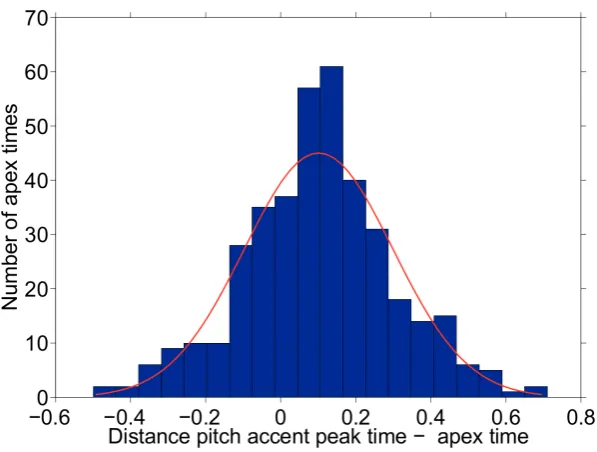
Positive values indicate that the apex time comes before PAPT. Negative values indicate the opposite. The mean value is 0.1 seconds. Standard deviation is 0.2 seconds. . . 102 4.8 Scatter plot of the PSI and GSI values that come from aggressive (circles)
and neutral (squares) styles. The linear polynomial straight line represents the correlation between PSI and GSI. The dashed lines represent the margin, experimentally determined, for the intensity rule. . . 104
4.9 Joints weights. Spines, neck, rightarm and leftarm, rightforearm and left-forearm have a weight of 1, and the rest of body joints have a weight of 0. . . 106 4.10 Edges generation. Edges in GMG connect consecutive GPs in original
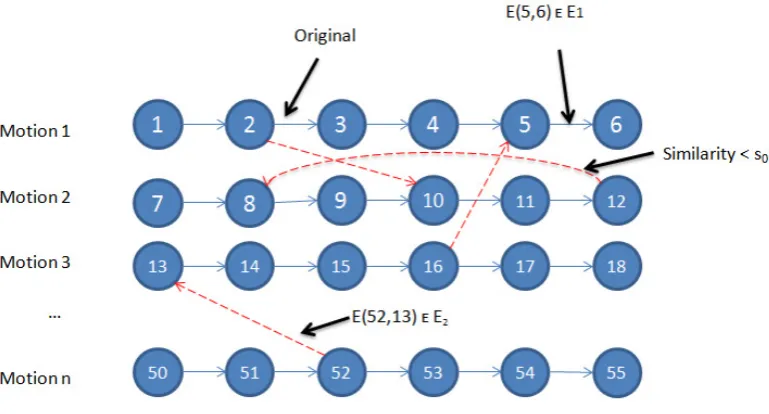
record-ings (E1) as painted with continuous lines, and GPs with a posture similarity under a similarity thresholdst(E2) as painted with dashed lines. . . 107 4.11 Gesture phrase alignment with anchor points. Dashed lines denote transition
motion segments and continuous lines gesture phrases. Apex from gesture phrases are marked with vertical lines. There are two timelines, one for each cue (gesture and speech). Anchor points define the gaps where gestures have to be fitted. . . 109 4.12 Snapshot of one step of the test using the online platform TRUE [Planet
et al., 2008]. Every step contains two videos which have to be evaluated by the tester. . . 112 4.13 Five-point scale CMOS responses of users’ preferences when comparing two
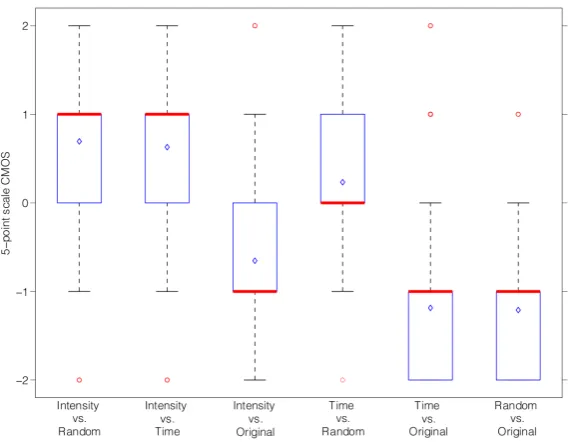
videos generated with different methods (see Section 4.4.5 for methods de-scriptions). The diamond marker within the boxplots represents the distribu-tions mean values. . . 115 4.14 Preference bars. They show the percentages of users ratings for each
com-parison. . . 115 4.15 System overview. The off-line stage is used to generate a motion graph (at
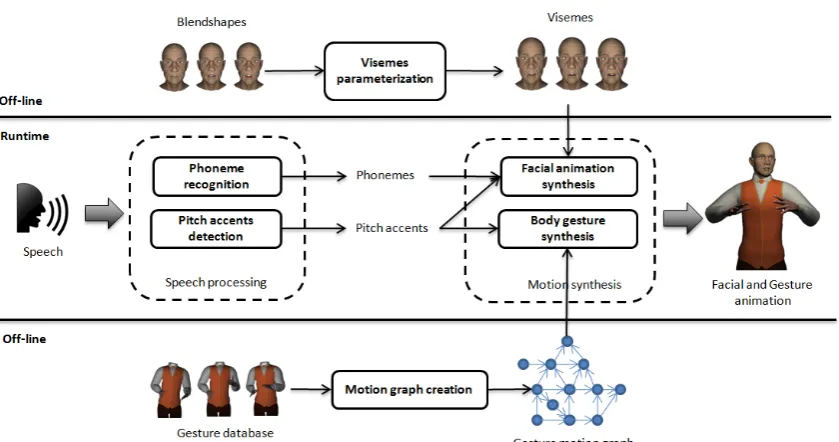
the bottom) and a set of visemes (on top). Then, body and facial animation are obtained from a speech signal in the runtime stage (on the middle). . . 119 4.16 New graph screen. GMG can be parameterized by changing input databases
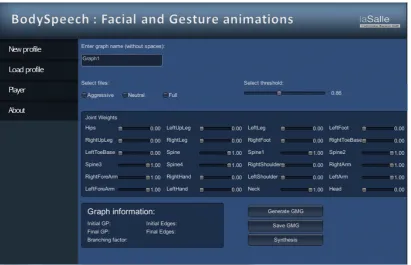
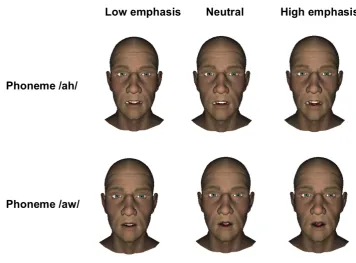
(aggressive, neutral or full, which includes both previous), joint weights for posture similarity computation (dark blue box in the middle), similarity thresh-old that defines the existence of transitions between GP’s (slider on top right). Once the GMG is generated, graph information is displayed at the bottom of the screen to know graph capabilities. . . 120 4.17 Emphatic visemes for /ah/ and /aw/ phonemes. . . 122 4.18 Gesture alignment. Body gestures are aligned with pitch accents by modifying
their length. The goal is to match stroke apexes with pitch accents times (t), taking into account anticipation times (Ta). We consider two cases: only
stroke (on the left) and gestural phrase (on the right). . . 123 4.19 Output viseme generation for pitch accents. Pitch accent (PA) strength is
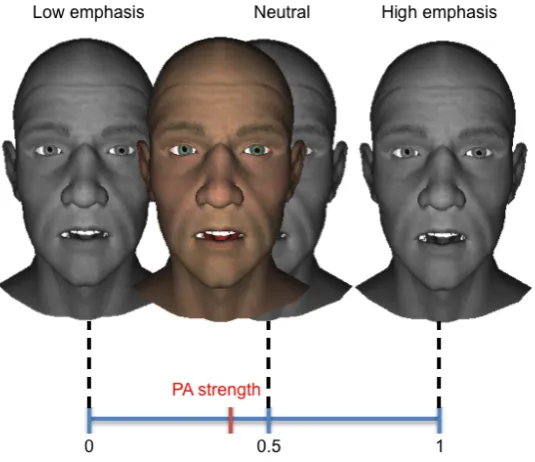
used to weight low emphatic, neutral and high emphatic visemes in the mor-phing process. In this example, higher emphatic visemes have more opened mouths. . . 124 4.20 Synthesis screen. On the upper-left corner, there are the buttons to select an
5.1 A screenshot from video game The Sims 3 University Life [EA, 2015]. As could be seen, virtual characters live in a virtual world that simulates a University campus, where they can walk, move on bicycle, and interrelate to each other as students. [JRC Gamecentrum, 2015] . . . 129 5.2 On the left, virtual characters displayed thanks to the detection of card
mark-ers [Bimber and Raskar, 2006]. On the right, AR EdiBear application for Samsung Apps [Samsung Electronics Co., Ltd., 2015] which provides a touch-screen interface for controlling the virtual bear. . . 130 5.3 Screenshot of a two-player MonkeyBridge game. One of the players has
already built a bridge for his character, which consists of virtual blocks (mod-els with the dark wooden texture) and physical tiles (bright balsa-wood and stone cubes showing through the virtual objects). The monster character of the user standing in the middle has just hopped over from a virtual tile onto a physical platform. The user is holding the next building block in his hand. [Barakonyi et al., 2005] . . . 131 5.4 AvatAR interaction system which is formed by a physical cube and a tablet
device. A virtual character is displayed on the screen inside the cube. . . 132 5.5 Vleo and Pleo mixed environment is formed by a Pleo, a physical cube and a
tablet device. Vleo appears on the tablet screen when the cube is detected. 134 5.6 Users can pull directly on the marionette strings with a second hand to gain
a greater range of independent arm movement beyond the paddle control. [Mazalek and Nitsche, 2007] . . . 135 5.7 Cube for controlling an AvatAR. Note that faces denote the type of
locomo-tion being the observed face reproduced on the virtual character. . . 136 5.8 An augmented reality virtual character (AvatAR) is displayed inside the cube.
Due to the camera is observing the idle face, AvatAR is in rest pose. . . 137 5.9 Interaction system. The system is formed by a tablet and a cube that user
manipulates behind the tablet (inside the interaction area appointed in red slashed lines) enabling to see the virtual character displayed over the camera visualization of the cube. . . 138 5.10 Control scenarios. . . 140 5.11 WalkRun blend tree state which at same time is formed by Walk and Run
blends tree states. Walk blend tree state is formed by WalkLeftShort, Walk-LeftMedium, WalkLeftWide, Walk, WalkRightWide, WalkRightMedium and WalkRightShort. Run blend tree state is formed by RunLeftMedium, Run-LeftWide, Run, RunRightWide and RunRightMedium. . . 142 5.12 Graphic design of the target cube. Note that icon images denote idle (left),
walking (top and down) and running (right) motion clips. . . 143 5.13 Pleo ”eating”. When you buy Pleo, it comes with an electronic dna green
leaf. If you call your Pleo and show it the leave, it will come and get close to the leaf and sniff it (actually at this moment it is watching the leaf with a small camera on his nose) then finally bite the leaf and a crunch sound will be heard. . . 146
5.14 Interaction flow system. User manipulates a physical cube that drives a virtual character. This virtual character acts on Pleo robot and user perceives the robot’s reactions. . . 149 5.15 Vleo-Pleo interaction. Vleo makes Pleo happy when it is throwing kisses,
so Pleo’s emotional states shifts from angry to neutral and happy emotional state. Contrarily, Vleo makes Pleo angry when it is shouting so Pleo’s emo-tional state shifts from happy to neutral and angry. . . 150 5.16 Cube gestures for controlling Vleo animation. . . 152 5.17 Communication system. Pleo controller communicates with the server through
bluetooth technology, on the other hand, Vleo controller communicates with the server through wifi using TCP/IP protocol. . . 153 5.18 Top, the state machine of Vleo actions; bottom, the blend tree used to
mate Vleo during shouting action. This last blend tree is formed by a head ani-mation (’pleo emprenyat head’ in the image), an aniani-mation that contain head and legs movement (’pleo emprenyat head legs’) and finally an animation that brings together the last two plus a tail movement (’pleo emprenyat full’). 154 5.19 Physical cube built to drive Vleo. Their faces are illustrated with Pleo images
that represents the actions that Vleo can perform. . . 155 5.20 The Pleo’s connectivity has been enhanced adding a bluetooth board and
an-tenna through the Pleo UART (Universal Asynchronous Receiver/Transmitter) system. The two points to access the UART are circled in red. . . 156 5.21 The facilitator explaining to a subject how to control Vleo. . . 157 5.22 Happy feedback perception and angry feedback perception. . . 159 5.23 Time taken to get Pleo happy and time taken to get Pleo angry. . . 160 5.24 Play preference . . . 161
6.1 On the left, a virtual mesh fitted on to a face thanks to the detection of key face points[behance, 2015]. On the right, a colored face of the virtual mesh whose shape denotes relax in the facial expression of the subject. . . 170 6.2 A depiction of a Microsoft HoloLens user navigating Windows Holographic,
with an application window on the left, and the Holographic Start menu on the right. [Wikipedia, 2015a] . . . 174
7.1 Graphical abstract. . . 183
8.1 Example of the entire annotation of a particular audio fragment. The FD an-notation tier contains the tags from the perceptual test. Sentence translation: ”For the umpteenth time I am at the Medialab.” . . . 193 8.2 Pitch accents detection. On top, there is the speech signal. Below, intensity
List of Tables
3.1 Joints belonging to each Human Kinematic Chains. . . 64 3.2 Transition duration and response in BPMGs and SMG. All results are in frames
(60 fps). Color yellow denotes that transitions can be achieved between two motion clips; color green for three motions and color magenta for four motion clips. . . 74 3.3 Motion to motion transition duration and response. Above, SMG results;
Down, BPMGs’ results. Motion clipsCn placed on rows are origin motions,
and motion clipsCnplaced on columns are target motions. Values in the top
left are durations and values in the lower right corner are responses, both in frames. Motion clips are normal walking C1, running C2, long step walking
C3 and slow walking C4 recorded at 60 fps. . . 76 3.4 Motion to motion optimal split profiles.In this matrix cells show the optimal
split profile that connects pairs of origin motion clip (rows) and target motion clip (columns). . . 82
4.1 MCC results for all stroke classifications with 3 parameters: FMDistance, velocity range and maximum velocity. . . 101 4.2 Graph results varying similarity threshold from 0.3 to 1.0. Original size
de-notes the number of nodes initially belonging to GMG. Original BF defines the branching factor of graphs after deleting edges that overcome the spec-ified similarity threshold. BF is computed as the number of edges divided by the number of nodes. SCC size describes the number of nodes belonging to the largest strongly connected component. Finally, SCC BF denotes the branching factor of the resulted SCC. . . 108 4.3 Possible answers for each step of the subjective test and its corresponding
quality values. . . 114 4.4 List of all types of comparisons between animations. . . 114 4.5 15 phoneme categories. Each category maps to a single viseme. Symbols are
codified with MRPA (Machine Readable Phonemic Alphabet). . . 121
5.1 Assessment questionnaire children perception . . . 158
8.2 MCC results for all the pitch accent classifications. . . 194
Chapter 1
Motivation
High quality virtual characters have starred in big Computer Animation or Computer-Generated Imagery (CGI) animation productions. From the premiere of ”Toy Story” [Pixar, 1995], companies like Pixar [Pixar, 2015] and Dreamworks Studios [Dreamworks Animation Llc., 2015] have launched a myriad of films where 3-dimensional (3D) nonrealistic cartoon hu-mans [Pixar, 2008][Pixar, 2009][Pixar, 2012], anthropomorphic animals [Pixar, 2003][Pixar, 2007][Dreamworks Studios, 2008][Dreamworks Studios, 2011] and fantastic creatures [Dream-works Studios, 2001][Dream[Dream-works Studios, 2004][Dream[Dream-works Studios, 2007] are involved. These CGI virtual characters look stylized and polished (see Figure 1.1a-e) and they are per-ceived by viewers as live entities. In fact, these are incredibly convincing cartoon characters. Audiences can tell that these characters look and feel real because they are modeled precisely and are clearly animated. The audience empathizes with the virtual characters engaging them throughout the story. Nevertheless, they do not look or move entirely realistic nor human-like.
Figure 1.1: From left to right, up to down: Buzz Lightyear (a) from ”Toy Story” [Pixar, 1995], Carl Fredricksen (b) from ”Up!” [Pixar, 2009], R´emy (c) from ”Ratatouille” [Pixar, 2007], Po (d) from ”Kung Fu Panda” [Dreamworks Studios, 2008], Shrek (e) [Dreamworks Studios, 2001] and Beowulf (f) [Robert Zemeckis, 2007].
As a result of Brenton’s work [Brenton et al., 2005] a set of heuristics for creators of animated characters may be produced to avoid the Uncanny hypothesis. They suggest that it is important to balance the realism of the various elements (graphics, animation, interaction) and to pay particular attention to certain aspects such as the appearance of the eyes [Geller, 2008]. In Figure 1.2 we can see two graphs indicating the emotional response of users against similarity to human appearance and movement. Specifically, the graphs show that the reac-tion of users to the movement of virtual characters is similar in shape to their reacreac-tion to the appearance of virtual characters, resulting a valley in both cases. These graphs, Figure 1.2, evidence that how virtual characters are animated affects more dominantly user’s reaction than the appearance. Therefore, movement is significant for the perception of realism and sense of familiarity of the virtual characters.
In CGI movies, virtual characters’ animation is carefully selected and cooked by expert an-imators. This occurs regardless how animations are created, either by keyframing, like it was done in the movies: ”Toy Story” [Pixar, 1995], ”The Incredibles” [Pixar, 2008], ”Up!” [Pixar, 2009], ”Nemo” [Pixar, 2003], ”Kung Fu Panda” [Dreamworks Studios, 2008][Dreamworks Studios, 2011] or ”Shrek” [Dreamworks Studios, 2001][Dreamworks Studios, 2004][Dream-works Studios, 2007]; or captured by motion capture technology as in ”Polar Express” [Robert Zemeckis, 2004] or ”Beowulf” [Robert Zemeckis, 2007]. Animators invest a lot of time and resources to get the final animations that are used on the big screen. This fact is evidence of the difficulty in generating realistic and ”natural” virtual characters. As in all audiovisual productions, viewers have a passive role because they only observe, therefore, no action can affect to the performance of the CGI films. On the contrary, in Human Computer Interaction (HCI) applications (e.g a video game), there is a real-time interaction between users, virtual characters, and indirectly with the virtual environment that are automatically and contin-uously synthesized. In these cases, the final animation depends on the user that controls the virtual character or any Artificial Intelligence (AI) system. Here the animation systems must decide which body posture is the most appropriate to show in each moment under the continuous demands of the user. The virtual environment can also affect the virtual characters’ movement, for example when a virtual element collides with a virtual character it provokes the character to fall. This can explain why attempting realistic and ”natural” animations worsen in interactive applications.
.
Figure 1.3: A capture from Ghostbusters: Sanctum of Slime [Atari, 2015].
Although later advances on Graphics Processing Unit (GPU) algorithms [Nguyen, 2007] allows to produce graphically realistic human-like virtual characters (see Figure 1.3 ), the illu-sion of being perceived as real disappears when virtual characters act, because their behavior and movements do not match their graphical realism. How virtual character animations and behaviors are being perceived by users play an important role in HCI applications, such as virtual worlds and video games. Virtual characters, part of the context, are the main mecha-nism used in an application. We also have also to take into account that users are capable of
perceiving subtle changes in motion [Johansson, 1973][Johansson, 1976] and can distinguish emotions [Atkinson et al., 2004][Blake and Shiffrar, 2007] [Atkinson et al., 2007], making the creation of ”natural” and interactive virtual characters more challenging. Overall, there are several challenges to address in developing interactive virtual characters that Magnenat et al. [Magnenat-Thalmann and Thalmann, 2005] classifies as: a good representation of faces and bodies, a flexible motion control, a high-level behavior, emotional behavior, a realistic appearance, interacting with the virtual world, and interacting with the real world.
A good representation of faces and bodies is the primary step in dealing with animation data. This provides a starting point to generate appropriate animations that create ”nat-ural” interactive virtual characters. Then, automatic motion synthesis [Pejsa and Pandzic, 2010][Van Welbergen et al., 2010][Geijtenbeek and Pronost, 2012] is intended to provide flexible motion control over virtual characters, which means that virtual characters can freely perform the desired motion at the desired time. This allows the virtual characters’ movements to properly synchronize with virtual world events and/or users input commands, maintaining the coherence and sense of control over the time. On the other hand, high-level behavior is focused on implementing decision algorithms for autonomous virtual characters [Maes, 1995][Cassell et al., 2000], usually named agents, that commonly interact directly with users programmed for an specific task. In addition, emotional behavior tries to convey expressivity through movement [Vinayagamoorthy et al., 2006]. This makes virtual characters more cred-ible. So, providing high-level behavior and emotional behavior to virtual characters enables their use in interactive applications where complex interactions with other virtual characters, the virtual world and/or users are needed. For example, we consider a complex interaction a dialogue between a user and a virtual character that acts as an assistant whose purpose is to help the user accomplish a task.
Furthermore, realistic appearance [Kalra et al., 1998] including aspects such as the sim-ulation of the hair [Ward et al., 2007], muscles [Teran et al., 2005] or cloth [Bridson et al., 2002] is considered basic in the creation of natural virtual characters. Within the interaction, we need to consider that virtual characters are part of an environment, real or virtual, they coexist with other elements. So, how virtual characters interrelate with their counterparts should be in a natural way [Abbott et al., 1999][Olfati-Saber, 2006][Thalmann, 2007], and, especially, how they precisely manipulate virtual/real objects. Yet, integrating virtual char-acters in the real world is a real challenge. These topics are in trend on ongoing research. Despite all the open discussions mentioned above, in this work we focus on flexible motion control, emotional behavior, and interacting with the real world. We consider these chal-lenges more interesting, as the scientific community is far from optimum results or they are in an early stage. The approaches we have adopted for these challenges are explained below in depth.
The goal of this thesis is to create realistic and natural interactive 3D virtual characters ready to seamlessly interact with the virtual world and/or the real world, by beingresponsive,
locomotion synthesis methods for navigation purposes. Then, we enter on emotional behav-ior synthesis by studying and generating appropriated body language for speaking situations. Finally, we focus on how to move virtual characters in the real world by proposing an in-teraction system, aiming to explore new inin-teraction opportunities. Further on, we work on topics related to how we take virtual characters from virtuality to reality causing the role of the user to become increasingly relevant. We bring virtual characters even closer to users in three levels:
• Increasing character controllers response: The main purpose of character controllers is to interpret and produce the desired animation according to any user (or AI) input. If response is high, user feels that the virtual character is moving properly to his indica-tions, and as a consequence, immersion and engagement increase. Achieving smooth and natural motion streams while getting a high response from the character controller is a challenge in character animation which we approach by improving data-driven mo-tion synthesis methods.
• Adding emotions to virtual characters: Expressive animations are those that incorpo-rate emotions to virtual characters. Emotional attitude increase credibility in virtual characters due to it is a very characteristic aspect of humans. Thus, emotional behav-ior needs to be plug into virtual characters to increase empathy with users and create an emotional bond between them. In this work, we address emotional behavior by an-alyzing the relation between body gestures and speech, and constructing a data-driven gesture controller able to generate gestural behavior linked to the emotion of any input speech.
• Moving virtual characters to real world: Bringing virtual characters from virtuality to reality requires several steps. We mix Augmented Reality (AR) and Tangible User Interface/s (TUI) to enable this transfer that opens varied alternatives to interact with virtual characters. Thus, we create a tangible character controller that allows a flexible motion control over an augmented reality virtual character. Then, we propose several interaction scenarios which include different ways for controlling virtual character mo-tion, and interaction between virtual characters and social robots through interactive storytelling.
1.1
Responsive virtual characters
Virtual worlds and video games are very rich and complex environments where a large number of animated elements coexist. These elements need to move purposefully to react convinc-ingly to inputs, and being able to change their activities on demand. In case of virtual characters, aside from the need of motions to be clean and appear human, players must control characters smoothly, and not see jumps or jerks resulting from sudden movements
on the control. A character controller must be able to manage unanticipated (usually in realtime) demands which might be originated either by a player or by game AI. Therefore, having a flexible control with high response on the movement while preserving the natural-ness of movement is necessary to steer the virtual characters in interactive applications.
In order to generate human motion there is a trade-off between control and realism. To ensure realism, movements are recorded in motion capture labs before being reproduced. This guarantees to preserve the subtleties of human motion into virtual characters [Pullen and Bregler, 2002]. From there, many data-driven techniques have been emerged to auto-matically generate human motion [Pejsa and Pandzic, 2010][Van Welbergen et al., 2010] allowing flexible control in realtime by creating powerful character controllers. Although there have been great results in terms of realism of the movements achieved, there is still room for improvement in the response of the character controllers.
One of the most known is motion graphs [Kovar et al., 2002][Lee et al., 2002][Arikan and Forsyth, 2002].Standard Motion Graph (SMG) is a technique that embeds motion data from motion capture in a graph in order to connect similar motion units (e.g. motion frames, segments or clips) under a distance metric [van Basten and Egges, 2009] for transitioning between them. This approach enables the mobility of a virtual character in a virtual world. The response and transition execution depends on how the connections are established and which technique is used for transitioning. Not finding smooth transitions or finding too long time transitions weakens the maneuverability of virtual characters when its time to synthe-size new motions. So, there is an evident lack of motion control which is constrained with the input animations and metric used to connect them. Thus, in the research of improving flexible control in SMG, we present a method that contributes with a more flexible structure that enable to find more transitions between a limited set of animations.
1.2
Expressive virtual characters
A believable 3D virtual character should be provided with emotions in order to be as ”nat-ural”, human-like, and to be perceived as the designer intended [Blake and Shiffrar, 2007]. Human behavior is greatly influenced by emotions, intentions, attitudes and moods that vary depending on the context of action. However, interactive virtual characters tend to be a bit wooden with respect to their expected behavior [Vinayagamoorthy et al., 2006] since their realistic appearance suggest a realistic behavior. Endowing emotional behavior to virtual characters is difficult to achieve. In real life people interact with each other providing variety of behaviors according to their personalities and situations, in case of virtual characters, their expressiveness is limited. If virtual characters are not expressive enough it is possible that the credibility will disappear when the user interact with them.
In virtual worlds, expressive animation is more evident and necessary in certain situations. The use of autonomous (or non-autonomous) speaking virtual characters is wide. In some situations virtual characters speak to users in video games for example, when a character explains how to address a challenge. Other types of application can be such as for marketing purposes, or for customer attention and tools for communication. Transferring emotions to virtual characters in these contexts boosts and enhances a relationship with users. From character animation point of view, it is a very challenging task due to the complexity of body language which entails a lot of types of gestures. Once again, reusing recorded data is a good solution for quality results. But it is hard to develop a flexible gesture controller able to generate appropriate gestures to any speech due to the amount of meaning they carry. However, automatic generation of appropriate body language of virtual characters has been widely researched [Levine et al., 2009][Levine et al., 2010] [Kipp et al., 2007][Neff et al., 2008].
The plausibility of speaking virtual characters is linked to the appropriateness between speech and gestures [McNeill, 1985][Loehr, 2004][Leonard and Cummins, 2011]. So, we propose a system able to automatically generate body gestures from an input audio speech taking into account the emphasis relationship of both cues. We name it Gesture Motion Graph (GMG) as it is based on motion graphs technique. GMG selects and concatenates gestures from a graph according to an input speech, which defines the strength and the timing of the gestures to select. We relate them thanks to a set of rules extracted from a correlation study between dynamic parameters of motion and prosodic parameters of speech, these latter define their emphasis. We use both aggressive and neutral gestures and speeches in order to cover a wide spectrum of performances with different levels of emphasis. By selecting a gesture dataset from extreme emotions, aggressive and neutral, in terms of activation, it provides us a wide range of gestures, some of them, not exactly expressing the expected emotion since it is very difficult to maintain the level of activation throughout time. Thus, as a result, we are able to generate appropriated gesture animation from any input speech, no matter the associated emotion to it because we base the selection of gestures on the emphasis of the speech. However, the style performance of the generated gesture motions
from the GMG with the correlation rules is constrained to the input corpus of gestures and speeches, and so, to the actor that has been captured, serving as a baseline.
Expressive animation goes beyond the generation of realistic behavior for virtual charac-ters. It can be used for customizing the behavior of virtual characters, pushing the creation of motion styles associated to the personalities of virtual characters. As described, we use rules for driving gestural animation from speech, however by modifying these rules it is possible to get variations in gesturing performance. These could slightly change the intention of the speech providing more or less credibility, but in any case, it allows the animator to have a flexible motion control over emotional behavior of virtual characters. To address this, we present BodySpeech, an automatic gesture animation system driven by an audio speech input, which includes facial and gesture animation synthesis that enables to create custom perfor-mances ready to be used in virtual world or video games, or any other interactive application.
1.3
Tangible virtual characters
Virtual environments are the habitat of virtual characters, but in recent times, virtuality is getting closer to reality [Poslad, 2011]. In the near future we expect that technology will be integrated into our surroundings so that we are not directly aware of its existence, but it can be used by users without much or none attention [Weiser, 1993]. Such situation describes ubiquitous computing which is a utopian that has been trying to achieve for years. Many researchers have focused on ubiquity to enhance the dialogue between users and computers (embedded computers), and the design of interfaces that make interaction with digital in-formation more intuitive, simple, and natural. To overcome the barrier between the virtual and physical worlds visualization modes have emerged such as augmented reality and various other modes for interacting with digital information such as tangible user interfaces.
in the real world. Cubes are physical containers of digital information, in this case, virtual characters. From a narrative point of view this make sense, a virtual character came alive when a device is pointing at the cube, on contrast, the virtual character lies hidden inside the cube (there is no virtual window). Furthermore, the marker is a physical object that allows us to design a tangible user interface (TUI) [Ishii and Ullmer, 1997] for controlling a virtual character. TUI allows to design interactions using everyday objects, breaking the traditional approach of interacting with computers and giving a strong sense of immediacy to the user. In our case, we base the interaction on manipulating the cube and gesturing with it. Thus, we also could address flexible motion control over augmented reality virtual characters with the aim of improving their interaction opportunities with the real world.
In this context, we present Augmented Reality virtual character (AvatAR). AvatARs are virtual characters visualized through mobile devices thanks to augmented reality and also controlled by tangible cubes. The manipulation of these tangible cubes allow to fine control the positioning and behavior of virtual characters. We relate cube faces to motion clips and so, the user could select the motion clip by orienting the cube to the camera. This converts the cube as a continuous character controller, where each orientation have a unique output motion clip resulting from the blending of reference motion clips. As regards to virtual char-acters positioning, it is directly mapped from the real position of the cube seen by the mobile device. This leads user to drive precisely virtual characters in real world, enabling them to have a similar maneuverability capacities as in video games or virtual worlds. AvatARs also have the features to be smart elements (tangibility and intelligence) allowing the interaction with other real objects. Smart or Intelligent environments are composed by physical and smart objects, that contain some digital information. These smart objects communicate with each other in order to execute collaborative tasks or simply for monitoring purposes. To put a virtual character in these environments is not a trivial task from the experience design point of view. In order to explore virtual character interaction with the physical world, smart objects should be as smart as virtual characters for the interaction to be just as meaningful and rich as in virtual worlds. In this context, character robots could be a good option. Thus, by joining AvatARs and character robots it is possible to create a meaningful mixed world where these types of entities can coexist.
Pleo [Inno Labs, 2014] is a social robot with the shape of a dinosaur. Among its common uses as a toy, it is used for reducing anxiety and stress to hospitalized children [Angulo et al., 2012][Larriba et al., 2015]. Despite it’s potential benefits, the experience of the children with Pleo is short and limited due to Pleo’s little depth in expressive behaviors, in other words, it was difficult to understand the meaning of it’s movements. To improve the Pleo’s experience to further enable long-term and richer interaction experiences are challenges in Human Robot Interaction (HRI). That is where AvatAR come in. Using an AvatAR ensures there will be a fluid and smooth interaction between the children and the virtual characters, since they can control the characters expecting a more precise and immediate response. So, we introduce Vleo, an AvatAR counterpart of Pleo, in the Pleo experience by putting them together in a mixed environment. With the aim to enable a direct relation between Pleo and Vleo, we link
the emotional behavior of Pleo to the emotional behavior of Vleo, which is controlled by the children through the cube, and also, it drives the performance of Pleo. To that effect, Pleo reacts to Vleo actions, and this occurs immediately and by exaggerating output animations and sounds. We use emotional states we consider that could be clearly identified such as happy and angry by interpreting character emotional behavior. This way we help children better interpret the Vleo-Pleo relationship understanding what is happening, and be able to enjoy playing in this scenario. This scenario clearly allows for myriad of applications to be designed in order to extend the time of the Pleo experience. More importantly, from this proposal the interaction between virtual and physical characters could be enhanced by taking advantage of puppetry, and the interactive storytelling advances and benefits.
1.4
Organization
This document is organized in 7 chapters: after the introduction, we begin with a background that covers the full manuscript and continuing with three chapters, each one assessing one of the challenges outlined above. Then, overall conclusions and future work. Finally the last chapter, describes the contributions and summarized publications.
The structure of the document is as follows:
• Chapter 1: Introduction. In this chapter we introduce the thesis by addressing the motivation and the research statement.
• Chapter 2: Notes on Character Animation. In the second chapter we are going to introduce motion capture, motion synthesis concepts, and techniques related with this work.
• Chapter 3: Synthesis and Evaluation of Progressive Transitions using Body Part Motion Graphs. In this third chapter we are going to propose a locomotion synthesis method that enables us to create a flexible and responsive character controller.
• Chapter 4: Analysis and Synthesis of Body Language driven by Speech Emphasis. In the fourth chapter we will face the generation of appropriated body language to speech. To that effect, we present a study of the correlation between gestures and speech, then, we propose a motion synthesis method that automatically generates gestural behavior of virtual characters from an arbitrary input speech.
• Chapter 5: Tangible Control and Interaction with Robots of Augmented Reality Virtual Characters. Here we present a concept that enables virtual characters to rest over the real world which are controlled by tangible objects and visualized through a hand-held device by an augmented reality. Then, we explore how to interactively control motion and the interaction of augmented reality virtual characters with character robots.
• Chapter 7: Research Outputs. In this final chapter we highlight the contributions of this thesis into the field of character animation. Additionally, there is a collection of publications that have emerged from this research.
Chapter 2
Notes on Character Animation
Chapter Abstract
2.1
Motion capture
Usually, 3D virtual characters are driven by motion capture data. Motion capture is the process of registering movements performed by a person, who is called actor, by some mech-anisms or devices. Motion capture systems can be categorized in two main groups: markers motion capture [Bodenheimer et al., 1997] or markerless motion capture [Moeslund and Granum, 2001][Moeslund et al., 2006]. Capturing motion with markers implies using some kind of sensors or devices that the actor must wear to help cameras recognizing motion or to send data to a manager system for further treatment, as see in Figure 2.1. This fact can pro-duce some distortion in motion because actor could be uncomfortable or simply constrained for this devices. In the other hand, markerless motion capture avoid these problems be-cause is based on computer vision algorithms that deal with images from capturing cameras. Although, this type of motion capture usually has less precision than markers motion capture.
Figure 2.1: An actor dressed in a suit with markers being captured while performing a shoot with a bow. [The Capture Lab, 2015]
virtual character is represented with a mesh, and we must determine how the vertices of the polygons that form the mesh change when the skeleton moves. The process of building a mapping from skeleton to polygon vertices is referred to as skinning [James and Twigg, 2005].
Figure 2.2: From right to left, motion capture to virtual character. Actor movement is captured by inferring 3D markers positions through cameras, then these 3D points are mapped to a human model for finally drive a virtual character by retargeting. [Wikipedia Commons, 2015a]
Markerless motion capture is based on how computer vision algorithms interprets captured images from cameras. There is a lot of literature about this type of algorithms. Moeslund has pursued an extensive review in [Moeslund and Granum, 2001] [Moeslund et al., 2006]. In addition to the algorithms is very important the type of the cameras and the set up. Markerless motion capture could be done using a camera, using stereographic cameras, 3D cameras or multiple cameras. Using only a unique camera avoid synchronization problems faced by systems with multiple cameras, although these last increase precision in tracking results. Kinect [Microsoft, 2015b] is the most know 3D camera for markerless motion cap-ture. Kinect is distributed jointly with video game console Kinect One, thus, it is mainly used for playing with games, where an accurate tracking is not necessary to engage players in them. In Figure 2.3 can be seen how Kinect One estimates skeletons from two users.
Figure 2.3: Two people are being tracked by a Kinect Xbox One. Note the obtained precision of skeletons although the captured subjects have their hands in touch. Although the obtained results, Kinect’s user tracking suffers from occlusion problems because as a unique camera it has only one point of view rather than tracking systems where more cameras are involved. [fxguide, 2015]
2.2
Motion synthesis
Although motion capture is a popular way to generate realistic motions for interactive ap-plications, its workflow is very tedious and specific for each type of motion and application. So, the idea of reuse motion clips [Bruderlin and Williams, 1995] [Witkin and Popovic, 1995] [Rose et al., 1998] [Rose et al., 1996] from motion libraries [Carnegie Mellon University Graphics Lab, 2004] [M¨uller et al., 2007] take importance in projects with low budgets or limited time, or simply to modify motion capture data.
![Figure 1.1: From left to right, up to down: Buzz Lightyear (a) from ”Toy Story” [Pixar,1995], Carl Fredricksen (b) from ”Up!” [Pixar, 2009], R´emy (c) from ”Ratatouille” [Pixar,2007], Po (d) from ”Kung Fu Panda” [Dreamworks Studios, 2008], Shrek (e) [DreamworksStudios, 2001] and Beowulf (f) [Robert Zemeckis, 2007].](https://thumb-us.123doks.com/thumbv2/123dok_es/5211690.94659/30.595.89.509.172.546/lightyear-fredricksen-ratatouille-dreamworks-studios-dreamworksstudios-beowulf-zemeckis.webp)
![Figure 1.2: Graphs of emotional response against similarity to human appearance and move-ment from [Brenton et al., 2005]](https://thumb-us.123doks.com/thumbv2/123dok_es/5211690.94659/31.595.94.482.278.578/figure-graphs-emotional-response-similarity-human-appearance-brenton.webp)