Empirical Machine Translation
and its Evaluation
Tesi Doctoral per a optar al grau de Doctor en Inform`atica
per
Jes ´us ´Angel Gim´enez Linares
sota la direcci´o del doctor Llu´ıs M`arquez Villodre
Programa de Doctorat en Intel·lig`encia Artificial Departament de Llenguatges i Sistemes Inform`atics
Universitat Polit`ecnica de Catalunya
A la vida,
un gran m`etode
Abstract
In this thesis we have exploited current Natural Language Processing technology for Empirical Machine Translation and its Evaluation.
On the one side, we have studied the problem of automatic MT evaluation. We have analyzed the main deficiencies of current evaluation methods, which arise, in our opinion, from the shallow quality principles upon which they are based. Instead of relying on the lexical dimension alone, we suggest a novel path towards heterogeneous evaluations. Our approach is based on the design of a rich set of automatic metrics devoted to capture a wide variety of translation quality aspects at different linguistic levels (lexical, syntactic and semantic). Linguistic metrics have been evaluated over different scenarios. The most notable finding is that metrics based on deeper linguistic infor-mation (syntactic/semantic) are able to produce more reliable system rankings than metrics which limit their scope to the lexical dimension, specially when the systems under evaluation are differ-ent in nature. However, at the sdiffer-entence level, some of these metrics suffer a significant decrease, which is mainly attributable to parsing errors. In order to improve sentence-level evaluation, apart from backing off to lexical similarity in the absence of parsing, we have also studied the possibility of combining the scores conferred by metrics at different linguistic levels into a single measure of quality. Two valid non-parametric strategies for metric combination have been presented. These offer the important advantage of not having to adjust the relative contribution of each metric to the overall score. As a complementary issue, we show how to use the heterogeneous set of metrics to obtain automatic and detailed linguistic error analysis reports.
On the other side, we have studied the problem of lexical selection in Statistical Machine Trans-lation. For that purpose, we have constructed a Spanish-to-English baseline phrase-based Statistical Machine Translation system and iterated across its development cycle, analyzing how to amelio-rate its performance through the incorporation of linguistic knowledge. First, we have extended the system by combining shallow-syntactic translation models based on linguistic data views. A sig-nificant improvement is reported. This system is further enhanced using dedicated discriminative phrase translation models. These models allow for a better representation of the translation con-text in which phrases occur, effectively yielding an improved lexical choice. However, based on the proposed heterogeneous evaluation methods and manual evaluations conducted, we have found that improvements in lexical selection do not necessarily imply an improved overall syntactic or se-mantic structure. The incorporation of dedicated predictions into the statistical framework requires, therefore, further study.
The two parts of this thesis are tightly connected, since the hands-on development of an actual MT system has allowed us to experience in first person the role of the evaluation methodology in the development cycle of MT systems.
Jes´us ´Angel Gim´enez Linares
TALP Research Center – Grup de Processament del Llenguatge Natural Departament de Llenguatges i Sistemes Inform`atics
Universitat Polit`ecnica de Catalunya
C/Jordi Girona Salgado, 1-3, E-08034 Barcelona, Spain.
e-mail:[email protected]
Agradecimientos
Entre los recuerdos m´as di´afanos de mi infancia hay uno que me gustar´ıa compartir con vosotros. Era un d´ıa cualquiera en casa de mi t´ıa Rosario. Mi primo David tecleaba en su Spectrum unas cuantas l´ıneas de c´odigo copiadas de una vieja revista de Inform´atica. Se trataba de un programa dise˜nado para calcular la esperanza de vida de cada persona a partir de sus respuestas a una serie de preguntas sobre sus h´abitos (“¿Practica usted alg´un deporte?”, “¿Come verdura?”, “¿Fuma?”, “¿Bebe Alcohol?”, etc.). Al llegar mi turno, y tras responder a las preguntas, el ordenador mostr´o por pantalla: “Usted vivir´a 92 a˜nos”. ¡Incre´ıble! Por aquel entonces la persona de m´as edad que yo conoc´ıa era mi abuelo Jos´e, que deb´ıa rondar los 75, as´ı que me sent´ı muy afortunado. Tambi´en me pareci´o realmente sorprendente que una m´aquina pudiera obtener de forma tan precisa esta infor-maci´on a partir de una serie de preguntas tan sencillas. Aunque, immediatamente, me asaltaba una duda: “¿Ser´a verdad que vivir´e tanto?”. Ciertamente, aquella era una predicci´on bastante poco elab-orada —el programa consideraba solamente unos pocos de los factores que inciden en la longevidad y probablemente les otorgaba un peso arbitrario. Eso era algo que podr´ıa hacer uno mismo tras unos minutos de reflexi´on y algunas sumas y restas. No obstante, usar aquel programa era mucho m´as divertido1.
Ese fue mi primer contacto con el fabuloso mundo de la Inteligencia Artificial. Sin embargo, muchos otros acontecimientos en mi vida tienen la culpa de que me inscribiese en este programa de doctorado. Tantos Sonimag’s... Me viene a la memoria una calurosa ma˜nana del verano de ¿1989? Me veo programando en Basic sobre un IBM 8086 junto a Ricardo Cucala, mi profesor de Ciencias en primaria. Tambi´en recuerdo el primer ordenador que hubo en casa, un Commodore con una RAM de 128Ks y disquetera de 5 y 1/4 pulgadas, que le debi´o costar a mi hermano Joaqu´ın un ojo de la cara. Luego tuvimos un 386 a 33Mhzs y con un disco duro de 80 Mbytes. Aun recuerdo a don Ricardo: “¡Qu´e barbaridad! Sr. Gim´enez Linares, ¡tiene usted disco duro para toda la vida!”. Pobrecito. Tardamos s´olo 6 meses en llenarlo. Fue la etapa l´udica de la Inform´atica. M´as tarde, en el instituto, el ordenador se convirti´o en una herramienta de trabajo indispensable, b´asicamente como procesador de textos.
Ya en la universidad, algunos profesores fueron realmente una inspiraci´on para m´ı. Por ejem-plo, Ferm´ın S´anchez, Elvira Pino, Javier B´ejar, Jaume Sistac, Tom`as Aluja, etc. Tambi´en quiero agradecerles a Climent Nadeu, y, en particular a N ´uria Castell, como coordinadores del MELP en 1999, por haberme dado la oportunidad de iniciar mi carrera investigadora. Adem´as, N ´uria ha sido mi tutora, y directora de tesis durante el primer a˜no. Gr`acies, N ´uria, per la teva dedicaci´o.
1
Para los curiosos, hace poco encontr´e una versi´on de este programa enhttp://www.klid.dk/lifetime.php
A m´es, durant la realitzaci´o de la tesi he tingut l’oportunitat de con`eixer un munt de gent inte-ressant. Vull destacar tot el grup de PLN, especialment els companys de despatx: Pere Comas i el seu peix blau, Montse Cuadros i el seu horripilant i triquin´os optimisme, Sergi Fern´andez (¿iremos al jazzy?), Daniel Ferr´es, Maria Fuentes, Edgar Gonz´alez i les seves hist`ories surrealistes, Muntsa Padr´o i els seus tes (hi ha vida despr´es de la tesi?), Emili Sapena (l’esp`arring de les meves bromes sense gr`acia), Meritxell Gonz´alez (caf`e?), Roberto As´ın (¿mociona ir a...?). Tamb´e la resta de membres del grup: Alicia Ageno, Manuel Bertran, Bernardino Casas, Neus Catal`a, Jordi Daud´e, Gerard Escudero, Cristina Espa˜na, Javier Farreres, David Farwell, Ramon Ferrer, Marta Gatius,
`
Angels Hern´andez, Samir Kanaan, Carme Mart´ın, Llu´ıs Padr´o, Jordi Poveda, Horacio Rodr´ıguez i Jordi Turmo... i antics membres: Victoria Arranz, Jordi Atserias (¿qu´e se le ofrece?), Xavier Car-reras, Mauro Castillo y familia (¡corresponde!), Isaac Chao, Eli Comelles, Juan Francisco Fern´andez (¿cu´anto le cost´o?), Miguel Garc´ıa, Josep Gubianas (¡casi te enga˜nan!), Reda Halkoum, Patrik Lam-bert, Eva Naqui, Francisco Javier Raya y su m ´usica, Francis Real, German Rigau, Mihai Surdeanu, Luis Villarejo (mi peloncete)... y otros compa˜neros y amigos: Claudia Ayala, Carlos M´erida... uff! quanta gent! Si-us-plau, disculpeu-me si em deixo alg´u. Vull agra¨ır tamb´e al personal del Departament de LSI, secretaria i laboratori de c`alcul, el seu bon treball.
Quiero tener tambi´en un agradecimiento especial para German Rigau y Enrique Amig´o. En-rique, lo nuestro fue amor a primera vista. Despu´es de casi tres a˜nos desde aquel d´ıa en Ann Arbor, puedo decir orgulloso que trabajar contigo ha sido verdaderamente excitante. A veces dando palos de ciego, y otras en el clavo. ¡Menuda pareja! ¡Cu´antas cosas hemos aprendido! German, te’n recordes del dia que em vas conv`encer per a que tradu´ıssim les glosses de WordNet? La teva fe en mi em va fer picar l’ham. I, la veritat ´es que la cosa va sortir prou b´e.
I, de manera especial, vull agra¨ır a en Llu´ıs M`arquez, el meu director de tesi, la seva entrega i la seva dedicaci´o absoluta, en cos i `anima. Llu´ıs, amb els teus consells, sempre adients, has aconseguit il·luminar el meu cam´ı i tamb´e motivar-me per donar el m`axim cada dia2.
Por supuesto, hay muchas otras personas que me han apoyado durante estos a˜nos; especial-mente, mi familia, padres, hermanos, y dem´as parientes cercanos, sangu´ıneos y pol´ıticos, presentes y no presentes... y buenos amigos que me han regalado su afecto.
Por ´ultimo, gracias a ti, Sandra, mi esposa, mi incansable compa˜nera de viaje. Gracias por tu apoyo. Gracias por tu paciencia. Gracias por renunciar a todo el tiempo que nos he robado. Gracias por mantenerme a flote. A ti van, pues, dedicadas, con todo mi cari˜no, todas y cada una de las horas recorridas en pos de este objetivo. A tu lado, ha sido un esfuerzo soportable. A tu lado me quedan todav´ıa tantas cosas que aprender.
2
Acknowledgements
One of my most vivid remembrances from my earliest childhood was at my beloved auntie’s place. My cousin David had programmed his Spectrum computer by copycatting some fifty lines of code from an old magazine. I said to him: “David, what is all this for?”. He replied: “Well, I’ve just typed a program so my machine can tell you how many years you are going to live. You want to give it a try?”. Of course, I tried. Through the screen, the computer started prompting a series of yes/no questions such as “Do you play sport?”, “Do you eat vegetables?”, “Do you drink alcohol?”, “Do you smoke?”, etc. By pressing either ‘Y’ or ‘N’ on the keyboard I answered. At the end, the computer stopped asking and prompted: “You are going to live 92 years”. Wow! The oldest person I knew was my grandfather Jos´e, who was 75, so I felt pretty fortunate. But, overall, I was wondering: “How could this metal and plastic artifact have elaborated on such an accurate prediction?”. Amazing, I know! After some reflection, I understood. There was nothing extraordinary in this program. On the contrary, it was something one could do by simply adding and subtracting some fixed values, associated to a list of supposed health indicators, to a heuristically-defined average expected life time. However, using that program was undoubtly much more fun3.
That was my very first contact with the world of Artificial Intelligence. However, there are surely many other facts that lead me to enroll in this Ph.D. program. There are also a number of important people in my life, relatives, friends and colleagues, whose names I shall not repeat (see ‘Agradecimientos’), without whose support I could not have get through. Let me only thank, with special affection, two important people. First, my advisor, Llu´ıs M`arquez, for his devotion and guidance throughout this research. Second, my wife, Sandy, for her unconditional love, and for keeping me always in a healthy mental shape.
I am also grateful to the European Commission for making its proceedings available, and to the TC-STAR Consortium, NIST, WMT and IWSLT workshop organizers, for providing such valuable data sets and test beds. I must also thank a number of NLP researchers worldwide whose tools have been utilized at some point for the purpose of our research: Enrique Amig´o, Johan Boss, Xavier Carreras, Eugene Charniak, Michael Collins, Brooke Cowan, Stephen Clark, James Curran, Mark Johnson, Philipp Koehn, Patrik Lambert, Llu´ıs Padr´o, Andreas Stolcke, and Mihai Surdeanu.
Finally, I am thankful to the Spanish Ministries of Science and Technology (ALIADO project, TIC2002-04447-C02) and Education and Science (OpenMT project, TIN2006-15307-C03-02) for supporting this research. Our NLP group is also recognized as a Quality Research Group (2005 SGR-00130) by DURSI, the Research Department of the Catalan Government.
3You want to know your expected life time? You are lucky. I found a version of this program athttp://www.
klid.dk/lifetime.php.
Contents
1 Introduction 1
1.1 Machine Translation . . . 2
1.1.1 Natural Language Understanding . . . 2
1.1.2 Classification of MT systems . . . 3
1.1.3 Current Applications . . . 4
1.2 This Thesis . . . 5
1.2.1 Automatic MT Evaluation . . . 5
1.2.2 Empirical MT . . . 7
1.2.3 Document Overview . . . 10
I MT Evaluation 13 2 Machine Translation Evaluation 15 2.1 Context-based Evaluation . . . 15
2.2 The Role of Evaluation Methods . . . 16
2.2.1 A Review . . . 17
2.2.2 Meta-Evaluation . . . 19
2.2.3 The Metric Bias Problem . . . 21
2.3 Human Evaluation . . . 24
2.3.1 ALPAC’s Approach . . . 24
2.3.2 ARPA’s Approach . . . 24
2.3.3 Other Evaluation Measures . . . 26
2.3.4 Problems of Human Evaluation . . . 27
2.4 Automatic Evaluation . . . 27
2.4.1 Metrics based on Lexical Matching . . . 28
2.4.2 The Limits of Lexical Similarity . . . 30
2.4.3 Beyond Lexical Similarity . . . 31
2.4.4 Metric Combinations . . . 32
3 Towards Heterogeneous Automatic MT Evaluation 35 3.1 A Heterogeneous Set of Metrics . . . 36
3.1.1 Lexical Similarity . . . 36
3.1.2 Beyond Lexical Similarity . . . 37
3.1.3 Shallow Syntactic Similarity . . . 44
3.1.4 Syntactic Similarity . . . 44
3.1.5 Shallow Semantic Similarity . . . 46
3.1.6 Semantic Similarity . . . 47
3.2 Automatic Evaluation of Heterogeneous MT Systems . . . 49
3.2.1 Experimental Setting . . . 49
3.2.2 Single-reference Scenario . . . 50
3.2.3 Multiple-reference Scenario . . . 52
3.2.4 The WMT 2007 Shared Task . . . 54
3.3 On the Robustness of Linguistic Features . . . 55
3.3.1 Experimental Setting . . . 55
3.3.2 Metric Performance . . . 56
3.3.3 Improved Sentence Level Behavior . . . 59
3.4 Non-Parametric Metric Combinations . . . 61
3.4.1 Approach . . . 61
3.4.2 Experimental Setting . . . 63
3.4.3 Evaluating Individual Metrics . . . 63
3.4.4 Finding Optimal Metric Combinations . . . 64
3.4.5 Portability across Scenarios . . . 66
3.5 Heterogeneous Automatic MT Error Analysis . . . 67
3.5.1 Types of Error Analysis . . . 68
3.5.2 Experimental Setting . . . 68
3.5.3 Error Analysis at the Document Level . . . 68
3.5.4 Error Analysis at the Sentence Level . . . 72
3.6 Conclusions of this Chapter . . . 75
II Empirical MT 81 4 Statistical Machine Translation 83 4.1 Fundamentals . . . 83
4.1.1 The Noisy Channel Approach . . . 84
4.1.2 Word Selection and Word Ordering . . . 85
4.2 Phrase-based Translation . . . 86
4.2.1 Approaches . . . 86
4.2.2 The Log-linear Scheme . . . 88
4.2.3 Other Extensions . . . 88
4.3 Syntax-based Translation . . . 90
4.4 Dedicated Word Selection . . . 92
CONTENTS ix
5 Shallow Syntactic Alignments and Translation Models 97
5.1 Building a Baseline System . . . 98
5.1.1 Data Sets . . . 99
5.1.2 Adjustment of Parameters . . . 101
5.1.3 Performance . . . 101
5.2 Linguistic Data Views . . . 103
5.2.1 Construction . . . 104
5.2.2 Experimental Results . . . 105
5.2.3 Heterogeneous Evaluation . . . 110
5.2.4 Error Analysis . . . 110
5.3 Conclusions of this Chapter . . . 115
6 Discriminative Phrase Selection for SMT 117 6.1 Discriminative Phrase Translation . . . 118
6.1.1 Problem Setting . . . 118
6.1.2 Learning . . . 119
6.1.3 Feature Engineering . . . 120
6.2 Local Performance . . . 122
6.2.1 Data Sets and Settings . . . 122
6.2.2 Evaluation . . . 123
6.2.3 Adjustment of Parameters . . . 123
6.2.4 Comparative Performance . . . 124
6.2.5 Overall Performance . . . 125
6.3 Exploiting Local Models for the Global Task . . . 128
6.3.1 Baseline System . . . 128
6.3.2 Soft Integration of Dedicated Predictions . . . 129
6.3.3 Evaluation . . . 131
6.3.4 Adjustment of Parameters . . . 132
6.3.5 Results . . . 133
6.3.6 Error Analysis . . . 138
6.4 Related Work . . . 140
6.4.1 Task Differences . . . 140
6.4.2 System Differences . . . 140
6.4.3 Evaluation Differences . . . 141
6.5 Conclusions of this Chapter . . . 141
7 Domain Adaptation of an SMT System 143 7.1 Corroborating Domain Dependence . . . 144
7.1.1 Settings . . . 144
7.1.2 Results . . . 145
7.1.3 Error Analysis . . . 146
7.2 Combining Knowledge Sources . . . 146
7.2.2 Integrating In-domain and Out-of-domain Translation Models . . . 150
7.2.3 Error Analysis . . . 153
7.3 Domain Independent Translation Models . . . 156
7.3.1 Baseline Performance . . . 156
7.3.2 Exploiting the MCR . . . 156
7.3.3 Error Analysis . . . 160
7.3.4 Discussion . . . 162
7.4 Conclusions of this Chapter . . . 162
8 Conclusions 165 8.1 Summary . . . 165
8.1.1 MT Evaluation . . . 165
8.1.2 Empirical MT . . . 166
8.2 Software . . . 167
8.3 Future Work . . . 168
8.3.1 Extending the Evaluation Methodology . . . 168
8.3.2 Improving the Empirical MT System . . . 170
8.3.3 Towards a New System Architecture . . . 171
8.3.4 Other Directions . . . 171
References 173 Appendices 194 A Author’s Publications 195 B Linguistic Processors and Tag Sets 201 B.1 Shallow Syntactic Parsing . . . 201
B.1.1 Part-of-speech Tagging . . . 201
B.1.2 Lemmatization . . . 204
B.1.3 Chunking . . . 204
B.2 Syntactic Parsing . . . 209
B.3 Shallow Semantic Parsing . . . 209
B.4 Semantic Parsing . . . 209
C Metric Sets 217
List of Figures
1.1 The Vauquois triangle for the classification of MT systems according to the level of
linguistic analysis . . . 4
1.2 Architecture of an Empirical MT system . . . 8
1.3 Architecture of a Linguistically-aided Empirical MT system . . . 9
2.1 MT system development cycle . . . 17
2.2 Evolution from the evaluation scheme entirely based on Human Assessors (top-left chart) to the evaluation scheme based on human assessors and automatic metrics (top-right chart). The role of meta-evaluation in this latter evaluation scheme is illustrated in the bottom chart. . . 18
2.3 MT task development cycle entirely based on automatic metrics . . . 21
2.4 NIST 2005 Arabic-to-English. System BLEU scores vs. human assessments . . . 22
3.1 NIST 2005 Arabic-to-English. A Case of Analysis (sentence #498). Syntactico-semantic Representation . . . 39
4.1 Phrase Extraction. An example . . . 87
5.1 Architecture of the baseline phrase-based SMT system . . . 98
5.2 A short fragment of the Spanish-English Europarl parallel corpus . . . 100
5.3 Linguistic Data Views. A motivating example . . . 104
6.1 Discriminative phrase translation. An example . . . 118
6.2 Discriminative phrase translation. Analysis of phrase translation results . . . 127
6.3 Discriminative phrase translation. Rejection curves. Linear SVMs + softmax (left) vs. ME (right) . . . 129
7.1 Translation of WordNet glosses. Impact of the amount of in-domain data . . . 152
List of Tables
2.1 Interpretation of Adequacy and Fluency scores . . . 25
2.2 Interpretation of Meaning Maintenance scores . . . 26
2.3 Interpretation of Clarity scores . . . 26
2.4 An example on the deficiencies ofn-gram based metrics . . . 31
3.1 NIST 2005 Arabic-to-English. A Case of Analysis (sentence #498) . . . 38
3.2 NIST 2005 Arabic-to-English. A Case of Analysis (sentence #498). Lexical matching 38 3.3 Lexical overlapping score for the case from Table 3.1 . . . 43
3.4 Average semantic role (lexical) overlapping score for the case from Table 3.1 . . . 43
3.5 An example of DRS-based semantic tree . . . 48
3.6 WMT 2006 Shared Task. Test bed description . . . 50
3.7 WMT 2006 Shared Task. Meta-evaluation results based on human acceptability at the system level . . . 51
3.8 NIST 2005. Arabic-to-English. Meta-evaluation results based on human accept-ability at the system level . . . 53
3.9 WMT 2007 Shared Task. Official meta-evaluation results for Foreign-to-English tasks 55 3.10 IWSLT 2006 MT Evaluation Campaign. Chinese-to-English test bed description . . 56
3.11 IWSLT 2006, Chinese-to-English. Meta-evaluation results . . . 57
3.12 IWSLT 2006, Chinese-to-English. Improved sentence level evaluation . . . 60
3.13 NIST 2004/2005 MT Evaluation Campaigns. Test bed description . . . 64
3.14 NIST 2004/2005 MT Evaluation Campaigns. Meta-evaluation results . . . 65
3.15 NIST 2004/2005 MT Evaluation Campaigns. Optimal metric sets . . . 66
3.16 NIST 2004/2005 MT Evaluation Campaigns. Portability of combination strategies . 67 3.17 NIST 2005 Arabic-to-English. Document level error analysis (lexical and syntactic features) . . . 69
3.18 NIST 2005 Arabic-to-English. Document level error analysis (semantic features) . 70 3.19 NIST 2005 Arabic-to-English. Test case #637 . . . 73
3.20 NIST 2005 Arabic-to-English. Error analysis of test case #637 . . . 74
3.21 NIST 2005 Arabic-to-English. Translation Case #149. . . 78
3.22 NIST 2005 Arabic-to-English. Error analysis of test case #149 . . . 78
3.23 NIST 2005 Arabic-to-English. Translation Case #728. . . 79
3.24 NIST 2005 Arabic-to-English. Error analysis of test case #728 . . . 80
5.1 Description of the Spanish-English corpus of European Parliament Proceedings . . 101
5.2 Baseline system. Automatic evaluation of MT results . . . 102
5.3 Baseline system vs. SYSTRAN. Heterogeneous evaluation . . . 103
5.4 Linguistic Data Views. Vocabulary sizes . . . 105
5.5 Linguistic data views. An example . . . 106
5.6 Linguistic data views. Individual performance (A) . . . 107
5.7 Linguistic data views. Individual performance (B) . . . 107
5.8 Linguistic data views. Local vs. global phrase extraction . . . 109
5.9 Baseline system vs combined data views. Heterogeneous evaluation . . . 111
5.10 Linguistic data views. G-phex method fails . . . 112
5.11 Linguistic data views. G-phex method fails (heterogeneous evaluation of case from Table 5.10) . . . 112
5.12 Linguistic data views. LDV models help . . . 113
5.13 Linguistic data views. LDV models help (heterogeneous evaluation of case from Table 5.12) . . . 114
6.1 Discriminative phrase translation. An example of feature representation . . . 121
6.2 Discriminative phrase translation. Numerical description of the set of ‘all’ phrases . 123 6.3 Discriminative phrase translation. Evaluation scheme for the local phrase transla-tion task . . . 123
6.4 Discriminative phrase translation. Numerical description of the representative set of 1,000 phrases selected . . . 124
6.5 Discriminative phrase translation. Local accuracy over a selected set of 1,000 phrases based on different learning types vs. the MFT baseline . . . 125
6.6 Discriminative phrase translation. Overall local accuracy . . . 126
6.7 Discriminative phrase translation. Local performance of most frequent phrases . . 126
6.8 Discriminative phrase translation. An example of translation table . . . 130
6.9 Discriminative phrase translation. Evaluation of MT results based on lexical similarity134 6.10 Discriminative phrase translation. Heterogeneous evaluation of MT results . . . 136
6.11 Discriminative phrase translation. Manual evaluation of MT results . . . 137
6.12 Discriminative phrase translation. Case of Analysis #1. DPT models help . . . 138
6.13 Discriminative phrase translation. Case of Analysis #2. DPT models may help . . . 139
6.14 Discriminative phrase translation. Case of Analysis #3. DPT models may not help . 139 7.1 WMT 2005 Shared Task. Description of the Spanish-English data sets . . . 145
7.2 Description of the small Spanish-English corpus of parallel glosses . . . 145
7.3 Translation of WordNet glosses. Baseline performance . . . 146
7.4 Translation of WordNet glosses. Error analysis #1 (good translations) . . . 147
7.5 Translation of WordNet glosses. Error analysis #2 (bad translations) . . . 148
7.6 Description of two Spanish electronic dictionaries . . . 149
7.7 Translation of WordNet glosses. Combined language models . . . 150
LIST OF TABLES xv
7.10 Translation of WordNet glosses. Error analysis #3 (Combined knowledge sources) 154
7.11 Translation of WordNet glosses. Comparison with SYSTRAN . . . 155
7.12 Translation of WordNet glosses. Baseline performance . . . 156
7.13 Domain-independent translation modeling. A sample input . . . 158
7.14 Domain-independent translation modeling. Results on the development set . . . 159
7.15 Domain-independent translation modeling. Results on the test set . . . 159
7.16 Translation of WordNet glosses. Error analysis #4 (domain-independent translation probabilities, ‘UNKM F S’ strategy) . . . 160
7.17 Translation of WordNet glosses. Error analysis #5 (domain-independent translation probabilities, ‘ALLM F S’ strategy) . . . 161
B.1 Performance of the SVMTool for English on the WSJ corpus . . . 201
B.2 PoS tag set for English (1/2) . . . 202
B.3 PoS tag set for English (2/2) . . . 203
B.4 Performance of the SVMTool for Spanish on the 3LB corpus . . . 204
B.5 PoS tag set for Spanish and Catalan (1/3) . . . 205
B.6 PoS tag set for Spanish and Catalan (2/3) . . . 206
B.7 PoS tag set for Spanish and Catalan (3/3) . . . 207
B.8 Base phrase chunking tag set for English . . . 208
B.9 Base phrase chunking tag set for Spanish and Catalan . . . 208
B.10 Grammatical categories provided by MINIPAR . . . 210
B.11 Grammatical relationships provided by MINIPAR . . . 211
B.12 Clause/phrase level tag set for English . . . 212
B.13 Named Entity types . . . 213
B.14 Semantic Roles . . . 214
B.15 Discourse Representation Structures. Basic DRS-conditions . . . 214
B.16 Discourse Representation Structures. Complex DRS-conditions . . . 214
B.17 Discourse Representation Structures. Subtypes . . . 215
B.18 Discourse Representation. Symbols for one-place predicates used in basic DRS conditions . . . 216
B.19 Discourse Representation. Symbols for two-place relations used in basic DRS con-ditions . . . 216
C.1 Metrics at the Lexical Level . . . 217
C.2 Metrics based on Shallow Parsing . . . 218
C.3 Metrics based on Dependency Parsing . . . 219
C.4 Metrics based on Constituency Parsing . . . 220
C.5 Metrics based on Named Entities . . . 220
C.6 Metrics based on Semantic Roles . . . 221
Chapter 1
Introduction
Machine Translation (MT) is one of the earliest and most paradigmatic problems in Natural Lan-guage Processing (NLP)1 and Artificial Intelligence (AI). Although the first writings on the use of mechanical devices for translation date back from the seventeenth century, we must situate the origins of MT as a field in the late 1940’s, right after World War II, with the availability of the first electronic computers in the US. In spite of their simplicity, original MT systems, based on bilingual dictionaries and manually-defined lexicalized reordering rules, obtained very promising results (Stout, 1954). However, after an initial period of euphoria, the lack of progress attained in the following years lead the US Government to set up the Automatic Language Processing Advisory Committee (ALPAC, 1966). In their report, its committee members concluded that MT was slower, less accurate and more expensive than human translation, and, therefore, recommended replacing investment in MT by investment in basic NLP research. Hence, it was set the beginning of almost two decades of difficulties for MT. Still, some research projects were developed, but it was not until the late 1980’s and early 1990’s when, through the use of more powerful and faster computers, able to handle larger amounts of data, MT recovered its original vigor.
Today, turning our eyes back to the past, one may certainly tell that the ALPAC report has actually yielded very positive consequences for NLP in the long term. Many resources (e.g., tools, corpora, knowledge bases, etc.) have been developed, specially for widely-used languages, and are, thus, at our disposal for being exploited in the context of complex NLP tasks such as MT. The availability of these resources allows developers to decompose the MT problem into smaller subproblems which are easier to address. Besides, the experience accumulated in the application of empirical methods to AI in general, and to NLP in particular, provides a battery of applicable solutions for many of these problems.
This rapid development of the field together with the inherent complexity of the task, make the MT scenario very attractive and challenging for NLP researchers. At the same time, the profitability of MT as a business has motivated a number of companies, governments and institutions worldwide, to invest large amounts of money in the funding of MT related projects. Hence, these days we are living with enthusiasm wealthy times for MT research.
1Natural Language Processing is a subfield of Artificial Intelligence and Computational Linguistics which studies the
automated understanding and generation of natural human languages.
In this thesis, following the current trend in MT research, we aim at exploiting present NLP technology for MT. Our work addresses the problem of Empirical Machine Translation and its
Evaluation. In first place, we have studied the most notable deficiencies of current evaluation
meth-ods, which arise, in our opinion, from the shallow quality principles upon which they are based. Instead of relying on the lexical dimension alone, we suggest a novel path towards heterogeneous automatic MT evaluation based on a rich set of automatic similarity metrics operating at different linguistic levels (e.g., lexical, syntactic and semantic).
In parallel to our work in MT evaluation, we have studied the problem of lexical selection in Statistical Machine Translation. For that purpose, we have constructed a Spanish-English base-line phrase-based Statistical Machine Translation system and iterated across its development cycle incorporating linguistic knowledge at different points so as to improve its overall quality. As a complementary issue, we address the problem of domain dependence in empirical MT systems.
The two parts of this thesis are tightly connected, since the hands-on development of an actual MT system has allowed us to experience in first person the role of the evaluation methodology in the development cycle of MT systems.
1.1
Machine Translation
MT is formally defined as the use of a computer to translate a message, typically text or speech, from one natural language to another. MT is considered, quoting Martin Kay, an
NLP-complete/AI-complete problem. The reason is that the generation of high quality translations requires a full
understanding of the message under translation.
1.1.1 Natural Language Understanding
Natural Language Understanding (NLU) is difficult because of Natural Language complexity. Nat-ural languages are expressive —they allow for many different ways to express the same message— and ambiguous —messages may have many different possible interpretations. For instance, words in a sentence may have different meanings, and even when the meaning of all words is known, still sentences may have different readings. Further, these readings may have non-compositional interpretations.
The impact of NL ambiguity on MT has been well studied since the early beginnings of the field (Kaplan, 1955; Koutsoudas & Korfhage, 1956; Harper, 1957). As an illustration, let us recall one of the most popular examples in MT literature: “Time flies like an arrow”2. This sentence has several possible interpretations: (i) time goes by very quickly just like an arrow does, (ii) you should time flies as you would time an arrow, (iii) time flies in the same manner an arrow would time them, (iv) time those flies that are like arrows, (v) time flies (as a type of insect) enjoy an arrow, etc. However, our knowledge about the use of language tells us that the most plausible interpretation is the first one; the sentence as a metaphor instead of as a literal description.
2We recommend Chapter 6 in (Arnold et al., 1994) for a detailed description of the linguistic problems inherent to
1.1. MACHINE TRANSLATION 3
Moreover, even when the sentence structure is clear, still it may have different interpretations in the context of the real world. In that respect, let us reproduce another classic example provided by Yehoshua Bar-Hillel in 1960: “Little John was looking for his toy box. Finally he found it. The
box was in the pen. John was very happy.”. In order to decide whether the word ‘pen’ refers to a
writing instrument or to a child’s play pen, real world knowledge, for instance, on the relative size of objects, is required. NLU involves, therefore, ambiguity resolution at different linguistic levels. Below, we list the most common types of ambiguity:
• Categorial ambiguity, i.e., words having more than one possible grammatical category.
• Word sense ambiguity, i.e., words having more than one possible meaning or sense.
• Syntactic ambiguity, i.e., sentences having more than one possible syntactic parsing, leading
to multiple alternative semantic interpretations.
• Semantic ambiguity, i.e., sentences syntactically unambiguous having still different possible
semantic interpretations.
• Referential ambiguity, i.e., anaphoric noun phrases having more than one possible referent.
• Ellipsis, i.e., incomplete sentences in which the missing constituent is not clear.
• Pragmatic ambiguity, i.e., when the meaning depends on the context of the current situation
(e.g., discourse, real world knowledge).
The level of complexity increases in the case of spoken language. For instance, additional types of ambiguity (e.g., phonetic ambiguity, emphasis drill, etc.) and other difficulties (e.g., ungrammat-ical speech) appear.
1.1.2 Classification of MT systems
Approaches to MT may be classified according to several criteria. For instance, regarding the de-gree of human interaction, MT systems may be classified in: (i) Machine-aided Human Transla-tion (MAHT), (ii) Human-aided Machine TranslaTransla-tion (HAMT), and (iii) Fully Automatic Machine Translation (FAMT) systems (Yngve, 1954). Nowadays, most commercial systems implement a MAHT scheme, whereas FAMT systems are dominant in the Internet, mostly free.
Figure 1.1: The Vauquois triangle for the classification of MT systems according to the level of linguistic analysis
deeply detailed, so all possible sentences expressing the same meaning in all languages receive the same representation. In this manner, the transfer between representations is no longer necessary.
With respect to the core technology, MT systems may be classified in two types: rule-based and
empirical. In rule-based systems, a set of rules describing the translation process are specified by
hu-man experts. In contrast, empirical systems acquire this knowledge automatically from a collection of translation examples. Actually, the expression ‘rule-based’ is slightly inaccurate nowadays. The reason is that empirical MT systems may also use automatically induced rules. Therefore, perhaps it is more appropriate to refer to these two types of systems as knowledge-driven and data-driven. However, for historical reasons, the term ‘rule-based’ is still widely used.
Another distinction between rule-based and empirical systems used to be that, while rule-based systems typically performed some kind of linguistic transfer (e.g., syntactic, shallow-semantic, in-terlingual), empirical systems usually performed a direct translation of lexical units. This argument does not hold anymore either. Empirical systems often incorporate linguistic knowledge (e.g., syn-tactic parsing, see Chapter 4). In that respect, let us also note the intentional amendment of the Vauquois triangle, in Figure 1.1, with a dashed line representing the current trend in direct ap-proaches to incorporate linguistic analysis.
Taking into account the differences and similarities between rule-based and empirical approaches, it will not be surprising that a variety of hybrid MT methods exploiting the best of both alternatives appear in the next few years. Indeed, several approaches yielding very promising results have been recently suggested (Alegr´ıa et al., 2008; S´anchez-Mart´ınez et al., 2007; Simard et al., 2007). For instance, Simard et al. (2007) presented a valid hybridization scheme based on the statistical post-editing of the output of a rule-based MT system.
1.1.3 Current Applications
1.2. THIS THESIS 5
translates Canadian weather forecasts from English into French, or the KANT system (Carbonell et al., 1992), devoted to the translation of machinery manuals from English into various languages. FAMT systems are, however, widely used in the Internet. For instance, the rule-based SYSTRAN MT system powers a number of web sites, such as Google. Also, military agencies rely on FAMT technology for the processing of languages spoken in conflict areas (e.g., Arabic, Pashto, Urdu, Dari). Moreover, the globalization of the economic system has also motivated a growing interest in the development of FAMT applications for languages in emerging markets, such as Chinese, which is also the most widely spoken language in the world with more than 1 billion speakers.
1.2
This Thesis
In this thesis, we have exploited current NLP technology for Empirical Machine Translation. Our goal is twofold. On the one side, we have studied the problem of Automatic MT Evaluation. We have analyzed the main deficiencies of the current methodology and suggested several complementary improvements. Our approach is based on the design of a heterogeneous set of automatic metrics devoted to capture a wide variety of translation quality aspects at different linguistic levels, from the lexical, through the syntactic, and onto the level of semantics. We also study the possibility of combining the scores conferred by different metrics into a single measure of quality.
On the other side, we have built an empirical MT system and have analyzed several of its limitations. We have incorporated linguistic knowledge into the system with the aim to improve overall translation quality. In particular, we have addressed the problem of lexical selection. We show that employing linguistic information allows for a better modeling of the translation context, effectively yielding an improved translation quality. As a side question, we have also studied one of the main criticisms against empirical MT systems, and empirical approaches to NLP in general, i.e., their strong domain dependence. We show how its negative effects may be mitigated by properly combining outer knowledge sources when porting a system into a new domain.
As stated in the beginning of the introduction, there is a connection between the two parts of this thesis in the sense that acting as system developers has allowed us to experience the enormous influence of evaluation methods across the different stages of the development cycle of an MT system. In the following, we outline the work deployed in each of these two research lines, as well as the circumstances that motivate it in the context of current MT research.
1.2.1 Automatic MT Evaluation
Automatic evaluation methods have notably accelerated the development cycle of MT systems in the last decade. They play a key role, allowing for fast numerical evaluations of translation quality on demand, which assist system developers in their everyday decisions. However, there are several purposes for which the behavior of current automatic evaluation methods is clearly unsatisfactory:
Evaluation of Global MT Quality. In many cases it has been argued that automatic metrics are
possible claims on the contrary, none of current metrics provides, in isolation, a global mea-sure of quality. Indeed, all metrics focus on partial aspects, and, while quality dimensions are diverse, most of current metrics limit their scope to the lexical dimension.
System Optimization. The quality of a MT system depends very strongly on the metric selected
to guide the development process. In other words, a system adjusted so as to maximize the score of a selected golden metric does not necessarily maximize the scores conferred by other metrics. We refer to this problem as system over-tuning (see Section 2.2.3).
Comparison of MT Systems. Current automatic evaluation metrics may not always provide
reli-able system evaluations. In particular, comparisons between MT systems directed towards different quality aspects have been showed to be problematic (Callison-Burch et al., 2006; Koehn & Monz, 2006). In particular, Callison-Burch et al. argue that MT researchers have possibly been overreliant on the capabilities of the BLEU measure, and, therefore, it is pos-sible that a number of inaccurate conclusions had been drawn from past experiments. They even suggest that some of the ideas in recent literature should be revisited and reevaluated. We further discuss this issue in Section 2.2.3.
Error Analysis. Current automatic evaluation metrics fail to provide reliable evaluations at the
sentence level (Blatz et al., 2003; Turian et al., 2003). Besides, they do not elaborate any interpretable information or explanation about the type of errors encountered which may help system developers to identify the strengths and weaknesses of their systems.
In order to overcome these limitations, we have deployed, in Chapter 3, a novel evaluation framework for heterogeneous automatic MT evaluation. Our proposal is based on a divide and
conquer strategy. Instead of relying on individual metrics, we study how the scores conferred by
different metrics can be combined into a single measure of quality. For that purpose, we have compiled a rich set of specialized automatic metrics operating at different linguistic levels (lexical, syntactic, and semantic). Our evaluation methodology has been validated over several test beds from recent well-known international evaluation campaigns. Besides, it is used, in Chapters 5 and 6, so as to assist us while iterating across the development cycle of the SMT system built for the purposes detailed in Section 1.2.2.
The main contributions of this thesis in this research line are:
• We present a heterogeneous set of similarity measures operating at different linguistic levels (Gim´enez & M`arquez, 2007b; Gim´enez & M`arquez, 2008c). Our approach provides a general framework for the definition of linguistic metrics which has been instantiated over particular similarity aspects.
• We show that linguistic metrics at more abstract levels may provide more reliable system rankings than metrics which limit their scope to the lexical dimension, specially in the case of systems belonging to different paradigms (Gim´enez & M`arquez, 2007b).
1.2. THIS THESIS 7
metrics are robust against parsing errors committed by the automatic linguistic processors upon which they are based, particularly in the case of system-level evaluation. At the sentence level, some of these metrics (e.g., based on semantic parsing) suffer a significant decrease.
• We have exploited the possibility of combining metrics at different linguistic levels (Gim´enez & M`arquez, 2008b). Our approach offers the important advantage of not having to adjust the relative contribution of each metric to the overall score. A significantly improved evaluation quality at the sentence level is reported.
• We have showed how to apply linguistic metrics for the purpose of error analysis (Gim´enez & M`arquez, 2008d). Our proposal allows developers to rapidly obtain detailed automatic linguistic reports on their system’s capabilities.
• As a by-pass product, we have developed a software package for heterogeneous MT evalu-ation, IQMT, which may be freely downloaded for research purposes (Gim´enez et al., 2005a;
Gim´enez & Amig´o, 2006; Gim´enez, 2007).
• We have studied the problem of meta-evaluation in the context of MT (Amig´o et al., 2006). We have found that there is a tight relationship between human likeness and human accept-ability.
1.2.2 Empirical MT
The second part of this thesis focuses on the study of fully automatic empirical MT of written Natural Language. By fully automatic we emphasize the fact that very light human interaction is required. By written Natural Language we distinguish text translation from speech translation.
Figure 1.2 depicts the prototypical architecture of an empirical MT system. Translation knowl-edge is acquired from a parallel corpus produced by human translators encoding translation exam-ples between the languages involved. Parallel corpora are machine-readable document collections in two or more languages, such that each document is available in all languages, either as a source document or as the human translation of the associated source document. Typically, parallel cor-pora are automatically aligned at the paragraph or sentence level (Gale & Church, 1993). Minimal aligned units are often referred to as segments. Parallel corpora are also called bitexts when there are only two languages represented.
Empirical systems address MT as the problem of deciding, given an input text and acquired MT knowledge models, which is the most appropriate translation according to a given optimiza-tion criterion. Pre-processing and post-processing steps (e.g., tokenizaoptimiza-tion, dedicated treatment of particular expressions such as dates, etc.) are optional.
Parallel Corpus
Training
MT Knowledge Models Human
Translators
Pre-Process Decision Post-Process
Input text
[image:28.595.109.474.98.362.2]Output text
Figure 1.2: Architecture of an Empirical MT system
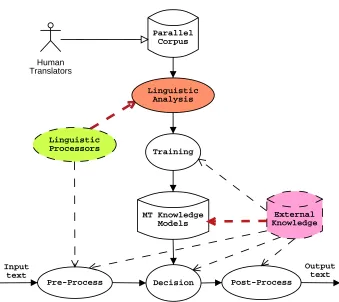
We have focused on SMT, which is today the most popular empirical approach to MT. SMT is also very well founded from a theoretical viewpoint. But the main reason for selecting SMT is that it allows for obtaining competitive results without using no additional linguistic information further than that implicitly encoded by lexical units. So, the room for potential improvement is in principle very large, and, at the same time, increasing the system quality is very challenging.
In our work, we suggest using current NLP technology and knowledge for improving an SMT system. Therefore, our golden assumption, and that of many other researchers (see Chapter 4), is that a system working with richer linguistic knowledge should be able to make better decisions. For that purpose, we have analyzed several points in the system architecture where improvements could take place. See Figure 1.3 as compared to Figure 1.2. Again, we would start from a parallel corpus. Linguistic processors would be used to annotate it with information at different levels. This linguistically enriched corpus would be used to train more informed knowledge models. At translation time, given a (linguistically) pre-processed input, these models would be used to provide more accurate translations. The resulting system output could be (linguistically) post-processed. Additional external knowledge sources, such as lexical ontologies or dictionaries, could be used at any stage.
1.2. THIS THESIS 9
Parallel Corpus
Training
MT Knowledge Models Human
Translators
Pre-Process Decision Post-Process
Input text
Linguistic Processors
External Knowledge
Output text Linguistic
[image:29.595.156.495.115.417.2]Analysis
Figure 1.3: Architecture of a Linguistically-aided Empirical MT system
Chapters 5 and 6, we have studied whether it is possible to improve the modeling of translation probabilities in SMT by using automatically annotated linguistic knowledge at levels deeper than the lexical level. We have focused on the problem of lexical selection, i.e., on deciding, for a given lexical unit (word or phrase), which is the best translation among the set of possible translations candidates available (see Section 4.1.2). We have built shallow-syntactic translation models and improved their performance by building dedicated phrase translation models which are able to take into account a wider feature context. Our approach is based on supervised discriminative learning. As a side question, in Chapter 7, we have studied one of the main criticisms against empirical MT systems, i.e., domain dependence. We present a case study in which we apply several techniques for improving the behavior of SMT systems when used in new domains.
The main contributions of this thesis in this research line are:
• We show that linguistic information at the level of shallow-syntax may be successfully used to improve phrase-based translation models (Gim´enez & M`arquez, 2005; Gim´enez & M`arquez, 2006b). Our approach is based on building shallow-syntactic word and phrase alignments. We also present two valid phrase alignment combination schemes for translation modeling.
source translation context in which phrases occur, which leads to a more reliable estimation of phrase translation probabilities. Apart from exhibiting a higher local accuracy than the base-line approach based on maximum likelihood, we show that these models can be successfully integrated into a phrase-based SMT system and applied to the full translation task, yield-ing a significantly improved lexical selection. However, through heterogeneous automatic evaluations, we have observed that an improved lexical choice does not necessarily imply an improved overall syntactic or semantic structure. Manual evaluations have confirmed that improvements are mainly related to the adequacy dimension.
• We have studied the problem of domain dependence (Gim´enez et al., 2005b; Gim´enez & M`arquez, 2006a). First, we have used in-domain corpora to build specialized language and translation models. We show that it is possible to adapt an existing SMT system to a very dif-ferent domain using only a very small amount of data belonging to the new domain. Second, we show that corpora from a similar domain may be helpful both for language and translation modeling. Third, we have built domain-independent translation models based on WordNet (Fellbaum, 1998). These models have not reported, however, much impact on translation quality, except for the case of unknown words.
• Our work in the development of an SMT system evinces the need for a heterogeneous MT evaluation methodology as the one proposed in this thesis.
1.2.3 Document Overview
The rest of this thesis is organized as follows.
• Part I. MT Evaluation
– Chapter 2. Machine Translation Evaluation
This chapter provides an extensive review on MT evaluation methods. We discuss both manual and automatic measures as well as the the role of evaluation methods in the context of the current development cycle of MT systems.
– Chapter 3. Towards Heterogeneous Automatic MT Evaluation
In this chapter, we present our proposal towards heterogeneous automatic MT evalua-tion. We describe a wide set of metrics operating at different linguistic levels and study their individual and collective application over several evaluation scenarios. We also present our approach to metric combination and to automatic error analysis.
• Part II. Empirical MT
– Chapter 4. Statistical Machine Translation
1.2. THIS THESIS 11
– Chapter 5. Shallow Syntactic Alignments and Translation Models
This Chapter presents the construction of a baseline Spanish-English phrase-based SMT system based on a collection of Proceedings from the European Parliament, and its en-hancement through the use of shallow-syntactic translation models. Linguistic knowl-edge is incorporated during the word and phrase alignment processes.
– Chapter 6. Discriminative Phrase Selection for SMT
This Chapter explores the application of discriminative learning to the problem of phrase selection in SMT. We build dedicated local phrase translation classifiers which are able to take further advantage of the source context. We also show how local predictions can be softly integrated into a phrase-based SMT system for the purpose of the global translation task.
– Chapter 7. Domain Adaptation of an SMT System
This Chapter presents a practical case study on the adaptation of the empirical MT sys-tem built on the previous chapters, from the political domain (i.e., European Parliament Proceedings) to the domain of dictionary definitions (i.e., WordNet glosses). Several complementary improvement techniques are presented.
• Chapter 8. Conclusions
In this chapter, main conclusions are drawn, and future work is outlined.
• Appendices
– Appendix A. Author’s Publications
This appendix is a full list of author’s publications while enrolled in this PhD program.
– Appendix B. Linguistic Processors and Tag Sets
This appendix provides information on the linguistic processors utilized as well as a series of tables describing the associated tag sets.
– Appendix C. Metric Sets
This appendix provides a full list of metric variants in the current metric set. These are grouped in several families according to the linguistic level at which they operate.
How to read this document
this topic might want to proceed directly to Chapter 5, although Sections 4.2, 4.4 and 4.5 will be referenced back, since they describe a selection of the most relevant works respectively related to the contents of the following three chapters. Chapters 5 and 6 deal with the problem of lexical selection. First, Chapter 5 describes the construction of a Spanish-to-English baseline system improved with shallow-syntactic translation models. Then, in Chapter 6, this system is further improved building dedicated discriminative phrase translation models also relying on shallow-syntactic information. Chapter 7 studies the separate problem of domain dependence, and it is only related to the two previous chapters in that the baseline SMT system is the same, although in the reverse direction (i.e., English-to-Spanish).
Part I
MT Evaluation
Chapter 2
Machine Translation Evaluation
Since its origins, research in MT has been accompanied by research in MT Evaluation (Miller & Beebe-Center, 1956; Pfafflin, 1965). In particular, there has been a wide interest in automatic evaluation methods. The reason is that these methods allow for considerably accelerating the devel-opment cycle of MT systems, and NLP applications in general (Thompson, 1991).
However, evaluating translation quality is a complex issue. This arises from the fact that MT is an open NLP task. Given a certain input, the set of solutions is not closed; every human subject could potentially produce a different translation, and all of them could be in principle equally valid. This is due to the expressiveness and ambiguity of Natural Language itself (see Section 1.1.1).
A number of evaluation methods have been suggested. Either manual or automatic, all share the common characteristic of operating over predefined test suites, i.e., over fixed sets of translation test cases (King and Falkedal 1990)1. Therefore, a first important concept to bear in mind is that test
suites introduce a significant bias in the evaluation process. For instance, if the test bed does not cover a representative set of test cases, evaluation results bias accordingly. Also, if the set of manual reference translations represents only a small part of the whole space of solutions, the significance of the results is affected. Similarly, if the set of automatic translations represents only a small subset of MT systems (e.g., systems belonging to the same paradigm or different versions of the same system), or a specific language pair, or translation domain, the validity of the evaluation results will be restricted to the specific evaluation scenario.
In the following, we have elaborated a thorough review on MT evaluation. First, in Section 2.1, we talk about context-based evaluation of MT systems. Then, we focus on what relates to the research work deployed in this thesis. Section 2.2 discusses the role of the evaluation scheme in the MT development cycle. In Sections 2.3 and 2.4 we respectively describe some of the most relevant approaches to manual and automatic evaluation.
2.1
Context-based Evaluation
Although the focus of our work is in the evaluation of translation quality independently of the con-text of the MT system, this section is a brief note on concon-text-based evaluation. This line of research
1
A test case typically consists of a source sentence and a set of human reference translations.
promotes the idea that potential users of MT technology should first evaluate the suitability of this solution for their specific purpose. In that respect, Church and Hovy (1993) analyzed what require-ments a good niche application for MT should meet. They suggested six desiderata: (i) it should set reasonable expectations, (ii) it should make sense economically, (iii) it should be attractive to the intended users, (iv) it should exploit the strengths of the machine and not compete with the strengths of the human, (v) it should be clear to the users what the system can and cannot do, and (vi) it should encourage the field to move forward toward a sensible long-term goal. These principles were fur-ther discussed and extended by the Evaluation Working Group of the ISLE Project (1999-2002)2. The main focus of this working group was the development of a classification or taxonomy of the features that are relevant to machine translation evaluation. They organized several workshops, and, overall, they developed FEMTI3, a framework for context-based MT evaluation (Hovy et al., 2002). FEMTI provides a methodology to evaluate MT systems according to a wide range of char-acteristics and quality aspects such as functionality, reliability, usability, efficiency, maintainability, portability, cost, etc. FEMTI is made of two interrelated classifications or taxonomies. The first classification enables evaluators to define an intended context of use for the MT system to evaluate. The second classification links the selected relevant quality characteristics to a set of metrics asso-ciated. Once the context of the evaluation is defined, in response, FEMTI generates appropriate evaluation plans to be executed by the user.
2.2
The Role of Evaluation Methods
The current development cycle of MT systems follows the flow chart depicted in Figure 2.1. In each loop of the cycle, system developers must identify and analyze possible sources of errors. Eventually, they focus on a specific subproblem and think of possible mechanisms to address it. Then, they implement one of these mechanisms, and test it. If the system behavior improves (i.e., the number of the selected type of errors diminishes without harming the overall system performance), the mechanism is added to the system. Otherwise, it is discarded. In the context of MT system development, evaluation methods are necessary for three main purposes:
• Error Analysis, i.e., to detect and analyze possible cases of error. A fine knowledge of the
system capabilities is essential for improving its behavior.
• System Comparison, i.e., to measure the effectiveness of the suggested mechanisms. This
is done by comparing different versions of the same system. It is also common to compare translations by different systems, so system developers may borrow successful mechanisms from each other. This allows the research community to advance together.
• System Optimization, i.e, the adjustment of internal parameters. Typically, these parameters
are adjusted so as to maximize overall system quality as measured according to an evaluation method at choice.
2
http://www.issco.unige.ch/projects/isle/
2.2. THE ROLE OF EVALUATION METHODS 17
Figure 2.1: MT system development cycle
2.2.1 A Review
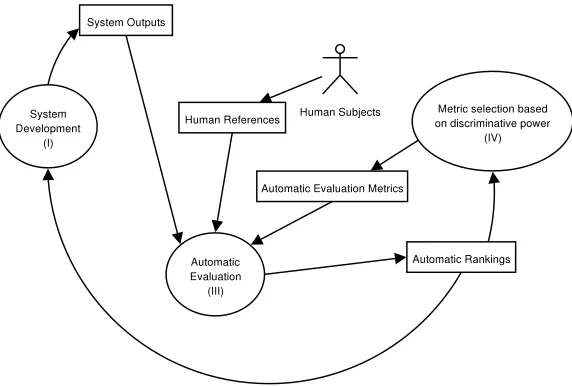
In the following, we provide a brief historical overview on the evolution of the evaluation scheme in the context of the MT system development. The original development scheme, prior to the availability of automatic evaluation metrics, was entirely based on human evaluations (see top-left flow chart in Figure 2.2). In this scheme, system developers iterated across the development cycle constantly introducing new changes so as to improve their prototype systems (process I). Eventually, they performed manual evaluations in order to evaluate the degree of progress attained, possibly at the time of running a competitive evaluation exercise (process II). Manual evaluations produced one or more manual rankings (depending on how many quality aspects were considered), which system developers could take into account for further system improvement.
The main drawback of the original scheme was that human assessments are expensive to ac-quire. Therefore, system developers could not monitor system improvements with enough regular-ity. In order to accelerate the development cycle, in the current scheme (see top-right flow chart in Figure 2.2), a process of automatic evaluation (process III) was added to the development cy-cle (Thompson, 1991). Automatic evaluation is based on automatic metrics which determine the quality of a system output according to its similarity to a predefined set of references generated by
2.2. THE ROLE OF EVALUATION METHODS 19
2.2.2 Meta-Evaluation
Automatic evaluation metrics allow researchers to evaluate and optimize their systems without re-quiring the intervention of expensive human assessors. However, the usage of automatic evaluation measures generates in its turn an additional step in the development cycle: meta-evaluation, i.e., the evaluation of evaluation measures.
The bottom flow chart in Figure 2.2 illustrates the role of meta-evaluation in the current MT task development cycle (process IV). Prior to starting to iterate across the system development cycle, developers must decide which is the most suitable evaluation metric for the task at hand. This decision will have an enormous influence over the whole development cycle, since the metric selected will be responsible for guiding the developer in identifying the system weaknesses and deciding which modifications should be introduced. Moreover, the metric will also be used to judge whether the modifications are helpful or not. And, commonly, the metric will also govern any process of adjustment of parameters guiding the system towards configurations which maximize the quality aspects the metric is able to capture. In the following, we describe the two most well studied meta-evaluation criteria.
Human Acceptability
The quality of automatic MT evaluation metrics is usually estimated in terms of their ability to capture the degree of acceptability to humans of automatic translations, i.e., their ability to emulate human assessors. This is usually measured on the basis of correlation between automatic metric scores and human assessments of translation quality (Papineni et al., 2001; Callison-Burch et al., 2007). The underlying assumption is that good translations should be acceptable to human eval-uators. For that reason, we call this type of meta-evaluation as based on Human Acceptability. Typically, metrics are evaluated against adequacy or fluency assessments, or a combination of the two, using either Pearson (1914, 1924, 1930), Spearman (1904) or Kendall (1938; 1955) correlation coefficients.
Most of current metrics have been developed on the basis of human acceptability. For instance, Papineni et al. (2001) say: “We propose a method of automatic machine translation evaluation
that is quick, inexpensive, and language independent, that correlates highly with human evaluation, and that has little marginal cost per run.”, Turian et al. (2003) say: “The most important criterion for an automatic MT evaluation measure is that it ranks MT systems the same way that a human judge would rank them.”, Lin and Och (2004a) say: “[...] the first criterion to assess the usefulness of an automatic evaluation measure is to show that it correlates highly with human judgments in different evaluation settings.”, Kulesza and Shieber (2004) say: “The resulting metric [...] is shown to significantly improve upon current automatic metrics, increasing correlation with human judgments [...]”, and Banerjee and Lavie (2005) say: “We evaluate METEOR by measuring the correlation between the metric scores and human judgements of translation quality”.
Actually, correlation with human assessments is a reasonable criterion, since automatic evalu-ation metrics were originally meant to replace human assessments, and therefore correlevalu-ation with them seems the most direct (and interpretable) way of ensuring that such replacement is possible.
(see Section 2.3). As a result, the behavior of automatic metrics is usually validated only in very few and specific evaluation scenarios, often in the context of an evaluation campaign or shared task, and over a limited number of samples. For instance, most meta-evaluation reports focus on a single language pair, a specific translation domain, and a small set of systems typically belonging to the same MT paradigm.
The problem of meta-evaluating on a very specific scenario is that results are not guaranteed to port well to other evaluation scenarios. The reason is that the quality aspects distinguishing high quality from low quality translations may vary significantly from one scenario to another, and, con-sequently, the performance of metrics operating on different quality dimensions may vary as well. In other words, the behavior of automatic metrics depends on a number of variables such as the lan-guage pair, the specific domain of the translation task, and the typology of systems under evaluation. Thus, it would seem reasonable to conduct a meta-evaluation process prior to any evaluation stage or campaign. However, meta-evaluation is in most cases ignored, or conducted only a posteriori. The reason is that human acceptability is a too costly solution for that purpose.
Human Likeness
A prominent alternative criterion is to evaluate metrics in terms of their ability to capture the degree of human likeness of automatic translations. The underlying assumption is that good translations should resemble human translations. Human likeness is usually measured in terms of
discrimina-tive power, i.e., the metric ability to capture the features which distinguish human from automatic
translations (Corston-Oliver et al., 2001; Lin & Och, 2004b; Kulesza & Shieber, 2004; Amig´o et al., 2005; Gamon et al., 2005). The idea is that, given that human translations are gold standard, a good metric should never rank automatic translations higher (in quality) than human translations. Then, when a system receives a high score according to such a metric, we can ensure that the system is able to emulate the behaviour of human translators.
The main advantage of human likeness is that it is a much more cost-effective alternative, since the need for human assessments disappears. Human likeness opens, thus, the path towards a new development scheme entirely based on automatic metrics (see Figure 2.3 as compared to the bottom flow chart in Figure 2.2). In this scheme, human subjects are only required for solving the test cases (as systems do) and, thus, to serve as models (i.e., providing human references) for the evaluation process. Avoiding human assessments eliminates also one subjective factor: the assessment eval-uation guidelines. In addition, human assessments are static, while discriminative power can be updated if new human references or system outputs are incorporated to the test bed along time.
However, meta-evaluation based on human likeness presents a major shortcoming; just like automatic evaluation, it depends strongly on the heterogeneity/representativeness of the test beds employed (i.e., sets of test cases, and associated automatic system outputs and human reference translations). For instance, if the set of reference translations per test case is small it may not represent well the full set of acceptable solutions, and the meta-evaluation process may be biased. Therefore, the applicability of human likeness as meta-evaluation criterion must be further studied and validated.
2.2. THE ROLE OF EVALUATION METHODS 21
Figure 2.3: MT task development cycle entirely based on automatic metrics
de Educaci´on a Distancia” (UNED), in Madrid, we have conducted a comparative study on the
be-havior of human likeness and human acceptability as meta-evaluation criteria in the context of open NLP tasks, such as Machine Translation and Automatic Summarization. Results have revealed that there is an interesting relationship between them (Amig´o et al., 2006). While human likeness is a sufficient condition to attain human acceptability, human acceptability does not guarantee human likeness. In other words, human judges consider acceptable translations that are human-like, but they may also consider acceptable many other automatic translations that would be rarely generated by a human translator. Therefore, given that human likeness is a stronger condition, it seems reason-able to think that basing the development cycle on it should lead to similar results. This hypothesis is currently under study.
2.2.3 The Metric Bias Problem
Evaluation measures are all focused on partial aspects of quality (e.g., adequacy, fluency, lexical similarity, etc.). The main problem of partial measures is that they may generate strongly biased evaluations. Besides, since evaluations are required at several stages, this bias may propagate across the whole system development cycle, leading developers to derive inaccurate conclusions and, con-sequently, to make wrong decisions. We refer to this problem as the metric bias problem.
In the following, we illustrate the negative effects of metric bias through three different exam-ples, respectively based on system evaluation, system optimization, and system development.
Unfair System Comparisons