Genetic and environmental factors
in asthma: a population based
european study
Francesc Castro Giner
PhD Thesis
TESI DOCTORAL UPF 2009
Genetic and environmental factors
in asthma: a population based
european study
Francesc Castro Giner
Mem `oria presentada per optar al grau de Doctor en Biologa per la Universitat Pompeu Fabra, any 2009
Aquesta Tesi Doctoral ha sigut realitzada al Centre de Recerca en Epidemiologia Ambiental (CREAL), de l’Institut Municipal d’Investigaci ´o M `edica (IMIM-Hospital del
Mar) sota la direcci ´o del Prof. Manolis Kogevinas i del Dr. Rafael de Cid Ibeas
Prof. Manolis Kogevinas
Director
Centre de Recerca en Epidemiologia Ambiental (CREAL)
Dr. Rafael de Cid Ibeas
Co-Director Centre de Regulaci ´o Gen `omica (CRG)
Prof. Josep Maria Ant ´o Boqu ´e
Tutor
Univeristat Pompeu Fabra i Centre de Recerca en Epidemiologia Ambiental
(CREAL)
Acknowledgments
This study started in 2004 in the Unit of Respiratory and Environmental Research (URRA) of the Municipal Institute for Medical Research (IMIM-Hospital del Mar) and continued in the Centre for Research in Environmen-tal Epidemiology (CREAL) after its foundation. Many people have con-tributed to this thesis in different ways.
I want to express my gratitude to my supervisor Prof. Manolis Kogevinas, who provided me with the opportunity to work on this project, for his help, support and guidance during these years.
I am deeply grateful to my co-supervisor Dr. Rafael de Cid for his guidance in the field of genetics, and for his professional and personal support.
I am grateful to Debbie Jarvis, Nicole Probst, Francine Kauffmann, Josep Maria Ant ´o and Juan Ramon Gonz´alez for their support with my work.
I wish to express my gratitude to the Fundaci ´o la Marat ´o de TV3 for financially supporting the genotyping and to the CIBERESP for partial support of my work.
Vull donar els meus agra¨ıments a tots els companys de treball que he tingut durant aquests anys. Finalment, i m´es important, agrair a la meva fam´ılia pel suport donat i a la meva parella per la seva paci`encia i recolzament durant aquests anys.
Francesc Castro Giner Barcelona, September 2009
Abstract
Asthma is a disease with a complex etiology, involving multiple genetic and environmental factors, and with an important role of the interplay of these factors through gene-environment interactions. In this thesis I aimed to ad-vance our knowledge on the importance of genetic polymorphisms and their interaction with environmental data for the occurrence of asthma and related phenotypes (atopy and bronchial hyperreactivity). This objective was devel-oped through the replication of genetic associations previously reported, the assessment of gene-environment interactions and the identification of new susceptibility genes using genome-wide analysis based on a pooling DNA strategy. The thesis was, mostly, performed within the European Commu-nity Respiratory Health Survey (ECRHS). This cohort has information and DNA samples from approximately 5,000 adult subjects followed-up for 9 years, with extensive questionnaires on respiratory symptoms, clinical eval-uations and information on environmental exposures. The association of
TNFA-308GA polymorphism with asthma was replicated and the effect on the disease was further established conducting a meta-analysis. Evidences on genes identified by positional cloning, NPSR1andADAM33, were also replicated. In addition, the analysis of asthma by age at onset suggests a role ofNPSR1on childhood asthma, particularly through the effect of this gene on asthma with atopy, a phenotype of asthma that is common in children. A review of studies evaluating interactions between environmental expo-sures, gene polymorphisms and asthma revealed that research on genetic de-terminants and gene-environment interactions is still incomplete, with few interactions well established. Analyses of interactions revealed the impor-tance of integrating genetic research with environmental and behavioural data. This thesis described the interaction of theNQO1gene with traffic re-lated air-pollution and the interplay ofTNFAand obesity in the causation of non-atopic asthma. The approach based on genome-wide analysis of DNA pools identified theSGK493 region being associated with atopy. This the-sis contributes to the understanding of the etiology of asthma through the identification and replication of genetic associations and gene-environment interactions.
Resum
L’asma ´es una malaltia d’etiologia complexa, formada per factors gen`etics i ambientals, on la interrelaci ´o de ambd ´os factors mitjanc¸ant interaccions gen-ambient juga un paper clau. L’objectiu d’aquesta tesi ha sigut aprofundir en el coneixement del paper dels polimorfismes gen`etics, i la seva interacci ´o amb factors ambientals, en la ocurr`encia d’asma, at `opia i hiperreactivitat bronquial. Aquest objectiu ha estat desenvolupat a trav´es de la replicaci ´o de variants gen`etiques pr`eviament identificades, l’avaluaci ´o d’interaccions gen-ambient i la identificaci ´o de nous gens de susceptibilitat mitjanc¸ant un disseny basat en el genotipatge de variants gen`etiques all llarg del genoma en pools d’ADN. La tesi ha estat majorit`ariament duta a terme dins l’estudi European Community Respiratory Health Survey (ECRHS) que est`a compr`es per 5.000 individus seguits durant 9 anys, pels quals es disposa d’un q ¨uestionari complet sobre s´ımptomes respiratoris, avaluacions cl´ıniques, informaci ´o sobre exposicions ambientals i mostres de ADN. S’ha replicat l’associaci ´o del polimorfisme TNFA-308GA amb asma i s’ha establert el seu efecte sobre la malaltia mitjanc¸ant un meta-an`alisi complet. Tamb´e s’han replicat evid`encies pr`evies sobre l’efecte dels gens identificats per clonatge posicional NPSR1 i ADAM33. A m´es, l’an`alisi d’asma segons edat d’inici suggereix un paper m´es agut de NPSR1 sobre asma originat en edat precoc¸, particularment a trav´es de l’efecte d’aquest gen en asma combinat amb at `opia, fenotip d’asma com ´u en la infantesa. Una revisi ´o dels estudis que avaluen interaccions entre exposicions ambientals, polimorfismes gen`etics i asma ha mostrat que la investigaci ´o en les bases gen`etiques i interaccions en asma continua incompleta, amb pocs gens i poques interaccions ben establertes. L’an`alisi d’interaccions mostra la import`ancia d’integrar investigaci ´o gen`etica amb dades ambientals i d’estils de vida. Aquesta tesi tamb´e descriu les interaccions deNQO1i contaminaci ´o relacionada amb tr`afic de vehicles, i l’efecte conjunt deTNFA i obesitat en asma d’origen no at `opic. L’an`alisi de pools d’ADN ha perm`es associar la regi ´o on es situa el gen SGK493 amb at `opia. Aquesta tesi contribueix al coneixement de l’etiologia d’asma amb la identificaci ´o i replicaci ´o d’associacions gen`etiques i interaccions gen-ambient.
Preface
W
E ARE LIVING IN A REALLY IMPORTANT PERIOD in the area of lifescience with the development of technological advances that open new possibilities for the research. The elucidation of the human genome in 2003 made possible the construction of the haplotype map of this genome, the International HapMap project, which catalogues common genetic variation in humans. This scientific goal together with the advance of high-throughput genotyping technologies has produced an explosion of genetic association studies with the objective of unraveling the genetic basis for common diseases. Nowadays, the availability of dense genotyping chips permits the evaluation of genetic variation thorough the genome. For this advances, ‘Human genetic variation’ was recognized as the Breakthrough of the Year 2007 by Science and its publisher, the American Association for the Advancement of Science. An international consortium is currently developing the ’1000 Genomes’ project sequencing the genomes of approximately 1200 people from around the world. This project will develop a new map of the human genome and the most detailed catalogue of human genetic variation. The tools for the genetic dissection of complex traits are nearing to be complete and, in the near future, individual genome sequencing will be economically feasible for epidemiologic studies.
Despite extensive research efforts for more than a decade, the genetic basis of common human diseases remains largely unknown. At the beginning of this thesis, most of the genetic risk variants in asthma needed to be replicated in independent studies. In addition, the genetic factors identified account for a small fraction of the predicted heritability, suggesting that other important factors were missed. It is widely accepted that the etiology of most common diseases involves not only the effect of genetic or environmental causes, but also the interaction between both. The study of gene-environment interactions was encouraged by the potential identification of new genetic factors and the promising applications in personalized medicine and preventive recommendations.
This thesis focuses on genetic basis of asthma and related phenotypes ad-dressing specific hypothesis for genetic and gene-environment interactions, and identifying new susceptibility genetic variants. Thus, the work
scribed here is interdisciplinary, involving epidemiology, genetics and sta-tistical approaches. The thesis consist of a compilation of 6 articles (3 pub-lished, 1 in press and 2 under review) based on data from the European Community Respiratory Health Survey (ECRHS) and, for some of the analy-ses, in combination with the Swiss study on Air Pollution and Lung Disease in Adults (SAPALDIA). This thesis also contains a general introduction to summarize the scientific knowledge in causation of asthma and the most im-portant points in genetic epidemiology. A general discussion was included to give a general view of some important points in genetic epidemiology and to deal with additional issues that were not included in the articles but that have been subject of an intense debate. Finally, I include a list of conclusions and a chapter explaining my next research plans and my view of the future directions of research on complex diseases.
Contents
Acknowledgments vii
Abstract ix
Resum xi
Preface xiii
Contents xvii
1 Introduction 1
1.1 General features of asthma . . . 1
1.1.1 Asthma definition . . . 1
1.1.2 Epidemiology of asthma . . . 2
1.1.3 Related phenotypes . . . 2
1.1.4 Mechanisms of asthma . . . 4
1.2 Factors influencing the development of asthma . . . 6
1.2.1 Environment and life style . . . 7
1.2.2 Genetic factors . . . 9
1.3 Methods for gene assessment: the asthma example . . . 10
1.3.1 Linkage analysis . . . 10
1.3.2 Positional cloning . . . 12
1.3.3 Genetic association studies . . . 13
1.3.4 Gene-environment interactions in asthma . . . 16
1.4 Pitfalls and challenges of genetic studies of asthma . . . 17
2 Rationale 19
3 Objectives 21
4 Methods 23
4.1 Description of the study cohorts . . . 23
4.1.1 ECRHS . . . 23
4.1.2 SAPALDIA . . . 24
4.2 Phenotypes ascertainment . . . 25
4.2.1 Asthma . . . 25
4.2.2 Related phenotypes . . . 25
4.3 Candidate gene approach and genotyping . . . 26
4.3.1 Candidate gene selection . . . 26
4.3.2 SNP selection . . . 26
4.3.3 Genotype characterization . . . 29
4.3.4 Data caring . . . 30
4.4 Statistical methodology . . . 30
5 Results 33 5.1 Gene–environment interactions in asthma . . . 35
5.2 TNFAand risk of asthma . . . 47
5.3 TNFA, obesity and risk of asthma . . . 61
5.3.1 Supplementary material for papers 2 and 3 . . . 69
5.4 Traffic pollution, genes and asthma . . . 71
5.4.1 Supplementary material . . . 85
5.5 Positionally cloned genes in asthma and atopy . . . 93
5.5.1 Supplementary material . . . 107
5.6 Pooling-based genome-wide in asthma and atopy . . . 119
5.6.1 Supplementary material . . . 131
6 Discussion 135 6.1 Main findings . . . 135
6.2 Methodological issues . . . 137
6.2.1 Study design . . . 137
6.2.2 Sample size and statistical power . . . 139
6.2.3 Confounding and Population Stratification . . . 141
6.3 Multiple testing . . . 145
6.4 Genetic main effects . . . 145
6.5 Gene-environment interactions . . . 146
6.6 Challenges of genetic association studies . . . 150
CONTENTS xvii
7 Conclusions 153
8 Future Research 155
Annex. Publications and congress contributions 157
1
Introduction
1.1 General features of asthma
1.1.1 Asthma definition
Asthma is a complex respiratory disorder characterized by variable episodic airway obstruction. The classical notion of asthma as a single disease is disappearing and the emerging idea is that asthma is a collection of different phenotypes, or a syndrome, produced by different pathologic mechanisms (Wenzel, 2006;Lancet, 2006). This idea have been derived not only by the numerous risk factors and pathological mechanism discovered, but also by the broad number of asthma phenotypes described. The Global Strategy for Asthma Management and Prevention performed a definition of asthma:
’Asthma is a chronic inflammatory disorder of the airways in which many cells and cellular elements play a role. The chronic inflammation is associated with airway hyperresponsiveness that leads to recurrent episodes of wheezing, breathless, chest tightness, and coughing, particularly at night or in the morning. These episodes are usually associated with widespread, but vari-able, airflow obstruction within the lung that is often reversible either spontaneously or with treatment’ (Bateman et al.,2008).
Since pathogenesis of asthma is still not clear, this definition is only descriptive and inclusive of the broad range of phenotypic manifestations that are used for its clinical diagnosis. The identification of specific phenotypes and the identification of their basis is one of the major challenges in next years on asthma research (Anderson,2008).
The lack of an instrument to identify asthma with certainty and its heteroge-neous manifestation has difficulted its assessment in epidemiologic studies. Questionnaires are the most common method to ascertain asthma, defining asthma using self reported diagnosis by a physician or respiratory symp-toms. Definitions based on self-reported statements of asthma are prone to classical biases in epidemiological studies such as recall bias or differential
access to care, and does not account for the heterogeneity in symptoms man-ifestations. For these reason, these definitions are often combined with mea-surements of clinical outcomes and biomarkers. The most used are forced expiratory volume in 1 second (FEV1), degree of reversibility, bronchial hy-perresponsiveness (BHR), inflammation, eosinophilia and immunoglobulin E (IgE). However, due to the high level of heterogeneity present in asthma, these combinations result in a selection of cases that are not always represen-tative of the general asthmatic population.
1.1.2 Epidemiology of asthma
Asthma is a serious global health problem. It has become a major cause of morbidity in children and adults from developed countries, with an estimated prevalence of 5-15% (Beasley et al.,1998). According to the Centers for Disease Control and Prevention, asthma is the third leading cause of hospitalization among subjects below 18 years of age in the U.S. (National Center for Health Statistics, 2005). The prevalence of asthma has increased during the second half of the 20th century, arising to a worldwide estimation of 300 million of affected individuals (Eder et al., 2006;Masoli et al.,2004). As an example, the prevalence of asthma among United States children increased from 3.6% in 1980 to 7.5% in 1995 (Akinbami,2006). This increase was similar in other countries (Eder et al.,2006). However, great disparities were found in the asthma prevalence between countries throughout the world (Figure 1.1) (Masoli et al., 2004). The highest prevalence was found among anglo-saxon countries, such us United Kingdom, United States, Australia, South Africa and Canada, while less ’westernized countries’ showed lower rates of prevalence. This high rate of variation was also observed among European countries (ECRHSII Steering Committee,2002). During the decade of 1990s, the prevalence of asthma reached a plateau in some Western countries (Eder et al.,2006). However, an increase of cases has been observed in Africa, Latin American and specific zones of Asia where the previous prevalence was comparatively lower (Asher et al.,2006). This indicates that the global burden of asthma is still rising.
1.1.3 Related phenotypes
1.1 General features of asthma 3
Figure 1.1: World map of clinical asthma prevalence. Figure adapted from Masoli et al.(2004)
mechanisms, although the specificity of these intermediate phenotypes is not complete.
Atopy. Atopy is an allergic hypersensitivity characterized by a predisposi-tion to develop allergen-specific IgE antibodies on exposure to low dose of environmental allergens (Johansson et al.,2001). It is characterized measur-ing total IgE levels and specific IgE in serum, or by skin test reactivity to allergens. Asthma and atopy are closely interrelated. Atopy is a well estab-lished risk factor for asthma since a large number of studies have reported that asthmatics tend to be more atopic than non asthmatics (Burrows et al., 1989;Dodge et al.,1994;Holt et al.,1999). Studies estimating the percentage of asthma cases attributable to atopy have reported a population attributable risk (PAR) ranged between 33% and 56% (Pearce et al., 1999; Arbes et al., 2007;Ponsonby et al.,2002). Atopy in early life seems to be one of the key factors to identify an individual risk to develop asthma (Sly et al., 2008). Asthma combined with atopy is the largest phenotype of asthma among children. In adults, asthma has been traditionally divided into atopic (ex-trinsic) and non-atopic (in(ex-trinsic) asthma. The phenotype of atopic asthma in adulthood was suggested to have its origins in early childhood (Wenzel, 2006).
associated with more rapid lung function decline but less exacerbations than atopic asthma (Ulrik et al.,1992). Although some pathological studies have suggested that immunopathologic processes in atopic asthma were the same as those of non-atopic asthma (Humbert et al.,1997,1996) other studies have seen differences (Miranda et al.,2004;Walker et al.,1992;Truyen et al.,2006). Further studies to examine in detail the pathological distinctions between atopic and non-atopic asthma are needed.
Bronchial hyperresponsiveness. Functional alterations of the lung airways are associated with asthma. Bronchial hyperresponsiveness (BHR) is the excessive sensitivity of the bronchi in response to a variety of stimuli. Abnormalities of airway smooth muscle (ASM), airway inflammation, airway remodelling and neural control have been implicated in the elevated responsiveness (Berend et al., 2008). BHR can be measured with bronchial provocation testing using different stimuli. These stimuli can be divided into agents that act directly on receptors of airway smooth muscle (histamine or methacholine), neural pathways (adenosine-3- monophasphate, cold air) and via some intermediate mechanisms by the stimulation of airway inflammation or other cells release mediators (Berend et al.,2008).
Longitudinal studies showing that BHR usually precedes asthma suggest that it is a risk factor for asthma development (Hopp et al.,1990). Thus, BHR has been included in the definition of asthma (Bateman et al.,2008) although its specificity has been questioned. Epidemiological studies have shown that the prevalence of BHR among asthma cases is around 40% to 60% (Masoli et al.,2004). In addition, a considerable proportion of individuals that do not have a history of asthma also develop BHR (Backer et al.,1991;Rijcken et al., 1988). This percentage usually represents more than the 30% (Jansen et al., 1997). Moreover, BHR can be also present in other airway disorders such as COPD and cystic fibrosis (van Haren et al.,1995;Brutsche et al.,2006).
1.1.4 Mechanisms of asthma
1.1 General features of asthma 5
Airway inflammation. Although clinical manifestation of asthma is highly variable, the presence of chronic airway inflammation remains a constant feature in all forms of asthma (Holgate,2008). The inflammatory response in asthma is mediated by T helper 2 (TH2) cells, involving predominantly eosinophils, mast cells, neutrophils and CD4+ helper T lymphocytes (Busse and Lemanske,2001). These cells are recruited into the airways by multiple pro-inflammatory mediators including cytokines, chemokines, adhesion molecules, inflammatory enzymes and receptors (Barnes, 2008). These mediators are generated by other inflammatory cells and structural cells of the airways, such as epithelial cells, airway smooth muscle cells, endothelial cells and airway nerves (Holgate,2008). Airway cells also produce agents that prologue the life of the inflammatory cells at the site of migration, such as granulocyte macrophage colony stimulating factor (GM-CSF) (Tattersfield et al.,2002).
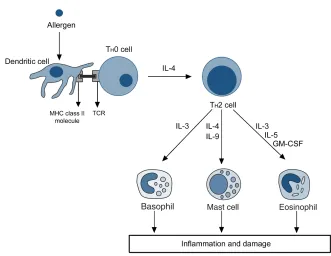
Immune response. In atopic individuals, allergic sensitization is an important feature of asthma (Holgate, 2008). Airway inflammation in allergic asthma is mediated by adaptive immune recognition of allergens by TH2 cells, resulting in airway eosinophilia (Figure 1.2). This mechanism is initiated by the uptake and processing of inhaled environmental allergens by dendritic cells situated in the airway epithelium and submucosal (Hammad and Lambrecht,2006). Dendritic cells present selected peptides using MHC class II molecules to naive T cells (TH0 ), directing them in favour of a TH2-cell phenotype and in detraction of TH1 (Holgate, 2008; Smit and Lukacs, 2006), resulting in TH2 mediated airway inflammation (Meyer et al.,2008). In asthmatic patients, there is an increase in the number of CD4+ T cells in the airways. These are mainly TH2 cells, whereas in normal air-ways TH1 cells predominate (Meyer et al.,2008).
TH2 immunity is fundamental for atopy. This mechanism provides a molec-ular framework to understand the associations of atopy with asthma. How-ever, there are some discrepancies about the TH2 inflammation hypothesis. This mechanism cannot explain why airway hyper-responsiveness and tis-sue remodelling are not clearly linked to infammation, or why new TH 2-targeted treatments have no effectiveness in the clinic (Anderson, 2008). The TH2-inflammation model cannot account for the substantial clinical and molecular heterogeneity that has now been unequivocally documented in human asthma (Anderson, 2008). Despite these discrepancies, TH2 immu-nity is undoubtedly important in pathogenesis of some asthma endotypes such as allergic asthma.
Figure 1.2:Inflammatory cascade in allergic asthma. Adapted fromHolgate (2008)
the thickening of airway wall (Holgate, 2008). Airway remodelling entails the increase of submucosal tissue, adventitia, and the hypertrophy and hyperplasia of smooth muscle cells (Busse and Lemanske,2001;James and Carroll, 2000). The increase in the mass of smooth muscle is also an important component of the bronchial hyperreactivity by increasing the force of bronchoconstriction and reduction of airway diameter (Wang et al., 2003). The precise mechanisms leading to airway remodelling are still not understood. Persistent airway inflammation may be an important factor to airway remodeling, through the secretion of inflammatory mediators and growth factors such as TGF-βfrom eosinophils (Holgate,2008). Other factors include epithelial injury, impaired repair and secretion of other growth factors from structural cells.
1.2 Factors influencing the development of asthma
gene-1.2 Factors influencing the development of asthma 7
gene, environment-environment and gene-environment interactions within a complex biological system (Ay,2002). After decades of intensive research, hundreds of factors have been associated with asthma. Despite this effort, only few of these factors are completely accepted. This evidences the overwhelming difficulties in unraveling the risk factors for asthma. The two main reasons of this pitfall are the heterogeneity of the phenotype and the inherent complexity in the etiology.
1.2.1 Environment and life style
The rising on the prevalence of asthma over the past 30 years is most likely to be explained by changes in the environment. This evidence has generated an intense debate about different hypothesis that have been proposed to explain this increase, encouraging the research on environmental determinants of asthma. Some of the most important are described below.
Air pollution.There is a link between the increase of respiratory diseases and the increase in air pollution. Pollution is though to affect the development, persistence and exacerbation of asthma (D’Amato et al., 2005). However, the exact role of pollution on asthma remains controversial (D’Amato et al., 2005). Pollution can occur both outdoor and indoor. The main source of outdoor pollution in urban areas is traffic. There are evidences showing that living near traffic roads is associated with an impairment of respiratory health, especially among children (Kim et al., 2008;Rosenlund et al.,2009; Gauderman et al., 2005). The most abundant compounds in outdoor pollutants are inhalable particulate matter, ozone, nitrogen dioxide, sulphur dioxide and diesel exhaust particles. Many studies have reported a role of these pollutants in the asthma exacerbations (D’Amato et al.,2005;Heinrich and Wichmann,2004;Kuenzli et al.,2000;Nel, 2005) and, to less extent, in development of asthma (Brauer et al.,2007; Jacquemin et al.,2009). These pollutants are strong oxidants leading to the production of reactive oxygen species (ROS) (D’Amato et al.,2005). Oxidative stress triggers the cytokine production and inflammatory response in the lung airways (Kelly,2003;Nel, 2005).
Triche,2008). On the other hand, the effect of ETS on asthma development and asthma severity is strong and consistent (Jaakkola et al.,2006;Spengler et al., 2004; Cook and Strachan, 1997; Raherison et al., 2007; Chan-Yeung and Dimich-Ward, 2003). It has been also associated with asthma related phenotypes such as lower lung function, BHR, and increasing levels of total IgE (Chan-Yeung and Dimich-Ward,2003).
Allergens. The antigen allergens are presented by dendritic cells to B cells, which are the responsible to produce the specific IgE, developing the sensitization to the specific allergen (Figure 1.2). Early life sensitization to common aeroallergens has been widely associated with risk of further development of asthma (Gaffin and Phipatanakul, 2009; Sherrill et al., 1999; Ly et al., 2006; Kusel et al., 2007; Illi et al., 2006). However, the direct link between allergen exposure and development of asthma has been less consistent (Torrent et al., 2007; Tovey et al., 2008; Gaffin and Phipatanakul, 2009). Different allergens have been associated with the development of asthma. Sensitization to house dust mite (HDM) is the most evaluated allergenic factor (Tovey et al.,2008;Celedon et al.,2007;Gaffin and Phipatanakul, 2009). Other well studied allergenic factors associated with asthma are sensitization to pet allergens (from cat and dog) (Torrent et al., 2007, 2006; Svanes et al., 2003) and IgE specific to fungi species present in mould (Alternaria alternata, Cladosporium herbarum, Aspergillus fumigatusand
Penicillum notatum). Finally, pollen allergens account for a large fraction of the allergic young adults and are associated with asthma as well (D’Amato et al.,2005;Knox et al.,1997;D’Amato,2001).
1.2 Factors influencing the development of asthma 9
of induction of asthma by these occupational exposures remain unknown but some evidences suggest an IgE mediated mechanism (Malo and Chan-Yeung,2009;Elms et al.,2001;Redlich et al.,2001).
Viral infections. Respiratory infections during early life have been shown as a protection factor for asthma (Kusel et al., 2007; Ramsey et al., 2007). These evidences support the ’hygiene hypothesis’ of asthma, which suggests that early child infections may favour disbalanced maturation of the T lymphocytes population, priming the TH1 population over TH2 and, therefore, reducing the risk for developing asthma and allergy (Strachan, 2000). Although the ’hygiene hypothesis’ is still controversial and continues under investigation, this mechanism may explain the observed association between risk of asthma and family size, birth order or day-care attendance (Illi et al.,2001;Ball et al.,2000;de Meer et al.,2005).
Other factors: Smoking, obesity and diet. During the last century, the harm-ful effect of tobacco on asthma was increasingly recognised. Tobacco smok-ing has been associated with development and severity of asthma, acceler-ated lung function decline in subjects with asthma and impaired short-term therapeutic response to corticosteroids (Thomson et al.,2004;Plaschke et al., 2000;Rasmussen et al.,2000;Kim et al.,2002). Obesity, has been associated with both incidence and prevalence of asthma, as well as with severity of the disease. Experimental studies support this association but the mecha-nisms linking obesity with asthma are complex and remain uncertain (Ma-tricardi et al.,2007;Chinn,2003;Beuther et al.,2006;Weiss,2005). The role of diet has been extensively studied. Dietary lipids, antioxidants and vitamins have been associated with asthma. Dietary lipids affect to proinflammatory and immunologic pathways. Evidences from epidemiologic studies suggest that n-3 PUFA (oily fish) is protective for the development of asthma, while n-6 polyunsaturated fatty acid (PUFA; margarine, vegetable oil) contribute to its development (Romieu,2005; Devereux and Seaton, 2005). An imbal-ance between reactive oxygen and antioxidants contributes to the chronic inflammatory process in asthma. Dietary antioxidants and vitamins favour the antioxidant defence mechanisms, protecting against oxidant factors such as air-pollution (Romieu,2005;Pryor,1991).
1.2.2 Genetic factors
component (Holberg et al.,1996; Lawrence et al.,1994;Jenkins et al.,1997). Studies on twins, were the concordance of asthma is compared among monozygotic and dizygotic, suggest that the heritability of asthma vary between 36% and 75% (Duffy et al.,1990;Skadhauge et al.,1999;Nieminen et al., 1991; Harris et al., 1997; Skadhauge et al., 1999; Koppelman et al., 1999). However, little is known about the genetic basis of asthma and could be premature to predict the proportion of asthma cases explained by genetic factors. Asthma, as a complex disease, is influenced by multiple loci. This was initially suggested by Tips (Tips,1954), in 1954 and further developed by Leigh and Morley in 1967 (Marsh and Meyers, 1992; Bias et al.,1978). Familial segregation studies indicate that asthma is influenced by a few genes with a moderate effect (’oligogenes’) (Holberg et al., 1996; Lawrence et al., 1994; Jenkins et al., 1997; Cookson, 1999), suggesting that asthma is a polygenic trait with a large number of contributing genes, most of them with small effect (Ober and Hoffjan,2006). The discovery of genetic variants that cause complex diseases has been one of the major challenges for geneticists during last decade. The next section describes the process for the identification of genetic determinants of complex diseases and includes a short review of current knowledge of the genetic basis of asthma.
1.3 Unraveling the genetic component of complex diseases:
the example of asthma
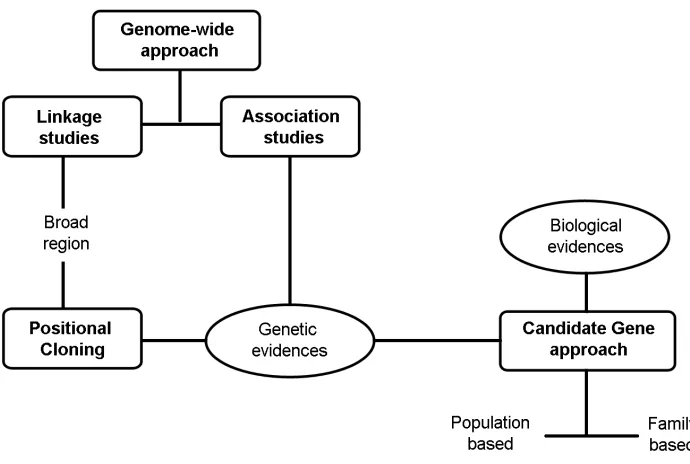
The main aim of genetic research in complex diseases is to elucidate new etiologic mechanisms and to identify interventions to prevent or cure the disease (de Vries et al.,2002). In general, three main approaches have been used to identify genetic susceptibility locus in complex diseases such as asthma: linkage analysis, positional cloning and genetic association studies (Figure 1.3).
1.3.1 Linkage analysis
1.3 Methods for gene assessment: the asthma example 11
linkage (Xing et al.,2005). The main advantage of linkage analysis has been the capacity to identify large genomic regions containing genes with strong phenotypic effects (Teare and Barrett,2005). For this reason, linkage is often the first stage in genetic investigation since it is used to identify susceptibility loci or pathways in the absence of previous hypotheses.
BOX 1. Types of genetic markers used in genetic analyses
Restriction fragment length polymorphism (RFLP).Variation in the DNA sequence of a genome that can be detected by fragmenting the DNA into pieces using restriction enzymes and analyzing the size of the resulting fragments by gel electrophoresis. RFLP analysis was the first technique developed and was cheap enough to see wide application. Nowadays, other techniques have largely replaced the RFLP mapping.
Microsatellites or Short tandem repeats (STRs).STRs are DNA sequences of 1-6 base pairs in length repeated from 5 to 10 times. DNA polymerases tend to ’slip’ when copying microsatellite tracts, adding or subtracting re-peat units. Although they are typically neutral, given their high poly-morphism microsatellites are widely used in mapping genetic diseases, in genetic counselling, in forensic genetics and in population genetics. Mi-crosatellites can also be used to study gene dosage (looking for duplications or deletions of a particular genetic region).
Single Nucleotide Polymorphisms (SNPs). SNPs are DNA sequence variation occurring in a single nucleotide. For example, two sequenced DNA fragments from different individuals, AAGCCTA and AAGCTTA, contain a difference in a single nucleotide. In this case we say that there are two alleles : C and T. SNPs can be classified as synonymous if the same polypeptide sequence is produced and nonsynonymous if the SNP modify the polypeptide sequence of the coding protein.
Copy-number variants (CNV).CNVs are structural variants in the genome that cromprise DNA segments that are 1 kb or larger and are present at a variable copy number in comparison with a reference genome. Classes of CNVs include insertions, deletions and duplications. This definition also includes large-scale copy-number variants, which are variants that involve segments of DNA ≥50 kb, allowing them to be detected by clone-based array.
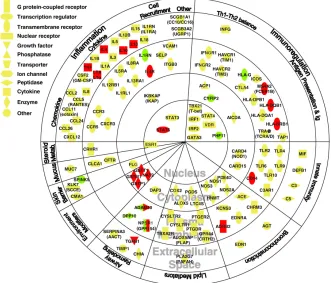
Barrett, 2005). This is particularly true for the most replicated regions in asthma, 5q31-33, 6p21 and 12q13-q24 (Illig and Wjst,2002;Ober and Hoffjan, 2006). For instance, 5q31-33 holds particular interest because this region contains a cluster of genes -interleukin 4 (IL4),IL13, monocyte differentiation antigen 14 (CD14), theβ2 adrenergic receptor (ADRB2) and serine peptidase inhibitor Kazal type 5 (SPINK5) - that are among the most replicated loci in allergic inflammation (Figure 1.4) (Ober and Hoffjan, 2006). Although one of the main advantage of linkage studies has been the identification regions containing genes with large phenotypic effects, such regions usually harbor susceptibility genes each one with relatively small effects on disease risk (Ober and Hoffjan,2006).
Figure 1.3: Methods of gene discovery for complex diseases. These methods can be broadly classified as hypothesis-free approaches (genome-wide) and hypothesis-based approaches (candidate gene)
1.3.2 Positional cloning
1.3 Methods for gene assessment: the asthma example 13
on disorders. For this reason, positional cloning has been extremely suc-cessful in identifying the genetic effects underlying single gene disorders (mendelian disorders), but is less powerful for complex diseases. However, this approach has been useful to identifying genes for asthma and asthma associated phenotypes.
Eight susceptibility genes for asthma, bronchial hyperresponsiveness (BHR) or atopy have now been identified by this technique, although the function of these genes remains unclear. ADAM metallopeptidase domain 33 (ADAM33) on chromosome 20p was initially identified as an asthma and BHR susceptibility gene (van Eerdewegh et al.,2002). This gene is highly expressed in bronchial smooth muscle and airway fibroblast, and may be involved in cell interaction, functioning and signalling (Umland et al.,2003; Powell et al.,2004), suggesting a role in the airway remodelling (Wills-Karp and Ewart,2004). Neuropeptide S receptor 1 (NPSR1also known asGPRAor
GPR154), which is located on chromosome 7p, encodes a G-protein-coupled receptor being up-regulated in inflamed airways epithelial cells and was initially identified as an asthma and atopy related gene (Laitinen et al.,2004). PHD finger protein 11 (PHF11), located on chromosome 13, was originally reported as a gene associated to atopy and total IgE levels (Zhang et al., 2003). It is supposed to be involved in the regulation of transcription of T and B cell genes (Bienz,2006). Dipeptidyl-peptidase 10 (DPP10) located on chromosome 2q, may modulate the activity of various proinflammatory and regulatory chemokines or cytokines, as well as influence neural regulation of smooth-muscle tone (Allen et al.,2003;Wills-Karp and Ewart,2004). Serine protease inhibitor, kazal type 5 (SPINK5, chromosome 5q) encodes a protease inhibitor protein that was associated with high serum IgE levels and atopic manifestations (Chavanas et al., 2000; Walley et al., 2001). Other genes identified by positional cloning are HLA-G histocompatibility antigen, class I, G (HLA-G) on chromosome 6p (Nicolae et al.,2005), cytoplasmatic FMR1-interacting protein 2 (CYFIP2) on chromosome 5q (Noguchi et al., 2005), Interleukin-1 Receptor Antagonist (IL1RN) on chromosome 2q (Gohlke et al., 2004) and prostanoid DP receptor (PTGDR) (Oguma et al., 2004). Further studies on these genes have not always replicated the initial findings (Ober and Hoffjan,2006;Hersh et al.,2007).
1.3.3 Genetic association studies
identification of large number of single nucleotide polymorphisms (SNPs) throughout the genome (HapMap) and the falling in the cost of genotyping allow the screening of a large number of SNPs across the whole genome. This has led to an increasing importance of association studies in genetic epidemiology.
In the context of genetic and etiological heterogeneity, where many genes are involved with small effect, association studies are likely to be more effective tools than linkage studies or positional cloning because they have a greater statistical power to detect small-to-moderate effects (Risch and Merikangas, 1996; Cordell and Clayton, 2005). Association studies can be classified as population-based (case control or cohort) or family-based design (case-parent triad, case-(case-parent-grand(case-parent and analysis of pedigrees). Usually, population-based association is more powerful due to the possibility of selecting large sample size from whole population, while family-based avoid some of the traditional confounding problems in population-based studies, such as population stratification. Two types of approaches have been developed according to prior hypothesis and number of polymorphisms evaluated: candidate gene and, more recently, whole genome association studies.
Association studies using candidate gene approach. The candidate gene approach is focused on genes that are selected in basis of a priori hypothesis about their etiological role in a disease. These genes may be selected because they have a known function that influences the trait, are located within a region identified by linkage analysis or have been previously identified by positional cloning or genome-wide association. This approach allows the simultaneous evaluation of genes, environmental factors and their interactions. It is, at present, the most effective tool for studying complex diseases at the population level (Tabor et al.,2002), because it is able to detect relatively modest effects. On the other hand, the main limitation of this type of approach is the need of a priory knowledge, which limitates the potential for identifying new susceptibility variants compared to other methods that use markers throughout the genome (Tabor et al.,2002).
This approach has been extremely successful. Most of the genes know to modify asthma have been identified through candidate gene studies (Figure 1.4). Although most of these genes have not been successfully replicated, there are several examples of genetic associations widely replicated in independent populations, considering the ’gene’ as a unit of replication (Ober and Hoffjan, 2006). For instance, ADAM33, interleukin 4 (IL4),
S-1.3 Methods for gene assessment: the asthma example 15
[image:33.499.95.426.130.413.2]transferase pi 1 (GSTP1) and signal transducer and activator of transcription 6 (STAT6) are among the most replicated genes, with more than 10 independent replications.
Figure 1.4: All genes were associated in at least one study (Ober and Hoffjan,2006). In red, genes associated in ten or more studies (Vercelli,2008). Green nodes indicate genes identified by positional cloning. Genes in the chromosome region 17q21 identified by GWAS, are not included. Figure adapted fromBosse and Hudson(2007)
function or location of a gene. Despite the skepticism of some authors (Hirschhorn,2009), genome-wide association (GWA) studies have improved our understanding of the genetic basis of many complex diseases leading to the discovery of novel genes (Wellcome Trust Case Control Consortium, 2007; McCarthy et al., 2008; Hirschhorn, 2009). Up to date, two GWA studies have been performed in asthma (Moffatt et al., 2007; Himes et al., 2009). The first study, by Moffatt and co-workers (Moffatt et al.,2007), has identified a strong signal in the chromosome region 17q21, which contains at least two genes, ORM1-like 3 (ORMDL3) and gasdermin B (GSDML), with unknown function (Moffatt et al.,2007;Wjst,2008). After the initial report, 8 independent studies have replicated the association of these region with asthma and different asthma phenotypes (Bisgaard et al., 2009; Wu et al., 2009a;Leung et al.,2009;Galanter et al.,2008;Tavendale et al.,2008;Sleiman et al., 2008; Madore et al., 2008; Bouzigon et al., 2008). The second study (Himes et al., 2009), has identified variants in the gene phosphodiesterase 4D, cAMP-specific (PDE4D) associated with asthma.
One of the limitations of GWA studies is the high economic cost required to perform a well powered study despite the decreasing cost of genotyping. To overcome this limitation, alternatives based on GWA analysis of pooling DNA have been developed. Different studies have concluded that two stage DNA pooling strategy may be more cost-effective than individual genotyping (Zuo et al., 2006; Pearson et al., 2007; Steer et al., 2007; Zhao and Wang, 2009). In a first stage of this design, genome-wide genotyping is performed in pooled DNA samples from a group of cases and pooled DNA samples from a group of controls. After the statistical analysis, most significant markers are genotyped in individual samples from an independent population for a replication. This approach has been already performed in a previous study for asthma, using microsatellite markers (Hui et al.,2008).
1.3.4 Gene-environment interactions in asthma
1.4 Pitfalls and challenges of genetic studies of asthma 17
2001;Kraft et al.,2007). This information could also help to design strategies of intervention at preventive and therapeutic level on the population at risk (Hunter,2005). The literature on gene-environment interactions in asthma has growth during the last years (Castro-Giner et al., 2006; London and Romieu, 2009). However, this is a relatively new field and only modest advances have been achieved (Castro-Giner et al.,2006).
The main limitation of these studies is the sample size required, which is markedly larger compared with studies of genetic main effects (Garcia-Closas et al.,1999;Dempfle et al.,2008) because the effects of a specific in-teraction are expected to be small given the complexity in pathologic path-ways (London and Romieu,2009). Research in asthma has been hampered by underpowered studies and generally not replicated by independent sub-sequent reports (Castro-Giner et al.,2006;London and Romieu,2009). One exception is the interaction between CD14 and endotoxin. This is among the most widely studied interactions in asthma with several replication in different studies and populations (Martinez,2007).
This type of studies have followed a candidate interaction approach using prior hypothesis of the interaction based on co-participation of the two factors in the same causal mechanism of disease. In a recent future, genome-wide studies incorporating environmental data will enable the exploratory identification of new interactions. These studies will need of very large sample sizes in order to achieve statistical significance after correction for multiple comparisons.
1.4 Pitfalls and challenges of genetic studies of asthma
False positive (type I error) results in the first study is the most plausible scenario for non-replication. Methodological limitations have been a source of non-robust results. Often, genetic association studies have been based on small sample size with insufficient power to detect minor contribution of genetic data and leading to provide incorrect estimates of the effects. In addition, genetic association studies are subject to traditional problems of epidemiological research such as selection bias, recall bias, misclassification and confounding (Khoury et al., 1993). Other classic problems are publication bias toward positive findings and the overestimation of the magnitude of the effects in the initial study (Ioannidis et al.,2001).
2
Rationale
Asthma has become a global health concern. The worldwide prevalence of asthma has increased over the last decades reaching an estimated number of 300 million of affected individuals (Eder et al.,2006;Masoli et al.,2004). It has become a major cause of absence from work in many countries (Bateman et al.,2008) and is among the most common causes of medical emergency in children (National Center for Health Statistics, 2005). Although treatment for asthma is efficient in most of the cases, the economic cost for health care systems is substantial. For these reasons, the identification of risk factors for asthma is a priority from a public health point of view. The importance of research on determinants of asthma also relies on the possibility of obtaining new insights in the different pathologic mechanisms of asthma. A number of risk factors have been identified after years of research, but only few of them are well-established.
Heritability and segregation studies have shown that genetic factors are important components of asthma pathology. Identification of genetic determinants could be useful for the identification of new targets for drug development and identification of new pathogenic mechanism and, in the future, to establish the individual susceptibility to develop the disease. Despite substantial research efforts, the genes identified represent a small fraction of the predicted heritability in twin studies. In addition, most of the genetic determinants reported have never been replicated, or the attempts of replication have produced inconsistent results. Failure to replicate results from studies reporting genetic associations has led to skepticism on the validity of such studies. Replication in large and well designed studies is a gold standard to establish the validity of associations. More efforts are required in order to identify new genetic determinants and to validate previous findings.
An individual’s predisposition to disease may affect the response to the environment. Increasing evidences suggest that gene-environment interactions play a critical role in pathogenesis of asthma. Combinations of genetic and environmental factors may explain a large part of the differences in the prevalence of asthma and related phenotypes between populations.
The study of interaction between genes and the environment have several
3
Objectives
This thesis aimed to give insight in the role of genetic polymorphisms, environmental exposures and their interaction, in the occurrence of asthma, atopy and bronchial hyperreactivity. The core of this thesis has been developed using a well phenotyped population based cohort of around 5,000 subjects with extensive information on phenotypic characteristics, clinical evaluations and environmental exposures. To address this general aim, the following specific objectives were developed:
• Replicate findings on genes reported to be associated with asthma and related phenotypes in this large and well-phenotyped population sample.
• Identify gene-environment interactions between different environmen-tal exposures and genes that affect the metabolism of specific com-pounds or that are associated with asthma and related phenotypes through mechanisms involving inflammation, immunity, bronchial hy-perresponsiveness or airways remodelling.
• Identify new genes associated with asthma and related phenotypes following an approach based on genome-wide genotyping on pooling DNA.
4
Methods
4.1 Description of the study cohorts
4.1.1 ECRHS
The European Community Respiratory Health Survey is a population-based multi-centric cohort study (Figure 4.1) (Burney et al., 1994). In the first phase of the study, developed in 1990-1994, a random sample of the population aged 20-44 years and living in the study areas (predominantly, but not exclusively, in Europe) was contacted and asked to complete a short questionnaire concerning respiratory symptoms. In a second phase, taking place in 38 centres from 18 countries, a 20% random sample of the responders was contacted (N = 18,811) together with a complementary sample of subjects with respiratory symptoms (N= 2,998) (Janson et al., 2001). The symptomatic sample included all subjects who had reported ’waking with shortness of breath in the last 12 months’, ’asthma attack in the last 12 months’ or ’taking asthma medication’ in the short questionnaire and were not selected in the random sample. In a second phase, subjects underwent interviewer-administered long questionnaires about respiratory symptoms, medical history, occupation, social status, smoking, home environment and medication. In addition, clinical measurements were performed for atopy (skin prick testing, specific serum IgE levels and total IgE serum levels), bronchial responsiveness (methacholine challenge test) and lung function (spirometry).
The follow up survey (ECRHS II) was conducted in 1999-2001, with a mean duration of follow-up of 8.9 years. In the second survey, 10,933 subjects (9,175 from the random sample and 1,758 from the symptomatic sample) from 29 centers distributed across 14 countries agreed to participate. Sub-jects underwent questionnaires similat to those completed in ECRHS I, us-ing the same questions for respiratory symptoms assessment. Clinical mea-surements were performed for atopy (specific IgE levels and total IgE serum levels), bronchial responsiveness (methacholinechallenge) and lung function (spirometry). In addition, blood samples for DNA extraction (Puregene kit, Gentra Inc., MN, USA) were collected in 19 centres from 10 countries (Figure
Figure 4.1: Distribution of centers and countries in ECRHS II. DNA was collected in Sweden (Ume and Uppsala), United Kingdom (Ipswich and Norwhich), Spain (Albacete, Barcelona, Huelva, Galdakao and Oviedo), Germany (Erfurt), France (Paris and Grenoble) and Belgium (Antwerp). Genetic data was not available for Italy, Netherlands, Iceland and a center in Portland (United States).
4.1). Finally, DNA was obtained from 5,874 subjects. Ethical approval was obtained for each centre from the appropriate institutional ethics committee and written consent was obtained from each participant.
4.1.2 SAPALDIA
4.2 Phenotypes ascertainment 25
conducted at the eight local centers over the course of one year. Participants from the SAPALDIA Basel centre aged 18-44 in 1991 are also participants in the ECRHS study (Ackermann-Liebrich et al., 2005). A second survey (SAPALDIA II) was conducted in 2002 with a median follow-up time of 10.9 years. Basic information about health status was obtained for 8,047 individuals (86% of alive persons). From these, 6,071 participants had complete interview data and DNA samples for genotyping. Ethical approval for the study was given by the Overall Regional Ethics Commission for Clinical Medicine (Swiss Academy of Medical Sciences) and regional ethics committee in each center.
4.2 Phenotypes ascertainment
4.2.1 Asthma
The main definition of asthma used in this thesis was based on a positive response to either of these two questions: attack of asthma during the 12 months preceding the interview or current use of asthma medication. Among subjects reporting an asthma attack, 67% also reported use of asthma medication. In order to be comparable with other studies and perform sensitive analyses, we also evaluated asthma as a positive response to the question ’have you ever had asthma’ and physician diagnosed asthma as positive response to ’have you ever had asthma diagnosed by a doctor’. By definition, all subjects reporting the main asthma definition had physician diagnosed asthma. Another commonly used definition of asthma examined in some of the analysis was based on symptoms of wheezing (Castro-Giner et al.,2008). Wheeze was defined as a positive response to the following two consecutive questions (the second asked on the basis of a positive response to the first): ’Have you had wheezing or whistling in your chest at any time in the last 12 months?’ and ’Have you had this wheezing or whistling when you did not have a cold?’.
4.2.2 Related phenotypes
atopy was defined using skin-prick tests (SPT). Skin testing was carried out using Phazets (Pharmacia Diagnostics AB, Uppsala, Sweden). Then, atopy was defined as yielding positive test results to at least one common inhalant allergen: house dust mites (Dermatophagoides pteronyssinus), timothy grass, cat andCladosporium herbarum.
Bronchial hyperresponsiveness. SAPALDIA and ECRHS used identical spirometric protocols (Burney et al.,1994; Martin et al., 1997). Consenting participants underwent bronchial challenge with methacholine chloride, administered via MEFAR1 aerosol dosimeters (Mefar, Bovezzo, Italy). BHR was defined as a 20% fall in forced expiratory volume in one second (FEV1) from the highest postdiluent FEV1 during methacholine challenge with a cumulative dose of 1 mg (Chinn et al.,2002).
4.3 Candidate gene approach and genotyping
4.3.1 Candidate gene selection
The genetic analyses in the ECRHS were mainly based on the candidate gene approach (for more details see page 14 in Introduction). Genes must be selected on basis of prior evidences. In this study, we selected candidate asthma genes on the basis of: (i) evidence of genetic main effect or interaction with environment in causation of asthma, atopy and BHR, (ii) biological evidences of involvement in any asthma-related pathologic pathway or (iii) identification by positional cloning techniques. Genes finally selected can be grouped into 3 major, partly overlapping, categories related to the evidences and possible mechanisms:
• Novel candidate genes identified by positional cloning (Wills-Karp and Ewart,2004):ADAM33, PHF11, GPRA, DPP10, SPINK5
• Genes associated with metabolism of environmental exposures (phase I and phase II enzymes): CYP P450 (1A1, 1A2, 27B1, 2A6, 2D6), NAT1, NAT2, NQ01, GSTP1, GSTM1, GSTT1
• Other candidate genes with known functionality in asthma or inflam-matory pathways: ADBR2, CD14, IL12B, TLR2, TLR4, TNF, VDR, HAVCR2, C21orf7
4.3.2 SNP selection
4.3 Candidate gene approach and genotyping 27
all putative functional SNPs in the genotyping design without losing of power, we selected tagSNPs combined with binned functional variants (most likely to influence gene expression or function) when possible.
Selection of SNPs was focused on the candidate gene region, 10 kb upstream from 5’UTR and 10 kb downstream from 3’UTR. SNPs information was derived from the HapMap Project database (http://www.hapmap.org, phase I, release #16) and Perlegen database (http://genome.perlegen. com/). Selection was restricted to SNPs with a minor allele frequency (MAF) of≥0.05 in Caucasian population, because common variants are more likely to contribute to complex traits and be subject to statistical power. In addition all described SNPs from public databases were analyzed (http:// www.ncbi.nlm.nih.gov/projects/SNP). The Ensemble search engine ENSMART (http://www.ensembl.org/index.html) was used to filter by frequency and validation status all described SNPs in a gene region. Selection of tagSNPs was derived from the linkage disequilibrium patterns described in the HapMap project or in Perlegen database. Selection of tagSNPs was carried out with the Tagger algorithm, implemented in Haploview (Barrett et al., 2005) using a threshold of r2 ≥ 0.80 and
a multimarker approach (pairwise and two-marker tagSNPs) to define correlated SNPs (binset) in selected region. SNP selection criteria were different for genesNPSR1 and DPP10due to the high number of inferred SNPs tagging these regions. In these cases, a more relaxed criteria was used with a r2 threshold≥0.60 and a MAF≥20%. In the special case ofDPP10, marker selection was focused on a candidate region, defined by an area of 100 kb around the microsatellite marker D2S308 which has been reported to be linked to asthma (Allen et al.,2003).
Functional genetic variants were incorporated to the genotyping design. First, evidences from published studies were used to select functional variants that have been associated with asthma, atopy or BHR. Then, potential functional variants were defined using PupaSNP browser (http: //pupasnp.bioinfo.cipf.es) (Conde et al.,2004). This tool generates a list of SNPs with putative phenotypic effects based on potential changes in amino acid sequence of the proteins and their localization in predicted transcription factor binding sites or conserved regions that the cellular machinery uses for the correct processing of genes (intron/exon boundaries or exonic splicing enhancers).
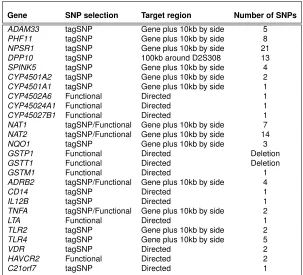
Finally, markers were selected using tagSNPs strategy based on r2 multi-marker method, selecting preferentially those SNPs with a described or pu-tative functional effect from the SNPs belonging to a bin. A summary of the SNPs examined by candidate genes can be found in Table 4.1.
Gene SNP selection Target region Number of SNPs
ADAM33 tagSNP Gene plus 10kb by side 5
PHF11 tagSNP Gene plus 10kb by side 8
NPSR1 tagSNP Gene plus 10kb by side 21
DPP10 tagSNP 100kb around D2S308 13
SPINK5 tagSNP Gene plus 10kb by side 4
CYP4501A2 tagSNP Gene plus 10kb by side 2
CYP4501A1 tagSNP Gene plus 10kb by side 1
CYP4502A6 Functional Directed 1
CYP45024A1 Functional Directed 1
CYP45027B1 Functional Directed 1
NAT1 tagSNP/Functional Gene plus 10kb by side 7
NAT2 tagSNP/Functional Gene plus 10kb by side 14
NQO1 tagSNP Gene plus 10kb by side 3
GSTP1 Functional Directed Deletion
GSTT1 Functional Directed Deletion
GSTM1 Functional Directed 1
ADRB2 tagSNP/Functional Gene plus 10kb by side 4
CD14 tagSNP Directed 1
IL12B tagSNP Directed 1
TNFA tagSNP/Functional Gene plus 10kb by side 2
LTA Functional Directed 1
TLR2 tagSNP Gene plus 10kb by side 2
TLR4 tagSNP Gene plus 10kb by side 5
VDR tagSNP Directed 2
HAVCR2 Functional Directed 2
[image:46.499.88.391.70.345.2]C21orf7 tagSNP Directed 1
Table 4.1:Summary of SNP selection by candidate gene
4.3 Candidate gene approach and genotyping 29
and is under selective pressure. It has been suggested that subjects with blue eyes share a single common ancestor (Eiberg et al.,2008). OCA2(Lao et al., 2007) and HERC2 (the genen encoding the regulatory element of OCA2) have been shown to be strongly associated with the European North-South gradient (Heath et al.,2008).
4.3.3 Genotype characterization
The ECRHS DNA bank was maintained at Helmholtz Zentrum M ¨unchen in Germany and genotyping was performed at the Centre for Genomic Regulation (CRG) in the Barcelona node from the ’Centro Nacional de Genotipado’ (CeGen) in Spain (http://www.cegen.org). DNA was extracted from blood cells using a commercially available kit (Puregene, Gentra Inc., MN, USA). SNPs genotyping was performed using the SNPlex platform (Applied Biosystems, Foster City, CA) according to manufacturer instructions and analyzed on an Applied Biosystems 3730/3730xl DNA Analyzer. Allele-calling was done by clustering analysis using Genemapper software (Genemapper v.4.0). Selected SNPs were distributed in pools with an average multiplex of 48 SNPs, and genotyping was performed in a 384 well plate format. Some of the selected SNPs were discarded for genotyping because do not fulfill criteria for the success of the SNPlex design: pooling rules, SNPs mapped in more than one region or in regions with a high content of GC, or because a secondary SNP was located at less than 20pb. In this case, SNPs were discarded and replaced for other SNPs that were at linkage disequilibrium of r2≥0.80 with the initially selected marker. Finally
115 SNPs were selected for genotyping.
Genotyping quality was controlled in two ways. First, internal positive and negative controls provided by ABI’s manufacturer were included in the reaction plates. Second, six duplicated samples of two HapMap reference trios were incorporated in the genotyping process. Both genotype concordance and correct Mendelian inheritance were verified. Genotype concordance was tested using SNPator, a web-based tool for genotyping management and SNP analysis (Morcillo-Suarez et al.,2008).
For polymorphism in GST’s genes, two semi-automated assays were implemented to facilitate the detection of null alleles from GSTM1 and
GSTT1, and the coding variant Ile105Val fromGSTP1. Ile105Val fromGSTP1
usingβ-globin gene as a positive control forGSTnull genotypes. Expected amplicons size is 219 bp (GSTT1), 459 bp (GSTM1), and 268 bp (β-globin). PCR products were analyzed with an automated DNA analyzer (model ABI XL3100; Applied Biosystems, Foster City, CA, USA).
4.3.4 Data caring
An exhaustive data caring was performed at both SNP and individual level in order to avoid possible genotyping errors and misclassification bias. Four SNPs were discarded because the genotyping rate was≤60%. One SNP was discarded since a secondary SNP was present nearby and the genotyping call was defective. Regarding subjects, the following criteria were used:
• First, 447 samples (4.6%) with low concentration (≤3 ng/µl) were discarded, in order to avoid low signals and problems with a putative amplification bias in the case of samples undergoing a whole genome amplification process
• Samples with a rate of genotyping under 80% (264 samples, 4.5%)
• A marker for chr Y was included in the genotyping process. Some dis-crepancies were observed among chr Y genotypes and the information from the ECRHS questionnaire. Regardless of the cause, these subjects were discarded (98 individuals, 1.7%).
The final number of samples discarded was 809 (13.77%). Characteristics of excluded population did not differ substantially from those included in posterior analysis. The final population size available for the analysis was 5,065 subjects. The genotyping rate was≥95% (95.9%).
4.4 Statistical methodology
4.4 Statistical methodology 31
not statistically suitable for an additive assessment. To evaluate gene-environment interactions, multiplicative model of interaction was assessed using likelihood-ratio test comparing models with additive term and interaction term. Haplotypes were estimated using haplo.em function from haplo.stats package (version 1.3.8) (Schaid et al., 2002). D’, r2 and χ2
p-values for marker independence were estimated to determine linkage disequilibrium between genetic markers.
We also performed a non-parametric approach using multifactor dimension-ality reduction (MDR). MDR was used to search for gene and gene-environment interactions by identification of a multilocus model for associ-ation, with the use of dichotomous disease status (Ritchie et al.,2001,2003; Hahn et al.,2003). It is an extension of the combinatorial partitioning method and can be seen as a data reduction technique that reduces the dimensional-ity of multilocus information to a single dimension. The method is nonpara-metric, assumes no particular genetic model and generates low false-positive rates (Hahn et al.,2003).
5
Results
5.1 Gene–environment interactions in asthma 35
5.1 Gene–environment interactions in asthma
Authors: Francesc Castro-Giner, Francine Kauffmann, Rafael de Cid and Manolis Kogevinas
Published in: Occupational and Environmental Medicine. 2006 Nov; 63(11): 776-86, 761
Full text: http://oem.bmj.com/content/63/11/776.extract
Summary
5.2 TNFA-308G>A in two international population-based
cohorts and risk of asthma
Authors: Francesc Castro-Giner, Manolis Kogevinas, MarlysM¨achler, Rafael de Cid, Kristel Van Steen, Medea Imboden, Christian Schindler, Wolfgang Berger, Juan Ramon Gonzalez, Karl A. Franklin, Christer Janson, Deborah Jarvis, Ernst Omenaas, Peter Burney, Thierry Rochat, Xavier Estivill, Josep Maria Ant´ o, Matthias Wjst and Nicole Margot Probst-Hensch
Published in: European Respiratory Journal 2008 Aug; 32(2): 350-61
Full text: http://erj.ersjournals.com/cgi/content/abstract/32/2/350
Summary
5.3 TNFA, obesity and risk of asthma 61
5.3 Joint effect of obesity and TNFA variability on asthma: two
international cohort studies
Authors: Francesc Castro-Giner, Manolis Kogevinas, Medea Imboden, Rafael de Cid, Deborah Jarvis, Marlys M¨achler, Wolfgang Berger, Peter Burney, Karl A. Franklin, Juan Ramon Gonz´alez, Joachim Heinrich, Christer Janson, Ernst Omenaas, Isabelle Pin, Thierry Rochat, Jordi Sunyer, Matthias Wjst, Josep-Maria Ant´ o, Xavier Estivill, Nicole Margot Probst-Hensch
Published in: European Respiratory Journal 2009 May;33(5):1003-9.
Full text: http://erj.ersjournals.com/cgi/content/abstract/33/5/1003
Summary
5.4 Traffic related air pollution, oxidative stress genes and
asthma (ECHRS)
Authors: Francesc Castro-Giner1;2;3, Nino Knzli1;2;3;4, Bndicte Jacquemin1;5,
Bertil Forsberg6, Rafael de Cid3;7, Jordi Sunyer1;2;3;8, Deborah Jarvis9, David
Briggs10, Danielle Vienneau10, Dan Norback11, Juan R Gonz´alez1;2;3, Stefano
Guerra1;2;3, Christer Janson12, Josep-Maria Ant´o1;2;3;8, Matthias Wjst13,
Joachim Heinrich14, Xavier Estivill3;7;8, Manolis Kogevinas1;2;3;15
Published in: Environmental Health Perspectives Dec 2009;117(12): 1919-24
Full text:
http://ehsehplp03.niehs.nih.gov/article/fetchArticle.action?articleURI=info%3Ad oi%2F10.1289%2Fehp.0900589
1. Centre for Research in Environmental Epidemiology (CREAL), Barcelona, Spain 2. Municipal Institute of Medical Research (IMIM-Hospital del Mar), Barcelona, Spain 3. CIBER Epidemiolog´ıa y Salud P´ ublica (CIBERESP), Barcelona, Spain
4. Catalan Institution for Research and Advanced Studies, ICREA, Barcelona,Spain 5. INSERM, U780, Epidemiology and Biostatistics, Villejuif, France
6. Occupational and Environmental Medicine, Department of Public Health and Clinical Medicine, Ume°a University, Ume°a, Sweden
7. Genes and Disease Program, Center for Genomic Regulation, Barcelona, Spain
8. Department of Health and Experimental Sciences, University Pompeu Fabra, Barcelona, Spain 9. Respiratory Epidemiology and Public Health Group, National Heart and Lung Institute, Imperial College, London, United Kingdom
10. Epidemiology and Public Health, Imperial College, London, United Kingdom
11. Department of Medical Sciences, Uppsala University and University Hospital, Uppsala, Sweden 12. Department of Medical Sciences: Respiratory Medicine and Allergology, Uppsala University, Uppsala, Sweden
13. German Research Center for Environmental Health, Helmholtz Centre GSF, Munich, Germany 14. Institute of Epidemiology, Helmholtz Zentrum M¨ unchen, Munich, Germany
72 5. Results
Abstract
Background. Traffic related air-pollution is related with asthma and this as-sociation may be modified by genetic factors.
Objectives. Investigate the role of genetic polymorphisms potentially mod-ifying the association between home outdoor levels of modeled nitrogen dioxide (NO2) and asthma.
Methods. Adults from 14 cities of the European Community Respiratory Health Survey (ECRHS II) were included (N= 2,920) for whom both DNA and outdoor NO2estimates were available. Home addresses were geocoded
and linked to modeled outdoor NO2 estimates, as a marker of local
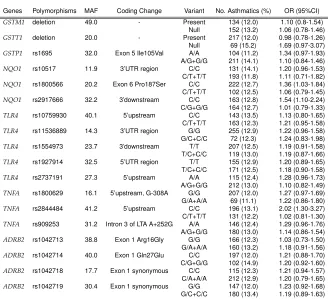
traf-fic related pollution. We examined asthma prevalence and evaluated poly-morphisms in genes involved in oxidative stress pathways (GSTM1, GSTT1, GSTP1, NQO1), inflammatory (TNFA), immunological response (TLR4) and airway reactivity (ADRB2).
Results.The association between modeled NO2and asthma prevalence was
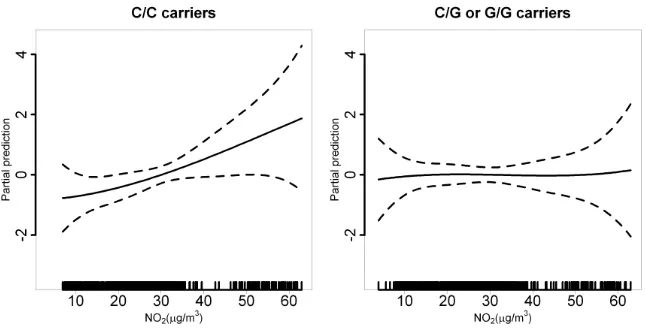
significant for carriers of the most common genotypes of NQO1 rs2917666 (OR = 1.54, 95%CI 1.10 - 2.24),TNFArs2844484 (OR = 2.02, 95%CI 1.30 - 3.27). For new-onset asthma, the effect of NO2 was significant for the most
com-mon genotype ofNQO1rs2917666 (OR = 1.52, 95%CI 1.09 - 2.16). A signif-icant interaction was found betweenNQO1rs2917666 and NO2 for asthma
prevalence (P = 0.02) and new-onset of asthma (P = 0.04).
Introduction
Asthma is a complex disease with both genetic and environmental compo-nents. The interaction between genetic predisposition and environmental factors is likely to have an important role in the etiology and prognosis of the disease. Yet, only few studies have addressed gene-environment interac-tions in asthma (Castro-Giner et al.,2006;London,2007;Yang et al.,2008). Air-pollution contributes to the development of asthma (Brauer et al.,2007; Gehring et al., 2002; Jacquemin et al., 2009; McConnell et al., 2006; Modig et al., 2006) and asthma exacerbations (D’Amato et al., 2005; Heinrich and Wichmann, 2004; Kuenzli et al., 2000; Nel, 2005). Traffic-related pollutants such as particulate matter, nitrogen dioxide (NO2) and Ozone