
The use of drama in the development of oral communication in ninth graders
133
0
0
Texto completo
(2) USING DRAMA IN EFL CLASS. The use of drama in the development of oral communication in ninth graders.. Maicol Steven Cobos Marroquin Mónica Lorena Guzmán López Universidad Distrital Francisco José de Caldas. Directora Martha Cecilia Candia Hurtado. Licenciatura En Educación Básica Con Énfasis En Inglés Facultad De Ciencias Y Educación Universidad Distrital Francisco José De Caldas Bogotá, D.C 2019. 2|Page.
(3) USING DRAMA IN EFL CLASS. TABLE OF CONTENTS. CHAPTER ONE: PRESENTATION Abstract………………………………………………………………………………..…….. 5 1. Objectives………………………………………………………………………...……….. 6 1.1 General Objective …………………………………………………………………..….... 6 1.2 Specific Objectives………………………..……………………………..……...…....….. 6 1.3 Professional Objectives …………………….……………………..…………..………….6 2. Introduction………………………………………………………………………………..7 3. Setting …………………….………………………………………………………………8 3.1 Misión…………………………………………………………………………….……....8 3.2 Vision……………………………………………….…………………………………….9 3.3 Modelo Pedagógico……………………….……………………………………………...9 4. Intervention ………………………………….…………………………..……………….10 5. Problem Statement………………………………………………………………………. 11 6. Expected results………………………………………………………………..…….…...11 CHAPTER TWO: THEORETICAL FRAMEWORK 7. Drama in EFL classes……………………………………………………………….……13 7.1 Risking to use drama and plays to teach English in an EFL classroom …...........13 7.2 Using drama in English foreign language classrooms………….....……………..14 7.3 Approaching drama in classroom………………………………….…………….16 7.4 Roleplays…………………………………………….………………………..... 18 7.5 Participating in drama-based English class……………………..………………..19 CHAPTER THREE: INTERVENTION 8. Chronogram………………………………………………………………………………. 21 3|Page.
(4) USING DRAMA IN EFL CLASS. 9. Lesson plan sample………………...…………………………………………………….. 25 10. Analysis ……………………………………………………………………………….....28 10.1 Role Play ……………………………………………………………………………….28 10.2 Monologues …………………………………………………………………………….35 10.3 Writing ……………………………...………………………………………………….47 11. Conclusions……...……………………………………………………………………….50 12. Further projects……………………………...…………………………………………...52 13. References……………………….……………………………………………………….53 14. Annexes……………………………………………………………………..……………55. 4|Page.
(5) USING DRAMA IN EFL CLASS. The use of drama in the development of oral communication in ninth graders. ABSTRACT. The following internship project will be developed in ninth grade English class in Instituto Guimarc school located in Bogotá. The purpose of this project is to use different plays in order to foster the verbal communication of ninth graders in English to develop their oral communication microskills. According to the principal’s report, students seem to present a lack of oral participation in the English class, the school asked for activities in which students can interact and develop their oral communication. One of the tools that will be used is roleplay, according to Boudreault (2010): “Apart from the obvious development of communication skills, it encourages leadership, teamwork, compromise, authentic listening skills and practice with real life savior-faire” (p.5), it seems that implementing drama in classrooms might encourage students to produce language orally. The activities proposed for this project are focused on oral communication between students as monologues and role plays taking as a basis the micro skills proposed by Brown, (2001) in his book Teaching by principles an interactive approach to language pedagogy. Keywords: plays - oral communication - role plays - drama - foreign languagemonologue. 5|Page.
(6) USING DRAMA IN EFL CLASS. 1. OBJECTIVES 1.1 GENERAL OBJECTIVE To detect what oral production microskills are developed through the use of drama in ninth grade at Instituto Guimarc school. 1.2 SPECIFIC OBJECTIVES To direct students to build the characters, main and supporting ideas about classic plays and perform a role play. To discover what oral competences selected from Brown (2009) are developed by ninth grade students through conversations, presentations, monologues after a period of six months.. 1.3 PROFESSIONAL OBJECTIVES To create a drama group for the school composed by students. To formulate drama as an strategy for teachers to encourage meaningful activities for students.. 6|Page.
(7) USING DRAMA IN EFL CLASS. 2. INTRODUCTION. The use of drama in ESL classroom may help you as a teacher to develop certain speaking microskills in your students, it is known that the more you practice speaking the better results you obtain.. In this paper the reader will find. evidence such as recordings, pictures,. transcriptions, and journals of a project based on the use of drama for the development of some specific speaking skills in ninth graders. The first chapter contains the the problem statement and the objectives of the internship, in Colombia the most difficult part of learning English is the speaking, nowadays people exposure to English has increased and it is necessary to have a good proficiency level. That is why teachers should be aware of how important is for students to speak.. The second chapter will guide you through different theories of drama in English clases and the importance of developing speaking skills. Different projects have been done with secondary students and the results have been fruitful in the field of pedagogy and language learning, but it is necessary to test it in a specific population where speaking has been taken apart from the curriculum, resulting in a lack of oral production in ninth graders.. The third chapter called INTERVENTION addresses the practical experience of the project where students and their work are the focus, it is analyzed through the use of journals and recordings in different categories such as role plays, monologues and writing. One of the most significant part of the project is the exposure to the language that was new for students and how they reacted to it. Finally conclusions are discussed, desired for further projects are stated and a list of bibliographic references can be found.. 7|Page.
(8) USING DRAMA IN EFL CLASS. 3. SETTING This internship was developed in a Private school located in the south of Bogota. Instituto Guimarc is a school situated in Jose Maria Carbone neighborhood. The institution is a single shift school funded in 1982 which offers Pre-school, Primary and Secondary education in a four level building.. The participants for the internship were 39 ninth grade students divided into two groups, the first group is 9A formed by 19 students (10 men and 9 women), this group has its English class on Wednesdays from 10.50am to 12.50pm. The other groups is 9B with 20 students (11 men and 9 women) taking the English class on Fridays from 7.00 am to 9.00 am. Students are between 14 - 17 years old and most of them live in or near the school neighborhood.. 3.1 MISIÓN “Formar personas integrales desde el ámbito, cognoscitivo, biológico, social, y psicológico que propenda por el desarrollo de habilidades individuales y colectivas, enmarcadas en un contexto axiológico que promueve hombres y mujeres críticos, líderes y competentes dentro de la sociedad.” The project was based on the mission of the school, it aimed to foster the communication between social interaction with peers through the use of drama, it is important for the project to take into account what the school purpose is and create a connection. The English language teaching is one of main goals for the school future vision in 2020, that’s why the current project helped learners to communicate and learn about English culture to drama which content exposure students to the target language.. 8|Page.
(9) USING DRAMA IN EFL CLASS. 3.2 VISIÓN “En el 2020 seremos una institución líder en educación preescolar, básica y media, que orienta procesos de formación en inglés e informática, promoviendo alianzas estratégicas con la educación superior, y brindando capacitación técnica, tecnológica y profesional; generando procesos de formación autónoma desde el modelo pedagógico enseñanza para la comprensión, y dando a la sociedad alternativas verdaderas de cambio, desde el eje principal de los valores y la formación de equipos colaborativos.”. 3.3 MODELO PEDAGÓGICO “Es un enfoque de enseñanza – aprendizaje basado en competencias y desempeños, asociado con las teorías constructivistas que nos permiten pasar de la teoría a la acción en cuanto a solución de problemas reales de manera abierta y creativa.”. Drama activities such role plays and monologues required active participation from the learners, because the results depended on how did their language process improved from a starting point and the final product.. 9|Page.
(10) USING DRAMA IN EFL CLASS. 4. INTERVENTION. The internship started on April 11th - 2018 and finished on September 28th - 2018 having three different stages. The first stage was the first two classes, when the teachers were able to superficially identify the students’ English level according to what they are supposed to know, their willingness to participate in speaking activities as well as in group work, and their behavior towards the English class.. The second stage was a nine weeks period starting on April 19th and finishing on June 13th. Here the teachers worked along with the 39 students during the classes. This was the time for acquisition of new vocabulary about the plays, creative writing and speaking practices about the plays altering individual and group work. A different play was addressed every two weeks in order to learn new different vocabulary and work on a varied range of activities.. Finally, the third stage has a length of ten weeks starting the first week after the school midyear break, on July 18th and concluding with the final presentation of a students-made role play the last week of September. In this stage, five students of each group were selected by the teachers to participate in the creation and performance of a role play in which different activities that include kinesthetic and voice management exercises were also carried out.. 10 | P a g e.
(11) USING DRAMA IN EFL CLASS. 5. PROBLEM STATEMENT According to Instituto Guimarc’s principal, ninth graders present a lack of oral production in English language when interacting with classmates. Different activities focused on speaking are proposed in this internship in order to improve students oral communication. Besides the lesson plan proposed, an acting group with students from both classes will be created . As a final product, a students-made roleplay will be performed in front of the two classes.. The strategy proposed for this project is a serie of drama activities such monologues and role plays based on classic plays. A research done by Hall (2001) suggested that : “In order to promote language learning we as language teachers: first, must create motivating and challenging interaction activities, second, assist learners involvement in the interaction from the beginning levels”.. 6. EXPECTED RESULTS. The results expected for this project are based on Brown’s (2001) oral communication microskills which he established in his book Teaching by Principles and the use of drama in the development of students’ oral production. A more fluid and wider vocabulary in oral production is expected. Students are presumed to develop a deeper and longer oral communication in English.. 11 | P a g e.
(12) USING DRAMA IN EFL CLASS. Students are expected to use English to: Brown (2001) : 1. Produce chunks of languages of different lengths. 2. Produce reduced forms of words and phrases. 3. Produce fluent speech at different grades of delivery 4. Monitor your own oral production and use various strategy devices - pauses, fillers, self-correction, backtracking to enhance the clarity of the message. 5. Use grammatical word classes (nouns, verbs, etc) systems (tense, agreement, pluralization) word order, patterns, rules and elliptical forms. 6. Use facial features kinesics body language and other non-verbal cues along with verbal language to convey meanings.. Brown’s speaking microskills are useful guidelines for this project due to they can easily connect the drama and the oral production. Fluency, the length of the interventions students do when speaking and the reduced forms evidence the progress students develop in their oral competences. When using drama in classroom it is important for students to have an idea of different aspects of the play, for example, the characters, setting, space and the main events. For Brown one of the microskills students must develop is the ability of sharing orally the main ideas that come to their minds. It allows the teachers to spot the issues where they need to work on in order to help students develop the microskill. To increase the way in which students express and share ideas is essential in this project. In a drama based class it is important for students to apply some techniques that allow them communicate in different ways and train their ability to show a message, this is why students work on their individual skills when doing exercises like monologues and roleplays.. 12 | P a g e.
(13) USING DRAMA IN EFL CLASS. CHAPTER 2 THEORETICAL FRAMEWORK. 7. DRAMA IN EFL CLASSES 7.1 RISKING TO USE DRAMA AND PLAYS TO TEACH ENGLISH IN AN EFL CLASSROOM. Even though the teacher is not a professional in the acting field, a drama-based class is a fantastic way to motivate students to produce oral and written chunks in the target language and some activities can be easily developed to enhance students’ oral production. A teacher should not be afraid of using drama, there are plenty of materials that provide them with different meaningful activities to address classic plays. It is also important the way drama is introduced by the teacher to a traditional EFL classroom, for this reason, a healthy and comfortable environment should be fostered, it provides students with the opportunity to express their ideas and opinions about what they are learning and what they think. Gray (2002) states that: “If the teacher is introducing drama to the students it is even more important to establish a comfortable and free thought-sharing environment” This is useful since students do not feel afraid of expressing in a verbal or non-verbal way in the English class and this gives them the chance to free behave in a different way making their self-esteem and self-confidence increase. “A good drama teacher can use the practice with role-playing to contribute to the self-esteem of the students, build their confidence in using the target language (English)” Boudreault (2010, para.10) In an EFL classroom where the focus is drama and performances, both students and teachers are supposed to take part in and participate actively, teachers as guides and students 13 | P a g e.
(14) USING DRAMA IN EFL CLASS. coming up with spoken spontaneous language, so a trusting environment shall be built up. The activities proposed should start from not demanding activities as a test to gather information about students’ oral production level to more complex tasks such as role plays. When using drama in class teacher should know that there are many challenges students will have to face, sometimes teachers get scared about the outcomes an activity would carry, as Royka (2002) suggested: “Many teachers feel that they cannot approach drama activities without being a trained actor. They feel, at times, they just wouldn't know what to do. Even if they have the activities in a book, which explains them clearly, some feel they couldn't do them properly or explain the purpose of the activity.” that might be one of the reasons why it is not familiar for students to act in front of their classmates and also for teachers because they feel they're not in their comfort zone. But as Royka (2002) suggested the books we can find in the market are user-friendly and they are well explained so whoever who wants to use drama would be able to carry out all the activities with not problems at all.. 7.2 USING DRAMA IN ENGLISH FOREIGN LANGUAGE CLASSROOMS One of the worries students have when facing English or whatever foreign language is to speak and communicate in the language, they get frustrated easily because they think they need to do it in a perfect way and as a native person. Nevertheless, speaking requires practice and one of the best ways to train the oral abilities to express ideas, thoughts, opinions, etc. is through plays. Boudreault (2010, para.5) sums up some of the benefits of using drama in classrooms: ● The acquisition of meaningful, fluent interaction in the target language; ● The assimilation of a whole range of pronunciation and prosodic features in a fully contextualized and interactional manner; ● The fully contextualized acquisition of new vocabulary and structure; 14 | P a g e.
(15) USING DRAMA IN EFL CLASS. ● An improved sense of confidence in the student in his or her ability to learn the target language, in terms of Wessels (1987). Cowley (2007) in the same line, listed some of them as: “using and enhancing students’ imaginative skills, experiencing what it’s like to be someone else, understanding why some people behave differently to others, seeing things from another viewpoint or perspective” (p.85). Hence, the use of plays in classroom carries a lot of benefits to students to contribute to some important aspects such as their pronunciation, creativeness, interaction, confidence and the opportunity to put themselves in someone’s position. The proposal for this project is based on Greek and Shakespeare classic plays. These plays give students the chance to get in touch with authentic English culture, which allow them not only to be immersed in English spoken literature, but also produce novel language and improve their oral communicative skills through different activities, such as: conversations, monologues, narrations and oral presentations. Due to conversations promote in students the ability to answer and ask questions in a spoken way, monologues encourage students to construct fluent verbal communication through the use of grammatical forms, tenses, rules, and systems. Finally, in order to present academic topics and short stories presentations and narrations are carried out. Using drama is a perfect tool to prompt. students to use the target language to. communicate, Bang (2003) affirms that : “Drama is essentially social, and involves contact and communication of meanings” consequently students who face drama in their curriculum improve the understanding and use of language and enhance their oral communication skills since they are supposed to complete speaking tasks. Since drama is a strategy that gets quickly the attention of the students, this allows the class to be developed in a better way, besides authors such Doson (2000) states that “the most 15 | P a g e.
(16) USING DRAMA IN EFL CLASS. immediately apparent benefit of using dramatic activities with L2/FL students is that they acquire and practice new vocabulary and grammatical structures”, it also places students in situations that can go far beyond of the grammatical aspect of language, the correct way to write a sentence and some grammatical rules, moving to more dynamics, fun circumstances. Improvisation is and important element in a drama-based class. Landy (1982:6) defines improvisation as “an unscripted, unrehearsed, spontaneous set of actions in response to minimal directions from a leader” and as some authors agree “Improvisation is an excellent technique to use in the L2 classroom as it motivates the learners to be active participants in authentic situations thereby reducing their self consciousness”.Athiemoolam (2004) “The improvisation aspect of drama gives students opportunities for developing their communicative skills in authentic and dynamic situations” (Boudreault 2010) Communicative activities allow students to produce novel language in class, as Sam (1990) suggested: “Drama used in the classroom can be considered a communicative activity since it fosters communication between learners and provides opportunities to use the target language in various 'make believe' situations.” it seems that when students face a hypothetical situation their outcomes aim to directly communicate meanings so there is a better understanding of the situation.. 7.3 APPROACHING DRAMA IN CLASSROOM Drama is a significant tool for students who are concern of their own language learning process and those who want a different alternative to practice. It is necessary then, different activities and techniques from theatre that allow students to enhance their oral production (Rauen, 1990) for example voice projection and the appropriate movement to non-verbal communication.. 16 | P a g e.
(17) USING DRAMA IN EFL CLASS. Lower the anxiety in students is a task teachers should address due to it gives students the opportunity to express easily their ideas and increase their willingness of participate in the performance and this way is easier for them to increase their output. Different authors have established the importance the use of drama has in a foreign language classroom agreeing that drama, “promotes students' creativity and encourages group cooperation” (Lin, 2011 ). Rauen also recommends to work by groups instead of individuals because such tasks involves communication and creativity and students might develop a better social and communicative skills if they witness a communicative environment in classroom, It is also helpful to give each student the opportunity to develop their self-confidence so they can later on become an active participant in all the speaking activities the teachers propose in class. Giving students that self-confidence may not be an easy task for teachers as students have different personalities and interests, however it is important to bear in mind that as a starting point students need to feel comfortable with themselves and with their classmates and this will guide them and the class to succeed in the class. Students expectations about drama may vary but it seems that most of them believe it is a complex and challenging activity, that is why is part of teachers’ job to change the belief and let students explore the bunch of fun tasks and games that involves drama, so they can feel more comfortable and see the work as an alternative of English learning. Timing represents other important aspect to take into account when planning a lesson, each student is different and so are their learning processes, the activities teachers propose should be aimed to create a connection between physical and mental activity (Rauen, 1990), so activities like improvisation allows the learners to explore the two areas.. 17 | P a g e.
(18) USING DRAMA IN EFL CLASS. 7.4 ROLEPLAYS Role play is the most common drama activity where students face different situations and they are exposure to direct communication, Gaudert (1990) stated that: “Role play is possibly the most familiar to teachers, and therefore the most acceptable of the drama techniques. Research indicates, however, that teachers' interpretation of role play varies. The most common form of"role play" is to select a dialogue, often an extract for listening comprehension, assign parts to the students and get them to read the dialogue aloud with the teacher correcting pronunciation errors. In training and retraining teachers, we have attempted to move them away from this "model" and teach them to create situations which would give rise to more spontaneous speech”. For young learners between 14-16 it is important to learn the language when they do not feel it as a hard challenge to achieve, when they find it fun to produce chunks of oral communication, they can take part of it by adjusting it to their context. Krawiek, (2014) states that “anyone who has worked with young children knows that they learn chiefly by exploring their world using their imagination and engaging in pretend-play”p.11, and that is the moment in which students enjoy the practice of performing role plays, they create their own imaginary situations and add something to the play, making use of language in different forms. Role-playing is seen as an important part in the process of learning a foreign language and it offers many benefits to the teacher and the learner which includes the cooperative work and interaction between students, the chance to express their emotions bringing them to an activity. As Rauen, (1990) states “Ability to improvise dialogue may well be the essence of communication.” it is necessary to expose students to activities where they have to think and 18 | P a g e.
(19) USING DRAMA IN EFL CLASS. act as if it were a real situation. Group work facilitates teachers work when applying such activity with a big amount of students, for example, students should be divided into groups, given a hypothetical situation, and then perform an improvised representation in a short time. Repetition exercises might help students to acquire vocabulary they will use when performing a role play, Rauen (1990) suggests that “ repetition technique not only gives the less articulate students a chance to experience more difficult roles, but also helps to enforce adequate social, verbal and non-verbal adaptation in the foreign language.” whenever a student faces foreign language he/she witnesses a necessity of adaptation, it may vary from cultural issues to the language itself. Repetition allows also students to create patterns of language which along with the pronunciation correction will prompt a better proficiency of the target language. 7.5 PARTICIPATING IN DRAMA-BASED ENGLISH CLASS When students face acting and drama activities in a classroom they practice the four skills they need to develop in the target language. They start to internalize the language by developing different tasks. Bang (2003) states that “in order to participate in activities the students will have to verbally express their ideas, listen to others’ opinions, read a related text and work on projects as the drama progresses” p.3 Another way students internalize all the things they learn is by making comparisons and linking the imaginary situations they create with situations in their real lives.Fleming (1995) cited by Ozbek (2014) claims that “using drama in education can lead to the development of broader understanding through generalizing and making connections” and these connections are not only of the student's own production but with others’ production. This is important since teachers are always in charge of different students and they need to work together and start communicating with each other. In a drama-based class the moment when students start to work together listening to others, linking their ideas and understanding 19 | P a g e.
(20) USING DRAMA IN EFL CLASS. the importance of communication in different contexts they can successfully achieve any task in the class. Participating in a drama-based class means that students work in different ways and are frequently exchanging ideas. Students need to talk, socialize their thoughts and have a regular dialogue with their classmates. Erbay and Dogru (2010) cited in Başaran, Karadağ, & Güneş agree that “drama has a significant positive effect on social communication skills” In drama situations in the classroom students have the opportunity to be whoever they want to be, create new characters and situations. “In drama, time can be altered, space changed and identities shifted. Winston, J. (2012) , making this a fun activity for the students and encouraging them to participate in the exercises with no fear especially when they are free to create everything. As states Boudreault, (2010) “When the students are enjoying an activity, they are learning and letting their guard down” Drama is all about how the performers present themselves. If the student can communicate better, the more likely others will see him/her as he/she wishes to be seen. (Boudreault 2010, para 20.). 20 | P a g e.
(21) USING DRAMA IN EFL CLASS. CHAPTER 3 INTERVENTION 8. CHRONOGRAM Week. Description. #1. Presentation. Abril 11. Students introduce themselves through speaking activities and play a speaking game about general culture.. #2.. Electra. Abril 18. Students work by groups, they read the summary of the play and identify the characters and main ideas. Then they share with the class.. #3. No class. Abril 25 #3. Electra (https://www.youtube.com/watch?v=vdqgdllmV18 ). May 2. Students finish the summary by groups, then work in answering questions about the play and share with the class.. #4. Prometheus. May 9. (https://www.youtube.com/watch?v=U_u91SjrEOE ) Students work in two groups playing pictionary and mimics about some vocabulary of the play, then read the story aloud and watch a video.. 21 | P a g e.
(22) USING DRAMA IN EFL CLASS. #5. Oedipus the King. May 16. Passive voice // students discussion. #6. Oedipus the king.. Mayo 23. Students read the summary aloud and point out the characters and main events of the play. They work by pairs, one student have the description of a sphinx and read it to the partner, who is in charge of drawing it following classmate’s instructions.. #7. Oedipus the king.. VIDEO. Mayo 30. Students watch a video about the plot of the play and based on the clip they answer some questions and develop a worksheet.. Stories. Greek gods. Junio 6. ttps://www.youtube.com/watch?v=eJCm8W5RZes&list=PL3lR -UVp9bUBh11W9cBLJRzckAro7F49h. Students watch the video about Greek gods, they discuss vocabulary. Teacher paste gods pictures around the class, students are given some characteristics about them and they have to match each word with the appropriate god.. #8 Facts Discussion Junio 13. 22 | P a g e. Greek gods.
(23) USING DRAMA IN EFL CLASS. Students are assigned a god to work with, by groups they create a new god with the characteristics, weapons, powers and personality they want, then they share with the group. VACATIONS #9. Vacation time. Julio 11. Students watch a video about “Mr. Bean vacations” in order to recognize characters and setting of a short story, then they write a short text about their vacations.. # 10. Romeo and Juliet. Julio 18. Students watch a serie of videos about the play and they have an oral presentation about the main events. #11. Script creation. Julio 25. Students are divided into two groups, start giving the main ideas and characters for the final roleplay. They work on writing the script for each scene.. #12. Role play. Agosto 1. Students perform Scene Number 1 and Number 2 following teachers’ suggestions and feedback.. #13. Monologue. Agosto 8. Students create their characters personality and prepare a. 23 | P a g e.
(24) USING DRAMA IN EFL CLASS. monologue. #14. Role play PLANNING. Agosto 15. Students practice the script and perform the first draft of the final role play.. #15. Body language ROLE PLAY PERFORMANCE. Agosto 22. Students practice techniques about body language when performing a role play in front of a public.. #16. Speed dating. Agosto 29. Students perform a speed dating where they collect personal information from their classmates.. #17. Monologue. Septiembre 5. Students perform an active monologue about a famous character.. #18. Improvised Situation ROLE PLAY. Septiembre 12. By groups of 5, students perform an improvised situation role play. #19. Monologue. Septiembre 19. Each student perform a monologue of their characters on their play.. #20. Final Presentation ROLE PLAY. Septiembre 28. Students perform the final product of their play.. 24 | P a g e.
(25) USING DRAMA IN EFL CLASS. 9.LESSON PLAN SAMPLE School Name: Instituto Guimarc. Grade: Ninth. Teacher (s): Maicol Cobos & Monica Guzmán Headroom teacher: Mayerly Rojas Objectives: To encourage students to use learnt vocabulary and produce sentences and questions about the topic.. Topic: Prometheus play conversation. Date:. Activities. Warm up. Time. Students will organize into two groups and 20 min. May 09th and 11st, 2018 Resources Objectives. Markers Board Vocab. To understand and perform key vocabulary of the play.. Teachers and students will read out loud the 40 min summary of the play, then students will watch an animated video of the play Prometheus, so they have a deeper knowledge of it.. Summary of the play Video. To identify important information and events about the play.. Teachers will divide the class into two 30 min groups and each teacher will be supervising one of them. The groups will create 15 questions about the play based on the summary and the video.. Sheet of paper Pencil Erraser. they will play pictionary with some vocabulary the teachers will give them about the play Prometheus.. Presentatio n. Practice. Production. Students in each group will take turns to ask one of the questions to the other group. The 20 min. To write 15 questions about the play in past simple form.. To respond questions in past form giving long answers. other group will have 1 minute to answer the question and win points.. Lesson plan Number 4. 25 | P a g e.
(26) USING DRAMA IN EFL CLASS. As seen in Lesson Plan Number 4 the activities proposed are focused on oral production, students are supposed to create questions from a Greek play called Prometheus by Aeschylus, they also work on identifying characters, main events and different endings so the students will have the opportunity to develop their creativeness and improvisation as well. They also will use novel language which is one of the proposals for this project. It is also addressed a summary made by the teachers because the time spent in classrooms is not enough to read the original play, in this summary (see Summary 1.) different language is used so it is easier for students to get the main idea of the play and develop the proper tasks.. Prometheus bound by Aeschylus. Zeus’s servants Kratos and Bia take Prometheus to Caucasus where Hephaestus chains him to the mountain. Hephaestus felt sorry for Prometheus. he went away. He was in pain and he complained loudly to the earth, the sun, the rivers, the seas and the air about the sufferings he didn’t deserve. He could predict the future. He knew that his sufferings will end and that he just has to endure a bit longer under Zeus’s tyranny. Soon the Oceanids came to Prometheus. They showed compassion and they had mercy for him. The Oceanids asked him to explain why he ended up chained to the mountain.. He explained the battle between Zeus and the Titans and how he stood on Zeus’s side and helped him in ousting Cronus. After the battle, Zeus wanted to destroy humans and then Prometheus stood against him. Then Oceanus came and tells him to say sorry to Zeus. After Oceanus left the Oceanids cried because of Prometheus’s destiny but he explains to them. 26 | P a g e.
(27) USING DRAMA IN EFL CLASS. that it’s all for the people. Io asked him to tell her when her sufferings will end. He tells her everything and that if she liberates him no one will ever oust Zeus.. Summary 1. Prometheus by Aeschylus summary.. 27 | P a g e.
(28) USING DRAMA IN EFL CLASS. 10. ANALYSIS. 10.1 ROLE PLAY. LESSON PLAN NUMBER 15, 18 AND 20. This compendium of three different lesson plans were selected from the project due to their main activity was to perform a role play which will help to identify, analyze and conclude the development of the students oral production in a sequence and to evidence in the process the importance and the impact of all the strategies that were carried out. The first of these lesson plans was developed on August 22nd, the second one was on September 12th and the last one was the last class on September 28th so the students had between two and three weeks before presenting the next role play.. Students were observed in order to identify different aspects related to their speaking skills. These aspects are based on Brown’s speaking micro-skills and were developed through role plays.One of the aspects to observe in these lesson plans was the length of students oral production and their ability to use vocabulary they already knew including structures, contractions and word classes. During the classes, students learnt different tips through videos and conversations with the teachers and recommendations to bear in mind when presenting a role play such as kinesics and the use of the space, they were supposed to apply those tips when acting out their role plays.. The first lesson plan focused on role plays was the lesson number 15 which aimed to gather information about important aspects of students’ performance when presenting a role play. The main objective for the class was training the body language of students and voice tone, they. 28 | P a g e.
(29) USING DRAMA IN EFL CLASS. needed to perform a role play based on a specific situation given by the teachers. These are the two situations they performed:. Situation 1 Social and family problems with LGBT community.. Situation 2 Racism in school This situations were selectected for the students among different topics as politics and drugs abuse, they stated they were familiarized or knew some real situations related to those subjects. So it was interesting for them to perform a situation based on that and they manifested their interested to create role plays based on realistic everyday situations more than in other subjects.. The second lesson plan developed with a role play was the Lesson plan number 18. As the students had previously stated their interest to work on role plays bringing real life situations to the stage, they performed a new situation they created by their own. In that class students had some minutes to establish the situation and characters but they were not allowed to write their script so they improvised their lines when presenting the role play.. The situations for this role play were: “The stalker teacher” a story about a Math teacher stalking one his students, and “I love you” a story about a guy confused by his feelings. Students had already made a role play with given situations so this was the time to improvise a role play created by themselves before presenting the final role play.. Finally, the third lesson plan centered on role plays was the lesson number 20, in this class students performed a final role play. Students worked hard creating a script. They also practiced their lines and performance every week and in this class they presented the role play. In the. 29 | P a g e.
(30) USING DRAMA IN EFL CLASS. final class the progress the students had had in terms of improvisation, kinesthetic and body language could be seen, in order to analyze in a better way the results.. INDIVIDUAL ANALYSIS. The following is an individual analysis of the students. The information cited below can be found in the transcription of the Lesson plans number 15, 18 and 20. (see Annexes). Juan Diego:. The speech produced by Juan Diego in the lesson plan number 15 evidenced a correct use of word clases most of the times. He used categories such verbs: “come with me”, determiners: “this is for you”; tense consistency and a correct structure in the sentences, “My name is James”, “what is your name?”. In the scene Juan Diego performed he was talking with a little girl and he demonstrated a good use of present simple tense and word classes. (see lesson plan number 15). After three weeks in lesson plan number 18 Juan Diego was able to create chunks of language in a longest length: making use of different word classes: “ This balloon is for you”and “ I have this for you”, are some examples of it. He also used self-correction systems when talking in order to monitor his own speech “ Yes I am I am your boyfriend. (see lesson plan number 18). Finally, in lesson plan number 20 Juan Diego displayed a great usage of grammatical word classes such nouns, verbs, etc) “Good morning, welcome to the restaurant. Are you ready to order?”; self-correction devices “I’m I'm sorry sir, please forgive me. Let me get you another soda.” systems (tense, subject agreement, pluralization) “Grandma, I need help”, “...but her 30 | P a g e.
(31) USING DRAMA IN EFL CLASS. father doesn’t like me”, “I am fighting for her” and word order, tense consistency when saying his lines This process was useful for Juan Diego because he learnt and applied different devices to correct himself when he made a mistake and give a clear message to the audience and he applied this not only when performing a role play but during the classes in any opportunity he had to say something. (see lesson plan number 20). Karen:. Karen´s speech in the lesson plan number 15 was short and did not evidence many things, however in the lines they had in that class, it is seen that she used a correct word order: “Who are you?”; tense and subject agreement “my name is Karla” (see lesson plan number 15). In lesson plan number 18 it was demonstrated the difference in Karen’s oral production. she participated from the beginning to the end of the role play and used verb tenses in a proper way (present) “Hello son, how are you?”, (past) “What happened son?. Compared with the previous role play, after three weeks Karen showed a more appropriate number of words when speaking and it helped her to express their ideas and be a more active participant during the classes and to think and say new ideas for her own lines and her classmates lines.. In the last lesson (lesson number 20) Karen spoke in a more natural way making use of pauses in speaking when she needed to join two ideas in a sentence and leave some time between them. “So, tell us Juan, / what do you do?” “Thanks for coming./ I hope didn't interfere your plans for tonight”. She also uses different word classes (verbs) “please come in”, (reduced forms of words) “ I hope didn't interfere your plans” (tense) “I will have dinner with my family tonight” (see lesson plan number 20).. 31 | P a g e.
(32) USING DRAMA IN EFL CLASS. Karen’s oral production improves from the first role play in which it was evidence that she did not participated too much, she was ashamed and she did not like to speak loud but the understanding and the use of some tips allowed Karen to improve. She felt nervous at the beginning, however during the six week process taken from the first to the last role play she tried her best to improve the aspects she considered important such as voice tone, self correction and fluency and this was important, she realized about the importance of these aspects when speaking along her process.. Erika. Although Erika sometimes doubted when speaking, in lesson plan number 15 Erika presented a fluent speech, she produced chunks of language in different lengths in some of her lines: “what are you doing playing with that ?”, “You are a dumb ”. There are some cases when it is evident that she made use of self correction restructuring what she was saying and repeating a word while she found the words she needed to use. “look your son playing with with with dolls … with dolls” (see lesson plan number 15). In the last class, six weeks after the first role play Erika showed the correct use of grammatical word classes as verbs “Tell me…”, “ I know...” “ I’m fine...”; verbs and pronouns in the same line “ I do. ” “If you think” “she worth it”. Erika always seemed to have an interest in monitoring her self-oral production by correcting herself when speaking and trying to say the appropriate word. Her process has much guidance from teachers since the beginning because she always asked for the correct way to speak, communicate and make it better for her and for the audience, she found significant the fact that the audience understood what she meant and during the time she had before the next role play the demonstrated a great progress.. 32 | P a g e.
(33) USING DRAMA IN EFL CLASS. Juan Carlos. In the first role play that Juan Carlos performed, he produced reduced forms of words and phrases and long chunks of language as in the example: “Hey Valery wha what's thinking, don't you think it's time to get aa some?. You already have a boyfriend”. Here it is evident that sometimes it seemed difficult for Juan Carlos to build up some sentences and he started repeating a word while he remembered the next one, that was his strategy for self correction (using fillers). He always wanted to talk but he sometimes got nervous (see lesson plan number 15). In the second role play Juan Carlos seemed to be more comfortable, he took his time when speaking, it was evident the increase in his self-confidence in the scenario after the first role play that was three weeks before. He used pauses in speaking when he had to express many things in the same sentence “Paula/ she is beautiful/ Juan Diego/ is handsome. I love them” he also had control on verb tenses (see lesson plan number 18 ) However in the following parts of the transcription it is evidenced that he tended to repeat some words when he did not remember what he was saying. “No no, he he’ll he my my my my friend, I swear”, “ listen mom. Juan Juan Juan Diego he my boyfriend”, “He he he is my friend”. In the final lesson plan (lesson plan number 20) Juan Carlos demonstrated that he could use corrective devices when talking such pauses, and backtracking besides self correction in order for the audience to get the message with no misunderstandings. He properly used pauses and breathing in long dialogues “Wow, she is so beautiful/ Hello Valentina how are you doing?” “Nice to meet you too/ so tell me about you.” monitoring his own oral production. He also spoke fluently during the whole role play making no mistakes and using appropriately different word classes as verbs, adjectives, pronouns and exclamations. (see lesson plan number 20) 33 | P a g e.
(34) USING DRAMA IN EFL CLASS. GENERAL ANALYSIS. The results obtained in these classes based on role plays reflected most of Brown micro skills included in this project. Since the beginning some students used reduced forms of words they already knew and they reinforced these words and used more of them. It is evident in words like “didn’t” instead of “did not”, “you’re” instead of “you are”.. Students’ oral production was different in every class, at the beginning they presented a lack of vocabulary and had some difficulties with structures but along the process their output in terms of length of speech, the adequate use of pluralization, grammatical word classes (verbs, conjunctions, pronouns, adjectives, determiners, etc.), improved significantly. The process related to role plays took six weeks in which the students showed a great advance, besides all related to language, they worked on their nervous and some situations that made them feel uncomfortable, so the exposure to different performances and to the audience increased their self-confidence when using the target language creating a pleasant environment.. The students found in this role plays lessons the opportunity to improve both oral and kinesthetic communication. They improved their fluency in their speech when acting because they created more complex dialogues as they were learning new things and concepts, they used self monitoring when speaking using different devices. (pauses, backtracking and self correction) that are relevant in their daily life and not only when doing performances.. One of the micro skills presented for Brown explains the use of facial features, kinesics body language and other non-verbal language to convey meanings. Despite this is not evidenced in the transcriptions it is appropriate to mention the role of body language in the development of. 34 | P a g e.
(35) USING DRAMA IN EFL CLASS. these lesson plans. During the performance of the first role play, students tended not to look at each other when speaking and remain still in their places sometimes.. During the development of the lessons and with the teachers’ guidance on a way to use kinesics when performing, students learnt and applied tips related to the use of the stage, the voice tone to use when presenting in front of an audience and they understood the importance of nonverbal communication as movements and facial gestures to emphasize a meaning.. This seemed fun for students to start using body language and facial expressions in order to show emotions when needed. They used them along with verbal language to clarify and convey meanings.. 10.2 MONOLOGUES. The following lessons were selected because they share the same main activity which is monologue and also because at this time of the project students had already developed many activities like completing a story and charades, where they had the opportunity to practice their improvisation. It is important for the project to analyze how students produce language in improvised situations, in lessons number 12, 17 and 19 students were asked to talk about what they wanted, playing themselves and also as a different real or unreal person. The results showed the amount of words students were able to produce and the attitude to achieve Brown’s microskills expected for this project which are the aim of the project and also expose students improvement through classes.. 35 | P a g e.
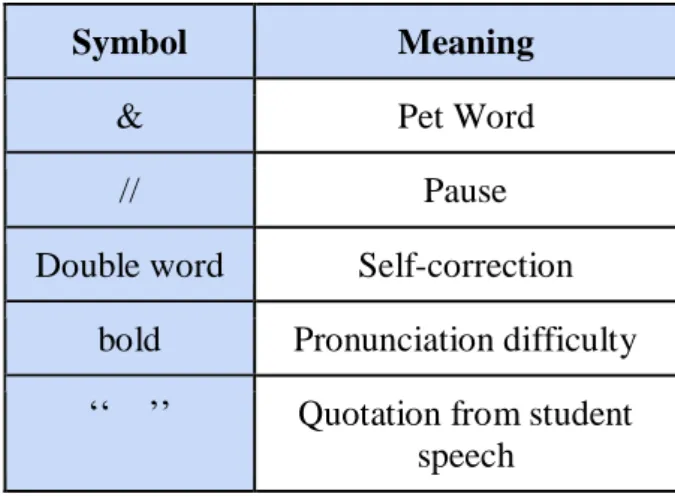
(36) USING DRAMA IN EFL CLASS. The transcriptions of the monologues audios are organized in Chart Number 1 and Chart Number 2. They way it might be read it is explained in Table number 1.. Symbol. Meaning. &. Pet Word. //. Pause. Double word. Self-correction. bold. Pronunciation difficulty. ‘‘. Quotation from student speech. ’’. Table Number 1. Audio transcription symbol conventions. (own source). LESSONS NUMBER 12, 17 AND 19. On lessons number 12, 17 and 19 were developed different monologues, these activities were divided in three topics, first it aimed to shortly present students occupation, age, likes and dislikes (lesson number 12), at this stage students were supposed to be able to create short sentences about themselves, they were not asked to use unreal information due to the monologues were based on the reality of their life, it helped students to recognize their time order when speaking and to have an idea of how develop a monologue according to different parameters given by the teachers like character personality, goal, obstacles and actions to achieve the goal. They also were able to identify the correct use of grammatical word classes (verbs, nouns, adjectives and adverbs) through student self instant feedback.. 36 | P a g e.
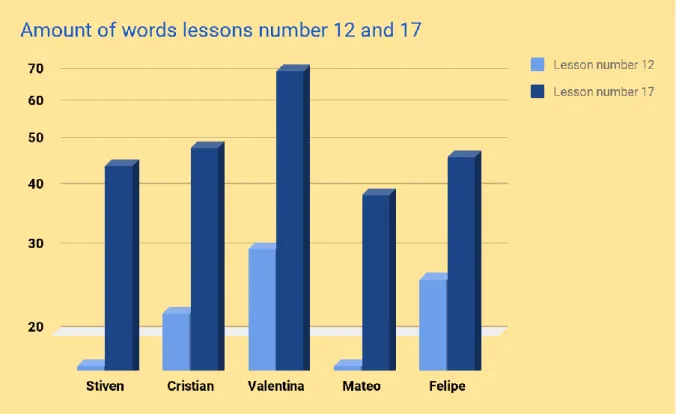
(37) USING DRAMA IN EFL CLASS. Second, students chose a famous character (lesson number 17), it could be real or unreal, most of them chose famous characters like Gustavo Petro and Sonic, the idea was to identify, examine and present subjective information about the character, students pointed to three parts of the monologue: what the character wants, what the obstacles for getting that objective are and finally the actions this character should do in order to overcome the obstacle and achieve the goal. This lesson is important for students oral production because while they were developing the task, they monitored their own production with strategies such as pauses and self-correction. When speaking, it is important for the learner to be aware of the mistakes he or she is doing, it might help him/her to identify the weaknesses and correct them immediately, this kind of correction supports their process to develop a more fluent speech.. Third, students developed the monologue of the characters they previously have created for the final play (lesson number 19). In this last monologue students identified their characters values, ideas, thoughts, feelings, emotions, objectives, obstacles and actions. At the last stage the output of students improved in terms of lengths of speech, fluency, self monitoring correction and use of systems and grammatical words as it will be seen below.. ANALYSIS. One of the expected results from this project is to witness an improvement in oral production in terms of length; from these 3 lessons, it was evident an improvement in some other the expectations. Graphic number 1 shows students amount of words produced in the three different lessons, all students oral production increased in terms of length, it not only seems to be a good improvement, but it also shows that the more students practice an activity the better results could be seen. When students monitor their speech, it is easier for them to identify the mistakes they make, this monitoring allows them also to guide them towards a more efficient 37 | P a g e.
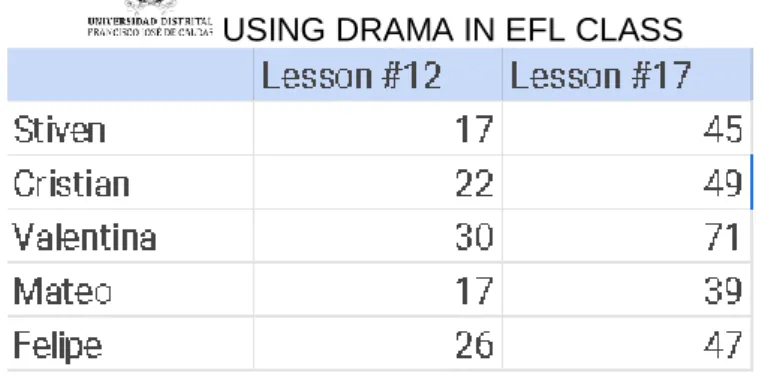
(38) USING DRAMA IN EFL CLASS. communication with others; other expected result for the project is to create more complex sentences which is evident in their speech on the second lesson plan when they went from telling the name and age to more significant chunks of language that provide deeper information about themselves.. Graphic Number 1. Students amount of words orally produced through 2 different lessons.. As seen in Graphic number 1 and table number 2 student's oral production improved in terms of length, it seems that they became more fluent and are now able to produce more complex sentences. It is important for this project to prompt students to use the vocabulary they already know and look for new ones , it might help them to increase the sentences their produce when speaking and also share deeply their ideas and thoughts. The aim of the proposal is to foster in students the willingness in expressing what they ant in different ways, not only through simple clauses but in complete sentences.. 38 | P a g e.
(39) USING DRAMA IN EFL CLASS. Table number 2 amount of words produced per student in lessons number 12 and 17. The chart Number 1 shows the transcriptions of the students’ speech from lesson Number 12 and Number 17, most of them produced a bigger amount of words, they also were able to connect better the ideas and to state their thoughts in a logic order. It is really helpful for students to have the ability to produce language fluently because this way they can not forget their idea and the communication will be successful. In Valentina’s case the exposure to the language helped her to say what she wanted in a more comfortable way due to she had already practiced. a. monologue. Student’ s name. Lesson Number 12. Lesson Number 17. Stiven. My name is Brayan Stiven Rendon Pulido my age is 16 years old &eh I like play football.. Hello, my name is Gustavo Petro, I am forty five years old, I am from Colombia I wor in senator of the republic. &eh my objective is to win a presidents // and my obstacle is Ivan Duque, the other candidater // My virtue is the clary clarity.. 39 | P a g e. before.. Observations Stiven’s oral production in first and second lesson plan changed in the following ways: The amount of words used in certain time. The use of pauses, fillers, self-correction, backtracking. The use of grammatical forms..
(40) USING DRAMA IN EFL CLASS. Hi, my name is Sonic, I am &eh twen. twentyone years old, I from I am from Cam. I am superhero in the videogame, my objetive is is the is the save my home, but but my my enemy, Doctor eggman eggman &eh &eh try des..destroy me &eh My my po my power is run fast.. Cristian’s oral production revealed an improvement in the use of grammatical word clauses and as seen in Stiven’s case the amount of words is bigger.. Valentina My name is valentina Vargas I have a 14 years old &em my favorite music is trap my favorite singer is Bad Bunny &eh I like make desserts I like *ate* desserts.. My name is Light Yagamy, I ha I am twenty years old, I am from japan &eh I study in the university in Japan &eh I am the keeper of the death note, my objective is / delete the evil in the world &eh &eh “Ele” is a pola police and he is my biggest enemy, my power is kills e I can kills a human only write in the, the no the-.. name in the death note. Valentina’s case indicated a development of the correct use of grammatical forms and tenses, however on the second monologue she still demonstrated simple problem with third person verbs in simple present tense.. Mateo. Hello, my name is Cristiano Ronaldo, I am tuerty three years old, I am from Portugal, I work // I played soccer &eh I want to advance like player soccer but Lionel Messi is rival, my power is jump and run.. Mateo’s oral production:. Cristian. 40 | P a g e. My names is Cristian // &eh I am I am twenty twenty four years old &eh I life in Bogotá my favorite fruit is apple.. My name is mateo ramirez &eh I am 50 &eh I am student My like soccer and sleep and eat.. He also used self-correction and pauses in order to restructure what he was saying and give the opportunity to the listener to understand.. In lesson plan 12 and 17 mateo had some difficulties with tenses and vocabulary, however his fluency improved..
(41) USING DRAMA IN EFL CLASS. Felipe. &eh hello my name is Felipe Ramirez &eh I am / fourteen years old &eh my favorite / music is rap &eh electronica &eh my favorite artist is Dante &eh I am a student.. Hi my name is Baki Hanma, I am sixteen years old, I am from japan, I work as professional fighter,&eh my objective is to defeat my father Yujiro Hanma &eh but on my way &eh I have to fight many strong warriors, &eh I can stand fighting a long time. Felipe’s oral production: Felipe continued hesitating when speaking, however his production in terms of length improved, he produced 2 more clauses in the second monologue, and they are now longer and more complex.. Chart number 1. Students monologues transcriptions from lessons Number 12 and Number 17. Brown’s microskills in oral communication are addressed in order to measure the development of the monologues worked in class. Stiven’s case revealed an important improvement in fluency, as seen in chart number 1 the amount of words compared in lessons number 12 and 17 increased in 27, it lets us know that through classes Stiven has increased his vocabulary and that also allows him to produce more complex sentences for example, he talked about his name, age and likes in the first class and in the lesson number 17 he was able to communicate his nationality, profession, objective, obstacles and adjectives. He not only spoke without hesitate but also used tenses properly, that might help him to concern about his own language learning process and specifically on the speaking. Stiven used grammatical word classes and tenses properly when he spoke, he organized better his sentences and he also increased the amount of coherent clauses and sentences.. In the same way Cristian developed an improvement in the quantity of words used in the same period of time, in addition he corrected himself in order to make the listener comprehend the message, this skills will help him in the future to communicate his ideas due to he is concern about his state and he will use all the tools to make himself clear to everyone.. 41 | P a g e.
(42) USING DRAMA IN EFL CLASS. Valentina was the student who demonstrated the longest oral production in the monologues, at the first stage she had problems with the verb to be (grammatical systems: tenses) but as she continued working through the classes she recognized the correct use and on the second monologue her work revealed an improvement, this is helpful for learners because then they are able to express particular meanings through different ways. Mateo had some difficulties when producing orally, he said he had been ashamed but he had tried his best. In the first monologue his sentences were short and he made some mistakes in terms of grammar, in comparison with the second monologue he produced more words, he used pauses to restructure a sentence and to express better the idea, Mateo is now willing to find different ways to communicate what he wants through alternative speech.. LESSON NUMBER 12 AND LESSON NUMBER 19. In lesson plan number 19 students were asked to develop a monologue of their characters from the play they performed as a final product, they had to imagine what were the feelings their characters have and the obstacles they had to overcome to achieve their main goal in life. The idea of this task was to increase students willingness to understand their roles and take from it the most important parts and build a more complex outcome, the comparison between the two lessons outcomes helped the research to identify the aspects where students had improved and also the consequences of having reached Brown’s microskills. We will compare the first monologue students performed with the last one in Graphic number 2 and Table number 3 .. The amount of words and the correct grammar used is important for students speaking development, that’s why comparing their output showed their evolution through classes and allowed us to understand how their language learning processes went.. 42 | P a g e.
(43) USING DRAMA IN EFL CLASS. Graphic number 2.Amount of words in monologues Lessons number 12 and 19. As seen in Graphic number 2 and Table number 3, the amount of words students used increased in numbers and also in quality, these sources made it easier to identify their development in speaking in two aspects: quantity and quality.. Table number 3. Amount of words in monologues Lessons number 12 and 19. 43 | P a g e.
(44) USING DRAMA IN EFL CLASS. Student’s Name. Lesson Number 12. Lesson Number 19. Observations. Erika. Hello my name is Erika Hernandez I am fourteen years old &em I like so much listen music &em my favorite artist is Ed Sheeran and Charlie Puth.. I am Juan diego’s grandmother and I am mexican. I work in a restaurant with my hu grandson, I want to support my grandson because he love Valentina but the parents to Valentina don't want that be together. I will help to my grandson with advices and support her opinions. Ericka's oral production became more complex, she used more vocabulary in the second monologue even though she continued making grammar mistakes. This time she was able to state a situation and give reasons to support it. She also uses a better range of tenses to refer to the past, present and future.. Juan Carlos. My name is Juan Carlos I’m 15 years old I like it cookiet.. My name is Juan Carlos, Im 21 years old.I was born in New York and I work in Wall Street, I have a lamborghini. I want to be with Valentina but she love Juan Diego, I will be friends with her father and will I will take her love.. As in Erika's speech, Juan Carlos could identify tenses and organize them in chronological order. His fluency and oral production in terms of length seems to improved due to he was able to speak with no hesitation which seems to difficult to reach for his classmates.. Juan Diego. I am Juan Diego / I am / 14 years I like pop I am student // I like I like play soccer.. I am Juan Diego and I am from mexico and my grandma is a mexican to, I am a waiter and like valentina. I want to be with Valentina because is beautiful but her parents don't want that because I. In the first monologue, Juan Diego did not connect his ideas what speaking, he was quite nervous and his production was short, compared with the second one, Juan appears to have a better control on his speaking and he was. 44 | P a g e.
(45) USING DRAMA IN EFL CLASS. don’t have money I will bring her flowers, I will tal talk with her.. able to speak more than he did last time, his ideas were well exposed and this time he did not do too many pauses.. Karen. Hello My names is Karen I am 14 years old &maa my favorite singer is // &eh *Skilets* &eh I like listen to music / bye.. I am the mother of the Valenti, my husband is Steven Rendon, I am 40 years old, my husband and me have much me money. I want to Valenti love Juan Carlos and they have by big family and beautiful boys. but Valenti love Juan Carl Juan Diego and Ignore Juan Carlos. I would I will invite Juan Carlos for dinning in our house.. Karen showed signs of being one of the most shy students, it did not stopped her to develop a better oral production in the second monologue, at the beginning of the course she hesitated a lot but, as she was practicing she was concerned about her process and it looks like she became more interested in overcome her difficulties. She did less mistakes, her speech wasore fluent and she used more vocabulary she was learning through the project.. Paula. My name is Maria Paula Calderon Gutierrez I am 15 years old and I play // basketball.. I am Paula the angel to Valentina and Juan Diego I want Juan Diego and Valentina to be together because Juan Diego and Valentina are a beautiful couple and I don't like Juan Carlos. The parents of Valentina don't want to be together because Juan carlos is men rich. I will. Compared to the second monologue Paula used more complex sentences, she stated problems and gave reasons which support her ideas, she also did not hesitate and her speech was more fluent, as it is evident in the rest of the students they made some grammar mistakes when speaking, before the second monologue Paula expressed she. 45 | P a g e.
(46) USING DRAMA IN EFL CLASS. give advis to Valentina of love Juan Diego. was a little nervous and it could cause she made those mistakes.. Chart number 2. Students’ monologues transcription Lessons number 12 and 19. Since the use of monologue was something new for the students, at the beginning of the project they were lost, the more they started to speak the better they become in oral production. They expressed that they liked the activities where they have to play the role of a different person since they can create their own personality, likes and dislikes, it seems that fictional information is easier to express than their own due to their speech was short when they were asked to share about themselves.. In Lessons number 12 and 19 students were asked to first, develop a monologue about themselves and in the second one they had to speak about a fictional character they created, the analysis of the results showed that all the students had a better production in terms of fluency and the lengths of language. They used more grammatical clauses to produce more complex sentences, they went from verb to be sentences like “My name is” to express their feelings and give reasons to support their ideas, they also organize the sentences in a coherent form, that carried many advantages for students oral production development, though drama they are now able to state a problem and different ways to overcome or solve it in a verbal communication.. Most of the students did not hesitate when speaking in the second monologue, it showed selfconfidence, and when they did not have the appropriate words they express their ideas in different grammatical forms, it is worth it to their verbal communication since learners in early stages of learning and orally produce need to considerate different forms of language to make 46 | P a g e.
(47) USING DRAMA IN EFL CLASS. sure the message gets to the listener correctly , they also used pauses to breath and organize their ideas which allows them to connect their thoughts and speak fluently so there were not much interruption between the speakers interventions.. This was also important for this project to generate a link between the oral and the written communication and a connection was made between them since the written communication is one of the ways students are more familiarized with in a foreign language learning process. Two lesson plans were selected because their main activity was a writing activity and the analysis is showed below.. 10.3 WRITING. LESSON PLAN NUMBER 2 AND 5, PASSIVE VOICE. The main objectives for Lesson Plan number 2 and 5 were for students to gather new vocabulary from the plays Electra for lesson number 2 and Oedipus the King for lesson number 5, identify the main ideas and importants events in both plays as well as practice passive voice changing sentences in the simple present tense into passive. In Lesson number 2 students had an approach to new vocabulary through digital flashcards. New vocabulary was introduced in the Play summary so students had a better understanding and this favored the interpretation of all the new words.. One of the microskills established by Brown and taken for this project is for students to use grammatical word classes such as nouns and verbs appropriately when writing and speaking in the target language. Students had the time to identify and recognize different verbs during the activity in order to communicate a meaning in a written form.. 47 | P a g e.
(48) USING DRAMA IN EFL CLASS. A review on passive voice and simple present tense was made by the teachers, however during the practice time, some students seemed to be confused when writing sentences in passive form. Some issued with verb tense, sentence structure and possessives were evident.. Picture number 1. Picture number 2. Picture number 3. In picture number 1 it is visible that the student did not use the passive form in a proper way, she did not write the verb in the correct form (past participle form). She wrote discover, kills and murder instead of discovered, killed and murdered. However, she wrote words in a correct. 48 | P a g e.
(49) USING DRAMA IN EFL CLASS. order. In pictures number 2 and 3, although there are some mistakes when using possessives, students used past participle form in almost all the sentences.. Following the topics developed in the school and after a couple of classes practicing passive voice with simple present and simple past tense, students showed an improvement in terms of structure, pluralization and word order. One of the microskills students needed to address was to express particular meanings in different grammatical forms, in this case students communicated things in Present and Past simple tense and turned sentences from active to passive voice as shown in picture number 4.. Picture number 4. Picture number 5. Picture number 6. 49 | P a g e.
Figure

Documento similar
The results for the L, K, S, MP scales and L + K and L + K-F indexes reveal a significant (when the confidence interval has no zero, indicating the effect size was significant),
Bearing in mind that a change in response style does not imply inconsistency, which may be observed in populations of psychiatric prison inmates, but not in malingerers, nor in
On the other hand, the larvae from 18 ovipostions that were kept in the laboratory at ambient temperatu- re emerged between two and four days after they were collected in the
Female genital mutilation, daughter- and wife-beating, child and arranged marriage, polygamy, purdah, easy divorce for men, female sexual and domestic slavery, veiling, routine rape
In the preparation of this report, the Venice Commission has relied on the comments of its rapporteurs; its recently adopted Report on Respect for Democracy, Human Rights and the Rule
The assessment of the value of the filtration process was assayed for the nanoformulation and, although the results showed no significant changes in the particle size when using
There are other factors in the development of cancer such as genetic, environmental, as well as the role of oxidative stress and free radicals in response to damage caused by
This article provides a review of the presence of best-ranked Spanish hospitals in social media and an examination of the use of Facebook and Twitter as communication
