UNIVERSIDAD TÉCNICA PARTICULAR DE LOJA
La Universidad Católica de Loja
AREA SOCIO HUMANÍSTICA
TITULACIÓN DE LICENCIADO EN CIENCIAS DE LA EDUCACIÓN
MENCIÓN INGLÉS
Teachers and
students’ perceptions of teaching English in small classes in
Ecuador
TRABAJO DE FIN DE TITULACIÓN
AUTORA: Torres Dután, Martha Eulalia
DIRECTORA: Salcedo Viteri, Karina Soledad, Mgs.
CENTRO UNIVERSITARIO NEW YORK, USA
ii
APROBACIÓN DEL TRABAJO DE FIN DE TITULACIÓN
Magister.
Karina Salcedo Viteri.
DOCENTE DE LA TITULACIÓN
De mi consideración:
El presente trabajo de fin de titulación: “Teachers and students’ perceptions of teaching English in small clases in Ecuador” realizado por Torres Dután Martha Eulalia, ha sido orientado y revisado durante su ejecución, por cuanto se aprueba la presentación del mismo.
Loja, Febrero, 2015
f)………..
iii
DECLARACIÓN DE AUTORÍA Y CESIÓN DE DERECHOS
“Yo, Torres Dután Martha Eulalia declaro ser autor(a) del presente trabajo de fin de titulación: Teachers and students’ perceptions of teaching English in small classes in Ecuador, de la Titulación de Ciencias de la Educación mención Ingles, siendo Salcedo Viteri Karina Soledad, director(a) del presente trabajo; y eximo expresamente a la Universidad Técnica Particular de Loja y a sus representantes legales de posibles reclamos o acciones legales. Además certifico que las ideas, conceptos, procedimientos y resultados vertidos en el presente trabajo investigativo, son de mi exclusiva responsabilidad.
Adicionalmente declaro conocer y aceptar la disposición del Art. 88 del Estatuto Orgánico de la Universidad Técnica Particular de Loja, que en su parte pertinente textualmente dice: “Forman parte del patrimonio de la Universidad la propiedad intelectual de investigaciones, trabajos científicos o técnicos y tesis de grado que se realicen a través, o con el apoyo financiero, académico o institucional (operativo) de la Universidad”.
f...
iv
DEDICATION
It is a pleasure for me to dedicate this study to my parents who have been always there for me. I also dedicate this research to my children who are my inspiration to fulfill my dreams. Finally, I offer this thesis to my husband for his patience and love during my career.
v
ACKNOWLEDGEMENT
I would like to gratefully thank God, for guiding me during my entire life. I would also like to thank all the people who belong to the UTPL for their unconditional help during my graduate studies, especially to Mgs. Karina Salcedo for supporting me with professionalism and dedication.
vi
CONTENTS
Aprobación del director del trabajo de fin de titulación……….…...ii
Declaración de autoría y cesión de derechos……….…... iii
Dedication………. iv
Acknowledgement…….. ……….. v
Contents……….…….….. vi
Abstract………. .1
Resumen………. 2
Introduction.………... 3
Method……….5
Discussion……….………..…….7
Literature Review…..……….….……….……7
Description, Analysis, and Interpretation of Results……….17
Conclusions...38
Recommendations……….………...………..39
References……….………..………...40
1
ABSTRACT
The study “Teachers and students’ perceptions of teaching English in small classes in Ecuador” is aimed to establish educators and learners’ insights, regarding the benefits of
teaching in small classrooms; strategies and resources teachers use in these classrooms; how students feel in this environment; and, the constraints that may involve work in classes with a few number of pupils.
The quantitative and qualitative methods were used to develop this study. The gathered data was presented in tables and graphs. The sample was taken from 5 English classes in 2 public high schools, and 1 private institution in the city of Cuenca. Sixty four students and 5 educators belonging to 8th grade of basic education to 3rd year of high school were surveyed and 5 class observations were done.
The main conclusion points out that teaching English in small classes promotes a good learning environment where teachers can apply adequate teaching strategies. A small class facilitates seating arrangements that aid the teacher-student and student-student
interaction, which entails communicative activities that are meaningful experiences to reach better English learning outcomes.
2
RESUMEN
El estudio "Las percepciones de los maestros y estudiantes en la enseñanza de Inglés en clases pequeñas en el Ecuador ", está encaminado a establecer la opinión de educadores y educandos acerca de los beneficios; estrategias y recursos; como los estudiantes se sienten en este entorno, y los posibles problemas que se pueden observar cuando se enseña en aulas con un número limitado de estudiantes.
Los métodos cuantitativo y cualitativo fueron utilizados para el desarrollo de este proyecto. Los datos recolectados fueron presentados en tablas y en gráficos. La muestra fue tomada de 5 aulas, en 2 instituciones públicas y 1 privada. Sesenta y cuatro estudiantes y 5 profesores pertenecientes a octavo de básica, décimo de básica, y 3er año de bachillerato fueron encuestados, y varias observaciones de clase fueron realizadas.
La principal conclusión señala que la enseñanza de Inglés en clases pequeñas promueve un buen ambiente de aprendizaje donde los maestros tienen más posibilidades de aplicar técnicas de enseñanza adecuadas, Una clase pequeña facilita la ubicación de los estudiantes en grupos, hacer que se involucren en actividades comunicativas, las cuales involucran experiencias significativas para alcanzar mejores resultados en el aprendizaje.
3
INTRODUCTION
Although most educators all over the country are being evaluated, and some of them are participating in government training programs to upgrade their English proficiency, there are other elements that can affect the teaching-learning process in Ecuador, such as working with a large or small number of students per class.
To this regard, the present research “Teachers and students’ perceptions of teaching English in small classes in Ecuador” has the main goal to determine the positive or negative impact that involve working in classes with a limited number of attendants.
To achieve the general objective of the present study, some questions have been raised: What are the benefits of teaching and learning English in small classes? What teaching strategies and resources benefit the teaching of English in small classes? How do students feel about learning English in small classes? Are there any limitations when teaching English in small classes?
The outcomes of this study will help to people who are involved in English educational affairs in our country, to have a real perception of the advantages and
disadvantages of working in small classes. The present work will also be the basis for future investigations.
In order to clarify the concepts, several related studies about the topic being investigated have been taken into account and exposed below:
Blatchford, Basset & Brown (2005) carried out a study in the city of London, England which principal objective was to determine teachers and pupils’ behavior in large and small classrooms, under three aspects: Teacher-student interaction; learner engagement; and pupils’ relationship during the class time.
4
which were connected directly with the different size of the classrooms. The study requires a more statistical analysis that must be conducted systematically.
The second study was done by Din (1999) in China, it was focused on how Chinese teachers perceive the strengths and weaknesses of teaching in small classes in basic education and secondary school; to establish the different techniques and strategies that teachers in large classes use to succeed during the teaching- learning proceedings.
To the accomplishment of this investigation, it was not encountered any limitation, since all of the participants collaborated to gather data collection in order to analyze and arrive to conclusions.
Finally, Cakmak (2009) made a study in Turkey concerning the effects that the size of a class entails during the English lesson development, and what are the perceptions that teachers and students have regarding learning achievement.
To carry out the research, some limitations were found as follow: The information was obtained from only one educational institution; the questionnaires were given to teachers who were receiving a course named “Planning and Evaluation of Instruction”; and, the study was
focused only on the importance of teachers and learners’ point of view with respect to class size, instead of giving a widespread understanding over this transcendental theme.
The present work will benefit to everyone belonging to educational matter, especially in the English language area. They can have an interesting background about the effects of teaching in classes with a limited number of attendants. The study will also aid to future investigations concerning quality in education.
5
METHOD
Setting and Participants
The current study was accomplished in the city of Cuenca, Ecuador. The sample
consisted of 64 students, and 5 educators who belong to two public secondary schools and one private educational institution. The learners were coursing: Eighth year of basic education, tenth year of basic education and 3rd year of high school.
Procedures
The Literature review was based in scientific and bibliographical material related to
teaching English in small classes. In addition, five previous studies about the same subject were investigated to complement and support the analysis of the results of the study. The data was obtained through books, journals, and the Internet.
The quantitative and qualitative methods were applied to carry out this investigation. The field research was developed by means of the application of some questionnaires to both teachers and students.
The surveys contained inquiries to know about the benefits of teaching and learning English in small classes; the strategies and resources teachers use in classes with few students; how students feel in this environment; and if there are any limitations during the process of teaching-learning English in small classes.
Then, the data collected was tabulated to be presented in tables in order to be
analyzed. Afterwards, some class observations were fulfilled by the trainee teacher to support teachers and students answers.
6
7
DISCUSSION Literature Review
The government of Ecuador has been carried out some plans to improve the education in Ecuador, especially in the English language area. One of the objectives is to enhance the teachers’ English proficiency which will be an advantage for second language
learners during the teaching learning process.
Public English teachers have been evaluated, and a training process is being implemented. Some of them are studying abroad to reach the B2 level according to the Common European Framework of Reference for Languages (Ministerio Coordinador de Talento Humano, 2014).
A theoretical background about some variables related to English teaching has been researched, as managing learning; class size; teaching techniques, strategies or activities for teaching English to small classes; and learning environment in classrooms with a small number of students.
Managing Learning
One of the factors to be handled in managing learning is feedback. Some studies
about it state that it is a useful technique which can be applied not only to a whole group of students but it also can be given individually.
The surveys imply that giving support to a whole group of students benefit to most of them, since it lets the teachers to observe the whole class; it helps the learners to be engaged on a theme; aids the educators to get students’ attention, and to be aware of the lesson
assignments.
8
make the students to feel uncomfortable with their outcomes so when the educators face this kind of problem, they need to be careful at handle it.
To this concern, the studies mention that feedback is used to increase students’ motivation and to create a good environment where the students feel confident to express themselves as well in content as to the form they speak or generate statements within the teaching-learning process (Rovegno & Bandhauer, 2013; Richards & Lockhart, 2006).
Giving instructions to the learners inside a class is another aspect of managing learning. Similarly, some researchers point out that to success in giving instructions to the students, it is important to be clear, concise and concrete, since if the learners do not understand what they are required to do, it will be a waste of time for both teachers and students.
Consequently, the researchers set, educators ought to be sure their pupils get a total comprehension of all the directions they impart in order to perform the tasks in a proper way. Besides the studies refer, it is necessary to explain to the learners why it is important to follow guidelines literally, and the advantages of doing exactly what the teachers ask them to do into the class, especially when they are being evaluated (Dixie, 2003; Harmer, 1998).
Timing is one of the most important issues at the moment of developing activities during an English lesson. Spielberg (2004) suggests that timing the assignments during the class is a relevant factor when students learn academic topics but it is not always linked to what learners can accomplish within the lesson time.
The study also reports that educators need to revise their behavior by starting the class on time, and they must be more organized, in order to get the student engagement during the class time.
9
mentions that assign time to each class activity do not assure the learning success, students should be strongly interested in the topic, working in a proper environment, and using the adequate tools which lead them to improve the study time and to get the goals.
Thus, the scientist says that sometimes students have to face with inappropriate resources and lack of efficient methodology that avoid them to arrive to a comprehensible input. Besides, it implies that when the learning environment is suitable this process is called “academic learning time”.
Teacher-student and student- student interaction
To this concern, some researchers state that teacher-student interaction is mainly
organized toward teacher-student language communication and students’ behavior. The teacher-student interaction is manage and guided by educators even in classrooms which are not teachers-centered.
On the other hand, the scientists set that there are some aspects to produce teacher-student interaction inside the classroom: A vast teachers’ background; a good interpersonal relationship among teachers and students; educators’ disposition to give feedback during the teacher-student interaction; and, to have clear objectives to be developed not only inside but outside the class (Zajda, 1998; Christenson, Reschly, & Wylie, 2012).
According to some studies, student-student interaction is of great importance for second language learners, since when they interact with one another, they have more exposition to the language, especially if their classmates are native speakers and offer them real opportunities to use the target language.
10
work in social tasks, which lead them to make use of the language in real situations (Yoon & Kyeung, 2012; Hellermann, 2008).
Class size
To say it is a small class or a large one depends on teachers’ perceptions or on the
institution parameters. To this concern, Hall (2011) affirms that large classes are conceived like problems for teachers and students. The educators cannot obtain enough students attention from their pupils.
It is difficult for them to make seating arrangements, the students’ interaction is null, and individual support is impossible. However, the study reports that the success in large classes has to do with teachers’ competences and professionalism.
Woodward (2001) implies, that in very large classrooms teachers face a lot of problems like noisy classes, lack of resources, impossibility to take into account students’
needs, and speaking activities get out of hand.
The study also says, that to manage crowded classes and to get students’ attention,
teachers need to consider some tips like to know all the students’ names in order to call them individually, to use a bell to control learners’ behavior, clapping, and pointing out on the
board to take the pupils to a better understanding, before or after having developed any activity.
Blatchford (2007) states, the educators who handle small classeshave more opportunities to give the students individual aid, to provide feedback whenever students require, and to get uninterrupted learners’ attention.
11
Likewise, other researchers imply that most of the time educators have desired to teach in small classrooms due to they believe that working with a small number of pupils offer a good classroom atmosphere in which both teachers and students will be prized.
In addition, the scientists set that teachers in small classes are able to control students’ behavior, keep the learners on their assignments, and get students’ motivation and
class participation for a long period of time (Flood, Lapp, Squire, & Jensen, 2003).
Teaching techniques, strategies or activities for teaching English to small classes
To this concern, Larsen-Freeman (2000) refers, that the techniques used to teach English in small classrooms, depends basically on the lesson purposes, and on what
approaches or methods educators consider are suitable for developing any activities during the class time.
Wadhwa (2006) states that there is a great variety of procedures to be applied in small groups, some of them are as follow: Brainstorming: it is a creative strategy that makes the students to have lot of ideas about a specific subject. Role playing: at using this practice, students get involve in self-created roles that let them to communicate each other in social frameworks. Free discussion: when using this technique the learners are allowed to choose the theme and guide their own debates. When students are involved in this practice, teachers become in spectators. Tutorial: in which a small group of students receive feedback about a specific subject, a project, an essay or any other task.
Learning environment in small classes
To the theme, Hue & Li (2008) assure that learning environment deals with classroom space and seating arrangements in which not only learners but educators can participate adequately during the teaching-learning process.
12
they have to set the students seats in order to get a suitable location where the students feel comfortable to reach an effective learning.
In addition, the scientist implies that creating a good class atmosphere has a high percentage of opportunities to increase students’ motivation, to control learners’ behavior, and
to achieve learning goals. Besides, they set that teachers with a small group of learners can get a good relationship with their pupils that let them to manage the discipline properly, and to have an excellent teacher-student and student-student interaction inside the classroom.
According to Finn & Wang (2002), physical location influences the way students participate in class, since a talkative learner needs to be placed ahead to avoid class interruptions, and a student who sits in the back is not able to work during the class
assignments. Moreover, they suggest that when the class is arranged in horizontal rows the peer activities are recommended. Thus, they say, group of four and circle settings benefit speech activities, and let the students to share resources.
Some previous researches in other countries, concerning to the topic being
investigated have been taken into account, in order to have a background about how regarding class size.
Blatchford, Bassett & Brown (2005) carried out a research in London, England, to establish the relation existing within two variables: class size and students’ advancement;
class size and teaching- learning proceedings which involve learners’ discipline, and seating arrangements inside the classrooms.
13
The research concluded that students who attend to small classes are more able to behave properly in comparison with those learners who study in crowded classrooms, since in small courses students do not present a disturbing attitude when receiving their lessons.
Besides, the research work implied that learners in small classes have more possibilities of class participation, and to get a prolonged interaction with their peers or teachers during the lesson time.
On the contrary, it says that in large classrooms, the students do not participate actively in class, and the communicative tasks do not take place very often. The survey also stated that the impact of class size during the teaching-learning process tends to disappear in the upper grades.
Madill, Gest, & Rodkin (2011) made a study in Pennsylvania, USA, about how students perceive the social affairs during the class time, regarding the kind of roles in teacher-student interaction. If the teacher-student interplay quality, minimizes the learners’ belligerent attitude and the refusal behavior toward their fellows.
To develop the present survey, it was centered on the current years of study, and it was taken from two assessments within 2 school years. In the first year, the students fulfilled the questionnaires two times, and the observations were done at the beginning, and at the end of the semester.
In the second year, the information was obtained through three stages: One of them was realized at the commencement of the academic year; the second one was carried out after 6-8 weeks; and the last one was performed before the classes ended.
14
the students who are not well treated by their peers become closer to their teachers, and it redounds in a good teacher-student interaction.
Moreover, the surveys also set, that when educators establish discipline rules inside the classroom and give affective assistance to their pupils, they can take control of rude students but this kind of learners can feel discriminated.
Garret (2008) developed a research in New Jersey, USA, which main purpose was to determine how three renamed teachers manage their classrooms regarding student-centered instruction, to look at the correlation among their academic competence and their
management accomplishments, and to find out if teachers who cope with student centered training, also get along with student centered guidance.
Three questionnaires were designed to interview the teachers who work in suburban elementary schools. One of them dealt with general information about instructional and management attainment; the other two surveys had to do with the difficult events occurring during the class observations. The data was obtained by recording and transcribing the information from the interviews.
Additionally, four observations were done in each classroom during two months which lasted about 90 minutes. The note taking technique was used to collect data of the teaching strategies and students performance within the lesson time.
Also, through the observations it was obtained background about classroom management as seating arrangements, physical space and control behavior.
15
to get immersed in discussion groups; to get them involved in topics of their own interest, and to have an active learners’ participation during the class time.
Moreover, the study sets that during the direct observations, it was realized that all of the teachers were likely to get the learners into a positive teaching-learning atmosphere. During the whole time they were able to manage students’ discipline, and all of the observed teachers could accomplish a good relationship among the classroom participants.
Din (1999) realized a research in China, which main objectives were to find out how Chinese teachers notice the advantages or disadvantages of working with a small number of students at elementary and high schools, and to know about the teaching-learning strategies that educators in large classes use in order to accomplish the students’ requirements.
According to the study, they were chosen five similar educational institutions, from elementary to high school. Twenty questionnaires packets were sent to the school heads and to the high school directors.
They were in charge to deliver the surveys to their teachers. The selected educators were chosen by their vast experience at teaching. The surveys contain questions concerning to class size aspects and the perception of Chinese teachers about it. Data collection occurs two weeks later.
The research found that teachers in rural educational institutions in China thought there is not a real connection among the amount of students they have to manage inside a classroom and the learners records they can obtain during the teaching-learning process.
16
contrary some of them asseverated that the number of students per class is not a big deal for them.
They also stated that in small classrooms they got an effective interaction between learners, and that most of the time they could give individual aid to the students to get a better comprehension of the lesson contents.
Cakmak (2009) developed a study in Turkey, which main purpose was to detect the possible implications that class size causes during the learning process, and the teachers and students points of view respecting the teaching issues.
To carry out the study, it was necessary to apply surveys to educators which contain open-ended questions in order to collect information about the teachers’ thoughts concerning the amount of learners per classroom, and the incidence on students’ achievements.
Thus, some questionnaires were fulfilled by the students to know about the effects that causes the number of students per classroom, especially, regarding teachers’ attitude toward the phenomenon.
The outcomes conclude that students in large classrooms do not pay enough attention to the class, and most of the lesson time they are dispersed, so learners are not able to
complete the tasks adequately. Otherwise, some students and teachers responses assured that an effective teaching-learning deal with teachers’ abilities and not with class size.
17
Description, Analysis and Interpretation of Results
18
Quantitative and Qualitative Analysis
[image:24.595.85.539.179.707.2]What are the benefits of teaching and learning English in small classes?
Table 1 Teachers’ Perceptions
N° In small classes:
T OT AL L Y AGREE AGREE PAR T IAL L Y AGREE DI SAGR E E T OT AL
f % f % f % f % f %
1 It is easier to design activities that help
students to apply what they learned in class
5 100.00 0 0.00 0 0.00 0 0.00 5 100
2 The students are attentive and participate in class
activities.
3 60.00 1 20.00 1 20.00 0 0.00 5 100
3 The classroom space is adequate to develop the
activities assigned by the teacher.
2 40.00 3 60.00 0 0.00 0 0.00 5 100
4 It is possible to give an adequate feedback. 2 40.00 3 60.00 0 0.00 0 0.00 5 100
5 The activities done in class let student-student
interaction.
4 80.00 1 20.00 0 0.00 0 0.00 5 100
6 There is more interaction between
teacher-students.
4 80.00 1 20.00 0 0.00 0.00 0.00 5 100
7 It is easy for teachers to remember all the students’ names.
5 100.00 0 0.00 0 0.00 0 0.00 5 100
Author: Martha Torres
19
Table 2 Students’ Perceptions
N° In classes with a few
number of students: TOT
AL L Y AGREE AGREE PAR T IAL L Y AGREE DI SAGR E E T OT AL
f % f % f % f % f %
1
The activities carried out in class allow the students to practice what they learned.
33 51.56 26 40.62 5 7.82 0 0 64 100
2
The students are attentive and participate during the activities developed in class.
25 39.06 22 34.38 17 26.56 0 0 64 100
3
Students concentrate better because there is not much noise in the classroom.
31 48.43 20 31.25 10 15.63 3 4.69 64 100
4
The classroom space allows adequately develop the activities assigned by the teacher.
30 46.88 25 39.06 7 10.94 2 3.12 64 100
5 The teacher gives an adequate feedback.
41 64.06 22 34.38 1 1.56 0 0 64 100
6 There is student-student interaction.
24 37.50 32 50.00 6 9.38 2 3.12 64 100
7 There is teacher-students
interaction.
34 53.12 20 31.25 6 9.38 4 6.25 64 100
8 The teacher remembers all the students’ names.
32 50.00 21 32.81 8 12.50 3 4.69 64 100
Author: Martha Torres
20
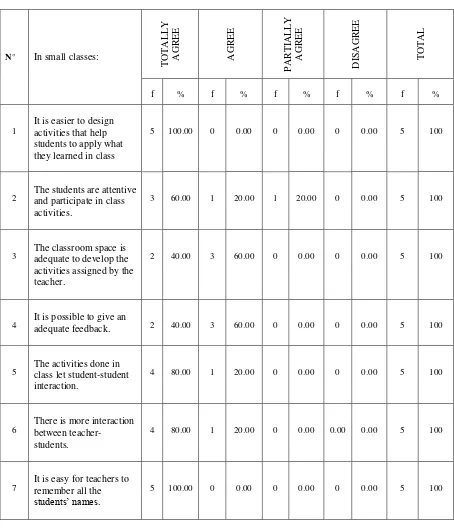
Analyzing the question number 1, regarding the benefits of teaching English in small classes, and according to the data obtained for statement 1, stated in table 1, it is noticed that all of the teachers’ responses (100%) show that in small classes, it is feasible to develop activities that allow learners to put in practice what they have studied during a lesson.
Likewise, the results to the variable number 1, statement 1, stated in table 2, show a similitude with the information stated in teachers’ surveys since 92.18% of the students asseverate that the activities they perform into a small class aid them to practice what they have learned. Only a small percentage of the learners disagreed with the asseveration (7.82%).
The direct observations demonstrated that most of the time teachers and students were immersed in tasks related to the current English lessons. Teachers reinforced learners’ knowledge and checked learning and comprehension before finishing the class time. A low percentage of learners were dispersed during the lesson.
To this concern, Blatchford (2007) infers that teachers who manage small classes can obtain effective students’ attention during the lesson time. They are able to give individual support to the learners, which redound in benefits to achieve the teaching-learning objectives.
Regarding the same theme, some researchers refer, that some strategies teachers used to teach English in small classrooms are determined by the lessons aims. In addition, the authors set that to succeed in small classes rely on the methods educators consider adequate to accomplish the tasks during the lesson (Larsen-Freeman, 2000; Wadhwa, 2006).
To analyze the statement 2, established in table 1, the results demonstrate that the vast majority of the respondents’ educators (80%) agree they can get students’ attention, and most of the time the learners are engaged in assignments which imply active class
21
Regarding the same point, set down in table 2, and similarly with the teachers’ information, the vast majority of the learners’ responses (73.44%) indicate that in small classes they pay attention and participate actively in all the activities they are required to develop during the English lessons. On the opposite, 26.56% of the respondent students assure that attending to small classrooms do not guarantee their class participation.
The direct class observations corroborated what teachers indicated in the
questionnaires. It could be seen that 80% of the learners were engaged in the different tasks teachers designed to apply into the small class. The observations showed that most of the students were dynamic at developing their assignments, and participated actively during the lesson time. Only 20% of the observed learners were doing other activities instead of their English tasks. This phenomenon could be due to there were classes with a higher number of pupils which can make difficult to encourage all the students to participate.
To Blatchford (2007), teachers who work with a small number of learners per class, have the advantage to get a sustained students attention and to provide individual feedback to accomplish better results during the teaching-learning process.
Concerning the same subject, some researchers imply that most of the teachers wish to teach in classrooms with few students, because they think they have more possibilities to create a good classroom climate where not only teachers but students will obtain their goals. They claim that working in small classes, let the educators to have more chances to control discipline, get students’ attention, and motivate learners to participate in all the designed activities to be applied into the class (Flood, Lapp, Squire, & Jensen, 2003).
The results for the 3rd statement, table 1, indicate that the total of the surveyed teachers (100%) agree the space where English lessons take place is the adequate.
22
arrange the seats adequately to perform the lesson assignments in class. Only few learners disagree with the asseveration.
In contrast, when the classes were observed, it was perceived that 60% of the schoolrooms where the language is taught are not fitting. Unfortunately, only 40% of the monitored classes are big enough to apply the different strategies and techniques that ensure the success during the learning process.
According to some scientists, the best classroom environment has to do with the space where the teacher can place the students in different seating positions, creating a learning atmosphere in which the pupils can accomplish the tasks comfortably during the teaching-learning process. Besides, the researchers imply that physical space affects the way students behave in the classroom, and also determine their class participation (Hue & Li, 2008; Woolfolk, 2007; Finn & Wang, 2002).
Regarding classroom space, Hall (2011) expresses that working in large classrooms is considered by teachers and learners as difficult to be managed, since it is a hard mission to control students’behavior, get students’ attention, and to have a good interaction among the
participants. Otherwise, the scientist says that to be successful in large classes does not depend on class size but on teachers’ abilities.
The outcomes for statement 4, table 1, show that 40% of the questioned educators are totally agree, and 60% of them agree that in small classes it is feasible to give feedback to the entire class.
To this concern, the responses to the statement number 5, table 2 corroborate
23
Feedback is one of most important aspects of managing learning, and it is used to promote learners’ motivation, and students’ confidence which encourage them to speak and to produce the language during the teaching-learning course. The scientists also infer that
feedback is an important strategy that can be administered after the lesson ends. It can be given to the whole group or individually (Rovegno & Bandhauer, 2013; Richards & Lockhart, 2006).
According to the information stated in teachers’ perceptions chart, with regard to the points 5 and 6, belonging to table 1, demonstrate that all of the surveyed educators (100%) believe that working with a small amount of pupils per class allows interaction among all the participants.
Similarly, and regarding the allegations number 6 and 7, table 2, a greater part (85%) of the questioned students assure that they are exposed to have teacher-student and student-student interaction when they attend to small classes, since only few of the learners answered negatively.
Likewise, taking into account the class observations it was realized that most of the time, teachers apply communicative and cooperative techniques that take the students to be immersed in activities which promote the use of the language in interactive assignments where both teachers and students participate actively. In addition, it was remarked that there are an effective teacher-student and student-student interaction during the lesson activities, especially in private institutions.
At this point, the information stated in the Literature Review mention that teacher- student interaction suppose communication between the participants; entails teachers’ disposition to give support to the students when they require help; it involves teachers’
24
Regarding student-student interaction, some researchers agree that to have a good interaction between learners, teachers must apply Cooperative-Learning techniques which let the students to get involved in activities like speeches and social assignments in which it is imperative the use of the target language in real life situations. Also, they claim that there is a good interaction among the participants when the teacher is relegated to a background, supportive role, in which the class becomes learner- centred (Yoon & Kyeung, 2012; Hellermann, 2008).
In accordance with teachers’ perceptions, statement 7, table 1, the information stated denotes that the total of the inquired teachers (100%) agree that working in small classrooms facilitate them to remember all the students’ names.
Conformable with the results set in students’ perceptions, point number 8, table 2; it is showed that 82.80% of the students argue that their teachers call the students by their names during the class time, only 17.20% of the interviewed pupils think the lecturers do not recall the learners’ names.
During the class observations, and similarly with the information stated in students’ surveys, 80% of the teachers are able to remember the names of the students along the lesson period. In addition, 20% of the observed educators do not remind students’ forenames. It happens especially in public schoolrooms where teachers have to manage more students per class.
25
[image:31.595.91.545.150.729.2]What teaching strategies and resources benefit the teaching of English in small classes?
Table 3 Teachers’ Perceptions
N
° In small classes: T
OT AL L Y AGREE AGREE PAR T IAL L Y AGREE DI SAGR E E T OT AL
f % f % f % f % f %
8
It is easier to design and apply activities that allow the students to
practice listening skills. 3 60.00 2 40.00 0 0.00 0 0.00 5 100
9
It is easier to design and apply activities that allow the students to practice speaking skills.
4 80.00 1 20.00 0 0.00 0 0.00 5 100
10
It is easier to design and apply activities that allow the students to
practice reading skills. 2 40.00 2 40.00 1 20.00 0 0.00 5 100
11
It is easier to design and apply activities that allow the students to practice writing skills.
3 60.00 2 40.00 0 0.00 0 0.00 5 100
12 It is easier to apply group
activities. 3 60.00 2 40.00 0 0.00 0 0.00 5 100
13 It is easier to apply
individual activities. 3 60.00 2 40.00 0 0.00 0 0.00 5 100
14 Technological resources are utilized in class. 3 60.00 2 40.00 0 0.00 0 0.00 5 100
15 Didactic materials are
used in class. 2 40.00 3 60.00 0 0.00 0 0.00 5 100
26
Table 4 Students’ Perceptions
N° In small classes: TOT
AL L Y AGREE AGREE PAR T IAL L Y AGREE DI SAGR E E T OT AL
f % f % f % f % f %
9
Activities that allow you to practice listening skills are
performed. 39 60.94 21 32.81 4 6.25 0 0.00 64 100
10
Activities that allow you to practice speaking skills are
performed. 39 60.94 18 28.12 7 10.94 0 0.00 64 100
11
Activities that allow you to practice reading skills are performed.
38 59.38 18 28.12 6 9.38 2 3.12 64 100
12
Activities that allow you to practice writing skills are
performed. 34 53.12 22 34.38 5 7.81 3 4.69 64 100
13
Group activities are
applied in class. 38 59.38 19 29.68 6 9.38 1 1.56 64 100
14 Individual activities are applied in class. 36 56.25 24 37.50 4 6.25 0 0.00 64 100
15 Technological resources are utilized in class.
14 21.87 23 35.94 22 34.38 5 7.81 64 100
16 Didactical materials are used in class 22 34.38 28 43.75 11 17.18 3 4.69 64 100
Author: Martha Torres
27
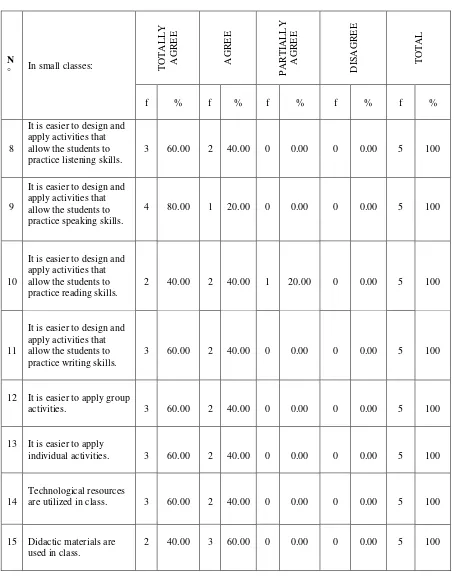
Analyzing the responses for question 2, statements 8 and 9, table 3, it is noticed that the vast majority of the lecturers perceived that working with a small group of students let them to design and apply assignments that lead their learners to practice and improve listening and speaking skills into the class.
Similarly, the arguments for points 9 and 10, set in table 4, concerning the
opportunities students have to develop activities that allow them to put in practice listening and speaking language abilities during the lesson time, show that almost the total of the surveyed learners answered affirmatively, which demonstrate that both teachers and students agree with the asseveration.
To corroborate the information mention above, the results obtained through the direct class observations showed that most of the students in small classes are engaged in different tasks like speeches, brainstorming, role plays, discussion groups, and interviews that take them to produce and acquire listening and speaking competences which improve the target language.
With reference to the subject, some scientists infer that to work with few students per class, let educators to use and apply many resources and techniques according to lesson purposes which is the base to design and develop tasks to improve the teaching-learning process. Besides, they imply that there are many useful and creative activities as
brainstorming, acting roles, free debates, summarize, dialogues, among others that teachers can utilize to get an effective student interaction to finally acquire the second language (Larsen-Freeman, 2000; Wadhwa, 2006).
28
In the same way, the outcomes for point 11 and 12 table 4, establish that most of the surveyed learners set out that in classes with a few number of classmates it is possible for them to be immersed in reading and writing assignments. The monitored small classes demonstrated that students accomplished assignments to enhance reading and writing skills like: storytelling, compositions, essays, writing mails to pen pals to achieve the goals. Thus, educators emphasize in content rather than in form at the moment of performing writing
assignments which allow the students to be confident at developing reading and writing tasks. To analyze the statement 12 stated in table 3; it is important to notice that 100% of
the requested teachers mention that in small classes they are able to group the learners to develop several activities during the lesson time.
Likewise, the information set for statement 13 table 4 illustrates that a predominant part (89.06%) of the answers given by the respondent learners suggests that in small classes teachers are able to conduct group activities when impart English lessons. Only a scarce number of students (10.94%) say they do not develop tasks in groups.
In contrast to what was set above, 60% of the observed learners were placed in small groups to carry out some class assignments during the lesson time. While, 40% of the
monitored teachers, experience difficulties to group the students when they perform activities into the classroom. It can occur due to in some of the institutions that were chosen for the sample, there were more pupils than in the other ones.
29
To describe and analyze the enunciation 13 sets forth in table number 3, it is essential to point out that all the surveyed teachers (100%) agree they can outline and put into practice individual activities into the classroom.
Similarly, the vast majority of students’ answers (93.75%) obtained for the allegation number 14 table 4 shows that most of the time teachers apply individual activities during the lesson time. Regarding the observations made in class, it was noticed that this approach is utilized in most of the classes, due to most of them are reduced class size, and almost all of the educators are able to give individual support to the learners.
To this point, some investigators indicate that teaching in small classes supposes to give individual assistance to the learners. The study suggests that this strategy is adequate when teaching to small classes. However, to apply this technique can be self- defeating if learners are shy or they are not accustomed to study in an environment with few classmates (Rovegno & Bandhauer, 2013; Richards & Lockhart, 2006).
According to this matter, Blatchford (2007) exposes that teachers who work in small classes have a lot of chances to provide the learners individual support, keep students’
attention which take to the participants to reach excellent accomplishments during the process of teaching and learning.
Respecting to the statements 14 and 15 stated in table 3, the results report that 100% of the inquired educators agree that in small classrooms they utilize technological resources and didactic material to teach English to their learners.
30
Even though the information stated in the students surveys, when the classes were observed it was noticed that all of the schoolrooms have technological and didactic resources as: computers, CD players, projectors, flashcards and others that allow educators to teach English efficiently. In addition it is to say that some of the observed classes make use of the internet. However, the outcomes suggest that not all of the educators make use of the resources the institution provides to them to impart adequate English lessons.
How do students feel about learning English in small classes?
[image:36.595.86.546.321.720.2]Table 5 Teachers’ Perceptions
N° In small classes the
students feel: TOT
AL L Y AGREE AGREE PAR T IAL L Y AGREE DI SAGR E E T OT AL
f % f f f % f % f %
16 Relaxed at the moment of speaking in front of the others.
1 20.00 3 60.00 0 0.00 1 20.00 5 100
17 Taken into account since they have more opportunities to participate in class.
4 80.00 1 20.00 0 0.00 0 0.00 5 100
18 Motivated to participate because there are few students into the classroom.
2 40.00 3 60.00 0 0.00 0 0.00 5 100
19 Comfortable, because they can compete healthily with other students.
1 20.00 3 60.00 1 20.00 0 0.00 5 100
Author: Martha Torres
31
[image:37.595.85.541.126.576.2]Table 6 Students’ Perceptions
N°
In classes with a few number of students I feel: T OT AL L Y AGREE AGREE PAR T IAL L Y AGREE DI SAGR E E T OT AL
f % f % f % f % f %
17 Relaxed at the moment of speaking in front of the others.
37 57.82 16 25.00 9 14.06 2 3.12 64 100
18 Taken into account since I have more opportunities to participate in class.
31 48.44 28 43.75 5 7.81 0 0.00 64 100
19
Motivated to participate because there are few students in the classroom.
29 45.31 28 43.75 6 9.38 1 1.56 64 100
20 Comfortable, because I can compete healthily with other students.
35 54.69 19 29.68 7 10.94 3 4.69 64 100
Author: Martha Torres
Source: Students’ Questionnaires
32
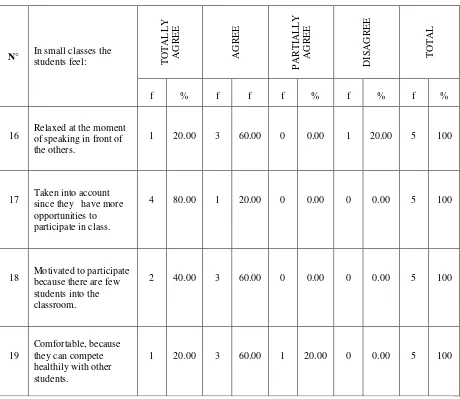
educators (20%) who asseverate the students feel stress when they are asked to participate in speaking assignments.
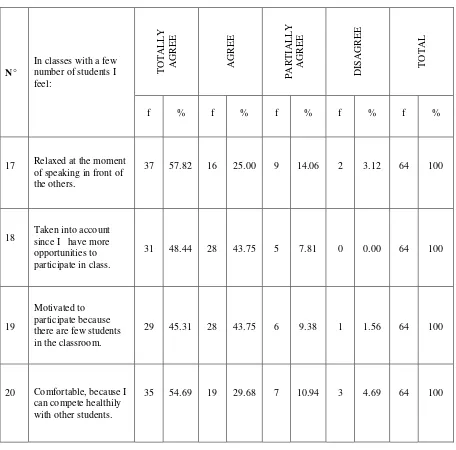
To this concern, the information stated for issues number 17 and 18, table 6 shows that exist a congruence within the criterion of teachers and learners, since a greater part of the respondent students (82.82%) agree they feel relaxed when speaking in front of the others in classes with a few number of attendants. Only (17.18%) of them disagree with the statement.
In contrast, regarding to the observations, it was observed that most of the learners (60%) feel stressed at the moment of participating in speeches, while 40% of them
experimented relaxation during communication tasks. This data evidences that most of the students do not feel comfortable in this environment. In small classes, all of the students are required to participate due to the small amount of peers, which take them to feel a degree of stress during the English lessons.
Creating a good classroom environment entails many chances to enhance learners’ motivation and to control discipline in order to reach learning aims. The research refers that working with a low number of attendants per class, let the teachers to get good relationships among the students which take them to have confidence at interacting with their classmates (Hue & Li, 2008; Woolfolk, 2007; Finn & Wang, 2002).
Analyzing the statements number 17 and 18, as can be seen in the table 5, all of the interviewed educators (100%) are awareness that managing small groups of learners let them to apply some useful techniques to create the adequate classroom environment where their students feel comfortable and have more possibilities to participate during the lesson time.
33
inside the schoolroom. Almost the total of the interviewed learners mention they are taken into account by their teachers in this classroom atmosphere.
Once the observations were done, it was noticed that only 60% of the students feel motivated to participate due to there are less students to compete with. While 40% of them experiment discouraged during their lessons. It is important to mention that this situation can come about especially in classes with a bigger number of pupils.
Some researchers say that most of the educators wish to teach in small classes since they think that managing a small number of learners per class guarantee the success during the teaching-learning process. Teachers who work with few pupils per class have the ability to control discipline, maintain the learners on their tasks; get students’ attention; encourage learners’ motivation, and elicit students’ participation all over the lesson time (Flood, Lapp, Squire, & Jensen, 2003).
Additionally, some scientists set forth that teachers who work with small groups of pupils have more opportunities to promote friendship between their students which will redound in a profitable teacher-student and student-student interaction as well as to control learners’ behavior. Besides, the study mentions that this environment motivates the students to participate during the lesson time (Hue & Li, 2008; Woolfolk, 2007; Finn & Wang, 2002).
Respecting the statement number 19 as it was set in table 5, most of the educators (80%) express that in small classes the students can compete healthily with their classmates, being that the amount of learners per class let them to do it.
34
peers during the class, especially when they are involved in activities like discussions or debates.
Woolfolk (2007) assures that creating a good class atmosphere where students feel comfortable, entails a high percentage of opportunities to increase students’ motivation, to control learners’ behavior, and to achieve learning goals.
Are there any limitations when teaching English in small classes?
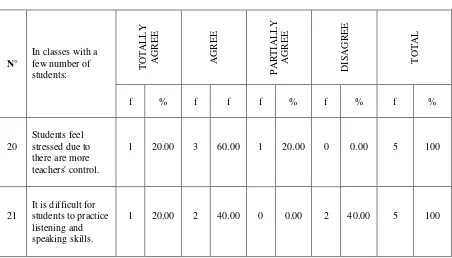
[image:40.595.87.539.301.559.2]Table 7 Teachers’ Perceptions
N°
In classes with a few number of
students: T
OT AL L Y AGREE AGREE PAR T IAL L Y AGREE DI SAGR E E T OT AL
f % f f f % f % f %
20 Students feel stressed due to there are more teachers' control.
1 20.00 3 60.00 1 20.00 0 0.00 5 100
21 It is difficult for students to practice listening and speaking skills.
1 20.00 2 40.00 0 0.00 2 40.00 5 100
Author: Martha Torres
35
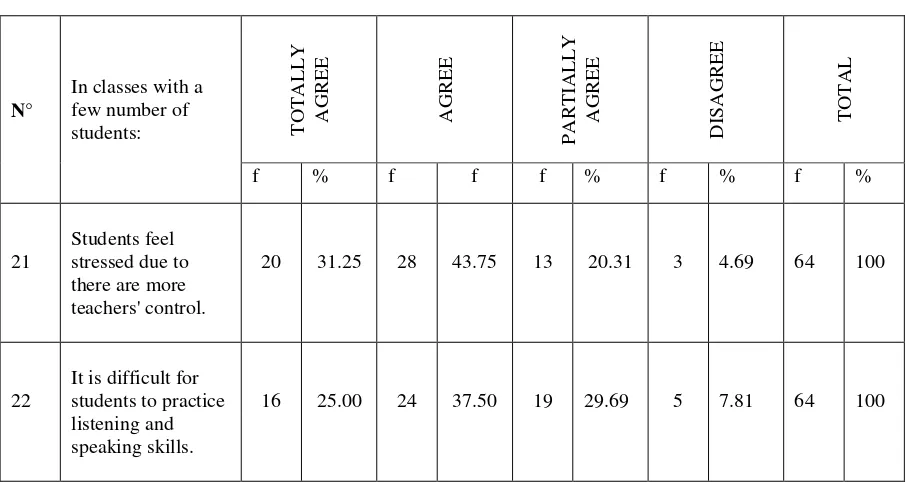
[image:41.595.85.538.122.363.2]Table 8 Students’ Perceptions
N°
In classes with a few number of
students: TOT
AL L Y AGREE AGREE PAR T IAL L Y AGREE DI SAGR E E T OT AL
f % f f f % f % f %
21
Students feel stressed due to there are more teachers' control.
20 31.25 28 43.75 13 20.31 3 4.69 64 100
22 It is difficult for students to practice listening and speaking skills.
16 25.00 24 37.50 19 29.69 5 7.81 64 100
Author: Martha Torres
Source: Students’ questionnaire
Analyzing the question number 4, statement 20, table 7, regarding the limitations educators have to face when teaching English in small classrooms, and analyzing the results obtained though teachers surveys, it is to say that, 80% of them agree that the students in small classes experiment anxiety during the lesson time. Only 20% of them assure the students do not feel fearfulness in classes with a few number of classmates.
Similarly to teachers’ responses, the results for statement 21, table 8, show that 75% of the interviewed learners indicated they do not feel relaxed during the lesson time due to there are more possibilities to be controlled by the teachers than in classes where attend a big number of students. On the other hand, 25% of the inquired learners say they do not feel anxious in small classes even though they are exposed to be observed by the educator all the lesson period.
36
sometimes increase students’ stress. In contrast with the asseverations of both teachers and students, it was observed that most of the learners (60%) feel comfortable at learning in small classes and of being taking into account by the teachers. However, there are (40%) learners who feel stress due to the teachers’ control in small classes.
Managing learning deals with feedback. This strategy is not only applied to a whole group of learners. Mostly, it is given individually. In small classes teachers are able to control the whole group of students, get the learners’ attention, and keep them concentrated on tasks (Rovegno & Bandhauer, 2013; Richard & Lockhart, 2006).
To the statement number 21, table 7, most of the teachers responses (80%) show that students in small classrooms do not have difficulties to be involved in activities to improve speaking and listening abilities. Otherwise, 20% of them asseverate that working with a small group of learners involve problems to encourage the students to listen and produce the target language.
In contrast, taking into account the statement 22 table 8, students’ outcomes demonstrate that most of the learners (62.50%) believe that in small classes it is hard to practice listening and speaking abilities. Also, it was pointed out that 37.50% of the surveyed learners disagree with the asseveration, since they can develop activities which involve speaking, and listening to the target language.
On the other hand, conformable to teachers’ responses, during the class observations, it was noticed that the vast majority of students (60%) were engaged in tasks that deal with speeches and hearing approaches such as: free debates, brainstorming, listening to CD players, and watching movies.
37
higher number of students into the class, teachers experience more difficulties to get students engagement in listening and speaking abilities.
According to Finn & Wang (2002), physical location influences the way students participate in class, since a talkative learner needs to be placed ahead to avoid class interruptions, and a student who sits in the back is not able to work during the class
assignments. Moreover, they suggest that when the class is arranged in horizontal rows the peer activities are recommended. Thus, they say, group of four and circle settings benefit speech activities, and let the students to share resources.
38
Conclusions
About the benefits of teaching English in small classes, the study shows that working with few students per class, helps educators to design and implement interesting activities regarding the lesson goals. Besides, it facilitates the use of adequate techniques and strategies, which let students to apply what they have learned during the class period.
The vast majority of pupils in small classes are able to participate actively during the lesson time. There is a close teacher-student and student-student interaction; teachers are able to get students’ attention. They can control learners’ discipline, and have the appropriate environment to give group and individual feedback.
Concerning the strategies and resources that foster English learning in classes with a small number of attendants, the analysis of the results points out that in small classes, teachers have more possibilities to make seating arrangements; get the learners involve in communicative activities; and, use updated resources most of the time.
In small classes, most educators make use of technological and didactic resources such as computers, internet, CD players, flashcards, and other appliances to increase
learners’ motivation during the lesson time which improve students’ learning.
There are many students who feel comfortable in small classes. They do not feel afraid of speaking in front of their classmates, they have more chances to participate, and have an appropriate classroom atmosphere which let them to compete reasonably with their classmates.
39
Recommendations
Teachers must create a friendly classroom atmosphere in order to make that students feel comfortable during the lesson time. Some students experiment stress when attend to a class with a small number of pupils since they feel that teachers control them during the whole class.
Headmasters of both public and private educational institutions where English language is taught should provide educators and learners with adequate and updated resources to improve the teaching-learning process which takes the students to acquire the target language abilities.
40
REFERENCES
Blatchford, P., Bassett, P., & Brown, P. (2005) Teachers and pupils’ behavior in large and small classes: A systematic observation study of pupils aged 10/11 years: Journal of Educational Psychology, 97 (3), 454-467.
Blatchford, P. (2007). The class size debate: Is smaller better? Maidenhead, UK:
McGraw-Hill International.
Cakmak, M. (2009). The perceptions of student teachers about the effects of class size with regard to effective teaching process. The Qualitative Report, 14 (3), 395-408.
Retrieved from http://www.nova.edu/ssss/QR/QR14-3/cakmak.pdf
Christenson, S., Reschly, A., & Wylie, C. (2012). Handbook on research on student engagement. New York, NY: Spring Science Business Media.
Din, F. (1999). The functions of class size perceived by Chinese rural school teachers,
National Forum of Applied Educational Research Journal, 12 (3), 1-5.
Dixie, G. (2003). Managing your classroom. London, UK: Continuum.
Finn, M., & Wang, C. (2002). Talking Small Classes One Step Further. Washington, DC:
Information Age Publishing.
Flood, J., Lapp, D., Squire, J., & Jensen, J. (2003). Handbook of research on teaching the English language arts (2nd ed.). New Jersey: Lawrence Erlbaum associates.
Garrett, T. (2008). Student-centered and teacher-centered classroom management: A case study of three elementary teachers, Journal of Classroom Interaction, ISSN
0749-4025. © 2008, Vol. 43(1), 34 – 4.
Hall, G. (2011). Exploring English language teaching: Language in action. New York, NY:
Routledge.
41
Hellermann, J. (2008). Social actions for classroom language learning. Tonawanda, NY:
Cromwell Press.
Hue, M., & Li, W. (2008). Classroom management: creating a positive learning environment.
Hong Kong: Hong Kong University Press.
Larsen-Freeman, D. (2000). Teaching and principles in language teaching (2nd ed.). Oxford:
Oxford University Press.
Madill, R., Gest, S., & Rodkin, P. (2011). Students’ perceptions of social relatedness in the classroom: The roles of student-teacher interaction quality, children’s aggressive behavior, and peer rejection. SREE Conference Abstract Template, 21(2), 1-11.
Ministerio Coordinador de Talento Humano. (2014) Ministro de Educación explica el fortalecimiento del aprendizaje del Inglés en el sistema educativo del país. Retrieved March 26, from
www.educacion.gob.ec/ministro-de-educacion-explica-el-fortalecimiento-del-aprendizaje-de-ingles/.
Richards, J., & Lockhart, C. (2006). Reflective teaching in second language classrooms.
Cambridge: Cambridge University Press.
Rovegno, I., & Bandhauer, D. (2013). Elementary physical education: Curriculum and instruction. Burlington, MA: Courier Kendallville.
Spielberger, C. (2004). Encyclopedia of applied psychology. Amsterdam: Elsevier.
Wadhwa, S. (2006). Teaching and learning methodology in higher education. New Delhi,
India: Sarup & Sons.
Woodward, T. (2001). Planning lessons and courses: Designing sequences of work for the language classroom. Cambridge: Cambridge University Press.
Woolfolk, A. (2007). Educational Psychology (10th ed.) Boston, Massachusetts: Allyn and
42
Yoon, B., & Kyeung, H. (2012). Teachers’ roles in second language learning: classroom
applications of sociocultural theory. Charlotte, NC: Information Age Pub.