
2 Alkoxycarbonylcycloimmonium ylides, efficient 1,4 dipole equivalents in the synthesis of new conjugated betaines
9
0
0
Texto completo
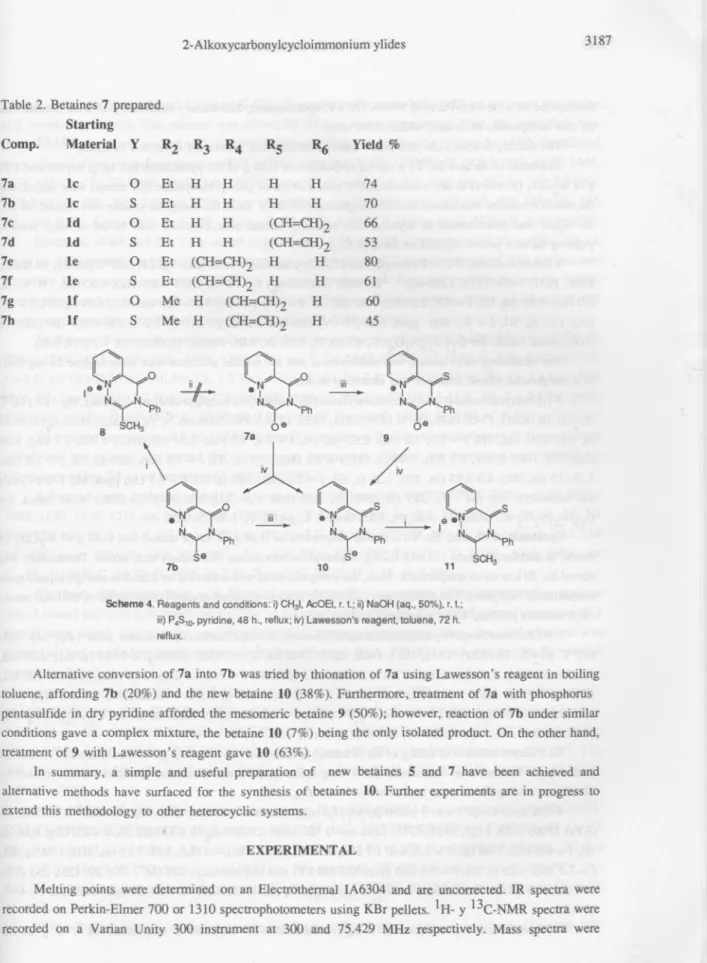
(2) A. M.. 3186. CUADRO. et al.. 2. 1a,Rl=OEt.Z=Br 1b. Rl = Ph, Z= Br Scheme 2. Reagents and condifions: i) CH2CI2 or CH3CN,K2C03.PhN=C=Y.20 h., r. 1. Table 1. Betaines 4 and 5 prepared.. Yield %. Starting. Compounds. Comp.. Material. Y. R1. 4. 5. 4,5a. la. O. OEt. 3. 70. 4,5b. la. S. OEt. 30. 63. 4,5c. lb. O. Ph. traces. 68. 4,5d. lb. S. Ph. 31. 66. 7 (Y=S) were directly obtained when phenyl isothiocyanate. was added to a suspension of. the salts 1c-f in dichloromethane. and potassium carbonate. However, following the above procedure, the salts. la and lb afforded compounds. 4 (Y=S) which underwent easy cyclization. to 5 (Y=S) in the presence uf. triethylarnine.. Scheme 3. Reagents and conditions:. All new compounds spectra of compounds. i). CH~12or CH3CN,~03.. gave satisfactory. spectroscopic. 7 were highly characteristic.. PhN=C=Y.20 h., r.t.;. MSTS. (IR, MS, 1H/13C-NMR). = mesytilenesulphonate.. and analytical data. IR. As an example, 7a shows a strong C=O stretching band. at 1700 cm-1 in addition to the band at 1635 cm-1 attributable. to the 3-0late group. Altematively,. 7b only. shows a strong band at 1701 cm-l. Several transformations. were tested, as indicated in Scheme 4, allowing the preparation of new derivatives.. Conversion of 7b into 7a was attempted via 8, obtained by S-methylation basic hydrolysis gave decomposition. products.. of 7b, but 8, when submitted to.
(3) 2- Alkox ycarbony lcycloimmonium. 3187. y lides. Table 2. Betaines 7 prepared. Starting Comp. 7a. Material. Y. R2. R3. Yield %. R4. H HH 74 H Et 80 le Ir H H53 Me 61 70 45 60S 66 Id O (CH=CH)2 (CH=CH)2 (CH=CH)2. -¡¡¡. ;(--. \. 7a. ':'~"y (Jo N~NI. iii. ..... Ph. se. 7b. Scheme 4. Reagents and conditions: i) CH31,AcOEt, r. t.; ii) NaOH (aq., 50%), r. t.; iii) P4S10' pyridine, 48 h., reflux; iv) Lawesson's reagent, toluene, 72 h. reflux.. Altemative. conversion. of 7a into 7b was tried by thionation of 7a using Lawesson's. toluene, affording 7b (20%) and the new betaine 10 (38%). Furthermore,. reagent in boiling. treatment of 7a with phosphorus. pentasulfide in dry pyridine afforded the mesomeric betaine 9 (50%); however, reaction of 7b under similar conditions gave a complex mixture, the betaine 10 (7%) being the only isolated product. On the other hand, treatment of 9 with Lawesson's In surnmary,. reagent gave 10 (63%).. a simple and useful preparation. of. new betaines 5 and 7 have been achieved. alternative methods have surfaced for the synthesis of betaines 10. Further experiments extend this methodology. to other heterocyclic. and. are in progress to. systems.. EXPERIMENTAL. Melting points were deterrnined recorded on Perkin-Elmer recorded. on an Electrothermal. 700 or 1310 spectrophotometers. on a Varian Unity 300 instrument. IA6304 and are uncorrected.. IR spectra were. using KBr pellets. lH_ y 13C-NMR spectra were. at 300 and 75.429 MHz respectively.. Mass spectra were.
(4) 3188. A. M.. determined on a Hewlett-Packard all new compounds. et al.. 5988A (70 eV) spectrometer.. Saúsfactory microanalyses. were obtained for. described, within 0.4% error.. The starting heteroeyclic Synthesis. CUADRO. precursors were obtained using previously described methods.4, 11,12. of 4a and 5a. To a stirred suspension of 0.63 g of the pyridinium salt la (2 mmo1) and 1.10. g of K2C03 (8 rnmo1) in dry acetonitri1e (10 mI), 0.24 mI of pheny1 isocyanate (2.2 rnmo1) were added, and the reaction mixture was súrred at room temperature for 20 h. Then, the inorganic residue was filtered off and the liquid was concentrated. to dryness. The resulúng residue was triturated with 10 mI of ethyl acetate,. yie1ding 5a as a yellow crystal1ine solid (0.43 g, 70%) 4-Ethoxycarbonyl-1-oxo-2-phenylpyrido[1. ,2-a]pyraziniun-3-olate. (5a). Mp 249-2500C (EtOH). IR (KBr):. 1688, 1641, 1453, 1323, 1206 cm-1; 1H NMR (DMSO-d6) S 9.70 (d, IR, J = 6.9 Hz); 8.40 (dd, IR, J=7.8, 2.0 Hz); 7.90 (td, IR, J = 6.9, 2.0 Hz); 7.80 (td, IR, J = 7.8, 1.2 Hz); 7.51-7.20 (m, 5H); 4.19 (q, 2H, J = 7.1 Hz); 1.21 (t, 3H, J = 7.1 Hz). ppm; MS (70 eV) m/e (re1 intensity): 310 (M+,24); 238 (70); 106 (23); 78. (100). Anal. calcd. for C17H14N204: C, 65.80; H, 4.55; N, 9.03. Found: C, 65.81; H, 4.75; N, 9.20. The remaining ethy1 acetate was concentrated and the residue triturated with ether to give 20 mg (3%) of a red powder whose sttucture was identified as 4a. ylide (4a). Mp 110-111 °c. 1-[( Ethoxycarbonyl-N-phenylcarbanwyl)methyl]-2-ethoxycarbonylpyridinium. (Et20). IR (KBr): 1745, 1638, 1611, 1579, 1531, 1435, 1339, 1298, 1096 cm-1; 1H NMR (DMSO-d6) S 10.57 (s, IR); 8.91 (dd, IR, J = 6.1, 1.2 Hz); 8.55 (td, IR, J = 7.8, 1,5 Hz); 8.24 (dd, IR, J = 7.8, 1.7 Hz); 8.09 (ddd, IR, J = 7.8, 6.1,1.7. Hz); 7.44 (d, 2H, J = 7.8 Hz); 7.17 (t, 2H, J = 7.8 Hz); 6.85 (t, IR, J = 7.2 Hz);. 4.35-.15 (m, 2H); 4.0-3.85 (m, 2H); 1.20 (t, 3H, J = 7.1 Hz); 1.02 (t, 3H, J = 7.1 Hz) ppm; MS (70 eV) rn/e (rel intensity):. 356 (M+, 3); 283 (8); 238 (9); 208 (26); 119 (74); 106 (44); 79 (100). Anal. calcd. for. C19H20N205:. C, 64.05; H, 5.65; N, 7.86. Found: C, 64.06; H, 5.80; N, 7.58.. Synthesis of 4b and 5b. To a súrred suspension of 0.64 g of la (2 rnmol) and 0.55 g of K2C03 (4 mmol) in dichloromethane (10 mI), 0,26 g of phenyl isothiocyanate (2.2 rnmo1) were added. The mixture was stirred for 20 h at room temperature. Then, the inorganic solid was separated by filtraúon and the liquids were concentrated. to dryness. The residue was purified by column chromatography. (silica gel 60 A, 230-400 mesh;. ethyl acetate) yielding 4b as a red solid (0.21 g, 30%). 1-[( Ethoxycarbonyl-N. -phenylthiocarbamoyl)methyl]. -2 -ethoxycarbonylpyridinium. ylide (4b). Mp 100-. 1010C (Et20). IR (KBr): 1741,1587,1400,1373,1346 cm-1; 1H NMR (CDC13) S 11.84 (s, IR); 8.68 (dd, IR, J = 6.1 Hz); 8.32 (td, IR, J = 7.8, 1.5 Hz); 8.13 (dd, IR, J = 7.8, 1.7 Hz); 7.84 (ddd, IR, J = 7.8, 6.1, 1.7 Hz); 7.73 (d, 2H, J = 8.5 Hz); 7.29 (t, 2H, J = 7.6 Hz); 7.06 (t, IR, J = 7.3 Hz); 4.5-4.3 (m, 2H); 4.153.95 (m, 2H); 1.35 (t, 3H, J = 7.1 Hz); 1.09 (t, 3H, J = 7.1 Hz) ppm. Anal. calcd. for C19H20N204S: 61.27; H, 5.41; N, 7.52. Found: C, 60.98; H, 5.19; N, 7.28. To a súrred solution of 0.38 g of 4b (1 mmo1) in methanol (10 mI), 0.15 mI of triethylamine were added. The mixture was súrred for 6 h at room temperature.. Then, the precipitate. e,. (1.1 mmol). was isolated by. filtration, yielding 5b as a red crystalline solid (0.20 g, 62%) 4-Ethoxycarbonyl-1-oxo-2. -phenylpyrido[ 1,2 -a]pyrazinium-3 -thiolate (5b). Mp 204-2050C (EtOH). IR. (KBr) 1709, 1675, 1451, 1413, 1371, 1216 cm-1; 1H NMR (DMSO-d6) S 8.33 (dd, IR, J = 8.0 Hz); 8.16 (d, IR, J = 6.6 Hz); 7.86 (td, J = 7.3, 6.6, 1.7 Hz); 7.78 (t, IR, J = 8.0, 7.3 Hz); 7.50-7.15 (m, 5H); 4.34 (q, 2H, J = 7.2 Hz); 1.29 (t, 3H, J = 7.2 Hz) ppm; MS (70 eV) m/e (rel intensity) 326 (M+, 28); 297 (25); 253 (52); 106 (20); 78 (100). Anal. calcd. for CzIHI4N203S: N, 8.24. 4-Benzoyl-1-oxo-2-phenylpyrido[1. C, 62.56; H, 4.32; N, 8.58. Found: C. 62.28; H, 4.14;. ,2-a]pyrazinium-3-olate. (Se). To a suspension. of 0.70 g of the.
(5) 2-Alkoxycarbonylcycloimmonium ylides. 3189. pyridinium salt lb (2 rnmo1)and 1.10 g of K2C03 (8 rnmol) in dry acetonitrile, 0.24 mI ofphenyl isocyanate (2.2 rnmol) were added. The mixture was stirred for 20 h at room temperature. Then, the precipitate was isolated by filtraúon and washed with distilled water unúl neutral, yielding the betaine Se which crystallised from ethanol affording yellow crystals (0.47 g, 70%). Mp 264-2650C (EtOH); IR (KBr) 1683, 1632, 1449, 1334,1197 cm-1; 1H NMR (DMSO-d6) a 10.18 (m, lH, J = 6.0,1.8 Hz); 8.51 (m, lH, J = 7.2, 2.9 Hz); 8.02-7.92 (m, 2H); 7.60-7.19 (m, 10H) ppm; MS (70 eY) m/e (rel intensity): 342 (M+, 80); 265 (16); 195 (71); 105 (100). Anal. calcd. for C21H14N203: C, 73.67; H, 4.12; N, 8.18. Found: C, 74.01; H, 4.41; N, 8.04. Synthesis of 4d and Sd. To a súrred suspension of 0.70 g of lb (2 rnmol) and 0.55 g of K2C03 (4 rnmol) in dichloromethane (10 mI), 0.26 mI ofphenyl isothiocyanate (2.2 rnmol) were added. The mixture was stirred for 20 h at room temperature. Then, the inorganic residue was separated by filtratiol1and the liquids were concentrated to dryness. The residue was purified by colurnn chromatography (silica gel 60 A, 230-400 mesh; ethyl acetate) yielding the betaine 4d as a red solid (0.25 g, 31%) . 1-[(Be nzoyl-N -phe nylthiocarbamoyl )methyl]- 2 -ethoxycarbonylpyridinium y/ide (4d). Mp 134-1350C. IR (KBr): 1734, 1627, 1567, 1501, 1393, 1307, 1195 cm-l; lH NMR (CDCI3) a 13.62 (s, lH); 8.42 (dd, lH, J = 6.1, 1.3 Hz); 8.16 (td, lH, J = 7.8, 1.3 Hz); 8.08 (dd, lH, J = 7.8, 1.7 Hz); 7.83 (d, 2H, J = 7.4 Hz); 7.56. (ddd, lH, J = 7.8, 6.1,1.7 Hz); 7.36-7.10 (m, 8H); 4.46 (q, 2H, J = 7.1 Hz); 1.41 (t, 3H, J = 7.1 Hz) ppm. Anal. calcofor C23H2oN203S: C, 68.30; H, 4.98; N, 6.92. Found: C, 68.10; H, 4.80; N,6.71. To a stirred suspension of 0.40 g of 4d (1 rnmol) in methanol, 0.15 mI of triethylarnine (1.1 rnmol) were added, and the mixture was súrred for 6 h at room temperature. Finally, the precipitate was isolated by filtration, yielding Sd as an orange solid (0.23 g, 65%). 4-Benzoyl-1-oxo-2-phenylpyrido[ 1,2-a]pyrazinium-3-thiolate (Sd). Mp 271-272oC (Toluene). IR (KBr): 1666,1450, 1419, 1219 cm-l; lH NMR (DMSO-d6) o 8.43 (m, lH, J = 7.2, 2.0 Hz); 8.12 (d, 2H, J = 7.1 Hz); 7.96 (dd, lH, J = 5.5, 1.5 Hz); 7.79 (td, lH, J = 7.2, 1.5 Hz); 7.75 (td, lH, J = 5.5, 2.0 Hz); 7.32-7.22 (m, 8H) ppm; MS (70 eY): 358 (M+, 21); 329 (22); 105 (34); 78 (57); 77 (100). Anal. calcd. for C21H14N202S: C, 70.37; H, 3.93; N, 7.81. Found: C, 70.25; H, 4.10; N, 7.79. Synthesis of betaines 7a, e, e, g. General procedure. To a suspension of the corresponding azinium salt (2 rnmol) and 1.10 g (8 rnmol) of K2C03 in dry acetonitrile (10 mI), 0.24 mI of phenyl isocyanate (2.2 mmol) were added. The mixture was súrred for 20 h at room temperature. Then, the solid obtained was filtered off and purified by column chromatography (silica gel 60 A, 230-400 mesh; acetone for 7a or ethyl acetate for 7e, e). 1-0xo-2-phenylpyrido[2,l-f][l,2,4]triazinium-3-olate. (7a). 0.35 g (70%) of a white crystalline solid.. Mp 308-3090C (CH3CN); IR (KBr): 1700, 1634, 1444, 1180cm-1; 1HNMR (DMSO-d6) 88.71-8.67 (m,lH);. 8.33-8.29 (m, lH); 7.98-7.93 (m, 2H); 7.50-7.24 (m, 5H) ppm; BC NMR (DMSO-d6) 8 157.1; 153.2; 135.8; 135.4; 133.8; 132.9; 129.6; 128.7; 128.4; 128.0; 125.7 ppm; MS (70 eV) m/e (rel intensity): 239 (M+, 12); 197 (29); 120 (11); 78 (100). Anal. calcd. Jor C13~N302: C, 65.27; H, 3. 79; ,17.56. Found: C, 65.05; H, 3.87; N, 17.37. 4-0xo-3-pheny/triazino[. 1,6-a]quinolinium-2-olate. (7e). 0.38 g (66%) as a yellow solid. Mp 334-3350C. (CH2ClZlEtOH);IR (KBr) 1701, 1630, 1412, 1193, 1138 cm-l; lH NMR (DMSO-d6) a 9.05 (d, lH, J = 8.8 Hz); 8.46 (d, lH, J = 8.8 Hz); 8.28 (dd, lH, J = 7.8, 1.2 Hz); 8.25 (d, lH, J = 8.8 Hz); 8.09 (ddd, 1H, J = 8.8,7.2, 1.5 Hz); 8.02-7.95 (m, lH); 7.55-7.30 (m, 5H) ppm; MS (70 eY) m/e (rel intensity): 289 (M+, 36); 247 (61); 128 (100); 114 (65). Anal. calcd. for C17Hl1 N30i C, 70.58; H, 3.83; N, 14.52. Found: C, 70.19; H, 4.15; N, 14.19. 1-0xo-2-phenyltriazino[6,l-a]isoquinolinium-3-olate. (7e). 0.43 g (74%) as yellow needles. Mp 330-.
(6) A. M. CUADROet al.. 3190. 3310C (CH2CI2IEtOH); IR (KBr): 1689,1631,1457,1336,1138 cm-l; lH NMR (DMSO-d6) ~ 9.67-9.63 (m, lH); 8.53 (d, lH, J = 7.3 Hz); 8.38 (d, lH, J = 7.3 Hz); 8.19-8.14 (m, lH); 7.92-7.86 (m, 2H); 7.53-7.29 (m, 5H); MS (70 eY) m/e (rel. intensity): 289 (M+, 7); 247 (38); 142 (14); 128 (100); 114 (48). Anal. calcd. for C17H11 N30z: C, 70.58; H, 3.83; N, 14.52. Found: C, 70.29, H, 3.91; N, 14.81. 1-Oxo-2-phenyltriazino[1,6-b]isoquinolinium-]-olate (7g). The final precipitate was washed with distilled water until neutral, and dried, yielding 7g (0.34 g, 60%) as a yellow solido Mp >3500C (DMFlEtOH);. IR. (KBr): 1692, 1629, 1485, 1269, 1210 cm-l; lH NMR (CF3COOD) ~ 9.36 (s, lH); 8.98 (s, lH); 8.08 (dd, m, J = 8.2, 1.2 Hz); 8.04 (d, lH, J = 7.8 Hz); 7.94-7.76 (m, 2H); 7.16-6.88 (m, 5H); MS (70 eY) m/e (rel intensity): 289 (M+, 11); 247 (16); 142 (38); 128 (100). Anal.calcd. for C17H11N30z: 14.52. Found: C, 70.31; H, 4.04; N, 14.70. Synthesis. of betaines. 7b, f, h, d. General. procedure.. C, 70.58; H, 3.83; N,. To a stirred suspension of the corresponding. azinium salt (2 mmol) and 0.55 g (4 rnmol) of K2C03 in dichloromethane, 0.26 mi (2,2 rnmol) of phenyl isothiocyanate were added. The mixture was stirred for 20 h at room temperature. Then, the precipitate was isolated by filtration, washed with distilled water until neutral, and petroleum ether and finally recrystallized. 1-Oxo-2-phenylpyrido[2,l-f} [1 ,2,4]triazinium-3-thiolate (7b). Recrystallization from CH2CI2IEtOH yield 0.36 g of7b as a pale orange crystalline solid (70%). Mp 212-213°C. IR (KBr) 1701, 1498, 1417,1212 cm-1; lH NMR (300 MHz, DMSO-d6) ~ 8.87 (dd, lH, J = 6.1, 1.2 Hz), 8.35 (dd, lH, J = 7.9, 1.9 Hz), 8.14 (td, lH, J = 7.8, 1.2 Hz), 8.07 (ddd, lH, J = 7.8, 6.1, 1.9 Hz), 7.49-7.18 (m, 5H) ppm; 13C NMR (75.429 MHz,DMSO-d6). ~ 176.8, 154.8, 138.9, 136.4, 136.3, 136.0, 130.2, 130.0, 128.9, 128.8, 125.7 ppm; MS (70. eY) m/e (rel intensity) 255 (M+, 11),223 (17), 106 (93), 78 (100). Anal. calcd. for C13~N30S: H, 3.55; N, 16.46. Found: C, 60.98; H 3.66; N, 16.71. 1-Oxo-2-phenyltriazino-[6,1-a]isoquinolinium-3-thiolate as an orange solid (61%). Mp 258-259. C, 61.16;. (70. Work up of the mixture gave 0.37 g of 7f. (DMF). IR (KBr) 1679, 1465, 1370, 1232 -1; lH NMR (300. MHz,CF3COOD) ~ 9.98 (d, lH, J = 8.8 Hz), 8.84 (d, lH, J = 7.1 Hz), 8.70 (d, lH, J = 7.1 Hz), 8.40-8.21 (m, 3H), 7.81-7.49 (m, 5H); MS (70 eY) m/e (rel intensity) 305 (M+, 6), 273 (17), 156 (12),128 (100). Anal. calcd. for C17H11 N30S: C, 66.87; H, 3.63; N, 13.76. Found: C,66.40; H, 3.96; N, 13.81. 1-Oxo-2-phenyltriazino[1,6-b]isoquinolinium-3-thiolate (7h). 0.26 g (45%) as a yellow solid. Mp 240241°C (DMF). IR (KR) 1681, 1487, 1450, 1217 cm-I; lH NMR (300 MHz,CF3COOD) ~ 9.85 (s, lH), 9.50 (s, lH), 8.65 (d, lH, J = 8.5 Hz), 8.56 (d, lH, J = 8.3 Hz), 8.44 (td, lH, J = 8.3, 7.1, 1.2 Hz), 8.35 (ddd, m, J = 8.5, 7.1,1.2. Hz), 7.82-7.50 (m, 5H) ppm; MS (70 eY) m/e (rel intensity) 305 (M+, 5), 273(8),156(34),. 128 (100). Anal. calcd. for C17H11N30S: C, 66.87; H, 3.63; N, 13.76. Found: C, 66.80; H, 3.82; N, 13.83. 4-0xo-]-phenyltriazino[ 1,6-a]quinolinium-2-thiolate (7d). After stirring at room temperature for 20 h, by addition of distilled water (20 mi) and extraction with dichloromethane. (3x20 mi), the residue was treated. with petroleum ether and the resulting precipitate was filtered off, giving 0.32 g of 7d as a red crystalline solid (53%). Mp 213-2140C (CH3CN). IR (KBr) 1678, 1468, 1411, 1205, 1121 cm-l; IH NMR (300 MHz,DMSOd6) ~ 9.06 (d, lH, J = 8.8 Hz), 8.67 (d, lH, J = 8.5 Hz), 8.35 (dd, lH, J = 8.2, 1.5 Hz), 8.29 (d, lH, J = 8.5 Hz), 8.17 (ddd, lH, J = 8.8, 7.2,1.5 Hz), 8.06-8.00 (m, lH), 7.53-7.37 (m, 5H) ppm; MS (70 eY) m/e (rel intensity) 305 (M+, 22), 273 (13), 156 (11), 128 (100). Anal. calcd. for C17H11 N30S: C, 66.87; H, 3.63; N, 13.76. Found: C, 66.74; H, 3.80; N, 14.01. 2-Phenyl-l-thiopyrido[2,l-f}[1,2,4]triazinium-3-olate pyridine (10 mi), phosphorus. pentasulfide. (9). To a suspension of7a (0.48 g, 2 mmol) in dry. 0.67 g (1.5 mmol) was added. After refluxing for 48 h., distilled. water (20 mi) was added and the suspension was extracted with dichloromethane was separated,. dried with magnesium. sulphate and concentrated. (3x50 mi), the organic phase. to dryness. The residue was purified by.
(7) 2-Alkoxycarbonylcycloimmonium. column chromatography. 3191. ylides. (silica 60 Merck, 230-400 mesh), using dichloromethane/acetone. g of 9 as an orange crystalline. solid (50%). Mp 308-309oC. 1204,1167 cm-l; lH NMR (300 MHz,DMSO-d6) 7.53-7.19 (m, 5H) ppm; 13C NMR (75.429 MHz). B B. (8:2), giving 0.26. (Acetone). IR (KBr) 1655, 1436, 1302, 1280,. 8.83-8.77 (m, lB), 8.68-8.64 (m, lB), 8.00-7.93 (m, 2H), 183.63, 151.49, 140.65, 137.00, 136.43, 133.43, 130.03,. 129.43, 129.30, 128.18, 127.74 ppm; MS (70 eY) rn/e (rel intensity) 255 (M+, 62), 213 (100), 181 (8), 78 (17). Anal. calcd. for C13~N30S: 2-Phenyl-I-thiopyrido[2,l-f][1. C, 61.16; H, 3.55; N, 16.46. Found: C, 60.91; H, 3.80; N, 16.21. ,2,4 ]triazinium-3-thiolate (10). Method A. A suspension of 7a (0.48 g,. 2 mmol) and 0.81 g (2 rnmol) of Lawesson's this time a mixture of two compounds. reagent in dry toluene (20 rnl) were refluxed over 72 h. After. was observed by t.l.c. Chromatography. of the mixture (silica gel 60. Merck, 230-400 mesh) with ethyl acetate gave 0.22 g of the betaine 10 (40%) and 0.11 g of 7b (20%). Method. B. A suspension. of 0.51 g (2 rnmol) of the betaine 9 and 0.81 g (2 rnmol) of Lawesson's. reagent in dry toluene (20rnl) were refluxed over 48 h. After this time, the reaction mixture was concentrated to dryness and the residue purified by column chromatography dichloromethane/acetone. (silica gel 60 Merck, 230-400 mesh), using. (9:1) as eluents, giving 0.32 g of 10 as a brown-reddish. solid (63%). Mp 215-2160C. (Acetone). IR (KBr) 1414,1267,1153,1124 cm-l; lH NMR (300 MHz,DMSO-d6) B 8.81 (dd, lB, J = 5.6, 1.3 Hz), 8.74 (dd, lH, J = 7.9, 2.2 Hz), 8.16-8.04 (m,2H), 7.50-7.11 (m, 5H); MS (70 eY) rn/e (rel intensity). +. 271 (M , 13),213 (32), 181 (37),78 (100). Anal. calcd. for C13~N3S2: C, 57.84; H, 3.62; N,15.40. Synthesis of compounds. 8 and 11. General. procedure.. C, 57.54; H, 3.34; N, 15.48. Found:. To a suspension of the corresponding betaine. 7b/lO (1 rnmol) in ethyl acetate (5 rnl), 0.44 rnl (4 mmol) of methyl iodide were added. After stirring at room temperature for 2 h, the resulting precipitate was filtered off and washed with ethyl acetate. Recrystallization fram ethanol gave 0.34 g (85 %) of 8 and 0.33 g (81%) of 11 as yellow and orange crystalline. solids. respectively. 3 -Methylthio-I-oxo-2. -phenylpyrido[2 ,l-fl[ I,2,4 ]triazinium iodide (8). Mp 213-2140C (EtOH). IR (KBr). 1727,1635, 1543, 1443, 1271cm-1; lH NMR (300 MHz,DMSO-d6) B 9.44 (d, lB, J = 6.3 Hz), 8.78 (dd, lB, J = 7.8, 1.7 Hz), 8.70 (t, lB, J = 7.8 Hz), 8.53-8.46 (m, lB), 7.69-7.44 (m, 5H), 2.61 (s, 3H) ppm; MS (70 eV) rn/e (rel intensity). 255 (M+-15,. 6), 223 (17),. 142 (58),. 106 (67), 78 (100).. Anal. calcd.. for. CI4H12N30S1: C, 42.33; H, 3.05; N, 10.58. Found: C, 41.85; H, 2.98; N, 10.23. 3 -M ethylthio-I-thio-2 -phenylpyrido[2 ,I-f] [ I,2,4] triazinium iodide (11). Mp 225-2260C (EtOH). IR (KBr) 1533,1468,1440, 1310, 1271 cm-1: lH NMR (300 MHZ,DMSO-d6) B 9.36 (d, lB, J = 6.3 Hz), 9.07 (dd, IH, J = 8.1,1.3 Hz), 8.67 (t, lB, J = 8.1, 7.8 HZ),8.53-8.47 (m, lB), 7.72-7.39 (m, 5H), 2.60 (s, 3H) ppm; MS (70 eV) rn/e (rel intensity) 254 (M+-32, 31), 213 (24), 181 (28),78 C, 40.70; H, 2.93; N, 10.17. Found: C, 41.00; H, 3.12; N, 10.22.. (38). Anal. calcd. for CI4HI2N3S2I:. ACKNOWLEDGEMENTS We wish to express our thanks to the Comision Interministerial financial support (Project PB90-0284), (A.M.C).. de Ciencia y Tecnologia (C.r.c.Y.T). for. and to the Ministerio de Educación y Ciencia by a grant to one of us. REFERENCES Zs.; Sandor, P.; Messmer, A. J. Hererocyciic Chem. 1986,23,375.. 1.. Bátori, S.; Juhász-Riedl,. 2.. Bátori, S.; Messmer, A. J. Heterocyciic. Chem. 1988, 25, 437..
(8) 3192. A M. CUADRO el al.. 3. 4. 5. 6. 7.. Hajós, G.; Messmer, A; Batori, S.; Riedl, Z. Bull. Soco Belg.1992, 101,597. Bátori, S.; Messmer, A J. Helerocyclic Chem. 1990,27, 1673. Kakehi, A.; Ito, S.; Uchiyama, K.; Konno, Y. Chem. Let!. 1976,413. Katritzky, AR.; Ballesteros, P.; Tárraga, A. J. Chem. Soco Perkin Trans./. 1981, 1495. Mo1ina, P.; Tárraga, A; Lorenzo Peña, M; Hurtado, E.; Vilaplana, M.J. Tetrahedron Lea. 1982, 23, 2985.. 8.. Molina, P.; Tárraga, A; Vilaplana, M.J.; Hurtado, M.; Lorenzo, M. J. Chem. Soco Perkin TransJ. 1395.. 9. 10. 11. 12.. Molina, P.; Tárraga, A.; Lorenzo-Peña, M.; Espinosa, A. Heterocycles.1987, Ollis, D.W.; Stanforth, S.P. Telrahedron. 1985,41, 223. G1over, E.E.; Loadman M.J.R. J. Chem. Soco (C). 1967, 2391. Tamura, Y.; Minamikawa, J.; Ikeda, M. Synthesis. 1977, 1.. 26, 2183.. 1983,.
(9)
(10)
Figure
Documento similar
No obstante, como esta enfermedad afecta a cada persona de manera diferente, no todas las opciones de cuidado y tratamiento pueden ser apropiadas para cada individuo.. La forma
The expansionary monetary policy measures have had a negative impact on net interest margins both via the reduction in interest rates and –less powerfully- the flattening of the
Jointly estimate this entry game with several outcome equations (fees/rates, credit limits) for bank accounts, credit cards and lines of credit. Use simulation methods to
Highest ef ficiencies for CZTS cells reported up to this date have been deposited via a process first reported by Shin et al in 2013 using co-evaporation of the elements at low
After filtration of the drying agent, the solvent was removed under reduced pressure, and the residue purified by column chromatography on silica gel (eluent: heptane/ethyl
The crude mixture was concentrated under reduced pressure and the crude solid was purified by column chromatography on silica gel eluted with CHCl 3 /MeOH (10:1), affording 2.4 g
Statistical analysis was performed using one-way ANOVA Tukey’s test (each group vs Control).. The crude was purified by column chromatography using ciclohexane/AcOEt (10:1)
Another interesting technique for the numerical evaluation of the Sommerfeld integrals was derived in [2], and it consisted on a new choice of the integration contour which was
