
Campus Universitario Dpto. de Teoría de la Señal y Comunicaciones Ctra. Madrid-Barcelona, Km. 36.6 28805 Alcalá de Henares (Madrid) Telf: +34 91 885 88 99 Fax: +34 91 885 66 99
Dr. D. Sancho Salcedo Sanz, Profesor Titular de Universidad del Área de Conocimiento de Teoría de la Señal y Comunicaciones de la Universidad de Alcalá, y Dr. D. Javier Del Ser Lorente, Director Tecnológico del Área Óptima de Tecnalia Research & Innovation,
CERTIFICAN
Que la tesis “Advanced Meta-heuristic Approaches and their Application to Operational Op-timization in Forest Wildfire Management”, presentada por Dña. Miren Nekane Bilbao Marón y realizada en el Departamento de Teoría de la Señal y Comunicaciones bajo nuestra dirección, reúne méritos suficientes para optar al grado de Doctor, por lo que puede procederse a su depósito y lectura.
Alcalá de Henares, Diciembre 2013.
Campus Universitario Dpto. de Teoría de la Señal y Comunicaciones Ctra. Madrid-Barcelona, Km. 36.6 28805 Alcalá de Henares (Madrid) Telf: +34 91 885 88 99 Fax: +34 91 885 66 99
Dña. Miren Nekane Bilbao Marón ha realizado en el Departamento de Teoría de la Señal y Comunicaciones y bajo la dirección del Dr. D. Sancho Salcedo Sanz y del Dr. D. Javier Del Ser Lorente, la tesis doctoral titulada “Advanced Meta-heuristic Approaches and their Application to Operational Optimization in Forest Wildfire Management”, cumpliéndose todos los requisitos para la tramitación que conduce a su posterior lectura.
Alcalá de Henares, Diciembre 2013.
EL DIRECTOR DEL DEPARTAMENTO
E
SCUELAP
OLITÉCNICAS
UPERIORD
EPARTAMENTO DET
EORÍA DE LAS
EÑAL YC
OMUNICACIONESD
OCTORADO ENT
ECNOLOGÍAS DE LAI
NFORMACIÓN Y LASC
OMUNICACIONESM
EMORIA DE
T
ESIS
D
OCTORAL
A
DVANCED
M
ETA
-
HEURISTIC
A
PPROACHES AND THEIR
A
PPLICATION
TO
O
PERATIONAL
O
PTIMIZATION IN
F
OREST
W
ILDFIRE
M
ANAGEMENT
Autor
MIREN NEKANE BILBAO MARÓN
Directores
Dr. D. Javier DEL SER LORENTE Dr. D. Sancho SALCEDO SANZ
Abstract
In the last decade the number and frequency of large-scale disaster events has in-creased sharply, mainly due to the devastating phenomena derived from worldwide climatological paradigms (e.g. global warming). Floods, hurricanes and earthquakes are among those disasters whose severity has grown significantly during this period: as to mention, in 2001 more than 20.000 casualties resulted from a massive earth-quake in the state of Gujarat (India), whereas this fatal indicator went up to approxi-mately 230.000 and 316.000 casualties in the earthquakes occurred in Indonesia and Haiti in 2004 and 2010, respectively.
The scope of this Thesis focuses on a particular class of disasters with an equally con-cerning increase of its severity and frequency in the last few years: wildfire events, understood as those large-sized fires not voluntarily initiated by the human being. Despite the variety of initiatives, procedures and methods aimed at minimizing the impact and consequences of wildfires, several fatalities occurred in the last few years have put to question the effectiveness of current policies for the allocation of fire-fighting resources such as aircrafts, vehicles, radio communication equipment, supply logistics and fire brigades. A clear, close exponent of this noted deficiency is the death of eleven firefighters occurred in a 130 km2 forest wildfire in Guadalajara (Spain) in 2005, which was officially attributed to a proven lack of coordination between the command center and the firefighting crew on site, ultimately resulting in radio iso-lation among the deployed teams. The reason for this missed coordination in the management of firefighting resources can be questioned by authorities and involved stakeholders, but it undoubtedly calls for the study and development of algorithmic tools that help operations commanders optimally perform their coordination duties. Unfortunately, the economical crisis mostly striking on countries from the Southern Europe has reduced significantly national budgetary lines for wildfire prevention and suppression to the benefit of deficit-reduction programs. As a consequence of these budget cuts, cost aspects have lately emerged as necessary, relevant criteria in opera-tions planning: from an optimization perspective, firefighting resources are allocated so as to achieve the maximum effectiveness against wildfires, subject to the available budget upper bounding the overall economical cost associated to the decisions taken by commanders and decision makers. Although the cost constraints in this problem are obvious and well-reasoned, in practice management procedures for firefighting resources do not follow cost-aware strategies, but are instead driven by the limited capacity of the human being to dynamically perform decisions in complex, heteroge-neous scenarios.
given problem by iteratively applying intelligent explorative and exploitative mecha-nisms, yielding solutions that trade optimality for a reduced computational complexity with respect to exhaustive search methods. In particular, the dissertation gravitates on the adoption of Harmony Search algorithm as the meta-heuristic technique lying at the core of the proposed resource allocation schemes, which are contextualized in two different scenarios:
• The first studied setup addresses the optimum design of wireless relayed commu-nication networks deployed over large-scale disaster areas. In this scenario the so-called dynamic relay deployment problem consists of finding the optimum number of deployed communication relays and their location aimed at simul-taneously maximizing the number of nodes covered and minimizing the cost of the deployment. This problem formulation is further extended by considering di-verse relay models characterized by different coverage radii and associated costs. To efficiently tackle this problem a novel hybrid scheme is derived comprising 1) a Harmony Search based global searching procedure; and 2) a modified version of the K-means clustering algorithm as a local search technique. Single- and bi-objective approaches are proposed for emergency and strategic communications planning, respectively. Numerical experiments are run over an emulated sce-nario based on real statistical data from the Castilla La Mancha region (center of Spain) to show that the proposed scheme provides an intelligent tool capable of simultaneously determining the number and models of the relays to be deployed. • The second scenario focuses on the optimal deployment of aerial firefighting air-crafts based on predictive fire risk estimations over a certain geographical area. The underlying optimization problem can be formulated as how to properly allo-cate firefighting resources to capacity-constrained aerodromes in such a way that the utility of the deployed resources with respect to fire forest risk predictions is maximized and the overall cost of performing the resource allocation is mini-mized. The problem formulation is further complemented by considering the relative distance between the aerodrome, the wildfire and water pump resources (sea, rivers and lakes) in the metric definition. From the algorithmic standpoint, single- and bi-objective Harmony Search heuristics are proposed jointly with a greedy local method that accounts for the imposed capacity constraints. The per-formance of the developed solvers is assessed through experiments run in syn-thetic scenarios and a realistic setup over the Spanish peninsula, including prac-tical estimations of the Fire forest Weather Index (FWI) and real geographical locations of water resources and aerodromes. The satisfactory results obtained therefrom shed light on the applicability of the derived techniques to the pre-emptive management of aerial resources under cost and effectiveness criteria.
Resumen
La última década ha sido testigo de un aumento vertiginoso de la cantidad y frecuen-cia de desastres a gran escala, principalmente debido a los fenómenos devastadores derivados de paradigmas climatológicos y ambientales a gran escala como el calen-tamiento global. De entre ellos son las inundaciones, huracanes y terremotos los de-sastres de mayor frecuencia de aparición y fatales consecuencias durante este período, tal como certifican los más de 20.000 muertos a consecuencia de un terremoto en la región de Gujarat (India) en 2001, o las 230.000 y 316.000 pérdidas humanas de los terremotos de Indonesia y Haití en 2004 y 2010, respectivamente.
En este contexto, el enfoque de esta tesis se centra en una casuística concreta de de-sastre a media-gran escala cuya frecuencia y severidad han crecido de manera igual-mente preocupante en los últimos tiempos: los incendios, definidos como un fuego de grandes dimensiones no voluntariamente iniciado por el ser humano, y que afecta a aquello que no está destinado a quemarse. Pese a la diversidad de iniciativas, cam-pañas y procedimientos orientados a la minimización del impacto y las consecuencias de los incendios, varios sucesos fatales acontecidos en los últimos años han puesto en duda la efectividad de las políticas actuales de gestión de recursos contra incendios como aeronaves, vehículos terrestres, equipamiento de comunicaciones radio, logís-tica de abastecimiento y las brigadas desplegadas en el área afectada. Un ejemplo manifiesto de esta falta de eficacia es la muerte de once bomberos ocurrida en un incendio de 130 kilómetros cuadrados en la zona de Guadalajara (España) en 2005, oficialmente atribuida a una deficiente coordinación entre el puesto de mando y los equipos de extinción debida, fundamentalmente, a problemas de cobertura en los sis-temas de radiocomunicación. Aunque la causa de esta falta de coordinación ha sido cuestionada por las autoridades y los agentes involucrados desde entonces, lo cierto es que este suceso supone un ejemplo evidente de la necesidad de estudiar y desarrollar herramientas algorítmicas que ayuden al personal de comandancia a ejecutar óptima-mente sus tareas de coordinación y control.
Por los motivos anteriormente expuestos, la presente Tesis doctoral propone la adop-ción de algoritmos meta-heurísticos para solventar eficientemente problemas de opti-mización que modelan procesos de gestión de recursos contra incendios. Esta familia de algoritmos de optimización es capaz de explorar el espacio solución de un problema dado merced a la aplicación iterativa de mecanismos inteligentes de búsqueda explo-rativa y explotativa, produciendo soluciones que sacrifican calidad por una compleji-dad computacional menor en comparación con la resultante de procesos determinísti-cos de búsqueda exhaustiva. En particular la Tesis plantea la búsqueda por harmonía (del inglésHarmony Search) como la técnica meta-heurística de optimización común a las herramientas diseñadas para la gestión de recursos en dos escenarios diferentes: • El primer escenario analizado contempla el despliegue óptimo de redes de comu-nicación inalámbrica para la coordinación de equipos de extinción en incendios forestales de gran escala. Desde el punto de vista formal, el problema del dpliegue dinámico de retransmisores que caracteriza matemáticamente este es-cenario consiste en estimar el número y localización de los retransmisores radio que deben ser desplegados en el área afectada por el incendio, de tal modo que el número de nodos móviles (i.e. recursos) con cobertura radio es maximizado a un coste mínimo del despliegue. A fin de reflejar la diversidad de equipamiento de retransmisión radio existente en la realidad, este problema es reformulado para considerar modelos de retransmisor con diferentes características de cober-tura y coste. El problema resultante es resuelto de manera eficiente mediante sendos algoritmos mono- y bi-objetivo que conjugan 1) la Búsqueda por Harmonía como método de búsqueda global; y 2) una versión modificada del algoritmo de agrupación K-means como técnica de búsqueda local. El desempeño de los méto-dos propuestos es evaluado mediante experimentos numéricos basaméto-dos en datos estadísticos reales de la Comunidad de Castilla la Mancha (España), merced a cuyos resultados queda certificada su practicidad a la hora de desplegar in-fraestructura de comunicación en este tipo de desastres.
• El segundo escenario bajo estudio se concentra en el despliegue y planificación óptima de vehículos aéreos de extinción de incendios basados en estimaciones predictivas del riesgo de incendio de una cierta área geográfica. De manera enunciativa, el problema subyacente busca la asignación de recursos a aeródro-mos y aeropuertos con restricciones de capacidad que maximice la utilidad de dichos recursos en relación al riesgo de incendio y minimice, a su vez, el coste de ejecutar dicha asignación. La formulación de este problema también considera, dentro de la definición de dicha función de utilidad, la distancia relativa entre aeropuerto, punto de potencial riesgo de incendio y el recurso acuífero (lago, río o mar) más cercano. Para su resolución eficiente se propone el uso de algoritmos de optimización basados, de nuevo, en la Búsqueda por Harmonía, incorporando además métodos voraces de reparación capacitiva. La aplicabilidad práctica de estos métodos es validada mediante experimentos numéricos en escenarios sin-téticos y un caso práctico que incluye valores reales del riesgo de incendio, posi-ciones de recursos acuíferos e instalaposi-ciones aeroportuarias.
Acknowledgements
Agradecimientos - Eskerrak
Ahora que estoy llegando al final de esta etapa quiero comenzar por agradecer la in-estimable ayuda, pero sobre todo, la inspiración que me han proporcionado mis dos directores de tesis, el Dr. Javier Del Ser Lorente y el Dr. Sancho Salcedo Sanz. Siem-pre es un placer trabajar con gente tan entusiasta, con tan buenas ideas y cuya forma de trabajar es el mejor ejemplo que cualquier investigador podría tener. Añado en esta mención al Dr. Jose Antonio Portilla Figueras y al Dr. Sergio Gil López, quienes han contribuido significativamente a que la Tesis llegue a buen término.
En el ámbito institucional quiero extender mi agradecimiento a la Universidad de Alcalá por brindarme la oportunidad de realizar esta tesis doctoral, así como a la Universidad del País Vasco por abrirme la puerta al mundo de la investigación y la docencia universitaria. En lo que respecta al plano personal nunca olvidaré el apoyo de mis compañeros de trabajo del Departamento de Ingeniería de Comunicaciones, con especial mención a mi compañera de despacho Eva y a mi consejera Cris. Y a Leire, con quien no sólo comparto trabajo, sino también una estrecha amistad forjada desde los comienzos de la carrera que hoy día trasciende mucho más allá de lo laboral. Nire amari eta aitari, beti niganako konfidantza izateagatik eta beti eman didaten maitasun eta laguntzagatik. Baita nire neba Koldo eta Nereri, beti pentsatu izan baitute posible dela. Eta nire ilobei, Aritz, Paule eta heltzear dagoen Leizuriri, ume txikiek beti indar pila transmititzen dute! Familiko beste kide guztiak eta lagun guz-tiak ahaztu gabe, bakoitzak bere ur tanta jarri baitu orain edatear nagoen edalontzi honetan.
Contents
List of Figures
XIList of Tables
XIIIList of Acronyms and Symbols
XV1 Introduction
1
1.1 Motivation and Research Hypothesis . . . 2
1.1.1 General Formulation of Resource Allocation Problems . . . 5
1.1.2 Complexity Aspects and Algorithmic Alternatives . . . 6
1.2 General and Specific Objectives . . . 8
1.3 Methodology . . . 9
1.4 Structure of the Thesis and Notation Generalities . . . 10
2 Background Material
13
2.1 Fundamentals of Optimization Problems . . . 132.1.1 Multi-Objective Optimization . . . 15
2.2 A Rationale for Meta-Heuristics and Soft Computing . . . 17
2.3 Soft Computing and Evolutionary Optimization . . . 19
2.3.1 Neural Computation . . . 20
2.3.2 Computation based on Fuzzy Concepts . . . 21
2.3.3 Probabilistic Reasoning . . . 22
2.3.4 Evolutionary Computation . . . 22
2.3.4.1 Genetic and Evolutionary Algorithms . . . 23
2.3.4.2 Particle Swarm Optimization . . . 26
2.3.4.3 Simulated Annealing . . . 27
2.3.4.4 Other Meta-heuristic Algorithms . . . 27
2.4 The Harmony Search Algorithm . . . 28
2.5 Meta-heuristics for Resource Management in Disaster Scenarios . . . 31
3 Dynamic Relay Deployment over Large-scale Wildfires
35
3.1 Problem Formulation . . . 38
3.2 Description of the Proposed Hybrid Heuristic Algorithm . . . 40
3.2.1 Proposed Global Search Algorithm . . . 40
3.2.2 Proposed Local Search Algorithm . . . 41
3.2.3 Extension to Bi-objective Optimization . . . 42
3.3 Experiments and Results . . . 42
4 Optimal Predictive Deployment of Firefighting Aircrafts
51
4.1 A Simplistic Problem Formulation . . . 544.2 Proposed Meta-heuristic Allocation Algorithm . . . 56
4.2.1 Numerical Experiments for the Simplistic Scenario . . . 57
4.3 A Problem Extension: Reallocation and Cost . . . 59
4.3.1 Numerical Experiments for the Problem Extension . . . 62
4.4 A Realistic Fitness Metric Definition: Water Resources . . . 65
4.4.1 Numerical Experiments for the Realistic Model . . . 66
5 Concluding Remarks and Future Research Lines
71
5.1 Publications and Merits . . . 735.2 Future Research Lines . . . 74
A Principles and Computation of the Fire Weather Index (FWI) System 77
List of Figures
1.1 Number of firefighting resources versus devastated area for all wildfires over 100 ha occurred in Spain from 2001 to 2011. . . 3 1.2 Methodology adopted in the Thesis. . . 10 1.3 Structure of the Thesis. Dashed arrows indicating the optionality of the pointed
chapter. . . 11
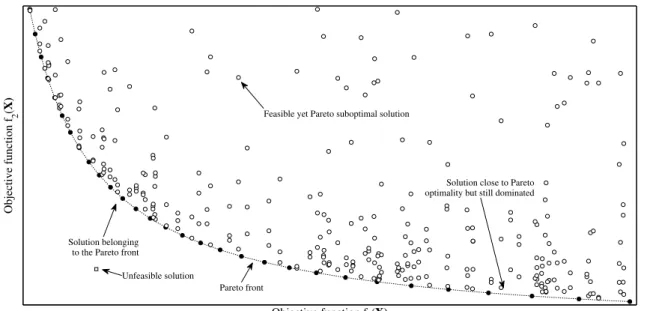
2.1 Example of a two-dimensional (i.e.|X| =2) function f(X) with multiple local optima and isolated global optima. . . 15 2.2 Example of the estimated Pareto front for a bi-objective minimization problem. . . . 16 2.3 General taxonomy of Soft Computing approaches. . . 20 2.4 Generic flow diagram of a genetic algorithm. . . 25 2.5 General overview of the improvisation process of a music band composed byK=3
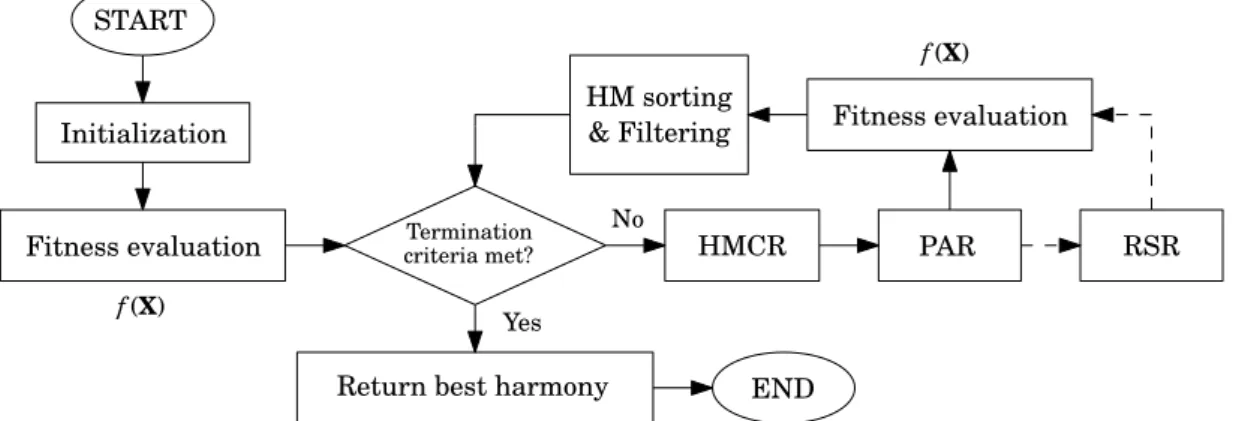
musicians and a harmony memory of sizeΨ=8. . . 28 2.6 Generic flow diagram of the HS algorithm. Dashed arrows correspond to optional
stages aimed at controlling the level of randomization of the search process inde-pendently from the nominal operator of the algorithm. . . 29
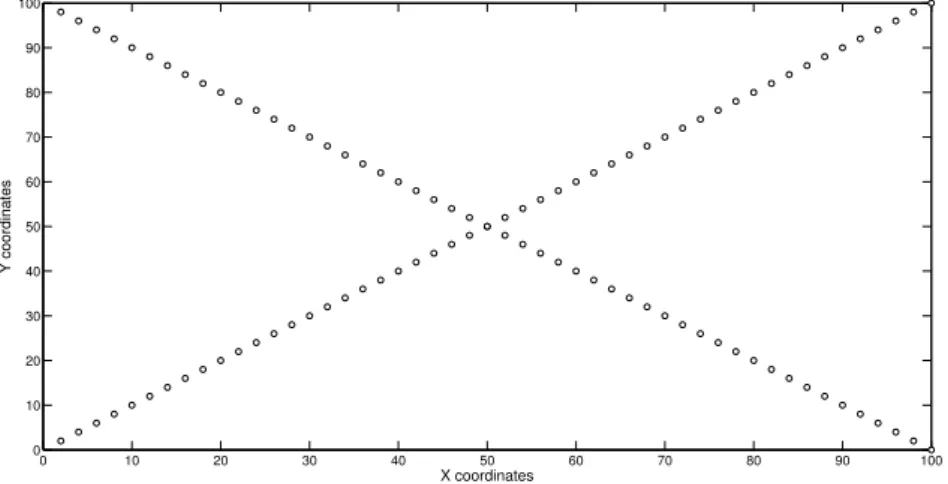
3.1 Schematic example of a dynamic relay deployment scenario. . . 36 3.2 Example of an MDRDP instance withM=2 relays andN=2 nodes to be covered. . 39 3.3 Synthetic scenario used to evaluate the performance of the proposed schemes.
Cir-cles represent the points to be covered. . . 44 3.4 Scatter plot of the (cost,coverage) value pairs obtained by the algorithms under
con-sideration over the synthetic scenario in Figure 3.4. . . 46 3.5 Scatter plot of the [cost,coverage] value pairs obtained by the algorithms under
con-sideration over the same synthetic scenario in Figure 3.4, but at a reduced cost for the relay models. . . 47 3.6 Fire risk map over the Castilla La Mancha region (center of Spain) extracted from
[210]. . . 48 3.7 Scatter plot of the [cost,coverage] value pairs obtained by the algorithms under
consideration over the emulated scenario in Figure 3.6. . . 49 3.8 Examples of relay deployments featuring different (cost,coverage) ratios computed
by the proposed bi-objective approach on the emulated scenario based on Figure 3.6. 49
4.1 FWI for the Spanish mainland and Balearic Islands corresponding to July 26th, 2012. 53
4.2 Example of the considered scenario forM=3 airport facilities andN=8 aircrafts. . 56 4.3 Diagram flow of the proposed meta-heuristic allocation process for the simplistic
scenario. . . 57 4.4 Assignment of aircrafts to aerodromes for a [16,49] risk estimation map. . . 59 4.5 Estimated Pareto front for the extended problem formulation using the risk grid
and airport positions of the [16,49,5] scenario. . . 63 4.6 Solutions obtained by the proposed meta-heuristic allocation algorithm. . . 64 4.7 Diagram of the steps considered in the firefighting operations of an aircraft. . . 65 4.8 Pictures of real aircrafts: (a) CL-215; (b) CL-415; (c) Air Tractor 802 “Fire Boss”; (d)
Air Tractor 802; (e) Kamov K32A 11 BC; (f) SOKOL/BELL 412. . . 68 4.9 Map of the Spanish peninsula with real data on the location and type of water
resources (ponds, lakes and rivers) and the geographical position of airports. . . 69 4.10 Estimated Pareto front for the realistic problem formulation using real data for the
Spanish aerial firefighting fleet. . . 69 4.11 Solutions obtained by the proposed meta-heuristic allocation algorithm in the
real-istic simulation scenario. . . 70
5.1 Extension of the system model in Chapter 3 considering multi-hop communications. 75
List of Tables
3.1 Values of the HMCR, PAR, RSR and bandwidthβfor relay models and coordinates,
denoted with superscriptsMandC, respectively. . . 44
3.2 Statistical results provided by the proposed single-objective hybrid scheme and Al-gorithm A (X-means and G-means) in terms of coverage and cost (mean±standard deviation) and extreme values for the synthetic scenario of Figure 3.3, assuming relay costs {Ct}3t=1={5,8,12}. . . 45
3.3 Statistical results provided by the proposed single-objective hybrid scheme and Al-gorithms A (X-means and G-means) in terms of coverage and cost (mean±standard deviation) and extreme values for the synthetic scenario of Figure 3.3, assuming re-lay costs {Ct}3 t=1={2,3,4}. . . 47
3.4 Statistical results provided by the proposed single-objective hybrid scheme and Al-gorithms A (X-means and G-means) in terms of coverage and cost (mean±standard deviation) and extreme values for the emulated scenario of Figure 3.6, assuming re-lay costs {Ct}3 t=1={5,8,12}. . . 48
4.1 Results’ statistics computed over 20 runs of the algorithm for each scenario. . . 58
4.2 Aircraft types based on the information from [226]. . . 67
4.3 Summertime deployment for aerodromes based on the information in [226]. Fields indicating the aircrafts assigned to every airport denote the number of allocated units per type. . . 67
A.1 Values ofLeandLf for the computation of DMC and DC. . . 80
A.2 Summary of features of the FWI moisture code system [232]. . . 81
A.3 Categorization of the Fire Danger based on the FWI index [223]. . . 81
List of Acronyms and Symbols
Chapter 1:
R Vector of generic resources
Rk k-th generic resource
Rk Vocabulary ofRk
Ω Generic resource allocation strategy
fΩ(R,S) Effectiveness metric, fitness or objective function ofΩ
S set of static variables involved in fΩ(·)
gi(R,S) i-th generic constraint imposed onRandS Nc Imposed number of generic constraints
HS Harmony Search
R Set of all real numbers
Z Set of all integers
Chapter 2:
X Generic set of optimization variables
X Alphabet forX
K Number of generic optimization variables
hi(X) Generic constraint of an optimization problem Hi Upper or lower bound ofhi(X)
f(X) Generic objective or fitness function
| · | Cardinality of a given set
L Number of fitness functions in a multi-objective problem
N Number of solutions conforming an estimated Pareto front ¯
X Vector comprising NPareto-optimal solutions
GA Genetic Algorithm
MLP Multi-Layer Perceptron
ELM Extreme Learning Machine
FL Fuzzy Logic
FS Fuzzy Sets
PSO Particle Swarm Optimization
DE Differential Evolution
EDA Estimation of Distribution Algorithm
F Generic set of all feasible solutions in an optimization problem
G Set of chromosomes in a GA
ζ:F7→G Chromosome encoding ofFinG
Ψ Population (GA) or memory (HS) size
pψ Probability of selecting theψindividual in the GA selection stage
VEGA Vector Evaluation Genetic Algorithm WBGA Weight-based Genetic Algorithm MOGA Multi-Objective Genetic Algorithm NPGA Niched Pareto Genetic Algorithm NSGA Non-Dominated Sorting Strategy PAES Pareto Archived Evolution Strategy MOEA Multi-Objective Evolutionary Algorithm
SA Simulated Annealing
ACO Ant Colony Optimization
CRO Coral Reefs Optimization
Xk(ψ) k-th note inψ-th harmony vector within the HM X(ψ) ψ-th harmony vector within the HM
HM Harmony Memory
ωHMCR Auxiliary variable for the definition of the HMCR operator
β Pitch adjustment bandwidth
VRP Vehicle Routing Problem
CVRP Capacitated VRP
VRPPD VRP with Pick-up and Deliveries
MDVRP Multiple Depot VRP
PVRP Periodic VRP
SDVRP Split Delivery VRP
TS Tabu Search
GRASP Greedy Randomized Adaptive Search Procedure VNS Variable Neighbor Search
Chapter 3:
VSAT Very Small Aperture Terminal
2G 2nd Generation of Cellular Networks (e.g. GSM or GPRS) 3G 3rd Generation of Cellular Networks (e.g. UMTS)
4G 4th Generation of Cellular Networks (e.g. WiMax, HSPA+ or LTE)
PMR Private Mobile Radio
WLAN Wireless Local Area Network
DRDP Dynamic Relay Deployment Problem TVSC Two-vertex Square Covering algorithm BIP Binary Integer Programming algorithm MDRDP Modified Dynamic Relay Deployment Problem
A Disaster area
N Number of emergency teams deployed {pi}Ni=1 Positions of the deployed emergency teams
D Set of parameters defining a relay deployment over A
M Number of relays
List of Tables XVII
Mmax Maximum value assumed for M
{(xR
m,ymR)}Mm=1 Location of theMrelays φ(m) Model assigned to relaym
R(m) Coverage radius of relay m C(m) Cost of relaym
Φt t-th relay model
Rt Coverage radius of relay modelΦt Ct Cost of relay modelΦt
τ Number of different relay models X Coverage (connectivity) matrix
I(·) Indicator function taking value 1 if its argument is true
M(ψ) Number of relays associated to theψ-th solution in the Harmony Memory
HMCRM HMCR parameter for the memory of relay models
HMCRC HMCR parameter for the memory of relay coordinates
PARM PAR parameter for the memory of relay models
PARC PAR parameter for the memory of relay coordinates
³
xRm,¦(ψ),ymR,¦(ψ)
´
New coordinate values after the application of PARC
z Realization ofZβ
Zβ Two-dimensional uniform random variable with support in [−β,β]×[−β,β]
RSRM RSR parameter for the memory of relay models
RSRC RSR parameter for the memory of relay coordinates
I℘ Iteration indexes at which the proposed K-means local search is applied
I Overall number of iterations BIC(·) Bayesian Information Criterion
∆j Model representing a K-means solution with Mjclusters J Number of clustering models considered in X-means LL(p) Log-likelihood ratio for the set of parametersp
pj Number of parameters in∆j
$ Number of independent realizations or Monte Carlo experiments βM Pitch adjustment bandwidth for the memory of relay models βC Pitch adjustment bandwidth for the memory of relay coordinates
m.u. Monetary units (generic cost quantifying parameter)
Chapter 4:
SIFVI Social and Infrastructure Flood Vulnerability Index EDRI Earthquake Disaster Risk Index
KBDI Keetch-Byram Drought Index
FWI Forest Weather Index
ISI Initial Spread Index
BUI Build Up Index
M Number of airports
A Area
pm Location of airportm
N Number of aircrafts
λ(n) Airport assigned to aircraftn
FWIz Risk of grid pointz B(m) Budget of airportm
R(n) Coverage radius of aircraftn
dm,z Distance from airportmto grid pointz
λ−1(·) Inverse function forλ(˙)
J(dm,z) Distance dependent risk weighting function
λ(ψ,n) Airport assigned to aircraftnin harmonyψ
τ Number of aircraft models
ϑ(n) Model of aircraftn
Qt Fuel consumption rate of aircraft modelt
dra
m,m0 Distance traveled by an aircraft reallocated from airportmtom0
WF(·) Fuel expenditure associated to a reallocation strategy
λ0(n) Airport initially assigned to aircraftn
pc Unitary price of a fuel litre ∆WF Refueling cost penalty
WR(·) Interregional airport usage fee
WC(·) Compensation to non-military airports Υ(·) Firefighting potentiality function
Vt Water tank capacity of aircraft model t
dwr
z,t Distance from grid point zto the closest water resource compliant with model t V(n,z) Amount of water eventually dropped by an aircraftnover pointz
Nr(˙) Number of water recharges without refueling
γt Distance penalty due to water reloading and carrying maneuvers
rep(x,t) Auxiliary function for building sets with multiple value repetitions
Appendix:
CFS Canadian Forest Service
LST Local Standard Time
FFMC Fine Fuel Moisture Code
T Temperature [Celsius]
H Relative humidity [%]
W Wind speed [km per hour]
r0 Rainfall measured in an open environment [mm]
m0 Fine fuel moisture content
F0 Value of the FFMC code in the previous 24 hours
rf Effective rainfall for the FFMC [mm]
EMC Equilibrium Moisture Content
Ed EMC for drying
Ew EMC for wetting
κo Log drying rate
κ1 Log wetting rate
mad Fine fuel moisture content after drying
DMC Duff Moisture Content
re Effective rainfall for the DMC [mm]
M0 Duff moisture content from the day prior to the computation
P0 Value of the DMC code in the previous 24 hours
List of Tables XIX
b Slope variable
Le Effective length of the day for the DMC computation
DC Drought Code
V Evapotranspiration measured in 0.254 mm water units per day
Lf Day length factor for the DC computation rd Effective rainfall for the DC [mm]
CHAPTER1
I
NTRODUCTION
“The key to growth is the introduction of higher dimensions of consciousness into our awareness.”
- Lao Tzu
In its unstoppable race towards levels of more advanced development, evolution has gravitated on several aspects of the human kind. To begin with, it is of undoubted certainty that human beings have undergone severe biological changes due to several interrelated reasons, ranging from the essential survivability of the species themselves to the inherent complexity of different challenges encountered during History. Examples are clear as evidenced by consecutive speed and height records in Olympics, and significantly decreased occurrence rates of diseases that more than a century ago were known to be epidemic and fatal partly as a consequence of an enhanced resilience of human organisms. Such evolutionary changes also spread to the beha-vioral patterns shown up by humans either in isolation or more remarkably, when collaboratively connect to each other towards a certain goal. No matter if human kind has collectively worked towards colonization, organization, exploration or conquest: socio-cultural models have evolved dramatically to yield a humankind strongly upheld on the purpose of survivability, sustainability, efficiency, freedom, leadership or progress. Most archaeologists and cultural anthropologists work within the framework of modern theories of sociocultural evolution in an attempt at unifying diverse approaches and beliefs on this matter.
A common factor featured by both biological and socio-cultural evolution lies on the exploita-tion of the available natural resources as a necessary substrate to support the evoluexploita-tion itself. Worthy is to mention the relevance and impact of wood and steel furnishing, land ownership, fishing, silicon fabrics and outer space navigation in several episodes of History featuring sig-nificant advances towards higher levels of prosperity. By natural resource it is meant any asset derived from undisturbed environments that offer potentiality to be exploited for the survival or profit of the humankind, such as land, water, soil, plants and animals. Beyond their primary use, many other criteria are often utilized to classify natural resources: their bioticity (if it arises from living, organic material) their potentiality, availability and timeliness. This Thesis will be par-ticularly concerned with the renewability of any given natural resource, understood as its ability to replenish naturally and seamlessly when consumed or exploited by the human being. Luckily, Nature has been generous in what relates to the renewability of natural resources with a strong impact on the survivability of the humankind such as wood, sunlight, wind or water. Other natu-ral resources with more technological implications such as fossil fuels or silicon are nowadays exploited at the pace dictated by their low, almost null renewability.
Among such renewable natural resources wood will grasp the thematic scope of this Thesis. In essence wood is made of a composite of cellulose fibers embedded and strongly compressed into a matrix of lignen. This naturally appearing combination of substances and elements gives rise to a robust, durable material traditionally employed in construction and organic propelling, with further uses in transport, furniture fabric and medicine, among others. Wood is obtained from forests from which, once it has been collected, is taken to lumber camp so as to elaborate boards, frames and other finished products alike. However, the motivation of this Thesis does not ground on the multiplicity of applications and uses of this natural resource, but rather capitalizes on the vulnerability of wood against fires and the technical and operational difficulties when extinguishing them in such a flammable environment. Due to its composition, wood is by itself a highly propagative material for fire which, in case of a massive forest fire event, requires strict yet quick preemptive countermeasures to minimize its impact and ultimately, avoid deforestation and soil desertification. Needless to highlight that such countermeasures are necessitated for a far more primary rationale than the importance of wood in different industrial sectors: forests – and plants in general – play a crucial role as a catalyst of the natural conversion from light to chemical energy and oxygen therefrom, which is of utmost necessity and a sine qua non condition for life in planet Earth.
Risk consequences in forest fire management also scale down to smaller, albeit equally avoida-ble granularities. Unfortunately, in addition to the fire itself, firefighting brigades deployed on site also undergo diverse life-threatening hazards ranging from heat stress to fatigue, smoke, dust and other injuries including burns, cuts and scrapes. Part of these hazards arise as a direct consequence of the work developed by the brigades for extinguishing the fire. However, in some other cases the promptness and urgency under which decisions are taken in these situations cause a lack of coordination between sparsely deployed teams, which may ultimately lead to isolated individuals and groups subject to carbon monoxide or direct exposition to flames. In regards to the former, carbon monoxide can be found at the highest concentration at close proximity to slow burning fires. This fact reveals that health hazards are not only a matter of wide-area disasters, but also underlie latently beneath smoldering, apparently low-risk fire events.
From an operational perspective, health risks should be reason enough to allocate as much financial resources as available so as to minimize its likelihood and severity. However, the world-wide economical context of the last few years has restricted stringently national budget items al-located to fire prevention strategies and disaster management methodologies by institutions and governments. This being remarked and in light of several evident facts discussed in forthcoming sections, there is a noted necessity for explicitly considering cost aspects in the management of firefighting resources in such a way that expenditure is properly balanced with respect to the available budget and the risk level of the scenario itself. Therefore, the design and adoption of cost-efficient processes, tools and methods to preserve the integrity of forests by increasing their resilience against fires and minimizing their catastrophic effects, as exposed in the remainder of this introducing Chapter.
1.1 Motivation and Research Hypothesis
1.1. Motivation and Research Hypothesis 3
resources allocated to a certain fire disaster and the life and economic losses resulting therefrom. Intuitively, leaving aside other factors such as the characteristics of the soil one could intuitively expect a clear correspondence between such indicators, in such a way that a forest fire should be assigned enough financial and firefighting resources so as to minimize the risk of suffering casualties subject to a positive balance between economic losses and expenditure. This eventual correspondence would pinpoint an efficient management of the resources allocated to the event at hand.
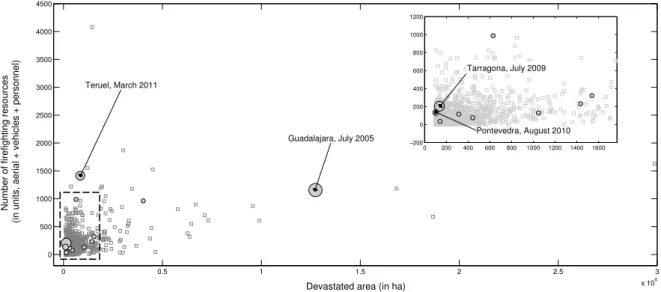
However, data do not unveil a so clear correlation between such factors. This assertion is supported by the indicators on the forest fire events over one hundred hectares of devastated woodland occurred in Spain registered and published by the Ministry of Agriculture, Nutrition and Environment (Ministerio de Agricultura, Alimentación y Medio Ambiente) in the period 2001-2011 [1]. In this data set several attributes and factual aspects related to such fire events are listed, including the area affected by every registered fire event, the number of fatalities and wounded individuals and the used resources (personnel, vehicles and aircrafts), among several other features. These factors are depicted in Figure 1.1 by scattering the devastated area versus the amount of firefighting resources with markers directly proportional to the number of human casualties due to every such fire event.
0 0.5 1 1.5 2 2.5 3
x 104 0
500 1000 1500 2000 2500 3000 3500 4000 4500
Devastated area (in ha)
Number of firefighting resources
(in units, aerial + vehicles + personnel)
0 200 400 600 800 1000 1200 1400 1600 −200
0 200 400 600 800 1000 1200
Teruel, March 2011
Guadalajara, July 2005
Tarragona, July 2009
Pontevedra, August 2010
Figure 1.1: Number of firefighting resources versus devastated area for all wildfires over 100 ha occurred in Spain from 2001 to 2011. Square gray markers correspond to those wildfires with no casualties, whereas the radii of circled markers are set proportional to the number of casualties of the fire they represent. The embedded plot magnifies the region bounded by a dashed rectangle.
This noted lack of correlation between casualties and dedicated resources is not be insightful by itself if the study focuses only in these two features, as none of them results to be representative of its intensity and extension. This is the reason why the plot considers in its horizontal axis the area devastated by every wildfire measured in hectares. Intuitively one expects that the area affected by any given fire results to be inversely proportional to the number of resources dedicated to its extinction, i.e. the more resources are allocated, the smaller the affected are by the fire will be. However, the same conclusion holds: data does not support this expected inverse relationship between both variables.
Although other hidden factors (i.e. weather conditions) may also play their role when wrap-ping up conclusions from the depicted data, the study so far suggests that the allocated resources have not been managed properly in all the fire events under consideration. This last statement becomes further buttressed when the three depicted variables are jointly analyzed: there are no means to infer from the data the amount of casualties from the number of allocated resources and the devastated area of a given wildfire. In other words: the number of casualties is not related anyhow to the amount of resources and the devastated area by the fire.
Summarizing, this data-based study puts to question the effectiveness of decisions taken to assign and deploy resources for the extinction of wildfires. Decisions in this context are driven by well-specified procedures and protocols based on the passive reaction triggered by circumstantial conditions (e.g. a given number of firefighting resources for every hectare of terrain affected by the fire). Unfortunately, there are three evidences for which these resource management procedures result to be far from optimal:
• Governmental investments for the acquisition, renewal and maintenance of firefighting re-sources are progressively decreasing as a result of the worldwide economical context. For instance, the environmental forum of theCastilla La Mancharegion (center of Spain) de-nounces, in their report published in October 2013 [2], that there are only 5 light vehicles in the region with the legally required equipment to combat wildfires (one per province), which incur in delays and an increased risk when performing their duty. Besides, in this same report it is claimed that regional firefighting brigades have undergone significant re-ductions – reaching up to 50% – in the number of effective hours dedicated to the preven-tion, surveillance and extinction of wildfires. More exemplifying datum: at a national level the Spanish firefighting campaign for 2013 has dedicated 267 aircrafts for the extinction of wildfires during summertime, 8 units less than in 2012 as a consequence of the funding reductions in the Ministry for Agriculture, Fisheries and Food. Cost, therefore, is called to play an essential role when allocating resources nowadays and in the present future. Current resource allocation procedures, on the contrary, do not take into account any cost related criteria in decision making.
• Decisions to combat wildfires are not made pro-actively nor preventively, but rather reac-tively in the form of countermeasures to taken risks. Examples of this lack of strategic preemption when organizing firefighting resources abound in practice, such as the wildfires occurred in the Spanish regions ofLevante(Cortes de PallásandAndilla, June 2012 [3]) and
Galicia(Fragas do Eume, March-April 2012 [4]). In these examples wind bursts hindered
1.1. Motivation and Research Hypothesis 5
also took a fatal role in the death of 11 members of the brigades involved in the wildfire that took place inGuadalajarain July 2005 [5]: an outdoor temperature of 33 Celsius, turbulent wind blowing at 20 kilometers per hour heading South east, a relative air humidity of 22 %, and 50% less rainfall than the same period of 2011. It is true that this wildfire has been proven to be human caused (i.e. a barbecue in a forbidden area); but equally certain is to state that more resources could have been allocated to this region should weather forecasts had been taken into account by authorities and decision makers.
• An underlying potential risk in the management of resources is the human intervention itself1. In disasters such as wide area wildfires commanders must assess and weight lots of data received from different means so as to effectively yet safely organize and deploy the firefighting brigades on site. However, cases such as the wildfire happened in a brush-choked canyon north of Phoenix (Arizona, USA) in June 2013 shows up the fact that human decision making is subject to errors and assumptions that may lead to fatalities: in this wildfire 19 elite firefighters perished while commanders thought the crew was in a safe place [6]. No extreme had heard each other for 33 minutes until just before the fire overwhelmed the brigade. Certainly decision support tools would have been extremely useful to deploy communication resources in a more effective, active, monitored fashion, discarding any non-supported assumptions from the commanding forces.
Based on these observations, the research scope of this Thesis gravitates on designing al-gorithmic tools that help decision makers and commanders allocate firefighting resources in a optimal yet cost-efficient manner. To this end, it is essential to understand beforehand how the allocation of resources breaks down into the formal mathematical statement of a optimization problem, as done in the following subsection.
1.1.1 General Formulation of Resource Allocation Problems
Generally speaking, resource can be defined as any asset that can be exploited so as to yield some measure of benefit for a given process. Ifprocessis mapped tofire extinctionandmeasure of benefit
corresponds to any positive metric quantifying effectiveness when extinguishing fire, it should be clear that resource may refer to a wide spectrum of assets reactively (vehicles, brigades, aircrafts, hoses, axes, water, etc) or preventively (surveillance patrols, bulldozers for opening firebreaks, forest cleaning teams) operating on the purpose of suffocating fire.
From a mathematical standpoint, resources can be modeled as variables whose values deter-mine their joint effectiveness when combating a wildfire. At a first approach one could intuitively think of an allocation strategy where each variable (namely, resource) is optimized to its best effectiveness disregarding how the rest of assets have been allocated. Nonetheless, the overall effectiveness of all assets against a given wildfire does not decompose into the individual contri-butions of each of such resources; all become mutually correlated since they are used in the same scenario and share underlying variables such as time, space, cost or any other alike. For example, one could not command bulldozers and forest cleaning teams to operate on the same geographical area since 1) there is a risk for the human crew; and 2) cleaning forest areas next to firebreaks is
1Interestingly this third point is succinctly linked to the concept of integrative complexity, which stands for a
not as effective against eventual wildfires as distributing geographically the available resources. In summary: the allocation of resources must be challenged from a global perspective, by casting effectiveness metrics implicating all the resources to be managed in a non-necessarily decompo-sable fashion.
Technically the above argued metric function is also referred to asobjective function, which is to be maximized or minimized by varying the values of the participating variables (correspond-ingly, resources). Let the set of resources be denoted as aK-dimensional vectorR,{R1,...,RK},
where Rk∈Rk is the variable representing the k-th resource to be optimized. The composition
itself and alphabet Rk for Rk depend roughly on both the parameter of the resource to be
allo-cated (position, time, capacity, etc) and the encoding approach used for its representation, which is strongly linked to the characteristics of the algorithm used for its solving. Having these defi-nitions in mind, a resource allocation strategy Ωestablishes an effectiveness metric, fitness or objective function fΩ(R,S) to be maximized (e.g. area covered by firefighting brigades) or
mini-mized (e.g. attendance delay by ground vehicles, economical cost required for establishing the allocation policyΩ). Arranged as a single mathematical formulation, resource allocation can be formulated as
Optimize
R fΩ(R,S), (1.1)
subject to gi(R,S)RGi, i=1,...,Nc, (1.2)
Rk∈Rk,k=1,...,K, (1.3)
i.e. as the conventional formulation of an optimization problem where Expression (1.2) corres-ponds to the Nc equality or inequality constraints set by the scenario at hand or the resource allocation strategy itself. For instance, in cost-constrained policies for wildfire prevention the com-mander may set a maximum monetary cost for the allocation process due to budget restrictions. Likewise, optimal positioning strategies for firefighting brigades can be subject to geographical constraints (e.g. very steep slopes in mountains or rocky wastelands where fires is not likely to propagate). In reference to the above expressionSdenotes the set of static variables involved in the definition of the metric that are not to be optimized, e.g. fixed costs, nominal coverage of radio communication devices or water tank capacity in firefighting crafts.
1.1.2 Complexity Aspects and Algorithmic Alternatives
Once the mathematical formulation of resource allocation problems has been exposed, the
leit-motivof this Thesis is in the position to show that the challenges arising from the efficient solving
of large-scale optimization paradigms also apply in the context of asset coordination in wildfire extinction campaigns. Inherent properties of this scenario such as the erratic fire dynamics and the heterogeneity of firefighting resources get further involved by the ever-increasing scales of wildfire events and the need for inter-agency coordination in a scenario demanding fast, reliable, multi-criteria optimization tools. Several clarifying facts and data from studies follow:
1.1. Motivation and Research Hypothesis 7
context exemplifying is to highlight the recent report presented at the annual meeting of the American Geophysical Union inSan Francisco (USA) in late 2012, where the burned area from wildfires in the USA was predicted to double in size by 2050 due to warmer and drier conditions in coming decades [9]. Besides this envisaged increase of wildfire scales, the record of incidences in such a year of intense activity as 2012 (with massive fires affecting
ColoradoandNew Mexico[10]) suggests that fire events take place in nearby locations and
very close in time, i.e. they are strongly correlated in both time and space. This ultimately leads to the certainty that commanders will encounter higher difficulties in the future when allocating their managed resources due to simultaneous, co-located and necessarily inter-connected wide-area wildfires, ultimately heading to an increased complexity of the opti-mization problem that models the decision making.
• As explained before in this chapter, there is an increasing concern by authorities and govern-ments about the cost implications of fire prevention and suppression. In particular, the case of USA has gained visibility in the last decade, with expenditures regularly beyond 10000 millions dollars per year in this period [11]. In light of this expended budget his-tory and its growing trend, the Federal Land Assistance, Management and Enhancement Act (FLAME Act) of 2010 enforced the national stakeholders in charge for managing fire-fighting resources (specifically, the U.S. Department of Agriculture, the U.S. Department of the Interior, and the U.S. Department of Homeland Security) to coordinately elaborate a Cohesive Wildfire Management Strategy to derive cost-effective, sustainable policies for allocating and managing fire resources [12]. When transferred to the algorithmic realm, the consideration of cost-driven criteria in the management of fire assets gives rise to an optimization problem subject to additional cost-related constraints that jeopardize the ap-plication of straightforward, deterministic solvers. Alternatively the problem might be re-formulated by including a second cost-representative objective function in Expression (1.1) to be simultaneously minimized along with fΩ(R,S). However, this bi-objective
optimiza-tion model calls for advanced optimizers capable of efficiently balancing both interrelated metrics and incorporating further methods to deal with the rest of constraints.
• When issuing commands from decision makers to the firefighting crew deployed on site, the heterogeneity of fire extinguishing resources may unchain suboptimal decisions due to the pattern-driven way of thinking of human beings when facing problems of this nature. In such cases human reasoning tend to oversimplify the decision making by searching for patterns among the assets. However, not all e.g. ground vehicles feature the same water and transporting capacity, autonomy and distance from their actual location to the wildfire at hand. By way of illustration INAER, a Spanish private company specialized in aerial emergency services and aircraft maintenance for mission critical operations has a portfolio of more than 150 aircrafts corresponding to 18 different helicopter models and 7 airplanes [13]. Differences become obviously more acute when comparing firefighters to each other, as physical conditions arise as a fundamental factor to drive any person’s potential perfor-mance to extinguish fires. In conclusion, the heterogeneity of resources becomes one of the most challenging issues for making decisions in wildfire management procedures, and is envisaged to become specially unmanageable as the scales of the wildfire at hand increase.
trial-and-error learning strategy. Only the computation of values of the objective function and the constraints are required disregarding their mathematical structure, continuity, differentiabili-ty, convexity and/or analytical decomposability. Within this category, meta-heuristics have been traditionally utilized in a plethora of problem formulations arising in different disciplines charac-terized by complex, non-smooth search spaces. By virtue of specialized stochastically-driven ope-rators, meta-heuristic solvers iteratively refine a candidate solution – or a set of them – with regard to a given quality measure bylearning from experienceand without making any assump-tions about the optimization problem under consideration. Moreover, their searching procedure can be extended to address optimization paradigms where multiple, conflicting objective functions are to be optimized simultaneously. A byproduct of this class of black-box optimization techniques is the lack of guaranteed optimality on the produced solution: by filtering out bad intermediate so-lutions, meta-heuristics only certify that the likelihood of being trapped in local optima decreases along iterations, but nothing can be claimed about the metric-defined distance of the remaining solutions with respect to the global optimum.
All the above rationale considered, this Thesis hypothesizes meta-heuristic algorithms as suitable optimization techniques for the allocation and management of firefighting resources in large-scale wildfire events, and hinges on the proven search efficiency, flexibility and robustness of these solvers to conduct research towards assessing their performance in different use cases.
1.2 General and Specific Objectives
Bearing in mind the established research hypothesis and in light of the motivating facts exposed in the previous section, the main contribution of this Thesis focuses on studying and validating the applicability of modern meta-heuristic algorithms for the efficient solving of complex opti-mization problems lying underneath the allocation of firefighting resources in the management of wildfires. As claimed before, meta-heuristic solvers allow for a balanced trade-off between the optimality of the produced solutions and the computational complexity required during the search process. This property makes this class of algorithmic optimizers specially promising for solving combinatorial and mixed integer optimization paradigms subject to multiple constraints, and possibly involving several conflicting objectives. As will be shown throughout this research work, problem formulations featuring these characteristics arise when managing resources of different nature in wildfire extinguishing campaigns.
The above main objective of the Thesis breaks down into the following set of specific goals:
1.3. Methodology 9
• Next the applicability of HS-based meta-heuristic optimization algorithms is exemplified in two different wildfire management scenarios. The first one essentially hinges on the so-called dynamic relay deployment problem, which consists of finding the optimum number of deployed relays and their location aimed at simultaneously maximizing the overall number of covered mobile nodes and minimizing the cost of the deployment. This problem is ex-tended by considering relay models characterized by different coverage radii and associated costs. To efficiently tackle this problem a novel hybrid scheme will be derived comprising 1) a Harmony Search (HS) based global optimization procedure; and 2) a modified version of the well-known K-means clustering algorithm as a local search technique. Single- and bi-objective formulations of the algorithm will be sketched targeting emergency and strategic operational planning, respectively. Simulations will be performed over a emulated scenario based on real statistical data from theCastilla La Mancharegion (center of Spain).
• The second scenario under study focuses on optimally deploying firefighting aircrafts on the existing aerodromes and airports over a certain geographical area based on predictive fire risk estimations. The problem will be mathematically formulated as 1) a capacity-constrained resource allocation problem where a measure of the utility or impact of the deployed resources with respect to fire forest risk predictions is to be maximized based on different aircraft and airport models; and 2) a multi-objective problem where cost and utility are to be jointly optimized and simultaneously considering their mutually conflicting nature. In the latter formulation, the initial location of airplanes and the operational cost of their reassignment is also taken into account. Likewise, the impact of the relative distance from the eventual wildfire to the closest water resource is also quantified and included in the definition of the utility function. On the purpose of efficiently tackling this optimization problem, a family of meta-heuristic solvers inspiring from the aforementioned HS algorithm will be derived, implemented and in a set of synthetically generated scenarios and a real case for the Iberian peninsula.
As can be guessed from the above description, both analyzed scenarios ground on the formu-lation of single- and bi-objective optimization problems subject to a set of constraints, which are then tackled via harmony search heuristics hybridized with local methods designed ad-hoc for the scenario at hand. This technological coherence throughout the Thesis is accomplished by virtue of a consistent, well-defined research methodology, as exposed in the next section.
1.3 Methodology
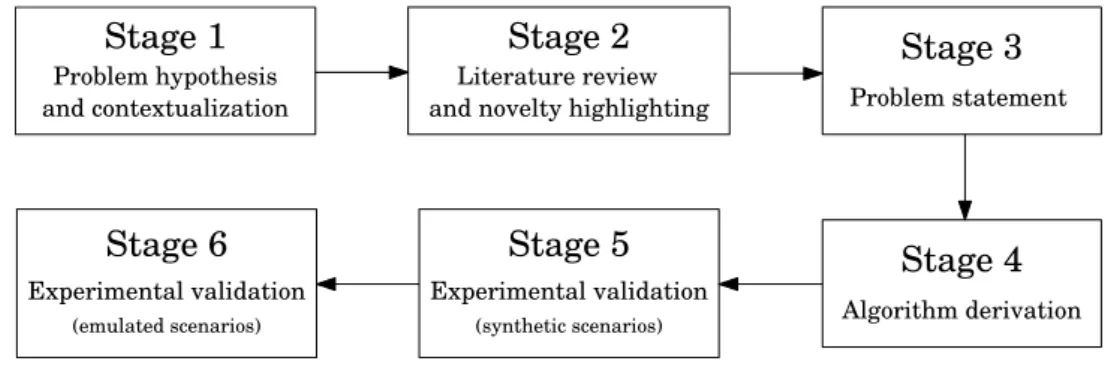
Next, the problem under consideration is formally posed in conventional mathematical nota-tion. Theretofore in this second stage the variables and parameters to be considered in the defini-tion of the problem will be listed and described in detail. Once the formuladefini-tion is completed jointly with the description of its participating variables, an insight on the complexity requirements of the problem itself will be discussed so as to argue the selection of meta-heuristic algorithms spe-cially tailored to alleviate the computational burden of the search procedure at the possible cost of optimality. Modifications of the naive version of the Harmony Search meta-heuristic from which the proposed resource allocation procedures inspires will be thoroughly discussed, along with the local methods inserted in the algorithm thread to efficiently tackle possible constraints featured by the problem.
Problem hypothesis
Stage 1
Literature reviewStage 2
and contextualization and novelty highlighting Problem statement
Stage 3
Algorithm derivation
Stage 4
Experimental validation
Stage 5
(synthetic scenarios)
Experimental validation
Stage 6
(emulated scenarios)
Figure 1.2:Methodology adopted in the Thesis.
As for the validation of the proposed algorithms, numerical computer experiments will be carried out oversynthetically generated and emulated simulation scenarios. The first refers to setups which do not reflect any connection to real situations and scenarios, but instead are built up artificially by means of analytical functions. On the contrary, the latter stands for scenarios which, even if they are still computer-generated, the functions lying beneath the generation of scenarios rely on real statistical data for their definition. This permits to validate the perfor-mance of the derived algorithms in artificial hence controlled simulation setups, and to shed light on their applicability by emulating a real problem composition. In both cases a range of perfor-mance indicators will be averaged by means of a Monte Carlo simulation methodology [15], which consists of randomly sampling the space of possible realizations of the algorithm under study for inferring meaningful statistics about the optimality, stability and mean behavior of the provided solutions.
1.4 Structure of the Thesis and Notation Generalities
1.4. Structure of the Thesis and Notation Generalities 11
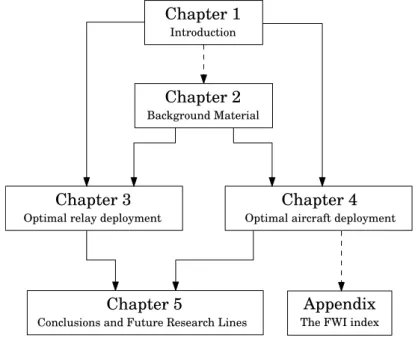
in this Thesis, together with their corresponding formal problem statements, derived algorithms and a discussion on the obtained results. Chapter 5 wraps up all the conducted research by dra-wing the main conclusions extracted therefrom and by motivating and sketching several lines of future research. Appendix A serves as a complementary yet insightful support to Chapter 4. The reader should notice that Chapter 2 is not deemed mandatory, but recommendable for grasping an overall outlook of the entire research work.
Introduction
Chapter 1
Optimal aircraft deploymentChapter 4 Optimal relay deploymentChapter 3
Conclusions and Future Research Lines
Chapter 5
Background MaterialChapter 2
The FWI index
Appendix
Figure 1.3:Structure of the Thesis. Dashed arrows indicating the optionality of the pointed chapter.
CHAPTER2
B
ACKGROUND
M
ATERIAL
“The proof of evolution lies in those adaptations that arise from improbable foundations.”
- Stephen Jay Gould
As has been anticipated in Chapter 1, this dissertation mathematically formulates the allo-cation of resources in the management of large-area disaster situations (in particular, wildfires) as a conventional optimization problem which, from a general standpoint, can be understood as the discovery of the best among a set of possible solutions subject to certain fitness criteria and imposed constraints. Formally enunciating the different resource allocation paradigms resulting from the characterization of the scenarios under study comes along with a number of substan-tial benefits. To begin with, the computational effort required for its resolution can be assessed by analyzing the convexity and linearity of the considered metric(s) and constraints, as well as the combinatorial nature of the search space defined by the alphabet of the involved variables. Likewise, the inspection of all such peculiarities may unveil the family of solvers best suited to efficiently deal with the problem at hand, as well as the eventual need for punctual modifications in the nominal definition of such solvers to handle particularly involvedhardconstraints.
Based on the above rationale, an interested reader of the Thesis should conveniently feature a solid background on the foundations of optimization problems and related solving approaches, with an emphasis on stochastically-driven algorithms. For the sake of completeness this chapter provides a formal introduction of the basic concepts of single- and multi-objective optimization problems, followed by a justification of the need for stochastically driven approximative solving methods and a overview on meta-heuristic algorithms as one of the most widely used portfolios of approximative optimizers in the literature. This review ends by delving into the Harmony Search algorithm on which the resolution of the optimization problems described in subsequent chapters is based. At this point it should be made clear that the contents of this Chapter aim at overlooking different practical approaches used for solving continuous and discrete optimization problems. The reader interested in further details of approximative and exact solving techniques is referred to the recent yet thorough surveys and reviews by Glover, Boyd and Nocedal in [16, 17, 18].
2.1 Fundamentals of Optimization Problems
Optimization problems arise in many disciplines and various knowledge domains. Researchers, practitioners, companies and public institutions face with decision processes in a daily basis,
most involving tens or even hundreds of alternatives whose expected or estimated impact on the process at hand is in essence the evaluation criteria that permits to assess the benefit of choosing an option or another. Besides the inherent difficulty of handling lots of interrelated decision variables, in practice users and companies are not free to select any possible option, but instead those that fulfill constraints that restrict the number of available alternatives, as exemplified by political decision making processes being recently impacted by budgetary and law limitations. Therefore, a decision alternative must be selected that complies with all the existing constraints, and that maximizes (e.g. power saving, speed, time, efficiency) or minimizes (correspondingly, money, time, risk or error) a fitness evaluation function.
In this context, this Thesis builds upon the conception of the allocation of firefighting resources as an optimization problem, which can be formally defined as the paradigm of finding the best feasible solution – in terms of a certain measure of fitness that must be either maximized or minimized – over a possibly constrained search space. Such imposed constraints can be implicit in the definition of the vocabulary for each compounding variable of the candidate solutions or, alternatively, may be set explicit as bounded function set of such variables. From a more formal approach an optimization problem can be defined as to find the best solution
X∗,{X1,...,XK}∈X, (2.1)
withX∗denoting the solution of the problem,Xkits compounding decision variables, andX,XK
the search space forX, such that
Optimize
X f(X), (2.2)
subject to hi(X)RHi,i=1,...,Nc, (2.3)
where f :X7→Ris the so-calledfitnessor objective function, and {hi(·),Hi}establish the Nc con-straints imposed on the problem formulation that restrict the search spaceXto a certainfeasible
subspace. The alphabet of the decision variables {X(k)}K
k=1 constituting the solution vectorXcan
be either continuous (Xk∈R) or discrete (Xk ∈Z). Consequently, problem models for optimiza-tion paradigms are coined as continuous when the alphabet of all decision variables is defined on the real set, i.e. X∈RK, as opposed to combinatorial problems where decision variables are drawn from a finite, discrete setZsuch thatX∈RK. Mixed problem formulations combine real and discrete decision variables jointly related through the fitness function f(X). For instance, the problem formulation tackled in Chapter 3 is mixed as the number of relays is a discrete integer variable, whereas their positions are regarded as continuous optimization variables.
It should be made clear that a problem formulation may render distinct feasible solutions, where feasibility must be understood as the thorough fulfillment of the Nc imposed constraints by the solution at hand. However, an optimization problem aims at achieving an optimum decision on the values for a set of variables in a global sense. In other words, any solving attempt at an optimization problem seeks the derivation of the globally optimum solution, which denotes the vectorXthat provides, among all feasible vectors inX, the best value for the fitness function f(·). This statement does not imply that the global optimum is always unique, as the cardinality of this set of optimum solutions may be even infinite in problems characterized by a high modality of its fitness metric. Seen in another way: optimality requires feasibility, but the reciprocal statement does not necessarily hold.
In line with the above definition of global optimum, a locally optimal solution denotes a
2.1. Fundamentals of Optimization Problems 15
feasible vectorX℘will be locally minimum if there exists an open neighboring setN
X℘ ofX℘such
thatf(X℘)≤f(X)∀X∈N
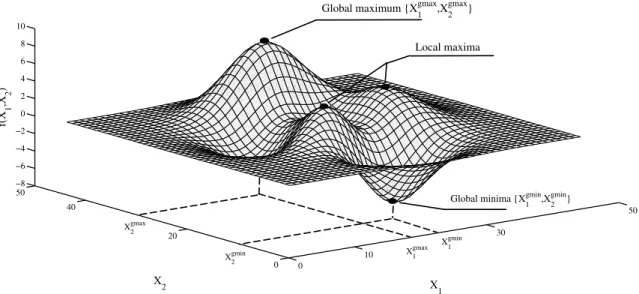
X℘(a clarifying bi-dimensional fitness function is depicted in Figure 2.1).
When confronting a given optimization problem one of the most involved challenges from the al-gorithmic point of view is to avoid declaring a local optimum as the global solution to the problem under consideration: indeed, first-order gradient descent methods [19] are known to get trapped in local optima if no further adaptations are done. In such a case it is desirable to devise strate-gies for escaping from locally optimal regions of the search space towards areas of increased (and hopefully, dominating) optimality.
0 10 30 50 0 20 40 50 −8 −6 −4 −2 0 2 4 6 8 10 X 1 X 2 f(X 1 ,X 2 )
X2gmax
X2gmin X1
gmax X1 gmin Local maxima Global maximum {X
1 gmax ,X 2 gmax }
Global minima {X 1 gmin,X
2 gmin}
Figure 2.1: Example of a two-dimensional (i.e.|X| =2) functionf(X) with multiple local optima and
isolated global optimaXgmax={Xgmax
1 ,X2gmax}andXgmin={X1gmin,X2gmin}. The function is built by
translating, scaling and sampling an aggregation of 2-dimensional Gaussian distributions.
In this context it is important to point out the notion of optimality when tackling an opti-mization problem with a given solver. The termoptimalitystands for the relative quality of the produced solutions (which is given by their fitness value) with respect to the global optimum of the problem at hand. As such, near-optimal solutions will refer to those candidates which are po-tentially close to the overall optimum without any further guarantee that they may coincide. The relevance of the near-optimality concept is paramount in the literature related to meta-heuristics and in general, approximative optimization methods; due to their iterative search behavior (which often relies on stochastic processes), this class of optimization techniques does not guarantee that the globally optimum solution is ever achieved, but only ensures that progressively better fitness values are iteratively attained. Therefore, the optimality of any optimization algorithm depends roughly on its capability to efficiently examine the solution spaceXby combining explorative and exploitative search procedures, which will be later discussed in this Chapter in the scope of the Harmony Search optimization algorithm.
2.1.1 Multi-Objective Optimization


![Figure 3.4: Scatter plot of the [cost,coverage] value pairs obtained by the algorithms under considera-](https://thumb-us.123doks.com/thumbv2/123dok_es/7260561.344425/72.892.118.771.277.567/figure-scatter-coverage-value-pairs-obtained-algorithms-considera.webp)