Stakeholder Selection for Business Processes Support Systems in
Interorganizational Environments
Luciana C. Ballejos
1and Jorge M. Montagna
1,2[email protected];[email protected]
1
CIDISI – Centro de Investigación y Desarrollo en Sistemas de Información Universidad Tecnológica Nacional – Facultad Regional Santa Fe – Argentina
2
INGAR – Instituto de Desarrollo y Diseño - Avellaneda 3657 – (3000) Santa Fe – Argentina Tel: +54-342-4534451 – Fax: +54-342-4553439
Abstract. This work presents a methodology with basic steps to follow before developing Interorganizational Information Systems (IOSs), which constitute the support for the execution of business processes (BPs) in new structural forms made up of various organizations, called Interorganizational Networks (IONs). Then, a framework is given to describe IONs, analyzing different characteristics in three dimensions: organizational, interorganizational and technological and given real examples for them.
The selection of stakeholders, one of the presented steps in the methodology, is a critical stage for this kind of projects. The dynamic interorganizational context in which IOSs-supported business processes are executed makes this task seriously difficult. For being applied on these contexts, an extended classification for stakeholders is given. Also, the strong link and influence existing between IONs characteristics and the stakeholders selection phase for this kind of environments is analyzed. Since specific attributes of each kind of networks are important and define the criteria for identifying stakeholders, basic selection criteria are deduced from the described analysis. This is particularly important in environments where cooperation and coordination among various organizations are the main objectives.
Keywords: interorganizational networks, interorganizational business processes, stakeholders, interorganizational information systems.
1. Introduction
In order to face the demands of a globalyzed economy and technological advances, industries are changing the way in which they execute their business processes (BPs), creating new models and disaggregating their activities by keeping fluent and flexible relationships between organizations [01,02,03]. Various configurations have been proposed to achieve collaboration among companies, which gives rise to structures called Interorganizational Networks (IONs) [04,05,06].
In an ION, relationships among independent organizations constitute the network structure and their interactions inside it are the network BPs. Links constitute economical, material, information or knowledge exchanges that should be synchronized so as to adjust each ¨node¨ (firm) activity to the whole system (network) activities [05]. This synchronization of individual activities encourages the coordinated creation and execution of certain BPs that will have to be implemented within the interorganizational environment. ION operation will focus on the coordinated processes execution that go beyond the organizations barriers. This introduces the interorganizational approach for BPs and the need of coordinating them due to the organizations heterogeneity being part of the network [07].
Forming these structures and coordinating their processes have been considerably encouraged by Information Technology and Communications (ICTs) that materialize the integration of BPs, even when the organizations are geographically dispersed [01].
In IONs, the technological structure is often present by means of Interorganizational Information Systems (IOSs) that constitute the main tool for supporting and coordinating BPs and enable the development of relationships and exchanges, settling electronic links [01,08]. They also allow the control of information flows to achieve efficient interactions and decision making [09].
development addresses new challenges arising from this kind of contexts, where each firm has its own requirements and priorities [10,11].
The characteristics of IOBPs and their support systems will highly depend on the environment in which they will be executed. Therefore, there is a need of working with a set of factors that allow identifying an ION so as to clearly define the requirements for the processes and IOSs. This work adopts the approach of defining factors to describe the ION and somehow avoids the need of including it in some predefined type, which may not adjust to specific cases since this type of relationships are quite dynamic [05,06,12,13,14]. This is the first objective.
The influence of those factors in different stages before IOSs development can be analyzed. In this work, the Stakeholder Selection stage will be studied in detail. It is important to achieve success in IOBPs design and in the analysis of IOSs requirements [15]. With a suitable stakeholders identification, the project guarantees powerful promoters for the IOS implementation [16].
In this kind of context stakeholders belong to various organizations, with diverse objectives, culture and they take part in diverse BPs that must be redesigned, integrated and coordinated for achieving whole network goals. Each IOS development and implementation will impact upon organizations culture and structure, requiring intraorganizational BPs to be redesigned and adjusted to new interorganizational processes [17]. So, the correct stakeholder selection is important not only in the coordinated planning of IOBPs, but also in the IOSs development that will enable and support them.
This work provides a set of stages that must be executed for succesful IOS development and implementation in an ION. Also a framework is given to describe IONs, analyzing different characteristics in three dimensions: organizational, interorganizational and technological. Then, the strong link existing between them and the stakeholders selection for this kind of environment is analyzed. Specific attributes of each kind of networks are important and define the criteria for identifying stakeholders, their role and profile. Basic selection criteria are deduced from the described analysis.
2. A Methodology for IOSs Development
When networks formation among two or more firms takes place, exist challenges not taken into account in traditional business models; e.g., the need for different technologies integration, processes belonging to different organizations, the coordination management among them, the proper analysis of cultural and organizational changes to be introduced, the management of risks coming from the lack of trust among firms, the need of integrating various visions of the environment, the execution of interorganizational processes, etc. These challenges are not completely managed by the existing methodologies for analysis, development and implementation of traditional systems.
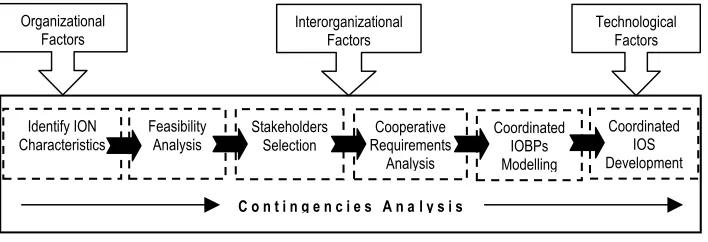
This work expounds a basic methodology to overcome this trouble. Figure 1 shows the stages included in this methodology. Their adequate execution embraces various critical elements in the interorganizational context: the adequate ION conformation, the coordinated IOBPs modelling and the development of IOS that support interaction between different involved units. This sequence of stages will allow generating detailed specifications in relation to the characteristics that define and describe an ION, its BPs and the associated IOS that support them.
Coordinated IOS Development Coordinated
IOBPs Modelling Cooperative
Requirements Analysis Stakeholders
Selection Identify ION
Characteristics
Feasibility Analysis
C o n t i n g e n c i e s A n al y s i s
Technological Factors Interorganizational
Factors Organizational
[image:2.595.125.479.599.720.2]Factors
Figure 1. Stages for IOS Development in Interorganizational Contexts.
From the Identification of ION characteristics, the network will be constituted with its own characteristics. This will make it easier to manage relationships among the firms, minimize latent risks in its formation and, in the cases in which an IOS is necessary, achieve its successful development and implementation. At this stage, a precise analysis should be carried out for each factor that influence it. It will be also needed for each one an analysis of all possible alternatives with their advantages and disadvantages for the concrete case being studied. The result will be a set of parameters that characterize networks and will constitute input information for the following stages.
The Feasibility Analysis has the objective of thoroughly evaluate the environment in which IOS will
operate, as well as the accurate justification of its implementation and necessary investments. A key problem is the existence of different frontiers: on the one hand, each organization´s own frontiers and on the other hand, those belonging to the ION, each of these dimensions incorporating their own demands and risks into the feasibility of implementing an IOS.
Stakeholders Selection is a critical stage. Subsequent stages related to requirements capturing, process
modelling, and the development of supporting systems will depend on it. There is now a new dimension, the interorganizational, from which there should be also stakeholders. Human relationships management has vital importance at this stage, since cooperation and competition attitudes among the involved people will generally intermingle in the same context.
Cooperative Requirements Analysis involves direct firms participation (through their stakeholders) at
the needs-posing stage, taking into account the frequent lack of technical knowledge, and therefore, providing effective tools to achieve a complete analysis, consistent with particular and general needs. Thus, stakeholders are directly involved in capturing needs and process requirements for the IOS.
Coordinated IOBPs Modelling involves modelling and design of processes executed among several
organizations in the network. Its main goal should be to optimize both time and costs. It should take into account the dynamism of the environment in which they will be executed, as well as the different factors influencing IOBPs execution.
Coordinated IOS Development should solve cooperation problems and support interactions that are
particular to an ION, coordinating the processes execution and also collaborating with the coordination of relationships among firms. Flows types and direction inside the ION are critical. They are associated with the type of resources the IOS will manage.
Contingencies Analysis takes place along all stages of the project. Risks occurrence must be analyzed
along the whole length rather than associating it to one stage in particular, bearing always in mind the main goal of collaboration which should constitute its treatment basis. In order to succeed in managing risks it is necessary to identify, categorize and monitor them. This will allow generating a precaution against potential contingencies, which can be technical (related to the particular system in particular and to the decisions on the technologies to be used) organizational (e.g., process integration and coordination) and those related to the environment (such as trust and coordination in the network).
3. Organizational, Interorganizational and Technological Factors to Identify an ION
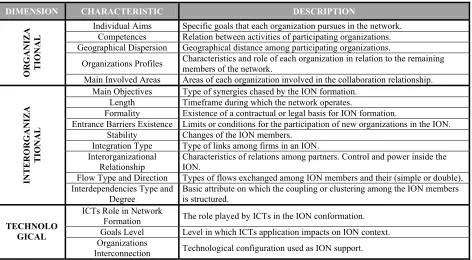
The stages presented in Figure 1 are executed under the influence of different organizational, interorganizational and technological factors that, besides allowing the characterization of an ION, affect each stage in different ways and with different degrees of importance.Identifying an ION and developing the subsequent stages, when they are executed according to different options that can take the characteristics described later on, has direct importance in both organizational and interorganizational matters. These criteria can be combined in different ways to generate a wide variety of IONs [06,13,18].
They should be evaluated at the ION definition stage, so as to be able then to analyze which degree of influence they have on each of the subsequent stages. The analysis of these factors at each stage has implicit importance since the business models posed by these structures are based on connectivity among IONs firms and on IOBPs that materialize this connectivity by being jointly executed by several firms [02]. As a result, a precise characterization of an IONis necessary so as to identify its determinant factors and thus focus on them for successful BPs modelling and IOS implementation, where stakeholders play a fundamental role.
DIMENSION CHARACTERISTIC DESCRIPTION
Individual Aims Specific goals that each organization pursues in the network. Competences Relation between activities of participating organizations. Geographical Dispersion Geographical distance among participating organizations.
Organizations Profiles Characteristics and role of each organization in relation to the remaining members of the network.
ORGANIZA TIONAL
Main Involved Areas Areas of each organization involved in the collaboration relationship. Main Objectives Type of synergies chased by the ION formation.
Length Timeframe during which the network operates.
Formality Existence of a contractual or legal basis for ION formation.
Entrance Barriers Existence Limits or conditions for the participation of new organizations in the ION. Stability Changes of the ION members.
Integration Type Type of links among firms in an ION. Interorganizational
Relationship
Characteristics of relations among partners. Control and power inside the ION.
Flow Type and Direction Types of flows exchanged among ION members and their (simple or double).
INTERORGANIZA
TIONAL
Interdependencies Type and Degree
Basic attribute on which the coupling or clustering among the ION members is structured.
ICTs Role in Network
Formation The role played by ICTs in the ION conformation. Goals Level Level in which ICTs application impacts on ION context.
TECHNOLO GICAL
Organizations
[image:4.595.64.536.105.365.2]Interconnection Technological configuration used as ION support.
Table 1. Factors to Identify an ION.
3.1 Organizational Characteristics: They refer to particular characteristics of the organizations participating
in the ION.
Individual Aims: According to the specific goals pursued by each organization, an ION can be
symmetrical if every organization is non-profit or if they are all profit organizations, or asymmetrical
when there are both profit and non-profit organizations in the network (e.g., chambers of commerce that comprise economic and political institutions) [04].
Newell and Swan [19] describe a case of ION among universities (symmetrical ION, non-profit organizations).
Symmetrical networks can be found in collaboration agreements among private companies and universities, usually to approach the resolution of technical problems.
Competences: individual competences are analyzed, which can be similar or complementary (also called
competences integration) [18].
Collaboration in one functional domain, e.g. distribution, constitutes an ION made up of organizations with similar competences [06].
An example of ION with complementary competences is the collaborative supply chain in the Japanese system for supplying cars, where each organization performs a specific task in the network that complements those performed by the others to attain the proposed objectives [05,13].
Geographical Dispersion: Geographical distance among network participants can be global, regional or
local [06]. In a global range area, organizations are geographically dispersed, while if the area is regional,
they are located in a certain region of the planet. In local IONs, organizations are located in a delimited geographical area, with a short distance among one another.
Munkvold [10] analyzes this characteristic as a determinant for communication and joint decision-making costs, which also enhances the complexity of some tasks and processes inside the ION.
Organizations Profiles: This factor refers to each organization characteristics and role in relation to the
remaining network members. Organizations that compose an ION can have different profiles in the value network: customers or consumers, competitors, related organizations, suppliers or distributors [07].
can refer to similar ones. That is the case of IONs of universities, researchers or professionals that, in spite of having similar competences, they are not studied as competing organizations but as similar ones.
Main Involved Areas: This factor analyzes the areas of each organization among which main network
interactions and processes are performed. They can be: operative, supportingstaff or strategiclevel [05].
From the main involved areas of each organization in the ION, the main actors and stakeholders will come out, who will have to be taken into account when forming the ION, implementing the technology, etc. The higher the organizational level of the involved actor, the greater the amount of information it will have and the influence he will have in the definition of objectives and decision making around the ION [20].
3.2 Interorganizational Characteristics: They refer to factors related to relationships and processes that take
place among the organizations that constitute the particular ION.
Main Objectives: It depends on whether the ION has been conceived with the aim of obtaining functional
synergies (attainment of objectives through operative integration) or strategic (they have influence on the ways of creating value, positioning in the market, etc.) [05]. There can be also knowledge synergies (because of the experiences, skills and knowledge exchange) [04]. An example of network with strategic synergies is Star Alliance, an alliance formed by Lufthansa, United Airlines and other 12 partners, with the objective of attaining synergies by means of a flights program that covers an important number of routes
[08]. This places the network at a higher level than that of its competitors.
Collaborative supply chains are a clear example of operational synergies. ChainStore is a case in the textile industry, which involves raw materials factories, a textile manufacturing company and the main British retail organization [09].
The relationships that make up IONs are an effective and implicit means of knowledge transference among firms [04]. Since knowledge is a tacit resource and lacks economic value, the pursuit of synergies of this type is implicit in several IONs. This becomes explicit in the interuniversity ION described by Newell and Swan [19].
Length:Depending on the length of a relationship, there are long term or short term IONs. Long term
networks are strategic and they generally have closed links among participants.
As examples of long term IONs, we can mention technological strategic alliances formed by IBM & Microsoft and by Honda & Rover [21]. In both two companies are joined to attain a set of previously agreed technological goals, but each of them keeps its autonomy.
As short term IONs, temporary agreements among firms to deal with ad-hoc situations can be mentioned.
Formality: IONs can be formal if they have a contractual or legal basis, or informal when there are no
agreements based on formal contracts among common interests of the involved parts [13]. Due to the difficulties of this type of structures, it is usually intended to generate a legal basis that supports the relationship. However, there are agreements among companies that are developed without this kind of support: e.g., regional industrial systems are usually supported by informal agreements among a set of companies that have developed ties of trust by sharing resources and working in the same industry and region. This relationship only involves the strategic summit of those organizations, thus the coordination of their operations is very poor and it does not require elements to formalize the relationship [05].
Entrance Barriers Existence: The network is open when there are no conditions for a new firm to enter
or closed when it has stable barriers [06]. In open IONs, any interested firm whose objectives are consistent
with the network ones can be incorporated. Completely closed IONs have well defined limits and try to take specific positions in the market. New participants are incorporated only in critical situations, e.g., when a member leaves the network and it is necessary to replace it. There are also networks with hybrid rules for the admission of new partners, which means that they are practically open networks, but they have certain admission barriers related to technical standards or to the incorporation, e.g., of specific processes.
Stability: An ION can be stable or dynamic[06]. Participating partners can be the same for long periods
In a dynamic network, there are several partners for each specific task, therefore, it is necessary to make a selection at the beginning of each activity. It is a more appropriate alternative for those cases in which the product characteristics or demanded quantities change frequently.
Integration Type: The integration among firms can be vertical: cooperation along the value chain,
involving different roles of participating firms (partners with distinct key competences that complement specific capacities), e.g., supply chains, or horizontal: collaboration takes place in the same functional domain, and it is generally related to firms interconnection at a stage of the value chain, e.g., researchers networks [08,13].
Nike Inc. vertically broke up the sport shoes production chain, forming a network with Asiatic contractors, so as to be just in charge of product design and marketing [08]. Firms integration in this network is vertical.
Interorganizational Relationship: According to the type of relationship that relates firms in an ION, the
networks can be hierarchical or non-hierarchical (also “focal” or “multi-focal”) [06,13]. The relationship is hierarchical when there is one dominant partner or when independent firms function around a strategic firm. On the other hand, it is non-hierarchical when members in the same business cycle cooperate and share resources (partners have similar influences) or when different organizations have key roles at different moments.
Coxa ION is an example of supply chain with hierarchical relationships [12]. It was established when Tetra Pak requested its suppliers to start cooperating in IONs so that they could receive more complete products, instead of having many suppliers delivering different parts.
Non-hierarchical IONs are typically formed by SMEs that create corporations such as industrial distrits, scientific parks and chains of companies that are interrelated in the same business cycle.
Flow Type and Direction: Here we analyze the type of flow or exchange that takes place inside the ION
(material, information, experience/skills, knowledge, technology, finance) and direction (simple,
double), which is necessary to determine the creation of a specific infrastructure or the definition of
exchange protocols [18,22].
Researchers networks have double-direction knowledge flow, whereas collaborative cupply chains are networks with simple-direction material flow and double direction information flow [13].
Interdependencies Type and Degree: The analysis of interdependencies among organizations is proposed
according to their type [05]:
Function Interdependency describes interdependency in performing similar activities among ION
members (e.g., distribution).
Process Interdependency describes interactions among different operative units so as to perform
complementary tasks.
Scale Interdependency is related to the need of involving various firms to achieve efficient
dimensions.
Social Relationships Interdependency is related to human relationships inside the network. This
interdependency is fundamental in all IONs, since social relationships constitute one of the main supports of network structures in general.
3.3 Technological Characteristics: These characteristics tend to describe technology as a relevant factor that
support IOBPs. They are mostly related to the described Interorganizational Characteristics since the ICTs functionality will depend mostly on the kind of the existing relationship, exchanges, interdependencies, coordination and so forth [16].
ICTs Role in Network Formation: It will identify the role played by ICTs during the ION formation. It
may be a supporting role, when it is used for materializing interactions and executing IOBPs; an enabling
role, when technology is the ground for the network formation or leads to the ION emergence; or a role of
no major influence [16]. This last option is incorporated since it automatically conditions the rest of the
Although some authors study ICTs as enablers of ION formation, the presented characterization is important since in the previously mentioned regional industrial systems, for example, ICTs do not play any specific role either in the network formation or operation [14,23].
Objectives Level: The objectives level that support ICTs are analyzed. The objectives support the
strategic level when they are at that level and the implemented technology has potencial for transforming
businesses (creating new products, new services, attracting new customers, exploiting scale economies, etc.). ICTs that support the operative level are generally focused on automation processes and their main objective is to enhance efficiency and operational coordination, reduce time consumption and costs and support routine operations. At this level, organizations are connected to share information as part of their daily business or to support a supply or value chain.
Organizations Interconnection:The technology to be used may require various configurations. A one to
one configuration represents the technology typically used in a buyer-seller system, where relationships exist between two organizations. A one to many configuration generally takes place in IONs where there is a dominant partner (hierarchical). There is a many to many interconnection where there exists horizontal integration and in IONs that are made up of several firms with similar competences.
All this constitutes a summarized set of factors that have been described in a simplified way in this work. Each of them deserves a more detailed study to determine the existing alternatives and relationships among them.
With these factors, the characteristics that are particular to an ION and that will influence the different steps previous to the IOS implementation can be determined. Each step of the methodology presented in
Figure 1 strongly depends on all these factors. In the following section, we work in detail on “Stakeholders
Selection” stage.
4. Stakeholders Selection for Coordinated Development of IOS
Various ION characteristics and processes executed in its context have a strong influence on the stages presented in Figure 1. One of them, crucial for many reasons, is stakeholders selection. The frequent cooperation and simultaneous competition among partners and members in the ION provide further complexity. The network development usually fails due to conflicts inherents to the divergence of objectives, the existence of opportunism between partners, cultural or interests differences and other matters that should be analyzed at this stage [24,25].
The correct selection of stakeholders and execution of the remaining stages is fundamental, mainly because IOSs are the systems that allow the development of links and offer common platforms to share information through systems and organizations [26]. Moreover, many problems arising from these structures result from mistakes in designing IOBPs, which are generally difficult to trace and expensive to be repaired at more advanced stages.
“Stakeholders” are individuals that must be involved in a project, since they are affected by its activities or results. They have an active participation in the elicitation, analysis, documentation and validation of requirements for the development and/or implementation of an information system [27]. Traditionally, projects have been supported by the knowledge of a group of developers or project team, leaving aside extremely useful people when analyzing the requirements of an information system. But this vision must be expanded to reach people that have some kind of knowledge that could be beneficial for the project success, mainly, in interorganizational environments [28].
In an interorganizational context, stakeholders are firstly necessary to design and model IOBPs and, secondly, analyze, design and/or implement IOSs, involving each organization of the network [10]. Their selection is critical, since they will be responsible for the precise needs and objectives definition of each organization and the whole network, so that the process and IOS implementation can then be successfully managed.
the initial specifications of stakeholders and the needs of future users. This must be achieved by integrating the different points of views of stakeholders. For that everyone must cooperate to understand the scope and the changes that will impact both, organizational and interorganizational levels [15].
The most important part of any stakeholder research and selection is planning. Before committing time and resources to requirements capture, it is useful to plan certain aspects such as: how many stakeholders are to be involved; how many different organizations will participate; if there are any final users involved; what type of stakeholders are to be involved; the mixture of ION internal and external stakeholders; who is to be involved from the design team. This stage is critical in interorganizational environments, where it is neccesary to analyze different kinds of firms.
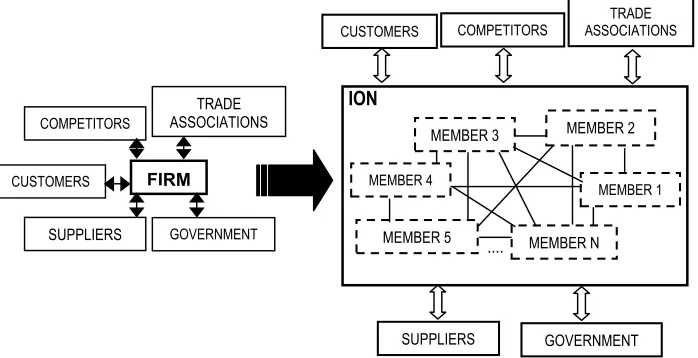
In these environments a new level is incorporated. Not only is required to think in terms of firms, but also in terms of a set of firms, whose limits are diffuse inside the ION. This can be seen in Figure 2, which shows that the ION can be formed by customers, competitors, governmental organizations, partners, etc. as members. However, at an ION level, there are also competitors, customers, suppliers, etc. This makes the analysis difficult, since benefits at an interorganizational level not necessarily are so for individual organizations. Usually, there are people that are responsible for each level of an organization, but it is hard to find them at an interorganizational level. That is why it is important to have clearly settled the scopes of interorganizational relationships for the successful stages execution presented in Figure 1.
Stakeholders needs, as well as the existing systems, organizational standards, regulations, etc., are the key inputs to the requirements engineering process in these contexts [27]. So, correctness in their elicitation and representation is directly related to correctness in stakeholders selection. The encouragement and exploitation of cooperation among them constitutes the best way of taking advantage of individual knowledge and competences to achieve efficient work. This proves and materializes stakeholders right selection.
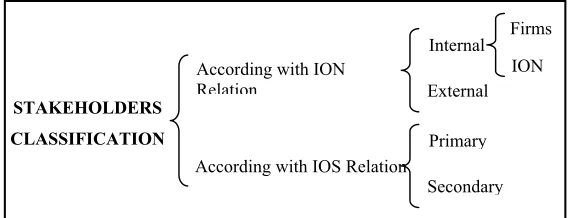
There is in general a lack of understanding of types of stakeholders and ideal candidates. There is also a lack of clear processes to identify them in an efficient way [15]. This can be firstly simplified by analyzing the objectives each stakeholder pursues with the project. Thus, there exists a distinction between internal
[image:8.595.119.468.506.685.2]stakeholders and external stakeholders, according to whether they are already involved in the organizations (manager, employee, etc.) or their point of view is necessary for this particular project (customer, auditor, etc.). In an interorganizational context, internal stakeholders must be subdivided into two groups (Figure 3): on the one hand, internal stakeholders of each firm (those that represent some particular organization) and on the other hand, network internal stakeholders (those that pursue interorganizational objectives). For that reason, the amount of internal stakeholders will be generally proportional to the number of organizations that constitute the ION.
Figure 2. Differences Between Traditional and Interorganizational Contexts. GOVERNMENT SUPPLIERS
CUSTOMERS COMPETITORS
TRADE ASSOCIATIONS
....
MEMBER 1
MEMBER N MEMBER 5
MEMBER 3 MEMBER 2
MEMBER 4
ION
GOVERNMENT SUPPLIERS
COMPETITORS
TRADE ASSOCIATIONS
CUSTOMERS FIRM
STAKEHOLDERS CLASSIFICATION
According with ION Relation
According with IOS Relation
Secondary Primary
ION Firms
[image:9.595.139.423.108.217.2]External Internal
Figure 3. Stakeholders Classification.
A clear case of an external stakeholder for an ION is government, which generally imposes rules on the way of doing things. Good examples are the integrated supply chains in the pharmaceutical industry. There, even though government is neither directly involved nor does it participate in processes or systems use, it intervenes by means of regulations, imposing and controlling some costs associated to the activity [29].
Munkvold [10] analyzes two examples in which external stakeholders interests influenced the selection of collaborative technology. When implementing a communication integrated system in an ION formed by four contractors in the Noruegan construction industry, the business sponsor selected ISDN as the base technology to be used. In the other case, which describes the implementation of a Lotus Notes documents management system in an ION of six telecommunication companies, the most important customer influenced the decision of adopting Lotus Notes as the communication technology.
On the other hand, the general group of stakeholders with regard to the IOS can be subdivided into
primary and secondary (Figure 3). With a traditional vision, primary stakeholders are defined as the system
users and secondary stakeholders would be customers, suppliers and staff of the organization that do not use the system directly [28].
In the interorganizational analysis, we can continue considering future users as primary stakeholders. Khalifa et al. [28] analyze the participation of final users as a key factor in system design and development. Meanwhile, Munkvold [10] considers their selection to act as pilot groups, as a strategic step for succeeding in the technology implementation. Nevertheless, the definition that undoubtedly will change is that of secondary
stakeholders, which are the ones that use the benefits achieved by the technology incorporation, but they do not interact with it directly, as in the case of, e.g., customers, suppliers, partners, etc. In this case, a rigurous analysis should be made on the ION structure so as to determine the characteristics and profile of each participating organization and to be able to define which entities generally considered as secondary stakeholders will be now primary for the interorganizational environment. In other words, it should be determined which stakeholders that have been always analyzed as secondary will now have active participation in the ION and will also be “users” of the technological platform to be implemented.
According to Chatterjee [11], for any relationship among firms to be successful, none of the stakeholders should be worse-off as a consequence of technology implementation. One way of avoiding this is to attain a correct selection of stakeholders. For that purpose, it is necessary to analyze different characteristics of the environment when performing their selection.
5. Influence of ION Characteristics on Stakeholders Selection
In interorganizational environments, the appropriate modelling and design of processes and technological platforms have to meet the concrete needs of a specific ION and have to be configured and designed according to its particular structure and to the needs of all participants [09].
The particular ION structure is characterized by the previously analyzed factors. In the same manner they influence the network definition, they also affect with different degrees the subsequent stages that are oriented to process modelling and IOS implementation (Figure 1). For example, Boutilier and Svendsen [30] conclude that firms facing hostile stakeholders should focus, first, on structural factors to end conflicts. Therefore, it is necessary to execute the stages analyzing these factors. It is an important step to achieve success in modelling and designing the BPs executed by several organizations.
Table 2 summarizes the results obtained from the influence analysis of each characteristic that describes
each stage. This is a generic evaluation that can be modified in specific cases. Three degrees have been posed:
high influence, when exists a significant effect of the factor on the stakeholders selection; low influence, when there is some influence but it is not significant; and finally ¨no influence¨ when the factor does not condition this stage.
DIMENSION CHARACTERISTIC INFLUENCE ON
STAKEHOLDER SELECTION
Individual Aims NO
Competences HIGH Geographical Dispersion LOW
Organizations Profiles HIGH
ORGANIZATIONAL
Main Involved Areas HIGH
Main Objectives LOW
Length NO Formality NO Entrance Barriers Existence HIGH
Stability HIGH
Integration Type HIGH
Interorganizational Relationship HIGH Flow Type and Direction NO
INTERORGANIZATIONAL
Interdependencies Type and Degree HIGH ICTs Role in Network Formation HIGH
Objectives Level HIGH
TECHNOLOGICAL
[image:10.595.94.499.152.392.2]Organizations Interconnection HIGH References: NO = No Influence, LOW = Low Influence, HIGH = High Influence
Table 2. Influence ION Characteristics Have on Stakeholders Selection.
When analyzing the influence of these factors on the stakeholder selection, the ICTs role in the network
formation is critical. ICTs must have a supporting or enabling role, being responsible for network
coordination.
The ICTs roles will differ in the difficulties for implementing them and the significance of stakeholders role. In general, when having ICTs with supporting role, the existing BPs and technologies are combined to reach the objectives of IOBPs and IOS. In the other case, when the role is enabling, new technology should be implemented and new IOBPs should be defined. Therefore, stakeholders role is more critical. Then, the number of stakeholders should be higher than when ICTs have a support role, because new IOBPs should be designed. These people will have to become familiar to the technology and the requirements and needs for its successful implementation in the ION.
In an interorganizational context the group of selected stakeholders will mostly depend on the involved
areas: the group of stakeholders that were selected due to their direct relation to the IOS to be developed
(primary stakeholders) will not be the same if the system will support decision-making processes at a management level or if it will automate information exchanges at an operative level. This will also depend on
the objectives level that should be managed through the IOS implementation, determining the necessary
functional level of the people to be involved according to whether it will be implemented at an operative, knowledge, management, or strategic level.
joint work of competing organizations, suppliers, customers, etc. From here, the division of stakeholders into internal and external to the ION will be also derived, since the type of participating organizations will be defined, selecting from them internal stakeholders. Also could be derived the organizations that, as a result of network formation, will keep relations with the ION rather than with a particular firm, selecting from them external stakeholders.
At this stage, the existence of entrance barriers and stability of the network should be also studied because if it is open (there are no entering conditions) or dynamic (partners change over time) it will be necessary to settle a stakeholder pattern with certain characteristics to be used when any other organization wants to participate and the capture and evaluation of its needs must be done from a moment to another. Nevertheless, the interorganizational relationship plays a fundamental role in the management and coordination of relationships among stakeholders, according to whether it is a hierarchical relationship (in which these tasks will be in the hands of the leading organization) or not (in which the mutual adjustment will be one of the most used mechanisms).
The organizations interconnection is important when planning the number of stakeholders of each
organization (depending on the number of relationships it has with the other firms), and when organizing communications and meetings among them. This is quite different from what happens with the ION main
objectives and the geographical dispersion of its members, which despite not significantly affecting the
selection, they should be taken into consideration when providing tools and environments to enable communication, since a global distribution of organizations imposes high stakeholders communication costs (telephone, fax, travel meetings, etc.) [10].
Individual organizations´ goals should not be overlooked by stakeholders that represent them. However,
when making the selection, they have no influences to be analyzed. The same happens with the length of relationships, which is a factor that even though it has no major influence at this specific stage, is a key factor that had to be studied at the previous stage, where the IOS development and implementation feasibility is analyzed. In general terms, if the length is short the implementation will be probably unjustified. Therefore, if the stakeholders selection stage is reached, it means that they are necessary for some technological implementation, independent of the network length. Formality is also a factor that should have been evaluated and studied before reaching this stage to determine the feasibility of the execution of subsequent stages. For that reason, it has no outstanding influences at this stage.
Neither flow type nor flow direction that take place in the IONhave significant influences at this stage, since they constitute network particular characteristics that should be analyzed when developing the IOS. They are related to the type of data the system must support. They will also determine the kind of resources the IOS will work with (information, material, etc.), but they do not influence the stakeholders selection specifically.
This analysis expresses the importance of identifying a particular ION by means of factors and the influence each of them generates at the stakeholders selection stage. With this, the relevance of the environment characteristics is proved, not only in the ION and its structure formation but also in the following activities, which should not leave aside the characteristics that identify it univocally.
6. Conclusions
Taking into account that an ION can present quite different forms, this work has emphasized the analysis of the factors that allow characterizing and defining it in a complete way. This approach beats many of previous works that study particular types of networks generalizing networks characteristics and that can soon become incomplete or useless due to the dynamism in this environments.
On the other hand, the implementation of IOSs to support and coordinate BPs that are executed in these structures are very risky tasks, proved by the great number of unsuccessful implementations generally due to “non-technical” matters inherent to the ION rather than to the IOS. As a result, a methodology is proposed which is constituted by different sequential stages that, at least, minimize the occurrence of some of these contingencies.
The influence each factor have in the diverse stages, analyzing degrees and alternatives was studied, emphasizing the Stakeholders Selection stage. It was also proved that the way a factor affects a particular stage usually depends on the analysis of that or other factors at previous stages. This generates a sequential chain not only of stages but also of factors influences at each stage.
This analysis can be performed with the remaining stages such as coordinated modelling of IOBPs, cooperative requirements analysis, etc., to study the type and degree of influence different characteristics have at every stage. This will constitute the research basis for future works.
References
[01]P.Buxmann, J. Gebauer – “Evaluating the Use of Information Technology in Inter-Organizational Relationships” – Proceedings 32nd Hawaii International Conference on System Sciences. 1999.
[02] W.W.C Chung, A.Y.K Yam, M.F.S Chan – “Networked Enterprise: A New Business Model for Global Sourcing” – Internationl Journal on Production Economics No. 87, pp. 267-280. 2004.
[03] R.H. Hayes – “Challenges posed to Operations Management by the “New Economy”” - Proceedings First World Conference on Production and Operations Management POM. 2000.
[04] B.R. Barringer, J.S. Harrison – “Walking a Tightrope: Creating ValueThrough Interorganizational Relationships” - Journal of Management, Vol. 26, No. 3, pp. 367–403. 2000.
[05] G. Nassimbeni – “Network Structures and Co-ordination Mechanisms. A Taxonomy” - International Journal of Operations & Production Management, No. 18, pp. 538-554. 1998.
[06] K. Riemer, S. Klein, D. Selz - “Classification of Dynamic Organizational Forms and Coordination Roles” - Proceedings of the e2001 Conference on E-work and E-business, IOS Press, pp. 825-831. 2001.
[07] A.J. Champy – “Reengineering Redux” – Technology Review. 2003.
[08] I.B. Hong – “A New Framework for Interorganizational Systems Based on the Linkage of Participants’ Roles” – Journal of Information & Management No. 39, pp.261-270. 2002.
[09] C.P. Holland – “Cooperative supply chain management: the impact of interorganizational information systems” – Journal of Strategic Information Systems, No. 4, pp. 117-133. 1995.
[10] B. E. Munkvold - “Adoption and Diffusion of Collaborative Technology in Interorganizational Networks” – Proceedings 31st Annual Hawaii International Conference on System Sciences - Volume 1, p. 424. 1998.
[11] D. Chatterjee, T. Ravichandran – “Inter-organizational Information Systems Research: A Critical Review and an Integrative Framework” - Proceedings 37th Hawaii International Conference on System Sciences. 2004.
[12] S. Gullander – “Developing and Maintaining Networks on the Firm Level – A 3-Dimensional Network Model” – Contribution for the SNEE 2000 Conference on Economic Integration in Europe: New Directions in Swedish Research. 2000.
[13] P. Knorringa, J. Meyer-Stamer – “New Dimensions in Local Enterprise Co-operation and Development: From Clusters to Industrial Districts” – Contribution to ATAS Bulletin XI, “New approaches to science and technology co-operation and capacity building”, 1998. [14] O. Volkoff, Y. Chan, P. Newson – “Leading the Development and Implementation of Collaborative Interorganizational Systems” –
Journal of Information & Management, No. 35, pp. 63-75. 1999.
[15] J. Coughlan, M. Lycett and R.D. Macredie – “Communication Issues in Requirements Elicitation: A Content Analysis of Stakeholder Experiences” – Journal of Information and Software Technology No. 45, pp. 525-537. 2003.
[16] M. Gogolin – “Success and Failure of Collaboration Platforms” – 10th Research Symposium on Emerging Electronic Markets. 2003. [17] N.F. Doherty, M. King, O. Al-Mushayt – “The Impact of Inadequacies in the Treatment of Organizational Issues on Information Systems Development Projects” – Journal of Information and Management No. 41, pp. 49-62. 2003.
[18] J. Britto – “Technological Diversity and Industrial Networks: An Analysis of the Modus Operandi of Co-operative Arrangements” – Science Policy Research Unit, University of Sussex – Electronic Working Papers Series – Paper No. 4. 1999.
[19] S. Newell, J. Swan – “Trust and Inter-organizational Networking” – Human Relations –Volume 53(10), pp. 287-328. 2000. [20] J. Child, R. Gunter McGrath – “Organizations Unfettered: Organizational Form in an Information-Intensive Economy” – Academy of Management Journal,Vol. 44, No. 6, pp. 1135-1148. 2001.
[21] A. Hidalgo Nuchera, G.L. Serrano, J. Pavón Morote – “La Gestión de la Innovación y la Tecnología en las Organizaciones” –
Ediciones Pirámide, Grupo Anaya, S.A.. ISBN: 84-368-1702-8. 2002.
[22] S. Khalid – “Innovation through Networks: Technology and Cooperative Relationships” – 18th Annual IMP Conference.2002. [23] T. Knudsen, B. Eriksen – “The Architecture of New Organizational Forms” – Research part of the project 01 within the LINK research program, sponsored by The Danish Social Science Research Council. 2002.
[24] R.D. Ireland, M.A Hitt, D. Vaidyanath – “Alliance Management as a Source of Competitive Advantage” - Journal of Management
Vol. 28, No. 3, pp. 413-446. 2002.
[25] R. Toppen, M. Smits, P. Ribbers – “Effects of Two New Inter-organisational Systems to settle Cross Border Euro Payments between Financial Institutions in Europe” - Proceedings 33rd Hawaii International Conference on System Sciences – 2000.
[26] R. Alvarez – “Confessions of an Information Worker: A Critical Analysis of Information Requirements Discourse” – Journal of Information and Organization No. 12, pp. 85-107. 2002.
[27] G. Kotonya, I. Sommerville – “Requirements Engineering: Processes and Techniques” – John Wiley & Sons Eds. – July, 2003. [28] G. Khalifa, Z. Irani, L.P Baldwin, S. Jones – “Evaluating Information Technology With You in Mind” – EJISE, Electronic Journal of Information Systems Evaluation – Vol. 4, Issue 1, Paper 5. 2001.
[29] N. Shah – “Pharmaceutical Supply Chains: Key Issues and Strategies for Optimisation” – Journal of Computers and Chemical Engineering, No. 28, pp.929-941. 2004.
[30] R.G. Boutilier, A.C. Svendsen – “From Conflict to Collaboration: Stakeholder Bridging and Bonding in Clayoquot Sound” – 60th