Object Oriented Modeling of Resource Assignment
Problems formulated as CSPs
Luis G. Rueda, Ivanna Arias, Francisco S. Ibáñez and Raymundo Q. Forradellas Computer Science Department, Computer Science Institute
National University of San Juan,
Cereceto y Meglioli (5400), San Juan, Argentina e-mail: {lrueda, iarias, fibanez, kike}@iinfo.unsj.edu.ar
Abstract
Proceedings CACIC ‘97 Ingeniería de Software. Bases de Datos UNLP
Departamento de Informática - Facultad de Ciencias Exactas
2
1 Introduction
Real world applications, mainly in the resolution of discrete combinatorial problems, can be solved by using Constraint Programming (CP) [Van Hentenryck,89] [Leler,90] [Ibáñez,94] [Ibáñez,95] [Forradellas,95] [Rueda,95] [Rueda,96] [Rueda,97]. In this paper we propose an object oriented model in order to deal with combinatorial problems of resource assignment which are solved by using CP and object oriented programming [Puget,94] [Ilog,95].
A Constraint Satisfaction Problem (CSP) is formed by the following components: a set of variables, a set of domains associated to the variables, and a set of constraints relating the variables. A solution for a combinatiorial problem consists of the assignment of values (belonging to the associated domains) to the variables in such a way that all constraints must satisfy.
Examples of problems which fit in this model are:
• the distribution of the cashiers on the cash posts in a supermarket which works in
different turns;
• teachers lecturing in the rooms of a school in certain days and schedules;
• the drivers of a transportation enterprise which has to be assigned to any of the
buses in different schedules;
• a factory with machines requiring work with some resources at different times and
conditions.
In general, we have entities that have to be assigned to places. In [Rueda,97] a particular case (the first mentioned above) with its correspondent implementation has been developed by using ILOG Solver [Ilog,95]. In this paper we propose a more general model to deal with combinatorial problems of resource assignment.
2 The Theoretical Model
2.1 CSP (Constraint Satisfaction Problem)
A CSP [Mackworth,86] is composed by: 1. a set of variables, V1,..., V
2. a set of domains D
n
1,..., Dn
3. a set of constraints relating the variables.
associated to the variables, and
A solution is a set of values a1,...,an, where ai ∈ Di and the substitution ai/Vi
Starting from a general CSP, we define a new model which deal with combinatorial problems of resource assignment.
2.1 The CSP-Space
Definition 1: A Resource Assignment CSP, called CSP-Space, consists of: 1. a set of variables, Vi1,..., Vi
where 1 ≤ i
k
1≤ l1
.... ,
1 ≤ ik ≤ lk
2. a unique domain D associated to the variables, and .
3. a set of linear
A solution is a set of values a
constraints relating the variables.
i1,...aik where ai1,...aik∈ D, and the substitution ai1/Vi1,...,
aik/Vik verifies all the constraints (1 ≤ i1 ≤ l1, ..., 1 ≤ ik≤ lk
In the ordinary CSP, the variables can be seen as points in a segment, while in the CSP-Space the variables can be seen as points (or vectors) of an n-dimensional space
denoted as S.
).
Definition 2: A group, symbolized as G, is defined as a set of variables Vi1,..., Vik
each i
, where:
j (1 ≤ j ≤ k), vary on aj ≤ ij ≤ bj with 1 ≤ aj and bj ≤ lj. The pair < aj,bj>
represent the range of the jth index of the variable Vi1,..., Vik
Then, from the Definition 2 a constraint will be associated to one or several groups, depending on the constraint sorting as shown later. In the real world the variables would represent places to be taken. D represents the set of all possible candidates to occupy these places. From now on all elements of D will be referred as candidates.
.
2.2 Constraint Sorting
Given a group of vectors G, we will define constraints of different types . We will say that a constraint involving vectors and candidates has weight 0 if the candidates “must not” be assigned to the vectors, and weight 1 if the candidates “must” be assigned to the vectors. The weight is symbolized as W.
The following are the different types of constraints sorted from several combinatorial discrete problems of resource assignment:
Type 1: Many candidates may occupy a group of vectors with weight 0.
Type 2: Any candidate, which may occupy any vector of a group with weight 0 or 1, may occupy another vector of the same group with weight 0 or 1.
Proceedings CACIC ‘97 Ingeniería de Software. Bases de Datos UNLP
Departamento de Informática - Facultad de Ciencias Exactas
4
Type 4: A candidate any occupy a vector of a group with weight 1.Type 5: A candidate, which may occupy a vector of a group with weight 0 or 1, may occupy any vector of another group with weight 0 or 1.
The constraints listed previously are general for several problems of resource assignment. However, other constraints may exist which can be sorted and included in any of the types defined previously or a new type can be obtained and included in the model.
3 The Object Oriented Model
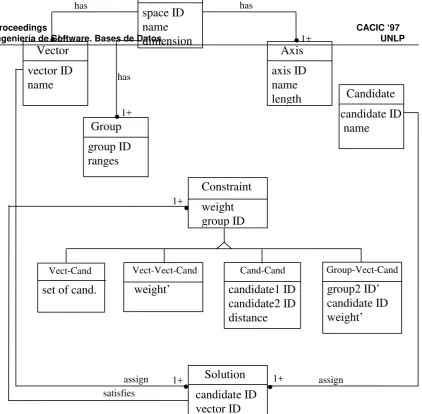
Starting from both the theoretical model of the CSP-Space and the constraint sorting defined previously, we build an object oriented model for the whole system. The components of the former and the constraint types of the latter are represented as classes, as shown in Figure 1, and the model is built based on the OMT [Rumbaugh,91]. This model describes the structure of the objects in the whole system: their identity, their relationships to other objects, and their attributes.
The operational model is not included in this work. We have to emphasize that the system has to be built around objects rather than functionality, because an object oriented model more closely corresponds to the real world and is consequently more resilient with respect to change.
It can be noted that the space, vectors, candidates, axis, and groups are represented as real world classes according to the concepts of the theoretical model. Each type of constraint is also a sub-class of a generic class Constraint. The types 1 and 4 are unified in an only type in order to because they share the same data.
4 Application to Real Problems
4.1. The Classroom Problem
4.1.1. The CSP-Space
Let us consider a School with t teachers. Each teacher is to be assigned to one of the r rooms in s different schedules and d different days. Besides a set of constraints limits
Proceedings CACIC ‘97 Ingeniería de Software. Bases de Datos UNLP
In order to model the problem as a CSP-Space, it is important to identify first the axis. The quantity of the axis determines the dimension of the CSP-Space.
As a general procedure, we propose here identify the most important entities of the problem. In this example, the most important entities are: school, teachers, rooms, schedules, and days. School corresponds to the Space, teachers are the Candidates,
and the remaining entities: rooms, schedules, and days will correspond to each of the axis of the CSP-Space.
Therefore, we can represent the problem by means of a the three-dimensional CSP-Space where each vector Vi,j,k represents the ith room available in the jth schedule and the kth
Let us suppose that the school has five rooms working in seven hours and five days, as it is shown in the Figure 2.
[image:5.595.92.515.14.428.2]day; and each candidate is a teacher.
Figure 1: OMT for the CSP-Space
Z
Y
5 4 3 2 1
V
4,6,5 Cand-Candcandidate1 ID
candidate2 ID
distance
name
dimension
Axis
axis ID
name
length
Vector
vector ID
name
Candidate
candidate ID
name
Group
group ID
ranges
Constraint
weight
group ID
Vect-Candset of cand.
Vect-Vect-Cand
weight’
Group-Vect-Cand
group2 ID’
candidate ID
weight’
•
1+
•
1+ 1+ has
Solution
candidate ID
vector ID
•
assign
Proceedings CACIC ‘97 Ingeniería de Software. Bases de Datos UNLP
Departamento de Informática - Facultad de Ciencias Exactas
6
X corresponds to the five rooms, Y corresponds to the seven hours, and Zcorresponds to the five days. The seven hours the School works are, for example: 7:00-7:40, 7:45-8:25, 8:30-9:10, 9:15-9:55, 10:00-10:40, 10:45-11:25, and 11:30-12:10. The five days are: Monday to Friday. Then the vector V4,6,5 (Figure 2)
represents the second room in the sixth hour (from 10:45 to 11:25) in the third day (Wednesday).
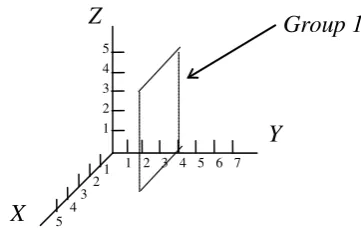
The plane Y = 4 (Group 1) includes all the rooms in the fourth hour in the five days, as shown in Figure 3. The group 1 is defined by means of the ranges [1,l1] [4,4] [1,l3] (all
the vectors Vi,j,k with j=4, i ∈ [1,l1], and k ∈ [1,l3]).
4.1.2. Constraints
Once the problem is fit in the CSP-Space, where groups are defined, several constraints may be represented and included as a type. The following enumerates an example of each type of constraint:
First type: The teachers number 3 and 5 must not work in any room in the fourth hour,
in the five days. That is, c3 and c5 (with c3 and c5
Second type: Any teacher which occupy a room in an hour and in a day can not
occupy another room in the same hour and the same day.
∈ D) must be assigned
with weight 0 to the group 1.
Third type: The teacher number 6 must work next to the teacher number 4.
Fourth type: The teacher number 2 must work in the third room the fifth and sixth hours Figure 2: A three-dimensional CSP-Space for the classroom problem
X
Z
Y
1
5 4
3 2
1 2 3 4 5 6 7 5
4 3 2 1
[image:6.595.192.373.313.429.2]Group 1
on Monday.
Fifth type: The teachers working in the third hour must rest in the fourth.
5 Conclusion
The advantages with respect to other approaches which deal with a particular case of the problem considered in this work [Fernández,96] [Rueda,96] are the following:
• A general model for several kinds of resource assignment problems in industry,
commerce, etc. is stated where the constraints are common for different problems and the space is the same.
• The constraints are sorted as classes of objects and a lot of redundancy is
eliminated, moreover new rules and specific searching algorithms can be defined in the CP environment.
• The different components of the CSP-Space are represented in an object oriented
model taking all the advantages provided by this paradigm, and therefore, increasing the declarativeness.
• Starting from the object model proposed for general resource assignment problems,
new classes may be defined, or the existent ones may be modified for a particular problem whenever it fits in the CSP-Space.
6 Future Extensions
A future extension of the present work, consist of considering W as a real number between 0 and 1, that is, a probabilistic value. Therefore, a candidate can occupy a resource with probability W. Then the problem could be thought as a discrete optimization problem [Smith,96] which has an additional variable representing the objective; each time a solution to the CSP is found, a new constraint is added to ensure that any future solution must have an improved value of the objective. This procedure continues until the problems becomes infeasible, and the last solution found is the optimal.
Another extension consists of considering the candidates and vectors as abstract objects instead of variables and domains respectively, so that many attributes may be added to that classes and the constraints relate not only the identification of both but also different attributes, and the model takes a true approximation to the real world.
7 Acknowledgments
Proceedings CACIC ‘97 Ingeniería de Software. Bases de Datos UNLP
Departamento de Informática - Facultad de Ciencias Exactas
8
ILOG SA Spain who provided us the development tools related to the CP environment.8 References
[Forradellas,95] R. Forradellas, “Un modelo para el tratamiento de Sistemas Dinámicos con Restricciones en el marco CLP”, Tesis Doctoral, Univ.Politecnica de Madrid, 1995.
[Ibáñez,94] F. Ibáñez, R. Berlanga, F. Barber y R. Forradellas, “Dos Enfoques de la Programación Lógica con Restricciones”, Revista de Informática Teórica y Aplicada, Brasil 4/1994.
[Ibáñez,95] F. Ibáñez, “CLP (Temp): Integración de Restricciones Temporales Métricas y Simbólicas en el Marco CLP”, Tesis Doctoral, Univ.Politécnica de Valencia, 1995.
[Ilog,95] “Ilog Solver - Reference Manual Versión 3.0”, Ilog, France, 1995.
[Jaffar,94] J. Jaffar and M.J. Maher, “ Constraint Logic Programming: A Survey”, J. Logic Programming, to appear, 1994.
[Leler,90] V. Leler, “Constraints Programming Languages - Their Specification and Generation”, Addison-Wesley Publishing Co. Inc., 1990
[Macworth,86] A.K.Mackworth, “Constraint Satisfaction”, Encyclopedia of Artificial Intelligence, 1986.
[Martin,94] Martin J. y Odell J., “Análisis y Diseño Orientado a Objetos”, Prentice Hall Hispanoamérica S.A., 1994.
[Puget,94] Puget J. “A C++
[Rueda,95] L.Rueda, R.Klenzi, L.Gutierrez, F.Ibañez y R.Forradellas, “Tratamiento de Problemas de Combinatoria Discreta mediante el Paradigma CLP”, 2das.Jornadas Informáticas, San Juan, 1995.
Implementation of CLP”, Ilog Solver Collected Papers, Ilog tech. report, 1994.
[Rueda,96] L. Rueda, I.Arias, F.Ibañez and R.Forradellas, “Representación y Tratamiento mediante POO de Problemas de Combinatoria Discreta en la Programación con Restricciones”, 25as. Jornadas Argentinas de Informática e Investigación Operativa (25as. JAIIO), 1996.
de Trabajo en Procesamiento de la Información y Control (VII RPIC), 1997.
[Rumba,91] Rumbaugh J, Blaha M., Premerlani W., Frederick E. and Lorensen W., “Object Oriented Modeling and Design”, Prentice Hall, 1991.
[Smith,96] Smith B, Brailsford P., Hubbard P. and Williams P. “The Progressive Party Problem: Integer Linear Programming and Constraint Programming Compared”, Ilog Solver Collected Papers, Ilog tech. report, 1996.
[Van Hentenryck,89] P. Van Hentenryck, “Constraints Satisfaction in Logic Programming”, MIT Press, 1989.