Multivariate analysis of risk factors for complications after loop
ileostomy closure
Análisis multivariable de los factores de riesgo asociados a complicaciones posterior al
cierre de ileostomía en asa
Omar Vergara-Fernández, Mario Trejo-Avila* and Noel Salgado-Nesme
Departamento de Cirugía Colorectal, Instituto Nacional de Ciencias Médicas y Nutrición Salvador Zubirán, Ciudad de México, México
Cir Cir. 2019;87:337-346 Contents available at PubMed www.cirugiaycirujanos.com
Abstract
Background: Despite the advantages of diverting loop ileostomy construction, it is related to complications. Objective: The aim of the study was to determine the risk factors for complications after loop ileostomy closure. Methods: Patients who un-derwent loop ileostomy closure from January 2010 to March 2018 were retrospectively analyzed. Multivariate logistic regression was used to determine the effect of the potential risk factors on the rate of each complication. Results: Atotal of 136 patients underwent reversal. Indications for the initial operation were colorectal cancer (39.7%), diverticulitis (25.7%), idiopathic chronic ulcerative colitis (ICUC) (8.1%), familial adenomatous polyposis (FAP) (7.4%), and others (19.1%). Multivariate analysis iden-tified the following risk factors: type of incision (midline laparotomy) (odds ratio [OR] = 6.5) for wound infection; treatment with immunomodulator (OR = 12.5) for anastomotic leak; history of FAP (OR = 9.8) for intestinal obstruction; previous use of im-munomodulator (OR = 10.0) and performing reversal through midline incision (OR = 18.9) for reoperation; and ≥ 65 years old (OR = 3.5) for medical complications. The rate of incisional hernia was 11%, and the risk factors were time to closure < 3 months (OR = 6.4) and parastomal hernia (OR = 13.2). Conclusions: Several patient-related and surgical technique factors should be considered at the time of loop ileostomy closure to reduce post-operative morbidity.
KEY WORDS:Loop ileostomy. Ileostomy closure. Stoma reversal complications.
Resumen
Antecedentes: A pesar de las ventajas de la ileostomía en asa de derivación, múltiples complicaciones se han asociado a su uso. Objetivo: Determinar los factores de riesgo para presentar complicaciones tras el cierre de una ileostomía en asa. Método: Se realizó un análisis retrospectivo de los pacientes sometidos a cierre de ileostomía en asa de enero de 2010 a marzo de 2018. Se determinaron los factores de riesgo utilizando regresión multivariable. Resultados: Se incluyeron 136 pacientes. Las indicaciones para cirugía fueron cáncer colorrectal (39.7%), diverticulitis (25.7%), colitis ulcerosa crónica idiopática (CUCI) (8.1%), poliposis adenomatosa familiar (PAF) (7.4%) y otras (19.1%). Se identificaron los siguientes factores de riesgo: incisión en línea media (OR: 6.5) para infección de herida; tratamiento inmunomodulador (OR: 12.5) para fuga de anastomosis; antecedente de PAF (OR: 9.8) para oclusión intestinal; tratamiento inmunomodulador (OR: 10) e incisión en línea media (OR: 18.9) para reintervención; y edad ≥ 65 años (OR: 3.5) para complicaciones médicas. La frecuencia de hernia incisional fue del 11%: < 3 meses para el cierre (OR: 6.4) y hernia parastomal (OR: 13.2). Conclusiones: Numerosos factores relacionados con el paciente y con la técnica quirúrgica deben de ser considerados al momento del cierre de la ileostomía en asa para reducir la morbilidad posoperatoria.
PALABRAS CLAVE: Cierre de ileostomía en asa. Complicaciones de ileostomía. Ileostomía en asa.
Correspondence:
*Mario Trejo-Avila Vasco de Quiroga, 15 Col. Sección XVI, Del. Tlalpan C P. 14080 Ciudad de México, México E-mail: [email protected]
I
ntroduction
Diverting loop ileostomy is commonly performed to protect a distal anastomosis when there is a high risk of anastomotic leakage1,2.
Although fecal diversion does not prevent an anasto-motic leak, it does decrease the potential morbidity and mortality from an anastomotic leak3. Despite the
poten-tial benefits of fecal diversion, loop ileostomy construc-tion is related to a significant rate of complicaconstruc-tions.
Closure of the loop ileostomy is associated with a low mortality, but morbidity may be as high as 20%4.
Patients needed additional operation (closure surgery) and may develop small bowel obstructions, parasto-mal hernia, stoma retraction or prolapse, skin pro-blems, electrolyte abnormalities, and acute kidney injury due to a high output stoma3,5.
Furthermore, stoma reversal may cause several complications, such as surgical site infection (SSI), anastomotic leak, bowel obstruction, post-operative ileus, wound dehiscence, and enterocutaneous fistu-las6,7. There is also an increased risk of developing an
incisional hernia after stoma closure5.
The aim of the study was to determine the risk fac-tors for complications after loop ileostomy closure using multivariate analysis, either if the first procedure was for a benign or a malignant colorectal disease.
Patients and methods
From January 2010 to March 2018, all patients who underwent loop ileostomy closure at Instituto Nacional de Ciencias Médicas y Nutrición Salvador Zubirán in Mexico City, Mexico, were included in this study. Data for these patients were retrospectively retrieved and analyzed.
The inclusion criteria included patients who were
≥ 18 years old and who underwent planned loop
ileostomy closure. Patients included had previous be-nign or malignant colorectal disease. Index surgery was defined as the operation that included colorectal resection (for benign or malignant disease), primary anastomosis, and construction of diverting loop ileos-tomy. The indications for protective loop ileostomy construction were low colorectal, ileorectal, coloanal, or ileal pouch anastomoses.
Exclusion criteria were patients younger than 18, patients who had diverting loop ileostomy non-related to colorectal diseases or operations, and patients with
double-barrel or terminal ileostomy. Patients with in-complete data were eliminated from the study.
All patients included in the study had pre-operative water-soluble contrast enema and colonoscopic eva-luation before the loop ileostomy closure. All anasto-moses were side-to-side and were performed with linear staplers and reinforced with non-absorbable sutures.
Ileostomy closure was performed either by peristo-mal incision (circular incision around the ileostomy) or by a midline incision as required. All patients had a peristomal incision first approach, and some patients needed conversion to midline incision mainly due to dense adhesions or inadequate small bowel length obtained through peristomal incision. Closure of the ostomy wound was performed by conventional linear closure or by pursestring closure, based on surgeons’ preference.
Pre-operative variables considered in this study were sex (female and male), body mass index (< 30 or
≥ 30), age (< 65 or ≥ 65), and the American Society
of Anesthesiology grade (ASA I-II or III-IV). Comorbi-dity was assessed using the Charlson ComorbiComorbi-dity Index (CCI)8. Other pre-operative variables were
to-bacco use and previous treatments (systemic steroids, immunomodulators, radiotherapy, and chemotherapy). Immunomodulators included azathioprine, metho-trexate, and mycophenolate mofetil. Either immuno-modulators or systemic steroids were withdrawn before the loop ileostomy closure. Variables regarding index surgery were type of index surgery (elective or urgent and laparoscopic or open) and reintervention for complications after index surgery. Surgical varia-bles concerning loop ileostomy closure were interval from index surgery to closure (months), type of inci-sion (peristomal or midline), and peristomal wound closure (linear or purse-string).
The following complications after loop ileostomy clo-sure were analyzed: wound infection either deep or superficial, anastomotic leakage, intestinal obstruc-tion, reintervention after loop ileostomy closure, ove-rall medical complications, and mortality. All post-ope-rative complications were recorded and stratified in accordance with Clavien-Dindo classification scheme (occurring either within 30 days of loop ileostomy clo-sure or during the hospital stay)9. The rate of incisional
hernia was also analyzed in the study.
Wound infections were either superficial or deep infections, based on the definition of the Centers for Disease Control for Surgical Site Infections10.
tomographic evidence of leak or perianastomotic co-llection. Intestinal obstruction was diagnosed in pa-tients with clinical symptoms and signs of obstruction (distention, pain, vomiting, and absence of gas/stool passage) and corroborated by imaging (dilated small bowel). Reintervention was the need to return to the operation room secondary to a complication directly related to the loop ileostomy closure and included all complications occurring within 30 days after loop ileostomy closure.
Incisional hernia repair was not considered in the reintervention group and was not included in the Cla-vien-Dindo classification. Incisional hernia was diag-nosed by clinical examination and corroborated by computed tomography. For incisional hernia, a period of 1 year to follow-up after ileostomy closure was con-sidered in the analysis.
Statistical Analysis
All data were collected retrospectively in a digital database. Categorical data were presented as totals (n) and proportions as percentages (%). Categorical data were compared using the Pearson’s Chi-square test or Fisher’s exact test. All tests were two-sided and used an alpha of 0.05.
Univariate analysis was performed for each compli-cation (analyzing patients in two groups: complicompli-cation present vs. absence of complication). All variables with a p value inferior to 0.10 in the univariate analysis were considered as potential risk factors and were entered into multivariate backward logistic regression analysis. The variables representing the lowest risk for each complication was considered to be the refe-rence group (odds ratio [OR] = 1). OR and 95% con-fidence intervals (95% CI) were calculated for each outcome (complication) (wound infection, anastomotic leakage, intestinal obstruction, incisional hernia, rein-tervention after ileostomy closure, overall medical complications, and mortality). p < 0.05 was conside-red to be statistically significant. All data were analyzed using SPSS statistic version 22.0 (IBM Corporation, Armonk, New York, NY).
Results
From January 2010 to March 2018, a total of 136 pa-tients underwent loop ileostomy closure at our institu-tion. Patient demographic and clinical characteristics are summarized in table 1. There were 69 women (50.7%), 71.3% (n = 97) of patients were < 65 years
old, 91.9% (n = 125) had a BMI < 30 kg/m2, and 58.1%
(n = 79) had a CCI ≥ 2.
Of the 136 patients, 82 (60.3%) had benign disease and 54 (39.7%) had malignant colorectal disease.
Patients in the benign disease group had one of the following diagnosis: complicated diverticular disease (n = 35), ulcerative colitis (n = 11), familial adenoma-tous polyposis (FAP) syndrome (n = 10), rectovesical fistula (n = 8), rectovaginal fistula (n = 8), colorectal trauma (n = 5), Hirschsprung’s disease (n = 1), ische-mic colitis (n = 2), colonic angiodysplasia (n = 2), rectal prolapse (n = 1), and obstructing rectal adeno-ma (n = 2).
Patients with malignant disease had rectal cancer (n = 40) or colon cancer (n = 14). The distribution of patients according to cancer stage (TNM) was11
Stage I (n = 7, 12.9%), II (n = 8, 14.8%), III (n = 28, 51.8%), and IV (n = 11, 20.3%).
Comparisons of baseline operative data, pre-vious treatments, characteristics of the index surgery, and perioperative data concerning loop ileostomy clo-sure are shown in table 1.
Wound infection
The overall rate of wound infection (superficial and deep) was 6.6%. No statistically significant difference exists between patients with benign and malignant disease for the rate of wound infection (8.5% vs. 3.7%, p = 0.267) (Table 2).
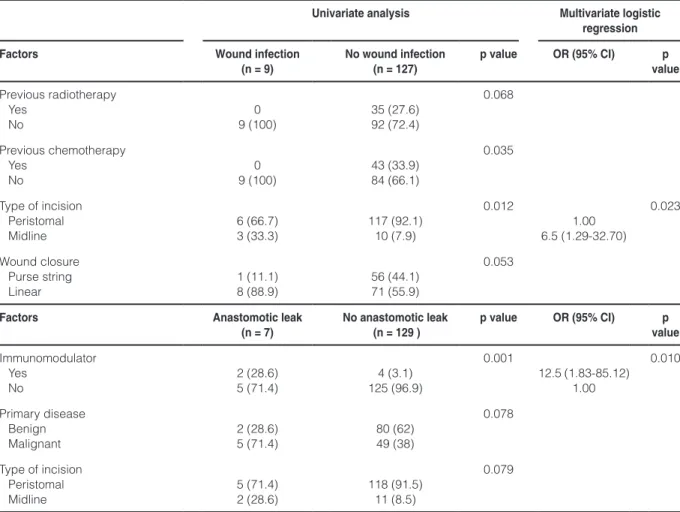
Univariate analysis results are summarized in table 3. Previous radiotherapy, chemotherapy, midline incision, and linear wound closure were considered potential risk factors for the occurrence of wound in-fection (p < 0.1).
Multivariate analysis identified the type of incision (conversion to midline laparotomy) as the only risk factor (OR = 6.5 [95% CI 1.29-32.70]; p = 0.023).
Anastomotic leakage
The overall rate of anastomotic leakage was 5.1%. Anastomotic leakage was similar between patients with baseline benign and malignant disease (2.4% vs. 9.3%; p = 0.078) (Table 2).
Table 1. Characteristics of patients
All patients
(n = 136) Benign disease(n = 82) Malignant disease(n = 54) p < 0.05
Sex Female
Male 69 (50.7)67 (49.3) 41 (50)41 (50) 28 (51.9)26 (48.1)
0.833
Age, n (%) < 65 years
≥ 65 years 97 (71.3)39 (28.7) 62 (75.6)20 (24.4) 35 (64.8)19 (35.2)
0.173
BMI, n (%) < 30
≥ 30 125 (91.9)11 (8.1) 74 (90.2)8 (9.8) 51 (94.4)3 (5.6)
0.379
Smoking, n (%) Yes
No 56 (41.2)80 (58.8) 34 (41.5)48 (58.5) 22 (40.7)32 (59.3)
0.933
Charlson Comorbidity Index 0-1
2-3 4-5 ≥ 6
57 (41.9) 41 (30.1) 31 (22.8) 7 (5.1)
48 (58.5) 19 (23.2) 15 (18.3)
0
9 (16.7) 22 (40.7) 16 (29.6) 7 (13)
<0.001
ASA classification I-II
III-IV 102 (75)34 (25) 66 (80.5)16 (19.5) 36 (66.7)18 (33.3)
0.069
Previous treatments, n (%) Steroids
Immunomodulator Radiotherapy Chemotherapy
21 (15.4) 6 (4.4) 35 (25.7) 43 (31.6)
19 (23.2) 6 (7.3)
0 1 (1.2)
2 (3.7) 0 35 (64.8) 42 (77.8)
0.002 0.042 < 0.001 < 0.001
Index surgery, n (%) Elective
Urgent 91 (66.9)45 (33.1) 41 (50)41 (50) 50 (92.6)4 (7.4) < 0.001
Modality of index surgery, n (%) Laparoscopic
Open 100 (73.5)36 (26.5) 10 (12.2)72 (87.8) 26 (48.1)28 (51.9)
< 0.001
Reintervention after index surgery, n (%)
Yes
No 106 (77.9)30 (22.1) 19 (23.3)63 (76.8) 11 (20.4)43 (79.6)
0.700
Interval from index surgery to loop closure, n (%)
≤ 3 months 3-6 months ≥ 6 months
27 (19.9) 48 (35.3) 61 (44.9)
19 (23.2) 33 (40.2) 30 (36.6)
8 (14.8) 15 (27.8) 31 (57.4)
0.057
Parastomal hernia, n (%) Yes
No 123 (90.4)13 (9.6) 10 (12.2)72 (87.8) 51 (94.4)3 (5.6)
0.322
Type of incision, n (%) Peristomal
Midline 123 (90.4)13 (9.6) 75 (91.5)7 (8.5) 48 (88.9)6 (11.1)
0.617
Wound closure, n (%) Linear
Purse string 79 (58.1)57 (41.9) 47 (57.3)35 (42.7) 32 (59.3)22 (40.7)
0.822
Table 2. Complications after loop ileostomy closure All patient
(n = 136) Benign disease(n = 82) Malignant disease(n = 54) p < 0.05
30-day post-operative complications (Clavien-Dindo)
I
Urinary retention Fever
II
Urinary tract infection Delirium
Pneumonia CD diarrhea Wound infection Intestinal obstruction IIIa
Abdominal fluid collection IIIb
Intra-abdominal abscess Intestinal obstruction Anastomotic leakage IV
Myocardial infarction (mortality)
2 (1.5) 2 (1.5)
2 (1.5) 2 (1.5) 2 (1.5) 1 (0.7) 9 (6.6) 11 (8)
2 (1.5)
1 (0.7) 2 (1.5) 7 (5.1)
2 (1.5)
2 (2.4) 1 (1.2)
1 (1.2) 2 (2.4) 1 (1.2)
0 7 (8.5) 8 (9.7)
1 (1.2)
1 (1.2) 1 (1.2) 2 (2.4)
1 (1.2)
0 1 (1.9)
1 (1.9) 0 1 (1.9) 1 (1.9) 2 (3.7) 3 (5.5)
1 (1.9)
0 1 (1.9) 5 (9.3)
1 (1.9)
0.517 0.764
0.764 0.517 0.764 0.397 0.267 0.379
0.764
1.000 0.764 0.078
0.764
Incisional hernia, n (%) Yes
No 121 (89)15 (11) 12 (14.6)70 (85.4) 51 (37.5)3 (5.6)
0.098
ACS: acute coronary syndrome, SSI: surgical site infections. CD diarrhea: clostridium difficile diarrhea.
Univariate analysis Multivariate logistic regression
Factors Wound infection
(n = 9) No wound infection (n = 127) p value OR (95% CI) valuep
Previous radiotherapy Yes
No 9 (100)0 35 (27.6)92 (72.4)
0.068
Previous chemotherapy Yes
No 9 (100)0 43 (33.9)84 (66.1)
0.035
Type of incision Peristomal
Midline 6 (66.7)3 (33.3) 117 (92.1)10 (7.9)
0.012
1.00 6.5 (1.29-32.70)
0.023
Wound closure Purse string
Linear 1 (11.1)8 (88.9) 56 (44.1)71 (55.9)
0.053
Factors Anastomotic leak
(n = 7) No anastomotic leak (n = 129 ) p value OR (95% CI) valuep
Immunomodulator Yes
No 2 (28.6)5 (71.4) 125 (96.9)4 (3.1)
0.001
12.5 (1.83-85.12) 1.00
0.010
Primary disease Benign
Malignant 2 (28.6)5 (71.4) 80 (62)49 (38)
0.078
Type of incision Peristomal
Midline 5 (71.4)2 (28.6) 118 (91.5)11 (8.5)
0.079
Factors Intestinal obstruction
(n = 13) No intestinal obstruction(n = 123) p value OR (95% CI) valuep
FAP Yes
No 4 (30.8)9 (69.2) 117 (95.1)6 (4.9)
0.001
9.8 (2.10-46.41) 1.00
0.004
Reintervention after index surgery Yes
No 13 (100)0 30 (24.4)93 (75.6)
0.044
Factors Incisional hernia
(n = 15) No incisional hernia(n = 121) p value OR (95% CI) valuep
BMI < 30
≥ 30 12 (80)3 (20) 113 (93.4)8 (6.6)
0.073
Primary disease Benign
Malignant 12 (80)3 (20) 70 (57.9)51 (42.1)
0.098
Type of index surgery Elective
Urgent 7 (46.7)8 (53.3) 84 (69.4)37 (30.6)
0.077
Time to loop closure < 3 months
> 3 months 6 (40)9 (60) 100 (82.6)21 (17.4)
0.038
6.4 (1.58-26.14) 1.00
0.009
Parastomal hernia Yes
No 10 (66.7)5 (33.3) 113 (93.4)8 (6.6)
0.001
13.2 (2.70-64.58) 1.00
0.001
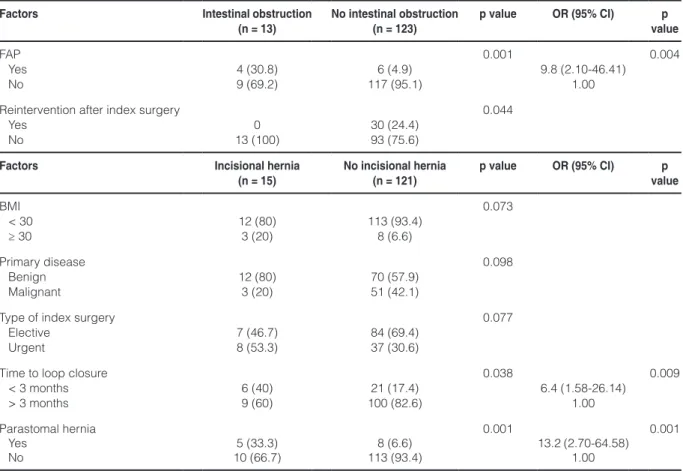
For multivariable logistic regression analysis, OR and 95% CI are presented. OR are calculated for each outcome (SSI), anastomotic leak, intestinal obstruction, and incisional hernia. Only significant results are shown. The reference category has an OR of 1.00.
OR: odds ratio, CI: confidence interval, SSI: surgical site infection.
Table 3. Univariate and multivariate analysis of factors associated with post-operative complications (Continued)
immunomodulator as the only risk factor for develo-ping anastomotic leak (OR = 12.5 (95% CI = 1.83-85.12); p = 0.010).
Intestinal obstruction
Intestinal obstruction was developed in 9.5% of the patients following loop ileostomy closure (Table 2). Of the total of patients with this diagnosis, 11 (8%) resol-ved with nasogastric tube and nil per os, and 2 (1.5%) patients needed reoperation.
Univariate analysis revealed that reintervention after index surgery as well as a history of FAP syndrome was associated with the occurrence of intestinal obs-truction after loop ileostomy closure (Table 3).
Multivariate logistic regression analysis identified a history of FAP syndrome as the only risk factor (OR = 9.8 [95% CI 2.10-46.41]; p = 0.004).
Reoperation
The overall reoperation rate after loop ileostomy closure was 7.3%. Reoperations were needed due to
intestinal obstruction (1.5%), anastomotic leak (5.1%), and intra-abdominal abscess (0.7%) (Table 2).
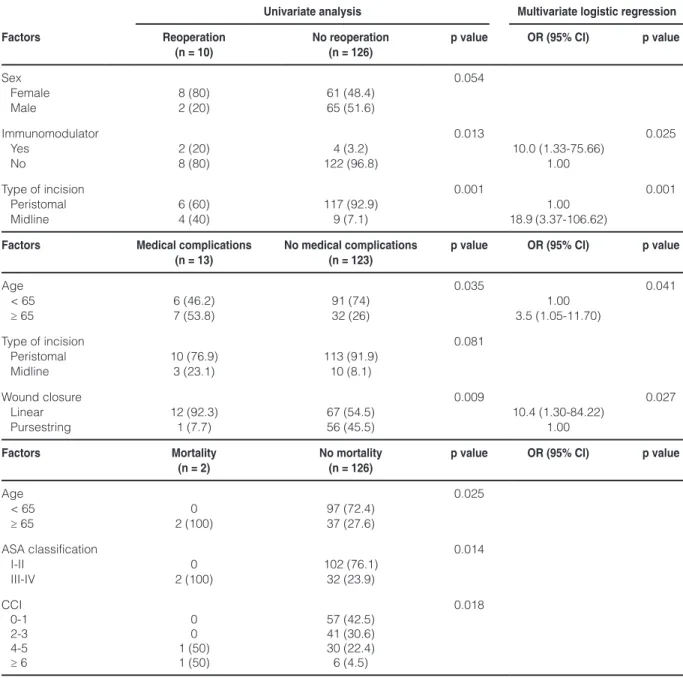
Univariate analysis showed that females, previous use of immunomodulator, and performing ileostomy closure through midline incision were associated with the need of reoperation.
Multivariate analysis determined two independent risk factors for reoperation: previous use of immuno-modulator (OR = 10.0 [95% CI 1.33-75.66]; p = 0.025) and performing ileostomy closure through midline in-cision (OR = 18.9 [95% CI 3.37-106.62]; p = 0.001) (Table 4).
Incisional hernia
The rate of incisional hernia was 11%, being more frequent in patients with benign colorectal disease, although this difference was not statistically significant (14.6% vs. 5.6%, p = 0.098) (Table 2).
and presence of parastomal hernia were considered as potential risk factors for incisional hernia (Table 3).
Multivariate analysis identified two independent risk factors for incisional hernia: time to loop ileostomy clo-sure within 3 months from index surgery (OR = 6.4 [95% CI 1.58-26.14]; p = 0.009) and presence of paras-tomal hernia (OR = 13.2 [95% CI 2.70-64.58]; p = 0.001).
Medical complications
The overall rate of medical complications was 9.5%. Several complications were considered as being me-dical and are shown in Table 2.
Univariate analysis identified age ≥ 65 years old,
midline incision, and peristomal linear wound closure as potential risk factors (Table 4).
Multivariate analysis determined two independent risk
factors for medical complications: ≥ 65 years old (OR = 3.5
[95% CI 1.05-11.70]; p = 0.041) and linear wound closure (OR = 10.4 [95% CI 1.30-84.22]; p = 0.027).
Mortality
The mortality rate found in our study was 1.5%. Based on univariate analysis, age > 65 years (p = 0.025), ASA grade III-IV (p = 0.014), and Charlson
Table 4. Univariate and multivariate analysis of factors associated with post-operative complications
Univariate analysis Multivariate logistic regression Factors Reoperation
(n = 10) No reoperation(n = 126) p value OR (95% CI) p value
Sex Female
Male 8 (80)2 (20) 61 (48.4)65 (51.6)
0.054
Immunomodulator Yes
No 2 (20)8 (80) 122 (96.8)4 (3.2)
0.013
10.0 (1.33-75.66) 1.00
0.025
Type of incision Peristomal
Midline 6 (60)4 (40) 117 (92.9)9 (7.1)
0.001
1.00 18.9 (3.37-106.62)
0.001
Factors Medical complications
(n = 13) No medical complications (n = 123) p value OR (95% CI) p value
Age < 65
≥ 65 6 (46.2)7 (53.8) 91 (74)32 (26)
0.035
1.00 3.5 (1.05-11.70)
0.041
Type of incision Peristomal
Midline 10 (76.9)3 (23.1) 113 (91.9)10 (8.1)
0.081
Wound closure Linear
Pursestring 12 (92.3)1 (7.7) 67 (54.5)56 (45.5)
0.009
10.4 (1.30-84.22) 1.00
0.027
Factors Mortality
(n = 2) No mortality(n = 126) p value OR (95% CI) p value
Age < 65
≥ 65 2 (100)0 97 (72.4)37 (27.6)
0.025
ASA classification I-II
III-IV 2 (100)0 102 (76.1)32 (23.9)
0.014
CCI 0-1 2-3 4-5 ≥ 6
0 0 1 (50) 1 (50)
57 (42.5) 41 (30.6) 30 (22.4) 6 (4.5)
0.018
morbidity index > 4 (p = 0.018) were found to be as-sociated with mortality. None of these factors resulted significantly on multivariate regression analysis (Table 4).
Discussion
There is a trend toward sphincter-sparing procedu-res with the use of very low pelvic anastomoses in either rectal cancer or benign conditions (diverticulitis, FAP, or ulcerative colitis)12.
The most dreaded complication of a low (pelvic) anastomosis is an anastomotic leak. Anastomotic leakage could result in generalized peritonitis or pelvic abscess, long length of hospital stay, decreased qua-lity of life, cancer recurrence, and higher mortaqua-lity1,13,14.
Fecal diversion is aimed to minimize these complications1,13.
The incidence of anastomotic leakage is higher if it is distal in the rectum or if there are predisposing factors such as immunosuppression, history of chemo- and radiotherapy, acute sepsis, and poor nu-tritional status1,3. Other factors related to leaks are
smoking, obesity, transfusion, and ASA class III-IV3,15.
The incidence of anastomotic leak after colorectal surgery ranges from 1% to 25%12,16 and the mortality
ranges from 6% to 22%17.
The absence of a diverting stoma in low anterior resection is associated with significant higher rate or anastomotic leak and reintervention18. For ultralow
re-sections with subsequent coloanal anastomosis, di-verting ostomy is almost always constructed3.
Despite the advantages of loop ileostomy, the role of temporary fecal diversion remains an area of con-troversy among surgeons3. Controversy rises because
the significant morbidity and morality related to ileos-tomy (high output ileosileos-tomy, acute renal failure, pa-rastomal herniation) and to ileostomy reversal (surgi-cal site infections, anastomotic leak). Furthermore, it has been estimated that 40-50% of temporary stomas are never reversed12.
Morbidity and mortality related to loop ileostomy closure had been described in several series as being 3-30%1,19 and 0-4%1,20, respectively.
In a large cohort of patients (from the NSQIP data-base) who underwent closure of ileostomy, 9.3% of patients had major complications, 8.4% had minor complications, and there was a mortality rate of 0.6%1.
Functional status of the patient, ASA class, and organ dysfunction were independent predictors of complica-tions after ileostomy reversal1.
In other study, elderly patient with age > 80 years (OR = 4.3 [1.6-11.0]; p = 0.003) was the only indepen-dent risk factor for post-operative complications on multivariate analysis13.
Mennigen et al.7, in a systematic review of risks of
ileostomy closure after restorative proctocolectomy for ulcerative colitis and FAP (n = 2146), reported that an overall morbidity was 16.5%, reoperation rate was 3%, anastomotic leak was 2.0%, bowel obstruction was 7.6% (with 2.9% requiring laparotomy for this), wound infection rate was 4.0%, and stoma site hernias was 1.9%.
On regard of the anastomotic leak, in a recent me-ta-analysis, there was no difference in the rate of anastomotic leak between the hand-sewn and the stapled anastomotic techniques for closure of a loop ileostomy (OR 0.81, 95% CI 0.43-1.54, p = 0.52, I2= 33%)21. Saha et al.22 reported a 4% rate of
anas-tomotic leak, with pre-operative anemia being signifi-cantly associated with leakage (p = 0.033).
Man et al.13 determined that closure of the ileostomy
with hand-sewn techniques showed a higher inciden-ce of post-operative intestinal obstruction (p = 0.049) compared to closure using stapler. This finding was corroborated in a meta-analysis, being higher the rate of small-bowel obstruction in the hand-sewn group compared to the stapled group (7.03% vs. 5.58%; OR 0.69, 95% CI 0.51-0.92, p = 0.01, I2 = 0%)21.
Surgical site infection following stoma reversal in-creases the risk of wound dehiscence, incisional her-nia, length of stay, and health-care costs6. In a recent
meta-analysis (including ileostomy and colostomy re-versal), pursestring closure had a significant decrease
in SSI (risk difference, −0.25; 95% CI, −0.36−0.15;
p < 0.00001; number needed to treat = 4) and higher satisfaction with cosmetic outcomes (standard mean difference, 0.7; 95% CI, 0.13-1.27; p = 0.02), when compared with conventional linear closure6. Another
study reported BMI ≥ 30 (OR = 1.4), ASA III-IV (OR = 1.7), and operating time ≥ 100 min (OR = 3.3)
as factors associated with incisional infection1. We
identified in the univariate analysis of our study seve-ral factors related with increased SSI included linear wound closure. However, only patients who needed conversion to midline laparotomy were associated with increased likelihood of SSI (OR = 6.5). The rate of conversion to midline incision (9.6%) seems to be high in our study; the main reason for conversion was dense adhesion needing dissection for adequate ten-sion-free anastomosis.
Mansfield et al.20 reported a 7.3% reoperation rate
immediate reoperation rate after ileostomy reversal of 5.3%, identifying higher BMI and anemia as the risk factors (BMI: p = 0.038; OR 0.73 [95% CI 0.55-0.98]; anemia: p = 0.001; OR 25.50 [95% CI 3.87-168.21]). Our reoperation rate was 7.3%, and previous use of immunomodulator and performing ileostomy closure through midline incision were found to be independent risk factors.
Medical complications should also be considered after closing a loop ileostomy. In a study including 5401 patients, the frequency of complications was pneumonia (0.9%), cardiac (0.4%), renal failure (0.6%), neurological (0.1%), venous thromboembolism (0.6%), and urinary tract infections (2%)1. In one study13, age
> 80 years was an independent risk factor for develo-ping urinary retention (OR = 5.6 [1.8-17.4]; p = 0.001). We found a 9.5% rate of medical complications, inclu-ding urinary tract infection (1.5%), pneumonia (1.5%),
and delirium (1.5%). Age ≥ 65 years (OR = 3.5) was
an independent risk factor associated with medical complications.
One of the most common late complications of sto-ma reversal is the development of an incisional her-nia, with overall incisional hernia rate of 7.4%, ranging from 0% to 48%5,24,25. Recognized risk factors
asso-ciated with incisional hernia are age, medical comor-bidities (especially, obesity and hypertension), and smoking, as well as the type of suture used to close and SSI24. We found, in our study, an incisional hernia
rate of 11% that is concordant with the incidence re-ported in previous studies, and two independent risk factors were found to be associated with an increased rate of herniation: time to ileostomy closure < 3 mon-ths (OR = 6.4) and presence of parastomal hernia (OR = 13.2). Incisional hernia can have an adverse effect on a patients’ quality of life and increases health-care costs5. In one study, hernias are detected in a median
of 6 months after stoma closure26. Around one-third
to one-half of hernias detected clinically required re-pair5. Prophylactic mesh placement has been
advoca-ted for preventing parastomal hernias; however, it has not been widely used in stoma closure reinforcement due to the risk of contamination5. In a recent
publica-tion, Warren et al.25 advocated the retromuscular
pla-cement of permanent synthetic mesh at the time of stoma reversal as an effective mean to prevent the development of incisional hernia.
The limitations of our study are largely attributable to the sample size and the retrospective design. The single institution nature of our investigation is prone to selection bias. The sample size could represent a
risk of bias for a multivariate analysis, which could led to the underestimation of the independent variables. However, we consider that this study provides eviden-ce of different risk factors associated with complica-tions that should be considered at the time of loop ileostomy construction and closure either if the first procedure was for a benign or malignant colorectal disease. These data can be utilized by colorectal and general surgeons for surgical decision-making and counseling patients about the risks and complications of having a loop ileostomy.
Conclusions
Loop ileostomy closure is associated with an impor-tant risk of complications either if the first procedure was for a benign or malignant colorectal disease. As loop ileostomy is still recommended for protection of high-risk colorectal anastomosis, several patient-rela-ted factors as well as surgical technique elements should be considered at the time of ileostomy closure to reduce post-operative morbidity.
Conflicts of interest
The authors declare that they have no conflicts of interest.
Funding
There were no grants/funds used for this research project.
Ethical disclosures
Protection of human and animal subjects. The authors declare that no experiments were performed on humans or animals for this study.
Confidentiality of data. The authors declare that they have followed the protocols of their work center on the publication of patient data.
Right to privacy and informed consent. The au-thors declare that no patient data appear in this article.
References
1. Sharma A, Deeb AP, Rickles AS, et al. Closure of defunctioning loop ileostomy is associated with considerable morbidity. Colorectal Dis. 2013;15:458-62.
3. Lightner AL, Pemberton JH. The role of temporary fecal diversion. Clin Colon Rectal Surg. 2017;30:178-83.
4. Gessler B, Haglind E, Angenete E. Loop ileostomies in colorectal cancer patients-morbidity and risk factors for nonreversal. J Surg Res. 2012;178:708-14.
5. Bhangu A, Nepogodiev D, Futaba K, West Midlands Research Collabo-rative. Systematic review and meta-analysis of the incidence of incisional hernia at the site of stoma closure. World J Surg. 2012;36:973-83. 6. Hsieh MC, Kuo LT, Chi CC, Huang WS, Chin CC. Pursestring closure
versus conventional primary closure following stoma reversal to reduce surgical site infection rate: a meta-analysis of randomized controlled trials. Dis Colon Rectum. 2015;58:808-15.
7. Mennigen R, Sewald W, Senninger N, Rijcken E. Morbidity of loop ileos-tomy closure after restorative proctocolecileos-tomy for ulcerative colitis and familial adenomatous polyposis: a systematic review. J Gastrointest Surg. 2014;18:2192-200.
8. Charlson M, Szatrowski TP, Peterson J, Gold J. Validation of a combined comorbidity index. J Clin Epidemiol. 1994;47:1245-51.
9. Dindo D, Demartines N, Clavien PA. Classification of surgical complica-tions: a new proposal with evaluation in a cohort of 6336 patients and results of a survey. Ann Surg. 2004;240:205-13.
10. Mangram AJ, Horan TC, Pearson ML, Silver LC, Jarvis WR. Guideline for prevention of surgical site infection, 1999. Hospital infection control practices advisory committee. Infect Control Hosp Epidemiol. 1999;20:250-78.
11. Benson AB, Venook AP, Al-Hawary MM, et al. NCCN guidelines insights: colon cancer, version 2.2018. J Natl Compr Canc Netw. 2018;16:359-69. 12. Hanna MH, Vinci A, Pigazzi A. Diverting ileostomy in colorectal surgery:
when is it necessary? Langenbecks Arch Surg. 2015;400:145-52. 13. Man VC, Choi HK, Law WL, Foo DC. Morbidities after closure of
ileos-tomy: analysis of risk factors. Int J Colorectal Dis. 2016;31:51-7. 14. Mirnezami A, Mirnezami R, Chandrakumaran K, et al. Increased local
recurrence and reduced survival from colorectal cancer following anas-tomotic leak: systematic review and meta-analysis. Ann Surg. 2011;253:890-9.
15. Konishi T, Watanabe T, Kishimoto J, Nagawa H. Risk factors for anas-tomotic leakage after surgery for colorectal cancer: results of prospective surveillance. J Am Coll Surg. 2006;202:439-44.
16. Paun BC, Cassie S, MacLean AR, Dixon E, Buie WD. Postoperative complications following surgery for rectal cancer. Ann Surg. 2010; 251:807-18.
17. Rullier E, Laurent C, Garrelon JL, et al. Risk factors for anastomotic leakage after resection of rectal cancer. Br J Surg. 1998;85:355-8. 18. Gu WL, Wu SW. Meta-analysis of defunctioning stoma in low anterior
resection with total mesorectal excision for rectal cancer: evidence based on thirteen studies. World J Surg Oncol. 2015;13:9.
19. D’Haeninck A, Wolthuis AM, Penninckx F, D’Hondt M, D’Hoore A. Mor-bidity after closure of a defunctioning loop ileostomy. Acta Chir Belg. 2011;111:136-41.
20. Mansfield SD, Jensen C, Phair AS, Kelly OT, Kelly SB. Complications of loop ileostomy closure: a retrospective cohort analysis of 123 patients. World J Surg. 2008;32:2101-6.
21. Madani R, Day N, Kumar L, Tilney HS, Gudgeon AM. Hand-sewn versus stapled closure of loop ileostomy: a meta-analysis. Dig Surg. 2018. DOI: 10.1159/000487310 (Article in press).
22. Saha AK, Tapping CR, Foley GT, et al. Morbidity and mortality after closure of loop ileostomy. Colorectal Dis. 2009;11:866-71.
23. Schneider V, Lee LD, Stroux A, et al. Risk factors for reoperation after ileostomy reversal-results from a prospective cohort study. Int J Surg. 2016;36:233-9.
24. Brook AJ, Mansfield SD, Daniels IR, Smart NJ. Incisional hernia following closure of loop ileostomy: the main predictor is the patient, not the sur-geon. Sursur-geon. 2018;16:20-6.
25. Warren JA, Beffa LR, Carbonell AM, et al. Prophylactic placement of permanent synthetic mesh at the time of ostomy closure prevents forma-tion of incisional hernias. Surgery. 2018;163:839-46.