Beyond class and nation: reframing social
inequalities in a globalizing world
1Ulrich Beck
Abstract
From the start individualization theory is the investigation of the paradigm shift in social inequality. Furthermore it shows, how the transnationalization of social inequalities bursts the framework of institutional responses – nation state (parties), trade unions, welfare state systems and the national sociologies of social classes. In this essay I shall try to conceptually elucidate the ‘cosmopolitan per-spective’ on relations of social inequality in three cases: (1) the inequality of global risk; (2) the Europe-wide dynamic of inequality; and (3) transnational inequalities, which emerge from the capacities and resources to transcend borders. Before that I take up Will Atkinson’s question: ‘What exactly constitutes individualization and to what extent has it really displaced class?’ (Atkinson 2007: Abstract)
Keywords: Institutionalized individualization; transnationalisation of social inequalities; methodological nationalism; methodological cosmopolitanism
I. Introduction
In his polemical critiqueBeck, Individualization and the Death of ClassWill Atkinson – at last! – takes up the challenge I threw down to the sociological analysts of class some 25 years ago.2I welcome the limitation to a ‘primarily conceptual critique’ (Atkinson 2007: 356). Atkinson thereby goes considerably further than those researchers of class who have described my theory as ‘data free’, devoid of an empirical base and without any firm mooring in the social world (Marshall 1997; Goldthorpe 2002; Skeggs 2004; Brannen and Nilsen 2005; Scott 2006; more on these below). Atkinson accuses me – no doubt justifiably – of ‘refuting’ a caricature of sociological class research which I have myself constructed (Atkinson 2007: 358). But that is at least equally true of him and the sociological researchers of class, who attack a travesty of my theory of individualization, which of course saves them from any serious discussion of
Beck (Insitut fur Soziologie, Ludwig-Maximillans-Universitet Munich (Corresponding author email: [email protected]) © London School of Economics and Political Science 2007 ISSN 0007-1315 print/1468-4446 online.
the accusation that their sociology of class is historically out of date. I would not have thought it possible, but Atkinson shows no appreciation whatsoever of thekey distinction between class and inequality, which is so fundamental to my argument. Accordingly the end of social classes is not the end of social inequality, but the beginning of radicalized inequalities; to maintain, that indi-vidualization means the disappearance of social inequality ‘in terms of move-ment’ (Atkinson 2007: 354) is complete nonsense.
There are two ways of discussing the ‘end of classes’. One is the well-trodden highway of welfare state integration of the proletariat – with the aim of levelling class differencesandsocial inequality (which Atkinson and the class sociologists imply is what I say); the other approach, which is the one I have taken from the start, is the investigation of the paradigm shift in social
inequality. Individualization theory is then preciselynota theory of
pacifica-tion (as is implied) but atheory of crisis, which furthermore shows, how the transnationalization of social inequalities bursts the framework of institutional responses – nation state (parties), trade unions, welfare state systemsandthe national sociologies of social classes.
Individualization implies no (final) state, but a process, more precisely: a process of the transformation of the grammar of social inequalities. This throws up two questions: on the one hand that of thede-structuring of social classes, and on the other, that ofre-structuring. In other words, the question as to thede-structuring of social classes (through welfare state individualization, ‘out-sourcing’ and ‘in-sourcing’ of risks, through ‘internal globalization’ and ethnic pluralization of social classes etc. – see Section II below) has to be supplemented by the questions ‘What post-class, “cosmopolitan” manifesta-tions of radicalized social inequalities are emerging and how can they be analysed sociologically and empirically?’ My response to the re-structuring question is ‘methodological cosmopolitanism’ (see Section III).
In my counter-critique, therefore, I shall address a second strategic misun-derstanding, that is, the completely abbreviated reception of my proposal of replacing the ‘methodological nationalism’ of the sociology of classes and inequality (which, incidentally, is also true of my theory of individualization! – that’s the point) with a ‘methodological cosmopolitanism’. Atkinson certainly concedes:
Here Atkinson falls victim to his own insufficient reading, notably of my trilogy on cosmopolitanism in the social sciences.3In this essay I shall try to concep-tually elucidate the ‘cosmopolitan perspective’ on relations of social inequality in three cases: (1) the inequality of global risks – where, within a cosmopolitan horizon, the nation state principle is replaced by the principle of the side-effects of decisions which transcend nation state boundaries (Section III); (2) the Europe-wide dynamic of inequality – where the nation state principle of incomparability is replaced by the principle of the comparability of national spaces of inequality (Section IV); and (3) transnational inequalities, which emerge from the capacities and resources to transcend borders (Section V). Before I address these misunderstandings in my counter-critique, however, I would first of all like to take up Atkinson’s question:
II. ‘What exactly constitutes individualization and to what extent has it really displaced class?’4
What does individualization mean empirically?
Again and again the ‘empirical deficit’ of individualization theory is referred to with a frown and pursed lips, without the empirical operationalization which I offer being even acknowledged, still less taken up or criticized. Nevertheless Atkinson does see, ‘that individualization is not, as some writers have argued it to be (i.e. Furlong and Cartmel 1997) simply a subjective phenomenon concerning self-identities and attitudes alone, but a structural phenomenon transfiguring objective life situations and biographies’ (Atkinson 2007: 353). In other words, individualization must be clearly distinguished from
individualism. Whereas individualism is commonly understood as a personal
attitude or preference, individualization refers to a macro-sociological phe-nomenon, which possibly – but then again perhaps not – results in changes in attitude in individuals. That is thecrux of contingency– how individuals deal with it remains an open question.5 I, like Zygmunt Bauman and Anthony Giddens, emphasize that individualization is misunderstood if it is seen as a process which derives from a conscious choice or preference on the part of the individual. The crucial idea is this, individualization really is imposed on the individual by modern institutions. To that extent there is agreement.
Not one of the authors, however, who criticize me, has drawn the obvious conclusion The instance of falsification (and with it also the empirical proof of the individualization hypotheses) is not to be found primarily in the contin-gency of attitudes and modes of behaviour of individuals (and in correspond-ing qualitative and quantitative studies, e.g. Paul de Beer 2007), but in the
Rose 1990). In all these fields there is evident, empirically verifiable or refut-able, an historic trend towards an institutionalized individualization.6This is because the addressee of these (basic) rights and reforms is the individual and not the group, the collective. From this point of view the historical-empirical basis for testing individualization theory, not only within a national society, but across borders, is:
1) the establishment of basic civil and political rights in the nineteenth century, their restriction (to men) and their de-restriction (inclusion of women) in the twentieth century and,
2) the establishment, expansion and then dismantling of the welfare state in Western Europe after the Second World War, and in particular the devel-opments from the 1960s and 1970s onwards.
Evident here is theirony and paradox of the welfare state. The class struggles of class society achieve the welfare state and with it the principle of individual assignment of claims and contributions with the consequence that individual-ization becomes permanent, and the internal structuring principle of modern societies (classes) become less important. It is thecollective successwith class struggle which institutionalizes individualization and dissolves the culture of classes, even under conditions of radicalizing inequalities. (The limit and exception of this is the institutionalization of collective solutions such as the general binding quality of wage agreements, which in turn, however, can be undermined by the individualization of employment groups and contracts (see Kratzer 2005; Nies 2007).7The extent to which such an institutional individu-alization has taken place since the Second World War can only be established in historical sectoral analyses which investigate how aspects of individualiza-tion find expression in the societal semantics of law, that is, in the texts of legislation or commentaries on legislation and in the practice of the adminis-tration of justice (against the background of public discourses and political debate) or also in current and future reforms of the welfare state and of the labour market. At the same time it is important to distinguish between insti-tutionally individualized opportunities to make decisions and institutionally individualizedobligationsto make decisions.
From that it becomes clear, that the institutionalized opportunities to make decisions and the institutionalized obligations to do so can only be analytically distinguished from one another but not in the real world. If one makes welfare state legislation the possible test case of individualization theory, then it is also necessary to pay attention not only tode-limitation, but also to the limitation of de-limitation (and then again subsequently to the de-limitation of the limitation and so on). In other words, tendencies tode-individualization in the transformation of the law must also be investigated. All three questions as to the institutionally individualizedopportunitiesto make decisions, the institu-tionally individualized obligations to make decisions and to tendencies to
de-individualization characterize thespace of ambivalencesof institutionalized individualization must be addressed. Atkinson does not regard these ambiva-lences of individualization as founded in the material itself, but blames them on the lack of clarity of my argument (Atkinson 2007: 362).8
Beyond the normal family and normal class
Under what conditions and in what sense can we speak of a ‘meta-transformation’ through institutionalized individualization and what conse-quences does that have for the construction of social classes? Since we are here entering new territory, it may be useful to elucidate matters with reference to an area which has been better researched – the meta-transformation of the
family (Beck 1992; Beck and Gernsheim 1995, 2002, 2004;
Beck-Gernsheim 2002): Until the 1960s there was in Western societies a generally acknowledged family model, which was indeed still practised by most people (more or less closely depending on life circumstances, class, religion etc.). This
normal family modelconsisted of an adult couple with their own children; it
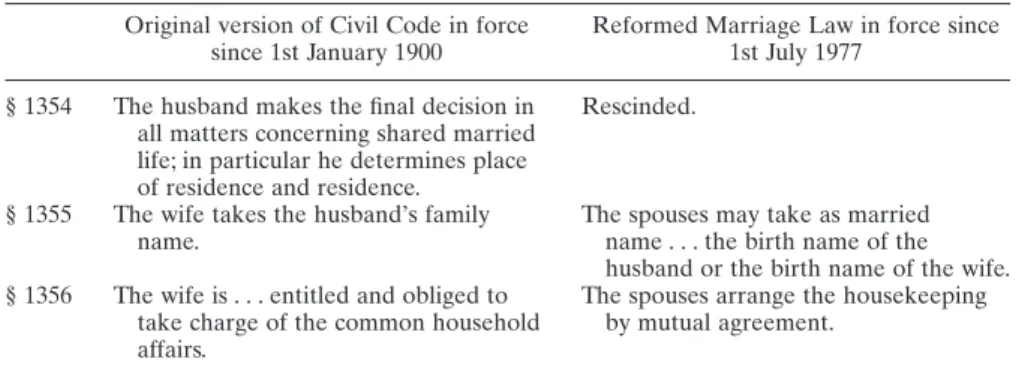
of various forms, for each of which equal rights already exist or are being claimed’ (Lüscher 1994: 19). Consequently there has been a relativization of ideas of normality. And that is the crucial point. There are not only more and more ‘deviations’ appearing, whose popularity is growing. What is important, rather, is that formerly deviant forms of co-habitation are now increasingly normalized and accepted, both socially and legally. This change in models, which turns abnormality into normality, is a central characteristic, an opera-tional criterion of the meta transformation of the cultural conditions of life. In other words, what is now establishing itself is not only diversity, but something much more than that: thenormalizationof diversity, both with regard to family law and to the self-image of family members, and finally even in the observer perspective of the sociology of the family. Meta-transformation with respect to law means an increasing number of regulations are being introduced, which have the deliberate aim of turning collective requirements into individual opportunities for choice. This is especially the case, where the order of gender relations in marriage is concerned. A fundamental reform of the relevant sections of the law has taken place in many countries. The transformation in the German legal system can be taken as an example (see Table I).
In addition, in Germany as in other Western countries, there are many other changes, all leading in the same direction –The Normal Chaos of Family Law
(see Dewar 1998; Mason, Fine and Carnochan 2001; Röthel 1999; Barlow and Grace 2004). Further examples, to mention but a few, are easier divorces, the improved legal position of children born outside marriage, the improved legal position of long-term relationships outside marriage, and the increasing acknowledgment of long-term homosexual relationships. In every case the legislators see it less and less as their role to prescribe just one kind of partnership as obligatory. Instead the decision of choosing between a number of forms of co-habitation, all with an equal legal status, is left up to the individual. Yet precisely this development sets in motion – a consequence
TABLE I: Transformation of family law in Germany
Original version of Civil Code in force since 1st January 1900
Reformed Marriage Law in force since 1st July 1977
§ 1354 The husband makes the final decision in all matters concerning shared married life; in particular he determines place of residence and residence.
Rescinded.
§ 1355 The wife takes the husband’s family name.
The spouses may take as married name . . . the birth name of the husband or the birth name of the wife. § 1356 The wife is . . . entitled and obliged to
take charge of the common household affairs.
The spouses arrange the housekeeping by mutual agreement.
which is both paradoxical and foreseeable – a regulatory spiral. When gay or lesbian couples marry or are able to enter into an official partnership, does that mean, that they also have a right to parenthood, through adoption or thanks to progress in reproductive medicine? If it is no longer taken for granted that on marriage the wife takes the husband’s name, which name should their children receive? If increasing numbers of people marry for a second and third time, how can financial resources be fairly distributed between partners and ex-partners and ex-ex-partners and their various children etc.?
Theempirical observation of institutional developments, which is necessary
to any scrutiny of individualization theory, confirms dramatic changes, as do studies in contemporary history, in particular those by Ulrich Herbert (2002, 2007). Within the space of about 15 years, that is, within a single generation, a similar change in the accepted model took place, almost simultaneously, in almost all European societies and not just for a few groups, but for all groups. Such a comprehensive and fundamental institutional change, which shifts the opportunities and risks of making decisions onto individuals, and in such a short time, is historically unparalleled. It is extended in the (Social Democratic or Conservative) concept of the ‘active welfare state’, which dominates the social policy agenda in all Western countries and links three principles: the development of human capital (education), individual responsibility and inte-gration into the labour market. Evident here is the extension of the institu-tional production and reproduction of the individualized individual. It is simultaneously an example of how the impossible task of finding biographical solutions to systemic contradictions is imposed on individuals. With reference to Canadian reform policies Janine Brodie similarly comes to the conclusion, that the active welfare state:
is a quintessential example of neo-liberal individualization ( . . . ).Although it identifies Canada’s poor by group-based or systematic markers, its proposed strategies for poverty alleviation are framed in terms of individual choices and private solutions. As such, this policy advice simultaneously downloads all responsibility for structural inequalities and risk management onto viduals and validates the market as the primary mechanism whereby indi-viduals secure personal security and well being. (Brodie 2007: 220)9
as expectation of others and as self-image – but at the same time social inequalities are intensifying, how can this ambivalence of an ‘individualized class society’ be sociologically and politically decoded (Nollmann and Strasser 2007)?11The argument of the individualization theorists is that objective fea-tures (income, position in the hierarchy) and subjective feafea-tures (conscious-ness, lifestyle, leisure interests, political attitude) diverge. Many individuals may still be in the same position. But there is no common and unifying explanation for their suffering, even more: they have to blame themselves. The consequences can be demonstrated with the help of the historian Edward Thompson (1980). In his essay,Class Struggle Without Classes, he writes: ‘Class as a product of the capitalist industrial society of the nineteenth century, which then shaped the heuristic understanding of classes, has no claim to universality, but is nothing more than a subordinate case of the historical formations which emerge from class struggles’ (Thompson 1980: 268). Here Thompson points to the key insight of the post-class diagnosis of inequality, given that he argued, that class conflict existed before classes existed, and that such a formation of classes out of social conflicts was by no means an historical law, but rather a special or exceptional case. This is exactly the position of the theory of the individualization of social classes. Individualization transforms class struggle, which, to adapt Thompson, precedes class. There emerges a capitalism without classes, more precisely: without classes for themselves. Individualization uncouples class culture from class position; as a result, there are numerous ‘individualized class conflicts without classes’, that is, a process in which the loss of significance of classes coincides with the categorical transformation and radicalization of social inequalities.
uninformed by individualization theory can be exposed even in these empiri-cal findings:
(1) The unreflected equation of constancy of educational level attained with the constancy of social classes underestimates the ‘elevator effect’ (Beck 1983) which the individualization perspective places centre stage. Even if the relations of social inequality (i.e., operationally speaking, the hierarchy of educational levels attained) have remained constant, the opening up of the universities in the 1960s and 1970s may have made it possible for many children from working-class homes to rise up the social ladder.Theirchildren are now likewise studying, but in the sta-tistics they already count as the children of parents with a university education. We are (possibly) dealing with a paradox here, i.e. the more working-class children have risen in terms of social class in the course of educational reform, the more constant the class structure appears to be, because the working-class children who have gone up the social ladder now ‘pass on’ their educational status to their children.
(2) The false conclusion of the leap from statistical constancy to social constancy of the ‘working class’ covers up the key question:whoare the persons and groups, who are now statistically subsumed under the con-stancy of the substantive term ‘working class’? In Germany, at any rate, it is the case that the cultural homogeneity of the so-called ‘working class’ has been dissolved in a process of ‘internal globalization and pluralization’. This can be demonstrated by the explosive increase in the proportion of foreign or immigrant youth completing their school edu-cation at a Hauptschule, the lowest rung of the eduedu-cational ladder. The constancy of social classes unreflectedly assumes the constancy of the national membership of the members of these classes. Here too it is the case, that class culture and class position are being uncoupled; the multi-ethnic, multi-national working class is no longer a working class.12 The question, regarding how nation and class are merged in the same educational categories, assumes a change of perspective, a ‘cosmopoli-tan outlook’. The critique of methodological nationalism is, however, primarily a self-critique of individualization theory. This is because not only class theory, but also individualization theory is trapped in the dead end of ‘methodological nationalism’: both analyse the transformation of social inequalities in the framework of the anachronistic gaze of a territorially defined nation state.13
III. The transnationalization of social inequalities
they would be challenged by border-transcending class conflicts. Looming on the political horizon was an international working-class movement, which presented the perspective of a world revolution. Marx’s ideas put the nation state in a panic. Its response was to locate the class problem, which emerged with explosive force out of the upheavals of industrialization, as a problem internal to the nation state. Thus the transnational class dynamic was trans-formed into many separate national ‘social questions’, and from that point on the integration of the proletariat into nation state societies was at the forefront of politics. This task had such a high priority, that such diverse attempts at a solution as Socialism, the welfare state and the sociology of class were involved, all tacitly accepting the national frame of reference. In the end the effort was so successful that national integration and solidarity as conditions of class order and class conflicts became simultaneously real and unrecognizable.
Critique of methodological nationalism
Class theory and sociology after Marx has (with a few exceptions) concen-trated on the economic position within the nation state. Put another way, the order, which the class order makes possible, is based on the principles of nationality and ethnicity, but the sociology of class has not and does not (adequately) address this theme. Most theorists of class, including Bourdieu, who gave so much thought to globalization in his final years, have identified class society with the nation state (Atkinson 2007: 359). The same is true of Wallerstein, Goldthorpe and many others.
constitute the unit of reference, the frame, in which the conflict-laden questions of the material distribution of resources are dealt with. The social scientific gaze, under the spell of methodological nationalism, can simply not
see that the combination of nationality and territoriality pre-eminently fixes the social position of individuals and groups on a world scale. Antecedent to the status which can be acquired within a national-territorial frame is the rank and political status of the nation of origin in the international system (e.g. in accordance with the distinction between centre and periphery).15
In other words, methodological nationalism is based on a double assumption of congruence: on the one hand the congruence of territorial, political, eco-nomic, social and cultural borders, and, on the other, the congruence of actor’s perspective and social scientific observer perspective. The premises of the normative-political nationalism of the actors become the unreflected premise of the social scientific observer perspective. Both congruence assumptions are mutually reinforcing. The consequence is that conventional ‘objective’ social theory and even the methodologically most sophisticated ‘value free’ empirical research ‘harbors a political position. Scholars who are methodological nation-alists not only take the boundaries of the nation-state for granted but also contribute to the reproduction of their state’s projects’ (Glick Schiller, Caglar and Guldbrandsen 2006: 613; Kurasawa 2007).
The research questions which arise, not least after the radicalization of social inequalities, because of the incongruity of boundaries (that is, when the con-gruence between political and socio-economic status dissolves) cannot even be posed, neither empirically, nor theoretically, nor politically, still less answered, within the framework of methodological nationalism. Territorial, state and economic, social boundaries certainly continue to exist, but they are no longer co-terminous! That triggers an avalanche of questions as to theambivalenceof co-national or multi-national spheres of action and situations, thecontingency
of non-congruent boundary constructions which have to be decoded as the result of collective and individual decisions and to the production and repro-duction oftransnationalspheres of activity and inequality (Mau 2007; Vertovec 2006).
Only in the systematic shift from the national gaze to the cosmopolitan outlook do the big blind spots – and sources of error – of the methodological nationalism of individualization and class sociology become recognizable. This is because only in the framework of such a cosmopolitan sociology of inequal-ity can the fundamental asymmetry of a perception of inequalinequal-ity trapped in the national gaze be uncovered, both in social terms and in terms of the perspec-tive of social science. Until then, the ‘legitimizing performance’ of the national welfare state will not become even visible, i.e. the latter turns its attention exclusivelyinwards and thereby excludes transnational or global inequalities from the field of vision of the relatively privileged. Only when thenation state
established for social and political actors, as well as for the observer and research perspective of social science, is it possible for politics and sociology, in an unreflected coalition, to concentrate on social classes and their regulation in the internal national space. The ‘functional performance’ of the nation state in ‘legitimating’ global inequalities derives not least from the fact that political comparisons can only be played outintra-nationally and neverinter-nationally. Delegitimizing comparisons in turn also always assume national norms of equality. Consequently, the differences in income, for example, between Nige-rians and Germans, South American women and Finnish women, Russians and Chinese, Turkish women and Korean women can be very great, even with the same qualifications and the same work, but this only becomes delegitimizing, when these comparisons are made within a common perceptual horizon of institutionalized equality. This can be given through membership of a nation or in a globally operating company, but also perhaps in ‘European society’ (see below).
At the same time methodological nationalism fails to recognize that the ability to cross borders and the possibility of doing so has become an essential resource of social inequality in a globalized world – whether through the possession of mobile capital or mobile cultural capital or whether, on the other hand, through being ‘bound to place’, e.g. through agricultural production or the territorial link to jobs with welfare state protection. Of prime importance is not continuous mobility, but theoptionof being able to exploit economic and cultural capital transnationally (Weiß 2005: 714).
Politics of framing
The following may be used to argue against this critique of the national introversion of class researchers. From world system theory (Wallerstein 1983) and dependency theory, to the broad field of development studies and the theorists of the globalization of classes such as Leslie Sklair (to mention only a few) there is a wealth of efforts and movements within sociology to research global inequalities. It is also true, that the global conditions of national inequalities, which are produced by factors like capital mobility, have long been on the research agendas of economists and social scientists. Is the critique of the methodological nationalism of the sociology of class, therefore, not in danger of forgetting and repressing research into global inequalities (see e.g. Martell 2007 as well as the overview in Kiely 2007)?
affirmative and transformative politics/policies (Fraser 2007) seems to me to be of central importance. The majority of social inequality researchers unquestioningly adopt the premises of international law, which assign indi-viduals to national societies – incidentally without the least empirical evi-dence! – as the premise of nation state framing. In this case, therefore, it is a matter of anaffirmativepolitics of framing. The clear-cut either/or of national and international, us and the others is adopted, theoretically and empirically, as the appropriate unit of social inequalities more or less without reflection. It is completely true that there is a great wealth of comparative international studies of social inequalities, but these too make use of nation state averages and don’t even think of including in their comparisons individuals in inequality categories which transcend and mix up national borders.Globalinequalities – as interesting and important as these may be – usually presume nation state averages. Three examples of the application of methodological nationalism may be distinguished:nationalframing,international comparative framing and
globalframing. These are all based on an unreflected affirmation of the
politi-cal and legal grammar of national boundaries as the premise of the framing of social science research into inequality.
This is to be distinguished from thecosmopolitanoutlook, which pursues an activetransformativepolitics of framing. The nation state principle no longer answers the Who-question of social inequality. In a globalized world the nation state framing loses its aura of self-evidence. In the face of geo-political insta-bilities the experience of ‘globality’ spreads (Albrow, Robertson). That means, for example, decisions taken within one territorial state significantly alter the situations of people living beyond the borders of that state, The same is true of the decisions of companies, transnational enterprises, the communication and information flows of the internet, the speculators of casino capitalism, supra-national organizations, global risks, transsupra-national public spheres etc. etc. But because under conditions of cultural, economic and political globalization nation state boundaries increasingly resemble a Swiss cheese in which there are more holes than cheese, people in their socially unequal positions find themselves more vulnerable to transnational currents, forces and powers. Con-fronted by climate change, the spread of Aids, the incalculability of transna-tional terrorism and the unilateralism of the world’s greatest military power more and more people find themselves exposed to the experience, that their conditions of life and survival are at least as much dependent on processes which penetrate the borders of nation states as on ones which appear within nation state control.
soon leads to conflicts as towho pays as member, that is,howis the relevant social unit defined? The key question which then arises for methodological nationalism is how can the frames, the units of social inequalities be con-structed across borders and between people and populations whose identities also include solidarities which are based on other interactive and participatory classifications than nations and political units?
Below I would like to at least sketch out a couple of answers to this question, by conceptually elucidating the social grammar of transnational, post-class specific forms of social inequality – (1) Inequalities of global risks, (2) pan-European inequalities and (3) border artists. The argument is this: the end of national class society is not the end of social inequality, but precisely the opposite, the birth of more radical, new ‘cosmopolitan’ forms of social inequal-ity, to which (so far) there are no institutionalized answers (trade unions, welfare state).
IV. The inequality of global risks
I have argued, that the nation state principle is no longer in a position to adequately describe inequalities. What can replace it? My suggestion is the
side-effect principle. This states that belonging to a unit of social inequality are persons, groups, populations, across nation state boundaries who are signifi-cantly affected in their situations and life opportunities by the consequences of the decisions and structures of others. Methodological nationalism can once again be defined from this viewpoint. Within its horizon the nation state principle coincides with the (side-) effect principle. This is precisely what no longer holds good in world risk society (climate change, terrorist threat, finan-cial crisis). There are now not only national, but cosmopolitan horizons: the search for a new future-oriented, planetary ethics of responsibility which turns subjection to the decisions of others into a political issue and finds advocates in new cultural movements (Beck 2007).
unborn generations.16National boundaries don’t have to be removed for this flourishing export of dangers, rather their existence is a precondition of it. It’s only because these walls, restricting sight and relevance, persist in people’s heads and in law that what is done with deliberation remains ‘latent’ and a ‘side effect’. Money is saved, if the risk is transported to a place where safety standards are low and the arm of the law cannot reach, in particular the arm of one’s own national law. That is as true of the export of torture as it is of the export of waste, dangerous products and controversial research. Accordingly dangers are ‘deported’ – to low safety countries, low wage countries, low rights countries. To the cosmopolitan gaze the distribution of ‘latent side-effects’ follows the pattern of the exploitation of marginal, peripheral regions where the law is weak, because here civil rights are a foreign phrase and where political elites maintain their position of remaining largely unresisting ‘side-effect countries’ and of assuming the ‘latent’ ‘maximization of dangers’ in the interests of a maximization of profit.
The non-perception of risks or the unwillingness to perceive them increases with the lack of alternatives in human existence. The risks are passed on to a place where they are not appreciated or not taken seriously. The acceptance of dangers in these countries is not to be equated with agreement. Their conceal-ment and the accompanying secrecy are the product of deprivation. Put dif-ferently, dangers are not accepted, they are imposed. And it goes unnoticed, thanks to the power to present processes as if nothing of importance is happening.
The dismissal of risks in states, in which poverty and illiteracy are especially widespread, does not mean, therefore, that these societies are not integrated into world risk society. In fact, it’s the other way round. Thanks to the scarce resource of silence, which they offer as their specific form of wealth, they are the worst affected. There is a fatal attraction between poverty, social vulner-ability, corruption and the accumulation of dangers. The poorest of the poor live in the blind spots which are the most dangerous death zones of world risk society.17
V. Pan-European inequalities
The pre-determined irrelevance of large global inequalities allows rich and powerful nation states to offload the risks of their decisions onto poor states (see above), a practice which is ultimately stabilized by the methodological nationalism of sociology which confirms and reinforces the national perspec-tive of activities. The sociology of class based on it doubles the national closure and depicts itself and its object of research in accordance with a nation state ‘nativist scholarship’. What elsewhere would be considered problematic in terms of scholarship is here unreflectedly elevated to the level of a method-ological principle: self research. This autism of the national gaze comes into conflict with the processes of Europeanization. That raises the question, what transnational, pan-European dynamic of inequality is emerging from Europe’s political integration (Beck and Grande 2007: ch. VI)?
With respect to this question, it’s not only a matter of which conflicts are already emerging with Europeanization, but also, primarily the meta-theoretical second order question as to which categories and co-ordinates characterize the pan-European conflict dynamic (Kriesi and Grande 2006). Is it possible to simply assume that the narrative of classes, which developed in the frame of nation states and national societies, is also applicable at the European level? Hardly. But then how are the first order What-question and the second order Who-question of social inequality related within the frame-work of Europe as a whole?
The eastward expansion of the European Union does not mean the coloni-zation of countries, nor are there likely to be unforeseeable migration flows, but something perhaps much more serious is taking place – whole countries are ‘emigrating’ to the EU. The framing of social inequality is therefore mutating. The second order question – who is unequal? – is in the process of being transformed. Voluntary collective immigration of states is an historically new phenomenon. What does that mean for the ‘ethnic’ self-definition of the European Union, and which has, thus far, been characterized by a kind of ‘West European racism’, which hardly needed to, or even could, see itself as such? Also, what does it mean for the pan-European structure of inequality and conflict?
the previous approaches, in terms of shared social and historical features. But nowhere do the key questions of a macro-sociological European dynamic even come into view. How can a societal space and its dynamic, to which national societies belong, be understood when, at the same time, it does not itself obey the national society premises of social cohesion, cultural homogeneity, political participation and welfare state assistance (Heidenreich 2006; Bach 2004; Delanty and Rumford 2005)?
Europeanization is characterized by a meta-transformation, i.e., the basis of the boundary construction and division of labour between national and inter-national politics is removed. Europeanization is, therefore, the classic historical example of a change in the form of social inequality through the de-limitation of national spaces. If, broadly speaking, one wishes to formulate a relationship between encapsulated nation state class analysis and the expansion and con-solidation of the EU, then one could say that the more Europeanization there is, the more the principle of comparability replaces the principle of the incom-parability of social inequality between nation state spaces, and the more the diversity of national cultures of inequality in Europe emerges within a Euro-pean framing, the more explosive the pan-EuroEuro-pean dynamic of inequality becomes. Whereas in the nation state epoch of First Modernity the economic and social differences between the European countries could be mutually ignored, with progressive Europeanization these differences now collide.
As a result of the economic and political de-limitation of national spaces the methodological nationalism of class theory and sociology is now also subject to examination. The supposed strict separation of national and international spaces (whereby civil, political and social basic rights and equality standards were institutionalized in national spaces, and international spaces arose through the mutual recognition of sovereign states) is eroding. And with that the gates are for the first time being opened to Europe’s volcanic landscapes of inequality. How do pan-European conflict dynamics interact with specific, regional, national and individual inequalities?
VI. Border artistes: agency, legitimacy and immigrant dynamics
accumulation of life chances, has become a key variable of social inequality in the globalized world.
While spatial relations are without doubt diverse, their influence on posi-tions of social inequality can be reduced to two aspects.Spatial autonomy
constitutes an advantage in itself. If spatial autonomy is compromised, the
quality of the spaces to which an actor is limited or gains access is an
important factor shaping positions of social inequality. (Weiß 2005: 714)
Several components are involved here:
First: Whoever belongs to a unit of social inequality, obeys not only an admin-istrative definitional power (passport holder, citizen), but also emerges from the agency of active transnationalizationfrom below. If it is true, that in Second Modernity borders blur and mingle, then the type of the ‘average (im)migrant’ is the embodiment of the blurring of borders between nations, states, legal orders and their contradictions. In order to survive, the average (im)migrant must become an artiste of the border (slipping under the border, using the border, setting the border, bridging the border etc.), and he or she can fall from the high wire of border use on which he or she is balancing. From the national perspective it is impossible to see the potentially criminal migrant as part of an avant garde of transnational mobility. Likewise, there is no thought, that these mobile populations are rehearsing a cosmopolitan form of existence; instead they appear recalcitrant, since they refuse assimilation.
Second: If one understands the capacity for border crossing, of border use as constitutive of transnational situations of inequality, then it is possible to show (as an initial step) how new kinds of radicalized hierarchies of inequality emerge beyond nation and class:
While the upper and some middle layers of world society extend their life-worlds to the globe, the lowest positions are affected by global dynamics, but reduced to their immediate surroundings in the opportunities for action. (Weiß 2005: 716)
the immobile parts of the population are also affected by the transnational-ization of inequality.
Third: In these ways of life, where border-crossing against possibilities are tested by poverty and wealth,various nation state spaces of social inequality
intersect and penetrate one another. But typically the mobile individuals find themselves unequally placed in the various framings of social inequality. At the same time it is the case that the greater the spatial autonomy of individuals (family and ethnic groups), the less important the border becomes.
In this context, with respect to political status, Aihwa Ong talks of ‘flexible
citizenship’ (Ong 2002). She refers in particular to attempts by top Chinese
entrepreneurs, managers, technocrats and business professionals to ‘exploit shifting national rules of affiliation for investment, work and relocalization in a vast international diaspora as they . . . seek to evade, deflect and take advantage of political and economic conditions in different parts of the world’ (Ong 2002: 174). Caroline H. Bledsoe (2004) provides a vivid example of strategic practices of border use: ‘anchor babies’ in the USA. ‘This term refers to children who, by virtue of their birth on US soil, become the means by which their families stake a future claim on legal US residence’ (Bledsoe 2004: 98). Since anyone who is born on US territory is automatically granted American citizenship, and since at the age of 18 a citizen born in the USA has the option of uniting family members, the adultanchor babybecomes a social actor answering the Who-question of social inequality, in that he or she brings all kinds of family members into the country as legal citizens.18 More precisely, the unequal resource of border crossing and border use contains three components:
(1) Anyone who disposes of the appropriateeconomic or cultural capital, which places him or her in a position to choose the optimum context for its realization, finds himself in a better position than those who (for whatever reason, e.g. agricultural ties to the land or welfare state ties to particular jobs) are bound to nation state frame and space in the devel-opment of their life chances (Weiß 2005).
(2) In addition there are theunintended instrumentalization opportunities of
border regimes.All attempts to make the politics of separation legally and
militarily watertight, open up unwanted and un(fore)seen holes, which the resourceful and experienced know how to make use of, in order to assemble border-crossing forms of existence.As states respond, attempt-ing to impose a clarity that will in turn allow them to impose restrictions, their efforts will inevitably create yet more loopholes and ambiguities of which people at the margins in turn will try to take advantage.
(3) At best tolerated, often criminalized, the ‘loop hole artistes’ are
extremely functional, even if they appear illegitimate or illegal in the
and tacitly tolerate or even encourage the employment of immigrants, ethnic minorities and women in the highly segmented labour markets at the centre. Because the extra-functional qualifications, which migrants offer, combining social competences with a readiness to work for low wages and to accept contracts (to the extent that these exist at all) which provide little protection, they are extremely functional for certain seg-ments of low skill sectoral labour markets. The transnationalization of capital, about which there is so much talk today, is complemented by a very restrictive transnationalization of cheap labour that is mostly not recognized and acknowledged for what it is: the model of an experimen-tal cosmopolitanism from below and out of impotence, in that a minimum (level) of change of perspective, dialogic imagination and inventiveness in dealing with the contradictions inherent in the border regime become the condition of survival.
The new type of a migrant everyday cosmopolitan develops his abilities to deal with otherness through the border experiences of culturalization and ethnicization. In the receiving societies (im)migrants become, almost inevi-tably, experts in the cultural system of distinction, which turns them into ethnic others, above all in its banal manifestations in everyday life. On the basis of these experiences there emerges a reservoir of ‘labels’ for the migrants’ everyday culture: e.g. for a temporary strategic self-ethnicization or for the many forms of ‘ethno-mimicry’, which are presented to multi-culturalism in order to outwit it . . . Neither the pleasure nor the burden of difference is attached to this culture. Here culture and identity are not autonomous horizons, to be expanded in the interests of an education in world citizenship. They are, rather, inseparable from a long history of hege-monic cultural and identity politics, which is inevitably also part of a specific, subjective history. And hence this cosmopolitanism depicts no utopias of paradisical, postnational conditions, but at best precarious heterotopias, which envisage the dream of a better life beyond the border quite practically and politically, within the terms of the doable. (Römhild 2007: 620)
VI. Prospect: The ‘modernity dispute’ in international sociology
Will Atkinson has publicly accused me of once again proclaiming ‘the death of class’. I plead not guilty due to proven innocence, but turn the tables and accuse Atkinson and the sociologists of class, for whom he speaks, of having barricaded themselves in the (world society) idyll of welfare state class analysis and, as a result, struck by self-imposed blindness, have failed to recognize the transformation and radicalization of social inequalities in a globalized world. Cosmopolitan forms of social inequalities should be confused neither with
notions – both in terms of their constitutive contents and with respect to their policy implications (Milanovic 2007; Pogge 2007; Thompson 2007; Held and Kaya 2007). The crucial difference between cosmopolitan forms of inequality on the one hand and global, international and national forms of inequality on the other lies in the choice of unit of reference, in the politics of framing. In one case, the dualism of national and international is taken for granted, in the other, it’s cancelled. For the former, the relations of social inequality are located primarilywithinnations (or in the comparison between nations), in the case the dualism of national and international is cancelled, the relations of social inequality are located across borders, that is, conceptualized as a relationbetweennations.
Global inequalities follow the principle of general universalism, i.e. the horizon of equality and accordingly the unit of social inequalities includes
everyone; no distinction is made between nationality or other classifications
(such as profession, gender, class, ethnicity etc.). International inequalities follow the principle of national particularism. The national or international comparative sociology of inequality and class separates the national social structures and allocates them to national sociologies in accordance with meth-odological nationalism. In the case of national and international inequalities the answer to the Who-question, who determines who belongs in the sphere of politically relevant inequality?, accords with the authority of states. Without doubt, there is a need for a third conception with adequate recognition of the plurality of border-crossing relations of social inequalities across the globe.
Anyone who ignores these non-global and non-international but cosmopoli-tan transformations and radicalization of social inequalities and marches on in step with welfare state class analysis is not being true to the task of the sociologist, that is, to explain the sudden otherness of the society in which we live. Strict modernists will read from their highly sophisticated empirical data that the class paradigm of the modern national society has timeless authority and compelling, canonical validity. Here one comes up against a paradoxical vulnerability of modernity, its inability to consciously age and its skill, even as it grows older, it stays with the conventional data production. This way one can say sociology of modernity is covering a political position in favour of the values and ideologies of the nation state. Thus modern sociology, which once broke all taboos, has itself become a taboo. It must not be questioned and put in doubt by cosmopolitan alternatives. A modernism, which was once the embodiment of the future is today largely concerned to anaesthetize the curiosity which is so vital for sociology.
of modernization. Ultimately at issue is, the extent to which sociology is equipped, intellectually and methodologically, to adequately understand and explain its object – the dynamic of a modern society which overthrows its own conceptual premises (Beck, Bonß and Lau 2003; Beck and Lau 2005). Since the early 1980s I have been trying both to conceptually grasp this paradigm dispute and to encourage it, by distinguishing betweensimple (orfirst) and
reflexive (or second) modernization. From the standpoint of the latter, the
modernization of modernity, it is not the crises, but the successes of radicalized modernization which have fundamentally altered social and political land-scapes worldwide and at great speed, overturning seemingly eternal basic categories like class and nation state. Routine breaks down in the face of these dramas of reflexive modernization. We are witnesses to the emergence of a new kind of capitalism, a new kind of internationality, new kinds of social inequalities, new kinds of nature, new kinds of subjectivity, new kinds of everyday co-existence with the excluded, indeed even a new kind of state organization, and it is precisely this kind of epochal transformation of meaning, which sociologists must understand, research and explain.
The other side in the debate – the majority – no matter to which theoretical school it belongs, generally perceives no sign of such a ‘meta transformation’ in the sense of a transformation of the frame of the transformation. It declares the ‘reflexive modernizers’ to be fantasists, mere journalists, essayists lacking empirical substance and evidence. They understand modernity as always having been a mixture of routine and drama19, as fields of activity, in which there are exceptions to continuing normality or simply anomalies.
My view, however, of the dramas of modernization at the beginning of the twenty-first century is also clearly distinct from those of Anthony Giddens and Alain Touraine. Giddens (1990) emphasizes, that the individual can benefit from the ever more abstract and globalized structures, which the development of modernity produces. Touraine (1992), on the other hand, fears that these structures are being increasingly and lastingly ‘hardened’ by scientific methods, so that the individual ultimately becomes an appendage of ever more rational production processes and leads a stunted existence as a ‘consumer unit’. To me the structures of (simple) modernity are very far from being as stable as Giddens anticipates or as Touraine fears. Exactly the opposite is true: they are eroding, disintegrating, and in the vacuum that arises the various players must learn – on an unfamiliar terrain of radicalizing cosmopolitan inequalities – to explore, without falling, their new sphere of activity in the context of uncertainties and not-knowing (and not being able to know).
credit of Atkinson’s lively and ironic attack on my voluntary and involuntary provisional arguments and exaggerations, that the silence about this ‘moder-nity dispute’ has now been publicly broken.
We are under the spell of a sociology, whose foundations were conceived and developed in the past hundred years. The first century of sociology is over. On the way into the second, which has now begun, the space of sociological imagination and research has to be opened up and determined anew, i.e. opened up to the cosmopolitan constellation. Learning about others is not simply an act of cosmopolitan open-mindedness but an integral part of learn-ing about and understandlearn-ing the reality of ourselves or even viewlearn-ing ourselves as other. A cosmopolitan sociology (Beck and Sznaider 2006) means a sociol-ogy which reflects on the ontologized premises and dualisms of a nation state sociology – such as national and international, us and them, internal and external – in their significance for the grammar of the political and the social, as for the determination of the sociological field of investigation, and in this way gains a new sociological perspective, not least on the phenomena of social inequality. A cosmopolitan sociology clearly distinguishes itself from a univer-salist one, because it doesn’t start out from something abstract (usually derived from a European historical experience and context, e.g. ‘society’ or ‘world society’ or ‘world system’ or the ‘autonomous individual’ etc.). Instead key concepts like contingency, ambivalence, interdependence, interconnectedness take centre stage along with the methodological questions posed by them. Cosmopolitan sociology, therefore, opens up indispensable new perspectives on seemingly isolated, familiar, local and national contexts. With this new ‘cosmopolitan vision’ it follows the empirical and methodological paths which other disciplines – such as contemporary anthropology, geography, ethnology – have already taken with enthusiasm.
(Date accepted: August 2007)
Notes
1. I would like to thank especially Jacob Arnoldi and Anja Weiß, also Elisabeth Beck-Gernsheim, Angela McRobbie, Peter A. Berger, Edgar Grande and Daniel Levy for their very helpful comments and references.
2. Jenseits von Stand und Klassemy initial essay on the individualization of social inequality was published almost 25 years ago.
3. The titles of the three books arePower in the Global Age(2005),The Cosmopolitan
Vision(2006) and (with Edgar Grande) Cos-mopolitan Europe(2007); the three volumes appeared in German in 2002, 2004 and 2005.
4. Atkinson (2007): Abstract.
5. An example is the interesting study ‘How individualised are the Dutch?’ by Paul de Beer (2007). Here individualization is made operational withdetraditionalization,
degree of institutionalized individualization in Holland (see below).
6. In earlier publications (drawing on Parsons), I have used the term ‘institutional-ized individualism’; that, however, mixes
up the objective and the subjective
dimension and leads to corresponding misunderstandings.
7. In the original version of the theory (1983; English translation 1992) I attributed individualization causally above all to the education system, educational reform; only subsequently did I extend causal attribution to the welfare state and its contemporary reforms.
8. After 25 years of research and debate some lack of clarity of the original version has been overcome. Now it is evident, not that the argument is ambiguous, but that reality is more complex; this is true, in par-ticular, if one also takes into consideration the transformative power of risk distribution and transnationalization (see below).
9. Zygmunt Bauman sums up the
ambivalence: ‘The subjects of contemporary states are individuals by fate: the factors that constitute their individuality – confinement to individual resources and individual responsibility for the results of life choices – are not themselves matters of choice. We are all today “individualsde jure”. This does not mean, though, that we are all “individualsde facto”. More often than not, control over life is the way in which the story of life is told, rather than the way in which life is lived.’ (Bauman 2001: 69; Bauman 2002, see also Schroer 2000 and Elliott and Lemert 2006)
10. These are the themes of the concep-tually and empirically highly differentiated life course research; for recent work/ research see Cosmo Howard (2007) or on specific topics Budgeon (2003), Elliott (2001), Furlong and Cartmel (1997), Mayer, K.U. (2004), Mills (2007), Mythen (2005), Nies (2007) and many others.
11. Nollmann and Strasser (2007) try to build a bridge between theories of individu-alization and class. ‘Individualisation theo-rists argue that individuals no longer consider themselves as class members with a
common fate and destination. At the same time, empirical studies show a more or less unchanged effect of class membership on education and life chances. These two points of view do not necessarily indicate irrecon-cilable assumptions. Rather, they refer to two different objects of sociological research. Individualisation theorists refer to the causal assumptions people seem to show more often in their attitudes and behavior, whereas class researchers refer to causal knowledge we can see from outside as scientific observ-ers’ (Nollman and Strasser 2007: 114). This original and challenging essay has two weak-nesses: 1) it underestimates the contingency of subjective reactions; 2) it remains tied to methodological nationalism.
12. The ‘super diversity’ of class also con-tains, not least, persons with a higher educa-tion, whose educational capital is not recognized (Weiß 2005; Vertovec 2006).
13. This is, incidentally, also true of the very stimulating and in many respects clari-fying discussion volume ‘Contested Individu-alization’ (2007) edited by Cosmo Howard.
14. See here also Nancy Fraser (2007), who suggests this in the context of ‘refram-ingjusticein a globalizing world’.
15. There are, however, initial reflections on this overlap and (inter)penetration of national society and world society position of social inequality in Wallerstein.
16. Many will perhaps think they see a contradiction here: On the one hand I main-tain that there is the objective expansion and qualitative novelty of risks – humanly produced threats (side effects of civiliza-tional advancement) which do not know state borders, class divisions, gender and ethnic differences etc., and are touching everybody equally with no privileged escape route. On the other hand, there’s the inequality of global risks. Here, too, there is no inconsistency in the approach, only the complexity of reality: both are true.
gentle a word in a world where so many are caught without hope ( . . . ). The worlds today are not so much risky as they are
deadly, and especially for those on the social and economic margins. Deadly worlds are violent worlds ( . . . ). There is a risk to be sure, but the ubiquity of violence in the world is something more.’ (2006: 177 f)
18. ‘A number of impoverished pregnant women every year try to reach the USA to give birth by undertaking dangerous cross-ings that parallel those in Europe: trekking across deserts, entering cargo containers,
and even crossing dangerous rivers. But the most striking cases may be wealthy Mexican women, who cross the border in the most routine manner, not just once, but multiple times, for prenatal checks with the physi-cians they have engaged to deliver them . . . In effect . . . the highly strategic use of just one birth can eventually transform an entire family into individuals with permanent legitimacy’ (Bledsoe 2004: 98).
19. ‘Routine’ and ‘drama’ are the two concepts Richard Sennett (2007) introduces to analyse the dynamics of risk society.
Bibliography
Atkinson, W.2007 ‘Beck, Individualization and the Death of Class’,British Journal of Sociology58(3): 349–66.
Bach, M.2004 ‘Unbounded Cleavages: Ter-ritoriale Expansion und soziale Ungleich-heiten in Europa’, lecture at the University of Bamberg, October 2004.
Barlow, A. and James, G.2004 ‘Regulating Marriage and Cohabitation in 21stCentury’, Modern Law Review67(2): 143–176.
Bauman, Z.2001The Individualized Society, Cambridge: Polity Press.
Bauman, Z. 2002 ‘Individually, Together’ Forword in U. Beck and E. Beck-Gernsheim (eds)Individualization, London: Sage.
Beck, U. 1983 ‘Jenseits von Stand und Klasse’ in R. Kreckel (ed.) Soziale Ungle-ichheiten, Göttingen: Schwarz-Verlag.
Beck, U.1992Risk Society: Towards a New Modernity, London: Newbury Park, Califor-nia: Sage Publications; German 1986.
Beck, U. 2005 Power in the Global Age: A New Global Political Economy, Cambridge: Polity Press.
Beck, U. 2006 The Cosmopolitan Vision, Cambridge: Polity Press.
Beck, U.2007Weltrisikogesellschaft, Frank-furt a. M.: Suhrkamp.
Beck, U. and Beck-Gernsheim, E.1995The Normal Chaos of Love, Cambridge: Polity Press.
Beck, U. and Beck-Gernsheim, E. 2002
Individualization: Institutionalized
Individu-alism and Its Social and Political Conse-quences, London: Sage.
Beck, U. and Beck-Gernsheim, E. 2004 ‘Families in a Runaway World’ in J. Scott,
J. Treas and M. Richards (eds) The
Blackwell Companion to the Sociology of Families.
Beck, U., Bonß, W. and Lau, C. 2003 ‘The Theory of Reflexive Modernization: Problematic, Hypotheses and Research Programme’, Theory, Culture & Society
20(2): 1–33.
Beck, U. and Grande, E.2007Cosmopolitan Europe, Cambridge: Polity Press.
Beck, U. and Lau, C.2005 ‘Second Moder-nity as a Research Agenda: Theoretical and
Empirical Explorations in the
“Meta-Change” of Modern Society’,The British Journal of Sociology56(4): 525–57.
Beck, U. and Sznaider, N.2006 (eds) Cos-mopolitan Sociology, Special Issue,British Journal of Sociology57(1).
Beck-Gernsheim, E. 2002 Reinventing the Family: In Search of New Lifestyles, Cambridge: Polity Press.
Bledsoe, C.H. 2004 ‘Reproduction at the Margins: Migration and Legitimacy in the
New Europe’, Demographic Research,
Special Collection 3: 85–116.
Brannen, J. and Nilsen, A.2005 ‘Individuali-sation, Choice and Structure: a Discussion of Current Trends in Sociological Analysis’,
Brodie, J. 2007 ‘The New Socialism’: Indi-vidualization and Social Policy Re-form in Canada’ in Cosmo Howard (ed.)Contested Individualization. Debates about Contem-porary Personhood, New York: Palgrave Macmillan.
Budgeon, S. 2003 Choosing a Self: Young Women and the Individualization of Identity, Westport, Conn.: Praeger.
Castells, M. 2003 ‘Die Entstehung der Vierten Welt: Informationeller Kapitalis-mus, Armut und soziale Exklusion’ in M. Castells Das Informationszeitalter (Band III). Opladen: Leske+Budrich.
Cosmo, H.(ed.) 2007Contested Individual-ization. Debates about Contemporary Per-sonhood, New York: Palgrave/Macmillan.
De Beer, P.2007 ‘How Individualized are the Dutch?’Current Sociology55(3): 389–413.
Delanty, G. and Rumford, C.2005 Rethink-ing Europe, London: Routledge.
Dewar, J. 1998 ‘The Normal Chaos of Family Law’,The Modern Law Review61.
Elliott, A. 2001 Concepts of the Self, Cambridge: Polity Press.
Elliott, A. and Lemert, C. 2006 The New Individualism, London and New York: Routledge.
Fraser, N. 2007 ‘Justice in a Globalizing World’ in D. Held and A. Kaya (eds)Global Inequality, Cambridge: Polity Press.
Furlong, A. and Cartmel, F. 1997 Young People and Social Change: Individualization and Risk in Late Modernity, Buckingham: Open University Press.
Giddens, A.1990 Consequences of Moder-nity, Cambridge: Polity.
Glick Schiller, N., Caglar, A. and Guldbrandsen, T.C. 2006 ‘Beyond the Ethnic Lens’, American Ethnologist 33(4): 612–33.
Goldthorpe, J.H. 2002 ‘Globalisation and Social Class’,West European Politics25(3): 1–28.
Heidenreich, M.2006 ‘Die Europäisierung sozialer Ungleichheiten zwischen nationaler Solidarität, europäischer Koordinierung und globalem Wettbewerb’ in Martin Heiden-reich (ed.) Die Europäisierung sozialer Ungleichheiten, Frankfurt a. M.: Suhrkamp.
Held, D. and Kaya, A. (ed.) 2007 Global Inequality, Cambridge: Polity Press.
Herbert, U. (ed.) 2002 Wandlungs-prozesse in Westdeutschland, Göttingen: Wallstein-Verlag.
Herbert, U. 2007 ‘Europe in High Modernity. Reflections on a Theory of the 20th
Century’,Journal of Modern European History, special issue 5(1).
Kiely, R.2007 The New Political Economy of Development: Globalization, Imperialism, Development, London: Palgrave.
Kriesi, H. and Grande, E.2006 ‘Globaliza-tion and the Transforma‘Globaliza-tion of the Na‘Globaliza-tional Political Space’,European Journal of Politi-cal Research45: 921–956.
Kurasawa, F. 2007 The Work of Global Justice – Human Rights as Practices, Cambridge: Cambridge University Press.
Lash, S. 2002 ‘Individualization in a
Non-linear Mode’, Foreword in U. Beck
and E. Beck-Gernsheim (eds) Individualiza-tion, London: Sage.
Lüscher, K.1994 ‘Was heißt heute Familie?’
in P. Brauns-Hermann (ed.) Verlorene
Liebe – gemeinsame Kinder, Reinbek: Rowohlt.
Marshall, G. 1997 Repositioning Class: Social Inequality in Industrial Societies, London: Sage.
Martell, L.2007 ‘Global Inequality, Human Rights and Power: A Critique of Ulrich Beck’s Cosmopolitan Politics’, unpublished paper, University of Sussex: Department of Sociology.
Mason, M.A., Fine, M.A. and Carnochan, S.
2001 ‘Family Law in the New millennium. For Whose Families?’ Journal of Family Issues22: 859–81.
Mau, S. 2006 ‘Grenzbildung; Homoge-nisierung, Strukturierung: Die politische Erzeugung einer europäischen Ungleich-heitsstruktur’ in M. Heidenreich (ed.)
Die Europäisierung sozialer Ungleichheit, Frankfurt a. M.: Campus.
Kratzer, N.2005 ‘Vermarktlichung und Indi-vidualisierung’, Soziale Welt 56(2/3): 247– 266.
Mayer, K.U. 2004 ‘Whose Lives? How History, Societies, and Institutions Define and Shape Life Course’,Research in Human Development1(3): 161–187.
Milanovic, B. 2007 ‘Globalization and Inequality’ in D. Held and A. Kaya (eds)
Global Inequality, Cambridge: Polity Press.
Mills, M. 2007 ‘Individualization and the Life Course: Towards a Theoretical Model and Empirical Evidence’ in C. Howard (ed.)
Contested Individualization. Debates about Contemporary Personhood, New York: Palgrave Macmillan.
Mythen, G.2005 ‘Employment, Individual-ization and Insecurity: Rethinking the Risk Society Perspective’, The Sociological Review53(1): 129–49.
Nies, S.2007 ‘Individualisierte Arbeitswelt’, Diplomarbeit, Universität München.
Nollmann, G. and Strasser, H. 2007 ‘Indi-vidualization as an Interpretative Scheme of Inequality: Why Class and Inequality Persists’ in C. Howard (ed.) Contested Individualization. Debates about Contem-porary Personhood, New York: Palgrave Macmillan.
Ong, A.2002Flexible Citizenship. The Cul-tural Logics of Transnationality, Durham and London: Duke University Press.
Pogge, T.2007 ‘Reframing Economic Secu-rity and Justice’ in D. Held and A. McGrew (eds)Globalization Theory. Approaches and Controversies, Cambridge: Polity Press.
Römhild, R. 2007 ‘Migranten als Avant-garde?’,Blätter für deutsche und internatio-nale Politik5: 618–624.
Röthel, A. 1999 ‘Nichteheliche
Lebens-gemeinschaften – neue Rechtsfragen’,
Zeitschrift für Rechtspolitik12: 511–19.
Rose, N. 1990 Governing the Soul: The Shaping of the Private Self, London: Routledge.
Rosenein, S. 2007 ‘Sutured Selves, Queer Connections: Personal Lives at the Cutting Edge of Individualization’ in C. Howard (ed.) Contested Individualization. Debates
about Contemporary Personhood, New York: Palgrave Macmillan.
Sassen, S.2006 Territory, Authority, Rights: From Medieval to Global Assemblages, Princeton, NJ: Princeton University Press.
Schroer, M. 2000 Das Individuum der Gesellschaft: synchrone und diachrone Theo-rieperspektiven, Frankfurt a. M.: Suhrkamp.
Scott, J.2006 ‘Class and Stratification’ in G. Payne (ed.)Social Divisions, Basingstoke: Palgrave Macmillan.
Sennett, R.1998The Corrosion of Charac-ter: The Personal Consequences of Work in the New Capitalism, New York: Norton.
Sennett, R. 2007 ‘Ritual and Drama’, opening speech on the occasion of the Munich Opera Festival.
Skeggs, B.2004Class, Self, Culture, London: Routledge.
Thompson, E.P.1980 ‘Die englische Gesell-schaft im 18. Jahrhundert: Klassenkampf ohne Klasse?’ in E.P. ThompsonPlebejische Kultur und moralische Ökonomie, Berlin.
Thompson, G.F. 2007 ‘Global Inequality, the “Great Divergence” and Supranational Regionalization’ in D. Held and A. Kaya (eds)Global Inequality, Cambridge: Polity Press.
Touraine, A.1992Critique de la modernité, Paris: Fayard.
Vertovec, S.2006 ‘The Emergence of Super-diversity in Britain’, unpublished manu-script, Oxford: University of Oxford.
Wallerstein, I. 1983 ‘Klassenanalyse und Weltsystemanalyse’, in R. Kreckel (ed.) Soziale Ungleichheiten, Soziale Welt,special issue 2, Göttingen: Schwarz.
Weiß, A.2005 ‘The Transnationalisation of Social Inequality’,Current Sociology53(4): 707–28.
Wohlrab-Sahr, M.2003 ‘Individualisierung: Differenzierungsprozeß und Zurechnungs-modus’ in U. Beck and P. Sopp (eds)