Business and Politics in a Criminal State: The Case of Equatorial Guinea
Geoffrey Wood*
Abstract
This article assesses the changing nature of the
contemporary political economy of Equatorial Guinea. It provides an overview of the complex and dynamic web of elite rent generation and explores the extent to which the development of an oil industry has contributed to a monoculture ofaccumulation. It is concluded that despite the oil windfall, other, 'illicit', modes of elite rent generation persist and have even intensified.
Dubbed the Kuwait of West Africa, the former Spanish colony of Equatorial Guinea has experienced extremely rapid growth as a result of the discovery and
exploitation of major offshore oil reserves.2 Less
enviably, the country has a well-deserved reputation for gross human rights abuses and corruption. Whilst
accumulation centring on a tiny elite is widespread on the continent, the concentration and nature of the activity has had particularly adverse consequences in Equatorial Guinea. Indeed, in his classic account, Small is not Always Beautiful, Max Liniger-Goumez suggests that the closest comparable examples can be found in the
former clan dictatorships of Latin America, including the Duvaliers’s Haiti, the Somozas’s Nicaragua, Porfirio
Diaz’s Mexico and Batista’s Cuba.4 Equatorial Guinea’s 'family caudillismo' Nguemist regime matches or exceeds earlier Latin American manifestations both in rapacity and brutality; President Obiang Nguema Mbasago is
regularly named as one of the worst despots in the world.5
This article provides an analysis of the political economy of Equatorial Guinea, which has been largely
neglected in recent Africa-related research.6 It provides
an overview of the complex and dynamic web of elite rent generation and explores the extent to which the
development of an oil industry has contributed to a monoculture of accumulation.
The Rise and Entrenchment of Nguemism
In the closing years of colonial rule, Equatorial Guinea enjoyed a flourishing cocoa sector and significant
growth, but this masked the persistence of a specific colonial tradition. The majority of the population remained locked in subsistence agriculture, with only a small minority integrated into the market economy; locals were largely confined to subordinate positions in public and private enterprises, with little prospects of upward mobility. Extensive use was made of migrant labourers from abroad.
associates; Francoism was succeeded by what has been referred to as Nguemism, rule by a small family elite.
In March 1969, an alleged abortive coup took place. Macias used this as an excuse to mount an extensive purge of both traditional leaders and qualified cadres; all political parties were fused into a United National Party.14 The constitution was suspended, with Macias
assuming dictatorial powers.15 Macias neglected all
functions of government other than internal security; almost all formal education ground to a halt, with most of the population being forced to revert to subsistence agriculture. The expulsion of most Nigerian contract workers and Spanish expatriates led to a 90% drop in GNP16. At the close of his reign, one third of the
population had been killed or exiled.17 Finally, Macias isolated himself in a bunker near his home village, and began murdering increasing numbers of his own family.18
In 1979, his nephew, Teodoro Obiang Nguema,
Commander of the National Guard and Military Governor of Fernando Po overthrew Macias. Obiang's brother had
recently been murdered at his uncle's behest, which may have prompted the coup. Obiang initially pledged to end the excesses of the Macias years, although few exiles were willing to risk returning; he retained Macias’
constitutional arrangements until 1980, facilitating his entrenchment of power. Civilian Nguemism was replaced by military Nguemism.19 A new constitution was introduced in 1982, with legislative elections being held in 1983;
multi-party politics were technically legalized in 1991, in response to Western pressure. However, Obiang remained committed to entrenching his personal authority and that of the clan; despite claims of acting as a 'liberator', his coup represented less of a 'revolution' than the reconstitution of Nguemism.
Recent Elections: Reaffirming Nguemism
Obiang won 97% of the vote in the 1996 presidential elections, a performance that was repeated in the
December 2002 ones.20 On the eve of the elections, the
principal opposition candidate, Celestino Bacale
withdrew, citing threats of violence.21 As with preceding
ones, the elections 'were marred by widespread fraud'.22 Parliamentary elections were last held in 1999; whilst new elections are due to be held in 2004, there is little sign that they will allow for a greater degree of political competition. The ruling Democratic Party is headed by one of Obiang’s brothers.
continue to boycott the House of People’s representatives owing to commonplace electoral irregularities. The latter would include an inflation of population estimates - from an estimated 500 000 to over one million - in order to facilitate ballot stuffing.25
Opposition Political Parties: Challenging Nguemism?
There are a plethora of opposition parties, including the Convergence Party for Social Democracy (CPDS), the
Popular Action of Equatorial Guinea (APGE), the Party for Progress of Equatorial Guinea (PPGE), the Popular Union (UP), the Progressive Democratic Alliance (ADP), and the Unions of Independent Democrats (UDI); with the notable exception of the CPDS, most of these parties are aligned to the ruling grouping. In addition, the Progress Party (PP), the Independent Democratic Socialist Party (PIDS), the Democratic Republican Front (FDR) and the Movement for Auto-Determination of Bioka Island (MIAB) remain
banned or unrecognized. Similarly banned is the National Movement for the Liberation of Equatorial Guinea
(MONALIGE); the latter runs the outspoken radio station, Radio Exterior, which is based in Spain.
Arguably, the UP and the CPDS have made the most headway in the face of persistent attacks and efforts at co-optation. These two parties played a central role in forming the Front of Democratic Opposition (FOD),
together with the PSD, PP, and ADP; in response, the authorities have periodically detain prominent CPDS leaders.27
The principal opposition parties remain severely hamstrung by a serious lack of resources (including
information), the arbitrary arrests of key activists, and infiltration of Obiang loyalists.28 In early 2003, Obiang
'tired of efforts' to co-opt oppositionists; his government now consists of insiders, mostly from the dominant Esangui clan of the mainland Fang tribe; one of the few exceptions is the Prime Minister, who is an
ethnic Bubi (from Bioka island).29
Senior to parliament and government, real power remains concentrated in the Family council of elders from the President's hometown, Mongomo.30 Almost all members of
the armed forces – which secure and interpenetrate the family elite - are recruited here.31 Real authority resides in both the hometown and the sprawling
Presidential Area in Malabo. The latter includes the presidential palace32, housing for senior government
officials and their families, and 'elite' members of the security forces; it is heavily policed and abuts the notorious Black Beach prison.35 Meanwhile, key ministries
and are largely unguarded, underscoring the extent to which real power is centralized.
Securing Nguemism: The Succession
There has been much speculation regarding the health of the President. He is rumoured to suffer, among other things, from prostate cancer and has also visited
cardiology clinics in America.37 It is widely expected
that his son, Teodorin Obiang Nguema ('The Patron') will be his successor. Teodorin is a regular visitor to
Hollywood, where he has a commercial interest both in a rap music company (TNO) and real estate; the former investment alone is estimated to have cost some $25 million dollars.40 Teodorin's principal rival is the
Secretary of State for Mines and Energy, Gabrial Obiang Nguema Lima, another son of the President.41 However, there is considerable evidence to suggest that the former remains the favoured heir; when in the country, he
surrounds himself with a crew of bodyguards and hangers-on that is often bigger than that deployed by his
father.42
The dominance of the Family Council by Obiang and his sons has not gone without challenge, especially given the recent oil windfall. In December 2003, a number of other members of the Esangui clan, headed by Obiang's half brother, General Agustin Ndong Ona, tried to seize power. Ndong Ona, Obiang's former Defense and Security Advisor, and a number of other alleged conspirators were jailed, with others fleeing into exile.44 The outcome
confirmed the extent to which power politics remained a family affair.
An even more serious challenge to Obiang’s authority took place in March 2004. On Sunday 7 of that month, a chartered Boeing 727 – that had ostensibly landed to refuel – was searched by Zimbabwean authorities in
Harare. Sixty four passengers – all alleged mercenaries were arrested – and a quantity of military material
seized; most were employees of a British Virgin Islands company, Logo Logistics. Many were former members of the former South African Defence Force’s Lusophone 32
'Buffalo' battalion, who had gone on to serve with the former security company, Executive Outcomes (EO), and its successor, Sandline International.46 The Zimbabweans also arrested the co-founder of EO, Simon Mann, who had gone to the airport to meet the aircraft; it was alleged that the alleged mercenaries had attempted to collect arms from the Zimbabwean Defence Industries (ZDI).47 Initial
reports claimed that they had been 'duped' by the Head of ZDI, Colonel Tshinge Dube, whom they had earlier
conspirators.48 Initial reports were also quick to blame
long-standing opposition figure Severo Moto, and Lebanese entrepeneur, Ely Calil, who, it was alleged, planned and funded the attempt to sieze power50; these claims were later reiterated by Simon Mann. Shortly after the Zimbabwe arrests, former 32 Battalion Commander (and Simon Mann associate), Nick du Toit, and 14 others, were arrested in Equatorial Guinea, and accused of being
involved in the conspiracy.
However, the real situation soon proved to be rather more complex. Du Toit had established a company in
Equatorial Guinea, Triple Option 610cc EG SA51, in
December 2003, in partnership with Armengol Ondo Nguema (Obiang’s brother and security service chief) and other senior members of the Family.53 A retired South African Defence Force General with links to the operatives
involved claimed that:
'…there is no way experienced operatives, such as Simon Mann, would have considered such an operation without the support of a substantial body of the local security
forces…there is way of doing such operations, we know how…'.55
It should further be noted that ZDI have a history of dealing with selected private security firms, and with shipping weapons to the Great Lakes region, the initial destination on the B-727’s flight plan. It is probable that Dube entered into the deal with Logo in good faith, but that higher authorities were tipped off by South African intelligence.
Informed commentators have suggested that the conspirators aimed to remove Obiang, and, preferably, Teodorin as well, blaming their deaths on yet another coup attempt by Severo Moto, whilst placing Armengol firmly in power. The exposure of the March conspiracy led to yet another pogrom against foreign labourers and small businessmen, which culminated in the evacuation of most of the Ghanaian community. One of the alleged
mercenaries has already died in Equatoguinean custody; a visit by the South African National Prosecutions
Authority to the prisoners revealed that most of the others had seemingly been tortured.58 Again, the coup attempt underscored the domination of power politics by the Family; however, it also revealed that the increased spoils of the recent oil boom have inflamed internal power struggles.
Economy and Accumulation
returning Spanish interests were soon overshadowed by French incursions; in 1985 Equatorial Guinea joined the CFA zone, whilst a number of French business houses established themselves in the country.68 More recently, as Frynas details in this issue of African Affairs,
French economic activities have been overshadowed by the arrival of major US oil firms.
Most of the population survives through subsistence agriculture.69 The commercial sector remains very
underdeveloped. A few larger companies owned by Spanish and Lebanese businessmen dominate the retail sector in Bata and Malabo; outside this the sector is dominated by Cameroonians. The latter, together with Nigerian,
Beninese, Togolese and Senegalese vendors, sell their wares from rented stalls in the main markets of cities, and control about 70 percent of retail marketing.
Official government purchasing is made through domestic middlemen (linked to the ruling group).71
A number of aid programmes sponsored by the World Bank and the IMF were halted in 1993, 'because of the government's gross corruption and mismanagement'; since then, the government has been trying to agree on a
'shadow' fiscal management programme with these two international financial organizations73.
There are many recorded instances where the African state has degenerated to a kleptocracy, characterised by the intense personalization of authority and the
voraciousness of a small state elite and their core constituents. The Equatoguinean state, however, is relatively distinct both on account of the extreme
personalization of authority and the relationship between the government and a range of supporting legal, quasi-legal and criminal enterprises. Indeed, it is one of the few African countries that 'can be correctly classified as a criminal state'.75
The following sections provide an introduction to the range of enterprises and activities that have emerged and reconstituted themselves over the past two decades and their relationship to the Presidency and associated elites. This article represents a limited coverage of a very much more complex network: 'businesses are, for the most part, owned by government officials or their family members'.76
Forestry
The Minister of Forestry is the President's son,
Large-scale logging took off in the late 1980s. The Malaysian enterprise, Schimmer was granted a 200 000
hectare concession in 1997. Schimmer has since scaled back its activities, but unsustainable logging remains a major problem.79 Other major players include ABM (an association of 3 Spanish companies), Sofega (Lebanese), A. Mongola (Spanish), Exfosa (Spanish) and Chilbo (North Korean). All companies have organized their activities on the lines of the commercial model developed by
Schimmer, that is through the operation of
sub-contractors, benefiting from minimal taxes and other forms of regulation.80 One of the few developmental
projects funded by the oil windfall has been the
construction of a new road that opens up large areas of Rio Muni to commercial logging.81 In summary, the
relationship between the family council and logging
interests varies between outright ownership and control, to a more indirect one, whereby the Nguemist’s 'lease their land' in return for a generous tithe.
Toxic Waste
For many years, there has been evidence of large-scale dumping of toxic waste on the remote island of Annobon (or Palagu). Transferred from Portugal to Spain in the eighteenth century, Annobon served as an important way station for shipping well into the nineteenth century; the inhabitants speak a Portuguese dialect, and are of mixed racial origin. During the Macias years, a large proportion of the island's population were abducted to Bioko, where they served as slaves on the plantations, replacing the Nigerian indentured labourers that had been forced out. The remaining Annobonese were abandoned to their own fate.82 Following the fall of Macias, an erratic
ferry link was restored.
In the 1980s, Obiang signed a number of agreements with British and US companies for the large-scale dumping of toxic and possibly radioactive wastes on the island and in adjoining waters.83 In March 1988, the Nigerian government sent a delegation to Equatorial Guinea to lodge objections against a deal with a French firm that entailed the dumping of a large consignment of chemical waste on Annobon.84 Two months later, a deal was made with Emvratex located in, Buckinghamshire, England and the US-based Axim consortium to accept 2 million drums of toxic chemical waste, again to be dumped on Annobon, in a 'large hole dug by convict labour'.85 Again, the
Nigerians objected fearing the consequences for the
press alleged that the Obiang regime had made some $200 million from a deal that entailed the dumping of both toxic chemicals and radioactive waste on the island87. In
the 1990s, a military blockade was imposed. A visiting German agronomist who managed to obtain access alleged that:
'There are indications of storage of radioactive substances in the coast of Annobón. The island is protected by the military, all the communications are cut. An urgent investigation of the injurious substance and the damages (to the environment) is necessary'. 89
Whilst there are very few accounts available of the situation in Annobon in the 1990s, what little evidence there is points to epidemics of leukaemia, ulcers and abscesses, as well as widespread malnourishment; the regime refused foreign offers of aid91. Opposition
movements have alleged that the results of toxic waste dumping have been catastrophic for the island's fauna and flora, and its inhabitants.92 An airstrip has now been built, with weekly flights from Malabo; however, there is little evidence of any serious effort to undo the
ecological damage inflicted in the 1980s and 1990s. Nor is there any evidence that toxic waste dumping has now ceased; security on the island remains high. For example, in October 2003, a group of German amateur radio
enthusiasts were subject to ongoing harassment, prior to being arbitrarily evicted from the island despite being in possession of the necessary permits. 93 Whilst its
revenue generating capacity has now been overshadowed by oil, toxic waste was of particularly importance to the Nguemists in the leaner years of the 1980s and early 1990s; again, 'land leasing' in return for tithes.
Drugs
The Paris-based Geopolitical Drug Observatory (OGD) has classified Equatorial Guinea as a 'narco-state', a
country where drug production or trafficking plays a
central role in economy and political life.94 The country
has long had an unenviable reputation as a centre for the trafficking and reexportation of drugs.95 Bayart alleges that the economy can best be described as interpenetrated by 'unofficial, illegal and criminal activities', citing the example of 20 Equatoguinean officials who were
arrested with a large consignment of cocaine in their possession.96 Indeed, there is a considerable body of
evidence pointing to the widespread involvement of Equatoguinean officials in drugs smuggling, under the cover of diplomatic immunity.97 For example in 1990, the
the Military Attaché to Nigeria in 1991 (30 cocaine), and the Ambassador to Spain (32 kgs cocaine).98 However,
their tactics seem to have improved since the 1980s, when:
'...one of Obiang's top aides, who was fortunate to
benefit from diplomatic immunity, was once stopped at New York's JFK airport with a suitcase full of marijuana. The police had little trouble making the bust: The aide's bag had a hole in the side, and he was trailing pot as he strolled through the terminal'.99
After his arrest and imprisonment for drug trafficking in Spain, the Minister of Information, Santos Pascal Bikomo released a detailed account of the nature of the network surrounding the ruling grouping in 1997. Bikomo alleged that Obiang, his brother Armengol Ondo Nguema and
Teodorin personally directed operations.101 The country
acted as a staging post for drugs operations, with
cargoes being brought to and from Malabo and boats on the high seas by smaller vessels; on Bata, they were
transhipped more openly; goods 'for The Boss' were allegedly exempt from customs control.102 Large
quantities were allegedly distributed in Europe through the shipments of tropical hardwood (through the Exfosa company), cocoa and coffee (Casa Mallo and APRA), and smaller consignments by diplomats and ministers on official trips.103 Even more damningly, evidence was
presented that a number of senior politicians and diplomats that had been previously arrested for drugs possession subsequently were promoted by Obiang to state minister or secretary general in government ministries.104
Flags of Convenience and Pirate Fishing
Under international law, the country whose flag a ship is flying is ultimately responsible for the vessels of
activity. Increasing numbers of fishing vessels are being placed under Flags of Convenience (FOCs) to escape regulation; they are then free to fish on the high seas, or in the territorial waters of highly impoverished
nations, with little prospect of being held to account for breaches of international conservation and fisheries management measures. Equatorial Guinea is one of the ten FOC countries with the greatest number of fishing vessels over 24 metres in length.105 Greenpeace has recently
Arms and Aircraft of Convenience
In the early 2000s, the country came a centre of the aircraft operations of the notorious Tajiki-Russian arms-trader, Victor Bout.108 The centre of Bout's weapons smuggling empire is his Trans-Aviation Network Group (TAN); its principal African subsidiary is Centrafrican airways. Bout has been linked to smuggling weaponry to the former UNITA rebels in Angola, the Taliban, the Sudanese government, and, more recently to the Rwandan-backed rebels in the DRC, returning with cargoes of tropical hardwood and gems.111
Previously based in Central African Republic, Bout was tried in absentia by the Central African authorities in early 2000; whilst he managed later to get the charges reversed, the Centrafrican airways office was closed.112 In 2001, Bout shifted more of his operations under the Centrafrica umbrella, flagged in Equatorial Guinea.
Valerii Naido113, a former Bout pilot and his 'number two'
in southern Africa, has also opened a company called CET Aviation in the country; the United Nations has alleged that he also is involved in an agency that formally registers planes under the national flag.114 These
developments would reflect Bout's increasing interest in outsourcing important functions and in delegating tasks to sub-contractors.115 Michael Harridine, an alleged Bout associate, through a United Kingdom company based in Kent, 'Aircraft Registration Bureau', 'offers a full
range of services on the Equatorial Guinea Civil Aircraft Register, which includes: creation of a company name; air operators certificate (no restrictions); full
aircraft/company documentation; ferry permits and crew validations'.116 Again, the relationship between the
Nguemists and the Bout network is largely a facilitative one; providing the room in which specific forms of
activity can flourish in return for 'licensing' and other fees.
Forced Labour and Labour Bureaux
During the Macias years, large numbers of Annobonese were enslaved to work on the plantations in Bioko. Whilst some of the excesses of this period were ended following
Obiang's seizure of power, considerable controversy continues to surround labour practices in the country. According to the 2002 US State Department Country Report on Human Rights prisoners are routinely used as labourers for officials and as workers on construction projects without any remuneration; there have been allegations of judges using prisoners as domestic workers.117
destination for trafficked peoples. Children are
trafficked to service the urban labour markets of Malabo and Bata, mostly from Benin and Nigeria; working hours are long and physical abuse endemic. In addition, the country serves as a way stations for trafficked labour to Gabon. Women are also trafficked from Cameroon, Benin and Nigeria to serve as prostitutes.120 The massive influx of
foreigners into the petroleum sector has led to the proliferation of prostitution. The sector is highly segmented; belonging to a network associated with the ruling elite allows access to a favourable soliciting location and freedom from arbitrary arrest.
Labour rights are heavily restricted; only one trade union, the Small Farmer's Syndicate (OSPA) legally
exists, whilst strikes are banned.122 The CPDS has
attempted to register its Syndicated Workers Union (UST), to little avail. Again, the independent Independent
Syndicated Services has been denied registration despite meeting all legal requirements. The abuse of worker
rights is particularly problematic in the case of the oil industry.123 There is a minimum wage in place whereby 'private sector companies outside the energy sector or other foreign companies must pay a minimum wage of franc CFA 75,000 ($100) per month, and all other organizations, including the government must pay a minimum wage of franc CFA 50,000 ($67) per month'.124
Oil and Transparency
The development of the oil industry and its effects have been described by Jedrzej George Frynas in this issue. But one particular aspect of the oil boom needs to be explored further: transparency.
The manner in which oil earnings are spent remains an official 'state secret'.148 The Equatoguinean
government has 'reacted coolly to the idea' that firms doing business in the region should disclose full details regarding payments made to governments.149 Official tax rates on oil export revenues are 20%, rather less than usual for an oil exporting country; however, this would not include under-the-counter payments.150 As noted
earlier, the Secretary of State for Mines and Energy, Gabrial Obiang Nguema Lima, is a son of the President; the Deputy Minister for Economics and Finance, Rosendo Otogo is the President's Cousin; this helps to maintain secrecy.
There have been growing demands by anti-corruption groupings such as Global Witness for a full investigation as to the involvement of leading US oil firms in the
payment of $300 million into a private US bank account said to be solely controlled by Obiang.151 A Los Angeles
Amerada Hess had been depositing a large proportion of the country's energy earnings into the account.152 The
implicated oil firms have refused to comment on the
matter, whilst the Equatorial Guinean spokesman responded that 'we can use the money as we see fit'.154 The account is held at the Dupont Circle branch of the Riggs Bank in Washington D.C.; details were accidentally disclosed
during a speech by the President's brother-in-law (and US Ambassador). Global Witness charged that:
'President Obiang appears to have taken advantage of a rash of secret deals with US companies to privatise his country's oil wealth to support his brutal regime and his extravagant personal spending'.157
As the Frynas article in this issues suggests, the dominant Esangui clan is heavily involved in the state oil industry. Hence, oil has both provided the family network both with direct sources of business activity and income, and indirect royalties.
Again, the country's new-found oil wealth has accorded a certain respectability to the state despite estimates that 80% of oil revenues directly accrue to less than 5% of the population, those linked to Obiang Nguema's inner circle.163 Oil companies have failed to
provide any check on his activities as Obiang 'defies criticism of human rights and corruption'; indeed, a number of oil firms have assisted in improving Obiang's image, inter alia by hiring Bruce McColm's 'Institute for Democratic Strategies' think tank/lobby group. The Obiang regime now pays him directly: 'according to its latest non-profit tax form, the IDS spent $223,000 in 2000, of which all but $10,000 went toward its Equatorial Guinea work'.165
Other Forms of Accumulation
Equatorial Guinea has also a reputation as a centre for money laundering.174 Again, there is some evidence that humanitarian aid is commonly misdirected: Medicins sans Frontieres has charged that 'the only goal' of people connected to the ruling clan is to 'divert humanitarian aid (and other international revenue) and enrich
themselves illegally'.176 However, whilst donors regularly threaten – and, in some cases, actually – to withdraw, the Nguemists have been relatively successful in
garnering overseas assistance from a range of different national governments, variously playing on cold war rivalries, French-Spanish rivalry, and, more recently, the desire for oil concessions.
Finally, owners of independent commercial
but also what amounts to protection money to the elite in return for various 'services'. When the owner of a
prominent restaurant, the Mesa Verde, had a falling out with a very senior government official in August 2003, a bomb went off in the restaurant. The owner, who was the sole occupant at the time, was very severely burned. This example underscores the extent to which the discovery of oil does not seem to have diminished the network’s
interest in exploring other, more dubious, forms of influence and revenue generation.
Securing Accumulation: The Coercive State Apparatus
The Interior Minister is Clemente Engongo Nguema. However, until the March 2004 coup attempt, much power resided with the Director of National Security, Armengol Ondo Nguema. He presided over a repressive state
apparatus that has an extremely bad reputation. A 1999 State Department report alleged that Armengol in at least one instance personally directed security forces to
urinate on prisoners, kick them in the ribs, slice their ears with knives and smear oil over their naked bodies to attract stinging ants'.179
The Equatoguinean prison system makes little provision for food, or meeting any other of the prisoner's basic needs180; whilst family members may provide them, these may be - and frequently are -
arbitrarily withheld. Prisons often lack working toilets and drinking water.181 Torture is routinely employed to
extract confessions.182 Major centres of torture seem to
be the Bata police station, Black Beach Prison, and, formerly, the headquarters of the Moroccan guard. From the family inner circle to the poor, Equatorial Guineans live in fear of arbitrary detention, harassment, beatings and the seizure of personal property. The government generally fails to prosecute members of the security forces involved in extrajudicial killings.183
In both 1995 and 1997 exiled opposition leader Severo Moto Nsa184 was sentenced in absentia to long
periods in imprisonment for high treason, after
ill-starred attempts to infiltrate the country.185 In 1997 a
serious coup attempt was quashed with Angolan assistance. In 1998 and 1999, a wave of arbitrary arrests of ethnic Bubis took place. Amnesty International charged that the 1998 wave was solely prompted by ethnic prejudice186
following the crushing of a separatist revolt on Bioko Island.187 Detainees were subject to beatings with
electric cable, whilst some had their ears cut off.188 In March 2002, Obiang launched a major purge,
the Macias regime.189 Obiang claimed that the arrests
were in response to the uncovering of a 'diabolical' coup plot.190 The arrests included founder members of the
underground FDR, a leader of one of the factions of the registered Popular Union party, CPDS leader Placido Miko191, as well as 150 retired or active members of the
armed forces, their partners and children; most were from the Mongomo district.193 Sixty-eight were later convicted
of attempting to overthrow the government, and were imprisoned at Black Beach. During the trial, it was evident that prisoners suffered from dislocated elbows, wrists, severe limps and other evidence of torture196In
September 2002, it was announced that at least one of the prisoners had died; his heavily scarred corpse indicated systematic torture; it has been alleged that other
prisoners had their ears cut off199. In July of that
year, every security officer at Bata airport was arrested for allowing a leader of the opposition Popular Union to board a flight to Gabon.
In addition to alleged opposition supporters and members of ethnic minority groupings, immigrants from the African mainland are a favourite target for regular
arbitrary police round-ups. A focus of Obiang's
particular ire are Cameroonians, possibly owing to the presence of Equatoguinean exiles in that country. In a 2000 speech, Obiang called for:
'...each and every one of you to wear a machete, sticks and batons to hit those thieves so that they go away'.202
Checkpoints are in place throughout the country, outside of major urban areas. Not only do these restrict the movement of opposition figures, but also police manning them routinely subject passers-by to searches and
extortion.203 All publications are subject to
censorship.204 The only private radio station, Radio
Asongo, is owned by Teodorin, whilst the only TV station is owned by Obiang himself.
There is no evidence that the country's appalling human rights record has troubled the major Western investors on the island. Indeed, a highly coercive environment may be a good one to do business. As one visitor remarked:
'You have to go there. It's ever so pretty. Other than the fact that they beat people up rather a lot, its really nice'.205
punishments meted out.206 The government has built lavish
- and heavily guarded - villas for hosting visiting oil executives; today most expatriate oil workers are housed in segregated compounds.
Critics have charged that the UN's decision to stop human rights monitoring in Equatorial Guinea in April 2002 was in response to pressures by member states was solely prompted by oil concerns.207 The Corporate Council
on Africa in Washington has now categorised the country as a 'fledgling democracy'.208 In 1998, US special forces started an initiative to give training to Equatorial Guinean troops in small unit tactics, navigation, light infantry skills, reconnaissance and medicine.209
Meanwhile, the French have trained a new arm of service, the Gendarme.210
The oil windfall has given the ruling elite
considerably more money to pay for security.211 This has
led to an influx of international private security firms. Two years after an initial application to overhaul the security forces was reject, Virginia-based Military Professional Resources Incorporated (MPRI) was given permission to provide an assessment for assistance; ostensible the latter centres on improving the coastguard.212. However, the terms of the contract
remained confidential, and subsequently, MPRI's brief was greatly expanded.214 MPRI has completed its initial
assessment for a National Security Enhancement Plan (NSEP), which includes the creation of a small mobile land force.
The NSEP was based on the findings of 'an integrated team of defence, security, and Coast Guard experts' to provide a detailed set of recommendations to the
government of Equatorial Guinea 'concerning its defence, littoral, and related environmental management
requirements'. Thereafter, the implementation of the NSEP began; its stated aims are to provide a more effective basis for an army than the current 'one or two thousand' soldiers who have access to a couple of patrol boats and aircraft, and handful of heavy weapons.215 US security
advisors have become a visible presence in Malabo, as have US manufactured police cars.
The use of private security firms has helped plug the gap in security expertise left by the departure of the notorious Moroccan guard in 2000. The latter had arrived in the country 6 weeks after the coup that
brought Obiang into power; one of their first duties was to execute Macias217, a task Equatoguineans shrunk from on
account of his reputed magical powers.218 In 1981, they played a central role in a staged coup attempt that was a pretext to eliminate potential opponents.219 Soon, Obiang
a guard that played a central role in the apprehension and torture of key opponents.220 However, whilst
dependant on them, Obiang may have come to resent their role, which was secured by relatively modest cash pay-offs and diplomatic support for the Moroccan occupation of Western Sahara. Access to considerably greater
financial resources has enabled Obiang to make a final payment to 'settle and close the contracts' and make security arrangements elsewhere, under terms that entail fewer personal compromises. However, whilst the guard has formally withdrawn, the Moroccans maintain a small presence at the former quarters of the guard.222
Nonetheless, the use of US consultants holds risks of its own; it is unlikely that the March 2004 conspiracy would have been attempted unless the plotters were confident of (at the very least) the acquiesance of the American ex-special forces 'advisors' present on Malabo.223
Finally, there is considerable evidence that the Mongomo elite maintain their grip on power through claims of supernatural power, practices initiated in the Macias years. State radio has recently announced that Obiang 'is in permanent contact with the almighty...like God in
heaven with all power over men and things'.224 Hence,
Obiang 'can kill anybody without going to hell'.225
Interlocking Accumulation
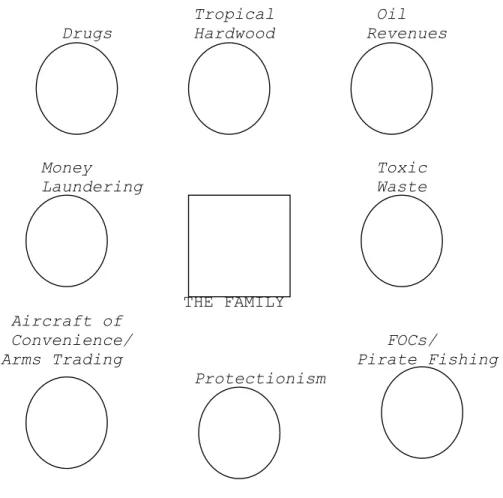
The Family Council provides the environment where a
number of partner organizations associated with the state elite may flourish. The Council - often coercively - reconciles rival factions and manages the core functions of accumulation. The Council and surrounding family
networks are intepenetrated by the military and paramilitary security apparatus, which underpins and
secures its dominance – over two decades after the Obiang coup, Nguemism retains a military flavour. Any
developmental activities that do not provide an immediate payoff are neglected; the state has degenerated into
little more than the centre of a large and dynamic set of activities that, in some instances, are illegal in terms of international law.
These activities are bound together with ties that range from outright ownership (logging companies and labour bureaux) and control (oil revenues), to the collection of what amount to tithes from operators engaged in dubious activities (pirate fishing and arms smuggling). Not all these activities are taking place at any particular moment; forms of accumulation adapt and are reconstituted in response to changes in the external environment.
Crucially, the oil windfall has not led to the
substantial petro-dollars seems to have done little to diminish the elite's appetite for petty trafficking and extortion. Whilst some activities may have declined or ceased, others, such as logging, FOCs and job agencies are flourishing. Indeed, the latter sector seems to have been revitalised by the oil boom. At the same time, the prospect of richer pickings has proved corrosive to
Figure 1: The Equatoguinean Network of Accumulation
Tropical Oil
Drugs Hardwood Revenues
Money Toxic Laundering Waste
THE FAMILY Aircraft of
Convenience/ FOCs/
Arms Trading Pirate Fishing Protectionism
Conclusion
The discovery of oil has opened up hitherto undreamed avenues of accumulation for the Equatoguinean state elite. However, this does not seem to have resulted in the abandonment of a number of other well-established forms of rent generation. Despite oil and oil rents, other, 'illicit', modes of accumulation persist and have even intensified, bound together through a web of
patronage, ownership and tithing. Nor is there any evidence that has the discovery of oil led to better governance; despite impressive growth rates, the bulk of the population remain locked in a subsistence mode of existence. Indeed, the oil windfall has greatly
Notes
2 The fieldwork for this article was conducted with
George Frynas, whose insights - and depth of knowledge of the West African oil industry - proved invaluable. The conclusions reached are, however, the author's own.
3 Max Liniger-Goumaz, Small is Not Always Beautiful:
The Story of Equatorial Guinea (Rowman and Littlefield, Savage MD, 1989).
4 Max Liniger-Goumaz, Small is Not Always Beautiful:
The Story of Equatorial Guinea (Rowman and Littlefield, Savage MD, 1989).
5 Ibid.; Afrol Country Report. Africa Online News
(Oslo, 2003). (www.afrol.com).
6 There is dearth of recent literature on the country.
Max Liniger-Goumaz's classic account, Small is Not Always Beautiful: The Story of Equatorial Guinea, represents a standard - albeit dated - reference work on the subject. Other published works include the similarly dated work by Randall Fegley, Equatorial Guinea: An African Tragedy (P.Lang, New York, 1989). Robert Klitgaard's Tropical Gangsters: One Man's Experience with Debt and Decadence in Deepest Africa (Basic Books, New York, 1990) provides an easily accessible, albeit largely anecdotal, personal account. One of the few recent works on the subject is J. Roitman and G. Roso, ‘Guinee-Equatoriale: Etre 'Off-Shore' Pour Rester 'National'’, Politique Africaine, 81 (2001): 121-142.
7 In 2000, President Obiang Nguema made the principal
town on the mainland, Bata, the capital. However, this seems to have had little effect in real terms.
8 CIA, World Fact Book: Equatorial Guinea (Washington
2003).
9 Ibid.
10 Liniger-Goumaz, Small is Not Always Beautiful. 11 Ibid.
12 Ibid. 13 Ibid. 14 Ibid.
15 Keesing’s Africa (London, 1972).
16 Afrol, Oslo, 21 August 2000 (www.afrol.com). 17 J. Bolender, Blind Eye on Africa: Equatorial
Guinea: Human Rights and Oil (2000) (www.zmag.org).
18 Afrol Country Report, Equatorial Guinea (Africa News
Agency, Olso, 2003).
20 CIA, World Fact Book: Equatorial Guinea; US Africa
Research Information, Equatorial Guinea (Washington, 2003).
21 Independent, London, 16 December 2002. 22 CIA, World Fact Book: Equatorial Guinea.
23 US Department of State, Country Reports on Human
Rights Practices: Equatorial Guinea (Washington, 2002); Financial Times, London, 17 December 2002).
24 J. Bolender, ‘Blind Eye on Africa: Equatorial
Guinea: Human Rights and Oil’ (2003) (www.zmag.org). In 1998, opposition representatives were denied the right to scrutinize the census process, despite an earlier
agreement that accorded them this right. Amnesty
International, ‘Equatorial Guinea: A Country Subject to Terror and Harrassment’ (AFR 24/001/1999) (London, 1999).
25 J. Bolender, ‘Blind Eye on Africa: Equatorial
Guinea: Human Rights and Oil’ (2003) (www.zmag.org); Amnesty International, ‘Equatorial Guinea: A Country Subject to Terror and Harrassment’ (AFR 24/001/1999) (London, 1999).
26 In August 2003 election posters depicting Obiang
remained prominently displayed in the passport control area of Malabo and in other government buildings,
leftover from the previous elections.
27 (US Department of State, Country Reports on Human
Rights Practices: Equatorial Guinea, Washington, 2002; Financial Times, London, 16 December 2002).
28 Afrol, Oslo, 22 September 2000.
29 Africa Confidential, London, 7 February 2003. 30 Ibid.
31 Ibid.
32 Significantly, Obiang has had a second palace built
close to the airport and the compounds for expatriate oil workers. However, the new palace seems uninhabited.
33 34
35 In a country renowned for unpleasant prison
conditions, Black Beach is notorious for overcrowding, systematic torture and a lack of food and water and medical attention (Amnesty International, ‘Medical care urgently needed for over 60 political prisoners:
Equatorial Guinea’, (AFR 24/12/2002),(London, 2002)). Some prominent prisoners have been held in the
On the beach itself, executions take place, with
prisoners being responsible for the digging of graves on the site of execution (Amnesty International, ‘Equatorial Guinea: A Country Subject to Terror and Harassment’).36
J. Roitman and G. Roso, G. ‘Guinee-Equatoriale: Etre 'Off-Shore' Pour Rester 'National'’, Politique Africaine, 81 (2001): 121-142.
37 Guardian, London/Manchester, 21 December 1999. 38
39 Africa Confidential, 29 June 2001.
40 Africa Confidential, 29 June 2001; Independent,
London, 16 December 2002.Bolender, ‘Blind Eye on Africa’.
41 Africa Confidential, 18 May 2001. Obiang has two
wives; his second wife is a Sao Tomean.
42 Afrol, Oslo, 16 October 2000.
43 Africa Confidential, 2 February 2004. 44 Africa Confidential, 2 February 2004.
45 MANN HAS NOT YET APPEARED IN THE TEXT! PLEASE ADJUST 46 Former EO operatives who had served in 32 Battalion
were involved in a coup attempt in Sao Tome et Principe (STP) during 2003; Diamondworks, a diamond mining and aspirant oil firm, often linked to Sandline had been seeking concessions on STP.
47 Guardian, Manchester/London, 13 March 2004;
Guardian, Manchester/London, 11 March 2004.
48 Africa Confidential, 5 March 2004.
49 Calil has previously been implicated in the alleged
payment of illegal commissions by Elf-Aquitaine to the former Abacha regime of Nigeria. He also has close ties to the Gabonese establishment.
50 Ibid.
51 Also known as Triple Option Trading. 52 Also spelled Armengal.
53 His name is sometimes spelled Armengal.
54 Confidential interview, Pretoria, March 2004. 55 Confidential interview, Pretoria, March 2004.
56 Calil’s involvement in the affair remains unclear,
but it seems likely he was party to the full conspiracy.
57 This would enable the real coup leaders to escape
international condemnation and legitimise their seizure of power.
58 Cape Times, 6 April 2004.
59 Cocoa production has since dwindled to negligible
amounts (Financial Times, 17 December 2002); indeed, a large number of plantations on Bioko island are visibly derelict.
60 US Africa Research Information, Equatorial Guinea
(Washington, n.d.).
61 Estimates on growth in real GDP vary greatly.
‘was 45.5% in 2001, up from the 16.9% growth in 2000, and narrowly missing the record 71.2% GDP growth experienced in 1997’, US Department of Energy,Country Analysis Brief: Equatorial Guinea (Washington, 2002). See also Business Africa, Equatorial Guinea (Hamburg, 2003).
(http://businessafrica.hispeed.com/africabiz/countries/eq uato.htm).
62 US Africa Research Information,Equatorial Guinea,
(Washington, 2003). Despite major oil reserves - and investment in new turbine generating capacity to supplement a traditional reliance on a mixture of
hydroelectric and caloric power sources - the capital has very erratic electricity and water supplies. This
reflects both ageing equipment and poor management (US Department of Energy, Country Analysis Brief: Equatorial Guinea, Washington, 2002). There does not seem to be any proper system for disposing of garbage. The situation in other centres is very much worse, with the possible
exception of Mongomo.
63 CIA, World Fact Book: Equatorial Guinea.
64 Medicins sans Frontiers. 2000. ‘Written Statement
Submitted to the UN Commission of Human Rights, 56th
Session (9th Item on Agenda)’ (United Nations, New York,
2000).
65 IRIN (News Organization of the United Nations
Office for the Coordination of Humanitarian Affairs), ‘Equatorial Guinea: Oil and Gas Production Climbs, But Where Does the Money Go?’, (New York, 2003)
66 J. Bolender, Blind Eye on Africa: Equatorial
Guinea: Human Rights and Oil (2000) (www.zmag.org).
67 US Department of Energy quoted in IRIN (News
Organization of the United Nations Office for the Coordination of Humanitarian Affairs), ‘Equatorial
Guinea: Oil and Gas Production Climbs, But Where Does the Money Go?’ (New York, 2003)
68 Liniger-Goumaz, Small is Not Always Beautiful. 69 Bolender, Blind Eye on Africa.
70 US Department of Commerce, Country Commercial Guide:
Equatorial Guinea (Washington, 2002).
71 Ibid.
72 CIA, World Fact Book: Equatorial Guinea. 73 CIA, World Fact Book: Equatorial Guinea. 74 J-F. Bayart, S. Ellis, S., and B. Hibou, The
Criminalization of the State in Africa (James Currey, Bloomington, 1999), pp. 25-6.
75 J-F. Bayart, S. Ellis, S., and B. Hibou, The
Criminalization of the State in Africa (James Currey, Bloomington, 1999), pp. 25-6.
76 CIA, World Fact Book: Equatorial Guinea (Washington
77 Guardian, London/Manchester, 21 December 1999. 78 Africa Confidential, 21 February 2003.
79 CIA,World Fact Book: Equatorial Guinea.
80 J. Roitman and G. Roso, ‘Guinee-Equatoriale: Etre
'Off-Shore' Pour Rester 'National'’.
81 Teodorin personally owns two logging companies. 82 Bar occasional forays from the military for the
purposes of plunder and rape.
83 El Pais, Madrid, 22 September 1988.
84 A. Dimah, Transboundary shipments of Hazardous
Wastes to tropical Africa: A Challenge for Nigerian
Foreign Policy (Southern University, Baton Rouge, 2003).
85 J. Vallette, The International Trade in Wastes: A
Greenpeace Inventory (London, 1988).
86 A. Dimah,‘Transboundary shipments’. 87 Die Weltwoche, 11 August 1994.
88 Keck, quoted in S. Mombe, ‘Annobon, the Forgotten
Paradise’ (Asodegue, Berlin, 2001).
89 Ibid.
90 See The Opinion, 5 February 2004. 91 See The Opinion, 5 February 2004.
92 Monalige, Tam Tam de Alerta (newsletter) (Madrid,
July 2000).
93 DX Expedition Annobon Island 2003,
(http://personal.telefonica.terra.es/web/ea5yn/) See also Amateur Radio Newsline™ Report 1366 , 17 October 2003. http://www.arnewsline.org/newsline_archives/cbbs1366.txt
94 El Diaro Internacional, October 1994; c.f. J.
Roitman and G. Roso, G. 'Guinee-Equatoriale: Etre 'Off-Shore' Pour Rester 'National'".
95 J. Roitman and G. Roso, G. "Guinee-Equatoriale: Etre
'Off-Shore' Pour Rester 'National''.
96 Bayart, quoted in S. Mangaya, 'Africa: Increase in
Drugs Trafficking', Bruxelles African News Bulletin – Bulletin d'Information Africaine Supplement (1997), 326.
97 A. Labrousse, La drogue, un marché de dupes.
(Éditions Alternatives, Paris, 2000).
98 J. Roitman and G. Roso, 'Guinee-Equatoriale: Etre
'Off-Shore' Pour Rester 'National''.
99 The Nation (Nairobi) , 22 April 2002.
101 S. Bikomo, 'Guinea Conexion', La Diaspora, 24 July
1997.
102 Ibid.
103 A. Labrousse, 'La drogue, un marché de dupes'.
104 S. Bikomo, 'Guinea Conexion'.
105 Greenpeace, 'Pirate Fishing: The Global Threat of
Flag of Convenience Vessels' (London, 1999); Greenpeace, 'Greenpeace Condemns the Lack of Action Against Pirate Fishing Vessels' (London, 2001).
106 . 107
108 Inter alia, this included the registration of at
least four Iluyshin freighters (JP Airline Fleets International 1999-2000, London). Bout was borne in Dushanbe, Tajikistan in 1967; Farsi was his first language. He holds five passports, two of which are Russian and one Ukrainian. US sources allege that 'his wife’s father, 'Zuiguin', at one point held a high
position in the KGB, perhaps even as high as a Deputy Chairman'. Bout is an ex-KGB major rumoured to have good contacts with the Russian and Ukrainian mafias. He
regularly changes the spelling of his name in an effort to confuse investigators; one such spelling is 'Victor Butt'. In 1993, Bout started his air operations when he bought at Cheliabinsk airport, 10 Antonovs, one Ilyushin and a Mi-8 helicopter 'for peanuts', according to Valery Spurnov, a former civil aviation inspector (Guardian, London/Manchester, 17 April 2002). By early 2002, his fleet had expanded to about 60 aircraft (Guardian, London, Manchester, 17 April 2002).
109 East African (Nairobi), 6 January 2003. 110 Guardian, Manchester/London. 17 April 2002).
111 Guardian, Manchester/London. 17 April 2002);Clean
Ostend, 'Ostend Airport Arms Running' (Ostend, 2001) (www.cleanostend.com).
112 East African, Nairobi, 6 January 2003. 113 This name may be a deliberate mispelling. 114 East African, Nairobi, 6 January 2003. 115 Ibid.
116 United Nations Security Council Report - Final
report of the Monitoring Mechanism on Angola Sanctions, paragraphs 111 - 144 (New York, 2000).
117 US Department of State, Country Reports on Human
Rights Practices: Equatorial Guinea (Washington, 2002).
118 US Department of State. Country Reports on Human
Rights Practices: Equatorial Guinea (Washington, 2002).
119 US Department of State. Country Reports on Human
Rights Practices: Equatorial Guinea (Washington, 2002).
120 Ibid.
121 The Equatorial Guinea Trade Union operates
underground.
122 The Equatorial Guinea Trade Union operates
underground.
124 US Department of Commerce, Country Commercial Guide:
Equatorial Guinea (Washington, 2002).
125 US Department of Commerce. Country Commercial Guide:
Equatorial Guinea (Washington, 2002).
126 This is despite some territorial disputes with
neighbouring states. During 2002, the ICJ ruled an equidistant settlement, defining the
Cameroonian/Nigerian/Equatoguinean maritime boundary (CIA World Fact Book: Equatorial Guinea). In April of that year, Nigeria and Equatorial Guinea formally agreed to resolve their dispute (Financial Times, 20 April 2002; South African Broadcasting Corporation News, 4 April 2002). The Cameroonian government later accepted the
ruling as well (US Department of Energy. Country Analysis Brief: Equatorial Guinea (Washington, 2002)). There
remains a territorial dispute with Gabon, over small islands on the hydrocarbon-rich Mbano/Mbagne bank (CIA World Fact Book: Equatorial Guinea).
127 R. Ives, "Diversifying the Oil Supply:
Recommendations for Productive US Involvement in Equatorial Guinea", International Affairs Review¸ 10 (2001):pp. 54-71.
128 Walter was later acquired by Nomeco, which was then
purchased by CMS Oil and Gas (Ives, "Diversifying the Oil Supply: Recommendations for Productive US Involvement in Equatorial Guinea"). Following on United Meridian's discovery of oil near Bioko, it was merged with Ocean Energy.
129 Alba is a gas condensate field, initially solely
developed for condensate production, gas being flared; the latter will be at least partially diverted to service the new methanol plant.
130 Ministry of Mines and Energy. Official Website
(Malabo, 2003). www.equatorialoil.com
131 Ministry of Mines and Energy. Official Website
(Malabo, 2003). www.equatorialoil.com
132 United Meridian Corporation had licensed blocks in
the area in the early 1990s (then designated Bioko Blocks A, B and C). Mobil then farmed-in to the exploration process, leading to the 1995 discoveries (Ministry of Mines and Energy. Official Website (Malabo, 2003)
www.equatorialoil.com).
133 Businesswire, 5 August 2003 (www.businesswire.com). 134 Ministry of Mines and Energy. Official Website
(Malabo, 2003) www.equatorialoil.com).
135 Ministry of Mines and Energy. Official Website
(Malabo, 2003) www.equatorialoil.com.
136 Africa Confidential, 7 February 2003; IRIN (News
Guinea: Oil and Gas Production Climbs, But Where Does the Money Go?" (New York, 2003) (www.irinnews.org).
137 IRIN (News Organization of the United Nations
Office for the Coordination of Humanitarian Affairs), "Equatorial Guinea: Oil and Gas Production Climbs, But Where Does the Money Go?" (New York, 2003)
(www.irinnews.org).
138 IRIN (News Organization of the United Nations
Office for the Coordination of Humanitarian Affairs), "Equatorial Guinea: Oil and Gas Production Climbs, But Where Does the Money Go?" (New York, 2003)
(www.irinnews.org).
139 Visible at night from Malabo.
140 IRIN (News Organization of the United Nations
Office for the Coordination of Humanitarian Affairs), "Equatorial Guinea: Oil and Gas Production Climbs, But Where Does the Money Go?" (New York, 2003)
(www.irinnews.org).
141 Ministry of Mines and Energy. Official Website
(Malabo, 2003) www.equatorialoil.com.
142 Business Wire, 30 July 2003 (www.businesswire.com). 143 Business Wire, 30 July 2003 (www.businesswire.com). 144 Business Wire, 30 July 2003 (www.businesswire.com). 145 Business Wire, 30 July 2003 (www.businesswire.com).
"Amerada Hess has an 85% working interest in and is the operator of Block F and adjacent Block G. Amerada Hess' partner in the blocks is Energy Africa Ltd. of South
Africa, which has the remaining 15% working interest. The government of Equatorial Guinea has a 5% carried interest in Ceiba Field production and would have a carried 5% participating interest in any Okume, Oveng and Ebano area commercial production". (Ministry of Mines and Energy. Official Website (Malabo, 2003) www.equatorialoil.com).
146 US Department of Energy, Country Analysis Brief:
Equatorial Guinea (Washington, 2002).
147 Luba Free Port. 2003. Official Website.
www.luba-freeport.com. Whilst expatriate workers in the free-port area will doubtlessly be accorded a degree of protection, the town's security forces have a deservedly bad
reputation for arbitrary violence. For example, in a recent incident, a citizen was arbitrarily executed in the streets after complaining of a power cut.
148 Africa Confidential, 7 February 2003; c.f. Medicins
sans Frontiers, 'Written Statement Submitted to the UN Commission of Human Rights, 56th Session (9th Item on
Agenda)'. New York, 2000).
149 Bolender, 'Blind Eye on Africa'.
150 IRIN (News Organization of the United Nations
Where Does the Money Go?'(New York, 2003)
(www.irinnews.org).
151 Other accounts have suggested the sum of money is as
much as $500 million. See Independent, London, 11 May 2003.
152 Los Angeles Times, Los Angeles, 20 January 2003. 153 ExxonMobil has cited a confidentiality agreement
with the country's authorities (Los Angeles Times, 20 January 2003).
154 Ibid..
155 A Riggs Senior Vice-President, Simon Kareri, manages
the account. The latter has helped Obiang in his property-buying binge.
156 Founded in 1936, Riggs specialises in offering
confidential services to wealthy individuals (Los Angeles Times, 20 January 2003). The Web site for the bank
assures "the utmost discretion"; the bank maintains offices in the Bahamas and the island of Jersey, both locales known for bank secrecy laws (Los Angeles Times, 20 January 2003).
157 Independent, London, 11 May 2003.
158 The Ministry of Mines and Energy is currently
revising the Model Petroleum Production Sharing Contract (Ministry of Mines and Energy. Official Website (Malabo, 2003) www.equatorialoil.com).
159 The Nation, Nairobi, 22 April 2002.
160 US Department of Energy, Country Analysis Brief:
Equatorial Guinea (Washington, 2002).
161 US Department of Energy, Country Analysis Brief:
Equatorial Guinea (Washington, 2002).
162 Independent, 11 May 2003.
163 J. Roitman and G. Roso, G. 'Guinee-Equatoriale: Etre
'Off-Shore' Pour Rester 'National'.
164
165 Africa Confidential, 7 February 2003.
166 Medicins sans Frontiers. "Written Statement
Submitted to the UN Commission of Human Rights, 56th Session (9th Item on Agenda)" (New York, 2000). In
September 2003, the US signed an agreement with
Equatorial Guinea, exempting eachother's citizen's from prosecution in the International Criminal Court without the permission of the other government (Reuters, 25 September 2003). Whilst the US has signed similar
agreements with a number of other third world countries, the Equatogunean case is of particular concern given its abysmal human rights record.
167 Centre for Public Integrity. 2003. "Oil Diplomacy"
(Washington, 2003); Times, 7 July 2003.
169 Financial Times, 4 January 2003. The State
Department has claimed that, inter alia, the human rights situation demonstrates the need for the reopening of the embassy (Financial Times, 4 January 2003). Silverstein (Independent 11 May 2003) has suggested that:
"It helps that the companies active in Equatorial Guinea have close ties to the Bush Administration. In addition to political heavyweights like ExxonMobil and Chevron, those firms include CMS Energy (which recently sold its holdings in Equatorial Guinea to Marathon). CMS's CEO, William McCormick, gave $100,000 to the Bush-Cheney 2001 Presidential Inaugural Committee. Ocean Energy's
consultant on its Malabo operations is Chester Norris, a former ambassador to Equatorial Guinea under George Bush Sr. Perhaps best connected of all was Triton, whose
chairman, Tom Hicks, made Bush a millionaire fifteen times over when he bought the Texas Rangers in 1998. Hicks's leveraged buyout firm, Hicks Muse, is Bush's fourth-largest career financial patron, according to the Center for Public Integrity". In 2001, Triton was taken over by Amerada Hess.
170 Ives, "Diversifying the Oil Supply: Recommendations
for Productive US Involvement in Equatorial Guinea".
171 Afrol Country Report.
172 Ives, "Diversifying the Oil Supply: Recommendations
for Productive US Involvement in Equatorial Guinea".
173 Guardian, 21 December 1999.
174 G. Clinton, 'Equatorial Guinea', New International,
265 (1995).
175 Medicins sans Frontiers, 'Written Statement
Submitted to the UN Commission of Human Rights, 56th Session (9th Item on Agenda)'(New York, 2000).
176 Medicins sans Frontiers, 'Written Statement
Submitted to the UN Commission of Human Rights, 56th
Session (9th Item on Agenda)'(New York, 2000).
177 Roitman and Roso, Guinee-Equatoriale: Etre
'Off-Shore' Pour Rester 'National'".
178 Los Angeles Times, 20 January 2003. 179 Los Angeles Times, 20 January 2003.
180 Medicins sans Frontiers, 'Written Statement
Submitted to the UN Commission of Human Rights, 56th Session (9th Item on Agenda)'.
181 US Department of State, Country Reports on Human
Rights Practices: Equatorial Guinea (Washington, 2002).
182 Ibid.
183 Ibid. See also International Bar Assocition,
Equatorial Guinea at the Crossroads (2003), www.ibanet.org.
184 Moto is now head of the Madrid-based Equatorial
185 Africa Confidential, London, 29 August 1997.
186 Afrol, Oslo, 13 August 2003; Ethnic Bubis were also
subjected to arbitrary harassment, beatings, rape, and destruction of their property. Amnesty International, 1999, 'Equatorial Guinea: A Country Subject to Terror and Harrassment' (AFR 24/001/1999) (London, 1999).
187 Amnesty International, Equatorial Guinea: A Country
Subject to Terror and Harrassment' (AFR 24/001/1999) (London, 1999).
188 Ibid.
189 Africa Confidential, London, 19 April 2002. 190 Financial Times (London), 20 April 2002. 191 Sometimes spelled Mico.
192
193 Other estimates have placed the number of detainees
at 144 (Bolender, 'Blind Eye on Africa'); Amnesty International, 2002, 'A parody of a trial in order to crush the opposition' (AFR 24/014/2002) (London, 2002).
194 IRIN, New York 11 July 2002.
195 Amnesty International, 'Medical care urgently needed
for over 60 political prisoners Equatorial Guinea' (AFR 24/012/2002) (London, 2002)).
196 US Department of State, Country Reports on Human
Rights Practices: Equatorial Guinea (Washington, 2002).
197 Ibid.
198 US Department of State, Country Reports on Human
Rights Practices: Equatorial Guinea (Washington, 2002). Amnesty International, 'Medical care urgently needed for over 60 political prisoners Equatorial Guinea' (AFR
24/012/2002) (London, 2002)).Bolender, 'Blind Eye on Africa'.
199 US Department of State, Country Reports on Human
Rights Practices: Equatorial Guinea (Washington 2002). Amnesty International, 'Medical care urgently needed for over 60 political prisoners Equatorial Guinea' (AFR
24/012/2002) (London, 2002)).Bolender, 'Blind Eye on Africa'.
200
201 Afrol, 21 August 2000. 202 Afrol, 21 August 2000.
203 US Department of State, Country Reports on Human
Rights Practices: Equatorial Guinea. Worse excesses have been recorded. For example, in July 2003, a young Spanish aid worker, Ana Isabel Sanchez Torralba, was executed by members of the security forces at a roadblock whilst en route to the village of Aconibe.
204 US Department of State, Country Reports on Human
Rights Practices: Equatorial Guinea.