Maestría en Economía
Facultad de Ciencias Económicas
Universidad Nacional de La Plata
TESIS DE MAESTRIA
ALUMNO
Guillermo Vuletin
TITULO
Regimenes Cambiarios y Performance Fiscal
DIRECTOR
Jorge Carrera
EXCHANGE RATE REGIMES AND FISCAL PERFORMANCE.
DO FIXED EXCHANGE RATE REGIMES GENERA TE MORE
DISCIPLINE THAN FLEXIBLE ONES?
Guillermo Javier Vuletin
* University of MarylandMarch 2003
Abstract
This paper analyzes the influence of exchange rate regimes on fiscal performance, focusing on the difference between fixed and flexible exchange rates.
For these ends, a sample of 83 countries for the 1974-1998 period, the GMM methodology for dynamic proposal panel models proposed by Arellano and Bond (1991) and diverse exchange rate classifications are used. In relation to the latter, this paper discusses recent regimes classifications and proposes a new one that permits to cover possible inconsistencies between the commitment of the central bank and its observed behavior.
The results suggest that regimes’ influence on fiscal performance depend on the international context, specifically the possibility of indebtedness and of the characteristics of the international finance system –integration, volatility and dominant financial structure-. In other words, it depends on credit availability as well as on the conditions or potential sanctioning of the finance system. It is found that in contexts where there is no original fiscal discipline and the authorities have the possibility of financing with debt of relatively low cost, fixed regimes do not purvey per se greater fiscal discipline than the flexible ones. On the contrary, flexible ones generate more discipline. In contexts with strong financing restrictions, the discipline’s effects of both regimes are not substantially different. While in situations with abundance of capitals but where they are highly integrated, volatile and possibly subject to contagion effect, the same functioning of the international finance system can, through their potential sanction, achieve greater discipline in economies with fixed regimes that wish to remain as such.
Keywords: exchange rate regimes; expenditure; revenues; deficits; international finance system; panel data; internal instru ments; GMM.
JEL Classification: C23, H6, F3, E52, F41.
Author ‘s e-mail address: [email protected]
*Modified version of the Master in Economics thesis. Department of Economics. National University of La Plata (UNLP). Director of thesis: Dr. Jorge E. Carrera. December 2001.
I am grateful to Ricardo Bebczuc, Leonardo Gasparini, Emilio Espino, Cesar Mateo and the participants of the Lacea 2003 meetings at Puebla, Mesxico and seminar of the UNLP for their valuable commentaries and sugestions and , especially to Walter Sosa Escudero for his generous disposition to clarify econometric matters. Any mistakes or omisions are of my responsability.
CO NTENTS
1 INTRODUCTION 3
2 THEORETICAL DISCUSSION 4
3 ECONOMETRIC METHODOLOGY 8
4 DATA 10
4.1 MACROECONOMIC AND FIS CAL VARIABLES 10
4.2 EXCHANGE RATE REGIMES CLASSIFICATIONS 10
5 EMPIRICAL RESULTS 14
5.1 IMPORTANCE IN THE CHOICE OF THE ESTIMATIO N METHOD 14
5.2 CONTROLLING ENDOGENEI TY FOR VARIABLES THAT INFLUENCE ON THE REGIME CHOI CE BUT
NOT ON THE FISCAL PERFORMANCE 15
5.3 THE ROLE OF INTERNATIONAL MARKETS 15
5.4 LONG AND SHORT TERM FIXED REGIMES:SHORT PEG AND LONG PEG 19
5.5 NEW EXCHANGE CLASSIFICATION:THE IMPORTANCE OF A CLASSIFICATION DETECTING
INCONSISTENCIES 20
6 CONCLUSIONS 23
7 REFERENCES 25
8 DATA APPENDIX 28
8.1 COUNTRIES’ SAMPLES 28
8.2 MACROECONOMIC VARIABLES’ DEFINITIONS 28
1
INTRO DUCTIO N
Before the fall of the Bretton Woods system in 1973, most of the countries had fixed exchange
regimes. Since then, countries have experienced with varied exchange rate regimes. The
evaluation of the costs and benefits associated with them has been the source of many debates
and continuous to be one of the most important in international economy in our days. In
theoretical terms, it is difficult to establish a univocal consensus on this relation due to the
many links –that are partly reinforced and partly counteracted – among the different exchange
rate regimes and the macroeconomic variables. Precisely, the relevance of the empirical
analysis consists of trying to quantify the relative importance of the different relations
involved.
There are many empirical studies that analyze the impact of exchange rate regimes on
different macroeconomic variables such as inflation and its volatility, money growth, real
interest rate, product growth and its volatility. An issue that has not been deeply analyzed is
the relation between ex change rate regimes and fiscal performance. The aim of this paper is to
set out the relative importance of these links, specifically analyzing the regime influence on
fiscal behavior.
Apart from informal discussions, the few existing empirical studies can be divided in two
groups according to the type of analysis. On the one hand, the first group comprises papers
like those of Tornell and Velasco (1995b) and Alfaro (1999), which recur to the analysis of
episodes for certain countries –generally from Latin America-. Even if these can provide
evidence in favor or against some hypotheses, it is not possible to isolate the effects of the
different variables involved. On the other hand, the second group is formed by research such
as that of Tornell and Velasco (1995a), Bazzoni and Nashashibi (1994) and Adam et al. (2000),
who limit the analysis to the Sub-Sahara region in Africa to eliminate potential endogeneity
problems in regime choice. This is because the countries that belong to the Franc Zone
maintained a fixed regime from 1948 to 1994 and because this choice was due to political
issues associated to colonial history and not to economic motives.
This paper surpasses previous analysis limitations covering a maximum sample of 83
countries during the 1974-1998 p eriod. At the same time that it finds evidence about the
exchange rate regimes´ influence on fiscal performance , it provides a possible criterion for
regime election.
The empirical analysis expands and improves previous literature in many regards:
• It allow s, unlike episode analysis, to work out the effect of exchange rate regimes on fiscal
• It advances towards the use of a dynamic methodology of estimation (Generalized
Method of Moments), which considers endogeneity problems and unobserved specific effects,
which generate bias in estimations performed by fixed effects if the dependant variable has a
strong persistence or temporal inertia.
• The correction of potential endogeneity problems, together with the inclusion of variables
that affect regime election, makes it possible to incorporate economies of different regions.
• It makes an extensive use of available information co ncerning the classification of
exchange rate regimes, widening the dichotomy "fixed vs. flexible” according to de jure
classification compiled by IMF, and of new contributions by Levy Yeyati and Sturzenegger
(2000) in relation to the classification according to behavior. In this sense, a new classification
of exchange rate regimes is suggested , making it possible to cover probable inconsistencies
between the commitment of the Central Bank -of intervening and subordinating its monetary
policy to the currency market- and its behavior.
• It evaluates fiscal performance in many w ays -total deficit, primary deficit, total
expenditure, primary expenditure and revenues -, trying to capture not only the effect of the
regime on an aggregated variable –defined on the basis of other variables- such as deficit, but
also on “ original” variables allowing to distinguish potential transmission mechanisms. Also,
total and primary concepts of fiscal variables are used, making it possible to indirectly
observe the links between the variables and the debt interests.
• Diverse sub-periods that characterize the level of capital market integration, indebtedness
possibility and the dominant finance structure are considered, analyzing if these
characteristics modify the influence of the regime on fiscal performance.
The paper is organized as follows: section 2 does a revision on the most representative
theoretical and empirical works; section 3 justifies econometric methodology choice; section 4
presents the macroeconomic variables and diverse exchange classifications that are used;
section 5 shows the econometric results; section 6 presents the conclusions.
2
THEO RETICAL DISCUSSIO N
Traditionally, the explanations about exchange rate policies were based on the theory of
optimal areas of Mundell (1960 and 1961), determining how different exchange rate regimes
could be desirable for countries with different characteristics. For example, small and open
countries having economies that are not very subjected to price shocks should have a more
fixed regime. Even though the traditional approximation was useful in the past, it does not
in vacuo, where each regime can be instantaneously placed and indefinitely sustained. As
history shows, exchange rate regimes are not chosen once and forever but are frequently
changed, either voluntarily or involuntarily.
More recently, attention has been focused on the potential credibility effects of the exchange
rate policy, emerging a trade-off between credibility and flexibility. The theoretical studies
analyzing the relationship between regimes and fiscal performance cover mainly four fields
of study of Economics: dynamic stochastic models, the so-called stabilization policies, issues
linked to political economy and studies relating the recent crisis of the nineties with growing
integration and volatility of the capitals market.
The first group consists of those papers based on dynamic stochastic models of general
equilibrium, which analyze the results of technological, monetary and government
expenditure shocks under different exchange rate regimes. Some of them are: Obstfeld and
Rogoff (1995b and 1998), Bachetta and van Wincoop (1999) and Devereux (1999). The latter
outlines that the effect of the exchange rate regime on macroeconomic variables depends on
the regime itself as well as on the monetary policy that is being implemented.
The second group, which is related to stabilization policies, includes many papers among
which are those by Aghevli et al. (1991), Frenkel et al. (1991), Giavazzi and Pagano (1988), and
Weber (1991). Their conventional vision supports the idea that fixed regimes provide more
fiscal discipline than the flexible ones, since the adoption of lax fiscal policies would lead to
an exhaustion of reserves and conseq uently to the collapse of the peg. As presumably the
eventual collapse of the fixed exchange rate would imply a big political cost for the policy
maker, this one would be disciplined, causing unsustainable fiscal policies not to occur in
equilibrium. In other w ords, devaluation is not an option, which is of course an
oversimplification, since like history repeatedly shows, fixed regimes usually fail to impose
discipline and generally end in devaluation crises1.
In relation to a most recent branch linked to issues of political economy, Tornell and Velasco
(1994, 1995a and 1995b), Alfaro (1999), Velasco (1997), and Alberola and Molina (2000) can be
named. Tornell and Velasco (1994, 1995a and 1995b) support that there are empirical and
theoretical problems with the kind of lines of thought exposed by conventional papers on
policy stabilization. They consider a fiscal authority prone to spend more than what is socially
desirable and with a lower discount rate after a certain moment –for example, because of
uncertainty about re-election - and, a central bank that can precommit itself not to finance the
deficits incurred by the fiscal authority for a finite period of time. They conclude that the
difference in fiscal behavior among regimes lies in the intertemporal distribution of the costs.
Under fixed schemes , unsound policies are manifested in falling reserves or exploding debts,
making their costs effective only w hen the situation is unsustainable. While w ith flexible
regimes, they are immediately manifested through movements in the exchange rate and the
price level. Therefore, being inflation costly for the fiscal authority, flexible regimes can
provide more fiscal discipline. It is important to outline that the previous result depends, on
one hand, on the possibility of intertemporal choice for the policymaker, because if it does not
have access to credit and/ or if it had insufficient reserves, money-financed deficits would
inevitably cause an immediate depreciation, regardless of the exchange rate regime. On the
other hand , it is essential that the central bank can precommit not to accommodate the wishes
of the fiscal authority only for a finite period of time because, if this commitment were
forever, the equivalence between regimes found by Helpman (1981) would persist.
Velasco (1997) develops a model analogous with that discussed in Alesina and Drazen (1991)
in which he rationalizes debt bubbles and post-stabilization programs. That is, it gives
rationality to the phrase “ things must be really bad before they start to get better again” . So,
he recurs to a model with interest groups where the government’s resources are seen as
common property. In first place, he finds that deficits can be can be reduced through fiscal
reform, but such a result will only happen after a long and intense period of government
indebtedness and, in second place, that the deficit bias will be greater as greater is the
fragmentation level of the interest groups.
From a distributive point of view, Alfaro (1999) justifies why governments hold policies that
are presumed not to be sustainable in the long run. Considering heterogeneity in the
population as regards its dotations, whether they have transable or non-transable goods, it
argues that the real exchange rate appreciation associated to sta bilization plans improves the
position of the latter.
Since the exchange rate and finance crises of the nineties, there has been a great upsurge of
literature that analyzes the role of growing integration and volatility of capital markets upon these
crises . Some of these papers are by Chang and Velasco (1998), Meng and Velasco (1999),
Chang (1999), and Velasco (1996). In general, they analyze credibility policy and finance
structure problems combined with herd behavior, contagion effect and financial frictions as
main elements in recent crises. Chang (1999) divides the recent disscusions that try to explain
the crises in emerging countries into two groups. Included into the first one, he considers
those under the “ bad policy view” that, in agreement with the spirit of Krugman’s first
Into the second one, he considers those under the “ financial panic view” , who maintain that
fundamentals do not seem to be good predictors and that, on the contrary, the expectations of
the market subject to herd behaviors and contagion effect are the key to understand the
nineties’crises.
Chang and Velasco (1998) analyze interaction between banking fragility and exchange rate
regimes, basing themselves on microfundamentals of the financial system, considering as
benchmark Diamond and Dybvig’s model (1983). They find that this fragility is evident in
fixed regimes. A drastic change in public trust can cause a fall in banking deposits and,
possibly, a run on deposits. Under fixed regimes, the central bank faces the following
trade-off. If nothing were done, a wave of banking bankruptcy would occur and consequently a
serious interruption of the economic activity. If it purveyed credits to the most affected banks,
these credits would rapidly return to the central bank in the form of a greater demand of
international reserves, causing the collapse of fixed exchange rate. On the contrary, with
flexible regimes and a central bank acting as lender of last resort, banking runs on deposits
originated by unfulfilled expectations can be eliminated.
Velasco (1996) extends the Barro-Gordon model to a dynamic context in which the level of the
state variable, in this case the debt stock, determines the sustainability of the fixed exchange
rate. Considering that reputation matters and that there is a fixed cost for devaluation, he
finds that fixed regime is sustainable if and only if the debt stock is sufficiently low. There is
an indebtedness rank in which multiple equilibriums are obtained, where the devaluation
result depends on the expectations of the agents. While for a certain level of high debt, there
is an equilibrium where the speculative attack occurs with positive probability, promoting the
decrease in debt size on the side of the government. That is, for the fixed exchange rates to be
really fixed, the debt must be smaller if investors are voluble -in the sense of being prone to
panic-.
The study of all this literature suggests many questions: Do fixed regimes provide more fiscal
discipline than flexible ones? Does the possibility of government indebtedness modify the
effect of exchange rate regimes on fiscal performance? Do greater integration and volatility of
the current international financial system have any special effect on fiscal behavior in
economies with fixed exchange rate regimes? Did stabilization programs of the eighties
promote greater fiscal discipline? The aim of this paper is to respond to these questions and
3
ECO NO M ETRIC M ETHO DO LO GY
In selecting the estimation method three aspects were taken into account. In the first place,
issues concerning data. Due to the availability of panel data -which make it possible to retain
all the information in relation to the use of annual averages - the presence of the country’s
unobservable factors must be enabled. Secondly, particularities of the dependent variable
must be considered. Fiscal performance in its diverse forms of measurement has a dynamic
nature –as table 9-1 show s-, reason for which the methodology to be used should allow for an
inertia behavior of this variable. A third element is the so-called “ reverse causality” . That is,
as some of the explanatory variables are likely to be jointly determined with fiscal behavior,
endogeneity of the explanatory variables must be controlled.
Considering these aspects, the appropriate methodology to use is the Generalized-Method
-of-Moments (GMM) estimator for dynamic panel data models develo ped by Arellano and Bond
(1991). This estimator deals with country specific effects and potential endogeneity of the
explanatory variables. The control for endogeneity is achieved by using “ internal
instruments” (i.e., instruments based on lagged values of the explanatory variables).
What follows is a brief presentation and justification of the chosen methodology and its
benefits as regards the most frequently used alternatives. The dynamic nature of the fiscal
performance (F) must be represented through a model containing lagged dependent variables
among the regressors. To simplify the analysis, a simple autoregressive model with one lag
period of the dependent variable is considered:
it it t i
it
F
x
F
=
δ
, −1+
'β
+
υ
i
=
1
,...,
N
t
=
1
,...,
T
(1)Where
δ
is a scalar,x
it' of dimension 1xk represents a group of variables that potentiallyaffect fiscal performance, and
β
is of kx1. Assuming that theυ
it follow s a one-way errorcomponent model:
it i
it
µ
ν
υ
=
+
(2)Where
µ
i~ IID(
0
,
2)
µσ
andν
it~ IID(
0
,
2)
νσ
are independent of each other and amongthemselves.
In these dynamic models, the implications of the election of diverse estimation techniques
have a different nature from those associated to static models. Since
F
it is a function ofµ
i,1 ,t− i
F
is also a function ofµ
i. Therefore,F
i,t−1, a right-hand regressor in (1), is correlatedestimator, the Within transformation wipes out the
µ
i, though (F
i, t−1−
F
i, t−1) where∑
= − −=
−
T t t i ti
F
T
F
2 1 , 1
,
(
1
)
will still be correlated with(
ν −
itν
i)
even if theν
it are notserially correlated. This is because
F
i,t−1 is correlated withν
i by construction. The latteraverage contains
ν
i,t−1which is obviously correlated withF
i, t−1. In fact, the Withinestimator will be biased and only if
T
→
∞
will the Within estimator ofδ
andβ
be consistent for the dynamic error component model.The same problem springs with therandom effects Generalized Least Square estimator (GLS)because
(
F
i, t−1−
θ
F
i, t−1)
willbe correlated with
(
υ
i,t−
θ
υ
i,t−1)
.An alternative transformation that wipes out the individual effects, yet does not create the problem mentioned above, is the First Difference Transformation. In fact, Anderson
and Hsiao (1981) suggested the following: first, differencing the model to get rid of
µ
i,and then, using
∆
F
i, t−2=
(
F
i, t−2−
F
i, t−3)
o rF
i, t−2 as an instrument for)
(
, 1 , 21
, −
=
−−
−∆
F
i tF
i tF
i t . These instruments will not be correlated with1 , −
−
=
∆
ν
itν
itν
i t as long as theν
it themselves are not serially correlated. Thisinstrumental variable estimation method leads to consistent but not necessarily efficient estimates of the parameters in the mo del, because it does not make use of all the available moment conditions as Ahn and Schmidt (1993) show, and it does not consider the differenced structure on residual disturbances (
∆
ν
it). A methodology consideringcountry specific effects and the bias of dynamic panel data models is the GMM estimator developed by Arellano and Bond (1991). This estimator works in the following way: first, take first differences of a model like (1) which, generalized to a model containing k lagged dependent variable as regressor, leave:
it it k j j t i j
it
F
x
F
=
δ
∆
+
β
∆
+
∆
ν
∆
∑
= −
'
1
, (3)
Where
∆
F
it=
F
it−
F
i,t−1. First differencing gets rid of the country specific effects, but leadsby construction a correlation between the differenced lagged fiscal variable and the
differenced error term. Therefore, these authors propose using lagged levels of the
The GMM estimator will be consistent if the lagged levels of explanatory variables are valid
instruments for differenced explanatory variables. This will hold if the error term is not
serially correlated. These assumptions can be tested through the tests proposed by Arellano
and Bond (1991). The first is a Sargan test of overidentifying restrictions, which tests the
overall validity of the instruments. Failure to reject the null hypothesis gives support to the
model. The second is a test for serial correlation in the error term. If such test does not reject
the null hypothesis of second order correlation abs ence, it can be concluded that the original
error term does not have serial correlation.
4
DATA
The largest sample embraces a panel of 83 countries2 –21 OECD countries and 62 non OECD -
for the 1974-1998 period. The source of data used for the macroeconomic and fiscal variables
were Macro Time Series (MTS) and Government Finance (GF) of the W orld Bank Global
Development Network Growth Database (W B). The source of data of exchange rate regimes was
the IMF Annual Report on Exchange Arrangements and Exchange Restrictions for de jure exchange
rate classification and the Exchange Rate Classification Database by Levy Yeyati and
Sturzenegger (2000).
4.1
Macroeconomic and fiscal variables
Total deficit, primary deficit, total expenditure, primary expenditure and fiscal revenues are
considered as fiscal performance measures, all of them as GDP percentage. The shock in trade
terms, GDP per capita, openness, inflation rate, a dummy of hyperinflation and, several
classifications of exchange regimes specifically discussed in the following sub-section are
used as explanatory variables3.
4.2
Exchange rate regimes classifications
There are two points that should be taken into account when carrying out an exchange rate
classification:
• The degree of detail in the de jure classification. W hile it is often spoken of the “ fixed vs.
flexible” dichotomy, the de jure classification available is broader, covering from currency
boards or countries not having their own currency, to flexible exchange rate regimes with
high, low or no intervention.
• The criterion to follow when carrying out the classification. Economic literature shows
two possible options to carry it out: a de jure classification, based on the commitment adopted
by the central banks; and a de facto classification, product of the actual behavior. Neither of the
methods is entirely satisfactory. The de facto classification has the advantage that it is based on
the observed behavior, but does not make it possible to distinguish between stable nominal
exchange rates resulting from the absence of shocks, and the stability produced by political
actions counteracting the shocks. Because of this, it fails to capture what might be the essence
of an exchange rate regime -the type of commitment of the central bank to intervene and
subordinate its money policies to the currency market. The de jure classification captures this
formal commitment, but fails to control policies w hich are inconsistent w ith this commitment.
Taking these two points into consideration, three exchange classifications are used:
• Initially, a three-category de jure classification is considered: fixed, intermediate and flexible.
The fixed regimes cover: a single currency peg; SDR peg; other official basket pegs; and a
secret basket peg, according to the IMF terminology. The intermediate group includes:
cooperative arrangement, unclassified flexible, rule based, crawling peg and target zone.
While the flexible group includes independent float and managed floating.
There were two questions in this way of grouping:
The first one was associated to the managed float category. It was decided to consider it as
floating because for the topics and variables involved it is more relevant to know whether
there is a commitment on the part of the central bank or not, rather than if they effecti vely
intervene or not in the currency market. In fact, according to Levy Yeyati and Sturzenegger
(2000), only a bit more than 30% of the countries said to have a floating exchange rate regime,
behave as such.
The second question is how to classify the countries participating in the European “ snake” in
the mid seventies and later in the EMS. These countries have fixed exchange rate regimes, but
they float against other currencies. In agreement with other papers -Ghosh et al. (1997) and
Levy Yeyati and Sturzenegger (2000)-, this group is classified as intermediate.
• The second exchange classification differentiates long or short term de jure fixed regimes, depending on whether they have been defined as such, at least five consecutive years or not,
respectively. This leads to a four-category classification: longpeg, shortpeg, intermediate and
flexible.
• The third exchange rate classification is the one suggested by this paper, which permit to
capture both the central bank commitment to intervene and subordinate its monetary policy
classification of the IMF and de facto classification by Levy Yeyati and Sturzenegger (2000)4
are combined under a grouping criterion.
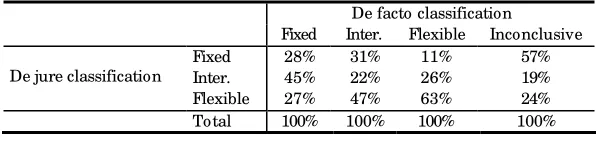
Tables 9-3 up to 9-5 describe, through the “ crossing” of de jure and de facto classifications, the
main characteristics of the regimes for the 1974-1998 period in quantitative terms, while tables
9-6 up to 9-8 do the same following some of the macroeconomic variables used in the
analysis. Some of the most outstanding characteristics are:
- An important proportion of the de facto inconclusive regimes are present for all the de jure
exchange rate regimes, especially for fixed regimes (table 9-4). At the same time the greatest
proportion of the de facto inconclusive regimes are concentrated in de jure fixed regimes
(table 9-3).
- While 63% of the regimes showing a flexible behavior are defined as such, just 28% of the
ones behaving as fixed admit being so (table 9-3). This behavior –paraphrasing Calvo and
Reinhart (2000)- could be referred to as “ fear of pegging” . It could results from a desire of
reduction of exposure to speculative attacks associated to explicit compromises.
- Excluding the inconclusive ones, while 62% of de jure flexible regimes behave as such, just
39% of the fixed ones does so (table 9-5). This result shows an important difference between
the central bank commitment to intervene and the behavior actually observed according to
the exchange rate regimes.
- The economies with de jure fixed regimes are open economies with low GDP per capita,
especially for those which are also de facto fixed (tables 9-6 and 9-8).
- As regards the inflationary performance, the de facto intermediate regimes show the highest
rates for each de jure regime; and de facto fixed regimes have lower average rate than the
flexible ones (table 9-7).
On the basis of the characteristics mentioned above, the theoretical and empirical elements
considered for building the new classifi cation of exchange rate regimes are:
- The categories’ diversity should balance a trade-off between greater information and
restrictions imposed by econometric issues.
- A clear difference between commitment and behavior, according to de jure exchange rate
regimes, is observed, with greater divergence for fixed regimes.
- The categories’ diversity should consider the performance or explanatory capacity of the
different possible categories. For example, while it seems to be obvious that a country with
4 Specifically the 1st round classification is considered, as it emerges from a deeper analysis likely to eliminate
the possibl e bias towards the irrelevance of the significance of the regime. The outline of the criterion considered by Levy Yeyati and Sturzenegger (2000) is presented in table 9-2.
a de jure fixed regime actually showing an intermediate or flexible behavior is inconsistent
with this commitment, it is not clear that an economy with flexible regime, behaving as
fixed, violates any kind of commitment which makes it inconsistent.
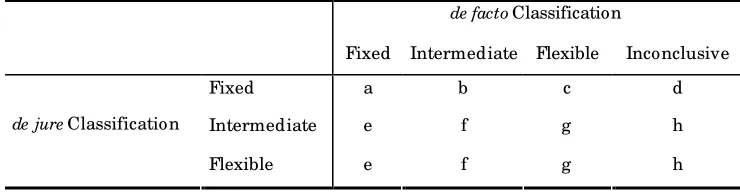
The new suggested classification of exchange rate regimes -with the letters identifying the
different categories- is presented in table 4 -1.
Table 4-1
New classification of exchange rate regimes
de facto Classification
Fixed Intermediate Flexible Inconclusive
Fixed a b c d
Intermediate e f g h
de jure Classification
Flexible e f g h
This new classification is composed of eight categories:
•(a) de jure fixed regimes behaving consistently with the commitment. For example: Lesotho
1980-1998, Bahrain 1992-1997, and Ireland 1976-1978.
•(b) de jure fixed regimes which, having behaved in the opposite way towards the
commitment –have variations on their exchange rates–, had strong movements on their
reserves. For example: Bolivia 1982-1985, Argentina 1975-1977, and Chile 1974-1976.
•(c) de jure fixed regimes which, even if they suffer changes on their exchange rates, are not
detected or punished for such behavior as they do not show greater changes on their
reserve levels. Fo r example: Poland 1992-1995, Burundi 1985-1991, and Sweden 1981 -1982.
•(d) A priori, they could be thought of as fixed regimes having stable economies, with no
greater external shocks or credibility problems. For example: Australia 1974-1983, New
Zealand 1974-1984, and The Bahamas 1974-1998.
The remaining categories have been grouped according to their observed behavior, as in
theoretical terms it is not evident that the disagreement between both classifications creates
any kind of inconsistency.
•(e) Economies behaving as fixed that do not want to be limited or judged by the rules
governing the de jure fixed regimes. They are linked to the “ fear o f pegging” concept. For
example: Finland 1992-1998, Ireland 1987-1998, Denmark 1981-1989, and New Zealand
[image:14.612.119.489.206.302.2]•(f) They have important movements in their reserves, and changing and volatile exchange
rates, but are not engaged with the exchange rate fixation. For example: Argentina
1981-1985, Brazil 1987-1993, and Thailand 1997-1998.
•(g) Within this classification, it is really close to pure flexible, as they show important variations in the exchange rate but little movement on its reserves. For example: the United
States 1977 -1998, Japan 1977-1998, Turkey 1981-1993, Chile 1992-1995, Uruguay 1986-1988 y
1990-1996.
•(h) It includes stable economies with no important external shocks or strong-enough as to avoid greater effects on their exchange rates or reserves. For example: Belgium 1974 -1998,
Canada 1974-1997, Tunisia 1987-1998, and Costa Rica 1993 -1998.
5
EM PIRICAL R ESULTS
In this section, the econometric results are presented. The inclusion of explanatory variables is
not derived from a particular model. On the contrary, it is general enough as to test different
hypotheses. The basic model is assessed for the 1974-1998 period and considers, in addition to
the lagged of the dependent variable, the terms of trade shocks, the GDP per capita, and the
exchange rate regimes as potential determinants of the fiscal variables. Later, the openness
and the inflation are included as control variables. Then, the study advances in two ways: in
first term, the model is evaluated at different sub-periods and, in second term, the exchange
rate classification is enriched.
It is worth mentioning that the Sargan test and the serial correlation test cannot reject their
respective null hypothesis for almost all the models estimated through GMM, supporting the
use of appropriate lags of the explanatory variables as instruments for the estimation.
For a proper reading of the coefficients associated with exchange rate regimes, it is worth
reminding that they refer to their differential effect compared to the flexible –de jure flexible in
the IMF classification, and pure flexible for the new classification (category g)-.
5.1
Importance in the choice of the estimation method
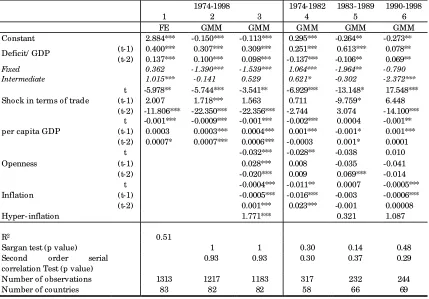
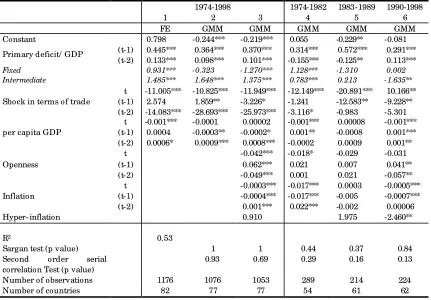
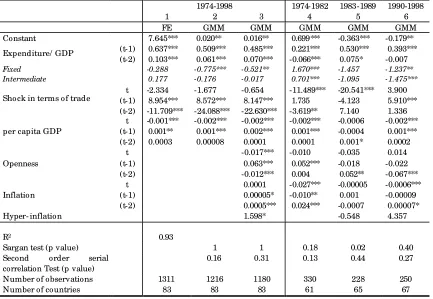
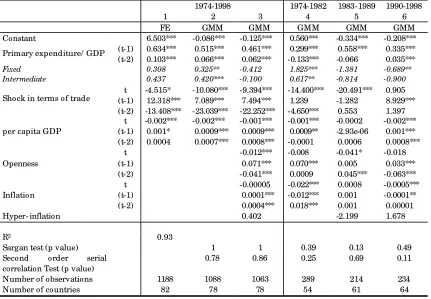
Models 1 and 2 of tables 9-9 and 9-13 represent the most basic estimated model. They cover
the 1974-1998 period and consider the current and past values of the shocks in exchange
terms and of the GDP per capita as explanatory varia bles together with lags of the fiscal
variable and the exchange regimes –fixed, intermediate and flexible. Models 1 and 2 differ in
the estimation methodology depending on whether it is FE or GMM respectively. The results
show the great importance of the proper choice of the method. On the one hand, for all fiscal
other hand, the effect of the regimes suffers several changes not only in significance but also
in direction and magnitude.
5.2
Controlling endogeneity for variables that influence on the regime choice but
not on the fiscal performance
Model 2 makes it possible to isolate the effect of each variable, including the regimes, on the
fiscal variable. How ever, this endogeneity control does not include variables having an
incidence on the regime choice but not a direct influence on the fiscal behavior. In the FE
estimation context this would be solved by the use of simultaneous equations for truncated
endogenous variables as Maddala (1983) suggests. Due to the fact that this proceeding is not
appropriate under GMM estimation, this type of variables were included in the regression
equation as control variables, building model 3, in which openness an inflation are added as
possible determinants of exchange regime, as many papers like Frieden et. al. (2000) and
Ghosh et. al. (1997) suggest.
Model 3 shows a strong persistence in all fiscal variables, with positive and significant
coefficients. An improvement on the exchange terms increases the total and primary fiscal
balance after many periods because of the increase in fiscal revenues and the decrease in
expenditures, which is consistent with the standard neoclassic approximation through a
tax-smoothing model. However, in the short run the increase in the revenues is compensated by
an increase in the expenditures causing a slight or null improvement in the fiscal balance,
which can be justified with political economy models, in line with the evidence found by
Tornell and Lan e (1994) and Talvi and Vegh (2000). As regards the influence of exchange rate
regimes, fixed ones show better fiscal performance over the total expenditure, total deficit and
primary variables. These results would support the conventional view held by Aghevli et al.
(1991), Frenkel et al. (1991), Giavazzi and Pagano (1988), and Weber (1991) according to which
fixed regimes provide greater fiscal discipline.
5.3
The role of international markets
Important issues to be taken into account in order to properly analyze the exchange rate
regime influence on the fiscal performance are indebtedness possibilities and the international
capital market characteristics, especially as regards their level of integration, volatility and
dominant financial structure. As described in the theoretical discussion, indebtedness
possibilities make the possibility of intertemporal choice for the policymaker. Likewise, there
is ample literature that analyzes how some changes in the international financial system
•Dominant financial structure change: while in the seventies and eighties the financial
structure was dominated by banks, since the beginning of the nineties there has existed a
great growth of institutions such as investment, pension and insurance funds which modify
the link and rules between debtors and creditors. As Krueger (2002) explains, while in the
eighties an important proportion of the emerging countries debts w ere in charge of bank
loans and the 85% of the creditors could be gathered arou nd a table, in the nineties the bond
market has quadruplicated and bond holders are more numerous, anonymous and hard to
coordinate than the banks. This creates a joint action problem , due to the fact that certain
agreements on debt reorganization that had once been achieved are, in the present context,
more difficult to achieve.
•New financial instruments’ growth: The previous situations worsen with the growth of debt
instruments and deriva tives, which allow investors to take short-term positions in weak
currencies through spot, forward and options of the money market. This means that those
countries having fixed regimes, especially those having unsustainable policies and
structural weakness, run under the risk of suffering speculative attacks to their currency
and of losing access to the capital market.
•Growing integration: several papers such as Bayoumi (1990) and Jones and Obstfeld (1997) find a grow ing financial integration pattern since 1973 through the correlation between
saving and investment.
•Grow ing volatility of financial flows: Fischer (1999) mentions that even though the nature of
the capital movement is not entirely smooth or predictable, the capital flow volatility in the
nineties seems to be excessive.
•Growing volume of financial flows: the total amount of financial flows as proportion of the
global product showed a slight upw ard trend between 1974 and 1982, a decrease in the
1983-1989 period and an important increase in the nineties.
•Contagion effect: Wolf (1997) defines contagion in the financial markets as the co -movement
of markets not ascribable to a common co -movement of the fundamentals. The three ways
that can help to explain this behavior are: the herd behavior –attributed to asymmetric
information problems-, the portfolio’s composition – which makes that any change in the
outp ut of an active in a market contribute to modifications in the rest of the composition -
and the interdependence of the portfolio –which seeks to compensate losses of capital in a
country with the sell of assets from other markets to increase liquidity in view of the rescue
of investors -.
For these reasons, the 1974-1998 period was divided into three sub-periods according to the
•1974-1982: This period was characterized for an international financial structure dominated
by bank loans and for an abundance of capitals that allowed strong increases of the debts
that ended with the 1982 crisis.
•1983-1989: It was a period of strong reduction in the capital flows as a consequence of the debt crisis originated by Mexico in August 1982, which continued with several crises in
emergent economies such as Argentina, Brazil, Chile and Nigeria.
•1990-1998: Like in the seventies, it is a period of capital abundance, but unlike the former
the growth of institutions such as investment, pension and insurance funds encouraged a
growing integration of the international financial system that favored the development of
bonds and stocks markets. The growing volatility of the financial flows appears as an
outstanding characteristic, which is usually explained by two classes of arguments. On the
one hand, some associate it to rational motives based on the fundamentals and; on the other
hand, there are arguments -about which most agree - supporting the existence of additional
irrational motives, such as the contagion effect or herd behavior, which make the volatility
characteristic of the international investors appears to be boosted by some level of economic
frailty. In this sense, Greenspan (1998) points out: “ Recent crises, while sharing many, if not
most, of the characteristics of past episodes, nonetheless, appear different. Market discipline
today is clearly far more draconian and less forgiving th an twenty or thirty years ago.
Owing to greater information and more opportunities, capital now shifts more readily and
increasingly to those ventures or economies that appear to excel.”
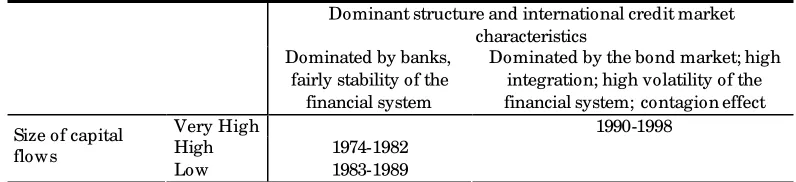
Table 5-1 summarizes the characteristics of these periods in tw o dimensions. In first place, it
differentiates according to capital flow size, trying to reflect the credit availability at a global
scale. In second place, it distinguishes the dominant structure, the characteristics of the
international credit market and the volatility level with the idea of reflecting the conditions or
potential sanctioning power of the financial market as explained above and as shown by
Greenspan’s (1998) statement.
Table 5-1
Characterization of different periods of capital flow
Dominant structure and international credit market characteristics
Dominated by banks, fairly stability of the
financial system
Dominated by the bond market; high integration; high volatility of the financial system; contagion effect
Very High 1990-1998
High 1974-1982 Size of capital
flows
[image:18.612.105.503.585.676.2]In this way -maintaining the de jure exchange classification used in models 1, 2 and 3 and the
structure of variables in model 3- models 4, 5 and 6 refer to periods 1974-1982, 1983-1989 and
1990-1998 respectively. An interesting result is that the 1983-1989 period appears as the one
with greater persistence or inertia of the fiscal variables, for those associated to both deficit
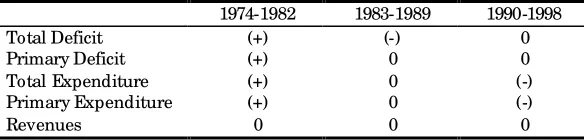
and expenditure. The results obtained are exposed on tables 9-9 to 9-13 and the differential
effects of fixed regimes in relation to flexible ones are summarized in table 5 -2.
Table 5-2
Differential fiscal performance of the fixed regime in relation to the flexible one
1974-1982 1983-1989 1990-1998
Total Deficit (+) (-) 0
Primary Deficit (+) 0 0
Total Expenditure (+) 0 (-)
Primary Expenditure (+) 0 (-)
Revenues 0 0 0
Note: 0 indicates that there is no statistically significant difference between the fixed regime coefficient compared to the flexible one, (+) that this difference is statistically positive and (-) that it is statistically negative.
A highly different behavior is observed when the different periods are considered, except for
the fiscal revenues, which do not show significant differences for any period in comparison to
the flexible ones. For the 1974-1982 period fixed regimes show a lower disciplinary effect than
that of the flexible ones, which could be associated to political economy models. That is, in an
international context with abundance of credit and low initial percentage debts, the presence
of “ weak” and divided governments or governments prone to spend, predict -ceteris paribus-
laxer fiscal situations in countries with fixed regimes and greater discipline in economies with
flexible regimes due to the immediacy of the punishment associated to the unsustainable
fiscal policy.
For the 1983-1989 period, even though the fixed regime shows greater discipline over the total
deficit, in general terms it does not show a different behavior from the flexible one as it does
in the preceding period. Nevertheless, since the influence of the regime does not only depend
on the possibility of its current strategic use but also on the accumulated behavior up to the
moment, the fixed regime grouping under a single category does not make it possible to
decipher its effect, for which future models would broaden this classification.
For the 1990-1998 period, the fixed regime is likely to have a grater fiscal discipline through
the expenditure variables, although it does not have influence on any other variable. These
[image:19.612.159.451.207.277.2]5.4
Long and short term fixed regimes: Short Peg and Long Peg
To differentiate -among the de jure fixed - those with long and continuous tradition from the
rest, the fixed classification is broaden to Long Peg and Short Peg depending on whether the
fixed regime lasted at least five consecutive years or not. The results thus obtained are
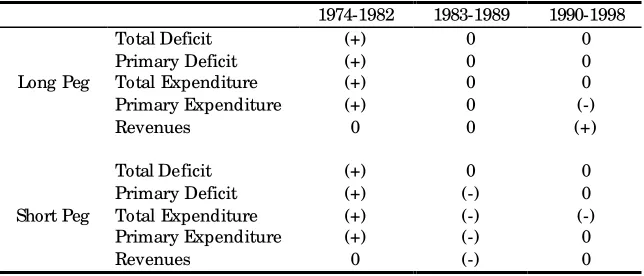
exposed on tables 9-14 to 9-18 and the differential effects of fixed regimes in relation to the
flexible ones are summarized in table 5 -3.
Table 5-3
D ifferential fiscal performance of Long Peg and Short Peg compared to the flexible one
1974-1982 1983-1989 1990-1998
Total Deficit (+) 0 0
Primary Deficit (+) 0 0
Long Peg Total Expenditure (+) 0 0 Primary Expenditure (+) 0 (-)
Revenues 0 0 (+)
Total Deficit (+) 0 0
Primary Deficit (+) (-) 0
Short Peg Total Expenditure (+) (-) (-) Primary Expenditure (+) (-) 0
Revenues 0 (-) 0
Note: 0 indicates that there is no statistically significant difference between the fixed regime coefficient compared to the flexible one, (+) that this difference is statistically positive and (-) that it is statistically negative.
Table 5-3 shows that while in the 1974-1982 period both classes of fixed regimes tended
toward w o rse fiscal discipline than the flexible ones, through the deficit and expenditure
variables, in the 1983 -1989 period, the performance was clearly different. Long fixed regimes
did not show a disciplinary effect different from that of the flexible ones - probably because in
the absence of international credit the potential costs of maintaining an “ unhealthy” fiscal
policy would be too high. On the other hand, the Short Peg had shown a greater disciplinary
impact on both expenditure variables and on the primary deficit, although they showed
lower collecting capacity and a similar total deficit performance. These results are consistent
with the ones observed under the so-called stabilizing policies, in which the presence of the
inflationary processes unfolded by the ongoing monetization of the fiscal defi cits make that
many countries establish fixed exchange rate regimes as nominal prices anchors, while they
tried as well to improve their fiscal performance. However, the difficulty in reducing the total
and primary expenditure, reflected on these variables’ strong inertia -especially in this
period -, the payment of great interests resulting from the bulky debts, and the decrease in the
fiscal revenues -partly resulting from the exchange rate appreciation-, did not make it
[image:20.612.145.467.220.358.2]recurrent phenomena during the period. The results obtained for the 1990-1998 period are not
sufficiently clear.
5.5
New exchange classification: The importance of a classification that detect
inconsistencies
In considering the central bank commitment affairs to intervene and subordinate its monetary
policy to the currency market, as the possible inconsistencies in its performance, the new
classification suggested in section 4 is used. The results obtained for this classification are
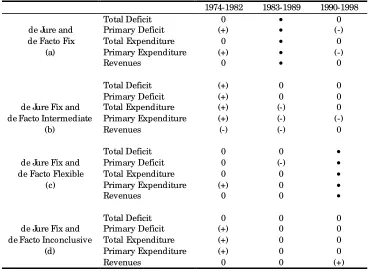
exposed on tables 9-19 to 9 -23 and are summarized in table 5-4.
Table 5-4
Differential fiscal performance of the new classification of fixed compared to flexible ones (g)
1974-1982 1983-1989 1990-1998
Total Deficit 0 • 0
de Jure and Primary Deficit (+) • (-)
de Facto Fix Total Expenditure 0 • 0
(a) Primary Expenditure (+) • (-)
Revenues 0 • 0
Total Deficit (+) 0 0
Primary Deficit (+) 0 0
de Jure Fix and Total Expenditure (+) (-) 0 de Facto Intermediate Primary Expenditure (+) (-) (-)
(b) Revenues (-) (-) 0
Total Deficit 0 0 •
de Jure Fix and Primary Deficit 0 (-) • de Facto Flexible Total Expenditure 0 0 •
(c) Primary Expenditure (+) 0 •
Revenues 0 0 •
Total Deficit 0 0 0
de Jure Fix and Primary Deficit (+) 0 0 de Facto Inconclusive Total Expenditure (+) 0 0
(d) Primary Expenditure (+) 0 0
Revenues 0 0 (+)
Note: 0 indicates that there is no statistically significant difference between the fixed regime coefficient compared to the flexible one, (+) that this difference is statistically positive and (-) that it is statistically negative and • that such variable is not considered in the regression because of the absence of observations.
In general terms, for the 1974-1982 period fixed regimes are bound to lesser fiscal discipline
than flexible ones. It is interesting to note how ever, that the regimes included in (c) – de jure
fixed with changes in their exchange rates, but not in their reserves - are not clearly less
disciplinary than the flexible ones. The fact of not having strong variations in their reserves in
despite of changes in their exchange parities might be due to the fact that the agents did not
expect such changes, maybe because their fundamentals –including its fiscal performance -
[image:21.612.121.491.277.548.2]In the 1983-1989 period many countries w ith serious debt crises and inflationary processes
adopted de jure fixed regimes apparently with two objectives: to behave as a nominal anchor
for prices and to favor a grater fiscal discipline. Literature shows that if the government does
not have access to credit and/ or had insufficient reserves, the monetary financing of deficits
would cause an immediate currency depreciation independently from the exchange rate
regime. The econometric results are in line with this idea since:
•Regime (d) -de jure fixed having stable economies, with no greater external shocks or
credibility problems– did not have a differential effec t when compared to the flexible ones.
•In general terms, regime (c) is still as disciplinary as the flexible due to the reasons
mentioned above.
•Regime (b) includes most stabilizing plans of the eighties, which were not too much
effective in reducing total deficits. The strong persistence of the fiscal variables in this
period, the insufficient disciplinary effect of stabilizing policies, and the recurrent re-lining
of the exchange rate -with its consequent punishment in terms of violating a rule and losing
credibility- would show that, in those economies with a poor fiscal performance and serious
inflationary problems, governments would have tended to see such costs with lower weight
than the ones that would result from a real budgetary adjustment in order to make its fiscal
performance consistent.
•Regime (a) does not have any observations. This would seem to indicate that to be defined
as fixed and behave in such a manner would be highly costly at times of strong financial
restrictions, probably due to the fact that the strong inertia of fiscal variables makes it
impossible to maintain a fixed exchange rate with constant deficits and inflation.
The 1990-1998 period is, as the sixties, one of capital abundance, with flows greater than the
ones observed before the debt crisis. However, the incidence of fixed regimes over the fiscal
performance compared to that of the flexible ones is highly different for this period. A
possible rationalization of this uneven performance could be found in the different
characteristics of the present international financial system highlighted above: growth of the
bonds and stocks market, new financial instruments favoring short term positions, higher
volatility of capital flows and contagion effect. For all this, even though it is a more
“ calibrated” system for rewarding a good performance, it is also so for discipline errors of
private investments or public policies once they are evident. This larger information and
opportunities make it possible for the capitals to move more easily and each time more
toward those more convenient opportunities, producing a more extreme and less
“ sympathetic” disciplinary capacity than twenty or thirty years ago did . This evidence in its
the so-called “ tw o poles” theory, w hich suggest an inherent tension between high capital
mobility and countries with fixed regimes wanting to perform a monetary policy w ith
domestic objectives. According to these authors, this occurs due to the higher fragility that the
grow ing capital mobility imposes on the exchange commitments, which will cause the
countries to be forced to choose between flexible regimes or exchange rate unions in the XXI
century. The main obtained results show that:
•Those countries with regime (a) have a reversal in sign compared to those of the 1974-1982
period. This could be due to the fact that those countries that have undergone external
shocks -shown in their reserves movement - and have been able to maintain their exchange
commitment must have had a more disciplined fiscal performance than the flexible ones.
•Regime (b) has a more disciplinary effect than the flexible only on the primary expenditure.
This performance –together with the possible impairment of other fundamentals- probably
favored, within the framework of highly volatile capital markets subject to panic, the
exchange rate destabilization.
•(c) Do not have any observations. This situation would show the limited current
possibilities of finding a country with de jure fixed exchange regime, which simultaneously
varies its exchange rates –violating its commitment- without being affected in its reserves’
levels.
•Exchange rate regime (d) does not generally have a differential influence over the fiscal
variables compared with the flexible ones w hich, w ithin the framew ork explained above,
could be associated with the fact that these stable economies not suffering credibility
problems do not need to show a special disciplinary performance, since they are not subject
to greater external shocks. However, they cannot relax their fiscal performance as they did
in the seventies because they would probably stop being stable. The underlying idea is that
the exchange rate regimes have an impact on the economic per formance only when they
represent a relevant restriction on the economic policy, which is more likely to occur w hen
6
CO NCLUSIO NS
This paper analyzed the effect of the exchange regimes on the fiscal discipline, focusing on
the fixed and flexible difference. The results strongly suggest that such differential effect
depends on the international context, specifically on the possibility of indebtedness and the
characteristics of the international financial system. In this respect, the results suggest that the
traditional view stating that fixed regimes necessarily provide greater fiscal discipline should
be revised.
The main conclusions can be summarized in three points:
• In situations where there is originally no fiscal discipline and the authorities have the
possibility of financing with debt with relatively low costs -associated to the low probability
in the regime collapse or to the low costs in terms of the incidence of such collapse on the rest
of the economy-, as in the 1974-1982 period, fixed regimes do not provide greater discipline
per se. On the contrary, flexible ones generate greater discipline because of the immediacy of
the punishment associated to the unsustainable fiscal policy. This result is compatible w ith
models such as those of Alesina y Drazen (1991), Calvo (1986), Tornell y Velasco (1995a,
1995b), and Velasco (1997) according to which the presence of “ weak” and divided or prone
to spend governments, in a context of credit abundance and low initial debt percentages,
produce ceteris paribus laxer fiscal situations in countries having fixed regimes.
• In contexts with strong financing restrictions, as in the 1983-1989 period, the monetary
financing of the deficits will inevitably cause an immediate currency depreciation,
independently from the chosen exchange rate regime. Therefore, the disciplinary effects of
either regime should not be substantially different.
• On the contrary, in contexts of abundance of capital but where these are highly volatile
and probably subject to contagion effect, as in the 1990-1998 period, fixed regimes desiring to
be consistent should -ceteris paribus- have a greater disciplinary effect compared to the
flexible ones to diminish the probabilities of suffering an exch ange attack. This is in line with
what Gavin and Hausmann (1999) suggest, according to whom in the context of high
economic and financial volatility, the main factor to protect oneself is being solvent, as
“ ...solvency has as much to do with what might hap pen as what is expected to happen...” .
That is, “ ...in order to protect an economy from financial contagion it is not enough to be
solvent under existing circumstances and those that are expected to prevail; it is also
important to be solvent under more difficult circumstances that may very well be down the
greater integration, volatility and punishment capacity -associated to greater information
flows and to the bond market growth -, made the functioning of the international financial
system itself to be in charge, through its potential punishment, of obtaining an extra
disciplinary effect by those fixed regime economies desiring to remain like that. This result
supports, on the one hand, the so-called “ Theory of the two poles” suggested by Eichegreen
(1994) y Obstfeld y Rogoff (1995a) and the empiric evidence found by Collins (1996) and
Edwards (1996) and, on the other hand, the “ fear of pegging” phenomenon. That is to say, if
in order to possess a consistent fixed exchange rate regime a country must have an extra
disciplinary effect, greater would the incentive to adopt flexible regimes, or alternatively,
those willing to behave as fixed ones would have less incentives to define themselves as such
7
REFERENCES
[1] Adam, C., D. Bevan y G. Chambas (2000); “ Exchange rate regimes and revenue
performance in Sub-Saharan Africa” ; QEH working paper Nº35.
[2] Aghevli, B., M. Khan y P. Montiel (1991); “ Exchange rate policies in developing
countries: Some analytical issues” ; IMF occasional paper Nº 78.
[3] Ahn, S. y P. Schmidt (1993); “ Efficient estimation of models for dynamic panel data” ;
Journal of econometrics, forthcoming.
[4] Alberola, E. y L. Molina (2000); “ Fiscal discipline & exchange rate regimes. A case o f
currency boards?” ; Bank of Spain working paper Nº0006.
[5] Alesina A. y A. Drazen (1991); “ Why are stabilizations delayed?” ; American Economic
Review; Vol. 81: 1170-1188.
[6] A lfaro, L. (1999); “ Why governments implement temporary stabilization programs” ;
Journal of Applied Economics; Vol II, Nº2: 211 -245.
[7] Anderson, T. y C. Hsiao (1981); “ Estimation of dynamic model error components” ;
Journal of American statistical association; V ol. 76: 598 -606.
[8] Arellano, M. y S. Bond (1991); “ Some tests of specification for panel data: Monte Carlo
evidence and an application to employment equations” ; Review of Economic Studies
58: 277-297.
[9] Bachetta, P y E. Van Wincoop (1999); “ Does exchange rate stability increase trade and
capital flows?” ; FRBNY working paper Nº9818.
[10] Bayoumi, T. (1990); “ Saving-investment correlations, immobile capital, government
policy, or endogenous behavior” , IMF staff papers.
[11] Bazzoni S. y K. Nashashibi (1994); “ Exchange rate strategies and fiscal performance in
Sub-Saharan Africa” ; IMF staff papers.
[12] Calvo, G. y C. Vegh (1996); “ Exchange-rate-based stabilization under imperfect
credibility” , en M oney, Exchange Rates, and Output. Cambridge Press.
[13] Calvo, G. y C. R einhart (2000); “ Fear of floating “ ; NBER working paper Nº7993.
[14] Collins, S. (1996); “ On becoming more flexible: Exchange rate regimes in Latin America
and the Caribbean” ; Journal of Development Economics, Vol 51.
[15] Cooper, R. (1971); “ Currency devaluation in developing countries” ; Princeton Essays in
International Finance, Nº86.
[16] Chang, R. (1999); “ Understanding recent crises in emerging markets” . FRBA, Economic
Review, Second quarter: 6 -16.
[17] ________ y A. Velasco (1998); “ Financial fragility and the exchange rate regime” ; NBER
[18] Devereux, M. (1999); “ A simple dynamic general equilibrium analysis of the trade-off
between fixed and floating exchange rates” ; mimeo.
[19] Diamond D. y P. Dybvig (1983); “ Bank Runs, Deposit Insurance, and Liquidity” ; Journal
of Political Economiy, Nº 91: 401-419.
[20] Edwards, S. (1996); “ The determinants of the choice between fixed and flexible
exchange -rate regimes” ; NBER w orking paper Nº5756.
[21] Eichengreen, B. (1994); International Monetary Arrangements for the 21st Century.
Washington, DC. Brookings Institution.
[22] Fischer, S. (1999); “ Global markets and the global village in the 21st century: Are
international organizations prepared for the challenge?” ; German Society for Foreign
Affairs, Berlin, Germany.
[23] Frenkel, J., M. Goldstein y P. Masson (1991); “ Characteristics of a successful exchange
rate system” ; IMF occasional paper Nº82.
[24] Frieden, J., P. Ghezzi y E. Stein (2000); “ Politics and exchange rates in Latin America” ;
Inter-American Development Bank research network working paper NºR-421.
[25] Gavin, M. y R. Hausmann (1999); “ Preventing crisis and contagion. The domestic policy
agenda” ; Conference on social protection and poverty, BID.
[26] Giavazzi, F. y M. Pagano (1988); “ The advantage of tying one’s hands: EMS discipline
and central bank credibility” ; European Economic Review, June.
[27] Ghosh, A., A. Gulde, J. Ostry y H. Wolf (1997); “ Does the nominal exchange rate
matter?” ; NBER working paper Nº5874.
[28] Greenspan, A. (1998); “ The structure of the international financial system” ; A t the
Annual Meeting of the Securities Industry Association, Boca Raton, Florida.
[29] Helpman, E. (1981); “ An exploration into the theory of exchange rate regimes” ; Journal
of political economy; Vol 89.
[30] Jones, M. y M. Obstfeld (1997); “ Saving, investment, and gold: A reassessment of
historical current account data” ; NBER w orking paper Nº6103.
[31] Kamin, S. (1988); “ Devaluation, exchange controls and black markets for foreign
exchange in developing countries” ; BGFRS occasional paper Nº334.
[32] Krueger, A. (2002); “ The evolution of emerging market capital flows: Why we need to
look again at sovereign debt restructuring” ; Economics Society Dinner, Melbourne,
Australia.
[33] Krugman, P. (1979); “ A balance of payments crises” ; Journal of money, credit and
banking.
[34] Levy Yeyati, E. y F. Sturzenegger (2000); “ Classifying exchange rate regimes: Dees vs.