NBER WORKING PAPER SERIES
CENTRAL BANK TRANSPARENCY: CAUSES, CONSEQUENCES AND UPDATES
Nergiz Dincer Barry Eichengreen Working Paper 14791
http://www.nber.org/papers/w14791
NATIONAL BUREAU OF ECONOMIC RESEARCH 1050 Massachusetts Avenue
Cambridge, MA 02138 March 2009
State Planning Organization, Ankara, and University of California, Berkeley, respectively. An earlier version of this paper was presented to the conference on Money Matters: The Law, Politics and Economics of Currency, held at Tel Aviv University on 7-9 January 2009. We are grateful to Tal Sadeh and other conference participants for helpful comments. The views expressed herein are those of the authors and do not necessarily reflect the views of the National Bureau of Economic Research.
Central Bank Transparency: Causes, Consequences and Updates Nergiz Dincer and Barry Eichengreen
NBER Working Paper No. 14791 March 2009
JEL No. E0,E58
ABSTRACT
We present updated estimates of central bank for 100 countries up through 2006 and use them to analyze both the determinants and consequences of monetary policy transparency in an integrated econometric framework. We establish that there has been significant movement in the direction of greater central bank transparency in recent years. Transparent monetary policy arrangements are more likely in countries with strong and stable political institutions. They are more likely in democracies, with their culture of transparency. Using these political determinants as instruments for transparency, we show that more transparency monetary policy operating procedures is associated with less inflation variability though not also with less inflation persistence.
Nergiz Dincer
State Planning Organization Ankara
Turkey
[email protected] Barry Eichengreen
Department of Economics
University of California, Berkeley 549 Evans Hall 3880
Berkeley, CA 94720-3880 and NBER
Central Bank Transparency: Causes, Consequences and Updates
1Nergiz Dincer and Barry Eichengreen February 2009
1. Introduction
Commenting on British monetary policy in 1929, Otto Niemeyer, director of
financial inquiries at H.M. Treasury, observed that “In prewar days a change in bank rate
was no more regarded as the business of the Treasury than the colour which the Bank
painted its front door.”2 In 1987 William Greider entitled his expose of the Federal Reserve Secrets of the Temple.3 Since then the world of monetary policy has changed. Transparency now is a byword. Central banks are supposed to be open about their
objectives, outlooks, policy strategies, and even their mistakes. The days when monetary
policy deliberations were regarded as no more the business of outsiders than the color
than the central bank chose to paint its door are now firmly in the past.
Or so it might seem. Assessing whether this move in the direction of policy
transparency is permanent – and if so how far it might go – or whether it might be
reversed requires understanding what lies behind the trend in the first place. One view is
that transparency enhances the effectiveness of monetary policy. Transparency about
monetary policy objectives, outlooks and strategies is necessary for effective
communication with the markets, and effective communication is necessary for monetary
1
State Planning Organization, Ankara, and University of California, Berkeley, respectively. An earlier version of this paper was presented to the conference on Money Matters: The Law, Politics and Economics of Currency, held at Tel Aviv University on 7-9 January 2009. We are grateful to Tal Sadeh and other conference participants for helpful comments.
2
Cited in Eichengreen, Watson and Grossman (1985).
3
policy to have stabilizing effects. Policy transparency makes it easier for observers to
anticipate central bank actions and minimizes disruptions when policies change. It
enhances the ability of policy makers to manage expectations, which is a key channel
through which monetary policy affects outcomes. Transparency about not just current
but also expected future policy gives the central bank leverage over long-term interest
rates (which depend on expectations) and thus provides an important mechanism for
influencing consumption and investment.
The seminal research on this subject built on the Barro-Gordon (1983) model in
which wages are set now on the basis of expected future monetary policy.4 Imagine, for example, that inflationary pressures are building and unions contemplate raising their
wage demands. If the central bank is transparent about the priority it attaches to price
stability, the risk it perceives that inflation will exceed its target, and the likelihood of
having to respond by raising interest rates, then wage setters will have reason to
anticipate that inflationary pressures will subside. They will be less likely to demand
higher wages now that would, require costly and difficult wage reductions in the future.
The disruptions to the economy from policies to contain inflation would be less. And
monetary policy makers are less likely to fall prey to an expectations trap in which
expectations drift off in ways that force them into unpalatable policy choices.5
Transparency thus allows the central bank to more effectively communicate with
the markets. It helps it to credibly commit. It is a way for monetary policy makers to
communicate the importance they attach to price stability.6 This in turn enables them to
4
See for example Geraats (2002a,b).
5
See Clarida, Gali and Gertler (2000) and Christiano and Gust (2000).
6
respond flexibly to disturbances without undermining confidence in their commitment to
their long-term target.
A second view is that transparency is a mechanism for democratic accountability
in a world of policy discretion and central bank independence. Once upon a time central
bank policy was constrained by rules like those of the gold standard, if not absolutely
then at least more tightly than today. Central banks may have had statutory independence
– many of them were in fact still private banks – but they did not have policy
independence.7 The demise of the gold standard was associated with the spread of modern central banking but also with increasing central bank dependence on the
government (as alluded to in Niemeyer’s quote above). At this stage there was no
question about the political accountability of the central bank. More recently has there
been recognition of the efficiency advantages of delegating the conduct of monetary
policy to an independent entity. Moreover, with the move away from pegged exchange
rates, central banks have acquired greater discretion over the stance of policy. But with
the growth of independent powers comes a need for democratic accountability, for
assurance that the independent technocrats now with discretion over monetary policy
imperfect because of unanticipated policy-implementation errors that the public is incompletely able to observe. Greater transparency about economic conditions thus enables agents to infer the central bank’s preferences more accurately. In turn this gives the monetary authority an incentive to build a reputation for valuing price stability. The private sector becomes more sensitive to unanticipated policy responses and actions, attenuating the incentive for the central bank to engage in them. The result is thus greater sensitivity of inflation expectations to policy actions, the less benefit to the central bank of inflating, and less inflationary bias. In this way increased transparency about control errors improves social welfare. Greater transparency about the central bank’s objectives may be more of a mixed blessing in this
framework. Transparency about objectives, in addition to reducing uncertainty about future inflation and output, which will be welfare improving other things equal, removes the central bank’s incentive to curtail inflation in order to signal its type, which can be welfare reducing.
7
decisions take those decisions in a manner consistent with the public interest and will be
taken to task for failing to do so. This mechanism for democratic accountability will be
effective only if the central bank is transparent about its decisions – only if those deciding
monetary policy cannot claim that their policy decisions are, in fact, in the public interest
for reasons that only they understand. In the absence of adequate transparency, suspicion
about central bank motives may develop, and pressures to curb the institution’s
independence may be irresistible.
Both rationales have been questioned. If asymmetric information is a distortion,
then the theory of the second best suggests that removing one distortion in the presence
of another may not be welfare improving. It is not hard to construct scenarios in which
additional transparency destabilizes expectations and accentuates financial market
volatility.8 Similarly, there are critics of the view that transparency can substitute adequately for direct political sanctions as a mechanism for holding monetary policy
makers accountable.9
In addition, even those who embrace these efficiency- and accountability-based
arguments wonder whether central bank transparency can go too far. The European
Central Bank has justified its refusal to publish the minutes and voting records of its
board on the grounds that individual members would then be subject to pressure from
8
Morris and Shin (2002, 2005) illustrate the point in a model in which individual welfare depends not just on the state of the world but on the actions of other individuals (there exists a coordination externality). Starting from a position where both private and public information are imperfect, they show that greater precision of public information can lead individuals to attach inadequate weight to private information. In the absence of coordination motives, the precision attached to the public and private signals will be commensurate with their relative precision. When coordination motives are present, however, agents attach greater weight to the public signal, since they know this to be common information. But since the public signal is noisy, this weight on the public signal may be suboptimal from a social-welfare point of view; agents may be led to coordinate on an inefficient equilibrium. This adverse outcome is more likely the more precise is private information.
9
Thus, some critics of the European Central Bank, whose transnational status, embedded in an
special interests (national interests, in its context) that compromised their independence
and led to inefficient policy decisions.10 Clare and Courtenay (2001) argue that minutes describing contentious discussion among central bank board members can heighten
asset-price volatility, suggesting that copious information only confuses investors. More
generally, van der Cruijsen, Eijffinger and Hoogduin (2008) suggest that agents may be
confused by the large and increasing amount of information with which they are
bombarded in a highly transparent regime. They suggest that excessive transparency may
cause agents to realize how uncertain the central bank is about economic conditions and
the efficacy of policy, in turn heightening volatility. Others ask whether requiring the
central bank to provide detailed information about its intermediate targets, only to miss
them, might similarly confuse and raise questions about the competence of policy
makers. Thus Goodhart (2001) questions the efficacy of requiring the central bank to
provide information on not just, inter alia, inflation forecasts but also its forecasts for the
future path of the monetary policy instrument, on the grounds that this would so
complicate decision making (board members would have to agree on an entire trajectory
for their policy instrument at each decision point) as to potentially undermine effective
decision making.11 Mishkin (2004) warns that a high degree of transparency might disrupt communication with the public, which would not easily understand that forecasts
for the policy instrument are conditional on the future state of the economy, and which
might misinterpret changes in the forecast (or deviations between forecast and realized
rates) as the central bank reneging on its commitments.
10
See Hamalainen (2001) for an early statement to this effect.
11
We cannot resolve these debates here, but the evidence we present speaks to
them. Specifically, in this paper, which is the latest in a series we have writing on the
subject of central bank transparency, we undertake three tasks.12 First, we document changes in the prevalence of central bank transparency, updating our measures through
2006. Second, we analyze the determinants of the degree of transparency, focusing here
on the role of political variables. Third, we examine the consequences for
monetary-policy outcomes such as inflation variability and inflation persistence. Here we probe for
nonlinear effects of transparency on policy outcomes as a way of providing a provisional
answer to Mishkin’s (2004) question of whether “transparency can go too far.” A
methodologically significant aspect of our work is that we consider the determinants of
transparency and the effects using a unified analytical framework. This means that we
can use our analysis of the determinants to identify instrumental variables that address the
concern that an observed correlation between outcomes and transparency reflects the
impact of the former on the latter, rather than the other way around.
2. Data
Our indices of central bank transparency follow the work of Eijffinger and
Geraats (2006). In contrast to earlier studies, most of which focused on particular aspects
of transparency (for example, whether the central bank announced an explicit target for
inflation), Eijffinger and Geraats acknowledged that transparency has multiple
dimensions. The result is 15 subindices (detailed in the appendix) designed to capture the
political, economic, procedural, policy and operational aspects of monetary policy
12
transparency.13 Political transparency denotes openness about policy objectives; economic transparency openness about data, models and forecasts; procedural
transparency openness about the way decisions are taken; policy transparency openness
about the policy implications; and operational transparency openness about the
implementation of those decisions.
We draw our data from information on central banks’ websites and in their
statutes, annual reports, and other published documents. We gather this information for as
large a number of central banks as possible (where Eijiffinger and Geraats looked at just
nine central banks).14 In addition, we gather the same information for every year from 1998 through 2006. Where there was a change in some aspect of transparency over the
course of a calendar year, we take the value that prevailed for the largest portion of the
year.15
We were able to assemble this information for 100 central banks.16 Most of the omissions are central banks of micro-states: our sample includes the central banks of all
large, systemically significant countries.17
13
The overall index thus runs from 0 to 15. Adopting the same criteria used by these previous investigators has the advantage of facilitating comparisons across studies and frees us of suspicions that we have
constructed our measures so as to maximize or minimize the impact of transparency.
14
An earlier study by Bini-Smaghi and Gros (2001) also considered 15 aspects of central bank
transparency, although they considered only four central banks. De Haan, Amtembrink and Waller (2004) developed a similar index for six countries, while De Haan and Amtembrink (2003) apply a similar approach to 15 countries. Siklos (2002) expands coverage to 20 central banks, all from advanced industrial countries. The most comprehensive previous study in terms of country coverage is Fry et al. (2000), although they construct indices only for 1998.
15
Adding this time dimension was particularly challenging, since many central bank websites describe current practice but not that of prior years. For this we had to rely mainly on published documents. We were able to access a relatively complete run of these on the basis of holdings in the University of California and Joint IMF-World Bank libraries. We are grateful to the staff of the Joint Bank-Fund library for granting us access to their collection.
16
Table 1 shows the results by country and region. The most transparent central
banks in 2006, according to our coding, were the Reserve Bank of New Zealand, the
Swedish Riksbank, the Bank of England, the Bank of Canada, the Czech National Bank,
the ECB, and the Central Bank of the Hungary. We see here a number of countries that
received high marks for transparency in previous studies (New Zealand, Sweden, the UK,
Canada) but also others (the Czech Republic, Hungary), which is a reminder of the
advantages of broad country coverage and of the fact that a number of countries with
relatively opaque central banking practices have been moving in the direction of greater
transparency. The six least transparent central banks were those of Aruba, Bermuda,
Ethiopia, Libya, Saudi Arabia and Yemen. Table 2 shows our coding of the 15 individual
components for these 13 countries as of 2006.
More generally, we can compare different dimensions of central bank
transparency. In 2006, 65 central banks received scores of 2 or more for political
transparency (inter alia, providing a quantitative definition of their objectives to the
public).18 Economic transparency (disclosing data, the policy model and forecasts) is less; only 5 central banks receive the highest possible rating. The picture is similar for
procedural transparency (the release of minutes and votes), where only four central banks
receive the highest possible score. And again for policy transparency (prompt
announcement and comprehensive explanation of policy decisions), where only the
Reserve Bank of New Zealand receives the full score and the Swedish Riksbank and the
17
Among the omissions are Bolivia, Ecuador, Chad, Iran, and Afghanistan We are aware that this creates a form of sampling bias: we tend to oversample more transparent central banks. There exist econometric corrections for this bias (involving strong assumptions), although we have not implemented these yet. Our defense is that the number of consequential omissions is relatively slight.
18
Fed receive a score of 2.5. No central bank receives a perfect score of 3 for operational
transparency (release of information about disturbances, control errors, etc.)
Taking unweighted averages of the countries making up a region (as in Table 1),
we see the highest level of transparency in Australia-New Zealand, followed by Western
Europe, Northern Europe, South East Asia, Southern Africa, and North America. That
South East Asia and Southern Africa are scored as more transparent than North America
is a figment of the unweighted averages. When we instead take GDP-weighted averages,
as in Table 3, the most transparent regions as of 2006, in descending order, are Europe
(led by Northern Europe), North America, Oceania and Southern Africa (dominated by
South Africa); lower weights on its relatively transparent small economies causes South
East Asia to drop down. Either way, the lowest levels of transparency, starting from the
bottom, are those of Northern Africa, Southern Asia, Eastern Africa and Western Africa –
no surprises here.
Turning to trends over time, the average transparency score in our sample rose
from 3.4 in 1998 and 5.4 in 2006. Strikingly, none of our 100 countries moved in the
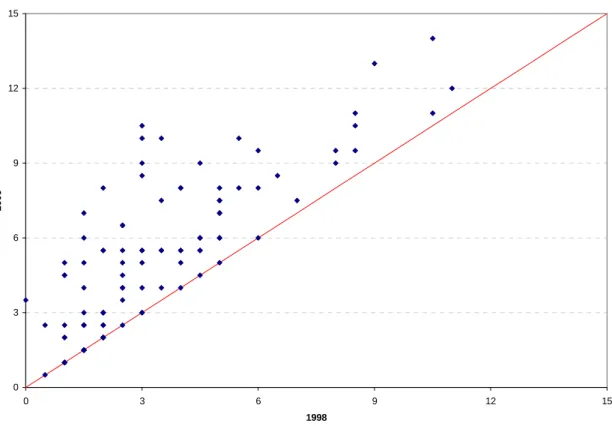
direction of less transparency. Figure 1 compares our measure of transparency in 1998
and 2006 (with 2006 on the vertical axis). There are only 10 countries on the diagonal,
indicating no increase in transparency, while the remaining 90 cases are all above and to
its left.
Figure 2 shows transparency by level of economic development (again, using
weighted averages). Consistent with the preceding discussion, central banks in the
advanced countries are more transparent than central banks in emerging markets (defined
which in turn are more transparent than central banks in developing countries. Consistent
with the implication of Figure 2 above, there have been increases in central bank
transparency in all three country groups. Perhaps most strikingly, the increase among
emerging markets is, on average, as large in absolute value as the increase among
advanced countries; the corresponding increase among developing countries is smaller.
Much of the increase in emerging markets is centered in the period following the Asian
crisis and again in the early parts of the present decade.
3. Determinants
We now use regression analysis to further characterize differences in central bank
transparency across countries and over time. Our goals here are to work toward an
explanation for these variations and also to identify instruments for our analysis of the
consequences of transparency. We proceed in two stages, first updating our previous
findings and then pursuing a more detailed political-economy analysis.
We start with the 1998-2006 cross section, with all variables averaged over the
period.19 We regress transparency on a vector of economic determinants: per capita income, inflation history (defined as the lagged log first difference of the consumer price
index), the de facto exchange rate regime (the Reinhart-Rogoff 2003 version as updated
by Eichengreen and Razo-Garcia 2006), and financial depth (defined as the ratio of M2 to
GDP). In addition we include a range of potential political determinants: rule of law,
political stability, voice and accountability, and government efficiency (all taken from
Kaufmann, Kraay and Mastruzzi, 2007), together with a number of measures of
democratic orientation (democracy and autocracy dummies and overall polity score)
19
taken from the Polity IV data base.20 Variable definitions and sources are described in Appendix A.
Since the political variables are strongly correlated with one another, we include
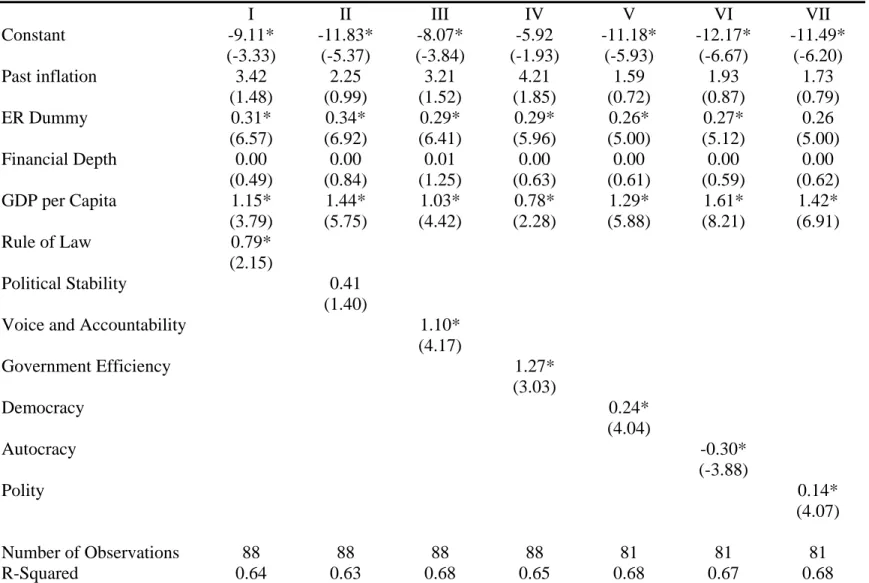
them one at a time. (This can be seen from the variance-covariance matrix presented in
Appendix B.) The results (Table 4) suggest that per capita GDP is a robust determinant
of overall transparency. There is good reason to think that that transparency should rise
with the general level of economic and institutional development, for which per capita
income proxies; this is also the measure of Figure 2 above. In addition, countries with
more flexible exchange rates (where a larger value of the index denotes greater
flexibility) tend to be more transparent in the conduct of monetary policy, as anticipated
by our introduction – the absence of an exchange rate peg eliminating one traditional
device for monitoring central bank actions.21 Finally, most of the political variables are significant and affect central bank transparency in plausible ways.22 Greater transparency characterizes central bank operations in countries that rank higher in terms of rule of law,
that have more stable political systems, that have higher ratings in terms of voice and
accountability, and that are more favorably regarded in terms of government efficiency.23 Countries with more open (democratic) political systems are also more likely to have
transparent central banks; it can be argued that the demand for political accountability is
20
Where we use variables from the Polity data base, we are forced to end the analysis in 2004.
21
Readers may be concerned that the exchange rate regime is endogenous – that countries with experience with monetary policy transparency may be better able to operate regimes of grater flexibility. In the event, dropping the exchange-rate regime leaves the other results unchanged.
22
The other variables do not approach statistical significance at conventional confidence levels. For what they are worth, the point estimates suggest that central banks of countries with better developed financial markets tend to be more transparent. Similarly, central banks of countries with a history of inflation tend to be more transparent, presumably as part of a credibility-building strategy. This is not something that would have been anticipated from the contrast between transparency in advanced and developing countries.
23
strong in such settings and that transparency is an important mechanism for
accountability.24
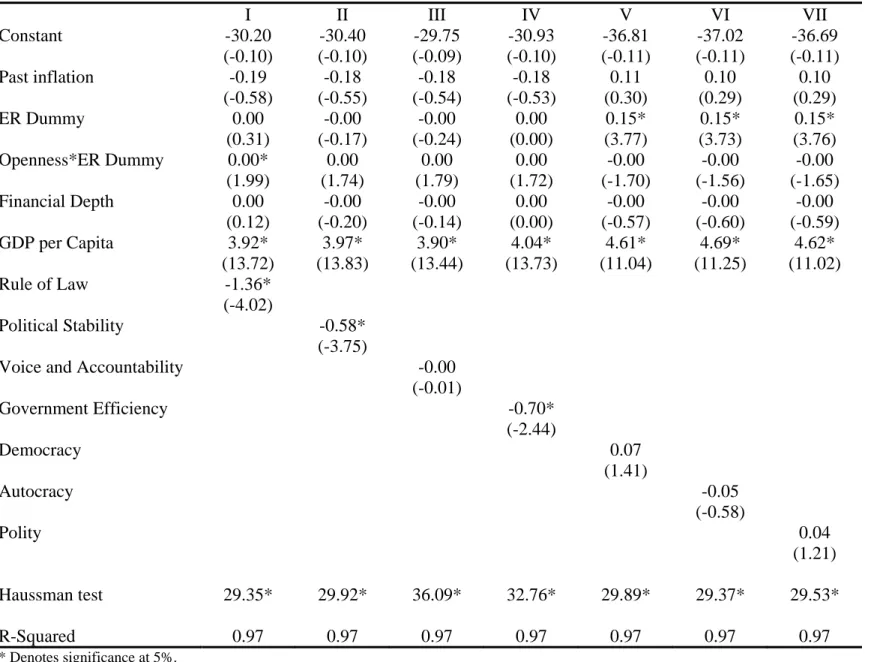
As a form of sensitivity analysis, we interacted the exchange rate regime with
openness (exports as a share of GDP) and added openness as an additional regressor. The
results (available from the authors on request) suggest that greater openness is associated
with greater transparency if the country in question has a relatively flexible exchange rate
but with less transparency if the country has a relatively rigid currency. This accords
with intuition and casual observation.
Next we analyzed the determinants of the individual components of the
transparency index to gain further insight into exactly how practice responds to these
same economic and political factors. In Appendix C we report analogous regressions for
each component of the transparency index. As can be seen there, per capita income and
exchange rate flexibility are positively associated with each of the five components of the
overall index. But the different components show different degrees of responsiveness to
the various political factors. Political transparency is a positive function of political
development as measured by voice and accountability.25 Economic transparency (the public disclosure of data, the policy model and forecasts), procedural transparency (the
release of minutes and votes) and operational transparency (release of information about
disturbances, control errors, etc.) are, in contrast, positively associated with a range of
political factors (voice and accountability, government efficiency, democracy versus
autocracy, and the Polity score). related to a wide range of political factors. Policy
24
Note that the “polity” variable in the final column is the difference between “democracy” and “autocracy.”
25
transparency (prompt announcement and comprehensive explanation of policy decisions)
stands out for being significantly related to each and every one of our measures of
policies and institutions, not just those that affect economic, procedural and operational
transparency but also political stability and rule of law. Thus, there are some subtle
differences here in terms of which components of the transparency index are driving the
observed correlation with political and institutional factors – the correlation appears to be
weakest in the case of political transparency – but the results for the different measures
are broadly consistent overall.
We can also use this specification to consider factors influencing trends in
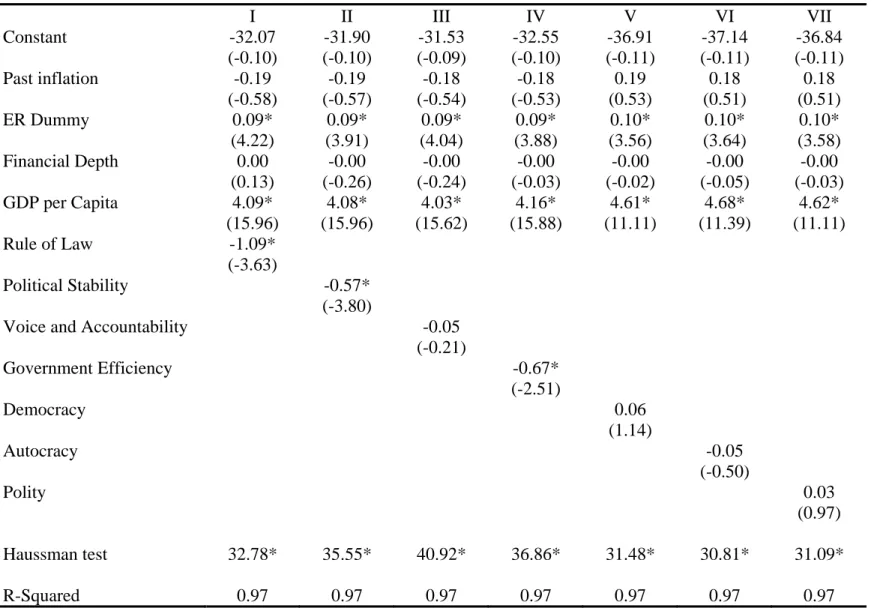
transparency. In Tables 5 and 6 we pool the annual observations and estimate
fixed-effects models (including separate intercepts for each country).26 The estimates are now driven by the time series variation in the data; they thus tell us something about why
central bank practice is evolving in the direction of greater transparency. The move to
more flexible exchange rates (especially in open economies), per capita GDP (as a
measure of general economic and social capability), rule of law and government
efficiency appear to be the main variables driving the increase in transparency over time.
While the democratic/autocratic nature of the political system helped to explain cross
country patterns above, the spread of democracy does not appear to have much power for
explaining within-country changes in monetary policy over time.
The correlation of some of these political variables with central bank
transparency—rule of law and government efficiency, in particular—will be useful when
we consider the impact of transparency on economic and financial variables below. That
26
is, while it is not hard to come up with an argument for why the transparency of monetary
policy should affect inflation, financial markets, or the development of trade, it is harder
to concoct a story for why it should have a first-order effect on, say, rule of law, which
depends on the larger political and social setting and is the product of a country’s history.
It can thus be argued that such political variables satisfy the two criteria for a valid
instrument: exogeneity and correlation with the explanatory variable of interest.
The fact that we will be relying on these measures as instruments also makes it
important that we consider their correlation with the different components of the
transparency index, as we did with the simple cross section above. There are some
suggestive variations here. (See Appendix D.) When we focus on trends over time,
policy transparency displays a correlation only with rule of law. Economic transparency
appears to be affected only by political stability and rule of law. Procedural transparency
responds only to government efficiency, voice and accountability and rule of law,
operational transparency to government efficiency, political stability and rule of law.
Political stability, in contrast, does not display a correlation with either rule of law or
political stability, but it is moves in the expected manner with most of the other political
and institutional variables.
4. Effects
We now explore the effects of monetary policy transparency. Some previous
studies (viz. Mishkin 2004) suggest that greater transparency should be associated with a
reduction in uncertainty about future policy actions and thus with a reduction in inflation
employing the Eijffinger-Geraats index for 2001, find a negative relationship between
inflation variability and central bank transparency.27 Other studies (viz. Mankiw, Reis and Wolfers 2004; Levin, Natalucci and Piger 2004) suggest that there is less variability
and dispersion in inflation expectations when central banks publish numerical targets for
inflation. Still others suggest that greater transparency should be associated with lower
inflation persistence, insofar as the credibility of monetary policy is enhanced and market
participants do not extrapolate future inflation from current inflation. A study of the
U.S., Sweden and the UK by Gurkaynak, Levin and Swanson (2005) provides indirect
evidence on this question; it shows that in the U.S., where the authorities do not publish a
target for inflation, there is a greater tendency for market participants to extrapolate
inflation expectations from the recent behavior of inflation.
These studies are subject to important limitations. Most compare a relatively
small set of not-obviously-representative central banks. In other words, central banks that
are transparent about their policies are not likely to be selected randomly from the larger
population. They focus on specific dimensions of transparency (publication of an
inflation forecast, for example) in lieu of comprehensive measures. Others utilize
indicators of transparency that are available only for one year. Virtually none of them
acknowledge that central bank transparency is a choice variable than may itself be
affected by the economic, financial and political environment.
Here we consider the impact on inflation variability and inflation persistence. In
contrast to previous studies we acknowledge the endogeneity of monetary policy
transparency by using the political variables utilized to explain the degree of transparency
27
in Section 3 as instruments for transparency in this section’s (second-stage) regressions.28 These second-stage coefficients are estimated using GMM to correct for
heteroscedasticity and serial correlation in our panel-data set-up.
Table 7 reports the estimates for inflation variability. In each column we report
the sum of squared residuals comparing the change in the point estimates with the loss of
efficiency when instrumental variables are used; the change in the point estimates being
relatively large, this supports our use of instrumental variables. In addition to the level of
past inflation, which is positively related to inflation variability, the most important
determinant is the (fitted value of the) central bank transparency index. This variable is
negative and always significant at conventional confidence levels.29 This is consistent with theories suggesting that greater monetary-policy transparency allows the public to
respond more quickly to policy actions, in turn discouraging the authorities from
attempting to manipulate inflation in the pursuit of other objectives.
Table 8 considers inflation persistence. Transparency enters negatively and
significantly when it is interested on its own (column 1), consistent with the notion that
greater policy transparency allows the public to adjust more quickly, in turn limiting the
incentive for the central bank to run inflationary policies in the effort to achieve
objectives other than the maintenance of price stability. This result is also consistent with
theories suggesting that greater monetary-policy transparency is a source of policy
credibility, allowing the authorities to respond to events without exciting expectations of
chronic inflation. However, the coefficient in question loses its significance as soon as
other plausible determinants of inflation persistence are added to the specification. The
28
Results using alternative instrument lists are discussed below and are available from the authors on request.
29
relationship of transparency to inflation persistence is not as robust, in other words, as its
relationship to inflation variability.
By adding a squared term in transparency we can also ask whether there are
diminishing returns to central bank transparency (“whether transparency can go too
far”).30 In the equation for inflation variability, transparency continues to enter with a significant negative coefficient as before, but transparency squared enters positively and
also significantly. (See Table 9.) This suggests that increased transparency has the
strongest effect on inflation variability for the most opaque central banks.31 The same broad pattern is evident in the regressions for inflation persistence, which show
persistence declining with increased transparency but at a decelerating rate. In this case,
however, the coefficients on the squared term designed to capture nonlinearities are not
significantly different from zero at standard confidence levels. Again, the relationship
between transparency and inflation persistence does not appear to be as robust as that
between transparency and inflation variability.
We explored the sensitivity of these results using alternative instrument lists, for
example instrumenting transparency with rule of law alone instead of the entire vector of
political and institutional measures The results were very similar, with stronger effects of
transparency on inflation variability than inflation persistence and evidence of
diminishing returns once transparency reached a certain threshold.
30
The squared term, like the level, is constructed from the fitted value of transparency derived from the first-stage regression.
31
Since completing the first draft of this paper, we have seen the analysis of van der
Cruijsen, Eijffinger and Hoogduin (2008), who similarly ask whether there are nonlinear
effects of transparency on inflation persistence, with persistence declining initially as
transparency rises, implying an optimal degree of central bank transparency. They
estimate their model using our data and find significant coefficients on both the level and
squared terms in transparency. They model persistence differently, using current
inflation as the dependent variable and including the lagged inflation term interacted with
transparency (and transparency squared) as an independent variable. They also include a
different set of controls.
In fact, the consequential difference between their approach and ours is now how
persistence is measured or what controls are included but simply whether or not the
potential endogeneity of transparency (our key point) is taken into account. In column a
of Table 11 we show our replication of their result. But when, as in column b, we use our
instruments for transparency, the significance of the key coefficients dissolves.32 In columns c and d we substitute our version of the dependent variable, running OLS in
column c and instrumenting transparency in column d. In neither case is there evidence
of a significant impact of transparency on inflation persistence.
We also explored more closely which component or components of the
transparency index mainly drive the negative association with inflation variability and
persistence. (Results are not reported to avoid a proliferation of tables but are available
from the authors on request.) All five components continue to be associated with lower
inflation variability and (less robustly) with lower inflation persistence when they are
32
included one at a time (in each case being instrumented by rule of law). When we include
all five simultaneously (employing a longer list of political instruments: rule of law,
political stability, democratic accountability, government efficiency, and regulatory
quality), there is an obvious multicolinearity problem. For what it is worth, these results
suggest that operational transparency (openness about the implementation of those
decisions), is mainly driving the reduction in inflation variability. This component enters
negatively, and its coefficient differs from zero at the 99 percent confidence level. None
of the other components have coefficients that differ from zero at standard confidence
levels. 33
An alternative is to test whether the five dimensions of transparency matter as a
group. To this end we constructed the principal components of our measures of the five
dimensions of transparency. We entered into the equation the first and second principal
components (where the first explains 34 per cent of the variation in the group, the second
12 per cent). When substituted for the various individual measures of transparency, the
two principal components enter negatively and significantly in the equation for inflation
variability (they are significant as a pair and the second principal component is
significant individually), but they enter insignificantly in the equation for inflation
persistence, consistent with the results we report above.
5. Conclusion
Greater transparency of central bank operations is the most dramatic recent
change in the conduct of monetary policy. We understand this as a response to changes
33
in the monetary policy environment. It is a way of ensuring the accountability of policy
makers when the traditional mechanisms for doing so – public monitoring of compliance
with an exchange rate commitment and direct oversight by a government with formal
control – are in decline, reflecting the shift to flexible exchange rates and central bank
independence.
In this paper we have presented new data on the extent of the trend and its effects.
The trend is general – a large number of central banks have moved in the direction of
greater transparency in recent years. The question is whether it will prove durable or be a
passing phase. In part, the answer depends on the consequences. Our preliminary
analysis suggests broadly favorable impacts on inflation variability, but less evidence of
an impact on inflation persistence. Still, if institutional arrangements that produce
favorable results retain public support, then this suggests that the trend toward greater
monetary policy transparency is here to stay.
The other way of approaching this question is to ask whether the changes in the
policy environment that precipitated the move toward greater transparency might
themselves be rolled back. We see the abandonment of pegged exchange rates as a
response to financial liberalization and greater central bank independence as a way of
insulating the conduct of monetary policy from short-term political pressures in
democracies. If financial globalization and political democratization are here to stay, as
Data Appendix
This appendix describes the construction of the transparency index. The index is the sum
of the scores for answers to the fifteen questions below (min = 0, max = 15).
1. Political Transparency
Political transparency refers to openness about policy objectives. This comprises a
formal statement of objectives, including an explicit prioritization in case of multiple
goals, a quantification of the primary objective(s), and explicit institutional arrangements.
(a) Is there a formal statement of the objective(s) of monetary policy, with an explicit
prioritization in case of multiple objectives?
No formal objective(s) = 0.
Multiple objectives without prioritization = 1/2.
One primary objective, or multiple objectives with explicit priority = 1.
(b) Is there a quantification of the primary objective(s)?
No = 0.
Yes = 1.
(c) Are there explicit contacts or other similar institutional arrangements between the
monetary authorities and the government?
No central bank contracts or other institutional arrangements = 0.
Central bank without explicit instrument independence or contract = 1/2.
Central bank with explicit instrument independence or central bank contract
2. Economic Transparency
Economic transparency focuses on the economic information that is used for
monetary policy. This includes economic data, the model of the economy that the central
bank employs to construct forecasts or evaluate the impact of its decisions, and the
internal forecasts (model based or judgmental) that the central bank relies on.
(a) Is the basic economic data relevant for the conduct of monetary policy publicly
available? (The focus is on the following five variables: money supply, inflation, GDP,
unemployment rate and capacity utilization.)
Quarterly time series for at most two out of the five variables = 0.
Quarterly time series for three or four out of the five variables = 1/2.
Quarterly time series for all five variables = 1.
(b) Does the central bank disclose the macroeconomic model(s) it uses for policy
analysis?
No = 0.
Yes = 1.
(c) Does the central bank regularly publish its own macroeconomic forecasts?
No numerical central bank forecasts for inflation and output = 0.
Numerical central bank forecasts for inflation and/or output published at less than
quarterly frequency = 1/2.
Quarterly numerical central bank forecasts for inflation and output for the
medium term (one to two years ahead), specifying the assumptions about the policy
instrument (conditional or unconditional forecasts) = 1.
Procedural transparency is about the way monetary policy decisions are taken.
(a) Does the central bank provide an explicit policy rule or strategy that describes its
monetary policy framework?
No = 0.
Yes = 1.
(b) Does the central bank give a comprehensive account of policy deliberations (or
explanations in case of a single central banker) within a reasonable amount of time?
No or only after a substantial lag (more than eight weeks) = 0.
Yes, comprehensive minutes (although not necessarily verbatim or attributed) or
explanations (in case of a single central banker), including a discussion of backward and
forward-looking arguments = 1.
(c) Does the central bank disclose how each decision on the level of its main operating
instrument or target was reached?
No voting records, or only after substantial lag (more than eight weeks) = 0.
Non-attributed voting records = 1/2.
Individual voting records, or decision by single central banker = 1.
4. Policy Transparency
Policy transparency means prompt disclosure of policy decisions, together with an
explanation of the decision, and an explicit policy inclination or indication of likely
future policy actions.
(a) Are decisions about adjustments to the main operating instrument or target announced
No or only after the day of implementation = 0.
Yes, on the day of implementation = 1.
(b) Does the central bank provide an explanation when it announces policy decisions?
No = 0.
Yes, when policy decisions change, or only superficially = 1/2.
Yes, always and including forwarding-looking assessments = 1.
(c) Does the central bank disclose an explicit policy inclination after every policy
meeting or an explicit indication of likely future policy actions (at least quarterly)?
No = 0.
Yes = 1.
5. Operational Transparency
Operational transparency concerns the implementation of the central bank’s
policy actions. It involves a discussion of control errors in achieving operating targets and
(unanticipated) macroeconomic disturbances that affect the transmission of monetary
policy. Furthermore, the evaluation of the macroeconomic outcomes of monetary policy
in light of its objectives is included here as well.
(a) Does the central bank regularly evaluate to what extent its main policy operating
targets (if any) have been achieved?
No or not very often (at less than annual frequency) = 0.
Yes but without providing explanations for significant deviations = 1/2.
Yes, accounting for significant deviations from target (if any); or, (nearly) perfect
(b) Does the central bank regularly provide information on (unanticipated)
macroeconomic disturbances that affect the policy transmission process?
No or not very often = 0.
Yes but only through short-term forecasts or analysis of current macroeconomic
developments (at least quarterly) = 1/2.
Yes including a discussion of past forecast errors (at least annually) = 1.
(c) Does the central bank regularly provide an evaluation of the policy outcome in light
of its macroeconomic objectives?
No or not very often (at less than annual frequency) = 0.
Yes but superficially = 1/2.
Yes, with an explicit account of the contribution of monetary policy in meeting
References
Ball, Lawrence and Niamh Sheridan (2005), “Does Inflation Targeting Matter?” in Ben Bernanke and Michael Woodford (eds), The Inflation-Targeting Debate, Chicago: University of Chicago Press, pp.249-278.
Barro, Robert and Roger Gordon (1983), “A Positive Theory of Monetary Policy in a Natural Rate Model,” Journal of Political Economy 91, pp. 589-610.
Bini-Smaghi, Lorenzo and Daniel Gros (2001), “Is the ECB Sufficiently Accountable and Transparent?” European Network of Economic Policy Research Institutes Working Paper no. 7 (September).
Carpenter, Seth (2004), “Transparency and Monetary Policy: What does the Academic Literature tell Policymakers?,” Finance and Economics Discussion Series 2004-35. Washington: Board of Governors of the Federal Reserve System.
Cecchetti, Steven and Stefan Krause (2001), “Central Bank Structure, Policy Efficiency and Macroeconomic Performance: Exploring the Empirical Relationships,” NBER Working Paper no. 8354 (July).
Chadha, Jagjit and Charles Nolan (2001), “Inflation Targeting, Transparency and Interest Rate Volaility: Ditching ‘Monetary Mystique’ in the UK,” Journal of Macroeconomics
23, pp. 349-366.
Chortareas, Georgios, David Stasavage and Gabriel Sterne (2001), “Does It Pay to be Transparent? International Evidence from Central Bank Forecasts,” Bank of England Working Paper no. 143.
Christiano, Larence J. and Christopher Gust (2000), “The Expectations Trap,” Economic Perspectives of the Federal Reserve Bank of Chicago, issue Q II, pp.21-39.
Clare, A. and R. Courtenay (2001), “Assessing the Impact of Macroeconomic News Announcements on Securities Prices Under Different Monetary Policy Regimes,” Bank of England Working Paper no. 125 (March).
Clarida, Richard, Jordi Gali and Mark Gertler (2000), “Monetary Policy Rules and Macroeconomic Stability: Evidence and Some Theory,” Quarterly Journal of Economics
115, pp.147-180.
De Haan, Jakob and Fabian Amtenbrink (2002), “A Non-Transparent European Central Bank: Who is to Blame?” Paper presented to the conference on Monetary Policy
Transparency, London: Bank of England (May).
De Haan, Jakob, Fabian Amtenbrink and Sandra Waller (2004), “The Transparency and Credibility of the European Central Bank,” Journal of Common Market Studies 42, pp. 775-794.
Demertzis, Maria and Andrew Hughes Hallett (2003), “Central Bank Transparency in Theory and Practice,” unpublished manuscript, Netherlands Bank and Vanderbilt University (January).
Dincer, Nergiz and Barry Eichengreen (2007), “Central Bank Transparency: Where, Why and With What Effects?” NBER Working Paper no.13003.
Eichengreen, Barry, Mark Watson and Richard Grossman (1985), “Bank Rate Policy Under the Interwar Gold Standard: A Dynamic Probit Model,” Economic Journal 95, pp.725-745.
Eijffinger, Sylvester and Petra Geraats (2006), “How Transparent are Central Banks?”
European Journal of Political Economy 22, pp.1-22.
Eijffinger, Sylvester, Marco Hoeberichts and Eric Schaling (2000), “A Theory of Central Bank Accountability,” CEPR Discussion Paper no. 2354 (January).
Faust, Jon and Lars Svensson (2001), “Transparency and Credibility: Monetary Policy with Unobservable Goals,” International Economic Review 42, pp. 369-397.
Fry, M, D. Julius, L. Mahadeva , S. Roger and G. Sterne (2000), “Key Issues in the Choice of a Monetary Policy Framework,” in L. Mahadeva and G. Sterne (eds),
Monetary Policy Frameworks in a Global Context, London: Routledge, pp. 1-216.
Geraats, Petra M. (2002a), “Why Adopt Transparency? The Publication of Central Bank Forecasts,” unpublished manuscript, University of Cambridge (July).
Geraats, Petra M. (2002b), “Central Bank Transparency,” Economic Journal 112, pp. F532-565.
Geraats, Petra M. (2005), “Political Pressures and Monetary Mystique,” Cambridge Working Papers in Economics no. 0557 (December).
Geraats, Petra M. (2006), “Transparency of Monetary Policy: Theory and Practice,”
CESifo Economic Studies 52, pp.111-152.
Goodhart, Charles (2001), “Monetary Transmission Lags and the Formulation of the Policy Decision on Interest Rates,” Federal Reserve Bank of St. Louis Review
(July/August), pp.165-181.
Greider, William (1987), Secrets of the Temple: How the Federal Reserve Runs the Country, New York: Simon & Schuster.
Gruner, H. P. (2002), “How Much Should Central Banks Talk? - A New Argument,”
Economics Letters 77, pp. 195-198.
Gurkaynak, Refet, Andrew Levin and Eric Swanson (2005), “Inflation Targeting and the Anchoring of Long-Run Inflation Expectations: International Evidence from Daily Bond Yield Data,” Paper prepared for the Riksbank Workshop on Inflation Targeting,
Stockholm (June).
Haldane, Andrew and Vicky Read (2000), “Monetary Policy Surprises and the Yield Curve,” Bank of England Working Paper no. 106.
Hamalainen, Sirkka (2001), “The ECB’s Monetary Policy – Accountability,
Transparency and Communication,” Speech delivered to the conference on “Old Age, New Economy, and Central Banking,” www.ecb.org (14 September).
Jensen, Henrik (2002), “Optimal Degrees of Transparency in Monetary Policymaking,”
Scandinavian Journal of Economics 104, pp.399-424.
Kaufmann, Daniel, Aart Kraay, and Massimo Mastruzzi (2007), “Governance Matters VI: Governance Indicators for 1996-2006,” World Bank Policy Research Working Paper, No. 4280, the World Bank (July).
Kuttner, Kenneth and Adam Posen (2000), “Inflation, Monetary Transparency, and G3 Exchange Rate Volatility,” Working Paper 00-6, Washington, D.C.: Institute for International Economics (July).
Levin, Andrew, Fabio Natalucci and Jeremy Piger (2004), “Explicit Inflation Objectives and Macroeconomic Outcomes,” ECB Working Paper no.383 (August).
Mankiw, Gregory, Ricardo Reis and Justin Wolfers (2004), “Disagreement About Inflation Expectations,” NBER Macroeconomics Annual 2003, pp.209-247.
Mishkin, Frederic (2004a), “Can Central Bank Transparency Go Too Far?” NBER Working Paper no.10829 (October).
Mishkin, Frederic (2004b), “Why the Fed Should Adopt Inflation Targeting,”
Morris, Stephen and Hyun Shin (2002), “The Social Value of Public Information,”
American Economic Review 92, pp.1521-1534.
Morris, Stephen and Hyun Shin (2005), “Central Bank Transparency and the Signal Value of Prices,” Brookings Papers on Economic Activity 2, pp.1-66.
Muller, Philippe and Murray Zelmer (1999), “Greater Transparency in Monetary Policy: Impact on Financial Markets,” Bank of Canada Technical Report 86, Ottawa: Bank of Canada (August).
Reinhart, Carmen, Kenneth Rogoff and Miguel Savastano (2003), “Debt Intolerance,”
Brookings Papers on Economic Activity 1, pp.1-74.
Shaling, Eric and Charles Nolan (1998), “Monetary Policy Uncertainty and Inflation: The Role of Central Bank Accountability,” De Economist 146, pp. 585-602.
Siklos, Pierre (2002), The Changing Face of Central Banking: Evolutionary Trends Since World War II, New York: Cambridge University Press.
Sørensen J.R. (1991) "Political Uncertainty and Macroeconomic Performance,"
Economics Letters 37, 4377–381
Van der Cruijsen, Carin A.B., Sylvester C.W. Eijffinger and Lex H. Hoogduin (2008), “Optimal Central Bank Transparency,” unpublished manuscript, De Nederlandsche Bank, Tilberg University and University of Amsterdam (June).
Figure 1. Comparison of Transparency in 1998 and 2006
0 3 6 9 12 15
0 3 6 9 12 15
1998
Figure 2. Trends in Transparency by Level of Economic Development: Weighted Averages
0 3 6 9 12 15
1998 1999 2000 2001 2002 2003 2004 2005 2006
T
ran
sp
ar
en
cy I
n
d
e
x
Table 1. Transparency, by Region
1998 1999 2000 2001 2002 2003 2004 2005 2006
Africa 2.2 2.3 2.5 3.0 3.3 3.5 3.6 4.0 4.0
Eastern Africa 1.8 1.9 1.9 2.4 2.6 2.6 2.6 2.8 2.9
Ethiopia 1 1 1 1 1 1 1 1 1
Kenya 2 2 2.5 4 4 4 4 4 5.5
Malawi 0.5 0.5 0.5 2.5 2.5 2.5 2.5 2.5 2.5
Mauritius 4 4 4 4 5.5 5.5 5.5 5.5 5.5
Rwanda 1.5 1.5 1.5 1.5 1.5 1.5 1.5 2.5 1.5
Uganda 2 2.5 2.5 2.5 2.5 2.5 2.5 2.5 2.5
Zambia 1.5 1.5 1.5 1.5 1.5 1.5 1.5 1.5 1.5
Northern Africa 1.4 1.4 1.6 1.6 2.0 2.1 2.1 2.4 2.5
Egypt 1 1 1 1 1 1.5 1.5 2.5 2.5
Libyan Arab Jamahiriya 1 1 1 1 1 1 1 1 1
Sudan 1 1 2 2 2 2 2 2 2
Tunisia 2.5 2.5 2.5 2.5 4 4 4 4 4.5
Southern Africa 3.2 3.2 3.8 5.0 5.3 5.7 6.0 7.2 7.2
Lesotho 1 1 1.5 1.5 1.5 2.5 2.5 4.5 4.5
Namibia 4 4 4.5 4.5 5.5 5.5 6.5 8 8
South Africa 4.5 4.5 5.5 9 9 9 9 9 9
Western Africa 2.7 2.7 2.7 2.8 3.2 3.7 3.7 3.7 3.7
Ghana 3 3 3 3 4 5.5 5.5 5.5 5.5
Nigeria 3.5 3.5 3.5 4 4 4 4 4 4
(con't) Table 1. Transparency, by Region
1998 1999 2000 2001 2002 2003 2004 2005 2006
Americas
Latin America and the Caribbean 2.7 2.8 2.9 3.4 3.9 3.9 4.1 4.1 4.0
East Caribbean 2.5 2.5 3 5.5 5.5 5.5 5.5 5.5 5.5
Aruba 0.5 0.5 0.5 0.5 0.5 0.5 0.5 0.5 0.5
Bahamas 4.5 4.5 4.5 4.5 4.5 4.5 4.5 4.5 4.5
Barbados 2.5 3 3 3 4 4 4 4 4
Cuba 2.5 2.5 2.5 2.5 2.5 2.5 2.5 2.5 2.5
Jamaica 3 3 3 4.5 6.5 6.5 6.5 6.5 5.5
Trinidad and Tobago 3.5 3.5 3.5 3.5 3.5 4 5.5 5.5 5.5
Central America 2.4 2.4 2.4 2.9 2.9 3.0 4.0 4.0 4.4
Belize 2 2 2 3 3 3 3 3 3
El Salvador 2 2 2 3 3 3 3 3 3
Guatemala 1.5 1.5 1.5 1.5 1.5 1.5 4.5 4.5 6
Mexico 4 4 4 4 4 4.5 5.5 5.5 5.5
South America 3.8 4.2 5.1 5.3 5.6 5.9 6.1 6.1 5.7
Argentina 2 2 2 2 2 4.5 5.5 5.5 5.5
Brazil 3.5 5.5 9 9 9 9 9 9 7.5
Chile 7 7 7.5 7.5 7.5 7.5 7.5 7.5 7.5
Colombia 2.5 3.5 5.5 5.5 6 6 6 6 5
Guyana 1.5 1.5 1.5 1.5 1.5 1.5 1.5 1.5 1.5
Peru 5 5 5 6.5 8 8 8 8 8
Uruguay 5 5 5 5 5 5 5 5 5
Northern America 6.7 7.0 7.0 7.0 7.0 7.0 7.2 7.2 7.2
Bermuda 1 1 1 1 1 1 1 1 1
Canada 10.5 10.5 10.5 10.5 10.5 10.5 11 11 11
(con't) Table 1. Transparency, by Region
1998 1999 2000 2001 2002 2003 2004 2005 2006
Oceania 5.4 6.2 6.2 6.6 7.1 7.1 7.3 7.3 7.4
Australia and New Zealand 9.3 10.5 10.5 10.5 11.3 11.3 11.3 11.3 11.5
Australia 8 8 8 8 9 9 9 9 9
New Zealand 10.5 13 13 13 13.5 13.5 13.5 13.5 14
Melanesia 1.5 1.9 1.9 2.8 2.9 2.9 3.4 3.4 3.4
Fiji 1.5 3 3 3 3 3 4 4 4
Papua New Guinea 1 1 1 3.5 4 4 5 5 5
Solomon Islands 2 2 2 2 2 2 2 2 2
Vanuatu 1.5 1.5 1.5 2.5 2.5 2.5 2.5 2.5 2.5
Asia 3.0 3.2 3.5 3.8 4.3 4.6 4.9 5.1 5.2
Central Asia 2.7 2.7 2.7 3.0 3.0 2.7 3.3 4.0 4.0
Kazakhstan 3.5 3.5 3.5 3.5 3.5 3.5 3.5 5.5 5.5
Kyrgyzstan 3 3 3 4 4 3 5 5 5
Tajikistan 1.5 1.5 1.5 1.5 1.5 1.5 1.5 1.5 1.5
Eastern Asia 4.6 4.8 5.2 5.2 5.7 6.3 6.6 6.6 6.7
China 1 1 1 1 1.5 4.5 4.5 4.5 4.5
Hong Kong 5 6 6 6 7 7 7 7 7.5
Korea 6.5 6.5 8 8.5 8.5 8.5 8.5 8.5 8.5
Japan 8 8 8.5 8 8 8 9.5 9.5 9.5
Mongolia 2.5 2.5 2.5 2.5 3.5 3.5 3.5 3.5 3.5
Southern Asia 2.2 2.2 2.2 2.3 2.9 3.4 3.8 3.8 3.9
Bangladesh 0 0 0 0.5 0.5 3 3.5 3.5 3.5
Bhutan 1.5 1.5 1.5 1.5 3 3 3 3 3
India 2 2 2 2 2 2 2 2 2
Pakistan 2.5 2.5 2.5 2.5 2.5 2.5 3.5 3.5 4
(con't) Table 1. Transparency, by Region
1998 1999 2000 2001 2002 2003 2004 2005 2006
South-Eastern Asia 3.1 4.0 5.0 5.6 6.5 7.2 7.4 7.6 7.7
Indonesia 3 4.5 4.5 4.5 4.5 7 8 8 8.5
Malaysia 4.5 4.5 5.5 5.5 5.5 5.5 5.5 5.5 5.5
Philippines 3.5 5 5 6 10 10 10 10 10
Singapore 2.5 4 4 5.5 4.5 5.5 5.5 6.5 6.5
Thailand 2 2 6 6.5 8 8 8 8 8
Western Asia 2.5 2.5 2.7 2.9 3.3 3.4 3.5 3.5 3.8
Armenia 4 4 4 4 4 4 4 4 4
Bahrain 3 3 3 3 3 3 3 3 3
Cyprus 2.5 2.5 2.5 3.5 6 6 6.5 6.5 6.5
Georgia 3 3 3 3 3 4 4 4 4
Iraq 2 2 2 2 2 2 2.5 2.5 2.5
Israel 5.5 7 7.5 8.5 8.5 8.5 8.5 8.5 10
Jordan 1 1 1 1 1 1 1.5 2 2
Kuwait 2 2 2 2 2 2 2 2 2
Oman 1.5 1.5 1.5 1.5 1.5 1.5 1.5 1.5 1.5
Qatar 3 3 3 3 3 3 3 3 3
Saudi Arabia 1 1 1 1 1 1 1 1 1
Turkey 3 2 4 5.5 8.5 8.5 8.5 8.5 10
United Arab Emirates 2 2 2 2 2 2 2 2 2
(con't) Table 1. Transparency, by Region
1998 1999 2000 2001 2002 2003 2004 2005 2006
Europe 5.3 5.6 5.8 6.3 6.8 7.2 7.4 7.6 7.6
Eastern Europe 3.4 3.9 4.3 4.6 5.5 5.6 6.0 6.4 6.8
Belarus 1.5 3.5 5 5 5 5 5 5 5
Bulgaria 4.5 4.5 4.5 4.5 4.5 4.5 5 5.5 5.5
Czech Republic 8.5 9.5 9.5 9.5 10 11 11 11 11
Hungary 3 3 5 6 8.5 8.5 8.5 10 10.5
Poland 3 5 5 6.5 6.5 6.5 7 8 9
Republic of Moldova 4.5 4.5 4.5 5.5 6 6 6 6 6
Romania 1.5 1.5 1.5 1.5 4.5 4.5 6.5 6.5 7
Russian Federation 1.5 1.5 1.5 1.5 1.5 1.5 2.5 2.5 2.5
Slovakia 4 4 4.5 3.5 5.5 5.5 5.5 6 8
Ukraine 2 2 2 2 3 3 3 3 3
Northern Europe 6.4 6.6 6.9 7.2 7.6 7.8 7.8 7.9 8.0
Denmark 5 5 5 5 5 6 6 6 6
Estonia 5 5 5.5 5.5 5.5 5.5 5 6 6
Iceland 5.5 5.5 7 7 7.5 7.5 7.5 7.5 8
Latvia 6 6 6 6 6 6 6 6 6
Lithuania 4 4 4 4.5 4.5 4.5 4.5 4.5 5
Norway 6 6 6 7.5 7.5 7.5 8 8 8
Sweden 9 9 10 10 13 13 13 13 13
United Kingdom 11 12 12 12 12 12 12 12 12
Southern Europe 4.0 4.0 4.1 4.4 5.0 5.8 6.0 6.0 5.8
Albania 4.5 4.5 4.5 4.5 4.5 6 7 7 6
Croatia 1.5 1.5 1.5 2.5 2.5 2.5 2.5 2.5 2.5
Malta 5 5 5.5 5.5 5.5 7 7 7 7
Slovenia 5 5 5 5 7.5 7.5 7.5 7.5 7.5
Western Europe 7.3 7.8 8.0 9.0 9.0 9.5 10.0 10.0 10.0
Switzerland 6 7 7.5 8 8 9 9.5 9.5 9.5
Table 2. Components of the Index for the 13 countries with extreme values
TI 1a 1b 1c 2a 2b 2c 3a 3b 3c 4a 4b 4c 5a 5b 5c
New Zealand 14 1 1 1 1 1 1 1 1 1 1 1 1 1 0.5 0.5
Sweden 13 0.5 1 0.5 1 1 1 1 1 1 1 0.5 1 1 1 0.5
UK 12 1 1 1 0.5 1 1 1 1 1 1 0.5 0 1 0.5 0.5
Canada 11 1 1 1 1 1 1 1 0 0 1 1 0 1 0.5 0.5
Czech Republic 11 1 1 1 0.5 1 1 1 1 0.5 1 0.5 0 0 0.5 1
Euro area 10.5 1 1 1 1 1 1 1 0 0 1 0.5 0 1 0.5 0.5
Hungary 10.5 1 1 1 0.5 0 1 1 1 1 1 0.5 0 0.5 0.5 0.5
Bermuda 1 0.5 0 0.5 0 0 0 0 0 0 0 0 0 0 0 0
Ethiopia 1 0.5 0 0.5 0 0 0 0 0 0 0 0 0 0 0 0
Libya 1 0.5 0 0.5 0 0 0 0 0 0 0 0 0 0 0 0
Saudi Arabia 1 0.5 0 0.5 0 0 0 0 0 0 0 0 0 0 0 0
Yemen 1 0.5 0 0.5 0 0 0 0 0 0 0 0 0 0 0 0
Table 3. Regional Transparency Index (Weighted)
1998 1999 2000 2001 2002 2003 2004 2005 2006
Africa 2.77 2.74 3.09 4.26 4.47 5.14 5.41 5.44 5.31
Eastern Africa 1.88 1.97 2.14 2.74 2.93 2.97 2.94 2.91 3.25
Northern Africa 1.21 1.20 1.25 1.27 1.55 1.90 1.91 2.32 2.35
Southern Africa 4.47 4.46 5.45 8.84 8.86 8.87 8.90 8.95 8.95
Western Africa 3.37 3.38 3.43 3.86 3.96 4.13 4.13 4.12 4.12
Americas 7.76 8.80 8.98 9.00 9.11 9.17 9.27 9.25 9.15
Latin America and
Caribbean 2.84 2.88 3.14 4.62 4.99 5.18 5.60 5.59 5.50
Central America 3.84 3.86 3.88 3.90 3.89 4.35 5.40 5.41 5.47
South America 3.39 4.51 6.68 6.62 7.58 7.85 7.99 8.05 7.04
North America 8.63 9.57 9.57 9.57 9.57 9.57 9.62 9.62 9.63
Oceania 8.22 8.53 8.50 8.54 9.50 9.52 9.54 9.53 9.54
Australia and New
Zealand 8.32 8.61 8.58 8.61 9.56 9.58 9.59 9.58 9.60
Melanesia 1.21 1.71 1.66 3.22 3.50 3.51 4.41 4.46 4.48
Asia 5.59 5.74 6.19 5.81 5.91 6.49 7.16 7.01 6.88
Central Asia 3.36 3.35 3.37 3.44 3.44 3.38 3.48 5.33 5.35
Eastern Asia 6.48 6.58 7.02 6.45 6.46 7.16 8.04 7.89 7.69
Southern Asia 1.98 1.98 1.99 2.02 2.06 2.23 2.38 2.37 2.43
South-East Asia 2.97 3.88 4.99 5.48 6.15 7.13 7.46 7.62 7.84
Western Asia 2.72 2.59 3.20 3.68 4.50 4.63 4.71 4.64 5.03
Europe 8.27 8.57 8.58 9.60 9.70 9.74 10.10 10.02 9.96
Eastern Europe 2.78 3.68 3.63 3.99 4.51 4.54 5.03 5.21 5.30
Northern Europe 9.78 10.49 10.62 10.74 11.06 11.11 11.17 11.11 11.12
Southern Europe 3.42 3.53 3.58 3.95 4.96 5.17 5.22 5.19 4.95
Table 4. Determinants of Transparency, 1998-2006 Averages†
* Denotes significance at 5%.
† t-statistics in parentheses
I II III IV V VI VII
Constant -9.11* -11.83* -8.07* -5.92 -11.18* -12.17* -11.49* (-3.33) (-5.37) (-3.84) (-1.93) (-5.93) (-6.67) (-6.20)
Past inflation 3.42 2.25 3.21 4.21 1.59 1.93 1.73
(1.48) (0.99) (1.52) (1.85) (0.72) (0.87) (0.79)
ER Dummy 0.31* 0.34* 0.29* 0.29* 0.26* 0.27* 0.26
(6.57) (6.92) (6.41) (5.96) (5.00) (5.12) (5.00)
Financial Depth 0.00 0.00 0.01 0.00 0.00 0.00 0.00
(0.49) (0.84) (1.25) (0.63) (0.61) (0.59) (0.62)
GDP per Capita 1.15* 1.44* 1.03* 0.78* 1.29* 1.61* 1.42*
(3.79) (5.75) (4.42) (2.28) (5.88) (8.21) (6.91)
Rule of Law 0.79*
(2.15)
Political Stability 0.41
(1.40)
Voice and Accountability 1.10*
(4.17)
Government Efficiency 1.27*
(3.03)
Democracy 0.24*
(4.04)
Autocracy -0.30*
(-3.88)
Polity 0.14*
(4.07)
Number of Observations 88 88 88 88 81 81 81
Table 5. Determinants of Transparency, Fixed Effects Models
I II III IV V VI VII
Constant -32.07 -31.90 -31.53 -32.55 -36.91 -37.14 -36.84
(-0.10) (-0.10) (-0.09) (-0.10) (-0.11) (-0.11) (-0.11)
Past inflation -0.19 -0.19 -0.18 -0.18 0.19 0.18 0.18
(-0.58) (-0.57) (-0.54) (-0.53) (0.53) (0.51) (0.51)
ER Dummy 0.09* 0.09* 0.09* 0.09* 0.10* 0.10* 0.10*
(4.22) (3.91) (4.04) (3.88) (3.56) (3.64) (3.58)
Financial Depth 0.00 -0.00 -0.00 -0.00 -0.00 -0.00 -0.00
(0.13) (-0.26) (-0.24) (-0.03) (-0.02) (-0.05) (-0.03)
GDP per Capita 4.09* 4.08* 4.03* 4.16* 4.61* 4.68* 4.62*
(15.96) (15.96) (15.62) (15.88) (11.11) (11.39) (11.11)
Rule of Law -1.09*
(-3.63)
Political Stability -0.57*
(-3.80)
Voice and Accountability -0.05
(-0.21)
Government Efficiency -0.67*
(-2.51)
Democracy 0.06
(1.14)
Autocracy -0.05
(-0.50)
Polity 0.03
(0.97)
Haussman test 32.78* 35.55* 40.92* 36.86* 31.48* 30.81* 31.09*
R-Squared 0.97 0.97 0.97 0.97 0.97 0.97 0.97
* Denotes significance at 5%.
Table 6. Determinants of Transparency, Fixed Effects Models
I II III IV V VI VII
Constant -30.20 -30.40 -29.75 -30.93 -36.81 -37.02 -36.69
(-0.10) (-0.10) (-0.09) (-0.10) (-0.11) (-0.11) (-0.11)
Past inflation -0.19 -0.18 -0.18 -0.18 0.11 0.10 0.10
(-0.58) (-0.55) (-0.54) (-0.53) (0.30) (0.29) (0.29)
ER Dummy 0.00 -0.00 -0.00 0.00 0.15* 0.15* 0.15*
(0.31) (-0.17) (-0.24) (0.00) (3.77) (3.73) (3.76)
Openness*ER Dummy 0.00* 0.00 0.00 0.00 -0.00 -0.00 -0.00
(1.99) (1.74) (1.79) (1.72) (-1.70) (-1.56) (-1.65) Financial Depth 0.00 -0.00 -0.00 0.00 -0.00 -0.00 -0.00
(0.12) (-0.20) (-0.14) (0.00) (-0.57) (-0.60) (-0.59)
GDP per Capita 3.92* 3.97* 3.90* 4.04* 4.61* 4.69* 4.62*
(13.72) (13.83) (13.44) (13.73) (11.04) (11.25) (11.02)
Rule of Law -1.36*
(-4.02)
Political Stability -0.58*
(-3.75)
Voice and Accountability -0.00
(-0.01)
Government Efficiency -0.70*
(-2.44)
Democracy 0.07
(1.41)
Autocracy -0.05
(-0.58)
Polity 0.04
(1.21)
Haussman test 29.35* 29.92* 36.09* 32.76* 29.89* 29.37* 29.53*
R-Squared 0.97 0.97 0.97 0.97 0.97 0.97 0.97
* Denotes significance at 5%.