UNIVERSIDAD TÉCNICA PARTICULAR DE LOJA
La Universidad Católica de Loja
ÁREA SOCIO HUMANÍSTICA
TITULACIÓN DE LICENCIADO EN CIENCIAS DE LA EDUCACIÓN
MENCIÓN INGLES
The influence of large classes in the English language
teaching-learning process in Ecuadorian high schools
TRABAJO DE FIN DE TITULACIÓN
AUTOR: Caiminagua Puglla, Jazmín Lorena
DIRECTOR: Quiñónez Beltrán, Ana Lucía, Dra.
COVER
CENTRO UNIVERSITARIO PASAJE
ii Doctora.
Ana Lucía Quiñónez Beltrán DOCENTE DE LA TITULACIÓN
De mi consideración:
El presente trabajo de fin de titulación: The influence of large classes in the
English language teaching-learning process in Ecuadorian high schools realizado por
Caiminagua Puglla Jazmín Lorena, ha sido orientado y revisado durante su ejecución,
por cuanto se aprueba la presentación del mismo.
Loja, marzo de 2015
iii
“Yo, Caiminagua Puglla Jazmín Lorena declaro ser autora del presente trabajo de
fin de titulación: The influence of large clases in the English language teaching-learning process in Ecuadorian high schools, de la Titulación de Ciencias de la Educación
mención Inglés, siendo la doctora Ana Lucía Quiñónez Beltrán directora del presente trabajo; y eximo expresamente a la Universidad Técnica Particular de Loja y a sus representantes legales de posibles reclamos o acciones legales. Además certifico que las ideas, conceptos, procedimientos y resultados vertidos en el presente trabajo
investigativo, son de mi exclusiva responsabilidad.
Adicionalmente, declaro conocer y aceptar la disposición del Art. 88 del Estatuto Orgánico de la Universidad Técnica Particular de Loja que en su parte pertinente
textualmente dice: “Forman parte del patrimonio de la Universidad la propiedad
intelectual de investigaciones, trabajos científicos o técnicos y tesis de grado o trabajos de titulación que se realicen con el apoyo financiero, académico o institucional
(operativo) de la Universidad”.
f ………
Caiminagua Puglla Jazmín Lorena
iv
giving me the opportunity to reach these instances in my professional career.
I also want to dedicate this work to my dear mother Estela who has always taught me the most important values of life. My mother has been the person who has supported me and encouraged me to achieve my goals; she has always been my inspiration and the person whose love and care were my strength.
v
I would like to thank a number of people whose support has proven invaluable during the research, planning, writing and production of this thesis.
First of all, I would like to thank the numerous teachers and students in the high school of Pasaje I visited. Their enthusiastic support and the detailed feedback and valuable suggestions I got from many of them were an important source of inspiration and guidance for me in developing the concept and creation of my research. Also, I appreciate all the support from teachers at Universidad Técnica Particular de Loja, whose guidance proved very important and helpful.
vi
COVER ... i
CERTIFICACIÓN... ii
DECLARACIÓN DE AUTORÍA Y CESIÓN DE DERECHOS ... iii
DEDICATION ... iv
ACKNOWLEDGEMENT ... iv
CONTENTS ... vi
RESUMEN ... 1
ABSTRACT ... 2
INTRODUCTION ... 3
METHOD ... 5
DISCUSSION ... 6
Literature Review ... 6
Description, Analysis, and Interpretation of Results ... 21
Conclusions ... 36
Recommendations ... 37
1
ABSTRACT
The purpose of this study, the influence of large classes in the English language teaching-learning in Ecuadorian high schools, is to determine whether or not large classes affect the English language teaching-learning process.
This research was conducted in a public high school in Pasaje, Ecuador. The sample was selected randomly and only 5 large classes were chosen; these classes consisted of 35 and 37 pupils from 8th basic to 3rd senior year, it means 179 students
as total. To these participants applied surveys whose results were tabulated and analyzed quantitative and qualitative by considering main aspects which concern instructional, social and psychological implications that has been presented in this investigation.
The results of the study show that aspects which concerning instructional implications of large classes affect the process of teaching and learning English in a positive way; however, aspects concerning social and psychological implications of large classes affect the teaching-learning process negatively, because students do face problems, mainly that they do not receive regular feedback and they do not have confidence to speak in class in front of their peers.
2
RESUMEN
El propósito de este estudio, la influencia de las clases numerosas en la
enseñanza-aprendizaje del idioma Inglés en los colegios ecuatorianos, es determinar si las clases grandes afectan o no el proceso de enseñanza-aprendizaje del idioma Inglés.
Esta investigación se llevó a cabo en un colegio público de la ciudad de Pasaje, Ecuador. La muestra fue seleccionada al azar y se eligieron sólo 5 clases numerosas; estas clases consistían entre 35 y 37 alumnos de octavo básico a tercero año de secundaria, dando como total 179 estudiantes. A estos participantes se les aplico las encuestas respectivas cuyos resultados fueron clasificados y analizados cuantitativo y cualitativo en base a los aspectos instruccionales, sociales y
psicológicos considerados para esta investigación.
Los resultados de los estudios demuestran que los aspectos que conciernen a las implicaciones educacionales de las clases numerosas afectan el proceso de enseñanza aprendizaje de una manera positiva; sin embargo, los aspectos concernientes a implicaciones sociales y psicológicas afectan el proceso de
enseñanza y aprendizaje negativamente puesto que los principales problemas que los estudiantes enfrentan son que no reciben retroalimentación periódica y ellos no tienen confianza de hablar en clase delante de sus compañeros.
3
INTRODUCTION
Working with large classes could be one of the biggest challenges that teachers face every day. According to the Decennial Education Plan (2006-2015) proposed by The Minister of Education, the permanent economic restriction for investment has caused a high deficit in the number of classrooms. As a result, teachers need to enhance their innovative awareness and capabilities for developing effective ways for dealing with large classes based on the characteristics of large classes.
In Ecuador there is not specified number of students per class either. UNESCO does not set a recommended number of students in a classroom because it recognizes the cultural and economic differences of each global region.
Based on what it is mentioned above, it is necessary to investigate the theme of this study the influence of large classes in the English language teaching-learning process in Ecuadorian high schools, whose purpose is recognize: What instructional implications do large classes have on the teaching-learning process? What social implications do large classes have on the teaching-learning process? And what psychological implications do large classes have on the teaching-learning process?
Similar studies have been carried in other countries. One of them was carried out by Ijaiya (1999) who formulated the following questions: Is there any correlation between the ranking of teachers and students with regard to the effects of over-crowded classrooms on classrooms interactions? Is there any correlation between the ranking of teachers and students concerning the coping strategies adopted by teachers in over-crowded classroom? The results of this study indicated that seating
4
Another study was developed by Yelkpieri, Namale, Esia-Donkoh & Ofosu-Dwamena (2012) to analyze the effects of large classes in the quality of teaching English as a second language. The study answered the following research questions: What problems and challenges do lecturers and students face in large classes in University of Education, Winneba (UEW)? To what extent does large class size
affect the quality of teaching, learning and assessment of students’ learning? How
can the problem of large class size be managed in UEW?
A third study was conducted by Smith & Warburton (1997) whose purpose was develop the following questions: why does schools faced overcrowded classes? How is the situation managed? And what effect do large classes have upon pupils and teachers? The limitation found in this study was that researchers were not able to prove the influence of large classes in the standards of achievement and quality of education.
5
METHOD
Setting and Participants
This research was carried out in a public high school in Pasaje, Ecuador. The sample was drawn from five large classes chosen randomly which population was around 35 to 37 students per class; the total number of participants was 179 distributed from 8th basic education to 3rd senior year.
Procedures
This investigation was developed in three steps: First, a bibliographic research was based on an investigation of a variety of sources such as books and journals. The information gathered provided a solid foundation for development literature review.
The second step consisted on conducting a field research whose methods were qualitative and quantitative. The instruments used for collecting data were questionnaires. It was necessary to collect information by surveying 179 students
randomly, the students’ questionnaires contained 21 statements related to
instructional, social, and psychological implications of large classes in the English teaching-learning process.
When all the information was collected in the field research, the analysis was done to interpret the obtained results in order to determine the possible reasons the influence of the large classes in the English teaching-learning process. This analysis was supported with the theories described in the literature review.
6
DISCUSSION
Literature Review
This section includes the theoretical information of the most important topics related to the present investigation, such as the methods used to teach English, the characteristics of large classes, the important aspects of managing large groups of students, activities that help teachers to teach large groups of students, the seating arrangements for large classes, and the different levels of proficiency that teachers may encounter in a class.
In addition, this section includes a review of five important studies developed by researchers around the world who investigated aspects related to class size, and its influence on the teaching-learning process. Their results and conclusions are briefly described at the end of this literature review.
Teaching approaches and methods
In the English language teaching-learning process involves several aspects that allow the development a great sort of methods that for your characteristics can be explained according to linguistic and teaching points of view. The first method is the Grammar Translation Method which Nagaraj (2005) defines this method as a way of learning a language through memorizing grammar structures and translation without oral practice and with bilingual vocabulary lists.
7
same authors also mentions that this method the main unit of teaching is the sentence since it is unique requirement to complete the language practice successfully.
The second method is Communicative Language Teaching. According to Rodgers (2006), this method has as purpose the communication. Some of the characteristics of this method described by the author are that educational activities are principally done with communicative intent and that students use language
through games, pair work activities, and role-plays. As mentioned above, this method of communication is designed so that activities are often carried out by students in small groups, while grammar is taught in larger groups.
Another characteristic of this method is that teachers sometimes become co-communicators, but most of the time they act as a facilitator. This means students interact with one another and errors are considered natural as a result of students’ participation.
Because of this interaction between students, the same author states that the role of teachers and learners has changed. Learners now have to participate in group activities focused on cooperation rather than individual work, while teachers have become facilitators, always monitoring the class while students listen to themselves and their peers in order to orchestrate effective communication with cooperative classroom activities.
Similarly, Candle & Mercer (2001) name the new role of the teacher in CLT as
the “needs analyst.” This is a person whose job is to give students the opportunity to
8
shy about speaking in public. As a result, students continue with the communication process while the teacher takes the mistakes into account for future lessons and corrections.
Another method that follows this collaborative approach is the Cooperative Language Learning. Richard & Rodgers (2001) define this method as a set of collaborative techniques and group work whose main goal is the communicative competence through social and interactive activities.
On the other hand, Slavin (1995) point out that the Cooperative learning refers to a variety of teaching methods in which students work in small groups to help one another learn academic content. In cooperative classrooms, students are expected to
help each other, to discuss and argue with each other, to assess each other’s current
knowledge and fill in gaps in each other’s understanding.
The next method is the Total Physical Response. Salim (2001, p.88) says
“Total Physical Response (TPR) is a language teaching method built around
coordination of speech and action.” He states that in this method, children learn the language through the use of commands. The author also explains that the learning process in this method takes place in three stages. First, the student develops listening competence. Second, listening skills are acquired after responding physically to spoken commands. Third, speech improve naturally after the student is able of mastering the listening skill.
9
not only to teach oral proficiency, but also reduce students’ stress. Total Physical Response can be used in combination with other methods.
The last method is Task-Based Language Teaching. Regarding this method, Harmer (2007) says that students have to perform simple real world tasks focused on language, these activities can be as simple as making a call to a friend or finding a train timetable, etc.
Furthermore, the same author mentions that TBLT consists on a pre-task, the task cycle and the language focus. In pre-task, teacher presents the topic to the class and helps learners with vocabulary after giving them instructions for the task. In the task cycle, students perform the task and plan how to present it to the rest of the class. Finally, in the language focus stage, students analyze characteristic of a listening or writing- focused activity about the same topic they presented before.
Similarly, Richard & Rodgers (2001) agree that the TBLT method consists on using real world tasks for teaching a language. Moreover, these authors consider that this method provides a better context for the activation of the students’ learning
process because real tasks allow students to remember new vocabulary and phrases that might be helpful in their daily lives.
These authors also mention that in this method, tasks are prepared according to
students’ needs and skills; meaning that tasks are designed to be useful in real
10
Class Size
It is difficult to say what would be the ideal class size because it can vary significantly from author to author and depends on different teachers’ perspectives. (Graham Hall, 2011)
Carbone (1998) mentions that the impersonal atmosphere in big classes is a real problem faced by many teachers. The author explains that students tend to feel
unmotivated because they struggle to be noticed among a large number of students. In addition, Saraswatti (2004, p.154) says that “A teacher cannot even get to know the names of all her learners in a large class. A personalized approach, very vital to the process of learning becomes impossible in a large class.” According to this
author, large classes demand more effort from teachers than small ones because in a large class teacher is more concentrated on managing and controlling the students rather than working towards achieving lesson objectives. This author also believes that a personalized class is essential in the teaching learning process because the more attention teacher gives to his/her students, the more success he or she will have.
In fact, Harmer (2007) mentions teachers have to adapt and use teaching techniques according to the number of students to solve a variety of different problems.
11
Managing Learning
An important part of managing learning is giving instructions. Nunan (1996) mentions that giving instructions clearly is a vital skill for all teachers. In an English classroom where the teacher provides the directions in the target language, clear instructions are critical because students might get confused easily if the directions are unclear. The way teachers give instructions to the pupils will affect their individual or group performance directly, if the teacher is clear students will likely perform the task in the way he or she asked, but if the teacher is not clear, students will waste time trying to guess what their teacher wants.
Furthermore, Gower, Philips & Walters (2005) suggest that in order to make instructions clearer, teachers should attract students’ attention and use simple
language and short expressions. Therefore, teachers must be consistent and use visual or written clues. At the end of a lesson, teachers should give a demonstration or example if possible.
Another important element in managing learning is feedback. These authors point to feedback as a valuable tool in evaluating students’ process and success in language learning, because learners may develop self-awareness and improvement through receiving authentic reinforcement. Teachers may provide feedback by doing individual monitoring or by encouraging students to discuss how they are doing their tasks in groups.
12
an essential because only when teachers have control of time can they follow all the steps in a lesson and conclude with the feedback.
Managing Large Classes
In order to be successful in teaching large classes, Woodward (2001) mentions that teachers require a combination of strategies such as crowd control, eye contact, body language, voice management and group work. Apart from these strategies, this author states that teachers should also know their students’ names and abilities. This will create a comfortable classroom, showing to the students that the teacher is interested in them as individuals, making the students to feel confident and relaxed. In addition, all these strategies should be used with fun activities and group work to avoid material that is too rigid so that the class is not monotonous or chaotic.
Furthermore, while implementing fun activities and group work, it is important that teachers plan activities with adequate instructions and consider the different kinds of learners present as well as how they interact with new knowledge; these activities should be presented clearly form so they can be used by the whole class without problems.
Nevertheless, Carbone (1998) brings a different idea to manage large classes and he suggests that teachers treat a large class as if it were a small one. Specifically, this author believes that it is important for teachers to move around the classroom and get closer to students when they ask questions. As a result, Carbone states that this is a good way to have the class controlled and to create good learning
13
Activities for working with large classes
There are some activities that teachers may use to work with large classes. For example, Richards & Renandya (2002) explain that group work, and projects are very helpful because they optimize space in large classes where space is usually a constraint.
Other activities suggested by Hess (2001) are pair work and review posters. This author mentions that students may work in pairs while answering questions in order to practice their speaking skills and foster greater interpersonal interaction in the classroom. Regarding to review posters, the author states that they are helpful because students have the opportunity to work together to create a poster that represents the main point of a lesson. This kind of activity will create a classroom community that provides students with support throughout the learning process.
According to Harmer (2007), pair work and group work are other types of activities that are often used in large classes to give students more opportunities for interaction. The point of these activities is to give students opportunities to maximize their independence. Students work together without the teacher controlling every move they make; this opportunity can be useful for both students and teachers because while students work together and interact on their own, the teacher can take advantage of the time to monitor the class and have everything controlled so he or she can give help where is needed.
Classroom space and Seating arrangement
14
well-designed classroom space is strategically planned for teacher and student movement and states that too much furniture or excessive clutter on classroom walls can affect students’ attention and discipline. In addition, the author thinks that if the space is so reduced that teachers cannot walk through the classroom easily, learning is directly affected because teachers cannot have contact with all the students.
Moreover, there are several seating arrangements that teachers can use in order to make effective use of space and maintain easy access to the whole class. For example, Woolfolk (2007) shows different kinds of seating arrangements such as the clusters of four and the circle arrangements, which are helpful for students’
interaction. Clusters allow students to talk, help each other, share materials, and work in group tasks. Circles are especially useful for discussions but still allow
independent seatwork.
Another arrangement proposed by Woolfolk is fishbowl or stack spatial formation where students sit close together near the focus of attention (the back row may even be standing). This sitting arrangement should be used only for short periods of time, because it could lead to discipline problems. This author also says
that the teacher can organize the class in horizontal rows not only to call the students’
attention towards the teacher at all times, but also to allow students to work more easily in pairs.
Similarly, Harmer (2007) proposes orderly rows and separate tables’
15
affirms that with this type of class arrangement both teacher and student can see each other clearly and the teacher can walk through the class and have personal interaction with the students. Another type of seating arrangement proposed by this author is the
separate tables’ arrangement in which students are sitting in small group in individual
tables, allowing the teacher to move around and monitor the student’s activity. The
author says that it is much easier for the teacher to work at one table while the others get on with their own work.
Different levels of proficiency
Within the same group of students there might be different levels of
proficiency. According to Snow & Evans (2013) the different levels of proficiency has become one of the biggest problems for teachers and they must therefore adapt diverse kind of activities that engage everyone.
Likewise, Ferrer (2001) explains that in groups with different levels of
proficiency teachers are forced sometimes to form small groups for the students with a higher level of proficiency in order to avoid boredom among students.
In addition, Tomlinson (2001) thinks that differences in students’ proficiency are a constraint of teaching in mixed groups since learners with low language skills tend to feel ashamed of speaking in front of their peers. On the other hand, advanced students could feel bored and may feel that their teachers demand more from them since advanced learners are usually asked to monitor their classmates’ work.
16
strengths as they make groups in order to integrate students and create a cooperative environment.
Additionally, Ducasse (2010) shows a different approach in which the different levels of proficiency within a classroom can be viewed as an advantage in speaking practice. According to this author, when learners from different levels are gathered together they can perform better orally than while interacting with students of the same level. Conversations also tend to last longer in mixed-level groups.
So far, the information used in this investigation project has been exposed; the following information that is part of this literature review is from some studies taken from journals.
The first is a study conducted by Ijaiya (1999) who formulated the following questions: Is there any correlation between the ranking of teachers and students with regard to the effects of over-crowded classrooms on classrooms interactions? Is there any correlation between the ranking of teachers and students concerning the coping strategies adopted by teachers in over-crowded classroom?
The purpose of this study was to find out the effects of overcrowded
classrooms on teacher-student interaction and the frequently used coping strategies applied by the teacher.
17
The results of this investigation show that poor seating arrangement in over-populated class limits the quality and quantity of teacher-student and student-student interaction, as well as the quality of teaching and learning.
At the end of the study Ijaiya concluded that that noise, difficulty of attracting
students’ attention, restriction of teachers’ movement and the lack of participation by
students sitting in the back are the major problems caused by overcrowded classes. Additionally, the author concluded that the main strategy to deal with these problems is punishment, which is the result of poor quality training of teachers.
A second study was conducted by Fabunmi, Brai-Abu &Adeniji (2007) in Oyo State of Nigeria. It pointed to two main hypotheses: the first one was that class factors like class size, classroom space, and classroom utilization rate taken together do not significantly determine secondary school student’s academic performance. The second hypothesis was that each of the class factors (class size, classroom space and classroom utilization rate) does not determine significantly secondary school
student’s academic performance in Oyo State of Nigeria.
A random sample of 200 out of the 336 secondary schools in Oyo States was selected for the study through the sampling technique. The instrument used for this study was a questionnaire consisting of five sections. Section A sought for
background information about the secondary school and section B requested information from student’s enrolment in each grade and number of furnished
classrooms. Section C gathered information about the number of lesson periods in the previous week and the number of total lessons taught. Section D sought for
information about the average area (in meters) of classrooms in the school, and
18
Certificate Examinations (SSCE) conducted by the West Africa Examinations Council (WAEC) during 1997-2002.
The results showed the rejection of the first hypothesis. This implies that when class factors are taken together, they significantly determine students’ academic performance. The second hypothesis showed that class size and classroom utilization rate significantly determined student`s academic performance while
student-classroom space does not. According to the author this study revealed that taken
together the class factors determine significantly student’s academic performance,
but when taken separately, all expected student-classroom space determined
significantly secondary school student’s academic performance in Oyo State of
Nigeria.
Another study developed by Yelkpieri, Namale,
Esia-Donkoh&Ofosu-Dwamena (2012) was also studied, the purpose of which was to analyze the effects of large size classes in the teaching of English as a second language through the
following questions: What problems and challenges do lecturers and students face in large classes in University of Education, Winneba (UEW)? To what extent does large
class size affect the quality of teaching, learning and assessment of students’
learning? How can the problem of large class size be managed in UEW?
The sample size for the study was 400 students. However, only 384 people participated. Respondents of the study were made up of 42 lecturers (29 males and 13 females) and 342 students.
19
In conclusion, the study showed that class size impeded students’
understanding of lessons; therefore, weak students’ needs were not attended in the classes. As a result they had to see lecturers and colleagues in their spare time or make extra effort on their own to understand lessons. The authors indicate that individual attention was not given to students who may have needed it.
The next study was developed by Owoeye, J. S., & Yara, P.O. (2011). The researchers proposed the following research hypothesis: There is no significant difference in the performance of students in rural and urban secondary schools, whether they are in small or large classes.
The sample of this study included a total of 50 secondary schools comprising four Federal unity schools and 64 public schools, in the rural and urban areas of the Ekiti state in Nigeria. The main instrument was a Student Class Size Questionnaire (SCSQ) made by the researchers that consisted of a four point Liker Scale.
Based on the results from the data the authors concluded that there is no
difference in students’ performance in rural and urban schools and confirm the
previously mentioned hypothesis.
The last study was done by Smith, P. & Warburton, M. (1997) in this study the following questions were raised: Why does schools faced very large classes? How is the situation managed? What effect do large classes have upon pupils and teachers? The sample of the study consisted on 12 schools identified as having in them at least one class with more than 35 pupils. The instruments to collect data were
20
21
f % f % f % f % f %
1.
The activities done in class help to apply what students learn in class.
117 65,4% 57 31,8% 4 2,2% 1 0,6% 179 100,0%
2.
The activities done allow to practice listening, speaking, reading and writing skills.
104 58,1% 64 35,8% 11 6,1% 0 0,0% 179 100,0%
3.
The students are attentive and participate in class activities, including those sitting at the back of the classroom.
49 27,4% 68 38,0% 49 27,4% 13 7,3% 179 100,0%
4.
Varied class activities are used such as group, individual, pair-work activities, etc.
130 72,6% 39 21,8% 7 3,9% 3 1,7% 179 100,0%
5.
Activities such as plays, competitions, debates, games, etc. are used in class.
47 26,3% 43 24,0% 61 34,1% 28 15,6% 179 100,0%
6. Students can cheat during the
test. 8 4,5% 9 5,0% 26 14,5% 136 76,0% 179 100,0%
7.
Students get distracted by doing assignments from other subjects.
7 3,9% 7 3,9% 28 15,6% 137 76,5% 179 100,0%
8.
The seating arrangement facilitates the tasks that are carried out in class.
82 45,8% 69 38,5% 23 12,8% 5 2,8% 179 100,0%
9.
Students cannot receive regular feedback from the teacher due to the large number of students.
37 20,7% 39 21,8% 48 26,8% 55 30,7% 179 100,0%
D IS A G R EE TO TA L
N° In classe s with a large numbe r of stude nts:
TO TT A LL Y A G R EE A G R EE PA R TI A LL Y A G R EE
Description, Analysis, and Interpretation of Results
This section presents the description, analysis, and interpretation of the results
gathered from students’ questionnaires. The total number of statements asked to the
students was 21 and they were classified in 4 different levels of agreement; totally agree, agree, partially agree, and disagree.
Students had to rank the statements according to their point of view and own experiences in their classes. The information of the questionnaires was tabulated to calculate the percentages in each question; the results are presented graphically in tables.
[image:27.603.116.534.375.733.2]What instructional implications do large classes have on the teaching- learning process?
Table 1
22
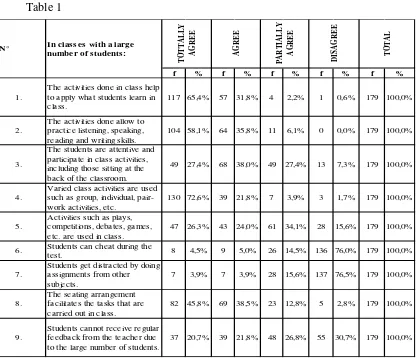
In Statement 1 of this table, it is evident that the activities done in class help students apply what they have learned in class. There is a majority in favor of the
statement, indicated by the 97.2% who “totally agree” (65.4%) and who “agree”
(31.8%). According to their opinion, this means that despite being part of a large
class, students can apply learning through the teachers’ activities.
Hess (2001) confirms these findings by pointing out that a variety of activities and techniques are important in all learning situations, but particularly in a large, multi-level classes because this variety can accommodate different levels and learning styles.
With regard to the results in statement 2, (58.1%) of students answered that they “totally agree” that the activities developed in class allow them to practice the four skills despite being in a large class. A high percentage (35.8%) answered they
“agree” with this statement. Only the 6.1% of students stated that the activities
applied by the teacher partially help them with effective practice in class.
0 10 20 30 40 50 60 70 80
Instructional Implications
Totally agree Agree
23
The results show that teachers might be using communicative activities to encourage learners to apply their speaking and listening skills. In fact, this type of activities is related to the Communicative Language teaching method, which according to Rodgers (2006) aims to give students the opportunity to establish communication in the target language. Indeed, mostly everything is done with communicative intent in this method and students use the language through communicative activities such as games, pair work activities and role-plays, etc.
Moreover, it is relevant to remark that Gower, Philips & Walters (2005) state that language skills in classes are often integrated, with one activity leading to another. Taking into account both what these authors state and the results obtained in the survey, it can be said that the majority of the students integrate their listening, speaking, reading, and writing skills through tasks that lead one skill to other in order to produce the English language on their own.
24
Harmer (2003) believes that it is difficult for teachers to interact with students at the back of the classroom in large classes and the results provided by this
statement might confirm the information provided by the author.
In relation to statement 4, (72.6%) students chose the option “totally agree” and (21.8%) chose the option “agree” this sums up a convincing 94.4% of students who think that varied class activities are used in a large classes such as group, individual, pair work activities, etc. In contrast, only seven students (3.9%) “partially agree”;
and (1.7%) do not agree. This shows a strong level of agreement among learners, probably due to the fact that teachers might have organized students to work with a variety of activities. Harmer (2003) mentions that group and pair-work activities
increase students’ participation in large classes.
Following with the statement 5 has to do with activities such as plays, competitions, debates, games, etc. are used in a large class, 47 of the students (26.3%) show they “totally agree” and 43 students (24.0%) “agree”; adding these results, we notice that half 50.3% of students are in favor of this statement. However, the majority fall in the option “partially agree” chose by 34.1% of students. It might be understood from this data that the teacher rarely uses these activities in this type of class. This idea was confirmed by 28 students (15.6 %) who disagreed, stating that that the referred activities are not used in class. Therefore, the responses might show that though teachers use collaborative activities such as group or pair work activities exposed in statement 4, other kind of interactive activities such as plays,
competitions, debates, etc. are not used to the same extent.
The answers given by the students in relation to the possibility of cheating during tests in a large class show that in statement 6, 136 students (76%) of learners
25
probably due to the fact that the space between seats is wide enough to impede
learners to look at others’ tests. In addition, teachers might be able to walk freely
amongst the rows to control students’ behavior during evaluations. Therefore, the
pupils’ responses support the description given by Woodward (2001) that cheating
(specifically copying) during evaluations in a large class might be the case. On the contrary, 4.5% of respondents do believe that it is possible to cheat during the tests and 5% also “agree” with this statement; if these percentages are summed up to the 14.5% who partially agree with this statement.
Statement 7 shows a strong support in relation to the level of distraction in a large class is low; 76.5% and 15.6% of students chose “disagree” and “partially
agree” respectively. This means that they do not get distracted by doing other
assignments from other subjects in classes. On the other hand, seven (3.9%) students admitted that they work on other activities during classes. This might be due to the lack of oversight by the teachers who should monitor the class to control students’ work. Harmer (2007) believes that when teachers make use of pair work or group work with large groups it gives the opportunity to students to work freely and gives teachers time to monitor students’ work. By applying this kind of strategy, teachers
can avoid students’ getting distracted while working on other activities and can
monitor the class to observe what students are really doing.
Regarding statement 8, which is about seating arrangement, the results show that a high number of students consider the way their teachers arrange seats appropriate to develop the activities in a large class; 82 students (45.8%) chose
“totally agree”, 69 students (38.5%) “agree”, and 23 students (12.8%) “partially
26
mentioned. Woolfolk (2007) affirms that different sitting arrangements are good for
student’s interaction and help them to work more easily.
Finally, in the statement related to feedback in a large class, the results are similar in that there is almost an absolute majority. So (30.7%) answered that in spite of the large number of students, learners can receive regular feedback by their
teacher, (26.8%) “partially agree”, (21.8%) “agree” and (20.7%) “totally agree”. The negative perception of the students (21.8% and 20.7%) indicates that students do not have feedback, which is concerning given that feedback is very important to successful learning. Teachers experience various kinds of difficulties during the process according to Watson (1997); through feedback, teachers can
correct students’ work and clarify their students’ questions. Additionally, Gower,
Philips & Walters (2005) suggest that teachers provide feedback in large classes not only by doing individual monitoring but also by encouraging students to work in groups or pairs to discuss how they are doing their tasks. This might help teachers in large classes by keeping students busy at the same time as they receive feedback.
27
f % f % f % f % f %
10.
There is a proper balance of student-student and teacher-student interaction.
89 49,7% 62 34,6% 20 11,2% 8 4,5% 179 100,0%
11.
Students have the opportunity to build relationships with their classmates
83 46,4% 68 38,0% 22 12,3% 6 3,4% 179 100,0%
12.
The teacher has problems remembering all the students' names.
42 23,5% 52 29,1% 49 27,4% 36 20,1% 179 100,0%
13.
The atmosphere is less stressful since the teacher does not ask several questions to the same student.
30 16,8% 63 35,2% 59 33,0% 27 15,1% 179 100,0%
14.
It is easier for students to use their cellphone or any other mobile device without being seen by the teacher.
13 7,3% 8 4,5% 27 15,1% 131 73,2% 179 100,0%
A G R EE TO TT A LL Y A G R EE
In classes with a large
number of students: TO
TA L D IS A G R EE PA R TI A LL Y A G R EE N°
[image:33.603.117.537.168.580.2]What social implications do large classes have on the teaching-learning process?
Table 2
Author: Jazmin Caiminagua
Source: Students’ questionnaire
28
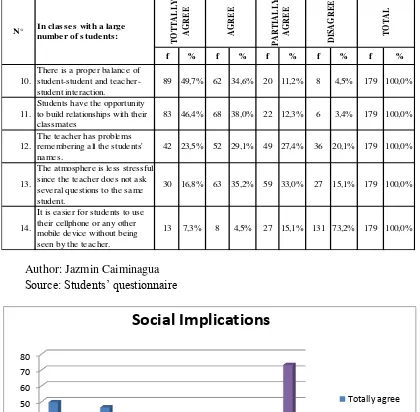
Regarding the social implications of large classes in the teaching-learning process, statement 10 shows that there is a tendency majority in favor of the statement, indicated by the 84.3% who “totally agree” (49.7%) and who
“agree”(34.6%). Meaning that there is a proper balance of interaction between
students and teacher. This group of students does not feel ignored and believes that the teacher maintains contact with all of the students in the class. Only 11.2% of students answered they “partially agree”. In short, 95.5% of students have a positive attitude respect to the teacher-student interaction which means that large classes does not impede that the interaction between students-students and between teachers-students takes place.
These results show a different approach regarding to the opinion of Baker (2000) who affirms that large class affect the teacher-student interaction, in contrast to the responses given by students is opposite to the author ‘thought.
With respect to the results in the statement 11 shows that a high number of learners are aware of the opportunities of building relationships with their classmates; 83 students (46.4%) selected “totally agree”, 68 students (38%) “agree”, and 22
students (12.3%) “partially agree”. These results indicate that these students feel that
they have several opportunities to develop relationships inside the classroom. Indeed,
only 3.4% of students answered “disagree” with the statement mentioned. According
to Hess (2001), large classes are featured by the continuous interaction between students and the answers given by the students corroborate the information given by the author about the ease of establishing relationships in large classes.
Concerning to the statement 12, which is about the students’ opinion regarding
teachers’ ability to remember names in large classes. The results indicate that 42
29
option “agree”. This results add up 52.6% of students believe that the teacher have
problems remembering their names. In contrast, 49 students (27.4%) “partially agree” and only 20.1% of students answered do not agree with this statement.
According to these results, it appears that students consider class size as a
factor that hinder teacher’s ability to remember all of their names. It appears to
confirm Saraswati’sassumption “A teacher cannot even get to know the names of all her learners in a large class.” Saraswati (2004, p.154).
Continuing with the analysis of the statement 13, in which students were asked about the level of stress in the learning atmosphere caused by the few questions the teacher asks to students, 30 students (16.8%) answered “totally agree” that the class atmosphere is less stressful; 63 students (35.2%) also “agree” that they feel more relaxed due to the fact that teacher does not ask several questions to the same student, while that 33% of students “partially agree” with this statement. In short, 85% of students think that in large classes the possibility that the same student could be called on several times by the teacher is reduced. On the contrary, only 15% of participants do not agree with this statement.
Finally, statement 14 refers to the student’ ability to access cell phones or any other mobile device in the classroom without being seen by the teacher. Most of the students (73.2%) do not think that large classes influence in the possibility of using their cell phones inside the class. This group of students answered that it is not easier for them to use mobile devices in the class behind the teacher’s back. Therefore, Harmer (2007) states that the reason might be that teachers use monitoring in the classroom, and the students comprehend well the consequences of using electronic
30
On the other hand, the 7.3% of students “totally agree” and the 4.5% of participants “agree”, while the 15.1% of students partially agree with this statement; amounting 26.9% of students who do believe that it is easier for them to use devices in large classes.
To sum up the results of the social implications of large classes in the teaching-learning process, it can be said that students perceive that large classes do not hinder interaction in the classroom. In addition, the high number of students does not impede teachers’ ability control the use of mobile devices in class. On the other hand, students perceive that large classes are a problem for teachers when they need
to remember students’ name, but at the same time results can be positive because
31
f % f % f % f % f %
15. The atmosphere is stressful. 24 13,4% 47 26,3% 54 30,2% 54 30,2% 179 100,0% 16. Students feel inhibet when speaking in front of the rest. 37 20,7% 49 27,4% 56 31,3% 37 20,7% 179 100,0%
17.
Students do not have the opportunity to express their opinions.
22 12,3% 56 31,3% 47 26,3% 54 30,2% 179 100,0%
18.
Students do not like to participate because they feel afraid.
27 15,1% 36 20,1% 54 30,2% 62 34,6% 179 100,0%
19 The teacher does not pay equal
attention to all his/her students. 48 26,8% 35 19,6% 33 18,4% 63 35,2% 179 100,0%
20.
Students feel they can act competively with other students.
87 48,6% 48 26,8% 33 18,4% 11 6,1% 179 100,0%
21. Students feel relaxed because they can go unnoticed. 28 15,6% 38 21,2% 52 29,1% 61 34,1% 179 100,0%
N° In classes with a large number of students:
TO TT A LL Y A G R EE A G R EE P A R TI A LL Y A G R EE D IS A G R EE TO TA L
[image:37.603.116.536.164.533.2]What psychological implications do large classes have on the teaching learning process?
Table 3.
Author: Jazmin Caiminagua
Source: Students’ questionnaire
32
The last table presents the data of the psychological implications that large classes have in the teaching-learning process. In relation to students’ responses
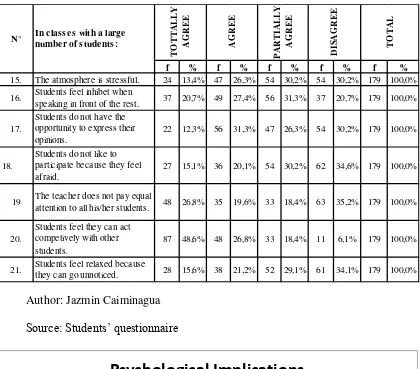
whether the atmosphere is stressful in the classrooms, the students indicated that, 30.2% “partially agree” and the same percentage of students answered “disagree” respectively; this results sum up 60.4 % of students who believe that atmosphere is not very stressful place. Meanwhile, 26.3% participants “agree” and 13.4% “totally
agree”, they might not feel comfortable because the classroom is very stressful for
them, too. Therefore, the stressful environment might be a result of the noise
produced by the overcrowded class; Ijaiya (1999) states that noise is one of the major problems caused by overcrowded classes.
However, these results indicate that students’ opinions are divided in relation to
the atmosphere in the classroom. Taking into account that in table 2, students expressed positive opinion of their interactions with peers, it appears that those perceptions might lead students to be ambiguous in their answers.
In statement 16, with regards to whether students feel inhibited when speaking in front of the rest. 37 of the students (20.7%) show they “totally agree” and 49 students (27.4%) “agree”: adding these results, we notice that almost half (48.1%) of students are in favor of this statement. On the contrary, the majority of students (31.3%) chose the option “partially agree”and (20.7) “disagree”, meaning that they do not feel uncomfortable speaking in front everyone.
33
their peers. Therefore, it show that students who agree with the question do not feel secure about participating in front of the class due to their low language skills.
In statement 17 students were answered if they do not have opportunities to express their opinions in class. About it, 12.3% of learners “totally agree”; 31.3% of students “agree” and 26.3% of participants “partially agree” and 30.2% of pupils
“disagree”. These results show a contradiction within the students’ responses because
a similar number of participants agree and disagree. However, the tendency of answers to be negative means that most students feel they do not have opportunities to express their opinions in class. This might be as a result of the impersonal
atmosphere expressed by Carbone (1998) who believes that students in large classes feel unmotivated because it is not easy to be noticed among a large number of students.
Following the interpretation of the results in relation to statement 18, students were asked about do not like to participate in class because they feel afraid. Most of the students, 34.6% answered “disagree” with this statement. On the other hand, 30.2 % of students answered that in some cases they do not like participate in class. This results are similar to the 20.1% of students who “agree” and the 15.1% who “totally agree” with statement 18; this group of students conforms about half of the students, concluding that most of the students actually do feel afraid of speaking in class.
Regarding statement 19, its purpose is to find out if the teacher does not pay equal attention to all the students. 35.2% of students “disagree” with the statement; they think that teacher pays equal attention to all the students in the class.
34
a lesser degree and the 18.4% “partially agree”. The trend of this statement is positive due to 64.8% agreement with this assumption. Saraswatti (2004), expresses that teachers in large classes are not capable of using a personalized approach. As a
result, students’ opinions coincide with the point of view given by the mentioned
author.
The next question was stated to know about the students’ feelings toward the level of competition in the classroom. The results show that 48.6% of students feel they can act competitively with other students. Only 6.1% students do not agree; thus showing a high concentration of answers in the positive scales of the item. Here, the opinion of large classes given by Ward & Jenkins (1997) provides important hints
about the students’ answers. The authors state that teachers and students in large
classes enjoy and gain from experience. As a result, students feel that the number of students promotes competition in the large classroom.
Finally, question 21 refers to the feeling of relaxation as a result of being unnoticed in large classes. 34.1% students do not believe they are unnoticed in the class in spite of the large number of students per class. 29.1% of participants
“partially agree”; 21.2% of learners “agree”; and only 15.6% students “totally agree”.
The results show that students do not consider that class size promotes anonymity in the classroom. About it, Woodward (2001) mentions that strategies for managing large classes help teachers to create a comfortable classroom that makes students feel relaxed and confident. Consequently, it seems that teachers in the selected high schools make use of different strategies that involve students in the lessons, avoiding situations in which learners feel unnoticed.
35
36
Conclusions
The results of this study demonstrate that 58.1% of students “totally agree” and
35.8% “agree” that the activities done in large classes allow them to practice the
language.
According to 65.4% of students in a large class say they are attentive and they
can participate in class activities, even those students sitting at the back of the classroom. These results indicate that a large number of students does not
interfere in students’ performance.
Almost all students 94.4% report that teachers in large classes apply different
kind of activities, such as pair work, group work, and individual work. However, activities such as plays, competitions, debates, and games are used to a lesser degree.
A majority of students 69.3% state that they do not receive feedback from the
teacher due to the large number of students.
The 39.7% of students who feel stressed in class confirm that the atmosphere in
large classes tends to be stressful because of the large number of students.
It was found that 52.6% of students answered that their teachers had difficulty in
remembering students’ names when dealing with large classes.
A negative aspect referring to the psychological implications in a large classes is
37
Recommendations
Teachers should use activities such as role play or games, in order to encourage
their students the use of those type of interactive activities.
Teachers should develop more strategies to give a permanent feedback to the
students in large classes, so that every single student can identify his or her weaknesses and strengths during the English learning process in order to learn this foreign language effectively and successfully.
Teachers should motivate students to diminish the level of student’ fear and so
38
REFERENCES
Baker, J., & Westrup, H. (2000). English language teacher’s handbook: How to
teach large classes with few resources. London: Continuum.
Candling, C., & Mercer, N. (2001). English language teaching in its social context.
New York: Routledge.
Carbone, E. (1998). Teaching large classes: tools and strategies. London: SAGE
publications Inc.
Chan, W. M., Chin, K. N., Bhatt, S., & Walker, I. (Eds.). (2012). Perspectives on
individual characteristics and foreign language education. Boston: Walter de
Gruyter incorporated.
Diller, D. (2008). Spaces & places: Designing classrooms for literacy. New York:
Stenhouse Publishers.
Ducasse, A. M. (2010). Interaction in paired oral proficiency assessment in
Spanish: Rater and candidate input into evidence based scale development
and construct definition. Peter Lang.
Fabunmi, M., Brai-Abu, P., & Adeniji, I. A. (2007). Class factors as determinants of
secondary school student’s academic performance in Oyo state,
Nigeria. Journal of social science, 14(3), 243-47.
Felix, E. (2011). Modern approach to classroom discipline and management. USA:
Xlibris Corporation.
Ferrer, H. (2001). Teaching English in a Spanish Setting. España: Universidad de
Valencia.
Flood, J., Lapp, D., Squire. J., & Jensen, J. (2003). Handbook of research on
teaching the English language Arts (2nd Ed.). New Jersey: Lawrence Erlbaum
39
Gower, R., Phillip, D., & Walters, S. (2005). Teaching Practice: A handbook for
teachers in training. Oxford: Macmillan Publishers Limited.
Hall, G. (2011). Exploring English language teaching. Canada and USA Routledge
Print.
Harmer, J. (2007). How to teach English.Edinburgh, England: Pearson
Education Limited.
Hess, N. (2001). Teaching large multilevel classes. New York: Cambridge
University Press.
Ijaiya, Y. (1999). Effects of over-crowded classrooms on teacher-students
Interactions. Ilorin Journal of Education, 19, 1-11.
Larsen-Freeman, D., & Anderson, M. (2011). Techniques and principles in
language teaching. (3th ed.). Oxford: Oxford University Press.
Nagaraj, G. (1996). English language teaching: Approaches, methods, techniques.
Hyderabad. Orient Longman Private Limited.
Norton, B., & Locastro, V. (2001). Teaching English to large classes; large classes and student learning. TESOL quarterly, 35(3), 493-496.
Nunan, D. (1996). The self-directed teacher: Managing the learning process.
Cambrigde University Press.
Owoeye, J. S., &Yara, P.O. (2011). Class size and academic achievement of
secondary school in Ekiti state, Nigeria: Asian Social Science, 7 (6), 184 – 189.
Richards, J. C., & Renandya, W. A. (2002). Methodology in language teaching: An
anthology of current practice. Cambridge: Cambridge University Press.
Richards, J., & Rodgers, T. (2001). Approaches and methods in language teaching
40
Richards, J. (2006). Communicative Language Teaching today. USA, Cambridge
University Press.
Salim, B. (2001). A companion to teaching of English. New Delhi, India: Atlantic
Publisher.
Saraswathi, V. (2004). English language teaching-principles & practices.
Hyderabad: Orient Longman Private Limited
Sears, C. (1998). Second language students in mainstream classrooms: A handbook
for teachers in international schools. (No.2). Great Britain: Multilingual
Matters Ltd.
Shamin, F. (2012). Teaching large classes. In Burns, A. & Richards, J. (Eds.), The
Cambridge guide to pedagogy and practice in second language learning (p.
95- 102). Cambridge University Press.
Smith, C. J., & Laslett, R. (1993). Effective classroom management: A teacher`s
guide (2th ed.). New York: Routledge.
Smith, P. & Warburton, M. (1997). Strategies for managing large classes: a case study. British Journal of In-service Education, 23(2), 253-266.
Snow, M. (2013). Principles and practices for response in second language writing.
New York: Routledge.
Tomlinson, C. A. (2001). How to differentiate instruction in mixed-ability classroom
(2nd Ed.). Alexandria: Association for Supervision and Curriculum
Development.
Ward, A. & Jenkins, A. (1997). The problems of learning and teaching in large classes. In Gibbs, G. (Ed.), Teaching large classes in higher education: how
to maintain quality with reduced resources (p. 23 - 36). London: Witwell Ltd.
41
Woodward, T. (2001). Planning lessons and courses: Designing sequences of work
for the language classroom. Cambridge University Press.
Woolfolk, A. (2007). Educational psychology (10th ed.). Boston, MA: Allyn and
Bacon.
Yelkpieri, D., Namale, M., Esia-Donkoh, K., &Ofosu-Dwamena, E. (2012). Effects
of large class size on effective teaching and learning at the Winneba Campus
of the UEW (University of Education, Winneba), Ghana: Academic Journal,
ANNEXES
UNIVERSIDAD TÉCNICA PARTICULAR DELOJA
La Universidad Católica de Loja
MODALIDADABIERTAYA DISTANCIA TITULACIÓNDEINGLES
Estimado estudiante:
Este cuestionario tiene como objetivo conocer la influencia de las clases numerosas en el proceso de enseñanza aprendizaje del Inglés.
La información que usted brindará a continuación se usará únicamente con fines académicos- investigativos. Le rogamos contestar honestamente de acuerdo a la siguiente escala de referencia.
Muy satisfactorio: Totalmente de acuerdo
Satisfactorio: De acuerdo
Poco satisfactorio Parcialmente de acuerdo Nada satisfactorio En desacuerdo
Datos Informativos:
Nombre de la institución:
Tipo de institución: Pública ( ) Privada ( )
Curso: 8vo. ( ) 9no. ( ) 10mo.( )
Ciudad:
Instrucción: Marque con una X según su criterio.
A. ASPECTOS ACADÉMICOS
En clases con bastantes estudiantes:
M uy sa ti sf ac to rio Sa ti sf ac to rio Poc o sa ti sf ac to rio Nad a sa ti sf ac to rio
1 Se realizan actividades que permiten poner en práctica lo aprendido.
2 Se realizan actividades que permiten practicar las habilidades de escucha, habla, lectura y escritura.
3 Todos los estudiantes están atentos y participan en las actividades desarrolladas en la clase, inclusive los estudiantes de la última fila.
4 Se utilizan actividades variadas dentro de la clase; como por ejemplo, actividades en grupo, actividades individuales, actividades en pareja, etc.
5 Se utilizan actividades tales como dramatizaciones, concursos, debates, juegos, etc.
6 Se puede copiar durante los exámenes.
7 Se puede realizar tareas de otras materias.
8 El espacio de la clase te permite desarrollar adecuadamente las actividades asignadas por el profesor.
9 No puedo recibir una retroalimentación adecuada por parte del profesor debido al número elevado de estudiantes.
B. ASPECTOS SOCIALES
N° En clases con bastantes estudiantes:
M uy sa ti sf ac to rio Sa ti sf ac to rio Poc o sa ti sf ac to rio Nad a sa ti sf ac to rio
11 Tengo la oportunidad de relacionarme con más personas.
12 El profesor no recuerda el nombre de todos los estudiantes.
13 El ambiente es menos tenso ya que hay menor probabilidad de que el profesor realice preguntas constantes al mismo estudiante.
14 Puedo usar mi teléfono celular o algún otro dispositivo electrónico sin ser descubierto por el profesor.
C. ASPECTOS PSICOLÓGICOS
N° En clases con bastantes estudiantes:
M uy sa ti sf ac to rio Sa ti sf ac to rio Poc o sa ti sf ac to rio Nad a sa ti sf ac to rio
15 El ambiente es estresante.
16 Me siento incómodo al momento de hablar frente a mis compañeros.
17 Tengo menos oportunidad de expresarme.
18 No me gusta participar porque me siento tímido.
19 El profesor nos presta atención por igual a todos los estudiantes.
20 Siento que puedo competir sanamente con otros estudiantes.
21 Me siento relajado porque puedo pasar por desapercibido.