A propósito del trasplante de células
hematopoyéticas número 1000 efectuado en la
Clínica Ruiz en Puebla, México
À-propos of the 1000
thstem cell transplant conducted at
the Clínica Ruiz in Puebla, Mexico.
Gisela Berenice Gómez-Cruz,1,4 Mauricio Olivares-Gazca,1,3 Iván Murrieta-Álvarez,1,3 Juan Carlos Olivares-Gazca,1,3
Andrés León-Peña,1,4 Yahveth Cantero-Fortiz,1,5 Guillermo J Ruiz-Delgado,1-3 Guillermo J Ruiz-Argüelles1-3
1 Centro de Hematología y Medicina
Interna de Puebla, Puebla, México.
2 Laboratorios Ruiz, Puebla, México. 3 Universidad Popular Autónoma del
Estado de Puebla, Puebla, México.
4 Benemérita Universidad Autónoma de
Puebla, Puebla, México.
5 Universidad de las Américas Puebla,
México.
Recibido: 27 de febrero 2019
Aceptado: 29 de marzo 2019
Correspondencia
Guillermo J Ruiz Argüelles [email protected]
Este artículo debe citarse como
Gómez-Cruz GB, Olivares-Gazca M, Murrieta-Álvarez I,Olivares-Gazca JC y col. A propósito del trasplante de células hematopoyéticas número 1000 efectuado en la Clínica Ruiz en Puebla, México. Hematol Méx. 2019 abril-junio;20(2):150-183.
https://doi.org/10.24245/rhematol. v20i2.3105
Resumen
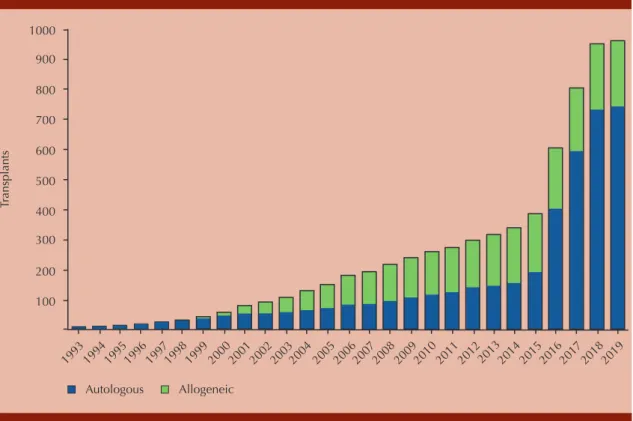
Elprimer trasplante de células hematopoyéticas (TCH) en la Clínica Ruiz en Puebla, México, se realizó el 5 de mayo de 1993, fecha importante en Puebla debido a la conmemoración de la batalla librada en 1862, en la cual el ejército mexicano derrotó al francés en los fuertes de Loreto y Guadalupe. Desde entonces y hasta enero de 2019, se han realizado 962 trasplantes (735 de células autólogas y 227 de células alogénicas) y se calcula que para mayo de 2019, 26 años después del primer trasplante, se realizará el trasplante número 1000. Usando modificaciones a las formas tradicionales de llevar a cabo los TCH, hemos podido realizar el procedimiento con células hematopoyéticas alogénicas, autólogas, haploidénticas, de donadores compatibles no emparentados y de células placentarias. El programa se ha convertido en el programa de trasplantes de práctica privada más grande de México y el tercero entre todos los programas de TCH en nuestro país. Trabajando en conjunto con el programa de TCH en el Hospital Universitario de Nuevo León, hemos publicado alrededor de 160 artículos en revistas nacionales e internacionales revisadas por pares. Algunas de estas publicaciones han sido premiadas por instituciones nacionales e internacionales, como la Agrupación Mexicana para el Estudio de la Hematología, la Academia Nacional de Medicina, la Fundación Mexicana para la Salud, el Instituto CARSO, el Latin American Bone Marrow Transplant Group, el Center for International Blood and Marrow Transplant Research (CIBMTR) y el Programa Universitario de Investigación en Salud-UNAM. Asimismo, en febrero de 2017, los doctores Guillermo J Ruiz-Argüelles y David Gómez-Almaguer recibieron el Premio del CIBMTR al Servicio Distinguido 2017 por sus contribuciones a la actividad de los TCH en todo el mundo. La Figura 1 muestra la actividad de TCH en la Clínica Ruiz iniciando el 5 de mayo de 1993 con el trasplante autólogo hasta el mes de enero de 2019. En los últimos 4 años, la actividad del TCH se incrementó sustancialmente, principalmente como resultado de la inclusión de personas con esclerosis múltiple. Nos hemos convertido en la instalación más grande del mundo que realiza trasplante autólogo en pacientes con esclerosis múltiple y otras afecciones autoinmunitarias. La Figura 2 indica el diagnóstico de los pacientes que han recibido un trasplante autólogo en la Clínica Ruiz, mientras que la Figura 3 muestra el diag-nóstico de los pacientes con trasplante alogénico realizado en nuestras instalaciones.
PALABRAS CLAVE: Trasplante de células hematopoyéticas; trasplantes; publicaciones.
Abstract
transplants have been performed (735 autologous and 227 allogeneic), and it is calcu-lated that by May 5, 2019, 26 years after the first transplant, the 1000th transplant will have been done. Employing modifications to the traditional ways to conduct HSCT, we have been able to graft allogeneic, autologous, haploidentical, matched unrelated and placental cells. The program has become the largest private practice transplant program in Mexico, and the third among all programs in our country. Working together with the transplant program at the University Hospital of Nuevo Leon, our program has pub-lished around 160 papers in national and international peer-reviewed journals. Some of these publications have been awarded by national and international institutions such as: Agrupación Mexicana para el Estudio de la Hematología, Academia Nacional de Medicina, Fundación Mexicana para la Salud, Instituto CARSO, Latin American Bone Marrow Transplantation Group, Programa Universitario de Investigación en Salud-UNAM. On the other hand, in February 2017, doctors Guillermo J Ruiz-Argüelles and David Gomez-Almaguer were granted the 2017 Distinguished Service Award for their contributions to the HSCT activity worldwide. The Figure 1 depicts the HSCT activity of the Clínica Ruiz starting the autograft done in May 5, 1993 and ending in January, 2019. In the last 4 years, the auto-HSCT activity has increased substantially, mainly as the result of the inclusion of persons with multiple sclerosis (MS). We have become the largest facility in the world autografting patients with MS and other autoimmune conditions. The Figure 2 indicates the diagnosis of the patients who have received an autograft at the Clínica Ruiz, whereas the Figure 3 depicts the diagnosis of the patients who have been allografted at our facility.
KEYWORDS: Hematopoietic stem cell transplant; Transplants; Publications.
1000
900
800
700
600
500
400
300
200
100
Tr
ansplants
19931994 19951996 19971998 199920002001 2002 20032004 2005 20062007200820092010 2011 201220132014 201520162017 2018 2019
Autologous Allogeneic
BIBLIOGRAFÍA
1. Ruiz-Argüelles GJ, Ruiz-Argüelles A, Alemán-Hoey DD,
Arizpe-Bravo D, et al. Autotrasplante en leucemia aguda de células totipotenciales movilizadas con filgrastim. Rev Invest Clin Méx 1993;45:479-480.
2. Ruiz-Argüelles GJ, Ruiz-Argüelles A, Pérez-Romano B,
Marín-López A, et al. Filgrastim mobilized peripheral blood stem cells can be stored at 4 degrees and used in auto-grafts to rescue high-dose chemotherapy. Am J Hematol 1995;48:100-103.
3. Ruiz-Argüelles GJ, Ruiz-Argüelles A, Pérez-Romano B,
Marín-López A, Delgado-Lamas JL. Non-cryopreserved pe- ripheral blood stem cells autotransplants for hematological malignancies can be performed en rely on an outpatient basis. Am J Hematol 1998;58:161-164.
4. Ruiz-Argüelles GJ, Lobato-Mendizábal E, Ruiz-Argüelles A,
Pérez-Romano B, et al. Non-cryopreserved unmanipulated hematopoietic peripheral blood stem cell autotrasplant program: long term results. Arch Med Res 1999;30:380-384.
5. Ruiz-Argüelles GJ, Gómez-Rangel D, Ruiz-Delgado GJ, Ruiz-
Argüelles A, et al. Results of an autologous non-cryopre-served, unmanipulated peripheral blood hematopoietic stem cell transplant program: A single institution, 10-year experience. Acta Haematol 2003;110:179-183.
6. Vela-Ojeda J, García-Ruiz-Esparza MA, Padilla-González Y,
Gómez-Almaguer D, et al. Autologous peripheral blood stem cell transplantation in multiple myeloma using oral versus I.V. melphalan. Ann Hematol 2007;86:277-282.
7. López-Otero A, Ruiz-Delgado GJ, Ruiz-Argüelles GJ. ¿Es
cierto que el trasplante de médula ósea autóloga mejora el pronóstico de los pacientes con mieloma múltiple?:
580 7 4
24 52
68
Multiple sclerosis Multiple myeloma Acute leukemia
Non-hematological malignancies
Lymphoma Chronic leukemia
Total = 735
125 33
15 24
9
4 6 4
2 3 1
Acute leukemia Chronic leukemia Bone marrow hypoplasia Lymphoma
Multiple myeloma Blackfan-Diamond
Non-hematological malignancies Primary myelofibrosis
Myelodysplastic syndrome
Thalassemia PNH
Hunter syndrome
Total = 227
Figure 2. Autologous hematopoietic stem cell trans-plants done at the Clínica Ruiz between May 1993 and January 2019.
Experiencia de una sola institución en México. Med Univ 2008;10:187-189.
8. López-Otero A, Ruiz-Delgado GJ, Ruiz-Argüelles GJ. A
simplified method for stem cell autografting in multiple myeloma: a single institution experience. Bone Marrow Transplant 2009;44;715-719.
9. Reyes-Torres V, Hernández-Arizpe A, López-Otero A, Ruiz-
Delgado G y col. El AMD3100 (plerixafor) puede mejorar la movilización de células hematopoyéticas para hacer trasplantes autólogos. Informe de un caso. Med Univ 2009;11:202-206.
10. Ruiz-Delgado GJ, Ruiz-Argüelles GJ. El trasplante autólogo
sigue siendo importante en el tratamiento del mieloma múltiple. Rev Hematol Méx 2011:12:1-2.
11. Ruiz-Delgado GJ, Calderón-García J, Alarcón-Urdaneta C,
Ruiz-Argüelles GJ. An increased body mass index is not an adverse prognostic factor in persons undergoing autolo-gous hematopoietic stem cell transplantation. Medicina Univ 2011;13:122-126.
12. Ruiz-Delgado GJ, Fernández-Macouzet M,
Alarcón-Urdaneta C, Ruiz-Argüelles GJ. The role of post-autograft maintenance therapy in multiple myeloma: A propos d’un cas. Rev Hematol Méx 2012:13:39-41.
13. Ruiz-Argüelles GJ, Gómez-Almaguer D. El trasplante de
médula ósea, el premio Nobel y la muerte del Dr. Edward Donnall Thomas. Rev Hematol Méx 2013;14:1-2.
14. Ruiz-Argüelles GJ, Ruiz-Delgado GJ, Garcés-Eisele J. ¿Es
ne-cesario el trasplante de médula ósea en el tratamiento de la leucemia mieloiode aguda? Rev Hematol Méx 2013;14:1-4.
15. Zamora-Ortiz G, Velázquez-Sánchez-de-Cima S,
Hernández-Reyes J, Vargas-Espinosa J y col. Veinte años de experiencia con trasplante de células hematopoyéticas en la Clínica Ruiz de Puebla, México. Rev Hematol Méx 2013;14:63-70.
16. Karduss-Urueta A, Ruiz-Argüelles GJ, Pérez R, Ruiz-Delgado
GJ, et al. Cell-Freezing Devices Are not strictly needed to start an autologous hematopoietic transplantation program: non-cryopreserved peripheral blood stem cells can be used to restore hematopoiesis after high dose chemotherapy: a multicenter experience in 268 autografts in patients with multiple myeloma or lymphoma. Study on behalf of the Latin-American Bone Marrow Transplantation Group (LABMT). Blood 2014;124:849.
17. Ruiz-Argüelles GJ, Léón-Peña AA, León-González M,
Vargas-Espinosa J, et al. Outpatient hematopoietic grafting in patients with multiple sclerosis employing autologous non-cryopreserved peripheral blood stem cells: a feasibility study. Br J Haematol 2016;173:17.
18. Gómez-Almaguer D, Ruiz-Argüelles GJ, Ruiz-Argüelles A,
Piñeiro LA. Dos casos de trasplantes heterólogos con sangre periférica. Rev Invest Clin Méx 1997;49:41-45.
19. Gómez-Almaguer D, Ruiz-Argüelles GJ, Ruiz-Argüelles A,
González-Llano O, et al. Hematopoietic stem cell allografts using a non-myeloablative conditioning regimen can be safely performed on an outpatient basis. Bone Marrow Transplant 2000;25:131-133.
20. Ruiz-Argüelles GJ. Quimioterapia versus minitrasplante
en el tratamiento de la leucemia aguda mieloblástica. Gac Méd Méx 2000;136:25-26.
21. Gómez-Almaguer D, Ruiz-Argüelles GJ, González-Llano O,
Ruiz-Argüelles A, Cantú-Rodríguez OG. Trasplante de cé-lulas hematopoyéticas de sangre periférica utilizando qui-mioterapia inmunosupresora sin destrucción de la médula ósea: “Minitrasplante”. Resultados de un programa pros-pectivo y multicéntrico. Gac Méd Méx 2002;138:235-239.
22. Ruiz-Argüelles GJ, Gómez-Almaguer D, Ruiz-Argüelles A,
González-Llano O, et al. Results of an outpatient-based stem cell allotransplant program using non-myeloablative conditioning regimens. Am J Hematol 2001;66:241-244.
23. Ruiz-Argüelles GJ, Ruiz-Argüelles A, Gómez-Almaguer D,
López-Martinez B, et al. Features of the engraftment of al-logeneic hematopoietic stem cells using reduced-intensity conditioning regimens. Leuk Lymphoma 2001;42:145-150.
24. Ruiz-Argüelles GJ. Outpatient programs of myeloablative
chemotherapy, autologous and allogeneic bone marrow transplantation. Haematologica 2000;85:1233-1234.
25. Ruiz-Argüelles GJ, Gómez-Almaguer D, López-Martinez B.
Editorial: ¿Por qué se están haciendo los minitrasplantes de médula ósea? Rev Invest Clin Méx 2001;53:110-111.
26. Ruiz-Argüelles GJ, Gómez-Almaguer D, Velázquez-Ferrari
M, Ruiz-Delgado GJ, Ruiz-Argüelles A. Salvage non-myeloa-blative allogeneic hematopoietic stem cell transplantation in two adults with advanced stages of leukemia. Rev Hematol 2001;2:9-11.
27. Ruiz-Argüelles GJ. Simplifiction, not demystification nor
trivialization of stem cell transplanta on. Haematologica 2001;86;07.
28. Ruiz-Argüelles GJ. Foro Clínico: El efecto de injerto contra
tumor en leucemia granulocítica crónica. Rev Invest Clín Mex 2002;54:154-160.
29. Ruiz-Argüelles GJ, López-Martinez B, Santellán-Olea MR,
Abreu-Díaz G, et al. Follow up of hematopoietic chimerism in individuals given allogeneic hematopoietic stem cell allografts using an immunosuppressive, non-myeloabla-tive conditioning regimen: A prospecnon-myeloabla-tive study in a single institution. Leukemia Lymph 2002;43:1509-1511.
30. Ruiz-Argüelles GJ. Resultados del protocolo mexicano
(Monterrey-Puebla) para llevar a cabo trasplantes alogénicos no mieloablativos (TANM). Gac Méd Mex 2002;138:139-141.
31. Ruiz-Argüelles GJ, Gómez-Almaguer D, López-Mar nez B,
Cantú-Rodríguez OG, Jaime-Pérez JC, González-Llano O. Results of an allogeneic non-myeloabla ve stem cell trans-plantation program in patients with chronic myelogenous leukemia. Haematologica 2002;87:894-896.
32. Ruiz-Argüelles GJ. Allogeneic stem cell transplantation
using non-myeloablative conditioning regimens: Results of the Mexican approach. Int J Hematol 2002;76:376-379.
33. Gómez-Almaguer D, Ruiz-Argüelles GJ, Tarín-Arzaga LC,
transplantation in children and adolescents: the Mexican experience. Biol Blood Marrow Transpl 2003;9:157-161.
34. Ruiz-Argüelles GJ, López-Martinez B, Gómez-Rangel D,
Estrada E, et al. Decreased transfusion requirements in patients given stem cell allografts using a non-myeloabla-tive conditioning regimen: A single institution experience. Hematology 2003;8:151-154.
35. Ruiz-Argüelles GJ, López-Martinez B, López-Ariza B.
Suc-cessful allogeneic stem cell transplantation with non-mye-loablative conditioning in patients with relapsed Hodgkin’s disease following autologous stem cell transplantation. Arch Med Res 2003;34:242-245.
36. Ruiz-Argüelles GJ. Trasplante alogénico no mieloablativo
(TANM): La experiencia de Puebla y Monterrey. Gac Méd Méx 2003;139:151-154.
37. Ruiz-Argüelles GJ. Actualidades en el trasplante de
cé-lulas progenitoras: Rompiendo dogmas. Gac Méd Méx 2003;139:154-156.
38. Ruiz-Argüelles GJ, Gómez-Almaguer D. El efecto de injerto
contra tumor en el tratamiento del cáncer. Hemos (Vene-zuela) 2002;3:9-11.
39. Ruiz-Argüelles GJ. Non-myeloablative bone marrow
trans-plantation. Arch Med Res 2003;34:554-557.
40. Ruiz-Argüelles GJ, Gómez-Rangel JD, Ponce-de-León S,
González-Déctor L, et al. The Mexican schedule to conduct allogeneic stem cell transplantation is related to a low risk of cytomegalovirus reactivation and disease. Am J Hematol 2004;75;200-204.
41. Ruiz-Argüelles GJ, Gómez-Almaguer D, Gómez-Rangel JD,
Vela-Ojeda J, et al. Allogeneic hematopoietic stem cell transplantation with non-myeloablative conditioning in patients with acute myelogenous leukemia eligible for conventional allografting: A prospective study. Leuk Lym- phoma 2004;45:1191-1195.
42. Ruiz-Argüelles GJ, Bordes-Aznar J, Díaz-Caballero N, Ruiz-
Delgado GJ. La importancia del quimerismo en medicina. Gac Méd Méx 2004;140:573-575.
43. Ruiz-Argüelles GJ, Gómez-Almaguer D. Breaking dogmata to
help patients: non-myeloablative hematopoietic stem cell transplantation. ExpertOpinBiolTher2004;4:1693-1699.
44. Ruiz-Argüelles GJ, López-Martinez B, Manzano C, Gómez-
Rangel JD, Lobato-Mendizábal E. Significance of one human leukocyte antigen mismatch on outcome of non-mye-loablative allogeneic stem cell transplantation from related donors using the Mexican schedule. Bone Marrow Transpl 2005;35:335-339.
45. Ruiz-Argüelles GJ. Introducción e historia del trasplante
de médula ósea en México. Rev Hematol 2004;5:80-85.
46. Ruiz-Argüelles GJ, Morales-Toquero A, Gómez-Rangel JD,
López-Martinez B. Trasplante de células hematopoyéticas alogénicas en niños y adolescentes empleando esquema de acondicionamiento no mieloablativo. Experiencia en una sola institución. Bol Med Hosp Inf Mex 2005;62:88-95.
47. Gómez-Almaguer D, Vela-Ojeda J, Jaime-Pérez JC,
Gutié-rrez- Aguirre CH, et al. Allografting in patients with severe,
refractory aplastic anemia using peripheral blood stem cells and a fudarabine-based conditoning regimen: the Mexican experience. Am J Hematol 2006;81:157-161.
48. Jaime-Pérez JC, Ruiz-Argüelles GJ, Gómez-Almaguer D.
Haematopoietic stem cell transplantation to treat aplastic anemia. Expert Opin Biol Ther 2005;5:617-626.
49. Ruiz-Argüelles GJ, Morales-Toquero A, López-Martinez B,
Tarín-Arzaga LC, Manzano C. Bloodless (transfusion-free) hematopoietic stem cell transplants: the Mexican expe-rience. Bone Marrow Transpl 2005;36:715-720.
50. Ruiz-Argüelles GJ. The Mexican approach to conduct
al-logeneic stem cell transplantation: braking dogmata and facing the Matthew effect. Hematology 2005;10:154-160.
51. Ruiz-Argüelles GJ. Historia del trasplante de médula ósea
en México. Rev Biomed 2005;16:207-213.
52. Ruiz-Argüelles GJ, Gómez-Almaguer D, Vela-Ojeda J,
Morales-Toquero A, et al. Extramedullary leukemic relapses following hematopoietic stem cell transplanta-tion with non-myeloablative conditransplanta-tioning. Int J Hematol 2005;82:262-265.
53. Ruiz-Argüelles GJ, Gómez-Almaguer D, Morales-Toquero
A, Gutiérrez-Aguirre CH, Vela-Ojeda J, García-Ruiz-Esparza MA, Manzano C, Karduss A, Sumoza A, de-Souza C, et al. The early referral for reduced-intensity stem cell trans-plantation in patients with Ph1 (+) chronic myelogenous leukemia in chronic phase in the imatinib era: results of the Latin American Cooperative Oncohematology Group (LACOHG) prospective, multicenter study. Bone Marrow Transplant 2005;36:1043-1047.
54. Ruiz-Argüelles GJ, Gómez-Almaguer D, Tarín-Arzaga LC,
Morales-Toquero A, et al. Second allogeneic peripheral blood stem cell transplants with reduced-intensity condi-tioning. Rev Invest Clin Méx 2006;58:34-38.
55. Ruiz-Argüelles GJ, Gómez-Almaguer D. Nephrotic syndrome
after non-myeloablative stem cell transplantation. Br J Haematol 2006;132:801-802.
56. Parra A, Ramírez-Peredo J, Hidalgo R, Morales-Toquero
A, Velásquez-Ramírez G, Ruiz-Argüelles A, et al. Altered functional status of the hypothalamic dopaminergic tone in patients with chronic graft versus host disease after allogeneic hematopoietic stem cell transplantation: A pilot study. Biol Blood Marrow Transpl 2006;12:566-572.
57. Ruiz-Argüelles GJ, Gómez-Almaguer D. Trasplante de
célu-las progenitoras hematopoyéticas en México. Acta Médica, Hospital Ángeles 2006;4:25-28.
58. Ruiz-Argüelles GJ, Suárez-González L, Gómez-Almaguer
D. El método mexicano para trasplante de células totipo-tenciales hematopoyéticas rompió dogmas y favoreció a muchos pacientes. Med Int Méx 2006;22:128-138.
59. Ruiz-Argüelles GJ, Suárez-González L, Gómez-Almaguer
D, Ruiz-Delgado GJ. El “método mexicano” para hacer trasplantes de células totipotenciales hematopoyéticas alogénicas. Médica Sur Méx 2005;12:203-211.
60. Ruiz-Argüelles GJ, Ruiz-Delgado GJ, Garcés-Eisele J, Ruiz-
non-myeloabla-tive allogeneic stem cell transplantation: A single institution experience. Leuk Lymphoma 2006;47:1952-1955.
61. Ruiz-Argüelles GJ, Ruiz-Argüelles A, Garcés-Eisele J.
Donor cell leukemia: a critical review. Leuk Lymphoma 2007;48:25-38.
62. Ruiz-Argüelles GJ, Garcés-Eisele J, Reyes-Núñez V, Ruiz-
Delgado GJ, Rosillo C, Camoriano JK. Clearance of the Janus kinase 2 (JAK2) V617F mutation after allogeneic stem cell transplantation in a patient with myelobrosis with myeloid metaplasia. Am J Hematol 2007;82:400-402.
63. Ruiz-Argüelles GJ, Suárez-González L, Gómez-Almaguer D.
El “método mexicano” para hacer trasplantes de células to potenciales hematopoyéticas. Parte I. De Trasplantes 2007;12:19-22.
64. Ruiz-Argüelles GJ, Gómez-Almaguer D, Ruiz-Delgado GJ,
Tarín-Arzaga LC. Transient mixed chimerism after stem cell transplantation can induce durable complete remis-sions in chronic myelogenous leukemia. Leuk Lymphoma 2006;47:2590-2592.
65. Ruiz-Argüelles GJ, Gómez-Almaguer D, Ruiz-Delgado GJ,
Tarín- Arzaga LC. Ocho años de experiencia con el “método mexicano” en la realización de trasplantes de células hema-topoyéticas alogénicas. Gac Méd Méx 2007;143:231-235.
66. Gutiérrez-Aguirre CH, Cantú-Rodríguez OG, González-Llano
O, Salazar-Riojas R, González-Martinez O, Jaime-Pérez JC, et al. Non-myeloablative hematopoietic stem cell trans-plantation is of limited value in advanced or refractory acute myeloblastic leukemia. The Mexican experience. Hematology 2007;12:193-197.
67. Ruiz-Delgado GJ, Vázquez-Garza E, Fernández-Lara D,
Priesca-Marìn M, Jiménez-Pérez G. Arizpe-Bravo D, et al. The cutaneous damage in transfusion-associated graft versus host disease is related to the presence on donor-derived lymphocytes in the skin. A case report. Haema 2007;10:170-173.
68. Cantú-Rodríguez OG, Gutiérrez-Aguirre CH, González- Llano
O, Mancías-Guerra C, Jaime-Pérez JC, Tarín-Arzaga LC, et al. Outpatient allografting using non-myeloablative condi-tioning: the Mexican experience. Bone Marrow Transplant 2007;40:119-123.
69. Gutiérrez-Aguirre CH, Gómez-Almaguer D,
Cantú-Ro-dríguez OG, González-Llano O, et al. Non-myeloablative stem cell transplantation in patients with relapsed acute lymphoblastic leukemia: results of a multicenter study. Bone Marrow Transplant 2007;40:535-539.
70. Ruiz-Argüelles GJ, Suárez-González L, Gómez-Almaguer D.
El “método mexicano” para hacer trasplantes de células totipotenciales hematopoyéticas. Parte II. De Trasplantes 2007;13:19-21.
71. Ruiz-Argüelles GJ, Gil-Beristain J, Magaña M, Ruiz-Delgado
GJ. Alemtuzumab-induced resolution of refractory cuta-neous chronic graft versus host disease. Biol Bone Marrow Transpl 2008;14:7-9.
72. Ruiz-Argüelles GJ, Gómez-Almaguer D. Editorial: De
pro-fetas, santos (Mateo y Marcos) y trasplantes de médula ósea en niños. Bol Méd Hosp Inf Méx 2007;64:139-142.
73. Gómez-Almaguer D, Ruiz-Argüelles GJ, Tarín-Arzaga LC,
González-Llano O, Gutiérrez-Aguirre CH, Cantú-Rodriguez O, et al. Alemtuzumab for the treatment of steroid-refrac-tory acute graft-versus-host disease. Biol Blood Marrow Transpl 2008;14:10-15.
74. Ruiz-Argüelles GJ, Tarín-Arzaga LC, González-Carrillo ML,
Gutiérrez-Riveroll KI, et al. Therapeutic choices in patients with Ph1 (+) chronic myelogenous leukemia living in Mexico in the tyrosine kinase inhibitors (TKI) era: stem cell trans-planta on or TKIs? Bone Marrow Transplant 2008;42:23-28.
75. Ruiz-Argüelles GJ, Gómez-Almaguer D. Making allogeneic
bone marrow transplantation available to patients in developing countries: The Mexican Experience. Open Hematol J 2008;2:30-36.
76. Ruiz-Argüelles GJ, Ruiz-Delgado GJ, Moreno-Ford V.
Alemtuzumab-induced resolution of pulmonary non-in-fectious complication in a patient with chronic graft versus host disease. Biol Bone Marrow Transpl 2008;14:1434-1435.
77. Ruiz-Argüelles GJ. Stem cell transplantation in developing
countries. In Prayoonwiwat W, Rojnuckarin P (editors). Education Book. The XXXIInd World Congress of the International Society of Hematology. Thailand, Bangkok, 2008:233.
78. Ruiz-Delgado GJ, Gutiérrez-Riveroll KI, Gutiérrez-Aguirre
CH, Gómez-Almaguer D, Eyzaguirre-Zapata R, Priesca- Marín M, et al. A single apheresis procedure in the donor may be enough to complete an allograft using the “Mexican Method” of non-ablative allografting. Biol Bone Marrow Transpl 2008;15:113.
79. Gutiérrez-Aguirre CH, Cantú-Rodríguez OG, González-Llano
O, Jaime-Pérez JC, et al. Reduced-intensity allogeneic ver-sus autologous peripheral blood stem cell transplantation in patients with Hodgkin’s and non-Hodgkin’s lymphoma. Biol Blood Marrow Transpl 2008;15:67.
80. Ruiz-Delgado GJ, Gutiérrez-Riveroll KI, Gutiérrez-Aguirre
CH, Gómez-Almaguer D, et al. A single apheresis procedure in the donor may be enough to complete an allograft using the “Mexican Method” of non-ablative allografting. Blood Transfus 2009;7:127-131.
81. Ruiz-Argüelles GJ, Ruiz-Delgado GJ, Calderón-Meza E,
Ruiz-Argüelles A, Garcés-Eisele J. Donor-derived hairy cell leukemia. Leuk Lymphoma 2009;50:1712-1714.
82. Ruiz-Argüelles GJ, Ruiz-Delgado GJ. Enfermedad de injerto
contra huésped. Rev Hematol Méx 2010;11:31-32.
83. Gutiérrez-Aguirre CH, Ruiz-Argüelles G, Cantú-Rodríguez
OG, González-Llano O, Jaime-Pérez JC, García-Rodríguez F, et al. Outpatient reduced-intensity allogeneic stem cell transplantation for patients with refractory or re-lapsed lymphomas compared with autologous stem cell transplantation using a simplified method. Ann Hematol 2010;10:1045-1052.
84. Cantú OG, Gutiérrez H, Ruiz-Argüelles GJ, López A, Mancías
hemato-poietic stem cell transplantation after a non-myeloablative conditioning. Haematologica 2010:95:653.
85. Ruiz-Delgado GJ, Rodríguez-Romo L, Tarín-Arzaga LC, Lutz-
Presno J, et al. Reduced-intensity allografting in childhood acute lymphoblastic leukemia. Biol Bone Marrow Trans- plant 2011;17:439-440.
86. Ruiz-Delgado GJ, Lutz-Presno JA, Alarcón-Urdaneta C,
Calderón-García J, Ruiz-Argüelles GJ. Body mass index as an indicator of prognosis in patients undergoing allogeneic hematopoietic stem cell transplantation. Rev Hematol Méx 2011;12:28-31.
87. Cantú-Rodriguez OG, Gutiérrez-Aguirre CH, Jaime-Pérez JC,
Treviño-Montemayor OR, et al. Low incidence and severity of graft-versus-host disease after outpatient allogeneic periph-eral blood stem cell transplantation employing a reduced-in-tensity conditioning. Eur J Haematol 2011; 87;521-530.
88. Parra A, Ramírez-Peredo J, Reyes E, Hidalgo R, Macías-
Ga-llardo J, Lutz-Presno J, et al. Moderate hyperprolactinemia is associated with survival in patients with acute graft-ver-sus-host disease after allogeneic stem cell transplantation. Hematology 2012;17:85-92.
89. Ruiz-Argüelles GJ, Gómez-Almaguer D, Steensma DP.
Out-dated dogma? Busulfan, seizure prophylaxis and stem cell allografting. Am J Hematol 2012;87:941.
90. Ruiz-Argüelles GJ, Gómez-Almaguer D. Editorial: Allografting
on outpatient basis can decrease GVHD prevalence, severity. Hem Onc Today 2012;13:8.
91. Ruiz-Delgado GJ, Lutz-Presno JA, Alarcón-Urdaneta C,
Calderón-García J, Ruiz-Argüelles GJ. Body mass index as an indicator of prognosis in patients undergoing allogeneic hematopoie c stem cell transplantation: a single institution experience. Biol Blood Marrow Transplant 2013;19:211-232.
92. Velázquez-Sánchez-de-Cima S, Zamora-Ortiz G, Hernández-
Reyes J, Rosales-Durón AD, et al. Oral versus intravenous fudarabine as part of a reduced-intensity conditioning for allogeneic stem cell transplantation. Acta Haematol 2014;132:125-128.
93. Zamora-Ortiz G, Velázquez-Sánchez-de-Cima S,
Ponce-de-León S, Gutiérrez-Aguirre CH, et al. Secondary malignancies after allogeneic hematopoietic stem cell transplantation using reduced-intensity conditioning and outpatient con-duction. Hematology 2014;19:435-440.
94. Zamora-Ortiz G, Velázquez-Sánchez-de-Cima S,
Ponce-de-León S, Gutiérrez-Aguirre CH, et al. Subsequent malignant neoplasms after allogeneic hematopoietic stem cell transplantation using reduced-intensity conditioning and outpatient conductions. Biol Blood Marrow Transplant 2014;20:249-250.
95. González MP, Martagón NA, Hernández J, Gómez A, et al.
Los pacientes sometidos a trasplantes de células hemato-poyéticas alogénicas con esquema de intensidad reducida tienen un mejor componente mental en calidad de vida relacionada con la salud que un grupo control. Rev Hematol Mex 2014;15:195.
96. Schcolnik-Cabrera A, Labastida-Mercado N, Galindo-Becerra
LS, Gómez-Almaguer D, et al. Reduced-intensity stem cell
allografting for PNH patients in the eculizumab era: the Mexican experience. Hematology 2015;20:263-266.
97. Vázquez-Mellado A, Navarro-Cabrera JR, Abello-Polo V,
Gutierrez-Aguirre CH, et al. Unmanipulated peripheral blood stem cells can be safely used to allograft patients with severe aplastic anemia: the impact of ATG in Latin American experience. Blood 2014,124;1255.
98. González-Ramírez MP, Miravete-Lagunes K, Gómez-de- León
A, Ponce-de-León S, Tenorio-Rojo AP, Martagón- Herrera NA, et al. Health-related quality of life in leukemia survivors of al-logeneic hematopoietic stem cell transplantation employing the Mexican reduced-intensity conditioning. Rev Invest Clin Méx 2015:67:109-116.
99. Ruiz-Argüelles GJ. The changing pattern of the admission to
the intensive care unit of allografted patients. Acta Haematol 2016;135:70-71.
100. León-González MG, León-Peña AA, Scholnick-Cabrera A, Labastida-Mercado N, et al. Trasplante de células hemato-poyéticas alogénicas con esquema de acondicionamiento de intensidad reducida para pacientes con hemoglobinuria paroxística nocturna (HPN) en la era del eculizumab: La experiencia mexicana. Rev Hematol Méx 2015;16:233.
101. González-Llano O, Gonzalez-López EE, Ramírez-Cazares AC, Ruiz-Argüelles GJ, Gómez-Almaguer D. Outpatient haploidentical peripheral bood stem-cell trasplantation with post-transplant cyclophosphamide in children and adolescents. Blood 2015;126:4389.
102. Ruiz-Argüelles GJ, Ruiz-Delgado GJ, González-Lllano O, Gómez-Almaguer D. Haploidentical bone marrow trans-plantation in 2015 and beyond. Curr Oncol Rep 2015;17:57.
103. Argüelles GJ, Gómez-Rangel D, Sánchez-Anzaldo J, Ruiz-Argüelles A y col. Trasplante de células de cordón umbilical: informe de dos casos. Medicina Univ 2002;4:233- 235.
104. Ruiz-Argüelles GJ, Reyes-Núñez V, Garcés-Eisele J, Warwick RM, et al. Acquired hemoglobin S trait in an adult patient with secondary acute myelogenous leukemia allografted with matched unrelated umbilical cord blood cells using a non-ablative conditioning regimen. Haema 2005;8:492- 496.
105. Ruiz-Argüelles GJ. Amoebic paralytic ileus in a patient given an autologous stem cell transplantation. Haema 2006;9:431-432.
106. Mancías-Guerra C, Ruiz-Delgado GJ, Manzano C, Díaz-Her-nández MA, et al. Umbilical cord blood transplantation using non-myeloablative conditioning: The Mexican experience. Hematology 2006;11:355-359.
107. Ruiz-Delgado GJ, Mancías-Guerra C, González-Carrillo ML, Ojeda-López Y, et al. Trasplante alogénico de células hema-topoyéticas de dos cordones umbilicales. Medicina Univ 2007;9:112-116.
109. Ruiz-Delgado GJ, Mancías-Guerra C, Macías-Gallardo J, González-Llano O, et al. Long term results of placental blood allografting using reduced-intensity conditioning: Multicenter experience in a developing country. Hemato-logy 2011;16:155-159.
110. Handgretinger R, Chen X, Pfeiffer M, Mueller I, et al. Feasibility and outcome of reduced-intensity conditioning in haploidentical transplantation. Ann N Y Acad Sci 2007;1106:279-289.
111. Muñoz-Maldonado GE, Salinas-Domínguez R, Gómez-Almaguer D, Guzmán-López S y col. Trasplante autólogo de células hematopoyéticas de médula ósea para el tratamiento de isquemia crítica en la insuficiencia arterial periférica en el paciente diabético. Informe preliminar. Medicina Univ 2008;10:29-35.
112. Rodríguez-Romo L, González-Llano O, Mancías-Guerra C, Jaime-Pérez JC, et al. Pediatric hematopoietic SCT in Mexico: recent activity and main problems. Bone Marrow Transplant 2010;46:607-609.
113. Ruiz-Delgado GJ, López-Otero A, Hernández-Arizpe A, Ramírez-Medina A, Ruiz-Argüelles GJ. Poor hematopoi-etic stem cell mobilizers in multiple myeloma: a single institution experience. Mediterr J Hematol Infect Dis 2010;2:2010016.
114. Ruiz-Argüelles GJ, Cazares-Ordoñez Y, Ruiz-Delgado GJ. Algunas observaciones sobre el rezago en la práctica de los trasplantes hematopoyéticos en México. Rev Hematol Méx 2011;12:1-4.
115. Ruiz-Delgado GJ, Ruiz-Argüelles GJ. A Mexican way to cope with stem cell transplantation. Hematology 2012;17:195- 197.
116. Galo-Hooker EG, Ruiz-Delgado GJ, Ruiz-Argüelles. In pursuit of the graft-versus-myeloma effect: A single institution experience. Biol Blood Marrow Transplant 2013;19:238.
117. Velázquez-Sánchez-de-Cima S, Zamora-Ortiz G, Ruiz- Delgado GJ, Ruiz-Argüelles GJ. Breaking another dogma: Successful hematopoietic stem cell transplantation in patients over 60 years of age: a single institution’s, 20-year experience. Rev Hematol Méx 2013;14:3-8.
118. González MP, Martagón NA, Hernández J, Zamora G, y col. El género como factor pronóstico de la supervivencia postrasplante de células hematopoyéticas totipotenciales: Experiencia en una sola institución. Rev Hematol Mex 2014;15:196.
119. Sotomayor C, Seber A, Bonfim C, Bouzas L, Bujan W, Daudt L, et al. Formación en trasplante de células progenitoras hematopoyéticas en América Latina: Estado actual. Grupo Latinoamericano de Trasplante de Médula Ósea (LABMT). Rev Hematol Méx 2014;15:37-42.
120. Galindo-Becerra S, Labastida-Mercado N, Rosales-Padrón J, García-Chávez J, et al. Outcome of recipients of hemato-poietic stem cell transplants who require intensive care unit support: a single institution experience. Acta Haematol 2015;134:119-124.
121. Ruiz-Argüelles GJ, Abello-Polo V, Arrais-Rodrígues C, Bou- zas LF, et al. Publications of bone marrow transplants in
Latin America. A report of the Latin American Group of Bone Marrow Transplantation. Bone Marrow Transplant 2015;50:1130-1131.
122. Ruiz-Argüelles GJ. Stem cell transplantation procedures are becoming affordable for individuals living in developing (middle income) countries. Acta Haematol 2016:135:79-80.
123. González-Llano O, González-López EE, Ramírez-Cázares AC, Marcos-Ramírez ER, et al. Haploidentical peripheral blood stem cell transplantation with post-transplant cyclophos-phamide in children and adolescents with hematological malignancies. Pediatr Blood Cancer 2016. doi: 10.1002/ pbc.26131.
124. Ruiz-Argüelles GJ. The changing pattern of the admission to the intensive care unit of allografted patients. Acta Haematol 2016;135:70-71.
125. Ruiz-Argüelles GJ, Ruiz-Delgado GJ, González-Lllano O, Gómez-Almaguer D. Haploidentical bone marrow trans-plantation in 2015 and beyond. Curr Oncol Rep 2015;17:57. doi: 10.1007/s11912-015-0482-9.
126. León-González M, León-Peña AA, Vallejo-Villalobos MF, Ruiz-Argüelles A, Ruiz-Argüelles GJ. Comparación de dos presentaciones de filgastrim en México empleadas para movilizar células hematopoyéticas totipotenciales de la médula ósea a la sangre periférica: Estudio prospectivo en una sola Institución. Rev Hematol Méx 2015;16:224.
127. León-Peña AA, León-González MG, Galindo-Becerra LS, Labastida-Mercado N y col. La evolución de los pacientes trasplantados con células madre hematopoyéticas quienes recibieron estancia en una unidad de cuidados intensivos: experiencia de una sola institución. Rev Hematol Méx 2015;16:229.
128. León-Peña AA, León-González MG, Ruiz-Argüelles GJ, Abello-Polo V y col. Las publicaciones de los autores lati-noamericanos sobre trasplante de médula ósea. Un estudio del Grupo Latinoamericano de Trasplantes de Médula Ósea. Rev Hematol Méx 2015;16:230.
129. León-González MG, León-Peña AA, Scholnick-Cabrera A, Labastida-Mercado N, et al. Trasplante de células hemato-poyéticas alogénicas con esquema de acondicionamiento de intensidad reducida para pacientes con hemoglobinuria paroxística nocturna (HPN) en la era del eculizumab: la experiencia mexicana. Rev Hematol Méx 2015;16:233.
130. González-Llano O, González-López EE, Ramírez-Cázares AC, Marcos-Ramírez ER y col. Trasplante de células hematopo-yéticas de sangre periférica haploidéntico ambulatorio con ciclofosfamida postrasplante en niños y adolescentes. Rev Hematol Méx 2015;16:234.
131. Ruiz-Argüelles GJ, Léón-Peña AA, León-González M, Vargas- Espinosa J, et al. Trasplante hematopoyético extrahospita-lario en pacientes con esclerosis múltiple usando células madre autólogas de sangre periférica no congeladas: un estudio de factibilidad. Rev Hematol Méx 2015;16:234.
133. Martinez-Rolon J, Baldomero H, Jaimovich G, Rivas M, et al. Hematopoietic stem cell transplant activity in Latin America: Predominant increase in autologous and modest increase in allogeneic HCT with high use of unrelated cord blood grafts. Blood 2015;126:4492.
134. González-Llano O, González-López EE, Ramírez-Cázares AC, Marcos-Ramírez ER, et al. Haploidentical peripheral blood stem cell transplantation with posttransplant cyclophospha-mide in children and adolescents with hematological malig-nancies. Pediatr Blood Cancer 2016.doi: 10.1002/pbc.26131.
135. Gómez-Almaguer D, Cantú-Rodríguez OG, Gutiérrez- Aguirre CH, Ruiz-Argüelles GJ. The treatment of CML at an environ-ment with limited resources. Hematology 2016:1-7.
136. Ruiz-Delgado GJ, León Peña AA, Gómez-de-León A, Ruiz- Argüelles GJ. Clearance of donor cell leukemia by means of graft versus leukemia effect: a case report. Hematology 2016:1-4.
137. Ruiz-Delgado GJ, Hernández-Reyes J, González-Ramírez MP, Martagón-Herrera NÁ, et al. Donor cell leukemia (DCL): A prospective study of its identification and treatment. Gac Méd Méx 2015;151:582-587.
138. Ruiz-Argüelles GJ, León-Peña AA, León-González M, Vargas-Espinosa J, et al. Outpatient hematopoietic grafting in patients with multiple sclerosis employing autologous non-cryopreserved peripheral blood stem cells: A feasibility study. Br J Haematol 2016;173:17.
139. Gómez-Almaguer D, Vázquez-MelladoA,Navarro-Cabrera JR, Abello-Polo V, Milovic V, García J, et al. The Latin American experience of allografting patients with severe aplastic anemia: real-world data on the impact of stem cell source and ATG administration in HLA-identical sibiling trasplants. Bone Marrow Transplant 2016;10.1038/ bmt.2016.212.
140. Motolinia-Muñoz Y, Gastélum-Cano JM, Tenorio-Páez C, Ruiz-Argüelles GJ. Hemophagocytic lympho-histiocytosis in a patient with myelomatous activity after autologous bone marrow transplant. Hematol Méx 2017 jul;18(3):139-145.
141. Argüelles G, Delgado G, Garces-Eisele J, Ruiz-Argüelles A, Perez-Romano B, et al. Donor cell leukemia after non-myeloablative allogeneic stem cell transplanta-tion: A single institution experience. Leuk Lymphoma 2006;47(9):1952-1955.
142. Weisdorf D, Ruiz-Argüelles G, Srivastava A, Gómez-Almaguer D, Szer J. et al. Economic Challenges in Hematopoietic Cell Transplantation: How Will New and Established Programs Face the Growing Costs? Biol Blood Marrow Transplant 2017;23(11):1815-1816.
143. Ruiz-Argüelles G, Leon-Peña A, Leon-Gonzalez M, Cortes A, Olivares-Gazca JC, et al. A Feasibility Study of the Full Outpatient Conduction of Hematopoietic Transplants in Persons with Multiple Sclerosis Employing Autologous Non-Cryopreserved Peripheral Blood Stem Cells. Biol Blood Marrow Transplant 2017;23(3):S141-S142.
144. Jaimovich G, Martinez-Rolon J, Baldomero H, Rivas M, Hanesman I, Bouzas L et al. Latin America: the next region for haematopoietic transplant progress. Bone Marrow Transplant 2017;52(5):671-677.
145. Gómez-Almaguer D, Vázquez-Mellado A, Navarro-Cabrera J, Abello-Polo V, Milovic V, García J, et al. The Latin American
experience of allografting patients with severe aplastic anaemia: real-world data on the impact of stem cell source and ATG administration in HLA-identical sibling transplants. Bone Marrow Transplant 2016;52(1):41-46.
146. Leon-Gonzalez M, Leon-Peña A, Vallejo-Villalobos M, Nu-ñez Cortez A, Ruiz-Argüelles A, Ruiz-Argüelles G. Mexican Biosimilar Filgrastim for Autologous Hematopoietic Stem Cell Mobilization and Transplantation. Rev Inves Clin 2016;68:181-3. 2016;(68):181-3.
147. González-Llano O, González-López E, Ramírez-Cázares A, Marcos-Ramírez E, Ruiz-Argüelles G, Gómez-Almaguer D. Haploidentical peripheral blood stem cell transplantation with posttransplant cyclophosphamide in children and adolescents with hematological malignancies. Pediatric Blood & Cancer. 2016;63(11):2033-2037.
148. Kardduss-Urueta A, Gale R, Gutierrez-Aguirre C, Her-rera-Rojas M, Murrieta-Álvarez I, Perez-Fontalvo R, et al. Freezing the graft is not necessary for autotransplants for plasma cell myeloma and lymphomas. Bone Marrow Transplant 2018;53(4):457-460.
149. Ruiz-Argüelles G, Gomez-Almaguer D. Hematopoietic stem cell transplants for persons with multiple sclerosis: Is this the best therapeutic option? Medicina Universitaria 2017;19(77):208-209.
150. León-González M, Núñez-Cortés AK, León-Peña AA, Torres-Priego MS y col. El programa de trasplantes de células hematopoyéticas de la Clínica Ruiz de Puebla (1993-2016). Rev Hematol Mex. 2016 julio;17(3):205-213.
151. Ruiz-Argüelles G, Olivares-Gazca J, Murrieta-Álvarez I, Blumenkron-Marroquin D, González-López E, Ruiz-Argüelles A, et al. Modifications to the “Classical” Autolo-gous Hematopoietic Stem Cell Transplantation in Multiple Sclerosis: A Less Toxic Approach is Feasible and Improves the Neurological Condition. A Mexican Perspective. Biol Blood Marrow Transplant 2018;24(3):S125-S126.
152. Martin PJ. Presentation of the 2017 Distinguished Service Awards by the CIBMTR, February 24, 2017. Rev Hematol Mex 2017 January;18(1):33-35.
153. Ruiz-Argüelles A, Gastélum-Cano JM, Méndez-Huerta MA, Rodríguez-Gallegos AB, Ruiz-Argüelles GJ. Glomerular Fil-tration Rate in Patients with Multiple Sclerosis Undergoing Stem Cell Transplantation and Treated with Cyclophospha-mide. Lab Med 2019;50(1):42-6.
154. Argüelles A, Méndez-Huerta MA, Lozano CD, Ruiz-Argüelles GJ. Metabolomic profile of insulin resistance in patients with multiple sclerosis is associated to the severity of the disease. Mult Scler Relat Disord 2018: 25:316-21.
155. Ruiz-Argüelles GJ, Gale RP. Autotransplantations Without Cryopreservation. J Glob Oncol 2018;4:1.
156. Kardduss-Urueta A, Gale RP, Gutierrez-Aguirre CH, Her-rera-Rojas MA, Murrieta-Álvarez I, Perez-Fontalvo R, et al. Freezing the graft is not necessary for autotransplants for plasma cell myeloma and lymphomas. Bone Marrow Transplant 2018;53(4):457-60.
Establishing stem cell transplantation programs globally
Morie A Gertz
Mayo Clinic Rochester, MN, USA.
The team at Centro de Hematología y Medicina Interna de Puebla are to be congratulated for the team they have constructed to deliver stem cell transplantation to the people of Mexico. They have provided a remarkable example of how a dedicated private organization can deliver high quality low cost care and be academically productive. This team has produced a number of important contributions that ultimately allow stem cell transplantation both allogeneic an autologous to be conducted throughout the developing world.
There been remarkable developments in the treatment of multiple sclerosis particularly the introduction of ocrelizumab a recombinant hu-man anti CD 20 monoclonal antibody designed to deplete B cells and significantly reduce the risk of disability in patients with progressive multiple sclerosis. In lymphoma the development of PD-1 inhibition has resulted in deeper response and more durable responses when combined with traditional chemotherapy. In myeloma the intro-duction of novel agents particularly lenalidomide and bortezomib have deepened response and have been responsible for improved survival. However the prohibitive cost of these drugs puts them out of reach for the majority of patients suffering with these disorders globally. The team led by Professor Ruiz-Argüelles has focused on stem cell transplantation which can be done at a fraction of the cost compared with the acqui-sition of new drugs. Much of their research in the private setting has been to reduce the cost of
transplantation and in so doing make it widely available throughout the world.
They have pioneered techniques in both au-tologous and allogeneic transplant to allow widespread utilization across the globe. There among the 1st groups to perform both alloge-neic an autologous transplantation slowly as an outpatient. The elimination of hospitalization for the majority of patients reduces the cost subs-tantially and makes it available to the masses. Some of the major technologic breakthroughs that further reduce the need for a massive infras-tructure have included the use of stem cells that do not require cryopreservation but are merely refrigerated for up to 48 hr and can then result in prompt in stable engraftment. They have focused on non myeloablative conditioning regimens to reduce hospitalization risks associated with pancytopenia. They have described transfusion free transplantation as well as transplantation accomplished with only a single apheresis of a donor. The use of oral fludarabine as conditioning for allogenic grafting instead of parenteral fluda-rabine has made the cost of condition within the reach of almost anyone.
Stem cell transplantation in the Clínica Ruiz
Robert A Kyle
Mayo Clinic, Rochester, USA.
By May 2019, the Ruiz Clinic in Puebla, Mexico, will have performed 1,000 stem cell transplants since their first transplant in May 1993. More than 75% of the transplants were autologous with the remainder being allogeneic. This transplant program is the largest private practice program in Mexico and the third among all groups in the country. The Ruiz Group has published more than 150 national and international peer reviewed journal articles. They have been re-cognized by multiple national and international institutions. The number of patients transplanted has increased markedly in the past four years. Multiple sclerosis was the single most frequent disease that has undergone an autologous trans-plant accounting for almost 80%. An allogeneic transplant was performed on 227 patients.
I believe that an autologous stem cell transplant is a major therapeutic modality for patients with multiple myeloma. The problem, of course, is to determine whether the patient is eligible for the procedure. One must remember that the median age of patients with multiple myeloma is about 70 years. Thus, nearly one-half of patients are ineligible because of their age. We generally think of 70 years as the upper limit for stem cell transplantation, but we have transplanted many patients with multiple myeloma who are in their 70s. It depends upon the condition of the patient. If risk factors are modest, we feel that stem cell transplantation is an early and important proce-dure for multiple myeloma. Ordinarily we would give 4-6 weeks of chemotherapy followed by stem cell collection and transplantation.
Stem cells should be collected before the pa-tient is exposed to alkylating agents. Peripheral blood is preferred compared to collection from the bone marrow. G-CSF with or without cyclo-phosphamide is the most common regimen used for stem cell mobilization. Plerixafor in combi-nation with G-CSF is helpful for those patients who have failed stem cell collection with only G-CSF or G-CSF plus cyclophosphamide. A total of 3 x 10⁶ CD34+ cells/kg are collected if one transplant is planned or 6 x 10⁶ CD34+ cells/ kg if two transplants are a possibility. Purging of the collected stem cells before transplantation is not of benefit. The stem cells are frozen and still retain their activity even after storage for many years. We recommend high-dose chemotherapy
(melphalan 200 mg/m2) as soon as the patient has recovered from the collection process. If the patient wishes to delay transplant until the first relapse he may do so because either early or delayed autologous transplantation for multiple myeloma produces comparable results.
Our criteria for stem cell transplantation are pa-tients < 70 years of age, but we have transplanted patients well into their 70s providing that their “biologic” age is approximately 70 years.
The evolving landscape of (bone marrow)
transplantation: a personal perspective in celebration of
a landmark event
Emmanuel J Favaloro
Haematology, Institute of Clinical Pathology and Medical Research (ICPMR), Westmead Hospital, NSW, Australia.
There are many achievements that need to be celebrated. In Australia, it is usual to celebrate a birth, various ‘comings of age’ (such as a 21st birthday), a new and exciting job, weddings and anniversaries to name a few. My own personal milestones include many of the above, as well as two separate careers. My current career, in the specialized field of thrombosis and hemo-stasis, has passed its 25th year anniversary, and seen me reach a kind of peak in my career, for example with various positions on scientific journals and societies, including my 11th year
as Editor in Chief (EIC) of the journal Seminars in Thrombosis and Hemostasis (STH). However, this is my ‘second’ career. Prior to switching to thrombosis/hemostasis, I spent some 10 years in the field of leukemia research. My main activity then was to produce and evaluate monoclonal antibodies for potential use in leukemia diagnosis and treatment. Indeed, although not generally known by colleagues in my current field, I was involved in various bone marrow transplant (BMT) related activities in the late 1980’s.1-3 In those days, monoclonal antibodies were the We begin the procedure in most individuals as an outpatient. They are seen daily and if fever or other evidence of infection occurs the patient is treated with antibiotics and then either hospi-talized or monitored very closely. Usually the duration of hospitalization is only a few days.
new kids on the block and being widely inves-tigated for potential utility in a wide assortment of applications. These were also the days when autologous and allogeneic BMT protocols where being developed or extended for an increasing number of indications, although clearly blood malignancies were where most of the focus was then placed.
I do not profess to be a current expert in this field, and indeed essentially started another path in my own life’s journal some 25 years ago. Neverthe-less, one’s life journey takes you to many places to meet many people. I attend many scientific meetings, and as EIC of STH I read much in the scientific field, especially as related to throm-bosis/hemostasis. Dr. Guillermo Ruiz Argüelles is one of the people that I crossed paths with along our separate journeys through life. Our first encounter was when he sent in some cor-respondence to STH around one of his other passions, Sticky Platelet Syndrome (SPS), which notably resides in the field of thrombosis/hemo-stasis. Guillermo wrote in response to a paper that STH had published on SPS6 and authored by another with a passion in the topic, Peter Kubisz, from a place called Martin in Slovakia. Well, this led to an eventual collaboration between Mexicans and Slovakians, supported by me as an Australian/Italian, culminating in another (jointly authored) paper on SPS in STH,6 as well as a couple of meeting invitations for both Guillermo and myself from Peter Kubisz and colleagues in Europe. Accordingly, I was fortunate to meet both Peter and Guillermo in Sarajevo in 2015, when we all attended the 18th International Meeting of Danubian League Against Thrombosis and Haemorrhagic Disorders (DLTH) International Meeting, Sarajevo, Bosnia and Herzegovina. On one of the meeting-free days, Guillermo and his wife Guadalupe agreed to accompany my wife (Beryl) and I on a side trip to the city of Mostar. That is an interesting story. When we enquired at the hotel reception in Sarajevo of a local tour
operator that could take us on a day trip to Mo-star, a local employee, who also doubled as the local hotel barista and alternate keeper of the hotel’s two-lane 10-pin bowling room offered to done his tour hat for the day. He did not really know where he was going, or where to take us, or indeed what to show us, but we nonetheless had a wonderful day on this road trip.
Our last reunion was in the city of Martin, at-tending the XXVth Slovak-Czech Conference on Haemostasis and Thrombosis, in 2018, where Guillermo was again accompanied by his wife Guadalupe, but also by a son, Manuel Ruiz-Del-gado and his wife Edurne Ocejo-Fernandez. In the intervening period, Guillermo and I have shared many family photos and email corres-pondences. In the last photo he sent, he was a grandfather yet one more time.
Guillermo and I both share a common interest in both thrombosis/hemostasis and transplantation,
although we have pursued different paths in these fields. My main professional preoccupation is with thrombosis/hemostasis, but Guiller-mo’s main professional preoccupation is with transplantation. Like me, Guillermo has also celebrated many milestones. He loves to share photos of his expanding family, is extremely proud of his children, and loves to celebrate his many times grandfather-hood (something that I am yet to attain). Within his career, a special milestone is approaching –that of the 1000th stem cell transplant (SCT) conducted at the Clínica Ruiz in Puebla, Mexico. As background to this milestone, their clinical research group has published over 150 papers in the field. Transplantation has evolved greatly from the time I was involved. Not only are outcomes much improved historically, but transplantation has moved from BMT to SCT with even better outcomes. Moreover, the clinical triggers for SCT are also shifting. Once the trigger was essentially a blood malignancy. Within the SCT practice undertaken in Mexico, blood malignancies comprise a smaller slice of the treatment pie, with most SCTs these days being performed as autologous hematopoietic SCTs for multiple sclerosis. This particular milestone is of course not just Guillermo’s alone. Indeed, there are many clinical collaborators. And of course, there are the patients themselves. Most of these patients will have longer better lives because of this work. How many extra children have been born, and how many more grandparents been created, because of this work?
1000 SCTs. This is indeed a legacy. Congratu-lations to Dr. Guillermo Ruiz Argüelles and his team. Yet other legacies are created, such as the children –both Guillermo’s and also those of the patients. I hope that these children and their children also excel in their chosen career. Several of Guillermo’s children have followed his footsteps into medicine, and also into the ‘family business’ of SCT. So, 1000 SCTs… this is perhaps just the beginning!
REFERENCES
1. Bradstock KF, Favaloro EJ, Kabral A, Kerr A, Prendergast
M, Berndt MC, Hughes WG, Zola H, Krishnan R, Haylock D, Juttner C. Standardisation of monoclonal antibodies for therapeutic use in autologous bone marrow transplanta-tion for common acute lymphoblastic leukaemia. Pathology 1986;18:197-205.
2. Zola H, Potter A, Neoh SH, Juttner CA, Haylock DN, Rice
AM, Favaloro EJ, Kabral A, Bradstock KF. Evaluation of a monoclonal IgM antibody for purging of bone marrow for autologous transplantation. Bone Marrow Transplant 1987;1:297-301.
3. Bradstock KF, Stevens M, Bergin M, Della-Pozza L, Duval
P, Favaloro EJ, Kabral A, Kerr A, Juttner C, Zola H. Trans-plantation of monoclonal antibody-purged autologous bone marrow for treatment of poor risk common acute lymphoblastic leukaemia. Australian N Zealand J Med 1987;17:283-289.
4. Ruiz-Arguelles GJ. Comment on sticky platelet syndrome.
Semin Thromb Hemost 2014 Mar;40(2):273.
5. Kubisz P, Stasko J, Holly P. Sticky platelet syndrome. Semin
Thromb Hemost 2013 Sep;39(6):674-83.
6. Kubisz P, Ruiz-Argüelles GJ, Stasko J, Holly P, Ruiz-Delgado
Stem cell transplantation in developing countries
Miguel Ángel Sanz
Universidad de Valencia, Valencia, Spain.
Unless my memory fails me, I believe I first met Guillermo Ruiz-Argüelles in 1987, when I atten-ded for the first time the Annual Meeting of the American Society of Hematology held in Wash-ington DC. Since then, we have forged a great friendship and mutually shared the development of our professional careers. I greatly admire the special innovative spirit that Guillermo has im-printed on his research activity that, to a large extent, he has carried out in collaboration with our common friend David Gómez-Almaguer. Although today we have been invited to celebrate the 1000th hematopoietic stem cell transplant (HSCT) performed at the Ruiz Clinic in Pue-bla, Mexico, I would like to emphasize that Guillermo's vast research activity has covered all areas of hematology, with HSCT being one of the most prominent among the many I should quote. In relation to the transplant activity led by Dr. Ruiz-Argüelles, I would like to highlight the innovative aspect of his contributions in the field of HSCT. Within the limitations of a developing country, such as Mexico, Dr. Ruiz-Argüelles has
always sought imaginative formulas that would allow for the administration of the most modern and sophisticated treatments at the lowest possi-ble cost, but with an efficiency level comparapossi-ble to that achieved in the economically more pri-vileged countries. The innovations introduced in the strategy of HSCT ("Mexican approach") have allowed not only Mexican, but also patients from many other countries, to benefit from these effective and cost-beneficial strategies. It is not necessary to describe these contributions in detail, may it suffice to mention the recognition received by doctors Guillermo Ruiz-Argüelles and David Gómez-Almaguer who were awar-ded the 2017 Distinguished Service Award by the Center for International Blood and Marrow Transplantation Research (CIBMTR) for their contributions to the HSCT activity worldwide. I had the privilege of personally attending this thrilling award ceremony. I wish Guillermo to continue such outstanding activity for the benefit of many patients with hematologic diseases living in Mexico and Latin America.
Another Puebla milestone?
Robert Peter Gale
Haematology Research Centre, Division of Experimental Medicine, Department of Medicine, Imperial College London, London, United Kingdom.
History has a way of repeating itself. After the Reform War (1858-60) President Benito Juarez declared Mexico would stop interest payments on debt to members of the Triple Alliance
City. On May 5, 1862 the French expeditionary force approached Puebla from the North en route Mexico City. There 8,000 well-equipped French troops faced off against 4,000 Mexican fighters led by Commander General Ignacio Zaragoza. The result was a stunning loss for the French, mostly because of an unorthodox plan by Zara-goza to dig a trench in the valley between Forts Loreto and Guadalupe (Figure 1). The message: ingenuity led to the Mexican victory (Figure 2). Oddly, Cinco de Mayo is widely-celebrated in Estados Unidos de America but only in Puebla state in Mexico.
A second point of interest is mole poblano, Mexico’s unique contribution of the world’s culinary heritage and, I think, the best of all of Mexico’s moles. Although the origin of mole po-blano is obscure and contested (I discount claims it was invented in Oaxaca) I prefer the legend it was created by nuns at the Convent of Santa Clara early in the colonial period. Upon hearing that the archbishop was to visit, the convent nuns panicked having no food suitable for such a distinguished guest. They prayed (naturally) and put together a dish of chili peppers, chocolate, almonds and an old turkey (a mole is a mix in Renaissance Spanish). The Archbishop loved it; the rest is culinary and cultural history.
Lastly, I point out the many interesting sites in Puebla including the old town and zócalo, the cathedral, the new Museo Internacional del Barroco by Toyo Ito and the Museo Amparo amongst others.
You may be wondering how any of this relates to celebrating of the 1000th haematopoietic cell transplant at the Clínica Ruiz. 1st, there is the ingenuity of the poblanos: Commander General Ignacio Zaragoza and the nuns of Convent of Santa Clara. Similarly, Prof. Ruiz-Argüelles and his colleagues developed innovations such as outpatient transplants and using refrigerated,
non-frozen haematopoietic cell grafts which have helped expand transplants to developing
Figure 1. Los Fuertes.
countries with technical and fiscal limitations. On to mole poblano, a mestizaje creation. This is also like Prof. Ruiz-Argüelles who claims Aztec, Ame-rindian and European ancestry. Next, there is the question of whether Clínica Ruiz should be added to Wikitravel as a must-see tourist sight in Puebla. Lastly, there is the issue of history repeating itself. Somehow, the mis-adventures of Napoleon III in Mexico remind me of President Trump and his Wall the cost of which he claimed Mexico would pay for. Dream on. We all recall what happened to Emperor Maximillian (Figure 3). Let’s hope things turn out better for Estados Unidos de America un-der the current Administration. So, congratulations to Prof. Ruiz-Argüelles and his colleagues on their
1000th transplant! Figure 3. Execution of Emperor Maximillian by Manet.
One thousand stem cell transplants (SCT) in Clínica Ruiz,
Puebla, Mexico
David Gómez-Almaguer
Universidad Autónoma de Nuevo León. Hospital Universitario. Servicio de Hematología.
In the early nineties during a friendly dinner at Guillermo J. Ruiz-Argüelles and his wife Guadalupe’s comfortable house in Puebla, Mexico, I remember a discussion that we had regarding the biological, technical complexity and also high cost of stem cell transplantation. At that time the stem cell transplantation (SCT) procedure was performed in special bone ma-rrow transplantation units, the results were not always good and the task for doctors, nurses, family and more important the patient, was formidable. At that time death in this field was “around the corner” and also depression and burnout were not rare in SCT health professionals dedicated to the care of those patients. Back in
Puebla, I remember that we were enjoying din-ner and some tequila when we finally agreed that no matter what, we should be involved in this complicated but unavoidable procedure. In Mexico in those days, only a few SCT had been performed with results far from those obtained in developed and rich nations.
find ways to avoid great expenses in medical procedures, since Mexico was and still belongs to a low or middle economical ranking. We used to say “bring the best medicine possible at the lowest cost possible” in order to help not only the privately insured patient but also those persons living in poverty. Therefore, we soon began to perform outpatient autologous SCT. In the nineties this was purely the so called “dis-ruptive innovation”.
We dedicated more time to develop our personal style of SCT procedures and in October 1998 at the Universidad Autónoma de Nuevo León the first reduced-intensity conditioning stem cell transplant was successfully performed,
af-Figure 1. Mrs. and Prof David Gomez-Almaguer; Mrs. and Prof. Guillermo J Ruiz-Argüelles at Talin, Estonia in 2013.
terwards Guillermo in Puebla proposed that that kind of transplants could be done 100% as out-patients, and together developed this important program. The results were good, the costs low and therefore we were able to help more patients in our twin programs in Puebla and Monterrey.
Guillermo, his colleagues and our group in Monterrey have published many papers (more than 150) together sharing scientific ideas, many articles were created in order to promote new practical ways to make SCT more affordable (1-3). Curiously we both also share the honor of being recognized during the ASBMT/CIBMTR Tandem Meetings in Orlando, February 2017 with the “Distinguished Service Award” for our significant contribution and work in this field. Furthermore, the efforts at Clínica Ruiz by Gui-llermo and now together with his son GuiGui-llermo Ruiz-Delgado, have developed one of the most important and successful autologous SCT pro-grams for multiple sclerosis patients.
Many hematologists from Mexico and also Latin-American have now been trained in this way to perform SCT, therefore the work at Clínica Ruiz and Guillermo’s leadership have now a more positive impact in many patients living in less fortunate countries around the globe. There is much more to celebrate, but for now we congra-tulate Clínica Ruiz for their first 1000 SCT. Keep up the good work!…
BIBLIOGRAPHY
1. Ruiz-Argüelles GJ, Gomez-Almaguer D. The Mexican
approach to conduct non-myeloablative stem cell trans-plantation should not be overlooked. Int J Hematol 2003;77:526-527.
2. Gómez-Almaguer D. The simplification of the SCT procedures
in developing countries has resulted in cost-lowering and availability to more patients Int J Hematol 2002; 76 Suppl 1:380-382.
3. Ruiz-Argüelles GJ, Gomez-Almaguer D. Breaking dogmata to
Our professional admiration to the work developed by
the Clínica Ruiz
María-Dolores Caballero,1 Jesús F San Miguel2
1 Hospital Universitario de Salamanca, Spain. 2 Clínica Universidad de Navarra, Spain.
The relationship between the Clínica Ruiz de Puebla (Mexico) and the Hematology Depart-ment at the University Hospital in Salamanca (Spain) started in the lates 80’s, and settled on two outstanding figures of hematology for both countries: Dr. Guillermo Ruiz-Reyes in Mexico and Dr. Antonio López-Borrasca in Spain. They worked together with the common goal of establishing a solid collaboration between the hematologists of both sides of the Atlantic, and in order to achieve this goal they created the “Asociación Iberoamericana de Hematología”, with the first congress held in Salamanca in 1992. But probably, the most ambitious dream for them was to publish, under the umbrella of the events of the Vth century of the arrival of the Spaniards into América, the Enciclopedia Iberoamericana de Hematología, fully written in Spanish. They did a huge effort by putting together over 300 hematologists leading the most important teams in Latin America and Spain, including some of them working in Europe or the USA but with Latin roots. The final result was a comprehensive text-book divided in four volumes.
Since then, we started a close collaboration with Guillermo and his brother Alejandro, who cre-ated the first flow cytometry laboratory in Mexico and one of the first in Latin America. They visited us in Salamanca and attended several Spanish meetings, at the same time we were invited several times to Mexico (including obviously Puebla), to scientific meetings and we have to
say that in all of them the team of Dr. Guillermo Ruiz-Argüelles had an important role, with his leadership capacity and hospitality. Over the time we had had the pleasant opportunity to see how much they have contributed to the develop-ment and visibility of Mexican Hematology and in favor of patients.
Now in the 21st century, when cell therapy and immunotherapy are magic words in medicine, it is important to remember that hematologists al-ready pioneered this field, 46 years ago, when the first hematopoietic stem cell transplant was performed.
Today, it is a great pleasure for us to speak about the development of Clínica Ruiz, in one of the most complex procedures in Medicine, the he-matopoietic stem cell transplant (HSCT). Guillermo J. Ruiz-Argüelles team started to do transplants in Mexico in 1993 and now they are celebrating the transplant number 1000. Congratulations!
It should be highlighted how the Clínica Ruiz adapted to patients necessities…many times with imagination but always with efficacy and safety. They performed autologous stem cell transplants without cryopreservation, they introduced reduced intensity conditioning (RIC) to offer transplant to more patients; they started as well ambulatory allogeneic transplants in order to offer the transplant to patients with few resources. They had the hypothesis that liv-ing at home is associated with less infections. Today, the importance of a diverse microbiota is being tested in prospective studies and, if you had spoken to Guillermo his assumption was that to keep the patients at home, with a diverse flora, was safer. How intelligent! More recently, in order to offer Mexican patients an allogeneic transplant, a haploidentical transplant program is running on.
Among the indications of these 1000 patients, they have included not only malignant but also non-malignant diseases; the Unit put their at-tention in multiple sclerosis, and probably they have one of the highest single center experience in the world.
The Puebla transplant Program has demonstrated its capacity to collaborate with National (Nuevo Leon Hospital) and international Societies
(CIB-MTR) projects. Nuevo León and Puebla have being recently granted and awarded by CIB-MTR because of their HSCT activities.
In summary, congratulations to the Ruiz-Ar-güelles team and family! We are very proud to be considered among their many, many, friends… because it is always an honor to be close to people that is never totally satisfied with the work they have accomplished, because they consider that there is still room to improve in benefit of their patients. Thanks…!!