UNIVERSIDAD TÉCNICA PARTICULAR DE LOJA
La Universidad Católica de Loja
ÁREA SOCIO HUMANÍSTICA
TÍTULO DE LICENCIADO EN CIENCIAS DE LA EDUCACIÓN
MENCIÓN INGLÉS
Teachers and students´ perceptions of teaching English in small classes in
Ecuador.
TRABAJO DE TITULACIÓN
AUTOR:
Sánchez Guillén, Lilia Mariana de Jesús
DIRECTOR: Ochoa Cueva, César Augusto, M.S.Ed.
Esta versión digital, ha sido acreditada bajo la licencia Creative Commons 4.0, CC BY-NY-SA: Reconocimiento-No comercial-Compartir igual; la cual permite copiar, distribuir y comunicar públicamente la obra, mientras se reconozca la autoría original, no se utilice con fines comerciales y se permiten obras derivadas, siempre que mantenga la misma licencia al ser divulgada. http://creativecommons.org/licenses/by-nc-sa/4.0/deed.es
APROBACIÓN DEL DIRECTOR DEL TRABAJO DE TITULACIÓN
Magister.
César Augusto Ochoa Cueva. DOCENTE DE LA TITULACIÓN
De mi consideración:
El presente trabajo de titulación: Teachers and students´ perceptions of teaching English in small classes in Ecuador realizado por Sánchez Guillén Lilia Mariana de Jesús ha sido orientado y revisado durante su ejecución, por cuanto se aprueba la presentación del mismo.
Loja, febrero de 2016
________________________________
DECLARACIÓN DE AUTORÍA Y CESIÓN DE DERECHOS
“Yo, Sánchez Guillén Lilia Mariana de Jesús declaro ser autora del presente trabajo de
titulación “Teachers and students´ perceptions of teaching English in small classes in
Ecuador”, de la Titulación de Licenciado Ciencias de la Educación mención Inglés, siendo el
Mgs. César Augusto Ochoa Cueva director del presente trabajo; y eximo expresamente a la Universidad Técnica Particular de Loja y a sus representantes legales de posibles reclamos o acciones legales.Además certifico que las ideas, conceptos, procedimientos y resultados vertidos en el presente trabajo investigativo, son de mi exclusiva responsabilidad.
Adicionalmente, declaro conocer y aceptar la disposición del Art. 88 del Estatuto Orgánico de la Universidad Técnica Particular de Loja que en su parte pertinente textualmente
dice: “Forman parte del patrimonio de la Universidad la propiedad intelectual de
investigaciones, trabajos científicos o técnicos y tesis de grado o trabajo de titulación que se realicen con el apoyo financiero, académico o institucional (operativo) de la Universidad”.
f. ...
Autor: Sánchez Guillen Lilia Mariana de Jesús Cédula: 130364091-4
DEDICATION
Dedicated to my beloved Spiritual Master, Jayapataka Swami; my beloved parents on earth, Efraín and Blanca; my beloved children, Nitay, Caitanya, Murary, María Jesús, and especially to myself for my effort, and for having succeeded in meeting this objective.
ACKNOWLEDGMENT
Deeply grateful to Krishna and Yashoda Mai, for giving me the push I needed to move forward in this endeavor when I lacked the strength to continue; likewise, to my children who on several occasions were my support and help.
My acknowledgement too, for the UTPL, for giving me the opportunity to advance in my personal growing, as well to all the teachers who during this process were always ready to guide me. Similarly, to all those classmates who were in the precise moment to encourage me and strengthen my knowledge.
My especial acknowledgment to my thesis director, César Augusto Ochoa Cueva, Mgs. for his guidance and for his kind words, every time I did not want to continue towards the goal. And of course, myself for the made effort, for so many nights without sleeping, for so many times that I could not share with my family for complying my duty.
To each one thanks for ever.
CONTENTS
COVER i
APROBACIÓN DEL DIRECTOR DEL TRABAJO DE FIN DE TITULACIÓN ii DECLARACIÓN DE AUTORÍAS Y CESIÓN DE DERECHOS iii
DEDICATION iv
ACKNOWLEDGMENT v
CONTENTS vi
ABSTRACT 1
RESUMEN 2
INTRODUCTION 3
LITERATURE REVIEW 6
METHOD 18
DISCUSSION 20
Description, Analysis and Interpretation of Results 20
Conclusions 37
Recommendations 38
REFERENCES 39
ANNEXES 43
1
Abstract
This research was conducted to investigate about teachers and students´ perceptions of teaching English in small classes in Ecuador, in order to determine the benefits, teaching strategies, resources, feelings, and limitations that teaching English in classes with few students represents.
The approach of this study was qualitative and quantitative. The sample consisted of 5 small classes with 20 students or less and five teachers from five different educational institutions such as high schools, and English institutes, in Ecuador.
The techniques applied were surveys, note taking, and observations; the instruments
used were teachers and students’ questionnaires and observation sheets for in service teachers.
The analysis, description and results, were taken from the data collected during classroom observations.
The most significant factor observed was that there were classrooms with just two or three students; however, the teacher competently involved the students in several interesting activities and the classes were given only in English. Another important fact was that not all the classrooms used technological resources, but the teachers managed their classes
effectively, using participative strategies, reaching in this way the desired success.
Key words:
2
Resumen
Esta investigación fue realizada para conocer la percepción de maestros y estudiantes sobre la enseñanza del inglés en clases con pocos estudiantes en Ecuador, determinando así beneficios, estrategias, recursos, sentimientos y limitaciones que la enseñanza del inglés en clases con pocos estudiantes representa.
El enfoque fue de tipo cualitativo y cuantitativo. La muestra consistió de 5 clases con 20 alumnos o menos con sus respectivos profesores, en cinco instituciones diferentes, tales como escuelas secundarias e institutos de inglés.
Las técnicas aplicadas fueron encuestas, toma de notas y observaciones; los instrumentos utilizados fueron cuestionarios para profesores y estudiantes y hojas de
observación para el docente en servicio. El análisis, descripción y resultados, fueron tomados durante las observaciones de clases.
El factor más significativo observado fue que había aulas con dos o tres estudiantes; sin embargo, los maestros los involucraron de manera competente en actividades interesantes y las clases ocurrieron solo en inglés. Otro dato importante fue que no todas las aulas utilizaron recursos tecnológicos, pero los profesores desarrollaron sus clases de manera efectiva, con estrategias participativas, alcanzando así el éxito deseado.
Palabras clave:
3
Introduction
Long ago, the teaching and learning of the English language has been a cause of preoccupation to all the competent institutions, which have seen how the poor outcomes in English learning are occupying a large ground in secondary schools in Ecuador.
Every day, many students of different schools find difficult the learning of the English language. Constantly, many learners say “English is very difficult”, “I'll never learn English”,
“I do not like English”, and as these, many other expressions related to this problem; but the
true reason why they have this kind of feelings is because the teaching that they receive is not of a good quality, probably teachers are not prepared to teach adequately, or simply,
classrooms do not provide the adequate environment to offer satisfactory teaching. Many and varied have been the techniques and the strategies used in the teaching English process, and many and varied have been the results in learning. Each educational institution has applied its own way to teach English; however, sadly, many have seen how students graduate from high school without obtaining a high level of English. Then they pass to the university where they have to approve several English levels, finding out that they have
to return to a beginner’s level, due to their reduced knowledge. And coincidentally, all these
students come from large classes.
All these situations and results are the reasons why this study has been made. And that is also the reason why nowadays many private institutions have adopted the teaching of English in small classes. Similarly, the ministry of education is planning class reduction as a solution to improve these outcomes, for students can confront a society full of challenges in which English has a very important roll.
4
class size variations affect learners’ academic achievement, and to study the relationship between class size and classroom procedures, which might clarify any doubt.
Results revealed that there was a strong influence of class size variations on students' academic achievement and teachers could have individual contact with students and provide additional teaching. This study does not have limitations.
Another study was made byHarfitt (2012), who declares that this study tries to determine from the students’ perspective, how class size reduction might simplify one key psychological aspect of learning in Hong Kong and Asia, namely language learning anxiety. .
The data collected from this study determined that smaller classes may reduce the anxiety in the students. The class size reduction may assist in breaking down cultural barriers and it can also assist to second language learners in overcoming their fears. A limitation of this study is that just four cases were considered (eight classes and four teachers).
Moradi, Moin, & Ketabi (2012) researched to answer whether willingness to communicate (WTC) changes the results when it is applied in the diverse size classes in Iranian EFL learners. This study determined that class size affects intensely the involvement of students in class debates and teachers should employ more communicative strategies to get better results in large classes. This study does not have limitations.
The current study shows the benefits that teaching and learning English in small classes offers both teachers and students of the different educational institutions and to all those concerned in improving the teaching English to produce substantial changes and increase the learning of the English language.
5
6
Literature Review
Nowadays, it is very important to know the different ways to teach and learn English, and how the teaching in small or large class can influence in the learning of this important language.
Through this research everyone will find important commentaries from the most qualified writers and journalists, likewise useful strategies that will allow drawing your own conclusions about how to achieve a successful English class.
Managing Learning
Stronge, J. (2007) explains that effective teachers recognize academic instruction as central role that is focused on instructions guide, not just on the teacher´s planning, and
classroom behavior, but also represents the major element in a robust learning environment. A teacher may express to students that is his or her job to see that they succeed or, that he or she wants they be prepared for life beyond the schoolhouse door. Even though effective teachers believe that students need to be challenged, they also recognize that students need to experience success.
Brain & Jacobs (1990) cited by Stronge (2007) state that effective teachers think that consistency and organization in the classroom is the most important thing, since their main focus is on the teaching and learning and that effective teachers should constantly prioritize instruction and student learning as the central purposes of schooling with enthusiasm and dedication so that students reflect it in their own behavior and practice.
7
modification techniques to increase learning production in students, and that effective teachers give opportune feedback related precisely to the criteria of the task.
They also state that studies reveal that the time used for the activity and the feedback has a critical effect on student success, and the longer they postpone to give feedback, the less likely students will respond to the feedback and the less likely learning will be boosted. In the same way, Black, William, Marzano, Pickering & Pollock (1998- 2001) cited by Strong (2007) ensure that effective teachers provide feedback that is mainly corrective, confirming that it avoids the use of right or wrong answers, since this practice could have a negative impact on student learning. Instead, effective teachers provide clear explanations of what students do correctly and what they do not do correctly.
In the same field, Kohn (1999) cited by Fisher & Frey (2011) talks about the
importance to know what exactly feedback is. He says that it is not recompense grades, happy faces on papers, or extra playtime at recess, because rewards weaken motivation.
On the other hand, he explains that the timing of the feedback within the instructional cycle is also important and corrective feedback it is most useful when the concepts or skills being learned are new and the feedback should be based on where the student is in the learning cycle.
Hartman, H. (2001) considers that many psychological theories put emphasis on the
8
The classroom practices contained in this chapter underline that the goal of providing feedback is to give students information about their performance and understand themselves better as learners.
Here they recommend provide feedback that addresses what is correct and elaborates on what students need to do, provide feedback appropriately in time to meet students´ needs, and engage students in the feedback process. Likewise they state that when students want to figure out a hard task, feedback should be postponed; but when students can use feedback to
complete a task, this should be given immediately.
They also say that feedback has to address the teaching that learners are supposed to learn and give knowledge that helps them to know how to improve their performance, and of course, feedback shouldn´t be individual but rather it should address performance on a task and provide specific guidance for Improvement
Shute (2008) cited by Dean (2012) declares that timing, as in many other areas of life, is very important when giving feedback. Recent researches indicate that timing of feedback depends on the nature of the task and on whether students are high performing or low performing.
Teacher-Student and Student-Student Interaction
Bascia, N. (2010) explains, according classroom observations, that “surveyed teachers reported that the quality of their relationships with students had improved as a result of the
smaller class size”. Likewise, Vito, J. (2003) says that teachers view all the interactions with
students as opportunities to fortify the teacher-student relationship, including interactions disciplinary or corrective.
They use the first or last few minutes of class, time between classes, tutorials,
9
events to practice relationship building. Some teachers even build relationships when they are managing behavior.
Additionally, Norton (1995) cited by Vito (2003) states that teachers should engage students in personal and significant dialogue to cultivate personal and positive relationships, communicating caring messages, since most of students desire to be an important person to their teacher and for that reason teachers should talk and listen to them, making they feel that they are important.
And on this same topic, Goldstein, E., Miehls, D. &Ringel, S. (2009) say that teacher-student interaction and the principle of mutual respect between teacher-students and teachers operates from a relational teaching model, which does not imply that the teacher is completely equal to
the students”. The teacher has the knowledge, thus the relational teacher always maintains the
function of students evaluator.
Regarding to student- student interaction, Forman & Cazden (1985) cited by Johnson (1995) say that it can cause cognitive conflict, which can produce cognitive restructuring and growth. On the other hand, D. W. Johnson & Johnson (1979) argue that when students work in groups they involve in an exploratory conversation and, therefore, use more informal language to learn and demonstrate what has been learned.
They conclude saying that if student-student interaction is structured and managed appropriately, it can play a significant role in students´ cognitive development, educational achievement, and emerging social competencies; moreover it can increase students´ abilities to work collaboratively, rather competitive social relationships among them, and foster positive attitudes toward school.
Class Size
10
a good communication with students, mainly with those sitting at the back part, because it will be difficult for them to listen to the teacher or ask for and receive personal attention.
However, big classes are not always bad, since it may produce a friendly atmosphere which can be used for the teacher to involve all the students in the development of the class and it may even be used to organize dynamic and creative teaching- learning sessions.
Although mostly of teachers prefer small or medium class, for effective teachers working with large classes, becomes a challenge.
In this same field, Saraswati (2004) ensures that large classes raise indiscipline, because it demands on teachers, to control the classes while they teach. But, it is not totally truth that discipline stems from class size or that there is perfect discipline in small classes. Maybe what really demotivates a leaner is not the size of the class, but a disinterested teacher or an
unrealistic system of examinations.
Likewise, she states that the physical stress of large classes becomes intolerable because teachers have to shout to be heard by their audience, besides teachers are not sure whether the learner is listening or has ceased to listen. The point is that learners learn by the practice, not being passive.
On the other hand, she explains that for teachers is difficult to know the names of all the learners in a large class and individual approaches necessary to the process of learning,
becomes very difficult. However in large classes, individual attention may be applied to involve learners to do tasks on their own, and so, they learn much better than when they just listen to their teacher.
11
five rows. Each row/half can speak a part in a dialogue, ask or answer, repeat sentences or words, etc., and obviously the teacher always has to give good feedback.
On the other hand, Blatchford (2003) declares that nothing supports the view that children in smaller classes have better peer relations. Indeed children in the smallest classes give the impression to be aggressive, and socially rejected.
The good thing is that teachers have a clearer and more visible picture of children in smaller classes, and maybe children have the tendency to be more salient. Other important thing is that with fewer children a teacher can know them better and so the teacher may be more aware of their difficulties.
However, children in smaller classes seem less social and more aggressive, and one probable reason is that children in larger classes spend more time interacting about work, what may be an important factor that influences in their behavior.
Contrary to this, Kendall & Khuon (2005) say that small- group instruction for English language learners offers better opportunities for students can learn enthusiastically, likewise teachers can give extra information, and manage easily to the students because they are few. Middle level schools should organize schedules for small groups to facilitate the
teaching of the English language, since in this way the teaching will get better results because
teachers can pay more attention to students’ needs and can easily adjust instruction to promote
the English learning. They also add that in small class, teachers can plan wonderful lessons, without caring how much time they spend planning or how creative the lessons are. Finally they conclude saying that small- group instruction is one way to succeed.
Teaching Techniques, Strategies or Activities for Teaching English to Small Classes
12
which is the basis for production, little by little they will be able to communicate clearly on the topic.
The most important is that this practice will provide them with a list of useful words that will help them to understand the next text, and it will let them to link the oral and written language. They also state that students should know from the start that “they will be graded on accuracy only if errors make communication impossible”. They should then to be given the
opportunity to put in practice what they learned and demonstrate their communicative skill. Brown (1994) explains that strategies, like styles, can be taught, depending on their specificity. He mentions four different approaches to be applied in a language classroom. For example: Teach strategies through interactive techniques, where a risk-taking style would result in a search of practice opportunities, such as making conversation, trying out language, asking for correction, making guesses, etc.
Brown also suggests familiarizing students with different strategies as promoting the
ten “commandments” through techniques applied in the classroom, thus some techniques will
be the ones previously utilized, and some of them, will perhaps be used to build strategic competence.
For this reason this author recommends many different techniques, for example the information gap listening technique, in which students listen to a conversation and then, in groups, fill in blank spaces according the requirements made by the task.
Other important strategy that Brown suggests is the use of compensatory techniques, which comprises: low tolerance of ambiguity, excessive impulsiveness, excessive
reflectiveness, too much field dependence, and too much field independence.
13
techniques, role play, fluency techniques, proofreading, language techniques, role-play, finding synonyms, skimming tasks, inductive rule generalization, and others.
Another technique is Administer a strategy inventory, for language learning that can be used in class for developing awareness of strategies proposed previously for the self-check list of styles. Finally, Impromptu teacher-initiated advices, for learners benefit greatly from the daily attention, and so get success.
Learning Environment in Small Classes
Bosch (2006) contemplates the Classroom organization, Classroom environment and Classroom operation, as the most important factors in the development of a successful class. In the concerning to Classroom organization, he explains that the main part of the classroom management plan must be how the classroom is organized to strengthen teacher instruction and student learning.
He also suggests the Classroom environment, which should make students feel comfortable in the class. Classrooms have to be bright and pleasant, where students can display their works on the wall; desks have to be placed allowing students to view the chalkboard and the projector screen, should provide easy traffic to facilitate the different activities of a classroom and the most important, students should feel safe there. So, Bosch ensures that environment can strengthen or dismay the aim of a lesson.
As for Classroom operation, the other part of classroom organization is the formulated policies, rules, incentives, consequences, etc. Classroom is governed by rules, rights,
expectations, or responsibilities, and it is set up as a democracy with rules to establish guidelines for behavior.
14
Finally Bosch (2006) adds that Routines and procedures are a vital part of efficient classroom operation such as taking attendance and recording lunch options, to request use of the bathroom, seek teacher assistance, etc.
To complement everything said so far, it is necessary to refer to the studies made in this field, which will contribute to reinforce the knowledge and will provide the reader with the necessary elements to deepen in the theme.
Din (1999) says that the purpose of this study was to collect the perception of the Chinese rural teachers about the class size problems. About 20 packages were distributed to each principal of five school selected, and in turn, each principal distributed the survey sets to teachers who had five or more years of experience in teaching.
Fifty percent of the teachers were surveyed with open- ended questions, and the questions referred to what kind of factor class size is, what benefits small classes in schools produce, and what teachers and students should do in large classes to teach and learn efficiently.
The findings of the study indicated that the Chinese rural teachers did not see a necessary link between class size and student achievement. Though, they thought that small classes facilitate classroom management, more student-teacher interactions, more
individualized help from the teachers, and reduce teachers’ workloads.
Bejarano (1987) explains that this study was aimed to measure the result of the fusion of two cooperative small-group learning techniques and of the old whole-class method on the common attainment of high school EFL students and on their acquirement of specific
language skills, to verify whether there is a variance in the result of small-group methods on the acquirement of diverse linguistic abilities.
For this study, different particular skills were used to prepare teachers in the appropriate
15
reading comprehension and listening comprehension, and grammar and vocabulary test, were used both as pre and post assessment.
A listening evaluation was also used to see if students understand the statements heard,
if they can follow the steps that the text indicates, both for the informative and the narrative text, supported of course in the images provided. The reading was also evaluated in its entire field, taking into account the different skills such as to match pictures with sentences, and grasping the narrative information, read in a text, likewise, proper use of basic grammatical structures and question formation were evaluated.
Each class was checked by three observers, who were responsible for collecting
systematic data, they were in classes twice during the experimental time when no examination or test was given. They also wrote a report on the behavior that students showed while this activity was performed.
All these group techniques serve different teaching objectives in the language class, and consequently form the link between the teaching content and the teaching process in small classes, showing that the variance in the result of small-group methods on the acquirement of diverse linguistic abilities, depend on much of the training that teachers receive to carry out this application.
Fathman (1976) says that the purpose of this study is to investigate what are the main environmental factors that influence the learning of English as a second language students involved in ESL programs were administered oral tests at the beginning and culmination of the school year.
ESL classes varied among other things in size, length and teaching emphasis. An oral conversation was given to students and the Second Language Oral Production English test (SLOPE) was also given to measure the oral productive ability.
16
were understood and the grammatical correctness of the responses given, so the oral dialogue was composed of a number of common questions and a picture description. Articles,
Prepositions, Progressive, Questions, Pronouns, Past and Present Tense, were some of the tested structures.
Learners who always practice English; learners who were separate from talkers of their native language; learners who were in small classes where oral language was emphasized and learners who were imposed to use English were the learners who enhanced most during the year. Providing the appropriate scenery where the non-native English speaker requires using English, seems to be the most effective factor, which inspires the student to converse only in English, and the stimulus for this is the best way to get it.
Harfitt (2012) declares that this study try to determine from the students’ perspective
how class size reduction might simplify one key psychological aspect of learning in Hong Kong and Asia, namely language learning anxiety.
Teachers were given one large and one smaller class of the same grade largely. All the students in the study were first language, and the focus of the questions were directed to the study of the most important points, that let to detect events and cases, that could show or determine if some incident were happening at any of the observed lessons; if students liked or disliked the learning English in large or reduced-sized classes and why.
Also their point of view on the learning and teaching received in their corresponding class; their points of view on peer relationships in their respective classes; why they
participated in the class, explaining the most important reasons for engagement in their respective class, and all the related to the cultural aspects; besides the reasons that produce them language learning concern.
17
the anxiety in the students, and that class size reduction may assist in breaking down cultural barriers and it can also assist to second language learners in overcoming their fears.
On the other hand, the fact that teachers participate in the development of the class, is
also a significant factor that helps to diminish the learners’ anxiety. However, this study also
determined that the support of the peers in class and the confidence helps students to participate in practice activities in class, increasing their learning; something that is more usual in large class.
Moradi, Moin, & Ketabi, (2012), research to answer whether willingness to
communicate (WTC) changes the results when it is applied in the diverse sized classes in Iranian EFL learners. In the current study the participants were selected from three separate classes with varying sizes, which were used for data collection. The study employed
descriptive statistics, that is, meanings and standard deviation with regard to each student’s
talk time.
Additionally, the Analysis of Variance (ANOVA), which is used when there are more
than two groups, was run to investigate the effect of class size on students’ willingness to
communicate. The researcher observed all three classes and verified the amount of time that each student used to talk and participate in activities, since the number of talk turn during communication and conversation for each student was taken into account. Observations took six weeks to be collected; each one lasted for one hour and half.
18
Method
Setting and Participants
This research work consisted of two parts. The first one was the literature review, to research the requested topics, and the studies made in previous researches. The second part consisted of the field research, applying methods, techniques, and instruments to collect data with the respective description, and scientific explanations on the aspects considered in the quantitative results.
This field research was carried out in five educational institutions in the city of Manta, Province of Manabí in Ecuador. The chosen institutions were three private high schools and two English institutes; all of them are located within the city. The observed classrooms in the high schools were of first senior high school with students from 14 to 15 years old; and the classrooms had from 15 to 20 students.
In the case of the institutes, the age of the students varied from 13 to 50 years old, and the level of the English classes was from beginner to advanced level. In the beginner level there were three students, and in the advanced one, there were just two adult students. In both cases students were male and female.
Teachers, on the other hand, were relatively young. Their ages ranged from 27 to 40 years old, all female, with exception of the advanced level whose teacher was a man.
Procedures
To investigate on “Teachers and students’ perceptions of teaching English in small
classes in Ecuador”, it was necessary to collect the most relevant information of prominent
authors through very deep reading and analysis in order to pursue the subject. This
information was distributed in five forms, one for each subtopic, the same that was the basis to organize and classify the required data.
19
classes and take notes on the managing of the learning, the interaction between the teacher with the students and among students, the class size, the teaching techniques, strategies and activities, and the learning environment in the classroom. In the end of each class observation, teachers and students answered the questions of the questionnaires.
After field observation, the answers of teachers and students collected from the questionnaires were analyzed, described and interpreted based on the results of the survey. This process was carried out for every question and answer in order to get precise
information that allows answering the four specific questions of the study. Then they were classified quantitative and qualitatively.
The quantitative analysis was made in terms of percentages; the data collected were compared, interpreted and tabulated relating and contrasting responses of teachers against students' responses in order to know the benefits of teaching English in classes with few students, the strategies and resources that were used, how the students feel, and whether there are limitations when teaching English in classes with small number of students
In the qualitative analysis the results were interrelated and argued based on the
information obtained from the previous research, the researcher’s opinion as well as the
support of the most important authors. In this way, the teachers and students’ perceptions of
20
DISCUSSION
Description, Analysis, and Interpretation of Results
Next, a meticulous, quantitative and qualitative analysis of the results of the surveys and observations made to teachers and students in small classes, carried out in different institutes and schools.
The description, analysis and interpretation of all these results will be supported by the findings of previous studies as well by noticeable writers and specialists in the topic, whose opinion will be of vital importance and a great guide in the educational ambit.
Qualitative and Quantitative Analysis
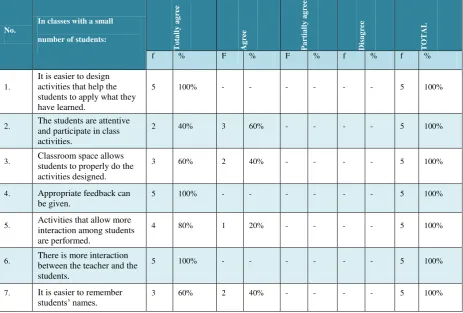
[image:27.595.81.545.417.730.2]What are the benefits of teaching and learning English in small classes?
Table 1
Teachers’ Perceptions
No.
In classes with a small number of students:
T ot al ly a gr ee A gr ee Pa rt ia lly a gr ee D isa gr ee T OTA L
f % F % F % f % f %
1.
It is easier to design activities that help the students to apply what they have learned.
5 100% - - - 5 100%
2. The students are attentive and participate in class
activities.
2 40% 3 60% - - - - 5 100%
3. Classroom space allows students to properly do the
activities designed.
3 60% 2 40% - - - - 5 100%
4. Appropriate feedback can
be given.
5 100% - - - 5 100%
5. Activities that allow more interaction among students
are performed.
4 80% 1 20% - - - - 5 100%
6. There is more interaction between the teacher and the
students.
5 100% - - - 5 100%
7. It is easier to remember
students’ names. 3 60% 2 40% - - - - 5 100%
Author: Lilia Sánchez Guillén
21
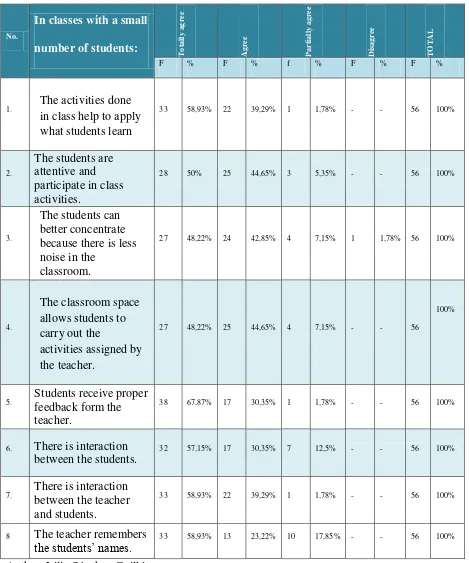
[image:28.595.79.548.164.727.2]What are the benefits of teaching and learning English in small classes?
Table 2
Students’ Perceptions
No.
In classes with a small
number of students: Total
ly a gr ee A gr ee Pa rt ia lly a gr ee D isa gr ee T OTA L
F % F % f % F % F %
1. The activities done
in class help to apply what students learn
33 58,93% 22 39,29% 1 1,78% - - 56 100%
2.
The students are attentive and participate in class activities.
28 50% 25 44,65% 3 5,35% - - 56 100%
3.
The students can better concentrate because there is less noise in the
classroom.
27 48,22% 24 42,85% 4 7,15% 1 1,78% 56 100%
4.
The classroom space allows students to carry out the
activities assigned by the teacher.
27 48,22% 25 44,65% 4 7,15% - - 56
100%
5. Students receive proper feedback form the
teacher.
38 67,87% 17 30,35% 1 1,78% - - 56 100%
6. There is interaction
between the students.
32 57,15% 17 30,35% 7 12,5% - - 56 100%
7. There is interaction
between the teacher and students.
33 58,93% 22 39,29% 1 1,78% - - 56 100%
8 The teacher remembers
the students’ names. 33 58,93% 13 23,22% 10 17,85% - - 56 100%
Author: Lilia Sánchez Guillén
22
One hundred percent of teachers, who were asked if designing activities that help students to apply what they learned in class is easier, answered that certainly they are. Likewise, 58.93% of students totally agree that in classes with few students it is easier to apply learning, 39.29% agree and 1.78 % partially agree.
According to the observation, as the number of students was small, teachers had more time to explain and develop the programed activities giving the students the same opportunity to practice and engage in the activities.
In this same point, Kendall & Khuon (2005) say that in class with few students, teachers can plan wonderful lessons, without caring how much time they spend planning or how creative the lessons are, since a small group offers better opportunities for students to learn enthusiastically.
With regard to whether students are attentive and participate in class activities, 40% of teachers said that students do pay attention in class, while 60% of teachers answered that not all students are attentive.
On the other hand, 50% of students answered that they are totally attentive in class, 44.65% said they are not totally attentive and 5.35% of students answered they are just partially attentive. However, in each class observation carried out, most of the students were very attentive while the teacher was explaining the topic, and every time the teacher asked them to put in practice the contents, students participated gladly to show their progress. In this sense, Bascia (2010) explains that students in small classes are more engaged in practical activities, and they appear to be learning comfortably. In addition, Heishman and Kochhar (2010, p.216) say that in small classes there are “less noise and fewer distractions”
which are associated to the concentration of the learners.
23
42.85% responded they do not totally concentrate, 7.15% said they partially concentrated, and 1.78% stated they do not concentrate at all.
From the observed classes, most students were absolutely concentrated on the class, and they kept in silence, but the noise from outside was not totally absent, and even in this
situation they paid attention to the class; or maybe they paid attention because they felt observed.
On this point, Ijaya (1999) in her research explained that a large class-size just offers noise, making difficult the student´s learning, and Bronzaft (2010) state that noise affects students in their learning, reading, problem solving, motivation, school performance and social and emotional development.
All these findings suggest that it is necessary to pay more attention to the effects that noise produces on the ability of students to learn and on the learning environment, mainly in school and at home. Noise causes negative effects on performance, predominantly in students; these changes are larger in students with poorer academic achievement.
Regarding whether classroom space allows both teachers and students to adequately develop classroom activities, 60% of teachers are in total agreement, but 40% of them, are not. On the other hand, 48.22% of students answered affirmatively to this motion, 44.65% of students do not agree completely, and 7.15% partially agree.
24
Likewise, Kendall & Khuon (2005) say that small- group instruction for English language learners offers better opportunities for students to learn enthusiastically; similarly, teachers can give extra information and easily manage students because they are few.
Regarding adequate feedback from teacher to students, 100% of the interviewed teachers answered they totally agree that providing good feedback to few students is possible. Likewise, 67.87% of students answered they totally receive adequate feedback; 30.35% of them just agree, and 1.78% partially agree.
During class observation, indeed teachers could give good feedback to their students, because in most of the cases they were just 3 or 5 students per class, which allowed teachers to use enough time to explain deeply all those parts that were difficult to understand. In this sense, Kendall & Khuon (2005) state that small class for English language learners provides good environment in which students are comfortable practicing and receiving feedback and teachers can offer additional teaching and modeling. Similarly, Rick Bilodeau (2013) thinks that students in a small class benefit from a more professional assessment, since teacher has more time to give feedback.
Concerning, whether in small class it is possible to practice activities that allow more interaction among students, 4 of the 5 interviewed teachers, that is 80% of them, answered that they can totally perform this kind of activities; and just 20% responded that not totally. Regarding students, 57.15 % of students, totally agreed; 30.35% did not agree totally, and
12.5% just partially agreed.
About this point, in all class observations, students interacted among them effectively, sharing oral dialogues, writing exercises, and question- answers about personal information; and every time they made mistakes they tried again until they improved learning.
25
concoct a plan they would never have dreamt of on their own, share their birthday, fantasy becomes more important, and their imaginative activities work in a different way.
Likewise, Brown (1994) explains that in classrooms with few students, different strategies can be developed among students through interactive techniques, such as making conversation, trying out language, making guesses, etc.
Whether there is more interaction between teacher and students, the answers of
teachers were 100% totally agree. However, students divided opinions; 58.93% totally agreed with this motion, 39.29% did not agree totally, and 1.78% of them just partially agreed. All the observed classes showed that teachers actually interacted with their students, in such a way that students ask all what they required knowing about each topic. Teachers also practiced short conversations with some students to encourage interactivity too.
On this topic, Blatchford (2003), & Brown (1994) when examining the effect of class size on classroom engagement and Teacher-pupil interaction, the smaller classes lead students to receive more individual attention from their teachers and having more positive interactions with them, so students are engaged in active interactions with their teachers, two to three times more often in a class of 15 compared to a class of 30.
Regarding whether in classrooms with few students remembering students’ names is easier, 60% of the teachers said they can remember students´ names, while 40% of them do not remember all the names. However, not all the students agreed with this motion, so 58.93% totally agreed, but 23.22% did not; and 17.85% just partially agreed.
26
Likewise Saraswathi (2004) supports this opinion declaring that for teachers it is difficult to know the names of all the learners in a large class and individual approaches necessary to the process of learning becomes very difficult.
What are the benefits of teaching and learning English in classrooms with few students? After the analysis of this survey, it is necessary to say that teachers are able to design appropriate activities because they have enough time to carry them out, and as students are few, most of them are usually attentive, and although not always the classroom space is the adequate, the teacher has more time to reinforce learning providing enough feedback, the interaction among them becomes more fluid and the teacher can easily remember students’
names making teaching-learning more successful.
What teaching strategies and resources benefit the teaching of English in small classes?
[image:33.595.82.533.401.731.2]Table 3
Teachers’ Perceptions
No.
In classes with a small
number of students, it is
easier to: To
ta lly a gr ee Ag re e Pa rtia lly ag re e Disa gr ee TO TAL
f % F % F % f % f %
8.
Design and apply activities that allow student to practice
listening skills. 5, 100% - - - 5 100%
9.
Design and apply activities that allow students to practice
speaking skills. 4 80% 1 20% - - - - 5 100%
10. Design and apply activities that allow students to practice
reading skills.
4 80% 1 20% - - - - 5 100%
11 Design and apply activities that allow students to practice
writing skills.
4 80% 1 20% - - - - 5 100%
12 Design and apply group work activities. 3 60% 2 40% - - - - 5 100%
13 Design and apply individual activities. 4 80% 1 20% - - - - 5 100%
14 Use technological tools 3 60% 2 40% - - - - 5 100%
15 Use didactic materials. 4 80% 1 20% - - - - 5 100%
Author: Lilia Sánchez Guillén
27
What teaching strategies and resources benefit the teaching of English in small classes?
Table 4
Students’ Perceptions
No.
In classes with a small number of
students, Tot
all y agr ee Agr ee Par tially agr ee Disagr ee T OT AL
f % F % f % f % f %
9. The activities done allow students to practice listening skills.
25 44,65% 28 50% 3 5,35% - - 56 100%
10 The activities done allow students to practice speaking skills.
30 53,56% 22 39,29% 4 7,15% - - 56 100%
11 The activities done allow students to practice reading skills.
27 48,22% 24 42,85% 5 8,93% - - 56 100%
12 The activities done allow students to practice writing skills.
26 46,425% 26 46,425% 4 7,15% - - 56 100%
13 Group work activities are used.
25 44,65% 19 33,93% 11 19,64% 1 1,78% 56 100%
14
Individual activities are used.
31 55,35% 20 35,72% 4 7,15% 1 1,78% 56 100%
15 Technological tools are used. 16 28,57% 16 28,57% 18 32,15% 6 10,71% 56 100%
16
Didactic materials are used.
22 39,29% 15 26,78% 18 32,15% 1 1,78% 56 100% Author: Lilia Sánchez Guillén
28
About designing and applying activities that allow students to practice the ability of listening, 100% of teachers agreed with this statement. However, just 44.65% of students stated that their teacher applies this kind of activities in the classroom, 50% of them said that they do not always develop listening activities, and 5.35% indicated that they do not practice this activity.
During observations, teachers applied listening activities, helped by a CD player and it was very easy for teachers and students to practice this activity. Furthermore this listening activity was also accompanied by other practical skills.
On this point, Rivers & Wilga (1987) stay that in small classes students are able to practice listening which is very important to increase their learning; besides, students have the opportunity to communicate with others and understand what others say.
Regarding designing and applying activities that allow practice the abilities of speaking, 80% of teachers totally agreed with this option, and 20% just partially agreed. Concerning students, 53.56% expressed they always practice the ability of speaking, 39.29% said they usually practice it, and 7.15%, stated they just sometimes practice this ability. When observing the classes, most students practiced this skill, but a few of them had difficulty in practicing it.
About this topic, Rivers & Wilga (1987) state that classrooms with few students stimulate them to use their imagination, challenge them to think and to speak, students are better prepared to talk about any topic, acquire some vocabulary, and production activities grow naturally in speech.
29
On this theme, Konstantopoulos & Chun (2009) say that in certain grade reading is a substantial benefit of being in classes with a small number of students; thus, class size
reduction appears to be an intervention that increases the achievement levels on all students. And around the same topic, Magnuson, Ruhm & Waldfogel (2007), state that students placed in classrooms with few students, get high levels of reading instruction.
About designing and applying activities to practice the abilities of writing, 80% of teachers agree with this option, while 20% of them do not agree at all. Similarly 46.425% of students agree with this option, 46,425% do not agree totally, and 7, 15% of them just partially agree.
During class observation, some teachers practiced activities to develop the ability of writing, sometimes the teacher after a short explanation on a particular topic asked students to write about that, or complete tasks in the book basing on the information the book provided, and every time students had any doubt they asked the teacher to help them, and in this way teacher helped everyone to complete the task in a good way.
Rivers & Wilga (1987) state that in classes with few students, they are able to write about any topic, work with texts, learn vocabulary, classify some important issues
surrounding the topic, and get a good basis for production in writing.
About designing and applying activities in group, 60% of surveyed teachers said that effectively in classes with small number of students they can work in groups, and 40% said that not always working in this way is possible. On the other hand, while 44.65% of students express they develop group activities, 33.93% said they do not always practice in group, 19.64% said they just sometimes practice in group, and 1.78% said they have never had group activities.
30
to practice conversation and it was considered as group work. Wang & Finn (2000) declare that small classes can create adequate conditions for teachers to teach and students to learn. To support this topic, Caspari, Kuhlthau and Maniotes (2007) state that classrooms with few students allow learners to work in groups; in this way, students share knowledge among them, they reinforce their learning, and help each other.
With respect to individual activities used in classes with few students, 80% of teachers said that in small class, individual activities are used a lot, and just 20% did not totally agree. However students had varied opinions about this question. So, 55.35% totally agreed, 35.72% just agreed, 7.15% partially agreed and 1.78% did not agree at all.
During class observations, all teachers practiced individual activities, and could develop the class in an easy way. King (2008) thinks that small classes allow teachers to spend more time working with students individually to be aware of their own progress and development of their skills. Likewise, Blatchford (2008) states that small classes benefit all pupils in terms of individual and active attention from teachers.
Regarding the use of technological resources, 60% of teachers consider it is really easier to teach using technology, and 40% of them did not agree totally. On the other hand, 28.5 % of students answered that definitely they use technological resources in class; 28.57% just agreed, 32.15% partially agree, and 10.71% did not agree with this option.
When observing classes it was found that not all of them had technological resources available, only those that were observed in institutes used CD players and projectors. About this topic, Scott (1999) affirms that technology is not only changing how small groups interact, but is also redefining our notion of a small group. Technologies create new environments to produce more open, fluid, and dynamic small group environments.
31
students admitted that they learn English using these materials, 26.78% said that they do not always use them, 32.15% said that just sometimes they use didactic materials, and 1.78% of students said they never use them. On this point, Ghosn (2013) says that a teacher can use didactic materials, taking into consideration the number of students there are in a classroom.
What teaching strategies and resources benefit the teaching of English in small classes? Definitely, in English classes with few students, it is easier and, therefore, more productive to design and apply activities that allow developing skills of listening, speaking, reading and writing, and it suggests that as these classes have few students, learning outcomes are higher level, since small classes give students and teachers more opportunity to practice individual activities and strategies which sometimes may occur in group. On the other hand, teachers have even more time to prepare didactic materials that can support them in the teaching – learning process.
How do students feel about learning English in small classes?
[image:38.595.81.539.466.744.2]Table 5
Teachers’ Perceptions
No. In classes with a small number of students,
T otally ag ree Ag ree Par tially ag ree Dis ag ree T OT AL
F % F % f % f % f %
16. They are relaxed when speaking in front of their
classmates. 1 20% 4 80% - - - - 5 100%
17
They are taken into account by the teacher because they have
More opportunities to participate in class.
4 80% 1 20% - - - - 5 100%
18
They are motivated to participate because of the small number
students.
2 40% 3 60% - - - - 5 100%
19
They are at ease because they can healthy compete with their
classmates.
4 80% 1 20% - - - - 5 100%
Author: Lilia Sánchez Guillén
32
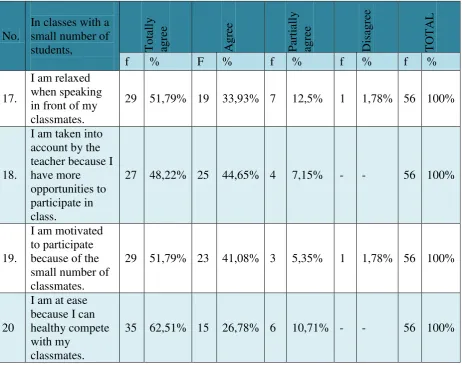
[image:39.595.83.546.167.532.2]How do students feel about learning English in small classes?
Table 6
Students’ Perceptions
No.
In classes with a small number of
students, Tota
ll y agr ee Agr ee P artially agr ee Disag re e TOT AL
f % F % f % f % f %
17.
I am relaxed when speaking in front of my classmates.
29 51,79% 19 33,93% 7 12,5% 1 1,78% 56 100%
18.
I am taken into account by the teacher because I have more opportunities to participate in class.
27 48,22% 25 44,65% 4 7,15% - - 56 100%
19.
I am motivated to participate because of the small number of classmates.
29 51,79% 23 41,08% 3 5,35% 1 1,78% 56 100%
20
I am at ease because I can healthy compete with my
classmates.
35 62,51% 15 26,78% 6 10,71% - - 56 100%
Author: Lilia Sánchez Guillén
Source: Student’s Questionnaire
33
When observing classes, all students were relaxed, and nobody seemed to be afraid about anything. In some classrooms, students practiced conversations in front of the class, and at any time they seemed nervous.
About this theme, Kendall (2005) states that small-groups offer a safe environment for students to comfortably learn to write, speak, and read in English. Students in small groups are frequently more relaxed asking questions and interacting with fellow students.
With regard to whether students feel taken into account because they have bigger opportunity to participate in the class, 80% of teachers said that students feel taken into
account, while 20% indicated that not all the students feel in the same way. On the other hand, 48.22% of students said that they feel totally taken into account, 44.65% said they not always feel taken into account, and 7.15% said they hardly ever feel taken into account.
During the observation of classes, most students were taken into account by the teacher. Regarding this theme, Malloy (2010) determines that the greatest objective for schools is class size reduction, and that it is one of the key aspects that contribute to changes
in teaching practices at their schools, since teachers can pay more attention to the “neediest,
at-risk” students. Also Blatchford (2008) says that smaller classes benefit all pupils
individually, with active attention from teachers.
About whether in small classes students feel motivated to participate in class 40% of teachers said that their students are completely motivated, while 60% said that not all the students feel motivated to participate.
34
However, during class observations, students were highly participative and totally engaged in the activities that the teacher practiced in the class. Johnson (1981) expresses that small class learning activities are effective for student learning and motivation, both
individually and for small groups. Likewise, Lee & smith (1995) state that smaller class sizes are related to greater achievement in learners.
Whether students are pleased because they can compete healthily with other students, 80% of teachers said that their students are satisfied in the class because they have the opportunity to compete with their classmates, but 20% of teachers did not agree.
On the other hand, 62.51% of students said that they are pleased competing healthily with their classmates, 26.78% said they do not feel totally pleased, and 10.71% said they are rarely pleased competing with their classmates.
Concerning the observation of classes, all students competed healthily and pleased among them, and every time that the teacher asked them to do any activity, all of them gladly participated and competed healthily to gain points, sometimes individually and sometimes the points were for the entire group.
About this topic, Johnson & Ahlgren (1976) say that small group promotes cooperation that is more beneficial socially, motivationally, and academically than
competitive ones. And on the same subject, Babcock & Betts (2009) state that small classes allow teachers to encourage disengaged students more efficiently, because students are better able to connect to the school setting.
35
[image:42.595.84.544.127.363.2]Are there any limitations when teaching English in small classes?
Table 7 Teacher´s perception Talking about whether
In classes with a small number of
students: Tot
all y agr ee Agr ee Par tially agr ee Disagr ee T OT AL
F % F % F % F % f %
20.
There is anxiety among students because there is more control form on the part of the teacher.
2 40% 1 20% 1 20% 1 20% 5 100%
21.
Listening and speaking skills are more difficult to develop.
- - 2 40% - - 3 60% 5 100%
Author: Lilia Sánchez Guillén Source: English teachers in Ecuador.
Are there any limitations when teaching English in small classes?
Table 8
Students’ Perceptions
No.
In classes with a small
number of
students: T
ot all y agr ee Agr ee Par tially agr ee Disagr ee T OT AL
F % F % F % f % f %
21.
There is anxiety among students because there is more control on the part of the teacher.
10 17,85% 22 39,29% 16 28,57% 8 14,29% 56 100%
22. Listening and speaking skills are more difficult to develop.
8 14,29% 18 32,15% 20 35,72% 10 17,85% 56 100%
[image:42.595.79.547.450.704.2]36
About whether there is anxiety among the students due to there is bigger control on the part of the teacher, 40% totally agreed with this option, 20% just agreed, 20% partially
agreed, and 20% did not agree at all. On the other hand 17.85% of students totally agreed with this alternative, 39.29% just agreed, 28.57% partially agreed, and 14.29% did not agree at all. Regarding class observation, students were not anxious; on the contrary they were very relaxed sharing different topics with their classmates.
With respect to this theme, Harfitt (2012) declares that small classes permit to have a good environment where students feel confident and secure to speak. That means that in reduce-size class students do not feel anxiety when participating in any learning activity.
About difficulties in practicing the skill of listening and speaking, 40% of teachers said that it is a little difficult, but 60% of them said it is not difficult at all. About this topic, 14.29% of students said that practicing listening and speaking is difficult, 32.15% said it is just a little difficult, 35.72% said it is not so difficult, and 17.85% said it is not difficult at all. Concerning to class observations, only in one of the institutes, students practiced listening and speaking skills, in the other classrooms, students just practiced “listening” to complete blanks in different texts. Byrne (1976) says the teacher ought to organize events to generate the adequate atmosphere within the class or group to give the students the
opportunity to use clues to integrate reading and writing with listening and speaking skills. Are there any limitations when teaching English in small classes? About this questioning, it is necessary to consider that maybe one of the limitations of the English teaching in small classes is the fact that due to they are few, it is difficult in some way, the developing of the English speaking skill, because they do not have many classmates to practice, making it perhaps a bit boring for them; on the other hand, some students get a little nervous because they know that inevitably they will be asked to perform any activity;
37
Conclusions
Small number of learners in a classroom permits teachers to have sufficient time for each of them; thus, teachers offer adequate feedback according to the needs of the students.
In classes with few students, teacher and students interact satisfactorily and it permits students to be absorbed in the lesson and increase their learning; furthermore, the teacher remember students’ name which generates a good relationship among them.
In small classes, teachers design and apply activities of listening, speaking, reading, and writing, which are vital to progress in the learning; they can also apply group work and individual activities according to their level of knowledge reinforcing their learning with the use of technological tools and didactic materials.
Small classes allow students to pay attention to the teacher's explanations since there is not much noise in the classroom; consequently, they can learn undisturbed.
38
Recommendations
In classes with small number of students, it is imperative that institutions provide teachers the necessary technological tools to teach English because that allows students engage more attentively in lesson; besides, students are at ease when they use them.
In small classes, teachers should apply group activities so that students work collaboratively among them and progress in the learning of the language skills, besides, in group they can speak and share their personal interests and knowledge.
In small classes, teachers should create an environment in which students feel
comfortable when learning each lesson and in this way they learn more quickly practicing the listening, speaking, reading and writing skills.
39
REFERENCES
Babcock, P., & Betts, J. R. (2009). Reduced Class Distinctions: Effort, Ability, and The Education Production Function. Journal of Urban Economics, Vol. 65, pp. 314–322. Bascia, N. (2010). Reducing class size: What do we know? Toronto: Canadian Education
Association, 1-19.
Bejarano, Y. (1987). A cooperative small- group methodology in the language classroom TESOL Quarterly, 21, 483- 504
Byrne, D. (1976). Teaching Oral English. Longman House
Blatchford, P. (2003). The class size debate: Is small better? Philadelphia: Open University Press
Bosch, k. (2006). Planning classroom management: A five-step process to creating a positive learning Environment.(2nd Ed.). California: Corwin Press.
Bronzaft, A. L. (2010). Noise: the invisible pollutant that cannot be ignored. Emerging environmental technologies. New York, NY: Springer.
Brown, D. H. (1994). Teaching by principles: An interactive approach to language pedagogy. San Francisco, Ca: Longman Publishing Group.
Caspari, A. K., Kuhlthau, C. C., & Maniotes, L. K. (2007). Guided inquiry: Learning in the 21st Century School. Westport, CT: Libraries Unlimited.
Dean, C., Hubell, E., &Pitler, H. (2012).Classroom instruction that works: research-based strategies for Increasing student achievement.(2nd. Ed.). USA: ASCD Publications. Din, F., S. (1999). The functions of class size perceived by Chinese rural schools teachers. National Forum of applied educational research Journal 12(3), 1-6
40
Felix, E.E. (2011). Modern approach to classroom discipline and management: Prevention and intervention strategies for students with behavioral problems. United States of
America: Library Congress.
Fisher, D., & Frey, N. (2011 ). The purposeful classroom: how to structure lessons with learning goals in mind. USA: ASCD Publications.
Ghosn, I. (2013). Language learning for young learners. In Tomlinson, B. (Ed.) Applied linguistics and materials development. (pp. 61-76). London: Bloomsbury.
Goldstein, E., Miehls, D. & Ringel, S. (2009). Advanced clinical social work practice: Relational Principles and Techniques. New York: Columbia University Press.
Harfitt, G. (2012). Class size and language learning in Hong Kong: the students´ perspective. Educational Research, 54(3), 331-342.
Harmer, J. (2003). How to teach English (10th ed.). Harlow, Essex: Pearson Longman. Hartman, H. (2001). Metacognition in learning and instruction: Theory, research and
practice. USA: Kluwer Academic Publishers.
Heishman, A., & Kochhar-Bryant, C. (2010). Effective collaboration for educating the whole child. California: Corwin Press.
Ijaiya, Y. (1999). Effects of overcrowded classrooms on teacher-student interactions. Ilorin
Journal of Education, 19(1-11).
Johnson, D. W, & Ahlgren, A. (1976). Relationship between student attitudes about
cooperation and competition and attitudes toward schooling. Journal of Educational
Psychology, 92-102.