
The OFFTATLED project: offensive and taboo exchanges subtitled by online university students
16
0
0
Texto completo
(2) 1. INTRODUCTION The use of swearwords is a fascinating topic. It has even been suggested that swearing may be a beneficial contributing factor in reducing stress and pain (Crystal, 2004). Although generally society condemns offensive and taboo terms, their inclusion in communication is undoubtedly one of the most efficient ways to deal with extra frustration or anger in difficult situations, or when the speaker is suffering from emotional distress, thereby the use of these terms can become a relief vehicle. Swearing can be said to be a universal phenomenon (Pinker, 2007), nevertheless, its use and abuse is not homogeneous across cultures. McEnery (2009) explains that offensive and taboo language has gained its power through a process of stigmatisation and the development of attitudes that lead to a specific society making inferences about the users of such language. Moreover, Andersson and Trudgill (1992) also add that although sometimes people swear because they want to be offensive, the reception and implications of the terms used vary according to contexts, cultures and ideologies. Thus, as every culture has its own position when it comes to what is considered offensive and taboo language, these terms become some of the most arduous tasks in the rendition of audiovisual (AV) materials from the source language (SL) into the target language (TL). They represent a real challenge for translators, professional or otherwise, as mediators between diverse ways of thinking. This study was established in order to analyse the translation techniques applied by a group of university students employed in rendering the offensive and taboo load from English to Spanish and vice-versa when given the task of subtitling clips from 6 films, namely Pulp Fiction (Quentin Tarantino, 1994), The Departed (Martin Scorsese, 2006), Django Unchained (Quentin Tarantino, 2012), Airbag (Juanma Bajo Ulloa, 1997), La comunidad (Álex de la Iglesia, 2000) and Torrente, el brazo tonto de la ley (Santiago Segura, 1998). The students were unaware of the intentions behind the research and were, therefore, free to create their own versions of the subtitles with the only objective of transferring spoken messages between languages rather than focussing on any specific terms. As students of English-Spanish Translation, they only had some extra indications about the general technical constraints of subtitling as one of the modes of Audiovisual Translation (AVT), mainly temporal and spatial, which narrow the possible translation choices, apart from the translation knowledge they had already gathered in the subject in which they were enrolled. In addition, the improvement of linguistic and translation skills was expected and intended by this extra activity, although it was only observed through their responses in the form of qualitative data. 2. THEORETICAL FRAMEWORK 2.1 Culture and Taboo Language is intrinsically linked to culture as it constitutes a “socially acquired knowledge” (Yule, 2009, p. 216). Moreover, as House (2009) explains, culture represents a continuum of conventions and values which are shared through every speech community, while, at the same time, this collective programming of the mind differentiates groups of people (Hofstede, 2001). Therefore, taboos, which can be considered as inseparable parts of every language, and hence its culture (Hashemian, Mirzaei & 205 THE OFFTATLED PROJECT: OFFensive and TAboo Exchanges SubtiTLED BY ONLINE UNIVERISTY STUDENTS Ávila-Cabrera, J. J. & Rodríguez Arancón, P. Encuentro 27, 2018, ISSN 1989-0796, pp. 204-219.
(3) Hosseini, 2014, p. 23), are not perceived in the same way by different groups of people, although, as stated earlier, offensive and taboo language exists in all of them to some degree or another (Pinker, 2007). As Ljung (2011) highlights, from a sociolinguistic perspective, the use of utterances that contain taboo words is seen as a type of linguistic behaviour that society regards as disrespectful, vulgar, and even offensive. Nevertheless, the degree of offensiveness that the terms carry is not always related to the perceived strength of the particular taboo term, which cannot be replaced with its literal synonyms, and this load can even change over time. An example of this is the fact that some taboo words can be used simply to add emphasis to the message the speaker wishes to convey and the same set of words can carry different meanings on different occasions (Ljung, 2009). Some words can have a widespread cultural acceptance in everyday language while in other parts of the same country are perceived as an insult. Swearing is formulaic as the meaning of the entire sequence cannot be understood from the words it contains or from its grammatical configuration (Ljung, 2011). Thus, the use of offensive and taboo language is a linguistic phenomenon worthy of investigation, particularly in AVT, as there are decisions that must be made in order to render meanings between two different languages and cultures. This process is not a mere act of translating words from SL to TL or searching for a synonym, but it also involves achieving a transfer of the offensive load present in the specific use of the term(s) in a particular context at a particular time. 2.2. Offensive and taboo words. As previously explained, offensive and taboo exchanges present AV translators with the task of making controversial decisions when they have to deal with certain expressions. This can be an even more delicate matter when the referents vilify religious figures such as ‘Jesus Christ’ or ‘Allah’ among the Christian and Muslim communities, for example. Are faithful renderings legitimate in every instance? This is a challenge where the answer does not always depend on the individual AV translators but on their clients or even the film studios for whom they work, who provide the professional with a series of instructions on how to deal with certain controversial words and swearwords. In order to make a linguistic distinction and in an attempt to avoid disparity in the terminology, in this paper while offensive words refer to swearwords, insults and expletives, taboo words can be defined as those which, depending on the medium, speakers’ culture and age, may be more or less (un)welcome, although different scholars resort to a variety of terms to define what can be considered dirty language (Jay, 1980), strong language (Scandura, 2004), taboo language (Allan & Burridge, 2006), or offensive language (Díaz Cintas, 2012). Some terms can be categorised as offensive, as in the case of the derogatory adjective ‘fucking’, while the verb ‘fuck’ could be used as a sexual term and, therefore, as a taboo word. All in all, for the purposes of this paper, we will resort to ‘offensive and taboo terms’.. 206 THE OFFTATLED PROJECT: OFFensive and TAboo Exchanges SubtiTLED BY ONLINE UNIVERISTY STUDENTS Ávila-Cabrera, J. J. & Rodríguez Arancón, P. Encuentro 27, 2018, ISSN 1989-0796, pp. 204-219.
(4) 2.3. Offensive and taboo language in AVT The field of offensive and taboo language has not been as widely researched as other areas of AVT, however some of the studies conducted are worthy of mention. Díaz Cintas (2001) delves into sexual expressions subtitled from Spanish to English in the film La flor de mi secreto [The Flower of my Secret] (Pedro Almodóvar, 1995), where a number of interesting findings are brought to the fore regarding the differences between the VHS version and the one broadcast by Channel 4 on British television. Acclaimed American director Quentin Tarantino’s films have been the object of study by diverse scholars conducting research on both dubbing (Fernández Dobao, 2006; Soler Pardo, 2015) and subtitling from English into Spanish (Martínez-Sierra, 2015; Ávila-Cabrera, 2015a, 2015b, 2016a, 2016b). In all that research the focus has been on the different approaches to describing the way in which taboo words, insults, swearwords and the like have been dubbed or subtitled. Moving on to this specific study, an interesting question may arise when it comes to dealing with this type of language within a university context: what happens when the decisions on how to deal with offensive and taboo words in AVT are taken by students? This research avenue opens out to innovative and pioneering studies in this field. Valdeón (2015) presents the results of a piece of research in which university students have to dub some episodes of a series from English to Spanish and whose results are compared with the way professional AV translators coped with such taboo elements. The present paper also deals with university students from the UNED (Universidad Nacional de Educación a Distancia, the Spanish Open University) who have to produce interlingual subtitles of film scenes (from English to Spanish and Spanish to English) in which there are offensive and taboo terms. Accordingly, attention is paid to the way in which they transferred those linguistic elements, that is, whether in a faithful manner to the source text (ST), or manipulating the script so as to tone down the load that these terms may have. Another study worth of mention is that by Ávila-Cabrera (in press) in which there is an analysis based on a corpus composed of a number of Tarantino’s films subtitled into European Spanish in which religious referents in the form of profanity and blasphemy are explored. It is significant to observe how direct blasphemies are avoided in the subtitles in favour of using some other offensive formulas, which in many occasions are not religion-related. We sustain that the elimination of offensive and taboo terms in the target text (TT) entails the loss of the speakers’ characterisation and that, consequently, the original function of that text can be affected by the use of formulas which tend to soften or eliminate the strength of this type of words. 3. THE EXPERIMENT This study was conducted during the 2015-2016 academic year, starting on 16th March and finishing on 3rd May 2016. The participants were from the third year of the Degree in English Studies from the UNED and the course that they were taking was English-Spanish Translation during which they had been taught various translation skills and strategies. Thus, they could be said to be familiar with those 207 THE OFFTATLED PROJECT: OFFensive and TAboo Exchanges SubtiTLED BY ONLINE UNIVERISTY STUDENTS Ávila-Cabrera, J. J. & Rodríguez Arancón, P. Encuentro 27, 2018, ISSN 1989-0796, pp. 204-219.
(5) strategies that were going to be necessary to complete the tasks in the project. This subject has some 400 students enrolled on average, out of which 41 participated. The initial qualitative data was gathered via a pre-questionnaire. At the beginning of the project, the participants were asked to fill in a form and a pre-questionnaire so that the researchers could learn about their profile. In the first place, 41 participants signed up to join the project (78% females and 22% males). Their age ranged mainly between 22 and 56, with most of the participants aged 31-46 years old. 92% of the participants were Spanish and 3 students were from the UK, the US and Romania respectively. The majority of these students were native Spanish speakers with some exceptions: one was a native speaker of Romanian, two of English and two of Catalan. Amongst their qualifications, 34.1% were graduates and 12.2% post-graduates, with a larger percentage of participants being undergraduates (53.7%). As for their linguistic competence in English most of them positioned themselves at intermediate, upper-intermediate and advanced levels. What is more, 48.8% said to have lived abroad in an English speaking country for some time. The researchers offered the possibility of taking part in this activity entitled “Interlingual Subtitling Project”; this title aimed to hide the specific focus of research, so as not to influence the decisions that the students would have to make when dealing with the transfer of offensive and taboo terms from English to Spanish and vice-versa. However, the research project was actually called OffTaTled, which stands for OFFensive and TAboo Exchanges SubtiTLED by Online University Students. The final goal revolved around three main research questions: -. -. Are the offensive and taboo exchanges subtitled faithfully? The answer to this question will allow us to know if the students’ renderings are faithful to the ST as far as offensive and taboo terms are concerned. Are the L2 subtitles (eng) more daring? An affirmative answer to this question could entail that participants use offensive and taboo terms in a foreign language more freely. Have the participants’ linguistic skills been boosted after participating in this project? The answers provided by the participants in the post-questionnaire will be used to address this last question.. Those three questions were addressed by making use of a multi-strategy design (Robson & McCartan, 2015) in which quantitative data appears in the form of the results obtained from the analysis of the subtitled videos; and qualitative data is obtained from the information provided by the participants in pre- and post-questionnaires. The research obsjectives were: -. To observe whether the load of offensive/taboo terms in the ST was present in the TT or, by contrast, whether some sort of ideological manipulation (Díaz Cintas, 2012; Díaz Cintas, Parini & Ranzato, 2016) or self-censorship took place. To verify if the language involved in the TT, either the participants’ native or foreign language, can be said to be a conditioning element when this type of language is transferred in subtitling.. 208 THE OFFTATLED PROJECT: OFFensive and TAboo Exchanges SubtiTLED BY ONLINE UNIVERISTY STUDENTS Ávila-Cabrera, J. J. & Rodríguez Arancón, P. Encuentro 27, 2018, ISSN 1989-0796, pp. 204-219.
(6) 3.1. Procedures and resources The project was organised on the basis of a number of tasks, which were designed so that the students followed the activities within an online setting. The tasks that the students had to complete allowed the researchers to obtain qualitatitive data in the form of pre- and post-questionnaires for the study as well as quantatitive data, considering the analyses of the subtitling activities. With the aim of rewarding the students’ participation, 1 extra mark was given to those who finished all tasks presented to them to be added to their final mark in the Translation subject. The time line of all the steps followed is shown below.. Tasks 1. 16th – 22nd March: Sign-up form & pre-questionnaire 2. 23rd March – 26th April: Subtitle six video clips (half from English to Spanish & the other half from Spanish to English) 2.1. Instructions: information on how to subtitle linguistically 2.2. Instructions: very basic conventions on subtitling 3. 27th April – 3rd May: post-questionnaire 4. Assessment by researchers Table 1. General structure of the experiment.. As can be seen in Table 1, and previously explained, (1) the students signed up and filled in a pre-questionnaire in which they provided general information on their skills and profiles. (2) With the aim of guiding the students in the process of subtitling the videos, a series of very general instructions were given. Following Díaz Cintas & Remael (2007), the students were informed about some conventions such as the necessary length of exposure of subtitles on the screen and basic rules of segmentation and linguistic units in order to help them understand some basic standards followed in this AVT mode. (3) Once the students completed the subtitling tasks, they filled out the postquestionnaire which dealt with questions on the project as well as their perception on their improvement in diverse skills. (4) Finally, the researchers assessed the subtitling activities. The corpus with which the students worked was composed of a total of three-minute-videos, half originally in English and half originally in Spanish; the former were: Pulp Fiction (Quentin Tarantino, 1994), The Departed (Martin Scorsese, 2006) and Django Unchained (Quentin Tarantino, 2012). The videos in Spanish were Airbag (Juanma Bajo Ulloa, 1997), La comunidad (Álex de la Iglesia, 2000) and Torrente, el brazo tonto de la ley (Santiago Segura, 1998). In both languages, the type of words/expressions used guaranteed we could delve into the manner of subtitling offensive and taboo terms to Spanish and English.. 209 THE OFFTATLED PROJECT: OFFensive and TAboo Exchanges SubtiTLED BY ONLINE UNIVERISTY STUDENTS Ávila-Cabrera, J. J. & Rodríguez Arancón, P. Encuentro 27, 2018, ISSN 1989-0796, pp. 204-219.
(7) Regarding the software the students had the choice between Subtitle Workshop, DivXL and Media Subtitler, Aegisub and ClipFlair, and Virtual Dub for merging the subtitles. The reason behing offering the students these particular software programmes is that they are freeware and user-friendly. 3.2. Methodology The analysis of the subtitles has been based on the treatment of offenisve and taboo exchanges into Spanish and English. In order to do so, we have followed the techniques proposed by Hurtado Albir (2001) which relate with the result of the translation, that is, the aim was to determine whether the offensive/taboo load of the original is transferred to the TT or not. However translation strategies (Vinay & Darbelnet, 2000) which concern the translation process have not been considered for the purposes of this paper given that one of the final goals is to observe the degree of faithfulness that offensive and taboo elements have in the TT. There are a potential number of elements to consider here when talking about offensive and taboo load transfer, since the aforementioned force of such elements in the TT can be toned down (if it shows that an effort has been made to transfer some of the load from the original), maintained (if some form of compensation is used) and toned up (if the TT becomes even more abusive). On the other hand, we can also encounter non-transfer cases in which the subtitle shows the offensive and taboo load being neutralised (it gets nullified with the words used), or omitted (the offensive/taboo term is simply discarded), (Ávila-Cabrera, 2014). Table 2 summarises these concepts:. Technique. Toned down. Maintained. Toned up. Transfer. x. x. x. Non-transfer. Neutralised. Omitted. x. x. Table 2. Observation on the offensive/taboo load in the TT.. As shown in the above table, we can pinpoint that the transfer of offensive and taboo terms materialises in cases in which the terms are toned down (as the subtitler makes an effort to transfer the load somehow), maintained or toned up. By contrast, when the load of the terms under study is neutralised or omitted, we can state that the the transfer has not taken place. All in all, the analysis of the offensive and taboo exchanges allowed the authors to address the research questions by making use of triangulation (Robson & McCartan, 2015) of quantitative and qualitative data in the form of the subtitles analysed and the questionnaires answered by all participants; considering that this mixed method relates both types of data in order to observe the phenomenon under analysis in more detail and shed some light on it. A Descriptive Translation Studies (DTS) approach has been followed (Toury, 2012) in an attempt to describe the resulting subtitling, rather than to “prescribe” the appropriate potential exchanges which could have been materialised. Regarding the qualitative data, the pre-questionnaire deals with information on the participants about the linguistic skills in English and Spanish, their habits when consuming audiovisual products, 210 THE OFFTATLED PROJECT: OFFensive and TAboo Exchanges SubtiTLED BY ONLINE UNIVERISTY STUDENTS Ávila-Cabrera, J. J. & Rodríguez Arancón, P. Encuentro 27, 2018, ISSN 1989-0796, pp. 204-219.
(8) etc. In the post-questionnaire the data obtained reflected the personal impressions of the participants regarding this pilot study and how it had affected their English skills. In this sense, the results obtained after the analysis of the subtitles are to be corrobarated or refuted by the answers provided by the participants in the post-questionnaire on how they aimed to subtitle the offenisve and taboo terms encountered. In addition, questions on the improvement of linguistic skills are also to be considered. 4. ANALYSIS AND DISCUSSION This section deals with the analysis of all the data gathered, that is, the analysis of subtitles, the quantitative and qualitative data, as well as the discussion on the experiment. 4.1. Analysis of the subtitles Some of the most representative samples subtitled by the students have been presented in tables in which elements such as the language direction involved, the ST and the TT with the back translation next to the Spanish exchanges, and the offensive or taboo category analysed (in bold type), with the corresponding technique employed, are included. It is of note to observe that in order to analyse the subtitles, we must consider whether the load present in the original dialogue is transferred or not; to this end special attention is paid to that load which may have been toned up, maintained or toned down. By contrast, the aforementioned load can also disappear since it can be neutralised or omitted, being then categorised as a non-transfer technique, as explained in the methodolgy section. All this analysis allows us to shed some light on the role these words play in the TT when being transferred by university students. Some of these instances, subtitled by the students, are fully analysed in the following tables. On the left side, the ST whose offensive/taboo words are in bold type is illustrated. It is on the right side where we can observe the subtitles produced by the students, whose offensive/taboo terms also appear in bold type. At the bottom of the table, the type of offensive/taboo term analysed is presented as well as the technique used. Example 1. Video 01 eng-spa. Pulp Fiction TT: Oh, mierda… [Oh, shit…]. ST: Oh, Jesus fucking Christ! Taboo (blasphemous) > transfer (toned down). Table 3. Example 1, from Pulp Fiction.. The phrase ‘Jesus fucking Christ’ included in example 1 above can sound very aggressive to Christians and, if used in professional subtitling some viewers might feel offended. The student seems not to have dared to subtitle it in a closer way to the original by opting for the use of mierda [shit] as a form of compensation. This term shows a scatology-related taboo term which plays its role in the TT and the subtitle can therefore be considered to be a case of ideological manipulation, a strategy that can also be observed with professional subtitles which deal with religious referents and tend to tone down the load of the original. 211 THE OFFTATLED PROJECT: OFFensive and TAboo Exchanges SubtiTLED BY ONLINE UNIVERISTY STUDENTS Ávila-Cabrera, J. J. & Rodríguez Arancón, P. Encuentro 27, 2018, ISSN 1989-0796, pp. 204-219.
(9) Example 2. Video 03 eng-spa. Django Unchained ST: Just who the hell is this nigger. TT: Simplemente, ¿quién cojones es este. you feel the need to entertain?. negro que parece necesitar entretener? [Just who the fuck is this black that you seem to need to entertain?]. Offensive (derogatory) > transfer (toned up) Taboo (racial) > non-transfer (neutralised) Table 4. Example 2, from Django Unchained.. The derogatory formula recurrently used after wh-words, the hell, has been toned up in the TT as quién cojones [who the fuck]. Therefore we can perceive a strong effect in this part of the subtitle. However, when dealing with the highly offensive term ‘nigger’, the student was not faithful to the original as the result was negro [black], neutralising the power that this term can have in the dialogue. Even though it had been uttered by Stephen, a black servant in a plantation farm in 19th century Texas, the audience knows the term is used to offend as this character can be considered to be very fond of white people. Example 3. Video 01 spa-eng. Airbag ST: Mirad listillos o sacáis los papeles. TT: Look, you smartasses, give me right. del puto coche ahora mismo […]. now the fucking car documents…. [Look, smart asses or you take the documents from the fucking car right now […] Offensive (insult) > transfer (maintained) Offensive (derogatory) > transfer (maintained) Table 5. Example 3, from Airbag.. There is a mild insult in the form of listillos [smart aleck] which gets subtitled as smartasses in the TT. The recurrent adjective puto [maintained] has also been transferred in faithful terms by using its equivalent in English, ‘fucking’. In both cases, the technique employed gives place to a maintained taboo/offensive load of the terms in the TT. Example 4. Video 02 spa-eng. La comunidad ST: Pareja de momias lesbianas buscan… para hacer la tijera.. TT: couple of old lesbian fossils are. [Couple of lesbian mummies look for… for scissoring.]. searching… a place where scissoring.. Offensive (insult) > transfer (maintained) Taboo (sexual) > transfer (maintained) Table 6. Example 4, from La comunidad.. Example 4 presents a series of offensive and sexually-related taboo terms whose effect is visibly maintained in the TT. Regarding momias lesbianas [lesbian mommies], the strategy used by the student has been to keep a similar rendering as ‘lesbian fossils’. The verb phrase uttered in the dialogue refers to a sexual-related taboo term with offensive connotations to describe female lesbian intercourse, hacer. 212 THE OFFTATLED PROJECT: OFFensive and TAboo Exchanges SubtiTLED BY ONLINE UNIVERISTY STUDENTS Ávila-Cabrera, J. J. & Rodríguez Arancón, P. Encuentro 27, 2018, ISSN 1989-0796, pp. 204-219.
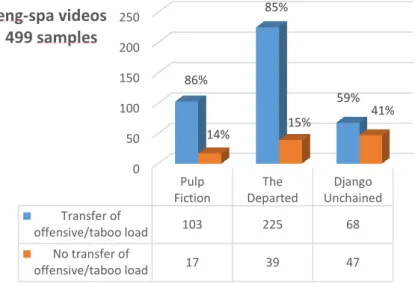
(10) la tijera [scissoring]. Albeit some viewers might feel offended by this expression, the student has been faithful to the original when subtitling it as ‘scissoring’. After this brief description of some illustrative samples, the results obtained from the exhaustive analysis are presented in the next section of this paper. 4.2. Quantitative data The analysis of quantitative data has been conducted by observing the transfer or non-transfer of the offensive and taboo terms in the TT, as explained in the methodology section. Having dealt with the scrutiny of the transfer of the offensive/taboo terms subtitled into English and Spanish respectively, the interpretation of the results in the form of quantitative data as well as the qualitative data from the postquestionnaire are discussed below. This experiment revolved around three research question, which are formulated and discussed in the ensuing sections. 1. Are the offensive and taboo exchanges subtitled faithfully? In order to address this question, the analysis focused firstly on the subtitling of videos from English to Spanish as indicated in Figure 1, of which 499 instances have been analysed.. eng-spa videos 499 samples. 85%. 250 200 150. 86% 59%. 100 14%. 50 0. 15%. 41%. Pulp Fiction. The Departed. Django Unchained. Transfer of offensive/taboo load. 103. 225. 68. No transfer of offensive/taboo load. 17. 39. 47. Figure 1. English-Spanish subtitling transfer analysis.. It can be observed that in the three films, the transfer of the offensive/taboo load in the TT was predominant in Pulp Fiction and The Departed, although in the case of Django Unchained, the difference was reduced. If all transfer cases are grouped, they account for 396 instances (79.35%) compared with 103 of non-transfer (20.65%). In this linguistic combination we can therefore assert that the participants aimed at providing faithful renderings. Thus, the tendency to subtitle from English to Spanish can be said to be faitful to the ST. 213 THE OFFTATLED PROJECT: OFFensive and TAboo Exchanges SubtiTLED BY ONLINE UNIVERISTY STUDENTS Ávila-Cabrera, J. J. & Rodríguez Arancón, P. Encuentro 27, 2018, ISSN 1989-0796, pp. 204-219.
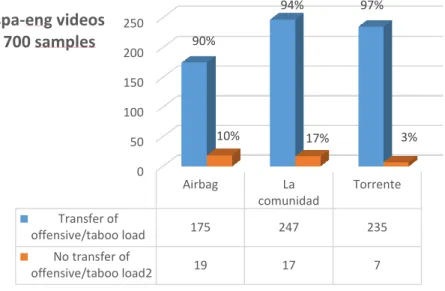
(11) As regards the Spanish-English subtitling, of which 700 instances have been analysed, the data obtained is included in Figure 2 in order to address the first research question.. spa-eng videos 700 samples. 94%. 97%. 250 200. 90%. 150 100 10%. 50 0. 3%. 17%. Airbag. La comunidad. Torrente. Transfer of offensive/taboo load. 175. 247. 235. No transfer of offensive/taboo load2. 19. 17. 7. Figure 2. Spanish-English subtitling transfer analysis.. The figure above shows that the three films exhibit the transfer of offensive/taboo load almost to the full. If all results are taken into account together, we can see that the transfer of this type of terms has been made in 657 instances (93.85%) against 43 cases (6.15%) in which the transfer was not possible. Here, we can observe a clear tendency to subtitle the offensive/taboo terms in a close manner to the ST. Thus, this result leads us to assert that the transfer of this type of terms is more daring than the original when subtitling in the L2, probably because of the avoidance of cultural constraints, scarce knowldege of swearwords in English, or the inability to manage English conventions properly. 2. Are the L2 (English) subtitles more daring? Comparing both results when dealing with the two linguistic combinations allowed us to shed some light on this research question as shown in Figure 3.. Interlingual subtitling eng-spa vs spa-eng 700 600 500 400 300 200 100 0. 6% 21% 94% 79% eng-spa videos. spa-eng videos. No transfer of offensive/taboo load. 103. 43. Transfer of offensive/taboo load. 396. 657. Figure 3. Both linguistic combinations subtitling. 214 THE OFFTATLED PROJECT: OFFensive and TAboo Exchanges SubtiTLED BY ONLINE UNIVERISTY STUDENTS Ávila-Cabrera, J. J. & Rodríguez Arancón, P. Encuentro 27, 2018, ISSN 1989-0796, pp. 204-219.
(12) As the graphs indicate, the L2 subtitling combination shows a greater number of faithful renderings with 94% of transfers in the case of the Spanish-English subtitling compared to 79% of transfers in the English-Spanish combination. This evidence leads us to confirm that the L2 subtitles have been more daring, for which reason we could conclude that when expressing themselves in an L2, speakers may feel freer to make use of taboo phrases and swearwords. In any case, these findings might lead to further research in the field. 4.2. Qualitative data This type of data allows us to explore information on the students which will be used to triangulate the results along with the quantiative data. In the pre-questionnaire, the participants were asked about their familiarity with audiovisual products and all of them said that they watched films, TV series, DVDs, YouTube videos, etc. When focusing on watching programmes with Spanish subtitles, 36.6% said they used them sometimes, 9.8% often, 26.8% hardly ever, and 26.8% never. In the case of English subtitles, 34.1% activated them often, 24.4% hardly ever, 4.9% always, and 9.8% never. We can therefore observe a tendency to use more subtitles in English within the population under analysis. Some questions were asked about the skills that they expected to be boosted by the experiment and the most significant findings were that: 61% of the participants expected to improve their written production in English, 43,9% their reading comprehension, 73.2% their listening comprehension and 61% to expand their vocabulary in this language. Regarding the post-questionnaire, only 25 participants (68% females and 32% males) finished the project, which, in our experience, is common in the case of online university courses. When dealing with the use of subtitling as an amateur activity, only 12.2% had experienced subtitling at some point. The project also aimed at the improvement of different linguistic skills, although this data was only observed through the participants’ perceptions. Thus, as for English skills, the students acknowledged an improvement, which is reflected by the results shown by the post-questionnaire. Finally, with the data obtained the third research question is answered below. 3. Have the participants’ linguistic skills been boosted after participating in this project? Based on the students’ perceptions, we can observe that they stated some improvement in the following skills: oral comprehension (90.9%), reading comprehension (63.6%), writing production (95.4%), vocabulary enhancement (95.4%), and translation skills (95.5%). Another important feature was that they became more familiar with interlingual subtitling and also highlighted the improvement of their ICT skills, as they had to use subtitling in an active way (Talaván 2006; Talaván and RodríguezArancón 2014). In more specific terms, 95.5% asserted that they had learnt useful vocabulary and practical expressions in English, especially those including insults, swearwords, and taboo terms. When they 215 THE OFFTATLED PROJECT: OFFensive and TAboo Exchanges SubtiTLED BY ONLINE UNIVERISTY STUDENTS Ávila-Cabrera, J. J. & Rodríguez Arancón, P. Encuentro 27, 2018, ISSN 1989-0796, pp. 204-219.
(13) were asked about how to subtitle offensive terms (insults, swearwords, swear phrases etc.), 90.9% said they had tried to balance the tone, 4.5% to tone it down and 4.5% to neutralise it. Regarding the manner of subtitling taboo terms (body parts, sex, religious referents, etc.), 95.5% aimed to balance the tone and 4.5% to neutralise it. Finally, 86.4% indicated that offensive and taboo terms should be transferred faithfully to the ST. All these qualitative results corroborate the findings provided by the quantitative analysis. Consequently, we can conclude that all research questions have been addressed and confirmed via the triangulation of data, inasmuch as the results obtained after the analysis of data validate the participants’ views on how to transfer offensive and taboo exchanges in the Spanish/English subtitles. 5. CONCLUSIONS This project had the intention of shedding some light on the manner in which a group of university students would deal with the transfer of the load of offensive and taboo terms when creating interlingual subtitles for clips from six films from English into Spanish and Spanish into English. They had no information about the fact that the researchers were to analyse whether their renderings of these terms were faithful to the ST and more daring when the direction was from a Spanish source into English. The only purpose of the activities, as far as they knew, was to create adequate subtitles for the AV content provided by the teaching team. The data was obtained through a process of triangulation with the help from pre- and postquestionnaires and the analysis of the texts produced by the participants. The results showed that the renderings were mostly faithful to the ST and the load maintained in those subtitles created by the students. Moving to the second research question, subtitles in the L2 proved to be more daring than in the L1 when the texts produced for both languages where analysed and compared. This could be due to the fact that there are fewer cultural constraints when swearing in an L2 and the terms do not seem to carry the same offensive load. Nevertheless, an avoidance of subtitling blasphemies literally was detected and the presence of some ideological manipulation. This process of mediation between ST and TT might be a response from the creators of the subtitles in order to avoid the possibility of offending the audience. In order to do so, the tendency here has been to neutralise the impact of the blasphemy in the TT, or use some other offensive and/or taboo exchange instead which does not directly vilify God or Jesus Christ. That demonstrates a cultural awareness on the part of the students worthy of mention. Apart from the fact that the work on the project made the students more familiar with subtitling and more competent with the use of ICTs; the participants mentioned several other aspects that they felt had improved as a result of their participation in the pilot study, such as an improvement in oral comprehension, an enrichment in vocabulary knowledge, and an enhancement in translation skills, in that order. Thus, the use of active subtitling, regardless of the purposes of the study, lead to the participant’s improvement of diverse linguistic and translation skills. 216 THE OFFTATLED PROJECT: OFFensive and TAboo Exchanges SubtiTLED BY ONLINE UNIVERISTY STUDENTS Ávila-Cabrera, J. J. & Rodríguez Arancón, P. Encuentro 27, 2018, ISSN 1989-0796, pp. 204-219.
(14) As a limitation to the results it is worth noting that it was carried out by a small number of participants and that it would be interesting to increase the sample analysed and the number of students taking part in future projects. As regards new research avenues, the comparison between the resulting texts produced when subtitling and dubbing the same clips would be a useful step forward, and even a comparison between the effects that the direction of both types of AV activities, L1 to L2 and vice-versa, have in the resulting TT. All in all, the data gathered in this study are expected to contribute to the literature of offensive and taboo language in AVT.. REFERENCES Allan, K. and Burridge, K. 2006. Forbidden Words: Taboo and the Censoring of Language. New York, NY: Cambridge University Press. Andersson, L. and Trudgill, P. 1992. Bad Language. London: Penguin. Ávila Cabrera, J.J. 2014. The Subtitling of Offensive and Taboo Language: A Descriptive Study. PhD thesis. Madrid: UNED. Ávila-Cabrera, J.J. 2015a. «An account of the subtitling of offensive and taboo language in Tarantino’s screenplays». Sendebar, 26, 37-56. http://revistaseug.ugr.es/index.php/sendebar/article/view/2501 _____ 2015b. «Subtitling Tarantino’s offensive and taboo dialogue exchanges into European Spanish: the case of Pulp Fiction». Revista de Lingüística y Lenguas Aplicadas, 10, 1-11. http://dx.doi.org/10.4995/rlyla.2015.3419 _____ 2016a. «The subtitling of offensive and taboo language into Spanish of Inglourious Basterds: A case study». Babel, 62(2), 211-232. https://benjamins.com/#catalog/journals/babel.62.2.03avi/details _____ 2016b. «The treatment of offensive and taboo language in the subtitling of Reservoir Dogs into Spanish». TRANS, 20, 25-40. http://www.trans.uma.es/Trans_20/Trans_20_A2.pdf _____ 2020. «Profanity and blasphemy in the subtitling of English into European Spnaish: four case studies based on a selection of Tarantino’s films. Quaderns. Revista de Traducció. In press. Crystal, D. 2007. The Cambridge Encyclopedia of the English Language (2nd edn.). Cambridge: Cambridge University Press. Díaz Cintas, J. 2001. «Sex, (Sub)Titles and Videotapes». In L. Lorenzo García, and A. M. Pereira Rodríguez (Eds.), Traducción subordinada II: el subtitulado (inglés – español/galego), (pp. 47-67). Vigo: Universidad de Vigo. Díaz Cintas, J. 2012. «Clearing the smoke to see the screen: ideological manipulation in audiovisual translation». Meta, 57(2), 279-293. https://id.erudit.org/iderudit/1013945ar Díaz Cintas, J. and Remael, A. 2007. Audiovisual Translation: Subtitling. Manchester: St. Jerome. 217 THE OFFTATLED PROJECT: OFFensive and TAboo Exchanges SubtiTLED BY ONLINE UNIVERISTY STUDENTS Ávila-Cabrera, J. J. & Rodríguez Arancón, P. Encuentro 27, 2018, ISSN 1989-0796, pp. 204-219.
(15) Díaz Cintas, J., Parini, I. and Ranzato, I. 2016. «The discreet charm of manipulation». In J. Díaz Cintas, I. Parini and I. Ranzato (Eds.), Numero Speciale Ideological Manipulation in Audiovisual Translation, (pp. i-ix). Altre Modernità. Rivista di studi letterari e culturali. Milan: Università degli Studi di Milano. https://doi.org/10.13130/2035-7680/6798 Jay, T. 1980. « Sex roles and dirty word usage: a review of the literature and a reply to Haas». Psychological Bulletin, 88(3), 614-621. Hashemian, M., Mirzaei, A. and Hosseini, M. 2014. «Rendering strategies in culture-specific items: Taboo expressions in IRIB’s dubbed Hollywood movies». International Journal of Foreign Language Teaching & Research, 2(7), 23-29. Hurtado Albir, A. 2001. Traducción y traductológica, introducción a la traductológica. Madrid: Cátedra. Ljung, M. 2009. «The functions of expletive interjections in spoken English». In A. Renouf and A. Kehoe (Eds.), Corpus Linguistics: Refinements and Reassessments (pp. 155-171). Amsterdam and New York: Rodopi. Ljung, M. 2011. Swearing: A Cross-Cultural Linguistic Study. Basingstoke: Palgrave Macmillan. Martínez Sierra, J.J. 2015. «La traducción de Nigger en Django Desencadenado: Un enfoque ideológico». In F. Chaume and M. Richart Marset (Eds.), Traducción, ideología y poder en la ficción audiovisual. Prosopopeya. Revista de crítica contemporánea, 9, 81-98. McEnery, T. 2009. Swearing in English: Bad Language, Purity and Power from 1586 to the Present. New York, NY: Routledge. Pinker, S. 2007. The Stuff of Thought: Language as a Window into Human Nature. New York, NY: Viking. Robson, C. and McCartan, K. 2015. Real World Research: A Resource for Users of Social Research Methods in Applied Settings (4th edn.). Chichester: Wiley. Scandura, G.L. 2004. «Sex, lies and TV: censorship and subtitling». https://id.erudit.org/iderudit/009028ar. Meta, 49(1), 125-134.. Soler Pardo, B. 2015. On the Translation of Swearing into Spanish: From Reservoir Dogs to Inglourious Basterds. Newcastle Upon-Tyne: CSP. Talaván, N. 2006. «Using subtitles to enhance foreign language education». Porta Linguarum, 6, 41–52. http://www.ugr.es/~portalin/articulos/PL_numero6/talavan.pdf Talaván, N. and Rodríguez-Arancón, P. 2014. «The use of reverse subtitling as an online collaborative language learning tool». The Interpreter and Translator Trainer, 8(1), 84-101. https://doi.org/10.1080/1750399X.2014.908559 Toury, G. 2012. Descriptive Translation Studies and Beyond. Amsterdam and Philadelphia: John Benjamins. Valdeón, R.A. 2015. «The (Ab)use of taboo lexis in audiovisual translation: Raising awareness of pragmatic variation in English-Spanish». Intercultural Pragmatics, 12(3), 363-385. Berlin: DeGruyter. https://doi.org/10.1515/ip-2015-0018 Vinay, J.-P. and Dalbernet, J. 2000. «A methodology for translation». In L. Venuti (Ed.), The Translation Studies Reader (2nd edn.) (pp. 84-93). London and New York: Routledge. 218 THE OFFTATLED PROJECT: OFFensive and TAboo Exchanges SubtiTLED BY ONLINE UNIVERISTY STUDENTS Ávila-Cabrera, J. J. & Rodríguez Arancón, P. Encuentro 27, 2018, ISSN 1989-0796, pp. 204-219.
(16) Filmography Airbag. 1997. Juanma Bajo Ulloa. Asegarce Zinema, Canal+, Degeto Film, Etb, MGN Filmes, Marea Films, Road Movies Dritte Produktionen, and TVE. Spain, Portugal and Germany. Comunidad, La. 2000. Álex de la Iglesia. Antena 3 Televisión, Lolafilms, and Vía Digital. Spain. Departed, The. 2006. Martin Scorsese. Warner Bros, Plan B Entertainment, Initial Entertainment Group (IEG), Vertigo Entertainment, Media Asia Films. USA and Hong Kong. Django Unchained. 2012. Quentin Tarantino. The Weinstein Company and Columbia Pictures. USA. Pulp Fiction. 1994. Quentin Tarantino. A Band Apart, Jersey Films, and Miramax Films. USA. Torrente, el brazo tonto de la ley. 1998. Santiago Segura. CARTEL, Rocabruno S.A. and Vía Digital. Spain.. 219 THE OFFTATLED PROJECT: OFFensive and TAboo Exchanges SubtiTLED BY ONLINE UNIVERISTY STUDENTS Ávila-Cabrera, J. J. & Rodríguez Arancón, P. Encuentro 27, 2018, ISSN 1989-0796, pp. 204-219.
(17)
Figure



+2
Documento similar