CanSat Leader
Training Program
-Past, Present and
Future-rei kawasHima*
EJES
It was the end of the 20th century when Prof Robert Twiggs proposed to make a tiny satellite called “CanSat.” He proposed the development of a new satellite that its in a Soda-can. his soda-can sized satellite was the irst small step to open a door to the new world where university students design, build, test, launch and operate satellites in the 21st century.
It should be noticed that CanSat itself has evolved, and that many types of CanSats such as rover type or parafoil type have been developed. In the beginning, a simple CanSat was a challenging project for graduate students in the aerospace engineering ield, but now it became a popular tool of hands-on training to learn basic space technology as well, and high school students enjoy developing their CanSat. CanSat is continuously evolving through both ways; challenging more advanced mission and training beginners and new comers.
he motivation of this paper is to explore new possibilities and opportunities for CanSat Leader Training Program (CLTP). In order to explore it, I would like to relect on the CanSat history.
In this paper, irstly the history of CanSat activities in Japan is introduced; secondly the motivation and achievement of CanSat Leader Training Program (CLTP) are described; thirdly new platforms and tools are introduced, followed by discussion on future possibilities of CLTP.
CANSAT HISTORY IN JAPAN
he irst CanSats made by Japanese students were launched in the Black Rock desert in Nevada, USA in September 1999. Figure 1 shows one of the irst CanSats built by students of the University of Tokyo. It was the beginning of the project called “A Rocket Launch for International Student Satellites (ARLISS).” Since then, Japanese students visited the desert and participated in the ARLISS to make suborbital launch experiment every year. Rockets are provided
Figure 1. First CanSat built by Japanese students.
by AEROPAC amateur rocket group. Figure 2 shows some scenes in ARLISS (UNISEC, 2016).
In ARLISS, CanSats are released at 4 km altitude on Nevada desert, which is impossible to conduct similar a launch in Japan due to regulations. Each CanSat team designs and builds one or more light models, and travels to the launch site in Black Rock,
Figure 2. Scenes in ARLISS.
Nevada to supervise preparation, launch, telemetry download and safe recovery of their experiments and data (Nakasuka, 2010; ARLISS, 2016).
CanSat is an efective educational tool as students can get hands-on experience in the life-cycle of a space project. Also, it is an afordable way to teach students the basics of satellite engineering. Students design and build a small electronic payload that its in a soda can. he CanSat is then launched and deployed from a rocket or balloon. Using a parachute, the CanSat slowly descends back to Earth, performing its mission while transmitting its telemetry. Post launch and recovery data acquisition allow students to analyze the cause of mission success and/or failure (CLPT7, 2015).
As table 1 shows, the number of participating universities in ARLISS has increased and more teams from different countries participate every year. It should be noted that the Japanese domestic CanSat competitions have been conducted at Noshiro-Space Event since 2005.
Table I. Numbers of ARLISS Participating Universities.
year Number of univs. from Japan
Number of Univs.
from USA
Other countries, high school, etc
1999 2 3?
2000 4 2
2001 5 2 Lockheed Mar�n
2002 7 3
2003 6 2
2004 6 3 JAXA
2005 7 1
2006 8 3 1 Univ. from Spain
2007 10 1 1 Univ. from Korea
2008 11 1 1 Univ. from Korea
2009 11 4 1 High School from Japan and US
2010 15 2 1 High school from Japan, US, Norway, 1 Univ. from France and korea
2011 16 1 1 High school from Japan
2012 9 3 1 Univ. from Korea, 1 high school from Japan, UNISON team
2013 9 3 White Label
2014 10 4 1 Univ. from Costa Rica, Egypt, and Peru, 2 Univs. From Korea
2015 10 4 1 Univ. from Peru, Egypt, 2 Univs. from Korea
In the history of Japanese CanSat activities, two professors’ contributions should be noticed. hey are Prof. Shinichi Nakasuka from the University of Tokyo and Prof. Kazuya Yoshida from Tohoku University.
His greatest contribution was to lead students to realize the irst CanSat project. In 1998, he did research with Prof. Twiggs at Stanford University, and was fascinated by his idea and motivation that is to make aerospace engineering students experience the whole cycle of a real space project.
Another outstanding contribution made by Prof. Nakasuka was to organize “Comeback competition,” where a machine (a kind of satellite model) with a certain steering mechanism such as parafoil is to, after release in high altitude, come back to a target point autonomously without human interaction, and the one which comes nearest to the target point wins the competition (Kawashima et al., 2004). hrough the competitions, CanSat has evolved in many ways; remote rovers, liers and sophisticated communications both in light and on the ground.
Prof. Kazuya Yoshida introduced rover to CanSat. He thought that the most efective way to come close to the target point could be rover, and gave students the opportunities to work on the project. he irst three years, Tohoku University teams had diiculties, but eventually, they achieved “0 meter to target” with their advanced rover in 2008. Rover type CanSat is shown in Figure 3 (UNISEC, 2016).
ACHIEVEMENT OF CANSAT LEADER TRAINING PROGRAM (CLTP)
UNISEC had focused on domestic activities in the irst 10 years since its establishment in 2001 including the preparation period. During these 10 years the experience gained from CanSat programs with Japanese students convinced us that CanSat are important for space engineering education. In 2011, UNISEC started spreading its activities to the rest of the world. A grant from “Funding Program for World-Leading Innovative R&D on Science and Technology” (FIRST Program) enabled UNISEC to spread its mission that is
Figure 3 Rover type CanSat (Left: he University of Electro-Communica-tions, Right: Tohoku University, 2011).
“support, promote and facilitate practical space projects at university level” to other countries.
We thought that the most efective way to spread the training program would be to «teach teachers how to teach.» hus, we invited university professors to participate in CLTP. CanSat Leader Training Program (CLTP)
CLTP1 (Wakayama Univ. in Feb-March, 2011)
Twelve participants from 10 countries
(Algeria, Australia, Egypt, Guatemala, Mexico, Nigeria, Peru started in this way. As table 2 shows, CLTPs was offered in six cycles in Japan (CLPT7, 2015).
Table II. CLTP offering cycles.
Sri Lanka, Turkey (3), Vietnam)
CLTP2 (Nihon Univ. in Nov-Dec, 2011)
10 participants from 10 countries
(Indonesia, Malaysia, Nigeria, Vietnam, Ghana, Peru, Singapore, Mongolia, Thailand, Turkey)
CLTP3 (Tokyo Metropolitan Univ. in July-Aug, 2012)
10 participants from 9 countries
Egypt (2), Nigeria, Namibia, Turkey, Lithuania, Mongolia, Israel, Philippines, Brazil
CLTP4 (Keio Univ. in July-August, 2013)
9 participants from 6 countries
Mexico(4), Angola, Mongolia, Philippines, Bangladesh, Japan
CLTP5 (Hokkaido Univ. in Sept, 2014)
7 participants from 5 countries
Egypt, Korea (2), Mexico (2), Mongolia, Peru
CLTP6 (Hokkaido Univ. in Aug-Sept, 2015)
8 participants from 8 countries
Angola, Australia, Austria (United Nations), Bangladesh, Egypt, Mexico, Tunisia, Turkey
by Uematsu Electric Co., Ltd. reduced a launch cost to less than 10% of that employed by used amateur rocket engines.
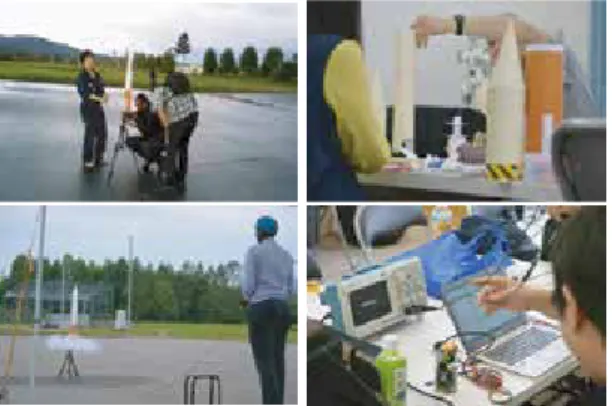
Figure 4. CanSat Launch Experiment with Paper Craft Rocket made by Each Participant.
NEW TOOLS AND PLATFORMS FOR CANSAT EDUCATION
hrough CLTP activities, new tools and platforms have been developed to make the program more efective.
1) i-CanSat
In most university classes, a CanSat is normally developed from scratch. Students need to select components and order them within a given budget. In CLTP, the duration is short and the main goal is that participants learn CanSat development and teaching methods. To achieve this goal a training kit called i-CanSat was developed.
he irst prototype of the iCanSat was developed by Prof. Hironori Sahara from Tokyo Metropolitan University, who was in charge of CLTP3. Prof. Shinichi Kimura from Tokyo Science University contributed in developing the Camera unit. It was used in the
CLTP4-6. With feedback from instructors, participants and teaching assistants, it has been revised. Figure 5 shows i-CanSat that has just been integrated during CLTP5.
2) CanSat Textbook
Prof. Yasuyuki Miyazaki from Nihon University authored a textbook about CanSat in Japanese. Figure 6 shows the cover page of the book. The book was co-authored with professors from other Japanese universities. The textbook was published in 2014 with funding from the Ministry of Education, Culture, Sports, Science
and Technology in Japan. It was sold in a market and anybody could purchase it (UNISEC, 2014). his textbook has become vital to the CanSat trainings and activities in Japan. It will be translated into English to share with the Global CanSat Community where the main players are CLTP graduates.
3) CanSat Mapping Website
CanSat Mapping was developed by Prof. Hidenori Watanabe and his students from the Tokyo Metropolitan University. It was designed to archive CanSats activities worldwide, using Google Earth. Anybody can upload his CanSat documentations with photos and/or movies to the website (UNISEC, 2015). Archiving the CanSat activities in each region would be helpful for the future generations. he lifecycle of students are quite short, and every year new students join. Technology succession is difficult especially hands-on training contains lots of implicit knowledge. With intentional and systematic archiving eforts, new students can learn from the past experiences. Figure 7 shows the CanSat Mapping website.
Figure 5. i-CanSat integrated in CLTP5 at Hokkaido University.
Figure 6. Cansat-Model nano-Satellite
FUTURE POSSIBILITIES OF CLTP
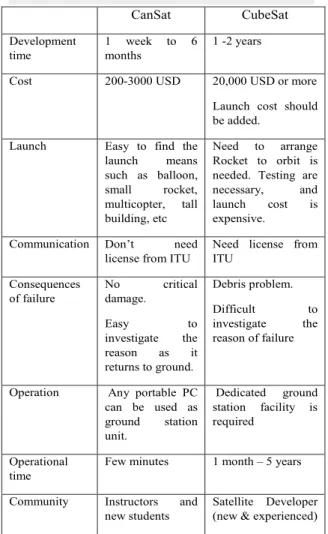
So far, we have presented the CanSat activities and CLTP. Before discussing future possibilities of CLTP, let’s consider why CanSat is important as basic space technology education. A comparison between CanSat and CubeSat would be helpful to understand it. As table 3 shows, CanSat and CubeSat have diferent characteristics and their learning outcomes are diferent. It is important to look at CanSat education as an introductory phase to a real space project such as CubeSat. Usually CanSat is considered as a very simple project by skilled satellite developers. Such criticism is vague because you can build complex CanSat that can perform complex mission such as the Comeback CanSat. he spectrum of CanSat is broad which makes it a really powerful customized tool that can satisfy diferent learning outcomes.
Table III. Comparison between CanSat and CubeSat.
CanSat CubeSat
Development time
1 week to 6
months
1 -2 years
Cost 200-3000 USD 20,000 USD or more
Launch cost should be added.
Launch Easy to find the
launch means
such as balloon,
small rocket,
multicopter, tall
building, etc
Need to arrange
Rocket to orbit is needed. Testing are
necessary, and
launch cost is
expensive.
Communication Don’t need
license from ITU
Need license from ITU
Consequences of failure
No critical
damage.
Easy to
investigate the
reason as it
returns to ground.
Debris problem.
Difficult to
investigate the
reason of failure
Operation Any portable PC
can be used as
ground station
unit.
Dedicated ground
station facility is
required
Operational time
Few minutes 1 month – 5 years
Community Instructors and
new students
Satellite Developer (new & experienced)
CubeSat is a real satellite which is launched into orbit. Even if it is small, it is a real satellite that can inluence other satellites. he failure of satellite would contribute to increasing the number of debris. Satellite developers should consider the consequences of their satellite launch. hus, it would be recommended to launch their satellite after getting enough skills and experiences. In this regards, CanSat education can provide the new satellite developers with the basic hands-on experience.
On the other hand, CanSat does not go to space and its cost is much less expensive. CubeSat requires all arrangements regarding frequency allocation and a launch slot as well as other legal procedures. CanSat allows students and instructors to focus on technical matters only, but CubeSat requires students and instructors not only to do technical matters but also to do a large amount of paperwork.
Now we understood the diference between CanSat and CubeSat, and let’s discuss future possibilities of CLTP from the view point of UNISEC-Global’s vision which state that “By the end of 2020, let’s create a world where university students can participate in practical space projects in more than 100 countries”(UNISEC, 2015; Kawashima, Cho and Ibrahim, 2014).
1) CLTP Localization
CLTP graduates are expected to teach CanSat to their students after going to their home country. So far, graduates are conducting CanSat training to their students and/or teachers in many countries such as Mexico, Egypt Turkey, Ghana, Nigeria, Peru, Mongolia, the Philippines, and hailand.
technical requirements. It is important to nurture good instructors whose motivation is high in learning more and sharing their experiences and knowledge for local CLTPs.
2) Expanding the CanSat community
CLTP can be the irst step to join the space engineering community. Without prior knowledge in space technology, participants can acquire the basic knowledge in space engineering from CanSat education. Instructors need to continue educating themselves. Once instructors stop improving and learning new things, they will lose the ability to inspire students. Instructors who teach CanSat would be better to have deeper knowledge about satellite because it is necessary to understand in order to explain the functions of each subsystem and component. hus, ailiation to the CanSat community would force them to continue challenging new things. Localizing CLTP is expected to boost the spreading the CanSat education at higher rate. his in turn will build local CanSat communities. The CanSat communities will expand and interact. Such interaction will be very beneicial to students and the communities at large. hings such as teaching techniques, i-CanSat customization, innovative mission ideas for CanSat, open source firmware and much more can be evolutionized and shared.
CanSat community and CubeSat community would be diferent because CanSat community will be organized by initiatives of CLTP graduates who are highly motivated to teach others and interested in improving their teaching skills. hus, the culture of CanSat community could be a little more altruistic. Eventually CanSat participants will join the CubeSat community.
3) Fund raising
Of course, inancial resources are always necessary for practical space projects. Even small CanSat cannot be made without inancial resources. As a community, fund raising should be discussed and necessary actions should be taken. Recent cloud funding system could be one way. As university does not have much funding, it should be considered how to raise funding from various resources.
CONCLUSION
As we have seen in the previous sections, CanSat activities are effective for education in aerospace engineering ield. CanSat Leader Training Program (CLTP) has contributed to making seeds of capacity building worldwide through teaching CanSat training to instructors at university level.
In the future, CLTP will be localized in many regions, sharing the common values, knowledge and technology.
SUMMARY
CanSat activities started in the end of 20th century, and CanSat has continuously evolved because of students. Organizing the Comeback competition accelerated the evolution. After ten-year of CanSat experiences in Japan, CanSat Leader Training Program (CLTP) was launched to provide training opportunities for university instructors motivated in teaching satellite technology at university level. hrough CLTPs, new tools and platforms were developed. he next step for CLTP would be localization so that more people will beneit from efective engineering education with hands-on training.
Acknowledgement
CanSat activity has been supported by many generous individuals and organizations. In terms of CLTP, it was supported by a grant from “Funding Program for World-Leading Innovative R&D on Science and Technology” (FIRST Program) where the principal investigator was Prof. Shinichi Nakasuka from the University of Tokyo in 2011-2014.
It is currently supported by the Coordination Funds for Promoting Aerospace Utilizarion, MEXT Japan, which is allocated to the UNISEC research team where the principal investigator is Prof. Yasuyuki Miyazaki from Nihon University.
CLTP 5-7 have been supported by Mr. Tetsuya Iwasaki of Sakura Rubber Co., Ltd.
REFERENCES
ARLISS. (2016). Consultado el 5 de agosto de 2016. http://www. arliss.org/
CLTP7. (2015). he 7th Cansat Leader Training Program. Consultado el 7 de agosto de 2016. http://cltp.info/
Kawashima, R., et al. (2004). Space Education in the 21st Century-»Real» Education Pursued by UNISEC. ISTS 2004-u-04, 24th
Interna-tional Symposium on Space Techonology and Science, Mizaki, Japan, June.
Kawashima, R.; Cho, M., and Ibrahim M. (2014). Challenges and
Opor-tunities of UNISEC-Global. IAC-14-E1.5.10, Toronto, October.
Nakasuka, S. (2010). Evolution from education practical use in Uni-versity of Tokio’s nano-satellite activities. Acta Astranáutica. 66(7), pp 1099-1105, April.
UNISEC. (2014). Cansat-Model nano-satellite. Japón: Ohmsha. UNISEC. (2015). Cansat Mapping. Consultado el 8 de agosto de 2016.
http://unisec-global.org/
UNISEC. (2016). Consultado el 4 de agosto de 2016. www.unisec.jp UNISEC. (2016). he Fourth UNISEC-Global Meeting. Consultado el