A Semi-Automatic Method for Ontology Mapping
⋆Laura Perez, Agustina Buccella, and Alejandra Cechich
GIISCO Research Group
Departamento de Ciencias de la Computaci´on Universidad Nacional del Comahue
Neuquen, Argentina
Abstract. Ontology mapping involves the task of finding similarities among overlapping sources by using ontologies. In a Federated System in which distributed, autonomous and heterogeneous information sources must be integrated, ontologies have emerged as tools to solve semantic heterogeneity problems. In this paper we propose a three-level approach that provides a semi-automatic method to ontology mapping. It performs some tasks automatically and guides the user in performing other tasks for which his/her intervention is required. Finally, a plug-in of the ontology editor, Prot´eg´e, is presented showing how the method is implemented through a case study.
1
Introduction
A Federated System [7] refers to the data integration of distributed, autonomous and hetero-geneous information sources. In general it is implemented by using a 4-layer architecture [3], in which the federation layer is the core of the system. In this layer, each information source is described by its own ontology (domain ontologies), and all of them converge in one global shared vocabulary. This shared vocabulary contains basic terms (the primitives) of the whole domain. In this way, an hybrid ontology approach [18] is followed.
Several proposals on ontology mapping have emerged in the last years [9]. Among them, we can cite [13, 12, 11, 14]. For example, [13] and [12] propose two similar ontology-merging tools. On one hand, the PROMPT tool described in [13] proposes an interactive tool that guides the user through the merging process. However the main problem with the PROMPT tool is that it is highly dependent on the names of the concepts in the ontology. On the other hand, Chimarea [12] provides support for merging of ontological terms from different sources, checking the coverage and correctness of ontologies and maintaining ontologies over time. Except for several situations referring to structural aspects of the ontologies, Chimarea does not make any suggestion to the user; and the only relation that Chimarea considers is the subclass/superclass relation. Another proposal for semantic matching is introduced in [11], where a lexical and a conceptual layer are used to find similarities. At the lexical level, the method uses a lexical function called lexical similarity measure (SM). At the conceptual level, concepts (classes and properties) are compared taking into account the taxonomies in which they appear. However, some types of properties are not considered by this method. Finally, the proposal of Rodriguez et.al [14] presents a combination of two different approaches to similarity assessment – the feature matching process [17] and the semantic distance. Common features increase the similarity value and distinct features decrease it. The main disadvantage with this method is that the similarity values cannot be calculated neither automatically nor semi-automatically due to the high dependence on natural language descriptions.
In previous work [5, 4], we have proposed a three-level approach that allows us to build similarities expressed as mappings. In this work we improve this method taking into account
⋆ This work is partially supported by the UNComa project 04/E059 (Mejora del Proceso de Desarrollo de Software
cycles in the ontologies and implementing a tool as a plug-in of the ontology editor Prot´eg´e [1]. This extension allows us to introduce a semi-automatic process for ontology mapping.
This paper is organized as follows: Section 2 shows the main steps of our three level approach describing changes performed to detect and solve cyclic ontologies. Then, in Section 3 the structure of components for our plug-in is described. An example describing how our tool works is shown in Section 4. We discuss future work and conclusions afterwards.
2
A Three-Level Approach to Ontology Mapping
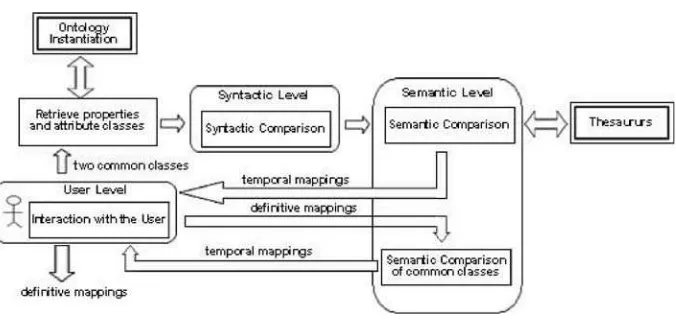
[image:2.595.122.460.286.446.2]In previous work, we have proposed a three-level method to ontology merging, taken into account information ontologies provide [5]. In this way, concepts of an ontology are compared using three comparison levels: syntactic,semantic and user level. Figure 1 shows our approach graphically, where the levels are part of the process.
Fig. 1.Approach for searching similarities
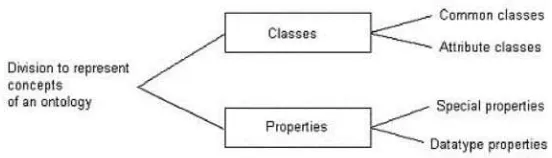
Ontology Instantiation and Thesaurus are the two external modules. The former, obtains the object structure from ontologies described in some ontology language. Figure 2 shows how the different elements of an ontology are divided. The first division refers to two different ele-ments. On one branch we have the classes and on the other branch the properties. Firstly we analyze the classes branch, which is also divided into two new branches: common classes and
attribute classes. Both are classes defined in the ontology to represent things about the world. The specific role defined in the ontology is the difference between them. The common classes
have the role of representing things about the domain and the attribute classes have the role of representing information about a common class. Both roles exist because some concepts of the ontologies act as attributes. For example, an ontology can have theAnimal class as a common class and theOrgan class as an attribute class because Organ exists to describe a characteristic about a common class. The Organ class has no properties.
Animal class and theString data type. On the other hand, thespecial properties are properties relating classes. For example, the relationship between the Animal class and the Organ class to denote the organs of an animal. Thus, a common class has both datatype properties and special properties, and attribute classes do not have properties.
Fig. 2.Proposed division to represent the ontology
The latter, theThesaurus module, uses thesauruses to search for synonyms, which are de-tected by the module through the use of a similarity function.
In Figure 1, two common classes (of different ontologies) are indicated by the user. These two classes are inputs of theRetrieve Properties and Attribute Classes module, which retrieves the attribute classes and special and datatype properties of each class by using the object structure of each ontology. This retrieved information enters the Syntactic Comparison module, which analyses syntactically classes and properties relating with the concepts. A set of syntactic functions [5] are used here.
Then, the Semantic Comparison module compares the classes and properties semantically. To do so, we extract semantic information from the Thesaurus module in order to find synonym relationships. Using the results of the syntactic level functions, we construct functions that combine these values together with the thesaurus information.
In theInteraction with the User module all the mappings that exceed a threshold are shown to the user, and he decides if the mappings are correct. The accepted mappings are classified as definitive mappings.
The Semantic Comparison for Common Classes module receives the definitive mappings and compares the common classes of the two ontologies. It uses the mappings added by the comparison of properties in order to denote the set of similar attributes (properties) of both classes.
One more time, in theInteraction with the User module, all mappings are displayed to the user and he decides if these mappings must be added permanently.
2.1 Improving the Method: Detecting Cycles
Our approach analyzes the ontologies as graphs, taking into consideration both taxonomic and non taxonomic relationships among terms.
Figure 3 describes our basic method for searching similarities. The method has a series of steps depending on the different elements of the ontology (see Figure 2).
Similarity(O1,O2)
the user enter to similar classes (c1,c2) if (c1 and c2 are common classes)
for each datatype propertydtpi∈c1 anddtpj∈c2
cleanning process(dtpi, dtpj)
sim1thesaurus(dtpi, dtpj) =search on thesaurus(dtpi, dtpj)
sim1sint(dtpi, dtpj) =wed∗simed(dtpi, dtpj) +wtri∗
simtri(dtpi, dtpj) +wdtc∗simdtc(range of(dtpi), range of(dtpj))+
wthesaurus∗sim1thesaurus(dtpi, dtpj)
ifsim1sint(dtpi, dtpj)≥thaccept
add mapping(dtpi, dtpj)
for each special property sp i∈c1andspj∈c2
cleanning process(spi, spj)
sim2thesaurus(spi, spj) =search on thesaurus(spi, spj)
simrest(spi, spj) =check restrictions(spi, spj)
sim2sint(spi, spj) =wed∗simed(spi, spj) +wtri∗simtri(spi, spj)+
wthesaurus∗sim2thesaurus(spi, spj) +wrest∗simrest(spi, spj)
if(c1, c2)∈/Visited add visited(c1,c2)
if (range of(spi), range of(spj))∈/Mapped
simtotal(spi, spj) =
calculate all the process f or(range of(spi), range of(spj))
if (range of(spi), range of(spj))∈Mapped
simtotal(spi, spj) =get value(range of(spi), range of(spj))
simsp(spi, spj) =wsint∗sim2sint(spi, spj) +wtotal∗simtotal(spi, spj)
ifsimsp(spi, spj)≥thaccept
add mapping(spi, spj)
remove visited(c1,c2)
using the added mappings cleanning process(c1, c2)
sim3thesaurus(c1, c2) =search on thesaurus(c1, c2)
sim3sint(c1, c2) =wed∗simed(c1, c2) +wtri∗simtri(c1, c2)+
wthesaurus∗sim3thesaurus(c1, c2)
if c1 and c2 are attribute classes simclass(c1, c2) =sim3sint(c1, c2)
if c1 and c2 are common classes
simclass(c1, c2) =wsint∗sim3sint(c1, c2) +wpropiedadtes especiales
∗simpropiedadtes especiales+wpropiedadtes tipo de dato∗simpropiedadtes tipo de dato
if(c1, c2)∈/Visited
ifsimclass(c1, c2)≥thaccept
add mapping(c1, c2) if(c1, c2)∈Visited
ifsimclass(c1, c2)≥(thaccept−(thaccept∗wpropiedadtes especiales))
add mapping(c1, c2)
denotes the process of elimination of articles, prepositions and non-relevant characters ( ,:,-, etc.). Next, thesauruses are used to search for synonymies. The functionsim1thesaurus(dtpi, dtpj) is equal to 1 if a synonym relationship is found for the two datatype properties and it is equal to 0 otherwise.
Then, thesim1sint(dtpi, dtpj) function is calculated using four syntactic functions. The edit
distance function, which considers the number of changes that must be done to turn one string into the other, and weights the number of these changes with respect to the length of the shortest string. Thetrigramfunction [10], which is based on the number of different trigrams in two con-cepts or strings. The data type compatibility function, (simdtc(range of(dtpi), range of(dtpj))) which compares the datatype of the ranges. And the result of applying the thesaurus function, aforementioned. Thesim1sint(dtpi, dtpj) function returns a value between 0 and 1; and the sum of weights, the w values (wed, wtri, wdt and wthesaurus), is equal to 1.
Finally, if the result of the function exceeds a threshold (thaccept), a temporal mapping is added.
The simrest(spi, spj) function checks special property restrictions [16] such as functional, symmetric, allValuesFrom, someValuesFrom, cardinality, etc. That is, it compares the constrains applied to the properties. Only when both properties have the same restrictions, the function returns 1; otherwise it returns a percentage according to the number of restrictions that are the same.
Then, a temporal mapping is added when thesimsp(spi, spj) function exceeds the threshold. Following, the method compares the special properties included in the common classes. The comparison is similar to the previous case, but the datatype compatibility function is not calculated.
Thesimtotal(spi, spj) function makes all the similarity process taking into account the range of the special properties. Therefore, this is a recursive method that will stop when the ranges are attribute classes (because they do not have properties). Once again, thesauruses are used to find synonymies relationships.
We have detected the presence of cycles in the similarity search graph. There is a major cause for cycles, the way special properties and classes can be combined are not acyclic graphs themselves. As a result, the cycles existing in the ontology become cycles in the similarity search graph, it means, a descendant of a concept could be simultaneously an ancestor of this concept. For instance, in our similarity searching method, the similarity value of a pair of classesA and
B depends on the resolution of the similarity value of a pair of classesC and D which depends on the similarity values of A and B.
Because the ontology graph contains cycles, precautions must be taken for avoiding loops in the graph traversal. It is necessary for the method to eliminate cycles. In addition, once a cycle is found with a graph’s node a partial similarity value has to be calculated in order to go on with the analysis. First of all, our approach for detecting cycles is to mark as visited the nodes while covering the graph in order to avoid visiting twice the same node. This is a very simple and effective approach. So, in Figure 3 the sentence if(c1, c2) ∈/ Visited verifies
whether the node is in the analysis path. If this condition is true, then the algorithm takes places again for the range classes with the purpose of finding the simtotal value. On the other hand, if(c1, c2) ∈ Visited means that the node has been visited so that no special properties
will be analyzed.
be obtained only from the information available on the node itself. For instance, semantic and syntactic analysis over the concepts will be carried out but no structural analysis over the special properties will be done.
Finally, the method compares the classes. This comparison is made using the syntactic functions for common and attribute classes and the semantic function for common classes. The semantic function uses the mappings added by the property comparisons in order to de-note the set of similar attributes of both classes. A temporal mapping is added if the final function exceeds the threshold. Notice that in the final similarity value for any pair of classes
simclass(c1, c2), the operand wpropiedadtes especiales∗simpropiedadtes especiales ought to be null if a cycle was detected on (c1, c2). Thus, the similarity threshold is lower in this case with the intention of giving more chances to the user to decide over the mapping of this classes.
Once all similarity values are obtained for two classes, the temporal mappings are displayed to the user and he/she must decide if these mappings must be added permanently. Thus, the user makes the final decision.
One last thing to point out over the method is the check done before the process starts again over the range classes. Taking into account that either of the ontologies having a lot of classes and properties will generate a large graph, a question whether a pair classes are already in the defined mappings set is stated with theif(range of(spi), range of(spj))∈Mappedsentence. If they have been mapped, then the found value is taken to avoid doing the same analysis again.
3
Architecting a Supporting Tool
As an implementation of our three-level approach for ontology integration, we built a plug-in for the Prot´eg´e ontology editor [1]. Basically, at its core, Prot´eg´e implements a rich set of knowledge-modelling structures and actions that support the creation, visualization, and manipulation of ontologies in various representation formats. Further, Prot´eg´e can be extended by way of a plug-in architecture and a Java-based Application Programming Interface (API) for building knowledge-based tools and applications. The Prot´eg´e platform supports two main ways of modelling ontologies through the following editors Prot´eg´e-Frames yProt´eg´e-OWL. In this section, we will describe the design of the Prot´eg´e plug-in called OWLSim.
During the design process, the Responsibility Driven Design (RDD) [20, 19] model was used to keep our focus on the behavior of our software. This methodology helps us to identify the application’s responsibilities and to divide them into collaborative objects.
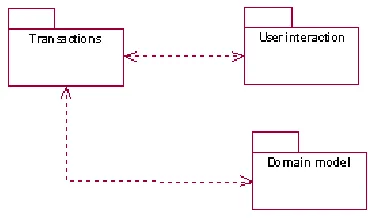
The plug-in’s architecture design is based on two architectural styles the model-view-controller (MVC) and its successor the presentation-application-control PAC [2, 6]. We describe how software objects are organized, this means how objects are located in components. Each component contains characteristic object roles that are located according to both the applica-tion components’ funcapplica-tionality and the object’s roles.
Fig. 4.Plug-in’s architecture
3.1 Designing classes
One of the most important activities in Object-Oriented design is to identify object classes. Thus, we move from the requirements and descriptions – the method specification explained in previous sections (behavior that the plug-in must accomplish), the definition of OWL ontologies and the Prot´eg´e model specification – to find and describe the most important classes.
Domain and application-specific objects Domain objects represent concepts in a specific field of interest. In our domain, the ontologies and their elements, the mappings between them, and the similarity method.
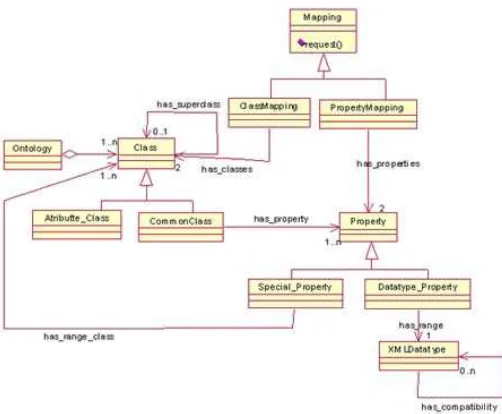
Figure 5 shows part of the domain class diagram using UML notation [8] – the part where the ontology and both their elements and mappings are modelled. There are classes that model the most important components of an OWL [16] ontology, such as classes, properties and re-strictions. In addition, as described in section 2, we also take into account the division of the ontology elements that the similarity method embodies (Atributte Class, Common Class,
Datatype Property andSpecial Property). As shown in the diagram, both classesAtributte Class
and Common Class were modelled as a class Class specialization. Because of their differences, the method gives different treatment to each of them. In addition, the has superclass relation represents taxonomic relations in an ontology. Regarding class Property, it has a specialization into two classes:Datatype Property andSpecial Propertyin accordance to the method’s division on property elements, as onlySpecial Property relates theclasses. Moreover, both special prop-erties and datatype propprop-erties ranges are different, so two distinct relationshas classrange and
has XMLDatatyperange were modelled to associate them to the range classesXMLDatatype and
Class. Further, thehas compatibility association shows that each data type might be compatible with other data types. Unlike Common classes, that might have both types o properties, the
Attribute classes have not gotten any property; thus, the association has propertyis between the subclass Common Class and the superclass Property. Finally, properties restrictions are also modelled.
Following, the mappings found by the method are contained in theMappingclass. The Prop-erty Mapping and Class Mapping classes are its subclasses. The former class involves classes using the has classes and the latter class involves properties using the has properties.
Fig. 5.Plug-in class design diagram part
Similarly, there are in the design plenty of other classes that are needed objects to translate the computer’s user inputs to commands to the right objects in the application. For brevity reason we only explained the Similarity Searcher class which is the core of our method.
3.2 Similarity searching
As a result of being too complex to be implemented by a single object, the SimilaritySearcher
[image:8.595.196.381.542.626.2]class main responsibility is divided into subresponsibilities reassigned to collaborating objects. Each object implements a quite different similarity search method depending on three elements as above mentioned. The SimilaritySearcher object coordinates these collaborating objects, as Figure 6 shows. If the ontology classes to be analyzed are Common Class then datatype and special property analysis would take place, following the class analysis is carried out.
Fig. 6.Symilary Searcher collaborates with other objects to find similarities.
Those specialized objects, which implement the subordinated responsibilities that the Simi-larity Searcher object delegates as well as coordinates are: DataType Property Analysis,Special Property Analysis, Class Analysis.
4
A Case Study - Using the Plugin
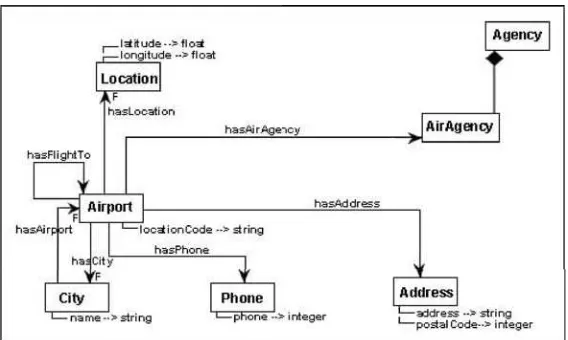
Now, we will present a case study that lets us show both the plug-in interface and how the method works. In addition, it let us point out some interesting results depending on the chosed ontologies for mapping. The following two ontologies were selected and created with the Prot´eg´e editor, they are shown graphically in Figures 7 and 8.
– The first ontology is called “Travel Ontolgy” 1
; it models flights, air agencies, car rental, hotels among other concepts. It has around 40 classes with many properties in order to describe their semantic and structure – they may be special properties or data type proper-ties. From this ontology we only show theAirport class and their taxonomical relationships, and properties and restrictions that apply to the related entities, the ones involved in the example.
– The second ontology is called“Location Ontology”2
[image:9.595.142.435.182.652.2]which possess five classes and a number of properties, both special and datatype properties, to represent a location domain.
Fig. 7.“Travel ontology part.”
Fig. 8.“Location ontology part.”
There are some points to notice in the two ontologies. Firstly, in both Travel and Location
ontology graphs there are cycles. It means, that there is a pair of special properties that made
1
www.ilby.net/travel.owl 2
[image:9.595.148.432.307.477.2]some class both range and domain class from each other at the same time. In the former, the
hasFlightTo,hasAirport andhasCity special properties involving the classesAirport andCity as their ranges and domains. In the other one, for instance, the hasParts and is Part Of involves the classes City and Country as ranges and domains classes from one each other. Nevertheless, our method will detect this and find out a similarity value too. Secondly, regarding to the City
and Address classes modelled in each of the ontologies, they are represented quite different. So the similarity values will not be high in spite of been the same entities. Later we will discuss examples on this points.
[image:10.595.146.434.259.338.2]Let us now look at the plug-in’s interface where we choose the .owl files containing the mentioned ontologies. As Figure 9 shows, this form lets the user to indicate the ontologies to be compared in OWL language.
Fig. 9.“OWLSim plug-in interface which lets us select the owl files to map.”
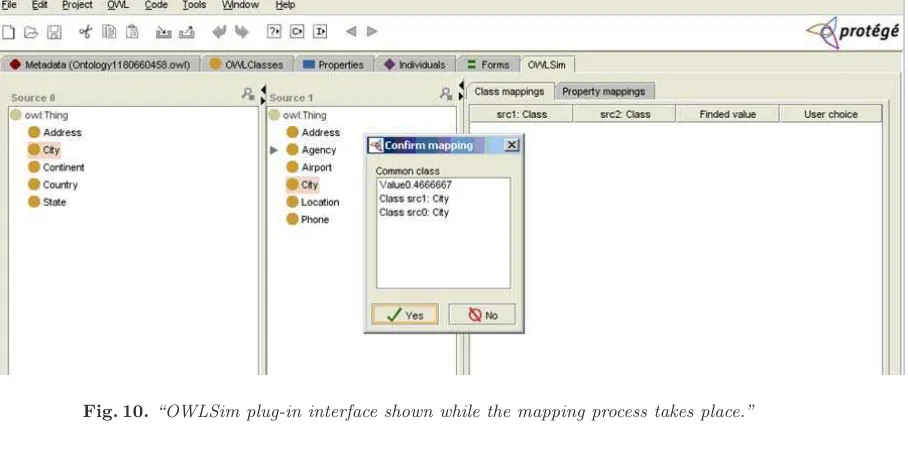
[image:10.595.78.532.500.727.2]Following, if both owl files are loaded successfully, the mapping layout screen appears (see Figure 10). It is divided into two main panels. On the left side, there is the select source classes form that holds each of the selected ontologies class hierarchy, so that a pair of classes to be compared could be choosen. On the other side, the right one, there is the show class and property mappings form. On this window, the mappings between classes and properties found by the procces are shown.
Fig. 10.“OWLSim plug-in interface shown while the mapping process takes place.”
a confirmation is required from the user through the confirmation window as shown previously in Figure 10.
Let us now look at two examples, which show the similarity values found when the two points described before occur while using the plug-in. First, when the Location.City and Travel.City
classes are selected to be compared the values shown in Figure 11 will be obtained as the method goes through the special properties graph. As the similarity searching progresses it will find a cycle when the City classes are visited again. The method detects that the node is in the searching path. As a result of the special treatment to this node, we can see that the similarities between the data type properties cityKeyWords, name y name 2 (stand for Location.City.name) are calculated. The similarity value from the two last ones only is higher than the acceptance threshold. Moreover, the syntactic and semantic values are equal to one. Thus, the structural comparison regarding the data type properties, simAttDtatypeProperties, is quite low. Moreover, because of being a cycle node, the simAttSpecialProperties is equal to cero. From this, the final value just barely exceeds the acceptance threshold.
Fig. 11.“Similarity values obtained by comparing Cityconcepts from both ontologies.”
In the second place, Figure 12 shows the results obtained from the analysis of bothAddress
classes. They match syntactically as well as semantically; consequently, the simThesaurus
and simSint values are equal to one. However, they are represented quite differently. On the one hand, the Location.Address class has two data type properties, street and zipCode in ad-dition to a special property city-of-address. On the other hand, the Travel.Address class is represented with two data type properties, address and postalCode. Although, the address and street properties meant to represent the same information about classes, they are represented rather different. Hence, it will afect the final result. Futher, the comparison of the zipCode
and postalCode properties is the only one that results in a grater value. Consequently, there is just one common attribute between these classes. The final similarity value is higher than the acceptance threshold so a temporal mapping is found, and this result will be prompted to the user. Then, if the user confirms this mapping it will be changed to permanent.
5
Conclusions and Future works
In this paper, we have presented our three level approach for searching mappings between two OWL ontologies, and aspects such as cycles in the ontologies and performance have been considered to avoid possible problems in the application of the method. An implementation of it as a Prot´eg´e plug-in has been presented and it will be soon available to be downloaded from Internet 3
.
However, currently our work is in a development stage for a number of tasks that are still being developed. Since our current method only deals with one-to-one relationships, we are improving the similarity functions in order to consider many-to-many relationships. Some efforts has been presented in [15].
References
1. Prot´eg´e. http://protege.stanford.edu/doc/users guide/index.html, 2000.
2. L. Bass, P. Clements, and R. Kazman.Software Architecture in Practice. Addison-Wesley Longman Publishing Co., Inc., Masachusetts, USA, 1998.
3. A. Buccella, A. Cechich, and N. Brisaboa. Ontology-based data integration: Different approaches and common features. In L. Rivero, J. Doorn, and V. Ferraggine, editors,Encyclopedia of Database Technologies and Applications. Idea Group, 2005.
4. A. Buccella, A. Cechich, and N. R. Brisaboa. Ontology-based identification of similarity among heterogeneous sources. Journal of Computer Science and Technology, 6(1):62–68, 2003.
5. A. Buccella, A. Cechich, and N. R. Brisaboa. A federated layer to integrate heterogeneous knowledge. InVODCA’04 First International Workshop on Views on Designing Complex Architectures, number 142 in Electronic Notes in Theoretical Computer Science, Elsevier Science B.V, pages 79–97, Bertinoro, Italy, September 2004.
6. F. Buschmann, R. Meunier, H. Rohnert, P. Sommerland, and M. Stal. Pattern Oriented Software Arquitecture - A systema of Patterns. Wiley and Sons Ltd., West Sussex, England, 1996.
7. S. Busse, R. Kutsche, U. Leser, and H. Weber. Federated information systems: Concepts, terminology and architec-tures. Technical Report Nr. 99-9, Technical University of Berlin, 1999.
8. Martin Fowler and Kendall Scott. UML distilled (2nd ed.): a brief guide to the standard object modeling language. Addison-Wesley Longman Publishing Co., Inc., Boston, MA, USA, 2000.
9. Y. Kalfoglou and M. Schorlemmer. Ontology mapping: the state of the art. The Knowledge Engineering Review, 18(1):1–31, 2003.
10. D. Lin. An information-theoretic definition of similarity. In Proceedings of the Fifteenth International Conference on Machine Learning, pages 296–304, July 1998.
11. A. Maedche and S. Staab. Measuring similarity between ontologies. InProceedings of the EKAW’02 13th Interna-tional Conference on Knowledge Engineering and Knowledge Management. Ontologies and the Semantic Web, pages 251–263, London, UK, 2002. Springer-Verlag.
12. D. McGuinness, R. Fikes, J. Rice, and S. Wilder. An environment for merging and testing large ontologies. In
Proceedings of the KR, pages 483–493, 2000.
13. Natalya Fridman Noy and Mark A. Musen. Prompt: Algorithm and tool for automated ontology merging and alignment. InProceedings of the Seventeenth National Conference on Artificial Intelligence and Twelfth Conference on Innovative Applications of Artificial Intelligence, pages 450–455. AAAI Press / The MIT Press, 2000.
14. M.A. Rodr´ıguez and M.J. Egenhofer. Comparing geospatial entity classes: An asymmetric and context-dependent similarity measure. International Journal of Geographical Information Science, 18(3):229–256, 2004.
15. S. Roger, A. Buccella, A. Cechich, and M. S. Palomar. Asematch: A semantic matching method. InTSD’06: Ninth International Conference on Text, Speech and Dialogue, pages 229–235, Brno, Czech Republic, September 11-15 2006.
16. M. K. Smith, C. Welty, and D. McGuinness. Owl web ontology language guide. W3C, February 2004. 17. A. Tversky. Features of similarity. Psychological Review, 84(4):327–352, 1977.
18. H. Wache, T. V¨ogele, U. Visser, H. Stuckenschmidt, G. Schuster, H. Neumann, and S. Hbner. Ontology-based integration of information - a survey of existing approaches. InProceedings of the IJCAI-01 Workshop: Ontologies and Information Sharing, pages 108–117, Seattle, WA, 2001.
19. R. Wirfs-Brock and A. McKean. Object Design: Roles, Responsibilities, and Collaborations. Addison-Wesley 2003, 2003.
20. R. Wirfs-Brock, B. Wilkerson, and L. Wiener. Designing Object-Oriented Software. Prentice Hall 1990, 1990.
3