DEPARTAMENTO DE FILOLOGÍA INGLESA
Máster en Profesor de Educación Secundaria Obligatoria, Bachillerato,
Formación Profesional y Enseñanza de Idiomas
TRABAJO FIN DE MÁSTER
GRADED READERS AS A TOOL FOR TEACHING EFL:
A COMPARATIVE ANALYSIS ON FRANKENSTEIN
Autor: D. Juan Ignacio de la Fuente McCauley
Tutora: Dña. Sara Medina Calzada
Juan Ignacio de la Fuente McCauley El presente trabajo está sujeto a una licencia de uso de Creative Commons de
ABSTRACT
Graded readers are an effective tool in EFL learning, and their use is widespread
nowadays. The present dissertation aims at analysing two adaptations of Mary Shelley’s
1831 version of Frankenstein, in order to determine whether a higher or lower degree of simplification would be more exploitable for both teachers and students. In order to do
this, we have established an analysis method, which can be taken as a reference method
for teachers when analysing this type of materials. Results intend to show which reader
is better for an EFL student. Finally, we have created a didactic proposal to put into
practice with the best reader.
Keywords: graded reader, EFL, reading, Frankenstein, simplification, method.
RESUMEN
Las lecturas graduadas son una herramienta efectiva en la enseñanza del inglés
como una lengua extranjera, cuyo uso hoy día está muy extendido. El presente Trabajo
de Fin de Máster pretende analizar dos adaptaciones de la versión de 1831 de Mary
Shelley de Frankenstein, con el propósito de determinar si el hecho de que una obra esté más o menos simplificada hace que tanto profesores y alumnos puedan sacarle un mayor
partido. Para esto, hemos establecido un método de análisis, que puede servir como un
método de referencia para profesores a la hora de analizar este tipo de materiales. Los
resultados buscan establecer cuál de las dos lecturas graduadas es mejor para un
estudiante de inglés como lengua extranjera. Finalmente, hemos creado una propuesta
didáctica para aplicarla con dicha lectura.
TABLE OF CONTENTS
1. INTRODUCTION ... 1
2. GRADED READERS IN EFL TEACHING ... 5
a. Literature in EFL Teaching ... 5
b. Graded readers... 6
c. Simplified texts vs. authentic texts ... 7
d. Extensive Reading Programmes in Spain ... 10
3. METHOD ... 13
4. ANALYSIS ... 17
a. Burlington Books ... 17
1) Level I ... 17
2) Level II ... 20
3) Level III ... 23
b. Eli Readers ... 24
1) Level I ... 25
2) Level II ... 28
3) Level III ... 31
5. DISCUSSION ... 33
a. Level I ... 33
b. Level II ... 35
c. Level III ... 36
d. Final remarks ... 37
6. DIDACTIC PROPOSAL ... 39
a. Pre-reading activities ... 39
b. While-reading activities ... 41
c. Post-reading activities ... 41
7. CONCLUSIONS ... 45
8. BIBLIOGRAPHY ... 47
1.
INTRODUCTION
Graded readers are a very common resource in EFL classes nowadays, given that
they allow learners to approach longer texts, which they would not have the level or the
time to read. At the same time, it is a useful way to encourage the students’ interest in
reading. Moreover, teachers can exploit these resources in order for students to acquire
the different skills, at the same time they learn about the literature and culture of the target
countries.
Nevertheless, there are mixed opinions about the use of these graded readers, since
there are scholars who think using them is not beneficial for learners. On the other hand,
we have many advocates of the use of these tools in the EFL classroom. However, this
thesis is not going to tackle this debate, given that it has been going on for more than three
decades. Assuming that graded readers are a useful tool in the teaching of second and
foreign languages, we are going to conduct a quantitative and qualitative analysis on two
adapted versions of one same novel, Mary Shelley’s Frankenstein. The purpose of this study is to establish what could be more useful in the teaching of English as Foreign
Language: a reader that has undergone a very strong process of simplification, or one that
is more faithful to the original, and thus is less simplified.
Even though this topic has been widely studied from a theoretical point of view,
it is hard to find studies tackling the issue from a more practical perspective, especially
applied to Secondary Education – many of the studies carried out deal with learners in
general, not in high-schools, where the environment is conditioned to the students’
diversity and needs. It is for this reason that we have decided to focus this thesis on this
aspect, apart from the obvious connection to the MA and many of the subjects in it, e.g.
Lengua Inglesa I and Lengua Inglesa II, Diseño Curricular, and Didáctica de la Especialidad, among others.
The materials we are going to work with are two graded readers, adapted from the
1831 version of Frankenstein, by Mary Shelley. These two readers belong to two different publishers: the first reader was adapted by Kate O’Brien for Burlington Books, and it was
first published in 2013; on the other hand, the second one was adapted by Elizabeth Ferreti
for Eli Readers, and the first edition was published in 2009.
The reasoning behind the choice of a graded readers adapted from Frankenstein
2
many cases, these works are chosen because they are more appealing to students. This,
however, is a risk, given that not all students have the same likings, and it is virtually
impossible that all of the students fully enjoy one same reader. However, here is where
the teacher’s job comes into play – teachers are supposed to show the students the
interesting, useful or curious aspects they can find, in order to increase their interest in
these readings, and thus foster their acquisition of English as a Foreign Language.
Even though the original version of Frankenstein was written in 1818, this novel has had a great cultural impact because of various reasons: first of all, there have been
films and adaptations made from it; next, Frankenstein’s monster has turned into a
Halloween character, and thus is very present in our culture; and finally, it deals with one
of the most important and exploited topics in the history of literature, which is the fact of
humans having an immense amount of power, and the consequences that this may bring
around. Also, it is probably a suitable choice for Second Year of Bachillerato students because it is a demanding reading, but if students work on it, it is accomplishable.
Moreover, we believe the adaptations on this work will have numerous elements to study
and analyse, from the point of view of linguistics, grammar and EFL learning.
In connection with the previous point, it is also necessary to clarify the overall
purpose of this thesis: when teachers in Secondary Education have to pick a reader, they
might be somewhat lost when having to select one edition or another, not knowing which
might be more recommendable. This thesis, which will include an exhaustive quantitative
analysis, may be useful for other teachers given that it is thought of as a reference work,
along with a method which can be used when analysing any reader. It is true that nobody
will go into much detail when having to select a reading, but this project can be used as a
reference point, with a clear evaluation on two different editions, in terms of
simplification.
Considering all this, the objectives of this study are the following:
1) To conduct a deep analysis on the different aspects that conform these readers,
the differences they present with regards to one another, and the original work
by Mary Shelley.
2) To establish whether a higher or lower degree of simplification is more
recommended, based on the results that we obtain from the analysis of the
3) To create a series of activities designed specifically for the reader that would
best suit an EFL classroom, tackling all the different skills, while maintaining
the students’ motivation and interest.
The organisation of this project is the following: first of all, we will conduct a
literature review on graded readers and their use in EFL teaching to set the grounds this
study is going to be built on. Next, in the “Method” section, we will explain the
procedures followed in order to carry out the analysis. Then, we will move on to the
analysis of the two graded readers per se. After this analysis has been conducted, we will
compare the results of both in the “Discussion” section. Once we have selected a preferred
reader, we will propose a series of activities that can be applied to an EFL classroom in
the “Proposal” section. Finally, we will summarise the main points and conclusions
reached with this study.
2.
GRADED READERS IN EFL TEACHING
Graded readers are widely used when teaching English as a Foreign Language in
extensive reading programmes, especially in Secondary Education. However, there is an
ongoing debate among scholars, some of them arguing these are to be used in the
classrooms, and others rejecting them. In this section, we are going to analyse the different
positions regarding graded readers, as well as some problems found in the use of these
materials.
a. Literature in EFL Teaching
A definition of extensive reading could be the one provided by Hill: he states that
“by extensive reading, we mean above everything else reading in quantity”. He then
moves on to explain that there are three conditions: “a good reading speed and materials
that both engage the interest of the student and are written at a level that matches the
student's proficiency” (Hill, 1992, p. 8). Extensive reading programmes are incorporated
into EFL lessons through the use of graded readers. The purpose, he explains, of these
adapted readings, is to “provide the large number of books that students need to read if they are to make real progress in their acquisition of a foreign language” (Hill, 1992, p.
55).
The use of literature as a means to teach English as a Foreign Language is an issue
which has divided scholars: some think it is a useful tool, such as Paran (2008), who
observes that: “literary texts are suitable because language is learned by human beings,
and the interest and love of literature for its various qualities is a human characteristic, a
common denominator” (p. 489). Others do not agree with this vision, and they argue that
other types of lessons would be more exploitable for students: Edmonson
(1997)postulates the idea that studying literature in an English as a Foreign Language
class forces the students to learn the teacher’s interpretation of the text, as well as saying
that literature, in general, offers nothing special to language learners.
However, there is a general consensus regarding the fact that extensive reading is
a useful tool for EFL students to improve in classes. The main theory backing extensive
reading programmes is Krashen’s Comprehensible Input Hypothesis, which states that
learners of a second language (or L2) will improve significantly when exposed to a great
amount of comprehensible input. Krashen formulated the i + 1 concept, in which “i”
6
presented to them, in order for them to improve using their previous knowledge. This
only works if the acquisition process has been continuous, structured and following a
series of logical steps. The more input they are exposed to, the more they will acquire.
Moreover, another of the tenets of this theory is that “speaking fluency cannot be taught directly (…) The best way, and perhaps the only way, to teach speaking (…) is simply to provide comprehensible input” (Krashen, 1982, p. 22).
Another key theory which has been connected to the use of extensive reading
programmes is Rosenblatt’s Transactional Theory of Reading, which states that readers
read texts with two different purposes in mind: they either read in order to obtain
information (in this case, the reading is called efferent); or they read for pleasure, in which case the reading is called aesthetic (Rosenblatt, 1994). Fernández (2006) applies this theory to the EFL teaching field by arguing that the approach that is more widespread
nowadays is the efferent reading one. She argues that this should change and give way to
a more aesthetic way of reading too in order for both of them to be present in the EFL
classroom, since giving a special relevance to either one of them is not beneficial as they
complement each other (Fernández, 2006).
Even if extensive reading programmes are regarded as a useful model for students
of EFL, there are also some detractors to them. One of the most important scholars who
rejects the idea of using literature in an EFL classroom is Edmondson (1997).
b. Graded readers
The earliest graded readers were developed in India in the 1930s. The purpose of
these readers was to make English literature more available to learners of the language.
It was not until the 1960s and 1970s that another wave of readers appeared. These kept
undergoing a development process throughout the 70s and 80s, focusing mainly on the
appeal of these books, which were intended for a variety of audiences who were learning
English as a Foreign Language (Hill, 1992).
There are two clear positions with regards to graded readers: we can first see how
there is a group of scholars who argue that simplified texts help learners acquire a better
understanding of the language they are studying, given that they exclude unnecessary
elements that may distract the learners. On the other hand, we have the position which
defends authentic texts over graded readers, explaining that there is not a particular reason
There are two clear-cut types of graded readers, each with their particular set of
characteristics: first, we have simplified versions of other books (for example, the readers
we are going to be working with in this dissertation are adaptations of the Romantic novel
by Mary Shelley, Frankenstein). These books have undergone a complex process, involving many different aspects: the vocabulary has been simplified, sentences have
been shortened, the plot usually is simplified as well, and, if there are any secondary plots
which, to the eyes of the editor, do not have a special relevance, these might be eliminated
in the graded reader.
On the other hand, we have original stories, created only with the intention to help
students of English as a Foreign Language improve. These stories are usually quite
simple, and the language used in them has been carefully picked for a particular level of
learners.
Both the adaptations and the original stories have been criticised because they are
written in a pre-fabricated language, and the simplification might affect the content of the
story too. Moreover, graded readers are usually very superficial, and they are not
demanding. This, on the long run, might turn out to be a problem because students do not
know how to deal with “real” literature, and the difficulties they might encounter could
lead to a loss of reading habits.
c. Simplified texts vs. authentic texts
There is an ongoing debate since the 1980s with regards to this issue: should EFL
lessons include simplified texts or authentic ones? Simplified texts, or graded readers, are
created by adapting authentic texts so as to fit a particular level, which can be determined
by the Common European Framework of Reference for Languages (2001) – the vocabulary, grammatical constructions and cohesive devices are adapted and simplified
so that learners can focus on a particular aspect of the language to improve. These graded
readers are published by different houses. Some of the most famous ones are Burlington Books, Oxford University Press, Young Adult Eli Readers and Pearson English Readers,
among others.
Some of the authors who defend the use of simplified texts are Simensen (1987),
Claridge (2005), and Nation and Wang Ming-tzu (1999). We will explain their positions
8
Simensen (1987) argues that these simplified texts are written with three particular
objectives: to illustrate a specific language feature (which could be useful when dealing
with students who are learning different constructions), to modify the amount of lexical
input introduced to learners, and to control for propositional input.
Moreover, simplified texts are often regarded as better for EFL learners because
they exclude any unnecessary and distracting information, and they reflect what they
already know, with the possibility of expanding that knowledge (Davies and Widdowson,
1974). This is directly connected to Krashen’s Comprehensible Input hypothesis, given
that simplified texts will include the information the students have already acquired in the
EFL classroom, as well as a series of features which they will not have acquired yet, in
order for them to do so by using their previous knowledge. In this case, this additional
information included would be what Krashen calls “+1” (1982).
In order to test the effects graded readers have on learners, Nation and Wang
Ming-tzu conducted a study on graded readers and vocabulary (1999), where the effects
that these readers have on students was studied, focusing on the acquisition of vocabulary.
These researchers argued that there should be a set number of graded readers for each
level of English – low-level students of English should read less books than high-level
ones, and it would be advisable to read at least one graded reader per week, in order “to
meet words often enough to have an effect on their vocabulary growth” (p. 369). They
also established that the average number of readers per level is five, and these readings
should be supplemented with a direct study of the new vocabulary learned.
Claridge (2005) starts her study on graded readers by referring to an opinion
dating from the 1970s, which “maintains that a graded reader cannot give the student an authentic reading experience” (p. 144). Her research on two texts which have been
simplified led to the conclusion that if a graded reader is properly written, it could be
quite useful for learners, and it could even be used as a means to prepare them for texts
which have not been simplified. In her PhD dissertation (2011), Claridge tackles the same
topic, concluding that there is a significant problem with regards to teachers’ attitudes
towards graded readers, since these tend to find useful only those texts which can be
exploited for the purpose of teaching grammar and vocabulary, rather than providing an
enjoyable experience for the students, where they also can learn.
There are many researchers, however, who discard the idea of using graded
it is much more beneficial for these learners to read authentic texts. Amongst these, we
find authors such as Davidson and Kantor (1982), whose readability formulas will be
discussed further on, and Crossley et al. (2007).
Crossley et al. (2007) summarise the studies in favour of the use of authentic texts,
mentioning that these incorporate cohesive devices, which are key for the understanding
of the text. They also highlight the fact that many critics argue that using a simplified
lexicon, rather than helping in the learning of a second language, might even be
counterproductive. They conducted a study using the computational tool Coh-Metrix,
analysing cohesion and text difficulty. The results concluded that, although simplified
texts might provide learners of English as a second language with more coreferential
cohesion and more common connectives, they also lack diversity in their parts of speech
tags, and they demonstrated to incorporate more complex syntactic constructions than
authentic texts, which might make the reading more difficult and even less useful for ESL
learners. Their study, however, did not give a clear view as to whether or not simplified
texts or authentic ones should be used. Nevertheless, their research did point towards
authentic texts as the better option out of the two.
Moreover, Davidson and Kantor (1982) decided to focus on the process of
creation of these adaptations, and they tackle the way in which graded readers are created,
studying the readability formulas used in the simplification process. These two authors
established that the term readability is a result of the combination of what the formulas measure (sentence length, vocabulary, or sentence complexity, amongst others), which
are all external features. Nevertheless, they also argue that the main flaw in these formulas
is the assumption that the only relevant features are sentence length and the complexity
of the lexicon employed, when, in fact, there are several other aspects to consider, such
as the reader’s purpose, or the learner’s background and motivation. These elements are
not treated by the person in charge of simplifying texts and, thus, are lost in many cases
when creating graded readers.
The question that needs to be studied here is whether these subtle aspects could
be adapted or included in adaptations and, if so, whether this adaptation would be carried
out in a successful manner. Davidson and Kantor (1982) explain that if the only relevant
aspects in readability were the external ones, then the formulas could be used in order to
produce adapted texts. These scholars pose the necessity of establishing what the term
10
arguing that graded readers undergo a loss of information which is detrimental for young
learners.
d. Extensive Reading Programmes in Spain
Given that this dissertation is being written in the context of the teaching of
English as a Foreign Language in Spain, we are going to make a brief analysis on
extensive reading programmes, and how these are portrayed in the Spanish curriculum.
If we go to the curriculum for Secondary Education, we can see that including
literature in the curriculum is considered to be a useful tool, and teachers are
recommended to use it in their lessons. The Introduction section in the curriculum
includes, amongst others, the following statement: “… the use of songs, movies, stories
and tales pertaining to the cultural identity of that language will be very useful” (Real
Decreto 1105/2014, 2014, p. 32233; my translation).
The same happens if we look at the curriculum for Bachillerato of Castile and Leon; we find that, in the “Contents” section, we have elements such as “Sociocultural
and sociolinguistic aspects belonging to the community where the target language is
spoken”, “Traditions, values, beliefs and attitudes”, “General and specific lexicon”,
among others (ORDEN EDU/363/2015, 2015, pp. 269-278; my translation).
Moreover, in the section for Second Year of Bachillerato, which is the level on which this study is focused, we can find the following evaluation criteria:
Conocer y saber aplicar las estrategias adecuadas para comprender el sentido general;
la información esencial; los puntos principales; los detalles relevantes; información,
ideas y opiniones tanto implícitas como explícitas del texto si están claramente
señalizadas; y matices como la ironía o el humor, o el uso poético o estético de la
lengua, formulados de manera clara. (ORDEN EDU/362/2015, 2015, p. 274)
All these elements can be found in graded readers, given that they provide a
different set of contexts in which all of these elements can be found. At the same time,
we can also find the following learning standard:
7. Comprende los aspectos principales, detalles relevantes, algunas ideas implícitas y
el uso poético de la lengua en textos literarios que presenten una estructura accesible
y un lenguaje no muy idiomático, y en los que el desarrollo del tema o de la historia,
señalizados con marcadores lingüísticos fácilmente reconocibles (ORDEN
EDU/362/2015, 2015, p. 275)
From this, we understand that incorporating literature in EFL classrooms is
regarded as a tool for teachers to exploit – literature contains many of these elements,
apart from grammar and vocabulary aspects, amongst others. The curriculum incorporates
the idea that literature, amongst other materials that will foster the learning of the target
culture, is to be used in the EFL classroom. The problem we find, nevertheless, is that
this is all theoretical, i.e. there are no practical guidelines explaining how this process
should be carried out. This is where the teachers’ training comes into practice, since they
have to find the best way to incorporate these elements into their classes so that students
can take advantage of them in their acquisition of the language.
The way literature is incorporated into the EFL classrooms in Spain is through the
use of graded readers. There is an issue with this, however, since these graded readers are
usually picked the year before by teachers who might not even be in charge of that class.
This poses the following question: if a teacher selects one single graded reader, without
knowing who his / her students are going to be, and thus not being able to anticipate
aspects such as their level and skills, their likes and dislikes and interests, as well as the
3.
METHOD
This dissertation will analyse two concrete graded readers in relation to the
original text, Frankenstein, by Mary Shelley, and it will establish a comparison between both.
First, I read the original text by Mary Shelley, taking down notes related to
content, and also annotating important aspects that should be regarded when analysing
the graded readers. At the same time, I looked for two adaptations of Frankenstein, making sure that these were created for the same level. I also made sure the publishing
houses were different, to see if there are any similarities or differences amongst both. The
two adaptations I chose were for the highest level in high-school (second year of
Bachillerato), and thus they should correspond to a B2 level, according to the Common European Framework of Reference for Languages. The two publishing houses are Burlington Books, a publisher high-schools frequently work with, and Eli Readers, which
is not as common. The latter edition had more pages than the one by Burlington Books,
which is another element to consider, and which will be analysed further on. The reason
why these two readers were picked was the difference in length, first, given that the
Burlington Books version is 67 pages long, whereas the Eli Readers one is 144 pages
long. Moreover, both readers belonged to the fourth stage.
After selecting the adaptations to work with, I read both of them, always having
the original novel as a reference. I marked all those elements that I found worthy of
analysing, and I then classified these into three different levels, which I created
specifically for this MA Dissertation. The first level (Level I) includes all those elements
related to sentence length, grammar structures, lexicon, register, format, and headwords.
The second one (Level II), deals with the changes and adaptations in content. Finally, the
third level (Level III) includes items provided by the publishers apart from the adaptations
themselves, such as the activities, the definitions and all other useful elements for teachers
to include in their lessons.
The idea is that the first level deals with the most apparent features of the text,
such as lexicon, for example. In order to analyse the second one, it is necessary to read
carefully the simplified texts, comparing them to the original novel, keeping in mind that
in this particular case, the novel analysed was written at the beginning of the 19th century,
14
belonging to the third level, it is key to have studied the two previous levels, as well as to
have a background on the teaching of English as a Foreign Language.
Once all the information was gathered, all these items were organised in tables,
and graphs were created in order to see more clearly the different aspects. Next, both
adaptations were compared. It is from this comparison that a conclusion will be extracted,
justifying why one of the adaptations is more recommended for its use in EFL contexts
(if there is one). Needless to say, this study is not dealing with whether or not there should
be simplified texts or not. Given that the actual system of education has these graded
readers included in the classroom, I have assumed as a starting point that these are actually
beneficial for students learning English as a second language, and to then conduct my
research. Also, this study will explore the different ways to use these readers in EFL
lessons.
Next, we are going to analyse each level in more depth, explaining what was
studied, the different criteria that was followed, and the purpose of the elements analysed.
First of all, in Level I, we are going to analyse the different grammatical structures
employed, using a chart created from the appropriate year the readers are directed for,
that students are supposed to learn. In order to carry out this analysis, we will use the two
first chapters in both readers, including the Prologue as well. Next, we will move on to
the different verbal tenses employed. The same process will apply here: a chart will be
created, marking down if there are sufficient instances of the verbal tenses included in the
curriculum, and then a series of graphs will be presented, showing the distribution of
tenses, and indicating as well if there is a prevalence of simple or complex tenses. After
this, there will be a general commentary on the headwords included, and the sentence
length and complexity.
Once this is analysed, we will move on to Level II, where we will study the two
readers, comparing them to the 1831 version of Frankenstein, by Mary Shelley,1 and commenting on the different content adaptations that have been carried out, and the
fidelity to the original, which is also an important matter.
Finally, we will move on to Level III. Here, we will take into account the readers,
but with a focus on the teaching and learning process. The exercises provided in the reader
will be studied, focusing on its applicability and usefulness. The definitions provided at
the bottom of the pages will also be compared between both readers, as well as any other
additional materials.
4.
ANALYSIS
This section will include a separate analysis on the different items we explained
in the Method section, focusing on each reader at a time, so as to establish a comparison
in the Discussion section. We will also follow the order established previously, analysing
the verbal tenses, lexicon, and other superficial aspects included in what we call “Level I”; next we will move on to the analysis of the content (Level II), and finally we will
assess the resources the teacher has at hand, as well as the different activities that are
provided for students to work on the readings, in Level III.
a. Burlington Books
The first reader we are going to analyse is the Burlington adaptation of
Frankenstein. This book was adapted by Kate O’Brien, and it was first published in 2009.
This book has 61 pages in total, and it has colourful images that illustrate whatever is
being described. It is classified as a “Burlington Activity Reader”, which, as we can read
on the back of the reader, is “part of a series of carefully graded readers especially designed for Spain” (O’Brien, 2013).
1) Level I
Moving into Level I, we are going to analyse the grammatical structures
employed, checking whether or not most of the structures considered in the curriculum
for Second year of Bachillerato are used, and with what frequency.
As we explained above, we are going to use a chart created with the program
“Excel”, looking at the different items listed in the curriculum for Second year of
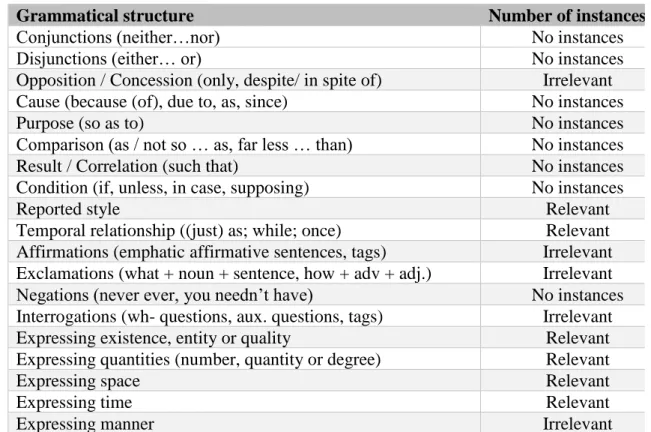
Bachillerato. The result of this analysis can be seen in Table 1, below. Items that are listed as “Irrelevant” have appeared less than five times, whereas those items that are labelled as “Relevant” have appeared five or more times, so we have considered that they can be exploited for the students’ learning of these structures.
As we can see by the results, many of the items listed by the curriculum are either
not used in this reader, or they are not included a sufficient number of times. This is
probably due to the simplification process undergone, in which many of the complex
structures have been simplified, instead including simpler sentences. The question that
arises here is the following: if we compare these results to the ones in the Eli Readers
18
that do appear, we can see that most of these are structures which are quite common, and
thus they are frequently used.
If we move on to the analysis of the verbal tenses, we have used the two first
chapters as a sample, as well as the Prologue. The analysis of these has been compiled
into the following table, from which we have created a visual graph to illustrate the results
we have obtained.
As we can see below, the tense that has been used the most is the past simple tense
due to the fact that the story is told by Frankenstein himself. This was expected when
carrying out the analysis, given that this also happens in the original version. The next
tense that appears frequently has a much lower number of instances: from 233 instances
in the case of the past simple, to 48 in the case of the verbs in their infinitive form. Finally,
the third most-frequent verbal tense that appears in this reader is the gerund. This is
surprising, given that this is a tense that would normally be expected to appear less
frequently than “easier” ones, e.g. the present simple tense.
Grammatical structure Number of instances
Conjunctions (neither…nor) No instances
Disjunctions (either… or) No instances
Opposition / Concession (only, despite/ in spite of) Irrelevant
Cause (because (of), due to, as, since) No instances
Purpose (so as to) No instances
Comparison (as / not so … as, far less … than) No instances
Result / Correlation (such that) No instances
Condition (if, unless, in case, supposing) No instances
Reported style Relevant
Temporal relationship ((just) as; while; once) Relevant Affirmations (emphatic affirmative sentences, tags) Irrelevant Exclamations (what + noun + sentence, how + adv + adj.) Irrelevant Negations (never ever, you needn’t have) No instances Interrogations (wh- questions, aux. questions, tags) Irrelevant
Expressing existence, entity or quality Relevant
Expressing quantities (number, quantity or degree) Relevant
Expressing space Relevant
Expressing time Relevant
Expressing manner Irrelevant
If we focus now on Figure 3, we can see a graph showing the aspects of these
verbs. We can see how the vast majority of the verbs are simple – we expected a higher
number of these verbs. However, only 10 verbs are progressive, and only 12 are perfect,
20
which is a very large difference. This also portrays the simplification process, since the
original Frankenstein is written in a complex Romantic style.
Regarding the headwords, if we go into the Burlington Bookswebsite, we can see
that Frankenstein is listed under the Stage 4 readers group, and it includes between 1700 and 2200 headwords, which is a rather vague and general figure. Next, if we analyse the
sentence length and complexity, we can see that the sentences are quite simple, in general.
Complex sentences include coordination with conjunctions such as “and”, “but”, and “so”; subordination with temporal, relative and spatial clauses (using pronouns such as “when”, “which”, and “where”, respectively), among others. In general, however, we can
see how the sentences are very segmented and simple:
One day, we passed a poor farm and started to talk to the farmer and his wife. The
couple had five children. One of the children looked very different from the others.
She was not dark and strong like them, but fair-haired and very delicate. (O’Brien,
2013, p. 9)
This example shows how the sentences have undergone a simplification process,
which in this case gives the excerpt a “poor” quality. If we go to the original version to
compare, we can see that Shelley wrote the following paragraph:
She found a peasant and his wife, hard working, bent down by care and labour,
distributing a scanty meal to five hungry babes. Among these there was one which
attracted my mother far above all the rest. She appeared of a different stock. The four
others were dark-eyed, hardy little vagrants; this child was thin and very fair. Her hair
was the brightest living gold, and despite the poverty of her clothing, seemed to set a
crown of distinction on her head. Her brow was clear and ample, her blue eyes
cloudless, and her lips and the moulding of her face so expressive of sensibility and
sweetness that none could behold her without looking on her as of a distinct species,
a being heaven-sent, and bearing a celestial stamp in all her features. (Shelley, 1831,
p.28)
2) Level II
If we continue onto Level II, we are going to establish a comparative between the
1831 version of Frankenstein and the graded reader, which is based on this version, rather than the original one of 1818. We are going to analyse the main events that are described,
Before commenting on any specific aspects that have been adapted, we are going
to see a table relating each chapter in the Burlington Booksversion with the chapters in
the original work.
Mary Shelley’s Frankenstein (1831) Burlington Books adaptation
Letters I – IV Prologue
Chapters 1 – 3 Chapter 1
Chapters 4 – 5 Chapter 2
Chapters 5 – 6 Chapter 3
Chapters 7 – 8 Chapter 4
Chapters 9 – 11 Chapter 5
Chapters 12 – 14 Chapter 6
Chapters 15 – 16 Chapter 7
Chapters 17 – 18 Chapter 8
Chapters 19 – 20 Chapter 9
Chapters 21 – 22 Chapter 10
Chapters 22 – 23 Chapter 11
Chapter 24 (including Walton’s last letters) Chapter 12 Table 2: Burlington: correlation between chapters
First of all, the graded reader is divided into twelve chapters. Every three chapters,
there are a series of activities, which we will analyse later on. Thus, it makes sense to
think that the book has been combined into twelve chapters, so that the activities appear
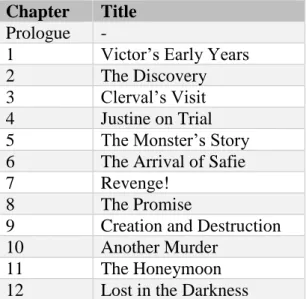
consistently after chapters 3, 6, 9 and 12, finally. Each chapter has an added title, which
describes the main event that takes place. In Table 2, we can see the title assigned to each chapter. These titles have been added by O’Brien, the author of this retelling.
Chapter Title
Prologue -
1 Victor’s Early Years
2 The Discovery
3 Clerval’s Visit
4 Justine on Trial
5 The Monster’s Story
6 The Arrival of Safie
7 Revenge!
8 The Promise
9 Creation and Destruction
10 Another Murder
11 The Honeymoon
12 Lost in the Darkness
22
Regarding the first pages in the reader, there is an “Introduction” section, written
in Spanish, Catalan, Basque and Galician, including some bibliographical information
about the author, as well as some facts about the work itself. Then, we can see how the
letters that Walton writes to Mrs. Saville, his sister, in which he explains what he is doing
in a ship in the North Pole, and which are a contextualisation of the work, have been
concisely summarised in the adaptation into four paragraphs, which have been titled
“Prologue”. The letter format used by Shelley is lost in the reader, turning it into a
straight-forward narrative.
Another important adaptation we can find with regards to the content can be found
in the fourth chapter of the graded reader (O’Brien, 2013). In this chapter, Justine is being
tried after being accused of having killed Victor’s younger brother, William. The different
pieces of evidence that are considered in order to convict her are listed, using bullet points,
and thus breaking with the narrative format too. This is probably done in order to ensure
that the students understand these aspects correctly, rather than explaining each one of
the points as the original presents them. Nevertheless, it comes out as a rather “strange”
change.
In Chapter 5, in the adaptation, we see how Victor, very much affected by the fact
that Justine was hanged for a murder that she did not commit and which, in fact, was
perpetrated by Frankenstein’s monster, decides to go on a trip to the mountains in
Chamonix and Mont Blanc. There, he meets the creature, who starts to tell him what he
experienced. In her original work, Shelley introduces a whole new chapter, in which the
narrator is the monster, and the story thus has a first-person narrator. In the adaptation,
there is a break in-between the chapter, and the monster begins his narration. The
first-person narrator is kept here, probably because it does not difficult the reading at all – in
fact, it makes the reader understand better the events that unfolded.
The following chapter, Chapter 6, contains the part where the monster sees the
family in the cottage, and he wants to belong to it. Safie, the young man’s fiancée, arrives,
and here, we can see a change from the original onto the adaptation. In the original, we
read Safie’s story, which includes some elements related to the Islam and Turkish society,
in tune with the Orientalism in vogue in Romantic Britain. Here, we see some elements
that may seem shocking to a younger audience, where Safie talks about harems, and to
how she defied her father’s authority to go and join Felix, whom she loves. In the graded
thought it was best to leave it out, both because it was not too relevant for the story itself,
and also to avoid the learners from getting mixed up with the different narrators.
Finally, another change we can see appears at the end of the novel, in the last
chapter. Here, we see how Victor Frankenstein finishes telling his story to Walton, and
he eventually dies. The point of view moves now, back to Walton, who explains, by
writing letters to his sister, what happens next. In the graded reader, nevertheless, we do
not get this change, but we get a third-person, external narrator.
3) Level III
The last level we have is the one related to the activities, materials and resources
included in the graded readers. In the case of the adaptation published by Burlington
Books, we have five different elements to analyse: the visual aids and general format, the activities, the media provided, the glossary at the end, and the “Cross-Curricular Focus”.
With regards to the general format of the reader, it includes colourful images that
help the learners picture the action in their heads. Before the story starts as such, we get
a page where there are images of the different characters with their names, so that students
become familiar with the main characters who will be appearing in the story.
Next, we have the activities, which are divided into two different groups: the
pre-reading activities and post-pre-reading activities. The pre-pre-reading activities are notably
simple: the first one deals with vocabulary that may appear further on in the text, and the
second one is a sort of “opinion” exercise, where students are given a series of statements,
and they have to explain what their position is. For example, the first statement they have
to comment upon is the following: “Great knowledge brings great responsibility”. The
vocabulary activity here is probably a way to trigger students’ previous knowledge, so
that they do not have as many problems when reading as they would if they did not answer
this activity. On the other hand, the second activity is more speaking-focused, and it could
be exploited by the teacher in question in order to raise aspects to debate which will be
key to the story.
The other set of activities included here are post-reading activities: after every
three chapters, there are around four to five activities. Most of them are either focused on
vocabulary, or reading comprehension. Some activities require the students to write long
answers in their notebooks, so they have to practise writing as well, and there are also
24
Moreover, in these sections, we find that the reader includes “fun facts”, which expand slightly the learners’ knowledge. These small texts include information about either the
book, vocabulary, or other aspects related to culture.
With regards to the media provided, students have an Internet link written down
in the reader, and if they look it up, it takes them to the Burlington Bookswebsite, where
they can listen to the different chapters, and they can also complete some activities on the
website. This is an alternative to the traditional format of graded readers, which typically
included a CD at the back, for learners to play.
The glossary included at the end of the reader has the following format: it has five
different columns, the first one with vocabulary words in English, and then the
translations into Castilian Spanish, Catalan, Basque and Galician. Some other readers,
instead of incorporating the translation, include a short definition. The glossary included
here is organised in alphabetical order, and it includes words from all categories. It
includes a total of 57 words, which are not marked in bold or underlined in the original
text, so students do not have a way to know which words are included in the glossary,
unless they check it out.
Finally, at the end of the reader, we have a section named “Cross-Curricular
Focus”. This section includes some readings about “Medical Ethics” (the text here deals with grave robbing) and “Cloning”. After both texts, there are a few activities, which only
work on the student’s reading comprehension. These activities are either “True or False”
activities, or putting statements into the correct order. These texts, moreover, include
some vocabulary that did not appear in the rest of the book itself, and there is a small
glossary at the bottom of each page, with a few words that may be more difficult for
learners to understand.
b. Eli Readers
The second reader to be analysed is the one published by Eli Readers, which has
144 pages in total, which is more than double the pages in the Burlington adaptation. It
was adapted by Elizabeth Ferretti, and the first edition of this reader was first published
in 2009. This, as well as the previous reader, includes images depicting the story, as well
as an audio CD at the back, which we will briefly comment upon in the Level II section.
Eli Readers are described as “a beautifully illustrated series of timeless classics and
1) Level I
In this level, just as with the previous reader, we are going to begin by analysing
the grammatical structures included, comparing these with the curriculum in Bachillerato. As we previously explained, those items listed as “Irrelevant” have appeared less than
five times, whereas if there are items that have shown up five times or more, they will be
classified as “Relevant”. The results from this analysis can be seen on Table 4 below.
We can appreciate how many of the structures appear a relevant number of times for
students to really take advantage of them. At the same time, there is only one case where
the structure does not appear at all. This means that, even though if the structures do not
appear frequently enough for students to apply and learn them, the teacher could direct
their attention towards these too.
Moving on to the analysis of the verbal tenses, we can first see that there are many
more verbs than in the Burlington reader, which is due to the fact that it has fewer pages.
In Figure 4, we can see how, just as in the previous reader, most of the verbs are in the
past simple, because almost the entirety of the story is told by Victor Frankenstein.
Nevertheless, we can also appreciate more variety, since we also have other tenses, e.g.
Grammatical structure Number of instances
Conjunctions (neither…nor) No instances
Disjunctions (either… or) Irrelevant
Opposition / Concession (only, despite/ in spite of) Relevant
Cause (because (of), due to, as, since) Relevant
Purpose (so as to) Irrelevant
Comparison (as / not so … as, far less … than) Relevant
Result / Correlation (such that) Relevant
Condition (if, unless, in case, supposing) Irrelevant
Reported style Relevant
Temporal relationship ((just) as; while; once) Relevant Affirmations (emphatic affirmative sentences, tags) Irrelevant Exclamations (what + noun + sentence, how + adv + adj.) Irrelevant
Negations (never ever, you needn’t have) Irrelevant
Interrogations (wh- questions, aux. questions, tags) Relevant
Expressing existence, entity or quality Relevant
Expressing quantities (number, quantity or degree) Relevant
Expressing space Relevant
Expressing time Relevant
Expressing manner Relevant
26
gerund, infinitive, past perfect, past continuous or present simple. This can give way to
the teacher to ask students to focus more on these tenses in particular. Other tenses, such
as the conditional, do not appear so frequently. This is expected, given that the conditional
tense is less used than other ones.
Finally, we are also going to analyse the aspect of these verbs, just as we did with
the Burlingtonversion. Figure 5 below shows that, just as in the previous reader, most of
the verbs are simple, and there are very few progressive and perfect verbs. With regards
to this aspect, the reader would lack some variety, as we will analyse in the Discussion
section.
The next element to be analysed are the headwords, as well as the sentence length
and complexity. With regards to the headwords, this graded reader is classified under the
label “Stage 4”, which corresponds to the B2 Level established by the Common European
Framework of Reference for Languages, and is thus classified as having 1800 headwords. The sentences in this reader are simpler than the original, as was expected. However, they
do have a certain degree of complexity. If we use the passage we saw in the Burlington
edition, we can see how the sentences are longer and more complex:
My mother liked to help poor families and would visit them when we travelled, to
give them money. It was on one of these visits that she found a child who had the most
beautiful blond hair. Indeed, her hair was of the brightest gold. She looked so adorable
and sweet (Ferreti, 2009, p. 15).
As we can see, the simplification process in this reader is less noticeable when
regarding sentence structure. Nevertheless, there has been a significant simplification
with regards to the content, given that this edition omits the fact that Elizabeth was one
of five siblings. This will be studied later on, in the next level.
In order to see how the simplification process has maintained some of the elements
in the original work, we have also included the first paragraph of the letter Frankenstein
receives, announcing that his brother William has been murdered:
“My dear Victor,
Your brother William is dead! William has been murdered!
I must tell you how it happened. Elizabeth and your two brothers were walking one
evening when they decided to play a game of hide and seek. William ran off to hide,
but did not return. We spent the night looking for him. At about five in the morning I
discovered the lifeless body of my lovely boy. He had been strangled. (…)” (Ferreti,
2009 p. 32)
In this letter, we can clearly see that there is a reminiscence of the style employed
by Shelley in her original work. The sentence “William ran off to hide, but did not return”
28
conjunction “but”. In the second sentence, in fact, the subject is omitted, given that it is “William”. This particular paragraph in the original version is longer and has more
description in it, apart from there being some changes in the content. Nevertheless, the
style in this reader, as we said above, is not as simple as expected.
2) Level II
Moving on to Level II, we are going to analyse the major differences in content.
First of all, as we did with the Burlingtonreader, we are going to see a comparative table
where we see how the chapters have been organised in the reader. If we analyse Table 5,
which shows the correlation between the chapters in the original version of Frankenstein
and the ones in the Eli Readers edition, we can see that there is an uneven grouping of the
chapters, i.e., some of the chapters in the graded reader include three different chapters
(e.g. Chapter 2), whereas others only include just one (e.g. Chapter 6). It is true that there
are chapters that might be longer, which may have prompted the editor to group the
chapters in this way. Moreover, the reason these chapters have been grouped in this way
is probably a content-related one: the graded readers is organised according to the events
that take place, as we will see next.
Mary Shelley’s Frankenstein (1831) Eli Readers adaptation
Letters I – IV, Chapters 1 – 3 Chapter 1
Chapters 4 – 6 Chapter 2
Chapters 7 – 10 Chapter 3
Chapters 10 – 16 Chapter 4
Chapters 16 – 20 Chapter 5
Chapters 21 Chapter 6
Chapters 22 – 23 Chapter 7
Chapters 23 – 24 Chapter 8
Walton, in Continuation Chapter 9
Table 5: Eli Readers: correlation between chapters
In this graded reader, we can find the same characteristic as in the one by
Burlington: each chapter has a sort of subtitle, describing the main event that takes place
in that chapter. This is probably done as an aid for students who might not be familiar
with the story. We can see in Table 6 the titles each chapter has been assigned by the
Chapter Title
1 A Mysterious Visitor
2 Where Does Life Come From? 3 The Most Unhappy of All Men 4 I Was Cold, Alone and Afraid 5 Hatred Filled My Heart
6 The Storm at Sea
7 The Wedding
8 Journey to the North
9 Journey’s End
Table 6: Eli Readers: subtitles in each chapter
As we can see in the table above, the titles either add some intrigue to the chapter,
or they describe the main events that take place. Learners might feel the need to discover
what these refer to, and thus read each chapter with more interest. This would be related
to one of Lazar´s approaches (1993), where she understands literature as a means for
personal enrichment.
Analysing the way in which the graded reader might incorporate adaptations from
the original version, we can first see that the first couple of pages in the reader are some
drawings of the main characters. This has probably been included in order for students to
start getting acquainted with the different characters. Next, we can see how, in Chapter 1,
the letter format Shelley uses in order to introduce the setting is maintained in the
adaptation. The letters Walton writes, which are addressed to his sister, are summarised,
but are faithful to the original version.
Once the letters end, we get a change in the narrative frame, which switches onto
Frankenstein’s story. In the graded reader, it includes a short title: “Victor’s Story”. Here,
we can find a difference between the original work and the adaptation, which we
commented upon in the previous section: when Frankenstein’s parents decide to adopt
Elizabeth Lavenza, in the original work she is described as one of five siblings, who
stands out because she is adopted. In the Eli Readers version, Elizabeth is presented as an
adopted child who has no siblings. It is also worth commenting the fact that, as with the
Burlington edition, this version of the reader is based on the 1831 version of Frankenstein, since Elizabeth is adopted, and not Frankenstein’s cousin.
At the end of the second chapter in the reader, Elizabeth sends Frankenstein a
30
Ingolstadt for over two years. The letter, which in the original version is quite complete,
is summarised here, by using the reported speech structure.
In Chapter 3, Justine’s trial is narrated. In the original version of Frankenstein, after she has been wrongfully charged for the murder of Victor’s younger brother,
William, Frankenstein and Elizabeth visit her in her cell, given that she used to work for
the family, and they believe she is innocent (in fact, Frankenstein is quite sure it was his
monster that murdered William). This visit is omitted in the Eli Readersversion, probably
due to the fact that it is quite long, and it does not really affect the course of the story
much.
In Chapter 4, in which Frankenstein’s encounter with the monster is narrated, we
can see another clear change in the narrative frame – the monster tells his story to
Frankenstein from the moment he was created. In here, we can also find an interesting
change: Safie’s story, which is quite detailed in the original version, is omitted in this one
as well. There could be two reasons for this change: first of all, just as it happened with
the Burlingtonedition, it could just have been a matter of space and relevance, given that
it is not even a secondary story, but a tertiary one (it is a story inside the monster’s story, which is at the same time inside Frankenstein’s story). However, Safie’s story includes
topics which may be controversial, such as slavery and the treatment to women in some
specific countries. This could have been a strategy to avoid students from focusing on this
topic, or to even get the wrong idea about them.
Continuing with Chapter 4, we can see that, when the monster narrates his
encounter with William, the adaptation is almost as violent as the original work, and there
has been no change here either. Nevertheless, it is necessary to keep in mind the fact that
the adaptations we are analysing are written for Second Year of Bachillerato students, who are almost adults. If the adaptation were written for younger students, there might
have been less violence.
The next remarkable aspect in the adaptation occurs in Chapter 6, where Victor
narrates his journey to England and Scotland, and the murder of his best friend, Clerval.
In the original work, Frankenstein stops telling his story to Walton, because he needs to
take a break, as he is very much affected by Clerval’s death, and he needs to rest before
he can tell him about this tragedy. In the Eli Readersversion, we find that this break is
a formal point of view: learners could see how the style changes, and they might also be
reminded that what they are reading is what Frankenstein is telling Walton, so it is a way
to bring the action back to the beginning.
Finally, in the ninth chapter, we can see how the graded reader re-incorporates the
letter format we found at the beginning, thus keeping the same generic conventions that
Shelley used for this last section of her work.
3) Level III
The last level we are going to analyse is Level III, where we will study the general
format of the book, along with its visual aids. We will also analyse different additional
resources presented in the graded reader, including the glossary, the activities, the media
provided, any extra-readings that are included at the end, and the last section of the book,
called “Syllabus”.
First, with regards to the general format of the reader, we can see it includes
colourful images that might help the students when reading by helping them imagine what
is going on. At the same time, it is necessary to say that these images are quite dark, and
they could even be linked to a Romantic aesthetics, given that there are many depictions
of nature, cold and foreign locations, as well as dark places. As we mentioned before, the
first two pages include drawings of the different characters and their names.
With regards to the glossary, there is not a compendium of vocabulary words at
the end of the reader as such – instead, there is a small section at the end of every page,
where difficult words are defined. It is curious, given that they are not translated into
Spanish, but rather they include a definition in English or a synonym. This is useful, as it
allows students to learn twice as much: they can learn the meaning of the word included
in this section, and they can also learn what other words they can use as synonyms.
Moving on to the activities presented in this reader, there are (just as with the
Burlington reader) “Before reading” activities, “After reading” activities each chapter,
and also some final activities, which we will discuss later on, because they are related to
the additional readings provided.
It is quite noteworthy to see the way the activities are presented, since every
32
activities per chapter, which is a high number. Also, not all the activities are the same:
there are “classic” matching activities or fill-in the blanks activities, for example, but there are also more “non-conventional” activities, such as a word search, or writing
exercises in which the students have to fit some contents presented in the story into text
messages, with a word limit. The activities are very well-explained, and they are also
quite useful for the teacher to direct the class (especially the “speaking” activities, which
give room for discussion).
Analysing the last pages of the reader, we can see that there are eight pages
including additional readings. The texts included deal with Mary Shelley and her life, but
there are also more texts dealing with the origin of her work, the major themes that this
work explores, and the way in which Frankenstein has influenced popular culture as well as history. This is very interesting, given that it provides students with some knowledge
about the original work, thus expanding their view on literature, and also fostering their
interest in reading and classic books.
With regards to the media provided, this graded reader includes a CD at the back,
with recorded extracts from the reader. This CD is also useful for the listening activities,
and students can download the full text in MP3 format if they head over to the official Eli
Readers website.
Finally, the last section of the book is titled “Syllabus”, and it contains a list of all
the grammatical aspects included in the reader, which is also useful when deciding
whether to use it or not for a certain purpose: the teacher can see clearly if this book is
5.
DISCUSSION
In this section, we are going to compare the results of the analysis of both readers
so as to establish which one would be the best one to use in an EFL classroom. The
comparison is going to follow the same structure we have used in the analysis: both
readers are going to be compared according to each level, establishing the strong and
weak points of each one of them.
a. Level I
First, we are going to see the results from the analysis of Level I. In the case of
the Burlingtonedition, we can first see that the reader itself is shorter than the one by Eli
Readers. If we focus on the grammatical structures employed successfully, we can see
that the Burlington edition uses less grammatical structures included in the curriculum
for Second Year of Bachillerato, whereas the Eli Readers one does include many more instances of these structures.
34
In the case of the verbs included, due to the length of both books, the Eli Readers
edition includes more verbs than the Burlington one. In order to compare them, we are
going to include the percentages of each tense in a graph (Figure 6).
As we can see, the percentage of verbal tenses is more or less similar; however,
we can see how the Eli Readers edition (in yellow) has more different tenses than the
Burlingtonone (in orange). In fact, the former has 11 different tenses, whereas the latter
only includes 8. In both readers, the past simple tense is the most used one, and the
infinitive is the second most used. The past tense is widely used, as we explained above,
because Frankenstein tells his story to Walton, and so he has to use the past tense. The
infinitive is widely used as well because there are many sentences which have these verbs
as subjects – this, in fact, is a rather complex construction.
With regards to the sentence length and complexity, the Burlington edition has
been simplified to a degree where the reading is somehow hindered by all the constant
stops. Students of Second Year of Bachillerato should have the enough proficiency to read more complex sentences, such as the ones presented in the Eli Readersadaptation.
Moreover, and in connection to the grammatical structures, this latter edition includes
structures that are useful for the students, even though they may seem to be more complex
at first. This is very significant when considering the Input Hypothesis formulated by
Krashen (1982). Students will be more likely to acquire these structures, which they have
been learning throughout their education.
Finally, the letter format in the original work by Shelley has not been kept in the
Burlingtonedition, which somehow is a loss for the learners, since they could study that
particular genre and style. In the Eli Readersadaptation, however, we do find this format,
both at the beginning and at the end of the book.
If we were to pick one of the readers, we can see how, in terms of the variety in
the grammatical structures, as well as the verbal tenses and the sentence length and
complexity, the most recommendable reader to use would be the Eli Readers edition.
Looking at Krashen’s Comprehensible Input Hypothesis, it can be argued that having more variety and more complex sentences would ensure that students acquired that “+1”
Krashen describes, which would be what they acquired by using their previous