M
I
NTRODUCTIONFormulated aquaculture diets generally contain 40–50% fish meal because of its high nutritional value; however, due to the constant increase in price, limited production, and growing demand, fish meal has become the most expensive feed ingredient and a limited resource. Research on the nutrition of aquatic organisms has therefore focused on
I
NTRODUCCIÓNLas dietas utilizadas en acuacultura son diseñadas generalmente con un contenido del 40% al 50% de harina de pescado. Este tipo de harina tiene características nuctriciona-les excelentes, pero se ha convertido en un recurso limitado debido a su creciente demanda; además, es el insumo más costoso debido al incremento constante de su precio y a su
Apparent digestibility of dry matter, crude protein, and amino acids of six
rendered by-products in juvenile Litopenaeus vannamei
Digestibilidad aparente de materia seca, proteína cruda y aminoácidos de seis
subproductos de rastro en juveniles de Litopenaeus vannamei
David Alonso Villarreal-Cavazos1*, Denis Ricque-Marie1, Alberto Peña-Rodríguez1,
Martha Nieto-López1, Mireya Tapia-Salazar1, Andreas Lemme2, Julián Gamboa-Delgado1,
Lucía Elizabeth Cruz-Suárez1
1 Programa Maricultura, Universidad Autónoma de Nuevo León, Cd. Universitaria, CP66450 San Nicolás de los Garza, Nuevo León, México.
2 Evonik Degussa GmbH,Rodenbacher Chaussee 4, D-63457 Hanau (Wolfgang), Germany. * Corresponding author. Email: [email protected], [email protected]
ABSTRACT. Apparent digestibility coefficients (ADC) of dry matter, crude protein (CP), and amino acids (AA) were evaluated in diets with six rendered by-products used to feed juvenile Pacific white shrimp: two poultry meals (poultry meal 1, 69% CP; poultry meal 2, 72% CP), two feather meals (89% CP), one blood meal (96% CP), and one pork meal (57% CP). Experimental diets were formulated with 30% of the test ingredient and 70% of a commercial diet supplemented with 1% ofchromium oxide as inert marker. AA contents in ingredients, diets, leached diets, and feces were determined by high performance liquid chromatography. Preprandial AA losses attributed to leaching were higher in the blood meal diet (15%) and pork meal diet (10%). Poultry meal diets 1 and 2 showed mean AA losses of 3% and 5%, respectively, while the reference diet had a mean AA leaching of 6%. The AA that had the highest leaching rates were lysine (21%), methionine (15%), and histidine (12%). The ADC of dry matter was higher for poultry meals 1 (70%) and 2 (73%), followed by pork meal (69%), feather meals (61%), and blood meal (57%). The digestibility of CP was higher for poultry meals (78–80%), followed by pork meal (76%), and blood meal and feather meals (65–67%). The digestibility of CP in the reference diet (83%) was higher than that observed for all the animal by-product meals except the poultry meals. The ADC of the sum of AA adjusted for nutrient leaching fluctuated from 65% for blood meal to 80% for poultry meals.
Key words: amino acids, digestibility, shrimp, rendered by-products.
RESUMEN. Los coeficientes de digestibilidad aparente (CDA) de materia seca, proteína cruda (PC) y aminoácidos (AA) fueron evaluados para seis subproductos de rastro utilizados para alimentar juveniles de camarón blanco del Pacífico: dos tipos de harina avícola (harina avícola 1, 69% de PC; harina avícola 2, 72% de PC), dos tipos de harina de pluma (89% de PC), un tipo de harina de sangre (96% de PC) y un tipo de harina de cerdo (57% de PC). Las dietas experimentales incluyeron 30% del ingrediente prueba y 70% de una dieta comercial suplementada con 1% de óxido de cromo como marcador inerte. El contenido de AA en los ingredientes, las dietas, las dietas lixiviadas y las heces fue analizado por cromatografía líquida de alta resolución. La pérdida preprandial de AA por lixiviación en agua fue mayor en las dietas con harina de sangre (15%) y con harina de cerdo (10%). Las dietas con harina avícola 1 y 2 presentaron pérdidas promedio de nutrientes del 3% y 5%, respectivamente, mientras que la dieta de referencia presentó pérdidas promedio del 6%. Los AA que se perdieron en mayor medida fueron lisina (21%), metionina (15%) e histidina (12%). Los CDA de materia seca fueron mayores para la harina avícola 2 y 1 (73% y 70%), seguidos de la harina de cerdo (69%), los dos tipos de harina de pluma (61%) y la harina de sangre (57%). La digestibilidad de PC fue más alta para los dos tipos de harina avícola (78–80%), seguidas de la harina de cerdo (76%) y la harina de sangre y las harinas de pluma (65–67%). La digestibilidad de PC de la dieta de referencia (80%) fue mayor que la de los subproductos de rastro excepto las harinas avícolas. Los CDA de la suma de AA ajustados para corregir la lixiviación de nutrientes oscilaron desde 65% para la harina de sangre hasta 80% para las harinas avícolas.
searching for new ingredients that can be used as a substitute for fish meal.
Several studies have been carried out using rendered animal by-products (Cheng et al. 2004, Hernández et al. 2010, Jayathilakan et al. 2012, Luo et al. 2012). These products are considered to have the potential of replacing fish meal in diets for aquatic animals. They include poultry by-product meal, pork meal, feather meal, blood meal (poultry, pork, or beef), and meat and bone meal. The protein and amino acid contents of these by-products are well charac-terized, and the cholesterol content is important in the formu-lation of shrimp feeds. Moreover, the global importance of the poultry, swine, and cattle industries ensures the supply of these products.
Substituting these ingredients for fish meal in diets for the Pacific white shrimp, Litopenaeus vannamei, has generally proved successful (Davis and Arnold 2000, Cruz-Suárez et al. 2007); however, there is little information on the digest-ibility of nutrients, especially amino acids, provided by these ingredients (Yang et al. 2009, Terrazas-Fierro et al. 2010, Liu et al. 2013). Understanding the digestibility of amino acids is essential to optimize shrimp diets, reduce nutrient pollution, and lower feed costs. The present study thus aimed to determine the in vivo apparent digestibility coefficients of dry matter, crude protein, and amino acids of six rendered by-products for juvenile L. vannamei, considering nutrient leaching in the estimations.
M
ATERIALSANDMETHODSRendered by-products
Six rendered by-products were evaluated: two pet-grade poultry by-product meals, two feather meals, one blood meal, and one pork meal. These ingredients were obtained from food plants and distributers.
Elaboration of the experimental diets
The diets were elaborated following the method described by García-Pérez et al. (2013). The ingredients were mixed in a KitchenAid mixer for 10 min and for another 15 min after warm water (30%) was added. The wet mash was passed through a Torrey meat grinder with 1.6 mm diameter holes at a rate of 40 min kg–1, reaching temperatures of 75–80 ºC. The spaghetti-like strands were dried in an oven at 100 ºC for 8 min and left overnight at room temperature before packing.
Feeding trial and feces collection
The digestibility of the ingredients was determined according to Cho and Slinger (1979). The experimental diets contained 30% of the test ingredient and 70% of a reference diet (Cruz-Suárez et al. 2009). The trial was carried out in a closed recirculating artificial seawater system at the
producción limitada. La investigación en nutrición de organismos acuáticos se ha centrado en buscar nuevos ingre-dientes que sirvan como reemplazo para el uso de harinas de pescado.
Existen varios estudios sobre el uso de subproductos de rastro (Cheng et al. 2004, Hernández et al. 2010, Jayathilakan et al. 2012, Luo et al. 2012). Estos subproductos son considerados ingredientes potenciales para sustituir a la harina de pescado en dietas para animales acuáticos. Entre estos ingredientes se encuentran la harina avícola, la harina de cerdo, la harina de pluma, la harina de sangre (ave, cerdo o res) y la harina de carne y hueso. El contenido de proteína y aminoácidos en este tipo de subproductos está bien caracterizado, y el contenido de colesterol es importante en la formulación de los alimentos para camarón. En cuanto a disponibilidad, no existe problema de abasto de estos subpro-ductos debido a la magnitud global de las industrias avícola, porcina y ganadera.
El uso de estos ingredientes para reemplazar a la harina de pescado en dietas para camarón blanco del Pacifico, Litopenaeus vannamei, ha sido generalmente exitoso (Davis y Arnold 2000, Cruz-Suárez et al. 2007); sin embargo, existe poca información relacionada con la digestibilidad de los nutrientes aportados por estos ingredientes, sobre todo la de los aminoácidos (Yang et al. 2009, Terrazas-Fierro et al. 2010, Liu et al. 2013). El conocer la digestibilidad de los aminoácidos es crítico para optimizar las dietas en la camari-cultura, reducir la contaminación del ambiente por exceso de nutrientes y bajar los costos de las dietas. El objetivo del presente estudio fue determinar los coeficientes de digestibi-lidad aparente (in vivo) de materia seca, proteína cruda y aminoácidos de seis subproductos de rastro utilizados enla alimentacíon de juveniles de L. vannamei, considerando en las estimaciones la lixiviación de nutrientes en el agua.
M
ATERIALESYMÉTODOSSubproductos de rastro
Seis subproductos de rastro fueron evaluados: dos tipos de harina avícola grado mascota, dos tipos de harina de pluma, un tipo de harina de sangre y un tipo de harina de cerdo. Los ingredientes evaluados fueron obtenidos de plantas de alimento y/o proveedores de ellas.
Elaboración de dietas experimentales
Autonomous University of Nuevo León. Twenty-eight, randomly distributed, 120-L tanks were used, with a water flow rate of 710 mL min–1. Each experimental diet was evalu-ated in four replicate tanks containing 25 juvenile Pacific white shrimp (5.1 ± 0.2 g). The shrimp were fed ad libitum initiating with 10% of the biomass. During seven days, the feces were syphoned off immediately after being excreted until a total of 12 g of fresh feces (per replicate tank) was collected.
Chemical analysis
The bromatological composition of the ingredients, diets, and feces was determined as follows: AOAC methods 930.15, 990.03, 942.05, and 962.09B were used to determine the moisture, crude protein, ash, and fiber contents, respec-tively (AOAC 1997); the Soxhlet method was used to deter-mine the lipid content (Tecator 1997); nitrogen free extract was calculated by difference; nutrient loss in seawater was determined according to Tapia-Salazar et al. (2013); chrome content was determined according to the method described by Bolin et al. (1952) and modified by Cruz-Suárez et al. (2009); and amino acids were determined according to Llames and Fontaine (1994) and Fontaine (2003).
Calculation of digestibility coefficients
The apparent digestibility coefficients (ADC) of the dietary dry matter, protein, and amino acids were calculated using the following equation:
where C and N are the concentrations of chromium oxide and nutrients, respectively, in the diets or feces (dry weight basis). The ADC of the test ingredients were calculated according to Bureau and Hua (2006). The ADC of the diets and ingredients were adjusted considering the percent of nutrient loss in seawater due to leaching (Nieto-López et al. 2011).
Estimating nutrient loss due to leaching
The leaching values obtained after one hour of immersion in seawater were used. To account for the loss of dietary dry matter, protein, and amino acids before being ingested by the animal, the apparent digestibility of dry matter, crude protein, and amino acids was corrected using the equations reported by Cruz-Suárez et al. (2009).
Statistical analysis
The nutrient concentrations (ingredients, diets, leached diets, feces) and ADC were subjected to one-way analysis of
%ADCdiet = 100 100– CdietNdietNfecesCfeces
secados en un horno ventilado a 100 ºC durante 8 min y permanecieron a temperatura ambiente durante una noche antes de ser empacados.
Ensayo de alimentación y recolecta de heces
La digestibilidad de los ingredientes fue determinada siguiendo la metodología descrita por Cho y Slinger (1979). Las dietas experimentales contenían 30% del ingrediente prueba y 70% de una dieta de referencia (Cruz-Suárez et al. 2009). El ensayo de digestibilidad se realizó en un sistema cerrado de recirculación de agua marina sintética, en las ins-talaciones de la Universidad Autónoma de Nuevo León. Se utilizaron 28 tanques de fibra de vidrio de 120 L, distribuidos al azar, con un flujo de agua de 710 mL min–1. Cada dieta experimental fue evaluada en cuatro acuarios replicados con 24 camarones juveniles (5.1 ± 0.2 g) de L. vannamei. Los camarones fueron alimentados ad libitum iniciando con el 10% de la biomasa. Durante siete días, las heces fueron reco-lectadas por sifoneo inmediatamente después de ser excreta-das hasta recolectar un total de 12 g de heces frescas por replicado.
Análisis químicos
La composición bromatológica de los ingredientes, las dietas y las heces fue determinada utilizando los siguientes métodos. Los contenidos de humedad, proteína cruda, ceniza y fibra fueron determinados con los métodos 930.15, 990.03, 942.05 y 962.09B de la AOAC, respectivamente (AOAC 1997). Los lípidos fueron determinados con el método de Soxhlet (Tecator 1997). El extracto libre de nitrógeno fue calculado por diferencia. La pérdida de nutrientes en agua marina fue estimada de acuerdo con la técnica docu-mentada por Tapia-Salazar et al. (2013). El contenido de cromo fue determinado utilizando el método descrito por Bolin et al. (1952) y modificado por Cruz-Suárez et al. (2009). Los aminoácidos fueron determinados según los procedimientos descritos por Llames y Fontaine (1994) y Fontaine (2003).
Cálculo de coeficientes de digestibilidad
Los coeficientes de digestibilidad aparente (CDA) de materia seca, proteína y aminoácidos de las dietas fueron calculados usando la siguiente ecuación:
variance and Duncan’s multiple range test to separate the treatment means into normal and homogenous groups using SPSS v16.
R
ESULTSProximate composition and amino acid content
The proximate composition of the test ingredients varied (table 1): protein content ranged from 57.4% (pork meal) to 95.9% (blood meal), lipid content from 2.2% (blood meal) to 16.1% (poultry meal 1), ash content from 1.92% (feather meal 2) to 25.29% (pork meal), and fiber content from 0.8% (poultry meal 1 and blood meal) to 2.41% (pork meal). Amino acid content (g/100 g dry weight) was highest in blood meal (87.1 g), followed by feather meal 1 (82.9 g), feather meal 2 (78.9 g), poultry meal 2 (61.0 g), poultry meal 1 (57.7 g), and pork meal (48.1 g) (table 1). The total concentration of amino acids analyzed in the experimental diets ranged from 29.9 (reference diet) to 48.4 g/100 g dry weight (blood meal diet) (table 2).
Standard apparent digestibility coefficients
The test ingredients had lower digestibility values than the reference diet (table 3). The ADC of dry matter were sig-nificantly higher for the poultry meals (poultry meal 1, 70%; poultry meal 2, 73%), followed by the pork meal (69%), feather meals (feather meal 1, 62%; feather meal 2, 61%), and blood meal (57%). The digestibility of crude protein was higher for the poultry meals (78–80%), followed by the pork meal (76%), and finally the blood and feather meals (65–67%). The ADC of individual amino acids in the refer-ence diet ranged from 80.7% to 91.4%, except in the case of glycine (77.9%), whereas the ADC of those in the rendered by-products ranged from 36.2% to 85.6%. The feather meals had the lowest ADC of amino acids, the difference being highly significant in most cases. The digestibility of total amino acids differed considerably among the rendered by-products; it was best for poultry meal 2 (81.3%), followed by poultry meal 1 (79.4%), pork meal (75.7%), blood meal (71.5%), feather meal 1 (70.9%), and feather meal 2 (66.3%).
Amino acid losses and apparent digestibility coefficients corrected for nutrient leaching
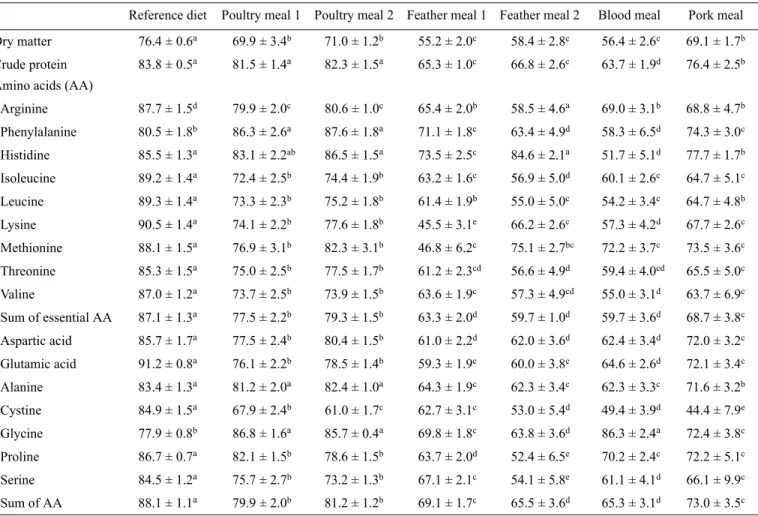
Mean amino acid losses were higher in the blood meal diet (14%) and pork meal diet (11%). The other diets showed mean nutrient losses ranging from 2% to 6%, and the refer-ence diet a mean leaching of 6%. The amino acids that had the highest leaching rates were lysine (21%), methionine (15%), and histidine (12%) (see table 4). The amino acid ADC adjusted for losses due to leaching also varied in rela-tion to the ingredient used to prepare the diet (table 5): the poultry meals had the highest concentrations (poultry meal 1,
perdidos en el agua por efecto de lixiviación (Nieto-López et al. 2011).
Estimación de pérdida de nutrientes por lixiviación
Se utilizaron los valores de lixiviación de las dietas des-pués de una hora de inmersión en agua marina. Para tomar en cuenta las pérdidas de materia seca, proteína y aminoácidos de las dietas antes de ser ingeridas por el animal, se corrigió la digestibilidad aparente de proteína cruda, materia seca y aminoácidos empleando las ecuaciones registradas por Cruz et al. (2009).
Análisis estadísticos
Los valores de las concentraciones de nutrientes (ingre-dientes, dietas, dietas lixiviadas, heces) y los CDA fueron sometidos a un análisis de varianza de una vía y a una prueba del rango múltiple de Duncan para separar las medias de los tratamientos en grupos normales y homogéneos utilizando el paquete computacional SPSS v16.
R
ESULTADOSComposición proximal y contenido de aminoácidos
La composición proximal de los ingredientes fluctuó (tabla 1): el contenido de proteína osciló entre 57.4% (harina de cerdo) y 95.9% (harina de sangre), el contenido de lípidos entre 2.2% (harina de sangre) y 16.1% (harina avícola 1), el contenido de ceniza entre 1.92% (harina de pluma 2) y 25.29% (harina de cerdo) y el contenido de fibra entre 0.8% (harina avícola 1 y harina de sangre) y 2.41% (harina de cerdo). El mayor contenido de aminoácidos por cada 100 gramos de base seca lo presentó la harina de sangre (87.1 g), seguida de la harina de pluma 1 (82.9 g), la harina de pluma 2 (78.9 g), la harina avícola 2 (61.0 g), la harina avícola 1 (57.7 g) y la harina de cerdo (48.1 g) (tabla 1). La concentración total de aminoácidos analizados en las dietas experimentales fluctuó entre 29.9 (dieta de referencia) y 48.4 g/100 g de base seca (dieta con harina de sangre) (tabla 2).
Coeficientes de digestibilidad aparente estándar
80%; poultry meal 2, 81%), followed by pork meal (73%), feather meal 1 (69%), and finally feather meal 2 and blood meal (65%). The adjustments were nil for the feather meals, but the ADC of amino acids were overestimated for the other ingredients: 6% for blood meal, 4% for pork meal, 2% for poultry meal 1, and 1% for poultry meal 2. Lysine (9%) and histidine (6%) were the most overestimated amino acids.
D
ISCUSSIONProximate composition and amino acid content
The proximate composition and amino acid concentra-tions in the different rendered by-products were similar to those previously reported (Novus 1996, Hess et al. 2006). This indicates the constant quality of these ingredients from a nutritional viewpoint.
Apparent digestibility coefficients of amino acids
The ADC of essential amino acids in poultry meals 1 (77%) and 2 (78%) were similar to the value (72%) reported by Yang et al. (2009). Both our poultry meals had similar
de sangre y los dos tipos de harina de pluma (65–67%). Los CDA de aminoácidos individuales en la dieta de referencia oscilaron entre 80.7% y91.4%, excepto la glicina (77.9%), mientras que los de los subproductos de rastro variaron de 36.2% a 85.6%. Los dos tipos de harina de pluma presenta-ron los CDA de aminoácidos más bajos, y la diferencia fue altamente significativa en la mayoría de los casos. La digesti-bilidad de aminoácidos totales fue muy diferente entre los subproductos de rastro; la harina avícola 2 (81.3%) y la harina avícola 1 (79.4%) presentaron mejor digestibilidad, seguidas de la harina de cerdo (75.7%), la harina de sangre (71.5%), la harina de pluma 1 (70.9%) y la harina de pluma 2 (66.3%).
Pérdidas de aminoácidos y coeficientes de digestibilidad aparente corregidos por lixiviación de nutrientes
La pérdida de aminoácidos fue mayor en la dieta con harina de sangre (14% promedio) y en la dieta con harina de cerdo (11% promedio). El resto de las dietas presentaron pérdidas promedio de nutrientes de entre 2% y 6%. La dieta de referencia presentó pérdidas promedio del 6%. Los aminoácidos que se perdieron en mayor medida fueron lisina Table 1. Proximate composition and amino acid (AA) content of the test ingredients.
Tabla 1. Composición proximal y contenido de aminoácidos (AA) de los ingredientes experimentales.
Poultry meal 1 Poultry meal 2 Feather meal 1 Feather meal 2 Blood meal Pork meal
Composition (% dry weight)
Crude protein 68.8 71.7 89.2 89.3 95.9 57.4
Crude fat 16.1 15.4 10.4 12.2 2.2 12.4
Crude fiber 0.80 1.10 2.10 2.15 0.80 2.41
Ash 13.24 10.84 3.62 1.92 3.60 25.29
AA content (g/100 g dry weight)
Arginine 4.4 4.8 5.9 5.7 5.0 3.9
Phenylalanine 2.5 2.6 4.0 4.2 5.7 1.8
Histidine 1.6 1.6 0.9 0.7 4.9 1.1
Isoleucine 2.5 2.7 4.1 4.1 3.8 1.6
Leucine 4.3 4.5 6.5 6.5 9.1 3.1
Lysin 3.9 4.3 2.3 1.6 7.6 2.9
Methionine 1.3 1.4 0.7 0.5 1.3 0.8
Threonine 2.6 2.7 4.1 3.8 4.7 1.8
Valine 3.0 3.2 5.9 6.5 6.2 2.3
Sum of essential AA 26.1 27.8 34.4 33.6 48.3 19.3
Aspartic acid 5.3 5.7 6.1 5.6 8.4 4.2
Glutamic acid 8.4 9.0 9.8 8.8 9.8 6.9
Alanine 4.3 4.6 4.2 4.2 6.9 4.0
Cystine 0.7 0.7 3.8 2.6 1.7 0.5
Glycine 5.7 6.1 6.7 6.2 3.6 6.4
Proline 4.2 4.3 8.4 8.5 4.0 4.6
Serine 3.0 2.8 9.5 9.4 4.4 2.2
mean amino acid ADC (80%); however, histidine and lysine were more digestible in poultry meal 2 than in 1 (histidine, 86% vs 82%; lysine, 81% vs 76%). Terrazas-Fierro et al. (2010) reported an ADC of 88.9% for essential amino acids in a diet for juvenile L. vannamei, which is much higher than our values for poultry meals 1 (77%) and 2 (79%). Liu et al. (2013) also obtained a higher ADC of amino acids in a poul-try meal for juvenile L. vannamei (90%) than that found in the present study (80%). These differences can be attributed to the temperature and type of raw material and processing that can affect the quality of the protein (Cruz-Suárez et al.
(21%), metionina (15%) e histidina (12%) (ver tabla 4). Los CDA de aminoácidos ajustados por lixiviación fluctuaron según el tipo de harina utilizada para preparar la dieta (tabla 5): las concentraciones más altas se presentaron en la harina avícola 2 y la harina avícola 1 (81% y 80%, respecti-vamente), seguidas de la harina de cerdo (73%), la harina de pluma 1 (69%) y, por último, la harina de pluma 2 y la harina de sangre (65%). Los ajustes fueron nulos para los dos tipos de harina de pluma; no obstante, los CDA de aminoácidos fueron sobreestimados para el resto de los ingredientes: 6% para la harina de sangre, 4% para la harina de cerdo, Table 2. Formula, proximate composition, and amino acid (AA) content of the experimental diets.
Tabla 2. Fórmula, composición proximal y contenido de aminoácidos (AA) de las dietas experimentales.
Reference diet
Poultry meal diet 1
Poultry meal diet 2
Feather meal diet 1
Feather meal diet 2
Blood meal diet
Pork meal diet
Formula (g kg–1)
Reference ingredient 1000 700 700 700 700 700 700
Poultry meal 1 – 300 – – – – –
Poultry meal 2 – – 300 – – – –
Feather meal 1 – – – 300 – – –
Feather meal 2 – – – – 300 – –
Blood meal – – – – – 300 –
Pork meal – – – – – – 300
Composition (% dry weight)
Crude protein 34.4 46.0 47.0 52.3 53.8 55.4 43.0
Crude fat 8.7 10.7 10.6 9.0 9.5 5.6 9.8
Crude fiber 3.4 2.4 2.6 3.0 2.1 2.4 2.9
Ash 10.5 11.0 10.3 8.8 7.7 8.1 14.0
Nitrogen-free extract 43.0 30.9 29.5 28.1 28.3 31.5 30.2
Crude energy (cal g–1) 4210 4310 4680 4710 4820 4610 4270
AA content (g/100 g dry weight)
Arginine 2.0 2.8 2.9 3.3 3.2 2.9 2.6
Phenylalanine 1.5 1.9 1.9 2.4 2.4 2.9 1.7
Histidine 0.8 1.0 1.0 0.8 0.7 1.9 0.9
Isoleucine 1.4 1.8 1.8 2.2 2.2 2.2 1.4
Leucine 2.3 3.1 3.1 3.8 3.8 4.7 2.7
Lysine 1.8 2.8 2.6 2.0 1.8 3.4 2.2
Methionine 0.7 0.9 0.9 0.7 0.6 0.8 0.7
Threonine 1.2 1.7 1.7 2.1 2.1 2.4 1.4
Valine 1.6 2.1 2.1 3.0 3.1 3.0 1.4
Sum of essential AA 13.3 18.1 18.0 20.3 19.9 24.2 15.0
Aspartic acid 2.9 3.7 3.8 3.9 3.8 4.7 3.3
Glutamic acid 5.8 6.8 7.0 7.2 6.9 7.6 6.3
Alanine 1.8 2.7 2.7 2.6 2.6 3.4 2.5
Cystine 0.4 0.5 0.5 1.4 1.1 0.8 0.4
Glycine 2.1 3.4 3.5 3.7 3.6 2.6 3.8
Proline 2.2 2.8 2.9 4.2 4.4 2.7 3.0
Serine 1.4 1.9 1.9 3.8 4.2 2.4 1.7
2007). Both our poultry meals were pet grade, but neither Yang et al. (2009), Terrazas-Fierro et al. (2010), nor Liu et al. (2013) specified the quality and/or type of processing. The ADC of phenylalanine in the poultry meal used by Liu et al. (2013) was especially low (55%) compared with our finding (81%); in that same study, Liu et al. (2013) also evaluated a fish meal and the ADC of phenylalanine was very high (98%). This inconsistency may indicate that there was some kind of problem with the determination of phenylalanine in that study. Our ADC of essential amino acids in pork meal (72%) was similar to that obtained by Terrazas-Fierro et al. (2010) for a similar product (77%) tested using the same spe-cies. Our ADC of amino acids in blood meal were lower than those reported by Noreen and Salim (2008) for the carp Labeo rohita,which on average were 12% higher than those found in shrimp. Likewise, the amino acid ADC obtained by Masagounder et al. (2009) for the bluegill Lepomis macrochirus was 25% higher. Gaylord et al. (2008) evaluated the apparent digestibility of essential amino acids in a blood meal for juvenile hybrid striped bass (Morone chrysops × M. saxatilis) and obtained similar values to those found in the
2% para la harina avícola 1 y 1% para la harina avícola 2. La lisina (9%) y la histidina (6%) fueron los aminoácidos más sobreestimados.
D
ISCUSIÓNComposición proximal y contenido de aminoácidos
La composición proximal y la concentración de aminoácidos en los diferentes subproductos de rastro fueron muy similares a los registrados en previos estudios (Novus 1996, Hess et al. 2006). Esto indica que los ingredientes son de calidad constante desde el punto de vista nutricional.
Coeficientes de digestibilidad aparente de aminoácidos
Los CDA de aminoácidos esenciales para la harina avícola 1 (77%) y la harina avícola 2 (78%) fueron similares al valor (72%) registrado por Yang et al. (2009). Los dos tipos de harina avícola fueron muy similares en cuanto a CDA de aminoácidos promedio (80%); sin embargo, los Table 3. Apparent digestibility coefficients (%) of dry matter, crude protein, and amino acids of the reference diet and rendered by-products for Pacific white shrimp (Litopenaeus vannamei).
Tabla 3. Coeficientes de digestibilidad aparente (%) de materia seca, proteína cruda y aminoácidos de la dieta de referencia y los subproductos de rastro para camarón blanco del Pacífico (Litopenaeus vannamei).
Reference diet Poultry meal 1 Poultry meal 2 Feather meal 1 Feather meal 2 Blood meal Pork meal
Dry matter 77.9 ± 0.6a 70.2 ± 3.3b 72.9 ± 1.2b 61.7 ± 2.0c 61.4 ± 2.6c 57.5 ± 2.5d 68.8 ± 1.6b
Crude protein 83.5 ± 0.5a 78.4 ± 1.4b 79.7 ± 1.4b 65.6 ± 1.0c 65.0 ± 2.5c 67.1 ± 1.7c 75.7 ± 2.3b
Amino acids (AA)
Arginine 87.8 ± 1.0a 78.3 ± 2.6b 79.8 ± 1.7b 66.1 ± 2.2c 58.3 ± 4.8d 69.3 ± 3.3c 72.9 ± 3.3c
Phenylalanine 80.7 ± 1.8a 80.5 ± 2.6a 82.1 ± 1.8a 68.5 ± 1.8b 60.2 ± 4.9c 67.0 ± 5.3c 68.4 ± 2.9b
Histidine 85.5 ± 1.3a 81.6 ± 2.0b 85.6 ± 1.4a 68.4 ± 2.3d 79.6 ± 2.0b 65.7 ± 3.6d 76.4 ± 1.5c
Isoleucine 88.7 ± 1.5a 70.4 ± 2.4b 73.3 ± 1.9b 63.0 ± 1.5c 54.2 ± 5.1d 68.5 ± 2.1b 64.1 ± 4.8c
Leucine 89.2 ± 1.4a 71.0 ± 2.3b 73.4 ± 1.7b 60.9 ± 1.9c 53.0 ± 5.0d 64.1 ± 2.7c 64.4 ± 4.5c
Lysine 90.5 ± 1.3a 76.3 ± 1.8c 80.7 ± 1.5b 55.1 ± 2.4e 68.1 ± 2.2d 69.5 ± 3.0d 73.6 ± 2.0c
Methionine 87.8 ± 1.6a 76.8 ± 2.7bc 81.1 ± 2.7b 50.3 ± 5.1d 72.1 ± 2.4c 74.6 ± 3.0c 73.4 ± 3.1c
Threonine 85.3 ± 1.3a 71.7 ± 2.6bc 74.7 ± 1.7b 61.3 ± 2.2e 55.3 ± 4.8f 67.0 ± 3.3cd 64.4 ± 4.7de
Valine 86.6 ± 1.2a 72.4 ± 2.4b 74.1 ± 1.4b 64.1 ± 1.8c 54.6 ± 5.0d 65.9 ± 2.4c 66.4 ± 6.2c
Sum of essential AA 86.7 ± 1.3a 76.5 ± 2.1b 78.9 ± 1.4b 64.2 ± 1.8d 58.8 ± 4.2e 68.1 ± 2.9c 71.2 ± 3.4c
Aspartic acid 85.8 ± 1.4a 74.5 ± 2.4bc 77.5 ± 1.5b 60.7 ± 2.1e 59.5 ± 3.6e 67.0 ± 3.0d 70.7 ± 3.1cd
Glutamic acid 91.4 ± 0.8a 74.9 ± 2.2bc 78.2 ± 1.4b 60.5 ± 1.8e 58.8 ± 3.7e 68.0 ± 2.3d 71.0 ± 3.3cd
Alanine 83.4 ± 1.3a 79.1 ± 1.9b 80.8 ± 1.0b 64.4 ± 1.8e 60.6 ± 3.3d 65.7 ± 2.9d 75.4 ± 2.7c
Cystine 86.7 ± 1.4a 61.0 ± 2.5b 58.3 ± 1.7bc 58.3 ± 3.3bc 51.0 ± 5.6c 58.8 ± 3.2bc 36.2 ± 7.2d
Glycine 77.9 ± 0.8b 83.8 ± 1.5a 82.8 ± 0.3a 68.4 ± 1.7c 61.7 ± 3.4d 67.6 ± 2.9c 79.2 ± 2.8b
Serine 85.0 ± 1.1a 72.0 ± 2.7b 71.2 ± 1.3b 67.7 ± 2.0d 54.3 ± 5.7d 65.5 ± 3.6c 60.0 ± 9.6cd
Proline 87.0 ± 0.7a 80.1 ± 1.4b 77.2 ± 0.6b 63.6 ± 1.9d 52.0 ± 6.3d 63.9 ± 2.5c 76.3 ± 3.6b
Sum of AA 88.5 ± 1.0a 79.4 ± 2.0b 81.3 ± 1.2b 70.9 ± 1.6d 66.3 ± 3.6e 71.5 ± 2.7d 75.7 ± 3.2c
present study, except in the case of the ADC of isoleucine, which was very low (38%) compared with our value (69%); however, in general, the ADC of amino acids in blood meal for shrimp were very similar to the values reported for hybrid striped bass.
Amino acid apparent digestibility coefficients corrected for nutrient leaching
Most of the ADC of amino acids corrected for nutrient leaching to seawater were overestimated considering the ADC of the sum of amino acids. Blood meal was the ingredi-ent that underwingredi-ent the largest adjustmingredi-ent of 6.2% (71.5% to 65.3%). Pork meal was adjusted from 75.7% to 73.0% (2.7%). The adjustment for feather meal 1 was 1.8% and for feather meal 2, 0.8%. The poultry meals did not show changes in the ADC of amino acids. Hence, the blood meal amino acids showed greatest solubility in seawater.
Summary
The ADC of dry matter, crude protein, and amino acids for all six rendered by-products were lower than those obtained for the reference diet, indicating that these ingredients are less digestible than a commercial diet. The
aminoácidos como histidina y lisina fueron más digestibles en la harina avícola 2 que en la harina avícola 1 (histidina, 86% vs 82%; lisina, 81% vs 76%). Terrazas-Fierro et al. (2010) registraron un CDA de aminoácidos esenciales del 88.9% en ingredientes similares utilizados en la alimentación de juveniles de L. vannamei, que es más alto que los valores encontrados en nuestro estudio para la harina avícola 1 (77%) y la harina avícola 2 (79%). Liu et al. (2013) registraron un CDA de aminoácidos del 90% para un tipo de harina avícola utilizada en la alimentación de juveniles de L. vannamei, que es superior al encontrado en el presente estudio (80%). Lo anterior puede estar asociado al tipo de materia prima, la temperatura y el tipo de proceso que afecta la calidad de la proteína (Cruz-Suárez et al. 2007). En el presente estudio, ambos tipos de harina avícola eran de grado mascota, mientras que Yang et al. (2009), Terrazas-Fierro et al. (2010) y Liu et al. (2013) no especificaron la calidad y/o el proceso. Para la harina avícola utilizada en el estudio de Liu et al. (2013), el CDA de fenilalanina fue muy bajo (55%) comparado con el encontrado en el presente estudio (81%); en ese mismo estudio, estos autores también evaluaron un tipo de harina de pescado y el CDA de fenilalanina fue muy alto (98%). Esta inconsistencia podría indicar que en el estudio mencionado se tuvo alguna problemática con la Table 4. Amino acid (AA) losses in seawater (% of initial content).
Tabla 4. Pérdidas de aminoácidos (AA) dietéticos en agua marina (% del contenido inicial).
Reference diet
Poultry meal diet 1
Poultry meal diet 2
Feather meal diet 1
Feather meal diet 2
Blood meal diet
Pork meal
diet Mean*
Arginine 16 6 9 8 4 8 17 9ab
Phenylalanine 4 0 0 2 0 20 1 3a
Histidine 2 8 11 8 6 28 10 12bc
Isoleucine 5 1 3 3 0 20 5 5ab
Leucine 1 0 1 3 0 21 5 5ab
Lysin 18 16 20 23 16 29 23 21d
Methionine 24 13 13 19 12 18 16 15cd
Threonine 3 0 1 4 1 18 5 5ab
Valine 0 2 6 4 0 22 10 7ab
Sum of essential AA 7 4 7 7 3 20 12 9ab
Aspartic acid 5 0 1 5 0 13 5 4ab
Glutamic acid 8 2 4 6 1 10 3 4ab
Alanine 7 4 6 8 4 12 16 8ab
Cystine 10 0 2 0 0 19 0 1a
Glycine 19 7 8 8 5 0 25 6ab
Proline 16 5 6 5 3 0 17 5ab
Serine 5 0 2 4 2 12 5 4ab
Sum of AA 6 3 5 6 2 14 11 7ab
standard ADC of amino acids for the rendered by-products were overestimated due to the loss of nutrients in seawater. The poultry meals were the most digestible ingredients (corrected for leaching), followed by the pork meal, feather meals, and blood meal. Feather meal is one of the best sources of digestible valine and blood meal is the best source of digestible histidine for L. vannamei.
English translation by Christine Harris.
R
EFERENCESAOAC. 1997. Official Methods of Analysis. 16th ed. Cunnift P (ed.). Association of Official Analytical Chemists, USA, 1033 pp.
Bolin DW, King RP, Klosterman EW. 1952. A simplified method for the determination of chromic oxide Cr2O3 when used as an index substance. Science 116: 634–635.
Bureau D, Hua K. 2006. Letter to the editor of Aquaculture. Aquaculture 252: 103–105.
Cho CY, Slinger S. 1979. Apparent digestibility measurement in feedstuffs for rainbow trout. Proc. World Symp. on Finfish Nutrition and Fishfeed Technology. Hamburg, Germany, Vol. II, pp. 239–247.
determinación de fenilalanina. Los CDA de aminoácidos esenciales para la harina de cerdo (72%) fueron cercanos a los registrados por Terrazas-Fierro et al. (2010) para un pro-ducto similar (77%) evaluado en la misma especie. Los CDA de aminoácidos para la harina de sangre fueron inferiores a los registrados por Noreen y Salim (2008) para la carpa Labeo rohita, que fueron en promedio 12% más altos que los encontrados en camarón. El mismo patrón fue encontrado al hacer una comparación con el estudio de Masagounder et al. (2009), quienes registraron un CDA de aminoácidos superior en un 25% para la chopa criolla (Lepomis macrochirus). Gaylord et al. (2008) evaluaron la digestibilidad aparente de aminoácidos esenciales de un tipo de harina sangre utili-zada en el alimento de juveniles de róbalo híbrido (Morone chrysops × M. saxatilis), y registraron valores muy similares a los encontrados en el presente estudio, excepto el CDA de la isoleucina, el cual fue muy bajo (38%) comparado con el encontrado en el presente trabajo (69%); pero, en general, los CDA de aminoácidos de la harina de sangre evaluada en camarones fueron muy similares a los valores registrados para róbalo híbrido.
Table 5. Apparent digestibility coefficients (%), adjusted for nutrient losses in seawater prior to ingestion.
Tabla 5. Coeficientes de digestibilidad aparente (%), ajustados por las pérdidas de nutrientes en agua marina antes de la ingestión.
Reference diet Poultry meal 1 Poultry meal 2 Feather meal 1 Feather meal 2 Blood meal Pork meal
Dry matter 76.4 ± 0.6a 69.9 ± 3.4b 71.0 ± 1.2b 55.2 ± 2.0c 58.4 ± 2.8c 56.4 ± 2.6c 69.1 ± 1.7b
Crude protein 83.8 ± 0.5a 81.5 ± 1.4a 82.3 ± 1.5a 65.3 ± 1.0c 66.8 ± 2.6c 63.7 ± 1.9d 76.4 ± 2.5b
Amino acids (AA)
Arginine 87.7 ± 1.5d 79.9 ± 2.0c 80.6 ± 1.0c 65.4 ± 2.0b 58.5 ± 4.6a 69.0 ± 3.1b 68.8 ± 4.7b
Phenylalanine 80.5 ± 1.8b 86.3 ± 2.6a 87.6 ± 1.8a 71.1 ± 1.8c 63.4 ± 4.9d 58.3 ± 6.5d 74.3 ± 3.0c
Histidine 85.5 ± 1.3a 83.1 ± 2.2ab 86.5 ± 1.5a 73.5 ± 2.5c 84.6 ± 2.1a 51.7 ± 5.1d 77.7 ± 1.7b
Isoleucine 89.2 ± 1.4a 72.4 ± 2.5b 74.4 ± 1.9b 63.2 ± 1.6c 56.9 ± 5.0d 60.1 ± 2.6c 64.7 ± 5.1c
Leucine 89.3 ± 1.4a 73.3 ± 2.3b 75.2 ± 1.8b 61.4 ± 1.9b 55.0 ± 5.0c 54.2 ± 3.4c 64.7 ± 4.8b
Lysine 90.5 ± 1.4a 74.1 ± 2.2b 77.6 ± 1.8b 45.5 ± 3.1e 66.2 ± 2.6c 57.3 ± 4.2d 67.7 ± 2.6c
Methionine 88.1 ± 1.5a 76.9 ± 3.1b 82.3 ± 3.1b 46.8 ± 6.2c 75.1 ± 2.7bc 72.2 ± 3.7c 73.5 ± 3.6c
Threonine 85.3 ± 1.5a 75.0 ± 2.5b 77.5 ± 1.7b 61.2 ± 2.3cd 56.6 ± 4.9d 59.4 ± 4.0cd 65.5 ± 5.0c
Valine 87.0 ± 1.2a 73.7 ± 2.5b 73.9 ± 1.5b 63.6 ± 1.9c 57.3 ± 4.9cd 55.0 ± 3.1d 63.7 ± 6.9c
Sum of essential AA 87.1 ± 1.3a 77.5 ± 2.2b 79.3 ± 1.5b 63.3 ± 2.0d 59.7 ± 1.0d 59.7 ± 3.6d 68.7 ± 3.8c
Aspartic acid 85.7 ± 1.7a 77.5 ± 2.4b 80.4 ± 1.5b 61.0 ± 2.2d 62.0 ± 3.6d 62.4 ± 3.4d 72.0 ± 3.2c
Glutamic acid 91.2 ± 0.8a 76.1 ± 2.2b 78.5 ± 1.4b 59.3 ± 1.9e 60.0 ± 3.8e 64.6 ± 2.6d 72.1 ± 3.4c
Alanine 83.4 ± 1.3a 81.2 ± 2.0a 82.4 ± 1.0a 64.3 ± 1.9c 62.3 ± 3.4c 62.3 ± 3.3c 71.6 ± 3.2b
Cystine 84.9 ± 1.5a 67.9 ± 2.4b 61.0 ± 1.7c 62.7 ± 3.1c 53.0 ± 5.4d 49.4 ± 3.9d 44.4 ± 7.9e
Glycine 77.9 ± 0.8b 86.8 ± 1.6a 85.7 ± 0.4a 69.8 ± 1.8c 63.8 ± 3.6d 86.3 ± 2.4a 72.4 ± 3.8c
Proline 86.7 ± 0.7a 82.1 ± 1.5b 78.6 ± 1.5b 63.7 ± 2.0d 52.4 ± 6.5e 70.2 ± 2.4c 72.2 ± 5.1c
Serine 84.5 ± 1.2a 75.7 ± 2.7b 73.2 ± 1.3b 67.1 ± 2.1c 54.1 ± 5.8e 61.1 ± 4.1d 66.1 ± 9.9c
Sum of AA 88.1 ± 1.1a 79.9 ± 2.0b 81.2 ± 1.2b 69.1 ± 1.7c 65.5 ± 3.6d 65.3 ± 3.1d 73.0 ± 3.5c
Cheng ZJ, Hardy RW, Huige NJ. 2004. Apparent digestibility coefficients of nutrients in brewer’s and rendered animal by-products for rainbow trout (Oncorhynchus mykiss (Walbaum)).
Aquacult. Res. 35: 1–9.
Cruz-Suárez LE, Nieto-López M, Guajardo-Barbosa C, Tapia-Salazar M, Scholz U, Ricque-Marie D. 2007. Replacement of fish meal with poultry by-product meal in practical diets for
Litopenaeus vannamei, and digestibility of the tested ingredients and diets. Aquaculture 272: 466–476.
Cruz-Suárez LE, Tapia-Salazar M, Villarreal-Cavazos D, Beltran-Rocha J, Nieto-López MG, Lemme A, Ricque-Marie D. 2009. Apparent dry matter, energy, protein and amino acid digestibility of four soybean ingredients in white shrimp
Litopenaeus vannamei juveniles. Aquaculture 292: 87–94.
Davis DA, Arnold CR. 2000. Replacement of fish meal in practical diets for the Pacific white shrimp, Litopenaeus vannamei.
Aquaculture 185: 291–298.
Fontaine J. 2003. Amino acid analysis of feed. In: D’Mello JPF (ed.), Amino Acids in Animal Nutrition. 2nd ed. CABI Publishing, pp. 22–31.
García-Pérez OD, Tapia-Salazar M, Nieto-López MG, Villarreal-Cavazos D, Cruz-Suárez LE, Ricque-Marie D. 2013. Effectiveness of aluminosilicate-based products for detoxifica-tion of aflatoxin-contaminated diets for juvenile Pacific white shrimp, Litopenaeus vannamei. Cienc. Mar. 39: 1–13.
Gaylord TG, Rawles SD, Gatlin III DM. 2008. Amino acid availability from animal, blended, and plant feedstuff for hybrid striped bass (Morone chrysops × M. saxatilis). Aquacult. Nutr.
10: 345–352.
Hernández C, Olvera NMA, Hardy MW, Hermosillo A, Reyes C, González B. 2010. Complete replacement of fish meal by pork and poultry meals in practical diets for fingerling Nile tilapia
Oreochromis niloticus: Digestibility and growth performance.
Aquacult. Nutr. 16: 44–53.
Hess V, Fickler J, Fontaine J, Heimbeck W. 2006. AminoDat®3.0-Amino acid composition of feedstuffs. Evonik-Degussa GmbH, Health and Nutrition, Hanau, Germany.
Jayathilakan K, Khudsia S, Radhakrishna K, Bawa AS. 2012. Utilization of byproducts and waste materials from meat, poultry and fish processing industries: A review. J. Food Sci. Technol. 49: 278–293.
Liu XH, Ye J, Kong J, Wang J. 2013. Apparent digestibility of 12 protein-origin ingredients for Pacific white shrimp Litopenaeus vannamei. N. Am. J. Aquacult. 75: 90–98.
Llames C, Fontaine J. 1994. Determination of amino acids in feeds: Collaborative study. J. AOAC Int. 77: 1362–1402.
Luo L, Wang J, Pan Q, Xue M, Wang Y, Wu X, Peng L. 2012. Apparent digestibility coefficient of poultry by-product meal (PBM) in diets of Penaeus monodon (Fabricius) and Litopenaeus vannamei (Boone), and replacement of fishmeal
with PBM in diets of P. monodon. Aquacult. Res. 43:
1223–1231.
Masagounder K, Firman DJ, Hayward RS, Sun S, Brown BP. 2009. Apparent digestibilities of common feedstuffs for bluegill
Lepomis macrochirus and largemouth bass Micropterus
salmiodes using individual test ingredients. Aquacult. Nutr. 15: 29–37.
Nieto-López M, Tapia-Salazar M, Ricque-Marie D, Villarreal-Cavazos D, Lemme A, Cruz-Suárez LE. 2011. Digestibility of different wheat products in white shrimp Litopenaeus vannamei
juveniles. Aquaculture 319: 369–376.
Coeficientes de digestibilidad aparente de aminoácidos corregidos por lixiviación
Los CDA de aminoácidos corregidos por lixiviación de nutrientes en agua marina de los subproductos fueron en su mayoría sobreestimados considerando el CDA de la suma de aminoácidos. La harina de sangre fue el ingrediente que sufrió el mayor ajuste de 6.2% (71.5% a 65.3%). La harina de cerdo fue ajustada de 75.7% a 73.0% (2.7%). El ajuste fue de 1.8% para la harina de pluma 1 y de 0.8% para la harina de pluma 2. Los dos tipos de harina avícola no mostraron cambios en los CDA de aminoácidos. Lo anterior demuestra que la harina de sangre es el ingrediente que contiene mayor solubilidad de sus aminoácidos en el agua marina.
Sumario
Los CDA de materia seca, proteína cruda y aminoácidos para los seis ingredientes evaluados fueron inferiores compa-rados con la dieta de referencia, lo cual hace evidente que estos ingredientes son menos digestibles que una dieta tipo comercial. Los CDA de aminoácidos (estándar) para los subproductos de rastro fueron sobreestimados por la pérdida de nutrientes en el agua. Los dos tipos de harina avícola fue-ron los ingredientes más digestibles (corregidos por lixivia-ción), seguidos de la harina de cerdo, los dos tipos de harina de pluma y la harina de sangre. La harina de pluma es una de las mejores fuentes de valina digestible y la harina de sangre es la mejor fuente de histidina digestible para L. vannamei.
Noreen U, Salim M. 2008. Determination of nutrient digestibility and amino acid availability of various feed ingredients for
Labeo rohita. Int. J. Agric. Biol. 10: 551–555.
Novus. 1996. Raw Material Compendium. Amino acid profiles database. Brussels, Belgium.
Tapia-Salazar M, García-Perez OD, Velásquez-Soto RA, Nieto-López MG, Villarreal-Cavazos D, Ricque-Marie D, Cruz-Suárez LE. 2013. Growth, feed intake, survival, and histological response of white shrimp Litopenaeus vannamei fed diets
containing grains naturally contaminated with aflatoxin. Cienc. Mar. 38: 491–504.
Tecator. 1997. Fat extraction on feeds with the Soxtec System HT: The influence of sample preparation and extraction media. Application Note AN 67/83 (1983.06.13). Soxtec System HT Manual, Tecator AB, Sweden.
Terrazas-Fierro M, Civera-Cerecedo R, Ibarra-Martínez L, Goytortúa-Bores E, Herrera-Andrade M, Reyes-Becerra A. 2010. Apparent digestibility of dry matter, protein, and essencial amino acid in marine feedstuffs for juvenile whiteleg shrimp
Litopenaeus vannamei. Aquaculture 308: 166–173.
http://dx.doi.org/10.1016/j.aquaculture.2010.08.021
Yang Q, Zhou X, Zhou Q, Tan B, Chi S, Dong X. 2009. Apparent digestibility of selected feed ingredients for white shrimp
Litopenaeus vannamei, Boone. Aquacult. Res. 41: 78–86.