UNIVERSIDAD TÉCNICA PARTICULAR DE LOJA
La Universidad Católica de Loja
TITULACION DE LICENCIADO EN CIENCIAS DE LA EDUCACIÓN
The use of supplementary materials in EFL classes: a comparative analysis of public and private high schools
Trabajo de fin de titulación.
AUTHOR:
Cedeño Guerrero, Verónica Yolanda
ADVISOR:
Nesterenko Nina, Mgs.
UNIVERSITY CENTER MACHALA
ii
CERTIFICATION
Mgs. Nina Nesterenko
Certifies that:
This research study has been thoroughly revised by the graduation committee.
Therefore, authorizes the presentation of this thesis, which complies with all the
norms and internal requirements of the Universidad Técnica Particular de Loja.
Loja, junio 2013
……….
Mgs Nina Nesterenko
iii
CONTRATO DE CESIÓN DE DERECHOS DE TESIS DE GRADO
Yo, Verónica Cedeño declaro ser la autora del presente trabajo y eximo
expresamente a la Universidad Técnica Particular de Loja y a sus representantes
legales de posibles reclamos o acciones legales.
Adicionalmente declaro conocer y aceptar la disposición del Art. 67 del Estatuto
Orgánico de la Universidad Técnica Particular de Loja que en su parte pertinente
textualmente dice: “Forman parte del patrimonio de la Universidad de la propiedad
intelectual de investigaciones, trabajos científicos o técnicos y tesis de grado que se
realicen a través, o con el apoyo financiero, académico o institucional (operativo) de
la Universidad”.
………
Verónica Yolanda Cedeño Guerrero
iv
DEDICATION
I dedicate this thesis to the following people:
Mainly to God, without him I would not be who I am today. Second, to my parents,
who with effort and dedication helped me to successfully complete my studies. I
find it very difficult now that my father is no with me, died three months ago, and
every day that passes I miss him more. Finally, to my daughter, for her
understanding when I had to dedicate hours and hours concentrating on doing this
v
GRATEFULNESS
Especially thank God, without your help; I would not have been able to complete this
thesis. To my mother and father who supported me unconditionally. Although my
vi
CONTENTS
Certification………...……….. ii
Contrato de cesión de derechos ………..…… iii
Dedication ……….. iv
Gratefulness……… v
Contents ………..… vi
Abstract………... vii
Introduction……….… 1
Method…….……… 4
Discussion……….... 7
Literature review..……….... 7
Results ………. 25
Description, analysis, and interpretation of results……….. 39
Conclusions……….… 77
Recommendations………... 78
Bibliography……… 79
vii
ABSTRACT
This research is titled „The use of supplementary materials in EFL classes: a
comparative analysis of public and private high schools ‟. Determining and analyzing
the type of supplementary materials used in EFL classes is the purpose of this
research in terms of pertinence and appropriateness.
This research was conducted in a public and a private high school in Machala where
five classes were observed in 1st, 2nd, and 3rd years of the senior level. The
participants were students between 14 to 17 years old who attended classes by
mornings. A qualitative and quantitative approach was used to collect and analyze
the gathered information. Main instruments employed were observation sheets,
description sheets, tables, and questionnaires, it helped the students to understand
using the reasoning, so that the teacher fails to realize, if the student understood him
and who did not
Main results showed that the supplementary materials mostly used in the public high
school were: the white board, pictures, songs, dialogues, and stories. In the private
high school the materials more frequently used were: flashcards, pictures, handouts,
1
INTRODUCTION
There are many aspects that affect the process of teaching English as Foreign
Language. Some of those factors are related to the teaching context, textbooks,
methods, techniques, materials, etc. used by teachers in EFL classes. Among those
components of the teaching process, supplementary materials are important because
they add interaction and help teachers to achieve the goals of the lesson. For this
reason this research states three main objectives. The first goal is to identify and
analyze the type of supporting materials used in EFL public and private high schools.
The second objective is to describe and analyze each one of the supplementary
materials used in EFL classrooms in terms of pertinence (content), appropriateness
(student‟s needs), and quality. The third objective of this research is to identify the
most frequently used material in each one of the observed high schools.
The analysis of the use of supplementary materials in EFL classes is important
because it provides a general view of the way teachers use those important resources
to make classes more attractive for students. According to different studies done
about the effects of using resources for teaching English, materials help learners in
many ways. An interesting study was done by Shuan (2005) to analyze the benefits
of using web resources in EFL instruction. The participants of this study had to
perform different tasks to analyze the type of information contained in the web site.
The author of this research found that students did not use websites for their
language learning process but a student‟s „questionnaire demonstrated positive
attitudes to web resources because, according to the learners, they acquire new
2
but teachers should be well trained to use online resources in order to help students
with their learning process.
A study done by Williams & Lutes (2003) proves the use of videos as a source
of motivation for students. The participants of this study were divided into two
groups: a control and a test group. Both groups received the same instruction but the
test group was taught using videos in eight classes. At the end of the study, students
answered a questionnaire to know their opinion about the material and its effects on
their learning process . The results showed that students in the test group were more
motivated and more engaged in the learning process than the students in the control
group.
Another study by Baoan (2002) proves the efficacy of songs in EFL classes.
He chose five grades from an elementary school in China; the students were taught
on the same topic using different types of songs and they were evaluated after each
class to determine their level of comprehension about the topic. The author of this
study found that learners were motivated, got better grades, and were more interested
in popular songs. He concluded that songs are source of motivation and provide rich
linguistic information.
All the studies mentioned above demonstrate that supplementary materials are
a source of motivation, interaction, and help learners to learn better. For this reason,
the present research is a valuable tool for the authorities and teachers who need to
improve the teaching process in EFL classrooms. In addition, researchers will find in
this study a scientific framework for future studies. With regard to main limitations
found along the path of the research process, it was not possible to have different
3
learning styles in the public high school because the same teacher taught in all the
4
METHOD
Settings and participants
A public and a private high school of Machala participated in this research. The
students of 1st, 2nd, and 3rd grade of senior level in each high school were the
participants; all of them were adolescents between 14 to 17 years old who belonged
to a lower to middle social and economic class. The students of the public high
school received six hours of English classes per week and the students of the private
high school received ten hours of English classes per week.
Procedures
The first stage of this research consisted on doing a bibliographic investigation
about the use of supplementary materials. This information was gathered in charts
that provide the group of references of this research.
Once the theoretical framework was elaborated the next stage was the field
research. In this part, five observations of different EFL classes were done in each of
the senior level courses of each high school; one observation per week was
performed during the last semester of the present year. Those observations were
done using a qualitative approach because it allows researchers to scrutinize directly
all the processes that take place in the research field. The results of the observation
process were registered on instruments such as observation and description formats.
In addition, teachers of both public and private classes were interviewed to know
their opinion of the use of supplementary materials in relation to students‟ learning
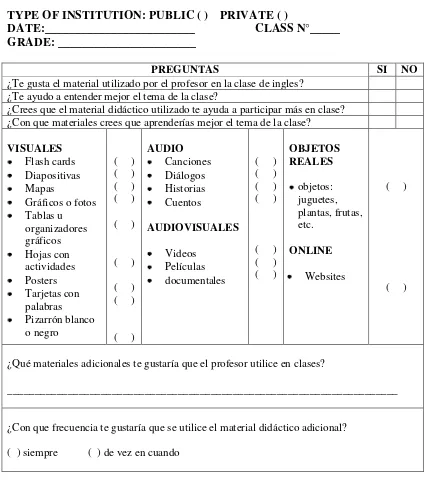
styles. Similarly, students from both institutions answered a survey to know their
point of view about the use of supporting resources in each of the observed classes.
5
and surveys. After all the observations were completed, eight charts were used to
tabulate the results and these indicators were taken into consideration: flashcards,
PowerPoint presentations, maps, pictures, charts, handouts, posters, word cards,
white board, songs, dialogues, stories, tales, videos, movies, documentaries, objects,
and websites. Those variables were classified into visual, audio, audio visual, realia,
and online materials. The information was classified according to the pertinence and
appropriateness of each of the materials used in the observed classes of the public
and the private high school.
The next stage consisted of using a quantitative approach to calculate the
frequency of use of supplementary materials in each of the observed courses of both
high schools. The quantitative approach is a method used to collect numerical data;
it was used in this research to obtain statistical information of the frequency and
percentage of use of supporting materials in the observed classes.
A qualitative analysis of results followed the tabulation of information to
describe the way teachers used materials in the observed classes. This analysis also
provides information about the topic and objectives of each class and details of the
use of supporting materials in relation to students‟ age, students‟ level of
comprehension, and quality. The main objective of this stage was to determine the
aspects that favored the pertinence and appropriateness of the used materials.
After performing the qualitative analysis, a quantitative analysis was done to
establish a comparison of the general results obtained from the observed classes in
the public and private high school. Then, the frequencies of use of supporting
materials of each course of both high schools were compared to determine the type
6
the opinions given by the surveys answered by teachers and students. Finally, a set
of conclusions and recommendations were elaborated considering the results
obtained.
7
DISCUSSION
This section presents the literature review that provides the theoretical
framework of this analysis. In addition, results, qualitative and quantitative analysis,
conclusions, and recommendations are also included in this section.
Literature review
Supplementary materials are of great importance in the teaching – learning
process because they are a source of new experiences for learners and help them to
retain knowledge easily. To explore deeply into the benefits of supplementary
materials, this section presents relevant information related to the factors that
influence the teaching of a foreign language; the differences among learners, their
motivation for learning, and their learning styles; teaching techniques for teaching
adolescents and the context where this process takes place. In addition, the revision
of the literature for this research places emphasis on main definitions, importance,
role, and types of supplementary materials; this information is supported by five
studies done about their use in the EFL classrooms.
Teaching English as a Foreign Language
Teaching English as a Foreign Language has been considered as a relevant
aspect in different countries because of different reasons. Specifically, Tiwari (2008)
remarks the importance of Teaching English as a Foreign Language (TEFL)
according to six aspects: internationalization, education, vocation, culture, discipline,
and recreation. This author explains that English as an international language helps
learners to overcome prejudices, to open their horizons and minds; people who study
8
careers. English learners also have new intellectual experiences because they
interact with a different culture and can enjoy the target language literature.
All those aspects mentioned above describe the importance of TEFL as a
result of English globalization. From a different point of view, Broughton & Brumfit
(1980, p. 6) say, “But in the rest of the world, English is a foreign language. That is,
it is taught in schools, often widely, but it does not play an essential role in national
or social life.” They state that the way English is taught is related to its role and has
an influence an individual‟s life. For this reason, the authors consider that teachers
must be well trained because teaching a foreign language is not only about the
learning process; it is also about teaching learners to become integral members of a
society. Part of that training, according to these authors, is concerned with acquiring
knowledge about Linguistics, Pedagogy, Psychology, etc. that allows teachers to
employ adequate resources and different methods to achieve their objectives in the
classroom.
A similar perspective is presented by Darling-Hammond & Bransford (2005)
who explain that there are different approaches of teaching English. Some of those
support the teaching of specific subjects such as reading a variety of texts while
others sustain that teaching English is concerned with the four language skills:
reading, writing, speaking, and listening. These authors also mention four additional
approaches of teaching English that take place in a classroom; (1) teaching the four
language skills mentioned previously; (2) teaching reading and writing to help
students with their personal growth; (3) teaching literature and writing to provide
students disciplinary practices; (4) teaching literacy to prepare students to judge the
9
The importance of teaching literacy in TEFL is highlighted by Byram &
Buttjes (1991). They consider that students increase their knowledge in the linguistic
and literary areas but more specifically in the human and social because they
improve their communicative competence and their attitudes about other cultures
change.
In summary, teaching a foreign language, specifically English, is important
because it offers learners a lot of benefits for their human, cultural, and intellectual
development.
Learners’ differences among children, adolescents, and adults
The benefits of teaching a foreign language are exploited by learners in
diverse ways according to their individual differences; these have been studied by
many authors. The first point of view is presented by Spratt (2005, p. 52-54) who
says, “The differences include learners‟ motivation, personality, language level,
learning style, learning strategy, age, and past language learning experiences.” This
author explains that learners‟ learning styles influence the way they are taught and
the type of strategies they choose to learn. Other aspects mentioned by this author
refer to age and past learning experiences. About age, he says,
Children can concentrate for shorter periods, learn through
experience, and pay attention to meaning in language. Teenagers‟
concentration is developing, can learn in abstract ways, and pay
attention to meaning and increasingly to form. Adults can
concentrate for longer periods, can learn in more abstract ways, and
10
With regard to past learning experiences, Spratt (2005) explains that some
learners may receive different English instruction out of the classroom and the type
of method previously used influences their new learning practice; this results in a
different pace of learning.
Learners‟ learning progress is different among them. About this topic
Littlewood (1984) remarks that individual differences determine learners‟ speed of
learning, and this in turn, influences learners‟ development of the new language.
From the point of view of this author, children learn faster than older learners
because their brain is more flexible and allows them to learn a language naturally and
easily. Adolescents and adults develop new strength for acquiring grammar
structures more quickly than children. In this way, this author states that while
adolescents and adults increase their language proficiency with age, children perform
better at acquiring pronunciation skills.
Comparisons among younger and older learners are also mentioned by Nunan
(2011). He explains that Pinter (2006) describes younger learners as individuals who
need to be taught using a holistic approach and who are able to comprehend meaning
without analyzing language; they are still developing their reading and writing skills
even in their native language. In contrast, the referenced author states that older
learners consider language as an abstract system, they demonstrate self-awareness of
their learning process, and they have good reading and writing skills.
From the arguments exposed above, younger and older learners show
different characteristics that influence their progress and way of learning such as age,
11
demonstrate more ability to acquire complex knowledge such as grammar structure;
their motivation to learn a language is focused on abstract topics.
Learners’ motivation
There are many factors that drive learners‟ purpose to learn. Some of them
are explained by Littlewood (1984, p. 53) who says, “It is a complex phenomenon
and includes many components: the individuals‟ drive, need for achievement and
success, curiosity, desire for stimulation and new experience, and so on.” According
to him, sometimes learners are not conscious about the communicative purpose of
language in a foreign language learning context; it depends on students‟ need for
communicating with people who speak the foreign language.
About learners‟ motivation towards foreign language learning, Oxford (1996,
p. 15-16) mentions eight factors that are part of Julkunen (1998)‟s model of
motivation:
(1) A communicative motive, including aspects of integrative,
instrumental, and cognitive motivation but emphasizing the
function of language as a means of communication. (2) Classroom
level intrinsic motivation, including linking for challenging tasks;
(3) teacher / method motivation, including liking and disliking of
certain teaching methods; (4) integrative motivation; (5) a
helplessness factor; (6) an anxiety factor; (7) criteria for success/
failure; and (8) latent interest in learning English.
Another model of motivation mentioned by Oxford (1996) refers to the one
presented by Csikszentmihalyi (1989). This author explains that learners‟ motivation
12
skills deal with challenging tasks, their motivation is high; if the task is complex and
learners‟ skills are not good, learners become anxious. At last, if the level of
complexity of the task is low and learners‟ skills are low too, the result is boredom.
Learners, according to Griffiths (2008), have also: instrumental, integrative,
intrinsic and extrinsic motivation. Instrumental motivation is related to students‟
interest in the foreign language. Integrative motivation is related to the practical uses
of the target language. Intrinsic motivation is the result of learners‟ interest for self
-rewarding and achievement; and extrinsic motivation as consequence of external
factors such as qualifications, reward or fear of punishment. The author adds that
learners with intrinsic motivation participate actively in learning tasks, solve
problems using different strategies, retain information easily, and they are connected
with thinking skills more efficiently.
Learning styles
Preferences to learn a language are different in each learner because of his/her
individual characteristics. In effect, Pritchard (2009) explains that people learn in
different ways which are known as learning styles or learning preferences; he gives
three definitions about this topic and also presents two interesting approaches.
The first definition given by Pritchard (2009) describes learning styles as a
unique form of learning that each learner has. The second definition refers to
preferred ways for processing information and proving that learning is assimilated by
learners. The third definition concerns particular styles of acquiring knowledge. The
last definition is more related to learners‟ educational goals such as habits, strategies
13 to learners‟ cognitive abilities for problem solving, information processing, or mental
strategies.
With regard to approaches about learning styles, Pritchard (2009) presents the
Honey- Mumford model which defines activists, reflectors, theorists, and pragmatics
styles. He describes each of those learning styles as, “Activists prefer learning by
doing…Reflectors stand back and observe…Theorists like to adapt and integrate all
of their observations into frameworks…Pragmatics are keen to seek out and make
use of new ideas.” (p. 42). Another point of view presented briefly by this author
refers to three learning styles that have origins in Neuro Linguistic Programming
(NPL) and which are widely known as visual, auditory, and kinesthetic styles.
In addition to visual, auditory, and kinesthetic styles, Spratt (2005) adds
these: group, individual, reflective, and impulsive. He relates learning styles to
learners‟ senses and declares that the learning process is influenced by the type of
style that learners choose for acquiring knowledge. This author describes visual
learners as individuals that like to learn by seeing; auditory learners prefer to learn
through hearing; kinesthetic learners like to learn by touching; group learners learn
better working in groups; individual learners learn better by working alone; reflective
learners take time to explore choices; and, impulsive learners react immediately to
class work.
Another classification of learning styles is presented by Tilestone (2010). She
explains an interesting relationship among learning styles and learners‟ cultural
background; learners from rural cities usually show kinesthetic learning approaches
14
usually need to be taught using a variety of resources that call their attention; they
tend to show auditory learning styles.
In consequence, the authors above bring important information about how
learners‟ cognitive, sensorial, and cultural differences influence their choices for a
preferred learning style. A last important aspect mentioned by Tilestone (2010, p. 15)
indicates, “If we teach and reteach using the same learning style that is not
compatible with a students‟ mode of learning, the chances are that we will not reach
that student.”
Teaching techniques for teaching adolescents
In order to meet students‟ needs, it is important to choose adequate teaching
techniques. When teachers work with adolescents, as Sejnost (2009) explains, they
need to decide which techniques motivate teenagers to participate, to question, to
analyze, and to get involved in meaningful activities. According to this author,
Crawford (2007) recommends teachers present information in such a way that it
develops adolescents‟ interest for learning. Tasks should be challenging and related
to teenagers‟ lives; projects and tasks have to promote discussion of ideas with their
peers through group working. It is also important to give adolescents opportunities
to solve problems using their thinking skills.
There are other types of techniques recommended by Swango & Steward
(2003) such as modeling, scaffolding, and project- based learning. Modeling,
according to these authors, helps learners to find the correct way to develop their
tasks and assignments; they can understand better what teachers expect from them.
With regard to scaffolding the authors say, “This technique gives support through
15
15); according to them, this technique is related to cooperative learning in which
students work together to achieve an objective. A last technique suggested by these
authors is project-based learning; it promotes resolution of issues raised by the
students and helps them to discover the real purpose of learning.
From another viewpoint, Crawford (2007) recommends teachers make
connections with adolescents to discover their interests and to help them with their
intellectual and ethical development; she adds:
Adolescence is a formative, tentative, and pivotal time when
students are contemplating significant personal and societal issues.
Their ideas may be somewhat confused or misconceived, ill
structured or unrefined, yet adolescents need to feel that their
contribution in a discussion matters to a teacher. (p. 65)
Based on the definition given above, Crawford (2007) recommends teaching
techniques that motivate adolescents to talk or write about their individual points of
view. She also suggests debates, role playing, and problem solving techniques that
encourage adolescents to discuss their personal perspectives and assumptions. This
author remarks that teenagers learn better when they are faced to make decisions and
to assume positions about issues related to real life.
As a complement to what the authors mentioned above explain, Tait (2007)
remarks that as a result of adolescents‟ brain development they need to be taught
using techniques that promote the use of their cognitive skills. In addition, this
author explains that adolescents are emotive human beings; he says, “Teachers need
to engage the senses and emotions to gain students' attention for learning, not just for
16 touch, and emotion can focus students on learning”(p. 35). He adds that as
adolescents are hard to please individuals, teachers have to use original techniques
that call and maintain adolescents‟ interest on the lesson; he lists these activities:
Cooperative learning activities: through these activities
adolescents share their opinions with their peers.
Debates and panel discussion: Adolescents like to discuss
about hot topics or real life situations.
Role plays: through them adolescents can find opportunities
to identify with characters even though learners in this stage
of development tend to be attentive about what others say
about them.
Creative writing: These kinds of activities give learners
opportunities to explore imaginary situations and raise on
them their thinking skills. (Tait 2007, p. 36).
To sum up, the authors mentioned above remark the importance of
considering adolescents‟ cognitive and emotive development in order to select
adequate teaching techniques.
Context for teaching English
Adolescents‟ cognitive and emotive development is influenced by the type of
context where the teaching process takes place. About this topic Wilkins (2006)
explains that the context for teaching is related to physical, social, institutional and
personal factors. This author mentions that the physical context is the classroom
where the students learn and it should be well-lit and with a good temperature to
17
The social environment including the relationship between teacher
and students and the cultural norms play a significant role in what
can and does occur in the classroom. How friendly/approachable an
instructor seems to be determines how outgoing students will be
and the kind of communication that will characterize classroom
interaction. (p. 7)
With regard to institutional factors, Halliday (1994) describes them as a result
of the interaction among the classroom and the outside world. He explains that
classrooms are placed into host institutions that can be state or private schools; this
author says, “In state education, the host educational environment provides strong
influences, from parents, employers and so on in the local community, which bear on
the classroom.” (p. 15). This author mentions that resources such as salaries and
furniture in educational institutions also receive the influence of the economy, and
political and bureaucratic institutions that are part of the community.
There are other factors mentioned by Aslam (2003) that also affect the
context for teaching; they are large classes, classrooms, and lack of facilities. When
teachers deal with large classes, this author explains, it is difficult to meet students‟
needs; equally, pair and group work becomes a challenge for teachers and they rely
frequently on common and less time consuming activities such as using the white
board or working with lectures. This author expresses that working with large
classes that are placed in small classrooms also makes the teaching process difficult
because students cannot work adequately; as a consequence, learners do not feel
motivated to participate in class. A last factor mentioned by this author is lack of
18
resources, the teachers frequently rely on the use of the unique available material: the
white board.
Supplementary materials
The process of teaching English is composed of techniques, methods, and
teaching resources. About supplementary materials, Dash & Dash (2007, p. 123)
say: “Instructional materials are devices or supplementary materials which help the
teacher to make his presentation concrete, effective, interesting, meaningful, and
inspirational.” They explain that supplementary materials make clear any learners‟
doubt and help teachers to present new concepts, words, facts, or interpretations;
also, materials allow teachers to review previous knowledge. Another definition is
given by Patel & Praveen (2008, p. 57) who say, “The material and aids which are
used by the teacher to make his teaching very effective is called teaching aids and
instructional material.” A last definition is presented by Felix (2009) who mentions
that supplementary materials facilitate the teaching process.
Supplementary materials are important for different reasons. Dash & Dash
(2007) remark that teaching resources allow learners to uses their senses and help
them to retain facts easily; learning becomes meaningful and students can reproduce
new information in subsequent classes. In addition to those aspects, Felix (2009)
points out that the use of supplementary materials improves learners‟ language skills
because they have the opportunity to interact with the teaching resources. A final
consideration about the importance of supplementary materials is presented by Patel
& Praveen (2008) who argue that they are source of motivation and help to develop
learners‟ cognitive abilities; materials also promote deductive reasoning because
19
With regard to the role of supplementary materials, Dash & Dash (2007)
explain that the function of materials is to motivate students to learn, to give them the
ability to observe and imagine events. According to these authors, instructional
materials help teachers to save time giving explanations, connect abstract definitions
to concrete situations, and solve any doubts the students have. Additionally, the
whole classroom benefits because more students can learn better and classes become
interesting. Similarly, Patel & Praveen (2008) and Felix (2009) highlight that
materials add variety to the classroom and avoid disruptive behaviors because
learners feel motivation for learning; the function of materials is also to make
learners retain knowledge permanently.
Types of supplementary materials
Along with the importance and roles of supplementary materials it is
necessary to know the main categories of instructional materials available for
teachers. Dash & Dash (2007) show five classes of teaching resources. The first
type includes projected and non-projected materials; according to the authors,
projected materials can be visualized on screens and some examples are films and
slides. Non-projected materials can be pasted on a wall or white board and can be
handled by students; some examples are pictures and charts. The second category of
materials mentioned by the authors includes audio, visual, and audio visual materials;
they involve the senses of hearing, seeing, and a combination of both and some
examples are radio, pictures, and sound films. The third category refers to hardware,
which are electro-mechanical materials such as computers and epidiascope; and
software, which includes programmes. The fourth category is big media, which
20
cassettes. In the same fourth category, the authors mention little media that can be
radio, audio cassettes, etc. Finally, the authors present a fifth category in which are
two-dimensional materials such as printed materials, white board, bulletin boards;
and three-dimensional materials such as static, dynamic, working, and sectional
models.
A similar classification is made by Gower & Philips & Walters (2005), they
mention visuals, audio, audiovisuals, but add realia and online materials. About
visual materials the authors say, “Visuals can be used to arouse interest and
concentrate attention at the beginning of a class, to elicit already known language, to
illustrate a new language item, or a vocabulary item, to create a need for new
language, to set the scene for a story, and to stimulate a discussion.” (p. 70) some
examples listed by them are magazines and posters; teachers can obtain visuals from
brochures, catalogues, etc.
With regard to audio materials, Gower & Philips & Walters (2005) explain
that teachers frequently use these type of resources and they bring excellent
opportunities for communicative activities; especially if they are developed in
groups. About audiovisual materials, these authors say, “audiovisual is much easier
to understand because of the facial expressions, the gestures, and the physical
background all gives us additional information” (p. 72). Regarding realia, the
authors state that common examples are real objects and can be used in different
ways, for example to teach the use of prepositions. Finally, the authors describe
computer assisted language learning as part of online materials; there are a variety of
programmes that can be employed to teach students but teachers must be well trained
21
An interesting approach about visual materials is presented by Nilson (2010).
She highlights the importance of these resources because the sense of seeing has
been used by human beings since writing and printing were invented; she states that
visuals are adequate for all learners. This author argues that visuals provide
information more quickly and directly and it can be efficiently processed by both
sides of the brain when they are combined with texts; she lists these materials:
pictures, charts, mind maps, figures, drawings, flowcharts, tables, etc. The
blackboard is described by this author as a traditional visual material; she gives some
guidelines to use it effectively as for example: to write clearly, to use colored
markers, to write on it before the class begins, to organize the content by dividing the
area and underlining important topics. According to her, students should come to the
board to write their answers, ideas, and to record the results of discussions or
debates.
As a final point, Nilson (2010) recommends teachers use computer based
materials not only because they are „cool‟ for students; these resources give students
new learning experiences by means of virtual information, learners‟ productivity
increases and their learning process becomes more effective because they receive
individual instruction.
To summarize, supplementary materials offer great benefits for learning
because their use improves the teaching process and helps students to learn better.
All the benefits of the teaching resources for learners have been investigated by
different experts. Some of them are exposed through five studies in the following
22
The first study was done by Shuan (2005) to analyze the benefits of using
web resources in EFL instruction. This research was carried out with students from a
Chinese University who received four assignments that required the use of web
resources. The first task was a scavenger hunt activity to analyze the type of
information offered by the web site. For the second task, students had to search for
information using key words and the skimming and scanning reading methods;
students completed it without difficulties. The third task demanded more reading
skills from students to search for detailed information. In the fourth task, students
used their writing skills to create a web assignment for their peers. After all tasks
were completed, students answered a questionnaire to know their opinion about the
use of web resources. The author of this research found that students did not use
websites for their language learning process; they needed guidance to focus on the
activity. The students‟ questionnaires demonstrated positive attitudes to web
resources because, according to the learners, they acquire new vocabulary words.
The author concludes that web resources are good for learning but students need new
ways to use them; teachers should be well trained to use online resources in order to
help students with their learning process.
A second study was done by Williams & Lutes (2003) to prove the use of
videos as a source of motivation for students. The participants were divided into two
groups: a control and a test group. Both groups received the same instruction but the
test group was taught using videos in eight classes. At the end of the study, students
answered a questionnaire to know their opinion about the material and its effects on
23
motivated and more engaged in the learning process than the students in the control
group.
The third study was conducted by Hsieh (2010) to prove the effects of DVD
films in EFL classes. The participants were freshman students in a Chinese
University who were divided into two groups: an experimental group and a control
group. The experimental group received instruction from a native teacher; he used a
comic film as supplementary material. A Taiwanese teacher taught the students in the
control group and he used a horror film with traditional methods of instruction. The
researchers found that the experimental group outperformed better than the control
group; 95% of the learners considered that films motivated them and helped with
their learning process. The author of this study concludes that students improved
their language skills and were more motivated as result of the use of film in classes.
In the fourth study, Baoan (2002) wanted to prove the efficacy of songs in
EFL classes. He chose five grades from an elementary school in China; the students
were taught on the same topic using different types of songs and they were evaluated
after each class to determine their level of comprehension about the topic. The
author of this study found that learners were motivated, got better grades, and were
more interested in popular songs. He concluded that songs are source of motivation
and provide rich linguistic information.
The last study was done by Nguyen (2006) to investigate the effects of songs
in learners‟ motivation, bottom up listening skills, and comprehension skills. The
participants were divided into two groups: a test and a control group; the effects of
songs on their instruction were evaluated in three stages. Students were evaluated in
24
the second stage, one group was taught using songs and the other group only
received instruction using the course book. In the third stage, students‟ listening
skills were evaluated again to measure the effect of songs. The author of this study
found that the test group got a better performance after receiving instruction with
songs; they participated actively and were more motivated than the students in the
control group, they also improved their cognitive skills and were more able to decode
25
Results
Qualitative tabulation
Chart one: Type of supplementary material used in public high school
Variable Indicators Yes No
Visual
Flash cards X
PowerPoint presentations X
Maps X
Pictures √
Charts X
Handouts X
Posters X
Word cards X
White/black boards √
Audio
Songs √
Dialogues √
Stories √
Tales X
Audiovisual
Videos X
Movies X
Documentaries X
Realia Objects (toys, plants, fruits) X
Online Websites X
Author: Verónica Cedeño
26
Chart two: Type of supplementary material used in private high school
Variable Indicators Yes No
Visual
Flash cards √
PowerPoint presentations X
Maps X
Pictures √
Charts X
Handouts √
Posters √
Word cards X
White/black boards √
Audio
Songs X
Dialogues √
Stories √
Tales X
Audiovisual
Videos √
Movies X
Documentaries X
Realia Objects (toys, plants, fruits) X
Online Websites X
Author: Verónica Cedeño
27
Chart three: Pertinence and appropriateness of the supplementary material used in
public high schools
Var
iab
le
Indicators
1st class 2nd class 3rd class 4th class 5th class
Pert. Approp. Pert. Approp. Pert. Approp. Pert. Approp. Pert. Approp.
Vis ual Flash cards PowerPoint presentations Maps
Pictures √ √
Charts Handouts Posters Word cards
White board √ √ √ √ √ √ √ √ √ √
Au
dio
Songs √ √
Dialogues
Stories √ √ Tales Au dio vis ual Videos Movies Documentaries R ea lia Objects (toys, plants, fruits) On lin e Websites
Author:Verónica Cedeño
28
Chart four: Pertinence and appropriateness of the supplementary material used in
public high schools
Var
iab
le
Indicators
1st class 2nd class 3rd class 4th class 5th class
Pert. Approp. Pert. Approp. Pert. Approp. Pert. Approp. Pert. Approp.
Vis ual Flash cards PowerPoint presentations Maps
Pictures √ √ Charts
Handouts Posters Word cards
White board √ √ √ √ X √ √ √ √ √
Au
dio
Songs Dialogues
Stories √ √ √ √
Tales Au dio vis ual Videos Movies Documentaries R ea lia Objects (toys, plants, fruits) On lin e Websites
Author:Verónica Cedeño
29
Chart five: Pertinence and appropriateness of the supplementary material used in
public high schools
Var
iab
le
Indicators
1st class 2nd class 3rd class 4th class 5th class
Pert. Approp. Pert. Approp. Pert. Approp. Pert. Approp. Pert. Approp.
Vis ual Flash cards PowerPoint presentations Maps
Pictures √ √
Charts Handouts Posters Word cards
White board √ √ √ √ √ √ √ √
Au
dio
Songs
Dialogues √ √ √ √
Stories Tales Au dio vis ual Videos Movies Documentaries R ea lia Objects (toys, plants, fruits) On lin e Websites
Author:Verónica Cedeño
30
Chart six: Pertinence and appropriateness of the supplementary material used in
private high schools
Var
iab
le
Indicators
1st class 2nd class 3rd class 4th class 5th class
Pert. Approp. Pert. Approp. Pert. Approp. Pert. Approp. Pert. Approp.
Vis ual Flash cards PowerPoint presentations Maps
Pictures √ √ √ √
Charts
Handouts √ √ √ √
Posters Word cards White board Au dio Songs Dialogues
Stories √ √ Tales Au dio vis ual Videos Movies Documentaries R ea lia Objects (toys, plants, fruits) On lin e Websites
Author:Verónica Cedeño
31
Chart seven: Pertinence and appropriateness of the supplementary material used in
private high schools
Var
iab
le
Indicators
1st class 2nd class 3rd class 4th class 5th class
Pert. Approp. Pert. Approp. Pert. Approp. Pert. Approp. Pert. Approp.
Vis
ual
Flash cards √ √ PowerPoint
presentations Maps Pictures Charts
Handouts √ √ √ √
Posters Word cards Whiteboard Au dio Songs Dialogues
Stories √ √ √ √
Tales Au dio vis ual Videos Movies Documentaries R ea lia Objects (toys, plants, fruits) On lin e Websites
Author:Verónica Cedeño
32
Chart eight: Pertinence and appropriateness of the supplementary material used in
private high schools
Var
iab
le
Indicators
1st class 2nd class 3rd class 4th class 5th class
Pert. Approp. Pert. Approp. Pert. Approp. Pert. Approp. Pert. Approp.
Vis ual Flash cards PowerPoint presentations Maps Pictures Charts
Handouts √ √ √ √
Posters √ √
Word cards
White board √ √ √ √
Au
dio
Songs
Dialogues √ √
Stories Tales Au dio vis ual
Videos X √
Movies Documentaries R ea lia Objects (toys, plants, fruits) On lin e Websites
Author:Verónica Cedeño
33
Quantitative tabulation
Chart nine: Frequency of use of supplementary material in 1st year.
Variable Indicators Public Private
Visual
f f
Flash cards PowerPoint presentations Maps
Pictures 1 2
Charts
Handouts 2
Posters Word cards White/black
boards 5
Audio
Songs 1
Dialogues
Stories 1 1
Tales
Audiovisual
Videos Movies
Documentaries
Realia Objects (toys,
plants, fruits)
Online Websites
TOTAL 8 5
34
Chart ten: Frequency of use of supplementary material in 2nd year.
Variable Indicators Public Private
Visual
f f
Flash cards 1
PowerPoint presentations Maps
Pictures 1
Charts
Handouts 2
Posters Word cards White/black
boards 5
Audio
Songs Dialogues
Stories 2 2
Tales
Audiovisual
Videos Movies
Documentaries
Realia Objects (toys,
plants, fruits)
Online Websites
TOTAL 8 5
35
Chart eleven: Frequency of use of supplementary material in 3rd year.
Variable Indicators Public Private
Visual
f f
Flash cards PowerPoint presentations Maps
Pictures 1
Charts
Handouts 2
Posters 1
Word cards White/black
boards 4 2
Audio
Songs
Dialogues 2 1
Stories Tales
Audiovisual
Videos 1
Movies
Documentaries
Realia Objects (toys,
plants, fruits)
Online Websites
TOTAL 7 7
36
Chart twelve: Frequency of use of supplementary material.
Years Public (f) Private (f) TOTAL
f %
1st 8 5 13 32.5%
2nd 8 5 13 32.5%
3rd 7 7 14 35%
37
Chart thirteen: Frequency of use of supplementary material in the public senior high
school.
Variable Indicators 1st year 2nd year 3rd year TOTAL
f f f f %
Visual
Flash cards PowerPoint presentations Maps
Pictures 1 1 1 3 13%
Charts Handouts Posters Word cards
Whiteboard 5 5 4 14 60.8%
Audio
Songs 1 1 4.3%
Dialogues 2 2 8.7%
Stories 1 2 3 13%
Tales
Audiovisual
Videos Movies
Documentaries
Realia Objects (toys,
plants, fruits)
Online Websites
TOTAL 8 8 7 23 100%
38
Chart fourteen: Frequency of use of supplementary material in the private senior high
school.
Variable Indicators 1st year 2nd year 3rd year TOTAL
f f f f %
Visual
Flash cards 1 1 5.8%
PowerPoint presentations Maps
Pictures 2 2 11.7%
Charts
Handouts 2 2 2 6 35.3%
Posters 1 1 5.8%
Word cards
Whiteboard 2 2 11.7%
Audio
Songs
Dialogues 1 1 5.8%
Stories 1 2 3 17.6%
Tales
Audiovisual
Videos 1 1 11.7%
Movies
Documentaries
Realia Objects (toys,
plants, fruits)
Online Websites
TOTAL 5 5 7 17 100%
39
Description, analysis, and interpretation of results
This section is about the analysis of results obtained from the observations
performed in the 4th, 5th, and 6th grades. In the first place, it describes the pertinence
and appropriateness of use of supplementary materials in each of the ten observed
classes. In the same way, the frequency of the material used in each grade was
calculated using the quantitative analysis; it also provides information about the total
frequency of materials used in all grades.
Qualitative analysis
Public high school
1st year
Pictures
Pictures were used in the fifth class titled „An Ecuadorian festival.‟ The
objectives of this lesson were: to develop speaking skills and to extend students‟
knowledge of Ecuadorian culture. The pictures were brought by the students and
represented different types of Ecuadorian dances and festivals such as Carnival,
Holly Week, Inti Raymi, Mama Negra, etc. The teacher used the pictures to have
students brainstorming ideas about those dances and festivals such as such as water,
beach (carnival); fanesca, church, prayers (Holly Week), etc. As a consequence, the
pictures were pertinent to the topic of the lesson. After the brainstorming activity,
the pictures were used to motivate students to talk about the characteristics of each
dance or festival; therefore, the pictures were pertinent to the objectives of the lesson.
The pictures were appropriate to students‟ age and level of comprehension because
they were able to provide information and described the pictures correctly; they also
40
quality of the pictures was good. Students cut them from magazines and newspapers
and pasted them on pieces of card of A4 size. The pictures had bright colors and all
students were able to see them.
Whiteboard
This material was used in all classes observed in this course and it was in
good condition. In the first class, the topic was „A British celebration‟ and objectives
were: to develop listening and writing skills and to build on students‟ knowledge of
the British culture. The whiteboard was used to write the topic of the lesson, the
explanation of some grammar structures and to write new words. In this way, the
material was pertinent to the topic of the class because it was used to write
information about the topic of the lesson. This material was also used by students to
write sentences related to the topic of the lesson; they also wrote important points of
a story told by the teacher and discussed that information. Therefore, the material
was pertinent to the objectives of the lesson because students were able to practice
writing skills and learnt new things about British culture.
The whiteboard was appropriate to students‟ age and level of comprehension
because they had the opportunity to express and write their ideas about the topic.
The quality of the material was good because the contents were well organized and
students wrote using a clear handwriting.
The topic of the second class was „Other English-speaking countries‟. The
objectives of this lesson were: to develop listening, writing and speaking skills; to
introduce a variety of words by means of a song. The whiteboard was used to write
some examples of English-speaking countries such as Canada, England, Australia,
41
had to listen to a song and came up to the board to complete information. This
material was pertinent to the topic of the class because it was used to write
information related to the class such as the names of English-speaking countries and
the completing activity. The whiteboard was also pertinent to the objectives of the
class because the students wrote the name of different countries where people speak
English and they also completed information about the song played in the class.
The whiteboard was appropriate to students‟ age and level of comprehension
because they were able to write the names of the country and completed the
sentences correctly. The quality of the whiteboard was good because the information
was correctly organized. The teacher divided it into two sections: on the left side
students wrote the name of the countries, and on the right side students completed the
sentences.
The topic of the third class was „Survey.‟ The objectives of this lesson were:
to provide statistical information about different topics by using reading, writing, and
speaking skills. The whiteboard was used by the teacher to draw statistical charts
about the results of a survey on healthy and junk food eating trends. First, students
observed the graphics; then, they had to read information of each graphic and write
short paragraphs describing eating trends. After students finished the writing task
they had to discuss their points of view about the topic.
The whiteboard was pertinent to the topic because it was used to draw graphic
bars from a survey of eating trends. In the same way, the material was pertinent to
the objectives of the lesson because the information written on the board was used by
42 The whiteboard was appropriate to students‟ age because the information
written on it showed eating trends of young and older adolescents. Similarly, the
material was appropriate to students‟ level because they were able to write short
paragraphs describing eating trends and discussed their points of view. The
whiteboard was a big help for the students to work on the activities proposed by the
teacher.
The quality of the whiteboard was good because it was made of acrylic
material and it was in good conditions. The teacher used black, red, and green
markers to draw the graphics and the labels of each bar were clear and all students
were able to understand them.
The topic of the fourth class was „Healthy eating‟. The objectives of this
lesson were: to build on students‟ knowledge of adverbs of quantity; to review
vocabulary related to the human body; and, to practice writing skills. First, the
whiteboard was used to check whether students had completed correctly a crossword
about human body parts, the teacher wrote the vocabulary and students marked all
the words that they found. Next, the whiteboard was used to write some adverbs of
quantity such as any, both, few, lots of, several, none, etc. and the teacher wrote some
examples such as Broccoli has lots of calcium to help our bones; he highlighted each
adverb with red marker and explained its usage. Then, students came to the board to
write their own sentences such as Both milk and broccoli are good for our bones.
The whiteboard was pertinent to the topic because it was used to explain the
lesson and to write sentences about healthy eating. In the same way, the whiteboard
43
how to use adverbs of quantity, to review vocabulary of human body parts, and to
practice writing skills.
The whiteboard was appropriate to students‟ age because students were
interested in the topic and provided examples of healthy eating. In addition, the
material was appropriate to students‟ level because students understood teachers‟
explanations and were able to write accurate sentences.
With regard to the quality of the whiteboard, it was made of acrylic material
and the teacher used black and red markers to explain the use of grammar structures.
Concerning the fifth class, the topic was „An Ecuadorian festival‟ and the
objectives were: to develop speaking skills and to extend students‟ knowledge of
Ecuadorian culture. The whiteboard was used to paste pictures of different types of
Ecuadorian dance and festivals brought by the students. Then, the teacher used the
whiteboard to write ideas that students brainstormed about the topic of the lesson
such as water, beach (Carnival); fanesca, church, prayers (Holly Week), etc.
The whiteboard was pertinent to the topic because it was used to paste
pictures related to Ecuadorian festivals. This material was also pertinent to the
objectives of the lesson since it was used to write down students‟ ideas about the
topic and students could talk and discuss the characteristics of each festival. The
whiteboard was appropriate to students‟ age because students used it to paste the
pictures that they brought to the class. In the same way, the whiteboard was
appropriate to students‟ level because it was used to take notes about their ideas for
44
About the quality of the whiteboard, it was made of an acrylic material that
was in good condition, and the teacher used black markers to write students‟ ideas
about each picture.
Learning styles
The teacher of this grade considered the topic being studied to be important to
decide the type of learning styles that were going to be involved in the lesson.
According to him, not all students‟ learning preferences can be covered in one lesson
but one type of material that always catches learners‟ attention is visuals because
through them students are able to visualize information. In the point of view of this
teacher, once students picture information, the teacher complements it with oral
explanations and uses adequate teaching and learning techniques. It was observed
that in this grade, learners cooperated and worked well, although the variety of
materials was not in accordance to the different types of learning styles.
2nd year
Pictures
Pictures were used as supporting materials in the first and fourth class in this
grade. The topic of the first class was „A role play‟ and the objective was to have
students develop speaking skills. A set of four pictures was used to provide ideas to
students about the play script that they had to develop to play roles. The pictures
showed different kinds of social problems such as gangs, drugs, violence, and
adolescent pregnancy; each picture was delivered to a group of students to play roles.
The pictures were pertinent to the topic of the class because students worked
in groups to play roles. The material was pertinent to the objective of the lesson
45 practicing speaking skills. In addition, the pictures were appropriate to students‟ age
because they showed images of social problems that affect adolescents. In the same
way, the pictures were appropriate to students‟ level because they got inspirational
ideas to display to the class by using simple language structures.
The quality of the pictures were good, they had color images and were of A4
format. The teacher pasted them on pieces of card paper and they showed clearly
each type of social problem that was understood by students clearly.
Whiteboard
The whiteboard was used in all the five observed classes. The topic of the
first class was „A role play‟ and the objective was to have students develop speaking
skills. The whiteboard was used to write instructions about a role play that students
had to perform in relation to four social problems: gangs, violence, drugs, and
adolescent pregnancy. The teacher wrote some prompts that students had to follow
in order to develop the role plays such as title, characters, main idea, setting, message
to be transmitted.
The whiteboard was pertinent to the topic because it was used to explain the
requirements of each role play that students had to do. In the same way, the
whiteboard was pertinent to the objective of the lesson because the instructions
written on it provided guidance to students to organize the speech of each participant
in the group. The material was appropriate to students‟ age because the information
about each role play help them to work correctly. In addition, the whiteboard was
appropriate to students‟ level because the prompts written by the teacher were clear
46
The quality of the whiteboard was good. The acrylic surface was in good
condition and the teacher used black markers to write the information on it.
The topic of the second class was „The media - newspapers‟ and the objective
was to develop listening skills and to practice use of passive voice. The whiteboard
was used to write sentences from a story about the history of the newspaper such as
The first printed newspaper in America was published without authorization, The
Boston newsletter was posted by John Campbell in 1704, etc. Using those sentences,
the teacher used the whiteboard to explain the use of passive voice; then, students
came to the board to write sentences using the grammar structure.
The whiteboard was pertinent to the topic of the lesson because it was used to
write information about the history of the newspaper. Similarly, this material was
pertinent to the objective of the lesson because the sentences written by the teacher
were dictated by the students after they listened to a story about the origins of
newspaper. The whiteboard was used also by the students to practice the use of
passive voice.
The whiteboard was appropriate to students‟ age because they demonstrated
interest in the topic and participated actively. However, the whiteboard was not
appropriate to students‟ level because they had some difficulty trying to write
sentences in passive voice. The teacher encouraged them to write sentences about
the story that they listened to rather than use more simple information related to
students‟ interests. About the quality of the material, it was in good condition and
the contents were well distributed.
The topic of the third lesson was „He said that…‟ and the objective was to
47
used to explain the grammar rules of reported speech. Then, the teacher and the
students play the game „Chinese whisper.‟ The teacher invited five volunteers to
come to the front of class and he whispered a sentence to the first student in the line.
The sentence was I traveled to Chile last year. Each student had to whisper the
sentence to the next student adding new information such as He said that he traveled
to Chile and bought a pair of shoes, and so on. The teacher encouraged also each
student to write on the board what he/she heard using reported speech.
As a result of the game played, the whiteboard was pertinent to the topic of
the lesson because it was used to write sentences using reported speech. The
whiteboard was also pertinent to the objective of the lesson because students
understood the use of reported speech and practiced by writing sentences.
Using the whiteboard to write what each student heard during the game was
appropriate to students‟ age because they had opportunity to practice reported speech
by means of a fun and original activity. The whiteboard was also appropriate to
students‟ level because students understood teachers‟ explanations and were able to
write the sentences heard during the game.
Concerning the quality of the material, the surface didn‟t have any type of
fault and black markers were used to write the rules of the grammar structure and
sentences.
The topic of the fourth class was „The history of television‟ and the objective
was to have students develop intensive listening skills. The whiteboard was used to
write information heard by the students of a story titled „The history of television‟. In
addition, the material was used to draw a chart in order to check whether students