Journal of Experimental Psychology: Copyright 1996 by the American Psychological Association, Inc.
Learning, Memory, and Cognition 0278-7393/96/$3.00
1996, Vol. 22, No. 1, 182-196
Test Question Modulates Cue Competition
Between Causes and Between Effects
Helena Matute and Francisco Arcediano
Universidad de DeustoRalph R. Miller
State University of New York at Binghamton
The research reported in this article replicated the well-established phenomenon of competition between causes (C) as well as the more controversial presence and absence of competition between effects (E). The test question was identified as a crucial factor leading to each outcome. Competition between causes was obtained when the test question asked about the probability of E given C, p(E I C), implicitly compared with the probability of E given some alternative cause, p(EIC' ). Competition between effects was obtained when the test question asked about p(CIE) implicitly compared with p(C[E'). Under these conditions, effects competed for diagnostic value just as causes competed for predictive value. Additionally, some conditions in which neither causes nor effects competed were identified. These results suggest a bidirectional and noncompetitive learning process, the contents of which can be used in different ways (competitively or noncompetitively and forward or backward) as a function of test demands.
Imagine you are taking three different medicines, always in compounds of two. When you take A and X, you always show an allergic reaction as a side effect (+). However, when you take B and X you never show the allergic reaction ( - ) . If you were a typical experimental participant exposed to these conditions (i.e., A X + and B X - ) , you would probably attribute the allergic reaction to A and discount the potential causal role of X. However, if you were a typical control participant who developed the allergic reaction with the same 50% probability whether you take one or the other medicine compound (i.e., AX___ and BX---), you would probably attribute a greater causal role to X. This difference in attribution is called the relative validity effect because, despite the allergic reaction being paired with the antecedent Event X the same number of times in both groups, in the experimental group Cue A presumably competes with Cue X in being viewed as a cause of the subsequent event (the allergic reaction in our example). This effect has been shown in human judgments of causality (e.g., Baker, Mercier, Vall6e-Tourangeau, Frank, & Pan, 1993; Wasserman, 1990a) as well as in Pavlovian and instrumental animal experiments (Mackintosh & Dickinson, 1979; Wagner, Logan, Haberlandt, & Price, 1968; Wasserman, 1974). The
Helena Matute and Francisco Arcediano, Departamento de Psicolo- gia, Universidad de Deusto, Bilbao, Spain; Ralph R. Miller, Depart- ment of Psychology, State University of New York at Binghamton.
Support for this research was provided by Direcei6n General de Investigaci6n Cientifica y T6cnica Grant PB91-0288 and by National Institute of Mental Health Grant 33881. We thank James Denniston, Lisa Gunther, and Ricardo Pell6n for comments on a draft of this article and Mirko Gerolin and Santiago Rangel for help in coding the data.
Correspondence concerning this article should be addressed to Helena Matute, Departamento de Psicologia, Universidad de Deusto, Apartado 1, E-48080 Bilbao, Spain, or to Ralph R. Miller, Department of Psychology, State University of New York at Bingbamton, Bingham- ton, New York 13902-6000. Electronic mail may be sent via Internet to Helena Matute at [email protected] or to Ralph R. Miller at [email protected].
relative validity effect along with several other related experi- mental findings (e.g., Kamin's [1968] blocking effect) are usually considered as examples of a more general phenomenon called cue competition or cue selection.
The original demonstrations of cue competition in learning situations involved several conditioned stimuli (CSs) at the antecedent location, followed by one unconditioned stimulus (US) at the subsequent location (Kamin, 1968; Wagner et al., 1968). Perhaps because of this historical accident, the gener- ally unquestioned assumption developed that cue competition occurred because antecedent events (i.e., CSs or causes) were prone to compete in predicting the subsequent event (i.e., US or effect). This was elegantly modeled by simple associative theories that viewed learning as a predictive (cause-to-effect direction) and competitive process (e.g., Mackintosh, 1975; Pearce & Hall, 1980; Rescorla & Wagner, 1972). More recently, however, this view has been subject to reexamination. Waldmann and Holyoak (1992) initiated the current debate. They asked the new and interesting question of whether effects, as well as causes, could compete with each other. Using a human causal learning preparation and cover stories to identify the events as causes or effects, they observed competi- tion between causes but not between effects. However, in their search for competition between effects, they always presented effects in the antecedent position (before causes). Therefore, it is unclear whether their results support or contradict associative theories such as that of Rescorla and Wagner (1972). On the one hand, their observed lack of competition between effects could be viewed as being at variance with associative theories if these theories were viewed as predicting competition between antecedent events, regardless of their causal meaning (Waldmann & Holyoak, 1992). On the other hand, Waldmann and Holyoak's results could be viewed as supporting associative theories because these theories could be viewed as predicting competition between causes but not between effects (see, for example, Van Hamme, Kao, & Wasserman, 1993).
Thus, one issue in this debate is how the same data are to be
interpreted. A second issue concerns specification of the empirical conditions under which cue competition takes place. These problems arise because, although raising interesting questions, Waldmann and Holyoak's (1992) discussion and procedure did not adequately isolate the variables that they claimed to be critical. For instance, they claimed a critical distinction between the predictive (cause to effect, CE) and diagnostic (effect to cause, EC) directionality, but their predic- tive versus diagnostic terminology referred sometimes (e.g., Waldmann & Holyoak, 1992, p. 222) to the directionality of the training (i.e., learning) phase, sometimes (e.g., Waldmann & Holyoak, 1992, p. 227) to the directionality of the test phase (i.e., postlearning judgment, inference, or response), and sometimes (e.g., Waldmann & Holyoak, 1992, p. 234) simply to competition between causes versus competition between ef- fects. Thus, at least three different interpretations of their data were suggested at different parts of their report. These three potentially critical variables can be summarized as (a) cause versus effect status of target cue, (b) CE versus EC directional- ity of the training phase, and (e) CE versus EC directionality of the test phase.
Procedurally, these variables were confounded in Wald- mann and Holyoak's (1992) experiments: Competition be- tween causes was always investigated under the predictive (CE) training condition, whereas competition between effects was always investigated under the diagnostic (EC) training condition. Thus, it is not possible to know whether the correct interpretation should be that causes compete and effects do not or that competition occurs as a result of predictive but not diagnostic learning. Finally, the directionality-of-testing vari- able was only partially confounded, but its results were no clearer. Waldmann and Holyoak always tested competition between causes in the CE direction, whereas they tested competition between effects in the CE direction in Experiment 1 and in the EC direction in Experiments 2 and 3. Effects competed in Experiment 2 but not in Experiments 1 and 3. Thus, Experiments 1 and 3 taken together seem to suggest that directionality of the test phase is irrelevant (at least for effects). Experiment 2, on the other hand, suggests that the null outcome of Experiment 3 should not be taken too seriously and that competition between effects can be obtained with test questions having EC directionality. Nevertheless, Waldmann and Holyoak noted that the only difference be- tween Experiments 2 and 3 was that in Experiment 2 they had used "concrete" knowledge (i.e., it involved symptoms of illnesses about which participants likely had previous knowl- edge that could have influenced the results), whereas in Experiment 3 Waldmann and Holyoak had used "abstract" knowledge, and, hence, no preexperimental biases supposedly influenced the results. For this reason, they suggested that it was Experiment 2 (rather than Experiment 3) that should not be taken seriously.
To assess properly the explanatory power of various associa- tive and cognitive theories in these situations, clearer identifi- cation of the critical factors is required. Some studies have been conducted that throw some light on this problem. Below, we summarize these studies before we describe the present research, which was a further effort to identify critical variables and make sense of the available data.
Identifying Critical Variables
Shanks and Lopez (in press) replicated the cause and effect conditions used by Waldmann and Holyoak's (1992) Experi- ments 2 and 3, but they used a factorial design that permitted comparisons of the variable (abstract knowledge vs. concrete knowledge) that had been manipulated between-experiments by Waldmann and Holyoak. That is, one condition involved training and testing of multiple causes in the CE direction, and the other condition involved training and testing of multiple effects in the EC direction. Orthogonally, half of the partici- pants in each of their conditions were exposed to concrete information that resembled Waldmann and Holyoak's Experi- ment 2 (which was likely affected by preexperimental bias), whereas the other half of the participants were exposed to r abstract information that resembled Waldmann and Holyoak's Experiment 3 (which was likely not affected by preexperimen- tal bias). Shanks and Lopez observed competition between causes and between effects, regardless of whether the informa- tion was abstract or concrete. This replicated and extended Waldmann and Holyoak's Experiment 2 and suggested that the null outcome obtained by Waldmann and Holyoak in their Experiment 3 should be attributed to a lack of statistical power or several other reasons discussed by Shanks and Lopez. Thus, Shanks and Lopez's study solved part of the empirical issue by showing that competition can be obtained both between multiple causes that are trained and tested in the CE direction and between multiple effects that are trained and tested in the EC direction.
The theoretical interpretation of these results, however, is still unclear. The competition between effects observed by Shanks and Lopez (in press) is at variance with associative theories if these theories are viewed as predicting competition between causes but not between effects. On the other hand, these theories can also be viewed as predicting competition between antecedent events, regardless of their causal mean- ing. Because Shanks and Lopez always trained potentially competing effects in the EC direction (i.e., effects presented as antecedents of causes), the competition between effects (ante- cedents) that they observed can also be interpreted as support- ing associative theories.
184 MATUTE, ARCEDIANO, AND MILLER
ing S) for one experimental group and one control group (antecedent condition) and was a subsequent event (presented in compound with S and predicted by A) for the other experimental and control groups (subsequent condition). At test, Esmoris-Arranz et al. presented X and observed whether in the antecedent condition it predicted that S would occur and whether in the subsequent condition it diagnosed that A had occurred. (Obviously, before they "asked" their rat subjects whether X predicted S or diagnosed A, they needed to provide some motivational basis for responding. Thus, before the test phase, but after the blocking manipulation had been com- pleted, they paired S with shock in the antecedent condition and A with shock in the subsequent condition.) At test, in both the antecedent and the subsequent conditions, the fear re- sponse of the experimental group was lower than that of the control group. That is, subsequent events competed for diag- nosing that A had occurred, just as antecedent events com- peted for predicting that S would occur.
The antecedent condition in Esmoris-Arranz et al.'s (1995) experiment could be interpreted as being consistent with previous findings that causes compete when training and testing are predictive (CE, e.g., Shanks & Lopez, in press; Waldmann & Holyoak, 1992). The subsequent condition extended previous findings by suggesting that competition between effects occurs not only when multiple effects are trained and tested in the EC direction (Shanks & Lopez, in press; see also Chapman, 1991; Price & Yates, 1993) but also when the training direction is CE (i.e., effects are subsequent events). Thus, CE versus EC directionality of training does not appear to be a crucial factor in obtaining competition between effects.
Directionality of testing, however, could still be critical. The reports discussed in this article so far that obtained competi- tion between effects all used EC questions in testing (Esmoris- Arranz et al., 1995; Shanks & Lopez, in press; Waldmann & Holyoak, 1992, Experiment 2; see also Chapman, 1991; Shanks, 1991, for congruent results). This contrasts with the studies that used CE questions in testing, all of which obtained no competition between effects (e.g., Waldmann & Holyoak, 1992, Experiment 1). An additional example of the potential influence of this variable can be seen in Price and Yates (1993). Price and Yates asked participants both about the probability of the cause given the effect, p ( C I E), and about the probability of the effect given the cause, p ( E I C ). They re- ported a robust cue competition effect. However, they noted that "this robustness is in part illusory" (Price & Yates, 1993, p. 570) because cue competition occurred only in response to the p ( C I E ) test question. These observations collectively suggest that the EC directionality of the test procedure could be a critical factor in obtaining competition between effects.
There is, however, a study by Van H a m m e et al. (1993) that seems to contradict this hypothesis. These authors used human participants and a relative validity procedure in which they manipulated the test phase. Additionally, they avoided the issue of directionality during training by presenting the infor- mation to participants in list format; that is, causes and effects were presented simultaneously. One condition, which they called
CE,
consisted of three causes (A, B, and X) and one effect, and participants were asked to rate the degree to whichX was the cause of the effect (i.e., a CE-worded test question). The other condition, called
EC,
consisted of three effects (A, B, and X) and one cause, and participants were asked to rate the degree to which X was the effect of the cause (an EC-worded test question). Van H a m m e et aL concluded (a) that causes compete and effects do not and (b) that competition occurs in predictive (CE) but not in diagnostic (EC) testing.If the CE versus EC wording of Van H a m m e et al.'s (1993) test questions is taken as corresponding to CE versus EC directionality of the test phase, then their study (though a null result with respect to effects) contradicts the prediction that EC directionality of the test question will yield competition between effects. Thus, a different variable would be needed to explain why the studies described above had obtained competi- tion between effects.
It is not clear to us, however, that the CE and EC wording used by Van Hamme et al. (1993) provided CE and EC directional- ity in the test questions. Instead, the test questions "Is C the cause of E?" and "Is E the effect of C?" could have been inter- preted by participants as essentially two variants of the same question. In both cases, the question appears to have asked about the causal relationship between C and E, or in other words, the probability of E given C, p ( E I C), implicitly com- pared with the probability of E given some other alternative cause, C', p ( E I C ' ). Thus, a plausible explanation of Van H a m m e et al.'s results is that the two questions that they used were both CE-directional questions that assessed attribution of causes, and their CE condition allowed cue competition because there were multiple potential causes available, whereas their EC condition did not because there was only one potential cause available. (It could be argued that Van Hamme et al.'s results simply reflect that causes compete and effects do not, as suggested by Waldmann and Holyoak [1992]. However, this explanation ignores the numerous instances in the literature of competition between effects [Chapman, 1991; Esmoris-Arranz et al., 1995; Price & Yates, 1993; Shanks, 1991; Shanks & Lopez, in press; Waldmann & Holyoak, 1992, Experiment 2].) In the present research we examined multiple causes (Experi- ment 1) and multiple effects (Experiment 2) by using CE- and EC-worded test questions in each case. If these two questions are interpreted by participants as equivalent (i.e., both assess- ingp[EI C] implicitly compared with p[EIC']), both questions should yield competition between causes when multiple causes are present (Experiment 1), and neither question should yield competition between causes when only one cause is available (Experiment 2). According to this view, neither question asks a b o u t p ( C l E ) ; thus, no competition between effects would be expected in either Experiment 1 or Experiment 2.
Table 1
Design Summary for Relative Validity of Causes in Experiment 1 and in the Cause Condition of Experiment 3
Group Treatment Test
Experimental AX+ and B X - A, X, and B
Control AX± and BX-- A, X, and B
Note. A, B, and X -- three medicines (potential causes) with A -- Aubina, B = Batatrim, and X = Dugetil; + = allergic reaction (potential effect) present; - = allergic reaction absent; ± = allergic reaction present in 50% of instances.
occurrence of t h e effect is indicative of the cause having occurred (which is equivalent to p [ C I E ] implicitly compared with p [ C I E ' ] ) in a condition in which several potential effects are available. These two predictions were examined in Experi- m e n t 3 for both multiple causes a n d multiple effects.
Finally, o u r hypothesis that cue competition d e p e n d s o n the n a t u r e of the test question implies that participants are sensitive to cooccurrence b e t w e e n events during training. Consequently, they should be able to report these cooccur- rences if they are asked to rate (noncompetitively) simple contiguity (e.g., a b s o l u t e p [ E I C] or a b s o l u t e p [ C I E ] ) . This was tested in Experiments 1-3.
O v e r v i e w o f E x p e r i m e n t s 1 a n d 2
Using a relative validity procedure, we tested in Experi- m e n t s 1 a n d 2 for competition b e t w e e n causes a n d b e t w e e n effects, respectively. Experiment 1 was i n t e n d e d as a replica- tion a n d extension of V a n H a m m e et al.'s (1993) C E condition (multiple causes), a n d Experiment 2 was i n t e n d e d as a replication a n d extension of V a n H a m m e et al.'s E C condition (multiple effects). T h e directionality-of-training variable was controlled by presenting all of the information simultaneously in list format (as V a n H a m m e et al. did). T h e potentially critical variable, the test question, was m a n i p u l a t e d within subject. Design summaries are depicted in Table 1 for multiple causes (Experiment 1) a n d are depicted in Table 2 for multiple effects (Experiment 2). T h e extensions occurred at the test phase. V a n H a m m e et al. had used o n e causality question (worded CE; i.e., potential cause stated before the effect) for causes a n d a different causality question (worded EC; i.e., potential effect stated before the cause) for effects. Instead, we tested with both of these causality questions in both experi- ments. W e refer to these questions as Causality C E - - " I s C the cause of E ? " - - a n d Causality E C - - " I s E the effect of C ? "
Table 2
Design Summary for Relative Validity of Effects in Experiment 2 and in the Effect Condition of Experiment 3
Group Treatment Test
Experimental +AX and - B X A, X, and B
Control _+AX and +-BX A, X, and B
Note. A, B, and X = three syndromes (potential effects) with A ffi Huxley syndrome, B = Lindsay syndrome, and X = Hamkaoman syndrome; + = Dugetil (potential cause) consumed; - = Dugetii not consumed; ± = Dugetil consumed in 50% of instances.
Additionally, in each experiment, we included two more questions i n t e n d e d to ask about simple cooccurrence (contiguity) of events. W e refer to these questions as Contiguity CE--"When C is present, does E c o o c c u r ? " - - a n d Contiguity EC--"When E is present, does C cooccur?" Thus, there were four test questions for each potential cause in Experiment 1 a n d four test questions for each potential effect in Experiment 2. As previously noted, we expected the contiguity questions to yield noncompetitive ratings because they discourage comparisons b e t w e e n alternative cues a n d the target cue. Conversely, we expected the causality questions to foster comparisons be- tween causes when several potential causes were available (Experiment 1), b u t n o t w h e n only o n e potential cause was available (Experiment 2). Competition b e t w e e n effects tested with a true E C directional question (i.e., p[CI E] relative to p [ C I E ' ] ) was assessed in Experiment 3.
E x p e r i m e n t 1 Method
Participants. Forty-two undergraduate students from Deusto Uni- versity volunteered for the study. None of the participants had taken part in any related experiment. Participants were randomly assigned to the experimental or control group.
Procedure. Table 1 summarizes the design of this experiment. Possible causes of the allergic reaction were always presented in compounds of two. Causes A (Aubina), B (Batatrim), and X (Dugetil) were three fictitious medicines that had been rated equal as the source of allergic reactions by participants in a preliminary study conducted for stimuli selection purposes (see the Appendix). For the experimen- tal group, consumption of the AX compound was always followed by the allergic reaction, whereas consumption of the BX compound was always followed by the absence of the allergic reaction. For the control group, both the AX and BX compounds were randomly followed by the allergic reaction on 50% of the trials. Order of presentation of the AX and BX compounds followed the same randomization used by Van Hamme et al. (1993). A translation of the cover story reads as follows. Imagine that the following situation is real. There are 16 patients taking medicines, and some of them have developed an allergic reaction. Your task is to determine which medicine is the cause of the allergic reaction. For this purpose, you ask the patients to write down what medicines they took and whether or not they developed the allergic reaction. The results presented by the patients are given below. Please use only the information in front of you, and try to ignore any previous knowledge that you may have about illnesses.
The information was presented in a list format, with one row for each of 16 patients showing the patient's number in a column headed patient, names of medicines consumed in a second column headed medicines, and yes or no in a third column headed allergic reaction. Order of yes or no across patients was identical to that of the equivalent groups in Van Hamme et al.'s (1993) study.
186 MATUTE, ARCEDIANO, AND MILLER
these questions were worded, respectively, in the following way: 1. Is Dugetil the cause of the allergic reaction?
2. Is the allergic reaction the effect of Dugetil?
3. On the occasions in which the patient had taken Dugetil, did the allergic reaction appear?
4. On the occasions in which the allergic reaction appeared, had the patient consumed Dugetil?
Equivalent blocks of four questions were asked for Aubina (Cause A) and Batatrim (Cause B). Each test question was followed by a scale anchored at 0 (definite& not), 4 (possib&), and 8 (definite&). A heading that indicated the medicine's name separated each block of four test questions.
Results a n d Discussion
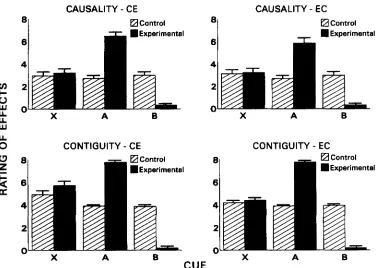
Competition between causes was observed in response to the Causality CE- and ECoworded questions but not in response to the Contiguity CE- and EC-worded questions.
Mean ratings for all three possible causes are shown in Figure 1 for each of the four test questions. As is evident in Figure 1, experimental participants differed from control participants in their mean ratings of Causes A and B in all four test questions. For each test question, ratings of Cause A were higher and ratings of Cause B were lower in the experimental group than in the control group (aUps < .001). Thus, partici- pants were sensitive to the differential treatment received with respect to A and B. For brevity, and because A and B ratings are not the critical data, we comment further only on the ratings of the target cause, X, for each test question.
The top two panels of Figure 1 show the mean ratings of Cause X for the two causality questions. A 2 (group: experimen-
tal vs. control) x 2 (wording: CE vs. EC) analysis of variance (ANOVA) on ratings of Cause X in response to the causality questions yielded a main effect of group, F(1, 40) = 6.23, M S E = 8.83, p < .05, but no other main effect or interaction was observed. That is, experimental participants rated Cause X lower than control participants, thus reflecting a cue competi- tion effect, but the ratings of Cause X were not affected by whether the test question was worded CE or EC.
By contrast, no competition between causes was observed in response to the contiguity questions. The bottom two panels of Figure I depict the mean ratings of Cause X in response to the Contiguity-CE question, which effectively asked about the absolute value of p ( E I X ) , and the Contiguity-EC question, which effectively asked about the absolute value o f p ( X I E ). A 2 (group: experimental vs. control) x 2 (wording: CE vs. EC) A N O V A on the ratings of Cause X in response to the contiguity questions yielded a main effect of wording, F(1, 40) = 26.31, M S E = 2.48,p < .001, and no main effect of group or interaction. This effect of wording suggests that participants were sensitive to the differential value o f p ( E I X) and P ( X I E ) asked by the Contiguity-CE and Contiguity-EC questions, respectively. This is consistent w i t h p ( X I E) = I and p ( E I X ) = .5 for both groups (see Table 1). More important, the absence of both a main effect of group or an interaction indicates that potential causes do not compete when the test questions are framed in terms of contiguity, which presumably does not foster cue competition. (In the General Discussion section we discuss some examples of similar questions that have yielded competition in previous research [e.g., Price & Yates, 1993].)
C A U S A L I T Y - CE C A U S A L I T Y - EC
8 [ ] Control
tal • Exoerimontal 6
4
U~ 2
uJ
U~
D 0
U.
O
ill:: 4
2
0
X A B X A B
C O N T I G U I T Y - C E C O N T I G U I T Y - E C
o ^ . * . ^ l ~ F ~ Control
0 v
X A B X A B
[image:5.594.111.481.425.694.2]C U E
In summary, this experiment replicated the findings of V a n H a m m e et al. (1993) a n d W a l d m a n n a n d Holyoak (1992), that competition b e t w e e n causes occurs when a causality question is used, a n d extends their results by showing (a) that the CE versus E C wording of the causality questions does n o t seem to be a crucial factor in the competition obtained between causes a n d (b) that despite cue competition occurring with the causality questions, participants are sensitive to the contiguity of events. Notably, competition between causes did not occur in response to questions worded in either the C E or E C directions when the test questions were worded in terms of cooccurrence. Thus, causes appear to compete or not to compete d e p e n d i n g on whether the test question encourages competition by implying comparisons b e t w e e n potential causes or discourages competition by asking about simple event cooccurrence i n d e p e n d e n t l y of other events.
E x p e r i m e n t 2 M e t h o d
Participants. Forty-two undergraduate students from Deusto Uni- versity volunteered for the study. None of the participants had taken part in any related experiment. They were randomly assigned to the experimental or control group.
Procedure. Table 2 summarizes the design of this experiment. Possible effects of consuming the medicine Dugetil were always presented in compounds of two. Effects A (Huxley syndrome), B (Lindsay syndrome), and X (Hamkaoman syndrome) were three side effects of Dugetil consumption that had been rated equal by partici- pants in a preliminary study (see the Appendix). For the experimental group, Compound Syndrome AX was always paired with ingestion of Dugetil, whereas Compound Syndrome BX was never paired with ingestion of Dugetil. For the control group, both AX and BX compound syndromes were randomly paired with Dugetil consump- tion in 50% of the trials. Order of presentation of the AX and BX compounds followed the same randomization used by Van Hamme et al. (1993). A translation of the cover story reads as follows.
Imagine that the following situation is real. There are 16 patients that have several syndromes, and you have to determine which of these syndromes is the effect of consuming a medicine called Dugetil. For this purpose, you ask the patients to write down what syndromes they have, and whether or not they took Dugetil before the syndromes appeared. The results provided by the patients are given below. Please use only the information in front of you and try to ignore any previous knowledge that you may have about illnesses.
The information was presented in a list format, with one line for each of the 16 patients. Column 1 was headed patient and contained the patient's number, Column 2 was headed syndromes and contained the names of syndromes that patient had, Column 3 was headed Dugetil consumption and indicated yes or no for each patient. Order of yes or no across patients was identical to that of the equivalent groups in Van Hamme et al.'s (1993) study.
There were four test questions for each possible effect, correspond- ing to the Causality-CE, Causality-EC, Contiguity-CE, and Contigu- ity-EC test questions previously mentioned. Like in Experiment 1, to make sure that participants would understand what was being asked by each of the four questions, we asked each participant all of the test questions, which were simultaneously presented on the same sheet of paper. Participants could respond to them in any order and could make corrections in their response if after reading a new question, they thought they had erred in their answer to any of the other ones. For
Effect X (Hamkaoman syndrome), these questions were worded, respectively, in the following way:
1. Is Dugetil the cause of Hamkaoman syndrome? 2. Is Hamkaoman syndrome the effect of Dugetil?
3. On the occasions in which the patient had taken Dugetil, did Hamkaoman syndrome appear?
4. On the occasions in which Hamkaoman syndrome has ap- peared, had the patient consumed Dugetil?
Equivalent blocks of four questions were asked for the Huxley syndrome (Effect A) and for the Lindsay syndrome (Effect B). Each test question was followed by a 0 to 8 rating scale anchored at 0 (definitely not), 4 (possibly), and 8 (definitely). A heading that indicated the syndrome's name separated each block of four test questions.
Results a n d Discussion
N o n e of the four test questions yielded competition between effects.
M e a n ratings for all three effects are shown in Figure 2 for each of the four test questions. As is evident in Figure 2, the experimental group differed from the control group in m e a n ratings of Effects A a n d B on all four test questions. F o r each test question, ratings of Effect A were higher and ratings of Effect B were lower in the experimental group t h a n in the control group (allps < .001), suggesting that participants were sensitive to the differential t r e a t m e n t received for A and B. F o r brevity, a n d because A and B ratings are not the critical data, we c o m m e n t further only on the ratings of the target effect, X, for each test question.
Ratings of Effect X showed that the causality questions did not foster cue competition in this experiment. T h e top two panels of Figure 2 show the m e a n ratings of Effect X for these two questions. A 2 (group: experimental vs. control) x 2 (wording: C E vs. EC) A N O V A on ratings of Effect X in response to these two questions yielded no significant main effects or interaction (all p s > .50). Thus, no competition of effects occurred with either the CE or the E C wording of causality questions.
Additionally, no competition b e t w e e n effects was observed in response to the contiguity questions. The bottom two panels of Figure 2 show the m e a n ratings of Effect X in response to the Contiguity-CE question, which asked about the absolute value o f p ( X ] C), a n d the Contiguity-EC question, which asked about the absolute value o f p ( C [ X ) . A 2 (group: experimental vs. control) x 2 (wording: C E vs. EC) A N O V A on the ratings of Effect X in response to the contiguity questions yielded a main effect of wording, F(1, 40) = 13.66, MSE = 1.61,p < .01, a n d no main effect for group or an interaction. This effect of wording suggests that participants were sensitive to the differ- ential value o f p ( X l C ) a n d p(CBX) probed by the Contigu- ity-CE and Contiguity-EC questions, respectively. This is consistent with p ( X I C) = 1 and p ( C ] X) = .5 for both groups (see Table 2). More important, the absence of a m a i n effect of group or an interaction indicates that potential effects do not compete when the test questions are framed in terms of contiguity.
188 MATUTE, ARCEDIANO, AND MILLER
o~
lad U . - I t . U J
C A U S A L I T Y - CE C A U S A L I T Y - EC
8 [ ] Control
I [ ] Experimental
X A B X A B
u .
O C O N T I G U I T Y - CE C O N T I G U I T Y - EC
Z~ ~ ~ ~^~'~J 8 ~J ~nntrnl
8 6
4 4
2 2
0 0
X A B X A B
[image:7.594.110.488.75.343.2]C U E
Figure
2. Mean ratings for all three possible effects (X, A, and B) for each of the four test questions in Experiment 2. Brackets represent standard errors. CE ffi cause to effect; EC = effect to cause.found that the EC wording versus CE wording of the causality question was irrelevant. In Experiment 2, lack of competition between effects was observed with both questions.
E x p e r i m e n t 3
Experiments 1 and 2 were intended as a replication and extension of Van Hamme et al.'s (1993) and Waldmann and Holyoak's (1992) studies demonstrating competition between causes but not between effects. Contrary to one of their interpretations, the CE wording versus EC wording of the test question had no effect on either the competition obtained between causes or the lack of competition obtained between effects. Indeed, both in Experiment 1 and in Experiment 2, participants appeared to interpret both CE- and EC-worded causality questions as essentially the same question in that they gave very similar ratings to the two questions in each experi- ment.
On the other hand, the results of Experiments 1 and 2 taken together could be viewed as suggesting that causes compete and effects do not, which was one of the other interpretations of Van Hamme et al. (1993) and Waldmann and Holyoak (1992). However, as noted in the introduction, this conclusion is inconsistent with numerous reports of competition between effects. Moreover, causality questions (whether CE or EC wording is used) seem to ask about p ( E I C ) implicitly com- pared withp(EJ C'), and thus, they are apt to foster competi- tion between causes but not between effects. In this frame- work, questions that appeal to p ( C I E ) implicitly compared
w i t h p ( C J E ' ) would be needed to obtain competition between effects. This prediction was tested in Experiment 3.
Thus, the purpose of Experiment 3 was to examine competi- tion between effects by using a test question that assesses p ( C I E ) implicitly compared with p ( C I E ' ) . For comparison purposes, competition between causes was also examined by using a similarly worded test question that assessed p ( E I C ) implicitly compared with p ( E J C ' ) . That is, we aimed to use a question that we thought would foster competition between causes in the cause condition (consisting of multiple causes and one effect) and a question that we thought would foster competition between effects in the effect condition (consisting of multiple effects and one cause).
question used for the cause condition should not substantially differ from the causality questions used in Experiments 1 and 2, which asked a b o u t p ( E I C) implicitly compared w i t h p ( E [ C') and fostered competition between causes. The question used for the effect condition, however, was substantially different from the questions used in Experiments 1 and 2, in that it asked a b o u t p ( C IE) implicitly compared w i t h p ( C I E'). Unlike the results from Experiments 1 and 2, we expected this question to foster competition between effects. In our view, this question is the essence of the questions that have been used in prior experiments reporting competition between effects (e.g., Chapman, 1991; Esmoris-Arranz et al., 1995; Price & Yates, 1993; Shanks & Lopez, in press; Waldmann & Holyoak, 1992, Experiment 2). By contrast, most of the experiments that have failed to obtain competition between effects (e.g., Van Hamme et al., 1993; Waldmann & Holyoak, 1992, Experiment 1; our Experiment 2) I have asked partici- pants questions that were functionally similar to p ( E I C ) implicitly compared with p ( E I C ' ) , which is not a competitive question for effects but is for causes.
Additionally, contiguity questions were also used in Experi- ment 3 for both causes and effects to test the reliability of the results of Experiments 1 and 2. These questions had proven useful in Experiments 1 and 2 in demonstrating that, when cue competition was observed, it was not a product of a competi- tive learning mechanism, but instead it seemed to be the result of the testing procedure. In response to these questions, participants in Experiment 1 exhibited sensitivity to the actual cooccurrence of events, despite competition between causes being observed with causality questions.
M e t h o d
Participants. One hundred ninety-five undergraduate students from Deusto University volunteered for the experiment. None of the participants had taken part in any related experiments. They were randomly assigned to the various conditions.
Design. The experiment used a 2 (group: experimental vs. con- trol) x 2 (condition: multiple causes vs. multiple effects) x 2 (ques- tion: indicator vs. contiguity) factorial design. With four groups of participants we manipulated the between-subjects variables of group and condition. As in Experiments 1 and 2, the question variable was within subject.
Procedure. The experimental and control groups for the cause condition replicated the training procedure of Experiment 1 (see Table 1), whereas the experimental and control groups for the effect condition replicated the training procedure of Experiment 2 (see Table 2). The cover stories were unchanged. The test questions were changed and there were only two for each element (X, A, and B). We refer to them as the indicator and contiguity questions. As in the previous experiments, both questions were presented to each partici- pant on the same sheet of paper to increase the chances that participants would interpret them in the intended way. Participants could respond to them in any order and were allowed to make corrections. AS in the previous experiments, each question was followed by a 0 to 8 rating scale anchored at 0 (definite& not), 4
(poss/bly), and 8 (definitely). For the cause condition, a translation of the indicator and contiguity questions reads, respectively, as follows:
1. Is taking (medicine's name) indicative that the allergic reaction is going to appear?
2. On the occasions in which the allergic reaction appeared, did the patient consume (medicine's name)?
For the effect condition, a translation of the indicator and contiguity questions reads, res~aectively, as follows:
1. Is (syndrome's name) indicative that the patient has taken Dugetil?
2. On the occasions in which the patient has taken Dugetil, did (syndrome's name) appear?
R e s u l t s a n d D i s c u s s i o n
Competition between causes and between effects was ob- served in response to the indicator questions but not in response to the contiguity questions.
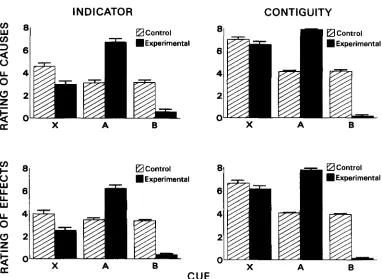
Figure 3 shows the mean ratings for all three elements in response to the indicator and contiguity test questions for the cause condition (top two panels) and the effect condition (bottom two panels). As is evident in Figure 3, the experimen- tal groups differed from the control groups in their mean ratings of A and B in all four conditions. For each condition, ratings of A were higher and ratings of B were lower in the experimental group than in the respective control group (all ps < .001). Thus, participants were sensitive to the differential
treatment received for A and B.
The critical data are the ratings of the Target Cue X. Figure 3 shows the mean ratings of X for the cause condition (top panels) and the effect condition (bottom panels). Cue competition occurred both between causes and between ef- fects in response to the indicator questions (left panels) but not in response to the contiguity questions (fight panels). A 2 (group: experimental vs. control) x 2 (condition: cause vs. effect) x 2 (question: indicator vs. contiguity) A N O V A on the ratings of X was conducted. This A N O V A yielded main effects for question (indicator vs. contiguity), F(1, 191) = 204.37,
M S E = 4.54, p < .001, group (experimental vs. control), F(1, 191) = 23.51, M S E = 4.12, p < .001, and condition (multiple causes vs. multiple effects), F(1, 191) = 5.5, M S E =
4.12, p < .05. The Group x Condition interaction was nonsignificant ( p > .10), reflecting the fact that the behaviors of the experimental and control groups were similar within the cause condition and within the effect condition. The Group x Condition x Question interaction was also nonsignificant ( p > .10). However, the critical Group x Question interac- tion proved reliable, F(1, 191) = 5.89, M S E = 4.54, p < .05, indicating that differences between the experimental and control groups (i.e., cue competition) depended on the specific question. Inspection of Figure 3 suggests that the group variable had a larger effect on the indicator question than on the contiguity question. To further clarify these results, we conducted separate 2 (group) x 2 (condition) A N O V A S for each of the two test questions.
The 2 (group: experimental vs. control) x 2 (condition: cause vs. effect) A N O V A on ratings of X in response to the indicator questions (see left side of Figure 3) yielded a main effect for group, F(1,191) = 21.75, M S E = 5.18,p < .001, but
190 MATUTE, ARCEDIANO, AND MILLER
I N D I C A T O R C O N T I G U I T Y
tal
o
nr X A B X A B
)_ 8
:al
I.U
U. 6
U. U.J
U. 4
0
Z
X A B 0 X A B
[image:9.594.105.487.72.351.2]r," C U E
Figure 3. Mean ratings for all three possible causes (X, A, and B; top panels) and for all three possible effects (X, A, and B; bottom panels) in Experiment 3. Competitive (indicator) questions are shown in the left panels. Noncompetitive (contiguity) questions are shown in the right panels. Brackets represent standard errors.
no main effect for condition nor an interaction. Planned comparisons showed that the experimental group rated X lower than the control group in both the cause, F(1, 191) = 11.95, M S E = 5.18,p < .01, and effect conditions, F(1,191) = 9.94, M S E = 5.18,p < .01, thus, reflecting a cue competition effect in both cases.
By contrast, the 2 (group) x 2 (condition) A N O V A on ratings of X in response to the contiguity questions (see right side of Figure 3) yielded no main effects or interaction (all ps > .05), suggesting, to the extent that a null result can, that the experimental and control groups were similarly sensitive to the actual cooccurrence of events in both the cause and effect conditions.
In summary, both presence and absence of cue competition between causes and between effects were obtained as a function of test question. Thus, effects can compete for diagnostic value just as causes can compete for predictive value, but competition takes place only under some, very specific, conditions. These results, together with those of Experiments 1 and 2, support the view that competitiveness evoked by the test question is a critical factor in cue competi- tion between causes and between effects.
G e n e r a l D i s c u s s i o n
The present results replicate the well-established phenom- enon of competition between causes (e.g., Baker et al., 1993; Shanks, 1985; Van Hamme et al., 1993; Waldmann & Holyoak,
1992; Wasserman, 1990a, 1990b) as well as the more controver- sial presence (Chapman, 1991; Esmoris-Arranz et al., 1995; Price & Yates, 1993; Shanks, 1991; Shanks & Lopez, in press; Waldmann & Holyoak, 1992, Experiment 2) and absence (Van Hamme et al., 1993; Waldmann & Holyoak, 1992, Experiments 1 and 3) of competition between effects. The conditions leading to those opposite outcomes were not clear in previous research. In this research we identified the test question as a crucial factor in obtaining one or the other outcome.
The multiple variables that might have been critical in producing the difference in cue competition between causes and between effects in Waldmann and Holyoak's study (1992), should be reconsidered. First, the results of Esmoris-Arranz et al. (1995) and Shanks and Lopez (in press) taken together had shown that, when events are sequentially presented, direction- ality of training is irrelevant. That is, Shanks and Lopez obtained competition between effects that were presented before causes during training, and Esmoris-Arranz et al. obtained competition between effects that were presented after causes during training. Thus, in the experiments reported in this article, we avoided the issue of directionality in training by presenting the information in list format (as did Van Hamme et al., 1993). However, we separated the roles of several other potentially critical variables that had remained confounded in at least part of the previous reports.
cue competition observed in these experiments was not depen- dent on whether the assessment question was worded CE or EC. Several potential causes of one effect were presented in Experiment 1, and competition between causes was observed, regardless of the CE or EC wording of causality questions. Several potential effects of one cause were presented in Experiment 2, and the competition between effects was not observed, regardless of the EC or CE wording of the causality questions.
The difference in cue competition between Experiments 1 and 2 could be viewed as suggesting that there is a difference between causes and effects in susceptibility to cue competition, as was also proposed by Waldmann and Holyoak (1992) and Van Hamme et al. (1993). Experiment 3 showed that this is not the case. As previously mentioned, there was a procedural asymmetry between the cause and effect conditions in all of the experiments that failed to obtain competition between effects. That is, when the test question was worded in terms of causality (i.e., probing p [ E I C ] implicitly compared with p [ E I C ' ] ) , regardless of being worded CE or EC, the question may have fostered competition between causes. Thus, the question may have become competitive when several causes were present (cause condition), but it became noncompetitive when only one possible cause was available (effect condition). When this procedural difference between the cause and effect conditions was eliminated in Experiment 3 by using an indica- tor test question for causes (i.e., probing p [ E I C ] implicitly compared w i t h p [ E l C ' ] ) in the cause condition and for effects (i.e., probingp[C I E] implicitly compared w i t h p [ C l E ' ] ) in the effect condition, the difference between causes and effects in their susceptibility to cue competition was eliminated. These questions showed that effects can compete for diagnostic value just as causes can compete for predictive value. Additionally, neither causes nor effects competed when the test question was worded in terms of cooccurrence (i.e., the contiguity questions used throughout Experiments 1-3).
Thus, at the empirical level it appears that whenever test questions ask about the relative predictive value of multiple potential causes, or about the relative diagnostic value of multiple potential effects, cue competition among the relevant cues can be observed. We now consider the implication of these findings for several accounts that have been discussed in the context of competition between causes and between effects.
Waldmann and Holyoak (1992)
Although our finding of competition between effects, by using a diagnostic test question, is consistent with Waldmann and Holyoak's (1992) Experiment 2 and with many other experiments that have shown competition between effects when diagnostic (EC) testing is used (see above), it is contrary to the predictions of Waldmann and Ho!yoak's model. Accord- ing to Waldmann and Holyoak, participants can reason at test in either the CE or the EC direction. However, the information is always learned in the CE direction (regardless of whether causes or effects are presented first), and only the antecedent events (i.e., causes) are learned competitively. Thus, in their view, even though the test phase allows for more flexible
forward or backward reasoning, competition should be ex- pected only between causes.
In their attempt to account for this discrepancy between their model and the existing data on competition between effects, Waldmann, Holyoak, and their colleagues have gener- ally tended to criticize the data. For instance, they discredited Waldmann and Holyoak's (1992) Experiment 2 on the basis that it could have been affected by preexperimental biases, and they discredited Shanks's (1991) data on the basis that partici- pants could have interpreted effects as causes (Melz, Cheng, Holyoak, & Waldmann, 1993; see Shanks, 1993, for a reply). Obviously, this latter criticism could also be applied to our Experiment 3. However, assuming that effects competed in our Experiment 3 because participants interpreted effects as causes implies that participants should have used the same logic in our Experiment 2 (as well as in Waldmann and Holyoak's Experiments 1 and 3). In the framework of Waidmann and Holyoak's model, it would remain to be explained why partici- pants sometimes interpret effects as effects and sometimes interpret effects as causes.
Rescorla-Wagner (1972) Model
The Rescorla-Wagner (1972) model assumes (a) a cause-to- effect directionality in the associations and (b) a competitive learning process. As noted by Van Hamme et al. (1993), who used both the same list format and the same predictive (CE) tests that we used in our Experiments 1 and 2, the predictions of the Rescorla-Waguer model for this case are clear: Compe- tition should be expected between causes (antecedent events) but not between effects (subsequent events). This was con- firmed by Van Hamme et al. as well as by our causality questions in Experiments 1 and 2. However, we also observed a lack of competition between causes when the contiguity questions were used in Experiments 1-3. This is not predicted by the Rescoda-Wagner model. Moreover, the Rescorla- Wagner model is silent with respect to diagnostic testing. Thus, it is not relevant to our Experiment 3.
However, an associative interpretation of our results could be generated from suggestions by Shanks and Lopez (in press). According to Shanks and Lopez, although predictive-competi- tive-associative theories, such as the Rescorla-Waguer (1972) model, predict competition between antecedent events and no competition between subsequent events, they could accommo- date competition of effects and noncompetition of causes. The rationale for this is that verbal preparations allow for the possibility that effects be presented (and processed) as anteced- ents of causes, in which case, the prediction would be that of competition between effects (antecedents) and no competition between causes (subsequent events).
192 MATUTE, ARCEDIANO, AND MILLER
the contiguity test questions for both causes and effects (although a null result) is possibly as important as the presence of competition between causes and between effects observed in response to our indicator questions in Experiment 3. A competitive learning mechanism does not account for the acquisition of such noncompetitive knowledge regarding cooc- currence of events. Third, we presented causes and effects simultaneously in list format (thus, it seems more plausible to identify effects as subsequent events following their causes than vice versa), and we observed competition between effects under diagnostic (EC) test conditions (Experiment 3). Consis- tent with this, data from the nonverbal preparation of Esmoris- Arranz et al. (1995) showed that when prior knowledge is minimized and effects could not plausibly be interpreted as antecedent events, effects could still compete for diagnostic value. Other nonverbal experiments, in which the directional- ity of associations was examined, also support the view that participants can reason from subsequent to antecedent events (e.g., Matzel, Held, & Miller, 1988; Zentall, Sherburne, & Steirn, 1992). Thus, diagnostic (backward) test conditions appear to foster types of reasoning that cannot always be reinterpreted in terms of predictive (forward) processes. A unified explanation that addresses both competition and non- competition between causes and between effects is needed.
Contiguity Versus Competitive Associative Theories
Since the dictums of Aristotle, most associative theories had maintained that associations are learned noncompetitively between contiguous events (e.g., Bush & Mosteller, 1951; Estes, 1950; Hull, 1943; Hume 1739/1964). These early conti- guity theories were displaced by competitive learning theories (e.g., Rescorla & Wagner, 1972) on the basis that contiguity alone was not sufficient to account for contingency effects (Rescorla, 1968) and cue competition effects, such as blocking (Kamin, 1968) and the relative validity effect (Wagner et al., 1968). However, the observation of cue competition under some test conditions, but not others, is at variance with the assumption of an underlying competitive learning process.
A return to simple contiguity (i.e., noncompetitive) theory of learning may seem counterintuitive because it implies that even adventitious (i.e., noncausal) pairings of events may promote the acquisition of associations between contiguous events. However, superstitious behavior and related phenom- ena support this statement (e.g., Dickinson & Charnock, 1985; Herrnstein, 1966; Matute, 1994; Rescorla, 1992; Skinner, 1948), even though there is also a good deal of evidence indicating that participants learn to respond differentially as a function of event correlations (e.g., Dickinson & Charnock, 1985; Hallam, Grahame, & Miller, 1992; Rescorla, 1968; Shanks & Dickinson, 1987; Wasserman, 1990b). These two sets of results may seem to contradict each other, but a substantial body of data shows that cue competition (and other disrupted responding effects) can take place at the retrieval, judgmental, or response stages, and consequently these effects do not necessarily imply a deficit in the acquisition of associations (i.e., learning; see, for example, Bouton, 1991; Miller, Kasprow, & Schachtman, 1986; Miller & Matzel, 1988; Rescorla, 1993; Shanks & Dickinson, 1987). The present data suggest that
intact associations can flexibly be used as a function of task demands during assessment. They may compete in some test conditions but not in others, depending on whether test conditions encourage competition.
Several other experiments have also shown that humans learn information noncompetitively, despite their showing contingency and cue competition effects under select test conditions. For instance, Wasserman, Elek, Chatlosh, and Baker (1993) acknowledged that competitive learning theories (e.g., Rescorla & Wagner, 1972) could account for contingency judgments but could not explain why their participants simulta- neously evidenced noncompetitive learning of the absolute values o f p ( E I C ) a n d p ( E l n o C). The specific wording of the probability questions in Wasserman et al.'s (1993) study was similar to our contiguity questions, that is, stating clearly that each question was asking about the conditional probabilities, p ( E I C ) and p ( E l n o C), independently of each other (i.e., no
comparison should be taken into account).
Other authors, however, have not always observed noncom- petitive ratings when they used conditional probability ques- tions (see Estes, Campbell, Hatsopoulos, & Hurwitz, 1989; Gluck & Bower, 1988; Price & Yates, 1993). For instance, Price and Yates compared judgments of the conditional probabilities p(CIE1) and p(E11C) in a condition in which several potential effects of one cause were available. The specific wording that they used was intentionally less con- strained than the one that we (and Wasserman et al., 1993) used for the contiguity questions. Price and Yates's rationale for doing so was to let participants make either a competitive or a noncompetitive interpretation. Price and Yates observed competition between effects when they tested p(C] El), which could be compared with p ( C I E ' ) because several potential effects were present, but not when they tested p(E11C), which could not be compared with p ( E I l C ' ) because no alternative potential cause was present. In a similar vein, Estes et al. asked participants in the test phase about p (CIE1) in a condition in which several potential effects were present. Their participants interpreted this question as competitive. However, during training, their participants exhibited noncompetitive acquisi- tion of information when they were asked to "predict" the occurrence of C on the basis of E being present during each training trial. As noted by Estes et al. (see pp. 567-568), this discrepancy between what is acquired during training and how participants respond to the conditional probability questions at test is also evident in other reports (e.g., Gluck & Bower, 1988).
actual cooccurrence of events, despite their making competi- tive judgments about the same events under different test conditions.
Our demonstration of a difference in cue competition between responses to questions worded in causal or indicator terms versus contiguity terms is consistent with a variant of contiguity theory (Matzel et al., 1988; Miller & Barnet, 1993), which assumes (a) that associations are learned noncompeti- tively and bidirectionally through simple contiguity and (b) that cue competition effects are the result of distinct postacqui- sition processes (e.g., Miller & Grahame, 1990). In this framework, cues do not compete for associative strength. Rather, intact associations may compete for response control (behavioral or judgmental) when several of them point to the same event (i.e., several of them predict the same effect or diagnose the same cause). In support of this view, the present data indicated that only when the test question probes one association implicitly or explicitly relative to other associations to the same target effect (in the cause condition) or to the same target cause (in the effect condition) does the response reflect a cue competition effect. That is, when the test circumstances (i.e., causal or indicator test questions) encourage several associations to activate the representation of the same event, associations apparently compete for predictive (or diagnostic) effectiveness. Conversely, when only one association is made relevant through the test conditions (i.e., contiguity questions), this association has no competitors for exciting the representa- tion of the target event. Consequently, competition between associations should not take place.
A word of caution, however, is in order. We are assuming that for specific wording in the test phase to influence whether competition or noncompetition is observed, the necessary associative information must have been stored in some man- ner. Also, for simplicity, we have assumed that simple contigu- ity was sufficient for acquisition. However, our procedures did not actually manipulate the training phase. Thus, any conclu- sion about the learning process can only be inferred from the testing data. An alternative interpretation, which is based on differential acquisition, is suggested below.
A n Alternative Possibility: Several Knowledge Bases
In the preceding analysis we assumed that the various assessment questions we asked (in any one experiment) all tapped a common knowledge base that was established during training. One alternative interpretation of the differences in cue competition that we observed with different assessment questions is that each question may have tapped different knowledge bases containing slightly different acquired informa- tion. Competition may have interfered with acquisition of some types of information but not with other types of informa- tion. Our contiguity question may have assessed information that was not subject to cue competition. In contrast, our causal and indicator questions may have assessed information stored in a different, competitively acquired, knowledge base.
There are little data from human subjects that address the question of whether a simple contiguity learning mechanism is used to acquire and store information in a unitary knowledge base or whether different (competitive and noncompetitive)
learning mechanisms are used to acquire and store informa- tion in different knowledge bases. However, animal data favor the former possibility. Cue competition in animal subjects has been attenuated through various posttraining manipulations (that precluded relevant, new learning), even when the identi- cal test procedures (i.e., same test questions) were used to observe both cue competition before the recovery treatment and absence of cue competition after the recovery treatment (e.g., Balaz, Gutsin, Cacheiro, & Miller, 1982; Cole, Barnet, & Miller, 1995; Dickinson & Charnock, 1985; Kasprow, Ca- cheiro, Balaz, & Miller, 1982; Kauftnan & Bolles, 1981; Kraemer, Lariviere, & Spear, 1988; Matzel, Schachtman, & Miller, 1985). The results of these studies have discouraged the view that cue competition is the result of attenuated acquisi- tion in some but not all of several knowledge bases, because the common test procedure used within any of these studies before and after recovery treatment presumably assessed the same knowledge base. Thus, we favor the more parsimonious view that there is a noncompetitive learning mechanism that is single and flexible, and the contents of which can be used in different ways (e.g., competitively or noncompetitively and forward or backward), depending on demand characteristics. (However, realistically, even if there is only one knowledge base, select cover stories may result in some degree of cue competition affecting the contents of the acquired knowledge base.)
Some Concluding Remarks
There are enough data to conclude that cue competition does not occur only among causes in predictive situations, or only between antecedent events, or only with CE directionality of the assessment question. This conclusion is problematic both to most associative models and to most cognitive models of learning (e.g., Rescorla & Wagner, 1972; Waldmann & Holyoak, 1992). Most such theories predict that causes are learned competitively and that effects are learned noncompeti- tively. By contrast, our results show that both causes and effects compete or do not compete as a function of test question. Neither family of models can currently explain this strong effect of test question. We have argued that a noncom- petitive learning process that is based on contiguity seems to be the most parsimonious explanation of the existing data and that differences in the testing procedure seem to be critical determinants of cue competition both between causes and between effects. In this framework, intact associations may compete, in either direction, when several of them are trying to activate the representation of the same event.
R e f e r e n c e s
Baker, A. G., Mercier, P., Vall6e-Tourangeau, F., Frank, R., & Pan, M. (1993). Selective associations and causality judgments: Presence of a strong causal factor may reduce judgments of a weaker one. Journal of Experimental Psychology: Learning, Memory, and Cognition, 19, 414-432.
Balaz, M. A., Gutsin, P., Cacheiro, H., & Miller, R. R. (1982). Blocking as a retrieval failure: Reactivation of associations to a