Slow age-related phase II on-transient
V
O
2and heart rate kinetics during
ramp exercise in adult men
Javier Padilla Pérez*,**
* Escuela Superior de Medicina del Instituto Politécnico Nacional.
** Canadian Centre for Activity and Ageing, School of Kinesiology, The University of Western Ontario (6501811FTGA), London, Ontario, Canada N6A 3K7.
ABSTRACT
We assessed for differences of the phase II cardiopulmonary (φII CRP) on-transient kinetics in terms of mean response time (MRT, s) for the expired ventilation (MRT Ve), pulmonary oxygen uptake (MRT VO2), carbon dioxide output (MRT VCO2) and heart rate (MRT HR) and also did the φIIVO2 on-transient kinetics degree of entropy (φIIVO2 MRT S, kcal•°C-1•s-1), between young (YG = 8, 25 ± 2.9; mean ± SD) and old adult men (OG = 9, 70.9 ± 4.7) men during legs cycling exercise computerized ramp test (YG: 25W•min-1; OG: 15W•min-1), in the search for determinant mechanisms or factors possibly involved in the VO
2 kinetics of adult men. The provided breath-by-breath pulmonary data and the beat-by-beat data were modelled by non linear regression. We observed ramp slow (MRT difference=OG - YG, s) φII on-transient age-related for both VO2 (23 s) and HR kinetics (30 s), and also increased age-related φIIVO2 MRT S (3.1 kcal•°C-1•s-1) for ramp exercise. The ramp test on-transient phase two of both the slow VO2 kinetics and slow HR kinetics were age- related, and they were accompanied by an increased VO2 kinetics entropy for ramp exercise, meaning that old adults could thermodynamically resists less the energy-transitions and thus increase their entropy in terms of kcal•°C-1•s-1. The amount of heat energy un-available for conversion into useful work (S) in the human body increases with ageing, and the human body does it with ageing by slowing down both the pulmonary O2 uptake and the heart rate on-transient kinetics during ergometric exercise.
Key words: Ramp, ageing; oxygen, heart rate, kinetics, entropy.
RESUMEN
En la búsqueda de mecanismos o posibles factores involucrados en la cinética (tiempo de respuesta media exponencial, TRM en s) de captación pulmonar de oxígeno (VO2) en el hombre adulto, evaluamos diferencias en la cinética transitoria de la phase ΙΙ
cardiopulmonar (φII TRM CRP) en términos de la ventilación espirada (TRMVe), TRM VO2, eliminación de bióxido de carbono (TRM VCO2) y frecuencia cardiaca (TRM FC), así como del grado de “entropía” (S) de la cinética transitoria de cinética de la φIIVO2 (φIIVO2 TRM S, kcal•°C-1•s-1), entre hombres adultos jóvenes (GJ = 8, 25 ± 2.9; media ± DE) y mayores (GM = 9, 70.9 ± 4.7) que hicieron una prueba computada de ejercicio tipo rampa en cicloergómetro usando sus dos piernas. Los datos pulmonares de respiración-por-respiración y de latido-por-latido de la FC fueron modelados mediante regresión no lineal. Observamos una cinética lenta de la φII de rampa transitoria relacionada con la edad (TRMdiferencia = GM - GJ, s) de 23 s en VO2, de 30 s FC, y un aumento de 3.1 kcal•°C-1•s-1 en la φ
IIVO2 TRM S relacionada con la edad durante el ejercicio tipo rampa. La cinética lenta de la fase dos transitoria de VO2 y FC estuvieron relacionadas con la edad, lo mismo que una entropía cinética aumentada de la VO2 del ejercicio de rampa, lo que se interpreta como una menor resistencia termodinámica en los adultos mayores para las transicio-nes energéticas y así se incrementa su entropía en términos de kcal•°C-1•s-1. La cantidad de energía calórica no disponible para su conversión en trabajo útil (S) del cuerpo humano aumenta con el envejecimiento y lo hace con una cinética de la captación pulmonar de O2 y de la FC transitorias del ejercicio ergométrico que disminuyen con la edad.
Palabras clave: Rampa, envejecimiento, oxígeno, frecuencia cardiaca, cinética, entropía.
INTRODUCTION
The work we performed during our daily life depends largely on the dynamics of the pulmonary ventilation (Ve),
rate-forcing protocols that have been used in an attempt to edu-ce control features of the CRP dynamics, after the square wave test, the ramp is the most commonly used because it provides four key parameters (VO2max; TVE, estimated venti-latory threshold; MRT, mean response time; and work effi-ciency) that make up a subjects aerobic profile1 in both
clinical and research settings. A linear system has the pro-perty that the kinetics of response does not depend on the stimulus amplitude. Thus, it is expected that the responses of VO2, VCO2, and Ve in the transition between loadless pedaling and higher work rates (WRs) should be linear in this respect,2 however, both Ve and VO
2 kinetics are
mar-kedly slower at work rates associated with sustained blood lactate elevations, and this tendency is also detected for VO2 (but not Ve) kinetics to be slower as WR increases for exercise intensities not associated with lactic acidosis. VO2 kinetics at high WRs are well characterized by the addition of a slower exponential component to the faster compo-nent, which is seen at lower WRs. In contrast, VCO2 kine-tics does not slow at the higher exercise intensities; this may be the result of the coincident influence diminished several sources of VCO2 related to lactic acidosis.2
Understanding the integrative strategy that the cardio-rrespiratory system and its kinetics adopt to meet the meta-bolic demands during ramp exercise eliciting maximum CRP values (Wmax, Vemax, VO2max, VCO2max, HRmax) would significantly contribute to our understanding of muscle energetics and limitations to exercise tolerance in this exer-cise domain. In fact, it is well known the impact of regular sport activity on CRP fitness; even at 2240 m over sea le-vel, regular sport activity positively affected aerobic power and counteract age-related decreases in HRmax, VO2max, maximum power max, maximum power index and fast tran-sitory CRP kinetics during increasing ergometric exercise.3
The measurement of VO2 kinetics is a good non-invasive estimation both in describing the response of the whole organism and in gaining insight into the skeletal muscle mass VO2 (VO2M) kinetics. Evermore, the exponential MRT of these CRP (MRT Ve, MRT VO2, MRT VCO2, MRT HR) increases during their transient increments with respect to work rate (ΔVe/ΔWR, ΔVO2/ΔWR, ΔVCO2/ΔWR, ΔHR/
ΔWR; ΔHR/ΔVO2, and ΔVe/ΔVCO2) is determinant of the oxygen deficit and, hence, of the potential requirement for anaerobiosis to supplement the ongoing aerobic compo-nent4 of the energy transfer for muscle contraction.5 For
example, the dynamic relationship ΔVO2/ΔWR, indicates if the metabolic response is adequate for a given power output; ΔHR/ΔVO2, could indicate if for a given metabo-lic demand either the stroke volume or the peripheral VO2 extraction or both are matched; and ΔVe/ΔVCO2, indica-tes if the there is excessive ventilation to the metabolic
stress.4 Consequently, it appears that indices of aerobic3
and anaerobic exercise performance differentially influen-ce the fundamental and slow components of the VO2 kine-tics.6
The ageing process is related with the participation or absence of many time constants.7 Ageing is associated with
a slowing of VO2 kinetics during the on-transition to a step increase in WR of submaximal exercise8 and the
negative-entropy (-S) of a human being decays when his VO2 kine-tics entropy (S) increases, in units of kcal•°C-1, with age-ing also durage-ing submaximal exercise.9 Entropy (from a Greek
word meaning “transformation”) is a property that an ob-ject has in addition to its temperature, and entropy is con-nected with the amount of heat energy un-available for conversion into useful work.10 The Φ two VO
2 kinetics S is
another fundamental parameter to study the transient res-ponse of gas exchange kinetics. However, it is unclear whether this slowing of VO2 kinetics is a consequence of blood flow limitations and/or VO2 delivery or of a slowest activation of the biochemical reactions in skeletal muscle, factors that have been implicated as limiting skeletal mus-cle VO2 consumption in old adults.11 Nevertheless, it has
been observed fast-age on transient contraction in artery stimulated with phenylephrine12 that could have cause-effect
relationships with the slow-age VO2 on-transient kinetics and its S (increased-age related VO2 kinetics S).9
We have already described three CRP on-transient phases (ΦI, cardiodymamic ;ΦII, linear primary component; ΦIII,
maximum ) and the ΦII CRP kinetics in Mexican athletes
during a ramp test at 2240 m above sea level.3 During Φ II,
specially the VO2 closely match the skeletal muscle active mass VO2 because the VO2 slope is not discernibly different from that of the response.1 In addition, it is well known that
the kinetic features in the VO2 response from above TVE square-wave test have important implications for the res-ponse to ramp test.1 We have already empirically applied
the entropy approach the study the O2 mass rate of chance per unit of time (S Φ2VO2τ, S phase two VO2 kinetics ) in
adult men9; specially important is the Φ
2VO2, because
du-ring this phase both VO2M and VO2 rise in a near- exponen-tial fashion towards the VO2 demand,13 but it has not been
explored for ΦII CRP ramp exercise test nor to study the
entropy of the ΦIIVO2 kinetics (S ΦIIVO2τ) in young versus
old men comparisons, during ramp exercise test.
The purpose of the present work was to assess for diffe-rences of the ΦII CRP on-transient kinetics (MRT Ve, MRT
VO2, MRT VCO2, MRT HR) and the ΦIIVO2 on-transient
kinetics degree of entropy (S ΦIIVO2 MRT), between young
Hypothesis
If the exponential ΦIIVO2 and HR on-transient response
to the ramp forcing function of maximal exercise are slow-age related in terms of MRT duration, thus the ΦII VO2
MRT, the S ΦIIVO2 MRT and the ΦII HR MRT estimated
values, should be significantly high in old compared to young men.
MATERIALS AND METHODS
Subjects
Our eight young (YG, aged 23 to 30 years) and nine old (OG, aged 64 to 78 years) male subjects that participated in this study were also studied for comparison with previo-us publication.8 Standard calibrated scales and
stadiome-ters were used to determine height (cm), weight (kg), and body mass index (weight/height2, kg•m-2). All subjects were healthy with no diagnosed CRP disease and were ac-tive having above average fitness. None of the subjects were on medication known to affect CRP function during exer-cise. Informed consent was obtained after the experimen-tal protocol and possible risks were explained to each par-ticipant. The research was approved by the University's Review Board for Health Sciences Research Involving Hu-man Subjects.
General protocol
Each subject was studied on one occasion and was tested at the same time of day on his visit to the laboratory.The subjects reported to the laboratory at least two hours after consuming a light meal and at least four hours after consuming caffeinated beverages. The sub-jects were asked to abstain from performing heavy inten-sity exercise prior to visiting the laboratory on the day of testing.
On his visit to the laboratory each subject performed an incremental exercise test with power output increased as a ramp function at 15-25 W.min-1 to volitional fatigue for the determination of the ventilatory threshold (TVE), peak O2 uptake (VO2peak) and maximal values for HR, CO2 and Ve. Subjects exercised in the upright position on an electri-cally-braked cycle ergometer (Lode, Model H-300-R); the resistance on the cycle ergometer was computer-controlled to produce a ramp signal that corresponded to a linear in-crease in power output. For the older subjects this test was performed under medical supervision and served as part of the medical pre-screening which also included a general medical examination.14,15
The VO2 averaged over the final 15 s of the incremental test prior to fatigue was taken as VO2peak. The TVE was defi-ned as the VO2 at which there was a systematic increase in the ventilatory equivalent for VO2 (VE/VO2) and end-tidal
PO2 (PETO2), with no concomitant increase in the ventila-tory equivalent for VCO2 (VE/VCO2), or decrease in
end-tidal PCO2 (PETCO2).
Ventilation and gas exchange (VO2, VCO2) were calcula-ted breath-by-breath by a computer based programme. Inspi-red and expiInspi-red airflow and ventilatory volumes were mea-sured by a low-resistance, low deadspace (90 ml), bi-directional turbine and volume transducer (VMM-110, Alpha Technologies); the volume signal was calibrated daily using a syringe of known volume (3.01 l or 0.99 l). Inspired and expired air was sampled continuously (1 ml•s-1) at the mouth, and analysed for fractional concentrations of VO2, CO2, and N2 using a respiratory mass spectrometer (Perkin Elmer MGA-1100 or Airspec MGA2000); the mass spectro-meter was calibrated daily using precision analysed gas mix-tures (9% O2, 7% CO2, 5% air, 79% N2). Analog signals from the mass spectrometer and turbine transducer were sam-pled and digitized every 20 ms and stored on computer for later analysis. Gas concentration signals were aligned with the inspired and expired gas volumes after correcting for the time delay of the analysis system. Ventilation, VO2 and VCO2 were calculated with corrections made for breath-by-breath fluctuations in lung gas stores.16,17 Temperature and water
vapour corrections were based on conditions measured near the mouth. Heart rate was monitored continuously via ECG electrodes using a modified V5 configuration; the heart rate signal was stored on computer for processing.
The dynamic relationships to characterize the metabo-lic (ΔVO2/ΔWR, ml•min-1•W-1), cardiovascular (ΔHR/
ΔVO2, beats•min-1•l•min-1), and ventilatory pattern (ΔVe/
ΔCO2, l•min-1•l•min-1) responses were determined during
the CRP ramp test4 in YG vs. OG comparisons.
Data analysis
The ΦII CRP (HR, Ve, VO2, VCO2) response was
deter-mined by simple linear regression and visual inspection of the entire CRP ramp response.18 The ramp-component
mo-del used to describe the ΦII CRP kinetic response was
des-cribed previously18 and provides an estimate of the
baseli-ne (a0), amplitudes (αx), time delays (TDx), and time
constants (τx), where x refers to a specific component in
the on-transient mass rate of change per unit of time for each CRP variable (dVe•dt-1, l•min-1; dVO
2•dt-1, ml•min-1;
dVCO2•dt-1, ml•min-1, HR•dt-1, beats•min-1). Model
para-meters were determined by least-squares nonlinear regres-sion in which the best fit was defined by minimization of the residual sum of squares (RSS).
The overall time course of the ΦII CRP response was
determined from the MRT. The MRT was the only kinetic parameter used for comparisons, which was calculated from a weighted sum of TD and τ for each component. The MRT is equivalent to the time required to achieve approxi-mately 63% of the difference between a0 and the new
stea-dy-state value.
Phase Two VO2 Kinetics Entropy
The entropy of the ΦIIVCO2 MRT (S ΦIIVCO2 MRT)
was calculated in terms of the Boltzmann's constant (k = 3.2983•10-4, cal•°C-1) by empirically substituting the
quan-titative measure of the atomistic disorder of a living system (D) in the formula of entropy (S = k • logD) by MRT; in other words, S ΦIIVO2 MRT = k • log(ΦIIVO2 MRT).8
Statistical analysis
General statistics, and the Pearson correlation coeffi-cients to assess the degree of relationships between varia-bles were applied to those of interest. The CRP kinetic parameter estimates were analysed using a one-way mea-sures analysis of variance (ANOVA) for on-transitions as the main effects. A significant F-ratio was further analysed using StudenNeuman-Keuls post hoc analysis. Student t-test was applied for YG versus OG comparisons.19
Statisti-cal significance was accepted at p < 0.05. All values are reported as the mean ± SD.
RESULTS
The anthropometric data from YG vs. OG comparisons showed no differences in height (179.63 ± 5.71 = 174.11 ± 5.53) body mass (79.13 ± 9.3 = 79.78 ± 9.87) and body mass index (24.49 ± 2.32 = 26.32 ± 3.05), but, as expected, in age (25.01 ± 3.95 < 70.87 ± 4.73, tα0.05=23.6, P < 0.001) the difference was -45.85 yrs. The maximal ramp test CRP data, and the transient increments in terms of ΔVCO2/ΔVWR, ΔHR/ΔVCO2, and ΔVe/ΔVCO2 caused by a ramp test input in the YG and OG are shown in table 1. The summary data for ramp ΦII kinetic CRP data
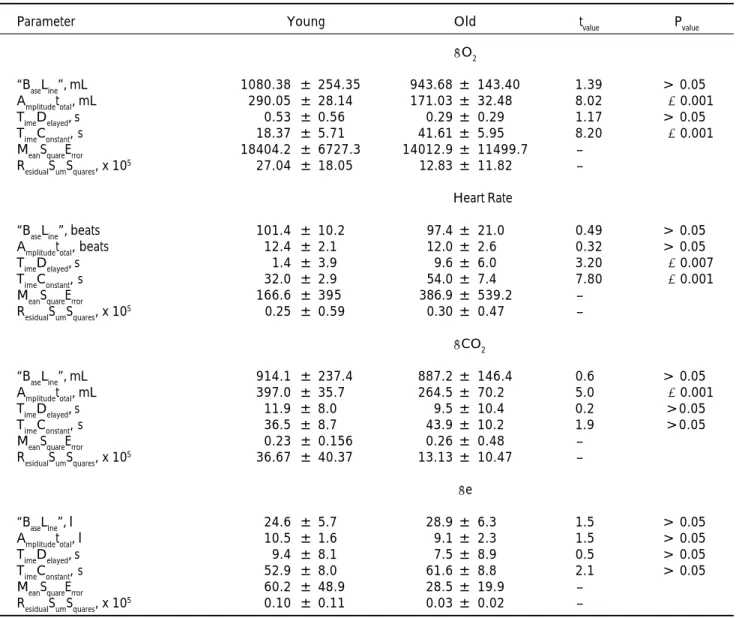
exercise are presented in table 2. An example of the CRP (VO2, VCO2, Ve, HR; ramp-component exponential fitting models describing both the VCO2 and the HR) ramp on-transient response in one young subject is shown in figure 1. The ΦII MRT kinetic parameter from the CRP variables
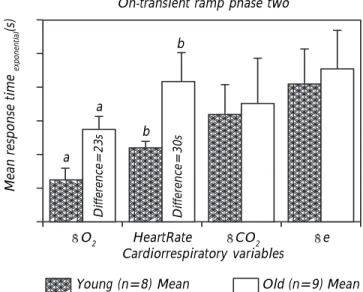
(VCO2, VCO2, Ve, HR) quantifying their dynamic respon-ses in YG vs OG adult men, during the on-transient of ramp test are shown in Figure 2. The ΦII MRT kinetic
para-meter entropy (ΦIIVO2 MRT S) quantifying the dynamic
response of VO2 in YG vs. OG adult men, during the on-transient of ramp test is shown in figure 3.
Maximal CRP Differences
As expected, all of the maximal ergo-CRP responses to the ramp test resulted significantly high in YG compared OG (Table I) in terms of differences as followed: WR (121.43 W), VO2, (1.55 l•min-1, 19.24 ml•kg-1 l•min-1),
HR (beats•min-1: experimental = 32.42, predicted = 45.78),
VCO2, (1.93 l•min-1), and e (44.5 l•min-1). However, only
the dynamic cardiovascular relationship (ΔHR/ΔVCO2) re-sulted significantly high in OG compared YG (differen-ce= 15.03 beats•min-1•l•min-1) (Table 1). The OG ΔHR/
Table I. Maximal ramp test cardiorespiratory data in eight young and nine old adult men.
Work Heart rate
Group rate VO2 peak experimental predicted VCO2 VE VO2/ΔWR ΔHR/VO2 ΔVe/ΔVCO2 (W) (l • min-1) (mL • kg-1 • min-1) (beats • min-1) (beats • min-1) (l • min-1) (l • min-1) (mL • min-1• W-1) (beatsl • l-1 • min-1) (l • l-1)
Young
249.88a 3.75b 47.38c 190.75d 195.00e 4.40f 140.50g 11.08 38.12h 25.79
± 45.72 ± 0.62 ± 6.39 ± 14.11 ± 3.07 ± 0.84 ± 36.24 ± 1.05 ± 7.23 ± 2.79
Old
128.44a 2.20b 28.13c 158.33d 149.22e 2.47f 96.00g 10.99 53.16h 30.06
± 20.84 ± 0.41 ± 7.18 ± 14.90 ± 4.74 ± 0.36 ± 29.78 ± 1.90 ± 14.58 ± 6.82
Numeric values are mean ± SD. VO2: Pulmonary oxygen uptake. Predicted heart rate = 220 years -age in years. VCO2: Carbon dioxide output. VE: Expired ventilation. WR: Work rate. ΔVO2/ΔWR, ΔHR/ΔVO2, and ΔVe/VCO2, metabolic, cardiovascular, and ventilatory dynamic
relationships, respectively. Student-tα, 0.05 test (Pa to f ≤ 0.001; Pg to h ≤ 0.02): at = 7.2, bt= 6.2, ct = 5.8, dt = 4.6, et = 23.3, ft = 6.3; gt = 2.8;
ΔVO2 was negatively related with VCO2peak (r = -0.72, P < 0.043).
ΦIICRP Kinetic Parameter Differences
The ΦII total amplitude in both the VO2 and the VCO2
resulted, 119 mL and 131.8 mL, respectively, high in YG compared OG (Table 2). The ΦII HR TD resulted 8.1 s
slow in the OG compared YG (Table 2). The ΦIIτ in both
the VO2 and the HR resulted, 23.25 s and 21.9 s, respec-tively, slow (P ≤ 0.001) in OG compared YG (Table 2). The ΦII MRT in both the VCO2 and the HR resulted, 23 s
(t = 8.3) and 30 s (t = 6.2), respectively, slow in OG compared YG (Figure 2). The ΦIIVO2 MRT S resulted 3.1
kcal•°C-1•S-1 high (t= 7.1, P ≤ 0.001) in OG compared
YG (Figure 3).
DISCUSSION
The three CRP phases (ΦI, ΦII, ΦIII) observed in this
stu-dy agreed with the fact that from sea level20 to moderate
altitude,17 CRP kinetics are characterized during a ramp
exercise by three progressively steeper slopes mainly based on Ve; the first from the beginning of exercise to anaerobic
Table 2. Ramp phase two cardiopulmonary kinetic data in eight young and nine old men.
Parameter Young Old tvalue Pvalue
VO2
“BaseLine”, mL 1080.38 ± 254.35 943.68 ± 143.40 1.39 > 0.05
Amplitudetotal, mL 290.05 ± 28.14 171.03 ± 32.48 8.02 ≤ 0.001
TimeDelayed, s 0.53 ± 0.56 0.29 ± 0.29 1.17 > 0.05
TimeConstant, s 18.37 ± 5.71 41.61 ± 5.95 8.20 ≤ 0.001
MeanSquareError 18404.2 ± 6727.3 14012.9 ± 11499.7
--ResidualSumSquares, x 105 27.04 ± 18.05 12.83 ± 11.82
--Heart Rate
“BaseLine”, beats 101.4 ± 10.2 97.4 ± 21.0 0.49 > 0.05
Amplitudetotal, beats 12.4 ± 2.1 12.0 ± 2.6 0.32 > 0.05
TimeDelayed, s 1.4 ± 3.9 9.6 ± 6.0 3.20 ≤ 0.007
TimeConstant, s 32.0 ± 2.9 54.0 ± 7.4 7.80 ≤ 0.001
MeanSquareError 166.6 ± 395 386.9 ± 539.2
--ResidualSumSquares, x 105 0.25 ± 0.59 0.30 ± 0.47
--VCO2
“BaseLine”, mL 914.1 ± 237.4 887.2 ± 146.4 0.6 > 0.05
Amplitudetotal, mL 397.0 ± 35.7 264.5 ± 70.2 5.0 ≤ 0.001
TimeDelayed, s 11.9 ± 8.0 9.5 ± 10.4 0.2 >0.05
TimeConstant, s 36.5 ± 8.7 43.9 ± 10.2 1.9 >0.05
MeanSquareError 0.23 ± 0.156 0.26 ± 0.48
--ResidualSumSquares, x 105 36.67 ± 40.37 13.13 ± 10.47
--Ve
“BaseLine”, l 24.6 ± 5.7 28.9 ± 6.3 1.5 > 0.05
Amplitudetotal, l 10.5 ± 1.6 9.1 ± 2.3 1.5 > 0.05
TimeDelayed, s 9.4 ± 8.1 7.5 ± 8.9 0.5 > 0.05
TimeConstant, s 52.9 ± 8.0 61.6 ± 8.8 2.1 > 0.05
MeanSquareError 60.2 ± 48.9 28.5 ± 19.9
--ResidualSumSquares, x 105 0.10 ± 0.11 0.03 ± 0.02
threshold; the second from anaerobic threshold to respira-tory compensation point, where the body CO2 stores are used to buffer acidosis owing to lactate production and this extra CO2 production drives the ventilation increase, at high altitude, ventilation increases owing to hypoxia and is characterized by two, instead of three phases,20 and the
third from respiratory compensation point to peak exerci-se. In the first detailed data on the time course of the CRP responses to exercise in humans21 it was shown that
car-diac output (HR • StrokeVolume, l •min-1) increases more
rapi-dly following an increase in exercise workload than does
arteriovenous O2 difference, proving that most of the early increase in VO2 is due to increased cardiac output, but as exercise continues, increased arteriovenous O2 difference contributed gradually more to increased VO2. Consequen-tly, we used the phase II HR kinetics because it may reflect O2 delivery to the working muscle in terms of phase II VO2
Figure 3. The phase two mean response time kinetic
parame-ter antropy for the pulmonary oxygen uptake (ΦIIVO2 MRT S)
quantifying the dynamic response of VO2 in young vs. old
adult men, during the on-transient ramp test.
Cardiorrespiratory variable Cardiorrespiratory variable 4000 3000 2000 1000 0 Phase I Time (min)
Start phase II End phase II
Phase III 300 240 180 120 60
0 3 6 9 12
Figure 1. An example of the three phases of the
cardiopulmo-nary ramp (25 W•min-1) on-transient response in one young
subject the pulmonary oxygen uptake (VO2), carbon dioxide
output (VCO2), expired ventilation (Ve), and heart rate (HR)
responses; and also the ramp-component exponential fitting
models describing the phase two of both the VO2 and the HR.
Ramp on-transient Ve, 1 min-1 Ramp on-transient HR, beats min-1 25Watts min-1
HR (time)= 114.4 + 9.6 (1-e –(time –(01/31))
○○○○○○○○ ○ ○ ○ ○ ○ ○
Ramp on-transient VO2 ml min-1 Ramp on-transient VCO2 ml min-1
VO2 (time)= 1188 + 327.3 (1 –e –(time-(01/21.1))
aaaaaaaaaaaaa aaaaaaaaaaaaaa aaaaaaaaaaaaaa aaaaaaaaaaaaaa aaaaaaaaaaaaaa aaaaaaaaaaaaaa aaaaaaaaaaaaaa aaaaaaaaaaaaaa aaaaaaaaaaaaaa aaaaaaaaaaaaaa aaaaaaaaaaaaaa aaaaaaaaaaaaaa aaaaaaaaaaaaaa aaaaaaaaaaaaaa aaaaaaaaaaaaaa aaaaaaaaaaaaaa aaaaaaaaaaaaaa aaaaaaaaaaaaaa aaaaaaaaaaaaaa aaaaaaaaaaaaaa aaaaaaaaaaaaaa aaaaaaaaaaaaaa aaaaaaaaaaaaaa aaaaaaaaaaaaaa
Young (n=8) Mean Old (n=9) Mean
15 10 5 0 Entropy V O2 kinetics (Kcal
ºC-1 s-1)
On-transient ramp phase two.
Groups
Difference=3.1
Young (n=8) Mean Old (n=9) Mean
Figure 2. The phase two mean response time kinetic
parame-ter (ΦII MRT) for the pulmonary oxygen uptake (VO2), carbon
dioxide output (VCO2), expired ventilation (Ve), and heart rate
(HR) responses quantifying their dynamic responses in young vs. old adult men, during the on-transient ramp test.
aaaa aaaaa aaaaa aaa a aaaaaa aaaaaa aaaaaa aaaaaa aaaaaa aaaaaa aaa a aaaaaa aaaaaa aaaaaa aaaaaa aaaaaa aaaaaa aaaaaa aaaaaa aaaaaa aaaaaa aaaaaa a a a
aaaaa aaaaaa aaaaaa aaaaaa aaaaaa aaaaaa aaaaaa aaaaaa aaaaaa aaaaaa aaaaaa aaaaaa aaaaaa aaaaaa aaaaaa aaaaaa aaaaaa aaaaaa aaa a aaaaaa aaaaaa aaaaaa aaaaaa aaaaaa aaaaaa aaaaaa aaaaaa aaaaaa aaaaaa aaaaaa aaaaaa aaaaaa aaaaaa aaaaaa aaaaaa aaaaaa aaaaaa aaaaaa aaaaaa aaaaaa aaaaaa
Mean response time
exponential
(s)
On-transient ramp phase two
VO2 HeartRate VCO2 Ve
kinetics at least before the increased arteriovenous O2 di-fference contributed gradually more to increased VO2.
Maximal CRP Differences
It was not a surprise that all of the maximal ergo-CRP responses to the ramp test resulted significantly high in YG compared OG.22 These differences in YG > OG for WR,
VO2,HR, VCO2, and Ve are, in general, the result of a de-cline with age in VO2max,10% per decade in sedentary people after the age of 25 yr and between the ages of 50 and 75 yr the decline is ,15% per decade (l•min-1); and other
para-meters of importance for physical fitness is an effect of reduced HRmax (8.2 %) that diminished maximal cardiac output accompanied by motoneuropennia and thereby of motor unitpennia and sarcopennia (skeletal muscle system is the most common affected); evermore, the decline in maximal aerobic power is due not only to ageing but also to lifestyle variables such as exercise and body composi-tion.22,23 Consequently, in this study the high ΔHR/ΔVO
2
in OG compared YG is explained because the age signifi-cantly influenced this relationship, and it agreed with a negative correlation between ΔHR/ΔVO2 and VO2peak.4
ΦII CRP Kinetic Parameter Differences
The slow age related ΦII HR TD contributed to the
slow age related ΦII HR MRT. The slow- age related
ΦIIτ in both the VO2 and the HR contributed to their
ΦII MRT in both the VO2 and the HR as well because
their MRTs were calculated by the sum of their τII +
TDII; however, since the τII (the inverse of the rate cons-tant derived through non-linear regression) does not apply as a significant kinetics parameter for ramp test24
because it is no interchangeable with MRT (solved al-gebraically), thus, it follows that we will just make a discussion on the ΦIIVO2 MRT , and ΦII HR MRT only.25
Near-infrared spectroscopy and computer simulations revealed a nonlinear relationship between microvascular muscle blood flow and muscle VO2 during incremental ramp exercise26 and, in healthy subjects, muscle blood flow
increased at a faster rate than muscle VO2 early in the exer-cise test and slowed progressively as maximal work rate was approached. In addition, De Cort, et al.21 observed in
normal healthy subjects, that blood pressure and afterload change immediately following an increase in exercise wor-kload, however the time course of the changes in blood pressure response was very long compared to those from cardiac output and VO2 due to the rapid decrease in after-load, implying a close and probably neurogenic link bet-ween increased exercise level and dilatation of blood
ves-sels in the exercising muscles, followed by a subsequent slower time course of afterload changes that may reflected an initial neurogenic component in the decrease in peri-pheral resistance followed by a more slowly developing metabolic component. Consequently, one possible expla-nation for our slow age-related ΦIIVO2 kinetics, and also
for the low OG ΦII total amplitude in both the VO2 and
the VCO2, could be in term of this mechanistic implica-tion of a slowed muscle blood flow progressively as maxi-mal work rate was approached26 probably due to a fast age related on-transient arterial contraction12 suggesting and
age-related decline in the regulatory signals to control the in-tracellular calcium concentration in the vascular
reactivi-ty.27,28 Evermore, in one study on the heart function with
either exercise training or phenylalkylamine calcium chan-nel blocker, verapamil, and the consequent effect on VO229
it was observed increasing ventricular preload with either exercise training or calcium channel blockade that was coincident with faster VO2 kinetics (τ) and increased VO2max in sedentary elderly individuals; however, even verapamil is a central or cardiac acting drug that did not changed blood pressure in that subjects´ study29 it is possible to
expect some peripheral effect on vascular conductance as exercise should did some how, “counteracting” some age- related decline in the regulatory signals to control the intracellular calcium concentration in the vascular reactivity. Consequently, these calcium channel blocka-de that was coinciblocka-dent with faster VO2 kinetics and in-creased VO2max in sedentary elderly individuals29 agreed with
the a fast age related on-transient arterial contraction12
sug-gesting age- related decline in the regulatory signals to con-trol the intracellular calcium concentration in the vascular reactivity27,28 as one of the causal factors of our slow
age-rela-ted ΦIIVO2 kinetics observed in this study. Evermore,
proba-bly this fast age related on-transient arterial contraction con-tributes to make a peripheral entropic barrier sensible different in old compared with young subjects, by chan-ging the tissues metabolic entropic potential in terms of protein-protein thermodynamic interactions because of sig-nificant entropic solvatation changes in the body fluids.7
We explain in part an slow age-related ΦII HR kinetics
because it agrees with the observation that cardiac output is a non-linear function of VO2 during ramp-incremental exercise because while the kinetics of cardiac output are faster than those of VO2 they progressively symmetry as work rate and VO2 increases.30 Evermore, the slow- age
related ΦII MRT in HR was in agreement with both the
high OG ΔHR/ΔVO2 and the negative relationship bet-ween OG ΔHR/ΔVO2 and VO2peak because they are signi-ficantly influenced by the ageing process.4 Besides, multi
heartbeat time series studies showed an age-related mo-nofractal spectrum probably due depressed neuro-autono-mic control, and an age-related spectral symmetry; ex-plained by a less dynamic complexity in terms of diminished number of responses to physical efforts, this agrees with the slow age-related ΦII HR kinetics observed
in this study, or emotional stress.7
ΦII VO2 Kinetics Entropy
The Φ two VO2 kinetic S parameter is a measure of variability (kcal•°C-1•s-1 on-transient) in the age of mass
rate of change in VO2 per unit of time between two crono-biological states, young and old, during the on-transient response to an ergometric forced function of exercise. Sin-ce S is the amount of heat energy un-available for conver-sion into useful work10 thus a slow exponential VO
2
on-transient kinetic causes a unidirectional (“irreversible”) trend of increase in entropy (increased- age related Φ two VO2 kinetic S). This increased- age related Φ two VO2 kinetic S, agrees with the general thermodynamic fact that when a system minimizes its internal energy at the same time maxi-mizes its S, and this has been observed during kinetic stu-dies on protein folding explicitly depending on the envi-ronment physicoquemical conditions.7 The increased-age
related ΦIIVO2 MRT S during ramp test in this study showed
more evidence of increased-age related Φ2VO2τS during
submaximal exercise in the same old men8 in agreement
with comparable VO2 kinetic results between ramp test and constant work rate tests.31 The significant increases in
the OG Φ two VO2 kinetics S in our studies together with the observations of both age-related decline in vasodilatory capacity32 and fast age-related on-transient arterial
con-traction,12 suggest blood flow limitations implicated
as limiting skeletal muscle energy metabolism in old adults in concerted action with an age- related dimi-nished capacity or function (i.e., endothelium, total body water, motor unitpennia, sarcopennia) in the ske-letal muscle affecting energy metabolismo33 during a
sudden increases in energy demand (slow age-related VO2M kinetics in the human body) may be because of the increased body internal environmental S diminis-hing at the same time the body internal energy.7
Exerci-se is a potent stimulus of the sympathetic system that when accompanied by blood hypo-perfusion metaboli-tes, the chemosensitive afferent nerve fibers (muscle metaboreceptors) are activated causing a positive fee-dback in sympathetic nerve activity in muscle blood vessels (vasoconstriction) increasing vascular resistan-ce in nonexercising muscles and thereby increasing blood pressure and perfusion pressure, that limits blood
flow in exercising muscles34 compromising O
2 tension
and this is also in agreement with our observed increa-sed Φ two VO2 kinetics S in the OG.
This increased age- related Φ two VO2 kinetics S, sug-gests a substantial O2- related on transient slow muscle entropy energy metabolic limitation in terms of 3 kcal•°C-1•s-1 (3.1 • 4.184 = 12.55 kJ•°C-1•s-1) to
4 kcal•°C-1•s-1 (4 • 4.184 = 16.74 kJ•°C-1•s-1)
on-transi-tion lost in useful energy; this does not meant an efficiency problem since efficiency is similar between young and old9,31 because S is a result of an energy rate of change between to states (i.e, young towars old), and efficiency reflects basic energy metabolism yields in terms of VO2M kinetics related to phosphocreatine (PCrM) kinetics and VO2 (pulmonary) kinetics5,35 that occurred in homeothermic
con-ditions10 in both young and old subjects, and efficiency is
something depending only upon upper and lower working temperatures.10 Consequently, an increased age- related Φ
two VO2 kinetics S, translate into a diminished body ener-gy capacity to keep the enerener-gy metabolism of adequate response to on-transitions in energy demands to perform work. Since the increased age-related ΦII VO2 MRT S was 3.1 kcal•°C-1•s-1 for ramp exercise in this study (4 kcal•°C-1•s-1
for Φ2VO2τ S submaximal exercise)9 then the OG
in-cresases from 3 to 4 units amount of heating capacity (motion towards entropy) from the energy metabolism per degree Centigrade and per unit of time; in other words, this suggests a slowing age-related in molecular motion to perform work but towards entropy because thermodynami-cally speaking this heat is just the total energy in the ran-dom motion,10 meaning that three to four units of VO
2
on-transient kinetics of entropy has been added from young state to the old one cronobiological- ergometric transition. The 3 to 4 amount of heat energy un-available for conver-sion into useful work in the OG is the “heat energy added in some positive quantity” for a given lost of information implicit in this increased S age-related. This age related-increased ΦII VO2 MRT S agreed with the Boltzmann´s
formula of entropy that S increases with time.10
Evermo-re, because total body water diminishes during the age-ing process,36 and the kcal (Calorie) is the amount of
heat that causes the temperature of one kg of water (a highest heat capacity molecule) to raise one degree Centi-grade or to increase the water entropy by one unit,37 it
follows that OG could resists less any change of matter motion towards an increase in entropy in terms of kcal•°C-1•s-1. Perhaps this is why also there is a
progressi-vely slowing in body motion during the ageing process36 to
death. Finally, since both the Φ2VO2Φ for submaximal
pe-riod during which physiological adaptations adjust to meet the increased metabolic demand, reflecting the response of the hemato-cardiovascular system and muscle mass to a step up in external work rate, then the Φ two VO2 kinetics S seem to be another fundamental parameter to specify the age- related energy lost in the study of the transient respon-se of gas exchange kinetics during ergometric forcing func-tions exercise.
The potential clinical implications from these studies suggest that there is need for caution when exercise trai-ning or physical rehabilitation regimens in elderly people are applied for clinical interest; because for that purposes it should be considered both, the peripheral-limb vascular function to whole-body cardiovascular health as an inte-gral medical evaluation and exercise prescription interven-tion in aged populainterven-tion.
CONCLUSIONS
The ramp test on-transient phase two of both the VO2 kinetics (ΦIIVO2 MRT) and HR kinetics (ΦII HR MRT) were
age-related, accompanied with 3.1 kcal•°C-1•s-1VO 2
kine-tics entropy (ΦIIVO2 MRT S) for ramp exercise, meaning
that old adults could thermodynamically resists less the energy-transitions and thus increase their entropy in terms of kcal•°C-1•s-1.The amount of heat energy un-available for
conversion into useful work in the human body increases with ageing, and the human body does it with ageing by slowing down both the pulmonary VO2uptake and the heart rate on-transient kinetics during ergometric exercise.
ACKNOWLEDGEMENTS
Financial support was provided by an operating grant to John M. Kowalchuk, PhD, from the Natural Sciences and Engineering Research Council of Canada. J. Padilla P. was supported by a grant from the Escuela Superior de Medicina, COFAA-EDD-COTEPABE, Instituto Politécnico Nacional, CONACyT (2236), México. The technical support offered by Mr. Brad Hansen was greatly appreciated. This research was carried out at The Centre for Activity and Ageing (affi-liated with the School of Kinesiology and Faculty of Medici-ne at The University of Western Ontario and The Lawson Research Institute at the St. Joseph's Health Centre).
REFERENCES
1. Whipp BJ, Ozyener F. The kinetics of exertional oxygen uptake: assumptions and inferences. Med Sport 1998; 51: 139-49. 2. Casaburi R, Barstow TJ, Robinson T, Wasserman K. Influence
of work rate on ventilatory and gas exchange kinetics. J Appl
Physiol 1989; 67(2): 547-55.
3. Padilla JP, Eguia Lis CG, Licea JM, Taylor AW. Capaci-dad aeróbia máxima y activiCapaci-dad deportiva en mexicanos de 13 a 56 años de edad. Arch Inst Nal Cardiol 1998; 68: 224-31.
4. Neder JA, Nery LE, Peres C, Whipp BJ. Reference values for dynamic responses to incremental cycle ergometry in males and females aged 20 to 80. Am J Crit Care Med 2001; 164: 1481-6.
5. Rossiter HB, Ward SA, Kowalchuk JM, Howe FA, Griffiths JR, Whipp BJ. Effects of prior exercise on oxygen uptake and phosphocreatine kinetics during high-intensity knee- extension exercise in humans. J Physiol 2001; 537: 291-303.
6. Berger NJ, Jones AM. Pulmonary O2 uptake on-kinetics in sprint- and endurance-trained athletes. Appl Physiol Nutr Metab 2007; 32: 383-93.
7. García-Colín SH, Dagdug L, Picquart M, Vázquez E. La física biológica en Mexico: Temas selectos 2. Distrito Federal, México: El Colegio de México; 2008, p. 1-390.
8. Babcock MA, Paterson DH, Cunningham DA, Dickinson JR. Exercise on-transient gas exchange kinetics are slowed as a function of age. Med Sci Sports Exerc 1994; 26: 440-46. 9. Padilla JP, Kowalchuk JM, Taylor AW, Paterson DH. Phase
two on-transient O2 kinetics is slow age- related during submaximal exercise in adult men. Rev Hosp Jua Méx 2008; 75(3): 166-82.
10. Taylor JC. Hidden unity in nature’s laws. Cambridge, UK: Oxford University Press; 2001, p. 1-194.
11. Scheuermann BW, Bell C, Paterson DH, Barstow TJ, Kowalchuk JM. Oxygen uptake kinetics for moderate exercise are speeded in older humans by prior heavy exercise. J Appl Physiol 2002; 92: 609-16.
12. Padilla J, Castillo M Del C, Guevara G, López J, Castillo C. Fast age-related on-transient contraction kinetics during a1- adrenergic phenylephrine stimulation in rat thoracic aortae artery. Experimental Biology 2009. LB386, FASEB J 2009.
13. Jones AM, Poole DC. Oxygen uptake dynamics: from muscle to mouth-an introduction to the symposium. Med Sci Sports Exerc 2005; 37:1542-50.
14. Padilla JP, Kowalchuk JM, Taylor AW, Paterson DH. Determi-nación de la cinética de la fase dos transitoria de la O2 duran-te ejercicio de carga constanduran-te de induran-tensidades moderada e intensa en hombres jóvenes. Rev Hosp Jua Mex 2007; 74(4): 231-44.
15. Padilla JP, Kowalchuk JM, Taylor AW, Paterson DH. Paterson. Comparison of model estimates of phase two on-transient O2 uptake kinetics during submaximal exercise in old men. Rev Hosp Jua Méx 2008; 75(3): 151-65.
recipients. J Appl Physiol 77:1935-1940, 1994.
17. Brendon JG, Scheuermann BW, Paterson DH, Kowalchuk JM. Prior heavy-intensity exercise speeds VO2 kinetics during moderate-intensity exercise in young adults. J Appl Physiol 2005; 98: 1371-78.
18. Padilla JP, Martínez EL, Olvera GS, Ojeda PC, Caudillo DP. Dinámica cardiopulmonar durante una prueba de esfuerzo máximo en atletas mexicanos de resistencia. Arch Inst Nal Cardiol 2000; 70: 268-84.
19. Zar JH. Biostatistical analysis. New Jersey USA. Englewood Cliffs: Prentice-Hall; 1984, p. 162-473.
20. Agostoni P, Valentini M, Magrí D, Revera M, Caldara G, Gregorini F, Bilo G, et al. Disappearance of isocapnic buffering period during increasing work rate exercise at high altitude. Eur J Cardiovasc Prev Rehabil 2008; 15: 354-8.
21. De Cort SC, Innes JA, Barstow TJ, Gijz A. Cardiac output, oxygen consumption and arteriovenous oxygen difference following a sudden rise in exercise level in humans. J Physiol 1991; 441: 501-12.
22. Åstrand PO, Bergh U, Kilbom Å. A33-yr follow-up of peak oxygen uptake and related variables of former physical education students. J Appl Physiol 1997; 82: 1844-52. 23. Jackson AS, Beard EF, Wier LT, Ross RM, Stuteville JE, Blair
SN. Changes in aerobic power of men, ages 25-70 yr. Med Sci Sports Exercise 1995; 27: 113-20.
24. Barstow TJ, Molé PA. A ramp test is inadequate for determining the time constant of pulmonary VO2 (Abstract). Med Sci Sports Exerc 1983; 15: 102.
25. Arena R, Humphrey R, Peberdy MA, Madigan M. Comparison of oxygen uptake on-kinetics calculations during submaximal exercise. JE Ponline 2003; 6: 1-7.
26. Ferreira LF, Koga S, Barstow TJ. Dynamics of noninvasively estimated microvascular VO2 extraction during ramp exercise. J Appl Physiol 2007; 103: 1999-2004.
27. Lakatta EG. Diminished beta-adrenergic modulation of cardiovascular function in advanced age. Cardiol Clin 1986; 4(2): 185-200.
28. Lakatta EG. Cardiac muscle change in senescence. Ann Rev Physiol 1987; 49: 519-31.
29. Petrella RJ, Cunningham DA, Paterson DH. Left ventricular diastolic filling and cardiovascular functional capacity in older
men. Exper Physiol 2000; 85: 547-55.
30. Stringer WW, Whipp BJ, Wasserman K, Pórszász J, Christenson P, French WJ. Non-linear cardiac output dynamics during ramp-incremental cycle ergometry. Eur J Appl Physiol 2005; 93: 634-9.
31. Markovitz GH, Sayre JW, Storer TW, Cooper CB. On issues of confidence in determining the time constant for oxygen uptake kinetics. Br J Sports Med 2004; 38: 553-60.
32. WrayDW, Richardson RS. Aging, exercise, and limb vascular heterogeneity in humans. Med Sci Sports Exerc 38: 1804-1810, 2006.
33. Seals DR, Taylor JA, Ng AV, Esler MD. Exercise and aging: autonomic control of the circulation. Med Sci Sports Exerc 1994; 26: 568-76.
34. Houssiere A, Najem B, Pathan A, Xhaët O, Naeije R, De Borne PV. Chemoreflex and Metaboreflex Responses to Static Hypoxic Exercise in Aging Humans. Med Sci Sports Exerc 2006; 38: 305-12.
35. Whipp BJ, Rossiter HB, Ward SA, Avery D, Doyle VL, Howe FA, Griffiths JR. Simultaneous determination of muscle 31P and O2 uptake kinetics during whole body NMR spectroscopy. J Appl Physiol 1999; 86:742-7.
36. Toth MJ, Beckett T, Poehlman ET. Physical activity and the progressive change in body composition with aging: current evidence and research issues. Med Sci Sports Exerc 1999; 31(Suppl): S590.
37. Demetrius L. Directionality principles in thermodynamics and evolution. Proc Natl Acad Sci USA 1997: 94: 3491-8.
Address correspondence to:
Javier Padilla P. MD, MSc
Fisiología del Ejercicio, Escuela Superior de Medicina 3er. Piso
Instituto Politécnico Nacional, Casco de Santo Tomás, DMH,
México, C.P.11340, D.F.