Youth, which is forgiven everything, forgives itself nothing: age, which forgives itself everything, is forgiven nothing.
George Bernard Shaw
The proportion of older people in the general population is stea-dily increasing worldwide, with the most rapid growth in
low-and middle-income countries.1
This demographic change is to be celebrated, because it is the con-sequence of socioeconomic develop-ment and better life expectancy. However, population aging also has important implications for so-ciety – in diverse areas including health systems, labor markets, public policy, social programs,
and family dynamics.2 A
success-ful response to the aging popula-tion will require capitalizing on the opportunities that this tran-sition offers, as well as effectively addressing its challenges.
Chronic kidney disease (CKD) is an important public health pro-blem that is characterized by poor health outcomes and very high health care costs. CKD is a major risk multiplier in patients with diabetes, hypertension, heart disease and stroke – all of
Chronic kidney disease and
the aging population
EDITORIAL
which are key causes of death
and disability in older people.3
Since the prevalence of CKD is higher in older people, the health impact of population aging will depend in part on how the kidney community responds.
March 13, 2014 will mark the celebration of the 9th World Kid-ney Day (WKD), an annual event jointly sponsored by the Interna-tional Society of Nephrology and the International Federation of Kidney Foundations. Since its inception in 2006, WKD has be-come the most successful effort to raise awareness among policy-makers and the general public about the importance of kidney disease. The topic for WKD 2014 is “CKD in older people”. This article reviews the key links bet-ween kidney function, age, health and illness – and discusses the implications of the aging popula-tion for the care of people with CKD.
Epidemiology of aging
The key drivers of population aging are socioeconomic develop-ment and increasing prosperity – which result in lower perinatal, infant and childhood mortality; lower risk of death in early
adulthood due to accidents and unsafe living conditions; and improving survival of middle-aged and older people due to chronic disease. The resulting in-creases in life expectancy (toge-ther with the lower birth rates that typically accompany so-cioeconomic development) mean that older people account for a larger proportion of the general
population.1 The extent of the
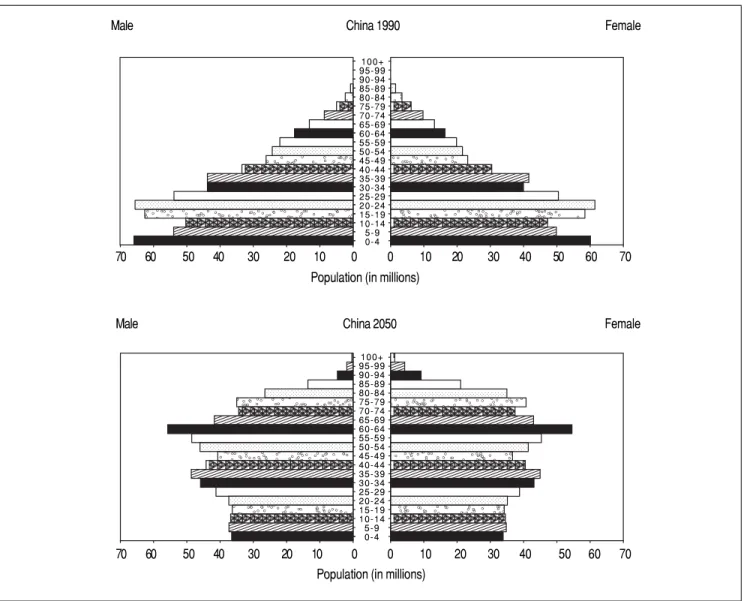
re-sulting changes in population characteristics can be start-ling, especially for developing coun-tries (Figure 1).
In contrast to the situation even two generations ago, people can expect to live for many years after the usual retirement age. For example, U.K men and wo-men aged 65 years in 2030 can expect to live until age 88 and 91 years, respectively.4 Predicted life
expectancy for today’s children is controversial, but experts esti-mate that 50% of U.K children born in 2007 will live to at least
103 years.4 Although it is clear
creases in the prevalence of CKD with age are equally striking for populations in the U.S, Canada
and Europe,7-9 although there are
between-country differences in the absolute prevalence.
At older ages, an increased proportion of prevalent CKD ca-ses has low eGFR alone (as com-pared to albuminuria alone, or both low eGFR and
albuminu-ria).10 Although this might
sug-gest that many older people with CKD can expect lower rates of kidney function loss, available
CKD is common in older people and its prevalence increases
in parallel with age
It has been known for decades that estimated glomerular filtra-tion rate (eGFR) declines in parallel
with age.5 The prevalence of CKD
among females in the Chinese general population increases from 7.4% among those aged 18-39 years to 18.0% and 24.2% among those aged 60-69 and 70
years respectively.6 Relative
in-data are inconclusive – and cur-rent knowledge does not allow clinicians to reliably distinguish between those whose CKD will and will not progress.
As for other age groups, the incidence of dialysis-dependent kidney failure has steadily in-creased among older people over the last few decades: in the U.S, a 57% age-adjusted increase in the number of incident octogena-rians and nonagenaoctogena-rians was noted between 1996 and 2003
alone.11 Despite this increase,
g
Figure 1. Changing age distribution in general population of China, 1990-2050. Source: US Census Bureau, International Data Base. Reproduced from WHO document number WHO/DCO/WHD/2012.2.
aaaa aaaaa aaaaaaaaa aaaaa aaa aaaaaaaaaaaaaaaaaaaaaaaaaaaaaaa
a a a a a a a a a a a a a a a a a a aaaaaaaaaaaaaaaaaaaaaaaaaaaaaaaaaaaa
aa aaaaa aaaaaaaaa aaaaa aaa aaaaaaaaaaaaaaaaaaaaaaaaaaaaa
a a a a a a a a a a a a a a aaaaaaaaaaaaaaaaaaaaaaaaaaaa
a a a a a a a a a a a a a a a a a aaaaaaaaaaaaaaaaaaaaaaaaaaaaaaaaa
aaaaa aaaaa aaaaaaaaa aaaaa aa aaaaaaaaaaaaaaaaaaaaaaaaaaaaaa
aaaa aaaaa aaa aaaaa aaaaa aaa aaaaa aaaaa aaaaaaaaaaaaaaaaaaaaaaaaaaaaaaaaaaaaaaaaaa
a a a a a a a a a a a a a aaaaaaaaaaaaaaaaaaaaaaaaaaa a a aaaa
aaaaa aaaaa aaaaaaaaa aaaaa aaa aaaaa aaaaaaaaaaaaaaaaaaaaaaaaaaaaaaaaaaaaaaa
a a a a a a a a a a a a aaaaaaaaaaaaaaaaaaaaaaaaa a a aaaaa a Male Female
Population (in millions)
0 10 20 30 40 50 60 70 70 60 50 40 30 20 10 0
Male China 2050 Female
100+ 95-99 90-94 85-89 80-84 75-79 70-74 65-69 60-64 55-59 50-54 45-49 40-44 35-39 30-34 25-29 20-24 15-19 10-14 5-9 0-4
Population (in millions)
70 60 50 40 30 20 10 0 0 10 20 30 40 50 60 70
patients aged > 80 years are still less likely to initiate dialysis than those aged 75-79 years – al-though a large recent study sug-gested that the risk of developing very low eGFR (< 15 mL/min/
1.73 m2) is similar for older and
younger adults.12 It is uncertain
whether this discrepancy is due to between-age differences in the true rate of progressive kidney function loss, the risk of death due to competing causes, patient views about dialysis, or physician
practices.12,13 Regardless of the
explanation, the aging population will likely lead to continued in-creases in the number of older people with severe CKD.
CKD is harmful but treatable if patients at
risk are identified
Like younger people, older people with advanced CKD are at increased risk of death, kidney failure, myocardial infarction and stroke compared to otherwise si-milar people with normal or
mild-ly reduced eGFR.14,15 Although
death is by far the most common of these adverse outcomes, this does not mean that older patients with clinically relevant CKD can-not benefit from timely specialist referral.
With appropriate management, patients with advanced CKD (re-gardless of age) may benefit from slower loss of kidney function (potentially preventing kidney fail-ure), better control of metabolic consequences such as acidosis, anemia and hyperphosphatemia, lower risk of cardiovascular events, and (for those who are in-terested in renal replacement) a more informed choice of renal replacement modality, including timely creation of vascular
ac-cess.16 The aging population will
likely lead to continued increases
in the number of older people who might require such referral, which should be considered in assess-ments of future nephrology work-force capacity.
Dialysis can benefit older people with kidney failure
In developed countries, the de-fault management strategy for older people with kidney failure appears to have shifted from con-servative management to initia-tion of dialysis.17 On average, life
expectancy after initiation of dialysis is relatively short for older patients: median survival among incident U.S dialysis patients aged 80-84 years is 16 months – and is only 12 months
among those aged 85-89 years.11
At the same time, these median statistics reflect a bimodal distri-bution of survival time in older dialysis patients: although a large proportion die within 6 months of commencing dialysis, a substantial minority may live for years. This heterogeneity in mor-tality appears to be driven by differences in baseline comorbidity. For example, analyses of a small U.K cohort of people with advan-ced kidney failure suggested that initiation of dialysis was not as-sociated with increased survival for those aged > 75 and with two
or more comorbidities.18,19
Simi-larly, the presence of two to three comorbid conditions in U.S dialy-sis patients aged > 65 years was associated with substantially in-creased mortality compared to
those in better health.11 When
functional status is lower at base-line, initiation of dialysis often signals the onset of further declines: among 3,702 nursing home residents initiating dialy-sis, 58% had died and 87% had experienced additional loss of
function at 1 year.20 Although
available data have limitations, quality of life appears reasonable among selected older dialysis patients – and can remain stable despite moderate or high levels
of comorbidity.21,22
These data suggest that dialy-sis is an appropriate treatment option for well-informed older pa-tients with kidney failure – espe-cially for those with good baseline quality of life. On the other hand, the very poor outco-mes experienced in those with more comorbidity or lower func-tional status at baseline clearly demonstrate that dialysis does not improve clinical outcomes for all older people with kidney fai-lure – and that good clinical judg-ment and careful communication will be increasingly required as the general population continues to age.
Kidney transplantation can also benefit older people with kidney failure
It is generally accepted that older age alone does not pre-clude kidney transplantation in otherwise suitable candidates. However, older patients with ki-dney failure are more likely to have absolute and relative con-traindications to transplanta-tion, and are less likely to be placed on the kidney transplan-tation waiting list. Unsurprisin-gly, patient and graft 5-year survival probabilities are lower among U.S kidney transplant
recipients aged ≥ 65 years as
compared to those aged 35-49
years (patient: 67.2 vs. 89.6%;
graft: 60.9 vs. 75.4%,
respective-ly).23 In addition, older people
Nonetheless, transplantation appears to reduce mortality among patients of all ages. For example, among those aged 74 years, receiving a deceased do-nor transplant was associated with a hazard ratio of mortality of 0.67 (95% confidence interval 0.53, 0.86) as compared to
remaining on dialysis.23 Use of
expanded criteria deceased do-nors24,25 as well as more liberal
use of older living donors26 also
appear to reduce mortality among older people with kidney failure, as compared to similar patients who remain on the transplant waiting list (Table 2). These latter two strategies are espe-cially appeal-ing for use in deve-loping countries, where growth in the prevalence of older people has been most pronounced. However, because transplant surgery itself temporarily in-creases the risk of death, the mortality benefits associated with kidney transplantation (re-gardless of donor type) are res-tricted to those with reasonable baseline life expectancy and
without dramatically increased perioperative risk.27
Research needs
Although much is known about chronic kidney disease in older populations, a great deal remains to be learned. Many trials of therapies for CKD have
excluded older patients28 – and
most do not provide guidance on how to manage comorbidities that often accompany CKD but may lead to competing therapeu-tic priorities. More information is needed on how to accurately identify people who will progress to kidney failure – and among these, the subset that can expect reasonable life expectancy and quality of life if they opt for dialysis treatment. Future stu-dies should test new ways to communicate information about the risks and benefits of dialysis (as compared to conservative management), to facilitate in-formed patient decisions. Above all, we need more studies that demonstrate how to optimize
qua-lity of life and manage symptoms in elderly people with CKD – in-cluding those who have chosen conservative management.
The way forward
The aging of the general popu-lation means that older people now account for a much greater proportion of patients with or at risk for kidney disease and kidney failure. The tremendous clinical heterogeneity within this population indicates the need for more discerning mana-gement. Chronological age alone will not be sufficient as the ba-sis for clinical decisions, and a more nuanced approach is re-quired - based on the comorbidi-ties, functional status, quality of life and preferences of each individual patient. Clinicians can be reassured that dialysis and kidney transplantation can increase life expectancy – and will allow reasonable quality of life in selected older people with kidney failure. Perhaps more importantly, clinicians, pa-tients and their families can be comforted by the knowledge that timely specialist evalua-tion can help to improve outco-mes and reduce symptoms in older people with advanced kid-ney disease – whether they have selected conservative ma-nagement or dialysis as their treatment plan.
ACKNOWLEDGEMENTS
Dr. Tonelli was supported by a Government of Canada research chair in the optimal care of people with chronic kidney disease.
REFERENCES
1. World Health Organization. Good health adds life to years: Global brief le
Table 1. l e
Table 1. Unmet needs for kidney transplantation in older CKD patients.
• Organ shortage. • Paucity of live donors.
• Organ allocation policies that appropriately weight likelihood of benefit from transplantation as well as chronological age.
• Ensuring appropriate referral of potentially suitable older recipients for transplantation assessment.
• Ethical concerns about offering a kidney to an older patient vs. a younger one. • Optimal immunosuppressive regimen.
Adapted from Mohanlal, et al. 2011.29
a
Table 2. Meeting the growing demand for kidney transplantation in older CKD patients.
• Preferential transplantation of organs from older donors to older recipients.
• Enlarge the donor pool by accepting expanded criteria donors: ≥ 60 years old or
≥ 50 with any of the following 2 conditions: history of hypertension, serum creatinine ≥ 1.5 mg/dL or death due to cerebro vascular accident.
• “Old for old”: preferentially using kidneys from older living donors for older recipients. • Transplanting two marginal kidneys instead of one.
for World Health Day 2012. Geneva, 2012.
2. Wiener JM, Tilly J. Population aging in the United States of America: im-plications for public programmes. Int J Epidemiol 2002; 31: 776-81. 3. Couser WG, Remuzzi G, Mendis S, et
al. The contribution of chronic kidney disease to the global burden of major noncommunicable diseases. Kidney Int 2011; 80: 1258-70.
4. Select Committee on Public Service and Demographic Change. Ready for Aging? Report. House of Lords: Lon-don, 2013.
5. Davies DF, Shock NW. Age changes in glomerular filtration rate, effective renal plasma flow, and tubular excre-tory capacity in adult males. J Clin Invest 1950; 29: 496-507.
6. Zhang L, Wang F, Wang L, et al. Pre-valence of chronic kidney disease in China: a cross-sectional survey. Lan-cet 2012; 379: 815-22.
7. Coresh J, Selvin E, Stevens LA, et al.
Prevalence of chronic kidney disease in the United States. JAMA 2007; 298: 2038-47.
8. Zhang QL, Rothenbacher D. Prevalence of chronic kidney disease in popula-tion-based studies: systematic review.
BMC Public Health 2008; 8: 117. 9. Arora P, Vasa P, Brenner D, et al.
Prevalence estimates of chronic kid-ney disease in Canada: results of a na-tionally representative survey. CMAJ
2013; 185: E417-E423.
1 0 . James MT, Hemmelgarn BR, Tonelli M. Early recognition and prevention of chronic kidney disease. Lancet
2010; 375: 1296-309.
1 1 . Kurella M, Covinsky KE, Collins AJ,
et al. Octogenarians and nonagena-rians starting dialysis in the United States. Ann Intern Med 2007; 146: 177-83.
1 2 . Hemmelgarn BR, James MT, Manns BJ, et al. Rates of treated and untrea-ted kidney failure in older vs. younger adults. JAMA 2012; 307: 2507-15.
1 3 . Keith DS, Nichols GA, Gullion CM, et al. Longitudinal follow-up and outco-mes among a population with chronic kidney disease in a large managed care organization. Arch Intern Med 2004; 164: 659-63.
14. Hemmelgarn BR, Manns BJ, Lloyd A, et al. Relation between kidney function, proteinuria, and adverse outcomes.
JAMA 2010; 303: 423-9.
15. O’Hare AM, Bertenthal D, Covinsky KE,
et al. Mortality risk stratification in chro-nic kidney disease: one size for all ages? J Am Soc Nephrol 2006; 17: 846-53. 16. Stevens PE, Levin A, Kidney Disease:
Improving Global Outcomes Chronic Ki-dney Disease Guideline Development Work Group M. Evaluation and manage-ment of chronic kidney disease: synopsis of the kidney disease: improving global outcomes 2012 clinical practice guideli-ne. Ann Intern Med 2013; 158: 825-30. 17. Thorsteinsdottir B, Montori VM, Prokop
LJ, et al. Ageism vs. the technical impe-rative, applying the GRADE framework to the evidence on hemodialysis in very elderly patients. Clin Interv Aging 2013; 8: 797-807.
18. Chandna SM, Da Silva-Gane M, Mars-hall C, et al. Survival of elderly patients with stage 5 CKD: comparison of con-servative management and renal replace-ment therapy. Nephrol Dial Transplant
2011; 26: 1608-14.
19. Murtagh FE, Marsh JE, Donohoe P, et al. Dialysis or not? A comparative sur-vival study of patients over 75 years with chronic kidney disease stage 5.
Nephrol Dial Transplant 2007; 22: 1955-62.
20. Kurella Tamura M, Covinsky KE, Cher-tow GM, et al. Functional status of el-derly adults before and after initiation of dialysis. N Engl J Med 2009; 361: 1539-47.
21. Lamping DL, Constantinovici N, Rode-rick P, et al. Clinical outcomes, quality of life, and costs in the North Thames Dialysis Study of elderly people on dialysis: a prospective cohort study.
Lancet 2000; 356: 1543-50.
2 2 . Unruh ML, Newman AB, Larive B, et al. The influence of age on changes in health-related quality of life over three years in a cohort undergoing hemodialysis. J Am Geriatr Soc 2008; 56: 1608-17.
2 3 . Knoll GA. Kidney transplantation in the older adult. Am J Kidney Dis
2013; 61: 790-7.
2 4 . Merion RM, Ashby VB, Wolfe RA, et al. Deceased-donor characteristics and the survival benefit of kidney trans-plantation. JAMA 2005; 294: 2726-33. 2 5 . Cohen B, Smits JM, Haase B, et al.
Expanding the donor pool to increase renal transplantation. Nephrol Dial Transplant 2005; 20: 34-41.
2 6 . Gill J, Bunnapradist S, Danovitch GM, et al. Outcomes of kidney trans-plantation from older living donors to older recipients. Am J Kidney Dis
2008; 52: 541-52.
2 7 . Gill JS, Tonelli M, Johnson N, et al.
The impact of waiting time and co-morbid conditions on the survival be-nefit of kidney transplantation. Kidney Int 2005; 68: 2345-51.
2 8 . O’Hare AM, Kaufman JS, Covinsky KE, et al. Current guidelines for using angiotensin-converting enzyme inhi-bitors and angiotensin II-receptor an-tagonists in chronic kidney disease: is the evidence base relevant to older adults? Ann Intern Med 2009; 150: 717-24.
2 9 . Mohanlal V, Weir M. Kidney Trans-plantation in the Elderly: It’s Not All Gloom and Doom. ASN Kidney News
2011; 3: 15-17.
Reimpresos:
Marcello Tonelli,* Miguel Riella**
* University of Alberta, Canadá. ** Catholic University of Parana, Brazil.
Correo electrónico: