Body Image and Femininity
of Latina Breast Cancer Survivors
G
LORIAP. M
ARTÍNEZ-R
AMOSRESUMEN
El cáncer del seno es el cáncer más común entre Latinas viviendo en Los Estado Unidos. Todavía queda mucho que aprender sobre el impacto del cáncer del seno en Latinas. Envistigaciones sobre sobrevivientes del cáncer del seno se ha enfocado en la experiencia de mujers reciente diagnósticadas y tratamiento y que han sobrevivido hasta cinco años desde el diagnóstico. Está menos entendido la Latina sobreviviente del cáncer del seno al largo plazo o mas de cino años. Este estudio pretende a contribuir a las investigaciones de percepciónes sobre su cuerpo y su femenidad de sobrevivientes del cáncer del seno entre Latinas. Usando metodología cualitativa, 25 Latinas que son sobrevivientes de cáncer del seno cinco años o más entre las edades de 28 y 83, específicamente las de origen Mexicano residiendo en California fueron entrevistadas sobre sus experiencias sobre cáncer del seno. Los resultados mostraron la percepción de las Latinas sobre su cuerpo, femenidad, y bienestar es socialmente contruida.
1. INTRODUCTION
Breast cancer survivors face unique challenges to their social identities, their bodies, their social roles, their intimate relationships, and their families (Oktay and Walter 1991). Research on breast cancer survivors report that women experience changes to their perceived notions of femininity because “social assumptions which define them as women no longer match their own interior definition of what it means to be a woman” (Kasper 1994; Kasper 2000).
Breast cancer changes to women’s body image, femininity, and sexuality is sensitive and important because Western society emphasizes beauty with breasts (Henson 2002; Potts 2000). As Anne Kasper (1994) describes, “American women live in a culture which places high values on breasts as part of the female form and persona. Through the process of female socialization many women come to believe that to lose a breast is to lose one’s identity and sense of self as a woman” (Kasper 1994: 264).
Most of the studies has focused predominantly on the experience of White middle-class women and has failed to examine the experiences of Latinas who are a growing subgroup of breast cancer survivors (Potts 2000; Carter 1996; Ferrell and Dow 1996; Dow 1991; Hilton 1988; O’Conner 1990). This study addressed this research gap by examining Latina long-term breast cancer survivors’ perceptions and meaning making process after being diagnosed and treated with breast cancer. This article seeks to understand how Latina breast cancer survivor’s body and femininity is impacted from breast cancer.
2. REVIEW OF THE LITERATURE
2.1. Latinas and Breast Cancer
There are over 45 million Latinos living in the United States and it is projected to double from the year 2010 to 2050. Most Latinos self identified as being of Mexican origin followed by Central American, South American origin, Puerto Rican, “Other” Hispanics, and Cuban, and most Latinos are Native born see Table 1 ( U.S. Census Bureau 2007).
Breast cancer is the most common form of cancer for Latinas. In 2006, an estimated 14,300 Latinas were diagnosed with breast cancer and 1,760 died
Table 1 Latino Total Population 2005-2007 3-Year Estimate
Total Hispanic or Latino:
Mexican Puerto Rican Cuba Dominican (Dominican Republic) Central American South American Other Hispanic or Latino
44,019,880 28,165,623 3,998,264 1,535,236 1,183,365 3,351,269 2,395,914 3,390,209
U.S. Census Bureau HISPANIC OR LATINO ORIGIN BY SPECIFIC ORIGIN - Universe: TOTAL POPULATION
(American Cancer Society Surveillance Research, 2006). Latinas experience breast cancer disparities in early detection and screening impacts the prognosis or the outcomes of their breast cancer survival (Glanz et al. 2003; Gonzalez 1990; Laws 1998; Otero-Sabogal et al. 2004; Peragallo 1998; Morgan et al. 1995). Latinas are more likely to be diagnosed with larger tumors than white non-Latina women and are less likely to be diagnosed with early stage breast cancer and have a survival rate of 83% and they are 20% more likely to die of breast cancer than white non-Latina women diagnosed at similar age and stage (American Cancer Society Surveillance Research, 2006).
Lack of access to health care and lower utilization of preventive cancer screening tests, such as mammography, may contribute to later diagnosis. Breast cancer survival rates are higher among Latinas of higher income and lower among women who live in poverty (Singh et al. 2003). In a study using data from the California registry during 1994-1997, showed that Latinas had the lowest levels of early stage breast cancer (Menk 2001). High rates of advanced stages require more surgery and treatment, such as, mastectomy and chemotherapy compared to breast conserving lumpectomy and radiation. Poverty, being uninsured, and having a low educational status impacts Latinas access to preventive breast cancer care and early detection (Tortolero-Luna et al. 1995; Yost 2001). Latinas who are living in the United States undocumented, and uninsured, and low income are the most vulnerable as this group and are more likely to have the lowest breast cancer survival rate (Shavers and Brown 2002).
In one study consisting of a multi-ethnic sample of White (non-Hispanic), African-Americans, and Hispanic breast cancer survivors diagnosed with early stage breast cancer in Miami, Florida Spencer et al. (1999) found that Latinas reported more distress, more social disruption, more concern about existential issues, sexuality issues, work issues, and partner issues than White non-Hispanic and African American women. Latinas used more religious coping than Whites non-Hispanic (Spencer et. al. 1999: 166). Similarly, Ashing-Giwa et al. (2003) explored class and ethnic similarities and differences in survivorship among African Americans, Asian Americans, Latinas, and White non-Hispanics and found that Latinas reported having similar concerns as other ethnic groups with respect to experiencing fear of recurrence, concern for their families, and fear of death, pain and suffering. Erickson’s (2008) research on breast cancer survivorship argues that gender and culture structures breast cancer survivorship, she states “after breast cancer treatment women remain acutely aware of the changes to their breasts every time they looked in the mirror… for women who had a mastectomy, reconstruction could lessen its impact, but reconstructed breasts never looked or felt as they had before surgery. Most women mourned these permanent changes as constant reminder of what they had been through” (Erickson 2008: 181). Erickson argues that breast cancer survivors emotional and sexuality is impacted in a unique way because of “the combined effects of a near-death experience, treatment, and these bodily changes” (Erickson 2008: 180). The purpose of this article is to understand how Latinas breast cancer survivors’ body and femininity is impacted from their breast cancer diagnosis.
2.2 Methods and Sample
approach I changed my method to involve respected persons who work in health care settings that served the Latina community. I introduced myself with letters to health care and breast cancer support organizations. In the letter I described the purpose of my research and requested them to identify long-term more than 5 years breast cancer survivors who were Latina and might want to speak with me about their experiences with breast cancer. I emphasized that I was bilingual and that I could conduct the interview in Spanish. I spoke to a few key individuals who worked in capacities that served the Latina community: two social workers, a psychologist, an elementary school teacher, and a physician’s assistant. Some were breast cancer survivors themselves.
Upon contacting individual Latinas, I formally introduced myself and asked if they were still interested in participating in my study that involved learning more about long-term breast cancer survivors. Many women told me that they never have been interviewed by a Latina doing research on breast cancer survivors and have never disclosed so much personal information about their breast cancer experience to anyone else. I conducted the interviews in a semi-structured way to allow survivors to share their experiences beginning from the time they were diagnosed with breast cancer. Grounded theory as a research method in qualitative research was developed to provide a well-integrated set of concepts leading to a thorough theoretical explanation of social phenomena under study (Glaser and Strauss 1967). Grounded theory uses a systematic method of data collection and analysis to develop inductively derived theory emerging from the data. The research involves a process of examining different issues related to the problem or topic; “thick” or rich data is used to elicit the development of theory building.
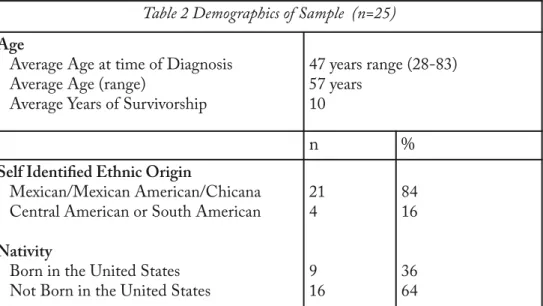
Table 2 Demographics of Sample (n=25)
Age
Average Age at time of Diagnosis Average Age (range)
Average Years of Survivorship
47 years range (28-83) 57 years
10
n
%
Self Identified Ethnic Origin
Mexican/Mexican American/Chicana Central American or South American
Nativity
Born in the United States Not Born in the United States
21 4
9 16
84 16
I analyzed the data using a constant comparative analysis to identify patterns and relationships (Glaser and Strauss 1979). Interviews were read and issues that the participants emphasized the most, such as illness, diagnosis, surgery, treatment, family structure, and changes in social relationships, were coded. Clusters of data were organized in broader themes and coded utilizing line-by-line in-vivo coding. I analyzed similarities and differences by socioeconomic status, age, education, type of treatment.
2.3. Description of the Respondents
Latinas mean age of diagnosis was 47 years, and mean age of at the time of the interview was 57 years.
Most respondents were college-educated 60%, with 40% reporting incomes higher than $60,000, however, 44% reported earning less than $30,000. Most respondents identified as being of Mexican origin and other Latinas identified as being from Guatemala, Honduras, Peru, and Argentina. Most Latinas, 60%, were foreign born in the United States but raised in the United States since early childhood, and 40% reported being born in the United States. Most respondents had mastectomies and chemotherapy, and a large number of them had breast reconstruction and lymph node resection, and a small number had a lumpectomy.
Education
8th Grade or Less and Some High School High School Graduate
Some College Graduated College Post College Study
Most of the Latinas who had a breast reconstruction reported having access to health insurance and financial resources to pay for their reconstruction or breast implant surgery.
There are limits to this sample because referrals are made nonrandom primarily from a snowball sample. Recruitment patterns may reflect similar social ties and respondents are similar in age, education, class, and ethnicity. Neither the women’s narratives nor my observations and interpretation represent all Latina breast cancer survivors.
2.4. Results
2.4.1. Meaning of Breast Cancer Diagnosis
Waskul and Van der Reit (2002) argue that cancer survivors struggle with “abject embodiment” because cancer threatens the “natural order between bodies and selves, bodies and others, bodies and society, bodies and nature, and bodies and morality” (509). The Latinas in this study perceived being diagnosis with breast cancer as a threat to their body, their femininity and sexual well-being that is permanent status. Christina has just lived in the United States for seven months before she was diagnosed with breast cancer at the age of 28. She was undocumented and without health insurance when she was diagnosed with breast cancer during a routine physical at the local county hospital. Her health care provider did not speak to her in Spanish which prevented her from understanding the extent of her cancer or her treatment options. She trusted the doctor to make all her health care decisions for her. She reported feeling stigmatized by the public and her family during her chemo therapy treatment because of the way she looked, “My brother-in-law did not give me hug because perhaps the cancer would stick to him. I told him cancer is not
Table 3
Type of Surgery and Treatment (n=25)
n
%
Mastectomy Lumpectomy
Auxiliary Lymph Nodes Breast Reconstruction Radiation
Chemotherapy Hormone Therapy
21 6 25 10 4 15 8
contagious.” Since most of her immediate family was in Mexico, Christina relied on her friends for social support. She was unsatisfied with the quality of health care and treatment she received because she felt she was not well informed about her cancer, her surgery, the long-term side effect of chemotherapy treatment and the thousands of dollars health bill she incurred at the hospital.
Similarly, Evita, diagnosed at the age of 72 was born in Mexico but lived most of her life in the United States. Although she said she knew very little about breast cancer she knew the treatments were harsh. Against her doctor’s recommendation she did not have chemotherapy treatment after her mastectomy because she was concerned that chemotherapy will kill her like it killed her daughter.
I told him no, I don’t want radiation. He tells me I do it to save your breast and I told him not to worry about saving my breast. I am not a beauty queen. Take it off. I am in God’s hands. I told him that I don’t want chemotherapy. Leave me alone, because my daughter died of it. I saw her suffer and she died of it. I don’t want it.
She also refused to take hormone therapy because she worked all her life as a cannery worker that she had very little money to cover the cost of the one-dollar daily pill of tamoxifin.
The lack of money and the lack of information about cancer was not an issue for Rebecca because she worked as an oncology social worker in a major university hospital, but when she was diagnosed with breast cancer she was very surprised.
You know we did the biopsies on three lumps and two came back negative and the other one is positive for breast carcinoma.” I realized that I had breast cancer. I wasn’t immediately shocked, I fell back into an intellectual defense and I thought. Well, ok, but you know what? That is not the final pathology report maybe the final path report will be different from the frozen section report that they got. My sister came back from lunch, and I didn’t tell her. In fact I told her that it looked suspicious but we didn’t have a final path yet. I think that in my heart I was hoping and praying that it would be different though a big part of me knew that it wouldn’t be. When I went back to see him probably a few days later and my sister was with me, and then they definitely told me that it was breast carcinoma.
Similarly, Eliza, a retired lawyer who was diagnosed at 73, delayed seeing a doctor even when her husband insisted.
He said, You better do something about that! I said, It’s a calcium deposit. He said, Stop trying self-examination. Do something about it. And I didn’t. I did start getting pains because the cancer was ulcerated. When I felt the breast, what caused me anxiety was that the tumor became ulcerated. There was such an aroma that came from my breast I knew that I had to do something by that time I could have been dead cause I was really at the last stages.
After two years, Eliza sought help and she still could not believe that her lump was breast cancer because she didn’t have a family history of breast cancer.
I never had a mammogram. I thought it couldn’t happen to me. My mother never had it so why should I get it. I convinced myself until I knew that I was in danger. The danger came when it became ulcerated. And it was over when they removed the breast. See, that is another thing I didn’t trust anybody to tell them [her family] that I was sick. See I couldn’t! I couldn’t get sick! When they took me to the hospital I was like, I am all right, I am all right; and I can hardly move. I have a friend who has several calcium deposits, and she has been biopsied, and she has been through everything, and it isn’t’ cancer, and I just assume that I was one of these people like my friend. Never did I want to realize that it is cancer so that really played havoc with my mental attitude and my whole approach to this.
It was after her first doctor’s visit that Eliza broke her silence.
I went to this oncologist who gave me some really good advice. I was already deterred now. I accepted the fact that now I did have cancer. I was ready to go. When I went to the oncologist. I didn’t want anybody to know my situation. I was really private. I didn’t want anyone not even my husband, my daughter. I did everything by myself. I drove myself to the doctor. I did everything by myself. I got to this oncologist and he said, “Are you here alone?” I said, “I am a big girl, why shouldn’t I be by myself?” He said, “Well I am going to tell you when you come to see the doctor for the first time bring somebody with you because you have been in denial for so long. You are not even going to hear what I am going to tell you about your condition which really opened up my eyes.
You know I had heard about needle aspiration, and I want to make sure what it is because there was something instinctive. I have always been very conscious about my health, about my diet and staying in shape. I was trying to tell myself. No it’s not cancer. It’s not going to be cancer, of course it is not cancer but I was scared. After the doctor told me I had cancer, I cried.
At age 27, Rosa Maria hesitated to tell her mother about her diagnosis but eventually she could not keep her diagnosis a secret.
I said, Mom, ‘I have just came from the doctor’s office, and he said I have cancer.’ She just freaked out and she said, What’s going to happen now? How does he know you have cancer? Maybe he doesn’t know what he is talking about! and blah blah blah. I said, I need a second opinion. I need to talk to somebody else. I am not convinced that I have cancer.
Rosa Maria sought out a second opinion without any referral from her doctor. She chose to go back to her doctor that she trusted at the farmworker’s clinic and then was referred to a specialist at a major private university.
I felt like I couldn’t go by myself. I know my mother for sure was going to go with me. It was all going to be in English, and my mother wasn’t going to understand anything.
Rosa Maria felt overwhelmed, confused, and found it difficult to make any decision about her treatment she relief on the help of her friend.
After ten years of being infertile, Rosa Maria was surprised to become pregnant at the age of 38. She was also surprised to be diagnosed with breast cancer again two weeks after the birth of her daughter. No one told Rosa Maria that pregnancy would put her at risk of her breast cancer reoccurring.
The cases illustrate that from the beginning of diagnosis, treatment, recovery and survivorship ideas about women’s role in the family and society shaped women’s experiences with breast cancer from talking about their breast cancer diagnosis to making decision about their health care.
2.4.2. Body Image and Femininity
Women openly discussed that as a result of surgery and the permanent effect of treatment their bodies were no longer the same after breast cancer. Some women experienced breast deformity. For some, chemotherapy induced menopause and weight gain, diminished menses, chemically induced infertility, and fatigue. Most Latina women who had mastectomies expressed more concerns being breast cancer having a negative effect on their bodies and their femininity.
For me, it was difficult to see myself because I saw my breast deformed. It first signified to me a scar on my body, a deformation on my body. For me it is a mutilization. I always fear losing a part of my body.
The women in the study discussed that they were socialized that having beautiful breasts symbolized femininity, beauty, and reproduction. For women who had their breast removed or scarred they experienced a sense of emotional sadness.
I was appreciated and presented to the world as a beautiful breasted woman and there was the value that people placed on me. It was a big deal that I had breasts and it was a sense of femininity. They were large, and they were beautiful. My body doesn’t look the same that it did. I think I had two very nice looking breasts. I am sorry that is not the case now. I do a lot of ballroom dancing and some of the Latin dancing dresses that are cut low in the front, you know that it looks nice, but, I will never be able to wear a dress like that so there is a degree of grieving that went along with losing my breasts. I am saddened that my body has had to look different, and I feel it is part of the sacrifice that one makes to get well.
The women reported that being diagnosed with breast cancer made them more aware of their femininity, and the influence that social and cultural forces had on their body image.
all the cleavages and all the stuff you look at while you are shopping for groceries. It’s there staring at you as if that is the most important thing about a woman, and I had to come to grips with that. Like it is the most important thing in the world. I had to come to grips with what does a breast represent to me? The breast meant breast feeding my child, pleasure to my husband, but he didn’t need two breasts at the same time, and it meant getting rid of the cancer. The only way that I can get rid of the cancer or feel like I am getting rid of it was to remove the breast that had the cancer. I saw it as my life. The grieving part wakes you up at night and makes you cry. I came to the realization that I am not a breast that I was a heart, that I was a mind, I was a mother, I was a wife, I was a professional, I was a cousin, I was a sister, and so on, just kind of help me through the process. When I get out of the shower and pass my big mirror. I sometimes look at myself twice ‘cause I almost see myself perfect, normal again, perfect, and two breasts. I have to stop and clear the mirror of the moisture and look again and see that, no. I don’t see my breast and probably a man who has his head together probably doesn’t either. He probably stops and sees his wife deformed or abnormal.
The women reported that they do not discuss their sadness, loss, and anxiety about their body image with others because they fear experiencing stigma. Although most women reported that they chose to have a breast reconstruction for themselves and not their spouses, many of the women discussed how expectations of others, such as family, friends and health care providers made them consider having breast reconstruction to restore their feminine body image.
Some people made some insensitive comments and they were often women. One teacher when she learned that I had reconstructive surgery said, How fortunate you are, how lucky you are. You know? You got to pick your size, and I says, You know what? I much rather have the ones God gave me, thank you very much, and I walked out of the room. And another one I tried to explain to her that I was grieving and that I was sad about the loss of my breast. And she said, I didn’t think you were into your body that way. And I said, Well it wasn’t a defining, it wasn’t the defining factor of my being but it’s still a loss your body, it is not the same as it was. It’s just not the same. People just don’t understand it when you have reconstructive surgery you lose all the nerve endings so that sense of touch is gone. It’s gone. It’s gone. It’s a whole other ball game. That’s a big loss. Or I thought that is a big loss.
I went to the doctor and the plastic surgeon and I expressed my thoughts and he says, I think you should do it. You are going to feel way better about yourself and everything. I said, Ok, lets do it.
My daughter is the one who insisted that I should have a plastic surgeon while next to the regular surgeon.
Ideologies about their body and beauty changed after being diagnosed with breast cancer. Most of the women in my sample asserted an alternative view of their femininity and body image. Latinas reported having to negotiate their expectations of their body image and sexual intimacy. They challenged sexism and patriarchy in both public and private spaces centered at work and in the family.
I changed my diet, and it’s [breast cancer] changed the way I value relationships. As a woman, it has really changed my life. I had not dealt with my past like my folks and my place in the family and my value as a woman and my culture. My sisters and I told my folks that it is not ok that the men in our family seemed to be much more valued than the women in the family. My father talks about his grandchildren as though the sons of his sons are his only grandchildren and I have three sons and my children grew up hearing this and they would be like who am I chopped liver? I am better affirming my own value and my own worth in different arenas. I am better able to stand up for myself. I think my husband had the perspective, ‘once we get through it she can go on and be the same person that she was’. You know, my attitude toward housecleaning changed, my attitude towards the way I spend my energy has changed, and my ability to say no got stronger. The fact that you are a woman, people don’t necessarily respect your opinion as much as they might be as an opinion of a man or the work that you do is not valued on the same level as the work that a man does. I think I became more comfortable with saying those things.
I have shown my body to many women. I wouldn’t like another woman to go through that because it was horrendous though I have a wonderful family and friends. But it is like they just hear the word ‘Cancer’ and it’s like a death sentence. I have found that it hasn’t changed.
Some Latina survivors became involved in sharing their experiences with local breast cancer education and support groups in the community.
I became a volunteer in the American Cancer Society and talking to Spanish speaking women became my specialty. I felt that it was needed, and I felt that they needed my support. I knew what they were going through, and I wanted to help them. I am like a vessel and just channel his love to people. It is like you become more centered and more focused when you had a confrontation with possible death, when you seen death come and take your friends.
Many women felt compelled to share, advocates, and witness their experiences to help educate other Latinas, especially monolingual Spanish speaking Latinas about breast cancer. They became involved in helping women who were recently diagnosed with breast cancer with navigating the health care system, becoming an interpreter, and provide social support. These actions helped them health and helped Latinas break the silence of breast cancer.
Body and Sexuality
Breast cancer changes to the body had long last changes in women’s sexuality. Most women reported that the loss of the breasted body. The women perceived that they never returned to the original sexual intimate experiences. For some breast cancer survivors, breast cancer castrated them because of the loss of the sense of touch to their skin, breast, and nipple.
He used to fondle my breast but now rarely does. Probably he is just a little scared. I don’t have feeling in my reconstructed breast but touches I do feel but I don’t feel any sensation at the nipple or nothing like that.
In a few cases, the women were rejected by their fiancée or had difficulty in communicating with their partners.
After breast cancer, some women are conscious about how their diagnosis affects their social relationships and wonder whether they will be able to be intimately and sexually involved with others. Women who were widowed or celibate stated that breast cancer did not impact their sexuality. Single women often reported avoiding becoming intimately involved in a relationship because they were embarrassed by the way they looked and feared being rejected. They perceived that others, especially men, would see them as not being “complete” or “perfect” and have nothing to offer. As Nancie explained,
I have not liked having relationships with another person. Even when I have had suitors, well, I feel, I feel bad, do you understand me? Because a man, when he sees one like this they say, No, you are no longer complete. They make you ugly and it hurts oneself, you understand. You are no longer complete. You are no good for nothing or something like that. This is primarily caused by all those macho concepts from men.
Women who described being in a supportive and loving long-term relationship reported that breast cancer did not have a negative effect on their sexual intimacy. They emphasized that the quality and strength of their emotional connection and love by their partner was more important than the frequency of the sexual contact. Nancie stated, “Right now it’s not what it used to be thirty years ago because we were younger and more active but the depthness of the emotional level we reach in our sexual moments is so, so much deeper, right. It’s less often but of so much value.” Being able to talk about how sexual pleasure is impacted from breast cancer surgery and treatment was perceived to be part of recovery from breast cancer. Rosa Maria said that it was difficult to discuss sexual pleasure but when she did he responded with sensitivity.
I have been able to talk to him and say, “I don’t have my breast now so I feel half of my joy is gone but why don’t we make up this way? More stimulation in other areas or whatever. Sometimes he says, “I am not very creative but you tell me what to do.” Which is good you know? This is very good because talking with a lot of women they cannot even talk about it or mention anything.
spoke to me about the changes to their sexuality required them to redefine their sexuality as a result of their body looking and feeling different. Most women reported that they rarely discussed their sexual challenges publicly with their partners or with other breast cancer survivors.
2. CONCLUSION
Consistent with the research on Latina breast cancer survivors, Latinas talked more about how breast cancer impacted their body image, intimacy and sexuality. The period after treatment ended is filled with many challenges for breast cancer survivors because it commences new meanings in their life, new emotional responses including loss, relief, uncertainty of their future, fear, determination to survive and recognition of their need for convalescence. Breast cancer survivors report that although family, friends, and health care professional perceive their experience to be largely over they experience new challenges as a result of complex changes such as disruption of intimacy, changes in self-perceptions, and body appearance. Carter (1996) argues that for breast cancer survivors, the sense of self is an ongoing interpretation over a lifetime and, as such, “reflects biological, personal, and social integration” (Carter 1996: 153). Latina narratives are very useful in that context in informing how the social context shapes Latinas breast cancer survivorship.
This study shows that social and cultural influences Latina’s experiences with breast cancer long after their diagnosis their diagnosis and treatment commences.
sexuality breasts are an important component of body self-image and they are a part of a woman’s identity and symbolize her unique femininity (Kasper 1994; Latteier 1998; Langellier and Sullivan 1998). Latinas experience is shaped by a complex set of organized practices at the individual, family, community, and societal levels reflecting ideas about gender and culture.
To provide high quality Latina health care and social support it is important that we understand the “naming, construction and translation of illness and healing experiences” (Chabram-Dernersesian and De La Torre, 2008: 154) of Latina breast cancer survivors and it necessitates the community, both lay and medical, to listen with sensitivity to their stories of survivorship. This study generates empirical research useful towards understanding the long-term impact that breast cancer has on Latinas. More research is needed to understand the complexity and diversity of Latina breast cancer survivorship.
REFERENCES
American Cancer Society. 2006. Cancer Facts & Figures For Hispanics/Latinos 2006-2008.Atlanta, GA: American Cancer Society.
Ashing-Giwa, K., G.V. Padilla, D.E. Bohorquez, J.S. Tejero, and M. Garcia. “Understanding the Breast Cancer Experience of Latina Women”. Journal of Psychosocial Oncology24:3 (2006): 19-52.
Ashing-Giwa, K., G.V. Padilla, J. Kraemer, K. Wright, A. Coscarelli, S. Clayton, I. Williams, and D. Hills. “Understanding the Breast Cancer Experience of Women: A Qualitative Study of African American, Asian American, Latina and Caucasian Cancer Survivors”. Psycho-Oncology13: (2004): 408-428. Baca Zinn, M. “Mexican-American Women in the Social Sciences.” Journal of Women
in Culture and Society8:2. (1982): 259-272.
Breaden, K. “Cancer and Beyond: The Question of Survivorship”. Journal of Advanced Nursing26: (1997): 978-984.
Carter, B.J. “Understanding The Experiences of Long-Term Survivors of Breast Cancer: Story As a Way of Knowing”. Contemporary Issues in Breast Cancer.K.H. Dow. Ed. 151-159.Boston, MA: Jones and Bartlett Publishers, 1996.
Chabram-Dernersesian, A. and A. De La Torre (Eds.) Speaking from the Body: Latinas on Health and Culture. Tucson, AZ: University of Arizona Press, 2008.
Chavez, L.R., F. A. Hubbell, J.M. McMullin, R.G. Martinez and S.I. Mishra. “Structure and Meaning in Model of Breast and Cervical Cancer Risk Factors: A Comparison of Perceptions Among Latinas, Anglo Women, and Physicians.” Medical Anthropology Quarterly9:1. (1995): 40-74.
Delgado, D., W.Y. Lin and M. Coffey. “The Role of Hispanic Race/Ethnicity and Poverty in Breast Cancer Survival”. Puerto Rican Health Science Journal 14:2. (1995): 103-116.
Dow, K. “The Growing Phenomenon of Cancer Survivorship”. Journal of Professional Nursing7:1. (1995): 54-61.
Ericksen, J. A. Taking Charge of Breast Cancer. Berkeley, CA: University of California Press, 2008.
Ferrell, B. and K.H. Dow. “Portraits of Cancer Survivorship: A Glimpse Through the Lens of Survivors’ Eyes”. Cancer Practice4:2. (1996): 76-80.
Frank, A.W. “For A Sociology of the Body: An Analytical Review”. The Body: Social Process and Cultural Theory.M. Featherstone, M. Hepworth and BS. Turner. Eds. 36-102. Newbury Park, CA: Sage Publications, 1991.
—.“Can We Research Suffering”? Qualitative Health Research.11:3. (2001): 353-362. Freund, P.E.S. “The Expressive Body: A Common Ground For The Sociology of Emotions and Health and Illness”. Sociology of Health & Illness12:4. (1990): 453-477.
Giachello, A. “Cultural Diversity and Institutional Inequality”. Health Issues for Women of Color: A Cultural Diversity Perspective. D.L. Adams. Ed. 5-27. Thousand Oaks, CA: Sage Publications, 1995.
Glanz, K., R.T. Croyle, V.Y. Chollette, V.W. Pinn. “Cancer Related Health Disparities in Women”. American Journal of Public Health93:2. (2003): 292-297. Glaser, B. and A. Strauss.The Discovery of Grounded Theory: Strategies For Qualitative
Research. New York, NY: Aldine De Gruyter, 1967.
Gonzalez, J.T. “Factors Relating to Frequency of Breast Self-Examination Among Low-Income Mexican American Women: Implications for Nursing Practice”. Cancer Nursing13:3. (1990): 134-142.
Hedeen, A.N. and E. White. “Breast Cancer Size and State in Hispanic American Women, by Birthplace: 1992-1995”. American Journal of Public Health 91:1. (2001): 122-125.
Henson, Helen K. “Breast Cancer and Sexuality”. Sexuality and Disability 20:4. (2002): 261-275.
Issues in Mental Health Nursing9: (1988): 217-238.
Hsu, J.L., S.L. Glaser and D. West. “Racial/Ethnic Differences in Breast Cancer Survival Among San Francisco Bay Area Women”. Journal of the National Cancer Institute89:17. (1997): 1311-1312.
Juarez, G., B. Ferrell and T. Borneman. “Perceptions of Quality of Life in Hispanic Patients with Cancer”. Cancer Practice6:6. (1998): 318-324.
Kasper, A. “A Feminist, Qualitative Methodology: A Study of Women with Breast Cancer”. Qualitative Sociology17:3. (1994): 263-281.
Kasper, Anne S and Susan J. Ferguson. Breast Cancer: Society Shapes an Epidemic.New York, NY: St. Martin’s Press, 2000.
Langellier, K. and C.F. Sullivan. “Breast Talk in Breast Cancer Narratives”. Qualitative Health Research8:1. (1998): 76-94.
Latteier, C. Breasts: The Women’s Perspective on an American Obsession. New York, NY: Harrington Park Press, 1998.
Laws, M. Barton. “The Latina Breast Cancer Control Study, Year One: Factors Predicting Screening Mammography Utilization by Urban Latina women in Massachusetts”. Journal of Community Health23:4. (1998): 251-267.
Lethborg, C.E., D. Kissane, W.I. Burns and R. Snyder. “Cast Adrift: The Experience of Completing Treatment Among Women With Early Stage Breast Cancer”. Journal of Psychosocial Oncology18:4. (2000): 73-90.
Longman, A.J., M.A. Saint-Germain and M. Modiano. “Use of Breast Cancer Screening by Older Hispanic Women”. Public Health Nursing9:2. (1992): 118-124.
Lorber, Judith. Gender and the Social Construction of Illness. Thousand Oaks, CA: Sage Publications, 1997.
Menck, Herman R. and Paul K. Mills. “The Influence of Urbanization, Age, Ethnicity, and Income on the Early Diagnosis of Breast Carcinoma”. Cancer92. (2001): 1299-1304.
Morgan, C., E. Park, and D.E. Cortes. “Beliefs, Knowledge, and Behavior About Cancer Among Urban Hispanic Women”. Journal of the National Cancer Institute Monographs18. (1995): 57-63.
Oktay, J.S. and C.A. Walter. Breast Cancer in the Life Course. New York, NY: Springer, 1991.
O’Connor, A.P., C.A. Wicker and B. Germino. “Understanding the Cancer Patient’s Search for Meaning”.Cancer Nursing13:3. (1990): 167-175.
“Mammography Rescreening Among women of Diverse Ethnicities: Patient, Provider, and Health Care System Factors”. Journal of Health Care for the Poor and Underserved15. (2004): 390-412.
Peragallo, N., P.G. Fox and M.L. Alba. “Breast Care Among Latino Immigrant Women in the U.S”. Health Care for Women International19. (1998): 165-172. Perez-Stable, E., F. Sabogal, R. Otero-Sabogal, R. Hiatt and S.J. McPhee.
“Misconceptions About Cancer Among Latinos and Anglos”. Journal of the American Medical Association268:22. (1992): 3219-3223.
Potts, L. (Ed.) Ideologies of Breast Cancer: Feminist Perspectives. New York, NY: St. Martin’s Press, 2000.
Ramirez, A., R. Villarreal, L. Suarez, E. Flores. “The Emerging Hispanic Population: A Foundation for Cancer Prevention and Control”. Journal of The National Cancer Institute Monographs18. (1995): 1-9.
Ramirez, R. and P. De La Cruz. “The Hispanic Population in the United States”. Current Population Reports (P 20-545). Washington, DC:U. S Department of Commerce, Economics and Statistics Administration, 1993.
Saint-Germain, M. and A. Longman. “Resignation and Resourcefulness: Older Hispanic Women’s Responses to Breast Cancer”. Wings of Gauze: Women of Color and the Experience of Health and Illness, B. Bair and S.E. Cayleff. Eds. 257-272. Detroit, MI.: Wayne State University Press, 1993.
Shankar, S., and N. Figueroa-Valles. “Cancer Knowledge and Misconceptions: A Survey of Immigrant Salvadoran Women”. Ethnicity and Disease9. (1999): 201-211.
Shavers, V.L., L.C. Harlan, J.L. Stevens. “Racial/Ethnic Variation in Clinical Presentation, Treatment and Survival Among Breast Cancer Patients Under Age 35”. Cancer97. (2003): 134-47.
Singh G.K, B.A. Miller, B.F. Hankey, and B.K. Edwards. Area Socioeconomic Variations in U.S. Cancer Incidence, Mortality, Stage, Treatment, and Survival, 1975-1999. NCI Bethesda, MD: National Cancer Institute, 2003.
Smith, D.E. The Everyday World as Problematic: A Feminist Sociology.Boston, MA: Northeastern University Press, 1987.
Spencer, S.M., J.M. Lehman, C. Wynings, P. Arena, C.S. Carver, M.H. Antoni, R.P. Derhagopian, G. Ironson and N. Love. “Concerns About Breast Cancer and Relations to Psychosocial Well-Being In A Multiethnic Sample of Early-Stage Patients”. Health Psychology18:2. (1999): 159-168.
Practices and Knowledge, Attitudes, and Beliefs About Cancer Among Hispanic and Non-Hispanic White Women 35 Years old or Older in Nueces County, Texas”. Journal of the National Cancer InstituteMonographs 18. (1995): 49-56. U.S. Census Bureau. 2005-2007 American Community Survey. Washington, DC:
Office of Management and Budget.
Waskul, D. and P. van der Riet. “The Abject Embodiment of Cancer Patients: Dignity, Selfhood, and the Grotesque Body”. Symbolic Interaction25:4. (2002): 487-518.
Wilmoth, M.C. “The Aftermath of Breast Cancer: An Altered Sexual Self”. Cancer Nursing. 24:4. (2001): 278-286.