
When standardized tests set the agenda: a study with school leavers
95
0
0
Texto completo
(2) Standardized Tests and School Procedures. When Standardized Tests Set the Agenda: A Study with School Leavers Yudy Andrea Ardila Perez Martha Viviana García Duarte Universidad Distrital Francisco José de Caldas School of Science and Education. 1.
(3) Standardized Tests and School Procedures. 2. Abstract. This research project explores and describes the influence of standardized tests on EFL classrooms. It examines how the ICFES Saber 11 test permeates the development of English classes of eleventh grade, modifying aspects such as methodology, discourses, the process of evaluation and students’ performance. The study aimed at describing the role of tests inside the classrooms and the perspectives students have about them. This topic was chosen because of the relevance given to standardized testing in the last years and the impact it has on school practices. This case study had two stages, before and after the test. Classroom observation and interviews were the main elements of data collection. The results suggest that there is a significant change in the methodology depending on the proximity of the test application. It also shows how the discourses at the school, revolve around the standardized government tests, setting the agenda for the school community. Keywords: ICFES test, , Standardized tests, Students’ perceptions, Teaching practices, Washback..
(4) Standardized Tests and School Procedures. 3. Chapter One Introduction. Since its inception, standardized tests have become an important part of the educational processes as they are established to measure students’ competence in the different areas of knowledge. In Colombia, the standardized test SABER 11 taken by eleventh grades or school leavers, (a term we gave to students who are about to finish school) is considered one of the most important test applied in the country as it is used as a tool to monitor the quality of education and as it is used as a requirement to enter higher education. To obtain good results in it, means to some extent, more opportunities to access to higher education as it provides information about the level of performance students have in each area of knowledge to universities. The study attempts to contribute to the understanding of the role of standardized tests in the teaching and learning process. The main reason of our inquiry was a concern about evaluation as the goal of education and as a mechanism of punishment rather than a mechanism for the betterment of education. Schools and students are pressured to obtain good results as those results are displayed to the public and as the schools receive categories according to these. The study was conducted through a qualitative approach, carried out in an eleventh grade in a school in Bogota. The study focuses its attention on Saber 11 test inside of an English class, as it can give clues on the way standardized test are influencing and interfering with aspects such as the methodology, the teaching and learning environment and the discourse. So that, we could.
(5) Standardized Tests and School Procedures. 4. describe how students’ participation within the class could change according to the closeness or presentation of the test. Also, we intended to highlight their perspectives about the role of tests in their learning process. For that reason, a case study was used to identify, characterize and establish the different elements of the class and the interference of the SABER 11 test in it. We divided our study into two stages; Before and after the test. In that way, we could identify if there was any change in the development of the classes and if student’s perceptions and performance changed, depending on the presentation of the test. The development of this research helped us to understand the influence of tests on education. It also allowed us to realize the impact of teaching for the test. The results of the study enlightened us on the impacts discourses can have on students’ attitudes and goals on the school. The study primarily draws on the work by Professor Shohamy, E, (2001,1996) which explains the power of testing and what tests mean for education; the theory of washback effect described by Bailey (1996- 1999), who defines and categorises the different effects or impact a test can have within the education environment; The study by Vargas, K (2011) which analyses and interprets the perspectives and discourses students have when talking about the ICFES Saber 11, and the study by Zakaria, A. (2013), which describes the effects that trying to do well on tests have on the classroom practices. Other studies are used to provide more information about the topic and support the proposed idea..
(6) Standardized Tests and School Procedures. 5. This monograph is divided into seven chapters. In the first chapter are the statement of the problem, the rationale, the research questions, and objectives. The second includes the literature review and the theoretical framework. The third chapter contains the research design. Chapter four describes the data analysis, procedures, and findings. Chapter five presents the conclusions. Chapter six deals with the implications the study has for teacher- researchers and the last chapter shows the limitations of the study and suggestions for further research in the area.. Justification The implementation of this study is relevant as it will provide the academic community with information about what is happening in the classrooms in relation to the national evaluation. Provided that, standardized testing has been enforced in the Colombian educational system as one of the most important tools for the improvement of education and that the ministry of education has drawn up different strategies and plans of action to ensure the improvement of the 1. evaluation processes within the country, embracing the international quality movement . Consequently, it is important to be conscious about the standardized tests roles, ideologies and discourses handle around it, as it can shape the agenda and objectives of the school. Standardized testing is a powerful tool which encloses several aspects that can influence on the different areas and procedures carried out in education.. 1. Standards and competencies are set for ensuring quality in education. Susan, R. (1996). Assumptions Central to the Quality Movement in Education..
(7) Standardized Tests and School Procedures. 6. Therefore, this monograph looks into the description of what happens when students take standardized tests and the class attention is directed to it. With this study, we expect to raise awareness among the academy community and institutions about the role given to test and the meaning concedes to standardization. This may be taken as an opportunity to reflect upon the teaching practice and the discourses handle in the classroom.. Problem Statement In Colombia, there is a series of national evaluation processes that have as a purpose knowing the competence and quality of the education offered in different institutions. These processes were created to gather empirical evidence of the educational system of the country. These are developed through standardized tests which contain a list of areas and competencies that students must develop depending on their level of schooling. These tests are developed by the Colombian Institute for the Promotion of Higher Education ICFES by its Acronym in Spanish ( Instituto Colombiano para el fomento de la educación superior). Which evaluates and monitors the quality of education of institutions by measuring standards and competencies established by the Ministry of Education. Among these tests, there is one which is considered the most important as it is taken as a requirement to enter higher 2. education. It is the ICFES Saber 11 . This specific test is applied to students close to finish the middle-education. It evaluates different areas of study, and some items related to civic competencies. The ICFES Saber 11 is 2. Decreto 869 17 de marzo del 2010. Ministerio de Educación Nacional..
(8) Standardized Tests and School Procedures. 7. the last from a series of tests taken by schools (Saber 3°, 5°, 7° 9° and 11°) and it is the one that provides the most important information for the evaluation and categorization of schools. From this exam, the best students are selected, and a ranking of the best schools is published based on the overall results. Since it is so important, schools pay special attention to it, becoming, in some cases a means of pressure for teachers to generate good results and for students to perform well. This emphasis given, can generate an excessive focus on testing practices which could modify different aspects within schools. One example is the introduction of testing preparation in the curriculum of some schools. Considering our experience and what we have observed in our teaching practicum, a special meaning and attention is given to the test in almost all the grades in an important number of schools. It happens especially when schools get recognition and are known because of the results of the test. In order to keep that recognition, they implement a different range of strategies that can ensure the success on the exam. It is the case of the school where our research took place. The school is recognized for the good results achieved in the saber 11. Thus, they develop different activities to keep getting satisfactory results. For example, they have a mid-term evaluation each month, which has a similar scheme as the ICFES and which is implemented from third to eleventh grade; they take mocks, they have certain programs to reinforce the performance in these tests, among other activities..
(9) Standardized Tests and School Procedures. Picture number1 and number2 are an extract of the ICFES exam for English subject and an example of the tests carried out in the institution. We can evidence the similarities and correlation between the two exercises.. Picture 1. Taken from icfesinteractivo.com. 8.
(10) Standardized Tests and School Procedures. 9. Picture N°2 Taken from Martes de Prueba. It was evident students were being prepared for taking the test by implementing similar exams. However, we wanted to go in deep and see in which extend the exams were shaping and modifying practices within the classroom so that we could understand and describe their influence on teaching and learning process, contrasting our observation of what was done in class to what students perceived..
(11) Standardized Tests and School Procedures. 10. The research was carried out in Public school in Bogota. It was essential to develop it in eleventh grade as it is in this grade in which students present the Saber 11 test. It was also important to narrow it to the English class as it is a really important subject whose development should be focus on the acquisition of skills for an effective communication in the language. An observation and analysis of this class could give us an idea of what was happening in other classes. . Research questions: ● How may Saber 11 test influence teaching methodology and decision making for the development of English class? -. What are the perceptions students have about the test and its role in their learning process?. Objectives: General: To understand the way in which the importance given to tests may influence the decision-making for every process within the classroom. Specific: ●. To understand the role of standardized tests on English teaching and learning practices.. ● To describe students’ participation within the classroom depending on the different stages of the presentation of the ICFES..
(12) Standardized Tests and School Procedures. 11. ● To know and highlight students’ perspectives about the test. ● To raise awareness about the implications standardized test may have in the teaching learning process.. Chapter Two Literature Review. The overall goal of this chapter is to give a brief explanation of the most important concepts that enclose our research: standardized testing, washback effect and social representations. It also provides a short review of the concepts enclosing testing as it helps us to understand in a wider way the influence of standardized tests. Finally, it includes a brief summary of the main research studies related to our inquiry. Evaluation Evaluation has different definitions which vary depending on the subject matter. Different authors have defined it as a systematic, purposeful process which intends to analyze, verify and value the worth of something.. Also, as mentioned by Cohen and Franco (1991), Evaluation is a. process that requires a comparison between the object of evaluation in regard to the established criteria or yardstick. It means that in order to carry on an evaluation, certain standards,.
(13) Standardized Tests and School Procedures. 12. achievements or criteria must be established. We evaluate to check the state of something, but also to know that the element under evaluation is fulfilling what is expected. On the other hand, Musto (1975) defines evaluation as the systematic exploration of the effectiveness of a program or project whose final purpose is to study and value the results of it. It means we evaluate to determine if something is working or to improve what is needed to make it possible. A definition that is completely applicable to what evaluation does in education. Evaluation in education has played a really important role as it is the basic central tool used to measure and follow, not only one process but all the processes surrounded education; as students learning, teaching processes, materials, methodologies, program’s effectiveness etc. Evaluation applied to the teaching and learning process, consists in organize, strict procedure, in which the institution has the opportunity of collecting data to make an adequate judgment of value, for making the correct decisions towards the improvement of education. This process has to be incorporated since the beginning in order to acquire meaningful continued information. (Casanova, 1999). It is important to highlight that in most of the definitions found, evaluation is shown as a tool that seeks to ensure the improvement of something. Nonetheless, the role of evaluation in education has changed many times over time. Historically, it focused on monitoring schools to ensure adherence to procedures and policies and attended to administrative issues (OECD, 2009). Nowadays, we deal with different conceptions of evaluation that shift the way it is used in.
(14) Standardized Tests and School Procedures. 13. education. Among those, it stands out the evaluation to ensure quality and evaluation as a way to ensure competitiveness.. A brief look at the history of evaluation in education. It is necessary, to look at the origins and history of evaluation in education, to better understand evaluation as we know it today. The origin of evaluation dates back to the 1700s in the United States when the evaluation was seen as a matter of supervision. The clergy was granted with the task of supervising teachers. The clergy had the right to hire or fire them, if their teaching did not match with the religious ideologies, or if the quality of the instruction was not the expected. (Robert, 2011). By the 1800s with a rising industrial base and the common schooling movement extended, more complex school systems were established. In this way, schools demanded more people expertise in a specific discipline, in order to teach it. Also, one teacher, within the school was selected to assume administrative duties and to look out the work of the other teachers. By this age, the clergy was not any longer considered to be able to do the supervision processes, as it was acknowledged they did not have the necessary knowledge to do judgments about teaching. By the mid-1800s, the supervision started to focus on improving instruction, as it was seen teaching was a complex process that requires of feedback to ensure its efficacy. In the early 1900s, based on Frederick Taylor beliefs about measurement as a way to improve production and employees work, and led by Thorndike, measurement started to be seen as a tool for a more scientific approach to schooling. Measurement in education would ensure the.
(15) Standardized Tests and School Procedures. 14. competitiveness and quality of students, it would ensure that teachers and schools were productive. Schools, began to be managed as factories, as mentioned in Cubberley's book Public School Administration (as cited in Robert, J 2011): “Our schools are, in a sense, factories in which the raw products (children) are to be shaped and fashioned into products to meet the various demands of life. The specifications for manufacturing come from the demands of twentieth-century civilization and is the business of the school to build its pupils according to the specifications laid down”. (p34) By the 50s, a big amount of schools started to implement the clinical supervision model, in which an observer (supervisor) monitored teachers, so as to collect data, analyze the findings and give feedback about their teaching. It was called clinical supervision as it was taken from the supervisory practices used in teaching hospitals. In the mid 60’s, the evaluation and supervision passed from being applied especially to teachers, to be applied, to school systems and programs. The evaluation of school programs become a requirement, early intended to understand social problems handled in school and the possible solutions to it. Later, researchers as Scriven saw the importance of including the process of evaluation in the classroom itself, doing a formative evaluation which helped students in their learning process. From the 70’s up, the evaluation started to take great importance, some foundations dedicated to creating evaluations units and activities, appeared. In this way, evaluation becomes a formula to ensure the effectiveness and competitiveness of the institutions. It becomes a process, that.
(16) Standardized Tests and School Procedures. 15. allows to identify, analyze, value and give feedback to the different procedures developed in schools. Since 2001 until today, regional systems of evaluation have been created. In the same way, many countries have been incorporated into international measure systems. Tests emerged as the main tool to evaluate the effectiveness of the educational systems, with the purpose of assessing what schools are doing and identifying what needs to be done in order to ensure the quality of the education. (Preskill & Russ Eft, 2015). Evaluation in Colombia. In Colombia, the evaluation has passed through a lot of changes as well as the educational objectives have been transformed. To contextualize and understand evaluation as it is conceived in our country, it is important to review some important moments. ● 1937- 1951 evaluation of contents. The evaluation is implemented to appraise students learning, focused on the memorization of contents. ● 1963: decree 1955. Evaluation of educational objectives. Institutions get evidence of their performance through the evaluation processes. with the decree, evaluation is established to identify if institutions have achieved the proposed goals and have contributed to the formation of good citizens. The decree, also established different evaluation modalities to determine students’ progress in relation to professional objectives. ● Law 30 of 1992 and 115 of 1994. Evaluation of achievements. Achievement indicators are established. Evaluation is implemented to assess the attainment of those goals to.
(17) Standardized Tests and School Procedures. 16. ensure the quality of the education. In this way, the culture of quality is introduced, leading to the opening of mass evaluation processes. ● Expedition of resolution 2343. The resolution established some competencies as the object of evaluation to guarantee the quality of education. In this way, the ministry creates the SABER program and gives the ICFES the task of creating tests for the evaluation of the quality of education in which for the first time, achievement levels are set for students. ● 1998 the National Planning Department (the DNP by its acronym in Spanish) determines evaluation must be guided by “quality standards”. Initially, it was just established for higher education, but then in 2003 it is established for all levels of education. Since then, the notion of quality has been shaped, based on the different forms of evaluation. (Amaya, 2008). Testing Testing is a method to determine how well something works. It is used in every subject, to prove and determine the working of things. Although related to evaluation, testing and evaluation may not be taken as the same, since testing is one more tool for evaluation. In education, it is mainly used to regulate the progress, knowledge and students’ ability in a determined task or content. It is also a way to have reliable information to make a judgment about the quality of schools and education. Testing intends to help governments in knowing the state of education systems. It helps to know what needs support, what is working or what is.
(18) Standardized Tests and School Procedures. 17. failing. It is for that reason, that national tests have been created and are being implemented all over the world. Education attainments are being tested and standardized, schools are being controlled, and tests are taking an important role in education (House of commons, 2008) It is for that reason, that we cannot think about tests as isolated events, but we have to understand that these events are developed in a complex context in which, economy, society, and politics play an important role. As it was mentioned by Shohamy (2001), it is important to consider not only why tests are applied, but how they are applied and used. Tests have power over many dimensions. She mentions for example, how tests can be used as tools of control and exclusiveness. Through the tests are defined the topics to be taught, and is determined what knowledge is prestigious. “the primary goal is to make teachers teach and students study specific topics” (p.34). it becomes a gatekeeper to government and ruling classes as they are the ones establishing what is included in the test and for instance what needs to be learnt. Also, she explains how, when implementing and analyzing test, it is the test the center of study, while the test taker is leaving aside. It is not taken into account the specific individual characteristics of each person under examination.. Standardized testing. Standards are established requirements, patterns or models that are generally accepted. Standards are used in a variety of fields, to ensure the quality of the service, product or program. In education, standards define the skills and knowledge students must.
(19) Standardized Tests and School Procedures. 18. achieve in the different levels. Also, they “serve as a basis for educational reform across the nation as educators and policy makers respond to the call for a clear definition of desired outcomes of schooling and a way to measure student success in terms of these outcomes". (National Research Council 2001). Education begins to revolve around standards, and the evaluation system is also established under their definition. Standards become the measure and aim of education. In that way, we evidence a standards-based education in which clear goals about what a student must know or do to a specific level, are specified. “The standards-based education movement grows out of the assumption that the only way to ensure that all students acquire specific knowledge and skills is to identify and teach to expected levels of performance for specific knowledge and skills”. (Robert 1993). Standards-based education seeks for the measurement of academic success, competitiveness, and quality of students and institutions. Therefore, standardized testing is established. Standardized testing is the most used and well-known testing method. It measures students learning achievement and school performance through it. Today, it is also used to classify. It helps to give some categories to schools and students depending on the performance they have on the tests. Some proclaim standardized testing besides a tool to evaluate schools and school programs, has become a determining factor in all the processes develop within the school, it means it influences on the curriculum, school climate, teaching schedules and on learning outcomes. (Farber, 2010). However, the standardized testing main role is to help in the recollection of information to evaluate and analyze how well, students, teachers and in general schools are.
(20) Standardized Tests and School Procedures. 19. doing. As it is standardized, it measures and classifies all the same way. “It assumes that all individuals are equally situated and can therefore be properly judged by the same measures”. Kali, M (2013). Standardized testing is proposed as an easy way to control and evaluate schools, as it imposes a mark, a goal that all schools have or are intended to achieve. It promotes competitiveness and intends to ensure quality. Saber 11 test. The initial objective of the ICFES “Instituto para la Evaluación de la Educación” was the design of tests for students’ admission in higher education. The institution initially called “Instituto Colombiano para el Fomento de la educación superior” “Colombian Institute for the Promotion of Higher Education", developed and implemented tests which displayed the performance of students in different areas helping universities to select their future students. Nevertheless, with the increasing importance of evaluation within the educational system, and with the implementation of some reforms and decrees, the ministry of education gave the ICFES the role of offering services to evaluate education in all its levels, and the role of investigating in order to know the factors influencing the quality of education, so that, it can be improved. In that way, the ICFES went from creating selection exams to evaluating the whole education system. Thus, the ICFES develops the Saber tests to be implemented in 3rd, 5th, 7th ,9th, and 11th grade in the case of a primary and secondary school, and the Saber pro to be implemented in higher.
(21) Standardized Tests and School Procedures. 20. education. Since its first implementation in 1965, the main exam has been the “ICFES”, today known as the Saber 11 test, emblem test of the institution, as it was the primary test created. Since its first implementation, it also has had many changes. Initially, it included 4 aptitude tests (mathematical, verbal, abstract reasoning, and spatial relations) and 5 knowledge based tests (social sciences, philosophy, chemistry, biology, physics and English). It was focused on the cognitive development and it was composed by 460 items of multiple selections. (Amaya, 2008). Today, it is divided by competencies. Language, mathematics, social sciences, sciences, and citizenship competencies. Also, the number of questions have been reduced and it has been included an open question. The way of grading has also changed. Now, students received a global an individual score for each competency and an average is given to each area. Students also receive a performance level for each field. In the case of English, the level is given based on the common European framework. Schools are also evaluated based on this test, so they receive a category, depending on the average and global score students get. The categories are A+, A ,B, C, and D.2 Authors as Martinez (2010) mentioned that although in Latin America, this kind of categorization given by tests does not carry big consequences as it does in the USA (where schools with low score achievements are closed), it still has an aftermath. He gives us as an example the curriculum, in which some important aspects are left aside because they are not measured by the tests. He also mentions how the acquisition of good results in a test, demonstrate how much emphasis schools gave to the test but not always if the school offers a good or bad quality of education. So, he considers it is not very accurate to use the results to.
(22) Standardized Tests and School Procedures. 21. accountability. and less when the context of each school is not considered. In that order, he reinforces the idea that tests are not a problem, but the way in which they can be used. Washback effect The washback refers to a type of impact, related to the effect of high stake tests within the classroom practices, mainly connected to teaching and learning process. These processes can be influenced by the tests in different ways, as by changing the curricula, by modifying the pace and depth of the subjects taught in a school, by modifying instruction- learning objectives, etc. The influence could be either positive or negative as it can contribute or impede on the achievement of the educational goals students and teachers held. (Bailey 1996). The washback effect is a key issue as it can show not only the way in which assessment tools are used but also the way in which students and teachers react to it depending on the social and economic scope it has. Therefore, if the test is a high - stake test, that is to say, it has an important spot in the educational system as it can be used to make important decisions about students, educators, or schools, the washback effect can be wider. Alderson and Wall (cited by Bailey 1999. P. 6) posed 15 possible aspects to appear and take into account when researching about the washback: ● A test will influence teaching. ● A test will influence learning..
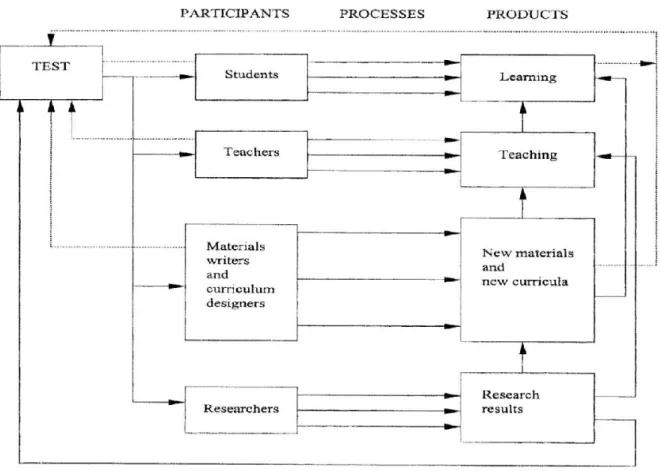
(23) Standardized Tests and School Procedures. 22. ● A test will influence what teachers teach; and ● A test will influence how teachers teach; and by extension from (2) above, ● A test will influence what learners learn; and ● A test will influence how learners learn. ●. A test will influence the rate and sequence of teaching; and. ● A test will influence the rate and sequence of learning. ● A test will influence the degree and depth of teaching; and ●. A test will influence the degree and depth of learning.. ●. A test will influence attitudes to the content, method, etc. of teaching and learning.. ● Tests that have important consequences will have washback; and conversely, ● Tests that do not have important consequences will have no washback. ● Tests will have washback on all learners and teachers. ●. Tests will have washback effects for some learners and some teachers, but not for others.. Bailey (1999) also posed a model for the research in washback effect, in which he explained how participants, procedures and products (teaching materials- learning- curricula) converge and interact. Thus, he describes the participants as the language learners, teachers, administrators, materials developers, and publishers, "all of whose perceptions and attitudes toward their work may be affected by a test”. The process as any actions taken by the participants and that can contribute in the learning, and finally the product is what students learn and the quality of what they learn. In this way, a test can modify in first place the way in which participants conceive the.
(24) Standardized Tests and School Procedures. 23. test, the way they act towards it and consequently, the outcomes of those behaviors and decisions.. Figure 1: Taken from Bailey (1999). Hence, the author suggests that although all the three elements are connected, the researcher must focus the attention on one, to go in depth and determine in a better way the elements of the washback. He determines different relationships. The first related to participant in the washback process. So, we have the test takers and the washback and the language teacher and the washback..
(25) Standardized Tests and School Procedures. 24. In the test takers and the washback, Bailey (1999) referred to the elements that can affect the students. He mentions these aspects: the experience of taking and, in some cases, of preparing for the test; the feedback they receive about their performance on the test; and the decisions that may be made about them on the basis of the test. He mentions additional factors as the importance that present well on those tests can mean for students, as it can generate study opportunities. The author also emphasizes how although students are the main participants influenced by tests, there is little research that document their point of view (p, 14). Different to the point of language teachers which is documented in most of the research related to washback effect. Consequently, the decision to work with test takers, emerged as a need to investigate and know more about this topic from the point of view of the main involved. In this case, we take it with the school leavers, term that we give to students who are about to finish their studies in secondary, since it is at this moment in which more important decisions are made on the basis of a test. Social representations Social representations refer to a system of values, ideas and practices that enable a person to interact and communicate among a community. These representations help the interlocutor to give meaning to a new idea or situation by using what he already knows or has received from others. Social representations are the result of interaction, they are a source of collectivity knowledge (Moscovici and Duveen, 2000). Although it is not our main purpose to depict the social representations of the classroom, it is important to consider the role of social representations inside the classroom. Understanding the.
(26) Standardized Tests and School Procedures. 25. social representations revolving around standardized testing helps us to have a clearer view of the reasons why students have certain opinions about the test, and the reasons why teachers make some decisions inside the classroom.. Review of the research During the review of state of the art, we paid special attention to the research reports and the thesis that appear in Table 1.. Author, year Sukyadi, D. , Mardiani, R. (2011). Problem or issue Washback effect of the English national Examination (ENE), on English teaching practices and students learning.. Length of study It was carried out with three schools with twelfth grade teachers and students.. Research method Qualitativecase study.. Zacaria, N. (2013). Teachers’ pressure to improve students’ scores in standardized English tests. The study was carried out with 244 secondary school. Quantitative – survey method. Results - Washback effect is stronger when the test is closer to be applied. -Teachers feel pressure to accomplish with high scores in the test, and start to focus their classes on the teaching of the test. -ENE test has a strong effect as all that happens in the class is determined by it. -There is a negative washback effect of the ENE on students ‘learning as they mainly prepare to face the test. -The length of the washback is short. -Teachers’ classroom practices are significantly influenced by their pressure to improve scores in the standardized test. -Pressure lead teachers to “teach to the test”.
(27) Standardized Tests and School Procedures. Adnan, M. (2014).. Barletta, N. (2006). Rashidi, N and Javanmardi , F. (2011).. Vargas, K. (2011). and its implication on classroom practices. Washback effect of the higher secondary school certificate exam on English teaching and learning.. Washback effect of the ICFES on English teaching and learning in the schools of the Atlántico Colombia Washback effect of the IELTS preparation examination on learning and teaching outcomes.. Perspectives, thoughts and ideas eleventh graders had. teachers of 36 schools in two districts Fifty Teachers of intermediat e English level (eleventh and twelfth grade) of Colleges of Sargodha and Faisalabad in Pakistan 1 year Students and teacher of eighth and tenth grade. The length of the study is not specified, but it was carried out with students and teachers of a IELTS course. It was conducted with 17 students of. 26. Quantitative – survey method. -Higher secondary school certificate exam affects the selection of teaching materials. -Success in the exam became the objective on classes. -Washback effect is stronger when examination is near to be applied.. Qualitativecase study. -Any of the schools studied felt pressure to work towards better results on the examination, even though they saw it as very important. - However, the competencies developed inside the classroom were limited to those tested in the ICFES exam. -IELTS preparation courses have a big impact on students’ expectations of the outcomes of the course. - IELTS preparation courses had positive impacts on the Iranian students’ learning processes and their achievement in this examination.. Mix –method. Semiotic Analysis. Before presenting the exam most of the students said that the exam was very important, however, after presenting the.
(28) Standardized Tests and School Procedures. about ICFES saber 11 and the value or sanction they gave to it.. the private school Aspaen Gimnasio Cantillana from Municipio Pediecuesta .. 27. exam some of those perspectives changed, as students did not get good results.. In the studies found in table 1, it is discussed three main issues: the role or impact of national standardized tests in schools processes (washback effect), the process of teaching for testing and the students and teachers’ perceptions about testing. It is important to highlight that most of the studies, observed washback in the micro-area of language teaching and learning. High stake tests and school processes With the increasing importance of standardized tests in education, tests have become an important tool and part in teaching and learning processes, especially when we talk about high stake tests. High- stake tests are those that can have consequences for schools, schoolers and 3. educators. They can be a determining factor for making decisions . A high-stake test as mentioned by Sukyadi, D. (2011) is one used “to compare and rank individuals, schools or national systems”. These high- stake tests as important factors in education, lead to the washback effect as they start to influence on the teaching and learning processes. In the study carried out by Sukyadi, D and Mardiani, R. washback is evaluated taking as basis 5 dimensions: Specificity, Intensity,. 3. Torin D.(2004). High-Stakes Testing: Educational Barometer for Success, or False Prognosticator for Failure.
(29) Standardized Tests and School Procedures. 28. Length, Intentionality and value. These dimensions are observed in an English class in three different schools which were chosen intentionally as they are classified according to a national examination considered a High-stake test. They have the categories of High achiever, Middle achiever and low achiever. Taking into consideration the five dimensions mentioned a priory, the researchers found the intensity of the washback varies depending on the closeness of the presentation of the exam. They also found, the exam influenced and affected different areas inside the classroom: Activity time arrangement, teaching material, strategies, ways of assessing and teaching content. These variations are implemented by teachers on the basis of the exam. Therefore, they determine the washback can be either positive or negative. It is positive if it helps to reinforce and achieve the original learning goals, principles, and interests. And negative if it fails to reflect the learning objectives or if those change to accomplish what the exam requires. One example is the omission of some topics that will not appear on the exam. This situation may be reflecting in English classes in Colombia, as ICFES does not evaluate the listening and speaking skills, they may be replaced or omitted to spend more time on skills assessed on the test. It happens because as mentioned by Shohamy (cited by Sukyadi. 2011), the washback produces a measurement- driven movement in which learning starts to be directed by tests. The Curriculum focus on the correlation between what is to be tested and what is to be included in the syllabus..
(30) Standardized Tests and School Procedures. 29. This perspective is shared by Rashidi, N., and Javanmardi, F (2011), in their study of the IELTS preparation washback on teaching and learning outcomes. They describe the big impact an examination can have, and how it is a powerful determiner, positively and negatively, of what happens inside the classrooms. As this test is a really important one, it generates pressure. It is expected of students to get good results and teachers proficiency is measured by the students’ performance. However, in this case, the effect is more positive than negative. It helped to improve and achieve the objectives of the class, as it was a test-taking preparation course. Barletta, N., (2006) also explains, how sometimes although teachers do not feel pressure to generate good results on the exam, the contents and organization of the classes are determined by the tests. This is the result of the teachers believes. Sometimes teachers think what they find in the test is the correct thing to teach. There are however, some other teachers that although not feeling pressure to generate good results, they see the need to remind students about the importance of taking the test, so they try to include a similar content in classes.. Teaching for testing The testing movement generated in the last years, has also aroused different questions about whether results in testing show students learning achievement. The study High-Stakes Testing and Student Achievement: Does Accountability Pressure Increase Student Learning? (Nichols, S, 2006).. shows how, although tests seem to have a great influence in students learning, as it. generates a lot of pressure on them for obtaining good results, it seems not to have a big impact.
(31) Standardized Tests and School Procedures. 30. on students learning achievement, as results on the tests just can be a product of a process of teaching for testing. Teaching for testing, refers to the student´s preparation for taking a determined test. It can be developed in different ways with different focuses as: teaching test- taking skills, teaching content known to be covered in the test, teaching the test in content and format, and practicing the test and parallel tests items. (Smith, 1991). As there are different focuses and ways to carry it out, its results and ways of interfering in learning process may be different too, which still being common, is the emphasis on preparing for obtaining good results in a test. These processes emerge as a result of the importance given to high-stake tests in the institutions. Zacaria (2013), in his study “Pressure to Improve Scores in Standardized English Examinations and their Effects on Classroom Practices” explores how these kinds of exams influenced on teaching practices because of the pressure they generate on teachers. According to the study, school administrators commit teachers the task of generating good results, because, on their basis, schooling administrators make decisions about funds for schools, students future schooling options and teachers jobs (in some cases). The study exposes how in the process of ensuring good results teachers are forced to teach for the test, contradicting in many cases what they consider to be a good teaching practice. Due to the nature of the exams which does not cover all the skills students must develop. However, Zacaria also found that some teachers believe results in a test do not mean good or bad teaching but the socioeconomic background and intellectual abilities of students. These results are.
(32) Standardized Tests and School Procedures. 31. consistent with those in other studies that show that tests may generate inequalities and that they affect not just what teachers teach, but also how they teach. There are different factors involved in the process of teaching for testing, not just the importance of tests for schools, but factors such as pressure imposed by peers, commitment to helps students, pressure by parents, among others. Adnan (2014) for example, explains how, when results in tests generate points for students’ future career studies, teachers feel committed to help students to get good results, changing the materials, the way of assessing, the topics and at last the focus of the class. Another example is the research developed by Moon (2007), where he explains the role parents have in the process of teaching for testing. Parents expect schools to guarantee good results. This expectation leads schools to change the curriculum and instruction, orienting them more towards the preparation for the tests. This situation is especially remarkable when the administration of the test is near. Teachers try to cover as many topics as possible from the ones they know are probable to appear in the exam, but at the same time, they exclude those that will not appear in the test. Although these studies mostly highlight the unwanted consequences of the teaching for the test, they explained the scope of the effect is not always bad. In some situations, it involves the improvement of students’ skills or the acquisition of abilities that will help them in other different scenes. They also highlight the role of participants in the process of teaching for testing, even though, most of them do not delve into the topic..
(33) Standardized Tests and School Procedures. 32. Participants’ perceptions about testing Although it is important to investigate the way processes are affected, it is essential to understand and analyze the individuals involved in those procedures. It is for that reason that while some studies focus on understanding the washback and the impact of testing, through the classrooms, teaching practices and methodologies, some others analyze what teachers and students think of these processes. The understanding of the role and perceptions of the participants is important as these may help to understand why classes are developed in certain way or why tests play such an important role in classrooms. This is the case of the research developed by Vargas, (2011), in which she studies the appraisement students give to the exams, based on the social representations, ideologies, and discourses that surround the topic. For instance, Vargas depicted the role sanction attached to the exam modifies the ways students talk and feel about it. She also illustrated the influence that figures of power, (teachers and parents), have on the assumptions students make about the test and the procedures determined by it. Hence, she found that scholars see the process of testing as necessary and meaningful for their process of learning, they consider it is indispensable to get prepared to take the examination. Nonetheless, she also found this perception may vary depending on the time of presentation of the test and on the results obtained. In that way, a student’s opinion could change before and after taking the test..
(34) Standardized Tests and School Procedures. 33. Some other studies, as the one carried out by Zacaria (2013), are more focused on teachers’ role in the washback effect. They try to understand how teachers beliefs and ideas might affect the teaching and learning process. These aspects and the ways teachers understand the test, as mentioned by Zacaria (2013), could be a determiner for the decisions make about the organization of classes, the material to use, the topics to teach, etc. Moreover, he also explains the role other participants may have “other parties such as the school administrators, parents and inspectorates should also be well-informed of how their expectation on teachers with regards to the students’ performance in examinations is, in fact, a potential source of pressure which encourages test-influenced teaching and stress among Teachers” (p 54). Even though, the characters mentioned in this passage are not direct participants in the process, they play an important role as they influence on how the things will be carried out. The information provided in these researches gave us some insights on the possible outcomes, we could find when we develop the intended study. Also, they help us to see the importance of narrowing the aspects to be under research as it will allow us to get a clearer and more organize perspective of the problem.. Chapter Three. Research Design.
(35) Standardized Tests and School Procedures. 34. The purpose of this chapter is to describe the nature of the study. This section includes a description of the research paradigm used to frame the investigation. Likewise, it gives a characterization of the type of the study, the context, the participants, the data collection, and the chronogram. Research Paradigm This study aimed at exploring, understanding and describing the role standardized test have on teaching and learning practices. For that reason, it was essential to choose a qualitative research for the development and achievement of the goals set for this investigation. The qualitative research is a paradigm for inquiring, mainly focused on understanding social phenomena within a specific context. This paradigm provides with ideas and information to formulate a hypothesis or to answer a question, having as a base the experiences, perspectives, and opinions of the individual under research. This kind of research is mainly developed as an interpretation and description of the problem. According to Hancock., (2007), “Qualitative research is concerned with developing explanations of social phenomena. That is to say, it aims to help us to understand the social world in which we live and why things are the way they are”. The qualitative research provides insights into a problem and allows the researcher to go in deep on a specified topic. Furthermore, in the qualitative investigation, researchers have a better comprehension of the context and the participants as they get more involved in the environment where the phenomenon takes place. One of the main objectives for this study was the recognition and understanding of.
(36) Standardized Tests and School Procedures. 35. the perceptions students have about tests in their learning process, and the identification of the discourses underlying those perspectives. This acknowledgment is simpler to achieve when the investigators are in the context and interpret from the context.. Type of study This research intends to describe a phenomenon, occurring inside the English classes. It is contemplated the way in which testing affects the procedures inside the English classroom. It is for that reason, that the project is presented as a case study. According to Merriam, S (1988), a case study "is an intensive, holistic description and analysis of a single instance, phenomenon or social unit". (cited in Merriam 2006). To consider a phenomenon as a case, it should have a boundary, it means it needs to have a limit. Merriam explains how a case could be a person, a group of people, a class, a program, etc. that should be specific. For instance, in this research, the event under study is the role of the ICFES inside the English classes. It is limited to an English class in an eleventh grade with 32 students and it is limited to the ICFES test and not testing in general. Although the case study has to be limited as its studies a specific instance, it also lights up about a general problem. This type of examination is an interpretation in context, we study a problem within a specific setting, and with a particular number of participants, but it gives us ideas of aspects and variables that can describe a problem and that can be constant in other environments. Indeed, with this research, even though, it is focused on a specific population and.
(37) Standardized Tests and School Procedures. 36. in the effect of a particular test, it intends to illuminate about the general process of testing in education. Setting Colombia has an eleven-year system of education, five years of primary school, and six years. of secondary school. These levels are mandatory and free in the case of public education. Schooling in this country is regulated by the Ministry of education. The Ministry monitors and controls institutions, either private or public, to make sure they fulfill the basic quality standards for teaching and learning. Besides, it establishes the learning objectives and curriculum each level of education must have. However, institutions can modify part of it, to make it more adjustable to the goals established in their PEI, (Institutional educational project). For the purpose of this study, the experimentation and data collection took place at a public school in Bogotá. It is an institution oriented to the integral formation of the students through the research and the building of the life project. It is known for the good results obtained in the ICFES test Saber 11 in the last few years. The institution promotes an integrated environment, for which it is a mixed gender school. It offers the two main groups of schooling, primary and secondary education. It also offers two different times, morning schedule and afternoon schedule. The selection of the school was made through a mix between purposive and convenience sampling. Convenience sampling is a technique where researchers select the place or participants to study taking as criteria aspects such the easy access, the geographical proximity,.
(38) Standardized Tests and School Procedures. 37. the availability or the willingness to participate. (Etikan, I, 2015, p. 2) This method is affordable and seeks to facilitate and speed up the process of research. However, in the selection of the school, we also tried to find one institution with characteristics that could be typical in others so it can work as a general illustration of what was happening in other instances. We certainly chose the school because of the easy access we got, as we were doing our practicum there, but also because of the characteristics it held. Participants Observations and interviews were carried out in an eleventh-grade classroom. The course was composed of thirty-two students,18 girls, and 14 boys, of which fifteen did the interview. Students were between fifteen to eighteen years old. They all belonged to a middle-class social status. This group had three hours per week of English class. The observations were made at least two hours per week. For selecting the participants, we used a nonprobability sampling known as purposive sampling, also used to select the school. The purposive sampling is a technique in which the choice of the participants is intentional, calculated and carefully studied. The participants have certain characteristics that make them suitable for the investigation. (Etikan, I, 2015, p. 2) . In this study, it was essential to work with eleventh graders as they are the ones who take Saber 11 test, and as they are close to finish school. Moreover, the teacher in charge of English classes was well informed about ICFES testing process what also motivated us to observe this specific classroom as the main purpose of the.
(39) Standardized Tests and School Procedures. study was to depict the influence the exam could have on teaching methodology and material development for English class.. Research question. ● How may Saber 11 test influence teaching methodology and decision making for the development of English class? -. What are the perceptions students have about the test and its role in their learning process?. Research objectives ● To understand the role of standardized tests on English teaching and learning practices. ● To understand the way in which the importance given to tests may influence the decision-making for every process within the classroom. ● To know and highlight students’ perspectives about the test. ● To raise awareness about the implications standardized test may have in the learning process.. 38.
(40) Standardized Tests and School Procedures. 39. Data collection methods A key step in a research project is the gathering of data. The procedures carried out to collect it, depend on the objectives and type of study. The purpose of this case study in part was to understand, describe, and explain the impact Saber 11 test may involve in English teaching and learning practices, and in part to recognize and depict the perspectives students have about this examination on their process of learning. For that reason, the methods used for collecting the data in this project were observations and interviews. Observations allow gathering information by directly observing the phenomenon.They provide knowledge about the context, the participants, and behaviors, which will help to understand better the problem and may function as a reference to know what further step to take in the investigation. (Merriam, 2009. pp. 119- 122). The observation must be intentionally and systematically applied to address a research question. In this case, the study seeked to answer and explain how the Saber 11 test may affect English classes teaching and learning. Thus, when doing the observations, we acquired a passive role to ensure the quality and reliability of the information gathered, by not interrupting the natural pace of the classes. We observed the content, materials and development of each class. On the other hand, interviews were used as a way to identify and describe the ideas and interpretations students had about the role of the exam in their classes and in their learning process. Interviewing aims at decoding feelings, perspectives, interpretation or actions that are.
(41) Standardized Tests and School Procedures. 40. not possible to understand with the mere observation. Interviews enable the researcher to get information from the voice of the participants. They allow having another perspective of the case under study. (Merriam, 2009 p. 88). Therefore, considering the kind of information expected to get from interviews, we selected the semi-structured type. Semi-Structured interviews are flexible and allow the inquirer to respond to the situation at hand. The researcher counts with a list of questions, but these questions do not have a specific order, they can be modified. The investigator is free to avoid or add more questionings depending on the ideas emerging at the moment.. The data was collected during five months. Three months before taking the test and 2 months after the test. The schedule was as follows: Date May 24 May 24 May 31 June 7. Instrument Survey Observation Observation Observation. Who 32 Ss Researchers Researchers Researchers. June 17 June 17. Interviews Observation. 15 Ss Researchers. July August 5. data analysis Observation. Researchers Researchers. August 19. Observation. Researchers. October 14. Observation. Researchers. What Previous knowledge about the ICFES Class development Class development Class development students’ participation Perspectives about the test Class development students’ participation First stage of data analysis Class development students’ participation Class development students’ participation Class development students’ participation.
(42) Standardized Tests and School Procedures. November 4. Observation. Researchers. November 4 November 8 November. Interviews Interviews. Students Students Researchers. 41. Class development students’ participation Perceptions about the ICFES Perception about the ICFES Data analysis. The instruments designed for collecting data were elaborated based on Bailey’s model on the washback effect, where we identify the different relation among participants, processes and products, paying special attention to the test- takers and procedures. Objectives: Classroom observation -. Identify content and materials used in classroom. -. Identify the methodology. -. Characterize students’ participation and interaction in classroom.. Interviews: -. Identify students’ perspectives about the test.. -. Characterize students’ perspectives.. Learning objectives When introducing and explaining a topic. When developing activities. When evaluating. Comments.
(43) Standardized Tests and School Procedures. Materials Methodology Studentsteacher interaction Classroom environment. 42.
(44) Standardized Tests and School Procedures. 43. Chapter Four Data Analysis and Findings. This chapter illustrates the process of data analysis. It shows the different strategies used, the findings and the relation to the literature. This section also shows some extracts and evidence from the original data used to determine the findings. The analysis was carried out through an inductive approach so that we could group the data and look for relations. For grouping and interpreting the data, we used a descriptive coding technique. Descriptive coding tries to “summarize in a word or short sentence the basic topic of a passage of qualitative data”. (Saldaña, 2010, p. 70). This technique helps to synthesize and organize the information in a more simple way to find categories and, themes for the final explanation and theory. We collected and analyzed the information, focusing on four different aspects; agenda organization, classroom procedures, students' participation and students voices. In that way, the data collection tools were designed to identify and describe those aspects. On the other hand, in the analysis, first, we determined codes for each piece of highlighted information inside the data. Then, we established relations that could allow us to formulate categories and themes and finally,.
(45) Standardized Tests and School Procedures. we answered the research question providing a clear explanation and description of the phenomenon. The following tables present the generated codes from the most relevant excerpts in the observations. Descriptive coding Observation 1 Excerpt. Codes. Teacher presents the topic relating it with the mother tongue in order that the students get a better understanding (grammar translation). -. Translation. Mother tongue use. Students were playing a game to practice wh questions. Then, once the game was finished teacher proceeds to explain them some other grammar topics: - ing - would like - Possessives Most of the explanation is made in spanish.. -. A lot of grammar topics. Focus on grammar. Mother tongue use.. As the students were not writing the teacher decided to give the instruction. She also reminds them, these topics will be in the Saber test.. -. Highlighted topics Topics in the test Focus on the test. concern about the test. Students get excited about the idea to know more about what is going to be in the exam. -. Interest in the test. Motivation to know test.. She tells students that they may remember she does not teach them anything that is not in the ICFES.. -. Reinforcing the test importance. Teaching to the test.. Teacher involves students in the class by asking them for examples related to the topic.. -. Students motivation Students involvement. 44.
(46) Standardized Tests and School Procedures. She also motivates them to ask if they have any questions.. Descriptive coding Observation 2 Excerpt. Codes. Students are developing an essay about public transport. -Teacher tells them, it is possible the ICFES starts to implement open question on the exam, so that is important to practice.. -. Highlight test Practice for the test. Focus on the test. Teacher includes cultural knowledge on the development of the essay by doing a comparison of the use of transportation in different countries.. -. Culture knowledge. She shows students two videos about transportation in other countries. Then, she gives examples in how to start the essay. She gives predetermined sentences for students to use in their own essay.. -. Technological resources. Predetermined structures.. Descriptive coding Observation 3 Excerpt Students are carrying on the week E (week E special week were the school looks for alternatives to encourage students reading) . This is a week in which students develop different reading activities. This week activity was created and imposed by the secretary of education as a. Codes -. Reading programs Improve test results. Practice to the test.. 45.
(47) Standardized Tests and School Procedures. way to generate reading habits and to improve the results on tests. Teacher expressed “I do not know why they do this. They come an interrupt all our normal activities to develop this other one, when the institution already have a reading program. But that's ok we have to do it".. -. Imposed activities Classes interrupted for “Reading program” Reading programs Agenda changing. Students developed two activities. Students have to read and answer some questions. The exercises include the different type of questions students may face in ICFES Saber 11 test.. -. Reading practices. Recognizing test structure.. Students seem to be bored with the activity. Some of them say: This again.. -. Lack of motivation Repeated activities. Descriptive coding Observation 4 Excerpt. Codes. Class starts with the socialization of grades. the students must re-organize the classroom because they have to take the Martes de Prueba. -. Grades socialization. Evaluation focus. Students develop Martes de Prueba. They are habituated to the process that the teacher does not need to tell them what to do. -. Practice to the test. Learned habits. The teacher express that most of the students do not need a lot of supervision because with the “training”They already know basic test skills. She says “La mayoría de estudiantes ya no necesitan supervisión para esta actividad, debido al entrenamiento que han tenido desde 9no grado”.. -. Training to the test. Testing habits... .. 46.
(48) Standardized Tests and School Procedures. She also expresses “es bueno que ellos aprendan habilidades básicas para responder un test, ellos saben que deben hacer y que no” She explains that saber 11 is not the only exam students must present along their lives she also lists some others. So, she says it is important to be ready and practice. Students were told they receive an extra grade for the results in “Martes de Prueba”. Students also remind the teacher they supposed to get an extra grade for the mock they took. They were told that if they get a good results they were going to receive points for the final grade of the term. So they were asking for that as that helps them to increase the grade. Also, always they have as homework to correct the “Martes de prueba” .. -. Acquiring Testing skills Practice to the test. Testing is a long life.. -. Importance of grades Ss motivation for grades... -. Test practice Test content.. Descriptive coding Observation 6 Excerpt Students are not taking more “Martes de Prueba” as they already took the ICFES test. So, they have a presentation about celebrations. Most of the presentations are made in spanish. Teacher does not say anything about it.. Codes -. No more “Martes de Prueba” Agenda changing. Mother tongue use. 47.
(49) Standardized Tests and School Procedures. Descriptive coding Observation 7 Excerpt. Codes. There is not a clear objective in the class. Teacher starts picking up an activity. Then , she gives students some riddles to guess. The rest of the class is spent on the riddles. Students seem to be more relaxed. The are enjoying the activity.. -. Not specific purpose Class changing. No grammar topics More relaxed environment.. Descriptive coding Observation 8 Excerpt Teacher is socializing the grades of the term. Students who have not presented something, have the opportunity to do it. Students are organizing and finishing activities they have not done.. Codes -. Socializing grades wrapping up course.. The previous tables showed the different elements observed in English classes. we could evidence a noticeable change among observations 1-5 from observations 6-8 which were. 48.
(50) Standardized Tests and School Procedures. 49. developed in different stages. Observations one to five were done before students took test and observations six to eight were done after the presentation of the test. In the next table, we can evidence the students opinions and the codes used to analyze the information collected to solve the research question. The chart also shows a summary of the problem, The research question, the categories emerged from the data analysis, the theoretical support and some conclusions.. RESEARC H QUESTION How may Saber 11 test influence teaching methodology and decision making for the development of English class?. CODING ANALISIS. SAMPLES OF DATA (Direct transcription of learners’ interviews). Meaning of the Saber 11 test. yo creo que esta sobre valorado “. Gate opener .. según eso las universidades van a mirar pues que tienes tú de conocimiento te ganas una Beca no. THEORETICAL SUPPORT. Some authors consider that: This pressure, generates nervousness, anxiousness and fear to the test, as like mentioned by Shohamy (cited in McCallum 2016) and that “More opportunities for student participation and student questioning; diagnosis of individual students weaknesses; and the combination of self-study with revision in class” (Alderson and Hamp cited by Bailey 1999)..
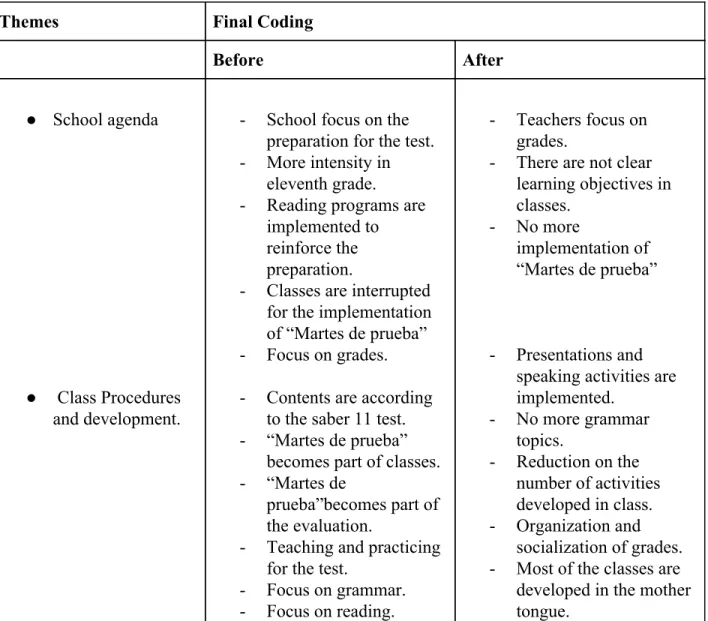
(51) Standardized Tests and School Procedures. GENERAL OBJECTIV E: To understand the role of standardize d tests on English teaching and learning practices.. Meaning of the Saber 11 test for families. Family pressure. Test and preparatio n Knowing the test.. que es súper importante que eso va a definir tu vida. Moscovici (2000) our mind is conditioned by the culture and predetermined set of beliefs, ideas and practices shared inside the community. ponle las ganas a eso. . tu carrera depende del resultado. Los profesores nos ayudan a corregir el martes de prueba. Nos enseña los tipos de preguntas Con el martes de prueba nos ayudaron.. This examination as a relevant tool for the government to measure and control the quality of education has become a factor capable of modifying the ways teacher decide to teach, students decide to study and administrators organize the agenda ( Shohamy, cited in Bailey 1999). These activities remind important just when the test preparation is a must, but once they get to the test they do not see it necessary. (Sukyadi, 2011). Shohamy (2006) it may be the result of focusing the goals of the teaching and learning in evaluation.. 50.
(52) Standardized Tests and School Procedures. Role of the test in the learning process. Schools focus on test. Learning more than a test. la prioridad siempre es pues para los colegios sacar pues bien esto el tema del ICFES nos enseñan matemáticas pero no a pensar y opinar. nos enseñan a presentar un examen. The Saber 11 test influenced on what the teacher taught, the rate and sequence of teaching, the kind of activities, and the attitudes participants had to the content, activities and the exam ( Bailey 1999) It seemed it was more relevant to practice the test that having language classes. (Bailey, 1996).. pero no nos enseñan como a trascender un poco. GENERAL CONCLUSIONS. The saber 11 test influenced the materials used in classes. Limitation in content and activities The test has a positive impact on students´ study habits. Teaching for testing since 9 grade. social factors influence students thoughts Standardized test shape education. 51.
(53) Standardized Tests and School Procedures. 52.
(54) Standardized Tests and School Procedures. 53. In the previous sample table, we identified different opinions about the test , finding similarities, correlations, and ideas reinforced by each one of the participants. The following table (Table 17), shows the identified themes and final coding, of the observations and interviews, based on the repetitiveness of initial codes and the relations among them. These findings are also divided into two different stages of the research. Before and after the test. Table 17. Themes and final coding. Themes. Final Coding Before. ● School agenda. -. ●. Class Procedures and development.. -. After School focus on the preparation for the test. More intensity in eleventh grade. Reading programs are implemented to reinforce the preparation. Classes are interrupted for the implementation of “Martes de prueba” Focus on grades. Contents are according to the saber 11 test. “Martes de prueba” becomes part of classes. “Martes de prueba”becomes part of the evaluation. Teaching and practicing for the test. Focus on grammar. Focus on reading.. -. -. Teachers focus on grades. There are not clear learning objectives in classes. No more implementation of “Martes de prueba”. Presentations and speaking activities are implemented. No more grammar topics. Reduction on the number of activities developed in class. Organization and socialization of grades. Most of the classes are developed in the mother tongue..
(55) Standardized Tests and School Procedures. -. Most of the classes are developed or translated to the mother tongue.. -. ● Students’ role and participation inside the classroom.. -. ● Students´ perspectives about the test and test preparation.. -. Findings and Discussion. Ss are motivated for the test preparation. Ss are encouraged to practice for the test. Motivated for grades. Nervousness when taking “Martes de prueba”. Concern about the test. Test as gate opener for study opportunities. Test as determiner for academic future. Overrated test. Pressure by family. Test preparation gives more learning. test preparation since ninth grade. opportunities. There is fear and concern about the test. Test in classes help for grades. There is pressure to get good results test has life importance. it downplays other aspects of education: culture, opinions.. -. -. 54. More relaxed environment. Ss are motivated for grades. Ss participate in activities.. Test as gate opener for study opportunities. Not relevant. Test preparation helps to reinforce knowledge. Test preparation is a motivation to study. Motivation for grades. Test as way to recognize knowledge. There is pressure to get good results Nervousness and fear affect results. Teachers decrease the stringency. Test results are important for grades. Not recognition of personal component. Not recognition of other knowledge.
Figure
Documento similar
In these tests we study the training time for the ensemble and for the single SVM as a function of the size of the train set N train and in function of t p.. The tests have been
Taking into account that the tendency in Spanish schools is to establish a bilingual primary education system (Spanish and English), those students who do not major in English
A giant M2L3 metallo-organic helicate based on phthalocyanines as a host for electroactive molecules
Moreover, taking into account the well-established electron donor role of the Pc chromophores in covalent and supramolecular ensembles with fullerenes, 11,12
In order to enable flow mobility in a client-based mobile IP context, the IETF has standardized the basic components that are required. These components are: i) multiple care-of
By taking into consideration the local economic, political and social forces, the present study helps to gain a better understanding of the file sharing in
MD simulations in this and previous work has allowed us to propose a relation between the nature of the interactions at the interface and the observed properties of nanofluids:
The strong design of our study, with statistical power sufficient to test the hypothesis regarding genetic mutation and disease phenotype, allowed us to correlate CCR5-D32 with
[31], in their study on the USI evaluation of the abdominal wall taking into account muscles and perimuscular connective tissues between subjects with lumbopelvic pain and
