
Dicyclopentadienyl titanium and zirconium complexes with the double bridged bis(dimethylsilanodiyl) dicyclopentadienyl [(Me2Si)2(η5 C5 H3)2]2 ligand: X ray molecular structure of [Ti{(SiMe2)2(η5 C5H3)2}Me2]
9
0
0
Texto completo
(2) A. Cano et ¢d./ Jtmrnal of Organometallic Chemistry 526 (1996) 227-235. are air- and moisture-sensitive, both in solution and in the solid state. They can, however, be stored unaltered for weeks if strictly anaerobic conditions are maintained. In the presence of a stoichiometric amount of water, hydrolysis takes place and the /x-oxo dinuclear derivatives [{M[(SiMe.,),(T/~-CsH 3)-,]Me}_,(/~-O)1 (M = Ti (5), Zr (6)) are isolated in 40-50% yield (Scheme 1). When 2 reacts with one equivalent of MgCIMe the chloro methyl c o m p o u n d [Zr{(SiMe.,).,(r/sCsH~)2}CIMe] (7) is obtained. Analogous chloro alkyl complexes [M{(SiMe., )-,(~5-C 5H .a).,}CIR] (M = Ti, R = CH-,SiMe., (8): M = Zr, R = CH:CMe2Ph (9)) ale the only products obtained from the reaction of 1 or 2 with MgCI(CH-, SiMe.~) or LiCH :CMe, Ph, whatever the molar ratio may be. All of the new isolated compounds ate soluble in chlorinated solvents (chiorotbrm, dichloromethane) as well as in aromatic hydrocarbons (benzene, toluene) and slightly :oluble in hexane and pentane. Their solubilities range in the order 7,8,9 > 3,4, > 5,6 > 1,2. The IR spectra of all of these complexes show the characteristic absorptions reported [11] for ~,~,.,(Si-C). ligand have bccn reported [8], but few Group 4 metal complexes are known [9,10]. Here we report the synthesis and s,raetural characterization of the bis( 1, i'.2,2'-dimethylsi|,modiyl)-~lS-dicyclopentadienyl titanium(IV) and zirconium(IV) oxoderivatives [{M[(SiMe-,),('05CsH0:]Me},(/~-O)] (M = Ti ($), Zr (6)). the chloroalkyl complexes [M{(SiMe-,)z(r)5-CsH3)~}CIR] ( M = T i , R=CHzSiMe3 (8); M = Z r , R = M e (7), CH:CMezPh (9)) and the characterization of the previously reported [10] complex 3 by X-ray diffraction methods. The spectroscopic characterization of the cationic species [{M[(SiMe~)~(r/~-CsH ~),]Me},,(/xMe)]* (M = Ti (10), gr Ill)) is also reported. 2. Results and Discussion The reaction of a diethyl ether solution of [M{(SiMe,)2(r/~.CsH;)2}CI,] (M =Ti (I), Zr (2)) at = 78 +<2 with two equivalents of the appropriate alkylating agent (LiMe or MgCIMe) led to the dimethyl derivatives [M{(SiMe:)~(r/s-CsH+;),}Me:] (M ==Ti (3). Zr (4)) as previously described [10]. Complexes 3 and 4. M•e•• S t ~. +%o.. M~T | l l h. M,,,,,.~CI "~I R. M+ T+,, M' + M~CI,R++-CH,~4M~(~) M+~, M'+Li, R+ CH~CMe~Ph@). Z+iP(,P,). M+3gkX,. Me" ~. P~'~M. e. M* T|($),Z¢(4) (CPh~iB~C~Fs),dj. M=TilS).Zr(6) M'=T~(IO)+Z~It+ SchemeI,.
(3) A, Cano et ul. / Jtmrnul of Orgammwtullic Chemistry 526 (1996~ 227-235. 229. Table 1 NMR data (8) for complexes 5-9 Compound. ' H NlvlR C~,D~,. 5. -0,19 (s, 6H, Me-Ti) 0,15 (s, 6H, Me-Si) 0,33 (s, 6H, Me-Si) 11.40(s, 6H, Me-Si) 0.90 (s, 6H, Me-Si) 6,64 (m, 4H, CsH 3) 6.74 (m, 41-I,CsH 3) 6.79 (m, 4H, CsH.O. 6. 0.23 (s, 6H, Me-Zr) 0.25 (s. 6H, Me-Si) 0.50 (s, 6H, Me-Si) 0.58 (s, 6H, Me-Si) 0.74 (s, 6H, Me-SB 6.05 (m, 4H, CsH~) 6.51 (m, 4H, CsH ~) 6.82 (m, 4H. CsH ~). 7. 0.05 (s, 3H, Me-Zr) 0.32 (s, 3H, Me-Si) 0.42 (s, 3H, Me-Si) 0,46 (s, 3H, Me-Si) 0,48 (s,31-I,Me-Si) 6.19 (m, 2H, C~H ~) 6.68 (m, 2H, C.~H a) 6.70 (m, 2H, C~H ~). 8. -0.14 (s, 3H. Me--Si) 0.17 (s, 3H, Me-Si) I).31 (s, 9H, M¢~-Si) 0.37 (s, 3H, Me~Si) {).42 (s, 3H. Me-Si) 1.13 (s. 21,t. ~CII ,~) 6.75 (m, 21.1.(7~1,1~) 6.79 (.n, 2H, C~tt ~) 6.81 (m, 2H, C~H ~). 9. 0.019 (s, 611, Me-Si) 0.33 (s, 01L Me:~Si) 0.38 (s, OFl,Me~ Si) 0,46 (~, 6}I, Me -Si) 1.478 (s. 121,1,Me,C) 1,59 (s, 4H, +CH z- ) 5.97 (m, 4H. C d~l ~) 6.15 (m, 4H, C~H ~) 6.68 (m. 4H, C~H ~) 7.4-7.2 (m, 10H, Ph). I~C NMR a. CDCI~. c~. --. 0.10 (s, 6H, Me-Zr) 0.35 (s, 6H, Me-Si) 0.63 (s, 6H, Me-Si) 0.67 (s, 6H, Me-Si) 0.84 (s, 6H, Me-Si) 5.93 (m, 4H, C5H~) 6,35 (m, 4H, CsH~) 6,79 (m, 4H, C,~H,~). -0.02 (s, 9H, Me~-Si) 0.22 1s, 3H, Me-Si) 0.36 (s, 3H, Me-Si) 0.71 (s, 3H, Me-Si) 0.75 (s, 3H, Me-Si) I.{)3 (s, 2tl. C H , ~ J 6.77 (m, 2H, CsH ~) 6.8"1 (m, 21t, C~It ~) 0.98 (m, 211. C~ H ~). - 5.5 (Me-Si) - 4.92 (Me-SO 1.39 (Me-St) 1.8 (Me- Si) 2.96 (Me~Si) 56.41 (~CH ,-) 110.39(C I (('~tl)) 115.00 (C~ {C~il ~)) 119.84 (C'~ (C~H ~)) 137,08 ((': or C,I (C~ H ~)) 1~}.33 (C, or C~(C~H ~)). (M@Si) 4.66 (Me=S0 0.70 (Me~Si) 1.55 (Me=Si) 34.48 (C..Me~) 40.06 (C..Me~) 69.37 (CH 2) 110.75 (Ph) 113.62 (C~It D I 14.66 (Ph) 124.76 (C ~I-I ~) 125.76 (CJ°I ,) 131.66 (C~ll~) 134.89 (C.JI ~) 135,18 (Ph) 5,148. m. " Key:. 5. 3.
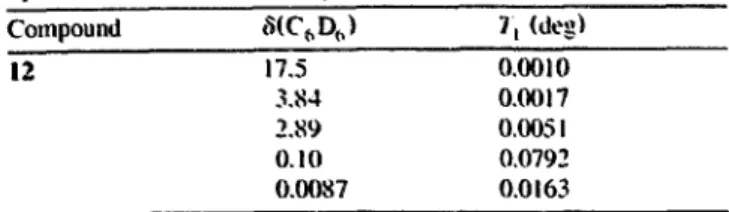
(4) A. (~m, et at. I J, mrmd ,,f Organomct, dlic Chcmiso T 526 ¢1996 ) 227-235. 2.'t0. /.t-CH~ ligands are identified in the ~H NMR spectrum by a singlet at ,5 - 1.22 for the titanium and 8 - 0 . 8 3 for the zirconium compound, and by a signal in the 13C NMR spectra at 8 29.8 and 8 30. I respectively, whel~eas the temlinal methyl groups appear at 8 0.05 for 10 (l~C NMR: 851.11 and 8 - 0 . 1 9 for 11 ('3C NMR: 851.91. These [{M[(SiMe2),(r/S-CsH3),]Me},(Ix-Me)] + complexes can be considered as containing one cationic 14-electron fragment [M{(SiMe,J,(OS-CsH02}Me] + stabilized by adduct formation with the neutral dimethyl metallocene complexes [M{(SiMe.,),(rrLCsH 3)2}Me: ] as ligands [3]. With this disposition the three protons of the cyclopentadienyl rings and the methyl groups bonded to silicon are not equivalent, and three multiplets ( 8 6.20, 6.97 and 7. I I for IO and 8 6.33, 6.59 and 6.98 for I1) and four singlets (8 0,15, 0,44, 0.67 and 0.73 for 10 and 8 0.28, 0,29, 0.80 and (I,85 for II) al~e observed in the IH NMR at - 7 8 ° C . Tile same features are obselwed in the ~C NMR spectra ( 1 0 : 8 -8.0, - 5 . 8 , -4.1, 0.9 (Si-Me): 125.9, 127.8, 128.2, 128.4, 129.1 (C~it 0: II: 6 1.4, 1.8, 3.6, 4.9 (Si-Me); !17.1, 125.8, 127.7, 128,5, 148.6 (CsH0). Reduction of a toluene solution of the titanium(IV) and zirconium(IV) derivatives I and 2 with sodium amalgam (10%) in a I:l molar ratio gave the g-chlorot i t a n i u m ( I l l ) and z i r c o n i u n : ( l l i ) c o m p l e x e s [M[(SiMc:):(tI~-CsH3),}( g-CI)]: (M ~ Ti, 12" Zr. 13) as red and red-brown solids respectively, in 75-80q yield (Scheme 2). Complexes 12 and 13 arc scarcely soluble in TIIF or Iohlene ~md insoluble in hexane. 'l'hcy re:wt in chloroform or dichloronlethane, being immedialely Iransl'ormed illlO tile COrl~2spondilt[~chloro-l||elal(IV) derivative~ Z and Z. Complex 121 is diama~aefic, and lhe ~ll NMR Sl~eClrum i. C,,I),, shows I,a,o signals at ~'; 0,62 mid 0.74 Ior the melhylsilyl protons of tl~e bridging ligand and two signals at ,] 5,02 (pseudolriplet) and 5.93 (pseudodoublet) 1i11"the cyclolx'ntadienyi p r o t o n s of an AA'B spin system (ratio 3:3:1:21. Complex 12 is paramagnetic, and tile II-I NMR shows broad signals lit 8 17.3 and 0.0 and tile spin-latlice relaxalion lim¢,~ [121 confirm the pm'amagnelic ll~.ItUl~ of the compound (see "l'abk 21,. M e I.. Mez "Chelatingligand". "Bridging ligand". (A). (n). Fig. I. Chelating (A) and bridging (B) disposifio,s for fl~e biR I.l'.2.2'-dimelhylsihnodiyl-~-dicyclol~mMienyl) ligand.. and v(Si=C) vibrations between 700 and 6(X)cm ~ and broad signals near 8(X)cm -I for v ( M - O - M ) vibrations. tH and °C NMR spectra for complexes 5 - 9 in C,D~, altd CDCI~ are summarized in Table I. These spectra show three multiplets for the non-equiv.'den, cyclopentadienyl protons (H.~-H~) and four singlets for the methyl protons bonded to silicon in the bridging group, indicating loss of the plane of symmetry observed fo." compounds [M{(SiMe 2)d rlS-Cs H .:),}X, ] with two equivalent sobstituents in the reflection plane. Similar features arc ob.~rved in the t~C NMR stxctra in which five signals for the C t - C s atoms and tour signals for the Me=St groups are present. All these data are in agreement with the chelating disposition (A) (Fig. I) of the his( 1.1'.2.2'-dimethylsihmodiylo ~1~-dicyclopentadienyl) ligand in metallt~eneotyp¢ derivatives, and with the presence of two dift~rent ligands occupying the other pseudolelrahedral positions ~u'ou,d the metal cenler. The reaction of the dimethyl complexes .~1and 4 wilh half an equivalent of [CPh J[B(C,F,).~I al = 78 ( ' i, CD:CI: led to the quantitative tbrmalion of dinuciear m¢lh~,lobridged cationic complexes I|M[ISiMe: ):~1 ~. C~H~):]Me}~( t~oMe)]" M = Ti. Ill (red) and M ~ Zr. II (yellow) (Scheme I). as evidenced by ~11 NMR spectroscopy. When the same ~actions are can'ied out in a I: I molar ratio 11o identifiable sD2cics are observed. Complexes 10 and II have been identified by ~|1 NMR at low temperature, decomposing abo~e - 4 0 ( ' . "l]~cy could not I-,¢ isolaled .~s solids at room teml'~.,ratutg,. The. M. ~. NatHg. M,,,,. ~. Toluene. ,. .. M ". ,. ,. ~. / g ~ ~. ~~/'M,,. M= Ti(12). Zr(13). M= Ti(1), Zr(2) ~CllIClllC ~.. ,,M,,.
(5) A. Cmu, ct ~d./ Journal qf Orgammwttdlic Clu'mL~'try 526 ~19961227-2.¢5 Table 2 Spin-lattice relaxation time {T~}(dee) for compound 12 Compound. ~(C~D,,). I, (deg). I ~_. 17.5 3.84 2.89 0. I0 0.0087. O.OOiO 0.0017 0.005 I 0.0792 0.0163. 231. Table 3 Atomic coordinates ( x 10a) and equivalent isotropic displacement pannneters (.~" x 1031 for compound 3 t. 2.1. Description of the o'ystal strucn,re of Til~iS(Me,, h.(~s-c~ H~),/Me,. (3) The crystal and molecular structure of 3 was determined by X-ray diffraction methods. There are two independent molecules in the asymmetric unit of the unit cell. Since the structures of the two molecules are simihu', only one is described in detail; data for the second are given in parentheses. Fig. 2 shows the molecuhu" structure and atom numbering scheme of molecule !. Final atomic coordinates and equivalent isotropic thermal parameters for non-hydrogen atoms are given in Table 3. Selected bond distances and angles are given in Table 4. The molecular structure of 3 is typical of a bis ligand metallocen¢ system, with the two Cp moieties linked by two SiMe, bridges, simihu" to [M{SiMe:),(r/'t C~H3):}CI: ] (M = Ti,Zr) [10]. Owing to the rigidity imposed by the double bridge, the Cp rings are eclipsed, and the two silicon and single titaniunt atotns define a phme in which the two Inethyl groups bonded to each titanium and silicon atom are located. The two Cp rings are phmar and lile dihedral angle between them is 63.5(2F (64.1(2F), simihu' to that found ill the aforem¢lllioned [Ti{(SiM¢~,)2(0 ~° C ~It ,~)z}el, ] [I 01, Related to it the angle Cp( I )eric I )-('p(21 is 126.8 °. Ti(I) C(I) C12) Ti(2) C(3) (2(4) C(ID ('112) 121131 C( 141 C(15) Si(I) C( 11D C(112) Si(2) C(1211 C(122) ('121) 022) C1231 O241 025) O31 ) C1321 C(33) C134) C135) C141 ) £'(42) (?.(43) C1441 C(45) Si(3) C(131) C(132) Si(4) C( 141 ) C(142). 817511) 921014) 843414) 7472(i) 6582(4) 8492(4) 6495(3) 6857(3) 7069{3) 6861131 6503(3) 6596111 5730(3) 6438(3) 7487( 1) 8207(4) 6689{5) 7946(3) 8320(3) 9318131 9562(3) 873413) 8408(3) 7509(3) 7597(3) 8491(3) s99113) 7305(3) 64112(31 5898(3) 643714) 7296(3) 845311) 84(~4) 9502(3) 6295111 523~ 31 6183(41. 194111) 1796(4) 319814) 1328(11 1816(4) 2320(4) 1735131 1079131 1410141 2219(41 2423(4) 1742111 It.154141 2767(3) 17811 ) -353(3) - 567(4) 1461(31 81013) 1015141 1736141 211116(4) 18913) - 43(3) 237(3) 64913) 61)9t3) 961X 4) 720(3) 1437(3) 2091(41 1795(41 34011) =501(3) 935(3) -=234111 ~ 207131 - 115113). 385511) 310014) 4018(4) 9086111 9855(4) 9431141 3609{3) 3182(31 241013) 2354(3) 3074(3) 4861111 5178(3) 5248(3) 3830( I ) 317414) 4162(41 5201113) 4777(3) 4868(3) 5311(31 553113) 90~113) 9277(3) 10169131 11)52813) 9876(3) 7570(3) 7764(2) 7838(3) 771013) 7551113) 7X8811) 71701d) 790414) 8341(I) 88118131 7631X3). 4511) 6812) 72(2) 4611) 76{2) 72(2) 5111) 53111 59(2) 63(2) 58( I ) 6011) 85121 77(2) 67( I ) 93(2) II 1(2) 5311) 5611) 61(21 61X21 56( I ) 5 I(1 ) 51111) 59(I) 6311) 62(I ) 46( I ) 45(I ) 53(I) 5~(21 50( I1 57(I) 9212) 811121 53111 78121 7412). It,., is defiuwd as oneothird of the trace of the orthogonalized U,, IPII ,',iOl'.. The Ti-C distances range fi'om 2.31315) to 2.487141A, but tiffs does not imply a deviation from planarity in the rings, nor a significant va,'iatioll in theo C - C dist:mces. The Ti-centrokl distances are 2.07A, and all tl~ese values correspond to a 5" me:in deviation of the metal centroid line from the normal between titan(trot and the ring plane, comparable with the reference contplex [ 10]. The Ti- methylo distances are in the range from 2.13817) to 2.158(5)A. normal for these. (126.7°).. systems.. NilN .111. ct~'3J. 3. Experimental section Ct2AI. Fig. 2. (~'l~.:n, view of IlIOl¢ctlhtr .structure of COmlX)und3 with the atomic labeling scheme.. All manipulations were performed under an inert atnlosphere (argon) using Schlenk and high v:tcuum line.
(6) 232. A, ('wu~ et al, / Journal oJ"Orgammwtallic Chemistry 526 (19961 227-235. Table 4 S¢1¢ct¢d bond lengths (/~) and angles (deg) for compound 3 Ti(I)-C(I) 2.158(5) Ti(2)-C(3) 2.149(6) Tt(1)-C{2) 2.138(7) Ti(2)-CX4) 2.157(6) TK I )-C( I I ) 2.320(4) Ti(2)-C(31 ) 2.324(4) Ti(I)-C(12) 2.32.5(4) Ti12)-C132) 2.313151 Ti(I)-C(13) 2.425(4) Ti(2)-C(331 2.433(5) Ti( I )-C(I 4) 2,487(4) Ti121-C1341 2.485(4) Ti( 1)-C( 151 2.424(4) Ti(21-C(351 2.424(4) Ti( 1)-C1211 2.327(4) Ti{2)-C(41 ) 2.321(4) Ti(I )-C122) 2.330(5) Ti121-C1421 2.33~41 Ti( I)-C1231 2.411151 Ti121-C(43) 2.431(4) Ti( 1)~C(24) 2.471(41 Ti(21-C1441 2.487(5) Ti(i)~C(251 2.425(4) Ti(2)~C(.~5) 2.410151 Si(I)-C(I II) 1,1,161(51 Si(31-C(131) 1.855151 St( 1)~C(112) 1.85415) Si(3)=C(132) !.859151 Si(I)-C(I I) 1.872(41 Si131~C1411 1.87115) Si(1)=C(21) 1.878(4) Si(3)=C(31) 1.876141 Si(2)~Ct 1 2 1 ) 1 , 8 7 3 ( 6 ) Si(4)-O 1 4 1 ) 1.860(4) Si(2)= C(122) 1 . 8 6 5 ( 6 ) Si(4)-C(142) 1.859(5) Si(2)=C( t21 1.867151 Si(4)-C(321 1.878(4) SK21-C122) !.871(51 Si(4)-C(421 1.855151 C( II )~C(151 1.415161 C(31 )-C(351 1.406(6) C(l I)~C(12) 1.455(6) C(31 )-C(321 1.450(5) C(12)=C(13) !.421(61 C132)~C(33) 1.41V9(61 C(13)=C(141 1.383(7) C( 33)=C1341 1.393(61 C(141~C(151 1.395(61 C(34)=C(351 1,402161 C(21 )=C(251 1,405(6) C141)=C(451 1.386171 C121)~C(221 1,456161 C(41)=C(421 1.464151 C122)~C(231 1,42216) C(4211C1431 1,422(61 (~23)~C1241 1,374171 (7'(43)=(7'(44) 1.384171 L'~24)=C(25} 1,41X1161 C(4411C(451 1.4t5(71 T~( 1)=Cpl 2,(t73 Ti(2)=Cp3 2.074 Tt( 1)- Cp2 2,13~ Ti(2 ) Cp4 2073 C(2)-Ti(1)~-C(I) Cpl:Ti(I)=Cp2 C(~) Tt(ILCp2 C(D-Tt(I)-Cpl ClllTt(I)=Cp2 OI);TI(ILCpl. 93,0(2) 120,S 1(18,7 1117,S 10,~.3 10%4. C(3)='t"1(21117(4) 92,413) Cp3.Ti(2) Cp4 120.7 C(4) Tt(~):Cp4 107,9 ('141 TI(21 ('p3 1{1~,3 C(3) Ti(2L ('p4 IilS.3 C(3) Ti(21 Cp.t 1117,9. Cpl i~ the cettttotd of C(II), C1121. C(131, C(141 atkl CIlSL CO=~ i~ Ih¢ e¢~llroid of C(~I ), C(22), ~2=~), C(24) and C(251. Cl~.i i~ the eenttold of ('131), ('(~), C1331, ('(34) iukt C(35L Cp4 is Ih¢ cetttrold of (-'141), C1421, (~431, C1441 and (X4~'~L. techniques or a VAC Mt~el HE 63P glovebox, Solvents were purified by distillation fi'om an appropriate drying=dcoxygenating agent (sodium=b~ntx~phenone lbr di¢thyl ethee, sodium for toluene, and st~lium=potasslum alloy for hexane),. 4,4,8,8,Tetramethyltetrahydro=4,8,disila.s.indacenc [i~], , . I l( - the nt¢tallocenes[M{(SiMe,), , , (~- '~ C:ll.)~.CI,..M Ti. Zr) [10]. [M[(SiMe,),(rt~oC~ll ,):}Me,] (M ~ Ti,. Zr) [ I0], and I,iCH :CMe:Ptl [ 14] wetx: pt~patwJ according to literature procedures, LiMe (l,6M solution in diethyl ether), MgCIMe (1 M solution in THF), MgCltCiI,SiMe~)(3 M solution in TilF), TiCI~, ZaCI,t, Na, Itg (Aldrich) wel~ obtained commercially. NMR sl~ctra wel~ ozcorded either on Varian Unity 31~) and Marian Unity 5(~) Plus instruments ( t H and ~C. chemical shifts we,~ referenced to external Me4Si, 6 = 0ppm). IR spectra were performed (Nujol mulls) on a Perk)n-Elmer 883 spectrophotometer. Mass spectra were recorded on a Hewlett-Packard 5890 spectrometer. Elemental C and H analysis were cmxied out on a Perk)n-Elmer 240B microanalyzer.. 3.1. Synthesis of lfTi[(SiMe 2 )2(tI~-CaH¢)2]Me]2( Ix'O)/ (5) A solution of [Ti{(SiMe 2)2(r15-C5 H 3)2}Me2] 3 (0.5 g, 1.56mmol) in toluene (50ml) was treated with [t20 (28.1 ttl, 1.56mmol). The reaction mixture was stirred for 12 h. The solvent was completely removed in vacuo to give an orange solid. RecrystaUization from toluene-hexane m - 2 0 ° C gave a microcrystalline solid characterized as S (0,24g, 50% yield). Anal. Found: C, 57.3: H, 6.70, C~0H~2OSi.~Ti 2. Calc.: C, 57.49: H, 6.75%. Mass spectrum m/z: M+-[{Ti[(SiMe2),(~ sC~H;)2]}2(kt-O)] 15.7%; M+-[Ti{(SiMe2)2(~/5CsH a):}] (2.90%).. 3.2. Symhesis of I{ZrltSiMe: (,(~-C: Hs )2/Me}fl it-O)/ A solution of [Zr{(SiMe, )~(q'LCs H ~),}Me, ] 4 (0.5 g, 1.37mmol) in toluene (50ml) was treated with H.,O (24.7gl, 1.37mmol). The reaction mi×tul~ was stirred tbr 12h. The solvent was evaporated in vacuo to a volume of IOml 'rod c~x~led ut ~-20°C 1o obtain a yellow solid whicll was recrystalli~ed I'lxmt toluene= hesan¢ and characterit,¢d as 6. (0.21 g, 43~ yield). Anal. Found: C, 51.32: II, 5.7 I. C ~,~II.t:OSi.,Zr:. Calc.: C. 5().91: il. 5.93¢;¢,. Mass slXtclrunt tO/C: M '. [{Zd(SiM¢, ),( ~,t'oC~tl, ), ]},( #4))] ( 15.7~;;-).. 3.3, S)wthcsi~ of IZr{fSibh,, )flTI'LC~H~ ):}CIMel 171 MgCIMe t, 1.81 ml of a I M THF solution, 1.81 mmol) was added dropwise to a stin'ing solution of [Zd(SiMe:)fltlS-C~tl~):}Cl~] 2 (0.5g, 1.24mmol) in toluene (50ml) at ~7R°C. "llle reaction mixture was warmed to rtxml temperature and stirred for 12 h. After filtration, the solution was concentrated under vacuum to yield a white product, which wits recrystallized from diethyl ether to yield a crystalline solid characterized as 7 (0,21 g, 45~;; yield). Anal. Found: C, 47.2: II, 5.63. ('j~tl:.('lSi:Zr. ('ale,: (', 46,9: !1, 5.93~;. Mass specttXllll *~'/~: [ M ] ' (7,08%),. 3.4. Synthesis of C~H.~J:}CIfCH:SiMc ~)/ (8J. lT"i{(SiMc:):lTI "~. MgCi(CH:SiMe~) 11.38 ml of a I M TttF solution, 1,38 retool) was added dropwise to a slitting solution of.
(7) A. Ctmo et aL / Jtmnud qf Org, nometullic (,TwmLvtry526 tl9961227-235. [Ti{(SiMe2),(~LCsH~)2}CI:] 1 (0.5g, 1.38mmol) in diethyl ether (50ml) at - 7 8 ° C . The reaction mixture was warmed to room temperature and stirred for 12 h. After filtration, the solution was evaporated to dryness and the resultant solid extracted into hexane. The white precipitate which formed was allowed to settle and was removed by filtration. The resulting solution was evaporated to yield an orange solid which was recrystallized from hexane at - 3 0 ° ( ? and characterized as 8. (0.37g, 65% yield). Anal. Found. C, 51.90; H, 7.32; CI, 7.98. C~sH,.gCISi~Ti. Calc.: C, 52.35; H, 7.08; Cl, 8.58%. Mass spectrum m/z: [M] + - (CH, SiMe 3) ( 14.10%7.. 3.5. Synthesis of IZrf(SiMe,).,(71s C+H+)2}CI(CH,CMe:Ph)] (9) A solution of Li(CH2CMe2Ph) (0.19g, 1.48mmol) in diethyl ether (20ml) was added dropwise to a stin'ing solution of [Zr{(SiMe2),('0-LCsH3)2}CI_,] 2 (0.3g, 0.74mmol) in diethyi ether (40ml) at - 7 8 ° C . The reaction mixture was warmed to room temperature and stirred for 12h. After filtration, the solvent was completely removed in vacuo and the solid obtained extracted into hexane. The white precipitate which formed was allowed to settle and was removed by filtration. The resulting solution was evaporated to yield an orange solid which was recrystallized from hexane at - 3 0 o c and characterized as 9. (0.26g, 63% yield). Anal. Found: C, 51.49; H, 5.23. C,4H.atCISi2Zt'. Calc.: C, 51.43; H, 5.93%. Mass spectrum m/z: [M + ] (12.1%).. 3.6. Synthesis ql' I{TiI(SiMe:):fTI°LC~ H.~):/Md:flzM,:')I " riO) A solution of [CPh:~I[B(C~Fs)+] ( 0 . 0 2 8 g , 0.0312 n|mol) in CI)~CI; ( 1.5 ml) at +°'78 °C was added to a solution ,~f 3 (0.020g, 0.062retool) in CD~CI, (2ml) in an NMR tube at c,~. ~78°C. The tube was sealed under vacuum ~,~t ~ 78°C and the reaction was studied by NMR spectroscopy.. 3.7. Symhesis of i{Zr/fSiMe,),(n'LCsHj),/Me},( pMe)/+ (!1) A solution of [CPh.~][B(CrF~)+] ( 0 . 0 2 5 g , 0.0275 mmol)in CD:CI: (1.5 ml) at - 7 8 ° C was added to a solution of 4 (0.020g. 0.05 retool) in CD.,Ci., (2 ml) in an NMR tube at ca. - 7 8 ° C . The tube was settled under vacuum at - 7 8 °C and the reaction was studied by NMR spectroscopy.. 3.8. Synthesis of./Ti{(SiMe,, )(,TIL' C~,. 233. was formed. After filtration and complete removal of solvent in vacuo, a red-brown solid was obtained. Recrystallization from toluene-hexane at - 3 5 ° C gave a microcrystailine solid characterized as 12. (0.33 g, 75% yield). Anal. Found: C, 51.23= H, 5.96. C.4HmCISi2Ti. Caic.: C, 51.60,; H, 5.58%.. 3.9. Synthesis of lZr{(SiMez)2(~S-CsH3 }el( iz-Cl)]z (13) Toluene (60ml) was added to a mixture of [Ti{(SiMe:,)z(rlLCsH3)2}CI2] 1 (0.5g, 1.24mmol)and 10% sodium-amalgam (0.043 g, 1.9 mmol) at room temperature. The mixture was then stirred for 12h. A purple solution was formed. After filtration and complete removal of solvent in vacuo, a red-brown solid was obtained. Recrystallization from toluene-hexane at - 3 5 °C gave a microcrystalline solid characterized as 13. (0.32 g, 70% yield). Anal. Found: C, 45.31; H, 5.28. Ci4HisCISi,Zr. Calc.: C, 45.55; H, 4.91%. Table 5 Crystal data and structure refinement for 3. Compound Empirical formula Crystal size (ram~) Color Crystal habit Formula weight Temperature (K) Wavelength(~). 3 TiSi,zC 16H.,4 0.2 x0.2 ×0.3 Red Prismatic. 320.43 293(2) 0.71069 Monoclinic 1'21/n. Crystal system. Space group Ullil cell dimensions ,+(,~) ~,<A). 14,221(71. 16.755(I) 15,282(7). /J (dc~_~,) Vohnne (,~:L) z Density(calc)(get;| ~) Absorptiotlcoefficient(cm i ) F(000) O range for data collection(deg) Index mnges. Reflectionscollected Independent reflections Refl. observed with I > 2a(I) Absorption correction Refinementmeth(xl Dat:|/restraints/par;tmeters Goodness-of-fiton F z Final R indices ( I > 2a(I)). . H<.),}(, I~-CI)/,° (121. R indices(alldata). Toluene (60mi) was added to ,a mixture of [Zr{(SiMez)z('0"LC~H3)2}CIz] 2 (0.5g, 1.38mrnol) and 10% sodium-amalgam (0.035g, 1.52mmol) at roorn temperature and then stirred for 12 h. An amber solution. Largest diff. peak •'rod hole (e ~- ;) Weighting scheme calc.: w= where P = ( io2 + 2 i"~2)/3.. I0X,96( 2 ). 3443{2) 1,236. 0.22 1300 2.09 to 26.91. ~ 1 8 < h < 1 8 , 0 < k< I1. 0<1<19 5632 5275 (Rim m0.0492) 3369 N/A Fttll+nmtrix least squares 011 F 2. 5265/0/421 1.151 RI = 0.0421. wR2 = 0.0980 RI ~ {).1247. wR2 ~ ~ 0.1766 0.283 and - 0.239. i/[crZ(F,2,)+(O.0499P):+ 2.1915P].
(8) 234. A, Cam, et ul./ Journal of Organometallic ChemL~'try526 (I 996) 227-235. 3.10. Crystal aml structural data for 3 A suitable crystal of 3 was sealed in a Lindemann robe under an atmosphere of argon and mounted on an Enraf-Nonius CAD-4 automatic four-circle diffractometer with bisecting geometry and using a graphiteoriented monoehromator, with MoKot radiation X = 0.71096/~,. Crystallographic and experimental details are summarized in Table 5. Data were collected at room temperature. Two check reflections were monitored every 120min and showed no significant variation. Intensities were corrected for Lorentz and polarization effects in the usual manner. No extinction correction was made. and it was not necessaD' to apply an absorption correction. The structure was solved by a combination of direct methods (SHELXS 90) [15] and Fourier synthesis and refined (on F-') (SHULXL 93) [16] by full matrix least squares calculations. All the non-hydrogen atoms were refined anisotropitally. Most of the hydrogen atoms were found in the Fourier synthesis map and refined, with the exception of the silicon-bonded methyl hydrogens which were located using geometric calculations and refined using a riding model with a thermal parameter equivalent to that of the C atom to which they were attached. Calcul:ttions were performed on an Alpha AXP Digital workstation. 4, Supplementarymaterial The supplementary material includes a complete list of bond dist:lnces and angles, anisotropic thermal fac= tots, the calculated fl'actional coordinates of the hydro° gen atoms, and a list of observed and calculated stmc~ lure factors,. Aeknowle4gements Financial support for this research by IX;ICYT (Project PB92-0178-C) is gratefully acknowledged. A,M. is grateful to Consejeria Educaci6n (CAM) for a fellow-. ship,. References [11 (al F.R.W.P, Wild, L, Zsohmi, G. Ilutmer and H,tl, Brint,m~+e~, J, Orga~+,~ct, Chcm,, 232 (1982) L~3, tb) F,R,W,P, Wild, M, W.+~iuctot~k. G. Hutt~'r at~l H.H. Brint++mg~r. J. Or.+j~m.m+~.~. {'h++m.. 21~ (19~51 ++~.re) A. Schtffer. E. Karl. I.. Z+hmL G. Hut(net and H.H, Brintginger. ,t, Orgam,,+t, Chore,, ,¢2+ ( 19871 17, (dl P, Bur+er, J, Diebold, S, Gutmann, H,+U, Huud and H,H, Brint~i;~ger, O~gam,~eta~liv,~, I t (1992) 1319, [2] (a) II, Kopf m~l W, Kahl, J, Or,t,,amm~ct, Chon,, 64 (19741 C37, (b) C,M, Fendrick, E,A, Mintz, L,D, Schertz, T J, Marks. and V.W+ Day, Organometallics, 3 (1984) 819, (c) H. Yasuda, K. Nagasuna, M. Akita, K. Lee and A. Nakamura, Organometallics, 3 (19841 1470, (d)C+S. Bajgur, W.R. Tikkahen and J.L. Petersen, lnorg, Chem.. 24 (19851 2539. (e) G. Jeske, L.E, Schock, P.N. Swepston, H. Schumann and TJ. Marks, J. Am, Chem. Soe. 107 (19851 8103, (f) P. Jutzi and R.D, Dickbreder, Chem. Bet., 119 (19861 1750, (g) J. Muller, F. Ludemann and H J, Kopf, Organomet. Chem,, 303 (19861 167. (h) W.A, Hen'mann, J, Rohrmann, E. Herdtweck, W, Spaleck and A, Winter, Angew Chem. Int. Ed. EngL. 28 (1989) 1511. (i) A. Kabi-Satpathy, C.S. Bajgur, K,P. Reddy and J,L. Petersen, J. Organomet. Chem.. 363 (1989) 105, (j) W, Rbll, H.H. Brintzinger, B, Rieger and R. Zolf, Angew Chem, bm Ed. EngL. 29 (1990) 279. (k) V.P. Conticelio, L. Brat'd, M.A, Giardello, Y. Tsuji, M. Sabat, C.L. Stem and TJ. Marks, J. Am. Chem Sot.. ! i 4 0992) 2761. (I) W, Spaleck, M. Antberg, J. Rohrmann, A. Winter, B. Baehmannn, P. Kiprof, J, Behm and W.A, Herrmann, Angew. Chem. in(. Ed, EngL. 31 (19921 1347. (m) J. Okuda, Any.ew. Chem, b~r. Ed, Engt,. 31 (19921 47. in) H, Kawamura-Kuribayashi, N, Koga and K, Morokuma, J. Am, Chem, S~'.. 114 (19921 8687, (o) U. Stehling, J, Diebold, R. Kirsten, W. R~ll, H.H. Brintzinger, S. Ji]ngling, R. Mfilhaupt and F. Langhan~r, Organometallics, 13 (19941 964. [3] M. Bochmann and S. Lancaster, Angew. Chem. Ira, Ed. EngL. 33 (1994) 1634. [4] (a) R, G6mez. T, Cuenca, P. Royo, W.A. Hem,ann and EJ. Herdtweck, Org~m,met. Chem., 382 (19901 103. (b) R. G6mez, T. Cuenea, P. Royo, and E. Hovestreydt, Org,n,metallics. i0 (199[) 2516, (e) T. Cuenca. J.C, Flores, R. G6mez, P. G6.nezSal, M, Parra-Hake and P, Royo, Inorg. Chem.. 32 (1993) 3608, (d) G, Ciruelo, T. Cuenca, P. Gdmez-S:d, A, Martin and P. Royo, J. Chem. Soc. lMhon Tran.~., (19951 231. [5] (n) C.S, Bajgur, W.R, 'l'ikkanen and J.L. Pelersen, bu,:u, ('hem, 24 (19851 2539. (b) C,S. Bajgnr, S,B. Jones and J.L. Petersen, Orgam~mcudlk'.~. 4 (19851 1929, (c) R. G6mez, T. Cuenea. P. Royo. M.A. Pelli,ghelli and A. Tiripicchio, Or~w~,mrealltc,~, 10 (1991) 1508, (d) T, Cuenca, R. G6ntez, P, G6mez=Sal ulld P, Royo, J, Orgauomct, Chrm,. 45,t (I 993) Ii)5, (e) S, fimelos, T. CuL,,ca. J.C, Flores, R. G6mez, P, G6me~oSal aod P+ Royo. Orgou,mct~dlh',~. 12 ( 19931 944, (f) T, Cuenea, A P+~dilla. P. Royo. M. Parraollake. M.~.+ Pelli,gheUl a,d A+ Tiripicchlo, Or,~,m,,ctallh+,~. 14 ( 19951 +4X. [6] (a) J. Weaver and P. Woodward. J+ Ct1¢~,..~oc. Dalt+~l "lho+.~=. (19"/31 1439. (b) P.A. Weg,er. V.A. Uskt. R.P. Kiester. S. Dabesta, i and V.W. DW, J. Am, Ch:m. S¢+('..99 (1971114846. (c) M.E. Wright. T.M. Mezza. G.O. Nelson and N.R. Ares(tong, Orguoomctullie,~. 2 (19831 171 I, (d) W. Abriehmd and J. Fleck, J. Organm,¢t, Chem.. 302 (19861 363, (e) N, Hock, W. Orosehin, G, Paotu¢¢i a,d R,D. Fischer, A,gcw, Chrm, In(, F.tL b:n,~L. 25 (19861 "138,(f) K, Qiao, R,D, Fischer, G, Paolucci, P. Traldi and F,. Celon, Or,q,mmwt~dlic,~, 9 (19901 1361, [71 ta) K,P, Reddy and J,L, Petersen. Or.~.m+mct~+lth'.... ~ (19891 547. (b) K.P. Reddy ttl~ J.L. Petermen. Or.+ammle++#i(v... 8 il9891 3107. (c) J. Cacciola. K.P. Reddy and J,L. Peler~en. O~\~+ot+mWt~llic,~, I I (19921 665. (d) S+ Cir,elo~, '1", Cuenca, J,(', Flor,:s, R, G6m¢~., P, G6mez+Sal and P. Royo, O+.'.~a+++ma+t~ilw....12 (19931 944, (e) T, Cueqca. J.C. Flores, R. G6mee, P, G6me~ Sal, M, Parnt-Hake and P. Royo, bu,'~,,. ('hem,, ,¢2 ( 19931 3(X18, [8] ia) M, Frit+, J, Hienneier, N. Hertkom, F, lt. K6hler, G. Mqller, G. Rebut and O, Steigchwmn, Chem, I~¢r.. 124 ( 19911 153~. (b) P, Jutzi, R, Krallmann, G, Wolf, B, Neumann and H,,G. St munlet, ('he+m, Her,. 124 (1991) 2391. (c) tl. Atzkern. J. Hienueier. B, Kanellakopulos, F, KShler, G, Mfiller :rod O. Steigelmann J. Chore, Soc. ('hem. Commun., (19911 997, (d) H. Alzkern. J. Hiem~eler, F. K6hler and A, Sleek, J, Or~amum't. Chore.. "108 (19911 281, (e) U, Siemeliug, P, Jutzi, B. Neumann and H.G..
(9) A. C, no el aL / Journ,I of Orgmumwtallic C/~emi,~u?,,526 (1996t 227-233 Stammler, Org,nmnetalli~:~. 11 (1992) 1328, (f) U, Siemeling and P. Jutzi, Chem. Bcr,, 125 41992) 31, (g) M, Fritz, J. Hiemlteier and F,H, K6hler, Z, Nano#,:~ch, Tcil B:, 49 (1994) 763. (h) H. Atzkom, P, Berger',tt, M. Fritz, J, Hiemleier, P, Hudeczek, O. Kahn. B. Kanellakopulos, F,H. K6hler and M. Ruhs, Chem, Bet,, 127 (1994) 2"/7. (i) F. Amor, P. G6mez-Sal, E. de Jesfs, P. Royo and A. Vfizquez de MigueL Organomelallic,~, 13 (1994) 4322. [9] Ca) W. Mengele, J. Diebold, C. Troll, W. R611 and H.H. Brintzinger. Or,~anomeralli,',~'. 12 (1993) 1931, (b) H. Lang, S. Blau, A. Muth, K. Weiss and U. Neugebauer. J. Organomet. them,. 490 (1995) C32. (e) H, Lang, S. Blau, H. Pritzkow and L. Zsolnai, Organometallics. 14 (1995) 1850. (d) J.Y. Corey. J.L. Huhmann and N.P. Rath, Inorg. Chem.. 34 (1995) 3203. (e) A.V, Churakov, D.A. Lemenovskii and L.G. Kuz'mina, J. Orgammrcl. Chem.. 489 (1995) C8 I.. !~5. [10] A, Cano, T, Cuenca, P. G6mez-Sal, B. Royo and P. Royo, Of,ganmnetallit',~, 13 (1994) 1688. [11] K, Nakamoto, in M, Tsutsui (ed.), Charat'tcri=,ti~m of Orgmumwudlic Comlumnd.~, Inte~cience, New York, t969. [12] H. Frebolin, Ba,~ic One and Two Dimen.~i,aud NMR Spc(u'o,~copy, VCH, Weitdleim, Germany, 1991. [13] J, Hiemleier, F.H. K6hler and G, Miiller, Organ,met(d/its. I0 (1991) 1787. [14] A. Cano, T, Cuenca, M. Galakhov, G.M. Rodriguez, P. Royo, C.J. Cardin and M.A. Convery, J. Organomet. Chem.. 493 (1995) 17. [ 15] G.M. Sheldrick, Acta Crv~rallogr. Sect, A:, 46 (1990) 467. [16] G.M. Sheldrick, SHELXL93, University of Gbttingen, 1993..
(10)
Figure

Documento similar