Otras secciones de este sitio:
☞ ☞ ☞ ☞
☞ Índice de este número
☞ ☞ ☞ ☞
☞ Más revistas
☞ ☞ ☞ ☞
☞ Búsqueda
Others sections in this web site:
☞ ☞ ☞ ☞
☞ Contents of this number ☞
☞ ☞ ☞
☞ More journals ☞
☞ ☞ ☞ ☞ Search Artículo:
Frequency of increased
aminotransferases levels and associated metabolic abnormalities in obese and overweight children of an elementary school in Mexico City
Copyright © 2005: Mexican Association of Hepatology
ANNALS OF HEPATOLOGY
Number 4 October-December 2 0 0 5
Volume 4
edigraphic.com
Annals of Hepatology 2005; 4(4): October-December: 279-283
Annals of Hepatology
Abstract
Background: Elevated ALT is an indirect marker of NAFLD in patients with non-alcohol abuse and without other known causes of chronic hepatitis. Obesity, type 2 diabetes and some dyslipidemias are associated to this condition. The purpose of this study was to determine the frequency of increased aminotransferases and as-sociated metabolic anomalies among overweight and obese children. Methods: Children from an elementary school with obesity or overweight were included. Medi-cal history and anthropometrics measurements were recorded and serum liver function tests, lipid profile, glucose and insulin levels, and HOMA index were de-termined. NAFLD diagnosis was considered in those children with ALT > 40 U/L and AST/ALT ratio < 1 af-ter exclusion of other causes of chronic hepatitis. Re-sults: Increase ALT levels (> 40 U/L) were found in 34/ 80 (42%) obese and overweight children; mean age was 9.5 ± 1.1 years and mean BMI of 25.8 ± 3. The met-abolic abnormalities in the study group were similar, there were no differences in insulin concentration, insu-lin resistance determined by HOMA-IR Index, serum lipid profile and serum glucose between children with or without increased ALT. Conclusions: The frequency (42%) of elevated ALT levels in children with excess
1Departamento de Gastroenterología. 2Departamento de Endocrinología.
3 Laboratorio de Investigación en Gastroenterología.
Hospital de Pediatría, Centro Médico Nacional Siglo XXI (CMN SXXI), Instituto Mexicano del Seguro Social (IMSS), México, D.F., México.
Address for correspondence: Judith Flores Calderón,
Servicio de Gastroenterología Pediátrica, Hospital de Pediatría, Centro Médico Nacional SXXI, IMSS, Av. Cuauhtémoc Núm. 330, Col. Doctores, Delegación Cuauhtémoc, 06725 México, D.F., México.
Phone: (52-55)56 27 69 00 Ext. 22365 Fax: (52-55)57 61 02 58
E-mail: [email protected]
Manuscript received and accepted: 19 September and 26 November, 2005.
Original Article
Frequency of increased aminotransferases
levels and associated metabolic abnormalities
in obese and overweight children of an
elementary school in Mexico City
Judith Flores-Calderón,1 Rita A Gómez-Díaz,2 Gabriela Rodríguez-Gómez,1 Segundo Morán-Villota3
body weight in this study was greater to those reported in other pediatric populations. There were no differ-ences among the metabolic alterations with or without increased ALT; these findings support that the princi-pal pathogenic factor involved in the development of the hepatic injury may be located in the liver.
Key words: Non-alcoholic fatty liver disease, insulin resistance, obesity, childhood.
Introduction
Non alcoholic fatty liver disease (NAFLD) is a com-mon cause of elevated aminotransferases levels, al-though this entity seems to be a benign disorder, steato-sis with fibrosteato-sis or cirrhosteato-sis has been reported in liver
bi-opsy from adults and children.1,2 In 650 hepatic biopsies
performed in children due to different causes, fatty liver
was found in 10.6% and steato-hepatitis in 2%.3
The natural history of NAFLD in children is unknown due to the lack of longitudinal studies. Some reports showed that liver histological changes of progression can be observed during infancy, steatosis with fibrosis and
cirrhosis has been noted in different studies.4,5
NAFLD prevalence determined by ALT elevation in
obese children has been reported from 9.5% to 25.5%,4,6-9
and frequency seems to be higher in those children with
hyperlipidemia and type 2 Diabetes.2,5 Clinically, is a
di-agnosis of exclusion that should be suspected as cause of chronic hepatitis in patients who deny alcohol consump-tion and have serologic tests negative for infecconsump-tion and other congenital and acquired causes of liver disease. In most cases diagnosis is done during routine laboratory testing; increased alanine aminotransferase (ALT) and AST/ALT ratio <1 are the predominant laboratory abnor-malities.10
In Mexico the prevalence of obesity increased in the past decade. According to the national nutritional report of the year 2000, obesity in children was found on 27.2%, in our Country no data is available in relation to NAFLD
Annals of Hepatology 4(4) 2005: 279-283
MG 280
edigraphic.com
The aim of this study was to describe the frequency ofelevated ALT levels and associated metabolic abnormal-ities in overweight and obese children from an elementa-ry school.
Methods
Children from an elementary school, located in a mid-dle income area of Mexico City were invited to partici-pate. Study design was approved by the Ethics and In-vestigation Review Board of the Pediatric Hospital, Na-tional Medical Center SXXI. Subjects that accepted to participate, informed consent was signed from both, chil-dren and their parents or guardians.
Evaluation was done between 8 am to 10 am; a ques-tionnaire was used to obtain information on demograph-ic and meddemograph-ical history. Anthropometrdemograph-ic measurements were obtained in 833 children dressed only in light un-derwear and no shoes. Body weight was measured on a 140-kg capacity floor scale and height was obtained us-ing the floor scale’s stadiometer, with the child standus-ing in the center of the scale. Height was measured to the nearest 0.5 cm and body weight to the nearest 0.1 kg. Body mass index (BMI) was calculated as weight (kg)
di-vided by height (m2).12 Abdominal circumference was
measured to the nearest 0.1 cm at the level of the greatest frontal extension of the abdomen between the bottom of the rib cage and the top of the iliac crest. The equip-ments were regularly calibrated using reference samples provided by the manufacturer.
Being overweight was defined as a BMI > 85th percen-tile and obesity was considered when BMI was > 95th per-centile, according to the tables from the Center for Disease
Control for children of the same age and gender.13
From those children with overweight or obesity who accepted to participate in the study, a 5 ml blood sample was drawn after 9 to 12 hour fasting; serum glucose, AST, ALT, Cholesterol (Ch), and High-density lipoprotein cholesterol (HDL-C) levels were assessed in a chemical analyzer (Ciba Corning Diagnostics, East Walpole, MA). Serum glucose was measured immediately by the Glu-cose Oxidase Method (Stanbio Laboratory Inc., Boerne, Tx) and cholesterol by the Trinder Method (cholesterol esterase and cholesterol oxidase). For HDL-C, measure-ment was carried on with Enzymatic Colorimetric Assay after precipitating very low and low-density lipoproteins (VLDL and LDL) with phosphotungstenic acid in pres-ence of magnesium. Referpres-ence values for lipids were
tak-en from the NCEP.14
Plasma insulin concentrations were determined by a Double-antibody RIA Technique (Cis Bio International, Gif-sur-Yvette, France). The intraassay and interassay coef-ficients of variations were < 5% and 9% respectively. Insu-lin resistance was calculated using the homeostasis model assessment (HOMA) method. HOMA-IR estimate insulin resistance using both plasmatic insulin and glucose
calcu-lated as follows: (Fasting serum insulin [µU/dL]) (fasting serum glucose [mmol/dL])/22.5. Normal HOMA-IR range
was considered when index was < 2.5.15,16
NAFLD diagnosis in those obese and overweight
chil-dren was determined when ALT was > 40 U/L,3 and AST/
ALT ratio < 1; in all obese and overweight cases with or without elevated ALT other causes of chronic hepatitis were excluded by the determination of Viral Hepatitis panel: anti-HCV (ORTHO HCV 3.0, Elisa Test), HBsAg (Hepanostika HBsAg Uni-Form II Lab Biomerieux); au-toimmune test for autoantibodies against cell nuclei (ANA), anti-smooth muscle anti body and antimitochon-drial antibody by indirect immunofluorescense test (EU-ROIMMUN) and serum ceruloplasmin by immunochemi-cal reaction (N Antisera to human ceruloplasmin, Normal range: 0.2-0.6 g/L Dade Behring). History of use of medi-cation known to precipitate steatosis, alcohol abuse, total parenteral nutrition (TPN) administration, abdominal sur-gery and Diabetes history data were investigated.
Statistical Analysis. Data was expressed as mean val-ues ± Standard Deviation (SD), Mann Whitney U test was used to compare children with and without abnormal ALT, p value < 0.05 was considered statistically signifi-cant. The analysis was done using the SPSS program ver-sion 10 for Windows (SPSS Inc. Chicago Il).
Results
From 833 children, aged 6 to 12 years screened by BMI, 125 children were found to be overweight and obese and 87 accepted to participate in the study. Elevat-ed ALT (> 40 U/L) and AST/ALT radio < 1 was found in 41/87 cases; TPN administration, surgery, both drug and alcohol abuse history were negative in all cases. Serum ceruloplasmin levels were normal, autoimmune markers negative and Anti-HCV negative in 87 cases. Hepatitis Virus B infection was found by positive HBsAg on 7/87 children who were excluded from the study.
Eighty children were included with and without ele-vated ALT, 64 (80%) were obese and 16 (20%) over-weight, the mean age was 9.5 ± 1.15 years, 44 (55%) were male, mean BMI was 25.8 ± 3. Type 2 Diabetes family history was positive in 19/34 (55%) in the group of chil-dren with altered ALT versus 35/46 (76%) in those with-out abnormal ALT. Increase ALT levels were found in 34/ 80 (42%), all were asymptomatic; there was no difference in age, gender, height and abdominal circumference be-tween those with normal and abnormal ALT. Weight and BMI measurements were significantly higher in those with ALT > 40 U/dL (Table I).
edigraphic.com
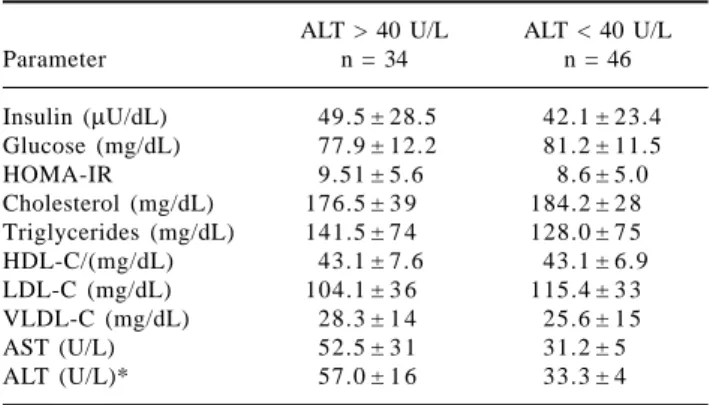
There were no significant differences in the metabolicparameters studied between children with and without ele-vated ALT. Insulin concentrations 49.5 ± 28 µU/dL vs 42.1 ± 23.4 µU/dL, high HOMA index scores 9.5 ± 5.6 vs 8.6 ± 5.0, total cholesterol 176.5 ± 39 mg/dL vs 184.2 ± 28 mg/ dL, HDL-C 43.1 ± 7.6 mg/dL vs 43.1 ± 6.9 mg/dL and trig-lycerides 141.5 ± 74 mg/dL vs 128.0 ± 75 mg/dL, mean val-ues were similar in both groups (p > 0.05) (Table II).
Discussion
The frequency of 42% elevated aminotransferases in obese and overweight children found in this study is ma-jor from those reported with prevalence from 9.5% to
25.5%,4,6-9 these differences could be explained by the
use of diverse criteria and methods for the diagnosis. Non invasive imaging techniques had been used to estimate
prevalence of hepatic steatosis;8,17,18 using ultrasound
among 810 children, fatty liver was found to be 2.6% on those with normal weight increasing up to 22.5% in those
with obesity.6 Steatosis also has been evaluated by MRI;
in 22 children with obesity and hepatomegaly, elevated
ALT (99 ± 46 U/L) was found in 92%.17 These
radiologi-cal modalities are useful to detect fatty liver and in-creased ALT level could discriminate simple liver steato-sis from steatohepatitis. Beside these methods, abnormal
ALT levels have been used to estimate prevalence of NAFLD in the majority of the reports, the most frequent-ly noted is a two to threefold elevation on serum levels
of ALT;1,19 normal values has been established between
10 U/L to 40 U/L in most laboratories.20 We used this
cutoff value, where abnormal range was determined when
ALT was > 40 U/L.3,20 Our results showed a high
frequen-cy of obese and overweight children with elevated ALT levels (34/80), due to the cutoff value that was used, the majority of these children, 28/34 cases had elevated ALT levels between 40 to 60 U/L reflecting mild liver mation and only 6/34 cases showed more active inflam-mation (ALT > 60 U/L). It has been reported that values > 2 fold from normal value are found in those with more liver damage; in 17 children with NAFLD biopsy-prov-en, 53% had fibrosis and cirrhosis, the ALT level was found from 2.2 to 16 times up from the normal range, ex-cept in one who had mild elevated ALT (1.6 times up
from normal value),2 this suggested that ALT level > 2 x
could help to identify those cases that could have more severe liver damage.
Liver biopsy has not been used by routine to diag-nose NAFLD in children, although in case reports studies in which biopsies were performed, a wide spectrum of histopathology abnormalities had been found from mild steatohepatitis to cirrhosis; among 299 obese children, Kinugasha et al, found 36 cases (13%) with elevated ALT and diagnosed steatohepatitis in 11/36 cases who
underwent liver biopsy;4 Rashid et al, studied 36
chil-dren with unexplained elevation of aminotransferases, obesity was identified in 83%, liver biopsy was per-formed in 24 cases showing inflammation in 88% and
fi-brosis-cirrhosis in 75%.5 These biopsy findings showed
that liver changes with fibrosis could be in up to 50% of the cases without or with few clinical manifestations and challenges like obesity could aware the clinician to sus-pect NAFLD.
The identification of those cases in risk to develop a major liver damage and evaluate the necessity of liver bi-opsy has been reported in adults; major age, obesity, type 2 diabetes, insulin resistance, ALT more than twice
nor-mal, and AST/ALT ratio > 21,21 are potential predictors of
NAFLD; in children these associated features and its im-pact in the development of progressive NAFLD has been examined poorly in the context of histological findings, it seems that high ALT and insulin levels correlates with the presence of fibrosis; recently 43 cases of children with NAFLD biopsy-proven were studied retrospectively to determine the correlation of liver changes and clinical or biochemical variables, steatohepatitis and fibrosis were strongly related to hyperinsulinemia (49 ± 9 µU/
mL) and elevated ALT (103 ± 71 U/L).22
In addition to elevated insulin levels, another meta-bolic factor that has been associated with increased ALT levels in obese children is abnormal lipid profile; hyper-cholesterolemia has been reported close to 25% and
hy-Table I. Demographic and clinical features of 80 obese and overweight children.
ALT > 40 U/L ALT < 40 U/L Parameter n = 34 n=46
Mean age (yrs) 9.6 ± 0.9 9.4 ± 1.2 Gender (male/female) 22/12 22/24 Weight (kg)* 52.1 ± 1 48.2 ± 2 Height (cm) 140.4 ± 9 1 3 9 ± 9 BMI (kg/m²)* 26.2 ± 4 24.6 ± 3 Abdominal circumference (cm) 85.6 ± 9 81.5 ± 8
Data are presented as mean ± standard deviation * p < 0.05 (Mann Whitney U Test)
Table II. Metabolic parameters in 80 obese and overweigth children.
ALT > 40 U/L ALT < 40 U/L Parameter n = 34 n = 46
Insulin (µU/dL) 49.5 ± 28.5 42.1 ± 23.4 Glucose (mg/dL) 77.9 ± 12.2 81.2 ± 11.5 HOMA-IR 9.51 ± 5.6 8.6 ± 5.0 Cholesterol (mg/dL) 176.5 ± 3 9 184.2 ± 2 8 Triglycerides (mg/dL) 141.5 ± 7 4 128.0 ± 7 5 HDL-C/(mg/dL) 43.1 ± 7.6 43.1 ± 6.9 LDL-C (mg/dL) 104.1 ± 3 6 115.4 ± 3 3 VLDL-C (mg/dL) 28.3 ± 1 4 25.6 ± 1 5 AST (U/L) 52.5 ± 3 1 31.2 ± 5 ALT (U/L)* 57.0 ± 1 6 33.3 ± 4
Annals of Hepatology 4(4) 2005: 279-283
MG 282
edigraphic.com
:rop odarobale FDP
VC ed AS, cidemihparG
arap
acidémoiB arutaretiL :cihpargideM
sustraídode-m.e.d.i.g.r.a.p.h.i.c sustraídode-m.e.d.i.g.r.a.p.h.i.c
cihpargidemedodabor
pertriglyceridemia in 50%;2,3,5,23 in our total group of
cas-es independently of the ALT levels, 73% showed altered lipid concentration. Due to the frequent asymptomatic character of NAFLD, and the probability of progression, monitoring is recommended, specialty in those cases with ALT > 2 fold upper the normal limit, AST/ALT
ra-dio > 1, obesity and metabolic associated risk factors.19,21
AST/ALT ratios > 1 suggest an advanced form of NAFLD or might be related with alcohol-induced
steato-hepatitis.1 In adults AST/ALT ratio has been identified as
a risk factor for fibrotic liver disease,1,24 in children AST/
ALT ratio > 1 has been reported in 30%, reflecting a
se-vere liver injury,9 in contrast with our cases were AST/
ALT radio was < 1 probably due to a minor liver inflam-mation.
Type 2 diabetes has also been related to NAFLD and
reported in 28 to 55% in adult population,1 in children is
not so common, from 0 to 11%,5,7,25 however the
proba-bilities for the affected obese child to develop latter type 2 diabetes is high, especially when there is a positive
family history,26,27 in this study 66% of the overweight
and obese children had relatives with type 2 diabetes. Hyperglycemia was found in 4 of our cases (4.5%), none of them had previous history of impaired glucose toler-ance; ALT was not elevated in two of these obese chil-dren; whether when or which child with these metabolic risk factor is going to developed NAFLD is difficult to predict until more longitudinal epidemiological studies be available.
Actually NAFLD is considered part of the Metabolic
Syndrome,28 however the mechanism involved in the
de-velopment of liver injury is not clear. In this study insu-lin resistance determined by HOMA-IR was found in the majority of the overweight and obese children with or without hepatic inflammation. In a similar way in 67 obese children insulin resistance was demonstrated in all
and 12 of them (17.9%) had raised ALT levels.29 Insulin
resistance is an important factor in the accumulation of hepatocellular fat, whereas excess intracellular fatty ac-ids, oxidant stress, adenosine triphosphate depletion and mitochondrial dysfunction may be important causes of hepatocellular injury in the steatotic liver, it is still to be defined the role of insulin resistance in steatohepatitis and determine if other metabolic abnormalities in a sub-ject with a predisposing genetic environment cause the development of liver disease and progression to
cirrho-sis.24,28,30 Although the detection or not of elevated ALT
in an obese child, metabolic consequences are multiple and begin in childhood; the risk of developing obesity in adulthood is 80% in those who were obese children; we found a portion of obese children with insulin resistance without biochemical evidence of liver disease, the early recognition and treatment of this problem may lower the risks of complications in infant obesity including
NAFLD.18,31,32 Management with weight reducing diets
and physical activity had demonstrated the
normaliza-tion of serum ALT.5,7,23 Treatment with AUDC and
Vita-min E reported in children, showed to be ineffective in
obese children to normalized elevated ALT.25,33 Clearly
these reports did not support a long term benefit and weight control treatment and physical activity program continue to be the first choice, in all of our children a gradual weight loss and exercise program was indicated. Closely monitoring metabolic risk factors and liver func-tion test in these children, will permit to select those for liver biopsy and treatment with new promising
medica-tion that reduce insulin resistance.34
The diagnosis of NAFLD required clinically a high index of suspicion because the majority of patients are asymptomatic or elevated transaminases are noted inci-dentally during blood test, clinical features such as obesi-ty could help to detect those in risk. Although NAFLD can occur in children with weights appropriated for their age in most of the reports weight is characteristically
above the 85th percentile,4-9 in our study in order to
iden-tify those children with major risk to develop NAFLD we decided to evaluate those with overweight and obesity and ruled out other frequent causes of chronic hepatitis; with this evaluation 7 children were excluded from the study because they were found to have positive HBsAg, these cases underwent further evaluation for Hepatitis B management as per the current recommendations guide-lines.35
In this study the frequency of altered liver function test in children with excessive body weight was elevated to that observed in others populations. The metabolic al-terations in obese children with and without elevated ALT were similar. The presence of obesity and hyperin-sulinemia, associated with elevated aminotransferases, may help to identify cases on risk to develop progressive
liver disease.22 It is known that hyperinsulinemia favors
retention of triglyceride in hepatocytes especially in obese subjects, however steatosis by itself can exist
with-out progressive fibrosis;30 thus it is possible that
un-known intrahepatic mechanisms may cause the hepato-cellular necrosis and inflammation. Further studies are needed to enhance our understanding of the pathogene-sis and natural history of this condition in order to give an effective medical therapy.
References
1 . Falck-Yttery, Mc Cullough AJ, Younossi M, Marchesini G. Clini-cal features and natural history of non-alcoholic steatosis syn-dromes. Sem Liver Disease 2001; 21: 17-26.
2 . Manton ND, Lipsett J, Moore DJ, Davidson GP, Bourne AJ, Couper RTL. Nonalcoholic steatohepatitis in children and adolescents.
Med J Aust 2000; 173: 476-79.
3 . Baldridge AD, Perez-Atayde AR, Graeme-Cook F, Higgins L, Lavine JE: Idiopathic steatohepatitis in childhood: a multicenter retrospective study. J Pediatr 1995; 127: 700-4.
edigraphic.com
5 . Rashid M, Roberts EA. Nonalcoholic steatohepatitis in children.
J Pediatr Gastroenterol Nutr 2000; 30: 48-53.
6 . Strauss R, Barlow S, Dietz W. Prevalence of abnormal serum aminotransferase values in overweight and obese adolescents. J
Pediatr 2000; 136: 727-33.
7 . Franzese A, Vajro P, Argenziano A, Puzziello A, Iannucci MP, Saviano MC, Brunetti F, et al. Liver involvement in obese chil-dren: ultrasonography and liver enzyme levels at diagnosis and during follow-up in an Italian population. Dig Dis Sci 1997; 42: 1428-32.
8 . Tominaga K, Kurata JH, Chen YK, Fujumoto E, Miyagawa S, Ichiro A, Kusano Y. Prevalence of fatty liver in Japanese children and relationship to obesity: an epidemiological ultrasonographic survey. Dig Dis Sci 1995; 40: 2002-9.
9 . Tazawa Noguchi H, Nishinomiya F, Takada G. Serum alanine aminotransferase activity in obese children. Acta Pediatr 1997; 86: 238-41.
10. Ballentani S. Prevalence and risk factors for Hepatic Steatosis in North Italy. Ann Intern Med 2000; 132: 112-17.
11. Rivera DJ, Shamah LT, Villalpando HS, González CT, Hernández PB, Sepúlveda J. Encuesta Nacional de Nutrición 1999. Estado
de Nutrición de niños y mujeres en México. Cuernavaca, Morelos,
México. Instituto Nacional de Salud Pública, 2001.
12. Maynard LM, Wisemandle W, Roche AF, Cameron W, Guo Sh, Siervogel RM. Childhood Body Composition in relation to Body Mass Index. Pediatrics 2001; 107: 344-50.
13. National Center for Health Statistics National Health and
Nutri-tion examinaNutri-tion survey. CDC Growth Charts: Body Mass index
for Age. United States 2000.
14. Expert Panel on Blood Cholesterol levels in children and adoles-cents. National Cholesterol Education Program report. Pediatrics 1992; 89 (suppl): 525-84.
15. Ascaso JF, Pardo S, Real JT, Lorente RI, Priego A, Carmena R. Diagnosing insulin resistance by simple quantitative methods in subjects with normal glucose metabolism. Diabetes Care 2003; 26: 3320-25.
16. Huang TT, Johnson MS, Goran MI. Development of a Prediction Equation for Insulin sensitivity from anthropometry and fasting insulin in prepubertal and early pubertal children. Diabetes Care 2002; 25: 1203-10.
17. Fishbein MH, Miner M, Mogren Ch, Chaleckson J. The spectrum of fatty liver in obese children and the relationship of serum aminotransferases to severity of steatosis. J Pediatr Gastroenterol
Nutr 2003; 36: 54-61.
18. Bergomi A, Lughetti L, Corciulo N. Italian multicenter study on liver damage in pediatric obesity (abstract). Int J Obes Relat
Metabol Disord 1998; 22 (suppl 4): S22.
19. Powell EE, Cooksley WGE, Hanson R, Searle J, Halliday JW, Powell LW. The natural history of nonalcoholic steatohepatitis. A
follow-up study of forty-two patients for up to 21 years.
Hepatology 1990; 11: 74-80.
20. Kaplan MM. Alanine Aminotransferase levels: What’s normal?
Ann Inter Med 2002; 137: 49-51.
21. Angulo P, Keach JC, Batts KP, Lindor KD. Independent predic-tors of liver fibrosis in patients with nonalcoholic steatohepatitis.
Hepatology 1999; 30: 1356-62.
22. Schwimmer JB, Deutsch R, Rauch JB, Behling C, Newbury R, Lavine JE. Obesity, insulin resistance, and other clinicopatho-logical correlates of pediatric nonalcoholic fatty liver disease. J
Pediatr 2003; 143: 500-5.
23. Vajro P, Fontanella A, Perna C, Orso G, Tedesco M, DeVicenzo A. Persistent hyperaminotransferasemia resolving after weight re-duction in obese children. J Pediatr 1994; 125: 239-41. 24. Day CP. Non-alcoholic steatohepatitis (NASH): where are we
now and where are we going? Gut 2002; 50: 585-88.
25. Vajro P, Franzese A, Valerio G, Iannucci MP, Aragione N. Lack of efficacy of ursodeoxycholic acid for the treatment of liver ab-normalities in obese children. J Pediatr 2000; 136: 739-43. 26. Srinivasan SR, Fronton MG, Berenson GS. Longitudinal changes
in risk variables of insulin resistance syndrome from childhood to young adulthood in offspring of parents with type 2 diabetes: The Begolusa Heart Study. Metabolism 2003; 52: 443-50. 27. Weiss R, Dziura J, Burgert T, Tamborlane WV, Taksali SE, Yeckel
C, Allen K, Lopes M, et al. Obesity and the Metabolic Syn-drome in Children and Adolescents. N Engl J Med 2004; 350: 2362-74.
28. Marchesini G, Brizi M, Bianchi G, Tomassetti S, Bugianesi E, Lenzi M, McCullough A, et al. Nonalcoholic fatty liver Dis-ease. A feature of the Metabolic Syndrome. Diabetes 2001; 50: 1844-50.
29. Evans HM, Baumann U, McLiernan PJ, Kirk JMW, Shaikh G, Kelly DA. Fatty liver disease in children in the West Midlands, United Kingdom. J Pediatr Gastroenterol Nutr 2004; 39 (suppl 1): S52.
30. Neuschwander-Tetri, Caldwell SH. Nonalcoholic steatohepatitis: Summary of an AASLD single topic conference. Hepatology 2003; 37: 1202-09.
31. Maffeis C, Moghetti P, Grezzani A, Clementi M, Gaudino R, Tato L. Insulin resistance and the persistence of obesity from child-hood into adultchild-hood. J Clin Endocrinol Metab 2002; 87: 71-76. 32. Bellizzi M, Dietz W. Workshop on childhood obesity: Summary
of the discussion. Am J Clin Nutr 1999; 70: 173S-5S.
33. Lavine JE. Vitamin E treatment of nonalcoholic steatohepatitis in children: a pilot study. J Pediatr 2000; 136: 734-38.
34. Angulo P, Lindor KD. Treatment of Nonalcoholic fatty liver. Present and emerging therapies. Sem Liver Diseases 200; 21: 81-88. 35. Lok AS, McMahon BJ. Chronic hepatitis B: Update of