Escuela de Ingenierías Industriales
Departamento de Ingeniería de Sistemas y Automática
TESIS DOCTORAL:
AGENT-BASED MODELLING AND SWARM
INTELLIGENCE IN SYSTEMS ENGINEERING
Presentada por María Pereda García para optar al
grado de doctora por la Universidad de Valladolid
Dirigida por:
School of Industrial Engineering
Department of System Engineering and Automatic Control
PHD THESIS:
AGENT-BASED MODELLING AND SWARM
INTELLIGENCE IN SYSTEMS ENGINEERING
A Thesis submitted by María Pereda García for the
degree of Doctor of Philosophy in the University of
Valladolid
Supervised by:
Acknowledgements
In this lines I want to remember and thank to all the people that has con-tributed to this thesis in some way.
This thesis would not have been possible without the help of my advisor, Jesús M. Zamarreño. I want to thank him for his tremendous dedication, his motivational skills and his effort spent in helping me with valuable comments and advices and guiding me during these four years.
I also want to thank to my partners of the System Engineering and Automatic Control department, and specially to my PhD colleagues for the good times in meetings and conferences. I wish them all the best.
I would also like to express my deepest gratitude to Marta Ginovart, for her advices and valuable contributions, and also for her hospitality during my stay in Barcelona.
I also gratefully acknowledge the research grants programAyuda para la Formación de Personal Investigador from the University of Valladolid and the research projects DPI2009-14410-C02-02 and DPI 2012-39381-C02-02.
I also want to remember and give thanks to my friend Josema, for the advices and reading material he suggested me.
I cannot forget my dear friends, I want to thank them the support, the chats, the good moments together... They make life happier.
I want to thank to my love, Manu, for everything, for being a reason to live for.
And thank you to my family: mom, dad and brother, for your uncondi-tional support, and for making home a sweet home.
Thank you, María
Summary
A smooth sea never made a skilled mariner.
English Proverb
Agent-based modelling is a modelling methodology that has revolution-ized the field of modelling and simulation of complex systems, being a reli-able alternative to traditional lumped parameter models, phenomenological or empirical. This technique aims to obtain models of systems representing the constituents of such systems. It is a bottom-up approximation where the properties of the systems are the result (emerge) from the aggregation of the properties of the system elements and the relations between these elements, the agents. This technique has been successfully applied in various fields: economics, social sciences, medicine, biology, etc.
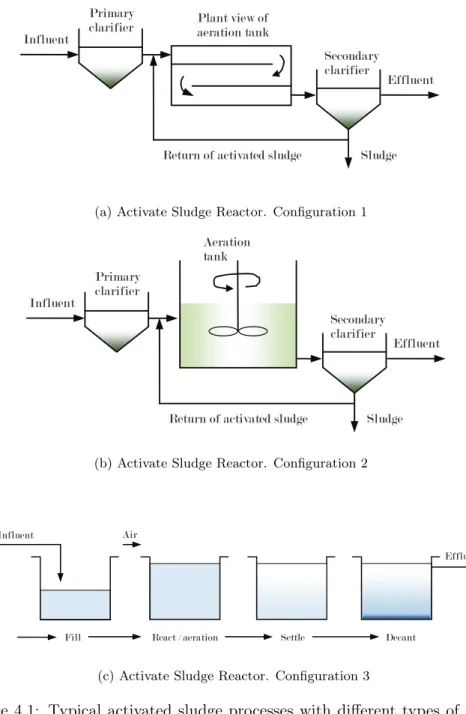
in anticipation for upcoming rainstorms, etc [93]. Control of the activated sludge process involves keeping the substrate concentration below a certain level established by law, maintaining enough concentration of biomass to allow degradation of the substrate, and maintaining enough oxygen to allow these reactions but minimizing it since it implies a cost. The main difficul-ties in controlling this process are the lack of measurable information online (estimators would be needed) and the complexity of the process (flow and load variations, weather influence) [88].
In this thesis we have applied agent-based modelling to the activated sludge process, which takes place in the process of sewage treatment. We have studied the methodology, the different options of implementation, de-veloped a model (a simplified version of the process with one type of bacteria and one type of substrate), and developed a notation to complement the cur-rent representation standard.
In addition, in this thesis we have worked with the Swarm Intelligence paradigm, that is, patterns and macroscopic behaviours that result from the collaboration of small entities with simple rules and without a leader-ship figure, for example, ant colonies, flock of birds, etc ... Based on this Swarm philosophy, somehow related with the agent-based modelling, some techniques arise. In this thesis we have worked with optimization algorithms, testing the Particle Swarm Optimization and designing our own algorithm, theHiker, which shows promising results, as seen in this document.
Usually, in the systems engineering and automatic control field, it is needed that algorithms and models are executed as fast as possible to be used in real time. Motivated by the need of reducing this computational time, in this thesis we have worked with code parallelization techniques, and in particular, parallel code to run on graphics cards. These techniques have been used both in agent-based modelling and in swarm optimization algorithms.
In summary, we have applied agent-based modelling to the activated sludge process, commonly used in the secondary treatment of the wastewater treatment plants, system in which the Control y Supervisión de Procesos research group in which I include myself has extensive experience toward getting an optimal plant control. We have also presented an optimization algorithm with promising results, based onSwarm Intelligence philosophy.
Resumen
Con el tiempo y la paciencia se adquiere la ciencia.
Proverbio español.
Elmodelado basado en agentes (en inglés, agent-based modelling) es una técnica de modelado que ha revolucionado el campo del modelado y simula-ción de sistemas complejos, siendo una alternativa fiable a los tradicionales modelos de parámetros concentrados, fenomenológicos o empíricos. Esta téc-nica trata de obtener modelos de los sistemas a través de la representación de los elementos que componen dichos sistemas. Se trata de un modelado de abajo hacia arriba, donde las propiedades agregadas de los sistemas son consecuencia (emergen) de las propiedades de los elementos que los com-ponen y de las relaciones entre estos elementos, los agentes. Esta técnica se ha aplicado satisfactoriamente en diferentes campos: economía, ciencias sociales, medicina, biología, etc.
modelos, donde las predicciones dadas por el modelo podrían ser usadas para obtener las acciones de control óptimas a aplicar al sistema (con respecto a ciertos objetivos de optimización). El problema de control de los sistemas de depuración de aguas tiene diferentes objetivos con distinta prioridad y que dependen además del diseño del sistema. Ejemplo de estos objetivos son: evitar fugas y caudales de aguas residuales fuera de los colectores, minimizar la energía de control (el coste energético de mover las válvulas y compuertas de regulación), maximizar el tratamiento aplicado para minimizar los conta-minates presentes en el agua, reducir el volumen en los tanques en previsión de posibles tormentas futuras, etc [93]. Respecto al control del proceso de fangos activados, este consiste en mantener la concentración de sustrato ba-jo un cierto nivel establecido por ley, mantener la concentración de biomasa suficiente que permita la degradación del sustrato, y mantener el oxígeno suficiente que permita estas reacciones pero minimizándolo ya que supone un coste de energía. Las principales dificultades que presenta el control de este proceso son la falta de información medible en línea (se necesita em-plear estimadores) y la propia complejidad del proceso (variaciones de carga y caudal, influencia meteorológica) [88].
En esta tesis se ha aplicado la técnica de modelado basado en agentes al proceso de fangos activados, que tiene lugar en una estación depuradora de aguas. Hemos estudiado la metodología y las diferentes opciones de im-plementación de este tipo de modelos, hemos desarrollado un modelo (una versión simplificada del proceso con un solo tipo de bacteria y un solo tipo de sustrato), y hemos desarrollado una notación que complementa al actual estándar de representación de este tipo de modelos.
Además, en esta tesis se ha trabajado en las técnicas englobadas bajo el nombre de Swarm Intelligence, que podríamos definir como inteligencia colectiva. Hace referencia a los patrones de comportamiento y comporta-mientos macroscópicos que son consecuencia de la colaboración de pequeñas entidades con reglas sencillas y sin una figura de liderazgo, por ejemplo, las colonias de hormigas, el vuelo de los pájaros, etc... Basado en esta filosofía, en cierto modo relacionada con los modelos basados en agentes, surgen un conjunto de técnicas Swarm, y en concreto en esta tesis hemos trabajado con algoritmos de optimización, probando elParticle Swarm Optimization y diseñando nuestro propio algoritmo, el Hiker, que presenta resultados muy prometedores, como se puede observar en este documento.
Resumen xiii
En resumen, se han aplicado las técnicas de modelado basado en agentes al proceso de fangos activados, uno de los procesos más utilizados en el tratamiento secundario en las plantas de depuración de aguas residuales, sistema en que el grupo de investigación deControl y Supervisión de Procesos en el que me incluyo tiene una amplia trayectoria y experiencia para obtener un control óptimo de la planta. Se ha presentado, asimismo, un algoritmo de optimización con resultados prometedores, basado en la filosofía Swarm Intelligence.
Desde un punto de vista de control de procesos, hemos explorado tres elementos de interés: modelado basado en agentes, optimización Swarm y computación en GPU (Graphics Processing Unit).
Objetivos
El objetivo general de esta tesis es aplicar la teoría deSwarm Intelligence y la técnica de modelado basado en agentes en el campo de ingeniería de sistemas y control automático, lo que implica explorar estas técnicas desde una nueva perspectiva, así como la aplicación de estas herramientas a sistemas donde no se han utilizado tradicionalmente. Los sistemas que se modelan en nuestro grupo de investigación son intrínsecamente dinámicos y complejos, por lo que la naturaleza de estos sistemas justifica la idoneidad de la aplicación de estas técnicas. Por lo tanto, los principales objetivos de esta tesis son:
1. Aprender y adquirir habilidades en la técnica de modelado basado en agentes. El primer objetivo comprende las etapas de investigación y documentación del estado del arte, la revisión de las propuestas de metodología de diferentes autores, así como ejemplos de aplicación en la literatura. La técnica se adquiere también con la práctica, lo cual se relaciona con el objetivo 4.
2. Seleccionar una plataforma software adecuada para desarrollar un mo-delo basado en agentes para el proceso de fangos activados.
3. Entender el proceso de fangos activados desde el punto de vista de sus constituyentes microscópicos y sus relaciones. Este objetivo tiene en cuenta la investigación en microbiología necesaria para entender el proceso antes de modelar.
5. Utilizar el modelo basado en agentes desarrollado para tener una me-jor comprensión del sistema y para generar nuevos conocimientos y conclusiones que podrían facilitar el control del sistema.
6. Desarrollar técnicas de optimización basadas en la filosofíaSwarm In-telligence para mejorar la eficiencia en la búsqueda de soluciones a problemas de optimización. Este objetivo persigue además desarrollar un nuevo algoritmo de optimización, inspirado en el algoritmoParticle Swarm Optimization.
7. Probar las diferentes alternativas de programación en paralelo sobre tarjeta gráfica (toolboxes de MATLAB, código nativo CUDA) y selec-cionar la más adecuada para las implementaciones de esta tesis. 8. Aplicar la computación en paralelo sobre tarjeta gráfica a los
desarro-llos de esta tesis para reducir el tiempo de ejecución de simulaciones y algoritmos. Este objetivo transversal incluye la aplicación de la compu-tación en paralelo al modelado basado en agentes, la exploración de las diferentes posibilidades de uso, así como la paralelización del algoritmo swarm desarrollado.
El modelo basado en agentes y el algoritmo de optimización desarrollados son dos de las piezas claves de un esquema de control predictivo basado en modelos, en el cual el grupo de investigación tiene amplia experiencia. Para su aplicación en tiempo real, el tercer elemento serían técnicas de programación paralela sobre GPU para acelerar la ejecución del código. La integración de estos tres elementos (modelo, optimizador y ejecución sobre GPU) a un caso real queda ya fuera del alcance de esta tesis.
Tratamiento de aguas residuales
El capítulo 4 explica el proceso de depuración de aguas residuales, y en concreto el proceso de fangos activados (proceso que se ha modelado en esta tesis). El proceso de fangos activados es un tipo de proceso biológico que se lleva a cabo en el tratamiento secundario de las aguas residuales en una planta depuradora. En esta parte de la planta se trata de reducir la materia orgánica degradable biológicamente, de las aguas residuales industriales o urbanas. El proceso de lodos activos consiste en:
• Un tanque de aireación (reactor biológico) donde los lodos activos y la alimentación (contaminación o sustrato contenido en el agua) se mezclan y airean durante un cierto período de tiempo.
Resumen xv
• Una recirculación del lodo activo hacia el tanque de aireación.
• Un sistema de tratamiento y evacuación de los lodos producidos (pur-ga).
Al reactor biológico o cuba de aireación llega el agua residual a tratar, donde tiene lugar el desarrollo de un cultivo biológico. La población bacteriana se debe mantener en un determinado nivel para llegar a un equilibrio entre la carga orgánica (sustrato) a eliminar y la cantidad de microorganismos (bio-masa) en el reactor. Es necesario un sistema de aireación y agitación que proporcione el oxígeno necesario para la acción de las bacterias aerobias, que evite la sedimentación de los fangos en el reactor y que permita la ho-mogeneización de los fangos activos. En este capítulo se introducen además ciertos conceptos de microbiología necesarios para el correcto entendimiento del documento. Además se incluye un estado del arte sobre modelado de tratamiento de aguas residuales, incluyendo modelado basado en agentes.
Metodología
Modelado basado en agentes
Los sistemas multiagente (MAS) son considerados tradicionalmente como un campo de la Inteligencia Artificial Distribuida (DAI), y junto con los sistemas basados en agente son una de las áreas de investigación más pro-metedoras dentro del área de Tecnologías de la Información y Computación. Actualmente no existe un consenso en la definición de agente. Las principales teorías al respecto se muestran en la sección 2.2.
Unsistema multiagentese puede definir como un conjunto de agentes autónomos, heterogéneos e independientes, que viven en un ambiente, inter-actuando con él y con los demás, con sus propios objetivos, capacidades y conocimientos.
Swarm Intelligence
Son una colección de algoritmos inspirados en la conducta social de los in-dividuos en la naturaleza, dentro del campo de la computación evolutiva de la disciplina de inteligencia artificial (AI). Se trata de algoritmos basados en población inspirados por el comportamiento colectivo de sistemas des-centralizados y auto-organizados, como las colonias de hormigas, termitas, abejas, y avispas, las bandadas de aves o bancos de peces. Este grupo de individuos con reglas simples que interactúan unos con otros, obtienen como consecuencia comportamientos colectivos emergentes o decisiones óptimas para el grupo, por ejemplo, dónde vivir, la formación de estructuras durante el vuelo, etc . En el capítulo 3 se presenta esta filosofía, ejemplos de aplica-ción, y se explica el algoritmo Particle Swarm Optimization, uno de los más famosos basados en este paradigma.
Computación paralela sobre tarjeta gráfica
En esta tesis se han aplicado técnicas de computación paralela sobre tarjeta gráfica para tratar de reducir los tiempos de ejecución de las implementacio-nes desarrolladas. Estas técnicas de paralelización se explican en el capítulo 5, mostrando un ejemplo sencillo, y los campos en los que se ha aplicado hasta la fecha.
Principales resultados del trabajo
En esta tesis se ha trabajado en acercar el campo de la ingeniería de sistemas y control automático al modelado basado en agentes y la teoría de Swarm Intelligence. Hemos estudiado el proceso de lodos activados desde el punto de vista de sus constituyentes microscópicos. Las conclusiones resultantes de este trabajo son:
• Hemos resumido los pasos de la metodología del modelado basado en agentes para que un recién llegado puede utilizar el capítulo 2 como guía inicial sobre el tema.
Resumen xvii
• Hemos desarrollado un modelo basado en agentes para el proceso de fangos activados, que permite probar la influencia de diferentes proto-colos de operación del reactor y una población de bacterias configura-ble.
• Hemos confirmado la influencia significativa que las oscilaciones y las variaciones en la composición del caudal de entrada a una estación de-puradora de aguas residuales tienen en un proceso de fangos activados. Nuestro modelo permite probar diferentes escenarios para estudiar la dinámica del sistema.
• Hemos proporcionado la posibilidad de lanzar cientos de simulaciones en paralelo, para estudiar, por ejemplo, la influencia de la estocastici-dad de la población bacteriana en el comportamiento macroscópico del sistema.
Contents
Acknowledgements vii
Summary ix
Resumen xi
I Introduction 1
1 Introduction and Objectives 3
1.1 Motivation and Background . . . 3
1.2 Objectives . . . 5
1.3 Document Structure . . . 6
II Fundamentals 9 2 Agent-Based Modelling 11 2.1 Introduction . . . 11
2.2 Definitions . . . 12
2.3 Application areas . . . 16
2.4 Strengths and weaknesses . . . 18
2.5 Methodology . . . 18
2.5.1 Agents and their Environment . . . 19
2.5.2 Agent Methods and Interactions . . . 20
2.5.3 Implementation . . . 21
2.5.4 Verification, validation and calibration . . . 23
2.5.5 Simulation . . . 24
2.6 Software . . . 24
2.7 Standards . . . 25
In the next chapter . . . 27
3 Swarm Intelligence 29
3.1 Introduction . . . 29
3.2 Particle Swarm Optimization . . . 30
3.2.1 Basic Particle Swarm Optimization . . . 31
3.2.2 Implementation Aspects . . . 34
3.3 Applications . . . 35
In the next chapter . . . 35
4 Wastewater Treatment 37 4.1 Introduction . . . 37
4.2 Wastewater Treatment . . . 38
4.3 The Activated Sludge Process . . . 38
4.4 Microbiological concepts . . . 42
4.5 ABM in microbiology . . . 43
In the next chapter . . . 45
5 Parallel Computing on the GPU with CUDA 47 5.1 Introduction . . . 47
5.2 What is the CUDA architecture . . . 48
5.3 CUDA program structure . . . 49
5.4 The NVIDIA GPU hardware . . . 51
5.5 Example of a CUDA C program . . . 51
5.6 Choosing a NVIDIA GPU for computing . . . 54
5.7 The Parallel Computing Toolbox from MATLAB . . . 55
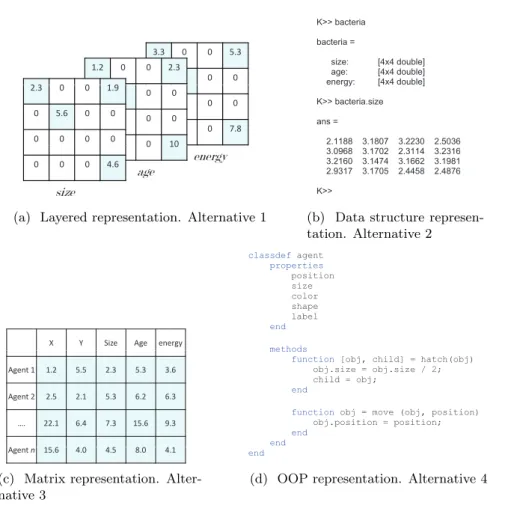
5.8 Swarm intelligence and ABM applications of GPU computing 55 III Developments 57 6 The State Space Agent-Based Representation 59 6.1 Introduction . . . 59
6.2 Mathematical Description . . . 60
6.3 Examples . . . 62
6.3.1 Segregation model . . . 62
6.4 Conclusions . . . 66
In the next chapter . . . 66
7 Agent-Based Model of the Activated Sludge Process 67 7.1 Introduction . . . 67
7.2 Activated Sludge Batch Reactor Model. NetLogo version . . . 68
7.2.1 Description . . . 68
7.2.2 SSABR Description . . . 72
Índex xxi
7.2.4 Conclusions . . . 83
7.3 Activated Sludge Batch Reactor Model. MATLAB version . . 84
7.3.1 Description . . . 85
7.3.2 Results . . . 87
7.4 Activated Sludge Reactor Model. Improved MATLAB version 89 7.4.1 Results . . . 93
7.4.2 Conclusions . . . 104
7.5 CUDA implementations . . . 110
In the next chapter . . . 113
8 Swarm Intelligence: The Hiker algorithm 115 8.1 The Hiker optimization algorithm . . . 115
8.2 Implementation Aspects . . . 118
8.3 Results . . . 119
8.3.1 Comparison of implementations in MATLAB . . . 120
8.4 Conclusions . . . 122
IV Conclusions and Future Work 123 9 Conclusions and Future Work 125 9.1 Conclusions . . . 125
9.2 Summary of contributions . . . 126
9.3 Future directions . . . 127
V Appendices 129 A SSABR application examples 131 A.1 Hilltopping behaviour in butterflies . . . 131
A.1.1 Simulation example . . . 134
A.2 Sugarscape 1 Immediate Growback . . . 135
A.2.1 Simulation example . . . 138
A.3 Particle Swarm Optimization Algorithm . . . 138
B Application of GPGPU in Optimization 143 B.1 The multi-start optimization method . . . 143
List of Figures
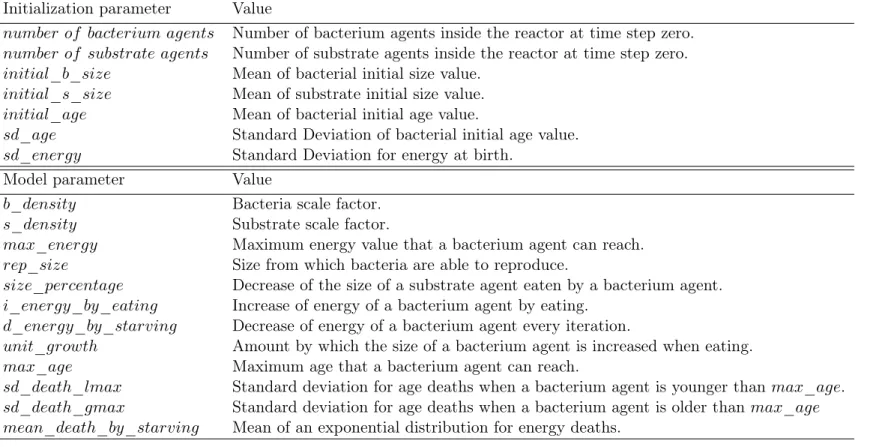
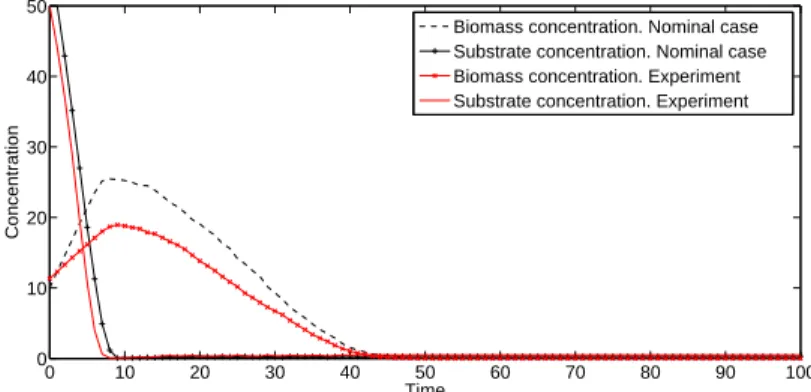
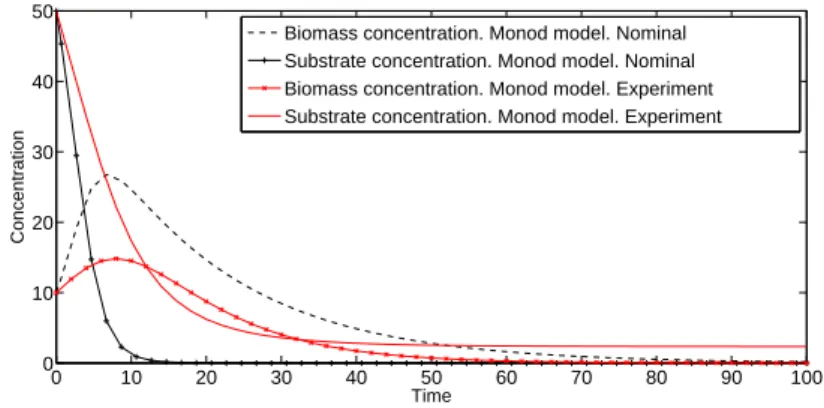
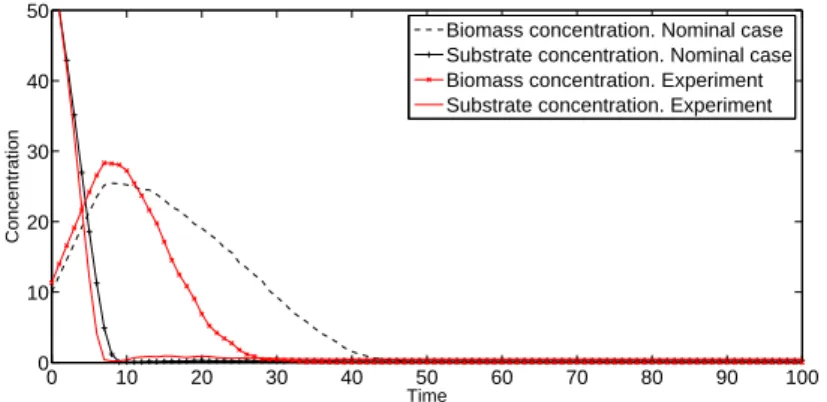
2.1 Agent research areas . . . 13 2.2 Correspondence between the modelled system and ABM . . . 14 2.3 Flowchart of a generic agent based model scheduling. . . 23 4.1 Typical activated sludge processes . . . 40 4.2 Temporal evolution of the concentrations . . . 41 5.1 Thread organization . . . 50 5.2 Execution of a CUDA program . . . 50 5.3 Memory structure of a NVIDIA GPU . . . 51 6.1 Evolution of turtle states. . . 65 7.1 Screenshot of the Netlogo model interface. . . 70 7.2 Temporal evolution of the concentrations . . . 77 7.3 Temporal evolution of bacteria reproduction process . . . 78 7.4 Temporal evolution of bacteria deaths in the ABM. . . 78 7.5 Concentrations ifsize_percentageis decreased by 50% . . . 78 7.6 Monod model Vs. experiment (µmax=1, Ks=200) . . . 79
7.7 ABM model Vs. experiment (unit_growth=0.1) . . . 80 7.8 ABM model Vs. experiment (rep_size=4.5) . . . 80 7.9 Monod model Vs. experiment (Kd=0.1) . . . 81
7.20 Dynamic behaviours of the four operating protocols . . . 94 7.21 Comparison of ABM and Monod model behaviours. . . 96 7.22 Concentration of biomass and substrate. µmax effect . . . 97
List of Tables
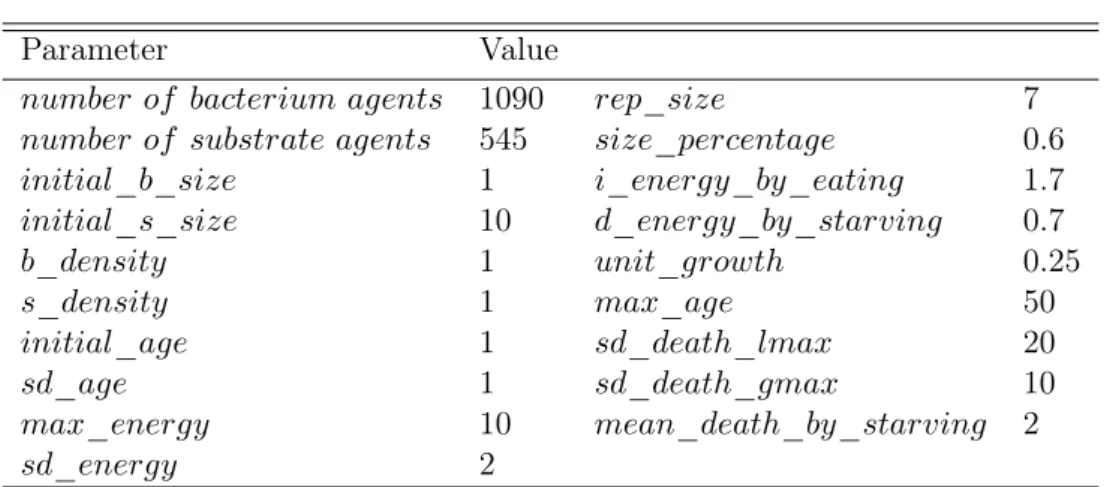
2.1 Agent-based Modeling Applications . . . 17 2.2 Questions to Ask Before Developing an Agent-based Model . 22 6.1 Turtle states in the Segregation Model . . . 63 6.2 Parameters of the Segregation Model . . . 63 7.1 ABM Parameters explanation. . . 71 7.2 Agent states in the ABM of the activated sludge process . . . 74 7.3 Monod model parametrization. . . 76 7.4 ABM parametrization. . . 77 7.5 Simulation time (seconds) comparison of implementations. . 86 7.6 Improved MATLAB ABM Parameters explanation. . . 91 7.7 Monod model parametrization . . . 95 7.8 ABM model parametrization. . . 95 8.1 PSO parametrization. . . 121 8.2 Hiker parametrization. . . 121 8.3 Optimization solutions to several functions . . . 121 8.4 Stop iteration of the optimization process of several functions. 121 8.5 Execution times of the optimization of several functions. . . . 122 A.1 Agent states for the Hilltopping model . . . 132 A.2 Parameters for the Hilltopping model . . . 133 A.3 States for the Sugarscape model . . . 136 A.4 Parameters for the Sugarscape model . . . 136 A.5 Particle states for the PSO . . . 140 A.6 Parameters for the PSO . . . 140 B.1 Acceleration factor. Peaks function. . . 147 B.2 Acceleration factor. Rosenbrock function. . . 147
Part I
Introduction
Chapter 1
Introduction and Objectives
The more extensive a man’s knowledge of what has been done, the greater will be his power of knowing what to do.
Benjamin Disraeli
Summary: This chapter introduces the motivation and establishes the objectives of this thesis.
1.1
Motivation and Background
This work has been carried out within the Process Control and Supervision (CSP) research group of the University of Valladolid. Members of this group mainly belong to the System Engineering and Automatic Control depart-ment.
The activities of the CSP research group are classified into several re-search lines, where the process modelling and simulation research line is the relevant one for the scope of this thesis. This is one of the main research areas of the group, with wide experience in sugar processes, petrochemical processes, wastewater treatment processes and renewable energies. Main topics are:
• Real-time process simulators.
• Distributed simulation.
• Development of process libraries.
• Languages for automatic modelling.
Thus, the research group makes its best efforts in developing models with a high level of detail that will be used afterwards in simulators or internally for model based controllers or for model supervision (e.g. fault diagnosis detection).
In certain type of processes, such as chemical reactors or biological pro-cesses, where the macroscopic models are usually obtained from empirical knowledge, a bottom-up approximation would obtain better results in terms of the representation of the underlying process.
Some members of the group have been working, in cooperation with a research group of the University of Salamanca, in the project Técnicas avanzadas de supervisión y control para la operación óptima de EDARS (ref. DP I2006−151716−C02−02), where the objective was to apply advanced techniques for control and supervision of wastewater treatment plants.
One of the main biological processes in a wastewater treatment plant is the activated sludge process. This is an adequate test bench where modelling from a microscopic level would bring a better understanding of the process dynamics (and consequently a better control). Large variations in the influ-ent wastewater flow rate, concinflu-entration and composition make wastewater treatment processes inherently dynamic. These variations are difficult to control and the adaptive behaviour of the involved microorganisms imposes further difficulties in terms of time-varying process parameters. Computer models and simulations are necessary to describe and control these systems, but this can result in highly complex models, sometimes difficult to apply from an operational point of view.
Modelling from the microscopic entities point of view is encompassed in the Agent-Based Modelling or Individual-Based Modelling techniques. This is the main topic of this dissertation, from the point of view of the system engineering field. Agent-based modelling is a suitable tool to study complex systems, formed by many interacting entities and non-linear interactions among them. They may have several stationary states, the resulting outcome may depend on the previous history and perturbations, they behave in non-stationary ways, show periodic or non-periodic oscillations, etc.
1.2. Objectives 5
1.2
Objectives
The general objective of this dissertation is to apply the Swarm Intelligence and Agent-Based Modelling (ABM) techniques to the system engineering and automatic control field, which implies exploring these techniques with a new perspective and also applying these tools where they have not been traditionally used. The systems that are modelled in our research group are intrinsically dynamic and complex, so the nature of these systems justifies the suitability of application of these techniques.
Thus, the main objectives of this thesis are:
1. To learn and acquire abilities in the agent-based modelling technique. The first objective encompasses the steps of research and documenta-tion of the state of the art, reviewing the methodology proposals from different authors as well as application examples in the literature. The technique is acquired with practise, which is related with objective 4. 2. To select a suitable software platform to develop an agent-based model
for the activated sludge process.
3. To understand the activated sludge process from the point of view of its microscopic constituents and its relationships. This objective takes into account the research to be done in microbiology to understand the process before modelling it.
4. To develop an agent-based model for the activated sludge process. This model aims to represent the dynamics of the process from the point of view of the entities involved in the process. It should present a more realistic representation of the process that also facilitates the understanding of the system. This objective groups the knowledge acquired from previous objectives and put in practise the agent-based modelling technique to develop a model of the activated sludge process. 5. To use the developed ABM to have a better understanding of the sys-tem and to generate new insights and conclusions that could facilitate the control of the system.
6. To develop optimization techniques based on the philosophy of swarm intelligence to improve efficiency in the search for solutions to optimiza-tion problems. This objective aims to apply the swarm intelligence to develop a new optimization algorithm, inspired in the Particle Swarm Optimization.
8. To apply the parallel computing over GPU technique to the develop-ments of this dissertation to reduce the execution time of simulations and algorithms. This transversal objective includes the application of parallel computing to agent-based modelling, exploring the different possibilities of use, and also parallelizing the swarm intelligence algo-rithm developed.
The agent-based model and the optimization algorithm developed as part of this work are two of the main blocks of a model based predictive controller, where our research group has wide experience. For its application in real time, the third element would be the parallel programming techniques over GPU for speeding up code execution. Integration of these three elements (model, optimizer and execution over GPU) and application to a real case is out of the scope of this thesis.
1.3
Document Structure
The document is organized in four parts: part one introduces the work devel-oped in this dissertation and states its objectives, the second one summarizes some fundamental concepts to facilitate the comprehension of the thesis; the third one exposes the developments of this dissertation, and the forth in-cludes the conclusions and future work directions.
Inside part two, chapter 2 introduces Agent-Based Modelling, the prin-cipal progress about this methodology, the application areas, the strengths and weaknesses, the software used in this thesis, and the main representa-tion standard. Chapter 3 explains some fundamentals about Swarm Intel-ligence, exposes applications of this paradigm, and introduces the Particle Swarm Optimization algorithm. Chapter 4 introduces the field of wastew-ater treatment, the principal models used in the field, the activated sludge process (process used in this dissertation), and also explains some microbi-ological concepts needed when describing the activated sludge process from the point of view of its microscopic components, bacteria. Chapter 5 deals with fundamentals about parallel computing using graphic processing units (GPUs).
In part three, chapter 6 presents our proposal of representation for agent-based models; an example of application is introduced in the chapter, and three additional examples in appendix A. The next chapter 7 covers the agent-based models for the activated sludge process, outcomes of this dis-sertation. It also includes our efforts in parallelizing the model to improve its performance. The next chapter 8 presents a new optimization algorithm based on the swarm intelligence theory.
1.3. Document Structure 7
Part II
Fundamentals
Chapter 2
Agent-Based Modelling
Learn from yesterday, live for today, hope for tomorrow. The important thing is to not stop questioning.
Albert Einstein,Relativity: The Special
and the General Theory.
Summary: This chapter is focused on agent-based modelling, the
central methodology of the thesis. We briefly introduce this concept and give some historical background. We then explain the structure of the methodology and the key aspects of application including a short introduction to the programming environments used in this thesis.
2.1
Introduction
Agent-based modelling (ABM) is a modelling approach that has gained in-creasing attention over the past years. This methodology has become so widespread due to the increasingly complex world where we live. We have the chance to analyse more and more complex systems than before, where traditional models are no longer applicable, for example, the deregulation of the electric power industry, as Macal and North [76] show. Doyne Farmer and Duncan Foley encourage a revision of traditional models in their article The economy needs agent-based modelling [29], where they summarize this need frankly and with no reservations in the sentence "the leaders of the world are flying the economy by the seat of their pants".
called information society, where more and more data are available, orga-nized into databases at finer levels of granularity. And also the computational power of computers continues increasing, providing the scientific community with more and more support to compute large-scale simulation that were not plausible years before.
ABM has historical roots in the developments of automata approaches and complex adaptive systems (CAS) and the underlying notion that "sys-tems are built from the bottom-up" [84]. The CAS field studies the arise of complex behaviours, adaptation and emergence of complex systems.
Before we start talking about ABM, it is essential to clarify what an agent and agent-based modelling are. Thus, next section 2.2 is about definitions. Then, in section 2.3 we review the application areas of this methodology. Sec-tion 2.4 summarizes the principal strengths and weaknesses of ABM. SecSec-tion 2.5 exposes some guidelines about how to develop agent-based models. Sec-tion 2.6 exposes a brief review of ABM tools. The last secSec-tion 2.7 reviews the current standards in the field.
2.2
Definitions
Multi-agent systems (MAS) are traditionally considered a sub-field of Dis-tributed Artificial Intelligence (DAI) field, and together with agent-based systems are one of the most promising investigation areas inside the infor-mation technologies and computation field.
Although the term agent is widely used, there is no universal accepted definition inside the multi-agent field in general, neither the agent-based modelling community in particular. The term agent appears in a diverse range of sub-disciplines of information technology with slightly different meanings. There are many articles that try to clarify what characteristics an agent should own to be considered a so called agent. The same occurs with the term "multi-agent system". In order to take a further look into this subject we do recommend reading [32, 46]. In the following, we summarize some definitions.
From a practical standpoint, anagentcan be defined as Macal and North [75] show:
• An agent is identifiable, a discrete individual with a set of character-istics and rules governing its behaviours and decision-making capabil-ity. Agents are self-contained. The discreteness requirement implies that an agent has a boundary and one can easily determine whether something is part of an agent, is not part of an agent, or is a shared characteristic.
2.2. Definitions 13
with other agents, such as for communication, and the capability to respond to the environment. Agents have the ability to recognize and distinguish the traits of other agents.
• An agent may be goal-directed, having goals to achieve (not necessarily objectives to maximize) with respect to its behaviours. This allows an agent to compare the outcome of its behaviour relative to its goals.
• An agent is autonomous and self-directed. An agent can function in-dependently in its environment and in its dealings with other agents, at least over a limited range of situations that are of interest.
• An agent is flexible, having the ability to learn and adapt its behaviours based on experience. This requires some form of memory. An agent may have rules that modify its rules of behaviour.
There are several features that are common to most agent theories. These are: autonomy, heterogeneity, active/pro-active, reactive, bounded rational-ity, communicative, learning... An explanation of these features can be found at [54].
According to Torsun [126], amulti-agent systemconsist of autonomous, heterogeneous and independent agents, living in an environment, interacting with it and with each other with their own goals, capabilities and knowledge. Multi-agent systems are applied in many disciplines. Luck et al. [72] classify the main agent research areas in three categories: agents as design metaphor (as a way of structuring software development), agents as a source of technologies (including different techniques and algorithms for dealing with interactions in dynamic, open environments), and agents as simula-tion (for representing complex dynamic systems. Agent-based modelling is included in this category), as Figure 2.1 summarizes.
!"#$% &!'()*+, -!.*%+/+$#!"
0#12/('#+%
Entities Agents
Entities interactions Agents interactions
Figure 2.2: Correspondence between the modelled system (left) and ABM (right). Based on [33].
Agent-based models consist of agents that interact within an environ-ment. Formally, agent-based modelling is a computational method that enables a researcher to create, analyse and experiment with models composed of agents that interact within an environment [34]. The models represent the simultaneous operation and interactions between multiple agents in an attempt to recreate the behaviour of a complex phenomenon.
mod-2.2. Definitions 15
elled system, and interactions in the model and interactions in the modelled system, as Figure 2.2 shows.
A review of the literature reveals many different terms being used to de-scribe what we have in this thesis so far calledagent-based modelling. These terms include agent-based modelling [10], multi-agent-based simulation [22], individual-based modelling [54, 52, 41], etc. An interesting attempt to clarify these terms is conducted by Hare and Deadman [46]. Also Heppenstall et al. show at [54] the differences between Cellular Automata, individual-based models and microsimulation (MSM):A CA is a discrete dynamic system, the behaviour of which is specified in terms of local relations. The space in a CA system is divided into a lattice or grid of regularly-space cells of the same size and shape, usually square. Each cell has a value either 0 or 1 or on a scale from 0 to 1. The state of a cell and its behaviour is determined by the state of other cells in close proximity at a previous time step, by a set of local rules and by the cell itself. An important feature of a CA is that the automata’s location does not move; they can only change their state. The position of the cells and their neighbourhood relations remain fixed over time. In contrast, agents can be either fixed in location or free to ’roam’ around their environ-ment. Unlike agents, CAs cannot have more than one attribute; for example, a cell could be occupied or unoccupied, but the cell could not contain multiple attributes such as building type, date built, etc. MSM is a well established methodology that works on the principle of creating small area microdata at a point in time, and then generating future microdata from that basis. Cru-cially in contrast to ABM, MSM only models one-direction interactions: the impact of the policy on the individuals, but not the impact of individuals on the policy and interactions between individuals are not simulated. Further-more MSM models do not have the behavioural modelling capability of ABM. For these authors, individual-based modelling (IBM) is a category grouping ABM, CA and MSM; it is not so in Ecology, where IBM is used as equivalent to ABM.
the term agent-based modelling and agent-based simulation are sometimes used interchangeably. As Galán and Izquierdo [33] point out,it is important to realise that a computer program is a formal model that can be expressed in mathematical language, e.g. as a set of stochastic or deterministic equations, and computer simulation is an inference tool that enables us to study it in ways that go beyond mathematical tractability.
A number of researchers think that the alternative to ABM is traditional differential equation modelling, but they should be seen as complementary approaches to the study of formal systems. Agent-based modelling and sim-ulation allows to explore the properties of certain formal models that are intractable using traditional formal analysis, providing new knowledge, giv-ing us the opportunity to explore inductively models which are difficult to solve analytically.
An important characteristic of complex systems that can be captured us-ing ABM is theemergent phenomena, that is, stable macroscopic patterns arising from local interaction of individual entities. By definition, emergent phenomena cannot be reduced to the systems’ parts; the whole is more than the sum of the parts. It is said that the process to represent (macroscopic level) emerges from the microscopic level, i.e., the interaction of relatively simple behaviours leads to complex behaviour from a global perspective. Phenomena such as flocks of birds, school of fish, and the complex biological systems of cells are good examples of how systems with simple goals can show complex emergent behaviours as a result of the communication with neighbouring agents.
One of the first models illustrating the emergent phenomena is the Boids Model, developed by Craig Reynolds [109], which simulates the flocking be-haviour of birds. In this model, each agent is governed by three rules: sepa-ration, alignment and cohesion, that lead to a coordinated flight.
2.3
Application areas
Bonabeau [13] has identified a list of conditions in which it is appropriate to use ABM to capture the emergent behaviour:
• Agents exhibit complex behaviour, including learning and adaptation in their behaviour.
• The behaviour of individuals cannot clearly be defined through aggre-gate transition rates.
• Agents interactions are complex, non-linear and present heterogeneity, and the interactions are dynamic.
2.3. Application areas 17
• Agent behaviour is stochastic. Points of randomness can be applied strategically within agent-based models, rather than a noise term added more or less arbitrarily to an aggregate equation.
• When it is important that agents form organizations or groups, and when it is relevant to model adaptation and learning not at individual level but at organization level.
• Agents spatial distribution is important.
ABMs have been developed for a wide diverse range of subject areas, from economics, ecology, social science, microbiology, environmental mod-elling, etc. Reviews of different applications can be found in almost any introductory guide to ABM. To see some examples of application areas the reader can review: [54, 75, 46, 125].
In [75] we can find the following summary (table 2.1) of ABM applica-tions.
Business and Organizations Society and Culture Manufacturing Operations Ancient civilizations Supply chains Civil disobedience
Consumer markets Social determinants of terrorism Insurance industry Organizational networks
Economics Military
Artificial financial markets Command and control Trade networks Force-on-force
Infrastructure Biology
Electric power markets Population dynamics Transportation Ecological networks Hydrogen infrastructure Animal group behaviour
Crowds Cell behaviour and subcellular processes Pedestrian movement
Evacuation modelling
Table 2.1: Agent-based Modeling Applications. From [75]
2.4
Strengths and weaknesses
The mayor advantages of ABM are [11, 13, 27]:
• It facilitates the abstraction since there is a direct correspondence be-tween entities in the model and entities in the modelled system, and interactions in the model and interactions in the modelled system.
• It allows the representation of interactions and spatial distribution of entities and also the study of the bidirectional relations between indi-viduals and groups.
• It provides the possibility to model heterogeneity almost by definition.
• It leads to formal yet more natural and transparent descriptions of the target system.
• It improves the understanding of systems.
• It can capture emergent behaviour.
• It can be used as virtual experiments in order to predict the behaviour of a system under certain conditions, that is, it is suited for detailed hypothesis-testing, i.e. for the study of the consequences of hypotheses regarding the interactions of agents.
There are also some weaknesses in applying this modelling approach:
• ABMs are very sensitive to initial conditions and to small variations in interaction rules, this path dependence means that using ABM for prediction can be challenging [49, 54].
• In most of the cases, the models cannot be solved deductively, as a consequence simulations must be run to study the behaviour of the model [13].
• The process of calibrating an ABM with the correct parameter values to fit the behaviour of the target system is challenging; it is usually necessary to use optimization tools.
• These models can have a high computational load.
2.5
Methodology
2.5. Methodology 19
The thematician’s work is to abstract the target system identifying the purpose of the model and hence the different individuals of the target sys-tem and its relationships. In order to fulfil the task, the thematician has to be an expert in the domain but not necessarily a modelling expert. Conse-quently, the conceptualization of the model (abstraction step), output of this stage, is usually a non-formal model in which many of the processes are not fully specified. The following is the design step, where the modeller trans-forms this conceptualization into a complete and formal set of specifications. Finally, the approximation process is conducted by the computer scientist, which must find a suitable (formal) approximation to the modeller’s model that can be executed in a computer. The goodness of the approximation may be quantified by the effect in the results, the less impact the better.
The modelling scheme described upwards can be embedded in a more gen-eral methodology which includes the design and development of the ABM model, but also its proper use, e.g. the simulation, analysis, validation or interpretation of the model. Although the details can depend on the context and goals of the model, typically this approach involves five different steps. Firstly, the definition of the agents involved, their characteristics, the en-vironment they live in (subsection 2.5.1), and the relationships between all of them (subsection 2.5.2). Even though in practice, research teams do not divide clearly their work according to the diverse roles and very often several roles may correspond to the same person, these tasks may be attributed to the thematician and the modeller. The following is the model implementa-tion by the role of computer scientist using a software platform (subsecimplementa-tion 2.5.3). The next is the verification, calibration and validation processes (sub-section 2.5.4). Finally, simulations can be performed (sub(sub-section 2.5.5).
2.5.1 Agents and their Environment
The first step is to identify the agent types along with their attributes. The agent types are the different species of individuals (entities in general) playing an important role in the model. The agents are characterized by their attributes. Attributes can be grouped into:
• Spatial location: identifying the position of the agents in the envi-ronment. Sometimes it is not used; for example, if the topology of the agents is a network, or if the spatial position of the agents is not relevant.
• Appearance characteristics: for visualization purposes. Agents can have different visualization properties, such as: shape, colour, visibility, label, trail, etc.
The agents can have two types of attributes, static ones (also called parameters), and dynamic ones that change over time (also known as agent states).
Some ABM [124] add learning processes to the agents, making use of different techniques. These include reinforcement learning algorithms, neural networks, genetic algorithms, genetic programming, and a variety of other algorithms that attempt to capture aspects of inductive learning.
Macal et al. [76] group the relationships between agents in five categories according to its spatial distribution:
1. Soup. A nonspatial model in which agents have no locational attribute. 2. Grid or lattice. Cellular automata represent agent interaction patterns and available local information by a grid or lattice; cells immediately surrounding an agent are its neighbourhood. Geographic information systems (GIS) of raster type, where agents move over realistic geospa-tial landscapes [34], are included in this category.
3. Euclidean space. Agents roam in 2D or 3D spaces; vectorial GIS can also be used [34].
4. Networks. Networks may be static (links pre-specified) or dynamic (links determined endogenously). Sometimes a multidimensional model can be developed, where different network layers can affect each other; an example of these networks is multiplex networks [45].
They also emphasize the idea that the fact that agents only interact with a limited group of agents in their surroundings is most important than the spatial distribution of agents itself.
2.5.2 Agent Methods and Interactions
In this subsection the most common process for the specification of the methods of updating the agents attributes, in response to the interaction with other agents or the environment is exposed, although there can be other modelling paradigms, such as SDML (strictly declarative modelling language) [89].
Agents can interact with each other and amongst themselves and with the environment. Relationships may be specified in a variety of ways, from simply reactive (i.e. agents only perform actions when triggered to do so by some external stimulus e.g. actions of another agent) to goal-directed (i.e. seeking a particular goal) [54]. The methods can be classified into:
• Movement methods: jump, turn...
2.5. Methodology 21
• Custom changes according to the agents attributes.
These methods are based on published literature, expert knowledge or data analysis [54]. They are also known as rules or submodels in the literature depending on the field.
Moreover, the methods to control which agents interact, the order and timing must be specified. These methods usually follow if-else statements based on the agents states (values of their attributes) carrying out an action once a specified condition has been satisfied.
To develop these methods, parameters related to the agents and the environment must be defined.
Both Macal and North [76] and Railsback and Grimm [106] present a set of questions to be answered before an ABM is designed. Table 2.2 shows the version of Macal and North.
2.5.3 Implementation
Once you have the executable model [33], that is, having completed the mod-elling steps of abstraction, design and approximation, the next step is the implementation of the model in a computational software, using a program-ming language or using a higher-level agent-based toolkit. There are several software platforms available which will be mentioned in section 2.6.
The model implementation is composed by several parts:
• Memory allocation, initialization of parameter values and agents states.
• The program would iterate between the different actions and through all the agents, sequentially checking if the requirements to happen are met; if then, the action occurs. For example, if an agent reaches a fixed value for reproduction, it could reproduce as a function of a statistical distribution if the model is stochastic.
• Calculate theaggregated variablesthat represent the macroscopic emer-gent behaviour of the model. These variables are expressed by means of relationships between the agent states and the parameters of the agents and of the environment.
• At every iteration, time must be evolved. If time is modelled by discrete time steps, an step counter is incremented.
• It is checked if the termination condition is satisfied. The algorithmic description is shown in figure 2.3.
Model Purpose and Value-added of Agent-based Modelling: What specific problem is the model being developed to address? What specific questions should the model answer?
What kind of information should the model provide to help make or support a decision?
Why might agent-based modelling be a desirable approach?
What value-added does agent-based modelling bring to the problem that other modelling approaches cannot bring?
All About Agents:
What should the agents be in the model? Who are the decision makers in the system? What are the entities that have behaviours?
Where might the data come from, especially on agent behaviours, for such a model?
Agent Data:
What data on agents is simply descriptive (static attributes, parameters)? What agent attributes are calculated endogenously by the model
and updated for the agents (dynamic attributes, states)? What is the agents’ environment?
How do the agents interact with the environment?
Is agent mobility through space an important consideration? Agent Behaviours:
What agent behaviours are of interest?
What decisions do the agents make and what information is required to make such decisions?
What behaviours are being acted upon? What actions are being taken by the agents?
How would we represent the agent behaviours? By If-Then rules? By adaptive probabilities, such as in reinforcement learning? By regression models or neural networks?
Agent Interactions:
How do the agents interact with each other? How do the agents interact with the environment? How expansive or focused are agent interactions? Agent Recap:
How do we design a set of experiments to explore the importance of uncertain behaviours, data and parameters?
How might we validate the model, especially the agent behaviours and the agent interaction mechanisms?
2.5. Methodology 23
Initialization
Methods and interactions (iterate through all the agents)
Calculate aggregated variables
t = t+1
End condition?
End No
Yes
Figure 2.3: Flowchart of a generic agent based model scheduling.
by the actions of other agents, and/or with reference to a clock) [54]. In the model’s schedule is also important to define how variables are updated, asynchronous (a state variable is immediately assigned a new value as soon as that value is calculated by a process) or synchronous (the new value is stored until all agents have executed the process, and then all are updated at once). Most ABMs represent time simply by using time steps, but time can be represented in other ways [43].
2.5.4 Verification, validation and calibration
Once there is a first working version of the model, it must be checked whether it accomplishes the objectives for what it was designed.
The first set of tests is called verification, also called internal validation [123, 9, 22], program validation [110] or face validation [64]. It is checked that the simulation performs as planned to do. Here some coding errors (called ’errors’) can appear or design errors or modelling mismatch (called ’artefacts’) [33] may appear. When this occurs, the results of the simulations may be erroneous. A great recommended read on the subject is [33].
Then, the process of validation must be performed, ensuring that the behaviour of the model does correspond to the behaviour of the system modelled.
the output of the model fits real data.
These three processes are explained in more detail in [64].
2.5.5 Simulation
A simulation is the process of running an experiment in a computational model. A set of entries is given, which are the initialization values of the states and the values of the parameters. These values depend on the ex-periment that is going to be performed. After the exex-periment, the data generated as a result must be analysed.
If the model is stochastic, two agent-based simulations can generally bring different results even if the underlying model is exactly the same.
2.6
Software
Nowadays, there are many software options for implementing an ABM. The general criteria for selecting one or another are: the easiness of developing the model/using the system; the size of the community using the system; the availability of help or support (most probably from the user commu-nity); the size of the community familiar with the programming language in which the system is implemented (if a programming language is neces-sary to implement the model); if the system is still maintained and/or up-dated; the availability of demonstration or template models; the technical and how-to documentation; and the licensing policy (open source, share-ware/freeware, or proprietary). There are other criteria related to the ABM modelling process: number of agents that can be modelled; degree of interac-tion between agents; ability to represent multiple organisainterac-tional/hierarchical levels of agents; variety of model environments available (network, raster, and vector); possible topological relationship between agents; management of spatial relationships between agents, and agents with their environment; mechanisms for scheduling and sequencing events, etc. All these topics are covered in the bookAgent-Based Models of Geographical Systems [54] under the chapter Guidelines for Choosing a Simulation/Modelling System, and in the article (in Spanish) Modelado basado en agentes para el estudio de sistemas complejos[98], and we also recommend to review [50, 54, 75, 76] to have a more extended knowledge on the subject.
2.7. Standards 25
(AgentSheets [108], AnyLogic [7]).
An ABM can also be implemented using spreadsheets, general computa-tional mathematical systems: (MATLAB [81], Mathematica [131]) or general programming languages.
In this thesis we have tested three ABM environments: SeSAm, An-droMeta [6] and NetLogo.
SeSAm is short for Shell for Simulated Agent Systems. It is a generic en-vironment for the development and simulation of Multi-Agent models. The main focus is to enable scientists to construct models by visual programming. The main advantage of multi-agent simulation is that the agent paradigm is very intuitive, especially when modelling societies. Moreover it has some valuable properties, like the possibility for formulating flexible interaction be-tween agents, multi-level interaction, adaptivity, etc. SeSAm was developed at the University of Wurzburg and applied in several projects in different ap-plication domains. SeSAm is open source (LGPL) and available to download for free.
AndroMeta is a software platform for technical and scientific computing which spans a diverse range of fields: from machine learning and artificial intelligence (AI) in general, distributed and concurrent computing, language design, modelling and simulation, etc, all of them are unified into an ad-vanced yet easy-to- use C++ framework. The website of the manufacturer is not reachable nowadays.
NetLogo is an open source programmable modelling environment for sim-ulating natural and social phenomena. It was authored by Uri Wilensky in 1999 and has been in continuous development ever since at the Center for Connected Learning and Computer-Based Modeling. It is used by tens of thousands of students, teachers and researchers worldwide. It also powers HubNet participatory simulations. It comes with an extensive models li-brary including models in a variety of domains, such as economics, biology, physics, chemistry, psychology, system dynamics... NetLogo allows explo-ration by modifying switches, sliders, choosers, inputs, and other interface elements. Beyond exploration, NetLogo allows authoring of new models and modification of existing ones.
2.7
Standards
or-der. These sections encompass seven elements that must be documented in sufficient depth for the model’s purpose and design to be clear and replicable for a third party: Purpose, State Variables and Scales, Process Overview and Scheduling, Design Concepts, Initialization, Input, and Submodels.
• TheOverview section aim is to sketch the model, describing: the en-tities in the model, the methods and interactions, and the model’s schedule. The Purpose subsection is intended to explain the goal of the model and its future use and application. The State variables and scales subsection outlines the structure of the model at a high level, but also at a low level, specifying all the variables that constitute the state of the model. The Process overview and scheduling subsection lists all the processes that occur in the model and how they are scheduled.
• TheDesignconcepts section does not describe the model itself, but the general concepts about it that are characteristic of ABMs. They group some of the following subsections (not necessary all): Basic principles, Emergence, Adaptation, Objectives, Learning, Prediction, Sensing, In-teraction, Stochasticity, Collectives, and Observation.
• TheDetails section should allow a complete re-implementation of the model. Initialization describes the starting state of the model. Input data describes any outside data that is input into the model. The Sub-models subsection explains in detail the processes listed in the Process overview and scheduling subsection within theOverview section.
In addition to the original 2006 publication, Grimm et al. have continued to publish updates to the protocol with examples of its application to research projects [43].
In the literature, another proposal to describe an agent based model can be found; Hinkelmann et al. [56] propose an addition to the ODD protocol: an algebraic structure to describe an ABM as a dynamical system using polynomials.
In this thesis we propose a complementary approach for representing agent based models. Our notation provides a new approach for represent-ing the agents in the model, the environment, and the relationships between agents with other agents, and agents with the environment, which lead to dif-ferent patterns and emergent behaviours. We propose a notation inspired by the State Space representation of systems, since this work has been developed in the System engineering and automatic control field and from our point of view, agents are dynamical systems whose states evolve in time within a state space domain, as a result of complex relations between agents and agents with the environment. The State Space Agent-Based Representation
In the next chapter. . . 27
In the next chapter. . .
Chapter 3
Swarm Intelligence
It is possible to make things of great complexity out of things that are very simple. There is no conservation of simplicity.
Stephen Wolfram
Summary: In this chapter the fundamentals of Swarm Intelligence are reviewed. Also the Particle Swarm Optimization algorithm and the variation used in this thesis are explained.
3.1
Introduction
Swarm Intelligence is a collection of algorithms inspired by the social be-haviour of individuals in nature, within the field of evolutionary computa-tion inside the artificial intelligence (AI) discipline. They are populacomputa-tion based algorithms inspired by the collective behaviour of decentralized and self-organizing systems. Examples of such systems which have fascinated scientists for many years are ants, termites, bees, and wasps, the flocks of birds or schools of fish. This group of individuals with simple rules that interact with each other produce, as a consequence, emergent collective be-haviours or decisions that are optimal for the group, for example, where to forage, where to live, the formation of structures during the flight, etc... A good introduction to Swarm Intelligence with explanation of several natural collective behaviours can be found at [12].
cooperation. Coordinated colony behaviour emerges from relatively simple actions or interactions between the colonies’ individual members.
A swarm can be defined as a structured collection of interacting or-ganisms (or agents). Swarm Intelligence can be defined as ’the emergent collective intelligence of groups of simple agents’ [14]. ’Self-organization is a set of dynamical mechanisms whereby structures appear at the global level of a system from interactions of its lower-level components’ [14].
Mark Millonas [85], at Santa Fe Institute, who develops this kind of swarm models for applications in artificial life, has articulated five basic principles of swarm intelligence:
• The proximity principle: The population should be able to carry out simple space and time computations.
• The quality principle: The population should be able to respond to quality factors in the environment.
• The principle of diverse response: The population should not commit its activity along excessively narrow channels.
• The principle of stability: The population should not change its mode of behaviour every time the environment changes.
• The principle of adaptability: The population must be able to change behaviour mode when it’s worth the computational price.
3.2
Particle Swarm Optimization
Particle swarm optimization (PSO) was originally introduced by Eberhart and Kennedy [23, 24, 61]. The PSO algorithm is a population based search algorithm inspired by the social behaviour of bird flocking or fish schooling. In this algorithm, every individual (particle) in the swarm represents a potential candidate solution and it is represented by a multidimensional vec-tor. Each particle has a position vector and a velocity vecvec-tor. The algorithm determines the rules to update both the velocity and position vectors. The update is conditioned to the best position the entire population has visited. The degree of optimality is measured by a fitness function defined by the user. The PSO process then is iterated a fixed number of times or until a minimum error based on desired performance index is achieved.
3.2. Particle Swarm Optimization 31
• single solution PSO: to find a single solution to unconstrained, static continuous optimization problems;
• niching PSO: to locate more than one solution to an optimization prob-lem;
• constrained PSO: to solve constrained optimization problems;
• multi-objective PSO: to solve problems with multiple conflicting sub-objectives;
• dynamic environment PSO: to locate and track optima in dynamically changing search spaces;
• discrete PSO: to solve problems defined over discrete search spaces. Since its introduction in 1995, particle swarm optimization has seen many improvements and applications. Most modifications to the basic PSO are directed towards improving convergence of the PSO and increasing the di-versity of the swarm. Based on the single solution PSO, there are several variations that modify the basic version to improve the performance, such as the introduction of the velocity clamping or inertia weight.
3.2.1 Basic Particle Swarm Optimization
The following description of the basic PSO and the inertia weight variation can be found at [26]:
Let~ui(t)denote the position of particlei in the search space
at time step t; unless otherwise stated, t denotes discrete time steps. The position of the particle is changed by adding a velocity, ~vi(t), to the current position, i. e.
~ui(t+ 1) =~ui(t) +~vi(t+ 1) (3.1)
with~ui(0)∼U(~umin, ~umax).
The velocity component drives the optimization process weighting the experiential knowledge of the particle (usually called cognitive component) and the knowledge of the entire swarm (calledsocial component). Thesocial component differs depending on the size of neighbourhoods of the particles. There are two main algorithms: the global best algorithm (gbest), where there is only one neighbourhood that is the entire swarm; and the local best PSO (lbest), with several neighbourhoods that can present different topologies.
3.2.1.1 Global Best PSO
For thegbest PSO, the neighbourhood for each particle is the entire swarm. The social network employed by thegbest PSO is the star topology, that is, each particle has information of all particles in the swarm knowing the best position visited by the entire swarmˆ~µ(t). ˆ~µ(t)is the best of all best personal positions of all particles.
From [26]:
Forgbest PSO, the velocity of a particlei is calculated as: vid(t+ 1) =vid(t) +k1r1d(t)[µid(t)−uid] +k2r2d(t)[ˆµd(t)−uid(t)]
(3.2) where vid(t) is the velocity of particle i in dimension d = 1, ..., nx at time step t, uid(t) is the position of particle i in
di-mension d at time step t, k1 and k2 are positive acceleration
constants used to scale the contribution of the cognitive and so-cial components respectively,r1d(t),r2d(t)∼U(0,1)are random values in the range [0,1], sampled from a uniform distribution. These random values introduce a stochastic element to the algo-rithm.
The personal best position,~µi(t), associated with particle i is
the best position the particle has visited since the first time step. Considering minimization problems, the personal best position at the next time step,t+1, is calculated as
~
µi(t+ 1) =
~
µi(t) if f(~ui(t+ 1))≥f(~µi(t))
~ui(t+ 1) if f(~ui(t+ 1))< f(~µi(t)) (3.3)
wheref :Rnx →Ris the fitness function.
The fitness function measures the quality of the solution found (best particle position), that is, evaluates the success of the optimization process.
From [26]:
The global best position, ~µˆ(t), at time step t, is defined as
ˆ
~
µ(t)∈ {~µ1(t), ..., ~µns(t)} |f(ˆ~µ(t)) =min{f(~µ1(t)), ..., f(~µns(t))} (3.4) wherens is the total number of particles in the swarm.

![Figure 5.3: Memory structure of a NVIDIA GPU. Based on [62].](https://thumb-us.123doks.com/thumbv2/123dok_es/5987860.168089/77.892.224.582.551.881/figure-memory-structure-nvidia-gpu-based.webp)