doi: 10.17711/SM.0185-3325.2019.038
Psychometric Properties of the Self-efficacy Scale
for a Healthy Diet in Individuals with Obesity
Julio CésarCortés-Ramírez,1GildaGómez-Peresmitré,1Romana Silvia Platas Acevedo,1LuisVillalobos-Gallegos,2 RodrigoMarín-Navarrete3
1 Programa de Doctorado en
Psi-cología, Universidad Nacional Autónoma de México, Facultad de Psicología, Ciudad de México, México.
2 Facultad de Medicina y Psicología.
Universidad Autónoma de Baja California-Campus Tijuana.
3 Unidad de Ensayos Clínicos en
Adicciones y Salud Mental, Instituto Nacional de Psiquiatría. Ciudad de México, México.
Correspondence: Julio César Cortés Ramírez
Universidad Nacional Autónoma de México. Facultad de Psicología, edificio D, cubículo 11, Mezzanine. Avenida Universidad 3004, Coyoacán, Copilco Universidad, 04510, Ciudad de México, México. Phone: +52 (55) 5622-2252. Email: [email protected] Received: 17 July 2019 Accepted: 19 November 2019 Citation:
Cortés-Ramírez, J. C., Gó-mez-Peresmitré, G., Platas Aceve-do, R. S., Villalobos-Gallegos, L., & Marín-Navarrete, R. (2019). Psy-chometric Properties of the Self-ef-ficacy Scale for a Healthy Diet in Individuals with Obesity. Salud Mental, 42(6), 289-296.
DOI: 10.17711/SM.0185-3325.2019.038
ABSTRACT
Background. Self-efficacy refers to an individual’s belief in his or her capacity to execute certain behaviors and determines changes in the lifestyle of persons with chronic diseases such as obesity. There is currently no instrument with optimal psychometric properties measuring self-efficacy for a healthy diet. HAPA is a theoretical framework that can describe, explain, and predict health behavior changes and its relationship with self-efficacy, and it that is useful for the development of interventions, particularly in the area of healthy diets. Objective. The purpose of this study was to develop an instrument to measure self-efficacy for a healthy diet in Mexican population with obesity and the evaluation of the psychometric properties of the Self-Efficacy Scale for a Healthy Diet (SSHD). Method. The sample included 202 participants receiving care in public obesity clinics. The SSHD applied is a Likert-type scale developed from the Health Action Process Approach containing 45 items. Omega coefficient and Confirmatory Factor Analyses were estimated to evaluate the psychometric properties. Results. The scale has good measures of goodness of fit χ2 = 66.49; p < .001; χ2 SB/gl = 41; CFIS = .955; NFI = .893;
RM-SEAS = .056 (95% CI [.029, .079]) and total scale reliability of ω = .896 (CI 95% [.876, .915]). Discussion and conclusion. The SSHD is a reliable, valid instrument for measuring the three types of self-efficacies proposed in HAPA in people with obesity who require changes to adhere to a healthier diet.
Keywords: Self-efficacy, behavior modification, obesity, healthy diet.
RESUMEN
Antecedentes. La autoeficacia es la creencia en las capacidades percibidas para realizar cualquier com-portamiento; determina cambios en el estilo de vida de personas con enfermedades crónicas como la obesidad. Actualmente no existe un instrumento con propiedades psicométricas adecuadas que mida la autoeficacia para seguir una dieta saludable. El Modelo Procesual de Acciones en Salud (HAPA, por sus siglas en inglés) es un modelo teórico que describe, explica y predice cambios en la conducta y su relación con la autoeficacia, especialmente en el área de la alimentación saludable. Objetivo. Desarrollar un ins-trumento que mida la autoeficacia para una alimentación saludable en población mexicana con obesidad. Con ello se obtuvieron las propiedades psicométricas de la Escala de Autoeficacia para una Alimentación Saludable (EAAS). Método. La muestra incluyó 202 personas adultas con obesidad que se encontraban en tratamiento para reducir su peso corporal. Se aplicó la EAAS; ésta es una Escala tipo Likert desarrollada con base en el Modelo Procesual de Acciones en Salud (HAPA, por sus siglas en inglés) y consta de 45 reactivos. Se obtuvo la validez de constructo, se estimaron coeficiente omega y análisis factorial confirma-torio para obtener las propiedades psicométricas. Resultados. La escala tiene buenas medidas de bondad de ajuste χ2 = 66.49; p < .001; χ2 S-B/gl = 41; CFIS = .955; NFI = .893; RMSEAS = .056 (IC 95% [.029, .079])
y de confiabilidad de la escala total ω = .896 (IC 95% [.876, .915]). Discusión y conclusión. La EAAS es un instrumento válido y confiable para medir los tres tipos de autoeficacia que propone el modelo HAPA en personas con obesidad que requieren cambios en la conducta alimentaria.
INTRODUCTION
Self-efficacy is a psychological construct understood as one’s belief in one’s ability to execute a specific behavior (Bandura, 1982, 1993, 2001). Self-efficacy is closely linked to mental health. It is associated with well-being, perceived stress, socialization, performance, optimism, self-control, self-esteem, depression, and anxiety. It has been found that self-efficacy determines changes in the lifestyles of people with chronic illnesses (Bonsaksen, Fagermoen, & Lerdal, 2014; Bonsaksen, Lerdal, & Fagermoen, 2012). Healthy eating is understood as the diet required to achieve a healthy caloric balance and weight. It is recommended to reduce the intake of fats, sugar, and sodium, and to increase the consumption of fruit, vegetables, pulses, whole grains, nuts, and water (Organización Mundial de la Salud, 2013). The main treatment for people with obesity is the adoption of this healthy diet, which involves a series of cognitive process -es to adhere to this behavior. The Health Action Proc-ess Approach (HAPA) has proven that self-efficacy is a con -struct that explains a large part of the variance in various domains of behaviors associated with healthy lifestyles, such as physical exercise and diet (Anderson, Winett, & Wojcik, 2000, 2007; Delahanty et al., 2013; Kreausu
-kon, Gellert, Lippke, & Schwarzer, 2012; Luszczynska, Gutiérrez‐Doña, & Schwarzer, 2005a; Motl et al., 2002;
Parschau et al., 2013; Renner et al., 2008; Scholz, Snie
-hotta, & Schwarzer, 2005).
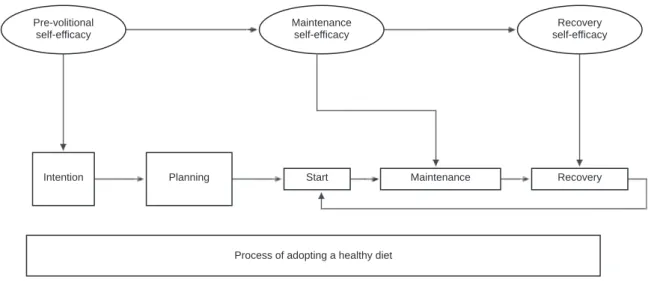
The HAPA model helps to understand the process of adopting a healthy diet. Figure 1 distinguishes two phases in the processes of behavioral changes. The first phase is a motivational one, in which intentions are formed to initi -ate a behavior and the second, called volitional, consists of
the process of formation of the new behavior (Schwarzer, 2008). In the motivational phase, the advantages and dis -advantages of behavioral change are analyzed, together with the damage and adverse consequences habits have had on health, as well as the possible outcomes of behavior -al change, such as success or failure. When people expect positive results in this change of lifestyle, it increases the intention and likelihood of changing behavior. Moreover, confidence in one’s own abilities to achieve the desired goal is essential (Luszczynska et al., 2005a; Schwarzer & Gutiérrez-Doña, 2009).
The volitional phase determines whether intentions will be achieved. Regulatory skills and strategies are required, which consist of detailed plans on how, when, and where behavioral changes will take place. Moreover, strategies are required to cope with the difficulties in achieving the desired results and whether one’s initial expectations have been met. This phase is crucial to maintaining healthy be -haviors, because the ability to recover from relapses is test -ed (Luszczynska et al., 2005a; Schwarzer, 2008; Schwarzer & Gutiérrez-Doña, 2009).
According to the HAPA model, there are three types of self-efficacy, one which operates in the motivational phase and two in the volitional phase: a) self-efficacy in actions or pre-volitional refers to an optimistic belief about the re -sults of one’s behavior; individuals with a high level in this component imagine success and are more likely to start a new behavior; b) maintenance self-efficacy is the optimistic belief in one being able to cope with the problems that arise when the actions have begun. Individuals with a higher lev -el of this factor will invest more effort in maintaining the behavior despite the difficulties and barriers that occur; c) self-efficacy in relapse recovery is the conviction that one
Pre-volitional self-efficacy
Maintenance self-efficacy
Recovery self-efficacy
Intention Planning Start Maintenance Recovery
Process of adopting a healthy diet
Volitional phase Motivational phase
will be able to continue with the plans drawn up, regain control of the situation and minimize the risks arising from relapses. (Renner et al., 2008; Schwarzer, 2008; Schwarzer & Gutiérrez-Doña, 2009).
In recent decades, several instruments have been con -structed to measure self-efficacy, usually on the basis of the General Self-Efficacy Scale (Luszczynska, Scholz, & Schwarzer, 2005b). The instruments have been developed for each specific behavior, such as The Self-Efficacy for Managing Chronic Disease Scale (Ritter & Lorig, 2014), and the Nutrition Self-Efficacy Scale/ Exercise Self-Effi -cacy Scale (Schwarzer & Renner, 2005). In Mexico, the following instruments are applied Self-Efficacy for Physi -cal Activity in School-age Children (Aedo & Ávila, 2009), Self-Efficacy for Engaging in Healthy Behaviors in Healthy Children (Flores León, González-Celis Rangel, & Valencia Ortíz, 2010), and the Inventory of Perceived Self-Efficacy for Weight Control Adapted for the Mexican School Popu -lation (Saldaña, Peresmitré, Meraz, & del Castillo Arreola, 2011). These instruments are difficult to use in the popula -tion of interest because they are mainly designed for chil -dren in a school context. At present, there is no instrument in Mexico for measuring self-efficacy for an adult diet based on the HAPA model (Luszczynska et al., 2005b; Scholz, Nagy, Göhner, Luszczynska, & Kliegel, 2009; Schwarzer & Renner, 2005).
Developing an instrument that makes a conceptu -al distinction between various self-efficacies is extremely useful in health behavior research since it allows one to fo -cus on the type of self-efficacy that must be reinforced at each stage of the change, particularly because of its impact on the formation of intentions, maintenance, and recovery from relapses. It has been shown that self-efficacy in actions is the best predictor of intentions, whereas self-efficacy in maintenance is the best predictor of behavior (Schwarzer, 2008; Schwarzer & Gutiérrez-Doña, 2009). Previous stud -ies have found a significant association between self-effica -cy in actions and maintenance and scores and the adoption of healthy foods (Hromi-Fiedler et al., 2016; Zhang et al., 2018; Zhou, Gan, Knoll, & Schwarzer, 2013). The high -er the score in these two types of self-efficacy, the great-er the decrease in body weight (Hattar, Pal, & Hagger, 2016). Self-efficacy in relapse recovery is related to both the in -tention of making changes in behavior and to an increase in physical exercise in people with obesity (Luszczynska et al., 2005a; Schwarzer & Gutiérrez-Doña, 2009).
METHOD
Study design
This is a descriptive, analytical, multicenter cross-section -al study with a convenience sample design, which con
-siders the recommendations previously established in the literature of having at least 200 participants (Lloret-Segu
-ra, Ferreres-Traver, Hernández-Baeza, & Tomás-Marco, 2014; MacCallum, Widaman, Zhang, & Hong, 1999).
Sites
Participating patients were recruited from three public sec -tor clinics in the metropolitan area of the Valley of Mexico, which offer specialized treatment programs to lose body weight; these consist of diet modification, general recom -mendations for physical exercise, and medical supervision.
Participants
The inclusion criteria for participants were men and women aged 18 to 65 years, with a Body Mass Index (BMI) ≥ 30, who were seeking nutritional treatment to reduce body weight and were able to read and write. The exclusion criteria were being candidates for bariatric surgery and attending treatment as a requirement for a surgical operation.
Development of the instrument
The construction of the SSHD was based on the Schwarzer Nutrition Self-Efficacy Scale (Schwarzer & Renner, 2005) with five items with four response options. The authors re -ported a good Cronbach’s alpha internal consistency of .87 (n = 1 726) and a r = .59 in the test-retest test (n = 982). This scale has been developed and tested on various samples (Gutiérrez-Doña, Lippke, Renner, Kwon, & Schwarzer, 2009; Renner et al., 2008; Schwarzer, 2008). To this end, the following steps were taken:
1. A bank of 60 statements was constructed to en -compass the dimensions of the HAPA model (Luszczynska et al., 2005b; Scholz et al., 2009; Schwarzer & Gutiérrez-Doña, 2009; Zhou et al., 2013): pre-volitional self-efficacy (18 items), maintenance self-efficacy (22 items), and self-ef -ficacy for relapse recovery (20 items).
2. The qualitative technique of cognitive laboratories was used (Johnstone, Bottsford-Miller, & Thomp
-son, 2006; Zucker, Sassman, & Case, 2004) to culturally adapt the statements and make them understandable for the Mexican population. The participants were people with obesity who had been in treatment to reduce body weight, male and female with an age range of 24 to 60 years, whose educational attainment ranged from middle school to undergraduate degree level. Based on their feed -back, sentences or words that were not understood were modified.
were chosen based on the criteria of: (a) experience in making judgments and decision-making based on evidence or expertise (such as degrees, research, publications, position, experience, and awards), (b) reputation in the community, (c) availability and motivation to participate, (d) impartiality and in -herent qualities such as self-confidence and adapt -ability (Skjong & Wentworth, 2000). The judges numerically rated each of the 60 items on a scale of one to four, in addition to making suggestions about the wording of the items, which were then modified. Items that obtained a degree of agreement of less than 80% were eliminated, in other words, those that obtained an average of less than 3.5 of all the judges’ evaluations (Appendix 1).
Measurements
The instrument applied to the sample was made up by 45 Likert items comprising the SSHD, with three dimensions of self-efficacy: pre-volitional, maintenance, and relapse recovery. Each dimension contains 15 items. Each item contains six response options ranging from Totally Agree to Totally Disagree.
Procedure
1. The SSHD was applied to 300 participants, on the assumption that 30% of the applications might have missing data. Patients who were at different stages of treatment were included and a database with 202 questionnaires was developed.
2. Construct validity was tested by exploratory factor analysis (EFA).
3. Items showing collinearity were eliminated, based on modification indices and ensuring that the item removed did not affect the measurement of an im -portant dimension of the construct according to the theory.
4. Lastly, a confirmatory factor analysis (CFA) was performed.
Statistical analysis
Descriptive statistics were used for the analysis of socio -demographic data. An exploratory factor analysis (EFA) was applied to find a model with a good fit and contrast it with the theoretical proposal of the Health Actions Process Approach. This analysis was performed with SPSS 23. The method employed was Main Components with VARIMAX rotation, and the significant contribution criterion of more than .4 was used to consider that the item corresponded to a factor. To confirm the structure obtained by the EFA, a con -firmatory factor analysis (CFA) was performed. Because
the data set failed to meet the assumption of multivariate normality, the maximum likelihood estimation with robust standard errors and a mean and variance adjusted test sta -tistic (MLMV) was used. Since the estimator uses scaling measures, the goodness of fit measures considered were Sa -torra and Bentler’s chi-square (χ2
S-B), the scaled comparative adjustment index (CFIS ≥ .95), and the Root Mean Square Error of Approximation (RMSEAS ≤ .05). The regression coefficients, standard errors, and statistical significance for each parameter estimated in the model are given. In addi -tion, the internal consistency of each factor and of the total scale was evaluated with the coefficient of reliability of the compounds (ω). To this end, the recommendations estab -lished in the literature were used (Raykov & Marcoulides, 2011). The CFA and the estimation of the reliability coeffi -cients were carried out using Mplus 8 software.
Ethical considerations
The study was approved by a research and ethics commit -tee, all patients gave their informed consent and interna -tionally established guidelines for the protection of human research participants were followed.
RESULTS
Participants had a BMI > 30 (range 30 to 42) and an average age of M = 46.3 (SD = 11.9) with a range of 27 to 65 years. Table 1 describes the sociodemographic characteristics of the sample.
Table 1
Characteristics of participants
n %
Sex
Men 57 28.2
Women 145 72.8
Occupation
Housewife 76 37.6
Employee 52 25.7
Shopkeeper 34 16.8
Other 40 19.9
Educational attainment
Did not answer 26 12.9
Elementary 9 4.5
Middle school 71 35.1
High school 47 23.3
Technical degree 27 13.4
University 19 9.4
Master’s degree 3 1.5
SD
Exploratory factor analysis
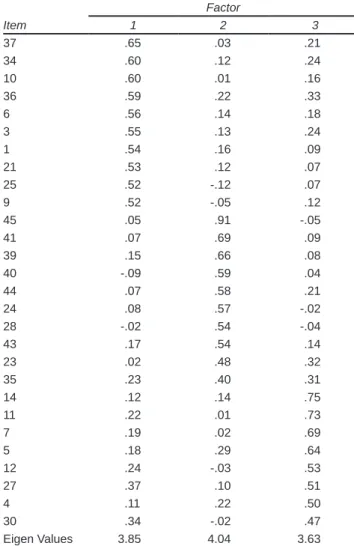
Forty-five items were analyzed, yielding a three-compo -nent solution that explains 41.1% of the variance. Table 2 reports the 27 items with factor loads of over .40, while items 2, 8, 13, 15, 16, 17, 18, 19, 20, 22, 25, 26, 29, 31, 32, 33, 38, and 42 had a lower load. Component 1, labeled “Pre-volitional Self-efficacy (PS),” grouped together 10 items corresponding to the belief in one’s capacity to initi -ate behaviors rel-ated to healthy eating. Component 2, called “Maintenance self-efficacy (MS),” grouped together eight items that measured the belief in the ability to maintain a healthy diet, even when barriers or difficulties began to be observed. Lastly, component 3, called “Self-efficacy for relapse recovery (SRR),” included nine items measuring beliefs in the ability to resume healthy eating following a suspension or relapse.
Confirmatory factor analysis
The CFA tested the 27 items with a factor load of at least .40. Items with high modification rates were eliminated follow -ing the recommendations to avoid collinearity (Byrne, 2010) and taking into account their theoretical importance (Kline, 2011).
The following items were eliminated: factor one 37, 34, 25, 21, 9, and 1, factor two 44, 43, 41, 35, 28, and 23, factor three 27, 14, 7, 5, and 4.
After evaluating the model, the following measures of goodness of fit χ2 = 66.49, p < .001, and χ2 S-B/gl = 41 were
obtained. CFIS = .955, NFI = .893, RMSEAS = .056 (95% CI [.029, .079]). The coefficients, standard errors and z val -ues of the items comprising the final version of the CFA are shown in Figure 2. Factor one comprised items 3, 6, 10, and 36; factor two items 24, 39, 40, and 45; and factor three items 11, 12 and 30. As regards internal consistency, the reliability coefficients of the compounds were: AP ω = .724 (CI 95% [.655, .793]); AM ω = .779 (CI 95% [.655, .793]); ARR ω = .711 (CI 95% [.628, .794]); total scale ω = .896 (CI 95% [.876, .915]).
DISCUSSION AND CONCLUSION
Measuring self-efficacy in the population with obesity pos -es a challenge for r-esearch. The development of this scale was based on the need to measure self-efficacy as regards diet in a population with obesity. Schwarzer’s Self-effica -cy Scale for Nutrition (Schwarzer & Renner, 2005), which
Table 2
Factor loads obtained in the exploratory analysis for the solution of three factors
Factor
Item 1 2 3
37 .65 .03 .21
34 .60 .12 .24
10 .60 .01 .16
36 .59 .22 .33
6 .56 .14 .18
3 .55 .13 .24
1 .54 .16 .09
21 .53 .12 .07
25 .52 -.12 .07
9 .52 -.05 .12
45 .05 .91 -.05
41 .07 .69 .09
39 .15 .66 .08
40 -.09 .59 .04
44 .07 .58 .21
24 .08 .57 -.02
28 -.02 .54 -.04
43 .17 .54 .14
23 .02 .48 .32
35 .23 .40 .31
14 .12 .14 .75
11 .22 .01 .73
7 .19 .02 .69
5 .18 .29 .64
12 .24 -.03 .53
27 .37 .10 .51
4 .11 .22 .50
30 .34 -.02 .47
Eigen Values 3.85 4.04 3.63
.487(.070)
.498 (.061)
.553 (.118)
.966 (.169)
.684 (.191)
.944 (.187)
1.412 (.216)
.259 (.169)
1.415 (.174)
1.018 (.245)
1.257 (.224)
1.154 (.177) r3
r6
r10
r36
r39
r40
r45
r24
r11
r12
r30 f1
f2
f3
1.000 (.000)
.743 (.099)
.747 (.118) 1.000 (.000)
1.079 (.134)
.934 (.161)
1.185 (.171)
1.000 (.000)
.921 (.162)
1.574 (.229)
.814 (.174) .402 (.072)
.155 (0.59)
.764 (.194)
-.014 (.112)
1.360 (.235)
we used as a base, contains five items. We consider that we could cover other aspects of self-efficacy by increasing the number of items for each dimension of the construct. These include the perception of support from one’s partner or family, criticism for being on a diet, the time and money spent preparing food, frustration in response to unsuccess -ful attempts, and being able to resist non-nutritious foods in poorly-controlled environments such as parties, etc.
The evaluation of psychological constructs during the initial, maintenance, and recovery from relapses stages re -quires the use of instruments that consider the sociocul -tural context. It was therefore necessary to consider the way patients understand the construct of self-efficacy and not only the definition. Accordingly, time and resources were spent on constructing statements that were clear enough to assess the patient’s beliefs in their own abil -ities in relation to healthy eating, the axis of treatment for reducing body weight. Although the HAPA model (Schwarzer & Gutiérrez-Doña, 2009; Schwarzer & Ren
-ner, 2005) has been translated into Spanish and used in the Latino population, as a result of analyzing the items it contains, we consider that the Spanish translation is insufficient. Mexicans may observe different barriers and obstacles from the populations that have been researched. Another reason for creating a new instrument was that some studies used four and seven response options interchange -ably. In short, we believe we could obtain greater validity by systematically conducting the development of the instru -ment (based on the HAPA model) from preparing the items to obtaining psychometric properties. To this end, cognitive laboratories were conducted to adapt it culturally. Content validity was obtained through expert judges, and construct validity through EFA and CFA to obtain the Self-efficacy Scale for a Healthy Diet (SSHD). The results obtained show a three-factor SSHD model with an adequate fit.
The factor structure of the SSHD coincides with the three types of self-efficacy proposed by the Health Ac -tions Process Approach (Schwarzer, 2008; Schwarzer & Gutiérrez-Doña, 2009; Schwarzer et al., 2007). The first factor, called “Prevolitional Self-efficacy,” is very import -ant for beginning the changes in the diet required to reduce body weight in obesity treatment. This type of self-efficacy is the best predictor of the intention to make a change in one’s diet (Anderson et al., 2000; Anderson, Konz, Frederich, & Wood, 2001; Delahanty et al., 2013). Ac -curately measuring this construct makes it possible to distinguish between people who are prepared to begin treatment from those who need to develop their intention and increase their self-efficacy. The second factor is called “Self-efficacy for relapse recovery.” It has been found that people who consider relapses a total failure are less likely to continue treatment, unlike those who perceive themselves as capable of recovering. The third factor was called “Main -tenance Self-efficacy.” Once people begin treatment, it is
important that they feel effective in overcoming the barriers and difficulties that come along with changes in food.
It was found that factors two and three are correlated, as observed in the results, while the third factor only com -prised three items corresponding to maintenance self-effi -cacy. This may be because once people start a healthy diet, they perceive relapses as part of the barriers to maintaining behavioral change rather than an independent difficulty. Re -cent studies have found that this type of self-efficacy pre -dicts positive results in weight loss. Measurement of this factor is essential, once actions have been initiated, since in -dividuals with a higher level of perceived self-efficacy will persist more and invest more effort in maintaining the new behavior (Schwarzer, 2008; Schwarzer & Gutiérrez-Doña, 2009; Schwarzer & Renner, 2005).
Limitations of the study include the fact that it is a non-probabilistic sample, which makes it impossible to generalize the results obtained through the sample to the population from which it was extracted, and the fact that data collection was based on self-reporting. An additional limitation is related to the use of the same sample to per -form EFA and CFA, even though this is a practice used in similar studies. This makes it impossible to determine whether the resulting model is strictly generalizable within the population or to other populations.
Although several articles on self-efficacy scales based on the HAPA model show internal consistency data (Luszczynska et al., 2005b; Schwarzer & Gutiérrez-Doña, 2009; Schwarzer & Renner, 2005), since no studies were found reporting the assessment of the factor structure of the instruments they use, the findings of this research contrib -ute empirical evidence to the HAPA model. It is a Spanish instrument, based on this model, which measures the three types of self-efficacy and has confirmatory factor analysis.
SSHD could be useful for evaluating the self-efficacy of people with obesity who begin treatment to reduce body weight, since self-efficacy is related to changes in diet such as the consumption of fruits and vegetables (Hromi-Fiedler et al., 2016; Zhou et al., 2013). High scores increase the chances of success in treatment, in addition to the fact that the instrument could provide important information for fo -cusing psychological interventions on this group of patients, since if they have low self-efficacy, they have a high proba -bility of dropping out of treatment or being unsuccessful in their attempts to lose weight.
Funding
During the undertaking of the study and the development of the
manuscript, JCCR received funding from the Consejo Nacion
-al de la Ciencia y Tecnología (CONACyT) through a doctor
-al study grant (grant number 165002). CONACyT was not in
Conflicts of interest
The authors declare they have no conflict of interest. Contributions
JCCR and GLPM designed the study, coordinated the data collec -tion and, together with LVG, drafted the manuscript and conduct -ed the statistical analyses. SRPA and RMN participat-ed through a critical review of the manuscript. All the authors have approved the final version of the article.
Acknowledgements
Thanks are due to all the study participants, authorities, doctors, and nutritionists at the obesity clinics who supported the undertak -ing of this research.
REFERENCES
Aedo, Á., & Ávila, H. (2009). Nuevo cuestionario para evaluar la autoeficacia hacia la actividad física en niños. Revista Panamericana de Salud Publica, 26(4), 324-329. Retrieved from https://www.scielosp.org/article/ssm/content/ raw/?resource_ssm_path=/media/assets/rpsp/v26n4/v26n4a06.pdf
Anderson, E. S., Winett, R. A., & Wojcik, J. R. (2000). Social-cognitive determinants of nutrition behavior among supermarket food shoppers: A structural equation analysis. Health Psychology, 19(5), 479-486. doi: 10.1037/0278-6133.19.5.479 Anderson, E. S., Winett, R. A., & Wojcik, J. R. (2007). Self-regulation, self-efficacy, outcome expectations, and social support: Social cognitive theory and nutrition behavior. Annals of Behavioral Medicine, 34(3), 304-312. doi: 10.1007/ BF02874555
Anderson, J. W., Konz, E. C., Frederich, R. C., & Wood, C. L. (2001). Long-term weight-loss maintenance: a meta-analysis of US studies. The American Journal of Clinical Nutrition, 74(5), 579-584. doi: 10.1093/ajcn/74.5.579
Bandura, A. (1982). Self-efficacy mechanism in human agency. American Psychologist, 37(2), 122-147. doi: 10.1037/0003-066X.37.2.122
Bandura, A. (1993). Perceived self-efficacy in cognitive development and functioning. Educational Psychologist, 28(2), 117-148. doi: 10.1207/s15326985ep2802_3 Bandura, A. (2001). Social cognitive theory: An agentic perspective. Annual Review
of Psychology, 52(1), 1-26. doi: 10.1146/annurev.psych.52.1.1
Bonsaksen, T., Fagermoen, M. S., & Lerdal, A. (2014). Trajectories of self-efficacy in persons with chronic illness: An explorative longitudinal study. Psychology & Health, 29(3), 350-364. doi: 10.1080/08870446.2013.856432
Bonsaksen, T., Lerdal, A., & Fagermoen, M. S. (2012). Factors associated with self-efficacy in persons with chronic illness. Scandinavian Journal of Psychology. 53(4), 333-339. doi: 10.1111/j.1467-9450.2012.00959.x
Byrne, B. (2010). Structural equation modeling with Amos: Basic concepts, applications, and programming (2nd. ed). New York: Taylor and Francis Group, LLC.
Delahanty, L. M., Peyrot, M., Shrader, P. J., Williamson, D. A., Meigs, J. B., & Nathan, D. M. (2013). Pretreatment, psychological, and behavioral predictors of weight outcomes among lifestyle intervention participants in the Diabetes Prevention Program (DPP). Diabetes Care, 36(1), 34-40. doi: 10.2337/dc12-0733
Flores León, A., González-Celis Rangel, A. L., & Valencia Ortíz, A. (2010). Validación del instrumento de autoeficacia para realizar conductas saludables en niños Mexicanos sanos. Psicología y Salud, 20(1), 23-30. doi: 10.25009/pys. v20i1.613. Retrieved from http://psicologiaysalud.uv.mx/index.php/psicysalud/ article/view/613
Gutiérrez-Doña, B., Lippke, S., Renner, B., Kwon, S., & Schwarzer, R. (2009). Self‐efficacy and planning predict dietary behaviors in Costa Rican and South Korean women: Two moderated mediation analyses. Applied Psychology: Health and Well-Being, 1(1), 91-104. doi: 10.1111/j.1758-0854.2009.01004.x
Hattar, A., Pal, S., & Hagger, M. S. (2016). Predicting physical activity-related outcomes in overweight and obese adults: A health action process approach.
Applied Psychology: Health and Well-Being, 8(1), 127-151. doi: 10.1111/ aphw.12065
Hromi-Fiedler, A., Chapman, D., Segura-Pérez, S., Damio, G., Clark, P., Martinez, J., & Pérez-Escamilla, R. (2016). Barriers and facilitators to improve fruit and vegetable intake among WIC-eligible pregnant Latinas: An application of the health action process approach framework. Journal of Nutrition Education and Behavior, 48(7), 468-477. doi: 10.1016/J.JNEB.2016.04.398
Johnstone, C. J. Bottsford-Miller, N. A., & Thompson. S. J. (2006). Using the think aloud method (cognitive labs) to evaluate test design for students with disabilities and english language learners. Technical report 44. National Center on Educational Outcomes, University of Minnesota. Retrieved from https://eric. ed.gov/?id=ED495909
Kline, R. B. (2011). Principles and practice of structural equation modeling (Second). New York: Guilford Press.
Kreausukon, P., Gellert, P., Lippke, S., & Schwarzer, R. (2012). Planning and self-efficacy can increase fruit and vegetable consumption: a randomized controlled trial. Journal of Behavioral Medicine, 35(4), 443-451. doi: 10.1007/s10865-011-9373-1
Lloret-Segura, S., Ferreres-Traver, A., Hernández-Baeza, A., & Tomás-Marco, I. (2014). El análisis factorial exploratorio de los ítems: una guía práctica, revisada y actualizada. Anales de Psicología, 30(3), 1151-1169. doi: 10.6018/ analesps.30.3.199361
Luszczynska, A., Gutiérrez‐Doña, B., & Schwarzer, R. (2005a). General self‐efficacy in various domains of human functioning: Evidence from five countries. International Journal of Psychology, 40(2), 80-89. doi: 10.1080/00207590444000041
Luszczynska, A., Scholz, U., & Schwarzer, R. (2005b). The general self-efficacy scale: multicultural validation studies. The Journal of Psychology, 139(5), 439-457. doi: 10.3200/JRLP.139.5.439-457
MacCallum, R. C., Widaman, K. F., Zhang, S., & Hong, S. (1999). Sample size in factor analysis. Psychological Methods, 4(1), 84-99. doi: 10.1037/1082-989X.4.1.84
Motl, R. W., Dishman, R. K., Saunders, R. P., Dowda, M., Felton, G., Ward, D. S., & Pate, R. R. (2002). Examining social-cognitive determinants of intention and physical activity among black and white adolescent girls using structural equation modeling. Health Psychology, 21(5), 459-467. doi: 10.1037/0278-6133.21.5.459. PMID: 12211513
Organización Mundial de la Salud. (2013). OMS | Dieta. Retrieved September 12, 2019, from https://www.who.int/dietphysicalactivity/diet/es/
Parschau, L., Fleig, L., Koring, M., Lange, D., Knoll, N., Schwarzer, R., & Lippke, S. (2013). Positive experience, self-efficacy, and action control predict physical activity changes: A moderated mediation analysis. British Journal of Health Psychology, 18(2), 395-406. doi: 10.1111/j.2044-8287.2012.02099.x Raykov, T., & Marcoulides, G. A. (2011). Introduction to psychometric theory.
Routledge.
Renner, B., Kwon, S., Yang, B.-H., Paik, K.-C., Kim, S. H., Roh, S., ... Schwarzer, R. (2008). Social-cognitive predictors of dietary behaviors in South Korean men and women. International Journal of Behavioral Medicine, 15(1), 4-13. doi: 10.1007/BF03003068
Ritter, P. L., & Lorig, K. (2014). The English and Spanish self-efficacy to manage chronic disease scale measures were validated using multiple studies. Journal of Clinical Epidemiology, 67(11), 1265-1273. doi: 10.1016/j. jclinepi.2014.06.009
Saldaña, R. M. E. G., Peresmitré, G. G., Meraz, M. G., & del Castillo Arreola, A. (2011). Análisis factorial confirmatorio del inventario de autoeficacia percibida para control de peso en población mexicana. Psicología Iberoamericana, 19(2), 78-88. Retrieved from http://www.redalyc.org/ comocitar.oa?id=133921440009
Scholz, U., Nagy, G., Göhner, W., Luszczynska, A., & Kliegel, M. (2009). Changes in self-regulatory cognitions as predictors of changes in smoking and nutrition behaviour. Psychology & Health, 24(5), 545-561. doi: 10.1080/08870440801902519
Schwarzer, R. (2008). Modeling health behavior change: How to predict and modify the adoption and maintenance of health behaviors. Applied Psychology, 57(1), 1-29. doi: 10.1111/j.1464-0597.2007.00325.x
Schwarzer, R., & Gutiérrez-Doña, B. (2009). Modelando el cambio en el comportamiento de salud: Cómo predecir y modifcar la adopción y el mantenimiento de comportamientos de salud. Revista Costarricense de Psicología, 28(41-42), 11-39. Retrieved from https://www.redalyc.org/ pdf/4767/476748706011.pdf
Schwarzer, R., & Renner, B. (2005). Health-specific self-efficacy scales. Retrieved April 5, 2018, from http://userpage.fu-berlin.de/~health/healself.pdf
Schwarzer, R., Schüz, B., Ziegelmann, J. P., Lippke, S., Luszczynska, A., & Scholz, U. (2007). Adoption and maintenance of four health behaviors: Theory-guided longitudinal studies on dental flossing, seat belt use, dietary behavior, and
physical activity. Annals of Behavioral Medicine, 33(2), 156-166. doi: 10.1007/ BF02879897
Skjong, R., & Wentworth, B. (2000). Expert judgement and risk perception. Retrieved from http://research.dnv.com/skj/Papers/SkjWen.pdf
Zhang, C., Zheng, X., Huang, H., Su, C., Zhao, H., Yang, H., ... Pan, X. (2018). A study on the applicability of the health action process approach to the dietary behavior of university students in Shanxi, China. Journal of Nutrition Education and Behavior, 50(4), 388-395. doi: 10.1016/J.JNEB.2017.09.024
Zhou, G., Gan, Y., Knoll, N., & Schwarzer, R. (2013). Proactive coping moderates the dietary intention–planning–behavior path. Appetite, 70, 127-133. doi: 10.1016/J.APPET.2013.06.097
Zucker, S., Sassman, C., & Case, B. J. (2004). Cognitive Labs. Retrieved from http:// images.pearsonassessments.com/images/tmrs/tmrs_rg/CognitiveLabs.pdf
APPENDIX 1
11 reactivos finales
1. Sé que puedo empezar a comer sanamente.2. Sé que puedo tomar más agua al día.
3. Estoy convencido/a que puedo evitar alimentos poco saludables (grasas, azúcares, salado, refrescos, etc.). 4. Estoy convencido/a que puedo comer más frutas y verduras cada día.
5. Estoy convencido/a que puedo comer alimentos nutritivos incluso si tengo poco tiempo para prepararlos y comerlos. 6. Estoy convencido/a que puedo tener una alimentación saludable solo si estoy relajado.
7. Estoy convencido/a que puedo tener una alimentación saludable incluso si algunos días fallara en mis intentos. 8. Estoy convencido/a que podría tener una alimentación saludable incluso si me criticaran por estar a dieta. 9. Dudo que podría retomar una alimentación saludable si fallara en algunas ocasiones.