Original article
Nicotine craving questionnaire (CCN):
psychometric properties on Mexican population
Luis Villalobos-Gallegos,
1,2Rodrigo Marín-Navarrete,
1Liliana Templos-Nuñez,
1Alejandro Rosendo-Robles
1SUMMARY
Smoker’s craving is one of the most important problems in tobacco ces-sation treatment. The aim of this study was to elaborate a self report questionnaire to assess smoking urge. Development process was carried out in two parts: construction of items using a natural modified semantic networks method. It was administered to 42 smokers; after that, the first version of the questionnaire was answered by 222 smokers. Internal con-sistency was obtained and an analysis of discrimination was conducted on the items; then, a factorial analysis with varimax rotation using prin-cipal components method was carried out, resulting in 12 items on three factors that explain 76% of the variance and 0.92 Chronbach’s alpha.
Key words: Tobacco craving, craving measurement, reliability, validity.
RESUMEN
El craving en fumadores es uno de los problemas principales del trata-miento del tabaquismo. El presente trabajo tuvo como objetivo la elabo-ración de un cuestionario de autorreporte del deseo de fumar. El proceso de desarrollo se llevó a cabo en dos etapas: construcción de reactivos por medio del método de redes semánticas naturales modificadas, el cual se aplicó a 42 fumadores; posteriormente se aplicó la primera versión del cuestionario a 222 fumadores. Se obtuvo la consistencia interna y se reali-zó un análisis de discriminación de reactivos; posteriormente se realireali-zó un análisis factorial con rotación ortogonal con un método de componentes principales. Los resultados arrojaron 12 reactivos en tres factores, que explican 76% de la varianza total y un alfa de Chronbach=0.92.
Palabras clave: Craving por fumar, medición del craving, confia-bilidad, validez.
1 Unit of Clinical Trials on Addictions and Mental Health. National Institute of Psychiatry Ramón de la Fuente (INPRF), Mexico City, Mexico. 2 Universidad Nacional Autónoma de México.
Corresponding: Dr. Luis Villalobos-Gallegos. Unidad de Ensayos Clínicos, Sub-Dirección de Investigaciones Clínicas, Instituto Nacional de Psiquiatría Ramón de la Fuente. Calz. México-Xochimilco 101, San Lorenzo Huipulco, Tlalpan, 14370, México DF. Tel. (55) 4160-5480 y 5481. E-mail address: [email protected] Recibido: 27 de enero de 2012. Aceptado: 21 de febrero de 2012.
INTRODUCTION
Cigarette smoking is a major public health problem.1
Ac-cording to the most recent survey on addictions in Mexico,2
there are about 14 million smokers in this country.
Smoking is frequently associated to lung disease, mouth and throat cancer; chronic obstructive pulmonary disease, chronic bronchitis, cataracts; premature birth and low birth-weight, and most important, nicotine addiction.
One of the factors to take into account in developing effective treatments is intense smoking desire. This is one of the most important problems in tobacco cessation treat-ment3-7 since it is a common phenomenon when abstinence
is reached.8,9 This phenomenon has been named “craving”,
which is a common English word, but it does not have an equivalent meaning word in Spanish.
Despite the fact that the importance of craving on ad-diction process has been criticized,10,11 in recent years the
in-terest on the topic has increased.12,13 It has been found to be
a relapse predictor,14,15 it can help taking a decision on type
and intensity of the treatment, and the moment of discharg-ing a patient,16 as well as to assess effectiveness of a
treat-ment (particularly those based on cue exposure),17 and to
develop psychological theories on addiction.18
Many issues to measure craving have appeared: related to definition of the construct, temporality and stability.12,19
Due to these difficulties many methods have been devel -oped to assess craving: single item measure, free response procedures, physiological measures, drug dreams, atten-tional bias of drug cues and multi-item self-report question-naires.12 Multi-item questionnaires have been used more
frequently because they have shown a high degree of face validity and are easy to construct and administer.19
Among multidimensional questionnaires to assess craving in smokers we find the Questionnaire of Smok -ing Urges20 and the Tobacco Craving Questionnaire,21 both
based on Tiffany’s Theoretical Model.22,23
Tiffany’s model20,22,23 affirms that there are four dimen
nicotine withdrawal-associated negative affect; 4. intention to smoke. This theoretical frame represents the basis of the Questionnaire of Smoking Urges,20 the difference lies in the
assessed time period (last week).
Despite the fact that the Questionnaire of Smoking Urg -es20 and the Tobacco Craving Questionnaire21 have shown
strong validity and reliability levels, as well as specificity on its measures, they were built just for American population.
In Spain, a brief Spanish version of the Questionnaire of Smoking Urges24 was developed, but it only assesses
crav-ing at the moment of the application and applies only to Spaniard population.
In Mexico, there is a questionnaire that measures co-caine craving according to Tiffany’s model.25 It was adapted
from Tiffany’s Cocaine Craving Questionnaire26 and showed
good psychometric properties. However, there is an impor-tant lack of tests measuring nicotine craving.
A valid and reliable craving measure in tobacco smok-ers built for Mexican population would result in a valuable clinical tool that would help to improve decisions on treat-ment and offer important data on craving clinical research.
Taking into account that we are looking for a stable measure and that Tiffany’s measures have shown it, we chose Tiffany’s theoretical concepts22,23 on craving.
The aim of this study was to develop a questionnaire to assess craving on Mexican smokers using Tiffany’s Theoretical concepts22,23 on craving and assess its psychometric properties.
METHOD
The process of questionnaire development was carried out in two stages; the first stage aimed to construct the items that were tested during the second stage, in which the best suitable combi-nation according to their psychometric properties was chosen.
Participants
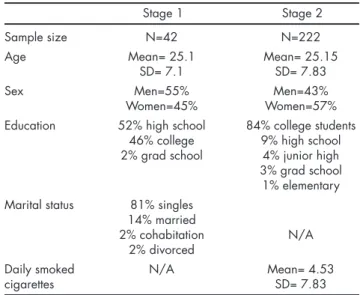
Each stage used different samples; both of them were open population. In stage 1 participants were 42 daily smokers unwilling to quit, who volunteered (non-probabilistic inci-dental sampling) to answer the preliminary questionnaire, local residents, older than 18 years (table 1).
In the second stage inclusion criteria were: older than 18 years, unwilling to quit daily smokers. Exclusion criteria consisted on inability to finish the questionnaire (10 or more unanswered items) (table 1).
Instruments
Preliminary questionnaire used in first stage was based on Natural Semantic Modified Networks method27 following
Sayette’s et al.19 recommendation: items must have common
meaning according to target population. It was integrated
with seven stimuli, six stand for the four dimension follow-ing Tiffany22,23 and Tifanny & Drobes20 theoretical model of
craving, and a distractor stimuli.
Questionnaire used on stage two included 46 items, all of them in affirmative sense, 10 negative, 36 positive. It used a Likert type scale, anchored from 1 (completely disagree) to 5 (completely agree). Questionnaire instructions explic -itly mentioned that answers should be based on last seven days cigarette craving.
Procedures
The procedure to select participants was the same in first and second stage; participants were asked whether or not they were daily smokers (to prevent including a non-smoker or a former smoker); if the answer was affirmative, it was asked if they could spare us a few minutes to answer a questionnaire.
To analyze first stage participant answer’s semantic weight was assessed and SSPS 17 to conduct a chi square test in order to establish if there were significant differences on definers affective charge. The item pool was developed us -ing those results. In the second stage, item analysis was con-ducted using SSPS 17 testing response options determining if every option was chosen through frequencies analysis on items; to conduct discrimination test a sum of all items was done, then quartiles 1 and 3 were obtained in order to use them as group variable (a group where cases were above quartile 3 and another which was under quartile 1) to execute a T Student’s independent sample on every item, cut-point to discard an item was p>.05; directionality through cross-tabs, using previously obtained quartiles 1 and 3 in rows and frequency of each item responses on columns, positive items needed to show a tendency toward higher scores in quartile 3 row and lower toward lower scores negative items were as-sessed inversely; independence discarding both items if they
Table 1. Demographics
Stage 1 Stage 2
Sample size N=42 N=222
Age Mean= 25.1 Mean= 25.15
SD= 7.1 SD= 7.83
Sex Men=55% Men=43%
Women=45% Women=57%
Education 52% high school 84% college students 46% college 9% high school 2% grad school 4% junior high 3% grad school 1% elementary Marital status 81% singles
14% married
2% cohabitation N/A
2% divorced
Daily smoked N/A Mean= 4.53
had a correlation higher than ±0.8; reliability internal consis-tency using Chronbach’s alpha; varimax factorial analysis us-ing principal components method and uniquenesses criteria, plus using test of the hypothesis that 3 factors are sufficient with chi square test trough R language. Items had to pass ev-ery test to be included in the final version.
RESULTS
In the first stage, definers obtained by Natural Modified Semantic Networks were transformed into a 46 item pool (some definers that had no relationship with our theoreti -cal construct of craving were deleted), distributed into four dimensions as is stated in theory.
After analysis and testing directionality, discrimina-tion, independence and reliability, 33 remaining items went through a varimax principal components factorial analysis.
Sample obtained a MSA rate of 0.915. According to Kaiser28
it has optimal values to conduct a factorial analysis.
Chi square test was used to assess whether or not the combination fits the most, also has at least three items per factor and eigen value equal or superior to 1.
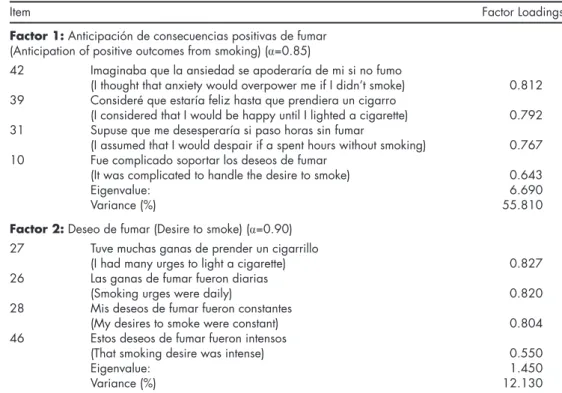
Test last version was a 12 item, 3 factor questionnaire. Fac-tors represented 76% of the total variance, and a Chronbach’s alpha reliability = 0.92, with a Hotelling T Square equal to 14.442 (df1=11; df2=211; p<.001). Factor 1 reliability=0.86; Fac-tor 2 reliability=0.90; and Factor 3 reliability=0.87; all of them using Chronbach’s alpha. KMO test value was 0.912, that lead us to assume that sample size had enough adequacy, and a value on Bartlett sphericity test equal to 1853.435 (df=66; p<.001); on uniqueness criteria it was obtained a model test Chi square of 46.72 (df=33; p= 0.0572) (table 2).
We can define factor composition as: Factor 1“ Anticipa-tion of positive outcomes from smoking” (it represents the expectations of a positive effect of smoking, such as pleasure,
Table 2. Factor loadings for a three-factor varimax orthogonal solution and alpha coefficients
Item Factor Loadings
Factor 1: Anticipación de consecuencias positivas de fumar (Anticipation of positive outcomes from smoking) (=0.85)
42 Imaginaba que la ansiedad se apoderaría de mi si no fumo
(I thought that anxiety would overpower me if I didn’t smoke) 0.812 39 Consideré que estaría feliz hasta que prendiera un cigarro
(I considered that I would be happy until I lighted a cigarette) 0.792 31 Supuse que me desesperaría si paso horas sin fumar
(I assumed that I would despair if a spent hours without smoking) 0.767 10 Fue complicado soportar los deseos de fumar
(It was complicated to handle the desire to smoke) 0.643
Eigenvalue: 6.690
Variance (%) 55.810
Factor 2: Deseo de fumar (Desire to smoke) (=0.90) 27 Tuve muchas ganas de prender un cigarrillo
(I had many urges to light a cigarette) 0.827
26 Las ganas de fumar fueron diarias
(Smoking urges were daily) 0.820
28 Mis deseos de fumar fueron constantes
(My desires to smoke were constant) 0.804
46 Estos deseos de fumar fueron intensos
(That smoking desire was intense) 0.550
Eigenvalue: 1.450
Variance (%) 12.130
Factor 3: Anticipación de alivio de retirada de nicotina o de afecto negativo asociado con la retirada (Anticipation of relief from nicotine withdrawal or from withdrawal-associated negative affect) (=0.87) 23 En mi mente estuvo la idea “con este cigarro me sentiré desestresado(a)”
(I had on my mind: “I´ll feel un stressed with this cigarette”) 0.879 22 Creí que fumar me haría sentir relajado (a)
(I believed that smoking would make me feel relaxed) 0.875 30 Pensé que sentiría placer con este cigarro
(I thought that I would feel pleasure with this cigarette) 0.728 34 Creí que prender un cigarro me haría sentir tranquilo
(I Believed that turning on a cigarette would make me feel easy) 0.610
Eigenvalue: 1.010
Variance (%) 8.480
happiness, control of anxiety and negative emotions; items 10, 31, 39 and 42). Factor 2“Desire to smoke” (represents so-matic signals identified by smoker prior to start smoking: items 26, 27, 28 and 46). In this case, an item (46) had a higher loading in factor 1 than in factor 2, regardless of that it was allocated in factor 2 because it had a significant factor load -ing (0.550) and a more appropriate semantic content.
Factor 3“Anticipation of relief from nicotine withdraw-al or from withdrawwithdraw-al-associated negative affect” (these are states where smoker expects a sensation of well-being and lower arousal level, such as: relaxation, lack of stress and being at ease; items 22, 23, 30 and 34).
A tridimensional model was built and performed CFA with Maximum Likelihood estimation (figure 1). Interfactor correlation (table 3) ranged from 0.561 to 0.733; the mean correlation between factors was r= 0.631 (SD= 0.090).
DISCUSSION
According to the results, achieving a Chronbach’s alpha larger than 0.90 we can consider the questionnaire as a reli-able one, regardless of the factorial analysis conducted in items, several analysis are needed for the final version of the questionnaire to go through such as: reapplication after a relaxation training,29 reapplication after a 1, 6 and 12-hour
nicotine privation episode,20,30,31 reapplication after a craving
inductive cue exposure session,30 convergent validity trough
correlation with equal questionnaires32 and reapplication
comparing score and nicotine blood level;30 those analysis
test convergent, discriminant and criterion validity which is the most critical concern in measuring craving.19
There are no equal findings in obtained factorial struc -ture in similar questionnaires. Those have found two24,33,34
and four35 factor structure, this could be related to
differ-ences in the smoking rate of the sample (light smokers av-eraging four daily cigarettes), regarding of differences used three-factor model prove to fit uniqueness criteria.
Comparing reliability between this scale and current ones, it was found that it was higher than Shiffman-Jarvick Smoking Withdrawal Questionnaire craving factor36 (=0.73
and 0.71), but only showed some marginal differences com-pared to QSU20 (Factor 1 =0.95; Factor 2 =0.93), Brief
QSU-Spanish version24 (Factor 1 =0.91; Factor 2 =0.81), QSU-Short
form32 (Factor 1 =.97; Factor 2 =0.92), TCQ21 (=0.82, 0.70,
0.75 and 0.48 for each factor) and TCQ-short form33 (=0.90,
0.89, 0.78 and 0.68 for each factor) so that lead us to the as-sumption that obtained internal consistency is fair enough.
The main limitation of the study was related to smok-ing pattern of the participants, it can be considered too low compared to the samples in similar studies; also the lack of criterion validation is another of its limitations. On the other hand, it represents the initial stage of a deeper analysis in order to assess and conceptualize craving across many sub-stances in Mexico.
Results suggest that this measure of craving has good psychometric properties, but need further testing in differ-ent populations (particularly in smoking cessation treatmdiffer-ent samples) and using the previously mentioned methods to prove its usefulness in clinical settings.
REFERENCES
1. U.S. Department of Health and Human Services. The health conse-quences of smoking: A report of the surgeon general. Atlanta, GA: U.S. Department of Health and Human Services, Centers for Disease Control and Prevention, National Center for Chronic Disease Preven-tion and Health PromoPreven-tion, Office on Smoking and Health; 2004. 2. Secretaría de Salud. Encuesta Nacional de Adicciones 2008. México
DF: Consejo Nacional Control as Adicciones; Instituto Nacional de Psiquiatría; Dirección General de Epidemiología, Instituto Nacional de Estadística, Geografía e Informática; 2009.
3. Iraguri-Castillo I, Corcuera-Bilbao N. Craving: Concepto, medición y terapéutica. Norte Salud Mental 2008;VII(32):9-22.
4. Baker T, Piper M, McCarthy D, Majeskie et al. Addiction motivation reformulated: An affective processing model of negative reinforce-ment. Psychological Review 2004;111(1):33–51.
5. Chesa-Vela D, Elías-Abadías M, Fernández-Vidal E, Izquierdo Mu-nuer E et al. El Craving un componente esencial en la abstinencia. Re-vista Asociación Española Neuropsiquiatría 2004;89:2912-2930. 6. Sayette M, Martin C, Wertz J, Shiffman S et al. A multi-dimensional
analysis of cue-elicited craving in heavy smokers and tobacco chip-pers. Addiction 2001;96(10):1419-1432.
7. Li T. Clinical perspectives for the study of craving and relapse in ani-mal models. Addiction 2000;95(Suppl 2):S55-S60.
8. West R, Schneider N. Craving for cigarettes. British J Addiction 1987; 82(4):407-415.
Table 3. Interfactor correlation between factors
Factor 1 Factor 2 Factor 3
Factor 1 0.733 0.561
Factor 2 0.733 0.600
Factor 3 0.561 0.600
Figure 1. Geometric space of factorial analysis. Factor 3
Factor 1 Factor 2 0.10.20.30.4 0.5 0.6
0.7
0.2 0.3 0.4 0.5
0.6 0.7 0.2
0.4 0.6 0.8 R23
R22
R30
R34
R39 R42
R10 R31
R26 R27 R28
9. Hughes J, Hatsukami D. Sign and symptoms of tobacco withdrawal. Archive General Psychiatry 1986;43(3):289-294.
10. Kozlowski L, Wilkinson A. Use and misuse of the concept of Cra-ving by lcohol, Tobacco, and Drug Researchers. British J Addiction 1987;82(1):31-36.
11. Tiffany S. A cognitive model of drug urges and drug-use behavior: Role of automatic and nonautomatic processes. Psychological Review 1990;97(2):147-168.
12. Ronsenberg H. Clinical and laboratory assessment of the subjective ex-perience of drug craving. Clinical Psychology Review 2009;29(6):519-534. 13. Piasecki T. Relapse to smoke. Clinical Psychology Review
2006;26(2):196-215.
14. Bagot K, Heishmann S, Moolchan E. Tobacco craving predicts lapse to smoking among adolescents smokers in cessation treatment. Nicotine Tobacco Research 2007;9(6):647-652.
15. Killen J, Fortmann S, Murphy G, Hayward C et al. Extended treatment with Bupropion SR for cigarette smoking cessation. J Consultant Cli-nical Psychology 2006;74(2):286-294.
16. Anton R, Drobes D. Clinical Measurement of Craving in Addiction. Psychiatric Annals 1998;28(10):553-560.
17. Conklin C, Tiffany S. Applying extinction research and theory to cue-exposure addiction treatments. Addiction 2002;97(2):155-167. 18. Skinner M, Aubin H. Craving’s place in addiction theory:
Contribu-tions of the major models. Neuroscience and Biobehavioral Reviews 2010;34(4):606-623.
19. Sayette M, Shiffman S, Tiffany S, Niaura R et al The measurement of drug craving. Addiction 2000;95(supplt 2): S189-210.
20. Tiffany S, Drobes D. The development and initial validation of a ques-tionnaire on smoking urges. British J Addiction 1991;86(11):1467-1476. 21. Heishman S, Singleton, E, Moolchan E. Tobacco Craving Questionnai-re: Reliability and validity of a new multifactorial instrument. Nicoti-ne Tobacco Research 2003;5(5):645–654.
22. Tiffany S. A cognitive model of drug urges and drug-use behavior: Role of automatic and nonautomatic processes. Psychological Review 1990;97(2):147-168.
23. Tiffany S. Cognitive concepts of craving. Alcohol Research Health 1999;23(3):215-224.
24. Cepeda-Benito A, Reig-Ferrer A. Development of a Brief Questionnaire of smoking urges-Spanish. Psychological Assessment 2004;16(4):402-407. 25. Marín-Navarrete R, Mejía-Cruz D, Templos-Nuñez L, Rosendo-Ro-bles A. Validation of a cocaine craving questionnaire (CCQ-G) in Mexican Population. Salud Mental 2012;34(6):491-496.
26. Tiffay S, Singleton E, Haertzen C, Henningfield J. The develpment of a cocaine craving questionnaire. Drug And Alcohol Dependence 1993;34(1):19-28.
27. Reyes-Lagunes I. Redes semánticas para la construcción de instrumen-tos. Revista Psicología Social Personalidad 1993;9:81-89.
28. Kaiser H. An index of factorial simplicity. Psychometrika 1974;39:31-36. 29. Singleton E, Anderson L, Heishman S. Reliability and validity of the
Tobacco Craving Questionnaire and validation of a craving-induction procedure using multiple measures of craving and mood. Addiction 2003;98(11):1537–1546.
30. Shiffman S, West R, Gilbert D. Recommendation for the assessment of tobacco craving and withdrawal in smoking cessation trials. Nicoti-ne Tobacco Research 2004;6(4):599-614.
31. Jarvik M, Madsen D, Olmstead R, Iwamoto-Schaap P. Nicotine Blood Levels and Subjetive Craving for Cigarettes. Pharmacology Bioche-mistry Behavior 2000;66(3):553-558.
32. West R, Ussher M. Is the ten-item Questionnaire of Smoking Urges (QSU-brief) more sensitive to abstinence than shorter craving measu-res? Psychopharmacology, 2010;208(3):427–432.
33. Toll B, Katukak N, Mckee S. Investigating the factor structure of the Questionnaire on Smoking Urges-Brief (QSU-Brief). Addictive Beha-viors 2006;31(7):1231-1239.
34. Cox L, Tiffany S, Christen A. Evaluatrion of the brief questionnaire of smoking urges (QSU-brief) in laboratory and clinical settings. Nicoti-ne Tobacco Research 2001;3(1):7-16.
35. Heishman S, Singleton E, Pickworth W. Reliability and validity of a Short Form of the Tobacco Craving Questionnaire. Nicotine Tobacco Research 2008;10(4):643-651.
36. Wewers M, Rachfal C, Ahijevych K. A psychometric evaluation of a visual analogue scale of craving for cigarettes. Western J Nursing Re-search 1990;12(5):672-681.