SUMMARY
In order to examine the effects of a nurse-patient inter-action-training program on the perceived well-being and medical recovery of patients in the Critical Care Unit of a second level care hospital, 18 nurses and 120 patients were randomly assigned to either an experimental or a waiting-list group. Training consisted of an intensive eight-week nurse training program which included read-ing materials, verbal instruction, modelread-ing, role playread-ing, and descriptive feedback (verbal and videotaped). The program sought to establish specific nurse behaviors such as visual contact, greeting the patient, offering help, physical proximity, praising, smiling, verbal re-quests, comforting touch, and avoiding criticizing, yell-ing/scolding and ignoring the patient. The effects of the program were measured in terms of patients’ perceived well-being, pain, level of satisfaction with nurse care, and length of stay in the hospital, as well as instruction following, and approving or thanking nurse behavior. Behavioral recording involved videotaping nurse-patient interaction through a video camera and recorder con-trolled by an automatic motion detection device which could get activated at any time within the correspond-ing area. Medical recovery measures included the scales of the Acute Physiology Age Chronic Health Evaluation II (APACHE-II) assessment system, the Glasgow Coma Scale and caregiver estimates of apparent emotional state, independence from life-support equipment, re-flexes, wound healing and general clinical stability. In order to assess inter-observer reliability, independent raters examined a random sample of at least one-hour of videotaped nurse-patient interaction in each eight-hour hospital shift. Reliability levels exceeded 80% for any given behavioral category or scale estimate. Results consistently indicated both clinical and statistically sig-nificant higher scores for the appropriate interaction and recovery measures of experimental participants as com-pared to those in the waiting-list condition. In view of several measures adopted to mitigate, against some al-ternative explanations of the results, and the practical-ity, low cost and effectiveness of the nurse-patient
pro-gram, its use is recommended in the context of health care facilities and conditions in developing nations.
Key words Key words Key words Key words
Key words: Hospital, recovery, cognitive-behavioral training, experimental, intensive, anxiety, health. RESUMEN
Con objeto de examinar los efectos de un programa de entrenamiento en interacción enfermera-paciente sobre el bienestar percibido y la recuperación médica de pacientes hospitalizados en la unidad de cuidados intensivos de un hospital público de segundo nivel, 18 enfermeras y 120 pacientes se asignaron aleatoriamente a un grupo experimental o a uno control en lista de espera. El entrenamiento consistió en un curso intensivo de ocho semanas a las enfermeras, que incluyó materiales de lectura, instrucción verbal, modelamiento, ensayos conductuales y realimentación descriptiva (sobre videograbaciones). El programa buscó establecer, en las enfermeras, conductas específicas tales como hacer contacto visual, saludar al paciente, ofrecerle ayuda, tener proximidad física, elogiarlo, sonreirle, hacerle solicitudes verbales, darle contacto físico de apoyo y evitar criticar, regañar, gritar o ignorar al paciente. Los efectos del programa se midieron en términos del bienestar percibido, dolor, nivel de satisfacción con el cuidado de las enfermeras, además de días de estancia hospitalaria, seguimiento de instrucciones dadas por el personal de salud y expresiones de agradecimiento a las enfermeras. El registro conductual incluyó la videograbación de la interacción enfermera-paciente mediante un equipo activado por un sensor de movimiento, que se podía activar automáticamente en cualquier momento. Las medidas de recuperación médica incluyeron las escalas del sistema de valoración Acute Physiology Age Chronic Health Evaluation II (APACHE-II), la Escala de Coma de Glasgow y estimaciones de los cuidadores sobre el estado emocional aparente, la independencia del equipo de apoyo vital, los reflejos, la cicatrización y la estabilidad clínica general. Con objeto de establecer la confiabilidad del registro, los obervadores
independien-* Mexican Institute of Social Security and National University of Mexico.
Reprint requests should be addressed to the second author at: Apartado Postal 22-211, 14091 Tlalpan Mexico City DF ; or at [email protected].
Recibido: 28 de noviembre 2001. Aceptado: 7 de enero 2002.
W
ELL
-
BEING
AND
MEDICAL
RECOVERY
IN
THE
CRITICAL
CARE
UNIT
: T
HE
ROLE
OF
THE
NURSE
-
PATIENT
INTERACTION
tes asignaron puntajes a una muestra de por lo menos una hora de videograbación de la interacción enfermera-paciente, por cada ocho horas que conformaban los turnos del personal de enfermería. Los niveles de confiabilidad excedieron el 80% en cualquiera de las categorías conductuales o medidas escalares. Los resultados revelaron constantemente mayores puntajes clínica y estadísticamente significa-tivos, de las medidas de interacción apropiada, bienestar percibido y recuperación médica de los participantes en las condiciones experimentales, en comparación con los controles en lista de espera. En vista de una serie de medidas adoptadas a fin de mitigar el efecto de algunas variables contaminantes que pudieran constituir explicaciones alternativas de los resultados, y del carácter práctico y económico del programa de interacción enfermera-paciente, se recomienda usarlo en el contexto de las condiciones de cuidado de la salud en los paises en vías de desarrollo.
Palabras clav Palabras clav Palabras clav Palabras clav
Palabras clave: Hospital, recuperación, entrenamiento cognoscitivo, conductual, experimental, intensivo, ansiedad, salud.
INTRODUCTION
Epidemiological profiles of morbidity and mor-tality in Latin American countries in general and Mexico in particular continue showing a polarized status in terms of infectious and chronic-degenerative diseases. Main causes of death include heart disease, malignant tumors, diabetes, cerebral-vascular diseases, liver cir-rhosis, and accidents, among others. On the other hand, however, infectious diseases still constitute an important cause of death among young children and the elderly, especially in low income strata (28, 29, 32).
In addition to the importance of both types of diseases as public health concerns, they bear two additional features which make them worthy of closer scrutiny by the behavioral sciences in general and health psychology in particular. On the one hand, they frequently lead to crises which imply extreme discomfort or pain and severe deterioration of the patients’ quality of life. These patients tend to require highly specialized urgent attention provided in a hospital’s Critical Care Unit (CCU). Physical and psychological disability, work absentee-ism, sustained stress and emotional affliction are frequent additional components of these ailments. On the other hand, their intensive management frequently involves high cost in-terventions, equipment and materials as well as relatively long hospital stays. Patients
hos-pitalized in critical care units usually suffer life-threatening conditions which require around the clock observation and frequent interven-tions.
Although attention to the critical care unit pa-tient encompasses the intervention of various health care professionals, it is probably the nursing personnel the one immediately re-sponsible for the closest follow-up and daily supervision of the patients’ recovery. In this regard, the nurses’ participation in the health restoration process results is a key contribution to the effectiveness of medical treatment. Suc-cessive sets of nurses remain in frequent con-tact with the patient 24 hours daily, they com-prise the largest proportion of health caregivers in hospitals’ critical care units, and are responsible for directly incorporating most health care interventions on patients.
In addition to administering most medical de-cisions and interventions, nurses can provide additional assistance to patients in the form of interpersonal support and encouragement. Thus, nurses have the potential for implement-ing additional interventions, psychological in nature, aimed at effectively helping patients to cope with stress and increase their well-being, as well as accelerating health recovery. In fact, conspicuous absence of human support has been linked to slower recovery and poor pa-tient quality of life in hospitals (24). Such poor recovery usually occurs through high levels of stress and anxiety or emotional reactions asso-ciated with excessive worrying and irrational fears. It may also occur through poor treatment compliance (17). Thus, it is only natural to assume that nurses trained to interact within well-calibrated interpersonal dimensions are likely to help hospitalized patients in critical care units. Another important aspect of im-proved medical recovery and patient well-being resides in the possibility of improved cost-benefit ratios of second and third level health care, derived from shorter hospital stays (18).
pa-tients in such units are likely to become a prime opportunity to analyze the clinical ef-fects (medical and psychological) of interven-tions aimed at improving patients’ well-being. Paradoxically, very few research studies in the intersection of the medical, nursing and behav-ioral fields have analyzed such effects (6).
Among other activities, nurses detect changes suggesting significant deterioration or improve-ment in the health status of patients. Comimprove-ments and indications by nursing personnel to other members of the health team frequently serve as feedback on care strategies.
One of the best structured approaches con-cerning nurse patient relations has been that by Hildegard Peplau (25). Its main purpose is to familiarize nurses with the cognitive, affec-tive and instrumental aspects of a highly func-tional interaction. This approach emphasizes understanding the needs, feelings and attitudes of patients provided that such aspects adopt a two-way syntonic interaction based on trust (17). Optimum nurse-patient relations are said to progress through four stages: orientation, identification, exploitation and resolution. Al-though these steps are supposed to fulfill rela-tively specific identifiable functions they tend to overlap in everyday practice, depending on the needs of the patient (7).
Thus, if health is conceived as the capacity to function at the highest possible physical, psychological and social level, and nurses are expected to optimize the factors affecting health recovery (14), it is only natural to ex-pect such factors to be a key component of health care (26, 36).
Experts in health care evaluation tend to agree on three basic quality components: a) technical care, b) interpersonal relations and c) the quality of the health care environment. Evaluation of such components should, in turn, allow for the evaluation of health care quality (11, 12). In Latin America, these assumptions have led to reconsider the role of interpersonal relations as part of quality standards for hos-pital care (2, 27). Interventions aimed at achieving these purposes are likely to be ef-fective only to the extent that they stem from well-researched natural principles and mecha-nisms (30).
In the context of health care costs, the typi-cal scarcity of resources in Latin American countries compels the search for better cost-benefit ratios. Several recent studies have
shown that professional nurses with varying degrees of specialized training may indeed im-pact on health care in terms of improved qual-ity and cost-benefit ratios (3, 15, 31, 33). In this regard, a widely used measure of hospi-tal health care quality involves the opinion of patients. Some recent studies which have made notable contributions to this type of re-search include those using objective definitions of quality, as well as expectations and predic-tors of patient behavior (23, 35).
Other studies have estimated patients’ expec-tations regarding nursing personnel, including satisfaction with such variables as restfulness, relaxation, food quality, personal hygiene, per-sonal support, reaction to treatment and qual-ity of contact with nurses (1). Still other mea-sures have included such aspects of interper-sonal quality as: communication, friendliness, courtesy, interest, kindness, personal tone and humor, and cheerfulness (10). On the basis of these and other studies, eight basic compo-nents of patient satisfaction have been identi-fied: clinical competence, accessibility, com-fort, physical environment, patients’ socio-eco-nomic status, care disposition, care continuity and treatment effectiveness.
In terms of the actual effects of nurse behav-ior on patient satisfaction and health status im-provement at the critical care unit, some re-cent studies have shown promising results. One showed that improved nurse-patient in-teraction significantly decreased the type of extreme anxiety associated with psychological immobility and numbness of patients under prolonged assisted breathing (5, 19). Also within this line of research, results by Vason (34) revealed that interpersonal contact aimed at reducing excessive sensory stimulation in a post-surgical recovery area decreased hyper-tension, sleep disorders, and perceived stress. Finally, in a study including two hundred pa-tients recovering from liver-transplant surgery, improved nurse-patient interaction led to sig-nificant reductions in length of stay, in-hospi-tal infections and costs, while increasing pa-tient satisfaction (20).
nurse-patient interaction and health recovery. In order to examine the effectiveness of a training intervention on specialized (critical care) nurses and its repercussion on the well-being and medical recovery of the patients receiving their care, the present study con-ducted a series of comparative controlled ex-periences. An additional purpose was to de-termine the applicability and practicality of the interventions under the typical conditions prevalent in public hospitals in countries with social, economical and cultural characteristics similar to those of Mexico.
METHOD
Participants Nurses
A total of 18 nurses of the critical care unit at the “Zone 2 hospital” of the Mexican Institute of Social Security in the capital city of the state of San Luis Potosi participated in the study. All were specialized nurses with formal training in critical care and worked in one of the three usual shifts of hospital personnel: morning, afternoon and night.
From the CCU nursing personnel roster in-cluding all shifts, nine were assigned to an ex-perimental condition and nine to a waiting list (control) condition. They were asked to par-ticipate in the study through an informed con-sent letter which all agreed to sign. All were women with the modal ages in the 30 to 35 years range, most were married and had be-tween 10 and 15 years of general nursing practice with 5 to 7 years of professional ex-perience in critical care units. Both groups had attended one single continuing education course in the last six months and none had attended conferences or conventions in the last 12 months. Also, none of the participants had attended the weekly clinical sessions routinely attended by physicians in which patient cases were reviewed.
Patients
Patients participating in the present study were sent by any of the hospital services or admit-ted to the emergency room. Participants in-cluded 120 patients, 60 randomly assigned to an experimental condition and 60 to a waiting list group in terms of being cared by the nurses described above, who were either trained im-mediately or in a deferred fashion.
Inclusion criteria
Patients were admitted to the research proto-col if their medical condition included the fol-lowing three criteria:
1. Seriously ill patients with good recovery po-tential, requiring assisted breathing, constant specialized surveillance and assistance. 2. Patients suffering from intermediate (serious)
conditions who required additional assistance for recovery.
3. Patients recovering from major surgical pro-cedures.
In order to achieve a reasonable level of ob-jectivity concerning the inclusion criteria, the nursing/medical team administered the “Acute, Physiology, Age, Chronic Health Evaluation II” (APACHE II). This set of procedures is de-signed to evaluate the seriousness of a disease (21, 22). The system takes three main param-eters: age, a set of 12 physiological variables and the health status prior to admission. Once the system generates a score, it classifies the severity of the condition by combining the three parameters. For the present study pa-tients with an “APACHE-II” score of 27, referred to the critical care unit along a period of 18 months were selected for participation. This score assumes a 50-50 chance of survival and recovery. Thus the sampling procedure of the study was intentional, producing a homoge-neous participant pool.
Exclusion criteria
Due to the reduced reactivity of patients and highly invasive care procedures imposed by some conditions, patients were not assigned to the study if they:
1. Were recovering from coronary bypass sur-gery.
2. Were originally admitted to the CCU as a di-rect consequence of cardio-respiratory arrest. 3. Suffered third degree burns.
4. Were not completing a minimum of 24 hours of stay at the CCU.
5. Had not completed the total set of "APACHE-II" assessment procedures.
(8%), digestive tube bleeding (6%), loss of consciousness (6%), intense headache (5%), other types of pain (5%), electric shock (3%), second degree burns (2%), and other condi-tions (8%).
The most frequent diagnoses made on arrival included myocardial infarction and conditions requiring exploratory laparoscopy. Most had had one or two previous hospital admissions, with at least one requiring surgery. Upon ad-mission, all patients were also administered the Glasgow Coma Scale. The expression capabil-ity of most patients was very similar, around the 9-11 (intermediate) range, in terms of re-sponsiveness to verbal stimuli and reactivity to health team directions. In nearly all cases, the initial medical assessment at the CCU led to specialized attention by the services of inter-nal medicine, cardiology and surgery.
In terms of patient socio-demographics, the percentage (in parentheses) distribution by bracket included Age: 31-40 (25%), 41-50 (25%), 51-60 (20%), > 61 (15%). Gender: Male (53%), Female (47%). Most patients were married, had six years of formal education, and owned the places they lived in. In most cases, such facili-ties included running water, drainage, electric-ity, bathroom and telephone. The modal fre-quency of monthly family income was around two times the minimum wage (approximately 300 US dollars). Regarding some health-relevant indicators, their daily diet was judged (by hos-pital dietitians) as inadequate and/or insufficient. Most reported taking showers every other day and washing their hands before eating or cook-ing.
Apparatus and materials
The study’s recording and training activities were supported by a TV camera, two video-recorders, a 21-inch color video monitor, vid-eocassettes, manual chronometers, writing materials and specially designed recording sheets.
Measurement
In addition to the regular recording of the Glasgow Coma Scale and the APACHE-II tems, a behavioral observation-recording sys-tem was designed to measure nurse-patient interaction indicators. It included behavioral categories involving positive and negative in-teraction indicators by nurses and patients. In all cases interaction was defined as the
occur-rence of behaviors belonging to a specific category during the observation intervals. All positive behaviors were expected to occur in the immediate physical proximity of the pa-tient or his/her bed while lying on it. Observ-ers entered the appropriate code in the corre-sponding interval segment of the recording sheet. Patient-recovery recording sheets in-cluded degree of consciousness, pain, reflexes, wound healing, clinical stability, apparent emotional status, and estimated interest to en-gage in activities.
A video camera was unobtrusively installed in the appropriate area of the CCU, on the wall, by the head side between two beds. The cam-era was connected to a video recorder and a motion-activated sensor which started the system’s recording mode. The camera’s scope included two beds and could be activated at any time, day or night.
Coding and recording from the videotapes was transferred to a printed sheet for noting down the occurrence of the corresponding categories. Recording sheets contained cells to include 30 intervals of 30 seconds of obser-vation each and a coding guide. Total record-ing by category included 24 time periods of 15 minutes each. Thus occurrence frequency included a total of 360 minutes for all catego-ries.
Four specially trained certified nurses with a minimum clinical experience of one year prior to the beginning of the study acted as coders and observers. Two were the main observers for the study and two assisted in recording reliability periods and analyzing data from the videotapes.
Observer training included four sessions, each for each component of the recording sys-tem as follows: a) manual reading and mastery of behavioral categories, b) an oral exam in-cluding recording procedures and categories, c) two three-hour sessions of actual on-the-setting supervised recording (where the trainer provided descriptive feedback), and d) reliabil-ity computing. Once a trainee achieved a re-liability criterion of 90% independent agree-ment for occurrence and 75% for non-occur-rence, he/she was formally assigned record-ing tasks.
corresponding nurses one shift at a time start-ing with the mornstart-ing shift.
Nurses positive interaction behavioral catego-ries
Sharing: Facing the patient, the nurse offers him/her such items as a glass of water, pre-scribed food, special urinals, the patient’s au-dio cassette player or transistor raau-dio, or some other object used to support the patient’s well-being or treatment.
Praising: Verbal comments involving ap-proval, recognition or praise to the patient, such as “that was very well done”, “you look much better today”, and “you are recovering real fast”. All comments had to involve clear, audible and a kind tone of voice, and may or may not involve such physical contact as pat-ting the patient’s feet, arms, hands or shoulders. Visual contact: The nurse looks the patient in the eyes for as long as the nurse is at the patient’s bedside (unless engaged in incom-patible technical procedures), regardless of whether the patient is looking at her/him.
Brief contacts: The nurse stands at a distance no longer than an arm’s length from the patient, for a period no shorter than five seconds.
Proximity: As in the previous category but involving contacts longer than five seconds.
Physical contact: The nurse touches, pats or hugs the patient.
Verbal requests: Include clearly audible ver-balizations expressing a request, a suggestion or announcement by the nurse. Some examples include “(patient’s name), please open your mouth”, “please lift your arm”, “please turn on your side so that I can raise your headrest”, “you are going to feel a mild sting but it will hurt very little”, “we are going to give you your sponge bath”.
Smiling: Lifting the lips corners while look-ing the patient in the eyes.
Modeling: Body changes or movements ac-companied by the corresponding descriptive verbalization, reproduced by the patient within the following ten seconds (“Please cough like this”, “lift you tongue like this”).
Laughing: Lifting the lips corners or congru-ently opening the mouth while emitting the characteristic voiced laughter sound, with or without an appropriate comment such as “that was funny Mrs/Mr... (patient’s name)”.
Nurses negative interaction behavioral categories Disapproving: Verbalizations implicating dis-agreement, negation, disgust or criticism of the
patient. Examples: “No, not like that”, “I´ve already told you how to turn around”.
Yelling: Loud verbalizations or utterances con-taining comments, criticism or disapproval of the patient. Examples: “Hey, that was really bad!”, “Don’t get out of bed!”, “Don’t remove that bandage!”.
Ignoring the patient: After a question or ver-bal request by the patient, the nurse does not answer verbally within five seconds in a con-gruent manner, or does not perform the re-quested action or does not give an explanation of why it cannot be done, or simply nods (yes or not), without establishing distinct visual contact with the patient.
Patient positive interaction behavioral catego-ries
Acceptance: After the nurse offers or performs a health related or comfort providing function the patient says “yes”, “mmhm”, thanks the nurse, nods affirmatively with the head, eyes or hand, expressing agreement, acceptance or satisfaction.
Instruction following: Engaging a behavior (within the patient’s actual capabilities) in re-sponse to an appropriate request or instruction by the nurse, within five seconds of the re-quest. Examples: posture changes, answering questions.
Visual contact: Same definition as the cat-egory for nurses.
Physical contact: Same definition as the cat-egory for nurses.
Requests: Includes verbal, digital or manual indications (in case of verbal impossibility) ex-pressing a need or request, followed by the corresponding nurse appropriate behavior. Examples: requesting a glass of water, pain medication, etc.
Smiling: Same definition as the category for nurses.
Maintaining attention: The patient keeps sustained eye contact while the nurse provides an explanation, information, instruction or ap-propriate comment.
Laughing: Same definition as the category for nurses.
Praise: A verbalization or clearly distinguish-able gesture expressing gratefulness or ap-proval of an action by the nurse.
Patient negative interaction categories
Ex-amples: “I don’t want that medicine”, “don’t move me”, “don’t touch me”, “I don’t want to eat”, “leave me alone”.
Yelling: Same definition as the category for nurses in the absence of a justifying situation such as acute pain, extreme discomfort or other urgent need.
Ignoring: Same definition as the category for nurses in absence of a justifying situation such as being asleep or unconscious.
Reliability
Inter-observer reliability was assessed by com-paring the recordings of two observers on ran-domly selected portions of every video ses-sion. Reliability raters were two specially trained nurses, separated by a wall partition, which observed and recorded the appropriate videotape segment. Three types of reliability were obtained: occurrence, non-occurrence and total reliability (16) through the use of the following formulas.
Total: Agreements divided by agreements plus disagreements, multiplied by 100.
Occurrence: Occurrences divided by occur-rences plus non-occuroccur-rences, multiplied by 100.
Non-occurrence: Non-occurrences divided by non-occurrences plus occurrences, multi-plied by 100.
Total nurse performance reliability for both baseline and treatment (control-experimental) conditions ranged between 93% and 99%. Ex-perimental participants’ baseline occurrence re-liability ranged from 73% to 86%. Treatment condition reliability ranged from 73% to 82%. Reliability of control participants (baseline only) ranged from 74% to 86%.
Patients’ total reliability ranged from 95% to 98% in both experimental and control condi-tions. Occurrence reliability of experimental
participants in baseline ranged from 77% to 90% during baseline, and from 65% to 81% during treatment. Control patients’ reliability ranged from 80% to 90%.
Design
The comparisons of the study involved a mul-tiple baseline design across groups (4). Both patients and nurses of each of the three shifts of the hospital’s CCU comprised each group. Recording involved six sessions for the morn-ing shift comprismorn-ing a total of 144 hours, twelve sessions for the afternoon shift (288 hours) and 18 sessions for the night shift (432 hours). The difference in the number of sessions reflects the stepwise delay component of the multiple baseline design for each successive shift. Thirty-second intervals comprised each obser-vation session.
Procedure
Nurse training involved six sessions which in-cluded readings, discussion and analysis of spe-cific technical (nursing) and behavioral proce-dures and observation criteria, written and verbal instructions, modeling, role playing, and descriptive feedback by instructors on either videotaped segments or recording materials. Training activities took place at either a room
TABLE 1
Mean rank behavior changes of nurses in relation to treatment
Behaviors Control Exp. p
Sharing 3.58 9.46 .0038
Praising 3.76 9.29 .0028
Visual Contact 3.72 9.44 .0037
Proximity 3.69 9.41 .0036
Physical Contact 3.72 9.19 .0034
Requests 3.81 9.16 .0035
Smiling 3.24 9.03 .0020
Modeling 4.61 9.18 .0031
Laughing 3.33 9.01 .0021
Disapproving 8.50 3.00 .0022
Ignoring 8.08 3.00 .0038
TABLE 2
Mean rank behavior changes in patients in relation to treatment
Behaviors Control Exp. p Acceptance 3.81 9.16 .0034
Praising 3.56 9.01 .0027
Visual Ct. 3.33 9.48 .0037 Physical Ct. 3.21 9.40 .0027
Requests 3.98 9.06 .0031
Smiling 4.65 9.26 .0026
Instruct F. 4.71 9.44 .0039
Laughing 3.29 8.99 .0027
Disapproving 9.50 3.50 .0021
Ignoring 8.50 3.00 .0022
TABLE 3
Patients mean physiological-reactivity recovery in relation to treatment (all associated p <.002)
Parameter Exp. Control
Glasgow Coma Scale 5.00 4.25 Apparent emotional state 3.00 3.90
Reflexes 3.00 3.30
Independence from:
I.V. fluids 6.00 3.00
Catheters 6.00 4.00
Probes 3.70 6.00
Infusion pumps 6.00 3.80
Draining 6.00 3.70
with the video equipment or the actual work site (CCU) with patients. Training was consid-ered complete when nurses achieved 90% of appropriate procedural/behavioral perfor-mance. Total training encompassed a total of approximately 145 hours. Control nurses were assigned to an adjacent area, opposite the ex-perimental treatment area. The facilities’ physi-cal features made unauthorized communication between nurses belonging to the two groups very difficult.
RESULTS
Data collected prior to the nurse training in-tervention were collapsed in order to convey a general sense of nurse and patient function-ing prior to the treatment, and are labeled “control” or “before” throughout this section. Similarly, data collected once the intervention (nurse training) was completed are labeled “ex-perimental” or “after”. In order to explore any initial differences among nurses or patients to be assigned to either treatment or control con-ditions, a Mann-Whitney U test was computed to data from their corresponding behavioral codes. This test was chosen provided the or-dinal nature of most measurement scales used
in the present study and the basic assumption that the underlying variables on which the two groups (experimental and control) were com-pared and continuously distributed (9). The computer program assigns a rank order to each measurement for each variable, and computes the associated probability in terms of the dif-ferences between the data from the two samples (conditions). No initial significant dif-ferences were found in any behavioral cat-egory.
Table 1 shows the mean rank values of nurse performance before and after training for both positive and negative behavioral categories. The third column shows the probability asso-ciated to the size of the difference, ranging from p=0.020 to p=0.038. All but one (brief approaches) positive behaviors increased and all negative behaviors decreased after training. Table 2 shows the mean rank values in pa-tients comparing before (control) and after (ex-perimental) performance in both positive and negative behavioral categories. As is the case for nurse behaviors, all positive patient behav-iors increased and all negative behavbehav-iors de-creased with change values associated to a probability (significance alpha) ranging from p=0.021 to p=0.039.
Table 3 shows recovery data along medical parameters from patients whose nurses had re-ceived the specialized training (Exp.), com-pared to those who had not (Control). Data include Student t scores on the means of physi-ological and reactivity parameters on both the Glasgow Coma Scale and other physiological independence measures. Except for the scales on apparent emotional state, reflexes and the use of probes, higher values represent less need for support materials and equipment. Statistical significance of pre- to post-treatment differences ranged from p<0.002 to p<0.0001. Table 4 shows the comparative frequency
TABLE 5
Mean rank patient satisfaction on nurses performance at time of discharge (lower scores denote less satisfaction, all p<.000)
Area Exp. Control
Individualized attention 2.50 1.00
Helpfulness 1.90 1.00
Information providing 2.25 1.05
Courtesy 2.10 1.00
Understandable explaining 2.65 1.00
Compassion 2.10 1.00
Punctual/opportune help 2.00 1.00 Frequency of assessment 2.25 1.00 Accessible object placement 1.95 1.00 Nurse care as recovery factor 1.60 1.00
Concern 2.10 1.00
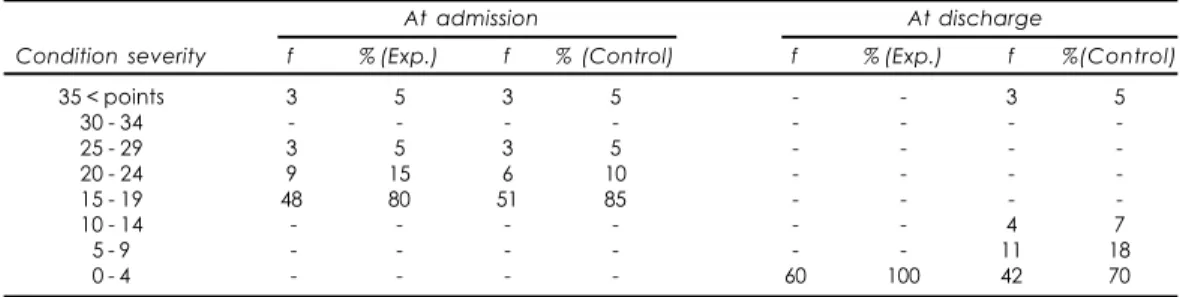
TABLE 4
APACHE-II Patient frequency and percentage distribution at admission and discharge in relation to treatment (all associated comparisons Chi-square p<0.01 at discharge)
At admission At discharge
Condition severity f % (Exp.) f % (Control) f % (Exp.) f %(Control)
35 < points 3 5 3 5 - - 3 5
30 - 34 - - -
-25 - 29 3 5 3 5 - - -
-20 - 24 9 15 6 10 - - -
-15 - 19 48 80 51 85 - - -
-10 - 14 - - - 4 7
5 - 9 - - - 11 18
and percentage data for APACHE-II values of patients at time of admission into the CCU and at discharge. Higher values in these scales denote more severity of the medical condition. Columns under the “At admission” heading include initial data from patients whose nurses would later receive the treatment (Exp.) and those who would not (Control). The statistical comparison between these two sets of data yielded non-significant Chi-Square differences at admission. Data under the “At discharge” heading contain the differences between pa-tients of nurses exposed to the treatment (Exp.) and those who did not (Control). Frequency differences at discharge showed statistical sig-nificance beyond the p<0.01-associated prob-ability value. Table cells containing dashes denote no patients falling in the correspond-ing APACHE-II condition severity-point inter-vals.
Table 5 shows the mean rank scores of pa-tient satisfaction along the ten categories de-fined for the opinion/subjective assessment of patients of their respective nurses’ perfor-mance during the patients stay at the CCU. Data for trained nurses (Experimental) and non-trained nurses (Control) showed Mann-Whitney U test differences associated to probabilities beyond p=0.0009.
The largest differences occurred for the cat-egories related to: understandability of expla-nations to patients (on procedures, health sta-tus, etc.); individualized attention to each tient, and amount of information given to pa-tients. The smallest (although still significant) differences occurred in the categories referring to nurse care as direct health recovery factor and personal helpfulness.
Finally, additional data on patients perceived pain, general interest and ability to engage in activities also showed significant improvement as compared from non-treatment to treatment conditions (p<0.002). Similarly, the modal per-centage of days of stay at the hospital for ex-perimental patients was 23% for the three days value, in contrast to 58% of control patients who stayed for an eight-day modal frequency. Student T test analysis on the total mean of days per conditions yielded a value with an associ-ated probability of p<0.002 in favor of the ex-perimental condition data.
DISCUSSION
The purpose of the present study was to ex-amine the effects of improving nurse-patient interaction on the medical and psychological recovery of patients hospitalized in a critical care unit. The study’s findings showed clini-cally and statisticlini-cally significant improvement of patient recovery and well-being on the ba-sis of an intervention conba-sisting of specialized nurse training. Scores in both instruments and observed behavioral categories designed to assess well-being and improvement along medical and psychological dimensions in-creased only after the intervention was put into effect. Differences could hardly be explained by time passage, general interactive habits by the health team, socio-demographic features of either patients or nurses or previous patient hospitalizations.
In terms of behavioral changes and psycho-logical well-being, measures related to qual-ity of interpersonal interaction appeared clearly linked to the treatment (nurse training). Expres-sions by patients and additional measures of medical conditions showed no significant dif-ferences prior to treatment, but were notice-able differences afterwards. On admission, patients were also similar concerning other variables such as previous number of hospi-talizations, general diagnosis on arrival, APACHE-II and interpersonal interaction scores. In contrast, measures after treatment showed marked improvement apparently re-lated to the intervention package for nurses.
Regarding medical recovery, nearly all the physiological parameters as well as clinical and laboratory data reflected both improvement and stability as an effect of the intervention, in con-trast to those of patients whose nurses were not exposed to it. The actual number of hos-pital stay days also reflected effects seemingly related to the intervention, showing a cumu-lative total of 212 days for patients under the treatment condition as compared to 419 for patients under the control condition. Although a specific analysis of actual hospital costs would be beyond the scope of the present study, it seems only natural to assume that the intervention actually helped reduce hospital expenditures.
gradual increase. After the initial training, sys-tematic feedback along several on-site sessions still produced improved nurse performance. This seems to imply that sustained appropri-ate interaction patterns are not common in everyday nurse-patient work. This would make additional training along specific inter-personal standards a desirable goal for health care systems.
The present findings also suggest the need for a systematic addition of interpersonal train-ing to both nurse education curricula and con-tinuing education programs.
Concerning patients opinion, data showed in-creased values toward normalcy and satisfac-tion with the various features of the nurse-patient relationship associated to the treatment. Patients were more alert, relaxed, depended less on brief-usage prosthetic devices or life support systems.
The findings of the present study confirm and extend previous ones in the sense of showing that an improved nurse-patient inter-action contributes to both psychological and medical recovery. Effects may well operate through such processes as improving interper-sonal competence, reducing stress and anxi-ety, providing comfort and support, and pro-moting therapeutic adherence, among others. The effects of these processes have been pro-posed by several researchers in relation to other instances of health recovery (13). In ad-dition, these results replicate other findings which suggest that improved nurse-patient interaction contribute to reduce the number of stay days, infections in surgical incisions, lev-els of stress and anxiety, as well as costs (1, 3, 5, 10, 15, 19, 20, 31, 33, 34).
The present results also suggest that nurses trained in interpersonal skills tend to be more effective in terms of clinical competence than untrained ones.
Additional informal comments and opinions by both medical personnel and hospital au-thorities at the end of the study consistently pointed out that the trained nurses were more in contact with the patients needs, detected both physiological and psychological problems earlier, had better communication with physi-cians leading to improved joint interventions and increased the time physicians actually spent inside the CCU. Further informal com-ments by hospital officers suggested that dis-semination of the procedures to the hospital
medical personnel could also lead to improved physician-patient interaction and medical effi-ciency.
Participating nurses informally pointed out that they felt more efficient, useful and in better contact with their patients as a result of the intervention. They also said training helped them cope better with the stress associated to staffing the CCU, provided better support to their patients and their family members, were more competent clinically, developed better human relations with the health team and felt better professionals.
Although there is always an open possibil-ity of both methodological errors and improve-ment, several features of the present study were put into effect to help mitigate some al-ternative explanations of the main findings.
Behavioral and psychometric reliability was high, nurses and observers were kept experi-mentally naïve as to any changes expected from the procedures, and automatic recording allowed for repeated assessment of behavioral data. Also, the design (as well as specific pre-cautions) helped isolate the effects of the ex-perimental intervention from other possible confoundings such as time passage or unautho-rized communication between participants under different conditions.
Further attempts to explore this line of re-search could include the analysis of long term maintenance, generalization and collateral ef-fects of improved nurse-patient interaction.
Additional analyses might also involve exam-ining the potential effect of adding physicians to an interactive triad and, in fact, extending the analysis of possible effects to other service areas of hospital care. Such analyses and their respective findings are likely to help improve hospital care especially in a context of chroni-cally scarce resources and occasionally run down facilities and equipment frequently found in Latin American public hospitals.
Health care in countries with these charac-teristics is very likely to benefit from the sys-tematic implementation of interventions based on sound behavioral research.
health psychologists in health care facilities and institutions.
Aknowledgments: Aknowledgments: Aknowledgments: Aknowledgments: Aknowledgments:
The research reported in the present paper was funded through grant IN-304998 from the Research (PAPIIT) Program of Mexico’s National University to the second author.
The authors are gratefully indebted to doctors Pedro Barrios-Santiago and Javier Illán-Torres for their definite support during the attainment of the study, and to doctor Laura Hernández-Guzmán for her com-ments to a preliminary version of the manuscript.
REFERENCES
1. ABDELLAH F, LEVINE E: Developing a measure of patient and personal satisfaction with nursing care. Nurses, (5):100-108, 1993.
2. AGUIRRE GH: Evaluación de la calidad de la atención médica. Revista Instituto Nacional Salud Pública, (8):70-98, 1990.
3. ANDERSON EF: Community as Client: Applications of the Nursing Process. University of Pennsylvania Press. Philadelphia, 1993.
4. BAER DM, WOLF MM, RISLEY TR: Some current di-mensions of applied behavior analysis. J Appl Behav Anal, 1(1):91-97, 1968.
5. BALLARD K: Identification of enviromental stressors for patients in a surgical intensive care unit. Issues Mental Health Nursing, (3):89-108, 1993.
6. BAUM A, NEWMAN S, WEINMAN J, WEST R, MCMANUS C: Cambridge Handbook of Psychology, Health and Medicine. Cambridge University Press. Cambridge, 1997.
7. BEARD M, JOHNSON MN: Nurse theorists ap-proaches in mental health. Psychiatric Nursing, 71-86, 1993.
8. COHEN F: Personality, stress and the development of physical illness. In: Health Psychology: A Handobook. Cohen F, Adler NE (eds.), 77-111 Josey Bass, San Francisco, 1982.
9. CURTIS DA, MARASCUILO LA: Point estimates and confidence intervals for the parameters of the two-sample and matched-pair combined tests for ranks and normal scores. J Exp Edu, 60(3):243-269, 1992. 10. DOLL A: The things patients say about their nurses.
Nurs, (5):113-120, 1979.
11. DONAVEDIAN A: La dimensión internacional de la evaluación y garantía de calidad. Conferencia: Internacional symposium “Perspectivas mundiales sobre la salud”. Boletín Instituto Nacional Salud Pública, 10:70-85, 1990a.
12. DONAVEDIAN A: The Definition of Quality and Ap-proaches to its Assessment. Health Administration Press. Ann Arbor, 1990b.
13. FORCHUCK C: The orientation phase of the nurse-client relationship: Testing Peplau’s theory. J Adv Nurs, 20(3):532-537, 1994.
14. GILLISS CL: Reducing family stress during/after coronary artery bypass surgery. Nurs Clin North Am, 19:103-112, 1993.
15. GUALDA DM: Eu conheco minha natureza: Um estudio etnografico de vivencia do parto:
Universidad de Sao Paulo. Revista Escuela Enfermería, 2:24-40, 1993.
16. HARRIS FC, LAHEY BB: A method for combining occurrence and nonocurrence interobserver agree-ments scores. J Appl Behav Anal, 11(4):523-527, 1978. 17. HORVATH AO: The therapeutic relationship: From transference to alliance. J Clin Psychol, 56(2):163-173, 2000.
18. JACOBS DF: Cost-effectiveness of specialized psy-chological programs for reducing hospital stays and outpatient visits. J Clin Psychol, 43(6):729-735, 1987. 19. JOHNSON M, SEXTON D: Distress during mechani-cal ventilation: Patients’ perceptions. Crit Care Nurs, 19:48-57, 1994.
20. JOYCE A et al.: Role of the nurse in the multidisciplinary team approach to care of liver transplant patients. Mayo Clin Proc, 64:648-698, 1994. 21. KNAUS WA: APACHE II. A severity of disease clas-sification system. Crit Care Med, 13:818-829, 1991. 22. KNAUS WA: APACHE II. Prognostic system, risk
pre-diction of the hospital mortality for critically ill hos-pitalized adults. Chest, 100:1619-1636, 1993.
23. MCDANIEL C, NASH J: Compendium of instruments measuring patient satisfaction with nursing care. Qual Rev Bull, 16(5):182-188, 1994.
24. MINICK P: The power of human caring: Early rec-ognition of patient problems. Sch Inq Nurs Pract, 9(4):303-317, 1995.
25. PEPLAU HE: A conceptual frame of reference for psychodynamic nursing. In: Interpersonal Relations in Nursing. MacMillan, New York, 1988.
26. REDLAND SH: Differences in recovery from cardial surgery. Heart Lung, 19:481-495, 1993.
27. RUIZ DE CHAVEZ M et al.: Bases para la evaluación de la calidad de la atención en las unidades médicas del sector salud. Boletín Instituto Nacional Salud Pública, 13:116-132, 1991.
28. SANCHEZ-SOSA JJ: Psychology and primary preven-tion in public health: Some implicapreven-tions for devel-oping nations and a progress report. In: Health and Clinical Psychology, Sanchez-Sosa JJ (ed.), pp. 403-414, Elsevier Science Publishers, Amsterdam, 1985. 29. SANCHEZ-SOSA JJ: Comportamiento humano y
salud: El papel de la psicología en la atención de problemas básicos de prevención, tratamiento y prospectiva de la salud en México. Higiene, 39:17-20, 1989.
30. SANCHEZ-SOSA JJ, HERNANDEZ-GUZMAN L: Investigación básica y derivación tecnológica en el análisis de la conducta: El difícil pero esencial tránsito del laboratorio a la práctica profesional. Psicología Iberoamericana, 4(2):61-67, 1996. 31. SHERER JL: Health care reform: Nursing´s vision of
change. Hosp, 67(8):20-26, 1993.
32. SSA (Secretaría de Salud): Estadísticas Vitales en Salud: Diez Principales causas de Morbi-mortalidad en México. México, 1992.
33. TEBBIT BU: Strategic planning in nursing.. In: Stra-tegic planning. Stall MK, Pikerton SE (eds.) Aspen Publishers, Gaithersburg, 41-50, 1994.
34. VASON R: Stress effects on patients in critical care units from procedures performed in others. Heart Lung, 9:494-499, 1993.
35. VUORI H: Patients satisfaction: An attitude or indi-cator of the quality of care? Qual Rev Bull, 13(3):106-108, 1993.