1280
First-Principles Calculations of the Electronic and Structural
Properties of GaSb
1E.-E. Castaño-González
a, N. Seña
b, V. Mendoza-Estrada
a, R. González-Hernández
a*,
A. Dussan
b, and F. Mesa
c**
a Grupo de Investigación en Física Aplicada, Departamento de Física, Universidad del Norte, Barranquilla-Colombia b Departamento de Física, Grupo de Materiales Nanoestructurados y sus Aplicaciones,
Universidad Nacional de Colombia-Colombia, Bogotá-Colombia
c Grupo NanoTech, Facultad de Ciencias Naturales y Matemáticas, Universidad del Rosario, Bogotá-Colombia
e-mail: *[email protected], **[email protected] Submitted February 3, 2016; accepted for publication March 1, 2016
Abstract—In this paper, we carried out first-principles calculations in order to investigate the structural and electronic properties of the binary compound gallium antimonide (GaSb). This theoretical study was carried out using the Density Functional Theory within the plane-wave pseudopotential method. The effects of exchange and correlation (XC) were treated using the functional Local Density Approximation (LDA), gen-eralized gradient approximation (GGA): Perdew–Burke–Ernzerhof (PBE), Perdew-Burke-Ernzerhof revised for solids (PBEsol), Perdew-Wang91 (PW91), revised Perdew–Burke–Ernzerhof (rPBE), Armiento–Mattson 2005 (AM05) and meta-generalized gradient approximation (meta-GGA): Tao–Per-dew–Staroverov–Scuseria (TPSS) and revised Tao–PerTao–Per-dew–Staroverov–Scuseria (RTPSS) and modified Becke-Johnson (MBJ). We calculated the densities of state (DOS) and band structure with different XC potentials identified and compared them with the theoretical and experimental results reported in the litera-ture. It was discovered that functional: LDA, PBEsol, AM05 and RTPSS provide the best results to calculate the lattice parameters (a) and bulk modulus (B0); while for the cohesive energy (Ecoh), functional: AM05,
RTPSS and PW91 are closer to the values obtained experimentally. The MBJ, Rtpss and AM05 values found for the band gap energy is slightly underestimated with those values reported experimentally.
DOI: 10.1134/S1063782616100110
1. INTRODUCTION
Knowledge of the physical and chemical properties of the binary compounds are relevant in the design and development of different devices that promote new technologies; among these compounds gallium anti-monide (GaSb) is found, which in recent years has been investigated with growing interest facilitating the fabrication of new electronic devices of great impact [1–4]. Antimonides have attracted greater interest due to their prospective applications in rechargeable lith-ium batteries as anode material [5, 6]. GaSb is a good candidate for the fabrication of thermophotovoltaic cells with low temperature systems [3], as well as in applications in spintronic devices when Mn atoms are introduced in the GaSb matrix [7, 8], super-lattices [9], and spin efficient injectors in semiconductors, among others. In addition, due to their high electronic mobility, antimonide compounds are commonly used in the application of the fabrication of other electronic devices [10, 11].
In this work, the structural and electronic proper-ties of the compound GaSb were studied using Local Density Approximation (LDA) functional and the generalized gradient approximation (GGA), starting with the density functional theory (DFT). A correla-tion between the values obtained using DFT calcula-tions, and the experimental values reported for the gap value and its implications in applications in opto-elec-tronic devices was presented. The band structure and densities of state (DOS) revealed a gap characteristic in the GaSb semiconductor as fundamental indicator within the optical properties of the material.
2. COMPUTATIONAL METHOD
For the structural study and electronic analysis of the GaSb compound, the functional density theory as it is implemented in the computational code VASP (Vienna ab initio simulation package) [12] was used. The effects of the electronic interchange and correla-tion were treated using in the Local Density Approxi-mation (LDA) functional [13], the generalized gradi-ent approximation (GGA) of
Perdew–Burke–Emzer-1The article is published in the original.
hof (PBE) [14], Perdew–Burke–Ernzerhof revised for solids (PBEsol) [15], Perdew–Wang91 (PW91) [16], revised Perdew–Burke–Ernzerhof (RPBE) [17], Armiento–Mattson 2005 (AM05) [18] and the meta-Generalized Gradient Approximation (meta-GGA): Tao–Perdew–Staroverov–Scuseria (TPSS) [19], Revised Tao–Perdew–Staroverov–Scuseria (rTPSS) [21] and modified Becke–Johnson (MBJ) [22], within the DFT.
Calculations were done using optimized values of a
k-point mesh of 8 × 8 × 8, centered in the Γ-point of the Irreducible Brillouin Zone (IBZ) and a cutoff energy of the plane waves was expanded until 800 eV. For the pseudo-potential of gallium (Ga) and antimo-nite (Sb), valence electrons in the states of: Ga (s2p1)
Sb (s2p3) were considered. The position of the system
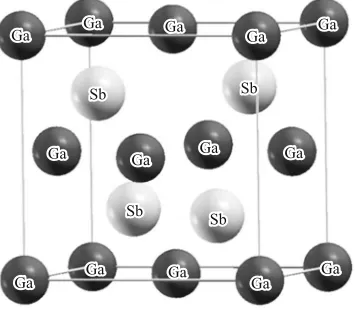
of study was (0, 0, 0) for the Ga atom and (0.25, 0.25, 0.25) for the Sb atom, as shown in Fig. 1. For the den-sity calculation of the states, a k-point screen of 16 ×
16 × 16, and the energy bands of high symmetry paths: L–Γ–X–U, K–Γ in the first zone of Brillouin.
3. RESULTS AND DISCUSSION
The GaSb crystal structure crystal structure was obtained and is presented in Fig. 1.
The crystal structure of GaSb is a GaAs-type (zinc-blende) structure, characterized by the Ga atom position in the corners of the cell and in the center of each one of the faces; while the position of the Sb atoms are given by the symmetric positions considered by (0.25, 0.25, 0.25). Lattice parameters, bulk modu-lus, and its derivations in respect to the GaSb pressure were calculated for the different functionals, adjusting the data with the total energy vs. volume of the unit-cell of the Murnaghan equation of state [23]:
(1)
= + + −
− −
' 0
0 0 0 0
0
0 0 0
1
( ) 1 ,
' ' 1 ' 1
B
B V V B V
E V E
V
B B B
where B0 is the bulk modulus (fundamental property,
since it determines the hardness of the cubic crystals and plays an important role in the establishment of the stability criteria). -its first derivative, V0 is the
vol-ume of equilibrium, and E0 is the energy of
equilib-rium of the structure. The cohesion energy of GaSb was determined using Eq. (2):
(2)
where EGa and ESb are the total energies of the isolated
gallium and antimonide atoms (supercell of 15 Å) respectively. NGa, NSb and NGaSb are the numbers of
atoms of gallium and antimonide within the unit cell and finally Ebulk is the total energy of the GaSb crystal.
The results obtained of the energy of cohesion (Ecoh) vs. volume for the interchange and correlation
[image:2.612.84.265.61.216.2]functionals studied; LDA, PBE, PBEsol, PW91, AM05, rPBE, TPSS and RTPSS, are presented in Fig. 2.
In Fig. 2, a shift of the minimum value of Ecoh
through the different functionals with a value of around 5.00 eV for the functional rPBE going through 6.50 eV (functional PBEsol) and reaching a minimum when the LDA functional (with a value of 7.45 eV) can be observed. The corresponding values to the relative error percentage for each one of the structural param-eters, a, B0, and Ecoh are reported in table. The value
determined using LDA shows a higher energetic sta-bility, which is characteristic of this type of approxi-mation. The variations found for the prediction of the band-gap energy (Egap) of the diverse functionals is
owed to the approximations that were done in the DFT, at the end of the energy of exchange-correlation, underestimate this value. This is a known error of DFT
0'
B
− −
= bulk Ga Ga Sb Sb
coh
GaSb
,
E N E N E
E
[image:2.612.302.545.62.226.2]N Fig. 1. Crystalline structure of the compound GaSb.
Fig. 2. Energy of cohesion as function of the volume of GaSb calculated with different functionals. An intermit-tent vertical line indicates the experimental equilibrium volume.
PBE
150
C
o
h
es
iv
e
en
er
gy,
e
V
–4.0
–7.5 –7.0 –6.5 –6.0 –5.5 –5.0 –4.5
200 250 300 350 400 Volume, Å3
Structural parameters A, volume V0 with one GaSb molecule, volume module B0 and its derivative , energy of cohesion
Ecoh, bandgap energy Egap, energy of Ga-4s states (up and down) and phonon frequencies at Γ-point for the GaSb, calcu-lated with different functionals
A, Å
Err, %
V0, Å3 Err, %
B0, GPa Err, %
Ecoh, eV Err, %
Egap, eV Err, %
E4s-up, E4s-dn, eV
Frequencies at Γ, cm−1 LDA 6.080 224.750 49.40 4.45 7.45 0.398 −9.238 223.332
0.024 0.098 14.07 19.46 103.51 −8.804
PBE 6.260 245.310 41.30 4.02 5.72 0.208 −9.184 229.640 2.840 8.288 36.44 4.89 289.42 −8.503
PBEsol 6.090 225.860 46.20 5.11 6.50 0.428 −9.195 226.411
0.131 0.390 21.96 7.69 89.25 −8.499
PW91 6.259 245.196 41.60 4.01 5.87 0.217 −9.227 229.647 2.820 8.246 35.45 2.21 273.27 −8.576
AM05 6.091 225.977 44.30 5.29 6.00 0.482 −9.146 227.124
0.147 0.442 27.20 0.00 68.04 −8.452
RPBE 6.260 245.314 38.60 4.60 4.93 0.236 −9.129 232.604
2.84 8.290 45.98 21.70 243.22 −8.392
TPSS 6.259 245.196 42.80 3.66 5.74 0.352 −9.294 229.229 2.827 8.246 31.65 4.52 130.11 −8.411
RTPSS 6.090 225.866 44.80 5.33 6.01 0.513 −9.299 228.828
0.131 0.393 25.78 0.16 57.89 −8.436
1.015
MBJ 20.19
Theoretical values reported
A, Å V0, Å3 B0, Gpa Ecoh, eV Egap, eV
E4s-up, E4s-dn, eV
Frequencies at Γ, cm−1 PP-LDA [21] 5.981 213.954 57 4.66 12.14 −9.153,
−8.804 [28] FP-LDA [21] 6.053 221.774 54 4.26 1.85
FP-GGA [21] 6.219 240.525 45 4.02 1.88
HF [21] 6.212 239.714 63 3.53
LMTO [21] 0.47 4.05
PP-PW [21] 0.54 1.64
Experimental values reported
A, Å V0, Å3 , Gpa Ecoh, eV Egap, eV Frequencies at Γ, cm−1 6.082 [22] 224.977 [22] 56.35 [22] 6.00 [24] 0.81 [25] 222.7−230 (ΓTO) [26, 27]
232.6−237 (ΓLO) [26, 27]
0'
B
0'
B
0'
B
0'
in semiconducting compounds type II–IV and III–V, in which there is a systematic tendency for the predic-tion of the band-gap energy in respect to the experi-mental value [20].
The obtained values for the different exchange-correlation functionals are reported in table. The experimental and theoretical results obtained by other GaSb authors in the literature, are also reported for each one of the cases. In Table, the values of the
struc-tural parameters (a, B0) and the energy of cohesion
(Ecoh) can be observed, obtained using eight different
functionals: LDA, PBE, PBEsol, PW91, rPBE, AM05, TPSS and RTPSS. The reported values are in accordance with the experimental [25] and theoretical [24] data reported by other authors. The general ten-dency when approximating the electronic density using only dependent terms of the local density (LDA) of underestimating the value of the lattice parameters (an error of 0.024%) with respect to the experimental values, resulting in an overestimation of the bulk mod-ulus of 49.40 GPa (error of 14.07%) and the energy of cohesion (error of 19.46%). In contrast to LDA,
func-tionals that employ the local density and its local spa-tial variations for the description of the exchange-cor-relation potential (GGA approximation) correct the underestimation (overestimation) of the lattice parameters (bulk modulus and energy of cohe-sion).However, a considerable over-evaluation of the GaSb structural parameters is presented itself. When analyzing the obtained results using the different func-tionals, it was possible to observe that the LDA and PBEsol allowed the calculation of the lattice parame-ters and the bulk modulus in a more precise way. While for the attainment of the energy of cohesion, the use of the PBEsol and RTPSS functionals was more effi-cient, because these values are closer to the experi-mentally and theoretically ones reported in the litera-ture (see table) [24].
The calculations obtained for the energy of cohe-sion in this investigation evidenced the percentages of error in some significant cases, which were 19.46% (LDA), 4.89% (PBE), 7.69% (PBEsol), 2.21% (PW91), 0.00% (AM05), 21.70% (rPBE), 4.52% (TPSS), 0.16% (RTPSS), with respect to the
experi-Fig. 3. Band structures and density of states of GaSb, obtained using the (a) LDA, (b) PBE, (c) PBEsol, (d) PW91, (e) AM05, (f) RPBE, and (g) RTPSS functionals. An intermittent horizontal line indicates the Fermi level.
(a)
(c) (d)
(b) 6
E
−
Ef
,
eV
3
0
−3
−6
−9
−12
6
E
−
Ef
,
eV
3
0
−3
−6
−9
−12
6
10 DOS6 8 4
2 Γ
Γ X
L U, K 10
DOS6 8 4
2 Γ
Γ X
L U, K
10 DOS
8 6 4 2 Γ
Γ X
L U, K 10
DOS 8 6 4 2 Γ
Γ X
L U, K
E
−
Ef
,
eV
Ef
Ef
Ef
Ef
3
0
−3
−6
−9
−12
6
E
−
Ef
,
eV
3
0
−3
−6
−9
[image:4.612.65.537.59.411.2]Fig. 3. (Contd.) 10
DOS 8 6 4 2 Γ
Γ X
L U, K 10
DOS 8 6 4 2 Γ
Γ X
L U, K
10 DOS
8 6 4 2 Γ
Γ X
L U, K
Ef Ef
Ef
6
E
−
Ef
,
eV
3
0
−3
−6
−9
−12
6
E
−
Ef
,
eV
3
0
−3
−6
−9
−12
6
E
−
Ef
,
eV
3
0
−3
−6
−9
−12
mental results. According to the variation of the rigid-ity of the material with the pressure, the calculated
val-ues for the derivative of the bulk modulus agree
with the ones theoretically reported in the literature [24]. However, it was not possible to make a compari-son with any experimental value, because there has been not reported value up to this point. The
disper-sion of the results was relatively minimal, and in
average, it was closed to 4.52, which is a typical value for III–V semiconductors. In table, we also show the
atomic energy levels (up and down) for the 4s-states of
Gallium atom (4s-Ga). We noted that the 4s-Ga
energy levels are very close together and they are in good agreement with LDA results: 9.153 and 8.804 eV [28].
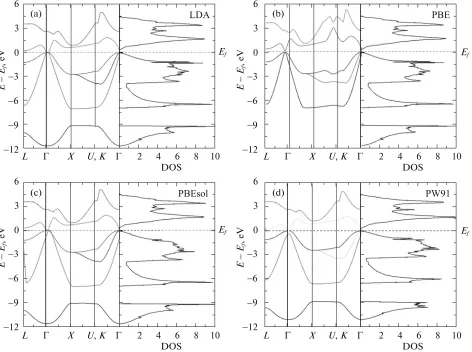
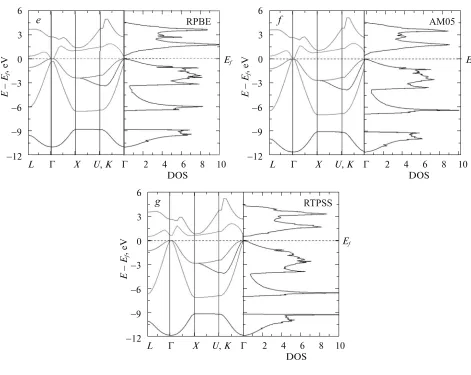
In respect to the electronic properties, Fig. 3 shows the electronic band structure and total density of states (DOS) for the GaSb, where the values of the parame-ters of the calculated lattices were used with every functional (LDA, PBE, PBEsol, PW91, AM05, rPBE,
0'
B
0'
B
TPSS and RTPSS). It can be observed that the band structure and the density of states are qualitatively similar in the energetic position of the electronic states.
Results indicate that the compound GaSb (see
Fig. 3) is a direct compound in Γ–Γ. The band gap
[image:5.612.61.532.52.427.2]energy bands were calculated along the paths: Λ–Γ–
X–Γ, K–Γ in the First Brillouin zone. In all cases, the
Fermi level corresponds to the zero in graphic band structure and density of states (DOS).
In the band structure, it can be observed that the band structure is direct; meaning that the valence band maximum (VBM), and conduction band
mini-mum (CBM) are located at the same k-point (Γ
-point) with energy of 0.398, 0.208, 0.428, 0.217, 0.482, 0.236, 0.352, 0.513 and 1.015 eV, for the functionals: LDA, PBE, PBEsol, PW91, AM05, rPBE, TPSS, RTPSS and MBJ, respectively. These values are sum-marized in table, along with their respective percent-ages of error for each of the functionals. It was clearly observed that the functionals MBJ and RTPSS showed the lowest percentages of error when being compared to the experimental values reported in the literature [26]. In addition, we note the tendency that the approximations LDA and GGA greatly underesti-mate the band gap energy of the GaSb compound, as it has been observed in other type III–V semiconduc-tors.
In table, the values obtained for the phonons at the
Γ-point are also observed, which are close to the
reported values by McGlinn et al. [26] and Aoki et al. [27], by means of Raman spectroscopy. Values
fluctu-ate in a range between 222.7 and 230 cm–1 for TO and
232.6 and 237 cm–1 for LO. However, this study does
not specify what type of phonon mode belongs to the value observed. The comparison between our calcula-tions and the experiment indicated that the computa-tional focus used to determine the vibracomputa-tional proper-ties of the system offer optimum results with experi-mental values.
4. CONCLUSIONS
In this work, the structural and electronic proper-ties of GaSb were studied by means of first-principle calculations, using LDA functionals and the general-ized gradient approximation (GGA) of: PBE, PBEsol, PW91 and meta-GGA: RPBE, AM05, TPSS, RTPSS and MBJ in the DFT.
The structural parameters calculated (A), (V0), (B0)
and the energy of cohesion Ecoh agree with the
experi-mental results reported in the literature. Starting with the different functionals used, it was possible to estab-lish that the LDA and PBEsol functionals provide bet-ter results for the paramebet-ter calculations of the lattice
(A) and the bulk modulus (B0), while for the energy of
cohesion (Ecoh) the functionals were obtained with
closer values than those experimentally reported. The calculated values for the forbidden energy band agree
with the experimentally reported values. However, the functional MBJ shows a lower percentage of error with respect to the experimentally reported values. This work may be used as future reference for theoretical and experimental studies based on GaSb.
ACKNOWLEDGMENTS
We would like to thank Universidad del Norte; Universidad Nacional de Colombia–DIB, with the support through the project Cod. Quipuú N 201010020958-COLCIENCIAS, and Universidad del Rosario.
REFERENCES
1. C. H. Fu, Y. H. Lin, W. C. Lee, T. D. Lin, R. L. Chu, L. K. Chu, P. Chang, M. H. Chen, W. J. Hsueh, S. H. Chen, G. J. Brown, J. I. Chyi, J. Kwo, and M. Hong, Microelectron. Eng. 147, 330 (2015). 2. Zhang Lixue, Sun Weiguo, Xu Yingqiang, Zhang Lei,
Zhang Liang, and Si Junjie, Infrared Phys. Technol. 65, 129 (2014).
3. Ye Hong, Shu Yue, and Tang Liangliang, Solar Energy Mater. Solar Cells 125, 268 (2014).
4. Yang Guandong, Zhu Feng, and Dong Shan, J. Cryst. Growth 316, 145 (2011).
5. J. T. Vaughey, J. O’Hara, and M. M. Thackeray, Elec-trochem. Solid State Lett. 3, 13 (2000).
6. M. Morcrette, D. Larcher, J. M. Tarascon, K. Edström, J. T. Vaughey, and M. M. Thackeray, Electrochim. Acta 52, 5339 (2007).
7. E. Dynowska, J. Bak-Misiuk, P. Romanowski, J. Z. Domagala, J. Sadowski, T. Wojciechowski, S. Kret, B. Kurowska, A. Kwiatkowski, and W. Caliebe, Rad. Phys. Chem. 80, 1051 (2011).
8. A. Wolska, M. T. Klepka, K. Lawniczak-Jablonska, J. Sadowski, A. Reszka, and B. J. Kowalski, Rad. Phys. Chem. 80, 1026 (2011).
9. Sun Wei-Feng, Li Mei-Cheng, and Zhao Lian-Cheng, Superlatt. Microstruct. 49, 81 (2011).
10. N. Liu, G. Y. Gao, J. B. Liu, and K. L. Yao, Comput. Mater. Sci. 95, 557 (2014).
11. N. Liu, G. Y. Gao, J. B. Liu, and K. L. Yao, Phys. B: Condens. Matter 405, 1663 (2010).
12. D. Varshney, G. Joshi, M. Varshney, Swarna Shriya, G. Kresse, and J. Hafner, Phys. Rev. B 49, 14251 (1994).
13. J. P. Perdew and A. Zunger, Phys. Rev. B 23, 5048 (1981).
14. J. P. Perdew, K. Burke, and M. Emzerhof, Phys. Rev. Lett. 77, 3865 (1996).
M. R. Pederson, D. J. Singh, and C. Fiolhais, Phys. Rev. B 46, 6671 (1992).
17. B. Hammer, L. B. Hansen, and J. K. Norskov, Phys. Rev. B 59, 7413 (1999).
18. J. Tao, J. P. Perdew, V. N. Staroverov, and G. E. Scuse-ria, Phys. Rev. Lett. 91, 146401 (2005).
19. P. Scharoch and M. Winiarski, Comput. Phys. Com-mun. 184, 2680 (2013).
20. J. P. Perdew, A. Ruzsinszky, G. I. Csonka, L. A. Con-stantin, and J. W. Sun, Pys. Rev. Lett. 106, 179902(E) (2011).
21. F. Tran and P. Blaha, Phys. Rev. Lett. 102, 226401 (2009).
(1944).
23. R. Ahmed, F. Aleem, S. Javad, H. Rashid, and H. Akbarzadeh, Theor. Phys. 52, 527 (2009).
24. N. N. Sirota and F. M. Gololobov, Sov. Phys. Dokl. 144, 89 (1962).
25. A. H. Reshak, Eur. Phys. and J. B 47, 503 (2005). 26. T. C. McGlinn, T. N. Krabach, M. V. Klein, G. Bajor,
J. E. Greene, B. Kramer, S. A. Barnett, A. Lastras, and S. Gorbatkin, Phys. Rev. B 33, 8396 (1986).
27. K. Aoki, E. Anastassakis, and M. Cardona, Phys. Rev. B 30, 681 (1984).