SERIE DO C UM ENTO S DE TRA BA JO
No . 9 1
Fe b re ro 2 0 1 1
OWNERSHIP STRUCTURE AND RISK AT COLOMBIAN BANKS
Ownership structure and Risk at Colombian banks
Constanza Martínez Facultad de Economía
Universidad del Rosario, Colombia1
Manuel Ramírez
Facultad de Economía Universidad del Rosario, Colombia
Abstract
The separation between ownership and the control of capital in banks
generates differences in the preferences for risk among shareholders and the
manager. These differences could imply a corporate governance problem in
banks with a dispersed ownership, since owners fail to exert control in the
allocation of capital. In this paper we examine the relationship between the
ownership structure and risk for Colombian banks. Our results suggest that
a high ownership concentration leads to higher levels of risk.
Key words: corporate governance and banking risk
JEL: G21, G32, G38, L13
I. Introduction
Most of banking activities involve risk. But, more important than determining its
type is establishing the sources that explain the risk taken by banks in its lending
operations. Cross countries differences in banking risk are usually attributed to financial
regulations represented by the deposit insurance, capital requirements and some other
restrictions. But within countries are required additional criteria further than that related
to financial regulations and the idiosyncratic component to address this matter.
Several empirical studies have pointed the ownership structure as the main culprit
of the differences in risk among banking institutions, since it determines whether or not
the capital owners are able to control the managerial decisions (Saunders, Strock and
Travlos 1990, Anderson and Fraser 2000, Caprio and Levine 2002, García and Robles
1 We would like to thank Natalia Cantor for her research assistance with data processing. The findings,
2 2008). However, other elements such as the market competition and banking size could
also contribute in shaping risk.
The property of Banks can be in hands of few or lots of investors. As Laeven and
Levine (2009) and the Corporate Governance theory suggest, the capacity of owners to
guide managers’ decisions concerning risk depends on the banking property distribution.
The higher the ownership concentration the higher will be the risk in a banking
institution, since capital owners obligate the manager to increase profits by seeking
higher levels of risk. Conversely, in banks with a low property concentration, the
separation between the ownership and the control of capital lead to a problem of
corporate governance that consists in the mismatch of the preferences for risk among
shareholders and the manager. According to Caprio and Levine (2002), small
shareholders fail to exert corporate control on managerial decisions by two main reasons.
The monitoring costs to control the manager are extremely high, so that, shareholders
have no option than accepting his portfolio decisions. Second, the shareholders may lack
of voting rights or are not properly represented in the management board, which
empowers the manager with absolute control over risk. In absence of a compensation
scheme additional to the salary, the manager usually adopts a risk adverse position in
controlling the capital by selecting a more conservative but less profitable portfolio.
The type of banking investors could also represent an extra source of risk
disparities among institutions, since banks can be private or publicly owned. According
to García and Robles (2008) government owned banking institutions lead to higher levels
of risks by conceding more credits to finance projects of their specific interests, and at
more flexible conditions than those offered elsewhere.
Likewise, lending operations crucially depend on the size of the banking firm and
the actions taken by other market competitors.
Concerning the Banking operating scale, the related literature had identified two
conflicting effects on risk. The argument of a negative association between size and risk
affirms that banks of large size may finance riskier credits without entering in immediate
problems of liquidity. Besides, their portfolios are more diversified representing higher
proceeds than those perceived by smaller institutions (Saunders, Strock and Travlos 1990,
3 positive association between banking size and risk is based on the premise “Too big to
fail”, which asserts that the deposit insurance measure, used by regulators to guarantee
the stability of the banking system, may have a perverse effect since large banks may
have incentives to choose riskier portfolios (Chumacero and Langoni 2001, and García
and Robles 2008).
In addition to the mentioned above, the type of market could affect the banking risk
by affecting the interest rates (Caprio and Levine 2002, Boyd and De Nicoló 2005, Boyd,
De Nicoló and Jalal 2006, and Nicoló and Loukoianova 2007). According to Boyd and
De Nicoló (2005), this variable could have two opposing effects. From one side, a high
market concentration (low competition) reduces the interest rates paid to deposits, which
increase profits, and allows risk reductions. From the other side, a market with low
competition leads to increments in the interest rates charged to credits, generating a
profits reduction by the nonperforming loans growth, which obligates the manager to
increase risk.
In order to determine the main sources of risk in Colombian banks we empirically
test three hypotheses:
i) A concentrated banking property leads to higher risk;
ii) Banking size and risk are negatively associated;
iii) An increasing market competition reduces the corporate governance problem,
also implying higher levels of risk.
In this paper we study the banking risk as a function of the ownership structure, size
and the market competition along with some traditional banking variables for Colombia.
Our estimations for data between 1989 and 2009 for banks and CAVS (Savings and
Housing Corporations) coincide with previous results in the financial literature, related to
these variables as the main sources of risk.
To our knowledge, this is the first attempt to investigate the differences in
Colombian banking risk using the ownership structure. Our empirical results suggest that
risk is higher in ownership concentrated and large size banks; but decreases with the
variable of market competition. In essence, banking risk depends on the side that controls
the capital (manager or owners), but the operating scale and the actions taken by other
4 This paper is divided into four sections, including this introduction. Sections II and
III contain the variables constructed, a general analysis on data, and the model and the
estimation method conducted. The results and final remarks are presented in Section IV.
II. Data
The Savings and Housing corporations (CAVS) began to partake in the financial
market in 1972, following a government policy which purpose was to stimulate the
construction sector by financing the domestic housing acquisition. In 1993 a government
reform (Law 35/1993) approved that, in addition to the housing market, CAVS could also
grant credits for consumption, which permitted them compete as equal with banks in the
markets of credits and deposits. By the end of 90’s and the beginning of 2000 some
CAVS were acquired by banks, others became banks, and quite a few were liquidated due
to solvency problems2. For these reasons we considered banks and CAVS similar
institutions in the domestic financial market.
We used yearly data for Colombian banks and CAVS between 1989 and 2009 from
the Profit and Loss Statements, Balance Sheets and the First Level Shareholders registers
reported by each banking institution to Superfinanciera3.
As dependent variable, we computed an ex-post measure of credit risk (RISK) that
is explained by the ratio of non-performing loans to total Loans. We recognize that other
measures of risk based on the Market risk approach could allow the identification of the
specific risk of each entity and the risk related to the market. However, that measure
could be underestimating the total banking risk in Colombia since quite a few banks are
trading their shares in the local Stock Exchange Market.
The Banking ownership structure is analyzed in several ways. First, we constructed
a Herfindhal Hirschman index of shares concentration per bank, termed OWNER_HHI.
As the index moves towards unity an extreme concentration in shares emerges implying a
2 The domestic market of credits has been supplied by a variable number of banking institutions. During the
90s its total number averaged 37, but with a non-trivial increase of 4 institutions between 1994 and 1997. The changing nature in CAVS in the beginning of 2000 along with the banking mergers, acquisitions and liquidations entailed a fall in the number banks from 29 in 2002 to 18 in 2009.
3 The Financial Superintendence “Superfinanciera” is a governmental organism that exerts control,
5 bank under the control of its owners. The higher the index of shares concentration, the
stronger would be the pressure exerted by major owners over managers to increase
profits, by increasing risk.
Besides the property concentration, we considered two dummy variables in terms of
the type of capital invested. The Dum_foreign takes the value of one for banks with
more than 50% of its capital shares in hands of foreign investors and zero otherwise. In a
similar way, the Dum_govern captures banks with prominent government participation
(higher than 50%), mainly represented by public banks, banks intervened and those that
experienced liquidation processes.
The scale of banking operations is captured by the variable SIZE, measured as the
natural logarithm of total Assets. To account for differences in the banking size, we
classified banks in small and large, with the Ward’s method that we computed based in
the natural logarithm of the total assets. For the computation of this clustering method we
used the squared Euclidean distance, given that this alternative minimizes the loss of
information that may result from the grouping procedure. Considering jointly the groups
by size and the type of investors, we found that Large Banks are mostly represented by
private capital (88.7%) and the Small banks are mainly foreign (63.2%). In regard to this
last characteristic, we constructed an additional variable that captures the interaction
between this group and the type of capital invested (Small & foreign).
Graph 1 Ownership concentration by banking size
(Moving average)
0.0 0.1 0.2 0.3 0.4 0.5 0.6 0.7 0.8 0.9
1992 1993 1994 1995 1996 1997 1998 1999 2000 2001 2002 2003 2004 2005 2006 2007 2008 2009 Large banks Small banks
6 Since the mid of the 90’s the ownership concentration have been increasing for
both banking sizes, presumably by the processes of acquisitions, liquidations and mergers
that turned even more pronounced between the end of 1990’s and the beginning of 2000.
But, the concentration in the banking property had been larger for small banks (Graph 1).
We also constructed an index of market concentration (MARKET) following the
Herfindahl Hirschman method. This index can be computed for assets and passives, since
banks compete for credits and deposits. However, we calculated this index only for the
assets side, because our main interest is centred on the risk of failure. From Graph 2 is
clear that market concentration has been increasing, a trend that coincides with a decline
in the number of banks, which passed from 34 in 2004 to 18 in 2009.
Graph 2 Index of Market concentration
0,00 0,02 0,04 0,06 0,08 0,10 0,12
1990 1991 1992 1993 1994 1995 1996 1997 1998 1999 2000 2001 2002 2003 2004 2005 2006 2007 2008 2009
Calculations by the authors. Source of data: Superfinanciera
Additionally, we included other variables in order to control for the most traditional
banking characteristics. The PROFITS variable is an operating margin measure that was
constructed as lagged one year value of the ratio between net Operational incomes and
total Assets. The LIQUIDITY indicator is represented by the ratio of Bank liquid Assets
and total liquid Liabilities; and the Loans growth variable (LOAN) is a discrete annual
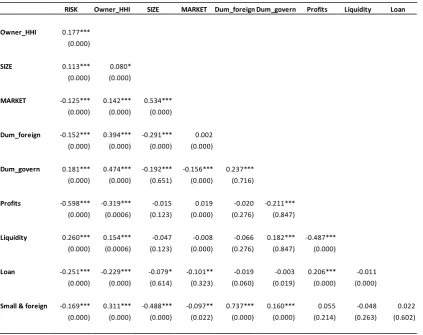
7 Notice in Table 1 that our measure of risk and the variables of ownership, Size and
Market competition are strongly associated (at 1%). The correlation matrix also shows
that overall risk is higher in ownership concentrated banks and in those that are of a large
[image:8.595.89.513.231.566.2]size. Conversely, risk is lower in small foreign owned banks.
Table 1 Correlation matrix of variables- All banks
RISK Owner_HHI SIZE MARKET Dum_foreign Dum_govern Profits Liquidity Loan
Owner_HHI 0.177***
(0.000)
SIZE 0.113*** 0.080*
(0.000) (0.000)
MARKET ‐0.125*** 0.142*** 0.534***
(0.000) (0.000) (0.000)
Dum_foreign ‐0.152*** 0.394*** ‐0.291*** 0.002
(0.000) (0.000) (0.000) (0.000)
Dum_govern 0.181*** 0.474*** ‐0.192*** ‐0.156*** 0.237***
(0.000) (0.000) (0.651) (0.000) (0.716)
Profits ‐0.598*** ‐0.319*** ‐0.015 0.019 ‐0.020 ‐0.211***
(0.000) (0.0006) (0.123) (0.000) (0.276) (0.847)
Liquidity 0.260*** 0.154*** ‐0.047 ‐0.008 ‐0.066 0.182*** ‐0.487***
(0.000) (0.0006) (0.123) (0.000) (0.276) (0.847) (0.000)
Loan ‐0.251*** ‐0.229*** ‐0.079* ‐0.101** ‐0.019 ‐0.003 0.206*** ‐0.011
(0.000) (0.000) (0.614) (0.323) (0.060) (0.019) (0.000) (0.000)
Small & foreign ‐0.169*** 0.311*** ‐0.488*** ‐0.097** 0.737*** 0.160*** 0.055 ‐0.048 0.022
(0.000) (0.000) (0.000) (0.022) (0.000) (0.000) (0.214) (0.263) (0.602)
Source: Author's calculations
P‐values in parenthesis; significant at ***(1%) ,**(5%), *(10%), respectively
III. Model and Empirical Results
We empirically estimate equation (2):
8
Xit: is a matrix that includes all banking characteristics for bank i at time t. The
coefficient estimates vectors are captured by β, φ, λ, δ, θ, and γ. In order to control for
changes in the average level of risk we estimated fixed effects models; and alternatively
we estimated models of random effects. In all specifications the Hausman test signalled
the random effects as the appropriate model to address the unobserved individual
heterogeneity.
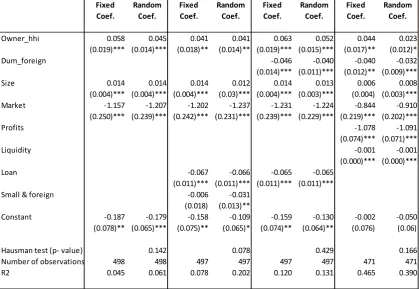
In Table No. 2 we present evidence of the main determinants of banking risk. Most
of our results are significant at 1% level, and most of them display the expected
[image:9.595.88.508.349.638.2]association with the dependent variable.
Table 2 Empirical Results- All Banks
Fixed Random Fixed Random Fixed Random Fixed Random Coef. Coef. Coef. Coef. Coef. Coef. Coef. Coef.
Owner_hhi 0.058 0.045 0.041 0.041 0.063 0.052 0.044 0.023
(0.019)*** (0.014)*** (0.018)** (0.014)** (0.019)*** (0.015)*** (0.017)** (0.012)*
Dum_foreign ‐0.046 ‐0.040 ‐0.040 ‐0.032
(0.014)*** (0.011)*** (0.012)** (0.009)***
Size 0.014 0.014 0.014 0.012 0.014 0.013 0.006 0.008
(0.004)*** (0.004)*** (0.004)*** (0.03)*** (0.004)*** (0.003)*** (0.004) (0.003)***
Market ‐1.157 ‐1.207 ‐1.202 ‐1.237 ‐1.231 ‐1.224 ‐0.844 ‐0.910
(0.250)*** (0.239)*** (0.242)*** (0.231)*** (0.239)*** (0.229)*** (0.219)*** (0.202)***
Profits ‐1.078 ‐1.091
(0.074)*** (0.071)***
Liquidity ‐0.001 ‐0.001
(0.000)*** (0.000)***
Loan ‐0.067 ‐0.066 ‐0.065 ‐0.065
(0.011)*** (0.011)*** (0.011)*** (0.011)***
Small & foreign ‐0.006 ‐0.031
(0.018) (0.013)**
Constant ‐0.187 ‐0.179 ‐0.158 ‐0.109 ‐0.159 ‐0.130 ‐0.002 ‐0.050
(0.078)** (0.065)*** (0.075)** (0.065)* (0.074)** (0.064)** (0.076) (0.06)
Hausman test (p‐ value) 0.142 0.078 0.429 0.166
Number of observations 498 498 497 497 497 497 471 471
R2 0.045 0.061 0.078 0.202 0.120 0.131 0.465 0.390
Source: Author's calculations
Standard errors on parenthesis ***(1%) ,**(5%), *(10%), respectively
The overall banking risk and its ownership structure are linked by a positive and
9 banks it is evident that shareholders have corporate control over the manager, exerting
pressure to increase proceeds by opting for riskier portfolios. These results are consistent
with previous findings of Saunders, et al (1990), Caprio and Levine (2002), and García
and Robles (2008) according to which a high property concentration lessens the conflict
of interests among the manager and the capital owners. Even when we controlled for
bank specific characteristics, the positive association between property’s concentration
and risk remains unchanged and significant.
Concerning the Banking Size in our estimations we identified a positive and
significant association with risk, which supports the premise “too big to fail”, but at the
same time contradicted our second hypothesis. In essence, this outcome suggests that
shareholders of large banks can successfully exert corporate control on managerial
decisions.
In relation to the market competition, our results disagree with our third hypothesis
since we identified a negative association with risk. In regard to this outcome, we noticed
that the effect of the market of deposits dominates, implying that the market
concentration decrease the interest rates paid to deposits, which increases profits and
reduces risk.
Regarding the control variables, we identified the expected results concerning
banking risk. As expected, a raise in the lagged one year value of profits and the growth
rate of loans lead to risk reductions. The effect of liquidity on risk though negative is
extremely small.
The effects of the additional variables of ownership are as follows:
Banks with a prominent foreign participation in their property prefer lower levels of
risk, suggesting that managers are the capital controllers, and that their portfolio decisions
represent risk reductions. This negative association is confirmed when we considered the
interaction with the group of small banks, given that most of foreign banks are small in
relation to the rest of market competitors.
The relationship between the government participation in the banking ownership
and risk is insignificant. A plausible explanation might be that most of Colombian
government owned banks are those that experienced temporary interventions due to
10 the government may not reflect the conflict of interests among the manager and owners,
but instead, the relation between the owner (government) and their employees
(managers). For this reason, we estimated again the model presented in equation 2
excluding all government owned banks; and most of our results remain unchanged and
[image:11.595.90.510.259.532.2]significant (Table 3).
Table 3 Empirical Results- Excluding government owned banks
Fixed Random Fixed Random Fixed Random Fixed Random Coef. Coef. Coef. Coef. Coef. Coef. Coef. Coef.
Owner_hhi 0.031 0.022 0.034 0.028 0.023 0.021 0.024 0.021
(0.012)*** (0.011)** (0.013)*** (0.012)** (0.014)* (0.012)* (0.014)* (0.012)*
Dum_foreign ‐0.007 ‐0.011 ‐0.012 ‐0.010 ‐0.018 ‐0.013
(0.011) (0.009) (0.011) (0.009)** (0.012) (0.009)
Size 0.016 0.015 0.016 0.016
(0.003)*** (0.002)*** (0.003)*** (0.002)***
Market ‐0.535 ‐0.498 ‐0.529 ‐0.492 ‐1.014 ‐1.011 ‐1.094 ‐1.083
(0.121)*** (0.118)*** (0.121)*** (0.118)*** (0.143)*** (0.141)*** (0.139)*** (0.137)***
Liquidity ‐0.029 ‐0.027 ‐0.030 ‐0.027 ‐0.020 ‐0.017
(0.008)*** (0.008)*** (0.008)*** (0.008)*** (0.008)*** (0.008)**
Loan ‐0.046 ‐0.045 ‐0.046 ‐0.045
(0.007)*** (0.007)*** (0.007)*** (0.007)***
Small & foreign 0.019 0.005
(0.012) (0.011)
Constant 0.089 0.090 0.089 0.090 ‐0.214 ‐0.202 ‐0.228 ‐0.210
(0.008)*** (0.010)*** (0.008)*** (0.010)*** (0.048)*** (0.043)*** (0.049)*** (0.044)***
Hausman test (p‐ value) 0.067 0.061 0.461 0.085
Number of observations 429 429 429 429 430 430 431 431
R2 0.046 0.056 0.034 0.027 0.040 0.045 0.0183 0.0636
Source: Author's calculations
Standard errors on parenthesis ***(1%) ,**(5%), *(10%), respectively
However, the previously identified preference of foreign banks for portfolios of low
risk disappears, even when we considered the joint effect of size and the origin of capital
investors, captured by the Small & foreign dummy variable.
Conclusions:
Corporate governance theory asserts that the ownership structure effects on banking
11 dispersed ownership the lack of corporate governance by owners empowers the manager
with absolute control on banking capital. In absence of the pressure exerted by owners,
the manager usually chooses a low risk portfolio. But, in a property concentrated bank,
the owners obligate the manager to increase profits, increasing risk. In this way, a
concentrated ownership structure lessens the conflict of interests among the manager and
owners, but increases the risk. Our results support these arguments, but also identified
that banking risk depends on other elements such as size and the market competition;
even when we excluded government owned banks.
In relation to size, we found that large banks prefer higher levels of risk, a result
that supports the premise “too big to fail”; according to which some regulatory measures
could generate undesirable effects on banking portfolios. Our results impeded us to go
beyond on this subject but suggest an interesting path to explore further.
Regarding the market variable, we found a negative effect on risk, suggesting that
the deposit effect dominates Colombian banking activities.
References
Anderson R., and Fraser D. (2000) “Corporate control, bank risk taking, and the health of
the banking industry” Journal of Banking and Finance24, 1383 - 1398
Boyd J., and De Nicoló G. (2005) “The theory of bank risk taking and competition
revisited” Journal of Finance, Vol. 60, 1329 - 1343
Boyd J., De Nicoló G., and Jalal A. (2006) “The theory of bank risk taking and competition revisited: New Theory and New Evidence” IMF Working Paper 297
Boyd J., and Runkle D. (1993) “Size and Performance of Banking Firms” Journal of
Monetary Economics 31
Caprio G., and Levine R. (2002) “Corporate governance in Finance: concepts and international observations” paper prepared for the 2002 World Bank, IMF and Brookings institution conference
Caprio G., Laeven L., and Levine R. (2007) “Governance and bank valuation” Journal of
Financial Intermediation 16, 584 – 617
12 Demsetz R., and Strahan P. (1997) “Diversification, size and risk at Bank holding
companies” Journal of Money Credit and Banking 29, 300 - 313
Demsetz R., Saidenberg M., and Strahan P. (1997) “Agency problems and risk taking at
banks” Federal Reserve Bank of New York, Research paper No, 9709
De Nicoló G., and Loukoianova E. (2007) “Bank ownership, Market structure and risk” IMF Working Paper 215
García T., and Robles M. (2008) “Risk-taking behaviour and ownership in the banking
industry: The Spanish evidence” Journal of Economics and Business 60, 332 – 354
Laeven L., and Levine R. (2009) “Bank governance, regulation and risk taking” Journal
of Financial Economics 93, 259-275
Saunders A., Strock E., and Travlos N. (1990) “Ownership structure, Deregulation and