FROM THE PROJECTED TO THE TRANSMITTED IMAGE: THE 2.0 CONSTRUCTION OF TOURIST DESTINATION IMAGE AND IDENTITY IN
CATALONIA
Estela Mariné Roig
Dipòsit Legal: T-543-2014
ADVERTIMENT. L'accés als continguts d'aquesta tesi doctoral i la seva utilització ha de respectar els drets de la persona autora. Pot ser utilitzada per a consulta o estudi personal, així com en activitats o materials d'investigació i docència en els termes establerts a l'art. 32 del Text Refós de la Llei de Propietat Intel·lectual (RDL 1/1996). Per altres utilitzacions es requereix l'autorització prèvia i expressa de la persona autora. En qualsevol cas, en la utilització dels seus continguts caldrà indicar de forma clara el nom i cognoms de la persona autora i el títol de la tesi doctoral. No s'autoritza la seva reproducció o altres formes d'explotació efectuades amb finalitats de lucre ni la seva comunicació pública des d'un lloc aliè al servei TDX. Tampoc s'autoritza la presentació del seu contingut en una finestra o marc aliè a TDX (framing). Aquesta reserva de drets afecta tant als continguts de la tesi com als seus resums i índexs.
ADVERTENCIA. El acceso a los contenidos de esta tesis doctoral y su utilización debe respetar los derechos de la persona autora. Puede ser utilizada para consulta o estudio personal, así como en actividades o materiales de investigación y docencia en los términos establecidos en el art. 32 del Texto Refundido de la Ley de Propiedad Intelectual (RDL 1/1996). Para otros usos se requiere la autorización previa y expresa de la persona autora. En cualquier caso, en la utilización de sus contenidos se deberá indicar de forma clara el nombre y apellidos de la persona autora y el título de la tesis doctoral. No se autoriza su reproducción u otras formas de explotación efectuadas con fines lucrativos ni su comunicación pública desde un sitio ajeno al servicio TDR. Tampoco se autoriza la presentación de su contenido en una ventana o marco ajeno a TDR (framing). Esta reserva de derechos afecta tanto al contenido de la tesis como a sus resúmenes e índices.
Estela Mariné Roig
FROM THE PROJECTED TO THE TRANSMITTED IMAGE:
THE 2.0 CONSTRUCTION OF TOURIST DESTINATION IMAGE AND IDENTITY IN CATALONIA
DOCTORAL THESIS
Supervised by Prof. Dr. Salvador Anton Clavé
Geography Department
Research group on territorial analysis and tourism studies (GRATET)
DECLARATION
I hereby declare that this is entirely my own work and that it has not been submitted as an exercise for the award of a degree at this or any other University. I agree that the Library may lend or copy this dissertation on request.
FAIG CONSTAR que aquest treball, titulat “From the Projected to the Transmitted Image: The 2.0 Construction of Tourist Destination Image and Identity in Catalonia”, que presenta Estela Mariné Roig per a l’obtenció del títol de Doctor, ha estat realitzat sota la meva direcció al Departament de Geografia d’aquesta universitat i que acompleix els requeriments per poder optar a Menció Europea.
Tarragona, 19 de maig de 2013
ACKNOWLEDGEMENTS
Firstly, I would like to thank my thesis supervisor, Professor Dr. Salvador Anton Clavé, for his helpful advice, guidance, dedication, teachings and support throughout these years. I would also like to thank the members of the GRATET (Research Group on Spatial Analysis and Tourism Studies)* and other URV scholars for their support and advice. In addition,I would like to express my sincere appreciation to Isabel Cortés and all of the other scholars of the Christel Dehaan Tourism and Travel Research Institute of Nottingham University who counselled me during my PhD internship abroad.
Special thanks to Esteve Mariné Gallisà for his expert Information Technology support and advice throughout this thesis.
Thanks also to my family, my father, mother and sister, and my friends for their permanent backing and encouragement. Finally, many thanks to my partner Nikos for his unconditional support, patience and faith in me.
* The research that this PhD is based on is part of the following projects:
1) Turismo, movilidad residencial y competitividad territorial. Respuestas locales a las dinámicas de cambio global. Entidad financiadora: Ministerio de Ciencia e Innovación
CSO2011-23004/GEOG. Duración: 2012-2014
2) Innovación territorial y modelos de desarrollo en destinos turísticos litorales. Análisis a diferentes escalas espaciales. Entidad financiadora: Ministerio de Ciencia e Innovación
CSO2008-01699/GEOG. Duración: 2009-2011
ABSTRACT
This thesis aims to explore online projected and perceived images of a tourist destination, to assess their mutual correspondence, and to shed light on the role of online user-generated images in destination image formation. It also seeks to analyse the spatial distribution of image by tourists and the complex image identity issues concerning a destination. To achieve this, online image sources regarding the case study of Catalonia were analysed through massive computerized quantitative content analysis of some 25,000 travel blog and review entries (perceived image) and around 3,000 official tourism webpages (projected image). The results showed significant dissonance between tourists’ images and official images of the destination in several aspects, notably its attraction factors and cultural identity. Tourists' destination images were found to be greatly concentrated on certain elements and spaces. Finally, this thesis proposes the concept of "transmitted image" to reflect the new central role of tourists’ online images in the creation, dissemination and formation of destination image.
Keywords: tourist destination image; destination identity; online image; perceived image; projected image; transmitted image; travel blog; travel review; official tourism websites; Web 2.0; quantitative content analysis; Catalonia
RESUM
Aquesta tesi té com a objectiu el d’explorar les imatges projectades i percebudes online d’una destinació turística, examinar la seva correspondència mútua, i contribuir a aclarir el rol de les imatges online generades pels usuaris en la formació de la imatge d’una destinació. Amb aquests propòsits, es van analitzar fonts d’imatge online sobre el cas d’estudi de Catalunya a través d’una anàlisi computeritzada quantitativa de contingut massiu d’aproximadament 25.000 entrades de travel blogs i travel reviews (imatge percebuda) i aproximadament 3.000 pàgines de webs oficials (imatge projectada). Els resultats mostren que hi ha una dissonància important entre les imatges dels turistes i les imatges oficials de la destinació en diversos aspectes, notablement en els seus factors d’atracció i identitat cultural. S’ha trobat que les imatges dels turistes sobre la destinació estaven altament concentrades en certs elements i espais. Finalment, aquesta tesi proposa el concepte d’ “imatge transmesa” per tal de reflectir el nou rol central de les imatges online dels turistes en la creació, disseminació i formació de la imatge d’una destinació.
PUBLICATIONS DERIVED FROM THE THESIS
Marine-Roig, E. (2009). Discussing the role of authenticity and identity in a mass tourism destination’s image construction. In Christel DeHaan Tourism and Travel Research Institute (Ed.), PhD Networking Conference "Exploring Tourism III: Issues in PhD Research" (pp. 159-175). University of Nottingham, UK
Marine-Roig, E. (2010). Los “Travel Blogs” como objetos de estudio de la imagen percibida de un destino [Travel Blogs as objects of study of the perceived image of a
destination]. In EU Turismo de Málaga (Ed.), TuriTec 2010. VII Congreso Nacional (pp. 61-75). University of Malaga, Spain
Marine-Roig, E. (2011a). The image and identity of the Catalan coast as a tourist destination in twentieth-century tourist guidebooks. Journal of Tourism and Cultural Change, 9(2), 118-139
Marine-Roig, E. (2011b). Innovation and identity in Barcelona’s tourist image as represented by souvenirs. Catalan Journal of Communication and Cultural Studies, 3(2), 175-194
Marine-Roig, E. & Anton, S. (2011). The evolution of the image of Catalan coastal
destinations. In L. Prats (Ed.), Researching Coastal & Resort Management: Cultures and histories of Tourism (pp. 146-170). Bloomington, USA: Palibrio.
Marine-Roig, E. (in press, accepted January 3, 2013). A webometric analysis of travel blogs and reviews hosting: the case of Catalonia. Journal of Travel & Tourism Marketing.
TABLE OF CONTENTS
Declaration
Certificate of the PhD supervisor Acknowledgements
Abstract
Publications derived from de thesis Table of contents
0. INTRODUCTION ... A. Aims and hypotheses
B. Structure and contents of the thesis
1. THEORETICAL FRAMEWORK ... 1.1. Introduction: the relationship between place, identity, image and tourism
1.1.1. What is tourist image?
1.1.2. The tourist destination image construct and its formation 1.2. The traditional view of tourist image: projected vs. perceived image
1.2.1. Projected image
1.2.1.1. The agents projecting image and Gartner’s classification 1.2.1.1.1. Intentionality and power
1.2.1.1.2. Ideology and discourse 1.2.1.2. Destination image identity
1.2.1.2.1. Identity: the content of image representations
• Definition and types of image identity
• Relationship of represented identity and place identity
• The dual role of tourist image towards cultural identity 1.2.1.2.2. Stereotypes as part of destination image identity 1.2.1.2.3. Political strategies
• Tourist image and place identity uniformization • Tourist image used for local culture enhancement 1.2.1.3. The economy of identity: branding
1.2.2. Perceived image 1.2.2.1. Definition
1.2.2.2. Perceived image components
• Cognitive component
• Affective component
• Conative component
• Spatial or orientational component
1.2.2.3.1. Secondary information sources 1.2.2.3.2. Primary information sources 1.2.2.3.3. Personal factors
1.2.2.4. Temporal dimension of perceived image
• Pre-visit image
• On-site image and transitional phases
• Post-visit image
1.2.3. Projected and perceived image mutual influence and image reproduction
1.3. Tourist image online
1.3.1. The context of online image communication 1.3.2. Agents projecting image online
1.3.2.1. Adaptation of Gartner’s classification considering online agents
1.3.2.2. Image or information dissemination online 1.3.3. Image dissonance and congruency
1.3.3.1. Representative dissonance
1.3.3.2. Congruency between projected and perceived images 1.3.4. Web 2.0
1.3.4.1. Characteristics of web 2.0
1.3.4.1.1. User-generated content and e-wom 1.3.4.1.2. Harnessing the power of the crowds 1.3.4.1.3. Other characteristics
1.3.4.2. Intentionality and power struggles in image projection with web 2.0
1.3.5. User-generated image vs. official image 1.3.5.1. Devices within web 2.0
1.3.5.2. Travel blogs
1.3.5.2.1. Blogs expansion, characteristics and aspects 1.3.5.2.2. What are travel blogs?
1.3.5.2.3. Motivations and reasons to blog 1.3.5.2.4. Previous studies on travel blogs
1.3.5.2.5. Travel blogs as objects for perceived image research 1.3.5.2.6. Travel blogs as spaces for projected image
1.3.5.3. User-generated travel reviews 1.3.5.4. Official tourism websites
1.3.5.4.1. Official tourism websites as image and information sources
1.3.5.4.2. Themes and what is transmitted within official websites
1.3.5.4.3. Potential influence of official tourism websites
1.3.6. Perceived tourist image becomes projected through user-generated content
2. METHODOLOGY ... 2.1. Case study
2.2. Database
2.2.1. Data sources
2.2.1.1. Official tourism websites
2.2.1.2. Specialized websites hosting travel blogs and reviews 2.2.2. Data collection
2.2.3. Data download 2.2.4. Data arrangement 2.2.5. Data cleaning 2.2.6. Data debug 2.2.7. Data language 2.2.8. Data mining
2.2.9. Data dissemination 2.3. Content analysis
2.3.1. Analysis technique selection 2.3.2. Definition, aspects and elements 2.3.3. The receptacle of content analysis 2.3.4. Quantitative vs. qualitative approach
2.3.5. How to content analyse the object of study in relation to the sample
2.3.6. Interpretation 2.3.7. Meaning unveiling
2.3.8. The process of content analysis 2.3.9. Selection of the categories of analysis 2.3.10. Key words within categories
2.3.11. Analysis units and counting or measuring system 2.3.12. Selection of Site Content Analyzer software 2.4. Analysis performance
2.4.1. First level of database analysis 2.4.2. Second level of database analysis
2.4.2.1. Selecting travel blogs and reviews only in English 2.4.2.2. Words groups (total databases)
2.4.2.3. Matrix with content categorization (file-per-file)
• Descriptive statistics per file • Pearson correlation
• Cluster analysis
2.4.2.4. Zoom into a certain subject through “regular language”
2.4.3. Third level of database analysis
2.4.3.1. User-generated image per brands 2.4.3.2. Spatial indexes
3. EMPIRICAL RESEARCH ... 3.1. Database
3.1.1. Data sources
3.1.1.1. Official tourism websites 3.1.1.2. Travel blogs and reviews 3.1.2. Data collection and download
3.1.2.1. Official tourism websites 3.1.2.2. Travel blogs and reviews 3.1.3. Data arrangement
3.1.3.1. Per ending or subject 3.1.3.2. Per years
3.1.3.3. Per months 3.1.3.4. Per brands 3.1.4. Data language 3.1.5. Data mining
3.1.6. Data dissemination 3.1.6.1. Indexed pages
• Official tourism websites • Travel blogs and reviews
3.1.6.2. Presence in social media
• Official tourism websites • Travel blogs and reviews
3.1.6.3. Link-based ranks
3.1.6.4. Geographical distribution of users 3.1.6.5. Visit-based ranks
3.2. Results
3.2.1. Compared results between official tourism websites and travel blogs and reviews
3.2.1.1. Main descriptive results 3.2.1.1.1. Most frequent words 3.2.1.1.2. Gaudí and his masterpieces 3.2.1.1.3. Catalan tourist brands and towns
• Tourist brand presence with reference to the total databases
• Brands’ descriptive statistics per file • Correlations between the brands
3.2.1.2. Tourism attraction factors of Catalonia
3.2.1.2.1. General attraction factor presence with reference to the total databases
3.2.1.2.2. Specific attraction factors with reference to the total databases
3.2.1.2.3. Attraction factors presence per files 3.2.1.2.4. Correlations between attraction factors 3.2.1.3. Feelings and dichotomies
3.2.1.3.1. Feelings and dichotomies with reference to the total databases
3.2.1.3.2. Feelings and dichotomies presence per file 3.2.1.3.3. Correlations between feelings and dichotomies 3.2.1.4. Cultural identity analysis
3.2.1.4.1. Cultural, linguistic and geographical identity references
3.2.1.4.2. Cultural traditions, folklore and dances and music 3.2.1.4.3. Cuisine and drinks
3.2.1.4.4. Correlations between cultural identity elements 3.2.1.4.5. Zoom into Catalan language as a symbol of identity 3.2.1.5. Relationship between brands and categories
3.2.1.5.1. Correlations between brands and categories 3.2.1.5.2. Cluster analysis of brands
3.2.2. Results per brands through geographically classified travel blogs and reviews
3.2.2.1. Distribution of attraction factors per brands 3.2.2.2. Feelings and dichotomies by brands
3.2.2.3. Cultural, linguistic and geographical identities by brands 3.2.3. Spatial Indexes of attraction factors according to travel blogs and
reviews
4. DISCUSSION ... 4.1. Destination image in relation to its constituent elements
4.1.1. Attraction factors, and feelings and dichotomies
4.1.2. Spatial component and geographical distribution of image: bloggers’ disproportion and concentration
4.1.3. Image and its relation to identity
4.1.3.1. The dual role of tourist image towards cultural identity. Economy of identity
4.1.3.2. Expectations, satisfaction and familiarity in relation to cultural identity
4.1.3.3. Identity dissonance between official tourism websites’ and travel blogs and reviews’ images
4.2. Progression of user-generated image versus official image
4.2.1. Expansion and increasing use of UGC and travel blogs and reviews 4.2.2. Trustworthiness of UGC and importance of the different sources
throughout the tourist process
4.2.3. Unequal visibility and usage of travel blogs and reviews vs. official tourism websites
4.2.4. Local organizations’ loss of control over user-generated images 4.3. The need for a new paradigm when perceived image becomes
transmitted image
5. CONCLUDING REMARKS ... 5.1. Contribution of the findings to theory and discussion
5.1.1. General contributions
5.1.2. Main contributions concerning the case study 5.2. Utility and benefits of the methodology
5.3. Further research
5.4. Social and institutional implications
References ...
Index of Figures... Index of Tables ...
ANNEX ... A. Software review
A.1. Utilities A.2. Applications
A.3. Ad hoc programmes B. Keywords per category
B.1. Geography keywords (brands, municipalities and tourist entities) B.2. Eight general attraction factors keywords
B.3. Thirty-one specific attraction factors B.4. Feelings and dichotomies keywords B.5. Cultural identity keywords
B.6. Composite words C. Correlation tables
424 424 426
429
431 433
439 439 439 447 451 454 456
460
473 473
0. INTRODUCTION
A. Aims and hypotheses
This thesis aims to explore online projected and perceived images, stressing the differential points of online image formation and assessing the correspondence between both types of images. For this purpose, Internet sources are studied in order to analyse the tourist image identity of a specific destination. Image identity, or identity within the tourist image, is understood here both as elements which generally identify the place in relation to tourist activities and uses (general attribute-based identity), and as elements of cultural identity. This thesis also aims to shed light on the role of online generated content and user-transmitted image in the destination image formation process and to emphasize the capacity of influence and image dissemination they have and how this affects the destination’s image formation.
In this regard, this study addresses and explores several research questions:
1. Does the image held by tourists who have visited a destination (in terms of attribute-based general identity and of cultural identity) correspond to the one officially constructed and projected by the destination? Is the image projected by the destination strong enough to influence tourists’ perceived image?
2. What are the characteristics of the transmitted image by tourists online? How do they differ from the official image? How is this image related to and distributed throughout the different destinations and spaces? What is the potential to influence or the potential to disseminate information of official tourism websites and of travel blogs and reviews?
In this respect we considered two main hypotheses:
H1. The perceived image that tourists hold once they have visited a destination does not correspond to the one constructed and projected by the destination (neither in terms of general represented place identity, nor in terms of cultural identity).
H2. With the creation of user-generated content and its transmission through the social media, image perceived by tourists becomes transmitted image and the image formation circle is increasingly closed from tourist to tourist due to its great potential influence. The user-generated image online (such as in travel blogs and reviews) has a greater capacity or potential to influence than the official destination image (such as in official tourism websites).
(Beerli & Martin, 2004). As Krizman and Belullo (2007) note from Gallarza, Gil and Calderon’s (2002) work, tourist image is difficult to define and conceptualize because of several factors: tourism products are complex and multidimensional, destination marketing involves the consumer physically moving to the behaviour scenario, there is great subjectivity when providing a tourist service, and finally tourism intangibility makes image assessment difficult as it depends on invisible elements of pre-visit selection and a pre-taste of the destination. Therefore, one main aim of this research will be to try to shed light on the tourist image construct and its elements by building an explanatory theoretical-conceptual model that will be progressively revealed and that will take online image and the role of online user-generated image as central aspects of the contemporary image formation process. Hence, this thesis will try to build a suitable outline for contemporary tourist image formation.
This approach will attempt to be broad, interdisciplinary and feed from different theoretical frameworks. Thus, as Buck (1977) notes citing ancient Chinese philosophy, “a way of seeing is a way of not seeing” and wide-spectrum approaches are needed to better understand the reality. Sticking to a single theory or point of view may prevent the researcher from seeing other important elements or perspectives of an issue. Therefore, positive elements of different theories can be gathered.
Another important aim of this study is to research deeper into the nature of user-generated content, which are its characteristics, what image tourists express online, how they do so, and how this image relates to the different destinations and spaces.
Due to the social, cultural and economic implications of tourist images, the approach to the study of tourism is an active one. The aim is not just to analyse a certain situation, but to do so in a way that could later be used to implement specific policies and to change the possible weak points encountered concerning a specific destination. Similarly to the Approach of Caton and Almeida (2008), when talking about postcolonial theory, the importance of a theory is “what it allows people to see, to question, and ultimately, change”. Therefore we intend to analyse the complex issues in the identity of the contested space of Catalonia in tourist image and to give an insight into what ought to be changed.
Tourist image is seen, within this research, as a key factor to understanding the tourist phenomenon itself and its relationship with culture, identity and the geographical area. Thus, the study of tourist image can hopefully provide a deep insight into wider areas and aspects of the tourist phenomenon and its relationship with space, time and society. Accordingly, this study is set in broader research fields on cultural identity perception and representation, power struggles and political strategies based on image and identity, the role of new technologies and the Internet in image formation and dissemination, and so on. This study aims to be reproducible in other destinations and territories.
B. Structure and contents of the thesis
This research is organized around different main sections, in classic organizational style. First, the Introduction consists of an initial approach to the subject of study as well as the presentation of the aims and hypotheses of this research.
Next comes the theoretical framework which is divided into three main sections. The first of these, consists of a general explanation of the nature of tourist destination image as a complex construct and its different elements. The second explains the traditional approach to tourist image, and the tourist image construct, which can be based, on the one hand, on the projected image of a destination, and on the other, on the image perceived by tourists. Several aspects of these two main aspects of tourist image are described as well as the interactions and influence between them and the mechanisms for image formation. The first part concerning projected image is where the different traditional image-projecting agents are presented, where the concept of identity as the content of tourist image is developed as well as subjects related to it such as its role towards local cultures and identity, stereotypes and the relationship of tourist image identity with political strategies and the economy of identity. In the second part, dealing with perceived image, the different perceived image components are deployed, the factors influencing perceived image formation and interpretation explained and the temporal dimension of perceived image presented. Finally, a third part explains the mutual influence of projected and perceived image and the concept of image reproduction.
The third section of the theoretical framework, which is the most central to this thesis, addresses the subject of online tourist image, its transmission through the internet with special emphasis on the new online agents and the nature of web 2.0 and user-generated content. The section starts by introducing the new context of online image communication. It then deals with the different new and old image-projecting agents and destination image dissemination. After that, the section explains the issue of destination image dissonance and congruency among different agents’ images as well as related social and cultural implications. From here on, the section plunges into the deployment of web 2.0, its characteristics and the power struggles originated therein. Next comes a section on generated image vs. official image; this section explains the subject of interest of user-generated image versus official image in an online environment and focuses on two online tourist sources: travel blogs and reviews (to represent the former and web 2.0), and official tourism websites (to represent the latter). Finally, the section addresses the phenomenon of perceived tourist image online, represented by user-generated contents, and how this becomes projected when transmitted online to other users.
The third chapter of the thesis corresponds to the empirical research. This section is divided into two main sections: the database and the results of the content analysis. In the first section, the obtained database is explained and presented in different manners which follow the application of the methodology to the case study of Catalonia. Then, in the second part the obtained results are explained. First, comparative results of official tourism websites and travel blogs and reviews about Catalonia are explained in different aspects, from the more general to the more specific. Then, specific results concerning the different brands in Catalonia are obtained from travel blogs and reviews.
The fourth chapter consists of the discussion part and is divided into 3 main sections. First, the issue of image in relation to its constituent elements, based on previous results, is discussed. This part discusses image in relation to attraction factors, attributes and feelings as well as image in relation to cultural identity and what the complex territory of Catalonia shows and the issue of identity image dissonance. Second, the subject of the progression of user-generated content is discussed compared to official image. Finally, the last section of the discussion argues in favour of the need for a new paradigm when perceived image by tourists becomes transmitted image online.
1. THEORETICAL FRAMEWORK
1.1. Introduction: the relationship between place, identity, image and tourism
The tourist phenomenon is driven to a great extent by the search for difference. In principle the search for difference is based on the premise that different territories have different inherent identities, characteristics and cultures that belong to them and that can only be acknowledged by traveling to those places. Tourist image is an important reflection of these identities and of how they are re-presented, transformed, adapted for different purposes and in different contexts by several agents and tourists.
Destinations (towns, regions, countries, etc.) have certain specific elements or features that identify them. These can be natural features, urban features, landscape. They also have certain cultures and tangible and intangible heritage elements which identify them. Tangible heritage can be found, for example, in what are called heritage sites, which may act as historic symbols of a nation and as a means of attracting tourists (Palmer, 1999). In this respect, Palmer (1999) explains heritage sites contain the symbols and beliefs about a nation which are embodied in a certain historic territory, or homeland, in common myths and historical memories, in a common mass public culture and common legal rights and duties for all members. On the other hand, intangible heritage is the most representative of a community’s cultural traditions and identity. “The idea that products, goods or local services are special because they come from a particular culture or region has been gaining ground” (André, 2011).
In this context the role of tourist image is very important as it becomes a link between place identity, its representation and tourism. Tourist image is seen as a complex construct which intermediates the relationship between the destination, its elements of identity and the tourists through the representation, communication and perception of these elements in image. Understanding tourist image can give important clues as to the dynamics taking place at the destination, the wider social, cultural, economic and political processes occurring, and as to the construction and evolution of places, among others.
1.1.1. What is tourist image?
as a social construct and also as a physical space-of-use, changes along with society. We could say that although the present research does not analyse image in different periods of time, it does acknowledge that changes in tourist images and narratives may be linked to changes in tourism models and in the destination itself (Mariné-Roig, 2011a), hence the importance of understanding the tourist image as an evolutionary entity.
The nature of tourist image is intricate and has been a recurrent issue among tourism studies for the last 40 years. This is not strange if we consider that in postmodern societies, visuality has become the most important medium of cognition and representation (Urry, 1990). As noted in Baloglu and McCleary (1999), already the early works of Boulding (1956) and Martineau (1958) suggested that human behaviour is dependent upon image rather than objective reality. Hence, the tourism phenomenon and tourists’ actions are driven by image to some extent. This fact has enormous implications for destinations, and their management organizations.
As explained by Stepchenkova, Kirilenko and Morrison (2009), the study of destination image has made substantial theoretical advancements since the 1970s, when it was first proposed by Hunt (1971). Since then, the tourist image concept has been widely studied from various disciplines such as marketing, geography, sociology, tourism studies, etc. and various topics and perspectives have been addressed. Kim and Richardson (2003) gather the main topics and perspectives studied about tourist image by various authors. Concerning perspectives, these include the relationship of image to destination choice, the image formation process, image modification and change, and image measurement. Regarding topics, these include the components of imagery, relationships between actual visitation and images, effects of geographic distance, influences of news coverage and cultural events, and the destination images held by tourism interest groups other than tourists. The topics mentioned by the authors should be broadened today with Internet related topics, as these add a whole new dimension of tourist image research related to the Internet and online media.
It is generally agreed that tourist image is a complex construct that still needs to be comprehended and further explained. “Image is one of those terms that will not go away, a term with vague and shifting meanings” (Pearce, 1988 as cited in Kim & Richardson, 2003). It can be considered a “widely employed...vaguely defined” concept (Mazanec & Schweiger 1981, as cited in Mackay & Fesenmaier, 1997). Moreso, today the debate as to the definition and construction of tourist image is alive with the appearance of the new communications media, especially the Internet, and within it, web 2.0. This new context leads us to question the function of the Internet itself in image transmission and creation, the role of the new agents and users intervening, and the concept of tourist image itself, as we shall see.
Different definitions of tourist image have appeared along the years. Many authors consider that destination image is ultimately the impressions or ideas people have of a place. From this vantage point Hunt (1975) described tourist image as the perceptions potential visitors have about an area in aspects such as natural environment, climate, and people. Crompton (1979) defined image as “an attitudinal concept consisting of the sum of beliefs, ideas and impressions that a tourist holds of a destination”. “Image is generally defined as a mental or attitudinal construct developed on the basis of a few selected impressions from among the flood of total impressions through a creative process in which those selected are elaborated, embellished and ordered (Reynolds, 1965)” (as cited in Krizman & Belullo, 2007). In turn, Echtner and Ritchie (1991) assessed that “image is not only the individual traits or qualities but also the total impression an entity makes on the minds of others”. Kotler, Haider and Rein (1993) define destination image as “the sum of beliefs and impressions people hold about a place”, as a simplified product of the mind created when trying to select essential data about a place from large amounts of information. Bandyopadhyay and Morais (2005), in making a compendium of other definitions, say that “destination images are the expression of all objective knowledge, impressions, prejudice, imaginations, and emotional thoughts an individual or group might have of a particular place”. Similarly, a destination brand can be defined as “perceptions about a place as reflected by the associations held in tourist memory” (Cai, 2002). For these authors, tourist image is considered to reside ultimately in the tourist’s mind but seem not to consider the tourist image created by the different tourism actors.
Although we do subscribe the content of the previous definitions we consider these visions of image to be incomplete. Such definitions describe only what we call the perceived image by tourists. Tourist image should not only be regarded as something perceived and residing in the minds of tourists, but also as something which is created, represented and projected by different actors in the social arena. Even if the ultimate intention of tourist image creation might be to attain the tourist’s mind (as image affects tourist behaviour, satisfaction and destination choice) and that tourist images would not make sense without the tourists perceiving it, the tourist image complex is a compound of images and representations projected by different actors-information sources and perceived images by the tourists, that interact with and influence one another in a two-way path. “The destination image formation is the result of a complex and relative process, where receiver and transmitter send stimuli to each other and constantly change that image” (Palou, 2005). “As different producers and audiences are involved, meanings are differently created, encoded, communicated, interpreted, decoded, and again communicated over time and diverse contexts. Producers and consumers negotiate through this communication in continuous acts of interpretation by (re)imaging and consuming the (con)text” (Ateljevic & Doorne, 2002).
double-sided nature of tourist image formation (projected image vs. perceived image) might be changing substantially.
Other authors such as Kim and Richardson (2003) and Anton and González (2008), collect the essence of the previous definitions of tourist image and overcome the problem of defining tourist image as being only in the minds of tourists by leaving space for multiple actors to establish image. For Kim and Richardson (2003) image is “a totality of impressions, beliefs, ideas, expectations, and feelings accumulated towards a place over time”. Anton and González (2008) define it as an “expression of knowledge, impressions, prejudices and collective emotional awareness related to a specific destination”. These are accurate definitions which gather the essence of the concept of tourist image.
We believe that defining tourist image requires specifically mentioning that tourist images might be images perceived in the minds of tourists or images created and projected by several agents, including the tourists themselves, to comprehend the full phenomenon and to be able to understand the formation process. Other subject areas such as destination branding also distinguish such a dichotomy (agents/tourists) in image. For example, the concepts of destination (or city) brand and brand image represent it. On the one hand, a destination brand is the brand names themselves, symbols, logos, word-marks, their identification, purposes and meanings associated uniquely with the destination; on the other hand, the brand image is the perceptions, associations and relationships created in the minds of individuals, with the public, as a result of the branding process (Fernández-Cavia & Huertas-Roig, 2009). All in all, and going by different names, projected and perceived images are two sides of the same coin.
Our approach to tourist image is to consider it basically as a dynamic compound of both the projected and the perceived images of a destination. Hence, “projected images, are collective images normally assigned to a determined destination, and perceived images are the way in which each individual interiorises the emitted images” (Anton & González, 2008). This primary distinction between projected and perceived images is basic to understanding the approach taken in this research and represents the starting point for further theoretical and analytical developments. Generally, we consider that tourist image is primarily a continuum of images formed through the interaction of the image held and projected by different agents and the image perceived by tourists. Both images interact and influence each other in a dialectical relationship which builds up an overall tourist image. Out of this confluence or clash of all the forces influencing tourist image, meaning or sense are created. Furthermore, we also argue that today with the user-generated content explosion and the generalization of Internet communication, such dual image outline (projected vs. perceived) becomes much more complex as the two sides merge, collide and boundaries dissolve. As developed later on, with the online user-generated content (UGC) and web 2.0, perceived image also becomes projected image in what we will call the transmitted image phenomenon (see section 1.3.6).
economy” (Travel Industry Association, 2005) and that Tourism has been ranked as the top industry in terms of the volume of online transactions (Werthner and Ricci, 2004; as cited in Pan, MacLaurin & Crotts, 2007). Indeed, the Internet has become a major channel of communication for projecting image, and more recently, with the appearance of Web 2.0, it has also become a platform for users to express their perceptions, opinions and feelings, which are accessible to other users, therefore becoming projected images.
After considering the different tourist image definitions and the specific focus of this research, we adopt the following general definition of tourist image:
Tourist destination image is a complex dynamic construct resulting from the interaction of both projected images and perceived images of a place or destination. Tourist image is then the total sum of ideas, feelings, values, impressions, attributes and identities attached to a place, within both the perceived image by tourists and the representations projected by different actors, which are transmitted in certain contexts and through certain communication channels.
It must be noted that images, as this sum of ideas, identities and impressions, need not be expressed only in a visual way; they can be transmitted through other media which are not strictly the visual senses. These can be, for example, word-of-mouth or written text.
Considering and analysing both sides of image seems necessary as, often, the projected and the perceived images of a destination do not resemble one another as many factors influence the process of image and meaning, creation and exchange. Tourist image can be really different according to who is creating it, the social, spatial and temporal context to which it refers, among others. “Research on image formation is connected with critical cultural work on representation of destinations and interpretations of pictorial images as indicative of the overall destination image with particular attention to the politics of cultural difference” (Andsager & Drzewiecka, 2002). This deviation between the image projected by the agents and the image perceived by tourists is a recurrent issue among destination marketers and researchers that needs to be further explored. This is especially true in the context of the online world where the image and the direction of this image seems to be less and less controllable by the destination itself and the different actors. Now with web 2.0, the opinions of users, which are increasingly credible and are available to other users in the so-called online peer-to-peer communication, become a very important part of the image that tourists may be in contact with and that they will take into account. This user-generated image is almost completely out of the reach of the local Destination Management Organizations (DMOs) let alone the local community. Therefore problems and contradictions may arise if such a user-generated image differs substantially from the image projected by the destination or the “official image”. Such an issue needs to be thoroughly studied and the roles of the different agents participating in image formation reformulated.
Besides, we should mention that the projected images are representations of the tourist space and the perceived image is also a representation of the tourist space which resides in the minds of people. However, in this research we will use the term “representations” to refer to the projected image as it is something propelled outwards, or (re)presented, to the social arena and to stress that projected image is not something “tangible” and fixed but a subjective construct built by the different agents, a metaphor of the destination. For the (re)presentations of the tourist place in the minds of tourists we will simply use the term “perceptions” as it is something within the mind of the tourist and not the social arena. Whenever the tourist conveys or transmits this knowledge or perception to the outer world, this becomes a projected image that we call transmitted image (see section 1.3.6). Authors such as Mercille (2005) and Almeida and Buzinde (2007) also use the term representations to refer to projected image. Both projected and perceived images are complex themselves and will be explored in later sections.
1.1.2. The tourist destination image construct and its formation
Tourist image construction and formation can be understood on two different axes: the temporal or horizontal one (along the years) and the vertical one (which includes the different elements which contribute to building touristic image at the same time: the agents, the media, external factors, the tourists, etc.). Both aspects of the tourist image construct (vertical and horizontal) are fundamental to understanding its nature. This research focuses on the vertical aspect of tourist image but always acknowledges its temporal and changing nature. Based on the results of this research, temporal studies could also be started.
In this study we understand the construction of the tourist image complex as a dynamic and interactive social process which can be grounded on the symbolic interactionist perspective. As explained by Almeida and Buzinde (2007), this perspective is both a “theory of experience and a theory of social structure” (Denzin, 1992 as cited in Almeida & Buzinde, 2007) largely derived from interpretations of scholarly contributions by George Herbert Mead (1934) and Herbert Blumer (1969). According to Blumer (1969) this perspective rests on three premises: 1) “human beings act toward things (from physical objects to ideals) on the basis of the meanings that the things have for them”, 2) “the meaning of such things is derived from, or arises out of, the social interaction that one has with one’s fellows” and 3) “these meanings are handled in, and modified through, an interpretative process used by the person in dealing with the things he/she encounters”. If we apply these premises to tourist image we understand that humans act in relation to tourist destinations, and conceive certain images, according to the meaning they have for them. This meaning (in this case this meaningful image) attributed to destinations has been constructed out of the personal experience, the influence of different information sources and agents in relation to the tourist’s subjectivity and social interaction with relatives, friends, agents and other tourists. Moreover, this meaning (or meaningful image) is not static but in a constant process of interpretation and construction as the tourist encounters new elements and lives new experiences.
multiple realities exist, (2) that data reflect both the researchers’ as well as the participants’ constructions, and (3) that the researcher is affected by the participants’ world (Almeida & Buzinde, 2007). These three assumptions are also considered in this research.
In relation to the above, the social aspect of tourist image formation is fundamental. Taking Shields’ (1991) view, both experiences and meaning have a shared nature and destination images are eminently intersubjective. MacCannell (1976) in this same line says that “the actual act of communion between tourist and attraction is less important than the image or the idea of society that the collective act generates”. Therefore, the social image is much more than the sum of all the individual perceptions and projections, including both those of agents and tourists. The social side or shared meanings concerning image is actually the global or overall image of the place, at a higher level than individual perceptions. Humans are essentially social beings, and such a condition determines how humans construct their own meanings, how they perceive and interpret reality.
If we focus on tourists’ images, how tourists interpret and perceive destinations and destination images is interrelated with social values and patterns. Pretes (2003) explains that although individual tourists can freely attach their meanings to a site, other authors such as Bruner note that certain patterns recur, “notably the consumption of nostalgia, the idea of progress, and an image of traditional” (Pretes, 2003). Moreover, reading through the work of Pretes (2003) one gets the idea that exposure to certain images can be part of a political social conditioning of the people.
What from an individual perspective can be seen as a construction of self-identity through images becomes a collective identity, at a social level, that not only opposes the self and the other but also a group of people before another group of people. In the same way, what McCabe and Stokoe (2004) point out as the affirmation of self-identity when tourists talk about their experiences through categorizing places and types of tourists is also a social construction, highly mediated by images. Such categorization of places and tourists is created in a social context, as the tourists attach themselves to social groups and interact with others and use space according to such common social understandings that belong to these groups. Moreover, according to McCabe and Stokoe (2004) when tourists tell stories about themselves and others as members of certain categories through the description of events they create a “common knowledge about what defines appropriate behaviours for such category members”. Indeed, “what tourists see, experience, and learn about cultures they visit is often conditioned by existing structures of image representation and interpretation of cultural others, which can re-affirm stereotypes rather than break them down” (Andsager & Drzewiecka, 2002). These patterns exist socially.
In this social interaction which leads to tourists’ image formation and perception, it is generally assumed that perceived images usually derive from the projected ones and are influenced by them. As Frochot and Legohérel (2007) expose in their book Le Marketing du Tourisme: “Tourists search in the first place an ideal representation of the destination that they have internalized through brochures and other information sources”, which affects the satisfaction and behaviour of tourists. In addition to that, we argue here that the influence is also the other way round: the perceived image influences the projected one by feeding the circle back. As images projected by agents want to meet the tourists’ expectations, these adapt to their preferences. Moreover, with web 2.0, social networks and UGC in general, image transmitted online by users seems to be at the same time perceived and projected image.
It is especially relevant that today the complexity of the process of tourist image construction and formation is becoming greater with the emergence of the Internet and the social networks. The Internet is an enormous new field of image interaction, creation, construction and especially communication or transmission. It has become the new platform for image creation and transmission “par excellence” where both actors and tourists interact and feedback to one another, and the communication among tourists flourishes.
Although the basic structure or logic of image creation is the same in online or offline contexts, the relationship between the actors and the tourists changes considerably. The power to influence of such actors as local governments, DMOs, travel agencies, etc. seems to lose weight in front of the user-generated content, or the direct influence of other users. Moreover, the presence of different actors is increasingly loose and indistinctive. And, even more, the power to transmit certain images of a user can be as powerful as that of the official website of a destination. The power of tourists or users is growing substantially in this respect. The Internet makes image communication immediate, image changes are quicker and powerful images are more intense but also more volatile. Knowing and understanding what is the user-generated image of a destination online is today fundamental for the development of these places and has enormous implications in cultural terms for local population. Today knowing what is said about us and how what is said differs from what we would like others to say about us or what we are saying from the destination (such as on official websites) are fundamental issues for policy making and cultural and natural sustainability.
Once tourist image has been defined and its formation/construction explained, the different parts of the tourist image construct should be deployed. In this section we give an overall description of the tourist image complex elements and nature that will be looked at in greater detail in further chapters. Depending on the vision of image proposed, the theoretical outline to explain the tourist image construct may be different.
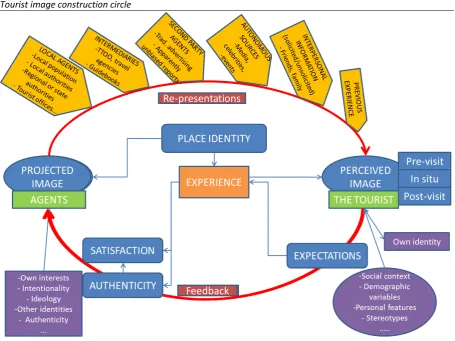
Figure 1.1
Tourist image construction circle
Source: Author
Regarding tourist image itself on an abstract level, the two basic parts of the construct are the projected and the perceived images. The amalgam of both images and their interaction contribute to building the overall tourist image of the destination.
Projected image consists of a series of representations of the tourist destination in its various aspects. These representations contain various elements of identity (see section 1.2.1.2).
Perceived images, similarly, are embodied in certain mental representations of a place containing several elements of identity (ranging from values, emotions, cultural elements to destination characteristics). Perceived images have the particularity of being highly dependent on the tourist according to several aspects: expectations greatly influence the perceived image and even the tourist experience itself. If the tourists’ expectations are matched, probably the image held will be positive and lead to a certain satisfaction. Image also affects tourist behaviour and decision-making. Satisfaction itself with the tourist experience influences the perceived image. Finally the tourist’s perceived authenticity, that is to say, whether the tourist has perceived the trip or destination as authentic or not, might also influence the final perceived image.
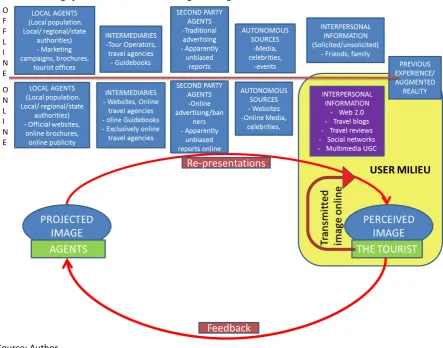
also be regarded as an active image-transforming actor (which is often overlooked), transmitting image to other peers which has now been exacerbated with 2.0 communication and the social media. These agents range from local actors, intermediaries, second party sources, autonomous sources, to interpersonal information and previous experience (classification based on Gartner, 1993), using different communication channels including the Internet; each of these agents having certain characteristics, own interests, a certain ideology, their own identities and conceptions of authenticity and place identity (what they consider identifies the destination). On the side of perceived image we find another agent of the image construction process, and probably the most important, the tourist. The tourist has his/her own personal identity, values, interests, experience, comes from a certain social context, etc. which makes perceived image highly subjective. It is the tourist who perceives image and who ultimately motivates tourist image transmission and construction.
On the third level we find the external elements to the image construct itself but that influence it and are fundamental sources from which it feeds. These elements are: the
identity of the place or destination itself that influences the projected image or representations of the destination in a minor or major way, and the tourist experience,
which influences and is determinant for the image perceived by the tourist. The presence of the tourist experience within the tourist image formation process gives a temporal dimension to perceived image as this can be before the trip (pre-visit), during the trip (in situ), or after the trip (post-visit). These three images might be very different from one another.
Another part of the circle concerns the links between these elements and the influences they exert on one another. The projected image influences the perceived image: the actors send information and stimuli in the form of representations to the tourists for them to receive them. The latter receive such and send information to the actors in the form of
feedback. Projected image is inspired in the destination and its identity and therefore influenced by it (different representations of place might exist). Place identity influences the tourists’ experience when they are at the destination. The experience in turn influences the perceived image of tourists. Perceived tourist image is influenced by tourists’ expectations, which also influence the experience, their satisfaction and their perceived authenticity, among others. Both of these elements (satisfaction and perceived authenticity) are influenced by the experience. Satisfaction itself might also be influenced by whether the tourist has perceived the destination as authentic or not.
by them prior to their trip as “brochures, travel guides and websites available to tourists shape their expectations long before they arrive at their destination”.
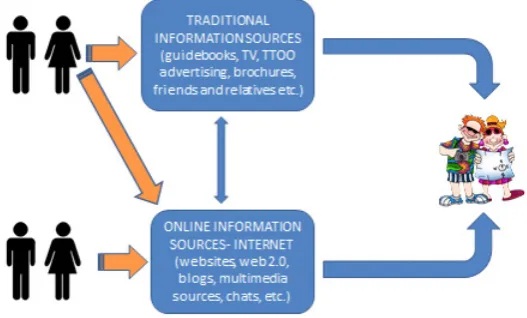
We live in a new context were online image communication becomes dominant in travel and tourism. In recent years this vision of tourist image has been changing as never before with the arrival of Internet communication. The basic understanding of tourist image and the way image is formed remains similar but several new elements appear and certain phenomena that need to be considered are amplified. Some authors note that “with the proliferation of the internet, its convergence with and influence on the de-massification of the media (Toffler 1980; Werthner and Klein1999), tourism destination images are becoming increasingly fragmented and ephemeral in nature (Harvey 1989)” (as cited in Govers, Go & Kumar, 2007a).
The Internet has revolutionized in many aspects the understanding and process of image formation. Both projected and perceived images become affected. Likewise, the roles of the agents within the tourist image complex change considerably; both the role of agents and especially that of tourists is distorted and new functions appear, especially with the explosion of web 2.0 or the participative web. We live in “the age when electronic channels of communication play a dominant role” (Govers et al., 2007a). As is developed in the following chapters, we maintain in this research that the Internet has not just become the main channel for seeking and disseminating information (Lin & Huang, 2006) but also for tourists’ self-expression and interpersonal communication as web 2.0 enables tourists to become active disseminators of information and tourism prescriptors, and to express themselves through this communicative means.
1.2. The traditional view of tourist image: projected vs. perceived image
As previously mentioned, destination image construction has often been approached and understood through the duality and relationship of projected vs. perceived images and their mutual influence. Both parts of the image construction circle, as well as their relationship, must be understood and explained to comprehend the destination image formation phenomenon and the different elements coming into play.
1.2.1. Projected image
Projected image is related to what elements or aspects and identity elements of the destination the different agents project in their images and representations. A multiplicity of agents contribute to destination image construction by projecting diverse images and identities (attached to certain ideologies and discourse), including stereotypes, with different intentions. These image identities are often used strategically for political purposes (either contributing to uniformize or enhance local identities).
1.2.1.1. The agents projecting image and Gartner’s classification
symbols, codes, and meanings (Almeida & Buzinde, 2007). Hence there is a need to study who these actors are.
These agents are usually seen as the sources of the information that tourists get. As a rule, agents or actors communicate their images through certain objects, platforms or media (communicative means) which are often considered agents themselves as they embody what is often intangible in a tangible way: as the actors may be a business, a local council, a group of people or even be undefined, often their tangible outputs such as guidebooks, news articles, websites, brochures, etc. are treated and identified as agents of the image formation process because they are the concealers of the information. Some of the communicative means are strongly related to the agent, such as tourist guidebooks, and in others the relationship to the agent may be looser, such as in general news. As Molina and Esteban (2006) explain “the value of the information these agents promote depends on it reaching consumers and satisfying their interests and needs. The means of promotion (brochures, guides, and tourist offices among them) are an active and open way of getting information to tourists”. The communicative means through which agents transmit information contain, in turn, certain sub-containers of information such as photographs, text and audiovisual materials.
In relation to the latter, different authors have classified image-projecting agents considering both the origin of image formation and how influential they are on the tourist. Gunn (1972) “was one of the first researchers to conceptualize the image formation process” (Kim & Richardson, 2003). According to Gunn (1972), two major types of image sources lead to the formation of image: organic image (usually unintentional information not related with tourism interests, such as films, newspapers, books, TV, etc.), and induced image (conscious promotion of destinations by the tourist organizations, such as brochures, marketing campaigns, advertisements, etc.). Miossec (1977) classifies projected images into three categories according to the sources/agents they come from: universal images, induced images and ephemeral images. According to the author projected universal images are those that destinations have created, for multiple reasons, in a very solid way and have become part of the collective knowledge and thinking. Induced images are those images created by destination marketing organizations or businesses and that are distributed in the origin markets to influence them. Finally, projected ephemeral images are those created by novels, art works, films, news, etc. that may create a collective image of a destination but that are usually ephemeral, as after some time they are destroyed or may perish.
Phelps (1986) classified destination images into primary or secondary according to the source that led to their formation. While primary images are formed through internal sources, mostly actual experiences and visitation, secondary images are formed through contact with external sources, especially before the trip.
and Haas, (1992), “source credibility, expertise, and trustworthiness are relevant issues in determining the effectiveness of image advertising by destinations”. Gartner (1993) proposes a classification of eight typologies of agents which form the continuum of the agents creating and projecting tourist image from the least to the most influential to the tourists. These range from traditional forms of advertising, popular culture and media to friends’ and relatives’ advice and actual visitation.
The agents or sources of destination image according to Gartner’s (1993) classification are:
1. Overt Induced I: Traditional forms of advertising (e.g., brochures, TV, radio, print, billboards, etc.). Destination marketing organizations with a specific interest in attracting tourists to their destinations. In this category lie the official tourism organizations who project the image created by the destination.
2. Overt Induced II: Information received from tour operators, wholesalers and travel agencies. They are interested in influencing the tourist’s decision making and creating attractive images about destinations, but are not attached to any specific destination. Images will be projected in order to attract and please their potential customers, probably embodying stereotypes, no matter what the local people of the destination might think of them.
3. Covert Induced I: Second party endorsement of products via traditional forms of advertising. These agents may be famous people or well-known by the audience that will be given the task of projecting the image of and promoting a destination. Their message will probably be better recorded by the audience, be more credible and create a better predisposition to the destination’s brand and image.
4. Covert Induced II: Second party endorsement through apparently unbiased reports (e.g., newspaper, travel section articles). Many of these images are created through familiarization trips by professionals (reporters, writers, etc.). These agents have apparently no self-interest in promoting a destination and are therefore credible. However, the destination has no control over these projected images.
6. Unsolicited Organic: Unsolicited information received from friends and relatives. These friends and relatives have very credible information as they have visited the destination personally and act in the so-called “word-of-mouth” mode. This may be for example, when some friends show us photographs of a past trip, without having solicited the information and maybe without even having thought about visiting it before.
7. Solicited Organic: Solicited information received from friends and relatives. These agents are highly influential as the potential tourist is already interested in the destination as he or she asks for information and advice from trustworthy people of their environment. This also works as word-of-mouth communication.
8. Organic: Tourist’s actual visitation and own previous experience.
As explained by Choi et al. (2007), the key difference between induced and organic image formation agents is the amount of control the destination has over what is presented. Organic images are those that arise from supposedly unbiased sources (books, school education, television documentaries, and the experiences of friends and family), and Induced images are those that emanate from the destination area itself and its marketing and promotional materials. Planas (2009) includes in her study a summary table of Gartner’s (1993) information sources classification considering the aspects of credibility, market penetration and cost of the image formation agents.
The four induced categories of agents (1-4) are considered to be the ones most controlled by destinations and their marketing organizations where publicity has a very important role in creating, reinforcing and improving tourist destination image by reaching lots of people. Their cost may be elevated although their impact on tourists may be low. However, these induced categories are considered to be less credible for tourists (they are not independent), and therefore may be less influential. According to Gartner (1993), the closer the agents and their images are to destination control, the less credible they become.
Instead, autonomous image formation agents (5), consisting of news and popular culture out of the reach of the destination’s control, are highly influential, authoritative and credible (Mackay & Fesenmaier, 1997; Kim & Richardson, 2003).
Unsolicited and solicited organic image formation agents (6-7) refer to information received from friends and relatives, which is considered to be unbiased information. These images are highly credible and influential as the tourist does not perceive any economic interest behind them. Moreover, solicited information is especially influential as the tourist considers the provider of the information knowledgeable on the subject and trustworthy. These agents are directly related to the word-of-mouth communication phenomenon.
Finally, organic image (8) is the most influential as it comes from the tourist’s previous experience of the destination.
induced source that had any significant influence were travel agents. Organic and autonomous sources, as well as word of mouth, also had a significant influence on the destination’s image.
As noted by Mackay and Fesenmaier (1997), the capacity of the different sources to influence perceived image formation mentioned by Gartner (1993) has strong implications for destination tourism organizations who aim to create or change image. What this continuum of image-projecting agents suggests is that the closer to the destination the image-projecting agent is, the less credible it will be; and that the closer to the individual (including his or her own past experience) the more credible the information will be.
However, some criticisms have been found of Gartner’s (1993) model: Dann (1996) explains that “missing from Gartner’s paradigm, however, are several types of pre-trip sources (e.g. literary and computer generated), as well as all forms of on-trip communication (e.g. guides, maps, etc.)”. This is a very important point as today with the Internet, agents have multiplied and changed. Moreover, Gartner “does not appear to entertain the possibility of combining his two covert categories (e.g. celebrities who write travelogues), a situation which would further enhance credibility, while admittedly increasing the cost” (Dann, 1996). This research aims to contribute to improving this model and adapting it to the Internet communication (see section 1.3.2.1).
Other studies emphasizing the role of information sources (or agents) in the formation of tourist images are Fakeye and Crompton (1991), Baloglu and McCleary (1999), Echtner and Ritchie (2003), Beerli and Martin (2004), Molina and Esteban (2006), Kim and Richardson (2003), Choi, Lehto and Morrison (2007), among others.
Numerous authors study the different agents through their different traditional image information sources or objects: photographs (Albers & James 1983, 1988; Markwell, 1997; Jenkins, 2003), tourist brochures (Cohen, 1995; Bandyopadhyay & Morais, 2005; Molina & Esteban, 2006; Caton & Almeida, 2008; Cannon 2008), postcards (Albers & James, 1983, Hughes 1992), souvenirs (Palou, 2005; Mariné-Roig, 2011b), films (Mercille, 2005), travelogues (Dann, 1996), guidebooks (Cannon 2008; Galí & Donaire, 2005; Mariné-Roig, 2011a; Mariné-Roig & Anton, 2011), television (Morgan & Pritchard, 1998) and even festivals (Jeong and Almeida, 2004), among many others. Previous experience, considered as an information source will be later explained within the perceived image section.
1.2.1.1.1. Intentionality and power